




Abstract
A central idea in the theory of technology cycles is that social and political mechanisms are most important during the selection of a dominant design, and that eras of incremental change are socially uninteresting periods in which innovation is driven by technological momentum and elaboration of the dominant design. In this essay, we overturn the ontological assumption that social order is inherently stable, drawing on Anselm Strauss’s concept of negotiated order to analyze the persistence of a dominant design as a social accomplishment: an outcome of ongoing processes that reinforce or challenge a socially negotiated order. Thus, we shift focus from battles over standards to periods of normal innovation. We extend the technology cycles model to explain social dynamics in periods of incremental change, and to make predictions specifying how contextual conditions in standards-setting organizations affect social interaction, leading to reinforcement or challenge to a socio-technical order.
Keywords
Introduction
Understanding the nature and sources of technological change has been a central concern for technology management scholars and organization theorists, as well as social scientists more generally. One of the prevailing theories of technological change is the technology cycles model (Abernathy & Clark, 1985; Abernathy & Utterback, 1978; Anderson & Tushman, 1990; Tushman & Anderson, 1986). In this theory, the pattern of evolution follows a model of punctuated equilibrium (Kuhn, 1962/1970), where relatively quiet periods of incremental change and social equilibrium are disrupted by technological discontinuities, i.e. rare and unpredictable innovations in product or process design (Anderson & Tushman, 1990; Tushman & Rosenkopf, 1992). These discontinuities are generally thought to be exogenous shocks—emerging from outside of a technological community—that mark the beginning of an era of ferment, where technological alternatives vie for dominance, until the selection of a dominant design ushers in an era of orderly incremental change and starts the cycle again (see Figure 1).
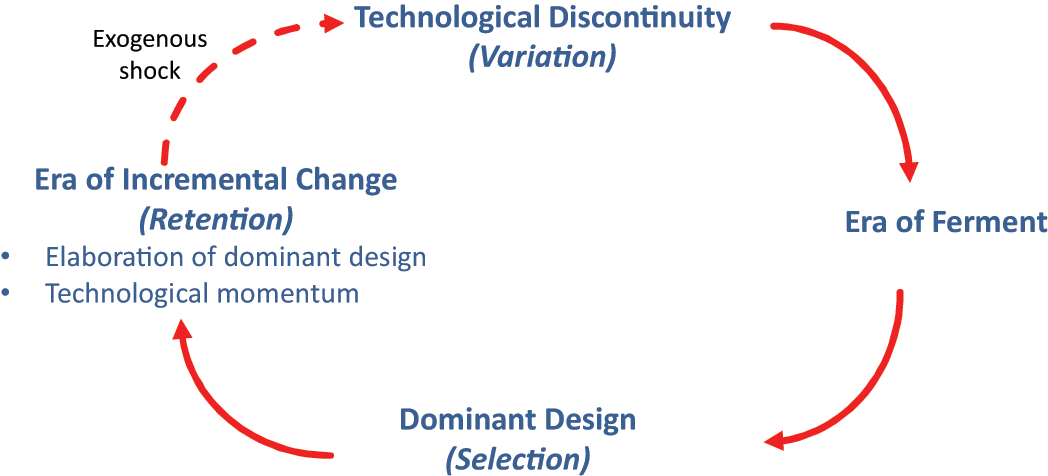
Technology cycles model
Theory on technology cycles accounts not only for the pattern of technological progress, but also how a technological community, i.e. the organizations and individuals concerned with the ongoing development and production of a technology, co-evolves with a technology. 1 Moving beyond technological determinism that assumes that innovation is solely determined by features of the technology itself, technology cycles theory emphasizes that the path of technological evolution is also socially determined through the interactions between the organizational and individual actors that make up a technological community, with eras of ferment showing high levels of social and technical contestation and eras of incremental change having relatively little social interaction (Tushman & Rosenkopf, 1992). The basic cyclical model of technology evolution has been applied to a wide variety of cases (e.g., Anderson & Tushman, 1990; Romanelli & Tushman, 1994; Rosenkopf & Tushman, 1998; Rothaermel & Hill, 2005; Tripsas, 1997), but the increasing complexity of technological systems has necessitated refinement and expansion of the model (see Kaplan & Tripsas, 2008; Murmann & Frenken, 2006; Suarez, 2004). At the same time, emerging empirical evidence highlights unresolved gaps in the technology cycles model. Recent studies suggest that eras of incremental change remain highly interactive and even disputatious for members of a technological community (e.g., Dokko & Rosenkopf, 2010; Jakobs, Procter, & Williams, 2001; Leiponen, 2008; Simcoe, 2007; Spring et al., 1995). Moreover, formal standards-setting organizations, alliance networks, and industry consortia provide venues for ongoing debate and negotiation long after a dominant design is selected, signifying more substantial social interaction than would be predicted by the technology cycles model. Research about these organizations as interaction contexts has been limited, instead focusing on alliances and consortia as vehicles of competitive advantage or formal standards-setting as an alternative to market-based standardization, which leaves our knowledge of the social dynamics of standardization within these contexts underdeveloped.
In this essay, we explore ongoing interaction and social dynamics in periods of incremental change by applying a negotiated order perspective to the theory of technology cycles. In adopting a punctuated equilibrium model, technology cycles theory rests on the underlying ontological assumption that social order is inherently stable. This assumption of baseline stability in the social order, common across much social sciences research (Tsoukas & Chia, 2002), challenges two key features of technology cycles research. First, prior research depicts the era of incremental change as theoretically and socially uninteresting. Given an innate stability in social order, the period of incremental change is depicted as smooth, orderly, and driven by technological considerations. Second, prior research identifies exogenous shocks as the primary locus of punctuated change. With an underlying assumption of stability, an exogenous shock is needed to destabilize the inertia that sets in after the establishment of a dominant design, and begin the next cycle of technological evolution (Abernathy & Utterback, 1978).
Negotiated order theory rejects the idea that social orders are innately stable, proposing instead that order and stability are social accomplishments that need to be explained (Maines, 1978, 1982; Strauss, 1978; Strauss, Schatzman, Bucher, Erhrlich, & Sabshin, 1963). Consistent with its roots in symbolic interactionism, the central premise of negotiated order theory is that social order is created through social interaction. Social structure or order, in this view, emerges through interactions and negotiations among actors who inhabit and create a social context. In emphasizing the importance of social interaction as a basis for social order, negotiated order theory differs markedly from theoretical perspectives that assume stability or inertia of social systems. Any disturbance to the context, such as a staff change, a change in alliances, or advances in technology or practices, triggers renegotiation or reappraisal that can lead to the creation of a new social order. In emphasizing that order is constantly being reinforced or challenged though social interactions, negotiated order theory holds that stability or “no change,” like change, “must be worked at” within any social system (Strauss et al., 1963, p. 167). For technological change, social orders can be understood as socio-technical orders, where technological evolution is co-determined by social interaction and technical factors that jointly construct the social structure (Tushman & Rosenkopf, 1992).
In applying negotiated order theory, we use a baseline assumption of instability, where social orders need reinforcement to persist. This assumption of instability has two implications for technology cycles research. First, it suggests that periods of stable, incremental change, far from being uninteresting and driven by technological considerations alone, are themselves a product of social processes or social interactions that are poorly understood. The attention of the technology cycles literature has been almost exclusively focused on the era of ferment and battles to determine a dominant design (e.g., Suarez, 2004; Vanhaverbeke & Noorderhaven, 2001). Second, it creates a mechanism for endogenously derived change that can account for technological discontinuities emerging from within a technological community. In the process of contestation and negotiation around details of incremental changes to standards, members of a technological community may have occasion to challenge the socio-technical order, and these challenges may initiate changes to the order. Thus, more enduring or more radical changes to order can emerge from social interaction within a technological community, rather than having to come from outside.
Negotiated order theory is well-suited to examining social dynamics in technological communities because of its attention to context and its focus on social interaction. Technological communities are complex contexts, involving firms, individuals, regulatory agencies, and technological components. Theory that explains stability and change in technological communities should both recognize different types of actors and be able to specify which contextual properties affect social interaction that will feed back stability or change to the socio-technical order. Negotiated order theory accounts for the complexity of context, emphasizing that some aspects of a structural context or social order may be more important than others in influencing social interactions and their outcomes. Other social theory perspectives consider a recursive relationship between action and structure (e.g., Orlikowski, 1992; Tsoukas & Chia, 2002); however, negotiated order theory is unique in accounting for different categories of actors and in challenging researchers to identify and analytically relate proximate aspects of a context to social interactions and their outcomes.
Therefore, negotiated order theory offers a conceptual framework that allows us to identify contextual conditions specific to technological communities. The challenge for researchers analyzing a specific context such as technological communities is to identify which conditions specific to that context will influence social interactions and interaction outcomes and to explain how. Our objective in this paper, then, is to extend the technology cycles model to specify the contextual conditions where interaction can lead to actions to challenge or reinforce a socio-technical order in periods of incremental change. To do so, we apply negotiated order concepts to standards-setting organizations (SSOs). SSOs are a fruitful setting to explore questions of technological change and social order, because they are a primary context of ongoing interaction for technological communities throughout technology cycles.
We develop the remainder of this paper in four sections. In the following section, we describe the technology cycles model and the role of SSOs in technological innovation. Next, we provide a brief overview of negotiated order theory, and use it to develop a model of stability and change in a socio-technical order. We identify contextual conditions of the SSO context that we expect to be important in shaping social interactions and their outcomes. Next, we develop causal arguments and testable propositions explaining how specific forms of these contextual conditions will influence actors’ propensities to reinforce or challenge a socio-technical order. We conclude by discussing the implications of our research for the technology cycles model, as well as broader implications for practice and for other organizational research.
Technology Cycles Theory, Technical Standards, and Standards-Setting Organizations
Figure 1 shows an illustration of technology cycles theory. The theory is based on an evolutionary model of variation, selection, and retention. Exogenously introduced technological discontinuities produce variation, leading to the contestation of alternatives during an era of ferment that culminates in the selection of a dominant design. Established through social and political processes within technological communities, the dominant design serves as an organizing logic—involving both cognitive frames and material design specifications—that guides smooth, technologically driven progress in the subsequent period of incremental change, where technological momentum results in incremental improvements that elaborate on the dominant design.
For complex technologies, a dominant design is a prevailing overarching technological architecture for a product class. Complex technologies are those where product subsystems provided by multiple firms are linked together through interfaces (Rycroft & Kash, 1994; Tushman & Rosenkopf, 1992). A dominant design is a high-level architecture consisting of relatively stable core components and interfaces (Henderson & Clark, 1990; Murmann & Frenken, 2006), allowing for the subsystems and components developed by multiple firms to work together. The selection of a dominant design signifies the establishment of a socio-technical order, which can be understood as the integration of a social order and a dominant design, as it represents high-level agreement about which technological alternative will be the focus of investment in feature improvement and complementary products (Tushman & Rosenkopf, 1992). The reduction in uncertainty allows for industry boundaries to be drawn or re-drawn, i.e., for the identification of the industry participants who will compete in the marketplace and act together to incrementally innovate.
While the selection of a dominant design marks the end of punctuated change, the period of incremental change that follows involves ongoing technological change that requires coordination. In incremental change, both subsystems and interfaces often must be adjusted to accommodate changes. Though the architecture of the system can be stable, the “devil is in the details” that must be continually coordinated for the subsystems to work together in practice as the technology advances.
This coordination is often done through technical standards, which are codified specifications about the components of a technology and the interfaces between them (Garud & Kumaraswamy, 1993). Technical standardization can occur with varying levels of formality. Several classifications of standards have been proposed, such as de facto (set by markets) versus de jure (set by committees) (Farrell & Saloner, 1988), and open versus closed (O’Mahony & West, 2005). For our purposes, we consider formalized, de jure technical standards that represent coordination in a technological community. Dominant designs and technical standards are independent, in the sense that technical standards may be agreed upon and codified for technologies that are not dominant designs; for example, there were formal technical standards written for HD DVD technology, 2 though it was never a dominant design. Similarly, dominant designs, particularly for simple technologies, such as a bicycle with two wheels of the same size (Bijker & Pinch, 1984), do not necessarily have formal technical standards.
For complex technologies, standardization is necessary to enable market acceptance and market growth (Shapiro & Varian, 1999; Vanhaverbeke & Noorderhaven, 2001), and dominant designs and technical standards are intimately linked and complementary. In addition, formal standardization tends to be especially important for dominant designs, because they tend to have wider diffusion and bigger technological communities (Abernathy & Utterback, 1978). To enable coordinated incremental change via formal standards, industry actors can participate in standards-setting organizations (SSOs), where interaction can occur apart from a competitive market setting. SSOs are voluntary organizations that provide a context for a technological community to interact to develop consensus technical standards for an industry. SSOs meet regularly, and have rules and procedures that govern the consensus-making process. Membership is typically at the firm level, 3 but firms are represented by individuals. Because they are responsible for working out the technical details of standards, most individuals involved in SSOs are engineers. While standards can also be defined through private alliances or market competition, most formal standards are created in SSOs (Shapiro & Varian, 1999), making SSOs the principal arena in which socio-technical orders are negotiated.
The discussions held in SSOs and the resulting standards advance technologies through the era of incremental change, 4 yet progress is not necessarily smooth or orderly. In practice, activity in SSOs can be highly contentious, leading to delays in publishing standards (Jakobs, 2002; Simcoe, 2007), and causing some participants to call for reform in standards-setting processes (Cargill & Bolin, 2007). Moreover, the interaction in SSOs is frequently face-to-face, with considerable cost in engineers’ time and travel to participating firms (Rosenkopf, Metiu, & George, 2001). Expenditure on SSO participation over long periods of time indicates that ongoing highly technical interaction with other firms in the technological community is valuable even in an era of incremental change. Therefore, instead of the decreased level and importance of social activity that existing theory predicts, firms actively engage with each other and the technology and continue to interact even in eras of incremental change.
In summary, SSOs are a context and vehicle for working out the detailed ways in which a slightly improved version of one component will work with a slightly improved version of another, or how complementary products will work with an incremental improvement. Technical standards are the output of SSOs that codify the outcomes of past negotiations, forming the basis for the next negotiations. Orderly progression along a path for incremental improvement requires this sort of detailed working out and continual reconstitution of order.
Negotiated Order in Technological Communities
A model of negotiated social order
Negotiated order theory develops a model of social order that is maintained through a recursive relationship between a structural context, a more proximate negotiation context, social interactions, and interaction outcomes. The structural context is the broader institutional context “within which … negotiations take place in the largest sense” (Strauss, 1978, p. 98). It includes the history, legal and regulatory environment, major ideological debates, culture, and authority relations in an industry or field.
The structural context is the backdrop of the negotiation context—the subset of salient properties of the broader structural context that have a proximate influence on social interactions and their outcomes. The negotiated order perspective emphasizes that most elements of the structural context are only remotely related to any specific social interaction, in contrast with other social theories, such as structuration theory, which posit a direct relationship between structure and individual action. As the salient venue in which technological change is negotiated, the SSO is the negotiation context in technological communities during periods of incremental change.
Contextual conditions are the elements of the negotiation context that are most important in influencing social interactions and interaction outcomes within a specific negotiation context. Strauss (1978) defines contextual conditions as proximate contextual properties that are salient in a social interaction. In specific case studies using the negotiated order perspective, he identified contextual conditions that serve three distinct purposes. First, contextual conditions define the types of actors that are interacting within a negotiation context, and the agency relationships between them. Second, contextual conditions can have causal effects on social interactions and their outcomes. Third, contextual conditions can mediate the causal effect of some other contextual condition on interaction outcomes. The contextual conditions of a given negotiation context can serve any or all of these purposes.
Contextual conditions that have causal or mediating effects influence social interactions—proposing agreements, making trade-offs, forming coalitions, identifying and framing issues, contesting proposals, etc.—leading to interaction outcomes, which are actions that either reinforce or challenge the existing order. Interaction outcomes feed back into the context. Actions that reinforce a social order lead to stability, which involves incremental change in both the negotiation and structural contexts. Actions that challenge a social order cause discontinuous change in the structural context when they alter more formal permanent structures (Strauss et al., 1963, p. 165).
Given the focus on the proximate negotiation context, negotiated order theory offers a general framework that researchers can draw on to formulate specific social mechanisms linking specific contextual conditions, social interaction, and actions to challenge or reinforce a social order. Social mechanisms are causal accounts of how one event or variable is linked with another event or variable, i.e., “social processes having designated consequences for designated parts of the social structure” (Merton, 1968, p. 43–44). The elaboration of social mechanisms is a means of developing middle-range theory—theory that is more bounded than general social laws that apply across time and context, but more generalizable than a descriptive account of the relationship between events or variables in a specific case (Hedstrom & Swedberg, 1996; Merton, 1968). In developing propositions, we identify specific social mechanisms that explain how contextual conditions of the negotiation context of SSOs affect interaction outcomes in technological communities. In some cases, the mechanisms that we identify specify a chain of interaction outcomes produced through ongoing interaction, in which one contextual condition has a causal effect on mediating contextual conditions, which in turn influences actions that either challenge or reinforce the social order.
Application of the negotiated order model to technological communities
Figure 2 represents the relationships between the structural context, negotiation context, and social interactions and outcomes in technological communities. The central feature of the structural context in technological communities is the dominant design that defines a high-level architecture for a product class. In addition to the dominant design, the structural context includes the market structure of firms with varying resources, market shares, and capabilities, the legal context including patenting laws and anti-trust regulation, engineering professions and their norms or logics, academic institutions that produce basic science and engineering research, collaborate with firms, and train employees who work in the industry, major purchasers and suppliers, and other organizations or actors that play a role in the field. This broader context is linked to social interactions via the negotiation context, a demarcated area of the structural context whose contextual conditions have a proximate influence on the interactions and their outcomes.
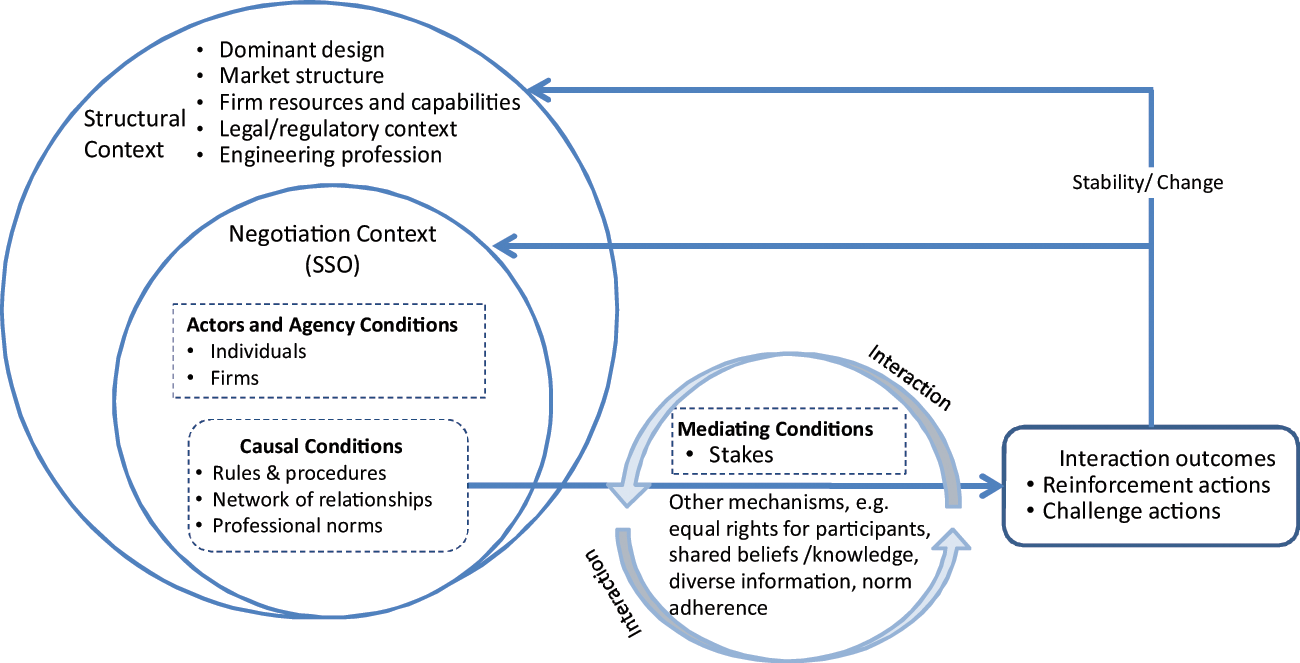
Contextual conditions, mechanisms and outcomes for technological communities
The SSO is the negotiation context within which technologies are regulated in periods of incremental change. As highlighted earlier, Strauss identified three purposes of contextual conditions: defining the type of actor and agency relations between them, identifying conditions that can have causal effects on interactions and their outcomes, and identifying conditions that mediate the effects of other contextual conditions.
First, Strauss (1978, p. 99) emphasizes that the types of actors (e.g., individuals, collectives, political parties, nation-states, etc.) interacting within a negotiation context, and the agency relationships between them, are central to shaping social interactions and their outcomes. In the SSO context, individuals and firms are the primary types of actors, with individuals acting as firm agents. However, individuals may also represent other entities, such as professions or ideologies or governments or even themselves, simultaneously or in turn (Strauss, 1978, p. 125). Within the SSO context, individuals are typically both firm employees and engineers, i.e., they are agents of their professions as well as their employers. Whether individuals are representing themselves, their firms, or their profession, or all of these at once, is important in influencing the outcome of a social interaction.
In addition to the types of actors and the agency relationships between them, Strauss identifies additional conditions of the negotiation context that can have a causal impact on social interactions between actors. We identify three such causal contextual conditions that are important in SSOs: (1) formal rules and procedures; (2) networks of relationships between firms or individuals; and (3) professional norms.
Formal rules and procedures are an important contextual condition that influences the power distribution in a negotiation context. While rules and procedures are one of multiple bases of power (Strauss, 197, p. 119), they are particularly relevant in SSOs. These rules and procedures have a causal effect on social interactions and their outcomes by defining decision-making procedures and voting thresholds.
The network of relationships between actors can represent the experience or history of prior interactions among negotiation parties, as well as the structure of relationships within a negotiation context, including “cliques and friendships of varying duration and strength” (Strauss, 1978, p. 126). In SSOs, the overall structure or pattern of relationships among firm or individual actors is important in structuring communication, influence, and conflict among all actors in the SSO. Actors’ positions within a network of relationships influence their interactions with others and their propensity to engage in actions that reinforce or challenge the existing socio-technical order.
Professional norms and values in engineering are also an important contextual condition in SSOs because of their effects on legitimacy concerns among negotiating actors. Legitimacy concerns as defined by the professions in a negotiation context involve the definition of actions or outcomes as normatively acceptable within a negotiation context (Strauss, 1978). Professional norms in engineering emphasize a commitment to technologies and to support technologically superior outcomes, independent of the political or financial interests of individuals or firms.
Strauss (1978) also identified, through his use of case studies, contextual conditions that mediate the effects of other contextual conditions on interaction outcomes. An important one for the SSO context is the stakes, i.e., the interests or goals of diverse negotiating parties. In the SSO context, the stakes of negotiating actors can mediate effects of rules and procedures, the network of relationships, and professional norms. In contexts where different parties are negotiating a cooperative structure, different parties in a negotiation may have a common stake in cooperating. In addition, they will have their own unique stakes that they aim to achieve (Strauss, 1978, p. 160). For actors involved in technological evolution, an SSO exists because of the common stakes within a technological community. Though firms may seek distinctive competitive advantage vis-à-vis each other, their interactions are conditioned by their common purpose in besting competing technologies. If community members are unable to reach consensus on specific operational details of the technology, resulting interoperability problems and market confusion can lead to failure in the marketplace (Farrell & Saloner, 1988).
The contextual conditions shape interaction through specific social mechanisms and result in interaction outcomes. In the SSO context, these mechanisms are specific to particular causal antecedents. For example, social network mechanisms such as shared beliefs and knowledge or access to diverse information are specific to particular social network positions, but are not contextual conditions.
Finally, interaction outcomes can feed directly back on the negotiation context. For example, ongoing interactions between individuals in the SSO context lead to constant evolution and change in the network of relationships between individuals, whether or not there is radical change in the larger socio-technical order. Interaction outcomes also feed back to the larger structural context. Actions that reinforce the socio-technical order lead to relative stability, e.g., incremental changes that are on a technology’s established migration path. Actions that challenge the socio-technical order can disrupt an existing dominant design, ushering in a new era of technological ferment. Changes in both the structural and negotiation contexts, in turn, impact subsequent social interactions.
Predicting Actions that Reinforce or Challenge the Socio-Technical Order
In the following section, we extend our application of negotiated order theory to SSOs, specifying mechanisms by which rules and procedures of SSOs, networks of relationships, and professional norms will influence whether social interaction will result in actions to reinforce or to challenge the existing socio-technical order. We identify specific mechanisms related to set-up and governance of the SSO itself, then features related to firm and individual actors. Mechanisms relating to the set-up and governance of SSOs emphasize the rules and procedures of SSOs as formal organizations, as well as the overall network of relationships in an SSO. Because firms and individuals are different types of actors, we distinguish between mechanisms relating to social network interactions between firms, and mechanisms relating to social network interactions between individuals.
Set-up and governance of the SSO negotiation context
The primary objective of an SSO is consensus around standards (Jakobs et al., 2001). To reach agreement, SSOs rely on rules and procedures—formal procedure and due process for proposing new standards or changes to existing standards, and ensuring the fair participation of its member firms when deciding which standards to adopt. Strauss (1978) emphasizes that rules and procedures affect the distribution of power between actors, which makes them an important influence on social interactions and interaction outcomes. Though firms in the broader marketplace have power based on size or proprietary resources, rules and procedures can affect the power distribution within the delimited SSO context. For example, for an SSO to be accredited by the American National Standards Institute (ANSI), it must ensure that any firm with direct and material interest has a right to participate by: (1) expressing a position and its basis; (2) having that position considered; and (3) having the right to appeal. 5
Adhering to formal procedures can be a way to support challenge to a negotiated order. Formal procedures and due process provide channels for firms to raise challenges that can be heard and considered in a way that might not be possible otherwise. While consideration of a standard is no guarantee of its acceptance, rules and procedures prevent summary dismissal of challenges. One notable example of this sort of challenge is the adoption of a CDMA standard for wireless telecommunications in the United States. Qualcomm, the primary patent-holder for CDMA technology, was a small startup when CDMA technology was approved as a digital standard in 1993 by the Telecommunications Industry Association (TIA), the primary US SSO for telecommunications (Farley, 2005). The approval of this standard upset the existing TDMA standard that was supported by industry leaders such as AT&T and Ericsson, and upset the socio-technical order by facilitating Qualcomm’s rapid growth into a multi-billion dollar firm (Mock, 2005). Despite the resistance of much more powerful industry leaders, the formal procedures of the TIA ensured that Qualcomm was able to have CDMA technology considered.
Proposition 1: Rules and procedures in SSOs that support equal rights of participants to present alternatives, voice positions, or appeal decisions will increase the likelihood of challenge actions.
While creating channels for firms to raise challenges to a socio-technical order, rules and procedures can also set a minimum threshold of support needed to bring about change. When this threshold is high, e.g., requiring consensus of committee members for adoption of new standards, it can have the effect of tilting the power distribution toward the coalitions and groups that favor preserving the status quo, promoting actions or technological developments that reinforce the existing order.
Proposition 2: Rules and procedures in SSOs that set a high minimum threshold of support for changes to standards will increase the likelihood of reinforcement actions.
The network of relationships is another contextual condition of SSOs that provides a set of mechanisms that affect whether a negotiated order is reinforced or challenged. As highlighted earlier, Strauss identifies social relationships between actors, including the pattern of relationships in an organization and the presence of cliques, as important features of the negotiation context that will influence social interactions (Strauss, 1978, p. 124). Subsequent research has greatly expanded our knowledge of the role of social networks and, more specifically, of network structures in influencing the flow of information, innovation, and other social outcomes (e.g., Borgatti & Foster, 2003; Burt, 1992). A social network structure is the pattern of relationships in a population of firms, individuals or other social actors. Among other things, a social network’s structure can affect patterns of communication and the formation of common or divergent knowledge and perspectives, which can create common or divergent stakes among actors.
Two topographical features of social networks that we expect to affect negotiations in SSOs are social network density and the cohesiveness of subgroups. Dense structures involve multiple, redundant connections across many or most firms or individuals in a population. Clique or “small world” structures (Watts & Strogatz, 1998) are characterized by subgroups that are densely connected within the subgroup, but infrequently or weakly connected to each other. In the context of SSOs, the network structure within the SSO is an important feature of the negotiation context that can influence interaction outcomes.
We propose that a dense network structure will support reinforcement actions. Densely connected social networks with a multiplicity of ties between parties foster shared knowledge and beliefs (Coleman, 1988). In the context of SSOs, dense networks lead to shared beliefs about how technologies can and should evolve. Shared knowledge and beliefs ground social interactions about the course of technological evolution in an industry, delimiting what is feasible as defined by the existing dominant design. They also create a common stake among actors, who define their interests and goals based on their shared beliefs about which technological choices are superior. These shared beliefs about what is feasible, rooted in the dominant design, as well as common stakes in current technologies, make it less likely that firms or individuals would pursue changes that challenge the existing socio-technical order.
Proposition 3: A dense network of relationships within an SSO will create common stakes, increasing the likelihood of reinforcement actions.
By contrast, a clique network structure of relationships will promote challenge actions. Because clique structures have densely connected subgroups that are only weakly connected to other subgroups, in clique structures, communication and prevalence of shared knowledge and beliefs tend to be intense within the subgroups, but more sporadic or less common across subgroups. An SSO with primarily non-overlapping membership across its subcommittees or working groups would have a clique structure, for example, if different components of a technology were produced by different vendors with only a few vendors working across components.
SSOs that have an overall clique structure should be more prone to challenges to the socio-technical order for two reasons. First, quasi-independent subgroups have fewer relationships that connect actors in different groups, and are less likely to have redundant knowledge, increasing the amount and diversity of knowledge in the SSO context as a whole that can be recombined for innovation (von Hippel, 1988). As a result, interfirm social networks with clique structures have been associated with innovation for the network as a whole (Fleming, King, & Juda, 2007; Schilling & Phelps, 2007). Diversity of knowledge held by subgroups in an SSO, by fostering innovation, makes it more likely that more alternatives or more radical alternatives to the current socio-technical order will be presented to the group for consideration and negotiation. The introduction of more, or more radical, proposals into negotiations is likely to lead to challenges to the socio-technical order. Second, to the extent that subgroups have discussions that are independent from the discussions held within other cliques, they should be more likely to develop divergent stakes, and develop proposals that conflict, resulting in continual negotiation and challenges to the socio-technical order.
Proposition 4: A network of relationships with a clique pattern within an SSO will create divergent stakes, increasing the likelihood of challenge actions.
Firm actors and the negotiation of social order in the SSO context
Firms are important actors in technological evolution, and one of the two central types of actors in the SSO context. The network of relationships among firms is a critical contextual condition in SSOs that has a causal impact on interaction outcomes. Firms that choose to participate in formal standards-setting engage in ongoing, direct interaction with other firms in a technological community (Dokko & Rosenkopf, 2010). This interaction, and the specific patterns of relationships that develop between a focal firm and other firms in a technological community, i.e., a firm’s social network position, can influence whether a focal firm acts to challenge or reinforce the socio-technical order.
An advantageous social network position causes a firm to develop its own unique stake in reinforcing the existing socio-technical order, which allows it to reap benefits that are not available to firms with less advantageous network positions. We consider two types of advantageous position that are commonly studied in social network research: centrality and bridging structural holes. Central firms, i.e., firms that are well-connected to others in an SSO, develop a stake in the existing socio-technical order for two reasons. First, central firms benefit from their position by having greater access to information and having greater prominence, enhancing their ability to advance their own interests in their interactions with other firms (Wasserman & Faust, 1994). Second, in an SSO, firms whose technological base is most tied to the existing dominant design are likely to be heavy participators in SSO subcommittees and working groups, and hence more likely to develop extensive relationships with other firms. As a result, a firm’s centrality is also likely to be associated with congruence between a firm’s technological base and the dominant design, giving it a stake in the existing socio-technical order. Firms whose technologies are incongruent with the technology being advanced by an SSO are less likely to be central within the SSO.
A social network position that bridges structural holes, i.e., a position that connects otherwise disconnected actors or groups of actors, also causes a firm to develop a stake in the existing socio-technical order through positive effects on its information flows and social influence (Burt, 1992). In an SSO, a firm that participates in multiple businesses might be in a bridging position. For example, Motorola manufactures both wireless telephone handsets and wireless infrastructure towers, so if they attend SSO working group meetings for both handsets and infrastructure and other handset or infrastructure manufacturers do not, then Motorola would bridge a structural hole between handset manufacturers and infrastructure manufacturers in a wireless telecommunications SSO. Bridging structural holes gives actors information and control benefits. Information benefits are primarily about having access to non-redundant information held by disparate subgroups, which increases the amount and diversity of information held by the bridging actor. Control benefits stem from the ability to shape the access and timing of information flows for others, determining which groups get information, and when they get it (Burt, 1992). These information and control benefits can enable a bridging actor to influence others, or play one group off against another, reaping returns from brokerage. Therefore, like centrality, a bridging position is generally advantageous, giving a firm in such a position a unique stake in the stability of the socio-technical order.
Proposition 5: Firms that are central in the network of relationships will develop a unique stake in the existing socio-technical order, increasing the likelihood that they will act to reinforce the existing order.
Proposition 6: Firms that bridge structural holes in the network of relationships will develop a unique stake in the existing socio-technical order, increasing the likelihood that they will act to reinforce the existing order.
On the other hand, firms that bridge structural holes may also be more likely to raise challenges to a socio-technical order if they use their information advantages to innovate in a way that is inconsistent with the dominant design. Bridging relationships with actors from different and disconnected parts of the social environment can put firms in a better position to innovate by providing non-redundant information that can be recombined into new alternatives that might stretch the limits of the dominant design. These innovations may provide opportunities to advantage a firm that makes them. For example, though SSO members are typically required to license intellectual property contained in a standard under fair, reasonable and non-discriminatory terms 6 (Simcoe, 2007), licensing these rights can result in substantial revenues for the innovator. More generally, innovations can shift a firm’s technological base, adding to a firm’s portfolio of technologies, or creating a new technological direction or competence that gives strategic advantage to the firm. Note that though central firms also have extensive access to information, the information available to very highly connected firms tends to have redundancies that reinforce consistency with the existing dominant design, limiting tendencies to innovate in radical ways. By contrast, the diverse information available to a firm that bridges structural holes is more prone to be recombined in ways that result in fundamental changes to its technological base. A change in a firm’s technological base can create a stake in challenging an existing socio-technical order.
Proposition 7: Firms that bridge structural holes in the network of relationships will develop a unique stake in changing the socio-technical order if they innovate such that their core technologies become inconsistent with an existing socio-technical order, increasing the likelihood that they will act to challenge the existing order.
Individual actors and the negotiation of social order in the SSO context
Analogous to the social network of relationships between firms, the network of relationships between individual actors is an important contextual condition of SSOs. Even when individuals represent firms, they develop their own personal social capital and personal friendships within standards-setting committees (Isaak, 2006). The network of interpersonal relationships within SSOs is distinct from the network between firms, and has independent influences on actions to reinforce or challenge a socio-technical order. Firms can send multiple people to represent them on different subcommittees or working groups of an SSO, and individual representatives of the same firm can have different levels of participation and interact with different people, such that they occupy non-equivalent positions in the social network connecting individuals in a technological community (Dokko & Rosenkopf, 2010).
Individuals’ actions are influenced by their position in the interpersonal network. Individuals who occupy privileged positions in interpersonal networks in an SSO would more likely develop their own unique stakes in reinforcing the existing order. For individuals, as for firms, centrality enhances the ability to acquire knowledge and mobilize resources. Central individuals in SSOs could be those in leadership positions, e.g., subcommittee chairs, or in positions that require interaction with many others, e.g., editors of standards, or who simply have a propensity or preference to interact with many others. In addition, individual relationships can also have affective content that influences the propensity to reinforce or challenge. Close relationships exert social influence in shaping attitudes and beliefs (Denrell & Le Mens, 2007), suggesting that the people with a friendship tie to a central actor might come to share conceptions of which technologies are superior, leading them to develop a common stake in the existing order with central individuals. This similarity in attitudes and beliefs would make individuals connected with central individuals more likely to reinforce the socio-technical order.
Individuals who bridge structural holes also have a number of advantages that lead them to develop a unique stake in the existing socio-technical order. Analogous to firms, their position bridging otherwise disconnected people or groups of people gives them information and control benefits, such that they have access to more, and more diverse, information, and they can control the information that others get (Burt, 1992). In an SSO context, individuals who bridge structural holes might be those that sit on multiple subcommittees with otherwise non-overlapping membership. Most of the theory and research concerning structural holes at the individual level of analysis is about competitive advantage, i.e., how actors can use their superior access to information about opportunities and preferences of other actors to their advantage in negotiation (Gargiulo & Benassi, 2000). Bridging individuals are more likely to be promoted and paid more, and they may have more control over the image they present and their personal reputations (Burt, 1997; Podolny & Baron, 1997). Bridging individuals in SSOs can also have better access to personal advancement opportunities, such as working on high-visibility projects, or hearing about job openings at other firms that participate in the SSO (Dokko & Rosenkopf, 2010). Therefore bridging individuals who use their position for competitive advantage should develop a stake in the status quo, and be more likely to act to reinforce the socio-technical order.
Proposition 8: Individuals who are central in the network of relationships will develop a unique stake in the existing socio-technical order, and common stakes with those they are directly connected to, increasing the likelihood that central individuals and their direct connections will act to reinforce the existing order.
Proposition 9: Individuals who bridge structural holes in the network of relationships who are motivated by personal competitive advantage will develop a unique stake in the existing socio-technical order, increasing the likelihood that they will act to reinforce the existing order.
Structural hole theory also emphasizes autonomy for a bridging position. Because bridging actors are less embedded in a single social group, they are able to act more freely and more flexibly. Research examining the link between a network position that bridges structural holes and competitive advantage focuses attention on individuals’ stakes in their personal advantage. Some individuals, however, show a propensity to coordinate, and use their bridging position to bring other actors together or translate across different perspectives to enable innovation (Obstfeld, 2005). Instead of seeking personal advantage, these individuals may have an interest in promoting collaborative decision-making processes or innovation leading to superior technologies. Therefore, actors who bridge structural holes can use their control benefits to sort through and speed the flow of information and increase coordination, rather than blocking the flow of information (Burt, 1997). This coordination activity for non-redundant information adds value to organizations, and can contribute to an organization’s ability to innovate successfully (Gargiulo & Benassi, 2000; Tsai & Ghoshal, 1998). This type of coordination propensity can lead individuals in a bridging position to develop a stake in challenging the existing order if resulting innovation creates an option for a superior and more consensus-driven technological direction than the one currently pursued.
Proposition 10: Individuals who bridge structural holes in the network of relationships and who are motivated by a propensity to coordinate may develop a unique stake in changing the existing socio-technical order, increasing the likelihood that they will act to challenge the existing order.
Next, professional norms in the engineering profession are an important contextual condition that define actions and outcomes that are legitimate, or normatively acceptable. While individual engineers within SSOs are agents for their employing firms, they are also agents or representatives of their profession. As a result, professional norms will likely guide interactions between individuals that lead them to challenge or reinforce the existing socio-technical order. Engineers have a professional culture that is distinguished by a strong commitment to technology, desire to work on technology that is “cool,” open exchange of technical knowledge, and respect for technical skill (Kunda, 1995; Perlow & Bailyn, 1997). One implication of this distinctive engineering culture is that professional norms and values support a commitment to the technology itself, and to supporting standards or changes to standards that are perceived as technologically innovative, elegant, or superior. This professional commitment to the technology has the potential to reinforce a dominant design by limiting overtly political challenges to the existing socio-technical order.
Proposition 11: Professional norms define politically motivated challenges to the socio-technical order as illegitimate, increasing reinforcement actions if proposed alternatives are technologically inferior.
These same professional norms and legitimacy concerns, however, can also promote actions that challenge a socio-technical order by protecting and supporting new and superior technologies in the wake of political opposition on the part of powerful firms with a vested interest in preserving existing technologies. The story of Qualcomm and CDMA standards, discussed earlier, can also serve as an example here. While the SSO’s formal rules and procedures were important in making it possible for Qualcomm to propose its standard, professional norms were important in enabling those rules to gain support. Professional norms can make it legitimate for individuals to support superior technologies even if an inferior technology may better serve their employers’ interests. The Chair of the TIA subcommittee who presided over the approval of the first CDMA standard told that story to illustrate when engineers supported a technologically superior option despite political pressure to vote against it, saying “it’s hard to turn the integrity switch ‘off’.” 7
Proposition 12: Professional norms define politically motivated opposition to new technologies as illegitimate, increasing challenge actions if proposed alternatives are technologically superior.
Discussion
Implications for the technology cycles model
In this paper, we extend prior research about technology cycles by going beyond the establishment of a dominant design to identify social processes at play during eras of incremental change. Our premise in this analysis was that limiting attention to the selection of a dominant design tells only part of the technological evolution story, and that the technology cycles model needs to be extended to account for active social interaction in periods of incremental technological change. We draw on the negotiated order perspective to overturn technology cycles theory’s ontological assumption that social order is stable, assuming instead that social order is constantly being reinforced and challenged through social interaction. Reinforcement of the socio-technical order reflects the social work necessary to maintain the existing order, and challenges to the socio-technical order present opportunities for the existing order to be overturned when challenges are unaddressed or when they present technological alternatives that become widely accepted.
Therefore, taking an assumption of instability yields two extensions to the technology cycles model: an era of incremental change that is socially active, and an endogenous mechanism for discontinuous change. First, instead of being characterized by technological momentum and elaboration of a dominant design, Eras of incremental change involve ongoing negotiation between actors, and actions that either reinforce the dominant design or challenge it (Figure 3). Extending the model in this way is consistent with empirical observations that incremental technological change is shaped by continual social interaction (e.g., Dokko & Rosenkopf, 2010; Jakobs et al., 2001; Leiponen, 2008; Simcoe, 2007; Spring et al., 1995). For example, Isaak (2006) describes the co-evolution over fifteen years of technical standards and social capital in an SSO for the POSIX software platform. He finds that repeated interactions resulted in trusting relationships and the reinforcement of common stakes among individuals. Other work shows that social interaction and relationships in SSOs are important in determining whether or not a firm supports a standard, above and beyond technology considerations (Ranganathan, 2011). These empirical observations cannot be explained by current technology cycles theory, which emphasizes inertia and stable technological trajectories driven by the dominant design (Dosi, 1982; Jenkins & Floyd, 2001).
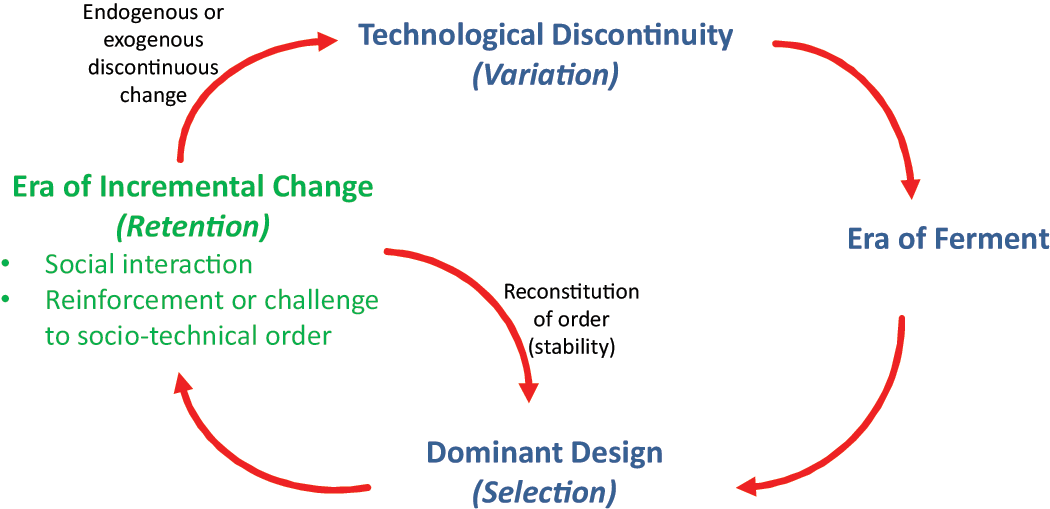
Technology cycles model, revised
Extending the model can also spur additional research into the industrial dynamics of technological evolution by encouraging technology management scholars to broaden their focus to the social interactions that happen at all stages of the technology cycle. We provide a framework for studying these social interactions, along with propositions that can be tested in quantitative empirical study. Studies that apply micro-sociological approaches to issues of technology cycles or technological change typically take a case study approach that enables rich understanding of the micro-processes of technological change (e.g., Garud & Rappa, 1994; Maguire, 2004). Our framework is based on a micro-sociological negotiated order approach, but we supplement negotiated order ideas of interactions and contextual conditions with more recent social network (Burt, 1992; Mizruchi & Galaskiewicz, 1993) and professions (Abbott, 1991) concepts to develop middle-range, testable theory for conceptualizing the processes of technological evolution (Merton, 1968, p. 39).
A second important implication of the extended technology cycles model is that changes that are conceptualized as strictly exogenous could, in fact, be rooted within a technological community. As highlighted in Figure 3, innovations that appear suddenly and overturn the existing socio-technical order can be the outcome of endogenous social interactions in the era of incremental change, as well as coming from exogenous sources. In some cases, discontinuous change can stem from failed challenges by a community member. Firms or individuals who dislike the direction of incremental change can break from the community and start a new community. In other cases, an innovation is not only originated within the existing community, but supported by it, leaving the existing community intact. For example, mobile phone technology was a natural outgrowth of personal radio communication and telephone technology, and leaders in those industries, like Motorola, Nokia, Ericsson, and AT&T and its offshoots remained leaders as cellular systems became standard for mobile telephony, and analog systems were replaced by digital systems (Farley, 2005). In flight simulation technology, the dominant design of full flight simulation was challenged by flight training device technology, which was eventually incorporated into a new hybrid dominant design within the same SSO (Rosenkopf & Tushman, 1998). Even incumbents that are displaced in the market by startups with a disruptive technology can be unsurprised by the technology itself. Leading disk drive manufacturers that failed in the market for the next generation of disk drive technology, were not only aware of the technology, but had in some cases, already successfully developed it (Christensen & Bower, 1996). These examples illustrate both a need for an extended model and directions of study for technology management scholars.
The characterization of endogenous change as exogenous shocks could, in part, be due to the technology management literature’s limited attention to the SSO as a venue for innovation. Most technology management research about SSOs emphasizes their potential for slowing down the innovation process or making it politically driven (e.g., Jakobs, 2002; Shapiro & Varian, 1999; Simcoe, 2007; Spring et al., 1995), rather than viewing SSOs as a venue for social interaction that could potentially lead to innovation. Our analysis provides theoretical justification for examination of SSOs as a generator of new technologies and more radical evolution to the dominant design.
Finally, an additional implication of our research stems from negotiated order theory’s emphasis on the types of actors and agency relationships between them as an important contextual condition. Existing research on dominant design and the industrial dynamics of technological change has rarely considered multiple levels of analysis. A negotiated order perspective, with its emphasis on individuals as representatives of other social actors, encourages serious consideration for the role of actors at multiple levels of analysis in technological change. Most of the technology management literature on technological evolution focuses on firm actors (e.g., Garud, Jain, & Kumaraswamy, 2002; Henderson & Clark, 1990; Rosenkopf & Nerkar, 2002; Tushman & Anderson, 1986); however, technologies evolve through the actions and interactions of many kinds of actors in a technological community. Rather than a stylized picture of firms interacting, an image of concrete, observable negotiations in a grounded context like an SSO requires consideration of individual representatives’ capabilities and motivations, their relationships, and institutional influences from professions.
Implications for other theories of technological change
In addition to the extensions to the technology cycles model highlighted above, our study has implications for broader conceptions of technological change and technological communities. For extending the technology cycles model, we limited our focus to technological communities that produce complex technologies and use formal, collaborative standards setting practices in SSOs. Technologies that are complex systems, i.e., with high interdependency between components, have a far greater need for coordination than simple technologies (Murmann & Frenken, 2006; Tushman & Rosenkopf, 1992), and are more likely to have an active community of firms and individuals involved with the ongoing evolution and production of the technology. Limiting our focus in this way allows us to develop specific and contextualized predictions that explore the social dynamics of technology standardization. However, we recognize that theory about the interactions between technology and society range broadly (Leonardi & Barley, 2010). While the technology cycles model examines technological communities that develop and produce technology, other theoretical perspectives account for user problem definitions and the construction of meaning during use (Bijker & Pinch, 1984; Orlikowski & Scott, 2008), or the effects of technology implementation on structure, power, and relationships in using organizations (Barley, 1986). Cross-fertilization of technology cycles theory with these other theories has been has been extremely limited to date, yet integrating these perspectives can enrich understanding of technological evolution by incorporating the role of users and user communities with the technological community (Munir & Jones, 2004). For example, recent work on user-driven innovation and entrepreneurship (Tripsas & Shah, 2007) suggests that users can be a source of both discontinuous change and additions to the technological community. However, our work in extending the technology cycles model can also enrich constructivist perspectives by offering a framework that is explicitly based on social interaction of both individuals and firms, and a regular venue of SSOs for exploring questions about how producers construct meaning and value around technologies.
Implications for other social theory
In addition to its contributions to technology cycles theory, our work has implications for theory about institutional change. Change in the dominant design, i.e., the socio-technical order, can be considered a specific type of institutional change. In assuming instability, we emphasize the need to explain institutional persistence or stability, a topic that has received limited attention in prior research (Dacin, Munir, & Tracey, 2010; Lawrence & Suddaby, 2006; Reay & Hinings, 2009). We extend existing research to identify contextual conditions, such as the network of relationships between actors, that have not been explored as sources of institutional maintenance in prior research (e.g., Scott, 2000). Second, in showing that negotiations leading to maintenance actions can be informed by multiple institutional logics, our research challenges the assumption that a multiplicity of institutional logics is by definition a source of instability. Consistent with the idea that institutional logics can operate at multiple levels of analysis (Thornton & Ocasio, 2008), action in the context of SSOs may be shaped by societal-level institutional logics of market competition and the engineering profession, and of the organization-level institutional logics of the SSO. Rather than assuming that conflict between logics must be managed, or resolved through selection of one over others (Dokko & Gaba, 2012; Nigam & Ocasio, 2010), our research suggests that the multiplicity of institutional logics is simply a feature of the broader social context that influences social interactions. Multiple logics can complement one another to inform maintenance actions or compete to result in challenge actions.
Finally, our research emphasizes that interactions between actors, rather than conflict between logics, is the locus for change. This highlights the need for a more nuanced understanding of social interaction in research on institutional theory. In contrast to prior research that focuses on individual agency or competition between actors (e.g., Jones, Maoret, & Massa, 2012; Seo & Creed, 2002), our work suggests that actors can have multi-faceted relationships with each other. Our focus on the contextual conditions of negotiations, furthermore, emphasizes that the nature of social interaction between parties is influenced not only by institutional factors, but also by the proximate contextual conditions of their interactions.
In addition to implications for institutional theory, our focus on when and how social interaction can reinforce a social order also has implications for process theories of organization. A recent stream of organization theory research develops the idea that organizations, organizational routines, and social structures are instantiations of process (Feldman & Pentland, 2003; Tsoukas & Chia, 2002). Performances of routines make them a source of evolution and change, and organizations constantly change and evolve as a consequence of the interactions, adaptations, and negotiations of their participants. Our research, grounded in negotiated order theory, shares with this research the basic ontological assumption that the social order is not stable. However, focusing attention on the theoretical challenge of stability in the social order highlights the need to distinguish periods of relative stability, i.e. incremental change, from periods of more radical or disruptive change. Punctuated equilibrium models of change like technology cycles theory have resonance, in part, because we often perceive stability and predictability in the social order, and perceive that this predictability is occasionally upended in specific social arenas, resulting in confusion, intensified sensemaking, and more radical change. Our research identifies conditions that shape actions leading to accelerated or disruptive change on one hand, and more incremental change on the other hand. Though process theory research has started to consider less constant patterns of change (Zbaracki & Bergen, 2010), exploring how incremental change, rooted in constant process and social interaction, can give way to more disruptive, radical change should be a fruitful direction for future research.
Implications for practice
Our theoretical emphasis on eras of incremental change also has implications for practitioners concerned with technology standards and technological change. Though scholars have paid most attention to the establishment of a dominant design, a negotiated order perspective better reflects empirical accounts of SSO activity in eras of incremental change (Isaak, 2006; Jakobs et al., 2001; Spring et al., 1995). It also makes predictions that can guide participants’ activity. For example, firms or individuals who seek to challenge the status quo can understand that resistance will be more likely if there are densely interconnected relationships between SSO members, or the existing dominant design is congruent with the norms of relevant professions. Another important practical implication of our analysis concerns the separation of firm and individual actors. Firms should be aware that their representatives may be subject to legitimacy concerns and relationship concerns that affect their propensity act in ways their employers want. Moreover, previous research finds that individuals carry their relationships with them when they change employers within an SSO (Dokko & Rosenkopf, 2010), suggesting that firms need to be sensitive to how job mobility can change the overall network structure of relationships and the subsequent ability to act. Finally, our propositions encourage SSO participants to consider how contextual conditions of the SSO context affect their and others’ propensity and ability to act in reinforcing or challenging an existing socio-technical order. Though interests, i.e., stakes and goals, and agency relationships are generally understood to drive behavior, other contextual conditions of SSOs, e.g., the governance structure, the structure of relationships, and legitimacy concerns, may be less obvious to practitioners as factors to consider when guiding their own behavior or predicting the behavior of others.
Footnotes
Notes
Author biographies
Gina Dokko is Assistant Professor of Management at the Graduate School of Management at the University of California, Davis. She received her BS and PhD from the Wharton School at the University of Pennsylvania. Her research addresses the consequences of individuals’ organizational and institutional boundary-crossing and boundary-spanning and their effects on individual and organizational innovation, learning and performance.
Amit Nigam is Assistant Professor of Management at the Wagner Graduate School of Public Service at New York University. He received his PhD in Management and Organizations and Sociology from New York University. His research examines change in institutional logics, the role of professions in institutional change, and political and interpretive dynamics of organizational stability and change.
Lori Rosenkopf is the Simon and Midge Palley Professor in the management department at the Wharton School of the University of Pennsylvania. She received her PhD in management of organizations from Columbia University. Professor Rosenkopf studies interorganizational networks and knowledge flow in various high-tech industries by analyzing participation in technical committees; alliances; the mobility of technological professionals; and patents within technological communities.