




Abstract
A significant stream of research taking a psychoanalytic perspective has focused on leadership in organizations. Studies have investigated, from a Freudian perspective, leader–follower relations where the leader represents a domineering and authoritarian father figure. We contribute to this research by introducing Lacanian theory to explore the increasingly influential ‘authentic leadership’ approach. In contrast to traditional leadership, this approach advocates, in line with postmodern trends, a post-heroic, non-authoritarian and even self-effacing leader figure. In analysing academic and practitioner-oriented authentic leadership texts we ask, drawing on Lacanian insights, whether authentic leadership enables subjects to separate from the master discourse of traditional leadership through promoting something like the analyst discourse, or whether it entails the return of a phantasmagorical Freudian primal father figure, leading to heightened dependency. In so doing, we discuss the political significance of Lacanian theory in illuminating possibilities for more autonomous and emancipatory relations in organizations.
Introduction
Psychoanalytic insights have been significant for understanding the complexities of organizational life. As an ‘interpretive discipline’ (Gabriel, 1999a, p. 51) psychoanalysis has shed light on the desires, emotions and fantasies underlying organizational actors’ behaviours. Psychoanalytic perspectives have been especially fruitful in leadership research (e.g. Cluley, 2008; Gabriel, 1993; Kets de Vries, 1990; Long, 2008; Schwartz, 1987a, 1987b). Understanding follower–leader dynamics through Freudian insights regarding the father–child relation has been particularly prevalent (Gabriel, 1997; Hirschhorn, 1997; Kets de Vries, 1988; Krantz, 1990; Oglensky, 1995; Stein, 2005).
This paper contributes to the literature by drawing on Lacanian theory to investigate authentic leadership, which is increasingly dominant in both academic (e.g. Avolio, Gardner, Walumbwa, Luthans & May, 2004; Avolio and Gardner, 2005; Gardner, Fischer & Hunt, 2009; Walumbwa, Wang, Wang, Schaubroeck & Avolio, 2010) and practitioner-oriented (e.g. Bennis, 2006; George, 2003, 2007, 2010; Goffee & Jones, 2000, 2001, 2005, 2006; Shelton, 2008) management literature. Authentic leadership denotes a ‘root construct’ (Avolio & Gardner, 2005) of new forms of post-heroic leadership, such as servant, spiritual and transformational forms. Belonging to the positive humanistic movement, it strives for greater well-being, happiness, autonomy and ethical responsibility in organizations. This approach opposes traditional authoritarian structures and hierarchical follower–leader relations – those described by the psychoanalytic literature cited above – advocating instead a distributed, egalitarian and altruistic leadership style. It is thus reflective of ‘“new” ideas about leadership [concerning] … “flatter hierarchies”, “empowered workers” … more flexible and informal leadership practices, less tied to hierarchical position and more focused on shared power and responsibility’ (Collinson, 2005, p. 1422). More generally, it could be said to mirror our postmodern era, where, in the name of freedom, empowerment and individuality, ‘we are witnessing … the massive collapse of the father figure’ (Verhaeghe, 2000, p. 135).
In light of this emergent approach, we ask: what happens to the follower–leader relationship when the leader assumes a non-authoritarian, self-effacing and altruistic role? Does this approach have liberating and positive effects on followers, as the authentic leadership literature claims? A Lacanian perspective can help answer these questions, which, given its nuanced analytical tools, is gaining momentum in organization studies (e.g. Arnaud, 2003; Jones & Spicer, 2005; Contu, Driver & Campbell, 2010; Driver, 2009; Essers, Böhm & Contu, 2009; Fotaki, Böhm & Hassard, 2010; Harding, 2007; Roberts, 2005; Stavrakakis, 2008). We draw on the Lacanian theorization of the subject, the big Other and the four discourses (master, university, hysteric and analyst). These four discourses, introduced and elaborated upon in The Other Side of Psychoanalysis (2007), represent various ways in which Lacan conceptualizes the social bond, i.e. how discourse structures relations between subjects in the social world. This will be of particular use in our analysis insofar as it offers a fruitful theoretical lens for analysing subject–authority relations.
In this paper, Lacan’s work provides the basis to critically analyse the liberating potential of authentic leadership, as described both by the academic literature, mainly in The Leadership Quarterly, and two popular leadership bestsellers, True North: Discover Your Authentic Leadership (2007) by Bill George and Why Should Anyone Be Led By You? What It Takes to Be an Authentic Leader (2006) by Rob Goffee and Gareth Jones. These texts are representative of the authentic leadership discourse; they illuminate its conceptual underpinning and provide empirical examples. Focusing on them, our analysis cannot shed light on ‘real-life’ leadership dynamics, but only an interpretation of how authentic leadership is portrayed. Analysing the discursive constructions of this approach in the literature is important, as these increasingly influence how leadership is understood in both academic and practitioner circles today.
The article is structured as follows. First, we present Freudian-inspired leadership research in organization studies. We do not provide an exhaustive overview of this literature, but focus on discussions that approach the leader as an authoritarian father figure. Second, we introduce the authentic leadership approach. Third, we argue that Lacan’s theory of the subject, the Other and discourses (master, university, hysteric and analyst) provides a fruitful lens for understanding this emerging approach in its complexity. In particular, we argue that the traditional leader–follower relation represents the master discourse and that the analyst discourse is needed for the advent of more emancipatory relations. Fourth, the introduced Lacanian insights are applied to analyse the authentic leadership literature. We explore both (i) the potential of authentic leadership to foster emancipatory subject–authority relations by enabling something like what Lacan terms the analyst discourse, as well as (ii) the danger of reintroducing repressive forms of authority through promoting an omnipresent and restlessly demanding leader figure akin to the Freudian primal father fantasy. Finally, we critically discuss the operating principles of authentic leadership in light of Lacanian discussions of authority in postmodernity. Here we reflect upon Lacanian ideas concerning greater autonomy and liberation in subject–Other (i.e. follower–leader) relations.
Our contributions consist of introducing Lacanian insights concerning the subject, the Other and the theory of discourses. Particularly, we extend Stavrakakis’ (2008) introduction to Lacanian insights regarding the subject–Other relation in organization studies by drawing attention to the analyst discourse as a potential answer to the dialectics of obedience, attachment and dissent. Interpretations put forward by prominent writers such as Verhaeghe, Žižek and Salecl regarding authority in postmodernity are also drawn upon. We shed light on power and control in the leader–follower relation – something to which present leadership research pays too little attention (Collinson, 2005). Moreover, using the Lacanian framework, we consider potential ways towards greater autonomy in organizations and thereby hope to make explicit the political significance of Lacanian theory.
Psychoanalysis, Leadership and Paternal Authority
Psychoanalytic theory, particularly Freudian conceptions of narcissism and the Oedipal complex and Kleinian insights regarding envy and rivalry, have been powerful theoretical resources to understand leadership (e.g. Baum, 1987; Cluley, 2008; Gabriel, 1993; Kets de Vries & Miller, 1984; Schwartz, 1987a, 1987b; Stein, 2005). Research has explored how leaders can represent (in fantasy) a form of paternal authority for followers (Gabriel, 1997; Hirschhorn, 1988; Kets de Vries, 1988; Long, 2008). The literature has followed ‘the key assumption of psychoanalytic theory… [namely] that present relations are structured by and resemble past ones, notably from early childhood with mother and father’ (Oglensky, 1995, p. 1036).
To elucidate this point, let us turn towards Freud’s work concerning the links between paternity and authority. In Totem and Taboo (1913) Freud argues that the prehistoric corollary of the family is the patriarchal horde of brothers ruled by a selfish, sexually insatiable and powerful primal father keeping women to himself and forcing the sons into obedience. According to Freud’s myth, the mob of frustrated, angry, afraid and jealous brothers joined forces and ‘killed and devoured their father and so made an end of the patriarchal horde’ (1913, p. 141). Freud maintains that once the father dies, the brothers experience guilt, leading to the establishment of the incest taboo, moral laws and other forms of social regulation – this marks the emergence of paternal/symbolic authority proper. According to Freud (1918, p. 97), the primal father represents a universal fantasy haunting children irrespective of actual personal experience. Hence, paternal authority is central for each individual’s assumption of his/her respective family role and the overcoming of the primal father fantasy. The later Freud (1937) emphasizes the need for the father’s symbolic authority, as it protects the child from the overbearing love of the mother.
When faced with authority figures, our relation to parents is likely to be projected onto them: ‘Bosses appear important not simply because they exercise real power, but also because we invest them with the moral authority we once accorded our parents and teachers’ (Hirschhorn, 1997, p. 8). The literature describes how followers fantasize about leaders as both a forceful and rivaling primal father and a more admired, albeit prohibitory authority figure (e.g. Gabriel, 1997; Hirschhorn, 1988). Ambivalence may arise, as followers admire and identify with those in authority through internalizing them in their ego ideal (Gabriel, 1993; Long, 2008; Schwartz, 1987a, 1987b), while also feeling threatened by their power (Carr, 1998; Gabriel, 1999b).
Studies have pointed to the shortcomings of such paternal leadership: it involves asymmetrical power relations; followers feel disappointed if their leaders do not live up to the heroic ideal (which is a deceiving construct, see Schwartz, 1996); leaders, believing in their heroic powers, become excessively narcissistic (Gabriel, 1997; Kets de Vries, 1988); and organizational conditions of turbulence and uncertainty make it difficult for leaders to fulfil such a role (Hirschhorn, 1988; Krantz, 1990). Moreover, in today’s postmodernity there is a push towards greater individual autonomy, emancipation and less hierarchy, leading to the questioning of authoritarian structures and, indeed, paternity (Boltanski & Chiapello, 2005; Salecl, 1998; Verhaeghe, 2000). Research has therefore called for greater distribution of leadership among organizational actors (Hirschhorn, 1997; Kets de Vries, 1988). It is thus crucial to study the emerging phenomenon of authentic leadership which, in line with contemporary anti-authoritarian/postmodern trends, seeks to overcome the shortcomings of hierarchical leadership.
Beyond Paternal Authority: Authentic Leadership
The authentic leadership approach has gained increasing momentum in academic and practice circles over the past decades. That it constitutes a central emerging leadership discourse is manifest in the special issue of Leadership Quarterly on authentic leadership (see Avolio & Gardner, 2005) and the burgeoning interest it has sparked since (e.g. Avolio, Walumbwa & Weber, 2009; Gardner et al., 2009; Ladkin & Taylor, 2010; Walumbwa, Avolio, Gardner, Wernsing & Peterson, 2008; Walumbwa et al., 2010; Yammarino, Dionne, Schriesheim & Dansereau, 2008). Management bestsellers have also greatly popularized this approach in the practitioner community (George, 2003, 2007; Goffee & Jones, 2006). Authentic leadership has diverse meanings in management theory and practice (Yukl, 2010). Originally influenced by transformational leadership (Bass & Steidlmeier, 1999), it is related to ethical, spiritual, charismatic and servant leadership approaches. Given this plethora, Avolio and Gardner (2005) argue that ‘authentic leadership is more generic and represents … a ‘root concept’’ (2005, p. 328). As a proponent of positive humanistic psychology, it constitutes the foundation of the ‘positive leadership’ movement concerned with ‘human happiness and eudaemonic well-being’ (Ilies, Morgeson & Nahrgang, 2005, p. 374).
Authentic leadership puts forward a new normative ideal by providing an antidote to the often-noted crisis in leadership. Against the backdrop of corporate scandals (e.g. Enron and WorldCom), corporate leaders, characterized by selfishness, heroism and short-term thinking, are seen as unethical. This is said to lead to the need for a leadership that displays consistency between words and actions and is devoted to values, ethics and the common good. A post-heroic, humble and even ‘altruistic’ (Avolio & Gardner, 2005, p. 331) leader, more interested in serving and being there for others than in status, hierarchy and power, is summoned. Authentic leadership also professes to address increasing employee demands for more democratic structures, diversity and non-conformity. It seeks to give all a voice, assuming that every follower can be a leader. The relationship between followers and leaders is argued to entail greater ‘openness and truthfulness’ (Ilies et al., 2005, p. 381), ‘closeness and trust’ as well as harmony and love. It strives for ‘empowering others [followers]’ (George, 2007, p. 41) thereby enabling ‘them to fulfill their needs for autonomy’ (Gardner, Avolio, Luthans, May & Walumbwa, 2005a, p. 364).
The emphasis on post-heroism, harmony and autonomy shares little with traditional paternal leadership. Authentic leadership alleges to overcome the shortcomings of previous approaches by promoting non-authoritarian, close, trusting and more symmetrical follower–leader relations. How can we understand authentic leadership psychoanalytically? What happens when forms of leadership fostering paternal authority are replaced by seemingly non-paternalistic ones? Does authentic leadership lead to greater autonomy and empowerment in organizations?
Towards A Lacanian Approach: Subject, Authority and the Theory of Discourses
This paper draws on Lacanian theory to analyse the organizing principles of authentic leadership. Following Lacan (2007), we argue that follower–leader relations resemble those of subject–authority not only because they reinvigorate family dynamics, but, more importantly, because we are subject to master signifiers (specific values and ideals) in participating in social bonds. The pertinence of psychoanalysis lies in the fact that general discursive structures account for human behaviour regardless of the particularities of infantile experience; the ‘unconscious is politics’ (Lacan, 1967, session of 10 May 1967) and must therefore be understood beyond the ‘solipsist sphere’ (Miller, 2002, p. 12) of the individual/family. What we have here, according to Miller, is not the reduction of politics to psychoanalysis but an amplification of the political sphere explicating unconscious behaviour. Thus, Lacanian theory provides a suitable avenue for critically analysing authentic leadership by making explicit its political underpinnings. In particular, the theory of discourses in The Other Side of Psychoanalysis allows conceptualizing subject–authority relations; the concept of the master discourse captures leadership in its traditional form, while the analyst discourse provides ways of formulating more emancipatory possibilities for subjects in relation to authority. Thus, the latter enables us to outline subject positions of greater autonomy, thereby providing the basis for analysing authentic leadership and its alleged potential for liberation. Before engaging with the theory of discourses, however, it would be useful to introduce Lacan’s registers of the imaginary, symbolic and real, along with other basic concepts.
The subject, the Other and symbolic authority
The imaginary constitutes the realm of fantasy, image, identification and alienation. Through identification with a counterpart, the subject gains a sense of unity (Lacan, 2006, p. 78). However, the identity (providing a certain continuity of self) acquired is an alienating one as it is based on the false fantasy of unity (see Driver, 2009; Harding, 2007; Roberts, 2005). The Lacanian name for the other through which his/her alienating identity is formed is the small other (a.k.a. counterpart). The symbolic designates the realm of language, discourse and law – Lacan refers to these as the big Other. The symbolic is crucial for social relations as it gives subjects a name and position in the social world. A feature of the symbolic is its inherent incompleteness; the social space is marked by inconsistencies due to holes and fissures in language. These inconsistencies – which imply that the big Other is barred, i.e. constituted by lack – bring us to the notion of the real ‘which resists symbolization absolutely’ (Lacan, 1988a, p. 66).
The fundamental implication of the big Other’s lack is that it fails to fully symbolize the subject, who thereby also becomes irremediably barred and lacking. To say that a subject is marked by lack simply means that no single identity can ever be final and uncontested, as there is no name (signifier) fully grasping it forever. This lack in the big Other (and the subject) is the source of anxiety. One of the functions of fantasy (belonging to the imaginary) is to patch up the lack constituted by the failure of symbolization in order to sustain the illusion of wholeness – this constitutes one way in which the imaginary is the site of alienation. For Lacan, this is particularly the case with respect to love, as it functions precisely to hide lack (one’s own as well as that of the other) by instantiating the fantasy of completeness with the other. Lacan even argues that love of the other risks bringing about the ‘veritable subduction of the symbolic’ (1988a, p. 142), reducing the big Other to a mere small other. As we will argue later on, this risk is particularly pertinent where the object of love is someone standing in the place of symbolic authority (e.g. a psychoanalyst, judge, etc.).
Symbolic authority must intervene by forbidding relentless efforts to complete the big Other via imaginary simulacra (fantasy, identification). Lacan (2006, p. 688) makes use of Freud’s myth of the primal father to demonstrate that symbolic authority, emerging after the primal father’s death, is crucial for the functioning of social relations. Here emphasis is placed on the symbolic role of authority (‘name of the father’): ‘It is in the name of the father that we must recognize the basis of the symbolic function’ (Lacan, 2006, p. 230). What holds universally is the form of the law/authority rather than any specific content it may hold in a given socio-symbolic (Lacan, 2006, p. 689; see also Zupančič, 2000). Despite the patriarchal overtones, the emphasis on the symbolic nature of the law implies that this function can be carried out by both genders (Lacan, 1998; see also Žižek, 2007, p. 177). Through recognizing symbolic authority and hence embracing lack, the space for the emergence of desire is created, as ‘Desire is a relation of being to lack’ (Lacan, 1988b, pp. 222–223). The importance of desire for any emancipatory ethics lies in that it can effectively counter the effects of imaginary alienation by introducing the ‘subject to a broader world of signification … unregulated by any individual or group, and unrestricted in the range of its possible messages’ (Grosz, 1990, p. 66). When the subject remains trapped at the level of imaginary alienation, fantasy veils the Other’s lack. The subject is thus left at the mercy of an unbarred Other, namely the persecutory fantasy of the primal father.
So far we can derive two ways in which psychoanalytic theory allows theorizing subject–authority relations. First, authority presents itself as a barred big Other providing a symbolic law that subjects must accept in order to occupy a place in the social world and for a desire-creating lack to emerge. This subject–authority relation is similar to the Freudian conception of paternal authority installed after the primal father’s death. Here we have the institution of symbolic authority/law regulating relations between the subject and the big Other, thereby limiting the extent to which fantasy veils the subject’s lack as well as that of the Other. Second, authority can be experienced as an unbarred, omnipresent and persecutory big Other. For Freud and Lacan, this is a phantasmagorical figure akin to the primal father, which emerges when the symbolic dimension of authority is obliterated. The banning of paternal/symbolic authority entails the ‘reversal of the primal myth, and thus … the loss of protection … and consequently a return to original chaos’ (Verhaeghe, 2000, p. 135). The obliteration of symbolic authority and the concomitant non-recognition of lack, rather than leading to the bliss of freedom, brings about a regression to fantasies of an unbarred primal father. This may happen when imaginary relations emphasizing love completely take the place of symbolic authority. The person representing symbolic authority is then reduced to a mere imaginary small other, thereby nulling his/her function as authority and making impossible the barring of the big Other. This paves the way towards a heightening of fantasy, particularly in the form of a primal father, compensating for the absence of law.
Taking into account these insights and the aforementioned assumption that followers project authority onto leaders, it could be argued that the anti-authoritarian and non-paternalistic stance of authentic leadership risks precisely such an abolishment of symbolic authority, giving rise to the return of the primal father fantasy (unbarred big Other). Alternatively, this leadership approach may represent a momentous emancipatory move enabling subjects to separate from the big Other without depending on an externally imposed master – the late Lacan envisioned such emancipation with the notion of the analyst discourse.
Beyond symbolic authority: The analyst discourse
In The Other Side of Psychoanalysis, Lacan conceptualizes the way in which social bonds are structured with his theory of discourses. The master discourse is the primary discourse out of which university, hysteric and analyst discourses are derived. All discourses depend on a prior barring of the big Other by the symbolic law. Without the barring of the big Other and the subject through the prohibitory function of symbolic authority the subject cannot partake in the social bond (the discourses). In the master and university discourse (the latter is a perversion of the former, see Lacan, 2007, p. 182), 1 subjects are provided with externally imposed master signifiers (values/beliefs of the prevalent doxa). Here, subjects emerge through subjugation to these master signifiers – a process that involves power and control effects. This is simply a reformulation of the first subject–authority relation described above, whereby the traditional leader embodies the symbolic authority providing followers with master signifiers. The hysteric discourse revolts against these master signifiers by exposing their inconsistencies/incompleteness. Lacan controversially claims that the hysteric subject, despite his/her remonstrations against master signifiers, remains in solidarity with them. The radical impasse of this discourse is that ‘the hysteric wants … a master’ (2007, p. 129). Nevertheless, the hysteric discourse is not simply conservative as it reveals the master’s lack. However, this is compromised by the will to replace this master with a more powerful one.
Rather than attacking and inadvertently embracing master signifiers, as does the hysteric, the analyst discourse makes use of the lack in the big Other. As with the intervention of symbolic authority, the key emancipatory factor lies with the emergence of desire. The difference is that now the individual is not subject to externally imposed master signifiers accomplishing the role of symbolic authority. Instead, the subject, having become fully cognizant of the contingency around which social reality (the big Other) is structured, can bring about change through the lack in the symbolic order. The movement between discourses is accompanied by the analyst discourse where the gap/lack in the symbolic is mobilized to instantiate a desire harboring subversive potential. Lacan equates the analyst discourse with a kind of revolutionary love defined as ‘the sign … that one is changing reasons … one changes discourses’. (1998, p. 16)
Freeing oneself from a given discursive reality requires acknowledging that its aura of necessity is a fiction propagated by the master discourse – this process is called separation. The analyst discourse provides the chance to recognize ‘the questionable, relative nature … of certain values and ideals’ (Bracher, 1993, p. 71). It succeeds in draining out prevalent master signifiers and emptying out the place of symbolic authority, thereby creating the required distance for ascertaining the contingency of given values and ideals. Thus separated from the grips of prevalent master signifiers, subjects are empowered to decide which ones to endorse. The draining of master signifiers merely empties the place of symbolic authority of its content – it does not totally eradicate it as a formal structure (an undesirable outcome leading to the emergence of a primal father like fantasy, as we explain later).
The social bond promoted by the analyst discourse differs from the two relations outlined above. The analyst neither provides master signifiers nor attempts to abolish symbolic authority entirely by feigning to be a small other. Instead, the analyst discourse empties the place of symbolic authority so that subjects separate from prevalent master signifiers and develop less oppressive and more autonomous relations to them. This discourse is not a particularity of the analytic setting but should constitute an organizing principle within an emancipatory social setting: ‘This is where the little perspective … that analysis has contributed introduces us to what may be a fertile step, not of thought, but of act. And it is in this that it appears to be revolutionary’ (Lacan, 2007, p. 176). It is therefore on the basis of Lacan’s notion of the analyst discourse that this paper will assess authentic leadership’s claim to provide emancipation and autonomy in organizations.
Methods
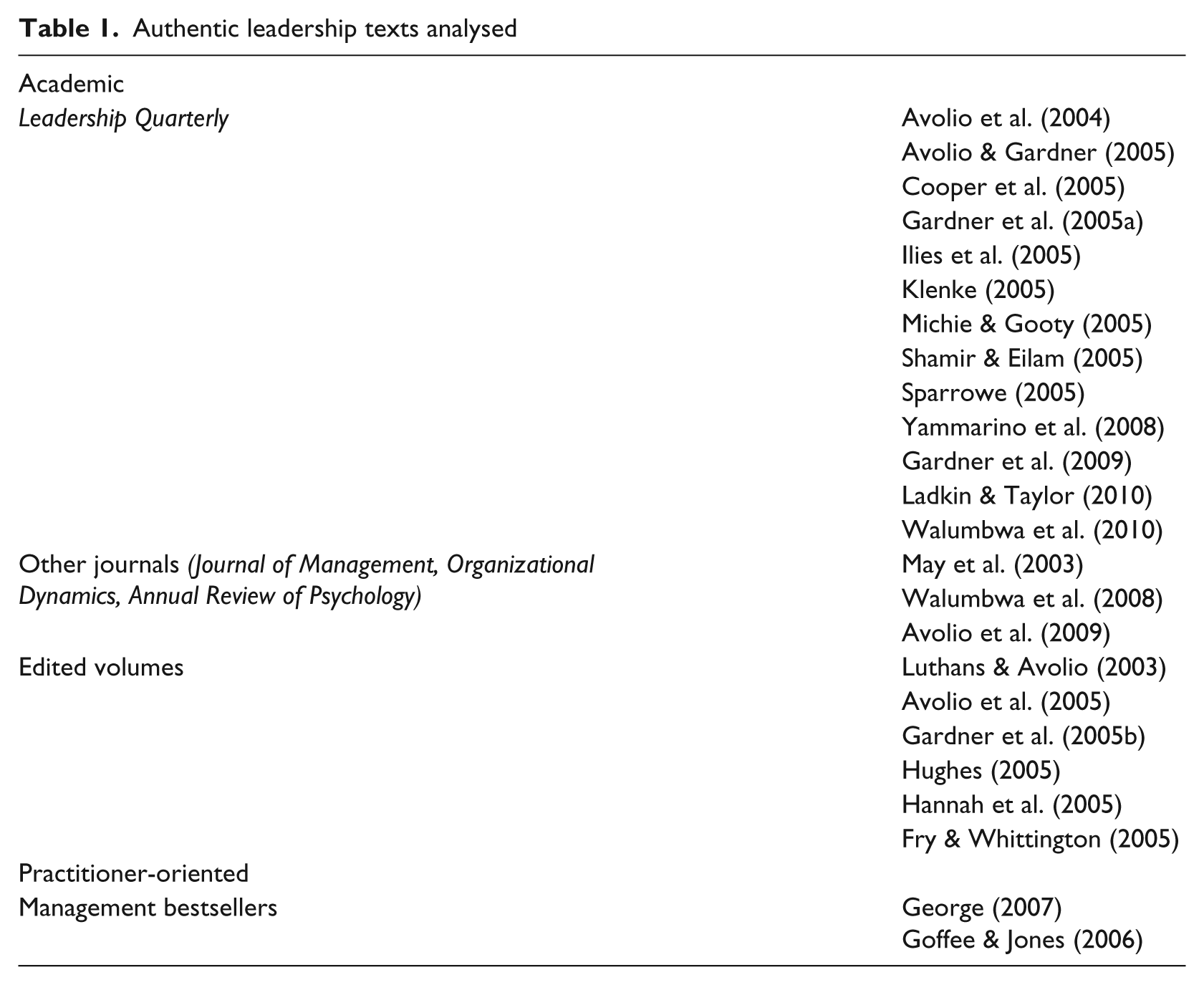
We argue our case by analysing authentic leadership texts shedding light on its operating principles. Of course, empirical studies would be welcome as supplements deepening our analysis. Nevertheless, these texts are important for understanding this emerging leadership approach. We analyse them in detail as their discursive constructions can highly influence how leadership is construed, practised and experienced. Our analysis builds upon publications that have been foundational in popularizing this approach in the academic and practitioner community (see Table 1). We selected 22 academic publications for analysis by searching for terms, such as authentic leadership and authentic leader, in EBSCO: 13 appeared in Leadership Quarterly (the dominant leadership journal, which devoted a special issue to this topic in 2005), three in other management and psychology journals and six in edited volumes, especially in Gardner, Avolio and Walumbwa (2005b). Central to our analysis are the writings of Luthans, Avolio and Gardner (Avolio et al., 2004; Avolio & Gardner, 2005; Gardner et al., 2005a; Luthans & Avolio, 2003). These represent the groundbreaking texts for this movement in leadership studies. 2 Yammarino et al. (2008) in their meta-analysis of authentic leadership publications note that the majority of these texts are conceptual rather than empirical; they aim at deriving general propositions and focus on the individual level, i.e. the leader.
Our analysis is also based on texts targeting the practitioner-oriented community, specifically two influential management bestsellers, True North: Discover Your Authentic Leadership (2007) by Bill George and Why Should Anyone Be Led By You? What It Takes to Be an Authentic Leader (2006) by Rob Goffee and Gareth Jones. We focus on these for the following reasons: the former CEO Bill George has popularized this notion and shaped its general understanding (e.g. his book was a bestseller in the Wall Street Journal and BusinessWeek list); this work has been a central basis for the development of the authentic leadership approach in the academic community (see Avolio et al., 2004; Avolio & Gardner, 2005); the books offer ample illustrative examples and thereby complement the academic texts; Goffee and Jones, especially, are interested in followership (see also Goffee & Jones, 2000, 2001, 2005) and hence provide more insights on what authentic leadership implies for followers. Although these academic and practitioner-oriented texts somewhat differ in their conceptualization, they share principal ideas regarding authentic leadership. Taken together, these wide-ranging texts provide a significant overview of the operating principles of this ever-more prominent leadership approach.
Authentic leadership texts analysed
Since our inquiry is exploratory and interested in the nuances of follower–leader relations, our study is qualitative in nature. In reading these texts we developed a set of themes, capturing their main threads. Our initial reading was guided by descriptive questions concerning how authentic leadership is defined and how the leader, the follower and their relation are described and conceptualized. In a next and more analytic step we re-read and coded these texts by drawing on our psychoanalytic conceptualization of subject–authority relations. Examples of codes are ‘love’, ‘autonomy’ or ‘the downplaying of authority’. In the subsequent process of refining and linking our codes, certain major themes concerning the relation between the subject and the Other surfaced, e.g. imaginary love relation, unbarred Other and the analyst discourse. The data analysis and use of psychoanalytic theory was iterative, involving going back and forth between theory and text. We were open to modifying our psychoanalytic conceptions in the course of the analysis. For example, our engagement with the later Lacan’s notion of the analyst discourse emerged in order to better assess the alleged liberating potential of authentic leadership.
Our analysis constitutes one among many other possible ones. Post-structuralist-inspired leadership research (e.g. Collinson, 2006; Ford, Harding & Learmonth, 2008; Sinclair, 2007) could, for instance, fruitfully critique essentializing trends. Similarly, another psychoanalytic lens, such as object relations theory, could be used to critique authentic leadership’s conceptualization of subjectivity (see Ford & Harding, 2011). Since it is beyond our scope to explore the different dimensions of authentic leadership (outlined in the various texts) in full detail (e.g. how they foster gendered conceptions of leadership), the analysis is limited. Our aim is only to provide a Lacanian avenue for understanding authentic leadership’s key operating principles, the potential (or lack thereof) in instilling more autonomous and less oppressive subject–authority relations. The discussion and later critique centre only on the authentic leadership approach; we do not make general claims regarding other leadership approaches’ possibility of fostering autonomy and emancipation in organizations.
Analysis of Authentic Leadership Texts
The authentic leadership literature goes beyond traditional leadership and claims to promote more empowering and autonomous follower–leader relations. We propose that authentic leadership can potentially overcome repressive subject–authority relations, by approaching a configuration akin to Lacan’s analyst discourse where the subject’s ascension to desire is achieved through separating from prevalent master signifiers. Yet we then suggest that it also entails the danger of fostering more oppressive follower–leader relations. This can occur insofar as the authentic leader plays the role of an imaginary counterpart (a small other) thereby leading to the obliteration of symbolic authority (i.e. concrete externally imposed norms). The reduction of symbolic authority to an imaginary small other is tantamount to transforming the big Other, in fantasy, to the status of an irrevocable unbarred big Other, namely the primal father.
The potential of authentic leadership: Towards emancipatory follower–leader relations?
A striking feature of authentic leadership is its opposition to previous hierarchical forms of leadership:
Authentic leaders … do not pretend to be leaders just because they are in a leadership position, for instance, as a result of an appointment to a management position. … Relatedly, authentic leaders do not take on a leadership role … for status, honor or other personal rewards. (Shamir & Eilam, 2005, pp. 396–397) Leadership is nonhierarchical (Goffee & Jones, 2006, p. 13; emphasis original)
This leadership approach does not treat ‘followers as means to ends’ (Sparrowe, 2005, p. 423), but is said to be genuinely interested in promoting well-being in organizations. Rather than promoting hierarchical/vertical power structures, leaders are advised to be ‘selfless’ (Luthans & Avolio, 2003, p. 243), ‘modest, self-effacing and … [even] shy’ (Goffee & Jones, 2006, p. 49). Authentic leadership is about ‘keeping personalized power and self-aggrandizement in check’ (Michie & Gooty, 2005, p. 442) and serving others instead:
‘You’ve got to flip that switch and understand that it’s about serving the folks on your team’ (leader quoted in George, 2007, p. 42)
In de-emphasizing hierarchy and power, a leadership is promoted that moves away from the master discourse, where symbolic authority is entirely embodied in the person of the leader. Authentic leadership aims to foster relations, whereby followers are not dependent on a symbolic authority inextricably linked to a powerful leader/master with ‘superior strengths’ (Goffee & Jones, 2006, p. 47). It tries to abstain from producing master signifiers, which enslave subjects who seek in them a source of security. Both the academic and practitioner-oriented texts recommend leaders to not present themselves as individuals without vulnerabilities and weaknesses:
Leaders identify with their followers by … openly discussing their vulnerabilities. (Avolio et al., 2004, p. 807)
In the academic literature, revealing weaknesses is part of ‘relational transparency’ (Gardner et al., 2005a, p. 347), whereby the leader ‘is willing to admit mistakes’ (Walumbwa et al., 2010, p. 906). Thus, not only does authentic leadership not seek to embody the master (symbolic authority), but also through showing its vulnerabilities it seems to acknowledge its lack (i.e. that it constitutes a barred big Other) as well as that of the subject: given that ‘every leader has weaknesses, and all are subject to human frailties and mistakes’ (George, 2007, p. xxxi), followers are also not expected to be ‘perfect’. Authentic leadership therefore seems to provide the space for the leader and followers to embrace their lack, thereby potentially opening the gap for desire and greater autonomy.
It is argued that followers are empowered and more autonomous, no longer relying on a dominant master figure (the leader) and thereby leading themselves:
Authentic leaders … support the self-determination of followers, in part by providing opportunities for skill development and autonomy. (Ilies et al., 2005, p. 383) Authentic leaders not only inspire those around them, they empower them to step up and lead. (George, 2007, p. xxxi).
The attempt to ‘empower’ followers providing them with ‘autonomy’ and ‘self-determination’ is, indeed, desirable. This is the aim of the analyst discourse where subjects separate from prevalent master signifiers in order to pave the way towards self-determined master signifiers compatible with their ascension to desire. Authentic leadership seems to approach a configuration akin to the analyst discourse insofar as the leader abstains from embodying the master (symbolic authority) and recognizes and presents him/herself as a lacking big Other by emphasizing vulnerabilities – similarly, the analyst undermines his/her own position as the ultimate authority (the ‘subject-supposed-to-know’) within the analysand’s transference. This may open the space required for the emergence of a desire-creating lack and maintain the possibility of greater autonomy and self-determination for followers.
The dangers of authentic leadership: Imaginary love, the small other and the unbarred big Other
Despite tendencies towards liberation, there is the danger that authentic leadership fosters greater dependency in subjects by promoting imaginary love stressing harmony/completeness in the place of symbolic authority. We must distinguish two forms of love in Lacanian theory. The first, a function of the alienating imaginary, promotes a false fantasy of unity with an other, thereby obliterating lack and suffocating desire. The second form of love is equated with the analyst discourse (Lacan, 1998, p. 16). It is seen in positive light as it builds on the recognition of the impossibility of harmony between subjects, thereby accepting the lack in the subject and the big Other (see Badiou, 2000; Taheri, forthcoming; Žižek, 1996).
3
We believe that imaginary love is more prevalent in authentic leadership, given its emphasis on unity and harmony. Treating ‘others as equals’ (George, 2007, p. 175), the authentic leader is presented as what Lacan terms the small other, namely a mere imaginary counterpart. Authentic leadership underpins such imaginary love:
[Authentic leadership is about] … establishing a social/organizational culture based on altruistic love. (Fry & Whittington, 2005, p. 187) Good leaders … build relations of warmth, loyalty, and affection. (Goffee & Jones, 2006, p. 23)
Such an emphasis on reciprocal relations of compassion derives from the perspective of positive organizational behaviour fundamental to authentic leadership. It aims to instil ‘positive emotions … [whereby] … love has been proposed as a core category’ (Hughes, 2005, p. 96). What then is problematic with such love relations?
When imaginary love relations replace the function of symbolic authority (as in the case of authentic leadership), rather than serving as a complement, they result in an alienating belief in one’s completeness in unity with the other. For Lacan (1988b), such love prohibits the sustenance of boundaries because of its inherently narcissistic nature through which the other is reduced to a mere aspect of oneself (how one was, is or would like to be, as Freud [1914] would say). Its failure to allow for proper separation amounts to a foreclosure of the most crucial requirement for a movement towards emancipatory subject positions, namely the acknowledgement of lack (one’s own and that of the other). In this way, the desire-creating lack required for the sustenance of autonomy is obliterated: ‘love … is a passion that involves ignorance of desire’ (Lacan, 1998, p. 4). The leadership literature’s ideal of an ‘authentic relationship’ confirms how an emphasis on imaginary love impedes separation, thereby disguising lack. The follower–leader relation is described as one of complete harmony and ‘commensurability’ (Avolio et al., 2004, p. 810):
Authentic leader–follower relationships are most likely to emerge when high congruence with respect to the leader’s and follower’s actual, ought and ideal selves exist, contributing to high levels of trust, intimacy, cooperation and alignment of goals. (Gardner et al., 2005a, p. 364)
This excerpt emphasizes perfect harmony, which, we argue, risks closing the space in which separation from the leader can be achieved. The illusion of unity and completeness at the level of the self, the other and the relation between the two forbids the acknowledgement of constitutive lack crucial for desire and hence autonomy.
Concomitantly, the leader is depicted as a consistent and authentic person without lack (despite the aforementioned emphasis on vulnerability, to which we return shortly):
Authentic leaders … are deeply aware of how they think and behave and are perceived by others as being aware of their own and others’ values/morale perspectives, knowledge, and strength; aware of the context in which they operate; and … are confident hopeful, optimistic, resilient, and of high moral character. (Avolio et al. cited in Yammarino et al., 2008, p. 694)
Insofar as it regards leaders as consistent and unfailingly morally good, authentic leadership falls prey to the alienating imaginary, i.e. the illusion of completeness. It claims that followers too can reach this ideal of authenticity by returning the leader’s ‘love’. The false promise of completeness/unity underlying authentic leadership holds great seductive and persuasive power: ‘positive emotions … [are] especially contagious’ (Ilies et al., 2005, p. 384). This is accentuated in the case of love, given the demand for reciprocity: ‘to love is to want to be loved’ (Lacan, 2006, p. 723). Demand abolishes all difference, converting everything into the currency of love. That is to say, ‘demand annuls … the particularity of everything that can be granted, by transmuting it into a proof of love’ (Lacan, 2006, p. 580). The ubiquity of love annihilates the particularity of the subject’s desire, which is the only means towards autonomy in that ‘desire reverses the unconditionality of the demand for love, in which the subject remains subjected to the Other’ (Lacan, 2006, p. 689). We thus see that love is antipodal to desire insofar as its heavy emphasis on wholeness and unity, expressed in terms of a demand for reciprocity, obfuscates subjective boundaries rather than allowing for separation. This impedes the emergence of a desire-creating lack through which the subject’s assertion of his/her singularity and autonomy can be achieved. Capitalizing on this failure of separation, the leader can place great demands on the followers. Indeed, the literature points out how, not only in acting as a role model of authenticity, but also in creating such intimate bonds, the leader has greater influence over the follower:
Leader’s … behavior will create pressure on followers to do as is done to them, thereby prescribing what kind of behavior is expected in the light of the group’s common cause. (Klenke, 2005, p. 171) Proposed follower outcomes of authentic moral leadership include: 1) greater trust in the leader, 2) higher power and latitude afforded to the leader. (Hannah, Lester & Vogelsang, 2005, p. 67)
Authentic leaders are portrayed as having greater power over followers when mobilizing ‘empathy’ rather than resorting to ‘the use of positional power and dominance’ (George, 2007, p. 194), i.e. the master discourse. They can thus demand that imaginary ‘bonding’ be reciprocated and remain assured that their request will be met given the ‘benevolent’ manner of its articulation: ‘When they [authentic leaders] ask for help, people are more than willing to respond’ (George, 2007, p. 193). As a loving small other, the authentic leader can pose incessant requests on the followers, thereby fulfilling the role of an unbarred demanding big Other – this results from the absence of the function of symbolic authority.
As established previously, a central aspect of authentic leadership lies in its attempt to overcome (traditional forms of) symbolic authority. Though this move may hold great emancipatory promise (constituting a step towards the analyst discourse), the problem lies in the fact that it places far too much emphasis on the imaginary dimension of love, thereby replacing symbolic authority with imaginary relations and making difficult the required barring of the big Other. Here we need to return to the emphasis on vulnerability in authentic leadership. Though this gesture may seem commendable, the problem is that when the leader allows such ‘barring’ to be made only by him/herself (rather than having it imposed externally) the very barring is undone. A weakness is revealed, yet the very fact of volunteering this ‘weakness’ places the leader in the much-revered position of one ‘valiant’ enough to expose him/herself:
There is, paradoxically, a feel-good factor in taking the initiative in revealing weakness. Leaders feel better because rather than having their weaknesses revealed by others – and so feeling defensive and inadequate – they have ‘owned up’ first. (Goffee & Jones, 2006, p. 77)
The act of self-barring is tantamount to a double negation, a barring of the bar, whereby the sanctity of the unbarred leader is reinstated. Authentic leaders, despite the ‘confession’, retain the position of the unquestionable and not ‘inadequate’ unbarred big Other, by virtue of the very fact that they ‘remain cognizant of their own vulnerabilities’ (Luthans & Avolio, 2003, p. 248). In the academic literature, this ‘self-awareness [through which] … leaders … understand their strengths and weaknesses’ (Gardner et al., 2009, p. 468) constitutes a ‘prerequisite’ for authentic leadership. Such an exposure of vulnerability is said to make ‘followers feel better because they have been given something that they can legitimately and publicly complain about’ (Goffee & Jones, 2006, p. 77). By contrast, we hold that the leader’s self-exposure protects him/her from more stringent external critique. As La Rochefoucauld (1959) put it, ‘we only confess our little faults to persuade people that we have no big ones’. Followers, unable to direct a critical glance towards the leader, internalize their anger and frustrations, thus leading to guilt: ‘since he [i.e. symbolic authority] doesn’t exist, all that is left for me is to place the blame on I’ (Lacan, 2006, p. 695).
The emphasis on love, authenticity and completeness in lieu of symbolic authority involves the danger of increasing leaders’ power through seduction and the creation of guilt, leaving followers in greater dependence – a dependency that is denied through authentic leadership’s illusion of emancipation. There is therefore the danger of double alienation (Žižek, 2000a): once by fostering imaginary relations and a second time by making followers think they are free. When leaders become small others promoting imaginary relations, the symbolic dimension of lack, required for the emergence of desire, is obfuscated. Followers are seduced by a leader, who, through the discourse of love, can place constant demands on them as an omnipresent unbarred big Other emerging through the obliteration of symbolic authority. Precisely insofar as the authentic leader represents a small other (rather than a symbolic authority) he/she becomes a persecutor (unbarred big Other) in fantasy, thereby placing the follower in a kind of paranoid position. 4 Authentic leadership not only aims to question the content of a given symbolic authority (i.e. the explicit rules to be followed) but – and this is its peril – it also aims to abolish the function of symbolic authority altogether by stressing imaginary love. The function of this imaginary fantasy consists of compensating for the disintegration of symbolic authority.
Indeed, the authentic leadership literature argues that leaders are ‘masters at working behind the scenes’ expanding ‘the scope and reach of their leadership through more people’ (George, 2007, p. 148). Describing an authentic leader, George notes:
Although her leadership of the collaborative was acclaimed by its members, she kept insisting, ‘I am not a leader’. … Rather than be the powerful out-front leader, she was quietly leading from behind. (2007, p. 162)
The authentic leader is a ubiquitously present figure who, equipped with ‘political skill’, can ‘influence and control people and situations with ease’ (Gardner et al., 2009, p. 476). This unbarred big Other who is ‘always there without being there’ (Goffee & Jones, 2006, p. 98) controls followers from where he/she cannot be seen, namely ‘from behind’.
Discussion
The main criterion distinguishing authentic leadership from more traditional forms lies in the undermining of the role of symbolic authority. The spirit of this move is commendable in that it seeks to overcome authoritarian relations. We believe that a certain parallel could be drawn with Lacan’s notion of the analyst discourse, which also aims for emancipation. Despite this potential, certain pitfalls inherent to authentic leadership risk bringing about more stringent forms of follower subjection. The main danger lies in fostering imaginary relations through the seductive discourses of love, harmony and completeness as a replacement for authority and hierarchy. As the authentic leader becomes a small other (given the emphasis on imaginary love) and thus no longer fulfils the function of symbolic authority, there is an emergence of an unbarred primal father/big Other fantasy. The following outlines a critique of authentic leadership, which, building on current Lacanian debates, is placed in the context of postmodernity. In posing this critique, we neither seek to cast out the possibility of any leadership approach providing spaces for follower autonomy, nor do we suggest that human relations should be entirely devoid of imaginary elements (e.g. love). Our point is that the replacement and consequent eradication of symbolic authority with an authentic leadership based only on imaginary lures is problematic. The discussion ends with a reflection on Lacanian ideas towards more liberating and emancipatory subject–authority relations.
A Lacanian critique of authentic leadership in postmodernity
Authentic leadership opposes previous approaches by emphasizing non-hierarchical follower–leader relations allowing for greater emancipation, empowerment and harmony. Though we welcome the striving for greater autonomy, we remain overall sceptical. Authentic leadership needs to be critiqued through its emphasis on positive emotions, such as love, harmony, happiness and well-being, reflective of the larger positive humanistic approach it belongs to. Such an approach is based on a dogmatic separation of positive from negative experiences, thereby stigmatizing the latter. As Fineman (2006) argues, the ‘positive scholars’ quest for positive change and learning is likely to be a truncated, single-loop mission if the stress, anxiety, anger, pessimism and unhappiness of life and work are silenced or marginalized’ (2006, p. 281). Ford and Harding (2011) also state that a central shortcoming of this approach underlying authentic leadership lies in the fact that it leaves ‘no room … for … anything that is not positive. The individual is not allowed a dark side’ (2011, p. 467). From our Lacanian perspective, this tendency to foreclose the ‘dark side’ and to marginalize negative emotions is tantamount to occluding the dimension of lack necessary for desire and autonomy. That authentic leadership is irreconcilable with autonomy is explicitly evidenced by the ways in which it endeavours to influence followers and align them around the leader’s/organization’s goals.
Following Lacan’s idea of the analyst discourse, a truly emancipatory setting would harbour space for radical openness and the recognition of contingency; the empty place of symbolic authority would exist without being filled with imaginary content (see Stavrakakis, 2007). However, it is this very emptiness, revealed through the contingency of symbolic authority and required for autonomous subject positions to emerge, that authentic leadership abolishes through creating imaginary relationships based on love. This abolition of symbolic authority has been observed in postmodernity at large. Contemporary Lacanians have noted that in our ‘post-modern society there is a total disbelief in authority’ (Salecl, 1998, p. 50) leading to ‘postmodern cynicism [as it] epitomizes above all widespread distrust and lack of belief in any symbolic function whatever’ (Verhaeghe, 2000, p. 135). This banning of traditional authority ‘has not resulted in the subject’s liberation from the law or other forms of social coercion’ (Salecl, 1998, pp. 150–151). To the contrary, ‘the symbolic structure … [is] replaced by imaginary simulacra with which a subject identifies’ (Salecl, 1998, p. 159). Such a disintegration of authority structure is accompanied by the rise of the persecutory fantasy of the ‘primal father… [i.e.] an absolute big Other with an irrevocable authority’ (Verhaeghe, 2000, p. 138).
Žižek provides a playful analysis of this. For Žižek, the ‘traditional’ father was ‘simply “repressive” in the mode of symbolic authority’, making unequivocally clear what the child’s duties are. While this father ‘tells a child: “You must go to grandma’s birthday party …!”’, the postmodern father says: ‘Although you know how much grandma would like to see you, you should go to her party only if you really want to – if you don’t, you should stay at home’ (Žižek, 1999, p. 10). Žižek’s analysis compares the postmodern father with an imaginary father, i.e. the Freudian sovereign of the primal horde. For him, the new-age father, ‘full of love’, represents the annihilation of the symbolic father. This leads precisely to ‘the return of figures which function according to the logic of the “primordial father”‘ (Žižek, 1997). Any child brave enough to test the ‘authentic’ father’s permissiveness will subject him/herself to the hidden reality of this figure, namely the imaginary father, who operates through the mechanisms of guilt (‘how can you be so cruel’):
What happens, after all, if the child takes it that he has a genuinely free choice and says ‘no’? The parent will make him feel terrible. ‘How can you say that!’ … ‘How can you be so cruel! What did your poor grandma do to make you not want to see her?’ (Žižek, 1999, p. 10)
It is this functioning/disfunctioning of authority in postmodernity that provides the ideological justifications of authentic leadership. The authentic leader acts like a ‘postmodern father’, who, for Žižek, follows an identical logic to the Freudian primal father. In both cases, we have a father/leader who does not return as a name to guarantee the functioning of the symbolic authority. The empty place of the symbolic is abolished (as the leader has, through an emphasis on love, assumed the role of small other in relation to the follower) and phantasmagorically replaced with the fantasy of an unbarred big Other, an omnipresent figure with seemingly irrevocable authority. As stated earlier, this imaginary fantasy has a precise function, namely, that of desperately trying to compensate for the disintegration of symbolic structure. The new-age ideology sustaining authentic leadership eschews the barring of the leader required for autonomy. Thus, authentic leadership exits the realm of discourses (the symbolic) altogether, destroying the possibility for the analyst discourse with its emancipatory potential. Rather than leading to greater autonomy, the dissolution of symbolic authority results in greater forms of guilt as the ‘suspended Law-Prohibition re-emerges in the guise of the ferocious superego that fills the subject with guilt the moment his performance is found lacking with respect to the norm-ideal’ (Žižek, 1996, p. 119).
This is in line with Lacan’s thoughts on the function of symbolic authority for human subjectivity. Where Dostoevsky holds that ‘If God is dead, then everything is permitted’, Lacan argues that if ‘God is dead [then] … Nothing is permitted anymore’ (Lacan, 2007, pp. 119–120). Moreover, the title of Lacan’s seminar Les non-dupes errent (1973) – in English ‘The non-duped err’ or ‘The names of the father’ – is a pun intended to elucidate that those not duped by symbolic authority – those who no longer believe in it at all – are doomed to a worse destiny. Lacan’s seminar entitled … ou pire (2011) – in English ‘or worse’ – alludes to this double bind: symbolic authority or worse.
Reflections on Lacanian theorizations concerning subject–authority relations
Our critique of authentic leadership is not a nostalgic call for hierarchical/authoritarian forms of leadership. We recognize that some Lacanian theorists (and the early Lacan) may endorse a seemingly conservative emphasis on the importance of symbolic authority. For example, Žižek’s analysis seems to leave room for only two possibilities, both of which seem to us insufficient: the traditional authority figure who unequivocally sets the rules ‘or worse’, as Lacan would say, the postmodern leader who achieves dominion through fostering imaginary love. Also Stavrakakis notes that in Lacanian theory subjects are predisposed ‘to accept and obey what seems to be emanating from the big Other, from socially sedimented points of reference invested with the gloss of authority and presented as embodying and sustaining the symbolic order, organizing (subjective and objective) reality’ (2008, p. 1045). This implies that leaders, as guarantors of the symbolic order, would have certain control and power over followers per se. There thus appears to be a favouring of authoritarian structures in Lacanian theory insofar as it argues that we can only emerge as desiring subjects, if we enter the symbolic, embracing symbolic authority.
However, as Žižek explains, though it ‘is true that the Lacan of the 1940’s and 1950’s does contain elements of such conservative cultural criticism; his constant effort from the 1960’s onwards, however, is to break out of this framework, to expose the fraud of paternal authority’ (2000b: 255). The later Lacan (e.g. 1973, 2007), which we have followed, stresses the impasses of paternal authority and the need to go beyond it. The sanctity of the notion of the name of the father is thus mitigated through the pluralized form, the names of the father (Lacan, 1973). For Lacan, in recognizing the ‘fraud of paternal authority’, subjects may separate from masters and become more autonomous. Lacan theorized this in the four discourses through the move from master/university, hysteric to analyst discourse.
The analyst discourse also involves master signifiers. However, it does so in such a way that their contingency and historicity is firmly acknowledged through the process of emancipatory separation, thereby allowing for the possibility of greater self-determination and the concomitant emergence of desire. For this reason, desire is the principle aim of psychoanalysis: ‘the freedom to desire’ (rather than happiness and well-being – the reference points of authentic leadership, in particular, and of the positive humanistic approach, more generally) thus becomes the ‘new [political] factor’ (Lacan, 2006, p. 663). The Lacanian framework is therefore neither conservative, emphasizing authoritarian structures (an impression perhaps created by Lacan’s critique of the 1960s student revolution), nor one believing in the possibility of complete, unbound freedom (for Lacan, becoming a speaking subject always entails sacrifices and restrictions regardless of socio-cultural contingency). That said, and as we have argued throughout, Lacanian theory provides insights for conceptualizing more emancipatory subject–authority relations through its theorization of the analyst discourse.
Conclusion
This paper asked whether the emergent trend of authentic leadership has the potential for more autonomous and emancipatory follower–leader relations in organizations. In analysing its operating principles on the basis of academic and practitioner-oriented texts we argued, drawing on Lacanian theory, that it can represent a first step towards the analyst discourse, by potentially enabling subjects to overcome stringent dependency on symbolic authority promoted by traditional hierarchical leadership where the leader embodies the master. More ardently, however, we stressed and critiqued the dangers of authentic leadership: its categorical emphasis on love, completeness and harmony as a way to replace symbolic authority leaves subjects in a paranoid dependency on an irrevocable fantasy figure akin to the Freudian primal father. One central contribution of the article was therefore to crystallize the possible implications of authentic leadership. Our analysis is, of course, limited, since we investigated the operating principles rather than how it is practised in ‘real life’ – something that future research could pursue. Notwithstanding this, we have provided significant insights into the potentials and dangers of authentic leadership, ultimately arguing against its alleged ability to achieve emancipation and autonomy.
Moreover, this article has extended efforts to introduce Lacanian ideas to organization studies. Although Lacanian theory represents a challenging intellectual endeavour, we hope to have shown that it offers refined theorizations concerning social relations. We have furthered our understanding of subject–authority relations, especially those attempting to promote greater autonomy, by elaborating on the theory of the subject, Other and discourses. Mobilizing various Lacanian authors, we have placed our discussion and critique of authentic leadership in wider interpretations of postmodernity. Finally, this paper sought to demonstrate that Lacanian insights open novel avenues for understanding subject–authority relations and also imagining more emancipatory possibilities, particularly in light of the notion of the analyst discourse. It is with respect to these political issues that we hope future research will extend and deepen the use of Lacanian psychoanalysis in organization studies.
Footnotes
Acknowledgements
The authors would like to thank the Special Issue Editors and reviewers for their helpful and constructive comments on earlier drafts of this article.
Funding
This research received no specific grant from any funding agency in the public, commercial, or not-for-profit sectors.