



Abstract
Social capital has been hailed as a means of virtuous, effective and enjoyable productivity through which firms can flourish. But it also confines advantage to network members and discriminates against non-members. This paper, drawing on detailed qualitative research into work in the UK film and TV industry, reveals the advantages and the disadvantages of social capital. Social capital aided recruitment, policed quality standards and ensured behavioural norms with the sort of speed and flexibility it would be hard to identify in other forms of organizing. However, it also advantaged white, middle-class men and ensured that middle-class signals came to be proxies for the most sought-after jobs. Professionals who were women, members of ethnic minorities or working class were less likely to secure jobs and were often restricted in the type of jobs they held. Significantly, the members of disadvantaged groups who succeeded did so after long periods employed by the terrestrial broadcasters or after extended apprenticeships. This is worrying, given the increasing insecurity of the labour market in this sector.
Keywords
Introduction
Social capital, the resources created and accessed through relationships (see, for example, Uzzi, 1997), has attracted a considerable degree of attention. It has been hailed as the cornerstone of democratic, participatory citizenship (Putnam, 2000), a predictor of school and student performance (Leana & Pil, 2006), as well as higher pay (Belliveau, 2005) and a means by which organizations can access equity capital (Batjargal & Liu, 2004). Even Columbian drug lords, the mafia and the Ku Klux Klan rely on it for their organizations to function efficiently (Rubio, 1997). Here we add to existing research with ethnographic fieldwork on the way networks function. Following Bourdieu (1985) we argue that it is not simply the existence of social capital that is important but also the type or quality of resources network members have access to (for a study of network structure and content in innovation, see Kijkuit & van den Ende, 2010) and, in addition to setting out the considerable advantages that social capital offers, bring out the corresponding disadvantages.
This article draws on detailed qualitative research (three months of participant observation and 86 semi-biographical interviews) with freelancers and small independent companies in the British film and TV industry. The sector is an unusual one since the absence of professional licences to practise and the dominance of project work, often staffed at short notice, mean that social capital is a key feature of the labour market (Baumann 2002; Dex, Willis, Paterson & Sheppard, 2000; Paterson, 2001).
For the people who worked in this industry, social capital had many positive features. Personal contacts aided recruitment, policed quality standards and ensured behavioural norms with the sort of speed and flexibility it would be hard to identify in other forms of organizing (see also Barley & Kunda, 2004; Bechky, 2006). However, this use of networks also carried particular forms of cultural capital in its wake, reinforcing the middle-class dominance of the profession. Roles could be filled swiftly and competence, as well as sociability, assessed but information was restricted to network members, opportunities were effectively hoarded by middle-class professionals and established scripts and shared understandings which equated middle-class educational experience and cultural capital with creativity reinforced this process.
Accordingly, after detailing the way industry networks operated, we review the people who constituted them, particularly the under-representation of women, working-class and black and minority ethnic (BME) professionals, and consider the social and structural reasons for this, exploring the way social capital and networks work. This article contributes in three ways. First, it provides an account of networks which is firmly located in context, detailing both the fragmented, project-based labour market and the freelancers working within that labour market. Second, it explains how and why these networks work, including a detailed discussion of class, gender and race-based disadvantage. Third, it reviews the exceptions – the informants who did succeed. We argue that the key element of disadvantage was the quality of the networks’ resources and particularly their potential to lead to quality jobs, rather than the strength of the network as measured by the number of contacts individuals had. White, male, middle-class informants were far more likely to enjoy networks which could provide access to quality work. Many working-class, women and BME informants possessed strong networks but these were far less well-linked to high-quality work. Some professionals from disadvantaged groups did succeed in developing strong networks which gave them access to high-quality work. These had, without exception, gained their connections either through long technical apprenticeships or by working for an extended period for a major terrestrial broadcaster. This is a revealing link, which raises questions about the implications that the structure of the current labour market has for participation.
Social Capital
The idea that individual friendships and relationships lie beneath, make possible or undermine organization is one that is well established in the literature (see, among others Dalton, 1966; Granovetter, 1995). The key point of difference between these earlier studies and more recent accounts of social capital is that social capital puts a value on the ‘goodwill that is engendered by the fabric of social relations and that can be mobilized to facilitate action’ (Adler & Kwon, 2002, p. 17; Coleman, 1988, 1990). So friendships, shopping for neighbours, babysitting for friends and joining social clubs produce material gains through new business, job opportunities, venture capital funding, higher salaries and even improved school results (Batjargal & Liu, 2004; Belliveau, 2005; Leana & Pil, 2006; Leana & van Buren, 1999; Putnam, 2000). It is easy to see why such a notion should appeal to scholars of organization. Indeed, it seems that social capital offers the possibility of virtuous productivity: individual and firm prosperity gained in an environment of trust and organizational citizenship by developing knowledge and skills (Adler, 2001; Bolino, Turnley & Bloodgood,. 2002; Nahapiet & Ghosal, 1998).
Many existing accounts of social capital focus, understandably, on specific groups within which such capital is exercised, devoting less attention to outsiders, other than as a means of comparing outcomes. Yet the very fact that a network confers advantages on its members means that non-members are excluded from such benefits (Portes, 1998). Indeed, observations of the way social capital confers advantage highlight ongoing social relationships as the key part of the process (Castilla, 2005; Fernandez & Castilla, 2001; Fernandez, Castilla & Moore,. 2000; Fernandez & Sosa, 2005). Fine (2001, p. 92) argues that: For some, associations generate inequality merely by exclusion of others from membership. Others are more far-reaching by virtue of the way in which the spin-off effects accrue. Only if a positive sum game is being played, and if social capital is all inclusive, are there no distributive or other effects related to power and control, notions that tend to be absent from the social capital vernacular as opposed to co-operation and benefits.
This has significant implications for the way studies explain social capital’s effect. Jones (2002), noting that screenwriters who were members of the most successful agencies earned $50,000 more per year than their colleagues, saw this as a signalling device for skills, but it could as easily be explained by powerful contacts and opportunity hoarding. Sorenson and Waguespack’s (2006) study of film distribution revealed that producers who had prior relationships with distributors were more likely to enjoy larger budgets, better release dates and greater advertising resources which advantaged their films. But such an advantage was a self-fulfilling prophecy and, once the variations in allocations of resources were controlled for, such films did worse than their comparators. Effectively, social capital is a distributive mechanism rather than a value generator. This does not diminish its importance, but it does mean that the way networks function needs to be interrogated and individualized accounts reintegrated into social relations, including features such as power, class and inequality (DeFillipis, 2002; Hyman, 2007). The second element which emerges as important from the literature is the type of resources group members have access to. So Kalnins and Chung (2006) demonstrate the increased advantages immigrant hoteliers enjoy when their networks of fellow migrants managed high-resource hotels, while Mauver and Ebers (2006) detail the way successful bio-technology start-up companies changed both the form of their social networks and the way they drew on contacts and information as their firms developed (switching technical contacts for business ones).
Bourdieu (1985, 1992, 2005; Bourdieu & Passeron, 1990) takes this one stage further and argues that social capital is one of the means by which groups perpetuate themselves and that its value is tempered by the resources and status a group already enjoys. The positive examples noted above can be matched by instances where group membership is not accompanied by material advantage. So, for example, black vernacular street-smart, a form of linguistic power, strengthens social capital but because this social capital is generally shared by poor, unwaged or working-class individuals it offers scant access to resources (Bourdieu & Wacquant, 1992; Batjargal, 2003; see also Willis, 1977, for a study of white, working-class boys). Lin’s (2000) research into the networks possessed by women and BMEs confirmed these as hindrances to progression. Strong social capital here is more likely to perpetuate economic disadvantage than to confer advantage.
It is not simply the existence of a network, but the resources that the network provides (Lin, 2001) as well as an individual’s position within it that matter (Burt 2005; Lin, 2000). This is the reason why, as Gerber and Mayorova (2010) point out, studies of social capital often seek links between network quality and job outcomes. Their research conceptualized network quality as the probability of obtaining acceptable jobs through the resources accessed via the network. In order for a network to be useful for its job-seeking members, it has to provide them with useful information (Lin, 2000), which is dependent on its composition and the types of members’ resources. All of the above suggest that the ways in which networks distribute the advantages and disadvantages of social capital have a number of structural, relational and quality dimensions which influence the advantages and disadvantages a network can confer on its members.
Under these circumstances, detailed contextual studies of the way social capital operates are badly needed (Daskalaki, 2010). We need to be able to understand, not only what advantages are conferred, but also the price paid for these in terms of preferences or exclusion. So information about the way networks work, who they include, the way competence is gauged and the impact of external categories such as gender, class and race needs to be integrated into analyses. This study provides that detail. It also goes one stage further and examines the successes from otherwise disadvantaged groups. We explain this in terms of labour market experience and consider the impact that the current labour market structure may have.
Work in the film and TV sector
Given our focus on social capital, the film and TV sector raises particular issues of interest. In Britain, until 1990 the TV sector was dominated by four major terrestrial broadcasters, all of which were large bureaucratic organizations with strong internal labour markets. Entrants to the industry, many of whom were graduates, started with lowly jobs and acquired skills as they worked their way up the hierarchy. Learning on the job and well-planned progression routes were coupled with a union closed-shop agreement which meant that only time-served members could be employed on projects. This ensured that skills were developed and maintained and job security safeguarded (see, for example, McKinlay & Quinn, 1999). Then this system changed. The closed shop was abolished, all broadcasters were required to source a minimum proportion of programmes from independent firms and waves of redundancies provided the first cohorts of highly skilled freelance workers (Saundry, 2001). While the terrestrial broadcasters are still major employers, the industry is now dominated by freelance workers and small independent companies (Skillset, 2007; Skillset/UK Film Council, 2008). So the majority of workers can expect to spend their careers on freelance projects or short-term contracts. Labour market institutions do exist (there are numerous professional bodies, trade unions and regional screen agencies) but they are not particularly powerful. The move has been from an almost entirely internal labour market to a very fluid, fragmented one (Dex et al., 2000).
The fragmentation of the industry, together with the brevity of contracts and the limited notice firms often had to staff a project, meant that social capital was a key part of the way the labour market operated, with professionals considered only as good as their reputation from their last job (Baumann, 2002; Blair, 2001; Ursell, 2000). Here, social capital had three major roles. The first was to help professionals get jobs (Blair, 2003; Blair, Grey & Randle, 2001; Blair, Culkin & Randle,. 2003). Projects were often short-term and budgets were limited so friendship networks provided a flexible means of identifying and recruiting suitable people (Coulson, 2012; Storey, Salaman & Platman,. 2005; Tempest, McKinlay & Starkey, 2004). Such job searches were not limited to recruiters’ immediate contacts, since it was normal practice for freelancers who were not available to work to recommend someone else who might be interested (see also Barley & Kunda, 2004).
Second, responsibility for recommendations did not end once a contact had been hired. Friends who had nominated friends for work found that their reputation was now inextricably intertwined with that of their nominee and they were expected to help police work quality and deadlines (Barley & Kunda, 2004; O’Mahony & Bechky, 2006). In an industry with little formal accreditation of skills and where past work credits might bear little relationship to the tasks actually undertaken (Tempest et al., 2004), this personalized form of quality control was important.
Third, the widespread knowledge that professionals were actively hired for their good attitudes, willingness to work and ability to get on with their colleagues meant that workers in the industry made sustained and consistent efforts to be pleasant and co-operative during work. Not only did this encourage gift exchange, rather than economic exchange between peers (Grugulis, Dundon & Wilkinson, 2000; Kunda, 1992), it also meant that short-term projects were easier to manage (though see also Antcliff, Saundry & Stuart, 2007; Saundry, Stuart & Antcliff, 2012, for the way workers used networks to organize themselves). Significantly too, at every level, institutions as well as individuals deployed social capital, drawing on friendships to gain commissions, encouraging networking and even calling rivals to staff projects or ensure that a particularly talented professional stayed in work.
Here social capital was the means of bringing together all the people involved in production despite the fragmented nature of the industry, and it was social mechanisms that were used to overcome labour market uncertainty (Glückler & Armbrüster, 2003). But this came at a cost. As Tilly (1998) points out, relationships do not occur in a vacuum and social networks are likely to be composed of similar people (homophily) (see, for example, Kossinets & Watts, 2009; Moore, 1951) privileging a particular in-group. Access is closely linked to the display of ‘soft skills’ (Roscigno, Garcia & Bobbitt-Zeher, 2007) which themselves are social in nature (Grugulis, Warhurst & Keep, 2004). They bear the imprint of the symbolic and cultural resources an individual has. So here, networks of like-minded people served to perpetuate the middle-class domination of particular jobs (Christopherson, 2009) and to disadvantage certain categorically defined groups (Bielby & Bielby, 1992, 1996).
The film and TV industry has long been dominated by the white middle classes (Warhurst & Eikhof, 2011). Overall industry figures reveal that women and BME workers are concentrated in the enclaves of make-up, costume and cleaning (Skillset, 2007, 2008). A previous director-general of the BBC described the industry as ‘hideously white’ (interview with Greg Dyke on BBC Radio Scotland’s The Mix, broadcast 7 January 2001). And the insecurities of freelance employment as well as the preponderance of unpaid or underpaid ‘traineeships’ at entry stage mean that the sector is effectively dominated by the children of the affluent middle classes, who are untroubled by student debt and whose families do not need their financial input or who have the resources to support them during their early years in the profession (see also Randle, Kurian & Leung, 2007; Randle, Wing-Fai & Kurian, 2008). Holgate and Mckay’s (2007) research into new entrants reveals that even offers of permanent jobs were often conditional on an extended unpaid ‘probation’. These elements fed into, and were supported by, the social signals of the networks, each perpetuating advantages already established. According to Lee (2011, p. 556) ‘exclusion is stratified along the lines of personal attributes, where the ability to network (and therefore to get on within the industry) is based on specific social skills’.
Methods and Methodology
This research project studied the fragmented network of film and TV freelancers and small independent companies in the north of England. Since we were interested in how these occupational networks operated, the research was qualitative. It had a number of different strands: in-depth semi-biographical interviews with industry professionals, interviews with ‘key informants’, three months of participant observation in a small independent film and TV company during which the second author observed filming a documentary and one day of filming with a freelance director/producer. There were 86 interviews in total, 77 with industry professionals and nine with key informants including screen agencies, professional associations, the terrestrial broadcasters and trade unions. All were promised anonymity and the names used in this article are pseudonyms.
The focus on explanation and causal relationships meant that the interview sample was purposive, with informants sought for what they could tell us, rather than their ‘typicality’, and generalizations are inductive rather than statistical (Eisenhardt, 1989). Interviewees were found in a number of ways: through professional bodies, the researchers’ own personal networks, by a ‘snowball’ technique when one interviewee would put forward the names of others who might be willing to be interviewed, from internet job-hunting sites and by attendance at professional film festivals and other networking events. Between them, the interviewees covered the full spectrum of job roles. All interviews were recorded and professionally transcribed and the average length of interview transcripts was just over 20 pages. Given our focus, particular emphasis was put on career activities (how they gained access to the industry, how they learned key skills, how they got jobs). During the fieldwork a detailed research diary was kept and typed up close to the time. Most of these notes were necessarily abbreviated. The transcribed field notes are 160 pages long.
During the data analysis phase, all informants were coded for class. These categories were ascribed by the researchers. All but four of the interviews were recorded, so accents could be assessed, and since interviews took a semi-biographical form we had a great deal of information about informants’ education and work experience with, for some, details of parents’ occupations and childhood residence. We acknowledge that this was an imperfect means of identifying class and that identity is multi-faceted, complex and often subjective. However, our concern was with the signals informants sent to others, particularly about the habitus they were located in and the social and cultural capital they possessed, in other words, with many of the factors we could observe and record through the interviews.
Social Capital in Practice
Building social capital
A characteristic feature of the industry was intensive social contact with colleagues during projects, generally to the exclusion of outsiders. Working hours were long and respondents frequently spoke about 12, 18 or even 48-hour shifts. Working conditions also fostered close contact. Our interviewees spoke of projects which involved spending a month in a tent in the African savannah with co-workers or several weeks in the Canadian Rockies. Those who worked on feature films might spend as long as two years in close contact with the same group of colleagues. Even standard, shorter shoots which did not involve extensive travel generally resulted in professionals spending week after week working together on set or in the confines of the editing suite. During projects, co-workers would either be booked into hotels near the location, where they would spend most evenings in the bar with colleagues or, if able to return home, they would be too tired and there for too short a period of time, to engage with external friends or partners.
Especially if you are freelance and you are going away for eight or nine weeks … If you go back home all you do is eat curry and [you fall asleep] you are getting up early and leaving, that is it, that is all you do … And certainly there is no like, real going out because you have to get up at five. It’s just crazy and it is relentless. It is like seven days a week and then you kind of, finish the job and then you get really ill … [Then] you pick up the pieces of your relationship which you are in and try to rebuild it and then you get another eight week job and there it starts again.
This was intensive socialization (Jones, 1996) which Bechky (2006) likens to a temporary version of Goffman’s (1961) ‘total institution’. The working patterns alternate between intensity and absence to such an extent that Gill and Pratt (2008, p. 14) describe them as ‘bulimic’. In practical terms it had the effect of making outside relationships, family life and friendships hard to sustain and colleagues were more dependent on one another for society as well as a successful project outcome.
Yes. Families are a very bad idea to have in the television business which is why many people have none or four. It is very difficult to sustain and it puts huge pressure on your other half. I mean, I was finishing a film last week and we were meant to be going on holiday for a few days and I was unable to tell my partner … we were going on Wednesday at 9 o’clock in the morning on the flight. And I was only able to confirm we were going at midnight the night before.
This development of often very intense, transitory working relationships was more than a way of passing the time during projects. The social networks these activities fostered and sustained actively helped the industry to function by providing a flexible and inexpensive means of recruitment and selection; by providing a guarantee of both worker and organization quality; and by setting social and behavioural norms which helped projects function.
Working with social capital
Recruitment was a consistent feature of (successful) working life and our informants actively engaged in this process. But while ‘cold calling’ activities could be effective, informants claimed most jobs were gained through friends and friends of friends.
You will often get emails from people that you maybe haven’t spoken to for a few months saying ‘hello you know I am free now, do you know of any jobs’. And we all do it you know and I don’t have a problem with that at all and I’m more than happy to sort of pass people on or pass CVs on if they need me to. Or if I know of a job I will just send out an email to everybody I have ever worked with saying ‘if anyone is looking for a job you know, send your CV to this person’ and I get emails quite regularly, at least once a month from someone I’ve worked with you know, asking if I am working or having my name suggested or whatever. Yes, so you do build up a circle of friends definitely, I have got quite a few.
This process was incorporated into the industry structures by the fact that appointments also ‘trickled down’ the hierarchy and some positions had others in their gift. Projects often had to be staffed at short notice (two weeks was a relatively common preparation time) so these personal networks also offered the advantages of flexibility and speed (Storey et al., 2005). Openings were rarely advertised and producers and directors tended to rely on the grapevine of what one of our respondents described as ‘chummy-dom’ to crew their set. As a result, industry professionals tended to ‘hunt in packs’ (Blair, 2001, 2009). In practice too, even when producers or directors resorted to formal applicants and cold callers, they attempted to bring these unknowns into the social system, asking everyone on the project whether they had heard of them or contacting the people who their professional credits suggested they had worked with.
Usually if I get a CV in I will look at all the jobs on there and without a shadow of a doubt I will know someone that that person will have worked with. That is how small the industry really is. So I will ring up quite a few people and get a reference on them. And if they are mad or bad, you will know that quite quickly. If they are really good you will know that quite quickly … Then I’ll ring up and find out what they are like to work with. I will ask if the project came in on budget, were there any fights, any arguments, was anyone difficult, is that person a pleasure to work with. And you know, if I get any sense of well, they are a bit tricky then usually I can find someone better than that who has got the combination of having done a good job and is nice to work with.
There were sound, structural reasons why social capital was so widely used in this sector. Work was very strongly role-based (Bechky, 2006). The successful completion of projects relied on everyone knowing their job and doing it competently and on deadline (Jones & Lichtenstein, 2008). Given this high level of interdependence, individual competence was in the collective interest. Yet such individual competence was difficult to guarantee. The old structural safeguards through which individual skills were developed and policed had been greatly weakened (Guile, 2009). Qualifications were high (many were educated to degree level) but were often unrelated to work; while past credits, roles taken in previous projects, were an erratic guide to the actual work undertaken. While large film companies and the major terrestrial broadcasters did have clear-cut job titles, generally accompanied by well-understood progression routes through which people achieved them, small production companies and freelance workers enjoyed no such established structure and firms would often offer enhanced job titles to compensate for limited pay levels (one respondent described the situation as ‘corrupt’).
This industry fragmentation, the lack of structures for vocational training and the fluidity of job titles, coupled with widespread learning on the job meant that it was difficult for recruiters to gauge an applicant’s ‘real’ experience. As one of our informants said, ‘wouldn’t it be wonderful if we had the sort of thing that the medical profession has. I mean, we will never get it, it is a dream, but wouldn’t it be wonderful if you knew that an anaesthetist could do his job’ (Christopher, director of photography).
Social Capital and Social Closure
Short notice of production, flexibility, limited budgets, the drive for quality and the high level of interdependency on and off set combined to encourage the sector’s reliance on informal networks to staff projects. But, as Tilly (1998) points out, network-based hiring means that external categories are likely to influence network membership and, through this, recruitment and job choice, effectively advantaging middle-class professionals. In this study, not only were middle-class professionals more likely to be working in film and TV, they also enjoyed better access to ‘quality’ projects and possessed stronger and higher ‘quality’ networks than their working-class colleagues.
Middle-class informants dominated this study. Of the 86 informants, nine were deemed ‘not applicable’ for this phase of the study since they held jobs in industry associations, professional bodies or trade unions. This was a cautious decision since many had worked in the industry because support organizations preferred to hire those with experience of the sector. One interviewee, who was working for a screen agency during his first interview, had returned to freelance producing and directing when he was contacted for a follow-up (accordingly, he has been coded as a producer-director).
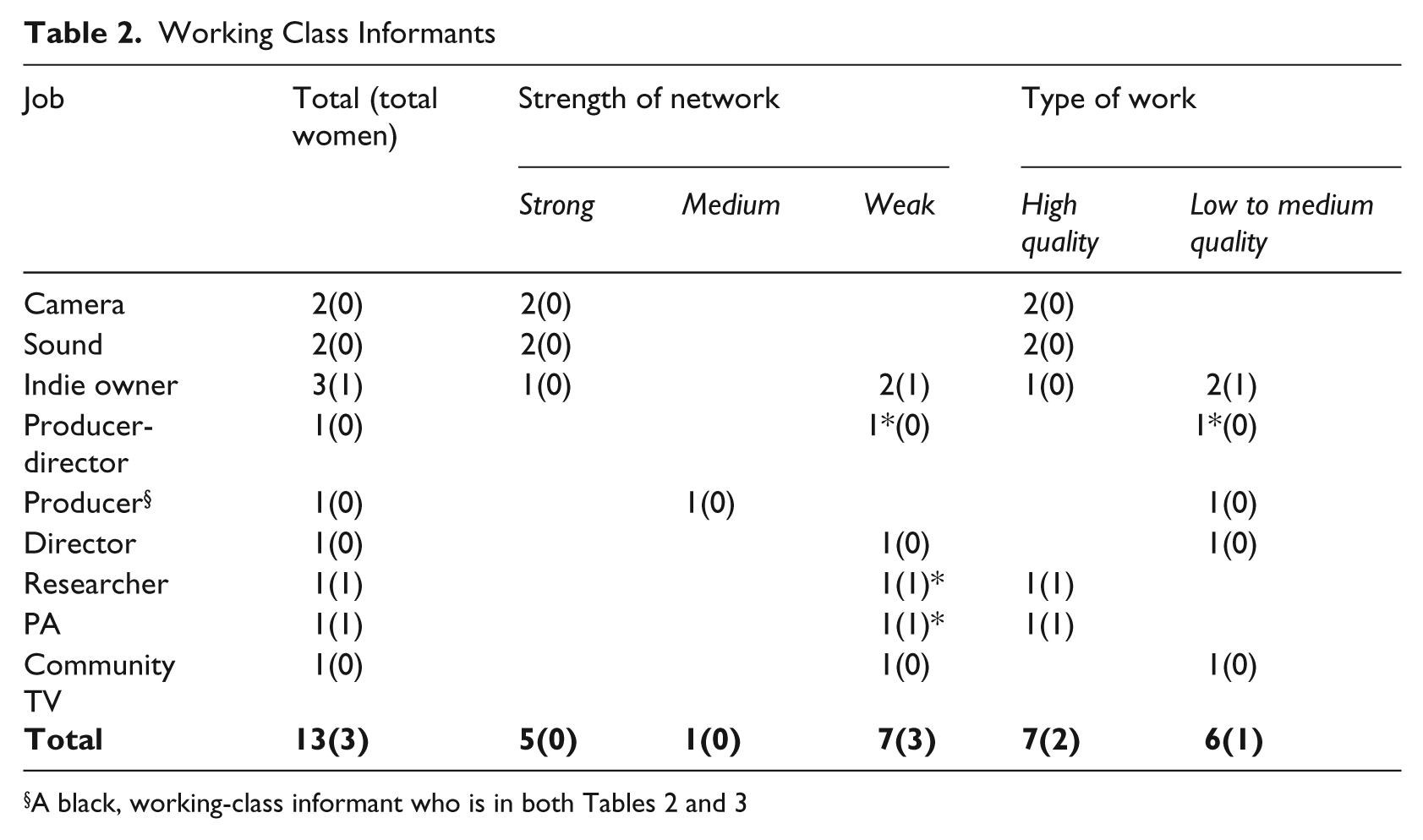
Because this article focuses on the categorical aspects of disadvantage the tables below distinguish between white middle-class (Table 1), working-class (Table 2) and BME (Table 3) informants specifying job titles and gender. In them we draw out both the strength of the network that our professionals had developed in the sense of the number of industry contacts they had and the type of work each was engaged in. In coding we differentiate between ‘quality’ work (feature films, terrestrial or satellite TV productions) and low to medium quality (pop promos, community TV, corporate videos). Although the skills required for each type of work were similar, network-based hiring meant that there was little movement between ‘classes’ of production (Grugulis & Stoyanova, 2009), so these divisions had a significant effect on individuals’ careers.
White Middle-Class Informants

Indicates a developing network
Independent self-financed film
Pop videos for major band
Working Class Informants
Black and Minority Ethnic Informants
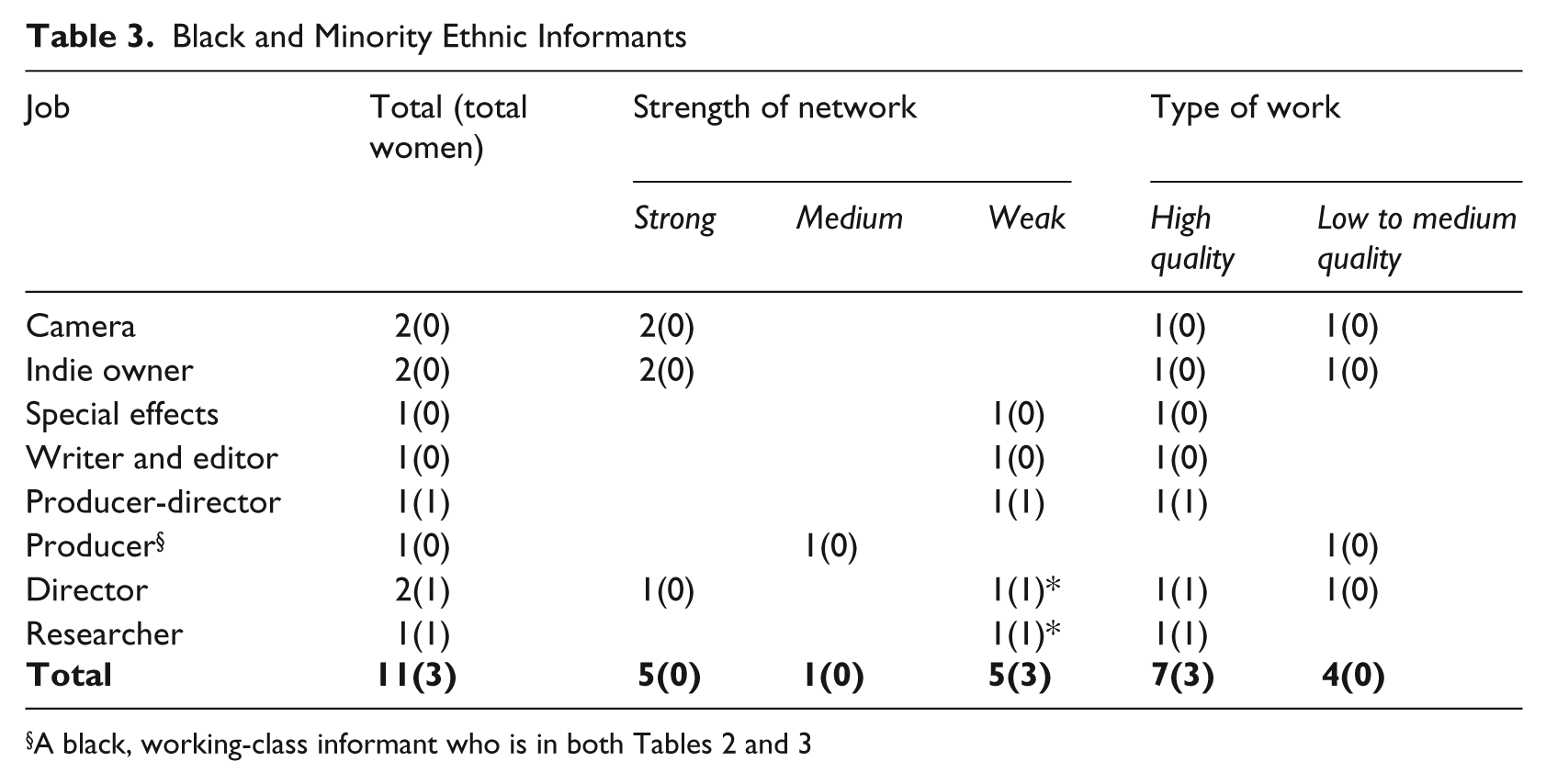
One example, which highlights the practical consequences of the difference between a strong network and a network which linked informants to high-quality work, is that of Jez. Jez was adept at networking. He boasted a considerable number of contacts and friends, but his contacts did not have access to high-quality film and TV work; while Jez’s network was strong, the type of work he and his contacts had access to was of low quality. In this industry, to get high-quality work, individuals needed contacts with access to high-quality work.
Of the 77 informants coded, 54 (just over 83 per cent) were middle class. Given our focus on film and TV production it is probably not surprising that the majority of white, middle-class informants (51/54 or 94 per cent) were engaged in ‘quality’ work and 76 per cent enjoyed strong networks. Interrogating the ‘weak’ networks also reveals further evidence of advantage since seven of the eight professionals in this category were considered to be ‘developing’ (a category we used to describe informants who had access to a network through which quality work could be gained but who were comparatively junior; they had the potential to develop networks which provided access to quality jobs, but had not yet done so; these are marked with an asterisk on the Table).
Working in large companies was an extremely effective means of developing networks which could access high-quality work. Grace, a researcher, secured her first job in a big independent production company (a ‘super-indie’) through a family friend. Having been on a gap year after university and having always wanted to work in TV, she managed to get an informal interview (‘a bit of chit-chat’) and an offer of a low-level job a few hours later. Hard work and initiative got her a reputation with the HR department of the indie and jobs followed this.
And then I just ran for the executives as I say which was literally just sort of helping people out, photocopying, faxing, you know all that kind of stuff. But all very much in-house, you know, it was all through people that knew people that knew people. That sort of offered me out as it were, you get kind of offered around as a runner.
Grace was coded as middle class with network with potential to secure quality work. She had worked on three popular programmes which followed from the contacts she had built. Her network was a good-quality one as it provided paid jobs in TV.
While women made up just under 43 per cent of informants they were disproportionately concentrated in particular jobs, often those of lower status (and it is also worth noting that four of our women interviewees had recently left the sector, generally because of the incompatibility of freelance contracts with childcare). In five of the occupations listed in our tables (camera, sound, editor, indie owner and director) we interviewed no white, middle-class women (in the study as a whole only two women were found in these roles, one working-class indie owner, effectively a sole trader, and one BME director). At the other extreme, six of the seven researchers were women, as were all the location managers, production managers, the costume and make-up artist and the personal assistant. This research was qualitative and explanatory, rather than statistically representative, so these figures may not accurately reflect the industry as a whole, but the Skillset (Skillset, 2005, 2007, 2008; Skillset/UK Film Council, 2008) surveys confirm the gendered division of labour.
A different picture emerges when we examine the networks of, and the projects undertaken by, the working-class and BME informants, summarized in Tables 2 and 3. Not only were working-class and BME professionals statistically under-represented, but also the work they had access to was of far lower quality. Thirteen (just under 17 per cent) of the informants were working class and 11 (14 per cent) BME. Only one informant, a black, working-class producer-director, appears in both Tables 2 and 3 since 10 of the 11 BME professionals, 91 per cent, were middle class. The group included nine Asian respondents and two black, with eight of the eleven being British born. The networks here were far less good with 62 per cent of working-class and 55 per cent of BME informants’ networks coded medium or weak (three working-class and two BME informants were considered to have developing networks, 23 and 18 per cent, respectively). It was also among both working-class and BME informants that the type of work started to look very different, with six (46 per cent) working-class and four (36 per cent) BMEs engaged in medium or low-quality work, including indie owners specializing in wedding videos or transferring home videotape to DVD. For some, this subsidized more creative work and one BME indie owner had won an award for his short-film making, but not even these projects succeeded in bridging the gap to high-quality funded projects.
Informants here were more likely to have fragile links with high-quality work. At the time of our study Rahul was working in a community-funded local film network. He had worked on unpaid student films for two years, then progressed to pop videos and occasional work for Channel 4 productions. But he never got established either in high-quality work or well-paid work and had to claim benefits in between productions.
The discovery that success in the labour market varies by gender, race and class is both a depressing and a familiar finding. Of more interest here were the successful working-class and BME professionals since all of these fell into two distinct categories: technical specialisms such as camera and sound with extended (often formal) apprenticeships; or informants who had worked for one of the major terrestrial broadcasters. In other words, for these informants, spending their early careers learning skills and consolidating professional contacts was an effective counter to the disadvantage and discrimination of class and race. These will be considered in more detail below; first we attempt to explain the sources of middle-class advantage.
Explaining advantage
This middle-class advantage can be explained in a number of ways. There were structural features: entry to the industry and moving up the job hierarchy often involved extended periods working for low or no pay with little guarantee of employment later, an extended apprenticeship that it was far easier for middle-class families to subsidize. But given the importance of networks to gaining and maintaining work, the social side of class was also important, through a shared habitus as well as direct and indirect personal connections.
Middle-class entrants possessed a shared cultural capital, norms and reference points which facilitated relationships (Bourdieu & Passeron, 1990; Bourdieu & Wacquant, 1992) – a factor Putnam (2000) labels ‘bonding’ capital (‘people like me’). In their article on the UK advertising industry, McLeod, O’Donohoe and Townley, (2009) reveal the advantages middle-class mores could convey. So here, middle-class informants who possessed no personal networks in the film and TV sector generally had the cultural capital to be able to fit in (an important criterion in hiring and one recruiters often specifically sought). Abigail, a producer director, stressed that she had had no personal contacts when she started work but she did have a degree from Bristol, a middle-class, Russell Group university, and was able to gain positions first in advertising in New York and then at CNN before going on to work freelance.
For some, advantage was obtained from direct contacts and work in the sector was effectively ‘inherited’. This could be seen most vividly in professionals with close family members in the industry who were almost guaranteed access to social networks and technical skills. Interestingly, numerous informants spoke of bringing their children in to work on set or to observe activities. Daniel, a cameraman, noted that when he started, ‘most people I knew there were either sons or nephews of guys already in the industry’, a surprising number of informants were married to others in the industry, and producer-director Michael’s mother had produced a prestigious BBC series so it was ‘natural progression’ to enter the industry through her network. Others obtained work through indirect contacts. Grace, a researcher, got her first post because her father, a fire safety inspector, knew a fire safety inspector in TV, who in turn knew a sympathetic unit manager; Christopher, a director of photography, became a runner when a friend of his father suggested that he might be interested; while Susan, a production manager, broke through a cycle of no replies from cold-calling CVs when she realized a distant relative was related in their turn to the managing director of a major independent production company, ‘so it was completely nepotism’.
Not fitting in?
It is easy to see why small companies, swamped with unsolicited applications they had little time to check, bereft of reliable signals from the labour market and anxious to preserve quality, used social networks to guarantee competence and staff projects swiftly. But the middle-class advantage did not stop here. Rather, as Tilly suggests, the prevalence of middle classes meant that their mores, even though unconnected to the nature of the work, were often seen as synonymous with professionalism or a job well done. In particular, desirable creative roles were assumed to need middle-class cultural capital, and working-class professionals who succeeded in gaining jobs were often stereotyped into support roles.
Sometimes this seemed logical. Middle-class universities tend to attract the most highly qualified students so a preference for such graduates might be interpreted as proxies for quality or intelligence. In the company in which we carried out our ethnography it was Victoria, the middle-class Cambridge graduate, who was given the role of researcher, developing programme ideas, while her less well-educated and less middle-class colleagues were allocated administrative work (Grugulis & Stoyanova, 2011). On other occasions the reasoning seemed prejudicial.
The difficulty is, once you are a production co-ordinator, people like me, that is what – not me, I would hope not me, but people like me that is what they perceive you as being is the production co-ordinator … And talking to Britney she would love to do … research and move into the creative side. I think her mind is there … The things standing in her way are that she is on the admin side and so she is going to find it difficult to move into another company and be a researcher because her experience has been production co-ordinating really. And I don’t know if I should say this, she – her demeanour, she is blonde, very made up and the way she dresses – this is appalling – this is not my prejudice this is my – when I see her, my initial reaction is: ‘production co-ordinator’ … She has gone to college in [the city], she lives at home with her parents, she is slightly restricted in her experience … You can’t help – your initial reaction is she looks like a production co-ordinator … I mean there are women who you know are big, busty and blonde who become great researchers but it is part of also where she comes from, her background is very present in her visual … the way she presents herself is ‘a woman who lives with her parents in [area of the city] and went to college locally’ … in the freelance world of television you have got to be a bit more mobile these days, not that I am particularly mobile but – and you have got to be able to, I don’t know, cross social boundaries, intellectual boundaries, like I say to get on with people … She would need to show she can … move out of her own social mores.
The elements mentioned here – appearance, attendance at college rather than university, college location and residence – have more to do with class than creativity, but they were used as proxies for creative competence. They were a signalling code, enabling people in the industry to be sorted into either support or creative functions (Jones, 2002). It is probably no coincidence that the majority of the informants who protested about networks and cliques dating back to school and university were support staff, annoyed, like Sandra, a production manager (who was herself middle class), that colleagues ‘all know each other from whatever bloody university they went to’.
This is not to argue that members of under-represented groups (whether class, race or gender) were never successful. Aziz, who had held senior posts in a major terrestrial broadcaster before running his own company (which he sold for a considerable profit after the fieldwork ended), found that being Asian worked to his advantage. He was a member of the main professional bodies and had been involved in judging prestigious awards because every panel needed: somebody from [an] indie, somebody outside London, preferably also somebody perhaps from the ethnic minorities. And I would, sort of, hit that target, you know.
But for the others, such privileges were more apparent in colleagues’ perceptions than in reality. Imran, a writer and editor, reported being told, ‘you will get what you want mate, because you are Asian. And they are always looking for Pakis in the industry’, but this did not translate into regular work. It was not that working-class or minority ethnic informants lacked networks, rather, their networks did not link them in to high-quality production. Prakash, a director, boasted that he no longer needed to send a CV in when bidding for commissions, but his work was limited to council-sponsored public awareness films.
At points, this discrimination clearly had a social aspect. Linda, a producer-director who had started as a camera assistant, explained: And film crews are … a real boys’ club … But like, when I was a camera assistant I used to get quite a lot of, ‘Oh, no, it is a girl!’ – and it was really really rare to have a girl as a camera assistant, really rare … The girls get ribbed at quite a lot … you have this inaugural sort of – electricians or sparks or gaffers and grips who are like – you know – they will just play practical jokes on you and wind you up. Like, you know, really builders’ mentality and they will just do it just to see what your reaction is. And it is just like, it is boring but you have to do it, you have to go through the whole like dance – you know, and then they will go, ‘Oh, she is alright then’.
None of the men mentioned practical joking as an initiation rite, although a few referred to ‘bonding’ activities such as sneaking away to dance in the vans during lunch breaks, so it appeared that the more challenging behaviours were reserved for the women.
There were responses to this. In trying to overcome the unfavourable position they had, and especially their access to networks with limited useful resources, women organized to support each other. Claire, a production manager, was a member of a women-only networking group and obtained her first ‘proper’ broadcasting job through someone she met at the networking meetings. Serendipity certainly played a part in recruitment for many of the people we spoke to (Grugulis & Stoyanova, 2009; Stoyanova & Grugulis, 2012) but, while some of our middle-class informants told us about being hired after making self- and family-funded student films, for others such experience became a reason not to hire them. Imran won a national competition to make a drama for Channel 4 but subsequently found it difficult to get a job as a runner, because he was over-qualified. He then funded his own productions as a student only to be told they were in the wrong format: It was all really becoming quite clear that the reason I wasn’t getting stuff had less to do with my skills and more to do with the colour of my skin.
Not only did disadvantaged informants have to do more to get accepted or to secure work, their networks also seemed more fragile. Malika left the BBC to do a Master’s degree in journalism, but then found it difficult to use her old contacts to get work. Occasionally, the main hindrance seemed to be unrealistic expectations rather than discrimination. Ajay had almost no film experience (he had taken a course in directing and ran a company which made wedding videos) but nonetheless claimed to have turned down many offers of work as a researcher and a runner because he only wanted to direct, but such comments were rare and many of our other informants actually hoped and actively applied for these entry-level positions.
Considering networks and the labour market
The categorical disadvantage described here was experienced at the intersection of the labour market and various social networks. Small firms, hiring from overstocked and opaque labour markets for short projects, rarely made combating discrimination one of their targets. There are clear advantages to a system with an emphasis on informality and social capital. Personal recommendations provided a flexible, inexpensive and swift way to crew a production under conditions where professionals needed to trust each other’s competence and might also ensure there was sense of community to achieve work goals (Adler, Kwon & Heckscher,. 2008). Social capital facilitated recruitment, ensured work standards and policed behaviour on set. However, this under-representation of particular groups, the fact that ‘being known’ was a condition of entry (Dalton, 1966), and the tendency for people to socialize with and recruit those who are like themselves (Moore, 1951) meant that ‘atypical’ workers were actively disadvantaged. The barrier to entry was not a total one, indeed Tilly (1998) likens it to a waterfall rather than a wall, but it was significant. As Simon, an official in BECTU, the sector trade union, said: In terms of the profile of the workforce, that in a sense shakes down over time, from those very very informal recruitment practices in terms of diversity and in terms of access – practical, real access – to the industry. I mean certainly it’s there in terms of ethnic identity you know. It is a very white … In the independent TV and film sector where … there’s nobody making overall decisions because it is hundreds and hundreds of companies making little decisions all the time, and actually the way it shakes out is that it is hideously white in film and it is hideously gender specific in particular departments. And I think … that what used to be gender mixed departments although they might have been sort of 80:20 … perhaps 20 years ago … they have settled down around the dominant gender identity to almost exclude the other one.
In interviews it was the senior staff in the large terrestrial broadcasters who were anxious to ensure fair representation and they, together with the government-funded screen agencies, who ran special projects, held workshops or awarded prizes to encourage talented young BME workers into the industry and equip them with sufficient skills to prosper there. Most of these activities tended to be restricted to BMEs, though some did target women. We found no evidence of any that sought to assist working-class entrants to the sector. Moreover, even where initiatives existed, their success was limited. Many took the form of short workshops or ‘getting to know you’ events in which BME film makers could meet commissioning editors, but this was not the same as winning a commission, which tended to require a far closer relationship developed over time. Longer-term interventions did exist and several informants were part of a regional film network, intended to support activity and networking in the sector. But this, by definition, simply brought together people who struggled to get work, which is not an effective method of tackling disadvantage in a network-based system. All of the informants who were members of this group were coded as having networks which gave access only to low- and medium-quality projects.
Given the emphasis on social skills, exclusion could also have a more subtle effect, as Moss and Tilly (2001) observe in their study of soft skills, race and hiring in the United States. So here, with intense competition for each job and a high level of enthusiasm expected, particularly from new and recent entrants, discontent at previous labour market struggles was likely to contaminate future prospects. This meant that everything from Imran’s plans to sue a regional film agency for racism, to Sandra’s reluctance to be a ‘media schmoozer’, was likely to count against them in the hunt for work.
The issue was not simply the use of networks, indeed Holgate and Mckay (2007) estimate that BME professionals used their networks more actively than their white colleagues, it was the resources those networks had access to. White, middle-class men dominated the senior and more creative roles (Christopherson, 2009), and their networks were more likely to be dominated by other white, middle-class men (Jones, 2002). Women’s networks, like those of BMEs and working-class professionals, were less powerful, and had access to fewer resources (Blair, 2005) so social capital conferred fewer and less significant advantages (see also Belliveau, 2005).
Here there are grounds for both optimism and pessimism. In particular, examination of the areas in which working-class and BME informants were successful was revealing, and suggests that the labour market structures also have a significant part to play in this. Those who possessed strong networks and had worked on high-quality productions had all either secured a specialism which involved extended formal, often apprenticeship-based training; or they had worked for a considerable period of time for one of the terrestrial broadcasters (or both). These processes meant that they gained technical skills and access to social networks. In this industry there are routes out of disadvantage. Unfortunately, given the fragmentation of the labour market, these are increasingly being closed off and fewer new entrants now experience formal apprenticeships or training through full-time, permanent employment. It may be, as our union interviewee suggests, that this will further exacerbate discrimination and disadvantage in the future.
Conclusions
Clearly it is rare to find areas of the economy where social capital is as significant as it is in film and TV (Cattani & Ferriani, 2008). In other sectors major employers, labour market institutions, licences to practice and formal qualifications are all likely to influence opportunities for employment, progression and skills development. Even Barley and Kunda’s (2004) account of freelance IT professionals operating in a comparatively unregulated area reveals intermediaries such as agencies which could assess technical competence. There we would expect a much greater reliance on formal policies, procedures, structures or certification. Given that reservation, and the fact that, in other sectors, the social aspects of work are mediated in ways that are not apparent here, our conclusions still have a wider resonance. While other industries may not be characterized by the recurrent hiring of project-based work, they still value personal recommendations (see Granovetter, 1995, for a classic study of getting a job). It may be that film and TV represent a more intense example of processes observed elsewhere (Smith & McKinlay, 2009) so the conclusions we draw about the way networks confined advantage to privileged groups will have wider resonance, as will the development of the network literature. Our principal contribution here is the empirical account of the way in which this occurred and the reasons some informants succeeded despite disadvantage. But this argument also has theoretical implications since it reinforces the importance of network type, quality, usefulness and context. All networks are not created equal and researchers need to be sensitive to these variations.
In this study, social capital had many real advantages. It provided access to work, guaranteed quality and helped to share skills and knowledge. It also offered a speed and flexibility unlikely to be matched by more formal systems. But the inevitable corollary of this was discrimination and exclusion. Significantly, it was the access which networks provided to quality work, rather than their strength or size, that secured advantage. Working-class, BME and female informants did not network any less actively than their white, male, middle-class colleagues, but they had far less access to high-quality productions.
Occasionally this selective inclusion was a proxy for quality, an identification of elite graduates; but most often the reasons given were far less rational and it would be difficult to attribute the processes we observed solely to a search for talent. Bielby and Bielby’s (1992, 1996) research on the pay gap between male and female scriptwriters argues that the contributory factors included short-term contracting for specific projects, difficulties in judging the final product, the importance of reputation and the male dominance of the industry. So here, wider disadvantages were made possible by the labour market structures.
These groups were discriminated against because they were not trusted insiders. They were not the ‘right’ gender or race, and they did not have the right accents, hairstyles, clothes or backgrounds to join the best networks. Being kept outside these social groups excluded them from jobs. These networks were the practical mechanism through which work was distributed. Jobs were not formally advertised and individuals without access to the appropriate social networks neither got to learn about projects that were recruiting nor were able to provide the sort of personal recommendations that all productions required, a process confirmed by examining the minority of successful ‘out group’ members since they were all established members of professional networks which linked them to high-quality projects. We observed no clear pattern of differences in mores between disadvantaged informants with access to high-quality work and those without, but there was a significant variation in initial work experience. The successful members of disadvantaged groups had all either spent many years working full-time for a terrestrial broadcaster or had joined a specialism with a long (and often formal) apprenticeship, such as camera work. Until 1990 the terrestrial broadcasters, large organizations with strong internal labour markets, dominated production. Employment was secure and productions often involved large teams with professionals employed for the duration of each project. Lengthy secondments to different departments were commonly used as developmental opportunities. This was a good environment for building technical skills but it also allowed professionals extended periods of time through which they could work with and get to know a range of other specialists. In practical terms this meant that any categorical or cultural differences which might hinder social contact could be overcome by repeated professional collaborations.
This focus on the successful minority from disadvantaged groups provided a valuable additional dimension to this study on the way that the networks functioned. Much existing research on disadvantage concentrates on the majority, leaving successes to be explained away by journalist accounts of individual exceptionalism. Yet, as we demonstrate here, there were also structural reasons for success and including them has considerable explanatory power.
These structural reasons for success advantaged our informants but they are also a cause for concern, given the changes to the industry over the last few decades. There are now far fewer jobs available in terrestrial broadcasters, freelancers dominate the labour market and new entrants can expect to spend the majority of their careers in insecure, erratic, project-based work. The period of stable and sustained employment at the start of an individual’s career through which social closure could be combatted is no longer a viable option for the majority. There are initiatives set up to tackle disadvantage but these are seldom effective counters to the problems experienced. Social capital operates and networks exist within structures. Those structures can mitigate the tendency for people to associate in similar groups, as stable employment in the terrestrial broadcasters did, or exaggerate it by supporting short-lived, temporary alliances. These results suggest that such alliances reduce opportunities for members of disadvantaged groups. It appears that, given the changes to the labour market, the tide is running against socially inclusive participation.
Footnotes
Funding
This research was funded by Bradford University School of Management. During the writing up Professor Grugulis was funded by an AIM/ESRC fellowship.
Author biographies
Irena Grugulis is the Professor of Employment Studies at Durham Business School and Joint Editor in Chief of Work, Employment and Society. She is also an ESRC/AIM Services Fellow and an Associate Fellow of SKOPE. Her research focuses on skills and training and has been funded by the ESRC, EPSRC and EU. Recent projects have focused on the retail sector and Retail Work was co-edited in 2011 as well as the creative industries covering film and TV and computer games.
Dimitrinka Stoyanova is a Lecturer in Management at St Andrews School of Management. Her research interests are in the area of work and employment in the creative industries, creative careers, learning and skills development and freelance work. She has studied the above in the context of UK film and television sector and has recently embarked on a project investigating working lives of freelance comedy performers. Her recent join publications with Irena Grugulis appeared in British Journal of Industrial Relations and Work, Employment and Society.