




Abstract
My research suggests that organizational fields are patchy and uneven. This patchiness allows organizations at the margins of fields to sidestep pressures for conformity. As a case study, this paper examines the private school field in Toronto, Canada. Data come from interviews and site visits at 60 Toronto private schools. My findings suggest that Toronto’s private school field is segmented, incorporating diverse private school forms, including elite, religious, and ‘rogue’ (non-elite, non-religious) schools. Within one subfield – small rogue private schools – a high degree of heterogeneity exists. These findings suggest a nuanced conception of institutional fields, with more attention to organizational agency, multiple field logics and diversity among organizational forms. This paper examines how organizations at the margins of fields are able to evade pressures for conformity, and how a heterogeneous organizational field can also be comprised of clusters of homogeneity.
Introduction
In their now classic article, Meyer and Rowan (1977) argued that schools garner legitimacy by incorporating traditional hallmarks of schooling: for example, hiring certified staff, delivering an established curriculum, having full facilities (e.g., gyms, libraries, playgrounds), and being run as non-profit bureaucracies. By adopting these standard elements, schools are insulated from scrutiny, are seen as ‘school-like’ and stable, and are less likely to fail (Meyer & Rowan, 1977, 1978). The new institutionalism forecasts that deviation from the standard template of schooling renders schools open to scrutiny, and liable to fail (Meyer & Rowan, 1978). Consequences are even more severe for private schools, which lack the protection of state funding, and must instead secure parents’ support (see Swidler, 1979). Toronto’s private school field is characterized by heterogeneity. I focus on non-traditional ‘rogue’ private schools: non-elite, small, secular academies, usually with enrolments of fewer than 50 students. They do not emulate schooling scripts and concentrate their limited resources on a pedagogical niche, rather than a comprehensive program.
With few exceptions (see Aurini, 2006; Aurini & Quirke, 2011; Hallett & Ventresca, 2006; Leblebici, Salancik, Copay, & King, 1991; Sauder, 2008), in-depth examinations of organizational actors’ responses to their environment are rare. In recent years, a few scholars have been examining heterogeneity and uncovering the dynamics of how educational organizations resist isomorphic pressures (Aurini, 2006; Davies & Quirke, 2007; Levy, 2006; Quirke, 2009). My study adds to this literature. Following Leblebici et al. (1991), I examine ‘fringe’ actors on the periphery of a field. I maintain that the experience and organizational characteristics of those on the margins of fields are particularly informative (Clemens, 1993). My research examines the topography of one field, exploring how organizations evade conformity (see Davies & Quirke, 2007).
By overtly eschewing ‘compulsory’, core practices espoused by mainstream schools, rogue private schools deliberately establish themselves on the periphery of the field (Meyer & Rowan, 1977). When private schools differentiate themselves from an ideal type of schooling, their legitimacy is arguably weakened (see Tubin, 2009). In this paper, I address two questions. First, what explains heterogeneity within an organizational field? Second, how do ‘rogue’ organizations operating at the margins of fields manage to sidestep pressures to conform? My data suggest that organizational actors are able to evade isomorphic pressures due to (1) the weak regulatory environment, particularly the weak status of the teaching profession, (2) pluralistic institutional logics, and (3) shifting technical and constituent demands.
Theoretical Framework: Organizational Fields
Despite the centrality of the organizational field as a concept in the new institutionalism, there is little agreement over what constitutes a field, a concept that is complex and continuously evolving (Meyer & Scott, 1992; Wooten & Hoffman, 2008). DiMaggio and Powell define a field as ‘those organizations that, in the aggregate, constitute a recognized area of institutional life: key suppliers, resource and product consumers, regulatory agencies, and other organizations that produce similar services or products’ (DiMaggio & Powell, 1983, p. 148). I argue that the most salient feature that defines a field is that organizations face the same regulations and environmental conditions. As many institutional logics may be at play, I emphasize the regulatory environment faced by organizations, rather than defining a field according to the presence of a singular shared logic. I argue that subfields, on the other hand, are largely bounded by the prevalence of a shared logic. For instance, Christian schools comprise one subfield of Toronto’s private school field, as they exist in the same regulatory environment as other types of private school, but share a common logic and worldview.
Scott (2001) suggests that earlier studies characterized fields as largely uniform and comprised of isomorphic pressures (see DiMaggio & Powell, 1983). More recent work characterizes fields as segmented, with substantial diversity among organizational forms (Davis & Greve, 1997; Greenwood & Hinings, 1996; Greenwood, Oliver, Sahlin, & Suddaby, 2008; Greve, 1996; Kondra & Hinings, 1998; Kraatz & Zajac, 1996; Levy, 2006; Lune & Martinez, 1999; Rowan, 2006). As fields mature, they may be characterized by heterogeneity, rather than homogeneity (Kraatz & Zajac, 1996; Schneiberg, 2002, Wooten & Hoffman, 2008). Notably, Lune and Martinez (1999) argue that organizational fields are segmented into distinct subfields, where organizations can better preserve their identity within a larger institutional environment.
Many scholars document heterogeneity among educational organizations, particularly within private education (Aurini & Davies, 2005, 2004; Boerema, 2006; Davies & Quirke, 2007; Kraatz & Zajac 1996; Levy, 2006; Quirke, 2009; Rowan, 2006). Notably, Levy (2006) found considerable diversity in the field of higher education in several nations, with different types of institutions providing services for different segments of the student population. For instance, public universities may promote traditional liberal arts, while emerging private institutions may tout practical, market-oriented credentials (Levy, 2006). Kraatz and Zajac (1996) found that, instead of becoming isomorphic with their institutional environments, liberal arts colleges worked to align themselves with the needs and values of their members and constituents, thus sidestepping pressures for conformity.
Fields and the multiplicity of logics
I argue that fields are characterized by a multiplicity of logics, as organizations can opt to correspond with alternate logics and sources of legitimacy. The new institutionalism’s earlier works overstated the coherence and unity of institutional environments and their influence over organizations (Scott, 2008), rendering little success in explaining persisting organizational heterogeneity. Other research emphasizes the ability of organizations to sidestep isomorphic pressures (Boxenbaum & Jonsson, 2008; Greenwood et al., 2008; Kondra & Hinings, 1998; Levy, 2006; Rowan, 2006). The notion that institutional environments impose structural uniformity upon passive organizations has given way to the recognition that fields may be fragmented, ‘containing competing requirements or prescriptions’ (Scott, 2008, p. 430; Friedland & Alford, 1991; Thornton, 2004). Parents may be motivated to opt for private schooling because of religious beliefs or their disagreement with the state’s educational mandates. They may feel that public schools give too much homework or, conversely, not enough. In the post-secondary sector, students may seek divergent paths, such as a broad, liberal arts education over an instrumental, job-focused program (Levy, 2006).
Environments espouse competing philosophies which vie for dominance (Scott, 1991). Institutions can simultaneously face multiple cultural logics, as they face different segments of pluralistic environments (Tubin, 2009; Van Gestel & Hillebrand, 2011). As such, organizations may be ‘legitimated by multiple mythologies’, while influences within an institutional environment may be multiple and contradictory (Kraatz & Block, 2008, p. 244, emphasis in original; see also Boxenbaum & Jonsson, 2008; Clemens, 1993, 1997). Multiple logics may be at play within a field, with actors changing their practices along with shifts of dominant logics (Lounsbury, 2007; Owen-Smith & Powell, 2008; Powell, White, Koput, & Owen-Smith, 2005; Stone, 1996).
As such, many philosophies or logics exist within institutional environments. For instance, Canadian schools are underpinned by a dominant philosophy that schools should prepare children for post-secondary education and entry into the workforce. Competing ideologies also vie for dominance; critics may call for public schools to simultaneously incorporate more cutting-edge technology, a service/consumer ethos, efficiency, sensitivity to children’s self-esteem, or increased physical activity within the school day. In tapping into alternative sources of legitimacy, organizations may forego traditional legitimacy, instead seeking support from particular segments of the population. In this way, organizational diversity can be understood as a natural consequence of organizations’ autonomy in choosing or creating their formal structures.
Agency
I emphasize the agentic nature of organizations, whereby organizational actors may strategically respond to institutional pressure in non-uniform ways (Boxenbaum & Jonsson, 2008; Oliver, 1991). Organizations can actively evade isomorphic pressures (Oliver, 1991; Scott, 2008). A multiplicity of field logics fosters organizations’ agency. While Meyer and colleagues have questioned the agency scholars may attribute to organizational actors (see Drori, Meyer, & Hwang 2009; Meyer, 2010; Meyer & Jepperson, 2000), there remains much debate about the rightful role of agency in explaining organizational change (see Hwang & Colyvas, 2011; Lawrence, Suddaby, & Leca, 2011). My work focuses on the experiences of rogue private school principals, and ‘the connection between this lived experience and the institutions that structure and are structured by it’ (Lawrence et al., 2011, p. 52). I posit that organizational actors can exercise discretion in adopting organizational change, innovating in response to external pressures (Dobbin, Kim, & Kalev, 2011; Goodrick & Salancik, 1996). Aurini (2006) emphasizes the autonomy organizational actors enjoy, as they shed key organizational elements, yet manage to retain legitimacy. Private tutoring organizations were able to thrive after divesting themselves of core ‘schooling scripts’, by strategically conforming to institutional pressures (Aurini, 2006, p. 83).
In the face of competing philosophies vying for dominance in the larger environment, an organization within a field may strategically opt for a particular course of action, and rely on a variety of rationales to justify its operations (Scott, 1991). New private schools may choose to emulate established models of private schooling by adopting traditional hallmarks of elite schooling. Alternately, they may attempt to appeal to a particular segment of parents and students. While some parents will desire the standards and prestige associated with venerable elite schools, others might seek a smaller, more relaxed educational environment.
Organizations can opt to seek legitimacy from unconventional sources and can maintain legitimacy without compromising their organizational practices to isomorphic pressures (Clemens, 1993, 1997; Levy, 2006; Quirke, 2009). Indeed, organizational actors can effectively advocate for a particular course of action even in the absence of supporting environmental norms, with some organizations more disposed to innovation (Dobbin et al., 2011). Organizations’ resurrection of dormant organizational practices creates increased heterogeneity and variation in the field (Wooten & Hoffman, 2008).
Shades of rogueness: assessing distance from the ideal type
I argue that homogeneity and heterogeneity exist along a continuum between two poles, with an institutional model or ideal type at one end, and non-conformity at the other. An ideal type may exist at the core of a field, with unconventional organizational forms at the periphery. Organizations do not simply either conform, or fail to conform; responses may be nuanced, as organizations choose to selectively conform to particular elements of the environment. As such, my data describe nuanced gradations of homogeneity and heterogeneity. Below, I discuss four dimensions along which I expect organizations to be similar. Schools experience pressure for conformity in several core areas: governance, physical structures, adherence to a professional model 1 of schooling (i.e., supporting professional norms such as formal certifications), and curriculum (see Table 1).
Private schools and dimensions of conformity.
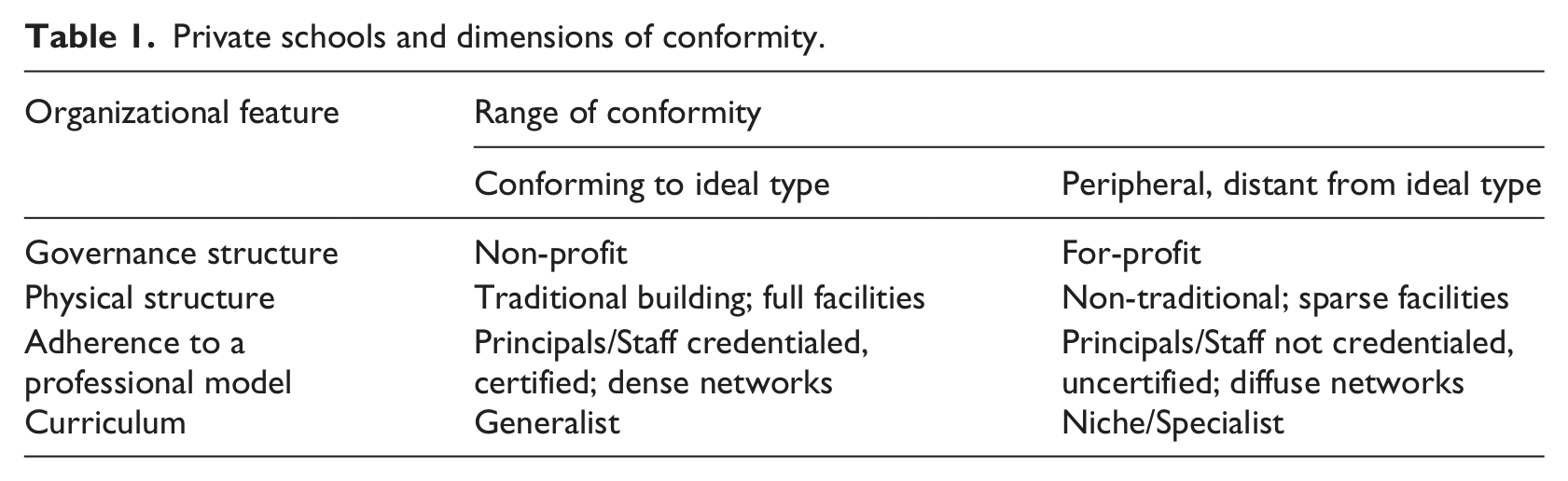
Variability in conformity along a menu of features allows a scaled understanding of how pressures for conformity within a field may vary in strength. Some organizational types may conform closely to an organizational model, with others quite distant from such an ideal type.
The Toronto Private School Field
Toronto is the provincial capital and, with a population of 2.5 million, Ontario’s largest city. The city boasts a private school enrolment rate of 10 percent, nearly double the provincial average (Ontario Ministry of Education, 2003). Private schools do not receive funding from the state. Loose provincial legislation regarding private schools currently allows for unrestricted growth and expansion in a largely unregulated environment (Aurini & Quirke, 2011). Prospective principals may operate in any venue, once they submit documentation that their premises have been approved by health, safety, and fire officials. As long as they provide instruction during regular school hours to at least five students, private schools are free to operate as either for-profit or non-profit organizations.
Indeed, Toronto’s private school sector is an educational free-for-all. Any individual can operate a private school, hiring any staff they deem suitable; private school principals may hire and fire teachers as they see fit (see Quirke, 2009). Professional influence is weak in this sector. All teachers and principals in public, state-funded schools must be certified members of a professional association, the Ontario College of Teachers. In contrast, neither principals nor private school teachers need to be certified by the state; experience is not required. There are no umbrella or professional organizations that unite private school teachers, or foster professional networks. The private school sector is left virtually unchecked by both state and professional influence.
In terms of curriculum, elementary (grades K–8) schools can deliver any curriculum they wish. These schools are not inspected and have complete freedom to teach any content that suits them. To offer Ontario high school credits, secondary schools (grades 9–12) must follow the province-wide curriculum offered in publicly funded schools; their curriculum documents are inspected by the Ministry of Education to ensure compliance. Nevertheless, accountability and school choice movements have not taken hold in Canada as they have in other jurisdictions. Lacking national educational performance outcomes or standardized testing mandates that schools (either public or private) must meet, the government plays a relatively weak role in education, and private education is not promoted by the state (Aurini & Quirke, 2011; Davies & Quirke, 2007; Quirke, 2009).
Private school growth
Toronto’s private school sector has witnessed dramatic expansion in recent years, along with corresponding province-wide growth (see Davies, Quirke, & Aurini, 2006). Private school enrolments have grown; the proportion of schoolchildren attending private schools province-wide increased by 60%, from 3.3% in 1990 to over 5% (Ontario Ministry of Education, 2008). The growth of private schools in Ontario has nearly doubled in the past 20 years. Currently, there are more than 900 private schools in Ontario, compared with 496 in 1991 (Ontario Ministry of Education, 2008). Decades ago, private schools – which consisted of religious, elite, and military schools – offered little choice. This is no longer the case (see Figure 1).

Private Schools by Type: City of Toronto, 2009 (N = 229).
Elite preparatory private schools: compulsory conformity
Elite ‘independent’ schools offer a competitive, challenging academic curriculum. Established between 1829 and 2002, they are operated as non-profit organizations by boards of directors (see Maxwell & Maxwell, 1995a; Russell, 1993). They enrol roughly 15 percent of private school students (Davies & Quirke, 2007). All 18 of Toronto’s elite schools belong to one umbrella organization, the Conference of Independent Schools (CIS); all undergo its rigorous accreditation process. Elite schools continually undergo arm’s length evaluation by the Canadian Association of Independent Schools to ensure core standards. Schools differ in terms of their history, mission or clientele (e.g., all-girl versus co-ed). However, elite schools adopt similar practices to ensure congruence with overarching standards of accrediting agencies and umbrella organizations. In short, elite schools’ conformity is mandated by accrediting bodies.
Tuition fees are typically in the $20,000 range, but can vary from $10,000 yearly for very young children, to more than $45,000 for boarding fees. Four out of five elite schools are located in traditional school buildings, and many boast lavish facilities. As an example, one boys’ school, established in 1850, is located in traditional ivy-covered stone buildings on 32 acres of property in mid-Toronto, and boasts a pool, sports fields, tennis courts, art and music studios, and a library with over 15,000 items. On average, elite schools enroll more than 600 students, and closely follow a professional model; more than 90% of elite school principals or heads are certified teachers and typically have advanced degrees. One third of elite schools hire only state-certified teachers (see Davies & Quirke, 2007). Elite schools highlight their staff members’ advanced degrees and international pedigrees and, failing that, their experience teaching in other elite schools, in their voluminous promotional material. Staff profiles on school websites attest to dense institutional linkages, as teachers may teach at several elite Toronto schools throughout their careers. Elite schools have close ties with one another that stretch back well over a century. Headmasters and headmistresses of leading schools have been formally meeting together since the 1930s (Russell, 1993). Today, these local alliances and professional networks remain strong, maintaining traditions of sports leagues and co-curricular activities across the city.
Elite schools tend to mimic each other’s practices (Maxwell & Maxwell, 1995b). Regarding curriculum, elite schools offer a broad liberal education (see Davies & Quirke, 2007). Elite schools typically offer material more challenging than public schools, enhancing their exclusivity and prestige. More than nine out of ten Toronto elite schools offer either advanced placement courses or the standardized International Baccalaureate (Davies et al., 2006).
Elite schools are the standard-bearers among private schools, and typify a private school model. Notably, when rogue private school principals did reference another private school, they typically mentioned one of two elite schools as the standard, or what parents imagine, when they think of what a private school is. They garner legitimacy by remaining similar to the traditional school form; they are non-profit organizations, have dense professional networks and offer a comprehensive, generalist, well-established school structure. As such, elite schools in Toronto appear to represent the core of the field, and can be seen as resembling an ideal ‘private school’ type.
Private religious schools: varying coherency and common mission
In Ontario, roughly four in ten students attending private schools go to schools offering religious instruction (Ontario Ministry of Education, 2000). Ontario is home to various faith-based schools, including Christian, 2 Jewish, and a growing number of Islamic schools. These schools each cater to a particular faith community; their content may centre on doctrine and religious beliefs, and may include second language instruction (e.g., Hebrew). As a group, religious private school fees range from $3,000 to $18,000; schools may be subsidized by religious communities or donations.
Toronto is home to approximately 26 Christian and 26 Jewish private schools; and gaining in prominence, approximately 24 Islamic 3 schools (see Figure 1). With respect to school governance, religious private schools are a mix of non-profit and for-profit structures. Some are located in traditional school buildings, but newer schools in particular tend to operate out of much humbler locations, getting by with sparse facilities. Their physical structures vary widely, with many more established schools of all faiths located in traditional school buildings, and others in more modest quarters (Zine, 2008).
Christian and Jewish private schools in Toronto have close access to post-secondary institutions in the area that host B.Ed. programs. These institutional linkages provide a local hiring pool of provincially certified teachers who are specifically trained to teach in Christian and Jewish private schools. Many Islamic schools lack formally qualified teachers, and do not yet have strong links with post-secondary institutions that could provide formal training for would-be teachers.
Professional networks are reasonably strong among Christian and Jewish schools. Many Christian and Jewish schools are members of larger umbrella organizations that assist and advise schools, providing curricular material, accreditation, professional development, access to large networks, expertise, and tuition relief for parents. For instance, teachers at private Christian schools in Toronto can engage in professional development at an annual convention overseen by the Ontario Christian School Teachers’ Association (OCSTA). In contrast to Christian and Jewish schools in Toronto, Islamic schools do not yet have a central board that accredits or oversees their operation, nor do they enjoy the local presence of supportive agencies whose mandate it is to provide resources and professional development.
With respect to curriculum, faith-based, specialized schools, such as Montessori or schools catering to special populations within the faith community, are rare. Instead, a generalist approach is more typical. Attempts to professionalize and standardize religious private schools are the most well-established in the Jewish community. A number of years ago, concerns around minimum educational standards existed among Jewish schools founded by parents or other community members who ‘may not have achieved high level educational academic qualifications’ (UJA Federation, 2010, p. 1). Toronto’s Board of Jewish Education played a key role in helping to raise educational standards, so much so that the assistance of the Board in this respect is perceived as no longer needed (UJA Federation, 2010). Toronto’s Centre for Jewish Education oversees Jewish private schools, comprising a de facto school board, standardizing school operations, ‘best practices’, governance and staffing (UJA Federation, 2010).
Religious schools: between the core and the periphery
Certainly, there is a substantial degree of variation within these three groups of religious schools; they do not conform or fail to conform to the traditional school model in lockstep. For instance, larger, more well-established Christian schools may exhibit more conformity (e.g., certified teachers, traditional school building, non-profit governance) than a Christian school located above a pizza shop that has opted to govern itself as a for-profit entity, hiring largely uncertified staff. While scholars such as Zine (2008) have provided rich data about religious schools, more research is needed to understand the various and strategic attempts of faith-based schools to gain and maintain legitimacy. As a group, compared with elite private schools, religious schools exhibit fewer features associated with an ideal private school type.
If anything, religious schools – as a group – appear to be a hybrid form: they incorporate some elements of the traditional school form while shedding others. Faith-based schools conform to the general tenets of the ideal private school type in their support of a professional organizational model and a generalist curriculum. However, religious private schools do not always conform with respect to for-profit governance structure and non-traditional facilities and school buildings. A professional model where credentials are prioritized coexists alongside a non-professional model, where teacher credentials are seen as secondary in importance to a faith-based worldview. It is common for non-certified individuals to teach in faith-based schools. They seem to do so with parents’ blessing. Parents do not seem to expect that all teachers are certified; they appear patient with schools that are in the midst of professionalizing and improving standards (UJA Federation, 2010; Zine, 2008). Islamic schools seem to be the most fledgling and distant from the ideal private schooling type, as many schools are so new, and they as yet lack links with post-secondary institutions to provide state-certified teacher training.
Case Study: Toronto’s Rogue Schools
One in five Ontario private school students now attends a rogue private school. This diverse assortment of schools is distinguished by specialized pedagogy and often bears the telltale influence of the idiosyncratic decisions of their founders and principals. Noted for their small size and specialized focus, they lack the resources to offer a wide breadth of courses or the full range of activities offered by a local public school (Davies & Quirke, 2005, 2006). Three-quarters of rogue schools are located in non-traditional settings, such as business space, strip malls, or older houses. The remainder rent space in public school buildings, and do not necessarily have access to gym or playground facilities. At the time of the survey, none owned a traditional school building nor a portion of one. Parents did not object to enrolling their children in non-traditional spaces, such as in one school in a plaza storefront: We have to go to the park to do phys. ed., which is a block away. It’s outdoor phys. ed. . Unless it’s raining or snowing or something…I thought people wouldn’t come, but that was a full class. Then we added [grades] 5/6, and I said well, who’s going to want to come to a shopping plaza to put their big grade 6 kid in? Well, that class was full, so then it just goes to show that if you provide a quality education, people will come, even if it’s in a hole in the wall like this. They will come. (Dundas Academy)
Resources such as libraries, science laboratories, gymnasia, and even playgrounds were frequently positioned as unnecessary by principals, citing parental support in this respect.
Rogue schools do not attempt to emulate either public schools or elite private schools, both of which generally provide well-rounded extracurricular experiences. Of the 45 younger schools surveyed, only two were actively trying to establish themselves as mid-size, elite 4 independent schools. Rather, they are educational ‘boutiques’, striving to create niche markets within their educational subsector. The vast majority embrace unconventional organizational niches and actively entrench their positions as unique. Rogue schools claim to offer small classes, individual attention, and a nurturing warm atmosphere with a personal touch (see Quirke, 2009), rather than elite resources, status, and social connections.
While many are small, and adopt a niche or specialist curricular form, their commonalities should not be overstated. Rogue private schools are characterized by their diversity rather than their similarities (see Davies et al., 2006). Depending on the interests and strengths of their founders or principals, they try to attract a certain type of student, such as gifted students, athletes, or students with learning disabilities or special needs. Some are characterized by a particular philosophical or curricular focus, such as a female-centered or values education emphasis. Others do not tout a special philosophy, but cater to particular age groups, e.g., senior high school students. One school offers museum-based schooling to students in grades 6–8, where museum collections are used as the basis for students’ problem-based learning. One high school functions as a classical liberal arts school, whereby students must exceed state requirements by learning either Latin or ancient Greek, and taking either art or drama classes each year. Many high schools concentrate on offering individual courses ‘by the credit’, instead of requiring students to take multiple classes simultaneously or to enroll full-time. These schools tend to organize their classes to resemble tutorials. Schools may also entice students to enroll by extending classes to two or three hours of intensive instruction daily so that students spend the state-mandated number of hours in class but finish credits in as little as six weeks. Some schools are more radical than others. Some schools overtly espouse a particular pedagogical or philosophical viewpoint that forms the centerpiece of their operations, while others espouse no clear distinguishing philosophy.
Methods
This study relied on interviews conducted with private school principals and school owners. The sample of rogue private schools was drawn from Ontario’s publicly available registry of private schools. 5 ‘Rogue schools’ are defined as private schools that are non-religious, not listed on the elite independent registry, and not Montessori, Waldorf, international, language or reform schools. At the time of data collection in 2004, Toronto was home to 64 rogue private schools. I conducted interviews with 60 of these schools, asking about school enrolments, staffing, teacher credentials, programs, and school mission/philosophy. With interviewees’ permission, all but one interview was tape recorded and transcribed. Each school was assigned a pseudonym, randomly named after a subway station or major city transit hub. Three principals declined an interview, and one did not return my calls.
Of the 64 rogue schools, 45 had been in operation for 15 years or less. I selected these ‘younger’ schools for closer study, conducting site visits and expanded in-depth interviews at these schools, because they were less established, and I wanted to learn about their decision making with respect to founding and operating their school. Expanded interviews lasted between 45 and 120 minutes, and were unstructured, allowing interviewees to elaborate on their experiences and share anecdotes (see Aurini & Quirke, 2011). The in-depth interview schedule asked interviewees about topics such as the circumstances of the school’s founding, how they perceive their own school, and how they see other private schools in the city.
I analyzed the 45 transcripts from the ‘younger’ schools using QSR NVivo and coded each interview three times. The first pass at coding organized interview data into general categories, while the second pass coded data into more finely-honed theory-driven categories, such as the extent to which principals experienced isomorphic pressures and what type of pressures (e.g., coercive, normative, etc.). I also incorporated an open coding scheme that allowed me to code inductively, creating categories as they emerged from the data (see Aurini & Quirke, 2011). A final reading of the data further refined these analytic categories, both theoretically informed ones (e.g., isomorphic pressures), and ones that emerged from the data. These data allow me to examine the experiences of front-line actors who are staking out territory on the fringe of an established field, to explore their micro-level decisions and perceptions.
Findings
Toronto’s private school field is segmented and diverse, with private schools varying widely along a number of dimensions of core organizational features. There is a broad range of variation in organizational responses to pressures for conformity. Organizations strategically conformed to some core characteristics, while abandoning other key features. For example, elite schools appear to conform most closely to an ideal type, while religious schools can be characterized as a middling or hybrid model, conforming on some dimensions but not others. What explains this field heterogeneity? Second, how do ‘rogue’ organizations at the fringes of fields evade conformity?
What is it about this organizational field that contributes to such patchiness?
Certain factors contribute to the patchy nature of organizational fields. First, with weak regulation and sparse infrastructure, Toronto’s private school field is fertile ground for organizational diversity. Second, it is a pluralistic field, and is able to support multiple logics – allowing alternative appeals to legitimacy – ultimately fostering segmentation and organizational diversity. Finally, I argue that heterogeneity in this field is due in part to organizational responses to changing technical demands, notably shifts in parental expectations, which encourage varied organizational responses across the field.
Weak regulations and sparse infrastructure
Lack of regulation in Toronto’s private school field stems from the state’s attempt to allow faith-based schools flexibility in hiring staff, e.g., religious schools can hire uncertified individuals from their faith communities. In practice, this absence of regulation creates a low baseline regarding state demands for conformity. The field of private schooling in Toronto allows for a range of organizational responses, as schools conform to varying degrees. Perhaps in response to the lack of oversight in this field, elite schools voluntarily attach themselves to external accrediting agencies, such as the Conference of Independent Schools of Ontario. External endorsements, and elite schools’ close curricular ties with the International Baccalaureate, allow elite schools to distance themselves from the unregulated tenor of the field.
Religious texts and beliefs act as a form of regulation or guidance, providing schools with common curricular and organizational scripts. Secular schools operate in the same field, but without equivalent pressures for conformity or the common mission that religious doctrine provides. The segmented and patchy nature of the private school field is due in part to the weak baseline for conformity required by the state, and also to schools’ varying adherence to external bodies, whether secular or spiritual.
Teachers’ lack of market shelter contributes to organizational diversity within this weak regulatory environment. The state provides stable market shelter to some professions (e.g., doctors, dentists), making it unlawful for unlicensed competitors to practice (see Freidson, 2001). However, teachers do not enjoy this protected status; any person can lawfully encroach upon their jurisdiction, performing ‘teaching work’ without a license. The teaching profession has a weak presence in Toronto’s private school field. While teachers’ professional body, the Ontario College of Teachers, and two teachers’ unions (one French, one English) hold no jurisdiction over private schools, the teaching profession has no say over this field, making it particularly vulnerable to intruders (Ingersoll & Perda, 2008; Quirke, 2009). While outsiders to the field lack the philosophical cohesion and common training that promote conformity, even insiders, former teachers and principals, also can act as change entrepreneurs (see Castel & Friedberg, 2010).
Conformity to organizational norms is more prevalent in elite and religious school subfields, where (voluntary) accrediting bodies and umbrella organizations provide resources and are actively involved with private schools. The lack of regulation in private schools leaves a void, where the teaching profession might otherwise be influential. Without an overarching board or body to which private schools must answer, the field is truly open, providing ease of entry to uninitiated actors. The absence of accrediting bodies with true leverage or power over schools lifts all but the most basic expectations for conformity. While many private schools choose to conform to core features of schooling, rogue schools’ deviance and distance from schooling norms demonstrate the lack of influence exerted by external bodies.
Multiple logics within a pluralistic institutional environment
Like many fields, Toronto’s private school field faces a pluralistic institutional environment that is able to support multiple logics simultaneously (see Reay & Hinings, 2009, 2005; van Gestel & Hillebrand, 2011). Fields have increasingly been conceptualized as ‘ambiguous and heterogeneous with multiple institutional pressures that often result in conflicting pressures for conformity’ (Boxenbaum & Jonsson, 2008, p. 84). As I have discussed earlier, institutional environments may support conflicting logics; they may support any number of pedagogical or philosophical approaches to schooling. The larger environment is pluralistic and is fertile ground for a broad range of organizational templates. As one principal summarized, when she founded her small ‘holistic’ school, she deliberately chose her own niche, so as not to mimic other types of private schools: I was looking at the private schools that do exist already. I thought why start another one? There’s lots of private schools out there, right? But when I really took a close look, there’s lots of private schools that are religious-based schools, and other ones that are really academic focused and – in my own opinion – very similar to the public system, but just have a different image. And I had talked to a lot of parents who didn’t fit into either of those categories. They didn’t want their child going to a school where they’d have to keep up with the Joneses and all that stuff. A lot of parents would tell me they didn’t want their kid in a school that they thought was elitist. And they didn’t want their kids in a religious school, because they didn’t follow a particular religion. (Wilson Academy)
As such, there are many types of private schools, but this does not preclude additional variation. Parents may bring widely divergent preferences to private schools. There is no consensus among parents that a private school should embody particular characteristics; the institutional environment can support a diverse assortment of organizations simultaneously.
Shifting parental demands
Finally, another factor that contributes to the patchy nature of organizational fields is the changing nature of constituent demands. Fligstein (1991) argues that organizational fields are not placid, inert places. Instead, he argues that fields undergo constant change, and can indeed experience turbulence. Powerful organizations can create shocks to the system, such as when new legislation compels organizations to alter their practices. Due to changes in middle-class parenting in Canada and elsewhere, the field of private schooling is somewhat in flux, with organizational actors scrambling to respond to the newest strains of consumer demand.
Today’s parents are arguably savvier than in the past. They hold more formal education, are more informed, sophisticated, and intimately acquainted with education systems than previous generations. As such, they are less deferential and more critical of the educational establishment (Davies & Guppy, 1997). Growing numbers of Canadians, particularly those with high levels of formal education, may have higher educational standards and expectations (Guppy & Davies, 1999). Moreover, middle-class parent activism is on the rise. ‘Parent power’ has emerged as local parent groups attempt to modify schooling to suit their own interests (Davies & Guppy, 1997; Gidney, 1999). Compared with working-class parents, middle-class parents are more likely to be critical of teachers, and are less likely to defer to teachers’ professional autonomy (Lareau, 2000, 2011). Schools face two primary demands from their environments: credential competition and intensive parenting.
Increasingly, more students and their parents come to desire and expect that they will participate in school systems, resulting in greater credential competition (Davies & Guppy, 2010). To schools, shifting parental desires are a powerful force in the environment. Notably, greater concern is afoot about the importance of educational credentials. Post-secondary education is increasingly being seen as the base requirement for job success in future economic markets. Clearly, childrearing today exists in a climate of heightened interest for children’s educational chances, something that is not lost on rogue principals. As one principal noted: Most kids, the stat was 20 years ago, only 25% of kids wanted to go to university, now it’s 78% in grade 9 want to go to university. So obviously there’s going to be more graduates coming through, wanting to go to university now. Anecdotally, that seems to be the case, that there’s a lot more informed parents…The more informed the parent is, sometimes the more trouble. (Dundas Academy)
As such, rogue principals observe the changing environmental pressures around them, as the climate shifts to one of increased concern for credentials. This principal was typical in his observation that parents can bring substantial influence to bear on a small school; many principals discussed the need for their school to respond to parents’ particular wishes.
In addition to increased concern about credential competition, scholars document recent shifts in middle-class parenting practices. Research suggests that parenting practices, particularly among middle-class families, have intensified in recent years (Hays, 1996; Lareau, 2011; Sayer, Bianchi, & Robinson, 2004). This parenting is characterized by investing enormous amounts of time in the day-to-day care of children. Hays (1996) argues that the logic of intensive mothering requires that mothers interact with their child at virtually all waking moments, attending closely to the child’s needs and demands. As such, rather than becoming simpler and more efficient, parenting has become more complex and time-consuming, as parents invest much time and energy raising their children (Lareau, 2000, 2011; Hays, 1996; Stevens, 2001). Children are increasingly viewed as unique beings with complex, individualized needs. Stevens (2001) argues that cultural assumptions about modern childhood have changed. Stevens (2001) posits that there is an ‘aggrandized individualism’ afoot in contemporary culture, manifested in an expansion of individualism and a growing ethos of self-fulfillment. In other words, increased attention is given to notions of self-development as a worthy pursuit, and a heightened conception of the individual and his or her needs (Stevens, 2001). What does this mean for childrearing? The importance of nurturing one’s expanded self has infused norms of childrearing as parents are increasingly sensitive to the needs of children as individuals, and strive to nurturing children’s ‘little selves’ and accommodating their distinctiveness. Children’s individual distinctiveness has come to be celebrated and valued (Zelizer, 1985). The rise of what I call the ‘documented childhood’ is a good example of the expansion of childhood. Parents enact a documented childhood as they take copious numbers of photographs of their child, chronicling charming quotes, which they then use to blog, scrapbook or otherwise post to social media, documenting everything from developmental milestones to everyday routines (see Goodsell & Seiter, 2011; Medley-Rath, 2010; Subhani & Kanwal, 2012). This attention to children’s distinctive lives resonates with a larger cultural celebration of individualism.
Intensive parenting practices place heightened pressure on schools (see Lareau, 2000). The findings of this study suggest that rogue private schools perceive a particular, concerted style of middle-class parenting, and that they aim to cater to parents’ heightened expectations of schooling. School personnel feel as though they are under heightened scrutiny from parents: I think most kids right now are over-parented. Completely overindulged…Teachers are on their toes all the time, walking on thin ice just in case they speak to Johnny in a way that might sound threatening to the parent when he takes it out of context to give his version of what happened. (Courtice Academy)
These shifts represent a change in technical pressures; as parents demand more attention for their children and more nurturing, and approach the school with heightened scrutiny, organizational actors may feel compelled to respond. Another principal demonstrated the extent to which technical pressures are changing, and how his school responds to parents’ heightened expectations: They want their kids to be treated as individuals. Parents today, there’s no longer three or four kids in a family, it’s one or two. They micro-manage their kids. Which I think is ridiculous… They have their whole days planned for them. And when they come to a school, they expect their kid to be micro-managed as well. And that’s not a good thing. But I think that with us, because we have a small class size, parents perceive, okay, my kid – and we do actually give them a lot of attention…Let’s say if you have 400 kids in a school, does that principal know that 400th kid? No way. I know every kid in this school. (Dundas Academy)
Parental demands comprise a shifting technical environment to which schools must respond. Various private schools may perceive these shifting pressures, drawn from changing childrearing practices. Further research is necessary to examine how elite and other types of private school respond to these changing demands. Overall, I maintain that organizational diversity within Toronto’s private school field is fostered by actors’ varied responses to fluctuating environmental demands.
How do rogue schools sidestep isomorphic pressures?
Rogue schools can be expected to conform to traditional school models along a number of dimensions: governance structure, physical structure, professional model of teaching, and curriculum. They fail to conform on any of these dimensions. Rogue schools’ ability to evade pressures to conform is fostered by the three conditions described above. First, the field’s weak regulatory environment and lack of infrastructure allows isolated schools run largely by outsiders and non-conformists to maximize unilateral power. Second, a pluralistic environment that supports multiple logics enables rogue schools to make alternate claims for legitimacy that more than compensate for penalties for deviating from core features of schooling. Third, shifting technical demands provide fertile ground for organizations to tap into particular niches of support, allowing them to concentrate their resources on a narrow constituency. Rather than offering an educational experience that appeals to all, rogue schools offer particular pedagogical themes and approaches, enjoying success by staying small and appealing to specific student niches. Below, I outline the extent to which rogue schools conform to an ideal type, along four dimensions: governance structure, physical structure (i.e., traditional school buildings), a professional model of teaching, and curricular offerings.
Strategic autonomy
As others have shown, in weak regulatory fields, organizations may be less likely to conform (see Dobbin et al., 2011). Rogue schools’ weak regulatory environment and its corresponding lack of infrastructure, together with organizational actors’ willingness to shed core features of schooling, mean that they can successfully avoid conformity. While most private schools leave their deviance potential partially untapped, rogue schools take full advantage of the weak regulatory field as they deviate on all core facets of schooling. They deliberately reject established norms of schooling, taking advantage of all opportunities to maximize internal control over their operations. Specifically, they maximize their organizational control by operating as for-profit businesses, and by promoting a non-professional model of teaching that localizes decision making in the hands of principals.
Governance structure: the merits of for-profit
Rogue schools’ leverage of the potential autonomy of for-profit governance structure is notable. Dispensing with convention established by Ontario’s oldest private schools, three-quarters of rogue schools are governed as for-profit businesses, entrenching their organizational structure as unconventional from the outset. As one for-profit principal argued, non-profit schools are seen in a more positive light: ‘We are for profit. There’s no putting any semantical flip on that’ (Dundas Academy). However, for-profit principals were uniformly pleased with their decision, regardless of how they may be negatively perceived.
I would rather pay, it’s $40,000 worth of taxes to be paid here [in this building]. And I’d rather pay the taxes than be not-for-profit. Because I’ve worked with boards, and I hate boards! [laughter] I hate boards so much that I’d rather be in debt than work with a board. So, no, I’m for-profit. I don’t make any money, but I’m for profit. (Davisville Academy)
Principals cite the greater latitude and personal control that for-profit status affords them. As one principal explained, ‘I’m controlling and bossy, and I want to run the school my way. I didn’t really want to have to sit down with a committee every time I decide to hire someone or make a change in the curriculum’ (Sheppard Academy). Rogue principals appreciate their ability to run their schools as they see fit, over the moniker of having a ‘not-for-profit’ school. Rogue principals saw non-profit status as personally risky; if they ran afoul of an unpredictable board of governors, they feared being dismissed from their own school. For-profit rogue principals take a calculated gamble; they deliberately absorb the negative implications of being ‘for-profit’, or hiring uncertified staff, locating their school above a pizzeria, and so on. The trade-off of deviating from the traditional school form is autonomy. Principals of for-profit schools enjoy substantial decision-making latitude, without having to align their agenda with a board of directors or accrediting body. These isolated schools govern unilaterally as for-profit entities, virtually free from oversight.
Rogue private schools do not endorse a professional model of teaching (see Quirke, 2009). Eighty-six per cent of rogue schools hired uncertified staff, compared with two-thirds of elite schools. Moreover, rogue schools promote a non-professional ethos of teaching, where a lack of formal credentials is signaled as a badge of authenticity, not a failing (Davies & Quirke, 2006; Quirke, 2009). No movement to professionalize is afoot. Rogue schools are unapologetic about preferring uncertified teachers, attesting to their superiority, regardless of credentials. Rogue principals are largely unsupportive of core professional characteristics, such as formal training, qualifications, and teaching specialization (see Ingersoll & Perda, 2008). This disdain for certified teachers was commonplace; even certified rogue principals often denigrated their certified teachers as out of touch, ‘miserable’, ‘burnt out’, and having a ‘union mentality’ (Quirke, 2009).
Principals overwhelmingly make hiring decisions in an idiosyncratic manner and do not generally take credentials or specialization into account when they hire staff. Some simply draw on their own social circles to hire enthusiastic individuals who have no formal teaching experience (Quirke, 2009). Personal attributes are the sole job requirement in many rogue schools; there appears to be no standard set of criteria upon which teachers are hired. Principals can swiftly dismiss teachers who do not share their views. In this way, the principal’s mission is not diluted by the competing interests of staff.
Principals are drawn from eclectic backgrounds, ranging from disgruntled homeschooling parents to entrepreneurs. Roughly half of the principals interviewed were state-certified teachers, and report having felt constrained by the bureaucracy of the public school system in the past. Principals who were uncertified as teachers came from a range of backgrounds, from teaching in private schools, to nursing or business. Outsiders to education, they report bringing innovation and fresh ideas.
Rogue schools do not draw upon common hiring pools. There is no commonality of experiences (e.g., socialization through teacher training) among teachers in rogue schools. As rogue schools are headed and largely staffed by such an eclectic group, there is an absence of a coherent unity of mandate among schools. One principal argued, ‘Every private school is different from other private schools. They’re all their own little entities, because they’re at the whim of the people in charge, from a philosophical standpoint’ (Bay High). Isolated and unaffiliated with other organizations, rogue principals are not exposed to a cohesive expectation of what a school should look like (Finnigan & Daly, 2010). With weak connections to other private schools, principals are not pressured by their network of professional colleagues to conform to operational templates (see Burt, 2004) and are free to run their schools as they see fit.
Professional networks among rogue school teachers are scarce. This subfield is virtually devoid of opportunities for professional socialization, for teachers to meet, share information, and compare experiences. Most principals quietly operate their own school, rather than foster connections with other schools. In particular, non-certified individuals who teach at rogue private schools lack former classmates or a network of teaching colleagues with whom they can foster connections. The few connections between rogue principals are non-reciprocal and negative. A handful of principals had previously worked with or for another principal, before branching out to start their own school (usually after a falling out); none were on speaking terms.
Toronto’s rogue schools strategically tailor their practices to align with the beliefs and needs of their particular constituents rather than a traditional private school form. The link between autonomy and responsiveness is at the heart of what enables rogue schools to survive. Most rogue schools have deliberately structured their practices so as to maximize their autonomy; by choosing for-profit governance, they have a great deal of latitude to operate their schools. This allows them to quickly and unilaterally respond to students’ and parents’ idiosyncratic requests: If I have a class that we feel should be kept smaller, or we have a child who needs help, we don’t necessarily have to go through a lot of red tape; we’re able to provide it… [In the public system] there’s a slowness to the process. That means you have, if the parent is sitting in front of you and that’s what the child needs Monday, you still have the process to go through…Their system is more encumbered, which makes sense considering it’s a large school board and I’m sure there’s paperwork you have to fill out and you can’t independently make these decisions. So I think cutting through the red tape as it were, is an advantage of the private sector. I think parents in some way feel that there’s more accountability. I’m not too sure why. I think in this case it’s smaller, and they know! We don’t have strikes and lock-outs, so they know what they’re getting. I think they feel in some ways that the administration can be more responsive in a way. In the public sector, they may be more encumbered by union restrictions and things like that. It’s not as easy to do something about it as it is in an unrestricted situation. (Wellesley Academy)
As this principal notes, private schools can change and implement new policies at the behest of the principal (Davies & Quirke, 2006). Having the autonomy to act unilaterally allows schools to be more responsive in order to ultimately retain students.
For relatively new, secular schools, pressures to follow tradition, to cater to influential alumni or adhere to faith doctrines are non-existent. Rogue schools can actively take advantage of the state’s lack of interference, and structure their operations as they see fit. Unlike schools governed by a board of directors, rogue principals are afforded a sense of symbolic and often literal ownership of the school, which grants them a fuller degree of authority than other principals (see Kerchner, 1988). This maximization of autonomy in an already weak regulatory environment allows principals to retain their status, power, and control – and thus their pedagogical vision or philosophy – over time without feeling coerced to conform to standard templates of schooling.
Appeals to alternative environmental logics
As I have argued elsewhere (see Quirke, 2009), rogue schools are particularly adept at appealing to alternative sources of legitimacy. As they deviate from many key features of schooling, they compensate by making alternate claims to legitimacy. By embracing for-profit status and rejecting professional norms of schooling, rogue schools burn bridges with many potential patrons. Rather than decoupling their practices from their espoused philosophy, such as by hiring uncertified teachers while touting the value of teacher training, rogue schools’ philosophy and practices are more aligned. They are unapologetic about their structures and practices, openly questioning the value of teacher credentials and championing alternative logics, as the case may be. Rogue schools can ward off criticism by appealing to popular values of individualism, responsiveness, parent control, choice, and market logic (Davies, 1999). In this way, they can sidestep isomorphic pressures and maintain their forms, while protecting themselves from scrutiny.
Notably, rogue schools championed a consumer ethos that emphasized their ability to nurture students (see Quirke, 2009). As one principal explained, the caring atmosphere at his school (located in a shopping plaza and employing no certified teachers) was popular with parents who wanted particular compassion: We had one mother mention a scenario that was pretty indicative of the public system. Her son in grade 9, grade 10 was having problems. The art teacher was giving him a hard time. And she went to the principal and said, ‘Theoretically, I have no problem with what’s going on in class, but I want the teacher to be a little more motivating, a little more nurturing.’ And the principal said to her, ‘We’re in the business of education, not in the business of nurturing’. And she’s sending her son here [laughter]. (Bay High)
Notably, as they fall short in incorporating a logic of professionalism, rogue principals invoke a caring consumer ethos, reassuring parents that their child will be given close attention and treated as an individual (Quirke, 2009). Rather than making appeals to legitimacy based on a logic of efficiency or professionalism, rogue schools garner support by making an alternative appeal to legitimacy, one based on the importance of responsiveness and attention to consumer preferences (Davies & Quirke, 2006). By offering a ‘nurturing atmosphere’, rogue schools no longer need to accrue legitimacy through traditional means and can successfully shed features associated with a standard template of schooling. While traditions and norms do exist and persist in the private school field, these organizational norms are not obligatory, particularly when organizations can make alternative claims to legitimacy.
Serving niche constituents
Finally, to survive while flouting core organizational templates, rogue schools concentrate their resources on a small number of supportive constituents rather than aligning with institutional scripts (Davies & Quirke, 2007). Within the field, different types of private schools serve a multitude of communities and constituencies. In doing so, they differ substantially from each other. Rogue schools deliberately avoided becoming similar to local elite prep schools, in favour of keeping their own unique educational approach (see Davies & Quirke, 2006, 2007). Notably, rogue schools distance themselves from a ‘mass’ system, and make concerted appeals to niche segments of the population.
More than 90 percent of rogue private schools offer a specialist curriculum, or target a specific student population. Without libraries, science laboratories, gymnasia or schoolyards, rogue schools generally do not have the physical capacity to offer the full range of academic courses. One principal of a rogue high school that caters to senior high school students characterizes her school in relation to public schools: We’re not in the same – we don’t even pretend to do the same thing. They offer the full gamut of a school. This is very much a tutorial approach. I do one thing. I offer credits. I offer support to go to Ontario universities. That – all of those other things that high schools have historically offered, I can’t offer…It’s very, very simplistic. I’ve taken education down to the most common denominator, and that is delivering credits. I think if you start to branch off from that, then I don’t think I would be as effective. (Spadina High)
However, there was a great deal of variation among rogue schools. Schools tended to take one of three approaches, with respect to specialization (see Davies and Quirke, 2007). First, many schools, particularly K–8 elementary schools, varied their curriculum extensively, departing from the standard curricular norms. These schools espouse diverse philosophies and specialize among a host of curricular themes, including ‘core knowledge’, social justice, girl-centered, and intensive academics.
A second approach adopted by some schools was to appeal to parents by offering some incentive, service or convenience. Many high schools, unable to deviate from the state curriculum, took this approach: they started classes at 10 am, compressed course instruction into just a few weeks, and offered high school courses on a per-credit basis. Finally, many schools targeted a particular segment of the local student population, such as schools enrolling gifted students, elite athletes, or students with special needs (Davies & Quirke, 2007).
As discussed above, schools face parents’ expectations, which act as a source of coercive pressure. As one principal noted, when she was trying to start her school, she encountered difficulties: ‘But we didn’t have the kids…It took a year to find five students, who wanted to be revolutionized’ (Bay High). As such, parents and students can act as an isomorphic force, prompting schools to temper their aims, in order to remain relevant and attractive to parents and students. Although they eschew some traditional trappings of schools, rogue schools must retain enough small-scale legitimacy among key supporters (e.g., fee-paying parents) to keep running smoothly. By shielding their organizations from external influence and appealing to niche populations of parents for support, rogue schools are able to survive in the face of pressure to conform.
Most rogue principals expressed a desire to remain small. With neither government funding nor wealthy alumni, they focus their resources on providing their own brand of schooling, thus trying to attract specific student and parent populations. For example, one principal, who runs a school with fewer than 20 students, typifies the logic that underlies his decision to serve a particular student population: ‘There’s a certain type of student who I know I’m successful with… If the [public] system is having trouble meeting the needs of a million, I’d have trouble meeting the needs of 50’ (Mimico High). Even the youngest and least-established rogue private schools are able to cleave to their own unique philosophy while serving small, specific populations. For example, the principal of Christie High explained that his school originated to meet demand from a very specific student subpopulation, those who sought an enriched curriculum with a focus on the liberal arts. Rogue schools meet with success by actively creating and structuring their organizations so as to cater to particular constituencies (Davies & Quirke, 2005). Even during times of uncertainty, they are able to maintain their own modest aspirations, sometimes enrolling only a handful of students.
In addition to staying small and developing their own curricular niche, rogue schools differ markedly from elite schools with respect to their frame of reference. The majority of elite prep schools voluntarily use quantitative indicators of their success (e.g., advertising the extent to which their recent graduates have been admitted to prestigious out-of-country universities, and participating in a rating system of a conservative think tank). In contrast, rogue schools opt out of rating schemes. Only one in 30 rogue schools advertised indicators of their quality (Davies & Quirke, 2007). Rogue schools use a local frame of reference, aiming only to fulfill their own niche base of support; they do not aim to demonstrate their performance, only to satisfy fee-paying parents. In sum, by staying small, and restricting their professional expertise or curricular offerings to a specialized theme or pedagogical philosophy, rogue schools can concentrate their resources on meeting the needs of a niche group of constituents.
Overall, my research suggests that institutional fields are patchy, with diversity interspersed with clusters of homogeneity (see Greve, 1996). Segments or subfields within organizational fields may be organized according to different principles. I maintain that isomorphic pressures operate differently within different private school subfields. While other private school subfields may be subject to stronger isomorphic pressures, I argue that rogue private schools, as a group, do not conform to one model or ideal type of school; thus, they sidestep isomorphic pressures. Using what autonomy they can muster, rogue schools deliberately eschew core features of schooling, knowing they can compensate for these shortcomings by appealing to alternate logics or sources of legitimacy.
Theoretical models that are well able to predict the workings of some fields (e.g., mainstream public schools, elite private schools) may not explain the margins of those fields. This field of private education dramatically illustrates the different ways in which schools respond to isomorphic pressures. Within this field, clusters of schools (e.g., elite schools) are highly isomorphic, while others adopt a ‘rejective’ response to the norms of mainstream schooling (see Nelson & Gopalan, 2003). Overall, a range of conformity, or shades of rogueness exist across organizational fields. Organizational actors may deliberately distance themselves from the core of a field, illustrating the importance of exploring the nuanced way in which actors choose to conform. Rather than emulating well-established forms of private schooling, rogue schools position themselves on the periphery of the field, opting to operate as small, isolated for-profit entities, and entrenching themselves as unconventional. As such, the field of private schooling in Toronto casts the patchy nature of institutional fields into sharp relief.
Discussion and Conclusion
This study demonstrates the heterogeneous and segmented nature of organizational fields (Kraatz & Zajac, 1996; Lune & Martinez, 1999). The results of this study suggest considerable variety among school types. This study has presented a number of dimensions upon which organizations can be expected to conform (e.g., governance structure, physical structure, professional model of teaching, and curriculum), and has illustrated the range and variation with which organizations conform. While rogue private schools vary their practices from an ideal type on all dimensions, others vary on some dimensions and not others. Variation among organizational forms is an underdeveloped concept within the new institutionalism. As Levy notes: ‘isomorphism may be frequently and increasingly weaker than the new institutionalism suggests’ (Levy, 2006, p. 155). The findings of this study suggest that institutional fields may be segmented, with patches where isomorphic pressures may be stronger or weaker. While these patchy areas within fields may be small, their theoretical importance is substantial (see Leblebici et al., 1991). As Schneiberg notes, attention to the peripheries of organizational fields is warranted: ‘change and the rise of new organizational forms often begins with champions of alternatives operating at the peripheries of established fields, where social control is generally weak and actors are exposed to multiple models’ (Schneiberg, 2002, p. 65).
Moreover, the Toronto private school field demonstrates that organizational fields are heterogeneous, while supporting homogeneous clusters of organizations. Overall, institutional links among various schools, and also between schools and accrediting bodies or other umbrella organizations, all prompt schools to become more similar to one another. Pressures for conformity appear particularly strong for elite schools, who must meet rigorous accreditation standards in order to continue as a member of the elite Conference of Independent Schools (CIS), and perhaps less so for fledgling Islamic schools, who are currently establishing themselves and working to institute professional standards as they expand. Ultimately, these findings demonstrate that heterogeneous organizational fields can support numerous clusters of relatively isomorphic organizations.
My work further demonstrates that organizations do not conform or fail to conform in a binary, categorical way, but instead can be located along a continuum of conformity, or shades of rogueness. Organizations may be closer to a core, or more peripheral in terms of their adherence to organizational norms. Borgatti and Everett’s (1999) concept of coreness can shed light on how networks, or the absence of networks, are aligned with organizational variation. While my data illuminate the organizational features of private schools, rather than network connections, one fruitful area of further research would be to examine the connections between organizations, with an eye to enhancing our understanding of organizational fields (Borgatti & Ofem, 2010; Owen-Smith & Powell, 2008). Rogue schools are notable for their lack of connections not only to elite or religious schools but to other rogue schools. They appear to occupy a peripheral position in the field; they lack network ties, and deliberately position themselves on the field periphery. These actors set up shop in something of a void, or structural hole, with respect to collaboration or networks (Burt, 1992). While I cannot determine a causal direction using this data set, weak professional networks and adherence to professional norms appear to be associated with weaker pressures for conformity, on the periphery of the field. It may be that actors who embrace a structural location on the periphery of a field prefer to be isolated, as was the case with the vast majority of the rogue principals in this study who wanted to unilaterally run their school as they saw fit. One fertile area of future research would be to further examine why organizational actors appear to be drawn to the periphery. While personality items were not a primary research aim, my research data suggested a particular ‘curmudgeon effect’, whereby principals of unconventional rogue schools were notable for their palpable dislike of working with others, instead preferring to remain isolated (see Burt, Jannotta, & Mahoney, 1998).
My findings underscore the importance of agency, that is, organizational actors’ ability to modify their social structures (see Covaleski & Dirsmith, 1988; Fligstein, 1991; Oliver, 1991). My research suggests that organizational actors have autonomy to select the environmental elements to which they want to conform and to pursue a strategic course of action when relating to their institutional environments (Scott, 1991, p. 170). I argue that diversity within organizational fields is intricately linked with autonomy; those organizations that can secure some control may leverage it into the creation of unconventional organizational structures.
While I document the autonomy and agency enjoyed by Toronto private school principals in this study, I also acknowledge the institutional context in which they operate their schools: the constraining expectations and demands of fee-paying parents, and the varying influence of professions and the state. In their discussions of the emphasis placed on individual actors in scholarly research, Meyer and colleagues make the argument that modern actors celebrate efficiency, and generally ‘valorize’ credentialed expertise, hiring and relying on credentialed ‘professionalized others’ irrespective of the utility of their credentials (Drori et al., 2009; Meyer & Jepperson, 2000). This depiction of organizational actors did not reflect my data, as my respondents did not celebrate efficiency, and were more likely to reject credentialed expertise. For their part, my respondents call into question the legitimacy of the state as an authority. Rather than invoking the expertise of experts or an authorizing agency, the agency enjoyed by rogue principals was akin to a traditional form of authority, vested in a charismatic individual who can hire and fire staff at will. I found that the ‘actors’ in my study failed to conform to these proclivities of modern actors as suggested by Meyer and colleagues, and their organizations did not depend on the centrality or authority of professionals (see Drori et al., 2009; Meyer & Jepperson, 2000). As such, my analysis of rogue organizations offers something of an agent-centered explanation of the decisions and behavior of private school principals, which I argue remains true to my data. More research is needed to assess the agency enjoyed by actors in rogue organizations.
Meyer and Rowan (1977) posit that organizations that vary their structures from core elements of schooling, or create unconventional structures, are vulnerable to scrutiny and censure. However, this may risk may only materialize if these unconventional elements are not otherwise legitimated within the institutional environment (Quirke, 2009). In other words, organizations can innovate and incorporate non-traditional elements without risking their legitimacy, as long as they make an appeal to an alternate source of legitimacy, a logic that resonates with constituents. As Greenwood et al. argue: ‘not all organizations respond in similar fashion to institutional processes…organizations confront institutional contexts containing multiple and inconsistent myths that allow for multiple yet equally legitimate responses’ (Greenwood et al., 2008, p. 11). In this case, rogue private schools jettisoned a logic of professionalism, but replaced it with a consumer logic with a nurturing flair. As such, this study has highlighted several contributions to the new institutionalism. It has highlighted the vitality and importance of organizational actors’ agency, illustrating how organizations can offset threats to legitimacy by making alternate appeals for legitimacy. As such, organizations may turn to multiple mythologies in order to substantiate claims for legitimacies (Boxenbaum & Jonsson, 2008; Clemens, 1993, 1997; Kraatz & Block, 2008). The importance of environmental context, when examining organizational actors’ responses and strategies, is underscored here (see Greenwood & Hinings, 1996). This study illuminates the pluralistic and shifting nature of institutional environments, demonstrating the range of ways that organizations respond to shifting environmental demands.
The case study presented above indicates that weak regulatory environments create something of a free-for-all, ultimately fostering organizational variation. Organizational actors can enjoy a measure of autonomy, which helps them shed core organizational features, while retaining legitimacy (Aurini, 2006). Moreover, it may be that the level of institutional pressure may vary throughout a field (Lounsbury, 2001; Özen & Küskü, 2009). Organizational fields are not only heterogeneous, but they can be home to clusters of homogeneous organizations. This work examines the topography of one institutional field, emphasizing the uneven and heterogeneous nature of organizational fields. Overall, this research draws the boundaries of one organizational field, illuminating how classic ‘institutional’ organizations operate in a weak regulatory environment, largely beyond the reach of state and professional bodies. It demonstrates the extent to which organizations are inhabited, with their features deliberately drawn through the agency of organizational actors (see Hallett & Ventresca, 2006). It furthers our understanding of the new institutionalism, by tracing the contours of one field, and demonstrating the range of organizational diversity therein.
Footnotes
Acknowledgements
The author would like to thank Jeffrey Aguinaldo, Janice Aurini, Mark Chapman, Scott Davies, Alexandra Marin, Jasmin Zine and three anonymous reviewers for their helpful comments on earlier versions of this article.
Funding
This research was funded by a Social Sciences and Humanities Research Council of Canada (Initiative on the New Economy) grant, awarded to Scott Davies.