




Abstract
This paper explores trust-building in multi-stakeholder partnerships. Through an analysis of the development of one multi-stakeholder partnership between a multinational corporation, two levels of government, and local indigenous peoples, we found that trust-building is a dynamic process in which emotionality plays a key role. Critical emotional incidents can unexpectedly punctuate the partnership process, serving as turning points in the development of trust. We also found that the practices used by the partners to navigate these incidents transformed negative emotions into positive ones. We theorize on the role that critical emotional incidents and emotional engagement practices play in multi-stakeholder partnerships.
Keywords
Introduction
Multi-stakeholder partnerships, together with broader approaches of stakeholder engagement and collaborative arrangements, are increasingly important mechanisms through which firms seek to improve corporate social responsibility (Albareda, 2010, Seitanidi & Crane, 2009), solve social problems (Kanter, 1999), and improve social welfare (Berger, Cunningham & Drumwright, 2004). They are also emerging as means to achieve strategic corporate goals (Sloan, 2009) and enable systemic change (Senge, Lichtenstein, Kaeufer, Bradbury, & Carroll, 2007).
Despite their widely recognized value and an abundance of practices aimed at promoting success, multi-stakeholder partnerships often fall short of expectations (Eden & Huxham, 2001), prove difficult to sustain (Bryson, Crosby, & Stone, 2006), or even fail (Albareda, 2010). Tensions, negative episodes (Eden & Huxham, 2001), and crises (Seitanidi & Crane, 2009) can further undermine their survival, with many becoming forums for contestation (Tomlinson, 2005). Some scholars have claimed that the rhetoric of partnership may have outpaced its reality (Googins & Rochlin, 2000, Vangen & Huxham, 2003b).
Lack of trust is a key problem in these arrangements (Tomlinson, 2005; Waddock, 1988). Trust – the willingness to rely on another’s actions in a situation involving the risk of opportunism – facilitates organizational cooperation and collaboration (Mayer, Davis, & Schoorman, 1995; McAllister, 1995). It is the “lubricant and glue of collaborations” (Bryson et al., 2006, p. 47) and the key to partnership success (Selsky & Parker, 2005; Waddock, 1988). However, trust cannot be assumed a priori (Tomlinson, 2005), and often takes considerable time to develop (Waddock, 1988). Obstacles to trust development include partner stereotypes (Waddock, 1988), different languages, values and cultures (Murphy & Arenas, 2010), the history of relationships (Mandell & Steelman, 2003), and power imbalances (Tomlinson, 2005). The literature on trust-building in multi-stakeholder partnerships – along with that on inter-organizational collaborations (Das & Teng, 2001; Inkpen & Currall, 2004) – has tended to focus on the rational practices that build trustworthiness, including setting modest, attainable goals (Vangen & Huxham, 2003a), sharing information and communicating effectively (Murphy & Arenas, 2010), demonstrating competency and good intentions (Bryson et al., 2006), or keeping promises (Murphy & Arenas, 2010).
The broader literature on trust, however, acknowledges it to be a ‘fundamental, complex aspect of human interaction’ (Weber, Malhotra, & Murnighan, 2005, p. 76) with psychological foundations that influence the willingness of an individual to accept vulnerability in his or her interactions with others (Rousseau, Sitkin, Burt, & Camerer, 1998). Trust thus includes both cognitive and affective dimensions (McAllister, 1995; McEvily, 2011; Williams, 2001). To date, studies of multi-stakeholder partnerships have tended to overlook the cognitive and affective micro-foundations (Felin & Foss, 2005) of interpersonal trust, and the dynamics of trust-building in these arrangements over time.
In this paper, we respond to calls for more longitudinal studies of trust development (Lewicki, Tomlinson, & Gillespie, 2006), by conducting a multi-year, multi-method case study to explore the question ‘How is trust developed in a multi-stakeholder partnership?’ Our focus is on the complex cognitive and affective dynamics between individuals engaged in a multi-stakeholder partnership, and our aim is to theorize about interpersonal trust development in this context. We do so by adopting a practice orientation (Langley & Abdallah, 2011), as it allows us to better understand how the structural contours of organizational life unfold over time through the interactions of people (Feldman & Orlikowski, 2011; Jarzabkowski, 2005).
Our study suggests that trust-building is a dynamic process in which emotionality plays a central role. We reveal how ‘critical emotional incidents’ can unexpectedly punctuate the partnership process, and serve as essential turning points in the development of trust. We also show how ‘emotional engagement practices’ enabled the partners to connect on an emotional level, and navigate these incidents in ways that transformed negative emotions into positive ones. We develop a theoretical model demonstrating how these incidents and practices contributed to a dynamic cycle of trust-building that led to an expansion of partnership objectives.
Our study offers new, empirically grounded insights into the complex relationship between cognitive and affective trust (McAllister, 1995; McEvily, 2011) as well as into the processes and patterns of trust-building (Weber et al., 2005). It underscores the importance of emotionality in organizations and reveals the nature and role of emotional engagement practices, thus contributing to the growing body of practice-oriented scholarship (Feldman & Orlikowski, 2011).
Defining Multi-stakeholder Partnerships
The mounting importance of multi-stakeholder partnerships has helped drive a growing body of academic research into collaborative approaches to stakeholder relationships. These arrangements go by a wide variety of names, including ‘partnerships’ (e.g. Seitanidi & Crane, 2009; Tomlinson, 2005), ‘collaborative groups’ (e.g. Bryson et al., 2006), ‘inter-organizational arrangements’ (e.g. Mandell & Steelman, 2003), ‘social alliances’ (e.g. Berger et al., 2004), and ‘cross-sector social partnerships’ (e.g. Selsky & Parker, 2010). The difficulty in defining these arrangements is well acknowledged (Googins & Rochlin, 2000; Mandell & Steelman, 2003; Selsky & Parker, 2005; Tomlinson, 2005).
In this paper, we use the term ‘multi-stakeholder partnerships’, which we define as formalized arrangements in which organizations from diverse sectors (private, public, and not-for-profit) commit to work together in mutually beneficial ways to accomplish goals that they could otherwise not achieve alone. This definition takes into account three basic premises. First, it recognizes the diversity of the partners. Unlike typical strategic alliances in which the partners are business firms seeking economic and relational benefits from collaboration, multi-stakeholder partnerships often include private corporations, public and governmental bodies, as well as non-profit partners (Bryson et al., 2006; Kanter, 1999). Second, the organizations have come together to attain goals that otherwise might not be accomplished independently (Mandell & Steelman, 2003; Warhurst, 2005), often by sharing knowledge and expertise (Vangen & Huxham, 2003b) and drawing together diverse and complementary competencies (Loza, 2004). Third, the partnership aims for mutual benefit (Waddock, 1988), win-win situations (Googins & Rochlin, 2000), and synergistic outcomes that give a ‘collaborative advantage’ to the partners (Vangen & Huxham, 2003b). While some partnership definitions focus on societal benefits (Selsky & Parker, 2010; Waddock, 1988), our definition makes room for strategic business benefits as well.
Trust in Multi-stakeholder Partnerships
The challenge of building trust in the context of a multi-stakeholder partnership, as in other contexts, involves both cognitive and affective dimensions (McAllister, 1995; Williams, 2001). The cognitive element centres on perceptions of an individual’s trustworthiness and the expectations of predictable, reliable behaviour of one party by another (Mayer et al., 1995; Tomlinson, 2005). Cognitive-based trust develops through calculated judgements (McEvily, 2011) that people make on the basis of experience and repeated interactions (Williams, 2001). It thus reflects a rational choice (McAllister, 1995; Weber et al., 2005).
Affect-based trust, in contrast, is anchored in the emotions and feelings that people have for one another. It reflects genuine care and concern (McAllister, 1995), along with goodwill and benevolence for others (Mayer et al., 1995). The level of affect-based trust can reflect the similarities or differences among members in a social group: similarities are associated with positive beliefs and feelings, while dissimilarities may evoke feelings of threat (Williams, 2001). Its development has been linked to both frequent interactions and peer-focused citizenship behaviours, that is, caring behaviours that are personally chosen rather than role prescribed (McAllister, 1995). Although the underlying mechanisms by which such attachments form remain poorly understood, the reliability engendered by frequent cycles of exchange, risk taking, and successful fulfilment of expectations (Rousseau et al, 1998), as well as the regulation of threats and the management of emotion (Williams, 2007), are seen as being important in the process.
The dynamics of trust development in a multi-stakeholder partnership may be heightened by the emotions of the individuals who come together in it. Emotions pervade the day-to-day interactions of individuals in a wide range of organizational contexts (e.g. Waldron & Krone, 1991; Waddington & Fletcher, 2005), including situations in which actors come from different social groups (Williams, 2001). Emotions are increasingly understood to influence organizational behaviours and outcomes related to decision-making (Maitlis & Ozcelik, 2004), the implementation of strategic initiatives such as mergers and acquisitions (Sinkovics, Zagelmeyer, & Kusstatscher, 2011), and the adoption of new technologies (Stam & Stanton, 2010).
In the context of multi-stakeholder partnerships, emotions have been acknowledged to potentially hamper progress during ‘episodes’ (Eden a&Huxham, 2001), ‘unexpected contingencies’ (Williams, 2007) or ‘crises’ (Seitanidi & Crane, 2009). During these moments, negative emotions can surface related to interorganizational or interpersonal tensions (Eden & Huxham, 2001), or threats to identity or neglect of the other’s interests (Williams, 2007). These incidents are generally assumed to have a deleterious effect on partnerships, potentially challenging their institutionalization or even survival (Seitanidi & Crane, 2009). Navigating these incidents may require partner tolerance (Eden & Huxham, 2001), emotional management to regulate threats (Williams, 2007), as well as new skill sets that enable the partners to sustain conflict (Seitanidi & Crane, 2009). Our study builds on and at times challenges many of these findings.
Data and Methods
The study consists of an in-depth, longitudinal investigation of the development of one partnership and the interactions of partners within it. Our intention to explore multi-stakeholder partnerships through the perspective of individual managers situates our study in the interpretive tradition, which allows for context-rich analysis of managerial behaviours and the development of insight into ‘the complex world of lived experience from the point of view of those who live it’ (Schwandt, 1994, p. 118). We use case study methods designed to enable theory-building (Eisenhardt, 1989; Eisenhardt & Graebner, 2007).
Our case study focuses on a multi-stakeholder partnership among a multinational company (MC), four Aboriginal 1 organizations located near MC’s facilities, as well as the federal Canadian government and its provincial counterpart. The partnership (referred to henceforth as ‘the MC partnership’) was initiated by a senior human resources manager from MC as a means of dealing with a key strategic problem – an impending shortage of skilled workers caused by declining birth rates and emigration to more economically vibrant locations. MC’s ability to alleviate this shortage was expected to have a major impact on its ability to attract future investment from its corporate parent. To deal with this, the HR manager considered importing foreign labour or hiring workers from local indigenous communities long overlooked by the company. The reduced likelihood that local Aboriginal people, who had been in the region for thousands of years, would emigrate, combined with their rapidly growing youth population and comparatively high levels of unemployment, ultimately led the manager to proceed with the second option. However, because past efforts to increase hiring of Aboriginal workers had failed to establish a significant, stable source of labour for the company, the manager chose a different approach, namely a long-term partnership with local indigenous communities.
Case selection
The theoretical sampling (Eisenhardt & Graebner, 2007) involved in the selection of this case was informed by three main considerations. First, this initiative represented an attempt to build a partnership involving multiple stakeholders with differing interests. MC’s overarching objective was to ensure steady access to skilled workers, the Aboriginal partners wanted to develop employment opportunities for their communities, and the federal and provincial governments had public policy goals to enhance Aboriginal economic development. Second, the partnership took place within a context of historically difficult relationships, where the partners had little prior personal interaction with one another. Given legacies of mistrust among the partners (Whiteman, 2009), this case represents a revelatory, extreme exemplar (Eisenhardt & Graebner, 2007; Yin, 1994) for studying the development and performance of a multi-stakeholder partnership, thereby holding the potential to reveal aspects of the phenomenon that might otherwise not be readily apparent (Murphy & Arenas, 2010). Finally, one of the co-authors gained privileged access to the development of this partnership and collected rich process data throughout its formation and development. The nature and extent of this access provided an exceptional opportunity to witness the interaction of Aboriginal and non-Aboriginal peoples as they pursued mutually beneficial goals. We note, however, that given the difficulties associated with similar partnerships elsewhere (e.g. Eden & Huxham, 2001), the success or failure of the initiative was highly uncertain as we embarked on this study.
Data sources
Our study combines three main sources of data: extensive participant observation over a six-year period, 11 semi-structured interviews with participants from each partner organization, and a three-hour video-taped group discussion involving three of the main partners.
The access granted to one of the co-authors as a participant-observer (Jorgensen, 1989) began with periodic contacts with government and MC officials during the partnership’s initial planning stages. During this study period, she was able to follow and assess its original intentions, become familiar with the proposed approach for implementing the partnership, and gain insight into the concerns of these partners. In September 2004, she was invited to join the first meeting of the newly established advisory council, where she met its members. Thereafter, she attended all nine subsequent meetings of the advisory council between 2004 and 2007. Each of these meetings lasted one full day, and was held either in a hotel meeting room or at one of the MC sites. At least one individual from each partner organization attended every advisory council meeting. The participant observation data were collected not only during discussions related to the formal agenda, but also during more informal interactions among the members at lunch or during breaks. This co-author took extensive notes during the meetings and compiled written materials related to the partnership. In addition, she regularly contacted participants on a more informal basis outside the meeting setting to explore the climate and development of the partnership as it evolved. Her field notes documented not only the substantive activities of the partnership and its progress, but also the practices and behaviours exhibited by partners during their interactions, along with her personal impressions. In total, over 500 pages of field notes and related documentation (including meeting agendas, meeting minutes, management guides and templates, plans, PowerPoint presentations, monitoring reports, progress reports, descriptions of partnership initiatives, etc.) were generated.
These data were supplemented by 11 semi-structured interviews conducted by both authors together in early 2007. Four individuals from MC were interviewed, as were one from each of the two government partners, and five individuals representing the four Aboriginal partner organizations. The interviews were used to verify and expand understandings drawn from the participant observation data, and to explore emergent theoretical categorizations. The interviews varied from one to three hours in length, and covered the participant’s involvement in the partnership and his or her impressions of it. They were conducted in a location chosen by the interviewee, and included MC facilities, government offices, Aboriginal community offices, and hotel meeting rooms. We used a standard protocol to guide the process, but left time for open-ended identification of issues by informants. (We elaborate on the content and development of this protocol below.) All interviews were digitally recorded and transcribed in full, producing 358 pages of transcripts.
Finally, we organized a three-hour group discussion with three of the most actively involved partners (one from MC, one from government, and one Aboriginal community officer) in the context of a course on corporate social responsibility in August 2009. At this group discussion, each participant introduced himself and then responded to questions from students and the authors concerning the partnership’s development. While acknowledging the potential limitations of collecting data in such a setting, we found that the partners were able to prompt each other’s memories about key points in the partnership’s development and, in many cases, articulated new reflections on key moments of its evolution. We thus retained this data in the spirit of triangulation with the earlier-collected participant-observer and interview data. The session was video-recorded and the audio portion was fully transcribed, producing 48 pages of transcript. The visual record of the session provided us with further non-verbal evidence of how the partners interacted with one another.
Methods
Consistent with case study methods (Eisenhardt, 1989; Eisenhardt & Graebner, 2007) we iterated between the case data, emerging theory, and existing literature. We conducted our analysis and theory-building in three linked phases.
The first phase involved using the participant-observer data to put together an initial chronology of the partnership, identifying key activities, events, and milestones. This timeline was subsequently refined by both authors as further data were collected through the interviews and group discussion, and the partners had the opportunity to review and clarify our interpretations. Concurrently, the participant-observer co-author prepared a preliminary analysis of field notes, focusing on how the behaviours and interactions of the partners had evolved over time. We used these to begin generating emergent theoretical constructs and to prepare an interview protocol that would enable us to explore the emerging constructs more systematically. One of our early insights was that the evolution of the partnership had not always been linear or smooth, and that it had been periodically marked by challenging moments – a finding consistent with prior research on multi-stakeholder partnerships (Eden & Huxham, 2001; Seitanidi & Crane, 2009). The protocol (presented in the Appendix) included questions probing informants’ perceptions about the evolution and effectiveness of the partnership, including any incidents that they viewed as important.
The second phase started with an analysis of the interview data. Four key turning points (centred on incidents) were widely described by informants as critical to advancement of the MC partnership as a whole. These four incidents became a focal point of the data analysis, and we noted that each one was characterized by high emotional content (George, 2000). Drawing together relevant participant observation field notes along with the interview transcripts and video data, we developed a detailed narrative construction to chronicle each of these four incidents (Maitlis & Ozcelik, 2004). Participant observations provided data relating to the substantive issues being addressed during the incident, as well as to the physical behaviours of members, such as facial expressions and body language (e.g. looking down, sweating) associated with emotions (Chen & Drummond, 2008; Flack, 2006; Stouten & de Cremer, 2010). The interviews and video data offered verbal insights from informants into the emotional reactions that were both felt by themselves and attributed to other members during the partnership process. Together, the observations, interviews and video provided a contextually rich set of information about the specific emotions and their sources (Maitlis & Ozcelik, 2004). We used the detailed narrative constructions to analyse the nature of each incident’s emotional content as well as the practices or actions – both routine and improvised (Feldman & Orlikowski, 2011) – engaged in by the partners. We summarize each narrative construction in the form of shorter incident ‘vignettes’ presented in the findings section, highlighting the most salient emotions and practices.
We used two main approaches in analysing the emotional content of the detailed narrative constructions. We began by identifying expressions of emotional content in the empirical material and coding them using the list of emotions in the Positive and Negative Affect Scale (PANAS) (Watson, Clark,& Tellegen, 1988). This preliminary effort provided us with an initial understanding of the emotions expressed during the incidents, although we found it did not fully capture the dynamic nature of the emotionality of each incident. In particular, it did not show the sequences of positive and/or negative emotions in emotional episodes (Waldron & Krone, 1991). To deepen our analysis, we then drew on broader categorizations of emotional valence, i.e. either positive or negative, following studies by Stam and Stanton (2010), Stouten and de Cremer (2010), Waldron and Krone (1991), and Watson et al. (1988). Examples of emotions having positive valence suggestive of feelings of well-being include enthusiasm, excitement, and pride (Watson et al., 1988), whereas negative emotions reflect intense unpleasant feelings (Maitlis & Ozcelik, 2004), and include fear, shame, anxiety, and anger (Watson et al., 1988). In the spirit of triangulation, we then recoded the detailed narrative constructions according to their dominant major valence over the course of each incident. The resulting analysis highlighted both the fine-grained emotions expressed at various points during the incidents and the flow of positive and negative emotionality throughout. We present both the dominant valence codes and the more fine-grained PANAS codes in our findings section.
We approached our analysis of the emotional engagement practices inductively, based on open coding (Strauss & Corbin, 1998). Because practices are entangled and interrelated elements of activity (Jarzabkowski & Spee, 2009), we began by re-examining the empirical material and coding both the textual and observational (behavioural) data for each incident. Consistent with our approach for coding emotions, we also paid attention to sequences of activities engaged in by the partners in coding the practices. As our data analysis progressed, we cycled back and forth between theory and data, consolidating our preliminary open codes into empirical categories (Glaser & Strauss, 1967).
The final phase of our analysis centred on sharpening our understanding of the characteristics of the incidents, by uncovering patterns and situating them within the evolution of the partnership. Following Eisenhardt (1989), we iterated between our case data and pertinent literature to refine our constructs and develop our emergent theory on the micro-dynamics of the development of trust within a multi-stakeholder partnership.
Case overview
The case study covers a period of six years – from 2001 to 2007 (see Table 1 for a timeline of key milestones). In the next section, we will provide a brief overview of the case study, followed by our findings.
Timeline and Milestones for MC Partnership with Indigenous People.

The first steps towards partnership were taken by MC’s senior human resources manager in 2001, when he contacted a person he knew in an Aboriginal community to explore new ways to improve the prospects for increasing Aboriginal representation in MC’s workforce. As an Aboriginal employment development officer, she was open to this idea, despite MC’s reputation for being a difficult place for Aboriginal people to work. She encouraged him to get in touch with one of her contacts in the federal government to explore a new government initiative to increase partnership between the corporate sector and Aboriginal organizations. The MC manager did this, ultimately inviting the federal official to visit MC’s facilities and discuss the potential for working together. As discussions progressed, the two managers presented the idea for a multi-stakeholder partnership to address MC’s strategic human resource needs to the company’s senior management. A number of MC’s managers were initially sceptical about the value and wisdom of this partnership, with some expressing disagreement or outright hostility. This meeting would foreshadow many of the challenges the partners would face, stemming in particular from differing cultural traditions and values, longstanding legacies of racism, mistrust and disappointment on both sides, and poor Aboriginal labour market experience.
Ultimately, the senior MC human resources manager was able to make a convincing business case for securing a long-term workforce through partnership with Aboriginal people, and a memorandum of understanding (MOU) was negotiated involving MC, three Aboriginal organizations (a fourth joined subsequently) and two levels of government. The overarching goal was to increase the representation of Aboriginal peoples in the MC workforce and supplier base. In November 2003, the partners made a formal commitment to develop a partnership at a public signing ceremony, and the implementation of the partnership began in earnest. The federal government provided MC with a written implementation guide that outlined the specific steps to follow. The guide included templates for conducting various activities and numerous checklists. However, despite the visibility of the signing ceremony, the availability of prescriptive tools such as the guide, and the internal efforts of MC managers, progress in hiring new Aboriginal employees was slow. Aside from one workshop developed by the MC manager to explain the company’s recruitment process in more detail to Aboriginal employment officers, progress with the partnership stalled.
By mid-2004, more than six months after signing the partnership agreement, the MC human resources manager finally decided to create an advisory council comprising representatives of all signatories to the MOU. He explained his long hesitation in doing this as concern about losing control of the process, stating that he ‘did not want someone telling me what to do’. Ultimately, he overcame his trepidation after speaking with several of his new partners from Aboriginal organizations, recalling: ‘We didn’t know what we were getting into and I wasn’t sure where it would go. Frankly, it was a leap of faith.’
At the first meeting of the new advisory council, the agenda focused on defining a work plan for the coming months, as well as discussing a pilot programme to prepare Aboriginal candidates for MC’s recruitment process. The council also decided to meet three or four times a year. Agendas were set in advance (with input from all of the partners) and at each meeting there was a report by MC on its key metrics – the number of job applicants, the number of hires, and the degree to which MC’s workforce was representative of the local Aboriginal labour market. Over time, the initiatives pursued by the council widened to include issues not originally contemplated in the partnership agreement, such as systemic barriers to Aboriginal employment in the education system.
By April 2007, the partnership was widely considered to have been ‘successful’: the company attained its initial goal of matching its percentage of Aboriginal employees to their representation in the labour market; all Aboriginal informants agreed that the partnership had contributed to a reduction in longstanding barriers to employment including racism; and the partnership was used as a model for others that were developed in several other economic sectors of this province. At the time of writing, the partnership was still in effect.
Findings
Consistent with commonly held perspectives on the partnership process (e.g. Seitanidi & Crane, 2009), the MC partnership passed broadly through identifiable stages – from formation through to implementation – and the partners embraced a wide array of formalized, rationally oriented ‘best practices’ (Bryson et al., 2006; Selsky & Parker, 2005), guidelines (Waddock, 1988), and templates (Googins & Rochlin, 2000) to direct the partnership process. For example, the partners drew upon the guidelines for partnership developed by the federal government, and expressed appreciation for the formalized practices related to agreement negotiation, goal setting, role and responsibility definition, meeting rules, and implementation of an advisory council. Various indicators – such as Aboriginal employment statistics – were developed, and were closely monitored and reported on at each meeting of the advisory council. However, our analysis also revealed two broad findings of a more novel nature: the importance of critical emotional incidents, and the emotional engagement practices that were particularly evident during these incidents. In the following sections, we discuss each of these findings in turn, and subsequently employ them to develop a theoretical model of trust development in multi-stakeholder partnerships.
Critical emotional incidents
The MC partnership did not advance smoothly through its stages of development. Instead, it followed a discontinuous path, punctuated by unexpected, emotionally laden events. Although these events held the potential to distract participants and provoke outright failure, our analysis revealed that they ultimately fulfilled an important role in trust-building among the partners. Four such events were described by partners as key turning points critical to the success or failure of the MC partnership as a whole. Each was characterized by emotional content, that is, high intensity feelings triggered by specific stimuli that demand attention and interrupt cognitive processes and behaviours (George, 2000). Building on the well-established concept of a ‘critical incident’ (Chell, 1998; Flanagan, 1954) we refer to these as critical emotional incidents.
Critical incidents tend to mark significant turning points or changes in the life of a person, institution or social phenomenon (Tripp, 1993). They are often unplanned, unanticipated, and uncontrolled, and their criticality can usually only be recognized after the consequences of the incident are known (Angelides, 2001). Due to the high level of emotionality in the critical incidents in the MC partnership – which made them particularly poignant for the individuals involved – we call them ‘critical emotional incidents’. We describe the criticality and emotionality of each of these incidents in Table 2, and illustrate them more fully in the contextualized vignettes below.
Critical Emotional Incidents and their Emotionality.
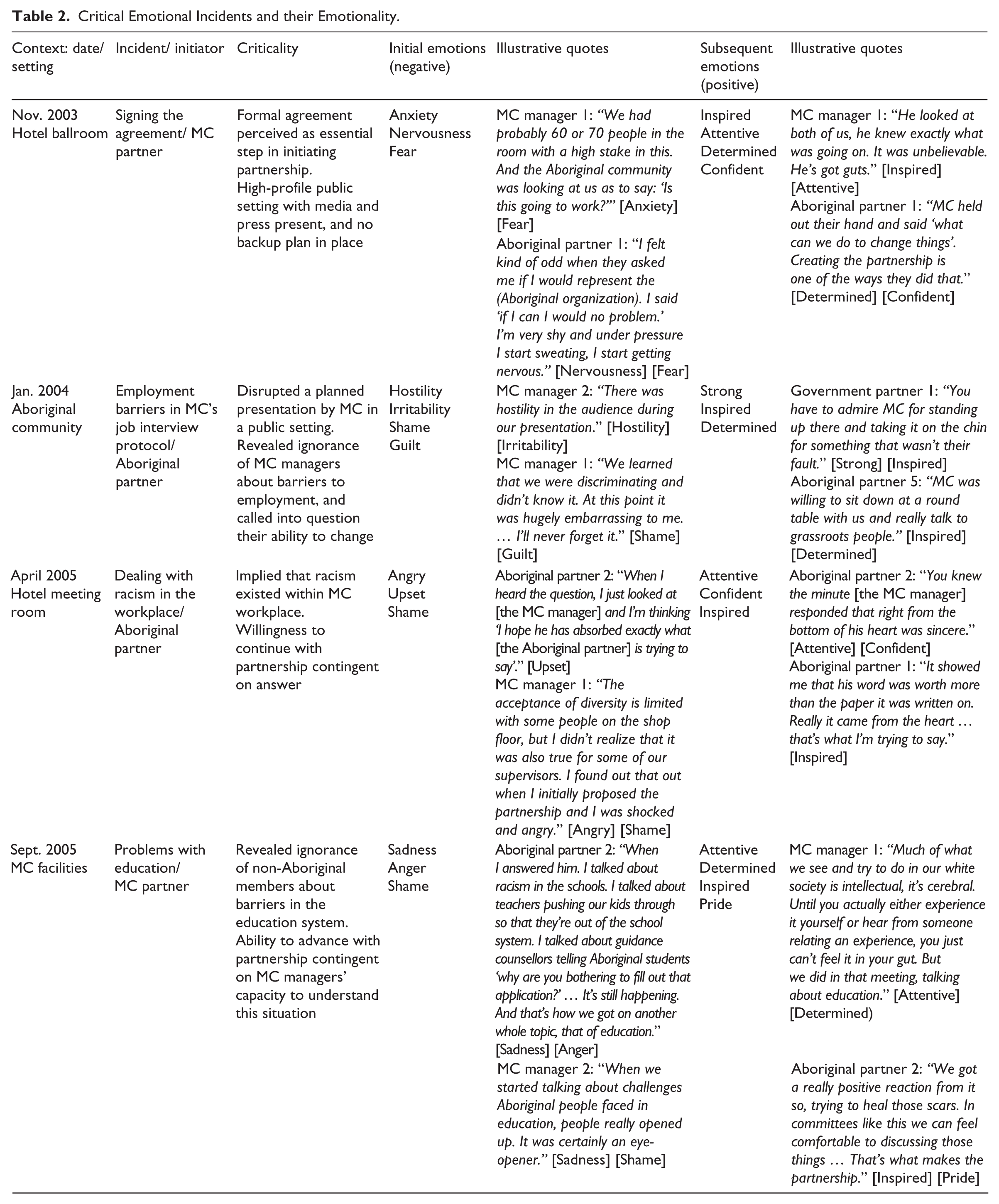
Each critical emotional incident was spontaneously and independently identified as critical by two or more partners during the course of our data collection. The incidents occurred in a variety of circumstances and were triggered by different issues and individuals, but all were unplanned, uncontrolled, and highly emotional for the people involved. We observed that the critical emotional incidents were characterized by multiple emotions, including those with both negative and positive valence, occurring in a sequence over time. Emotions with negative valence, including fear, anxiety, and shame, were dominant in at the onset of these incidents, while those with a positive valence were evident subsequently. Because negative emotions can irreparably damage relationships (Waldron & Krone, 1991) or become toxic for organizational decision-making (Maitlis & Ozcelik, 2004), there was a very real potential for these highly charged emotional incidents to damage or destroy the partnership. The transformation of the negative emotions into positive ones (as we outline in the section below on emotional engagement practices) contributed to their identification by partners as turning points in the way they interacted with and trusted one another. We now turn to present brief ‘vignettes’ describing each critical emotional incident.
Critical emotional incident 1: Signing the agreement
In November 2003, after months of negotiations, the partners had reached an agreement and decided to hold a formal signing ceremony. It was to be attended by representatives of all of the partners, including senior executives from MC, political leaders from the Aboriginal partner organizations, and high-ranking officials and politicians from both levels of government as well as national media organizations. This signing was an important event for MC, as one of the company’s managers explained:
We don’t sign things lightly in this organization so this really spoke volumes to me. We said: ‘Look, we’re taking this extremely seriously, and we’re prepared to back it up by putting our name on the line.’ (MC manager 3)
However, on the day of the signing, the designated signatory from one of the Aboriginal organizations did not show up. The day before, this individual had been involved in a dispute with one of the governments involving longstanding issues unrelated to the MC partnership. As a sign of protest, this designated signatory unexpectedly decided not to attend the ceremony. Only one other person from this organization was present.
The senior human resources manager at MC faced a difficult choice at this moment. He could abort the signing in a very public setting, proceed with the ceremony without a signature from that Aboriginal partner organization, or ask for help from the sole attendee from that organization. The HR manager recalled feeling extraordinarily anxious and vulnerable, given his personal involvement in convincing his organization to sign this agreement. Ultimately, he proceeded to ask the sole individual present from the missing organization to sign on behalf of his entity, knowing the delicate position in which it would place him with his community. He explained:
We postponed and postponed. Finally I went over to the only person there and asked if he was willing to sign. He just had on a working shirt. It was unbelievable. The press is there and he knows it’s going to get splashed on the front page of the paper … sweat is dripping off him.’ (MC manager 1)
The attendee from this Aboriginal organization considered the request and made many phone calls to members of his community. It would be up to him to decide what to do. In the end, he decided to sign the agreement, reflecting on his decision as follows:
If a person is good enough to stand beside you and attack or address an ongoing problem, you want to take his hand and really, really thank him for it. Thank him for taking that initiative, because a lot of people wouldn’t and MC is one of the few that held out their hand and tried to change things. (Aboriginal partner 1)
For the MC manager, it was an important moment:
That morning he took it all on himself to sign that piece of paper. That was a word of trust and it took courage. … It was the right thing to do. (MC manager 1)
During this incident, these two partners engaged with one another on a highly emotional level for the first time, initially prompting negative emotions, such as anxiety, nervousness, and fear. But, by being open and acting in ways that clearly signalled how they valued each other, not only was the problem solved, but the initial negative emotions were transformed into positive emotions, which contributed to a stronger bond between them.
Critical emotional incident 2: Employment barriers in MC’s hiring practices
One of the first priorities of the emergent partnership was to strengthen communications between MC and the local Aboriginal communities. During the partnership negotiations, MC managers learned not only that these communities had a negligible understanding of the company’s recruitment practices, but also that MC was perceived to be a highly secretive organization that would be difficult to trust. MC managers therefore decided to put together a workshop to explain the company’s hiring processes, using a PowerPoint presentation to outline the demographics the company faced and the potential for new jobs for Aboriginal people. Their essential message was ‘here is the opportunity as we see it – and here is what we understand of your population’ (MC manager 1).
At the workshop, the MC managers and government officials recalled that they felt tension, almost hostility in the room. Part-way through, an Aboriginal participant active in education and employment development for his community asked ‘Do you know why we can’t get jobs?’ This superficially simple question took the MC managers present by surprise. The questioner went on to describe how aspects of MC’s hiring system systematically excluded Aboriginal candidates, for example, by requiring the applicant to provide ‘recent’ examples of previous job experience. If candidates had not held a job in the past year, they would be screened out. The MC senior human resources manager vividly recalled the conversation and the point made by the community member, who had said:
You’ve just ruled out most of our people, because many of them have not worked in the past year. Some have worked odd jobs here and there, but it’s not uncommon to go 18 months without a job. And so they may be doing great volunteer work somewhere and be wonderful people that you could hire, but when you ask them in an interview to give you a job-relevant example from the past year, they can’t. So they will give you an example that’s not work-related, but that … won’t pass the interview. (Aboriginal community member)
The MC managers were surprised and embarrassed at the effect that this seemingly benign interview question was having on their ability to hire Aboriginal employees. They chose to pursue this subject, focusing less on telling the community members about the job opportunities and more on understanding how MC processes might be part of the problem. In the words of MC manager 2, ‘We were seen as listening, not doing all the talking … listening and working together overcame serious stumbling blocks.’ Within two weeks, the MC managers had taken steps to change this aspect of their hiring practices.
The emotionality of this incident also flowed from negative to positive, with an initial provocative question by an Aboriginal community member eliciting feelings of shame and guilt in MC managers. The behaviours of the MC managers, which conveyed their openness and willingness to change, not only diffused initial emotions of hostility and irritation among the Aboriginal community, but also had broader and longer-term implications for the partnership. Several Aboriginal representatives recognized that many barriers were caused by a lack of knowledge rather than a lack of willingness to change on the part of MC. They also began to realize that despite MC’s reputation for secrecy, the company was willing to act when it had the facts and a fuller appreciation of the situation. The MC representatives also came to realize that some of their practices had unintended consequences, and that by working together with the Aboriginal partners they could uncover these more effectively than by going it alone. As the senior HR manager reflected, ‘We need to look to some other people to help us out’ (MC manager 1).
Critical emotional incident 3: Dealing with racism in the workplace
The first meeting of the advisory council was held in September 2004, and informants described the atmosphere as one of caution and scepticism. The agenda included a review of the council’s mandate, an update on progress, and a definition of more formal plans for the future. The MC manager noted: ‘We did our usual MC thing – here’s the timeline, and what actions you need, and who’s going to do them’ (MC manager 1). The advisory council decided to meet quarterly, with each meeting having a formal agenda covering the substantive issues negotiated in the agreement.
At the third meeting of the council, a new item was added to the agenda – a ‘round table’ session in which participants could raise any issue they wanted with the rest of the group. There were to be no rules or procedures for defining what could be raised. The discussion during the first round table turned to racism, and its effect on the workplace climate. This was one of the most sensitive issues for both company partners and those from the Aboriginal communities. The Aboriginal partners were unanimous in their descriptions of racism, with one stating: ‘You know racism is out there. It’s alive and well. It’s thriving. It’s real and doesn’t hurt any less now than it did then’ (Aboriginal partner 3).
During this discussion, one of the Aboriginal partners (Aboriginal partner 1) pointedly asked the MC senior human resources manager what he would do about racism in MC’s workplace. The Aboriginal partner further demanded that the MC manager ‘give his word’ that racism would not be tolerated. The manager listened, and carefully and slowly admitted that racism was a problem in his company. He explained to the group as a whole that there had been incidents of racism that had angered and disappointed him. He also outlined how these had been addressed and explained the company’s policies and practices. He concluded by making a heartfelt promise that he would not allow racism to be tolerated in his organization. The Aboriginal participants stated that they found this response to be deeply meaningful, signalling another turning point in the development of the partnership, prompting partners to discuss ways to implement a new emphasis on cross-cultural training for MC’s managers and front-line workers. The Aboriginal participant who posed the question reflected:
He gave me his word that if he hears something like that going on he’ll address it, take care of it. That means a lot to me. … He just gave me his word, his word is good you know, written in stone. (Aboriginal partner 1)
Negative emotions were reflected in the provocative question about racism. These deepened as the MC manager made sensitive disclosures about racism in the MC workplace. Opening the agenda to focus on this issue began the process of transforming anger, guilt, and shame into attentiveness and confidence that action would be taken to remedy this problem.
Critical emotional incident 4: Problems with education
This incident occurred at an advisory council meeting held at one of MC’s factories, during which all partners toured the facility and met other MC employees involved with the partnership. As with other meetings, the agenda was set in advance. One item dealt with a pilot project designed to address recruitment barriers that had been identified by Aboriginal representatives early on in the partnership. The ensuing discussion turned to persistent educational problems experienced by Aboriginal youth.
The incident was triggered when an MC manager asked a seemingly innocent question: ‘Why is education such a problem for Aboriginal people?’ (MC manager 1). The other council members were silent. Finally, one by one the Aboriginal partners spoke up, sharing stories of racism in schoolyards and how it affected young people and their capacity to be successful in school. This discussion had a profound effect on the non-Aboriginal members of the council because it humanized the effects of racism. The candour of the Aboriginal partners also surprised another MC manager:
Our greatest surprise was when we started talking about challenges that Aboriginal people faced in education areas, people really opened up. It was certainly an eye opener – reflecting the trust among the group to share that. (MC manager 2)
This incident also allowed the various participants to reflect on just how far the partnership had evolved, as described by one of the Aboriginal representatives:
You put your heart on the table and realize that it can be crushed in an instant. But if you also know that trust and comfort level is there, that’s a partnership. It’s a relationship. It’s as close to intimacy as you can get and I think that’s the whole point. Being able to trust the Aboriginal community members, being able to trust not just a non-Aboriginal person but an entire board and company – that is huge. (Aboriginal partner 2)
This ensuing discussion about dysfunctions in the Aboriginal education system took the partnership in an unanticipated direction, toward more concerted efforts to deal with systemic barriers within the education system. The MC managers were surprised by this new direction, but ultimately decided that the issue was too important to be ignored, and so initiated contact with the provincial ministry of education. The senior HR manager noted:
They have taken us down some paths that I did not anticipate. I did not anticipate the whole education path at all. I anticipated that education was a huge barrier. I just didn’t think that we would end up in the middle of it. (MC manager 1)
A manufacturing plant HR manager elaborated:
We are now coming together and looking at the problems we are having, whether it is education barriers or a school system that pushes people through … We are ready to look at whatever is standing in our way and solve the problem … The partnership is strong enough to say ‘who else needs to come to the table?’ That’s effective. (MC manager 3)
Like the other critical emotional incidents, this one also was characterized by a high degree of emotional connection among the partners. Initial negative emotions of sadness, anger, and shame were ultimately transformed into positive ones by practices that enabled difficult issues to be tackled in substantive ways, and that signalled how the partners valued each other.
Emotional engagement practices
This section focuses on the practices partners used to handle the critical emotional incidents. We identified a set of four emotional engagement practices that occurred during each incident: asking provocative questions; offering sensitive disclosures; opening the agenda to pursue spontaneous ideas; and valuing the other in attitudes and acts. Although we also observed these practices at other points during the study period, this sequence of practices was particularly evident during the playing out of the critical emotional incidents.
We conceive of emotional engagement practices as a specific form of relational practice (Dutton & Dukerich, 2006) related to connecting to others on an emotional level. More specifically, we define emotional engagement practices as practices that impact the emotional valence of the partnership by stimulating a personal engagement with other participants and partnership tasks. This definition builds on earlier studies of personal engagement in work role performance, which relates to ways people tie their individual selves to their work roles by expressing themselves physically, cognitively, and emotionally through task behaviours (Kahn, 1990). We suggest that emotional engagement practices are distinct from the more traditional relational activities and practices identified in the stakeholder partnership literature emphasizing trustworthiness and the expectation of predictable, reliable behaviour of one party by another (Tomlinson, 2005), such as sharing information and communicating effectively (Murphy & Arenas, 2010). Rather, they appeared to be based on a more unpredictable logic for trust-building: one in which weaknesses are exposed, vulnerability embraced, and leaps of faith taken.
We thus see the chief role of emotional engagement practices as stimulating the flow of positive and negative emotions among the people involved in the partnership in ways that increase their involvement and participation. Evidence related to these practices has been presented in the vignettes of the critical incidents. In Table 3 and in the detailed descriptions below, we further describe the impact of the practices on both emotions and trust.
Impact of Emotional Engagement Practices on Partner Emotions and Trust.

Asking provocative questions
In the MC partnership, partners were frequently willing to pose questions about difficult issues, for which the answer was unknown by the questioner and the response often challenging to provide. Indeed, each of the critical incidents that we identified revolved around a provocative question posed by one of the partners. In two incidents, these questions came from an Aboriginal participant, in two by a representative of MC. Each of these questions served to surface sensitive topics such as abuse or racism, and if negatively interpreted, held the potential to derail or compromise the entire partnership.
Our data shows that provocative questions were often asked out of frustration or anger, reflecting a negative emotionality in the person asking them. For example, questions such as ‘Do you know why we (Aboriginal people) can’t get jobs?’ (incident 2) or ‘What will you do about racism?’ (incident 3) surfaced longstanding issues and legacies of mistrust among the Aboriginal partners. The MC HR manager’s question about Aboriginal education attainment (incident 4) reflected his frustration at trying to find qualified Aboriginal people for the MC workforce. Once asked, the questions stimulated further negative emotions among the partners, often related to shame or guilt in others (incidents 1, 3, and 4).
Our evidence further suggests that the provocative questioning had a counter-intuitive impact on trust-building. While negative emotions can irreparably damage relationships and impair the process of trust development (Waldron & Krone, 1991), our findings suggest that the act of asking these types of question not only surfaced sensitive issues and negative emotions, but also served as tests of the commitment and sincerity of partners. Specifically, we found that these questions created moments for the partners to demonstrate one of the key antecedents to trust, namely integrity (Mayer et al., 1995). Each question provided the opportunity for a thoughtful, considered response demonstrating respectfulness and integrity – even in extremely negative emotional situations. As noted by one of the MC managers, this had a beneficial effect on trust:
To build trust … you need to listen and to really understand, not only what the other person is saying but where they’re coming from and what they’re feeling if you can. (MC manager 1)
Offering sensitive disclosures
The responses to the provocative questions that launched these incidents included highly sensitive, personal disclosures. Our evidence shows that these sensitive disclosures involved emotions with a negative valence, for both the person making the disclosure and for others who were witness to it. For example, disclosures often involved exposing personal vulnerabilities and distressing experiences. Disclosures about racism (incidents 3 and 4) evoked anger and sadness in the Aboriginal partners who had experienced racism, and guilt and shame in non-Aboriginal partners, who saw first-hand how this societal problem had personal consequences. Similarly, disclosing that racism existed in the MC workplace was a distressing admission for the MC HR manager (incident 3).
At the same time, the personal stories that were shared had the effect of deepening the personal attachments among the partners. Participants frequently spoke about the powerful impact these disclosures had on the development of empathetic and benevolent bonds among the partners. While such a practice might be considered disruptive in another context, refusing to deny the emotionality of these disclosures would prove highly beneficial to trust-building in the MC partnership. As an antecedent to trust (Mayer et al., 1995), the benevolence underlying both the decision to make a personal disclosure and react attentively to it appears to have permitted the release of emotional energy that was subsequently channelled into more trusting relationships. As one of the MC managers observed:
Sharing (sensitive) information through the partnership, shows there’s trust. It was just that you get comfortable with people and you realize that you know these folks want to help themselves, but they also want to help us. (MC manager 3)
Opening the agenda to pursue spontaneous ideas
Over the course of the partnership and in particular during the incidents, participants demonstrated a willingness to open the agenda to include new items that arose in the discussion, often initiating new lines of inquiry. This practice facilitated partners’ ability to handle the emotional critical incidents and ultimately build trust. Although the chairperson would set an agenda for each of the advisory council meetings, members of the group would frequently deviate from this agenda as important – and at times emotional – subjects arose spontaneously during the course of the meetings, at which point the formal agenda was temporarily set aside. This finding is somewhat counterintuitive, given that clear agendas (Kanter, 1999), specific goals (Eden & Huxham, 2001; Waddock, 1988), and deliberate planning (Bryson et al., 2006) have long been identified as important practices for enabling multi-stakeholder partnerships to work effectively. Since formal control processes are designed to regulate the interactions among partners and increase the reliability and predictability of the partnership (Tomlinson, 2005), abandoning an agenda holds the risk of losing control.
The practice of suspending agendas to focus on spontaneous, often contentious issues may also be seen as disruptive or counter-productive in the management of emotions, in that it focuses attention squarely on the threatening issue rather than diverting attention away from it (Williams, 2007). However, we observed that by opening the agenda to pursue spontaneous ideas, the partners were able to explore emotional yet important topics of discussion. Opening the agenda was ultimately associated with predominantly positive emotions. For example, changing course on who would sign the partnership agreement (incident 1) and introducing education as a critical new topic (incident 4) inspired the partners and generated enthusiasm for the partnership. By creating a safe environment to explore new paths (Huy, 1999), this practice reassured partners that crucial issues would be examined and addressed, as well as providing opportunities for self-expression and pride – as noted by one Aboriginal partner:
I feel really proud that they’ve listened, it took a while, but we didn’t push it. You know you have to sometimes you have to let MC make the choice … they have to feel that it’s their own idea … not that they’re not receptive to ours but they have to figure out how it’s going to work for them. (Aboriginal partner 1)
By temporarily setting aside the agenda, the partners were able to demonstrate their personal integrity and benevolence towards each other, again strengthening the basis for trust development (Mayer et al., 1995).
Valuing the other in attitudes and acts
In handling each of the incidents, participants appeared careful to act and speak in ways that demonstrated equality with their partners, respect for their very different life experience and practices, and willingness to take action based on this perspective. One Aboriginal member described this in the following way: ‘We don’t talk over anybody and we don’t talk up or down to anybody, we are on the same playing field as partners.’ By facilitating the ability of everyone to speak freely, partners helped to create a culture of inclusion (Maak & Pless, 2004) in which members could relate to one another as equals, fostering positive emotions such as pride and enthusiasm among the partners:
It’s about relationships … it’s people that are coming together and if you can establish that relationship … people are becoming much more frank, much more open … our Aboriginal partners don’t mind telling us the way it is and that’s wonderful. (MC manager 4)
While the partnership literature acknowledges the importance of equality in decision-making (Waddock, 1988) and relational skills such as patience, empathy, honesty, and deference (Vangen & Huxham, 2003b), the ‘valuing’ practice in the MC partnership involved more than relational skills alone. Specifically, it also entailed acting on the advice, wishes, and desires of the other. For example, the MC human resources manager decided to establish the advisory council even as he feared losing control of the process. The Aboriginal representative who signed the partnership agreement at the request of the MC manager did so, risking backlash in his own community. Discussing changes to the education system was difficult for the MC managers– but they did so when they understood the importance to the other partners.
It’s evolved because of the richness of the information the Aboriginal community has brought … the MC folks have really listened and not immediately said ‘Oh no we can’t do that.’ They really looked at ‘How can we do that?’ (Government partner 2)
This commitment to action had a discernible impact on trust, summed up by one of the Aboriginal partners as follows:
It’s very encouraging because they’re not only talking the talk, they’re also walking the talk … It’s a place where you can go and you’re not only happy to see everybody but you know what you say is going to have some action to it. (Aboriginal partner 1)
Critical emotional incidents, emotional engagement practices and trust-building: A model
We now integrate our findings to develop a model of trust-building in multi-stakeholder partnerships. We propose that critical emotional incidents can unexpectedly punctuate the more rationally oriented process of partnership development, evoking negative emotions among partners. We further suggest that specific emotional engagement practices can transform negative emotions into positive ones, thereby contributing to a dynamic cycle of trust-building that leads to the expansion of partnership objectives. Our model is depicted in Figure 1, and described in more detail below.
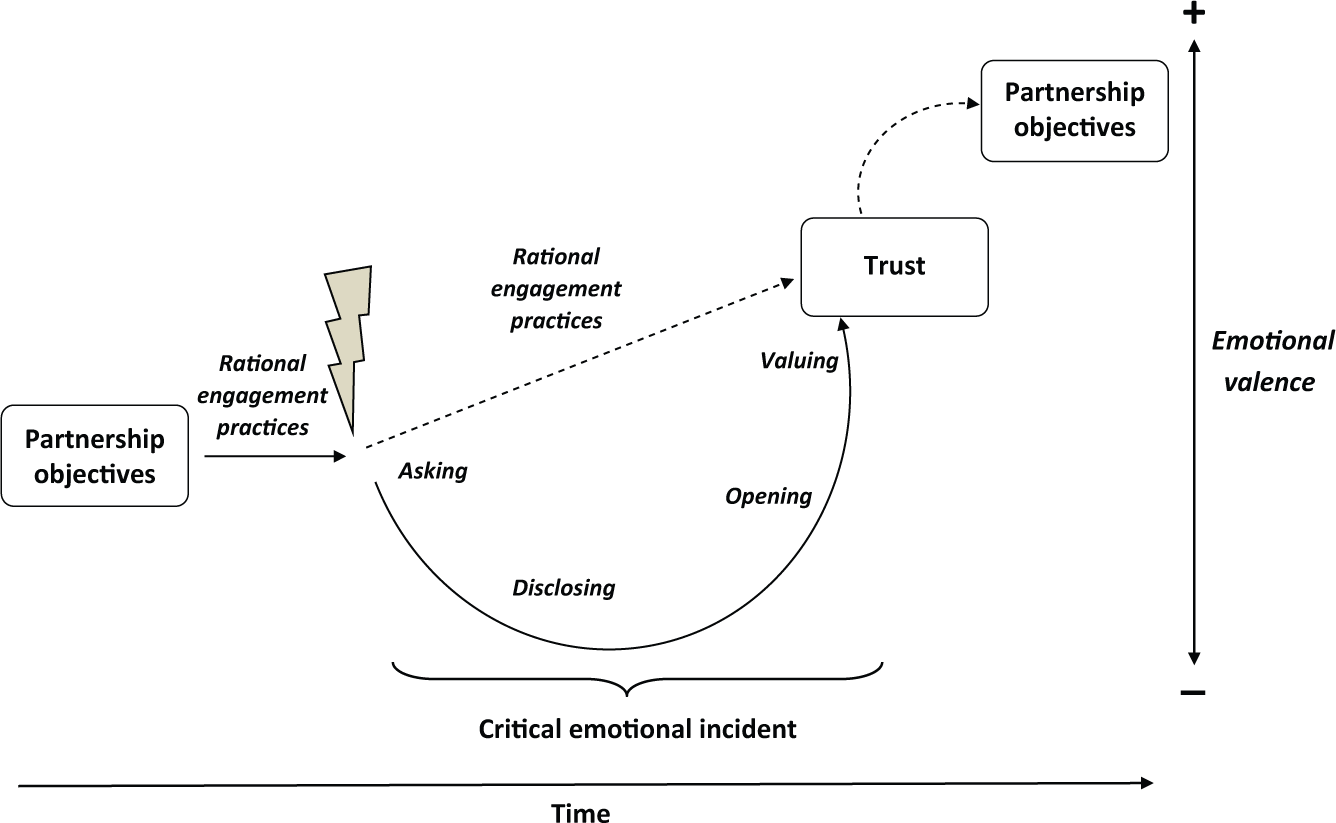
Critical Emotional Incidents, Emotional Engagement Practices and Trust-Building in Multi-stakeholder Partnerships.
The partnership process was initiated with broad agreement among partners based on the strategic objective of increasing Aboriginal employment at MC. This shared objective was complemented by formalized partnership guidelines to formulate and implement the partnership agreement that established roles and responsibilities, set clear meeting agendas, and instituted metrics. These practices were important to establishing control and building competence-based trust, as they enabled partners to see that their counterparts could deliver on their commitments and demonstrate their abilities, one of three antecedents to trust-building (Mayer et al., 1995).
We agree on actions and we get them done before that date. So that the next meeting we can report on what success we’ve had. And success builds success. And people start to say: ‘Ok, they said they will do this and they did it.’ That’s what builds trust. And the easiest way to lose trust is to not do what you said you’re going to do. (MC Manager 1)
However, at several points in the partnership process, these goal-oriented and largely rational practices were interrupted. On four key occasions, a partner chose to ask a provocative question that incited a critical emotional incident, which brought to the surface differences and tensions that had previously been set aside (but not forgotten) in the interest of establishing a partnership. The triggering of the critical emotional incident led other partners to engage in other emotional engagement practices, which initially amplified the negative emotions but ultimately stimulated positive emotions. At all points during the incidents, partners could have chosen not to react, or to speak. The fact that they chose to engage in this sequence of practices carried risks, and demonstrated an orientation toward increasing personal vulnerability through emotional engagement rather than partnership control. Each iteration of this sequence of emotional engagement practices afforded partners opportunities to demonstrate benevolence and integrity, two key antecedents to trust (Mayer et al., 1995).
As the partners began trusting each other to a greater degree following each incident, they began to take still more risks, which resulted in a broadening of the original partnership objectives to address a wider range of concerns. The improved trust developed during the first incident at the signing ceremony got the partnership off the ground. The second incident led the partners to focus on eliminating barriers to workplace employment. The third incident resulted in their decision to address racism in the workplace, while the fourth resulted in adding a new focus on longstanding problems in the education system.
We should note that these emotional engagement practices did not eliminate the rational partnership practices. However, participants identified the emotional engagement practices as particularly critical to trust development in the MC partnership. As one partner explained:
It takes a while before they’ll say ‘I think you could do some things differently.’ But it’s been hugely valuable to us when they have. I think some of it is establishing enough trust to talk to us about things that we can improve upon. In any company, if you’re going to get better that’s what you need. (MC partner 1)
The partnership continued to unfold this way over time, following paths of both rational and emotional engagement practices as they moved through critical emotional incidents, ultimately leading to increasing levels of trust.
Discussion
This paper explores the micro-foundations of multi-stakeholder partnerships, examining how trust is developed in such arrangements. Our evidence suggests that trust-building is a dynamic process that is, at times, punctuated by critical emotional incidents that evoke negative emotions among partners. We further propose that emotional engagement practices may be used by partners to transform negative emotions into positive ones, fostering the development of trust in these arrangements.
Trust-building in multi-stakeholder partnerships
In investigating the micro-foundations of trust-building, our aim has been to shed light on a critical gap in the multi-stakeholder partnership literature. Prior studies have acknowledged that trust is a key to partnership success (Bryson et al., 2006; Selsky & Parker, 2005; Vangen & Huxham, 2003a; Waddock, 1988) – and that it can be particularly difficult to develop in the context of multi-stakeholder partnerships because of social group differences (Googins & Rochlin, 2000; Murphy & Arenas, 2010, Waddock, 1988), negative prior experiences (Mandell & Steelman, 2003), and power imbalances (Berger et al., 2004; Tomlinson, 2005, Vangen & Huxham, 2003a). However, most scholarship to date has overlooked the individual characteristics and interpersonal dynamics (Felin & Foss, 2005) that provide the foundations for trust (Rousseau et al., 1998; Weber et al., 2005). Our longitudinal, empirically based interpretive case study helps to address this gap.
Our evidence confirms that trust has both cognitive and affective dimensions (McAllister, 1995; McEvily, 2011; Weber et al., 2005; Williams, 2001), and that a certain amount of cognitive trust is necessary before affective trust can develop (McAllister, 1995). Additionally, our findings support Williams’ (2001) observation that social group differences among people influence how they feel about each other, and historical legacies can both have an impact on affect-based trust. Our methodology of studying trust in a situation of extreme differences has helped us gain a better understandings of the trust-building phenomenon, which might otherwise not have been apparent (Eisenhardt & Graebner, 2007; Murphy & Arenas, 2010). At the same time, while we agree that the two forms of trust have distinct foundations – with cognitive-based trust based on rational judgements of another person (McAllister, 1995; Weber et al., 2005) such as trustworthiness (Mayer et al., 1995; Tomlinson, 2005), and affect-based trust reflecting the emotions and feelings that people have for one another (McAllister, 1995; Williams, 2001) – we hesitate to categorize them as polar opposites (McEvily, 2011). Our model is suggestive of a ‘hybrid’ form of trust (McEvily, 2011), in which both cognitive and affective trust are connected and developed through a dynamic process.
While trust is frequently studied through quantitative analysis aimed at hypothesis testing (Möllering, Bachmann & Lee, 2004, p. 560), our qualitative, longitudinal, case study approach enabled us to identify and refine the constructs associated with trust-building, and to develop the linkages among them, thus responding to calls in the literature for understanding trust development over time (Lewicki et al., 2006). The model of trust development that we propose links emotions, emotional engagement practices, and trust-building, and helps to explain not only how trust is developed, but also to account for the flow and discontinuities that occur in a partnership process. As such, we believe the finely grained perspective on trust development proposed in our model – that explicitly includes trust as a valuable outcome – provides a useful counterpoint to other models of partnerships and collaboration that see trust as a partnership attribute or antecedent (Mohr & Spekman, 1994) or external to the process (Gray, 1989).
Our model also introduces an alternative, empirically grounded explanation for the ‘rational choice’ model, which argues that trust grows in a gradual ‘S-shaped’ curve as a result of deliberate, careful cognitive processing (Weber et al., 2005), or through more orderly stage models of trust development (Lewicki & Bunker, 1995). Our evidence reinforces the notion that when people engage in seemingly non-rational acts, the ‘curve’ of trust development can be steep and accelerated (Weber et al., 2005). Our empirical evidence further suggests that these rapid moments of trust-building occur episodically, and that the trajectory of trust development is a series of accelerated curves that ultimately lead to high levels of trust. As such, the model provides a starting point for further examinations of processes and patterns of trust development not only in partnerships but also in other organizational contexts, ideally using longitudinal approaches.
Our attention to the complex relations and dynamics between individuals places greater emphasis on interpersonal trust. In doing so, we adopt a different point of departure from the majority of scholarship on multi-stakeholder partnerships (Tomlinson, 2005; Vangen & Huxham, 2003a; Waddock, 1988) and interorganizational collaborations (Das & Teng, 2001; Inkpen & Currall, 2004), which focus on the development of organizational trust and the interplay between trust and control. In doing so, we do not mean to suggest that organizational controls are unimportant in the partnership process. Indeed, we found that many of the organizational practices used in the MC partnership provided direction and control to the partnership, minimized risks (Das & Teng, 2001), and helped provide the foundations for organizational stability and survival (Inkpen & Currall, 2004). Rather, our evidence leads us to suggest that interpersonal trust can lay the foundation for the development of interorganizational trust. Indeed, because the starting conditions for this partnership could be characterized as high in mistrust – which generally reduces opportunities for success (Vlaar, Van den Bosch, & Volberda, 2007) – trust needed to be developed on an interpersonal level before reducing the interorganizational distrust prevalent at the start of the partnership.
Emotions and critical emotional incidents in trust-building
This study also highlights the crucial role that emotions can play in a multi-stakeholder partnership. It draws attention to the tensions endemic in partnerships (Eden & Huxham, 2001) and shows how negative episodes (Eden & Huxham, 2001; Seitanidi & Crane, 2009) can threaten or compromise the prospects for partnership success. Specifically, our evidence reveals that the MC partnership was punctuated by noteworthy discontinuities which held the potential to derail the partnership because of the intense, usually negative, emotions that were provoked. We offer an in-depth understanding of the nature and dynamics of these ‘critical emotional incidents’, as well as suggesting how they contribute to the process of trust-building.
Critical emotional incidents, like ‘critical incidents’ (e.g. Chell, 1998), are unexpected and highly significant events. However, unlike critical incidents involving cognitive tasks – such as handling crises on a flight deck (Flanagan, 1954) – the unexpected, significant incidents that arise in relationship-based activities such as trust-building have emotional as well as cognitive content. The intense emotional feelings during these incidents demanded attention and interrupted cognitive processes and behaviours (George, 2000). This emotional content contributed to their being seen as major turning points around which individuals constructed meaning in this emerging partnership. Against the background of partner mistrust, these incidents initially posed threats to trust-building as their uncontrolled and highly personal nature caused the potential for identity damage (Williams, 2007). Ultimately, however, they served a useful purpose by affording opportunities for individuals to deepen their understanding and trust of each other.
We were struck by the importance of emotional expression – both negative and positive – in the development of trust in this partnership. In some respects, this is to be expected. Emotions play an important role in organizational settings because of their ability to influence social interactions and cooperative behaviour (Stouten & de Cremer, 2010; Williams, 2007). More surprising, however, is the importance of expressing negative emotions, which have been linked to signals of broken trust (Jones & George, 1998) or to the creation of a toxic environment for organizational decision-making (Maitlis & Ozcelik, 2004). While the regulation of emotions may facilitate work-related relationships (Waldron & Krone, 1991) and the building of trust in some contexts (Williams, 2007), our evidence suggests that the expression of negative emotions served a beneficial purpose in the MC partnership. The negative emotions that occurred within the critical emotional incidents served to test partner commitment to the partnership and especially to each other, and created the context for partners to shift from incremental stage-based processes of trust development (e.g. Lewicki & Bunker, 1995) and take ‘leaps of faith’. Had the negative emotions been suppressed, we speculate that the resultant festering, unresolved feelings could have negatively affected the quality of interactions (Waldron & Krone, 1991). This point merits further attention, especially in partnerships that have failed.
In this partnership, each incident that we examined was followed by intense relationship work that converted the negative emotions experienced by partners to more positive ones, consolidating the growing connection and trust between the partners. Once the incident and its aftermath had passed, the partners largely returned to the more rationalistic practices that predominated pre-incident. Thus, both cognitive and affect-based practices appeared to contribute to trust development, with more cognitive-based aspects of trust developing through stable interactions among individuals, while more affect-based elements of trust advanced most quickly during uncontrolled interactions. The latter point may be particularly salient when partners are highly dissimilar and less spontaneously disposed to positive beliefs and feelings (Williams, 2001). Our punctuated, discontinuous model of trust development complements studies focused on more continuous processes of trust development in a collaborative context, and provides further evidence for the importance of emotional factors in trust development in organizations more broadly (McAllister, 1995; Schoorman, Mayer & Davis, 2007; Williams, 2001, 2007).
Emotional engagement practices and trust-building
The emotional engagement practices that were exhibited during the critical emotional incidents clearly played a vital role in trust-building. Emotional engagement practices impact the emotional valence of a partnership by stimulating a personal engagement with the other participants and the partnership tasks. These practices appear to have fuelled the flow of both positive and negative emotions among the people involved in the partnership in ways that increased their involvement and participation. We underscore that there were four such practices – asking provocative questions, offering sensitive disclosures, opening the agenda to pursue spontaneous ideas, and valuing the other in attitudes and acts – and emphasize that all four were evident in each critical emotional events and were used in sequence. We suggest that this sequence of practices may be necessary to prompt the transformation of emotions, and would encourage further investigation of this sequence and its impact on the flow of emotions in other contexts.
Unlike practices oriented toward increasing control of the other, such as agenda setting or following guidelines, emotional engagement practices appear to involve subsuming one’s need for predictability to a desire to expand the ability of one’s partners to speak freely. These practices are thus grounded in a logic of risk-taking rather than risk-mitigating – a finding that stands in contrast to other studies that associate trust-building with risk minimization (Das & Teng, 2001) or threat reduction (Williams, 2007). More generally, the emotional engagement practices used by the partners during the critical emotional incidents can be seen as taking leaps of faith that provided clear and significant signals of trust that were hard to downplay (Weber et al., 2005). We see emotional engagement practices as a form of relational practice (Dutton & Dukerich, 2006) specifically related to emotions. While they share some of the characteristics of appreciative inquiry (e.g. Cooperrider & Whitney, 2005) and dialogical organizational development (e.g. Bushe, 2009), we propose that emotional engagement practices are intrinsically different. One of the distinguishing characteristics of emotional engagement practices is that they involve a combination of both potentially threatening and positive interactions. For example, rather than asking unconditionally positive questions, the MC partners triggered negative emotions through asking destabilizing and provocative questions. Posing tough questions in this way is highly consistent with the importance of identifying blind spots (Sanchez-Burks & Huy, 2009) and sources of defensiveness (Ely, Meyerson, & Davidson, 2006). Indeed, even the valuing practice often involved partners’ managing considerable personal discomfort. Although a degree of threat regulation and emotion management (Williams, 2007) was evident in these practices, they involved an acceptance of emotions, both negative and positive, rather than a minimization or downplaying of feelings. We encourage further work to explore the relationship between emotional engagement and emotion management.
Our study brings to light a richer and deeper understanding of the practices that make multi-stakeholder partnerships effective, drawing attention to the importance of emotional engagement practices as complements to widely used practices aimed at building trustworthiness. The emotional engagement practices are finer-grained examples of practices that may contribute to affect-based trust development beyond frequent interactions and peer-focused citizenship behaviours (McAllister, 1995). The affective trust developed through the MC partners’ navigation between rational and emotional engagement practices enabled them to generate more intangible energy and momentum to advance into new fields of activity, leading to results far exceeding those initially anticipated. Finally, the emotional engagement practices that we have uncovered open a novel focus of inquiry in the practice literature. The practice lens allows people to understand how things unfold over time through the interactions of people (Jarzabkowski, 2005). A variety of practices have been identified in this literature related to discourse (Mantere & Vaara, 2008), framing (Kaplan, 2008), and sensemaking (Rouleau, 2005). Our identification of practices that stimulate flows of emotions not only adds to the growing body of practice-oriented scholarship (Feldman & Orlikowski, 2011), but may also offer complementary explanations for the cognitive framing practices (Kaplan, 2008) that have been identified in situations characterized by contestation and conflict.
Limitations
We acknowledge that our methodological decision to focus on an ‘extreme’ case study limits our ability to generalize directly to other multi-stakeholder partnerships. However, we would suggest that the difficulties these partners confronted may have simply made behaviour more visible that would otherwise have remained hidden (Eisenhardt & Graebner, 2007; Murphy & Arenas, 2010). While the legacies of distrust that pre-dated the partnership may have led to particularly strong emotional expression during the critical emotional incidents, failure to address subterranean emotional concerns might be expected to lead to similar incidents in other multi-stakeholder partnerships in which parties have different objectives, values, and indeed world views. Moreover, the fact that practices were effectively used by these partners to overcome such difficult starting conditions in no way negates their effectiveness in less volatile situations. An absence of effective emotional engagement practices might be one explanatory factor for the lack of success of multi-stakeholder partnerships. However, we would propose that further study in less extreme settings is merited to validate this point.
Future directions
Our micro-foundations approach to trust-building redirects the traditional lines of inquiry in the multi-stakeholder partnership literature and offers new lines of inquiry in the literature on organizational trust. Specifically, we believe that a critical emotional incidents approach may provide a valuable methodological point of departure for future investigations into partnerships and collaborative arrangements that complements earlier work on tensions, episodes (Eden & Huxham, 2001), and crises (Seitanidi & Crane, 2009). Building on the growing body of interpretive use of critical incident analysis that involves identifying incidents, their outcomes, and how they are managed (Chell, 1998), we propose the study of critical emotional incidents might extend this established technique to include explicit prompts related to emotional content. More broadly, we wonder if additional empirical study of critical emotional incidents – their triggers and responses – might shed light on a variety of other managerial issues related to the roles played by emotions in the interplay between trust and control (Costa & Bijlsma-Frankema, 2007), beyond the narrow context of multi-stakeholder partnerships. Are similar sequences of emotional engagement practices apparent in other contexts?
We also noted that as the MC partners began to trust each other to a greater degree through having successfully traversed multiple critical emotional incidents together, they appeared to identify more closely with the other partners’ desires and intentions, often referred to as ‘identification based trust’ (Lewicki & Bunker, 1995). We propose that future research might usefully explore the linkage between emotional engagement practices and identification-based trust, as well as the development of a sense of collective identity and collaboration (Hardy, Lawrence, & Grant, 2005) more broadly.
Ultimately, we found that managers themselves matter – not just in their cognitive orientations, but also in their emotional ones. While recognition of the role of emotions is growing in areas such as strategic change (Huy, 2002), similar efforts are needed to better understand their meaning in the enactment of stakeholder partnerships and engagement. By drawing attention to the emotional practices involved in building trust in this partnership, we hope to broaden the spectrum of practices that contribute to their success or failure. We believe that additional empirical study of the often messy processes of partnership engagement holds great promise in advancing our understanding of how these initiatives work.
Footnotes
Appendix: Interview Protocol
Interviewer name:
Date:
Location:
Acknowledgements
We are indebted to Jane Lê and other seminar participants at EGOS 2009, the University of Sydney, Victoria University, and the University of Melbourne for their insightful comments on previous versions of this article. We would also like to thank Senior Editor Anca Metiu and three anonymous reviewers for their invaluable feedback and suggestions.
Funding
This work was supported by the Fonds québécois de la recherche sur la société et la culture.