



Abstract
Previous studies of the effects of resource slack and constraints on creativity and performance offer contradictory findings. To resolve this debate, some authors operationalize resource slack and constraints in ways that actually may have concealed their underlying complexity and dynamics. This study seeks to demonstrate how perceived resource positions influence entrepreneurial decision making and creativity by drawing on in-depth case studies of three high-tech start-ups. The authors show that resource positions are perceived, relative, transient and multidimensional; that is, they reflect the entrepreneur’s perception of available resources relative to demand. Moreover, perceived resource positions are not static but change over time, and entrepreneurs can experience different types of resource constraints and slack simultaneously. The influence of perceived resource positions on decision making in turn depends on individual, temporal and resource position dynamics. These findings link perceptions of resources to the emergence of organizational ingenuity, by explaining how perceived resource positions influence decision making.
Introduction
Both new and established firms need resources for their survival (Pfeffer & Salancik, 2003), growth (Penrose, 1959) and sustainable competitive advantage (Barney, 1991); resource constraints instead hinder firm growth and lower the probability of survival (Becchetti & Trovato, 2002; Musso & Schiavo, 2008). However, such constraints also might foster creativity (Hoegl, Gibbert, & Mazursky, 2008; Moreau & Dahl, 2005) and force firms to deal with problems promptly (Bhide, 1992). Slack resources tend to improve firms’ financial performance (Daniel, Lohrke, Fornaciari, & Turner, 2004), buffer environmental shocks and allow for more discretion and flexibility in responding to competitor strategies (George, 2005). Yet large resource endowments also could hinder the entrepreneurial process by impairing firms’ ability to identify new business opportunities (Mosakowski, 2002). Thus, it is unclear when resource constraints or slack lead to organizational ingenuity – the ability to create innovative solutions within structural constraints using limited resources and imaginative problem solving (Lampel, Honig, & Drori, 2011).
Several scholars have attempted to resolve these contradictory potential outcomes of resource slack or constraints on creativity and performance, for example in terms of inverse U-shaped relationships and context dependent effects (Bradley, Wiklund, & Shepherd, 2011; Hoegl et al., 2008; Hvide & Møen, 2010). A relatively less explored explanation involves the underlying dynamics of resource constraints and slack (Nohria & Gulati, 1996) which remain concealed in cross-sectional studies that take the firm as the primary unit of analysis. If the entrepreneur’s perception of resource constraints and slack is likely to affect sensemaking (Weick, 1995) and entrepreneurial decision making, as suggested by the radical Austrian approach to entrepreneurship (e.g. Chiles, Bluedorn, & Gupta, 2007; Chiles, Vultee, Gupta, Greening, & Tuggle, 2010), then more objective, firm-level measures of constraints and slack cannot serve to identify the true underlying dynamics.
Accordingly, this study considers the possibility that entrepreneurs perceive resource constraints or slack as transient positions relative to their start-up’s own resource demands (George, 2005; Renko, Reynolds, & Carsrud, 2010), at any given moment. We draw on insights from both sensemaking theory and the radical Austrian approach to explore how perceived, anticipated and relative resource positions influence entrepreneurial decision making. In turn, we study the influence of constraints and slack at the decision-making, rather than overall firm, level – such that entrepreneurs experience different resource positions over time.
With in-depth event studies of how three high-tech start-ups develop over several years, this research makes three key contributions to the literature pertaining to the effects of resource slack and constraints on entrepreneurial decision making. First, by studying resource positions as perceived, anticipated and relative, we demonstrate that resource positions must be understood as transient and multidimensional. Slack and constraints cannot be investigated separately, at the firm level or with cross-sectional research designs, because such measures often lead to contradictory findings. By framing resource slack and constraints as two extremes of the spectrum of attainable resource positions, we thus integrate research on resource slack and resource constraints. Second, this study reveals how perceived resource positions influence decision-making processes in terms of individual, temporal and resource position dynamics. Third, we contribute to Austrian perspectives on entrepreneurship by empirically demonstrating how subjective perceptions of resource positions enter the decision-making process, in which entrepreneurs generate idiosyncratic options with varying degrees of creativity. These contributions advance understanding of the emergence of organizational ingenuity, by building theory on how constraints in a range of resource positions influence (creative) decision making by entrepreneurs (Lampel et al., 2011).
Theoretical Background
An entrepreneur’s resources include all assets, capabilities, organizational processes, information and knowledge under his or her control that may serve to improve efficiency and effectiveness (Daft, 1983). We conceive of resource slack and resource constraints as the two extremes of a spectrum of attainable perceived resource positions. As Figure 1 illustrates, resource positions reflect perceived resource availability, which results from the set of actual or potential resources at one’s disposal (Bourgeois, 1981), relative to the perceived resource demand (Cohen, March, & Olsen, 1972; George, 2005; Mishina, Pollock, & Porac, 2004). At one end of this spectrum, the entrepreneur experiences a shortage of resources because resource demand is greater than resource availability. At the other end, he or she enjoys an abundance of resources in excess of demand, or resource slack.
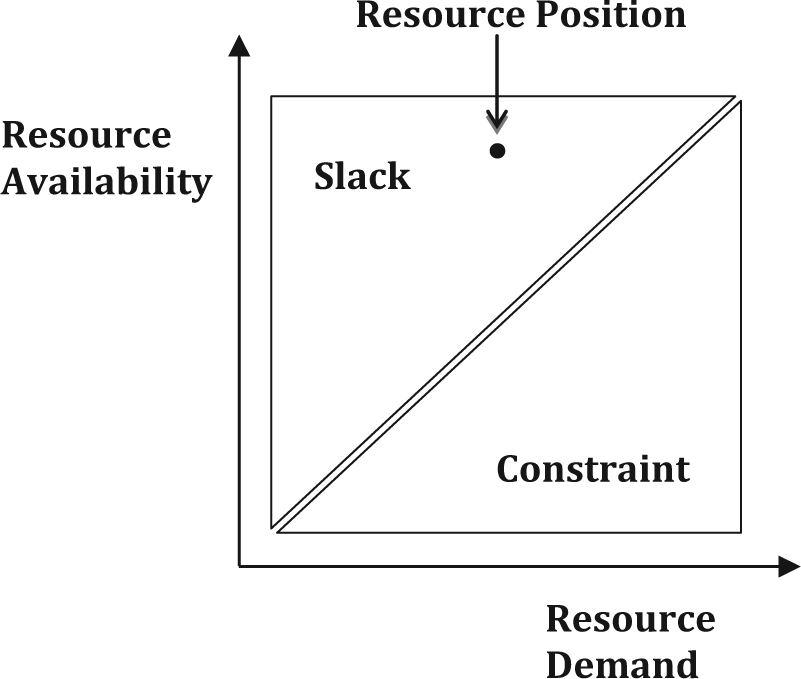
Resource position.
The effects of resource positions
Resource positions have been linked to creativity, defined as the production of novel and useful ideas in any domain (Amabile, 1996), such that creative ideas differ from previously realized ideas. Accordingly, innovation is the successful implementation of creative ideas in an organization (Amabile, 1996). Existing studies of how resource positions influence decision making, creativity and innovation have produced mixed findings. Slack resources might fuel innovation, by promoting experimentation and risk taking (Bourgeois, 1981; Nohria & Gulati, 1996; O’Brien, 2003; Thompson, 1967). In this sense, substantial resource slack relaxes internal controls and allows firms to undertake multiple innovation projects while enabling the firm to survive, even if a project’s outcomes are unsuccessful (Agarwal, Sarkar, & Echambadi, 2002; Bradley, Shepherd, & Wiklund, 2011; Nohria & Gulati, 1996; Voss, Sirdeshmukh, & Voss, 2008). However, firms with abundant resources may be less inclined to experiment (George, 2005), because the routines they have established to exploit successful paths to market ultimately compromise their exploration of new ideas (Levinthal & March, 1993; Mishina et al., 2004). In contrast, resource constraints might foster creativity (Hoegl et al., 2008; Moreau & Dahl, 2005) and stimulate innovations that are more efficient, in terms of both time and money (Gibbert & Scranton, 2009; Hoegl, Weiss, & Gibbert, 2010).
Resource positions also influence how firms interact with their environment. Slack resources buffer firms against environmental shocks, stabilize the firm in times of distress (Cyert & March, 1963; Donaldson, 2001; Pfeffer & Salancik, 2003; Van Dijk, Berends, Jelinek, Romme, & Weggeman, 2011) and provide freedom and flexibility to allow the firm to adapt to changing competitive environments (Levinthal, 1997; Thompson, 1967). These buffers also can mask underlying problems though, or result in overconfidence (Kahneman & Lovallo, 1993; Ross & Staw, 1993). By isolating a firm from exogenous shocks, slack can promote managerial complacency, induce irrational optimism (George, 2005) and allow a firm to establish structural misfits with the environment (Litschert & Bonham, 1978). Instead, resource-constrained firms that experience the direct effects of environmental pressures instead are more likely to respond quickly and seek creative ways to overcome such pressures (Hoegl et al., 2008).
Researching resource positions
Various strategies have been applied in attempts to reconcile the conflicting findings arising from previous work on the implications of resource availability. For example, some studies propose a curvilinear relationship between available resources and firm performance (Hvide & Møen, 2010; Nohria & Gulati, 1996; Tan & Peng, 2003; Zhou & Wu, 2010) or explore mediation effects (Bradley, Wiklund, et al., 2011; Hoegl et al., 2008). Others imply that the effects of resource constraints and slack are contingent on the context, such as the market or competitive environment (Bradley, Shepherd, et al., 2011; Katila & Shane, 2005), perceived environmental threats (Voss et al., 2008), project and team characteristics (Hoegl et al., 2008) or recovery after an adverse event (De Carolis, Yang, Deeds, & Nelling, 2009). The actual effects of resource availability and operationalization of resource slack and constraints continue to be subject to controversy though (Bourgeois, 1981; Marino & Lange, 1983; Mishina et al., 2004; Nohria & Gulati, 1996).
Most studies operationalize resource slack and constraints at the firm level, using financial ratios (Greve, 2003) or measures that compare resource availability with industry averages as a proxy for resource demand (Bromiley, 1991; Daniel et al., 2004; George, 2005; Mishina et al., 2004). However, financial ratios often fail to reflect a firm’s resource availability or ability to invest accurately (Bottazzi, Secchi, & Tamagni, 2012; Kaplan & Zingales, 1997, 2000; Musso & Schiavo, 2008), nor do these measures indicate the firm’s actual resource demand (George, 2005), which is problematic if slack or constraints depend on perceived resource demands (George, 2005; Mishina et al., 2004; Renko et al., 2010). In addition, the majority of studies in this area adopt a cross-sectional approach, measuring slack or constraints at a single point in time, such that they ignore changes over time (Bourgeois, 1981; Mishina et al., 2004; Moses, 1992) and possibly conceal the underlying dynamics (Nohria & Gulati, 1996) that might explain the mixed results obtained from previous studies.
Dealing with resource constraints and resource slack
Entrepreneurs have various ways to deal with a shortage or abundance of resources. When resources fall short of demand, entrepreneurs might seek to lower or eliminate resource demands (e.g. abandoning existing plans for growth); cope internally and continue to operate under constrained conditions, by making do with the resources at hand (Baker & Nelson, 2005); or alleviate constraints through external resource acquisition (Hoegl et al., 2008). Internal coping implies a selection among the effects that can be established with a given set of resources (Sarasvathy, 2001; Sarasvathy, Dew, Read, & Wiltbank, 2008; Baker & Nelson, 2005), whereas external resource acquisition generally relies on outside parties for the resources needed (Pfeffer & Salancik, 2003). Entrepreneurs may also seek to attract external financial capital to fund the procurement of additional resources. When information asymmetries between capital providers and entrepreneurs (Jensen & Meckling, 1976) and transaction costs (Williamson, 1981) make this option expensive or unavailable, entrepreneurs search out different options, such as bootstrapping methods (Bhide, 1992). Bootstrapping methods aim to minimize capital requirements, optimize cash flows, and secure resources with less cost (Winborg & Landström, 2001; Winborg, 2009; Ebben, 2009; Ebben & Johnson, 2006). Other alternatives include reliance on social capital (Bouty, 2000; Davidsson & Honig, 2003; Hoang & Antoncic, 2003), resource cooptation (Starr & MacMillan, 1990), or inter-firm joint resource usages (Winborg & Landström, 2001). By building networks of partnerships, entrepreneurs also might obtain resource commitments from early-stage stakeholders (Sarasvathy et al., 2008; Sarasvathy & Dew, 2005).
In contrast, when entrepreneurs believe they have slack resources, they can redeploy them to various new uses, depending on the type of resources available, their accessibility (Bourgeois & Singh, 1983), ease of recoverability (Greve, 2003; Singh, 1986) and liquidity (Mishina et al., 2004; Penrose, 1959). The various types of resource slack include human resource (Mishina et al., 2004), financial (Nohria & Gulati, 1996; Tan & Peng, 2003), operational (Bourgeois, 1981) and customer relational (Voss et al., 2008) slack. Entrepreneurs also vary in the degree of managerial discretion or flexibility they have to (re)deploy slack resources (George, 2005; Nohria & Gulati, 1996; Sharfman, Wolf, Chase, & Tansik, 1988). Entrepreneurs thus can decide differently according to their resource availability, involving various degrees of creativity, but it is not clear how resource positions influence their decisions.
Perceived resource positions
Research on sensemaking and subjectivity in entrepreneurship provides some insights into how entrepreneurs likely determine their resource positions, according to their past experiences and imagined futures. As Porac, Thomas and Baden-Fuller (1989) and Weick (1995) recognize, people act on the basis of the sense they make of the situation at hand. Entrepreneurs make such sense by creating an account, together with others, from an array of prior experiences, assessments of current conditions and of what can be done in the future (Weick, 1995). This account, which might manifest in an espoused strategy, also provides a means to convince others to engage and perhaps provide resources (Cornelissen & Clarke, 2010). In a changing environment, sensemaking involves a continuous, dynamic practice to deal with new and adapted experiences. That is, to make sense of the world around them, entrepreneurs relate their perceived resource position to their (social) environment, past experiences, decisions and actions. When an entrepreneur perceives resource constraints, (s)he may determine that the situation demands making do with whatever resources are available (Baker & Nelson, 2005; Weick, 1993); another entrepreneur in the same situation might perceive some form of resource munificence and pursue firm growth strategies (Edelman & Yli-Renko, 2010). As Bourgeois (1981) notes, these resource perceptions include both existing and potential resources. Overall, the entrepreneur’s perceived resource position is highly subjective and temporary, so sensemaking processes determine how entrepreneurs choose a particular course of action.
The Austrian school of economics (see Jacobson, 1992; Kirzner, 1997) suggests that entrepreneurs’ subjective perceptions of their resources drive decision making. These perceptions generate heterogeneity among entrepreneurs, often because they lack accurate data (Kirzner, 1997; Von Hayek, 1937), but also because entrepreneurs evaluate resources and their potential differently, depending on their varying preferences. Hence, the value of the resources is always in the eye of the beholder (e.g. Foss & Ishikawa, 2007; Foss, Klein, Kor, & Mahoney, 2008).
The radical subjectivist strand of Austrian economics (Lachmann, 1976, 1986) further suggests that it is not only perceptions of (potential) resource availability, but also the imagined actions enabled by these resources that play an important role (Chiles et al., 2007; Chiles, Tuggle, McMullen, Bierman, & Greening, 2010; Foss et al., 2008; McMullen, 2010). If evaluations of resource availability depend on how entrepreneurs imagine making use of resources to support a venture (Cohen et al., 1972; George, 2005; Mishina et al., 2004), their dissimilar imagining creates heterogeneity in perceived resource positions. The imagined action scenarios vary partly according to how entrepreneurs make use of the resources they have at hand, such that a similar resource base (e.g. equal amounts of available funds) can have different implications for different entrepreneurs (Baker & Nelson, 2005; Chiles, Tuggle, et al., 2010; Mosakowski, 2002).
Because resource positions are perceptual and dependent on imagined action scenarios, and sensemaking processes influence decision making, firm-level measures of constraints and slack, as used in most studies, appear inadequate for understanding the relationship between resource positions and decision making. Moreover, resource availability, foreseen resource demand and imagined futures may change with time, creating a need to consider resource positions from a process perspective.
Method
This study adopts a process research approach (Langley, 1999) to explore resource positions and decision making over time. Using in-depth case studies that incorporate multiple sources of data, we help advance theory by studying (the underlying dynamics of) resource positions and how they affect decision making (Lee, 1999; Locke, 2001; Yin, 2009). This qualitative research design is appropriate, considering the (1) absence of adequate metrics for measuring resource positions, which implies the need for an exploratory approach; (2) perceptual and relative nature of resource positions, which demand a method that can incorporate (real-life) contextual conditions; and (3) ephemeral nature of resource positions, which renders cross-sectional research largely inadequate.
Case selection
We selected three high-tech start-up firms in different emerging industries. The relation between resource positions and decision making is easier to establish for nascent than for mature firms (Renko et al., 2010), and the creation and development processes of start-ups often involve decision making under uncertainty (McMullen & Shepherd, 2006), such that resources have key roles, especially for high-tech start-ups (Alvarez & Busenitz, 2001). Therefore, we selected start-ups in the telecom and solar energy industries, which were relatively immature industries at the time our focal start-ups were founded (1997, 1999, 2000). Because their industries were marked by high degrees of uncertainty, the entrepreneurs had substantial freedom to choose their venture’s path to market, rather than having to conform to mature market structures (Ambos & Birkinshaw, 2010).
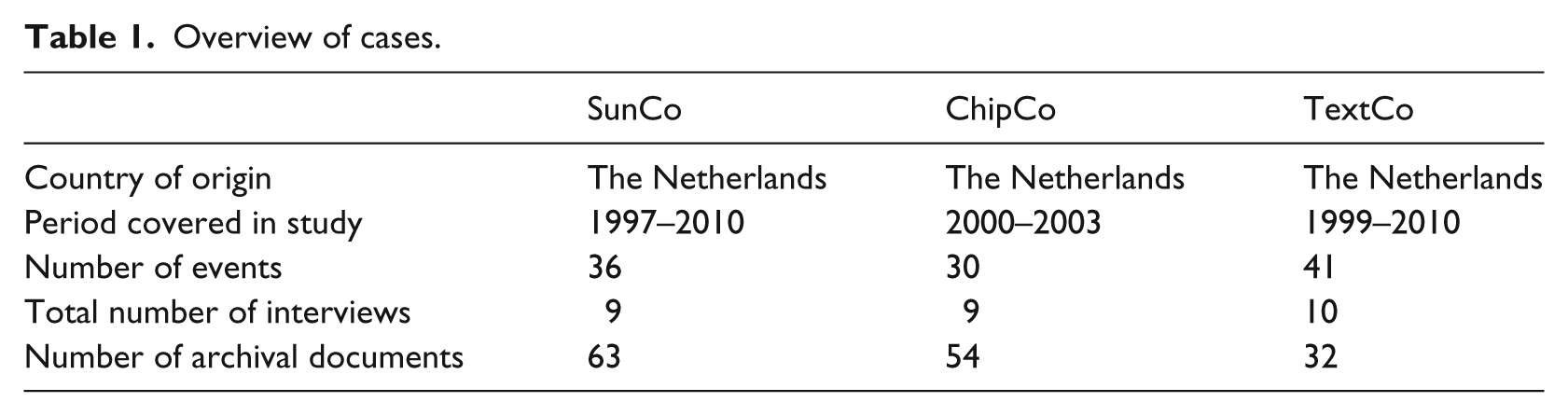
Each case covers the venture’s development, from idea conception, through the founding of the venture, to commercial exploitation and market interaction. With our objective of studying resource positions and their influence on decision making and venture development, we needed to study the venture from its very start, to determine how initial resource positions affect its development and entrepreneurial decision making (Shane & Stuart, 2002; Sorensen & Stuart, 2000; Stinchcombe, 1965), and for a period long enough to allow for some evolution (Ambos & Birkinshaw, 2010). We selected ventures that were founded at approximately the same time and in the same country (The Netherlands), to avoid substantial variance due to differences in national culture or economic climate. To avoid a (strong) success bias, we selected two successful ventures (i.e. substantial growth in staff and/or revenues) and one failure (i.e. no growth, insolvency, bankruptcy). We provide an overview of the three cases (SunCo, ChipCo and TextCo) in Table 1.
Overview of cases.
Data collection
The data include archival and interview data. The archival data collected (149 documents) consist of annual reports, strategic planning documents, patents, company presentations, newspaper articles, web articles and public interviews. Interviews (28 in total) were conducted with the founders, employees, investors and other important stakeholders of the ventures. During the semi-structured interviews, we first invited the interviewees to elaborate on their role in the organization and describe the development trajectory of the venture. Subsequently, we posed questions about important decisions during the venture’s development trajectory, especially those related to the management team and employees, products and services, clients, revenue models, suppliers, partners, competitors, intellectual property protection, locations and facilities. We also asked about environmental shifts, such as market dynamism or important changes in the business environment. If the interviewee mentioned significant events, we asked follow-up questions to obtain sufficient details. During these discussions we raised additional questions, when relevant, about (initial) resource endowments, resource needs, resource acquisition, and planning and decision making. (The complete interview protocol is available on request.) The interviews lasted 69 minutes on average and were conducted by at least two interviewers; with the exception of one telephone interview, all the interviews were conducted face-to-face. If necessary, we requested additional information or conducted follow-up interviews for clarification. Each interview was digitally recorded and transcribed.
Data analysis
To investigate how resource positions evolve and influence decision making, we sought to identify resource positions at the time of the decision and processes by which they influenced decision making. Therefore, the data analysis consisted of three steps, using coding procedures developed by Van de Ven and Poole (1990).
First, we analysed the interview transcripts together with archival data to create a case-specific event list of important decisions – locations, management team, employees, products and services, investments, clients, suppliers, partners, and competitors – for each firm. Significant decision-making events such as introducing a first product, contacting a potential customer or hiring an employee involve various degrees of creativity. Creative decision making typically entails the exploration of new ideas, areas, products or technologies. In each case, a member of the research team identified and coded these events, and then these initial event lists were subjected to extensive discussions among the research team, until we reached consensus on their identification. For each event, we recorded the time of occurrence, to facilitate chronological ordering. We used QSR Nvivo software to code the events, which helped us maintain a chain of evidence across the raw interview data, archival data, and events (Yin, 2009). To mitigate any retrospective bias, we collected data about each significant event from at least two sources (e.g. interviews and documents), such that any biases or memory lapses were likely offset by those of other informants (Golden, 1992; Huber & Power, 1985). In addition, we concentrated on significant events, which are easier to remember more accurately (Chell, 2004). Finally, we sent the event lists to the interviewees for validation. The final lists (30–41 events per case) enabled us to consider single decision-making events, as well as their longitudinal implications (Langley, 1999).
Second, the analysis focused on determining the decision-making process for each event. We coded these processes according to the decision trigger (or decision-motivating tension; Zeleny, 1982) and subsequent decision outcome, in the form of an observed action. Two types of decision triggers demand action by entrepreneurs: organizational objectives and environmental change. Both triggers emerged from our data analysis and also correspond with previous research (Cheng & Kesner, 1997; Keeney, 1994; Voss et al., 2008). In addition, we coded the resource position, as perceived by the entrepreneurs, according to the decision to be made in relation to each particular event. The decision-making process coding began with all three members of the research team coding the first 30 events of the TextCo case together. Next, one team member coded the remaining events in the first case and discussed these codes with the team. Two team members used the refined coding rules to code the remaining two cases; that is, each case was coded by at least two team members. The subsequent discussion led to some minor changes, but all differences in codes assigned by different coders were resolved through discussion. For the observed resource position codes, we found that we needed a more elaborate discussion; so two members of the research team worked together to identify the resource positions perceived by the entrepreneurs and establish appropriate categorizations. These categories thus materialized from our data, rather than prior theory, related to the different resources available relative to demand at the time of the decision. After carefully (re)examining all events, we iteratively refined and aggregated the categories, which produced a coding scheme that we applied to code all the events again. Table 2 displays the final coding scheme, definitions, and illustrative quotes.
The resource positions identified (coding scheme).
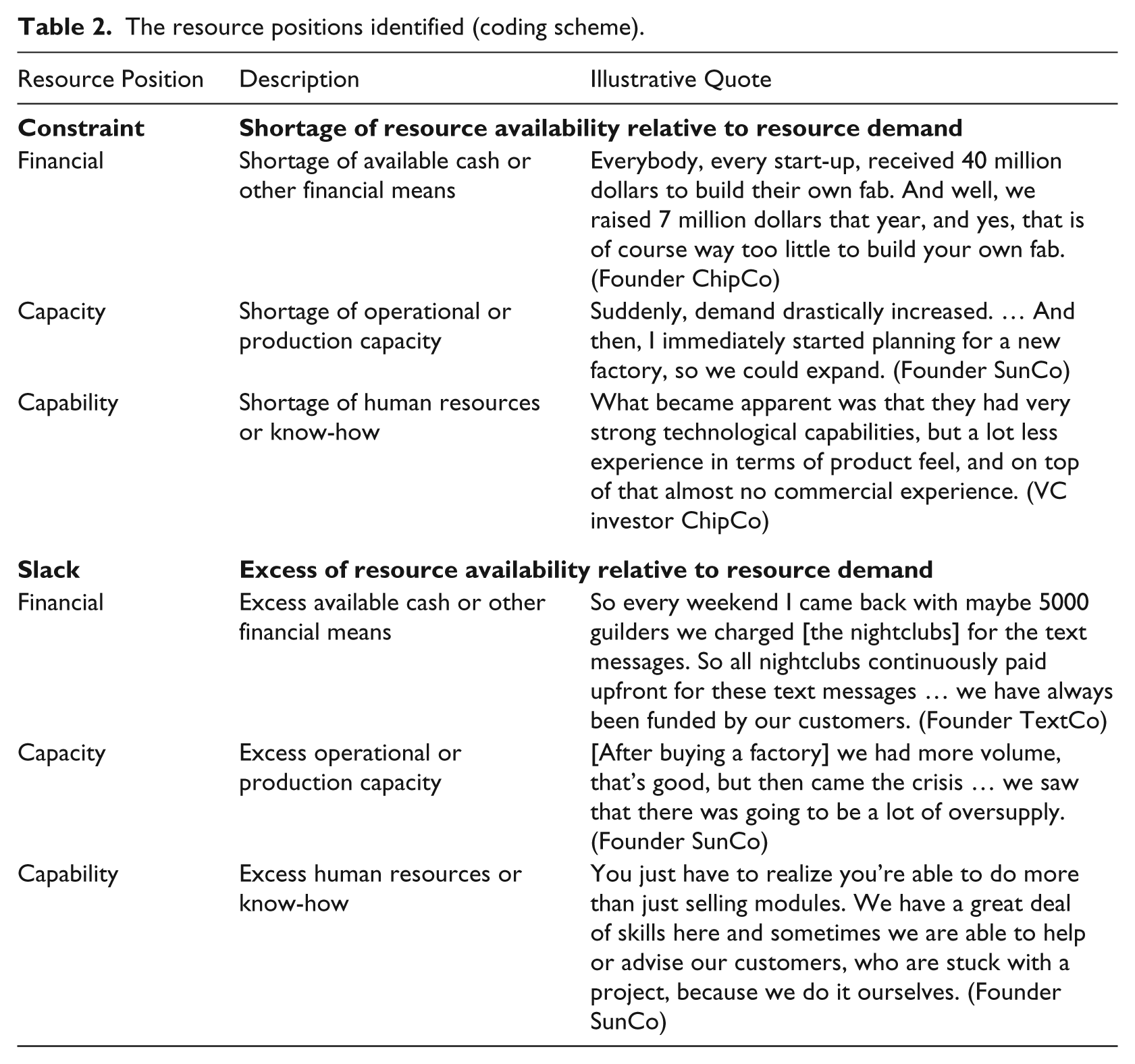
The analysis ultimately yielded six resource positions (i.e. perceived resource availability relative to perceived resource demand) at the time of a decision. We identified three types of constraints: financial, capacity, and capability. In accordance with our conceptualization of resource positions, these three types of constraints mirrored the three types of resource slack we identified. Financial resource positions reflect the relative availability of cash or other financial means; capacity resource positions refer to operational or production capacity; and capability resource positions involve human resources or know-how (see Table 2). Unlike previous research in this area that mainly draws on firm-level measures (Daniel et al., 2004; Mishina et al., 2004), we define resource positions as the abundance or shortage of resources perceived by the entrepreneur. A focus on (the heterogeneity among) individual entrepreneurs is essential, because researching firm-level phenomena must start with the individuals constituting these firms (Abell, Felin, & Foss, 2008; Felin & Foss, 2005; Foss, 2011).
To facilitate further in-depth analyses, we created tables with information about the decision-making processes in each start-up. These tables include, for all events, the (decision-making) event number, year the event took place, decision trigger, resource position at the time of the decision, decision outcome, and illustrative quotes. For each case, Tables 3–5 show the decision-making processes for key decision-making events.
Decision-making process for key events, SunCo.

Decision-making process for key events, ChipCo.

Decision-making process for key events, TextCo.

Finally, we conducted in-depth analyses of the decision-making processes. To trace patterns in resource positions over time, we created a graphical overview of the resource positions per event per case (see Figure 2). By combining these overviews with detailed descriptions of the events in the decision-making process tables (e.g. Tables 3–5), the nature of the resource positions could be studied. Noting the large variety in resource position configurations, i.e. combinations of different types of slack and constraints, we grouped events with similar resource positions across cases, to analyse their relation with decision making. In so doing, we drew on several tabular representations to group events by the types of resource slack, resource constraints and their particular combinations. However, in grouping the events and establishing a link between resource positions and decision making, we did not identify any direct, consistent effects of resource positions. Therefore, we redirected our attention toward the underlying dynamic complexity that appears to influence the relationship between resource positions and decision making.
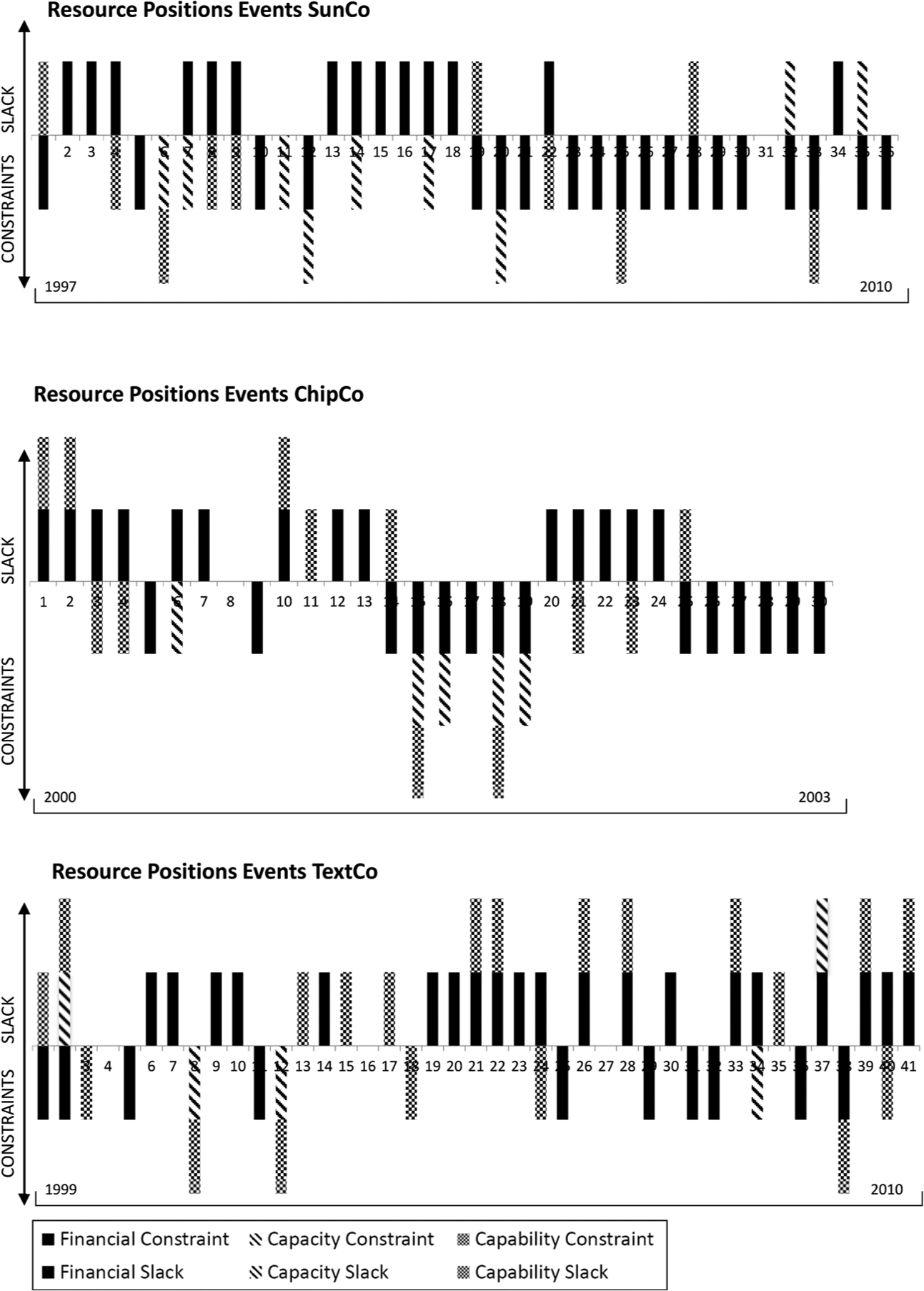
Transient and multidimensional resource positions (perceived).
Findings
In this section we start with the case descriptions of the three start-ups. Next, several key findings on the transient and multidimensional nature of perceived resource positions are discussed. Finally, we synthesize the outcomes of the process analyses in terms of the underlying dynamics of resource positions and decision making.
Case descriptions
SunCo
In early 2000, the founder of a small energy company and the founder of a multinational glass company combined forces and started a new company in the solar panel industry. The two entrepreneurs had different ideas about how to develop the company, so they adopted a dual strategy: The founder from the small energy company set out to build a project-based business in The Netherlands and neighbouring countries, focused on selling and integrating solar panels already available on the market, while the other founder committed large upfront investments to developing a radically new solar technology. In the first few years, the project-based business expanded internationally (Europe and the United States) while the technology development process ran increasingly behind schedule and depleted the initial budget, as a result of several major problems. When the economic crisis hit in 2008, demand for SunCo’s products and services dropped, and major liquidity problems emerged. The company’s leadership developed various alternative strategies to get through the crisis and finally chose to cooperate with an experienced partner to develop the new solar technology, so that it could get the product to market.
ChipCo
After being approached by a venture capital (VC) firm in 2000, a professor and doctoral student from the electrical engineering department of a Dutch university realized the potential of starting a company based on the optical chip technology they had invented. Noting the growing use of broadband telecommunication, the VC firm offered the researchers substantial funding, provided that they would develop a commercial proposition for the global telecom market. The team was unable to translate its findings into a business case though, so an outside CEO with extensive telecom experience was hired to start the business. After obtaining the VC funding, the start-up team set out to develop its first product, a demonstrator chip that incorporated the expertise of three doctoral dissertations on optical integration. In 2000, during the product development phase, the telecom industry crashed with the collapse of the dot.com bubble, and major telecom operators faced severe losses. Confident in their abilities, ChipCo’s team continued the product development process and hired additional employees. Although potential customers were impressed by the team’s abilities, they remained unwilling to purchase the new chip, because its implementation demanded an extensive system redesign. In need of cash, the entrepreneurs quickly developed a second, more marketable product and started looking for additional funding, but were unsuccessful in the rapidly declining industry. This crisis motivated the team to look for other applications and markets for the technology, but without success. With no other options left, the company filed for bankruptcy in June 2003.
TextCo
In 1999, two industrial engineering students explored new ways of making money by advertising for nightclubs. They noted the growing use of mobile telephones and thus decided to use text messages (SMS) as an advertising tool for their local nightclub. After collecting the mobile numbers of people entering Belgian nightclubs, the students used their university laptops and their parents’ internet connections to send advertising messages. When this experiment proved successful, they started a company to offer SMS services to other types of Dutch and Belgian businesses, such as logistics firms. The founders also tried to develop and introduce new products in the market and opened an office in Poland, though they were forced to close this foreign office when their products failed to catch on locally. In response to customer feedback, the founders successfully developed a new service, a 24-hour monitoring system for SMS traffic. In 2002, a key competitor launched a new concept, in which it charged customers extremely high fees to receive text messages that allowed them to participate in televised SMS voting. TextCo’s founders thought little of this new use and stuck to their existing operations, but the competitor’s concept proved to be a huge success. Four years later, TextCo’s founders sought to claim some share of this opportunity, while expanding their operations to other European countries.
Perceived and transient resource positions
We identified different types of resource positions, as shown in Table 2. A closer inspection of the perceived resource positions in each case and across cases, in Figure 2 and the decision-making process tables (key events in Tables 3–5), reveals several interesting observations. In particular, entrepreneurs’ perceptions of resource positions are not static but transient and changing over time. Perceived resource positions can change any time a situation involves some reflection on (anticipated) available resources relative to (anticipated) resource demand. Both perceived resource availability and perceived resource demand can shift easily, such that the resource position perceived by the entrepreneur becomes a transient imagination. For example, by the end of 2002, the founders of SunCo believed they had sufficient financial resources to buy an existing solar development project, but this view changed when a key supplier (which they already had prepaid thousands of Euros) was about to go bankrupt. This anticipated financial constraint stimulated the entrepreneurs to come up with an idea to prevent severe losses.
This example also illustrates how anticipated resource positions arise from imaginations of the future and influence entrepreneurial decision making: anticipated financial constraints (i.e. expected bankruptcy of supplier) led the entrepreneurs to act to prevent future losses. These findings highlight how resource positions may enter subjectively imagined futures (Chiles et al., 2007). The constantly changing positions and configurations of the bars in Figure 2 reflect the ever-changing perceptions of (anticipated) resources relative to demand, demonstrating the transient nature of perceived resource positions. Therefore, the time-invariant or annual measures of slack and constraints used in previous studies (e.g. Daniel et al., 2004; Nohria & Gulati, 1996; Tan & Peng, 2003) appear to generate situational snapshots, with limited longitudinal reliability.
We also explore how understanding resource positions as perceived and transient might relate to conventional, firm-level measures of resource positions. In Figures 3–5, we depict different operationalizations of financial slack and constraints for all three cases, including three common firm-level measures of financial resources (relative to demand) obtained from annual reports: cash (George, 2005; Voss et al., 2008), current assets divided by current liabilities or current ratio (Bourgeois, 1981; Bromiley, 1991; Daniel et al., 2004), and the difference between current assets and current liabilities (Bradley, Wiklund, et al., 2011; Mishina et al., 2004). A comparison of longitudinal patterns reveals that the firm-level financial measures convey different, and at times inconsistent, information with respect to the level of financial slack. The three firm-level measures produce graphs with different shapes, implying opposite conclusions. Consider, for example, Figure 3(a) versus Figure 3(c) for TextCo: The cash measure (a) indicates substantial excess financial resources during 2006–2008, whereas the difference measure (c) implies significant financial constraints in the same period, because current liabilities exceed current assets. This important finding sheds some new light on why previous studies offer conflicting results regarding the effects of slack and constraints.
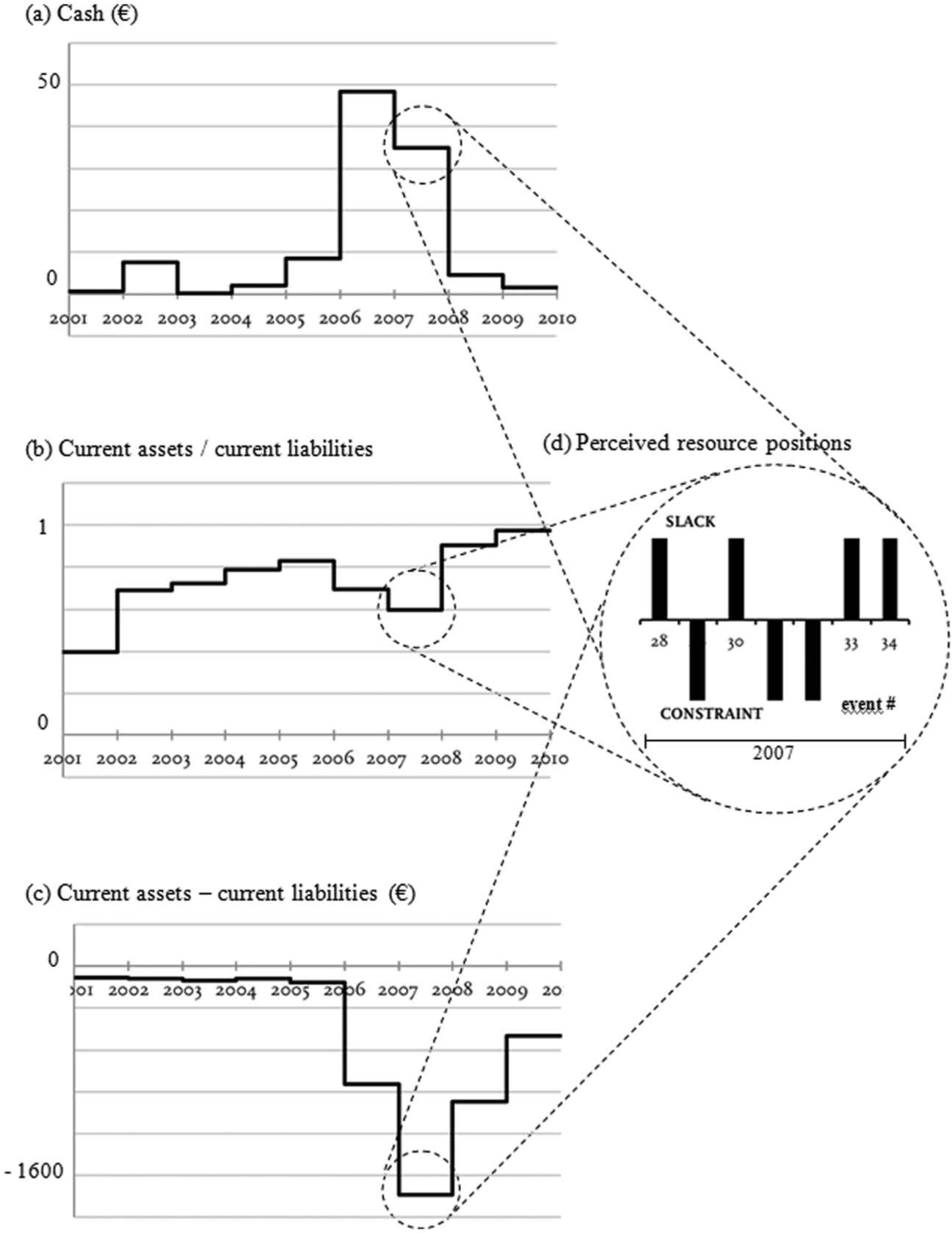
Financial slack: Firm-level vs. perceived resource positions (TextCo).
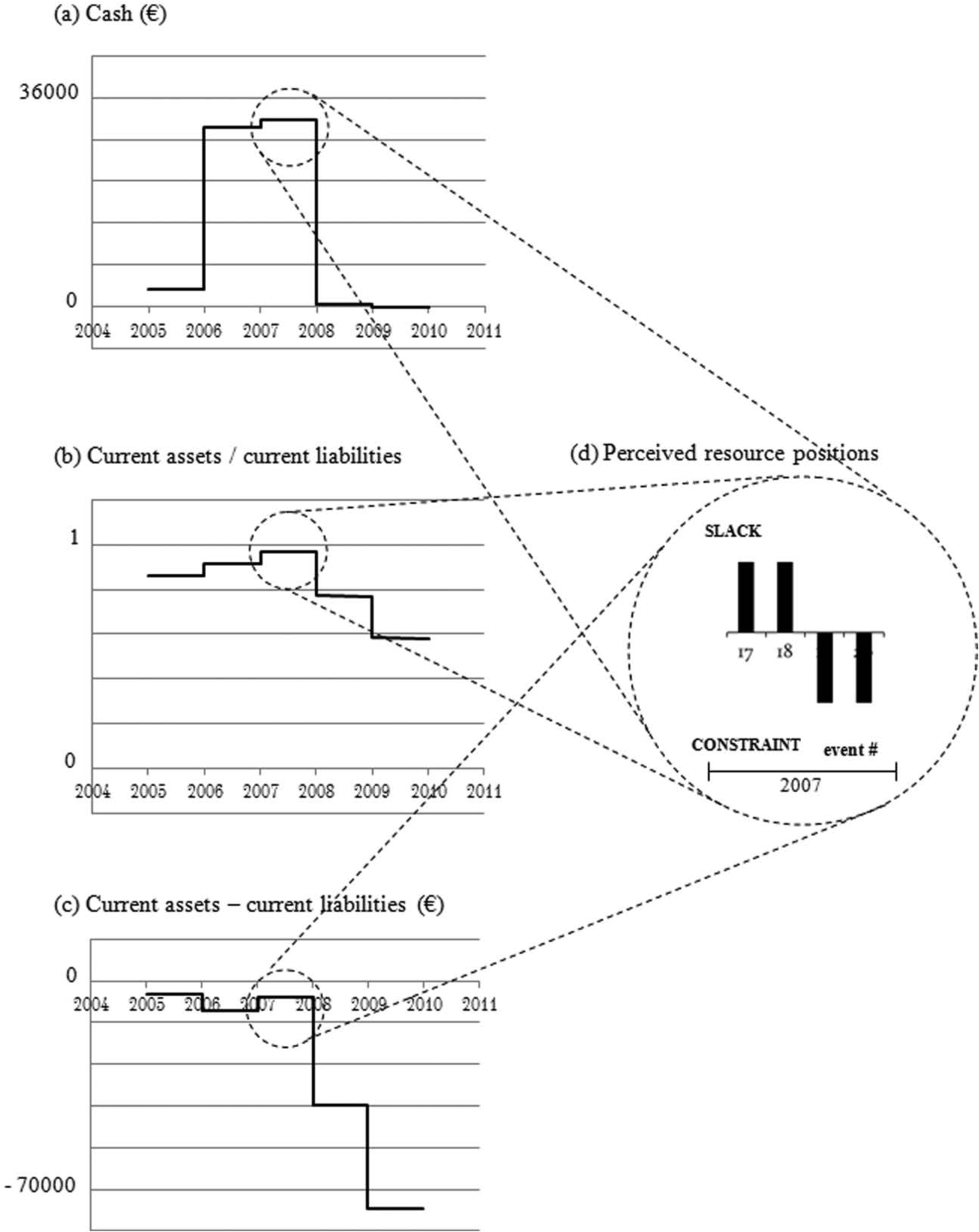
Financial slack: Firm-level vs. perceived resource positions (SunCo).
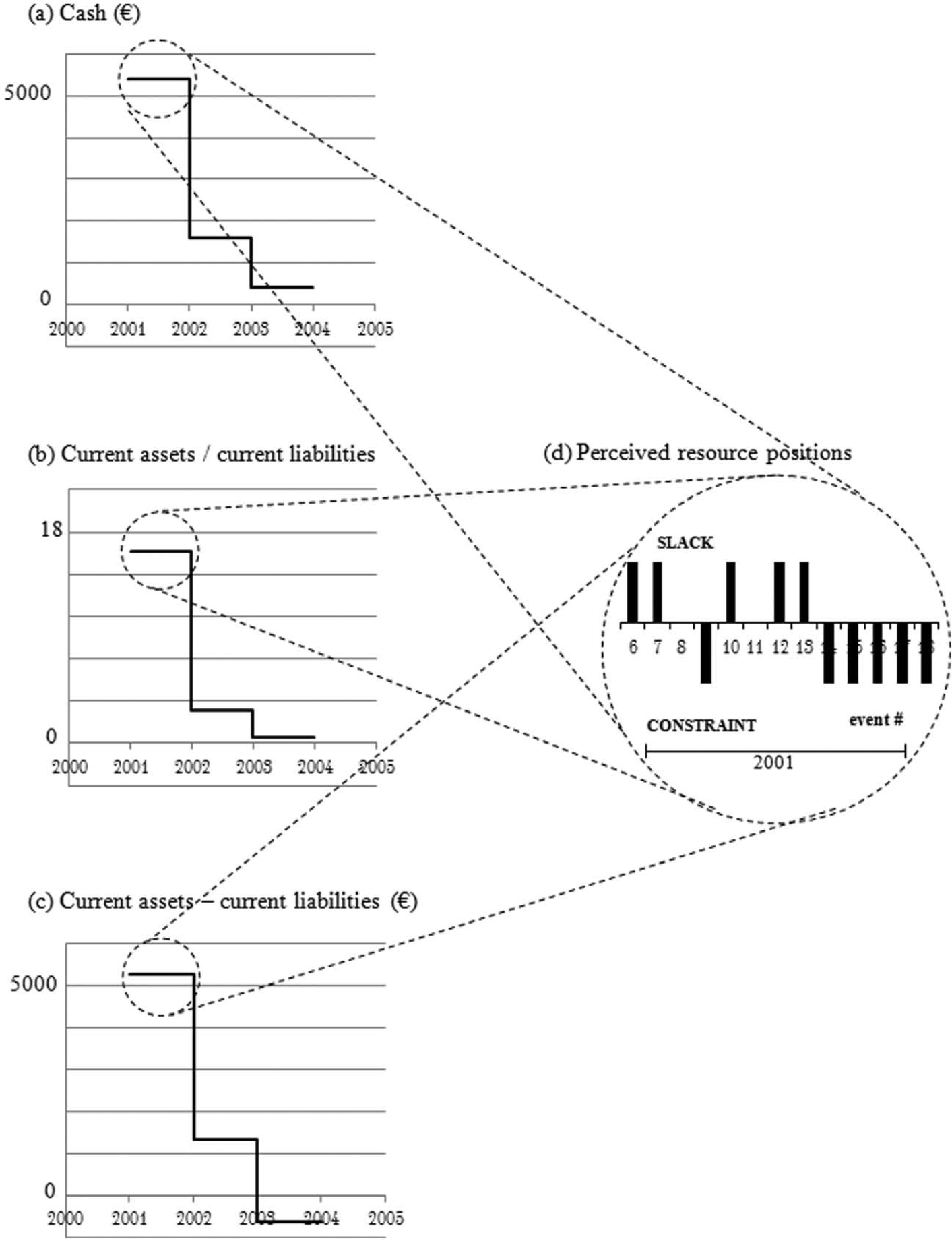
Financial slack: Firm-level vs. perceived resource positions (ChipCo).
Figure 3(d) further illustrates the difference between these objective financial measures and perceived, transient resource positions. Consider 2007 for TextCo. The firm-level financial measures indicate the company is experiencing either financial slack or financial constraints for the entire year; our approach reveals a more fine-grained and dynamic picture. Thus, firm-level measures appear poorly suited for capturing and incorporating the subjective nature of resource positions (Chiles et al., 2007; Chiles, Tuggle, et al., 2010; Foss et al., 2008; Kor, Mahoney, & Michael, 2007). Researchers must attend to the heterogeneity among individual entrepreneurs to understand firm-level outcomes (Felin & Foss, 2005; Foss, 2011), particularly with regard to their subjective perceptions of resource positions (Foss et al., 2008).
A micro-level perspective of dynamic perceived resource positions over time entails both subjective and volatile resource availability and subjective and variable imagined resource demands. For example, TextCo’s entrepreneurs experienced both financial slack and constraints during 2007, depending on their perceptions of their financial resources available relative to the amount they needed. Its founders were looking to expand the company, but financial constraints limited their ability to do so, so the founders made the decision to start looking for investors, as TextCo Founder 2 explained:
First, that did not work really well, because we didn’t have a track record. … Then we hired someone to make a business plan and slides and then we went to visit 10 investors.
Yet in the same year, TextCo’s founders experienced enough excess financial resources to take over entire divisions of competing companies. Founder 2 further noted:
[In] 2007, there were so many acquisitions. And we took part in that too. … And we did that twice, successfully. So we just told competing companies: ‘We are buying your division!’ … We told them: ‘Yes, you will sign over your customers to us and we will give you money in return.’
In summary, considering resources positions as perceived and transient offers an appropriate approach, because it provides a more accurate, fine-grained representation than do firm-level measures. These observations also correspond well with events that can be tracked in firm-level measures. Returning to Figure 2, we find that the solid bars representing TextCo’s financial resource positions do not exhibit a particular pattern but move almost randomly up and down over time, in line with the company’s internal cash-flow financing strategy and organic growth. SunCo’s financial resource positions in Figure 2 instead indicate a wave-like pattern, representative of its initial large financial commitments to product development, followed by the constraining effects of the economic downturn. ChipCo’s financial resource positions in Figure 2 also display a pattern consistent with its (anticipated) venture capital rounds and subsequent bankruptcy: financial slack during the first rounds of venture capital, followed by a series of constraints related to costly production. Later, in anticipation of new funding, it made investments to speed up the development process, but the inability to attract additional funding led ChipCo to declare bankruptcy.
Multidimensional resource positions
Different types of resource constraints and resource slack can be perceived simultaneously, as also illustrated in Figure 2. In contrast with one-dimensional measures, which indicate that firms experience either resource constraints or slack, we observe simultaneous combinations of constraints and slack. Therefore, resource positions appear multidimensional, in contrast with the conventional wisdom that implies constraints or slack are absolute positions in time (Bradley, Wiklund, et al., 2011; Nohria & Gulati, 1996; Tan & Peng, 2003). By identifying financial-, capacity- and capability-related resource positions (see Table 2), we observe that entrepreneurs can experience constraints and slack at the same time, as illustrated by ChipCo’s event 14 in Figure 2. In 2001, the founders of ChipCo anticipated severe financial constraints; they needed to secure a second round of VC funding but also received a complaint from another company claiming patent infringement. ChipCo’s CEO explained:
During the second round funding we faced a blocking patent, … where we would have to pay royalties of about 20 percent on everything we sold and a sign-up fee of, I believe, half a million, really ridiculous. … We were in the middle of [securing] that investment round and [potential VC investor] told us: ‘This is a major event, so we will need to see. This changes the entire situation.’
At the same time, ChipCo employed top-notch scientists, with plenty of underutilized (slack) capabilities. According to its CEO:
The brainpower of our guys, I mean, we had about four or five PhDs from [university X], super smart guys, real betas – tremendous amount of respect for those guys who all got their PhD at the intersection of physics and electrical engineering, real eggheads with international status. … They worked to see if they could come up with a re-design to work around the patent. Within two weeks they came up with seven re-designs!
In this example, financial constraints arising from patent infringement and slack capabilities jointly characterized the resource position at the time of the decision; together they spurred creative solutions. The finding that entrepreneurs can (simultaneously) perceive different types of constraints and slack reflects early theorizing about the role of resources in organizations (e.g. Hannan & Freeman, 1993; Scott, 1987; Thompson, 1967), and it signals that attempts to attribute particular effects to one-dimensional measures are highly problematic. The use of one-dimensional measures can result in outcomes driven by unobserved factors, which may explain the mixed prior findings regarding the effects of resource slack and constraints. Resource slack or constraints thus cannot be scrutinized in isolation; instead, they must be examined in more comprehensive ways.
Mixed effects of constraints and slack: Underlying dynamics
We now turn to exploring how perceived, anticipated and relative resource positions pertain to decision making. Previous research has not been able to provide consistent insights regarding the effects of resource constraints or slack. We grouped events with similar resource positions in tables to establish a link between resource positions and decision making; however, we did not detect a recurrent or systematic pattern at the event level. The perception of constraints in some instances motivates entrepreneurs to engage in some creative explorations (e.g. Table 4, event 28, ChipCo), whereas entrepreneurs perceiving constraints in other settings do not pursue that direction (Table 3, event 25, SunCo). Similar results arise with regard to the effects of slack resources (Table 5, events 14 versus 21, TextCo). At times, constraints encourage the production of creative ideas; at other times, slack resources stimulate such ideas; and in still other instances, neither constraints nor slack induce creative solutions. But why do constraints and slack not have univocal effects?
In line with our theoretical argument, our findings show that a decision outcome is unlikely to relate directly to an observed resource position. The relationship between resource positions and decision making instead depends on several underlying dynamics, including those at the individual, temporal, and resource position levels. In the remainder of this subsection, we ground these key factors and relationships in our data.
Individual dynamics
Analysis of the relation between resource positions and decision outcomes suggests entrepreneur-specific effects. Different entrepreneurs have unique backgrounds and perceptions of their ventures’ resource availability and demands that lead them to construct specific ideas about how to make their decisions; the decision outcome observed likely arises from the interaction between the entrepreneurs leading the venture. For example, both SunCo and TextCo started with two founders, each with their own perceptions of resource availability, resource demands, and options to develop the venture.
SunCo’s Founder 1, who previously had started and operated a small energy company, explained how his background influenced his view of the situation:
I wasn’t born rich. At one time, I started in a chicken barn of 500 square meters … That’s what I started with, to first prove that it works, so I put in the small amount of money I owned.
Then, after he met SunCo Founder 2:
So we started SunCo. I owned half of the company and [Founder 2] the other half … When you talk about starting, it was very small scale, facilitated by another small company I owned. It was just me, with one other guy. We did not start with huge investments but built up very slowly … dipping your toes in the water to feel how warm it is, to find out whether to proceed or hold back.
SunCo Founder 2 came from a multinational company and believed there were no financial constraints, which resulted in a different approach to the venture. The company’s chief technology officer, one of the first employees, explained:
[Founder 2] came in and said: ‘I want to make solarpanels, go figure it out!’ … In addition to the entrepreneurship style of [Founder 2], the beginning of the story is: this founder wants this specific technology, and that’s what we started with.
SunCo Founder 1 added:
We did invest a great deal in development. Compared to many other companies, really a lot. But it is because, for [Founder 2], it was worth the money. He told us: ‘this is what I want to do, this is my project. I will put in a lot of money because I believe in it.’
TextCo Founder 1 also recognized the differences between his and Founder 2’s perceptions:
You need to grow every dimension of your company. At first, this was difficult to get used to. Because it meant one had to make large investments which were, at that time, somewhat excessive, but needed in future. And this is where an important difference between me and [Founder 2] becomes visible. [Founder 2] is more of a visionary, he is able to foresee the future, what will be needed, and invest. I’m more conservative: Should we really do this? Why not focus on minimal investment? This is a very interesting and healthy tension. Whose plan of action is taken comes down to who has the most convincing arguments.
These examples effectively show how prior experiences influence entrepreneurs in making sense of their perceived resource availability and demand (Weick, 1995). Not only individual perceptions play a role (Chiles et al., 2007; Chiles, Vultee, et al., 2010), but interactions within the organization also affect the relationship between perceived resource positions, decision making and creativity (Ford & Gioia, 2000; McMullen, 2010). Many decisions made by SunCo and TextCo arose from negotiated compromises, based on inter-subjectivity or joint sensemaking by pairs of entrepreneurs with different attitudes (Weick, 1995), which influenced the overall creativity in these decisions (Ford & Gioia, 2000). However, the founders also actively engaged in perspective taking, allowing their partners sufficient resources and time to experiment.
Temporal dynamics
Regarding the connection among multiple events within a case, our findings suggest that the influence of resource positions on decision making is not consistent over time but rather is subject to temporal dynamics. Past experiences (paths) influence the decision-making process and thus the relationship between resource positions and decision outcomes. Such path-dependent effects occur when entrepreneurs only see options along their existing path, despite possible changes in their perceived resource position. In this case, entrepreneurs decide according to routine first (i.e. choosing the familiar path) rather than according to their current, changed resource position.
The product development phase at the VC-backed ChipCo clearly revealed path-dependent effects. Its initial financial slack facilitated a development trajectory, free of short-term financial and environmental pressures; later ChipCo persisted with the development of its product, even in the face of severe resource constraints. Founder 1 explained that, at first, he believed all necessary resources were available:
When we started, both VC investors told us: ‘Don’t bother about attracting subsidies. It is a lot of effort and a lot of hassle. If you need more money, then just ask for more money and you will get more money’ … they [VC investors] pushed us: ‘Continue the development of the Holy Grail, don’t focus on simple sub-products [to generate cash-flow].’
The CEO added:
… it was just invested based on the needs of the technology. This has that much potential; this will turn out just fine. Something will come out of this: that has been the starting point.
Because the founders of ChipCo believed their resource demands would always be met, they set out to develop a cutting-edge product that would incorporate all the technical expertise available to them.
However, by the final stages of the product development process, ChipCo’s target (telecom) market appeared on the brink of collapse, creating vast uncertainty. ChipCo’s founding team still perceived ample financial slack, in the form of substantial (existing and potential) VC funding. Founder 2 reflected on the decision to proceed with product development:
Actually, it was the wrong time to … when you look back; it was really a very odd period to start a company. Actually, it is just not possible. A shrinking market and a completely new technology.
As ChipCo continued with its product development activities, the costs increased drastically. Despite these (anticipated) financial constraints – a significant change in resource position – the team still decided to continue with the initial idea and even increased the number of design runs. The CEO explained why ChipCo persisted, even when the perceived resource position changed from financial slack (7 million Euros of VC funding) to financial constraints (high development costs):
At one point we had that 7 million. Initially, we did one design run every month. We improved our own process every run, as we were inventing something new. One run takes 100,000 Euros, as all parties have to perform their tasks every run. But we also had our daily costs of keeping the business going; we had to pay 20 staff members, the rental fees, etc. It is a very costly business. Then we increased to two runs a month and we burned our money even faster.
In addition to high operating fees and a collapsing telecom market, another problem surfaced: Customers were not willing to buy ChipCo’s products because they were not able to integrate them into existing systems. Faced with even greater financial constraints, ChipCo’s leadership saw few alternatives other than continuing to develop products for the telecom market. According to its VC investor:
At that time, the feeling that we needed to generate revenue became stronger and stronger. … The long-term vision did not change, but the quest became: OK, what is needed for tomorrow?
The entrepreneurs did not want to give up on ChipCo’s long-term (product development) goals, so they conceived of an intermediate product for the telecom market that would be more marketable but still based on the developed technology (i.e. slack capabilities). Founder 1 indicated:
But then we thought about another application, a monitoring application, as this does not demand a significant redesign of the system. This can be plugged in [existing systems of telecom providers], and then we can at least sell something. It is based on the same technology we are already using, but then with [more] channels. … And yes, I think we were a little too late with that.
In the end, after confronting the consequences of a collapsed market, ChipCo’s investors resigned themselves to failure. At that point, the founding team of the insolvent ChipCo finally saw how the routine had failed: ChipCo’s path had constrained the options that the founders could imagine, even when the situation (and resource positions) kept changing. As soon as the founders were no longer able to follow the existing path, they acknowledged the need to explore alternative ideas. Founder 1 explained:
At the moment that everybody … that the telecom market collapsed, that clients told us not now, not at this moment, then we started looking at alternatives. Yes, because still we were able to build about anything … The time to develop something to be used in a different market; this takes time and money. Both we did not have.
ChipCo’s product development process thus illustrates that when entrepreneurs decide to stick to an existing path, unaffected by changes in resource positions, it impedes the timely imagination and exploration of creative solutions.
The SunCo case revealed a similar path dependency in its response to resource constraints. Such path dependency affects the relationship between resource position and decision making: past experiences constrain the options entrepreneurs are able to imagine, even when changes in their resource position give them a reason to become creative. That is, unconstrained, forward-looking imagination can drive the creative decision-making process more effectively (in line with the Austrian argument; e.g. Chiles et al., 2007; Chiles, Tuggle, et al., 2010; Foss et al., 2008; McMullen, 2010), whereas approaches that rely on previous paths and experiences can constrain creativity (Keeney, 1994; Vergne & Durand, 2011; Weick, 1979, 1995) by making entrepreneurs less receptive to changes in resource positions.
Resource position dynamics
Our findings suggest different types of resource constraints and slack are perceived simultaneously; together they make up the overall resource position perceived at the time of the decision. Perceived constraints and slack jointly influence the way entrepreneurs make decisions, so perceptions of different resource configurations have different effects. In 2008, SunCo set out to establish international sales offices for its modules, which led it to assess its resource position (Figure 2, event 19). According to SunCo’s chief operating officer:
I think we were more a module producer. So, we built modules. But, as we grew, only building modules was not sufficient to create enough volume [to make profit] … When I arrived, there was a kind of organization that had a track record and a number of people who had, say, expertise [of project management] in their heads. … You just have to see you are capable of doing much more than just selling modules. So there is a lot of capability here and sometimes we can use those capabilities to help customers who are stuck with a project, we can help those customers because we are used to doing it too. … So we have an additional channel, an additional outlet to bring products to the market. Because we also add value, not just [deliver] a module, but a complete system, you generate an interesting margin.
Thus, SunCo established a second line of business, in view of both (anticipated) financial constraints and slack capability. This example suggests it was the perception of this specific combination of constraints and slack that stimulated the novel idea of a second line of business, rather than the need to generate higher margins or underutilized existing capabilities. When entrepreneurs perceive a combination of various resource positions, this specific combination affects their decision-making process, which makes it impossible to trace observed effects back to single resource positions. Moreover, studying resource positions in isolation may result in an incomplete picture of the entrepreneur’s perceived situation, which fails to account for any combination-specific effects of resource positions.
In the ChipCo case, we also observed an influence of perceived resource combinations (e.g. Figure 2, event 15). In 2001, when ChipCo’s founders started planning the production of their first product, they experienced for the first time all three types of resource constraints, because of the resources demanded: they did not have a cleanroom to develop their product (capacity constraint), nor did they have sufficient financial resources to build their own cleanroom facility (financial constraint), and the team also lacked the proper experience (capability constraint). The founders faced tough challenges, as ChipCo’s CEO recalled:
With respect to operations, it is highly complex and incredibly expensive, it is a nightmare. So I almost developed a stomach-ache because of this, apart from the fact that I had absolutely no idea what it [building a cleanroom] was about. I cannot build such a thing …
Because, unlike other start-ups in the industry, ChipCo lacked sufficient financial resources to build a cleanroom, Founder 1 noted their production decision had to involve creative elements:
Everybody, every start-up received 40 million dollars to build their own fab [cleanroom]. And well, we raised 7 million dollars that year, and yes, that is of course way too little to build your own fab. But that made us realize that we had to do things in a different way. So we started looking for production partners. And that is exactly the path we ended up taking.
This particular combination of constraints pushed ChipCo’s founding team to come up with the idea for production partners. What would they have done, though, had they experienced fewer resource constraints or a different combination of constraints and slack? The way entrepreneurs make sense of their context and the options they imagine appears to depend on the (situation- and time-specific) perceived combination of resource positions. These findings demonstrate how perceived combinations of different types of resource constraints and/or slack enter the decision-making process and influence the entrepreneur, generating idiosyncratic options with varying degrees of creativity. Therefore, our results extend entrepreneurship theory, in particular with regard to the process of resource (re)combination (Chiles et al., 2007; Chiles, Vultee, et al., 2010; Foss et al., 2008; Schumpeter, 1934), by showing how entrepreneurs not only engage in imaginative (re)combinations of existing resources but also can be guided by imaginative (re)combinations of perceived resource slack and resource constraints.
Discussion
We have explored the characteristics of resource positions and how they influence entrepreneurial decision making and creativity. Viewing resource slack and resource constraints as two extremes on a spectrum of resource positions constitutes an important step toward integrating the resource slack and resource constraints literature, which represent core discourses on organizational ingenuity. Perceived resource positions reflect the entrepreneur’s imagination of available resources relative to demand including anticipated resources or resource demands. Furthermore, resource positions are transient imaginations, allowing the entrepreneur to move along the constraint–slack spectrum over time. Resource positions are multidimensional constructs too; our findings show that entrepreneurs perceive different types of constraints and slack simultaneously (e.g. capacity constraints and financial slack), in line with prior work that has acknowledged the multidimensional nature of resources (e.g. Hannan & Freeman, 1977; Voss et al., 2008).
Such perceived, anticipated and relative resource positions influence creative decision making, but not systematically. Constraints and slack do not have univocal effects, but rather lead to idiosyncratic decisions by entrepreneurs. Constraints sometimes encourage inventive behaviour, or slack resources might induce innovative activities; in other cases, neither constraints nor slack result in creative decisions. The relationship between resource positions and (creative) decision making thus is highly complex, influenced by underlying dynamics that tend to remain hidden in firm-level studies that rely on cross-sectional measures (Felin & Foss, 2005). By studying perceived, anticipated, and relative resource positions over time at the decision-making level, we demonstrate that the processes by which resource positions influence decision making depend on individual, temporal, and resource position dynamics. These results have notable implications for research and theory about the relationship between resources and creativity in decision making.
Perceived resource positions and individual dynamics
Resource positions reflect an entrepreneur’s perception of available resources relative to demand. Unlike previous research that has tended to overlook the role of individuals in organizations (Abell et al., 2008; Felin & Foss, 2005; Foss, 2011) because it adheres mainly to firm-level measures (Daniel et al., 2004; Voss et al., 2008), we conceptualize resource positions as the abundance or shortage of resources perceived by the entrepreneur. Perceived resource availability and demand are entrepreneur-specific and highly subjective, in line with sensemaking (e.g. Cornelissen & Clarke, 2010; Weick, 1995) and Austrian economics (e.g., Foss & Ishikawa, 2007; Foss et al., 2008) research. An entrepreneur’s imagination influences the subjective evaluation of available resources (Chiles et al., 2007; Chiles, Tuggle, et al., 2010; McMullen, 2010), so firm-level measures cannot address the heterogeneously perceived value of available resources in relation to imagined action scenarios. The commonly used, financial firm-level measures, which result in contradictory characterizations of a start-up’s resource position, thus are less appropriate for describing the effects of resource slack and constraints.
The idea that resource positions are transient imaginations has important implications for related studies, because the relationship between resource positions and decision making is subject to individual-level dynamics. Different entrepreneurs perceive resource availability relative to imagined demand in distinct ways – as clearly exemplified by the two SunCo founders – and therefore make different decisions. Our findings thus extend prior research that suggests that founders likely engage in creative and innovative activity by nature, by habit, or in response to certain resource positions (Baker & Nelson, 2005; Bundy, 2002; Woodman, Sawyer, & Griffin, 1993). For example, effectuation theory implies that the way entrepreneurs make decisions depends on their individual expertise and the degree of uncertainty (Sarasvathy, 2001; Sarasvathy et al., 2008; Read & Dolmans, 2012). As the degree of uncertainty may shift for each event, it is impossible to find a direct or generalizable effect of resource availability, because individual perceptions and decision-making drive firm-level behaviour and outcomes.
Various decision outcomes also arise from the interaction between entrepreneurs who team up for a particular venture. Both individual perceptions and interactions between individuals thus influence the relationship between perceived resource positions and decision making (Chiles et al., 2007; Chiles, Vultee, et al., 2010; Ford & Gioia, 2000; McMullen, 2010). In this sense, our findings extend research on collective creativity by showing how interactions between entrepreneurs, perceiving distinct resource positions, can affect the production and implementation of creative ideas (Ford & Gioia, 1995; Hargadon & Bechky, 2006; Kurtzberg & Amabile, 2001; Sawyer & DeZutter, 2009; Sawyer, 2008; Woodman et al., 1993). Our study also extends previous work on perspective taking and creativity (McMullen, 2010) as antagonistic perspectives might generate underlying tensions, and founders who cannot converge on a shared perspective on resource positions may nix their partners’ creative ideas. Ongoing research should incorporate these individual and collective effects and gather the perceptions of all entrepreneurs (and perhaps their stakeholders) about their resource availability and imagined resource demand.
Transient resource positions and temporal dynamics
Perceived resource positions are not static, but change over time (George, 2005; Mishina et al., 2004). On an event basis, perceived resource positions can shift easily, such as when the founders of SunCo perceived that they had sufficient resources to buy an existing solar development project but shortly thereafter recognized significant financial constraints due to the expected bankruptcy of a key supplier. Time-invariant or annual measures of slack and constraints thus may not capture precisely how resource positions affect decision making (Daniel et al., 2004; Nohria & Gulati, 1996; Tan & Peng, 2003). Capturing resource positions with a single observation only provides a situational snapshot, whereas both perceived resource availability and imagined resource demand are variable. The underlying temporal dynamics offer an important explanation of the mixed effects of resource constraints and slack, as they can blur the causal relationship between resource position and observed outcome. Depending on when resource positions, decisions and outcomes get measured, different conclusions emerge regarding the effects of constraints or slack. Measuring resource positions at a single point in time thus ignores the possibility that a follow-up measure would produce a completely different result. Therefore, subjective and longitudinal representations of resource positions (related to decision-making events) are necessary.
From the Austrian economics perspective, scholars have argued that the perceived nature of a firm’s resources reflects the heterogeneity of entrepreneurs and their dynamic perceptions of resources over time (e.g. Chiles et al., 2007). We extend these insights by showing that micro-level dynamics, including subjective and variable resource availability and subjective and variable imagined resource demand, determine the transient resource position (Figure 1).
Although perceived resource positions are variable, path-dependent effects dampen the variation in decisions made on the basis of resource positions (Hannan, 1998; Romme, 2004; Stinchcombe, 1965). The ChipCo case reveals how entrepreneurs can grow accustomed to a routine for dealing with problems, and that routine regulates their future behaviour, regardless of their resource position (Heiner, 1983; March & Simon, 1958). Even when confronted with resource shortages, they may seek to exploit their past successes by engaging in local learning and optimization, rather than learning from distant places or exploring new opportunities (Levinthal & March, 1993; March, 1991). Entrepreneurs can become trapped in an exploitative learning cycle, such that they simply fail to take into account their actual resource position. These findings extend existing research by showing that the influence of both resource slack and constraints is subject to organizational routines (Cheng & Kesner, 1997; Cyert & March, 1963; Nelson & Winter, 1982). Unconstrained forward-looking imagination can drive creative decision-making processes (e.g. Chiles, Tuggle, et al., 2010), whereas approaches relying on past paths and experiences can constrain creativity (Keeney, 1994; Vergne & Durand, 2011; Weick, 1979, 1995), which makes entrepreneurs less receptive to changes in resource positions. This happens when entrepreneurs see few alternatives besides the obvious ideas they have implemented before (Keeney, 1994; Lubart, 2001). The notion of path dependency thus helps explain entrepreneurial decision making (in view of resource positions) and the level of creativity in entrepreneurial decisions.
Furthermore, entrepreneurs do not make decisions in a vacuum. We have focused on the individual entrepreneur, to elucidate the micro-foundations of the effect of resources (Felin & Foss, 2005; Foss, 2011), but the strategy and organizational design of the firm also can create path dependency. Major commitments to capital providers and employees make it hard, if not impossible, to change decisions radically (Hannan & Freeman, 1984), which may reduce the level of creativity in key decisions. Such a path-dependent effect is evident in the failure case, in that ChipCo’s founders had such strong commitments to their current path that only after the team ran out of alternatives did it decide to explore new options. In the two other cases, the founders were more responsive and proactive in their approaches to change.
Multidimensional resource positions and resource position dynamics
Simultaneity of resource constraints and slack challenges the conventional wisdom that constraints or slack take absolute positions in time (e.g. Bradley, Wiklund, et al., 2011; Tan & Peng, 2003). Our results imply that resource positions are multidimensional, such that different types of slack and constraints occur at the same time. Early theory about the role of resources in organizations suggested this simultaneity (e.g. Hannan & Freeman, 1993; Thompson, 1967), but recent studies tend to overlook these insights.
These simultaneous perceptions can create problems for researchers who want to attribute particular effects to one-dimensional interpretations of resource positions, whereas firms, such as SunCo, might establish a second line of business in view of both financial constraints and slack capability. Moreover, the relationship between resource positions and decision making appears subject to such combinations in resource positions; because different configurations of resource constraints and slack jointly influence entrepreneurs’ decisions, it is difficult to attribute any specific decision outcomes to a single type of resource constraint or slack. Investigating constraints or slack in isolation produces an incomplete picture of the resource position, which may explain mixed effects in previous studies (Hoegl et al., 2008; Mellahi & Wilkinson, 2010). Our case studies also illustrate how perceived combinations of different types of resource constraints and slack enable entrepreneurs to generate idiosyncratically creative options, which extends existing theory about the process of resource (re)combination (Chiles et al., 2007; Chiles, Vultee, et al., 2010; Foss et al., 2008; Schumpeter, 1934). Entrepreneurs not only engage in imaginative (re)combinations of existing resources, but also are affected by imaginative (re)combinations of perceived slack and constraints in resources.
Conclusion
This article sheds new light on the ongoing debate about the effects of resource constraints and slack and the circumstances under which organizational ingenuity may emerge. We show how the relationships of resource positions, decision making and creativity depend on underlying dynamics that remain concealed in cross-sectional studies at the firm level. By conceiving of resource positions as perceived, anticipated and relative, we clarify how perceived resource positions influence organizational ingenuity in terms of decision making and creativity – not systematically, but according to individual, temporal, and resource position dynamics. Individual-level dynamics relate to how different entrepreneurs, even those working in the same venture, may perceive resource availability relative to demand in distinct ways; individual-level dynamics also relate to how interactions between entrepreneurs affect decisions. Temporal dynamics imply that the influence of resource positions on decision making is not consistent over time, as past experiences can influence the decision-making process and hence the relationship between resource positions and decision outcome. Finally, resource position dynamics pertain to how combinations of different types of resource constraints and/or slack enter the decision-making process and lead to unique outcomes.
Our finding that resource constraints and slack are transient with the entrepreneur’s perception of available resources and resource demands has important implications for further investigations of the effects of resource positions. To link resource positions to outcomes of interest, researchers should assess both resource availability and perceived resource demands, preferably on an event-specific basis. Future work also needs to acknowledge that resource positions are multidimensional, and moreover that the entrepreneur’s sensemaking of complex situations explains his or her decisions. To understand the effects of resource positions, one cannot examine resource constraints and slack in isolation. Because entrepreneurs perceive resource availability in relation to demand, while individually and collectively making sense of the present, past and future, firm-level operationalizations are insufficient as well. Future research must build on individual and collective interpretations of resource positions.
Limitations and directions for future research
Several limitations of this study offer directions for research. First, we focused on short-term implications of resource positions for entrepreneurial decision making and ignored longer-term effects. The potential value of investigating long-term (performance) effects may be somewhat questionable, considering that resource positions are transient imaginations. Nonetheless, longer-term implications, such as those associated with deployments of slack resources or new strategies implemented in response to resource constraints, need to be studied and assessed. Second, our results are based on data pertaining to more than 100 events involving three companies, one of which was unsuccessful. The research design thus is not perfectly balanced; in-depth longitudinal studies, using larger samples with a more balanced research design, are likely to provide further insights. Third, our data pertain to high-tech start-ups in emerging industries. More research should explore whether similar patterns can be observed in other types of start-ups and in large corporations, in both emerging and mature industries.
With in-depth longitudinal studies, future research can also derive higher-level implications of resource positions and generate testable propositions. The use of process methods and individual- and collective-level interpretations of resource positions should clarify the causal relationships among resource positions, decision making, and creativity. Alternatively, more quantitative studies likely will be only as effective as the operationalizations adopted. Without appropriate measures, studies using quantitative methods may be ineffective; because resource positions are transient imaginations grounded in individual and collective sensemaking, we suggest that additional work addresses the possibility of capturing, characterizing, and quantifying resource positions systematically. Finally, further research should expand understanding of the inner workings of, or interplay among, the underlying dynamics of resource positions. For example, future work can investigate how different levels of inter-subjectivity in perceived resource positions relate to creative imagination and decision making, or how organizational routines influence collective sensemaking within organizations.
We have empirically demonstrated how subjective perceptions of resource positions enter the entrepreneurial decision-making process that generates idiosyncratic options with varying degrees of creativity. As such, research exploring the relationships among entrepreneurship, resource positions, decision making and organizational ingenuity needs to incorporate such micro-foundational dynamics.
Footnotes
Acknowledgements
The authors are grateful to the special issue editors Benson Honig, Joseph Lampel and Israel Drori, three anonymous reviewers and participants at the 2011 Ingenuity Conference and the 2011 Babson College Entrepreneurship Research Conference for their helpful comments. Any remaining errors are the responsibility of the authors.
Funding
This research is partly funded by the Eindhoven University of Technology InnovationLab and a European grant (E-Force, within CIP 2007–2013).