




Abstract
In this introduction to the special issue we explore the main features of ‘organizational ingenuity’, defined as ‘the ability to create innovative solutions within structural constraints using limited resources and imaginative problem solving’. We begin by looking at the changing views of the importance of ingenuity for economic and social development. We next analyse the nature of ingenious solutions. This is followed by a discussion of structural, resource and temporal constraints that face problem solvers. We next turn our attention to creative problem solving under constraints. We contrast ‘induced’ and ‘autonomous’ problem solving. The first arises when external stakeholders or top managers impose tasks that define problems for the individuals and groups that must solve them; the second arises when these individuals and groups recognize and define the problems for themselves. We argue that in both induced and autonomous problem solving, individuals and groups that wish to act creatively confront two types of constraint. The first are ‘product constraints’ that define the features and functionalities that are necessary for a successful solution. The second are ‘process constraints’ that stand in the way of creative problem solving in a given organizational context. We argue that both types of constraints can lead to organizational ingenuity, but that dealing with process constraints is crucial for organizational ingenuity, and hence for sustaining organizational ingenuity more generally. We provide an overview summary of the articles in the special issue, and conclude with suggestions for future research.
In a world where creativity is prized and innovation is widely supported, the obstacles to creative solutions to pressing economic and social problems seem to be greater than ever (Homer-Dixon, 2002). At the same time, the very institutions that support and fund innovations – governments, corporations, universities – generate structures that hamper creativity and reduce resource mobility (Nelson, 1992; Robertson & Langlois, 1994). Inevitably, one response to this paradox has been to call for the dismantling of institutional and regulatory structures, and to champion economic and social spaces that are relatively free of constraints (Awrey, 2013; Vietor, 1994). But turning away from institutions that play such an important role in economic and social life is neither feasible nor desirable (Courpasson & Clegg, 2006). Not only do these institutions have strong political and social legitimacy, they also possess considerable resources and organizational capabilities that can be brought to bear on urgent social and economic problems. The challenge is to get this done within the context of structural constraints that these institutions inevitably generate.
This challenge forms the background to this special issue of Organization Studies. When we framed the call to the special issue we were mindful of the extensive research on creativity and innovation, and that these terms encompass large conceptual and empirical domains. To focus thinking on creative problem solving within institutional constraints we needed a term that reflected the intersection of these domains. We chose ‘ingenuity’ because the word is generally associated with creative problem solving. The Oxford dictionary, for example, defines ‘ingenuity’ as the ‘quality of being clever, original, and inventive’. The Merriam-Webster dictionary is even more specific, defining ‘ingenuity’ as ‘skill or cleverness that allows someone to solve problems, invent things’. Both these definitions, however, emphasize ingenuity as the property of individual actors; reinforcing the contrast that is often made in the research literature (not to mention in popular discussion) between creativity and its absence: on the one hand we have romantic images of entrepreneurs asserting the primacy of creativity by breaking rules and transcending boundaries, and on the other institutionalized managers constrained by rules and prevented by boundaries from exercising creativity (Lampel, Honig, & Drori, 2014).
Equating ingenuity with gifted individuals who operate outside, or even struggle against, established organizations is part of the ethos of rugged individualism that was prevalent in early capitalism, especially in the United States. In the early days of the American republic, ingenuity, or more specifically ‘Yankee ingenuity’, was seen as the main advantage of American industry in a world where European powers with superior resources clearly dominated the economic landscape. Alexander Hamilton, one of the founding fathers, believed that Americans had a special ‘genius’ for invention, a genius that showed in their ‘peculiar aptitude for mechanical improvement’ (Fisk, 2009, p. 20). Eighteenth century, and early nineteenth century, authors, such as Benjamin Rumford (1968) (memorialized later in a prestigious American scientific prize) and John Melish (1812) who influenced Thomas Jefferson (Peterson, 1970), went further back in time to argue that ingenuity can be seen in its purest form in pre-industrial societies precisely because resources are so scarce, and necessity is so immediate. It followed from this that American ingenuity flourished in the new world not only because of pressing needs and scarce financial and human resources, but also because this newly created society had avoided the institutional constraints that shaped innovation in Europe.
By the middle of the twentieth century the pendulum had swung against seeing ingenuity as the mainstay of technological change and economic development. Government funding of technological innovation, and the rise of corporate research and development, led many to argue that organized research and development was demonstrably superior to ingenuity which depends on hunches and inspiration, and hence is hard to predict and control. John Kenneth Galbraith (1967, p. 75) sums up this view in the clearest way when he writes that: The real accomplishment of modern science and technology consists in taking quite ordinary men, informing them narrowly and deeply and then, through appropriate organization, arranging to have their knowledge combined with that of other specialized but equally ordinary men. This dispenses with the need for genius. The resulting performance, though less inspiring, is far more predictable.
This special issue argues that writers such as Galbraith who saw ingenuity as unnecessary in the age of organized research and development failed to differentiate between routine and creative problem solving. The former does useful work in a myriad of situations, but the latter is essential for economic and social renewal (Greve, 2003; Schumpeter, 1934). We have ample evidence that modern organizations have a remarkable ability to develop systems that tackle routine problems. But we also know that the more organizations use systems and structures that tackle routine problems to achieve better performance, the more they are likely to lose their ability to solve problems creatively (Jelinek, 1979; Miller, 1991). The challenge for organizations today, as it has always been, is how to carry on the task of routine problem solving without losing the ability to tackle problems creatively. The challenge, one can argue, consists of combining organizational structures and managerial routines with creativity, not only in specialized R&D units but at every level of the organization.
The nature of organizations makes this combination difficult to achieve and sustain. Organizational actors must contend with boundaries; they have to operate both within and through existing rules, and they are often not free to choose their own problems. To deal with the resulting constraints actors sometimes develop a set of skills, social tactics and mental orientation that express ‘organizational ingenuity’: the ability to create innovative solutions within structural constraints using limited resources and imaginative problem solving. Enacting organizational ingenuity requires creativity, but it also demands exceptional political, social and communicative abilities. Organizational ingenuity is therefore the domain of the organizational actor, fluent in negotiating organizational boundaries, and fully cognizant of the constraints and limitations imposed by the bureaucratic institution they inhabit (Isaacson, 2011). Unlike Whyte’s (1956/2013) archetypical organizational man, who eschews creativity in favour of organizational conformity and the status quo, organizational ingenuity depends on individuals and groups that are motivated to act creatively both by the intrinsic reward that often accompany creative problem solving, and by organizations that rewards ingenious solutions.
On Ingenious Solutions
Ingenious solutions often attract attention. They testify to our ability as humans to rise above the mundane – which is why they are often described as elegant, and at other times colloquially as ‘sweet’. Aesthetics aside, the overriding priority is for organizations and societies to find solutions to pressing problems. Ingenuity may be culturally inspiring, but it cannot be an end in itself.
To see why ingenuity matters we have to consider the standard definition of a creative solution. Adapting Boden (1994, pp.75–117), we can define a creative solution as combining novelty and value, where value is defined as ‘fitness for purpose’. Based on this definition, one can argue that a solution is less creative if novelty is low but the fitness for purpose is adequate, i.e. the actors satisfice available solutions relative to the constraints.
The transition from adequate to ingenious solution arises when novelty increases fitness for purpose, and when this increase is exponential. Thus, when a novel solution delivers far greater fitness for purpose than anticipated or necessary, we have arrived at an ingenious solution. In more general terms, in the face of constraints, actors are intent on finding solutions that are fit for a particular purpose. There may be individuals who are motivated by novelty (e.g. artists), and organizations that value novelty for its own sake (e.g. universities), but in terms of legitimacy it is clear that fitness for purpose is the overriding criterion that allows actors to obtain the resources they need, and justify the solutions once they arise. Novelty matters to the extent that it increases fitness for purpose beyond the threshold required, and generally exceeds what most people expected.
On the Nature of Constraints
The products of the ‘American system of manufacturing’, which Europeans first encountered during the 1851 World Fair in London, excited admiration and later widespread imitation. Echoing their American counterparts, European commentators attributed the extraordinary technological leap ushered in by mass-produced standardized products using interchangeable parts to ‘Yankee ingenuity’ (Murrin, 2008). In reality, the use of interchangeable parts had been successfully demonstrated in France during the late eighteenth century. However, there is a considerable distance between pioneering the basic concept and transforming it into a manufacturing system. Bendict Crowell (1919), Assistant Secretary of War and Director of Munitions, saw the distinction clearly when he attributed American manufacturing success to constraints systematically imposed on the development of machine tools and worker training. As he put it: The French artisan sees always the finished article, and he is given discretion in the final dimensions of parts and in the fitting and assembling of them. But the American mechanic sees only the part in which he is a specialist in machining, working with strict tolerances and producing pieces which require little or no fitting in the assembling room. Consequently in the translating of French plans [for interchangeable parts] it was necessary to put into them what they never had before, namely rigid tolerances and exact measurements. (Crowell, 1919, p. 23)
Constraints usually have negative connotations. We associate constraints with limits, boundaries, prescriptions and prohibitions. Thus, Rosso (this issue) defines constraints as the ‘state of being restricted, limited, or confined within prescribed bounds’. Lombardo and Kvålshaugen (this issue), are more specific, defining constraints as ‘limitations or restrictions for what can or cannot be done in the problem solving, and for what the final solution should fulfill’. If constraints limit what agents can do in a given situation, it is not surprising that reducing or eliminating constraints is often seen as a prerequisite to creativity. But such framing of the relationship between constraints and creativity in this fashion is misleading. In reality, the relationship between constraints and creativity is both negative and positive.
The negative is self-evident, and is the stuff of folklore: Galileo forced to recant his theories, Mozart chafing under restrictions imposed by his employer, the archbishop of Salzburg, and Orson Welles enduring the humiliation of the RKO film company cutting one hour out of The Magnificent Ambersons. The positive impact of constraints on creativity is rarely celebrated, but may be just as important. For example, in his study of the relationship between constraints and creativity, Rosso (this issue) finds that R&D teams described product requirements imposed by the organization in overwhelmingly positive terms. Whereas researchers such as Amabile (1988) see external constraints as antithetical to creativity, Rosso’s respondents argue that the product requirements that are imposed by their top managers lend clarity and direction to their creative efforts.
We tend to overlook constraints when they play a positive role. Constraints are often rules and regulations that protect workers, consumers and the public in general. Efficient markets depend on constraints. Remove constraints, for example by allowing excessive leveraging by financial institutions, and the result is often disastrous. Impose constraints on waste disposal and activities that pollute, and the result leads to more innovation rather than less. For example, Cunha, Rego, Clegg, Neves and Oliviera (2014) point out that scarcity of land for waste disposal in Japan ‘helps to explain why the Japanese cement industry now makes use of approximately 6 per cent of the country’s waste and why the nation reports the smallest energy consumption per ton of cement produced among developed countries’. What is true for countries is also true for organizations. As organizations are forced to do more with less, and compete with more munificently endowed organizations, the adage ‘necessity is the mother of invention’ becomes an imperative (Honig, Karlsson, & Hagg, 2013).
Structural constraints
James Q. Wilson (2014, p.352) has remarked that ‘we ought not to be surprised that organizations resist innovation. They are supposed to resist it… The standard operating procedure is not the enemy of organization; it is the essence of the organization’. Standard operating systems are coupled to the organization structures that define rules and demarcate activities. Structural constraints, however, are often the most complex and persistent obstacles to organizational ingenuity. Norms, rules and rituals are strongly embedded in organizational routines and practices that define organizational life, irrespective of their efficiency or contribution (Meyer & Rowan, 1977). Ingenuity often requires circumventing or re-focusing these organizational norms. For example, Edison’s trial-and-error approach to developing the incandescent light bulb was arguably the easier part of his invention. Overcoming the social, political, regulatory and commercial obstacles that were necessary in order to create the so-called ‘Edison system’ required all of Edison’s ingenuity as promoter and organizer (Hargadon & Douglas, 2001). In retrospect, achievements such as Edison’s seem so persuasive that it is easy to fall victim to hindsight bias, i.e. to assume that a product or a system is so obviously a superior solution that simply presenting it to the public ensures that widespread adoption will follow (Lampel, 2001).
Business history provides many examples of exceptionally creative solutions that did not reach the market, or reached the market but failed commercially, not because they did not address important technological and social problems but because they were stymied by structural constraints and organizational barriers. Headquartered in New York, Xerox corporate decision makers were remote from technologies being developed at the Xerox Palo Alto research centre in California. Consequently, they had no appreciation of the ingenuity and market potential of the work being done – in part because they were focused on short-term share value, but also because of constraints generated by their own corporate structures.
What Xerox learned, and other organizations ignore at their peril, is that managing institutional, legal and commercial structures that support more diverse, creative and flexible decision making does not end with establishing corporate structures that are focused on systems and lines of authority. It is perhaps for this reason that current US policy makers are once again endorsing ingenuity as a national asset. To quote Todd Park, President Obama’s chief technology officer: Government is truly beginning to embrace the power of innovation for the people and by the people, the idea that if government collaborates openly with and unleashes the ingenuity of the public, it will get much more done, much faster and at much lower cost than if government acted alone.( Ferenstein, 2012)
Resource constraints
Resource constraints often motivate actors to work towards high fitness-for-purpose solutions. These may involve bricolage, improvisation, bootlegging and scavenging – to mention practices that have long been covert but have recently attracted considerable attention from researchers (Baker & Nelson, 2005; Kannan-Narasimhan, this issue). In these activities actors demonstrate ingenuity by addressing constraints that stand in the way of attaining creative solutions. For example, Korhonen and Valikangas (2014) describe how a copper smelting company in postwar Finland, at a time when the country was struggling with wartime reparations to the Soviet Union, and with a sharp fall in electricity generating capacity, tackled lack of capital and shortage of electricity by developing a new smelting technology that was not only simpler and more economical to implement, but also generated almost as much energy as it consumed. The early days of Amazon.com, when Jeff Bezos and his team were operating out of a garage and working under severe financial constraints, provide another example. Early on they faced security issues related to internet transactions that threatened the viability of their fledgling business. Their solution – to put sensitive information on a floppy disk, and ‘walk it’ across the room once a day for immediate and secure billing – was both ingenious and efficient (Spector, 2009).
Temporal constraints
Time constraints severely curtail upfront exploration and search processes, but surprisingly are often the source and inspiration for creative and ingenious solutions. There is substantial research on the impact of time constraints on creativity (Amabile, 1988; Baer & Oldham, 2006). The key argument put forward by this literature is that time constraints reduce search scope, and thus may lead to adoption of substandard or inferior solutions. Other research, however, suggests a curvilinear relationship where time constraints may actually lead to better solutions, up to a point. Finally, there are instances where time constraints demand ingenious solutions, as, for example, during the Apollo 13 mission when the crew ensured breathable atmosphere by jury-rigging the carbon dioxide removal system.
From one perspective, time constraints point to the new literature on attention-based strategy. This literature suggests that managerial attention is a crucial resource, and allocating it efficiently is one of the most important predictors of success (Ocasio & Joseph, 2005). In our context, time constraints may lead to a better allocation of attention. Faced with time constraints, actors are forced to decide early what search routes they should explore, and what they should discard (e.g. Apollo 13). This may sometimes lead to a suboptimal solution, as Amabile, Hadley, and Kramer (2002) argue, but it can also mean that actors are more likely to explore in depth possible solutions that are more ingenious. From a process point of view, of course, further reflection is needed regarding how attention is allocated when time is limited, and how this attention manifests itself in practice. In a sense, this loops back to a cognitive perspective, but here the cognitive is linked to, or is grounded in, organizational and social practices.
Reframing problems: bypassing constraints
Not all problems are solved by explicitly dealing with constraints; sometimes ingenious solutions occur by avoiding constraints that others see as imperative. In these situations, the constraint provides the catalyst or urgency, but the solution may be to avoid the constraint entirely through creative approaches. When the Wright brothers were designing the first aeroplane, they had to solve three particularly difficult challenges relating to lift, control and power. While some elements of these problems had been previously examined, analysed and tested using established scientific principles, the problem of designing propellers for the engines that would provide thrust for heavier-than-air vehicles defied efforts. The conventional thinking was that propellers for aircraft were in principle no different than ship propellers. All that was required for a good propeller design was substituting air pressure for water pressure in the calculations. At first the Wright brothers followed this line of reasoning, but they eventually recognized that moving through air was different than moving through water. Freed from the constraints of conventional thinking, they were still some distance from finding a solution. The insight that took them to the final solution was the recognition that propellers moving through air were essentially air foils. Using mathematical models they had developed previously for wing design, they repurposed the propeller as an inverted wing (Weber, 2006).
Constraints and Problem Recognition
The papers in this special issue generally invoke constraints as a generic term, signifying restrictions, boundaries and limitations, or point to technical, economic, legal or organizational constraints in a particular context. Given the wide variety of constraints that decision makers confront when attempting to solve problems, it is useful to classify key dimensions that cut across creative problem solving, not only in the papers that are in this special issue, but more generally in research in this area. In what follows we identify two dimensions that shape problem recognition and influence solutions (see Table 1).
Problem Solving Strategies.
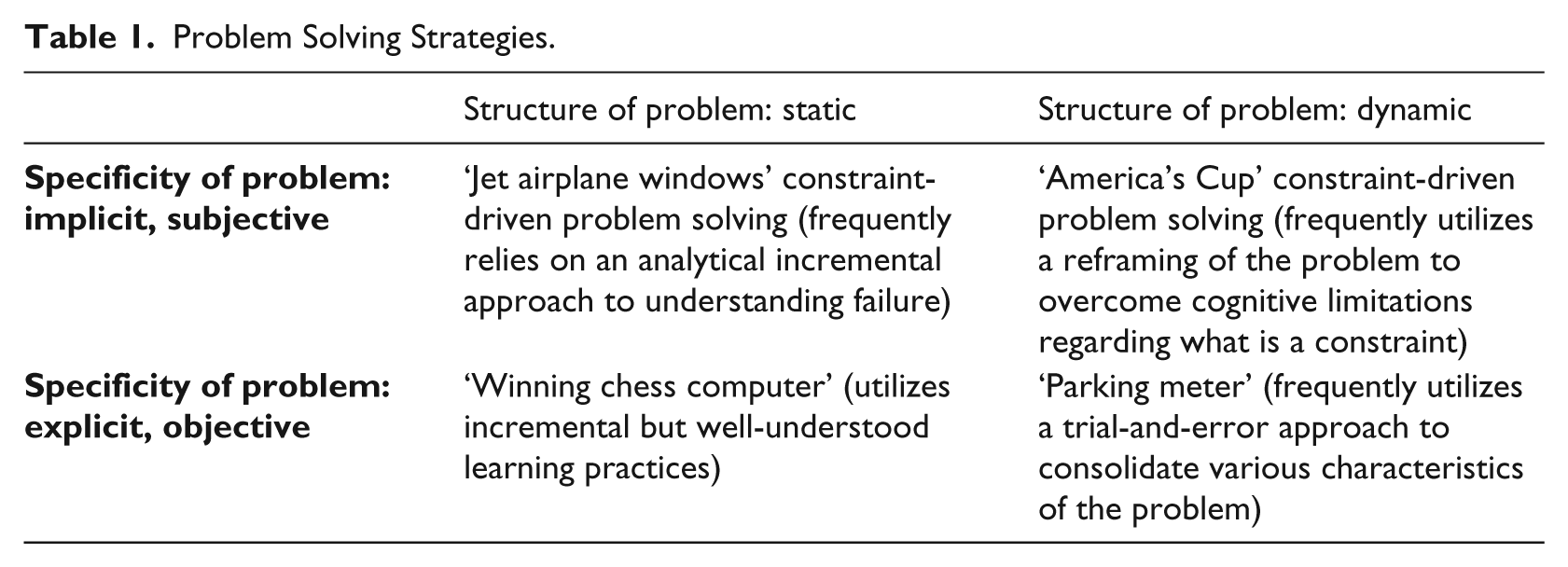
Static vs. dynamic. Constraints generally fall along a continuum between static and dynamic. Rules and regulations are typically relatively static constraints. They are static in the sense that actors do not expect them to change in the short run. If they change in the medium to long term, actors usually have advanced notice of this change. Resources, on the other hand, including time, when viewed as a resource, are more flexible and hence impose variable constraints. Frequently, resources can be borrowed, or converted from other allocations. Money, for instance, represents a highly variable resource constraint because, as Kannan-Narasimhan (this issue) points out, it is highly fungible. The variability of human resources can be an important constraint in knowledge-based industries where motivating and scaling up the initiative and creativity of labour is an important potential advantage. In contrast, tangible resources such as machines are often constrained by their design, but even here constraints are variable if the operators acquire an intimate understanding that allows them to develop new uses. For example, we tend to think of jet engines in rather narrow terms, as confined to air transport, but after the Iraq-Kuwait war, Hungarian technicians repurposed MiG fighter aircraft jet engines to put out oil field fires set by the retreating Iraqi military (Al-Yousifi, 2014).
Dolmans, Burg, Reymen and Romme (this issue) argue that resource constraints are intrinsically variable because their limits depend on what entrepreneurs perceive to be their future use. As they put it: ‘... entrepreneurs’ perceptions of resource positions are not static but transient and changing over time. Perceived resource positions can change any time a situation involves some reflection on (anticipated) available resources relative to (anticipated) resource demand.’
Explicit vs. implicit. While some constraints are explicit, clearly stated, immediately recognized and normatively agreed upon, others have to be derived, inferred from a situation or problem. Pols (2002) uses the example of an architect who is faced with the challenge of designing a house to illustrate the difference. The specification for the house entails a range of explicit constraints, but there are also implicit constraints that go with assumptions of what a house is supposed to include, e.g. bathrooms, or a staircase if there is more than one floor, etc. Solving the design problems of a house entails dealing with both explicit and implicit constraints. Creative problem solving may involve recognizing that certain implicit constraints can be dropped. For example, the architect may decide to save space by eliminating stairs and putting an elevator into the house. Implicit constraints are often inferred, but as this example illustrates they also represent taken-for-granted assumptions, cognitive limitations. An example of how such taken-for-granted assumptions can have tragic consequences is the catastrophic failure of the Comet, the first passenger jet-powered aircraft to enter commercial service. The designers of the Comet assumed that the square shape for the windows that were in use in propeller aircrafts were also the proper shape for jet aircraft. But higher altitude and hence repeated cycles of cabin pressurization and de-pressurization put greater stresses on window corners, resulting in excessive metal fatigue and dire consequences for the integrity of the fuselage (Selinger, 1995). Oval windows and different installation techniques solved the problem, and they also changed design assumptions.
If we take this classification as generating four quadrants, then constraints-driven creative problem solving will vary in the two extreme quadrants, i.e. fixed/explicit vs. variable/implicit. Actors in the static/explicit constraints are more likely to approach problem solving from an analytical perspective. Building a winning chess computer would fall in this quadrant, and consists of incremental but well-understood learning practices. Indeed, overwhelmingly, most of the research on problem solving, including that pursued by the Carnegie School (March, 1977; Steinbruner, 1974), is of this type, Those in the static/implicit category may face limitations based on cognitive assumptions that may not actually apply. Implicitly assuming that aeroplane windows that were used for propeller planes would do for jet aircraft was cognitively efficient. It took several fatal air accidents, and exhaustive testing of fuselage design, to reconsider this assumption. Trial-and-error rather than ingenuity yielded a workable design in this case, but in other cases insight that identifies implicit assumptions and then makes them an explicit part of the analysis often yields ingenious solutions.
In contrast, actors in the dynamic/implicit quadrant are more likely to depend on clever resource acquisition practices and restructuring or reframing the problem, i.e. seeing that certain constraints do not apply (Gibbert & Scranton, 2009). For example, winning the America’s Cup consists of building a faster sailing vessel – but the most recent winners have been those that reframed the problem by substantially reducing the hull to surface characteristics and limitations used by previous winners. Finally, problems in the dynamic/explicit quadrant consist of known problems that face dynamic constraints. An example is the invention of the parking meter. When horses and buggies were the main mode of transport, parking in shopping areas was not a major problem for the simple reason that horses could not be tied to the general store’s rail and left unattended for long periods of time. When cars were first introduced, they were relatively few in number, and hence could be parked for as long as the driver desired. But as the number of cars increased, parking space became scarce, and merchants complained that cars that were left at the curb for long periods of time were denying new customers the space needed to park and shop. The problem got worse during the first three decades of the twentiety century as the volume of private cars increased until 1932, when Carl Magee, a local newspaper editor in Oklahoma City, came up with the parking meter (Crossen, 2007). Magee’s ingenious solution consisted of reframing the parking problem from a technical one (lack of parking space) to an economic one: how do you incentivize people to reduce their use of parking space?
Creative Problem Solving under Constraints
Theories of creative problem solving describe a multi-stage process, beginning with emergence of the problem, followed by efforts to solve the problem, the discovery of a solution, and then verification that the problem is indeed solved (Bilton, 2007, p. 8). The emergence of the problem plays a pivotal role in how the problem is defined and tackled. In organizational terms we found it useful to apply Burgelman’s (2002) distinction between induced vs. autonomous strategy processes, to ‘induced’ and ‘autonomous’ problem generation. Induced problem generation sees the problem as emerging independently of the actors that are tasked to solve it. In effect, the actors do not initiate the process leading to the emergence of the problem, nor are they are able to fundamentally alter the scope of the problem as defined by others within the organization that induce the process to begin with. For example, top managers may instruct their engineering department to deal with problems associated with higher than expected product failure rates. The engineers must take the problem they are given, with the solution, i.e. improving product reliability, also stipulated. Their first step, according to Simon and Newell (1971, p. 151), is to represent the problem in a ‘problem space’. The representation identifies a range of constraints, and assumes others. For instance, the engineers may identify certain design limits as posing a problem when the product is used outside its intended purpose. They will then generate a ‘solution space’ which may call for improved design, or if the cost is prohibitive, new instructions to the consumer.
The autonomous view sees the emergence of problems as contingent on how actors interpret organizational performance relative to the aspirations or goals they set for themselves. Unlike the induced view where there is a separation between actors that induce the problem and actors who are tasked with solving the problem, here the actors that define the problem are also the actors that are directly involved in the search for solutions. The emergence of the problem is therefore ‘autonomous’ to the problem solvers. A useful starting point for examining autonomous emergence of problems, as Banerjee (2014) notes, is Cyert and March’s (1963) behavioural theory of the firm. The behavioural theory of the firm argues that organizations judge their performance relative to previously set aspirations. If performance falls below aspirations, the organization will initiate a ‘problemistic search’ for solutions that improve performance, or it may revise its aspirations downward. Constraints clearly play a role in whether the organization adopts the first or second option, but it is important to note that, unlike the first view, organizational decision makers have the choice of whether to engage in problemistic search or to downgrade their aspirations. The choice will depend on how decision makers interpret constraints. For example, in a severe economic downturn organizations are more likely to revise aspirations downward rather than engage in problemistic search if, as is likely, they see depressed consumer demand as constraining solutions that require costly investment in plant and machinery. On the other hand, if they have accumulated substantial slack resources during the preceding boom, they may decide to ignore depressed consumer demand and instead engage in problemistic search that tackles constraints in their production systems even if this means acquiring costly new equipment.
The articles in this special issue examine creative problem solving from both induced and autonomous perspectives. Lombardo and Kvålshaugen (this issue) illustrate the induced perspective. They examine how teams in 12 projects in two engineering consulting firms deal with the constraints that result from a project scope set by their clients. This project scope induces the constraints that the engineers must tackle if they wish to deliver the project on budget and on time. Lombardo and Kvålshaugen show that the engineers often challenge the induced constraints, rather than accept them, or even sought ways to bypass them. This constraint handling, they argue, ‘is inherent in creative action’. For instance, in one case the engineers openly challenged the managing director’s definition of the problem, and ultimately managed to obtain a revision of the technical specification. Another case that Lombardo and Kvålshaugen examined involved upgrading a 20-km-long highway segment in a high-traffic area. The upgrade built on a previously approved modification that had gone through a complex public approval process. The engineering consultants formulated a new highway design that would reduce construction costs and substantially improve traffic safety. However, the new design would involve going through the approval process once again, with impact on the project timeline. To avoid this constraint, the engineers developed design changes that delivered better performance without requiring additional permissions from the local authorities. For instance, they moved junctions to flatter terrains, kept the highway line away from a local tannery, thus avoiding land acquisition costs, and pioneered the use of LED-based lighting systems at major junctions to reduce energy costs.
The variety of what Lombardo and Kvålshaugen call ‘shattering practices’ builds on Onarheim’s (2012) suggestion that when actors search for design solutions there are four practices available: (a) ‘black boxing’, treating certain constraints as unchangeable, focusing instead on constraints that are considered more crucial; (b) ‘removal’, setting aside temporarily highly fixed constraints to see if new solutions emerge which were previously overlooked; (c) ‘introducing’, the practice of identifying and adding implicit constraints to make the problem clearer; (d) ‘revision’, going back and looking at constraints that stand in the way of a creative solution to see if they can be revised or redefined. Lombardo and Kvålshaugen (this issue) argue that the practices that actors will employ will be influenced by the power relationship with their clients. The same point is made by Walker, Schlosser and Deephouse (this issue) in their study of how organizations deal with a powerful electricity monopoly that is being asked to open its distribution grid to companies that produce renewable energy. Specifically, Walker et al. look at solar power startups that emerge in response to Ontario legislation requiring the Ontario Power Authority, a Crown corporation responsible for the entire electricity system in the province, to grant grid access to private firms that produce renewable energy. Most of this access was quickly taken up by well-funded wind farms, confronting solar energy producers with a constraint that rendered their operations uneconomical. Walker et al. show that the solar energy companies first used a variety of ingenious political tactics to challenge the 7 percent limit, and when this did not yield the desired result, the companies entered a period of looking for solutions that bypassed the constraint, for instance developing products that functioned independently of the grid.
We generally assume that employees in an organization lack the control and discretion that is at the disposal of entrepreneurs. Burgelman (1983), however, notes that employees often act as internal entrepreneurs, or ‘intrapraneurs’. These intrapraneurs often launch autonomous strategic initiatives that are outside the corporation’s current scope of strategy. Furthermore, these initiatives compete with induced projects for scarce resources, often, as we shall discuss later, by employing a variety of covert practices. Rosso (this issue) examines R&D teams in a large Fortune 500 multinational company that operate with a fairly high degree of autonomy. One of the teams operates in a ‘skunkworks’ mode, able to recruit as much resources as it required. This team imposed constraints on itself as a way of focusing efforts and attention on goals that it pursued flexibly. In other words, the gap between resources and goals varied, which in turn influenced the problems that emerged, and the creativity of the solutions that the team came up with.
For Rosso’s teams, resource constraints are defined by the organization in which they operate. Kannan-Narasimhan (this issue) argues that resource constraints are perceptual, depending on anticipated demand for resources rather than evaluation of what is currently available by objective analysis. The key to how entrepreneurs evaluate resources, she maintains, is to recognize that this is essentially a sensemaking process. At any single point in time, the abundance or shortage of resources is perceptual, based on anticipated demand and anticipated availability of resources. In effect, resource constraints are not experienced as independently as, for example, we often find when looking at technical design problems, but as a function of imagined futures. Furthermore, the evaluation of an entrepreneur’s resource position also depends on the actions that he or she proposes to take. Thus, the problem emerges as a result of autonomous reflection by the entrepreneur on his or her position as opposed to more powerful actors defining the problem to be tackled.
A dramatic example of the Kannan-Narasimhan argument at the strategic level comes from Microsoft’s experience with the development of Windows Vista, a project that was originally code-named ‘Longhorn’. In July 2004, Bill Gates was informed that Longhorn would not be ready on time, and was so complex that it was unlikely it would ever work properly (Guth, 2005). Gates insisted that Jim Allchin, the senior executive in charge of the project, continue the effort. He also relaxed the time constraint, giving the development team several more months to complete the project, and agreed to reduce the original product specifications. Notwithstanding the additional resources that were thrown in, the extension failed to deliver Longhorn. Evaluating Microsoft’s failure to meet its initial goals forced Gates to accept that the real problem did not reside in overambitious technical goals, nor was it lack of resources, but in Microsoft’s development process itself. Microsoft had become a mammoth bureaucracy. The Longhorn project alone required 4,000 engineers writing code (Guth, 2005). These engineers were organized into multiple specialized teams, and in turn were supervised and coordinated by an ever expanding managerial hierarchy. As Eichenewald (2012), put it: ‘More employees seeking management slots led to more managers, more managers led to more meetings, more meetings led to more memos, and more red tape led to less innovation’. Paradoxically, writes Eichenewald, the sheer volume of cash flowing into Microsoft’s coffers was the actual driving force behind this expanding hierarchy. Thus, absent financial and human resource constraints, Microsoft eventually realized that its own organizational processes were the constraints stopping the company from creatively solving problems.
Process Constraints and Managerial Ingenuity
Microsoft’s Longhorn crisis suggests that when we speak of organizational ingenuity as creative problem solving under constraints we must distinguish between two types of constraints. The first type consists of constraints that partially or completely define problems, and the second are constraints that stand in the way of solving the problem creatively. Rosso (this issue) refers to the first as ‘product constraints’ and to the second as ‘process constraints’. Microsoft’s difficulties with the Longhorn project illustrate both types. The Longhorn project was initiated as part of Microsoft’s wider strategy of countering competition and reinforcing its dominance. The proposed functionalities reflected Microsoft’s evaluation of what it would take to upgrade its operating system in the face of rivals such as Google, Apple and Linux (Guth, 2005). Longhorn’s initial project scope was based on this evaluation. This in turn defined the product constraints that Microsoft’s developers faced when writing code for new functionalities, as well as product constraints they had to overcome when integrating the code written by different groups into a single robust operating system. However, Microsoft’s developers also had to contend with process constraints that influenced both their ability to devise creative solutions to code-writing problems, and creative solutions to the problems posed by having to integrate a complex operating system. These process constraints consisted of a bureaucracy that made coordination difficult, and a reward system based on performance ranking that not only discouraged cooperation but led developers to actively undermine other engineers. The result, as one Microsoft engineer told Eichenewald (2012), was that people did everything in their power to avoid being relegated to the bottom of the ranking. Withholding information was therefore common, and even sabotaging other people’s efforts was not unheard of. ‘One of the most valuable things I learned’, confessed the same engineer, ‘was to give the appearance of being courteous while withholding just enough information from colleagues to ensure they didn’t get ahead of me on the rankings.’
The process constraints that hindered creative problem solving in Microsoft may be unusual in their severity, but arguably they are an extreme example of how process constraints in general shape how actors deal with problem constraints. Put differently, for organizations to creatively solve problems under constraints, i.e. deliver ingenious solutions, they often also have to deal with process constraints that stand in their way. As one of Rosso’s respondents put it: ‘We can think of ten ways of hitting the targets, but because of the organization we’re in, we can’t do half of these.’
The articles in this special issue examine how organizations manage, or fail to manage, process constraints as well as product constraints. More importantly, some of the articles in this issue focus on how actors within organizations tackle process constraints ingeniously. In other words, how they create ingenious process constraints that allow them to go around, or if necessary, even subvert institutionalized process constraints that stand in the way of creative solutions.
The most pervasive process constraints that face organizational actors when it comes to tackling product constraints creatively derive from lack of adequate resources. In many instances, resources are available elsewhere in the organization, but not accessible to the innovators. As Kannan-Narasimhan (this issue) puts it, innovators often find themselves in an ‘interesting contradiction; at the individual level they face constraints in accessing resources for innovation but at the organizational level their organization holds the resources they need’. Research suggests that, broadly speaking, when actors are in this position they either seek ingenious ways of making do with the resources they have at their disposal, or they find ways of ingeniously obtaining additional resources, or both. Practices are brought into play such as ‘bricolage’ – ‘making do by applying combinations of resources at hand to new problems and opportunities’ (Baker & Nelson, 2005, p. 333), and ‘bootstrapping’, which involves retaining cash by delaying payment, or employing underused equipment. In contrast, Kannan-Narasimhan (this issue) lists practices such as ‘borrowing’, ‘begging’, ‘scavenging’, ‘amplifying’, ‘bootlegging’ and ‘finagling’ as methods that allow actors to obtain additional resources. As she describes these: Borrowing enables innovators to secure resources temporarily; while begging or tincupping allows them to secure resources permanently. Through scavenging, innovators extract usage from resources that others do not perceive as valuable. Amplifying allows innovators to leverage more value out of an asset than what is perceived by the original owner of the asset. Innovators use other strategies such as bootlegging or diverting resources from other projects without formal authorization.
Finally, ‘finagling’ involves ‘obtaining resources through deceitful or underhanded methods including off-time and stealing from official projects’.
At one level all these practices seek to address resource constraints that hamper the ability of actors to solve problems, but at another they represent the actors’ attempt to deal with process constraints. Put differently, when actors engage in these practices they acknowledge that their organization’s resource allocation process is indifferent, or even hostile, to the goals they wish to pursue. Making do with resources at hand, or covertly finding ways of acquiring additional resources, is one way of addressing these constraints. Another way is to manipulate or challenge process constraints. Kannan-Narasimhan notes that innovators seek legitimacy through imaginative bricolage. By imaginatively ‘repurposing’ resources even before they complete the project, innovators increase their organizational legitimacy, and consequently can obtain more resources from higher-ups.
Constraints on resource acquisition are a subset of more general structural constraints that organizational actors face when they seek to solve problems creatively. Lombardo and Kvålshaugen (this issue) examine project teams that directly challenge structural constraints, employing both rhetoric and hard bargaining to have constraints relaxed. Dealing with process constraints that are a function of structural constraints involves recognition that they reflect and reinforce the distribution of power within and without organizations. As Lombardo and Kvålshaugen point out, innovators will often directly resist these constraints, but at other times they may use covert means to bypass and manipulate process constraints. Ingenuity here is often Machiavellian. Wilson (2014) recounts how the first chief of the Bureau of Aeronautics, Rear Admiral William Moffett, circumvented restrictions on the role of aircraft during the 1930s. At that time, the American navy was dominated by battleship officers who believed that aeroplanes should be confined to a purely reconnaissance role. Officially Moffett endorsed this view, but privately he worked towards developing a carrier force that could strike independently. To obtain funding and avoid resistance from a navy that believed that battleships were the mainstay of naval warfare he shrewdly suggested that the reconnaissance role would be better served if the planes were on aircraft carriers that that would accompany the battleships. His ingenious ploy worked. By the time of the attack on Pearl Harbor the US navy had eight carriers in operation (three in the Pacific) and ten under construction. The Japanese strike put the entire US Pacific battleship force out of action, and decisively demonstrated the importance of aircraft carriers in naval warfare. However, thanks to Moffett’s process ingenuity, the US had at its disposal a carrier fleet capable of countering Japanese naval forces in the Pacific.
Overview of Contributions
When we released the call to this special issue we were not sure how many scholars would share our view that ‘organizational ingenuity’, which we defined as ‘creative problem solving under institutional constraints’, was a topic that merited intensive research attention. The final tally of 45 papers submitted more than met our expectations, especially when one considers that many of the submissions had multiple authors. But with that many papers came the hard task of reviewing and editing. The five articles that passed the review process in this special issue focus on the area of organizational ingenuity from different perspectives, and they all make a contribution that will allow other researchers to build on their insights.
The opening article, ‘Organizational Ingenuity in Nascent Innovations: Gaining Resources and Legitimacy through Unconventional Actions’, by Priya Kannan-Narasimhan, looks at organizational ingenuity in large organizations. The paper argues that while large corporations have resources at the level of the firm, individual innovators pursuing early-stage, untested innovations face considerable constraints in accessing these resources. Kannan-Narasimhan points out that although evidence from the field suggests that innovators act unconventionally and creatively to acquire resources under constraints, the effects of resource acquisition strategies on innovation legitimacy are not sufficiently appreciated. Combining insights from institutional theories of legitimacy and resource acquisition, with theories of managerial attention, the paper identifies two types of ingenuity: material ingenuity and process ingenuity. Innovators use material ingenuity as a key lever and determine when to draw attention to their innovation versus when to keep it under the radar. Handling managerial attention successfully leads to resource acquisition as well as resulting legitimacy for nascent innovations.
Sharon Dolmans, Elco van Burg, Isabelle Reymen and Georges Romme’s ‘Dynamics of Resource Slack and Constraints: Resource Positions in Action’ examines the paradoxical impact of resource slack and resource constraints on innovation. Slack resources give firms greater freedom to experiment and discover creative solutions, but they also reduce the entrepreneurial initiative that drive firms to go beyond what is conventionally effective. Resource constraints – in effect the very opposite of slack resources – make it harder for firms to invest in the search for new innovations, but in some situations spur organizations to develop ingenious solutions. If we wish to resolve this apparent paradox, argue Dolmans et al., we have to look at resource slack and resource constraints as the two extremes of a spectrum of attainable perceived resource position. Borrowing from the Austrian school of economics, they suggest that resource position is highly subjective and temporary. A resource position evaluated as munificent by one entrepreneur may be considered poor by another. Sensemaking rather than objective criteria usually decide whether entrepreneurs feel resource rich or poor, and sensemaking will likewise be strongly influenced by the entrepreneur’s view of the future. Dolmans et al. use in-depth case studies of three high-tech start-ups to explore the effects of perceived resource slack or constraints on decision making. Their data shows that different entrepreneurs perceive resource availability relative to the demand that they believe will be needed in the future. Needless to say, since views of the future change, the perception of resource availability will likewise change.
Brent Rosso’s ‘Creativity and Constraint: Exploring the Role of Constraint in the Creative Processes of New Product and Technology Development Teams’ examines the balance between freedom and constraints in the creative process. As he points out, creativity theorists have traditionally seen constraints as the enemy of creativity, but empirical research suggests that constraints can actually enhance the creativity of research and development teams. Resolving this contradiction, he argues, requires greater attention to how constraints influence creative problem solving. Specifically, he sets out to examine the key constraints that R&D teams confront, and how they may inhibit or enhance creativity. Drawing on extensive field research with four R&D teams in a Fortune 500 corporation, Rosso finds that the teams had to contend with two types of constraints: product constraints and process constraints. He shows that, in general, product constraints benefited creativity because they enhanced clarity and improved focus. In effect, R&D teams preferred clearly defined product requirements, even when these reduced their freedom to explore alternatives. This preference is rooted in team dynamics: clearly defined product requirements reduced ambiguity which, in turn, had a positive impact on the ability of the team to coalesce around a common effort. In contrast, process constraints had a negative impact on team creativity because they damaged team motivation and the willingness to experiment. In effect, process constraints inhibited creativity because they forced teams into confrontation with structural constraints which they felt they could not win.
Sebastiano Lombardo and Ragnhild Kvålshaugen’s ‘Constraint-Shattering Practices and Creative Action in Organizations’ looks at the politics of resource constraints. He points out that constraints are usually approached as external to the problem being tackled. But for the actors involved in solving problems, constraints will be part of the problem if the constraints are imposed. This often happens in organizations when superiors instruct subordinates to perform tasks with certain in-built constraints. Theories of problem solving tend to assume that subordinates accept the constraints as fixed. Empirical research suggests that organizational actors will try to modify or circumvent the constraints. This ‘handling’ of constraints, as Lombardo and Kvålshaugen point out, is often a creative process that involves a variety of practices they call ‘shattering’. They examine shattering practices in 64 projects undertaken by two engineering consulting firms. Specifically, they look at how project teams deal with constraints that are imposed by clients’ specifications. They show that some teams protest to their superiors about constraints they deem to be unreasonable, or may even reject the constraints outright. A number of teams worked covertly against the specified constraints, devising unauthorized solutions, while others colluded secretly to revise project scope in a way that circumvented the imposed constraints.
The final paper in this special issue, by Kent Walker, Francine Schlosser and David Deephouse, titled ‘Organizational Ingenuity and the Paradox of Embedded Agency: The Case of the Embryonic Ontario Solar Energy Industry’, explores organizational ingenuity within the paradox of embedded agency. The paradox emerges out of the observation that while organizational stakeholders are constrained in their behaviours by institutions in which they are embedded, and to which they owe their powers, they are nevertheless able to influence and change these institutions. Organizational ingenuity speaks to this paradox. Institutional embeddedness suggests that actors will solve problems within the norms set by the institutions without seeking to creatively change these institutions. In their study of the emerging solar industry in Ontario, Canada, Walker et al. show that stringent top-down constraints on the industry led to a series of bottom-up ingenuity strategies. In particular, industry actors dealt creatively with two major institutional constraints: limited grid access and political uncertainty. The resulting strategies displayed ingenious solutions to these constraints. They included collective mobilization to defy constraints, and the development of new products and markets that circumvented constraints. The authors analyse each ingenuity strategy at different industry levels – firm level, partnership level and collective level – showing that legitimacy was central to each of these strategies. In effect, legitimacy was a key, if not the key, consideration when it came to devising strategies that complied or circumvented constraints.
Concluding Comments
In this introductory article, we explore some of the main features of organizational ingenuity, focusing on structural and organizational elements, problem definitions, resource scarcity, constraints and strategies. We point out that to understand ingenuity it is necessary to know not only how the problem arises, but also who defines the problem. Organizational ingenuity consists of the capacity of organizations to solve challenging problems creatively, but it also emerges when actors seek to overcome the challenges of problem solving in a particular organizational context.
A key objective of this special issue is to persuade researchers that ingenuity is not merely a term used to describe a highly creative solution to a problem, but a proper subject of research that is important to our understanding of how organizations make small improvements, that are nevertheless crucial, or achieve breakthroughs that can change entire industries. Future research on ingenuity should encompass creative problem solving that is localized as well as cases where ingenuity is globally transformative. The same can be said about striking a balance between studying industries where ingenuity is taken for granted and industries where it occurs but is rarely noticed. The media tends to lavish attention on the ingenuity of high-tech pioneers such as Jeff Bezos at Amazon (Lampel et al., 2014) and Steve Jobs at Apple and Pixar (Isaacson, 2011, p. 344), but ingenuity can be found in more traditional fields such as haute cuisine (Senf, Koch, & Rothmann, 2014) and furniture design (Hanks, Roth, & Talbott, 1981), to name a few.
Beyond ensuring balance when it comes to collecting cases of ingenuity, there are a number of questions that arise when we look at the dynamics of organizational ingenuity. To begin with, we do not have a good understanding of how ingenuity can be scaled up. While smaller firms often owe their reputations to their ability for creative problem solving under resource constraints, growth generates structural constraints that undermine organizational ingenuity. A firm’s structure as well as environmental conditions are likely to change over time. Research is needed to examine how organizations evolve and manage ingenuity both through their own life cycle and through the environmental changes that they must address over time. Understanding how emergent organizations can adapt to growth and success, while maintaining their ingenuity advantage, represents an important and pressing opportunity for new scholarship on this subject. Another important and so far overlooked research opportunity consists of adaptation and movement across the different dimensions of organizational ingenuity. How might an organization that is successful at solving problems in a static environment learn to do so in a dynamic one? How can individuals and teams that are accustomed to dealing primarily with explicitly laid-out problems learn to understand and tackle the implicit dimensions of problems? Most of the aforementioned opportunities require a longitudinal and a comparative perspective. While this presents certain methodological obstacles, scholars should bear in mind that the returns to such research are considerable. We hope that this framing discussion, as well as the exciting and original work presented in this special issue, motivate and convince our colleagues of the merits of pursuing this important area of research.
Footnotes
Funding
We wish to thank the Social Science and Humanities Research Council, Canada, for a grant supporting our initial ingenuity conference that took place at McMaster University, Hamilton, Ontario, Canada, 8–10 September 2011.