



Abstract
There has recently been renewed scholarly interest in management innovating, the creation of new organizational practices, structures, processes and techniques. We suggest that external involvement in the process of management innovating can transpire in three different ways: direct input from external change agents; prior external experience of internal change agents; and the use of external knowledge sources by internal change agents. We ask whether the type of innovation created (radical or not; systemic or not) depends on the use of these three forms of involvement and whether the forms are substitutes or complements. We empirically investigate this through an archival study of 23 major historical innovations, using in-depth data from a large number of sources in the academic literature. We use three complementary methods of analysis: unstructured qualitative observations, correlational analysis and crisp-set qualitative comparative analysis. We find that the presence of external change agents is associated with systemic and incremental innovations; that the absence of external experience is associated with systemic and radical innovations; and that the presence of external sources of knowledge has no clear effect. Furthermore the three forms of involvement act to a large degree as substitutes. We contribute new theoretical arguments for the facilitators of management innovation, demonstrate the usefulness of an open innovation lens to the study of management innovation, show that management innovating is a relatively complex form of strategic process and highlight how the creation of management innovations is similar to and different from the genesis of other types of innovation.
Keywords
An important domain in organization studies concerns innovation in the nature of the practices used to manage organizations. This has often been framed as management innovation and is a topic that has long attracted scholarly and practical attention (Abrahamson, 1991; Damanpour & Evan, 1984; Kaplan, 1998; Stata, 1989; Volberda, Van Den Bosch & Heij, 2013). In a broad sense the study of management innovation allows scholars to map progress (or its absence) in how organizations are managed, and to track efforts by organizations to improve their effectiveness over time. Recently, there has been a resurgence in work in this area (Damanpour, Walker & Avellaneda, 2009; Foss, Pedersen, Pyndt, & Schultz, 2012; Vaccaro, Jansen, Van Den Bosch & Volberda, 2012), probably best exemplified through the work of Birkinshaw, Hamel and Mol (2008) who developed new insights into the process of management innovation, arguing that it is driven by the work of internal and external change agents who grapple with specific organizational and environmental contexts. For the purposes of this paper, we follow the definition of management innovation suggested by Birkinshaw et al. (2008, p. 825): ‘the invention and implementation of a management practice, process, structure or technique that is new to the state of the art and is intended to further organizational goals’.
A deeper understanding of the management innovation process leads to further accumulation of academic knowledge on organizations, and potentially allows scholars to assist organizations in creating innovations that could produce a variety of benefits (Hamel, 2006; Volberda et al., 2013). Yet current literature on management innovation still displays gaps. The bulk of the work on management innovation looks at: diffusion and cross-organizational or cross-border transfer of particular innovations, such as quality (Lillrank, 1995), ISO 9000 (Guler, Guillén, & McPherson, 2002) and poison pills (Davis, 1991); management fashions and fads (Abrahamson, 1991; Abrahamson & Eisenman, 2008); how variations in practices emerge as they diffuse across multiple organizations (Ansari, Fiss & Zajac, 2010); and internal antecedents and performance consequences of the firm-level implementation of innovations (e.g., Damanpour, 1987; Vaccaro et al., 2012). There have also been case studies of contemporary management innovations that discuss the implications of these innovations for organizational performance (Birkinshaw & Mol, 2006; Davies, Gann & Douglas, 2009; Foss et al., 2012). But, beyond the conceptual work of Birkinshaw et al. (2008) and single innovation case studies (e.g. Chandler, 1962; Udagawa, 1995) there is relatively little research on the ‘genesis’ of management innovation, that is, how specific innovations first emerged, through a process we will call management innovating. Management innovating is fundamentally different from diffusion (Abrahamson, 1991; Ansari et al., 2010; Birkinshaw et al., 2008) because it involves creation, rather than adoption and adaptation. This suggests that managerial agency and creativity (Amabile, 1997) will play a large role in management innovating, while institutional pressures to innovate may play a lesser role than in the case of adoption.
Research on management innovating could help shed light on an important question in the management literature, namely, what are the processes through which organizations attempt to make improvements in how they are managed, when no pre-existing solutions are available? This would lead to better theories of management that are of more value to managers and other stakeholders. It would simultaneously add to the array of process-based studies in the literature (e.g. Langley, Smallman, Tsoukas & Van de Ven, 2013). Although there is now a lot of process-based research addressing various aspects of change (Langley et al., 2013), it has not addressed the early stages of the process of management innovation.
Another subject that has received much attention in the literature is open innovation (Chesbrough, 2003; Leiponen & Helfat, 2009), which we broadly view as a manner of innovating that draws on, and potentially contributes to, the outside world. In the open innovation literature, authors typically assess the extent to which product or process innovation comes about as a consequence of innovating more openly. But as far as we know there is no work that applies an open innovation perspective to management innovation in a systematic manner.
We address these gaps in the literature by extending and empirically investigating the ideas of Birkinshaw et al. (2008) about the role of external change agents in the process of management innovation. Our objective is to understand the different forms of external involvement that potentially shape the management innovation process, and how these different forms influence the type of innovation that emerges.
We start by characterizing three forms of external involvement, specifically, external experience, external knowledge and the direct involvement of external change agents. We then develop a typology, based on how much the management innovation departs from existing practice (incremental versus radical) and its scope of impact on the organization (single function versus systemic). We show how existing theory offers contrasting perspectives on how external involvement might shape the type of innovation, and develop two specific research questions. These questions are addressed using a set of 23 key historical innovations, which are analysed through a multi-method study including unstructured qualitative observations, bivariate correlations and crisp-set qualitative comparative analysis (QCA). The focus on studying single innovations ‘has shaped the questions scholars have pursued’ (Abrahamson & Eisenman, 2008, p. 721) and we believe it has decontextualized studies of management innovation. We therefore focus on multiple innovations here in order to compare and contrast innovation characteristics, rather than treating all innovations as uniform.
This paper contributes to the literature on management innovation by broadening our understanding of the various ways in which external involvement might influence the process of management innovation. We find that more radical management innovations (as opposed to more incremental ones) occur in the absence of external change agents and in the absence of external experience. We show, somewhat surprisingly, that external involvement tends to correlate with more incremental (rather than radical) and more systemic (rather than single-function) innovations, though the results vary depending on the type of external involvement. We also observe that the different forms of external involvement are partial substitutes for one another in terms of how they influence the type of management innovation. These insights allow us to put forward new theoretical arguments for the facilitators of management innovation. We contribute to the literature on open innovation by demonstrating that, similar to technological innovation, management innovation may be studied through an open innovation lens, and to the strategy process literature by showing that management innovating is a relatively complex form of strategic process. Finally, we contribute to literature on the genesis of innovation by highlighting how the initial creation of management innovations is similar to and different from that of other types of innovation.
External Involvement in the Management Innovation Process
We conceptualize the management innovation process as transpiring through multiple stages according to an evolutionary logic (Burgelman, 1991; Damanpour & Schneider, 2006; Zbaracki, 1998). These stages have been called motivation, invention, implementation, and theorization and labelling (Birkinshaw et al., 2008). The process involves internal change agents as driving forces and may also involve external change agents. The process takes place within an organizational and environmental context that constrains and enables these agents. While we do not wish to downplay the significance of that context here as it may, for instance, be of significant impact on organizational creativity (Amabile, 1997), it is not our research focus.
External involvement is the use of inputs in the innovation process that originate outside the boundaries of the focal organization. Internal change agents are assumed to use external involvement whenever they consider it to be beneficial. These benefits may be more tangible, for instance, when external involvement helps shape an innovation directly, or less tangible, for example, when external involvement is sought primarily to legitimize an innovation (Staw & Epstein, 2000). We acknowledge that the use of external involvement is costly, although some costs will have been incurred prior to an innovation effort, i.e. the marginal costs may be small.
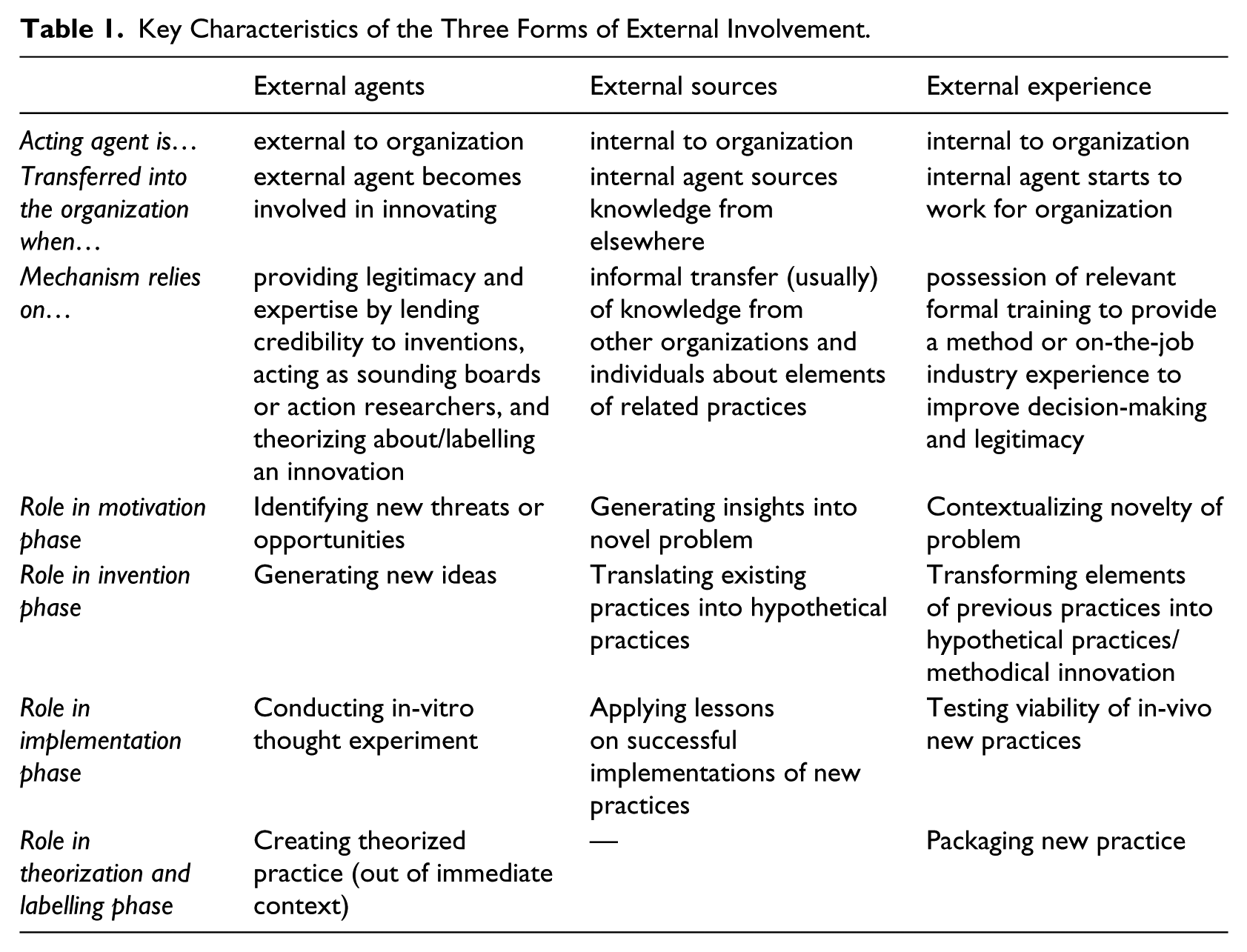
We suggest it is useful to distinguish between three forms of external involvement, each of which potentially affects the process of management innovation through a different mechanism. The first is external change agents (Birkinshaw et al., 2008, p. 832), individuals who ‘are independent consultants, academics, and gurus who are proactive in creating interest in, influencing the development of, and legitimizing the effectiveness and retention of new management practices’. Birkinshaw et al. (2008, p. 832) contrast this with internal change agents, ‘who are the employees of the innovating company proactive in creating interest in, experimenting with, and validating the management innovation in question’. The second is external knowledge sourcing – the observation of related practices in other organizations and contexts that are transferred into the focal organization. External knowledge sourcing is a well-known means of innovating in the technology and product domains (Ahuja, 2000; Leiponen & Helfat, 2009) and has been theorized to affect management innovation as well, a view that is increasingly supported by empirical evidence (Ganter & Hecker, 2011; Mol & Birkinshaw, 2009). The third form is external experience (Bapuji & Crossan, 2004; Hoang & Rothaermel, 2010), which occurs when an internal change agent brings in relevant novel experience from the outside, either from industry or through some form of training. We next discuss these forms in more detail; Table 1 summarizes their key characteristics.
Key Characteristics of the Three Forms of External Involvement.
External change agents
The function of external change agents in management innovating is to provide legitimacy and expertise during the four different phases by lending credibility to inventions, acting as sounding boards or action researchers, and theorizing about an innovation (Birkinshaw et al., 2008; Kaplan, 1998). According to Birkinshaw et al. (2008), external agents play a number of specific roles: they identify new threats or opportunities (in the motivation phase), generate new ideas (in the invention phase), conduct in-vitro thought experiments (in the implementation phase) and create theorized practices outside of the immediate context (in the theorization and labelling phase).
The work of internal and external agents is enabled and restricted by the characteristics of the focal organization, such as its culture, and the institutional environment the organization operates in. Compared to internal change agents, external change agents are typically seen as bringing new knowledge and a fresh perspective into the focal organization, and an ability to generalize experiences beyond a single organization, which helps in later efforts to theorize and label innovations (Birkinshaw et al., 2008). In other words, use of external agents may help in overcoming the downside of embeddedness in the internal network and opening up new opportunities (Uzzi, 1997).
External knowledge sourcing
External knowledge sourcing is another channel through which outside inputs are brought to bear on the management innovation process. Yet the role of external knowledge differs somewhat from that of external change agents and is likely to be focused mostly on enhancing expertise because legitimization processes benefit from active agency (Greenwood, Hinings & Suddaby, 2002), which a knowledge source does not provide, unlike an external agent. External knowledge either takes the form of outside examples that are partially transferable to an organization, or of more abstract principles that are accepted by the organization. Birkinshaw et al. (2008) suggest that external knowledge is more likely to be employed early in the innovation process, especially during motivation and invention, to generate insights into novel problems and transform elements of existing practices from other contexts into hypothetical new practices. External knowledge is less likely to be used in the later stages of implementation and theorization and labelling, because transmission of outside prior knowledge is not a major part of the ‘in vivo experimentation’ or ‘in vitro thought experiments’ that occur during implementation. During this phase it is learning from experimentation that matters most. However, there may be generic lessons from prior implementations elsewhere that could be applied, such as how to successfully move from a pilot to large-scale rollout of a new practice.
Thus the mechanism of external knowledge sourcing seems to be used by change agents both as a means to generate new ideas, acting as a source of inspiration, and as a means to improve the odds of success with any given innovation effort, through reducing the uncertainty an organization faces when introducing new practices, as suggested by Weitz and Shenhav (2000). More specifically, we expect that by excluding design options that have proven to be ineffective elsewhere and focusing on options that have been successful as observed through external knowledge sources, change agents can reduce the number of trials they need to undertake with their innovations, as well as scale up the size of their trials.
External experience
External experience, in the form of learning from training, industry competitors and other firms, constitutes a third type of external involvement in innovation (Bapuji & Crossan, 2004; Hoang & Rothaermel, 2010). External experience differs from external knowledge in that there is clear agency involved. In the earlier stages of the management innovation process, external experience could act both as a source of ideas, when internal change agents reapply practices they know from elsewhere, and as a gateway, when earlier experience allows internal agents to more effectively select in the most promising inventions. In the later stages of the process, external experience could help in implementing innovations more effectively, because the internal agents’ external experience lends them credibility and makes their ideas more legitimate – although it may equally lead to the ‘not-invented-here’ syndrome if not managed well.
External experience can be gained through prior training or work experience. Training provides a ‘method’ for innovating, structuring and perhaps formalizing the thinking of change agents, so its contribution is more around the idea itself and less around its acceptability to the organization. Work experience, in contrast, provides a template for a specific innovation, and may be more helpful in increasing the odds of successful innovation.
External experience initially helps internal agents to better contextualize the problem, particularly the extent to which it is unique. During the invention phase, internal agents can draw on their experience to adapt elements of practices they have seen elsewhere or to apply their structured methods to the innovation process. During implementation, internal agents with relevant prior experience will find it easier to assess the viability of practices, and to take decisions on whether to proceed with implementation. Finally, in the theorizing and labelling phase, prior experience can potentially provide a template for packaging the innovation.
These three forms of external involvement are conceptually different in terms of how they operate, but of course they are unlikely to be mutually exclusive in practice, and in our empirical investigation we give careful consideration to this point. Moreover, there may be further forms of external involvement that occur more indirectly, especially ‘second-order’ external knowledge sources, when external knowledge is sourced and processed by external agents, who then bring it into the focal organization. While this could be an important type of knowledge, it is indirect and difficult to separate from the external agents themselves – when external agents are not present, second-order external knowledge sources will not be present (Birkinshaw et al., 2008). Furthermore, this information is hard to trace and the historical record we use below does not consistently provide information on second-order external knowledge sources. We therefore do not explicitly investigate them.
A Typology of Management Innovations
In this section we present a typology of management innovations, which allows us to identify what we see as primary dimensions along which management innovations vary, as a first step in theory building (Doty & Glick, 1994). Our typology uses the broader literature on the management of innovation. It is worth noting that this typology is concerned with the characteristics of the innovations as such, and not with questions of impact or effectiveness. This approach is in line with our focus on the genesis of management innovations: we are more interested in the role external involvement played in shaping the type of innovation that transpired, rather than its organizational impact or subsequent diffusion. Equally, note that the focus is not on organizational characteristics.
Degree of novelty
The first dimension is the extent to which the management innovation is a departure from existing practice, and we characterize each innovation as ‘incremental’ (i.e. it is a refinement and improvement of existing practice) or ‘radical’ (i.e. it represents a significant departure from existing practice). This distinction is ‘one of the central notions in the literature on technical innovation’ (Henderson & Clark, 1990, p. 9) and it has also been applied to management innovation (Ettlie, Bridges, & O’Keefe, 1984). It is important both because the impact of incremental and radical innovations on their users is very different and because the organizational capabilities involved in implementing them are so different. Incremental innovations tend to reinforce existing capabilities and ways of working, while radical innovations often require organizations to develop entirely new capabilities and perspectives (Christensen, 1997; Nelson & Winter, 1982; Tushman & Anderson, 1986) and unlearn old ones.
One versus many functions
The second dimension concerns the scope (or breadth) of the innovation’s impact on the focal organization. We characterize each innovation as either focusing on a discrete functional activity, e.g. the human resource function or the supply chain, or affecting multiple functions across the organization and the linkages between them. This is an important dimension because it influences both the degree of risk and complexity in implementing the innovation in the first place, and the difficulty that other organizations will have in adopting the innovation if it proves to be successful. As the resource-based view of the firm has shown, the greater the degree of interdependence in the firm’s knowledge assets (Winter, 1987), and the greater the degree of causal ambiguity in the relationship between inputs and outputs (Lippman & Rumelt, 1982), the more likely it is that a firm’s internal resources and capabilities will be a source of competitive advantage. More systemic management innovations may therefore offer greater potential for competitive advantage but equally are likely to be more difficult to implement effectively.
In Figure 1 we summarize this framework and include some examples for the purposes of exposition. For example, scenario planning, as developed at Shell (Wack, 1985), provided a tool to help those in the strategy function to think more effectively about the future. Return on investment, introduced by Donaldson Brown at Du Pont in 1912, was a radically new idea for calculating the prospects and performance of projects, but its focus was not on the system as a whole (Johnson & Kaplan, 1987), but on investment decision-making. The M-Form structure was a radical management innovation at the time of its introduction because it required executives at the top of the organization to give up power over operational decision-making, and it required many employees to work in business units rather than in central functions (Chandler, 1962), resulting in changes throughout General Motors. By contrast, management by objectives (MBO) was more incremental, as the pursuit of objectives had been around, but it was the manner in which they were defined and used that was novel (Greenwood, 1981), even though it too had implications for the entire General Electric (GE) organization. These examples refer to the original versions of these innovations, not the subsequent evolution of the innovations as they diffused (Ansari et al., 2010). For instance, brand management at P&G was initially focused on organizing the marketing function only, but brand managers subsequently extended their reach into such areas as production management (Dyer, Dalzell & Olegario, 2004).
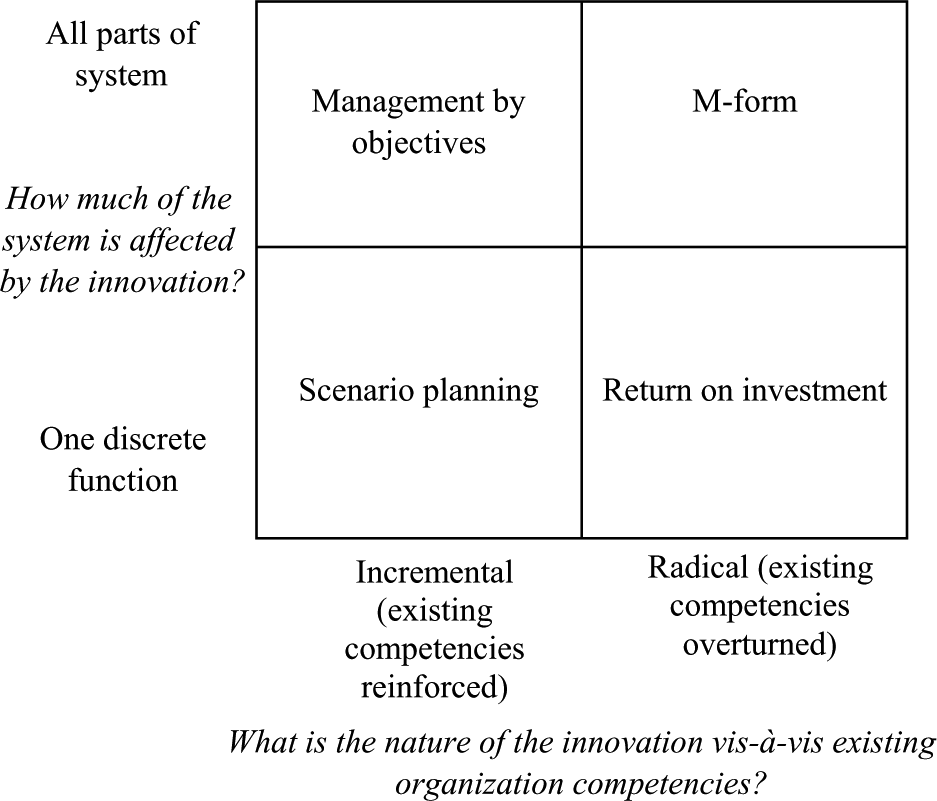
A Typology of Management Innovation.
We believe this typology provides a useful way of characterizing management innovations and has close parallels to the well-known typology for technological innovation introduced by Henderson and Clark (1990). We acknowledge the two dimensions may not be orthogonal: we might expect, for example, that radical management innovations are more likely to affect multiple parts of the system, while incremental innovations might be more likely to transpire within a single function. However, our examples suggest that the dimensions are not entirely overlapping either, and it is ultimately an empirical question what proportion of innovations we observe in each box.
External Involvement and Type of Management Innovation
We now bring the two aspects of our conceptual development together, by asking the question: How does the nature of external involvement vary depending on the type of management innovation? Prior research is of limited help to us here, because the typology developed above has not been widely applied in the management innovation literature and work on the genesis of innovations is very rare. We therefore refrain from developing explicit hypotheses. Rather, we consider the competing arguments that can be drawn from the extant literature, and then conduct an empirical study to establish which arguments have greater validity in our setting.
The typology suggests two dimensions that address different facets of ‘difficulty’ for those seeking to introduce a management innovation to an organization. In other words, for the internal change agents in question, radical (rather than incremental) innovations require a greater departure from the current way of working, and systemic (rather than single function) innovations require more parts of the organization to buy into the new way of working. However, it is not entirely obvious whether these more difficult innovations are helped or hindered by external involvement. Two contrasting arguments can be put forward.
On the one hand, more difficult and complex innovations benefit from external involvement, because they require a greater breadth of knowledge inputs to be conceived and implemented (Nelson & Winter, 1982). There are many empirical studies suggesting that external knowledge sources provide such breadth (e.g. Laursen & Salter, 2006; Leiponen & Helfat, 2009), as well as providing access to multiple organizations (Garud & Kumaraswamy, 1995). While management innovation differs from large-scale technological innovation in that the innovations concerned are not products to be sold to customers, we argue that the same principle holds true: when firms pursue more radical and/or more systemic innovations, they benefit from having access to a diversity of external knowledge sources.
On the other hand, there are circumstances in which the relationship between external input and innovation is negative. For example, the literature on organizational complexity suggests that there are often so many interdependencies within a system that additional inputs from the outside can compromise or slow down the innovation process. According to this worldview, new insights from the outside are not a bad thing per se, but the costs of integrating them with the existing structures and systems of the organization often outweigh the benefits (Ethiraj & Levinthal, 2004). A separate point that applies particularly to the role of external change agents is that such individuals have their own motivations, such as reducing the risk of failure, and applying their insights about what works from other organizations they have worked with (Kaplan, 1998). Both these arguments suggest that external involvement may sometimes dampen the extent to which a management innovation is radical or systemic in its scope.
Rather than choose between these two lines of argument, we prefer to set up the following research question that we then address in our empirical analysis:
Research question 1: Does external involvement in the creation of management innovation vary with the type of management innovation? How do the forms of involvement affect the creation of radical or incremental, and systematic or single function, management innovations?
Our second research question is concerned with the interaction between different forms of external involvement. On an intuitive basis, one might expect that ‘more is better’ and therefore that organizations using multiple forms of external involvement would benefit more than those using one form. However, empirical evidence suggests there is not a single factor that drives the adoption of management innovations (Damanpour & Evan, 1984), and in more recent work (Mol & Birkinshaw, 2009) it has been shown that external knowledge sources and internal knowledge-producing characteristics, such as having a highly educated workforce, can be traded off against each other, i.e. they act as substitutes for each other. Using the behavioral theory of the firm, Mol and Birkinshaw (2009, p. 1273) argue that there is a cost involved in any of the mechanisms that help generate management innovations, especially more active mechanisms such as the search for external knowledge sources and the use of external change agents, and internal change agents will only bear that cost if it is required. This suggests that the three different modes of external involvement (external experience, external knowledge sources and external change agents) may not actually have a cumulative effect in the production of radical and systemic innovations. Hence our second research question:
Research question 2: How do the forms of external involvement interact in management innovation? Are the three forms complements or substitutes?
Methods
When looking for a sample of management innovation processes to analyse, we needed to study ‘completed’ innovations where processes and outcomes were relatively clear, because of our interest in categorizing management innovations as radical/incremental and systemic/single function. This meant using archival sources of data, which has significant advantages and disadvantages (Ketchen, Ireland & Baker, 2013; Myers, 2013; Yin, 2003). In terms of advantages, it allowed us to compare and contrast important historical management innovations (e.g. brand management, the M-Form) that have had a significant impact on the advancement of the field of management. Moreover, the literature sources we used had been through a quality assurance process (i.e. peer review and subsequent citation of work), allowing us to be more confident about the quality of descriptions of innovation processes. Furthermore, we were able to identify detailed quotes that closely align with our theoretical constructs, overcoming the problem of external validity that plagues many archival studies in strategic management (Ketchen et al., 2013).
In terms of disadvantages, this historical record clearly has a pro-innovation bias and is far from comprehensive in terms of the innovations it documents and the aspects of those innovations it acknowledges. By restricting ourselves to English language archives, we potentially missed out on some important cases. With all such biases, the key concern is whether they are likely to systematically influence our findings, and our view is that they will not (i.e. our interest here is not in innovation success but rather in the type of innovation produced). We believe that the sample presented here is representative of the major management innovations recognized in scholarly investigation. We focused on the last 150 years, although of course there were innovations even before that (Greif, 1996), but the record on such innovations is far less detailed.
To the best of our knowledge nobody has attempted to create a comprehensive list of key historical management innovations. Hence, we created our own list for this study. This list had to comply with several objectives. First, the innovations had to be completed, so that their outcomes were known. Second, for practical purposes, we restricted ourselves to innovations that were well-known in the English language literature, even though they might have originated from outside the English-speaking world. Third, a specific instance of implementation had to be described in the literature. Fourth, it had to be possible to find descriptions with some level of detail about the process through which the innovation was implemented.
We first constructed a long list of possible management innovations by consulting a variety of mostly academic sources. Some of these sources contained lists of management innovations in particular subfields (e.g. Kossek, 1987), others merely a few examples (e.g. Abrahamson, 1996). We used various sources to triangulate information (including Abrahamson, 1991, 1996; Barley & Kunda, 1992; Carson, Lanier, Carson & Guidry, 2000; Clark, 2003; Davenport & Prusak, 2003; Ettlie, 1988; Georgantzas & Shapiro, 1993; Kimberly & Evanisko, 1981; Kleiner, 1996; Kossek, 1987; Knights & McCabe, 1998; Lillrank, 1995; Nickell, Nicolitsas & Patterson, 2001; Pascale, 1990; Rigby, 2001; Staw & Epstein, 2000; Voss, 1995; Wolfe, 1995). Next we interviewed four functional experts at a leading global business school, who were asked to comment and to add further innovations. Through this process we generated a list of 181 potential innovations. 1
The second major stage of defining the sample involved narrowing that list using various filters. First, we tested whether a case met our definition of a management innovation presented above. In the very few cases where we did not know the term at all, we either asked a colleague with substantial knowledge of the specific area or ran a preliminary search to identify its meaning. For example, at this stage we dropped ‘globalization’ because it is a broad term, not a specific practice. For the remaining cases we searched for a formal definition as well as an early example or a first implementation, which led us to drop further cases. 2 During this stage, 90 cases were dropped, leaving us with 91 potential innovations.
The next step was to create a survey featuring the remaining 91, their formal definitions, and an instance of their first implementation. This survey was distributed among a panel of eight academic innovation experts who were not part of the research project. This panel was asked to comment on whether they thought these were management innovations, bearing in mind our definition, and to provide insights into the examples. Based on the assessments of these experts another 17 terms were dropped. Terms dropped for instance included ‘empowerment’, as it was seen as representing a movement rather than a specific practice. We then investigated the remaining 75 cases. For 36 out of 75 it proved difficult to find detailed information on the first implementation. For example, Celanese is mentioned as a firm where the practice of outplacement might have originated, but we could not find sufficient detail on what actually happened. Thus we collected data on the remaining 39 innovations from a variety of sources as described below, but in many of these cases we could not obtain sufficient data on variables of interest in this paper. For example, we were not able to trace the external experience of the creators of revenue (or yield) management at American Airlines. We ended up with a sample of 23 innovations and view these cases as representative of the population of major management innovations covered in the English language literature over the last 150 years, rather than comprehensive.
Data collection
We used various literature sources simultaneously to understand and document the discourse around a specific innovation, supplementing our own knowledge with information provided by interviewees and experts. It turned out these informal search mechanisms produced good starting points for most of our innovations, but we also used more formal search mechanisms. We searched the Business Source Premier database to identify relevant articles, using alternative search terms (such as lean production, lean manufacturing, lean supply, and Toyota production system for the innovation we call lean manufacturing below). 3 Articles that were cited often, even those that did not specifically discuss the creation of the management innovation, were seen as seminal articles that might be good sources for generally accepted definitions of the innovation and its characteristics. For example, key sources for brand management included Low and Fullerton (1994), Schisgall (1981) and Dyer et al. (2004). We ran searches of library databases, particularly the Library of Congress, to find relevant books. A third formal search mechanism was Google Print to directly access books.
We then used forward and backward snowballing to identify further relevant sources. Backward snowballing focused especially on those sources that were indicated to contain information about the creation of a specific management innovation or that were described as being seminal sources on the innovation. Forward snowballing involved finding more recent sources that cited an older source, as some of these could contain important extensions. We used Web of Knowledge and Business Source Premier for articles and Google Scholar for books. In all, we contend that our search produced fairly complete and accurate results. Although we recognize that each of the sources taken individually is likely to contain inaccuracies, their joint application and the resulting triangulation greatly reduce the chance of more serious omissions.
Data coding
Before investigating these sources, we ensured that the information categories were clearly identified, with a specific question that had to be answered. For the category ‘external change agent’, we asked the question ‘are there individuals external to the organization (such as academics, consultants, gurus) involved prior to the theorization and labelling phase?’ The primary data gatherer read and searched the literature sources, in an effort to answer these questions. The set of sources we had identified was large and diverse enough for the 23 cases to trace the history of each management innovation.
The primary data gatherer wrote a detailed report on the innovation, ranging in length from 4 to 10 pages, which cited relevant sources and, where possible, quoted them. For the 23 cases presented here a total 172 report pages were produced, i.e. an average of 7.5 pages per innovation, and a total of 291 sources, i.e. an average of 12.7 sources per innovation, were used to create those reports (many more sources were investigated, but not used). The primary data gatherer handed the report to a second person who checked for inconsistencies and asked follow-up questions. With the feedback provided, the primary data gatherer made changes to the report. The second person then read the report once more to assess the changes. Finally a third person read the series of reports to check for consistency across reports and provided more detailed critique where necessary. We believe this process ensures a high level of reliability. In a few instances there was disagreement over how events had unfolded or the coding. Rather than calculate inter-rater reliabilities, which would have limited statistical accuracy given the small numbers, we resolved this through a consensus seeking process. We also note that we report the actual data below.
Empirical methods
Due to the intermediate number of observations - too many for detailed case analyses and too few for robust multivariate analyses - and to gain the benefits of producing new insights through triangulation (Heugens & Mol, 2005), we use three different methods in this paper. First, we interlace the arguments below with quotes from our 23 cases, i.e. an unstructured qualitative analysis, to provide insights into why certain patterns emerged. Important insights can be gained by using examples of historical management innovations that have been discussed widely in the literature on organizations (e.g., Chandler, 1962; Drucker, 1954; Low & Fullerton, 1994).
Second, we run bivariate correlations between each of the three types of involvement and the different types of innovation to draw inferences about associations between variables. While bivariate correlations are a simple tool, notably not allowing us to control for the effects of other variables, they are appropriate with this number of observations (see for instance Carson et al., 2000, with 16 observations). Because all variables are dummies, the appropriate type of correlation to use is the polychoric correlation, but we note that the significance levels are the same when applying a Pearson’s r correlation.
Third, we use QCA, a set theoretic method first introduced by Ragin (1987) and highly suitable for intermediate numbers of observations – a key property of our study. QCA links different configurations, consisting of multiple conditions (variables), to outcome variables of interest (Ragin, 1987). QCA allows us to draw conclusions about whether certain conditions are necessary and sufficient to achieve an outcome, given the data. Thus in this paper we specifically use QCA to assess whether particular conditions of external involvement are associated with the creation of radical and/or systemic innovations. A major advantage of QCA is that it allows us to assess whether entire configurations (i.e. combinations of the three types of external involvement) produce these innovations, rather than each of the dimensions separately. This is helpful in this study, since different configurations of external involvement could well lead to very different outcomes and inferential statistics cannot deal with such configurations effectively (Fiss, 2007). QCA is also an appropriate method for a sample such as ours that is clearly ‘non-random’ in nature and where a standard method based on statistical inference (e.g. regression) might not produce reliable results (Fiss, 2007). QCA is starting to be applied to the study of management innovation (Meuer, 2013).
Space limitations preclude a detailed description of how QCA works, but in essence the analysis was conducted in three steps. We first created a data matrix, called a truth table, with 8 (23) rows, as there are three causal conditions here. All 23 cases were sorted into these rows. We then reduced the number of rows to include only those rows with at least one case and a consistency of 0.80 and above (Ragin, 2008). In the third step, QCA reduces the truth table rows to simplified combinations of attributes using an algorithm that relies on Boolean algebra. Since all our variables are effectively dummy variables, i.e. either there is an external change agent or not, we apply so-called crisp-set QCA and do not need to engage in the potentially hazardous calibration process required for fuzzy-set QCA. Furthermore, this process of finding the best solution proceeds from a complex, through a parsimonious, to an intermediate solution, but because our data is relatively simple there is no need to choose a prime implicant in the process and these three solutions are carbon copies.
In sum, our use of inferential statistics provides insights into whether specific forms of external involvement and specific types of innovation are related. The use of QCA extends this to consider whether configurations of multiple conditions, i.e. the three types of external involvement, are related to outcome variables, the types of innovation, in a systemic manner. Neither, however, helps us understand why there may be such relationships, and this is where the qualitative analysis comes in. Thus we suggest the methods employed here are highly complementary.
Results
We start our analysis by describing, in Table 2, the names of all 23 cases of management innovation, the organizations they took place in, when they first emerged, which of the three kinds of external involvement they featured, whether they were radical and/or systemic and during what specific stages external change agents were involved. One case had no external involvement. We retain it because the absence of external involvement could well have shaped the innovation. A total of 14 innovations were coded as systemic, while 17 innovations were coded as radical. From this table it can be observed that for only one of these 23 cases (activity-based costing) we could find no evidence of external involvement (Kaplan and Cooper were strongly involved, but only in stage 4 by theorizing around activity-based costing and promoting it to a wider audience). Note that we do not code for the presence of external change agents if there is ‘stage 4’ (Birkinshaw et al., 2008) involvement only, as it occurs largely or entirely outside the focal organization and is present for all of the major innovations sampled here. This is the phase where management innovations are prepared for diffusion and possibly become management fashions (Abrahamson, 991).
Innovations in Sample and Coding.
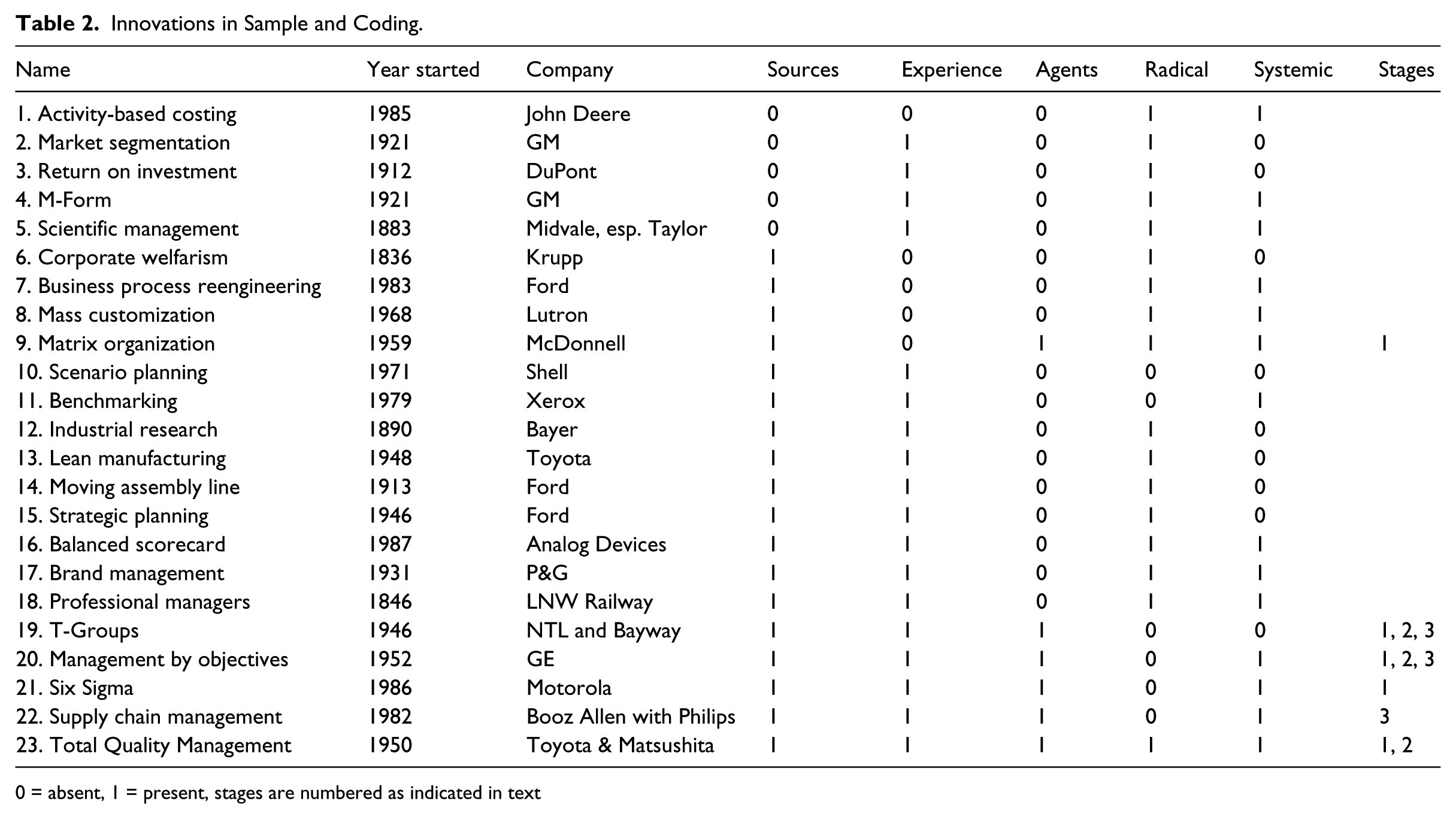
0 = absent, 1 = present, stages are numbered as indicated in text
For six innovations we found evidence of external change agents. One such case is MBO: when GE’s Harold Smiddy implemented MBO in the late 1940s, management thinker Peter Drucker was very heavily involved in these efforts, perhaps to the extent that it was really Drucker who invented MBO and Smiddy who assisted him, and in the process used GE as an experimentation ground (Greenwood, 1981). As Greenwood (1981, p. 226) puts it:
When Harold Smiddy first came to the General Electric Company in 1948, he introduced the monthly letter concept to two operating divisions; but it was not until 1952, when he first began to have the corporate philosophy of management written, that Drucker was able to convince him of the ease with which the monthly letter concept could act as a foundation for an MBO philosophy of management.
And while it was Smiddy who used these monthly letters, it was Drucker who eventually coined the term MBO. Drucker was equally involved in some of the raw ideas that led to MBO in the earlier stages of the innovation process, for instance by introducing the notion that objectives are neither given nor obvious or ubiquitous (Greenwood, 1981).
For 18 cases there was clear evidence of use of external knowledge sources that helped to inspire the innovating firm. In the case of brand management, it was Neil McElroy at P&G who, while in England working on the introduction of the Oxydol brand,
… observed that the diverse operations of European soap and margarine giant Unilever competed directly with one another, but in an inefficient fashion … McElroy believed that each P&G brand should have its own brand assistant and managers dedicated to the advertising and other marketing activities for the brand. (Low & Fullerton, 1994, p. 180)
So this knowledge about outside examples provided McElroy with both an idea about what might be possible, to let different brands compete head-on, as well as a warning sign about the ineffectiveness of the method used elsewhere, meaning that if P&G were to successfully introduce brand management it needed to do so differently from Unilever. Yet sometimes external knowledge sources were absent: Alfred Sloan, for example, explicitly said he did not draw on any significant external sources when inventing the M-Form at GM, and DuPont’s simultaneous invention of a divisional structure was a separate development (Chandler, 1962).
Finally, there were also 18 cases of internal change agents with prior experience. In the cases of the M-Form and brand management, for example, this experience came primarily from the training backgrounds of the internal change agents. Neil McElroy, prior to joining P&G as an advertising department mail clerk in 1925, had graduated from Harvard Business School and used this training in his work on brand management (Schisgall, 1981). Alfred Sloan at GM had trained as an engineer at MIT, using this focus to design the structure he proposed in his famous ‘Organizational Study’ (Chandler, 1962). He was also previously the president of Hyatt Roller Bearing and United Motors (Chandler, 1962).
When it comes to MBO, the external experience came from the work experience of Smiddy. As Greenwood (1981, p. 226) argues:
Harold Smiddy, before coming to GE, had been a partner at Booz, Allen, and Hamilton. There he had learned the concept of the ‘manager’s letter’ from one of his associates. Simply put, the ‘manager’s letter’ required a job holder (manager or individual contributor) to write a letter to his or her superior indicating what the goals for the next period of time were, how the goals would be met, and what standards were to be expected. When the superior accepted this letter — usually after editing and discussion — it became the work ‘contract.’
In Table 3 we present the correlations. With the number of observations available here it is very difficult to obtain significant correlations, and any tests are thus conservative. The first point to note is that the correlation between the radical and systemic variables is close to 0, suggesting the dimensions of the framework in Figure 1 appear to be orthogonal. In terms of addressing research question 1, we find that the correlation with radical innovation is negative for external change agents, knowledge sources and experience. On the other hand, the correlation with systemic innovation is strongly positive for external change agents, marginally positive for external knowledge sources, and negative for external experience. Finally, the correlation with innovations that were radical and systemic (referred to here as radical*systemic) is somewhat negative for external change agents and negative for external knowledge sources and external experience. In other words, and without drawing strong conclusions due to the small sample size, the overall pattern suggests that external involvement is negatively associated with radical innovation, especially when external change agents are involved, but more positively associated with systemic innovation. This is a somewhat surprising finding, as it suggests that the role of external involvement varies depending on which of the two dimensions of the typology we are concerned with.
Polychoric Correlations Between Variables (N = 23).
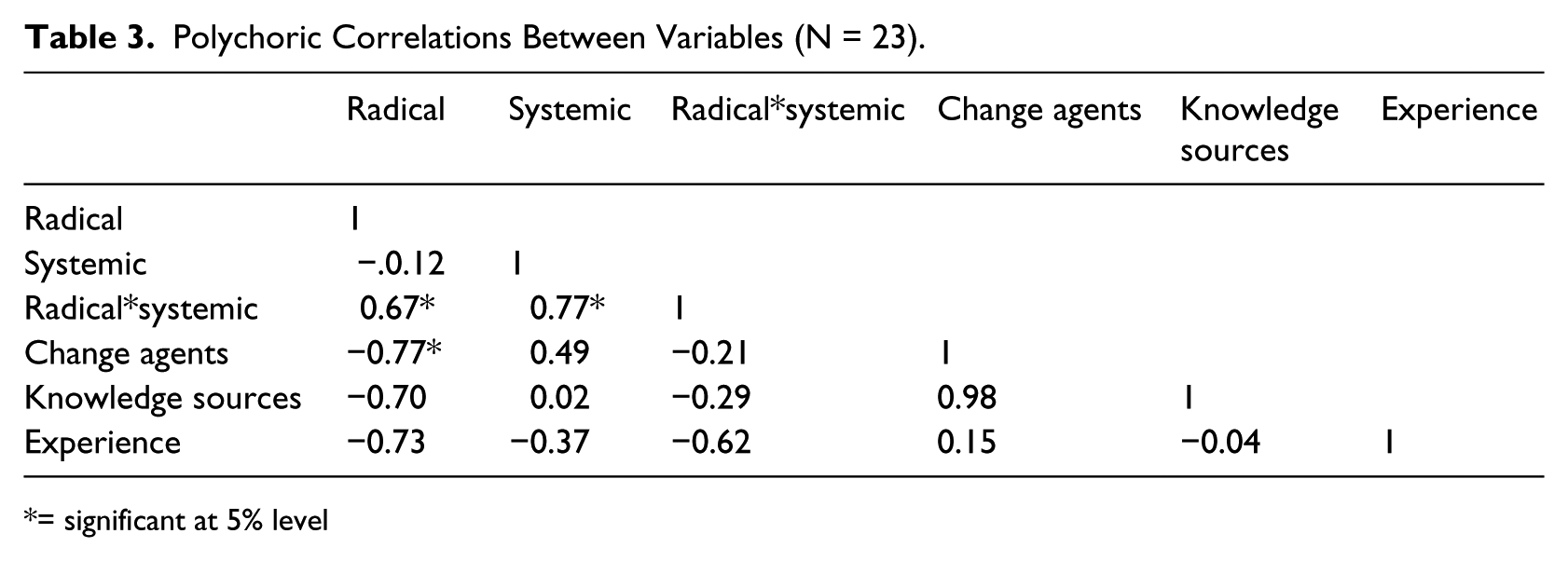
= significant at 5% level
It is worth considering a couple of the cases to exemplify what is going on here. For example, we characterized the invention of industrial research by Bayer in 1890 as a radical break with the past but focused on a single function rather than the enterprise as a whole, yet it was put in place entirely through internal change agents (Meyer-Thurow, 1982, p. 369):
By about 1890 Bayer had recognized the distinctive role of the research chemist and made research a salaried, lifelong, specialized occupation. Yet many difficulties remained. The laboratories were scattered all over the plant, located where there happened to be a free room. (Beer, 1958, p. 129)
Shortly after, the company decided to further formalize industrial research and committed to the construction of a purpose-built laboratory:
In 1890 the directors of the plant voted to house the new research division in a laboratory costing 1½ million marks. This modern building incorporated some original features of interior arrangement, conceived by Duisberg, that have been widely copied by industrial laboratories ever since. (Beer, 1958, p. 129)
In contrast, we characterized the development of T-Groups in NTL in 1946 as incremental in nature, yet there was a very high level of external influence from external agents, in this case practically minded academics, who brought with them ideas about what had worked in their prior engagements:
Although the history of the T-group is usually traced to Kurt Lewin and the serendipitous events in New Britain, a number of experiments with group processes preceded the Connecticut workshop. In fact, Lippitt and Bradford had earlier experimented with confrontational meetings among nurses and doctors at the Freedmen’s Hospital in Washington while they were both at the Federal Security Agency. Much earlier, the German psychologist Jacob Moreno had developed the concept of encounter, which emphasized breaking social constraints and dealing honestly with others … More immediate influences on the ideas of the T-group developers were the projects conducted during World War II by the Tavistock Institute in England and the Office of Strategic Services (OSS) in the United States. (Highhouse, 2002, p. 280)
Similarly, in the case of MBO, as Drucker argued in an interview, although the concept had not been proposed in the manner he put forward,
A good many people in earlier times managed by objectives. Sloan was the first one I met, for the simple reason that he was the first significant figure in management I met personally. But I would imagine that Pierre Du Pont, before him, started out with objectives — perhaps even more clearly than Sloan did … In other words, to manage by objectives is nothing new. (Greenwood, 1981, pp. 229–230)
These examples reinforce that very few novel practices are truly new to the world: some innovations are ‘new to the state of the art’ (Birkinshaw et al., 2008), and the vast majority are best designated as being only ‘new to the organization’. Internal and external change agents, in this case Smiddy and Drucker, learnt from others before and during the creation of management innovations, and therefore, even in our sample of the most well-known management innovations, a good number of innovations were not radically new.
Moving now to research question 2, we correlate the different types of innovation with the number of forms of involvement (anywhere from 0 to 3), using standard Pearson correlations. This produced some clearer findings. In particular, the number of forms of external involvement is negatively correlated with the production of radical innovations (significant at 5%) but not correlated significantly with systemic innovation or radical*systemic innovations. In line with the notion of substitution between forms describe above, we calculated a correlation between the types of innovation and the curvilinear (squared) term for the number of forms of involvement. This produced an even stronger negative correlation (significant at 1%) with radical innovation. This tentative finding is interesting, as it suggests there may be some ‘optimal level’ of external involvement, beyond which an innovation is less likely to be radically new.
Moving on to the QCA analysis, we begin by looking for sufficient conditions for radical, systemic and radical*systemic innovations. Sufficiency can be observed directly from truth tables. Although there are eight possible configurations, our dataset only includes cases for six of these. The cut-off point for assessing whether a condition is sufficient for the dependent phenomenon to occur is a consistency of 0.80 (see Ragin, 2008). In Table 4 we summarize the results, using recently developed conventions (Fiss, 2011). We report which sets of conditions, whether present or absent, are associated with the outcome variables, distinguishing between core conditions, which are part of the parsimonious and intermediate solutions, and peripheral conditions, which are eliminated in the parsimonious solution.
Configurations Associated with Radical, Systemic and Radical*Systemic Innovations in the QCA Analysis.
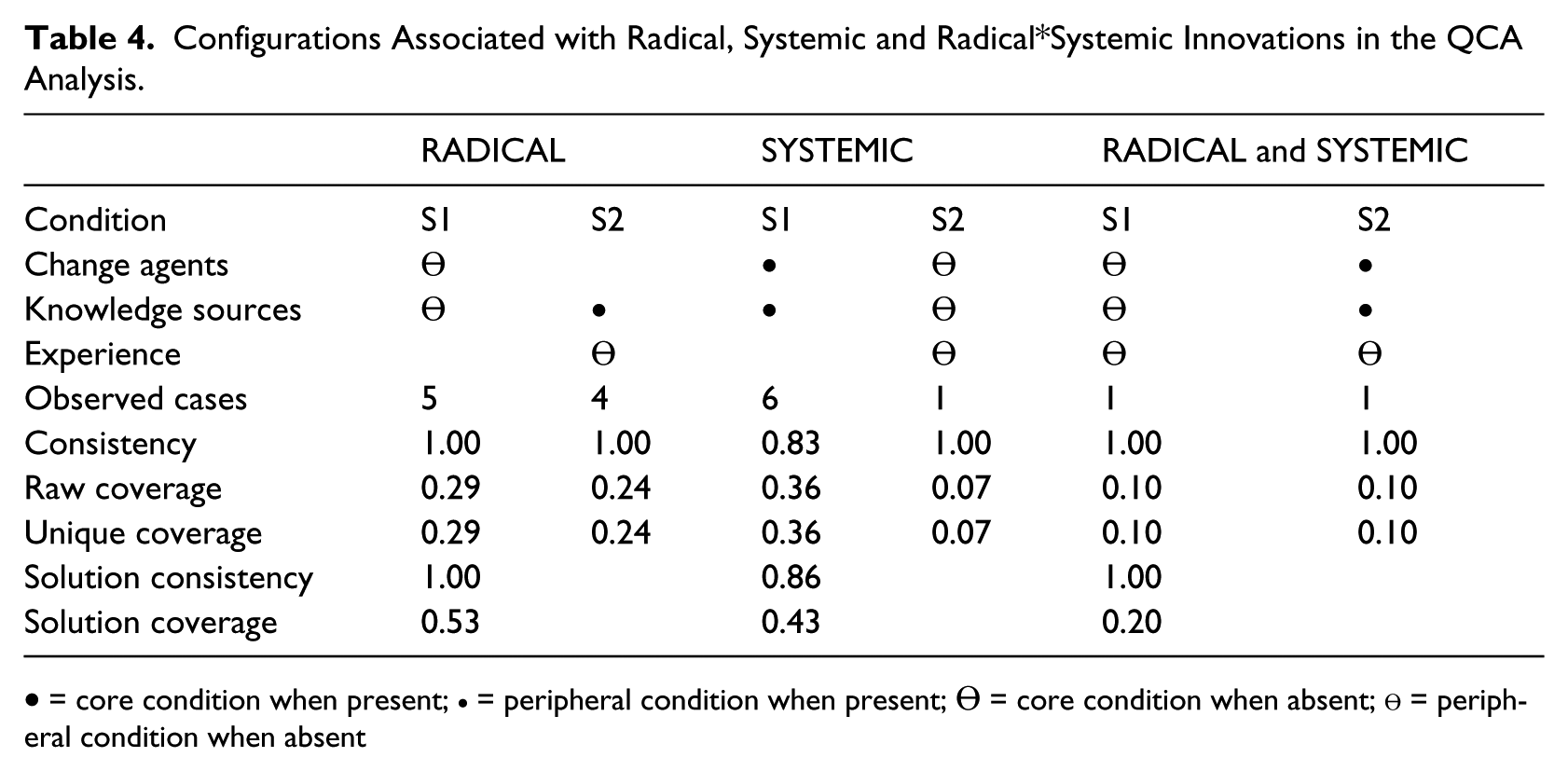
• = core condition when present; • = peripheral condition when present; Ө = core condition when absent; Ө = peripheral condition when absent
The truth table suggested that in this dataset radical innovations come about when one of four configurations occurs: (1) no external involvement at all; (2) only external knowledge sources; (3) only external experience; (4) external change agents and external knowledge sources. Our intermediate solution reflects this, as it produces two combinations of sufficient conditions, namely ~sources*~agents (this means not sources and not agents), with a raw coverage of 0.29, and ~experience*sources (not experience and sources), with a raw coverage of 0.24. 4 Coverage tells us to what degree the solutions that are produced explain the outcomes. The fact that a condition is necessary, however, does not provide information on whether or not that condition is sufficient and therefore further tests are warranted (Schneider & Wagemann, 2012). There is no single condition that occurs in both solutions and we run a separate necessity test, which reveals that none of the conditions has a consistency score above 0.90. Thus our conditions are sufficient but not necessary.
One example of the ~sources*~agents configuration is activity-based costing. Its motivation and development was entirely internal, as noted by Kaplan and March (1987, p. 7):
Keith Williams had been aware that the existing cost system, although satisfactory at an aggregate level, was ineffective for costing and bidding individual parts. He was experimenting with other ways to apply overhead to products. When Maxwell called him in November 1984, Williams realized that the situation at Gear and Special Products provided an opportunity to demonstrate the weaknesses of the current system and to develop a new approach that would be more useful for decision making.
From this internal development, a radical innovation emerged, that according to Anderson and Young (2001, p. 20) ‘revolutionized the field of management accounting, elevating cost analysis from a tactical exercise in management evaluation and control to a key component of planning’.
In the truth tables systemic innovations came about when one of three configurations is present: (1) no external involvement; (2) change agents and knowledge sources; (3) all three forms of involvement. The intermediate solution again produces two necessary conditions, which are ~experience*~sources (not experience and not sources), with a raw coverage of 0.07, and sources*agents (sources and agents), with a raw coverage of 0.36. Similar to the above, there is no single condition that occurs in both solutions and the necessity test did not throw up conditions with a score above 0.90 and these conditions are sufficient but not necessary.
A well-known example of the sources*agents configuration is the development of total quality management, which is systemic because (Ebrahimpour, 1985, p. 421):
Implementing quality control effectively necessitates the cooperation of all people in the company, involving top management, managers, supervisors, and workers in all areas of corporate activities such as market research, research and development, product planning, design, preparations for production, purchasing, vendor management, manufacturing, inspection, sales and after-service, as well as financial control, personnel administration, and training and education.
The innovation as developed relied heavily upon the involvement of external changes agents, especially Joseph M. Juran, Armand V. Feigenbaum and Philip Crosby (Ross, 1999, p. 4), and external knowledge sources were used too, as TQM as developed in Japan drew explicitly upon earlier developments in the United States (Juran, 1995, p. 556):
The middle 1920s witnessed the first significant wave of so-called ‘Statistical Quality Control’ (SQC). It had its origin in the Bell System. It was initiated in 1926 when a team from the Bell Telephone Laboratories proposed that the Hawthorne Works of Western Electric Company (the manufacturing arm of the Bell System) apply certain tools of statistical methodology to the control of quality of manufactured telephone products.
Finally, radical*systemic innovations occur when one of two configurations is present: (1) no external involvement; (2) change agents and knowledge sources. Once more, the analysis produces two solutions, ~experience*~sources (not experiences and not sources), with a raw coverage of 0.10, and ~experience*agents (not experience and agents), also with a raw coverage of 0.10, which is a substantially lower coverage than we obtained for the two underlying dimensions and therefore provides less of an explanation for the outcome variable. Since ~experience appears in both solutions it could be a necessary condition, but its consistency score in a test of necessity is only 0.40, indicating this is not the case. The results for the QCA analysis are broadly consistent with the correlations presented earlier, but provide additional insights, and the quotes elucidate why we observe these patterns, meaning our methods are complementary.
Discussion and Limitations
We can summarize the findings from this multi-method study as follows. Research question 1 asked how external involvement varied depending on the extent to which the innovation was radical (rather than incremental) and systemic (rather than single-function). Our evidence suggests the presence of external change agents is associated with systemic (not single-function) and incremental (not radical) innovations; that the absence of external experience is associated with systemic and radical innovations; and that the presence or absence of external sources of knowledge have no clear effect one way or the other.
The key insight, then, is that external involvement appears to have a dampening effect on the radicalness of the management innovation. Or to say it slightly differently, when we see truly radical management innovations, they transpire primarily through internal change agents (typically the top executives) acting on their own initiative, and without much outside help. Of course, these individuals may well have been inspired indirectly by things they observed beyond their firm’s boundaries, but in cases where they directly received external input, their management innovations were more likely to be incremental.
In contrast, the effect of external involvement on the single function/systemic dimension appears more mixed. External change agents are seen more in systemic innovations, we believe because a significant part of their role is to act as ‘process consultants’ who take responsibility for implementing changes across multiple parts of the organization. External experience, on the other hand, is associated more with single-function innovations, perhaps again because such experience pushes internal change agents towards less ambitious change programmes.
Research question 2 asked how the three types of external involvement interact in the management innovation process, and the answer was that they act to a large degree as substitutes rather than complements in the creation of more complex forms of management innovation. This suggests that the optimal number of forms of involvement, to the extent that more radical and systemic innovations are sought, may be an intermediate number.
Contributions
Our study contributes to the literature in four domains: management innovation, open innovation, the genesis of innovation and strategy process. In terms of work on management innovation, this study builds on and extends ideas presented by Birkinshaw et al. (2008) on the innovation process. We show that, besides external change agents, there are two further important forms of external involvement that are used to create new management practices: external experience and external knowledge sources. We see this as a significant advance in terms of scholarly work on management innovation, which traditionally focused more on internal factors (e.g. Damanpour & Evan, 1984). We then created a typology of management innovation along two dimensions and were able to demonstrate that the three forms of external involvement have a differential impact on the type of innovation, and can be seen as substitutes. We believe that the forms of external involvement and this typology offer significant potential for future research efforts because of their general applicability to management innovations across a range of functions and complexity levels. This complexity should have implications for the amount of effort required to create and implement an innovation and potentially also for its effects on firm competitive advantage.
The literature on diffusion of management innovations ought to explicitly incorporate these distinctions too. As argued above all too often it focuses on a single innovation and fails to recognize how the innovation’s characteristics influence diffusion and implementation processes. In particular, we call for empirical studies that explicitly compare diffusion processes of multiple innovation using innovation characteristics as the explanatory variable for differences in these processes.
Our findings about the role of external change agents leads us to the supposition that they are highly conditioned by what they have seen working well elsewhere, and because they have relatively little formal influence in the focal organization they tend to push relatively incremental initiatives as opposed to innovations that are radically new to current practice. Some of the most radical innovations, it turns out, are driven by insiders who have sufficient power, both formal and informal, to push through ideas that have not been proven elsewhere, or perhaps lack a frame of reference on what has been done elsewhere. In terms of the subsequent spread of innovations to other organizations through fashion markets (Abrahamson & Eisenman, 2008; Abrahamson & Fairchild, 1999), radical innovations may actually prove to be a harder sell for external change agents supplying the fashion and could therefore diffuse more slowly and less widely – this is another proposition the literature on diffusion of innovations ought to test. Another interesting question for follow-up research could be the extent to which organizations need to develop ambidextrous capabilities among their managers to be able to pursue both incremental and radical innovations at the same time (Mom, Van den Bosch & Volberda, 2009; O’Reilly & Tushman, 2011).
The second area where we see implications is the literature on open innovation (Chesbrough, 2003). This literature has thus far focused on product innovations and to a lesser extent process innovations, but there is no a priori reason why its central contention, that an organization can become more innovative and generally more successful by using both inflows and outflows of innovation knowledge (Chesbrough, 2003), could not equally apply to management innovation. The exploratory findings generated in this study add to recent work that has looked on the use of external knowledge sourcing for the generation of product innovation (Laursen & Salter, 2006; Leiponen & Helfat, 2009; Monteiro Mol, & Birkinshaw, 2011) and management innovation (Mol & Birkinshaw, 2009). While some studies have suggested there may be trade-offs within a single form of external knowledge sourcing (Laursen & Salter, 2006), between external knowledge sourcing and internal factors (Mol & Birkinshaw, 2009) and between external knowledge sourcing and attempts to strategically protect a firm’s own knowledge (Monteiro et al., 2011), the current study finds these trade-offs among the different forms of external involvement. Our empirical evidence that the three different forms of external involvement may be substitutes for each other enriches the study of open innovation by moving it away from the simplistic notion that the more external involvement there is, the better firms will be able to innovate.
Third, this paper generates insights about how the genesis of management innovations compares to that of process and product innovations. While there are similarities, our findings underline two areas of differences. First, because management innovations are to a significant degree socially constructed (Zbaracki, 1998) and because most organizations lack expertise in developing new ways of working (Birkinshaw et al., 2008), there is a greater need for independent validation of such innovations from external sources than with process or product innovations. External involvement, as we saw from our historical data, is almost always an important feature of the management innovation process, whereas in product and process innovations it is seen less often. Second, our evidence suggests management innovating is highly iterative and informal. This contrasts with the literature on process innovation (Davenport, 1993; Davenport & Short, 1990) which has often emphasized the role of information technology and presents a relatively linear approach, and the literature on product innovation (e.g. Cooper, 1993) which has often emphasized a sequential, ‘stage-gate’ logic to the process. Of course, there is some level of iteration in all innovation processes, but our sense is that because management innovating happens rarely, organizations have no experience or prior routines to fall back on, so the process ends up being rather haphazard and lacking in structure. This is especially true in the motivation and invention phases, due to the ambiguity surrounding organizational problems and what has been called ‘the multifaceted nature of dissatisfaction’ (Birkinshaw & Mol, 2006, p. 84), and the intangibility of inventions.
Finally, we see this study adding to the literature on strategy process along the same lines that earlier work on management innovation (e.g. Birkinshaw et al., 2008; Zbaracki, 1998) has done. The process of management innovation is a relatively complex one, involving a great need for legitimacy and the bringing together of disparate pieces of knowledge and experience. This at once explains the need to involve a variety of actors and knowledge sources, the importance of prior experience, the length of management innovation processes (for instance the decades it took Toyota to put together lean manufacturing), the low rate of success (e.g. Staw & Epstein, 2000) and the difficulty of capturing management innovation in the act. It also points to the need for relatively rich sources of evidence (Langley, 2007), such as those presented here. Unlike most strategy process literature, we draw linkages between nature of the process and its outcomes, in terms of the type of innovation.
Although our empirical work is historical in nature, we believe this paper still has a lot of practical implications to offer. We would suggest that internal agents looking to create an innovation can afford not to use all three external forms of involvement. Instead they might mix the forms of involvement based on the characteristics of the innovation they look to produce. For instance, external agents are not helpful when attempting to create radical innovations. Furthermore, this process of mixing external forms of involvement ought to take into consideration the different mechanisms, as outlined in Table 1. External agents are a good source of legitimacy, but this is much less true for external knowledge sources, which mostly inform the design of the innovation. Depending on the organizational context one or the other may be important. Another consideration is that the involvement of external agents may come at a greater cost. If internal agents do not possess relevant prior experience it is not possible to acquire this experience overnight – perhaps other individuals can be assigned to the project. We note that in practice most management innovating efforts in organizations will probably be rather less complicated than those we have studied here – our innovations made it into the written record because they are special.
Limitations
As is the case with any empirical work, this study faces some limitations. Clearly the use of the historical record, while allowing us to focus on the genesis of a set of management innovations that have gone on to heavily influence practice and academic thinking about management theory, introduces several forms of bias. As noted above, there is a clear linguistic and cultural bias. Although there are some innovations in our sample of non-Anglo Saxon origin, there are likely to be further interesting innovations elsewhere and perhaps the use of external involvement differs between countries, for instance due to differences in the institutional factors that drive inter-organizational trust. Furthermore there is a clear pro-innovation bias in this sample. Because this study does not focus on innovation success as such, but rather on the process through which these innovations come about, i.e. there is no sampling on the dependent variable, we do not see this as overly problematic. Furthermore we believe there are some unique insights that can be gained from this sample.
Another limitation of this study is through its focus on whether or not certain forms of involvement were present. In reality there are likely to be different degrees of use of each of the three forms of involvement, but our data does not allow us to measure this. Degree of use, rather than the discrete choice to (not) use a form portrayed here, may determine the observed outcomes. More quantitatively oriented future work, such as through surveys, could test this. Finally, we acknowledge that our study perhaps overemphasizes the distinction between individuals internal and external to the organization. Some of the external change agents in this study were associated with the focal organization for some time, such as Blake and Mouton at Bayway, and thus the boundaries between the internal and external spheres were not entirely clear-cut. In today’s world of complex networks and fluid boundaries such distinctions are surely more unclear. Internal change agents may form part of social networks that extend well beyond the boundaries of the organization and affect their knowledge and decision-making to a significant degree (Nahapiet & Ghoshal, 1998). Future empirical work could therefore take more of a network perspective.
Conclusions
In this paper we theorized about three forms of external involvement that affect the management innovation process, developed a typology of management innovation, and investigated how the forms of involvement relate to the type of innovation by embarking on an exploratory historical study. Our discussion and empirical analysis focused on the use by internal change agents of external experience and external knowledge and the direct involvement of external change agents. The typology of management innovation applies the dimensions of radical versus incremental and systemic versus single-function innovations. The results suggest that external involvement is frequently associated with less radical but more systemic innovations, suggesting that external change agents, in particular, play a more nuanced role in the management innovation process than was previously recognized. We also showed that the three forms of external involvement are for the most part substitutes not complements. We conclude by expressing the hope that the management innovation research agenda will continue to be explored further in future work.
Footnotes
Acknowledgements
Previous versions of this paper were presented during EURAM and SMS special conferences and in seminars at City University, Copenhagen Business School, the University of Bath, the University of Manchester, the University of Oxford and Valencia Polytechnic University. The authors would like to acknowledge useful comments received from Chris McKenna, Sirus Pussayanavin and Richard Whittington and from the anonymous reviewers. They are also grateful for assistance provided by Latzechar Hristov, Nora Markova and Ignacio Vaccaro in collecting the data used in this study. The usual disclaimer applies.
Funding
This work was supported by the Advanced Institute for Management Research.