




Abstract
Taken-for-granted cognitive schemas form a core aspect of institutions. Whilst much is known about their effects, past research has not yet detailed and formalized how individual actors are able to initiate changes to such institutionalized schemas, reframe their circumstances and how, in turn, such a provisional reframing may itself evolve into a taken-for-granted schema. In this article, we argue that changes to existing institutions come about when actors engage in discursive processes of frame shifting or frame blending by which they articulate alternative or combined schematizations and succeed in building up common ground around the novel cognitive template. We elaborate a set of propositional arguments for when and how actors are more likely to initiate and realize institutional change by either discursively marking the contrast with prior cognitive schemas or by scaling these up into a broader understanding.
A vibrant line of contemporary institutional research focuses on how institutions and broader institutional fields 1 are constructed, sustained and altered in micro-political struggles over frames and their consequences (Armstrong, 2005; Granqvist & Laurila, 2011; Meyer & Höllerer, 2010; Powell & Colyvas, 2008). In such struggles, the framing of one group is often rebutted or challenged by frames of other groups—a process referred to as framing contests (Benford & Snow, 2000; Rao & Kenney, 2008). In addition, skilled actors, as “institutional entrepreneurs”, may through their use of framing language build up broad-based support for a change and reorder the field (e.g., Battilana, Leca, & Boxenbaum, 2009; Fligstein & McAdam, 2011, 2012; Lounsbury, Ventresca, & Hirsch, 2003; Rao, Monin, & Durand, 2003). Rao et al. (2003) for example demonstrate how a movement of chefs advocated a reframing of the role of chefs as creative agents and instigated an institutional change from haute to nouvelle cuisine. Similarly, Khaire and Wadhwani (2010) have recently shown how a purposeful reframing by art houses of contemporary Indian paintings as a variety of “modern” rather than “provincial” art created and institutionalized an entire new market category.
In the present paper, we focus on these kinds of framing tactics through which actors not only access prior latent meaning structures, as cognitive schemas, but also consciously draw verbal associations with other ideas and cultural values (e.g., Douglas, 1986; Suddaby & Greenwood, 2005; Weber, Heinze, & DeSoucey, 2008) that suggests how practices in a particular institutional field can be reconsidered and rethought. Such discursive acts of framing (Hirsch, 1986), or what is sometimes labelled as the creation of a new “vision” (Battilana et al., 2009) have been recognized as a crucial plank for institutional change. Yet, we lack a clear specification of the different types of framing tactics that actors may use in a specific institutional setting, and with that we also lack a broader understanding of when and how a particular framing tactic is more likely to succeed in gaining support from other actors in the field as a stepping stone towards more broad-based institutional change.
In other words, whilst prior research has highlighted how a skilful reframing may form the basis for institutional change (e.g., Benford & Snow, 2000; Fligstein & McAdam, 2011, 2012), there is a general lack of detail on the discursive tactics that actors use when they aim to mobilize and align actors and groups in a field and build common ground for institutional change. To address this limitation in the literature, we theorize about two categories of discursive framing tactics, frame shifting and frame blending, through which actors talk alternative conceptualizations of an institution into being and attempt to disseminate these frames with others in their institutional setting. Frame shifting involves specific forms of disjunctive and counter-factual language, which is a tactic where individual actors query the institutionalized cognitive schema in a field and articulate and promote an alternative frame that marks the contrast with the prior cognitive understanding. Frame blending involves conjunctive language and analogies through which actors discursively iterate between or integrate cognitive schemas in a field, including bridging between past schemas as part of a proposed novel schematization. Both these processes extend previous research on framing tactics into a coherent and parsimonious theoretical typology.
We use this typology in turn to develop a set of propositions on when and how actors are more likely to realize cognitive change through either frame shifting or frame blending and gain support from others in an institutional field. These specific propositions are based on the general argument that besides a skilful play of words, the effectiveness of newly articulated frames also depends on their alignment with so-called discursive opportunities that “open up” in an institutional field (McCammon, Sanders Muse, Newman, & Terrell, 2007). In so doing, we provide an account of how strategically inclined actors are able to articulate alternatives to the institutional status quo and how when they align such frames with discourses at the macro level they are more likely to gain support for a change (Fligstein & McAdam, 2012).
With our theory-building we specifically aim to make a number of contributions to neo-institutional theory. First, neo-institutional theory increasingly recognizes the importance of grounding and explaining macro-social phenomena such as the structure of organizational fields and markets in terms of micro-level processes and mechanisms (DiMaggio, 1997; George, Chattopadhyay, Sitkin, & Barden, 2006; Powell & Colyvas, 2008). In the paper, we conceptualize the micro-level processes of frame shifting and frame blending through which individual actors, whilst embedded in their institutional contexts, are able to reframe their circumstances and vie for change. The specification of these processes addresses the paradox of embedded agency (Battilana et al., 2009; DiMagggio, 1997) and provides depth and foundation to our understanding of the discursive tactics associated with initiating and potentially realizing institutional change. Second, ever since Goffman (1974), the notion of framing has provided an attractive option of connecting micro and macro levels of analysis and of combining cognitive dispositions with discursive processes of meaning construction (e.g., Tannen, 1979). Recent neo-institutional research has been criticized for losing this connection (Barley, 2008; Hallett, 2010; Suddaby, 2010) and as effectively presenting macro-social structures of cognition as “analytically removed from the more active struggles over meaning” (Lounsbury et al., 2003, p. 72). With our theory-building we aim to reconnect framing in discourse with cognitive frames, or schemas (see DiMaggio, 1997), and elaborate how framing in discourse employs cognitive schemas as both constraints and resources in promoting and realizing a cognitive change. Third, we develop a coherent typology of framings tactics that distinguishes between tactics based on the form of reasoning through which an alternative framing is proposed against the backdrop of the institutional status quo. In this way, we advance prior research on framing tactics (Benford & Snow, 2000; Fligstein & McAdam, 2011, 2012) that has described and labelled various tactics but has stopped short of a direct theorization of such tactics. We thus present a theoretically grounded and parsimonious typology that we hope will be of use to further institutional research on micro-political struggles over frames and their consequences (Armstrong, 2005; Granqvist & Laurila, 2011; Guérard, Bode, & Gustafsson, 2013; Meyer & Höllerer, 2010). Fourth, we develop a set of propositional arguments for when and how actors are more likely to gain support through frame shifting or frame blending and potentially realize broad cognitive change in an institutional field. These propositions build on the premise that the discourses that feature in an institutional field present specific discursive opportunities which strategically inclined actors can exploit through specific framing tactics. When in this sense the right tactic is chosen, it is more likely, we argue, that actors are able to persuade others and gain legitimacy for the proposed change. In elaborating these arguments we relate macro-social discursive and cognitive conditions with micro-level processes of framing in context.
We proceed in the paper as follows. First, we will present a brief review of prior work on framing and frames in institutional theory. Next, we will define the main processes of frame shifting and frame blending and outline a basic typology of framing tactics. We in turn extend the typology into a set of propositions that link framing tactics to field-level institutional conditions and specifically the main discourse, or discourses, that feature in an institutional field. We conclude with a discussion of the implications of our typology and arguments for research on institutional change.
Framing and Institutional Change
Within neo-institutional theory, the construct of frame has often been considered as core to the very fabric of institutions (Beckert, 2010). As Scott (2003, p. 880) notes, frames are central to the cultural-cognitive aspect of institutions which “involves the creation of shared conceptions that constitute the nature of social reality and the frames through which meaning is made”. Beckert (2010, p. 607) similarly notes that neo-institutional theory “emphasizes the role of cognitive frames and meaning structures as decisive for the explanation of economic outcomes by broadening the notion of institution; institutions are defined as inter-subjectively shared meanings and thereby become almost indistinguishable from cognitive frames”.
These definitions in effect highlight the dual character of the frame concept in that it captures the institutionalization of enduring meaning structures whilst at the same time providing a macro-structural underpinning for actors’ motivations, cognitions and discourse at a micro level. This duality extends from foundational work (Bateson, 1955/1972; Burke, 1937; Goffman, 1974) that focused on how common cultural frames of reference are used to define and label experiences in specific contexts. Frames as such allow actors to impart meaning onto events and experiences and provide cognitive “schemata of interpretation” (Goffman, 1974, p. 21). As templates for organizing experiences frames also provide the key ingredients for change in that they can be questioned, transplanted and changed when actors apply them in context (Sewell, 1992; Weber & Glynn, 2006). Whilst this duality makes framing a versatile concept for studies of institutional change, prior research on the subject often pays insufficient attention to the detailed linkages between the macro-social level of cognitive schemas and actors’ active struggles over meaning at a more micro level (Glaser, Fiss, & Kennedy, 2011; Rao, 1998; Weber & Glynn, 2006).
Framing contests and field frames
In a well-known paper, Lounsbury et al. (2003) aimed to bridge between framing contests on the ground and broader institutions at a macro or field level. They primarily criticized institutional theories (such as institutional logics) that consider institutions as exogenous to actors and as thus “analytically removed from active struggles over meaning and resources” (Lounsbury et al., 2003, p. 72). In response, they propose the “intermediate concept” of the “field frame”, “that has the durability and stickiness of an institutional logic, but akin to strategic framing, it is endogenous to field actors and is subject to change and modification” (Lounsbury et al., 2003, p. 72). The utility of this field frame construct is that it provides an analytical structure for understanding the process by which an initial set of discursive framings in context evolves into a set of commonly held conventions (as a field frame), which in turn form the ground for new practices, organizational forms and market categories (Jones, Maoret, Massa, & Svejenova, 2012; Lounsbury et al., 2003; Rao, 1998; Weber et al., 2008). To give one example, Weber et al. (2008) demonstrate how advocates for grass-fed meat and dairy products discursively framed a new market and distinguished it from industrial agriculture so as to motivate producers’ entry into the nascent market category.
The prime advantage of the field frame construct is that it highlights the active struggles over meaning in an institutional field in which default institutional frames, as taken-for-granted schemas, are challenged and reconfigured or transposed altogether with alternative framings, and where, as an outcome of such struggles, novel framings may potentially settle as field frames that form the basis for new practices, organizational forms and market categories (Hirsch, 1986; Rao, 1998). Such field frames are temporary settlements, or agreed upon conventions (Lounsbury et al., 2003), although occasionally they may evolve further into institutional frames; naturalized and taken-for-granted cognitive schemas (Cornelissen & Werner, 2014). In this article, we restrict our focus to exploring how against an existing institutional backdrop, actors are able to reframe their circumstances and collectively establish a new field frame. In adopting this focus, we restrict our gaze in this paper to the literature on framing and institutional change. This also means that in order to ensure theoretical depth and traction, we do not directly draw on other closely related institutional constructs such as theorization, logics and categorization.
Strategic framing and macro discourses
The conceptualization of a field frame synthesizes theories of social movement framing and of institutionalized cognitive frames at the field level. To begin with, much research within neo-institutional theory draws heavily on social movement research on framing (Lounsbury et al., 2003). Initially this stream of social movements research followed the symbolic interactionist tenets of Goffman (1974) quite closely; however, over time, the primary emphasis has shifted to framing as a strategic process of persuasion aimed at gaining support and legitimacy for political and institutional change (Benford & Snow, 2000; Polletta, 2006). Frames are in turn often cast in this literature as strategic messages or accounts uttered by social movement leaders who with such language tactically direct the movement’s symbolic position along existing belief systems and cultural values, and which it is then hoped will chime with other actors and groups in an institutional field (Fligstein & MacAdam, 2011, 2012). However, as Oliver and Johnston (2000, p. 41) remark: “when a collective action frame is recast as something that leaders must articulate so that it better ‘markets the movement’ the interactive negotiation of ‘what’s going on here’ takes [a] back seat to a one-way, top-down process”. Benford (1997) highlights that with this overly strategic emphasis social movement researchers have moved away from a more processual approach to framing (as in Goffman, 1974) and have instead focused on identifying and distilling frames across empirical settings. In response, he argues for social movements research to move beyond “naming frames to studying framing processes analytically” (Benford, 1997, p. 423).
Schneiberg and Clemens (2006, p. 211) similarly highlight a common tendency in neo-institutional research to distil and name “typical frames” where the “common measurement strategy” is “to use actors’ discursive output as topics for analysis, that is, as documentation of cognitive frames, principles, or institutional logics”. The concern shared by Benford (1997) and Schneiberg and Clemens (2006) is that the “naming of frames” leads to a reification and a static premise based on conflating framing, in language and others symbols, and frames, as a set of cognitively held beliefs and values. Failure to distinguish the dynamic interrelations between the two (Goffman, 1974, 1981) leads to the premise that meanings are pretty stable, or static, across time and space. The inference in turn is that frames can be easily inferred from speeches and other texts and also that if strategic actors want to mobilize others for their cause, they merely have to put “the right ‘spin’ on their issue to tap into fixed preconceptions” (Oliver & Johnston, 2000, p. 41). The overall result of this strategic view of framing is the tautological argument that those who won framing contests simply employed the most resonant frames (Benford & Snow, 2000, p. 626; Fligstein & MacAdam, 2011, 2012). It also leads to a rather “heroic” image of the skills of institutional entrepreneurs (Battilana et al., 2009; Fligstein & McAdam, 2011, 2012), as opposed to seeing their success as at least in part contingent on the framing of others and the broader discursive opportunities and constraints afforded by a particular institutional field (Ansari, Wijen, & Gray, 2013; Armstrong, 2005; Sgourev, 2013).
In contrast to this strategic tendency, or bias, more macro-oriented scholars within neo-institutional theory have taken a different tack and explore how common discourses constrain and guide the framing efforts of actors and underpin the establishment of new institutions such as practices, organizational forms or market categories (e.g., Loewenstein, Ocasio, & Jones, 2012; Phillips, Lawrence, & Hardy, 2004). For example, Jones et al. (2012) recently analysed the vocabularies of keywords used by movements of architects as they started to frame and define the emerging field of modern architecture. “Modern functional” and “modern organic” architects pronounced and underscored different conceptions of modern architecture and between each other started to promote their own code of practice. The starting point in this and other studies is the common discourses—that is, sets of keywords, common expressions and statements (Phillips et al., 2004)—that are prevalent in an institutional field and which are seen to direct and constrain acts of framing on the ground (Heracleous & Barrett, 2001; Maguire, Hardy, & Lawrence, 2004). The focus, in other words, is on socially shared linguistic repertoires with institutional change being cast as a variation on, or combination of, existing keywords and expressions from within that domain (Jones et al., 2012; Loewenstein et al., 2012; Weber, 2005).
Our criticism of this line of research is that there is ample evidence to suggest that actors are able to be creative in their language use and may draw in discourses from outside of their institutional field (Hirsch, 1986; Rao et al., 2003; Suddaby & Greenwood, 2005). In addition, whilst a focus on the structure and content of common discourses is an important step towards examining the discursive fields in which framing occurs and on which it draws (Glaser et al., 2011; Steinberg, 1999), it is still arguably a step removed from the active struggles over meaning in framing contests on the ground and that in turn may form the basis for new field frames (Lounsbury et al., 2003). Hallett (2010) makes this point clear, we believe, in his recent study of teachers in an urban elementary school who responded to the introduction of the institutional discourse of “accountability” in their school. In discursive interactions on the ground, they challenged this discourse, the result of which was that they blended the institutional template that was being imposed with the previous institutional order that was built around their own work routines. As in this example, it seems important to build linkages between broader discourses (Steinberg, 1998) and instances of framing and sensemaking by actors on the ground. This dialectic is in line with the original cognitive linguistic and symbolic interactionist work on framing (Bateson, 1955/1972; Goffman, 1974) in that it balances a notion of strategic action with the opportunities and constraints afforded by macro level discourses within an institutional field (Diehl & MacFarland, 2010).
This balance also implies that rather than only documenting changes in discourses, as collective resources of sensemaking (e.g., Jones et al., 2012; Loewenstein et al., 2012; Lounsbury et al., 2003; Weber, 2005; Weber et al., 2008), such broader discourses need to be linked to lower-level discursive strategies and framing contests on the ground. This analytical and methodological turn is increasingly called for (e.g., Barley, 2008; Powell & Colyvas, 2008; Suddaby, 2010) and requires a shift in focus from a structural linguistics or structural semiotics (e.g., Jones et al., 2012: Loewenstein et al., 2012; Weber, 2005; Weber et al., 2008) to a cognitive linguistic focus on how actors deliberately use language to influence the creation or maintenance of cognitive schemas (Suddaby, 2010, p. 17; see also Green & Li, 2011). This particular focus will deliver much needed insights, we argue, into how individual actors are not only able to enlist institutional contents such as common discourses but through linguistic and cognitive associations are also able to create new frames that initiate and shape changes to existing cognitive schemas and which may provide the basis for institutional change. Among other things this focus will also bring greater insight into the “grammar” of framing tactics, as opposed to abstracting and distilling frames around sets of keywords that in turn are seen as emblematic of broader discourses, or discursive positions (Benford & Snow, 2000; Creed, Langstraat, & Scully, 2002; Schneiberg & Clemens, 2006).
In the cognitive linguistic perspective that we adopt in this paper, frames are both cognitive schemas as well as linguistic resources for ongoing meaning construction, and the interrelations between these dimensions are analytically important to modelling cognitive change (DiMaggio, 1997). The cognitive linguist Fillmore (1975, 1982) defines frames as structured semantic representations, or cognitive schemas, that are invoked by words in a particular speech context and are rooted in motivating cultural background knowledge. As such, he argued that generally speaking “nobody can really understand the meanings of the words in that domain who does not understand the social institutions or the structures of experience which they presuppose” (Fillmore 1982, p. 31). This cognitive linguistic perspective on frames comes with three basic assumptions. The first assumption is that words, when used as acts of framing in context, prompt larger cognitive representations, or frames, which means that in ongoing speech and communication individuals need to detect the changing background assumptions necessary for continued interpretation (Goffman, 1974, 1981; Tannen, 1985). The second assumption is that the words and thus frames that actors use define situations and structure their experiences (Goffman, 1974; Snow, Rochford, Worden, & Benford, 1986). Words invoke or cue larger cognitive frames that organize experience and create expectations about important aspects of the institutional context by directing individuals to elaborate on the default or prototypical scenario in a manner suggested by the frame (Lakoff, 1987; Tannen, 1979). A third assumption relates to creativity and change in using words to construe frames. Words are linked to (cognitive) frames and may become conventionally used in an institutional field to the extent that individuals readily accept the framing and automatically draw inferences on the basis of such typical uses and often do so without conscious effort or awareness (Rosch & Lloyd, 1978). At the same time, individuals are able to reflect on their context and can actively extend word usage or create new associations in order to shift understanding or to suggest alternate meanings and conceptualizations (e.g., Coulson, 2001; Lakoff, 1987). Yet, consistent with cognitive linguistics, such “creative” framing and reframing efforts are grammatically structured and constrained and, as we will outline below, manifest themselves in specific forms of speaking and thinking.
Dynamics of Framing: Frame Shifting and Frame Blending
As Goffman (1974) noted, social situations can be framed in alternative ways, and can therefore draw on different rationales for action (Kraatz & Block, 2008). Frames are in effect analogue schematic representations created and invoked through words that order observations and power inferences in context (Lakoff, 1987). This understanding also implies that actors can deliberately contest institutional frames and propose alternative schematizations (Benford & Snow, 2000; Kaplan, 2008). In other words, actors have the ability, as creative agents, not only to reinforce institutional background as part of their framing but also to reassemble words and thoughts to actively invoke a different type of frame and understanding (Diehl & McFarland, 2010; Goffman, 1974). Diehl and McFarland (2010) conceptualize such a reframing as a “lamination” on the institutional frame, and Weber and Glynn (2006) refer to the same process as “editing”—to highlight how such a reframing is often grounded in, and made possible by, the prevailing institutional frame, akin to how creative writing builds on established genres and styles.
These broad and figurative descriptions helpfully recognize the “embedded agency” of actors; however, they provide very little explicit detail on the actual forms of language use and semantic leaps that are involved in such changes in frames (Cornelissen & Werner, 2014). Similarly, the stream of research of Fligstein and McAdam (2011, 2012) recognizes the constitutive role of framing in institutional change, yet does not clearly detail and define the actual expressions, discursive tactics or cognitive changes that it involves. Framing accordingly remains somewhat of an abstract, reified and elusive concept in their analysis. The same problem bedevils the well-known work of Benford and Snow (2000), which carries a tendency to abstract and reify categories of framing processes (Cornelissen & Werner, 2014; Polletta, 2006; Steinberg, 1999). To illustrate this point, their probably best-known framing typology highlights four processes of framing: (a) bridging, or the linking of two or more ideologically congruent but previously unconnected frames regarding an issue or problem; (b) amplification: invigorating and emphasizing specific cultural values and beliefs as part of a frame; (c) extension, or enlarging a frame’s reach whereby activists and movements “extend the boundaries of their primary framework so as to encompass interests or points of view that are incidental to its primary objectives but of considerable salience to potential adherents” (Snow et al., 1986, p. 472); and (d) transformation, which seemingly refers to a counter-factual framing and to “changing old understandings and meanings and/or generating new ones” (Benford & Snow, 2000, p. 625).
Recent research has critiqued this original typology as rather abstract, as largely descriptive (as opposed to theoretical) and as not sufficiently detailed at the level of the speech of actors and the discursive utterances that align individuals and groups (Ansari et al., 2013; Brummans et al., 2008; Dewulf & Bouwen, 2012). A related concern is that the typology over-emphasizes the strategic nature of framing, and is only loosely coupled to the institutionally embedded meaning construction, or sensemaking, of the individuals involved (Cornelissen & Werner, 2014). We build on these criticisms and elaborate two types of discursive framing tactics—frame shifting and frame blending—through which actors may contest the existing schemas at the core of an institution and present an alternative schematization. We describe both sets of tactics, and consistent with our cognitive linguistic approach, articulate the “grammar” through which such alternative framings are construed. These framing tactics, we argue, present more fine-grained detail than the broad categories of “bridging”, “extending”, or “transforming” frames (Benford & Snow, 2000; Snow et al., 1986).
Frame shifting
The first set of framing tactics is labelled as frame shifting, which at its core suggests a semantic re-writing that reorganizes existing information and conventions associated with the prior schema into that of a new frame (Coulson, 2001). When actors initiate a shift to such a new frame, they actively question and query existing institutionalized schemas and do so by mobilizing an alternative frame that restructures expectations and experiences and suggests different inferences. The shift to a novel frame may result from a process of sensebreaking (Pratt, 2000), or the breaking down of meaning for actors in a field when institutionalized schemas are seen to falter in contexts of practice (Seo & Creed, 2002). Such sensebreaking triggers self-reflective questioning and a search for an alternative framing that settles understanding and thus fills a meaning void (Pratt, 2000). Frame shifting may also more directly stem from an ad hoc and strategic effort by individual actors to reframe the institutional schema (Goffman, 1974), drawing on alternative discourses, values and perspectives. These triggers may combine, as for example illustrated in the way in which chefs in the movement for nouvelle cuisine were disgruntled with the stifling effect of haute cuisine and reframed themselves as “creators” of a new cuisine in line with a broader anti-establishment trend that swept through the arts and French society at the time (Rao et al., 2003).
At a basic level, frame shifting involves a contrast in words and thoughts that marks the difference between a novel framing and the prior institutionalized schema. Such shifts in frames can be characterized as counter-factual reasoning, where individuals highlight, whilst speaking, the difference or “break” from the past frame (Goffman, 1974). In effect, transposing a new frame essentially involves analogical mappings between actors and activities in similar but counterfactual scenarios (Fauconnier & Sweetser, 1996). The counter-factual nature of frame shifting is evident in analyses of institutional change such as, for example, the shift from haute to nouvelle cuisine (Rao et al., 2003). The institutionalization of a new order started in this instance with individual actors within the institutional setting imagining and articulating a comparable but counter-factual analogue in order to conceptualize an alternative schema.
Linguistically, frame shifting is evident in disjunctive language that modifies the understanding of the prior schema. Disjunctors can be direct negations of prior knowledge, or simple word-based cues which suggest that information can be framed and interpreted in a different way. The disjunctor is typically emphasized in speech (such as placing it as a sentence final noun) that prompts the frame-shift, such as the example of “unspoiled” production methods in the case of framing a new mode of agricultural production (Weber et al., 2008). As in this example, disjunctors mark a difference from the default frame and expectations and need to pack a punch in terms of prompting listeners to reconsider and reinterpret the default schema (Coulson, 2001). Disjunctive language can also be easily identified in empirical settings as direct negations or in terms of contrastive pairs that are drawn out in speech.
Frame blending
Frame blending is defined as the discursive combination of two separate schemas that share some abstract structure, or as the incorporation of words and elements of one schema into that of another (Coulson, 2001; Fauconnier & Turner, 2002). The result of such a combination is a hybrid or more abstract frame (a blend) that is comprised of elements and structure from each of the input schemas as well as often unique structure of its own through the further completion and elaboration of the blend according to its emergent properties and logic (Cornelissen, 2005; Fauconnier & Turner, 2002). Rather than an explicit contrast with a prior schema, frame blending involves an alignment and conceptual integration of multiple schemas (Turner, 2001). Such a combination creates a new hybrid schema to describe or bring about changes in something familiar. Typically, such combinations manifest themselves in conjunctive language. This may include phrasal conjunctions (e.g., “and”) that connect frames and qualify their relationship (Fillmore, 1975; see also Weber, Patel, & Heinze, 2013), but more commonly consist of a noun–noun combination (a nominal compound) or an adjective–noun modification where in both instances a modifier (noun or adjective) is applied to a head concept (usually a noun). Examples of such compounds include critics of the Atlantic Symphony Orchestra incorporating market-related adjectives that modified assessments of cultural authenticity in their reviews (Glynn & Lounsbury, 2005) or the emerging industry around the “hybrid” compound of “commercial microfinance” that blends elements from development and banking schemas (Battilana & Dorado, 2010).
An important but largely neglected issue in frame blends involves the nature of the combination between the two concepts. It is often assumed with terminology such as “hybrids” that the two concepts are symmetrically aligned (Thornton, Ocasio, & Lounsbury, 2012). Yet, in virtually all compounds, the one noun modifies the other noun, as the main emphasis and target. Another issue involves the fact that a new blend may have emergent attributes and inferences; that is, attributes and emerging insights that are different from those that exist in either of the constituent parts (Cornelissen, 2005; Fauconnier & Turner, 2002). For example, the “commercial microfinance” blend gave rise to the radically new idea that clients of such organizations are not simply either customers or beneficiaries but micro-entrepreneurs who deserve financial and social support to a degree that is financially justifiable (Battilana & Dorado, 2010).
Frame blending may be particularly opportune when distinct institutional schemas exist and are based on seemingly competing sets of cultural beliefs (Greenwood, Raynard, Kodeih, Micelotta, & Lounsbury, 2011). Such a context may provide an opportunity for actors to frame and comprehend these in an integrated manner and to circumvent the dilemma of alternative and competing schemas (e.g., Battilana & Dorado, 2010; Fligstein & MacAdam, 2011, 2012). Besides such opportunities for blending from within an institutional field, actors may also draw on discourse from alternative arenas and import and blend these with existing institutional schemas (Hirsch, 1985). Suddaby and Greenwood (2005), for example, record how a retailing discourse around “one-stop shopping” was blended with other market-based metaphors in favour of a new accountancy and law partnership. Conjunctive language (including phrasal conjunctions, basic analogies and nominal compounds) is often clearly marked and can as such also be easily identified in empirical research.
A typology of framing
On the basis of these definitions, we are now in a position to outline a basic typology of “creative” framing tactics through which actors are able to articulate a change to existing institutional schemas. The typology is itself based on two axes; the first axis represents whether a framing generally highlights a similarity with, or contrast from, the prior default institutional schema or schemas. The second axis captures whether a framing provides a minor or more significant change compared to the previous default schema or schemas. Positioning frame shifting and frame blending on these two axes gives four ideal-types of framing tactics. Obviously, these are ideal-types and the typology itself can probably best be seen as giving a set of rough coordinates for theorizing about, and understanding, the type of framing that is used by actors in context to vie for institutional change.
Logically, the typology is premised on the general assumption that suggesting alternate frames and frame-based changes to default schemas rests on analogical reasoning that involves an implicit comparison with the prior schema or schemas (Fauconnier & Turner, 2002; Hofstadter & Sander, 2013). This assumption chimes with classic and contemporary writings in institutional theory (e.g., Douglas, 1986; Etzion & Ferraro, 2010; Jones et al., 2012; Leblebici, Salancik, Copay, & King, 1991) but we extend and unpack the range and forms of analogical reasoning, including counter-factual reasoning, underpinning the framing of a change. First of all, a main type of analogical reasoning involves associating words and schemas, and constructing correspondences between them—a process that we defined as frame blending. A correspondence may be premised on key common elements between words and schemas, and may, on the basis of such a correspondence, lead to the projection of a further attribute from the one to the other schema. For example, in the mentioned example of critics of the Atlantic Symphony Orchestra, market-related terminology was being drawn into a cultural authenticity schema (Glynn & Lounsbury, 2005), which adjusted how these critics wrote about orchestra productions and publicly assessed their cultural performance. We label this type as “moderate” frame blending (see Figure 1), which mobilizes a familiar discourse to argue for the modification of an existing institutional schema. The correspondence that is articulated and conceptualized as part of frame blending may also involve the alignment and subsequent integration of entire discourses and schemas such as blending provincial Indian and modern art (Khaire & Wadhwani, 2010), micro-credit and finance (Battilana & Dorado, 2010) or environmental auditing and financial reporting (Etzion & Ferraro, 2010). These are all examples of more “radical” frame blending (Figure 1) as these involve the full integration of discourses and schemas that were previously unconnected.
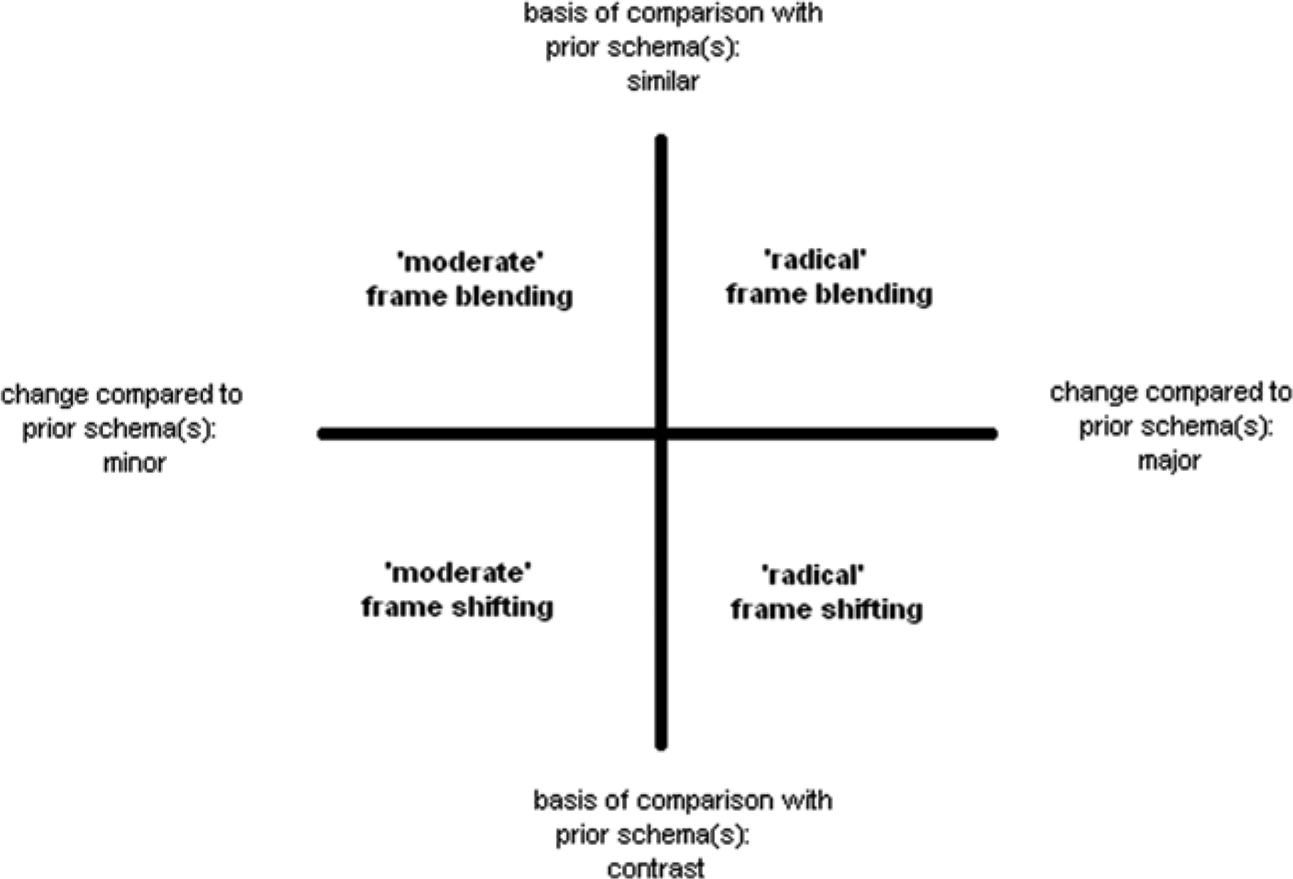
Types of Frame Shifting and Frame Blending.
A further type of analogical reasoning involves counter-factual reasoning, which highlights combinations between schemas, but does so through highlighting dissimilarity, or contrast, rather than similarity. The counter-factual frame that is articulated and conceptualized away from the prior schemas or schemas, a process we defined as frame shifting, still operates on the basis of analogical connections between similar but in this case counterfactual representations (Fauconnier & Sweetser, 1996). The key dimension here is thus that a dissimilarity, or contrast, between schemas is emphasized in processes of frame shifting, rather than similarity or a correspondence between schemas. The contrast may involve only specific elements of schemas so that besides a key element of difference the shift between frames also shares at least some of the same key roles, actions or hypothetical action sequences (Coulson, 2001). We label this type of frame shifting as a “moderate” form as it involves an adjustment of a specific part of an existing schema. Kellogg’s (2009) study of reform in two hospitals, for example, demonstrates that institutional change was successfully realized in one hospital, but not in the other, in part because of the successful framing efforts of proponents who highlighted in “relational frames” the specific new role requirements that were associated with tasks and behaviours.
Similar to frame blends, the process of frame shifting may also involve the alignment and transposition of entire schemas, rather than specific individual elements such as roles. In this case, “counterfactual scenarios are assembled mentally not by taking full representations of the world and making discrete, finite, known changes to deliver full possible worlds but, instead, by conceptual integration” (Fauconnier & Turner, 2002, p. 218), which systematically rewrites the prior schema or prior schemas into a counter-factual alternative. This is a more “radical” form of frame shifting that presents a complete overhaul of the previous schema. Actors use in such instances an extensive vocabulary of key words and phrases that present a complete disjuncture with the default schema. For example, in the Weber et al. (2008) study, advocates for grass-fed meat and dairy products developed an entire vocabulary of neologisms and metaphors such as “grass-fed” and “unspoiled” production methods, “living soil” and “heritage-breed” cattle. These words emphasized the contrast with the default schema of industrial agricultural production and supplanted it with a sustainability logic (Weber et al., 2008).
In short, the first axis of (dis)similarity recognizes that the framing of a change compared to existing schemas includes a degree of similarity to such prior schemas as well as a degree of dissimilarity. The issue instead is how much difference, or contrast, is emphasized between schemas, and thus whether actors mark a fundamental contrast with prior cognitive schemas or whether they emphasize a degree of continuity with prior schemas. Besides the (dis)similarity axis, a further yet related dimension, we argue, is the degree to which a framing involves a modification, and thus a kind of updating or adjustment, of existing schemas—a minor, or incremental, change—or whether it presents more significantly a major, or transformational, change in the form of a fundamental overhaul and rewriting of existing schemas (cf. Thornton et al., 2012).
The typology provides a useful basis, we argue, for studies of framing and institutional change. It captures the main framing tactics through which actors are able to conceptualize a basis for change and in turn attempt to convince others to follow suit. In line with the assumptions and body of evidence in cognitive linguistics (Barsalou & Hale, 1993; Coulson, 2001; Hofstadter & Sandel, 2013), we also assume that the majority of linguistic and cognitive innovations happen through processes of frame shifting and blending. From this perspective, even seemingly de novo frames draw on already existing discourses and ideas from within or outside of the institutional setting in which they emerge. Fauconnier and Turner (2002, p. 382) argue in this respect that any form of “creativity and novelty depend[s] on a background of firmly anchored and mastered mental structures”, or frames. The cognitive psychologist Barsalou (1992) similarly suggests that “frames readily support the creative combination of information [and] provide the combinatorics that support construing reality in myriad ways and conceiving of the possible worlds that lie beyond it” (Barsalou, 1992, p. 66). In other words, the creation of new frames and any emergent meanings involves combinations and contrasts, through shifting and blending, between prior frames.
The typology also raises a vexing question. By contrasting various forms of reframing, that imply more incremental versus radical change, it raises the issue of when and how a particular reframing is more likely to garner success within an institutional field. Prior research, including the examples mentioned, provides case-based illustrations of different framing tactics and the way in which these effected change in a particular institutional field. However, these studies have not been brought together or been compared in any systematic way. Furthermore, answering this question also requires, we argue, a consideration of framing tactics in the context of the opportunities and constraints of the broader institutional field (Sgourev, 2013). As Armstrong (2005, p. 167) notes; “whether or not a field ‘locks in’ may depend on whether actors and frames manage to come together before a particular window of opportunity closes”. In terms of this “coming together” between frames and opportunities, we develop the argument in the following section of the paper that the success of specific framing efforts depends on discursive opportunities that open up and are salient in a field at a particular point in time.
Discursive Opportunities and Frame Dynamics
In the current section we extend the typology into a set of specific propositions. To create the ground for these propositions we first make a theoretical distinction between the broader systems of words, or discourses, that communities or collectives use within their institutional field (Berger & Luckmann, 1966) and the opportunities “seized” by actors to strategically reframe and rethink their institutional context in contrast to existing words and schemas, or, as mentioned, by blending words and schemas together. In this way, we aim to connect our propositions with the small body of work that highlights how actors disrupt existing conventions by instigating a change in the collective discourses in a field, and which, ultimately, may change institutions (Jones et al., 2012; Loewenstein et al., 2012; Lounsbury et al., 2003; Nigam & Ocasio, 2010).
A discourse refers to a discursive repertoire of words, expressions and statements (Jones et al., 2012; Loewenstein et al., 2012; Suddaby & Greenwood, 2005) that actors have collectively built up in interaction with target audiences and opponents (Jones et al., 2012; Suddaby & Greenwood, 2005). Strictly speaking, a discourse thus refers to a system of words and their meanings that a collective of actors use in their ongoing communications and actions (Loewenstein et al., 2012). Through repeated use of the same language, discourses themselves become highly structured. In particular, sets of key words or idioms become emblematic of the broader discourse and are as such repeatedly used by actors (Jones et al., 2012). This repeated use of the same words also invites individuals to induce and learn the collective’s conventional schema around roles, situations and actions. Individuals are furthermore aided in this when these words become connected to examples of specific social practices, as it helps them to induce the specifics and boundaries of a schema by drawing comparisons between specific examples, which in turn yield generalizations (Jones et al., 2012; Kennedy, 2008).
Institutional fields may be home to multiple discourses (Loewenstein et al., 2012) which, as common repertoires or cultural toolkits (Swidler, 1986), are “public resources” that actors use but can also selectively “pull down” (Weber & Dacin, 2011), extend or blend in the service of framing and promoting alternative schemas for understanding. The resulting order—in the form of a system of words and meanings—that exists, or rather emerges, for communities and social collectives in an institutional field is as a result “inherently partly disorderly or fuzzy, since the actual structuring of meaning is done in use” (Steinberg, 1998, p. 856). Faced with discourses in an institutional field, actors may advocate an alternative framing which may stem either from possibilities within and between discourses in the field, or from words and ideas in the larger culture that have got some salience and legitimacy (McCammon et al., 2007) and that, when imported, can provide a discursive vehicle for rewriting the default discourse and schemas.
Discursive opportunity structures
In this article we argue that individual actors are more likely to gain broad-based support for their frame when their framing coherently draws on a salient discourse and also clearly marks the proposed change, or “line of action” (Fligstein & MacAdam, 2011, p. 7). We conceptualize this process by drawing on the construct of discursive opportunity structures, which refers to the opportunity provided by salient discourses that are alive and have momentum at a particular point in time (McCammon, 2013; McCammon et al., 2007). Koopmans and Statham (1999), who introduced the construct, highlighted how using the right discourse at the right time may lead a frame to being seen as “sensible”, “realistic”, and “legitimate”. The notion of a discursive opportunity structure is also in effect the basis for the cultural resonance of a frame, which is often mentioned as a key mechanism for a frame to be effective in appealing to others and to mobilize them into action (Benford & Snow, 2000; Gamson & Lasch, 1983). Snow et al. (1986, p. 477), for example, argue that one of the key determinants of the differential success of framing efforts is variation in the degree of frame resonance, such that the higher the degree of frame resonance, the greater the probability that the framing effort will be relatively successful, all else being equal.
In a recent study, Kellogg (2011) illustrates the broader principle of a discursive opportunity structure in her comparison between a successful case of institutional change in a hospital in the early 2000s and two earlier failures in hospital reform in the 1970s and 1990s. She demonstrates that whilst the framing for the change at the behest of medical interns was possible from the 1970s, such arguments only resonated and gained force in the early 2000s when the macro discourse in society had turned in that direction. Kellogg’s (2011) analysis thus points first of all to how the broader societal context outside of individuals or organizations can gradually or even suddenly present discursive opportunities (Fiss & Hirsch, 2005); that is, opportunities for framing that derive from salient discourses that are culturally significant at a particular point in time. In addition, where Koopmans and Statham (1999) initially defined discursive opportunity structures as static and objective, Kellogg (2011) demonstrates that such opportunities are socially constructed, and may thus in effect “emerge” at particular points in time. We argue that the notion of a discursive opportunity structure underpins the success of framing efforts (McCammon, 2013), and potentially offsets the tautology that those who won framing contests simply employed the most resonant framings (Benford & Snow, 2000, p. 626).
McCammon et al. (2007) recently defined the concept of discursive opportunity structure in two main ways. First, they argued that some discursive opportunities are stable while others are far more volatile. That is, opportunities for a reframing can stem from discourses that are long-lived and deeply embedded in the broader culture. An example is the way in which proponents of a new organizational form drew on well-established cultural discourses (Suddaby & Greenwood, 2005) or the way in which art critics appropriated a market ideology in their assessment of cultural productions (Glynn & Lounsbury, 2005). On the other hand, the social context can produce far more volatile discursive opportunities; that is, opportunities for framing that derive from relatively short-lived or relatively new and emerging discourses (Hardy & Maguire, 2010; Maguire & Hardy, 2009). These can still be critical or highly salient discourses, but unlike stable discourses these tend to be culturally significant for a shorter period of time and thus tend to emerge and offer themselves up, as well as disappear again. Often such opportunities emerge triggered by technological and broader cultural changes, such as the anti-establishment movement that swept through France in the 1960s and offered French chefs an opportunity to reframe themselves as “creators” rather than as “translators” of a cuisine (Rao et al., 2003).
Second, McCammon et al. (2007) argued that discursive opportunities also hinge on the extensiveness, or breadth, of a discourse that provides a whole system of keywords through which a situation can be reframed, whereas in other cases an opportunity is narrow in that a specific discourse offers a more limited set of words and idioms. This distinction largely points to the structural features of a discourse. In addition, the opportunity for using a discourse also depends, as we have already suggested, on whether and how such discourses are coherently connected by actors with existing words and schemas in an institutional field. That is, we extend the arguments of McCammon et al. (2007) by suggesting that an opportunity does not lie solely in the availability and breadth of a discourse but in whether and how the discourse coherently extends the prior vocabulary and schema of a collective; either by inversing it or extending it in sensible and realistic ways (cf. Koopmans & Statham, 1999; Steinberg, 1998). This kind of “fit” can be both narrow—in that a discourse captures and re-describes a particular element of a prior schema—or broad, and thus more extensive, in that it potentially extends to the entire schema. Only in this way, in “fitting” a discourse to the prevailing schema in an institutional context can actors judge whether it presents a real opportunity and whether it is likely to be seen by others as apt and fitting to critical elements in their institutional context. Consistent with institutional writings (Diehl & MacFarland, 2010; Douglas, 1986; Weber & Glynn, 2006), we define a schema as a cognitive representation of actors, situations and actions, including links between these elements, such as the template of a “role” (i.e., an actor-in-situation) and that of a “script” (i.e., actions in particular situations). Key to a successful reframing, we argue, is the degree to which a discourse coherently re-describes a specific element of a schema, or the entire schema altogether—as a more “moderate” or “radical” reframing.
Both elements—the stability and volatility of a discursive opportunity and the narrow or broad fit of a discourse with the existing institutional schema—present in effect an opportunity set and the challenge for actors is to mobilize the right discourse as part of their framing and to present what are seen as legitimate ideas. The key in other words is for actors to recognize such discursive opportunities, and to take advantage of them by aligning their framing with the broader environment. In the remainder of this section we develop a set of propositions to theorize that actors who respond to discursive opportunities, that is, actors who articulate frames to “fit” with critical elements in their institutional context, are more likely to be effective. Specifically, we define effectiveness as the likelihood that such frames will resonate or persuade others, and which in turn may mobilize relevant others to adopt the proposed frame as a schema. Relevant others are defined here as individuals and collectives across an institutional field who are the target of the proposed change and who, when they agree on a field frame and change their common ground (Berger & Luckmann, 1966, p. 75; Loewenstein et al., 2012; Lounsbury et al., 2003; Thornton et al., 2012), may initiate a broader institutional change.
We focus first on the stability and volatility of discursive opportunities. The argument that we wish to make here is that frame shifting is more likely to succeed in the context of volatile opportunities, whereas the success of frame blending rests on stable discourses within as well as outside of the direct institutional field. As mentioned, volatile discursive opportunities often emerge on the back of relatively sudden technological or societal changes that unsettle previous assumptions in society and thus present an opportunity for change. Such a broader change in society presents in effect the force behind a tactic of frame shifting. It presents a legitimizing parallel and a sense of urgency that grants the framing of a divergent change with a certain strength and credibility. In effect, the parallel with the broader societal change provides the proposed frame with a cultural resonance that stems from the recency of the emerging discourse in broader society. Examples of this argument involve the way in which “modern” architects drew on an industrial discourse to frame their work (Jones et al., 2012, p. 11) and the way in which French chefs piggybacked their framing efforts on the back of the anti-establishment discourse that emerged in French society (Rao et al., 2003). Without such emerging discourses, and thus without a sudden and volatile opportunity, acts of frame shifting may fall flat. The counter-frame would then be judged on its own merits but without having any broader cultural resonance and support.
Frame blending, on the other hand, hinges on stable discursive opportunities. This principle is drawn out by empirical observations that blending often involves combinations between well-established discourses and schemas that have been around for some time (e.g., Battilana & Dorado, 2010; Khaire & Wadhwani, 2010). The presence of such basic vocabularies and schemas may lead to ongoing framing contests around contrasting words and frames (Hallett, 2010), but importantly may also, we argue, pressure actors to blend these well-known discourses and schemas as a way of finding common ground and to bridge between the interests and values of different actors (Fligstein, 1997). For a blend to resonate, however, it is key, we argue, that it bridges between basic, or established discourses and schemas (Greenwood et al., 2011) by mapping congruent relations between words and frames (e.g., market-based assessments of cultural productions) or by combining these together in terms of a hybrid (e.g., commercial microfinance, for-profit recycling). In such circumstances, the blend that is offered is seen as a legitimate hybrid that resonates and settles the divergence in the field.
Whilst volatile and stable discursive opportunities are different in time and space, they both point to the importance of the cultural resonance of a frame for it to be persuasive and ultimately effective. Gamson and Modigliani (1989, p. 5) developed the well-known argument that certain discourses have “a natural advantage because their ideas and language resonate with larger cultural themes” and thus make their use as part of framing “appear natural and familiar”. Central to such cultural resonance is the salience of the used and imported discourse, with salient discourses being defined as those that are foremost on our mind due to conventionality and familiarity (e.g., Benford & Snow, 2000; Weber et al., 2008, Weber, Rao, & Thomas, 2009). Such salience is, however, time and space-dependent, which in turn presents discursive opportunities for either frame shifting or frame blending.
Proposition 1a: The success of frame shifting (i.e., for a novel frame to resonate and be persuasive to others) is associated with volatile discursive opportunities.
Proposition 1b: The success of frame blending (i.e., for a novel frame to resonate and be persuasive to others) is associated with stable discursive opportunities.
The “fit” of a discourse with the vocabulary and institutional context presents a further dimension that determines whether a discourse presents an opportunity, and in turn affects whether a framing effort is likely to succeed, or not. Here, we wish to make the argument that it is not the salience of the discourse per se on which a frame draws, but its fit with the institutional context and the meaning that it creates relative to the default vocabulary and understanding. That is, a framing (e.g., seeing chefs as creative artists) is more likely to be seen as apt and fitting when it allows an insight into some previously salient meanings (the roles of chefs and methods of cooking), while promoting new ones (creatively combining ingredients and inventing dishes). This principle suggests that the discursive opportunity for a novel framing requires not only drawing on a salient discourse, but also one that simultaneously differs qualitatively from the prior discourse and schema whilst allowing for the recovery of the same schematic knowledge (Giora, 2003). For example, Fiss and Zajac (2006) found higher stock market returns for German corporations that framed, in the form of a “balanced” frame or blend, the adoption of shareholder value practices as analogous to, and thus consistent with, their past consensus-based orientation towards stakeholders. Where there is a “fit” and a frame sensibly re-describes schematic knowledge such as roles and scripts, actors are able to understand the new schematization, and as such are more likely to judge the reframing as credible and legitimate (Coulson & Oakley, 2005; Goffman, 1981). In contrast, where there is a lack of fit it makes it hard for actors to make the semantic leap, to establish shared presumptions and to fuel inferences about their own context.
A key difference concerns, as mentioned, whether such a fit between a new discourse, as part of a framing, and the existing discourse and frame is “narrow” or “broad”. We argue that a narrow discourse with a limited set of structurally connected key words (Jones et al., 2012) allows for more “moderate” forms of frame-shifting and frame blending, whereas a broad and extended discourse (such as the “sustainability” discourse; Weber et al., 2008) enables more “radical” forms of frame shifting and blending to succeed. With a narrow “fit” the available discourse allows an actor to change an existing element of a schema; by adjusting and modifying it or by replacing it altogether. In such an instance, a frame is likely to resonate and be persuasive to others when it coherently rewrites a particular element of a schema, and in a way that is afforded by the imported discourse. Examples include the previously mentioned studies of how reform and accountability discourses were appropriated in re-describing professional roles as part of broader institutional changes within schools and hospitals (e.g., Hallett, 2010; Kellogg, 2009, 2011).
However, when the fit itself is quite narrow in the context of an established discourse and schema, but actors stretch it further to present a more radical overhaul of the schema, they will in all likelihood not succeed in convincing others. Such a stretch is then seen as lacking coherence, and will on that basis not resonate. Yet, when a discourse is broader, it offers an opportunity for actors to articulate more radical alternatives that in effect present “a systematic alteration” that fundamentally reconstitutes what it is for actors that is going on (Goffman, 1974, p. 45). For such a systematic alteration (or “keying” in Goffman’s terms) to be possible, a salient discourse needs to be extensive and supple enough to completely overwrite the prior discourse and schematic knowledge. In other words, the discourse that is drawn into a “radical” framing, needs to provide a contrasting but consistent set of words and expressions that reframes the prior schema, is internally coherent, and puts the proposed change in perspective (Fillmore, 1982). When a discourse affords this opportunity, it is key that actors take advantage of the opportunity—as the French chefs did in systematically altering schematic knowledge around their roles and scripts regarding cooking (Rao et al., 2003). But even if such an opportunity presents itself, actors may fail to take advantage when they effectively do not mobilize the discourse in such an extended way.
Proposition 2a: The success of “moderate” forms of frame shifting and frame blending (i.e., for a novel frame to resonate and be persuasive to others) is associated with narrow discursive opportunities.
Proposition 2b: The success of “radical” forms of frame shifting and frame blending (i.e., for a novel frame to resonate and be persuasive to others) is associated with broad discursive opportunities.
As mentioned, discursive opportunities may as it were “emerge” in a particular institutional field and concern the coherent linkage of a discourse to the framing of an institutional setting. Such opportunities result in part from the framing efforts and discourses used by others actors (Steinberg, 1998), and as such spotting such opportunities may also depend on the strategic position of actors within a field. Fligstein and McAdam (2011, p. 7) describe in this respect the crucial importance of strategically inclined actors having a “highly developed capacity for reading people and environments”. Besides individual ability, this capacity points to the importance of actors having a sufficiently central and embedded position within the field as well as an awareness of discourses in adjacent fields within society. Such a position makes them aware of the changing discourses within and outside of the field, and to spot opportunities for a reframing when these emerge (Armstrong, 2005). When in turn they exploit such opportunities, they use resonant frames to connect their own motives for change with the strategic intent of convincing other actors to change their views and take action in support of the change.
Discussion
In this article we set out to theorize how actors “craft a vision for divergent change in terms that appeal to the actors needed to implement it” (Battilana et al., 2009, p. 79). Specifically, our aim has been to extend recent work that highlights the role of framing in how actors articulate and imagine such a “vision” for change but that has not yet detailed the specific framing tactics that this involves (e.g., Battilana et al., 2009; Jones et al., 2012; Loewenstein, 2012; Rao et al., 2003). We therefore elaborated in the paper a typology of framing tactics that accommodates empirical observations from past research and provides a logically coherent set of constructs that contributes to theory and can be used to guide empirical research.
We also extended these constructs into a set of propositional arguments that link broader discursive opportunities at the macro level of institutional fields with the use of specific framing tactics at the micro level of individual actors crafting a vision for change. In doing so, we provide a set of predictions about when a particular framing of a change is more likely to resonate with and persuade others whose support is needed to realize the change. These predictions also balance micro and macro accounts of framing in the context of the opportunities and constraints of the broader institutional field (Lounsbury et al., 2003; Sgourev, 2013) and as such overcomes the biases and limitations associated with either overly strategic or purely structural accounts of frame-based institutional change.
At this point, it is worth emphasizing that the scope of our typology and propositions is largely confined to the initial or formative stage of actors imagining a vision for divergent change (Battilana et al., 2009). As such, we do not directly cover as part of our theorizing the rhetorical strategies that actors may use to mobilize support for their frame-based vision, nor do we document the possible further diffusion and institutionalization of their vision into a collective taken-for-granted schema of understanding. We can hint at this point, however, at implications that follow from our theory development for our understanding of these related topics.
In term of rhetorical strategies (see also Hardy & Maguire, 2010; Maguire & Hardy, 2009; Phillips et al., 2004) we expect that actors will use the same frames that they articulated to make sense of the change as a basis for their strategic persuasion of others. They will thus use analogical and counter-factual arguments but may over time adapt their rhetoric when they realize that their arguments are not sufficiently effective in convincing others (Cornelissen & Clarke, 2010; Etzion & Ferraro, 2010). To illustrate, Suddaby and Greenwood (2005) demonstrate how the original frame blend of a “one-stop shop” as a rationale for merging accountancy and law services into a single organizational partnership did not convince the various parties involved nor did it settle the professional differences. The proposed change instead gained increasing support when proponents switched to other forms of rhetoric that drew on broader cultural and allegorical narratives such as seeing the change as a new stage on the “historical path”, as a “vision” of a dramatic change, and as a “revolution” brought about by historical and structural “forces”.
Furthermore, Powell and Colyvas (2008, p. 294) recently likened the process of institutional change to a particular trajectory where novel frames provide initially analogical templates or suggestive images for sharing and organizing experiences, although over time, and through repeated usage, such provisional framings may evolve into naturalized, taken-for-granted institutional schemas that “render some features of social life ‘objective’ but deflect attention to other aspects”. Our theory development can be seen as an elaboration of the initial and formative phases of this model of institutionalization and institutional change in that we highlight that a novel framing is initially at least a tentative comparison, although indeed over time and through repeated usage it may subsequently become literal and objectified (Berger & Luckmann, 1966; Cornelissen & Werner, 2014; Powell & Colyvas, 2008). A key avenue for further research may be, we think, to compare and contrast processes of institutional change with an eye towards identifying possible sources of variation based on whether the trajectory extends from an act of frame shifting or frame blending.
Contributions and implications
In a more direct sense, with our theorizing we hope to have offered a number of distinct contributions to institutional theory. First of all, we define the specific constructs of frame shifting and frame blending which provide a foundation for understanding how the bedrock of institutional change involves the “recombination” of language and ideas from familiar but distinct domains of knowledge (Powell, 1991, p. 199; Powell & Colyvas, 2008). Contemporary and classic writings have drawn particular attention to analogical combinations between words and ideas that allows actors to craft a new “vision” and to posit a proposed change and social arrangement as legitimate and natural (e.g., Etzion & Ferraro, 2010; Glaser et al., 2011; Hargadon & Douglas, 2001; Leblebici et al., 1991; Navis & Glynn, 2010). Bourdieu (1991) referred in this respect to “generative discourse” whilst Douglas (1986) highlighted the role of what she defined as “naturalizing analogies” in initiating institutional change. With our theory development we extend these classic and contemporary writings by clarifying and specifying varieties of analogical reasoning that are involved in changing institutional vocabularies and schemas, ranging from counter-factual reasoning as part of frame shifting to analogical blends in frame blending.
Second, we present a general typology of frame shifting and frame blending tactics through which individual actors are able to reframe their institutional circumstances and conceptualize an alternative scenario to the existing status quo. With this typology we provide a theoretical vocabulary for describing how actors imagine and frame a divergent change, whilst at the same time being embedded in, and constrained by, their institutional contexts (Battilana et al., 2009; DiMaggio, 1997). We also accommodate as part of this typology differences between incremental and transformational institutional change (Thornton et al., 2012) and highlight the way in which actors may, as part of their framing, draw a greater or lesser contrast with prior institutional discourses and schemas. In drawing out this particular linkage, we hope to contribute to recent research (Jones et al., 2012; Loewenstein et al., 2012) by elaborating not only how macro linguistic and cognitive conventions around an institutional discourse may provide the impetus to micro-level acts of framing, but also how such acts of framing selectively draw in and “pull down” such discourses as part of a proposed change initiative (Weber & Dacin, 2011).
Third, we offer a set of propositions that specify when and how individual actors are more likely to gain support for their reframing from others within the institutional field. These propositions are built on the premise that a reframing is more likely to resonate and be persuasive to others when it mobilizes and draws in a salient discourse and simultaneously connects with and re-describes the previously default discourse and schema. We formalized this premise with the construct of discursive opportunity structures which, we argue, emerge in relation to existing discourses in an institutional field as well as broader cultural changes in society. A key challenge, we argue, is for actors to exploit a discursive opportunity structure and align their framing with broader discourses as a basis for institutional change. These propositions offer a set of predictions that can be modelled in empirical research and that as such may extend our understanding of how the effectiveness of micro acts of framing depends on a “fit” with the broader institutional and cultural environment.
Fourth, we provide a typology of framing tactics which we believe is theoretically more detailed and parsimonious than prior research. Existing accounts (e.g., Benford & Snow, 2000: Fligstein & McAdam, 2011, 2012) have described a range of framing tactics but without characterizing and delineating such tactics in more theoretical terms. The typology aims to provide such theoretical grounding and may on that basis be of direct use to further institutional research on micro-political struggles over frames and their consequences (Armstrong, 2005; Granqvist & Laurila, 2011; Guérard et al., 2013; Meyer & Höllerer, 2010). The typology, for example, defines key forms of disjunctive and conjunctive language associated with frame shifting and frame blending, to provide an account of the “grammar” by which changes to existing frames are articulated (Coulson, 2001). Such forms of language use can be empirically identified in future studies of institutional change, and their effect can be explored in connection with surveys of the discourses or vocabularies that circulate in an institutional field at particular points in time (Schneiberg & Clemens, 2006).
Whilst the typology and propositions relate in the first instance to questions of institutional change and institutional entrepreneurship, we do believe that, by extension, they may also have implications for our understanding of entrepreneurship more generally. Virtually all entrepreneurs have to convince resource providers that their novel venture is both legitimate as well as different from other ventures (Cornelissen & Clarke, 2010; Navis & Glynn, 2010). They will do so by using disjunctive or conjunctive language (including analogies and counter-factuals) to frame how their venture is superior to other ventures. The implication of our paper is that entrepreneurs need to be able to gauge the discursive opportunities within their market setting so that they can leverage a certain discourse to frame their venture as sensible, realistic and legitimate. Failing to spot those opportunities, which in effect implies a failure to mobilize the right discourse at the right time, may in turn hamper the ability of an entrepreneur to gain legitimacy and support for his or her burgeoning venture.
In closing, framing and frames form an important cornerstone of institutional theory (Goffman, 1974; Thornton et al., 2012). In our article, we aim to add to prior work on the constitutive role of framing in the development and evolution of institutions. To this end, we have adopted a cognitive linguistic focus on institutional change to elaborate a coherent set of theoretical processes and explanations for how individuals are not only guided by primary institutional discourses and schemas but are also able to reframe their circumstances in ongoing processes of sensemaking and social interaction. As such, besides bringing greater specificity to the framing construct, we also hope that the arguments presented here underscore the importance of continuing to investigate framing processes and outcomes across a variety of institutional domains.
Footnotes
Funding
This research received no specific grant from any funding agency in the public, commercial, or not-for-profit sectors.