



Abstract
The purpose of this article is to mobilize postfeminism as a critical concept for exploring women’s contemporary organizational experience. Specifically, it is argued that rather than interpreting women’s position in organizations solely in terms of exclusion connected to a dominant masculine norm, critically deploying the concept of postfeminism facilitates a critique of how women and a reconfigured femininity are now being included in the contemporary workplace. As the focus of the paper is the connection between postfeminism as a cultural phenomenon and the emergence of feminine organizational subjectivities, the construction of feminine subjectivities in the entrepreneurial arena (referred to as entrepreneurial femininities) is presented through a reading of the gender and entrepreneurship literature. Four entrepreneurial femininities are depicted—individualized, maternal, relational, excessive—with one key characteristic being the way in which they are all constituted through the doing of both masculinity and femininity via the integration and embodiment of conventional feminine and masculine aspirations and behaviours.
Introduction
The purpose of this article is to mobilize postfeminism as a critical concept for exploring women’s contemporary organizational experience. Specifically, it is argued that rather than interpreting women’s position in organizations solely in terms of exclusion connected to a dominant masculine norm, critically deploying the concept of postfeminism facilitates a critique of how women and a reconfigured femininity are now being included in the contemporary workplace. In doing this, the paper is not claiming that the concept of femininity (and contemporary reshapings of it) has been completely absent from the field of organization studies in general and gender and organization studies (hereafter GOS) in particular. Indeed, commentators writing from the vantage point of third wave feminism (e.g., Essers & Benschop, 2007, 2010), have explored how femininity is reconfigured if viewed through the lens of intersectionality. Such a lens exposes how studies of the relationship between ethnicity and gender conceptualize ethnicity as a differentiator of meanings and understandings of femininity, with implications for how women as a heterogeneous group experience work and organizations. However, an exposition of postfeminism and how it has reworked cultural understandings of femininity in countries such as Britain and America, impacting on women’s access to and positioning within organizations, is largely absent from the broad field of organization studies.
An exception to this is Kelan (2008a, 2009, 2010) who investigates the way individuals in the ICT sector and on an MBA programme make sense of the experience of gender discrimination at the same time as presenting contemporary organizations as gender neutral. Kelan found that experiences of gender discrimination tended to be depicted as rare and if discrimination did occur it was treated as something which had to be overcome through individual strategies. She argued that this orientation is part of a postfeminist climate where women’s belief that they are equal means that ongoing sources of inequality are ignored, rendered invisible and have become increasingly difficult to name. However deployment of postfeminism as a critical concept can do more than make visible the gender suppression (Linstead, 2000) outlined by Kelan. It can also direct critical attention to the kinds of organizational subjects women (and men) are being asked to become, such as the new ideal manager characterized by a feminine ethos manifest in a range of managerial attributes associated with femininity (Fondas, 1997; Kelan, 2008b). As the cultural phenomenon of postfeminism “has contributed to a greater degree of fluidity regarding what femininity means in contemporary times” (McRobbie, 1993, p. 409), it can be deployed as a critical tool for analysing the feminine organizational subjectivities which form the basis of women’s inclusion in contemporary organizations.
The paper will begin with a discussion of the masculine norm that dominates much of the theoretical and empirical analyses of women’s experience of work and organizations (Billing, 2011). It will be suggested that the contemporary feminization of management and organizations requires a questioning of this dominance with an urgent need to direct more attention at the concept of femininity and how this impacts on women’s work and organizational experience. Following this, an examination of postfeminism which maps out the definitional complexity of this phenomenon is presented. To facilitate use of postfeminism as a critical concept, it will be suggested that it is best understood in terms of “an ambivalent set of hegemonic discourses around gender, feminism and femininity” (Dean, 2010a, p. 19), which shape manifestations of contemporary femininity. Finally, the construction of feminine subjectivities in the entrepreneurial arena will be presented through a reading of the gender and entrepreneurship literature. Entrepreneurship is the focus of the exploration of emerging feminine organizational subjectivities—here referred to as entrepreneurial femininities—as the gender and entrepreneurship literature has mirrored the GOS literature in raising issues around the positioning of femininity within discourses of entrepreneurialism and the dominance of the masculine norm. The article’s contribution is twofold: first, it demonstrates how critical use of the notion of postfeminism can direct attention at the relatively neglected concept of femininity in the GOS field. Second, reading the gender and entrepreneurship literature through the lens of postfeminism, a set of entrepreneurial femininities connected to women’s “doing” of business is identified and the implications of these femininities is considered.
The Masculine Norm and Feminization in Gender and Organization Studies
From an almost complete absence and blindness to gender issues, the study of gender is a now a vibrant field of inquiry in organization studies (Acker, 1990; Alvesson & Billing, 1997; Billing, 1994; Calas & Smircich, 1992a, 1992b; Hearn & Parkin, 1983; J. Martin, 2001; Mills, 1988; Runte & Mills, 2006; Wilson, 1996). Contributors to this field sought to develop a range of theoretical and empirical analyses of women and men’s experience of organizations which made visible the impact of gender. GOS dates from the1970s when “feminism came along to point out the problematic nature of the obvious” (Acker, 1990, p. 40), that is, the ongoing and overwhelming dominance of men and masculinity within organizations (Collinson & Hearn, 1994, 1996). In seeking to make gender visible, the questioning of the gender “neutrality” of organizations and occupations became a dominant focus of much of the research (e.g., Alvesson & Billing, 1992; Benschop & Doorewaard, 2012; Calas & Smircich, 1992a, 1992b; Collinson, Collinson, & Knights, 1990; J. Martin, 2001; Martin & Knopoff, 1997; Mills, 1988). Acker’s (1990, 1992, 1994) theory of gendered organization has been particularly influential in this regard through its concentration on the way gender is deeply embedded in organizational structures.
Acker’s approach was transformative in the way it demonstrated how a masculine norm is literally “built into” management and aspects of organization, requiring that an individual has to enact a masculine identity if s/he is to be deemed to be abiding by organizational requirements or doing a management job properly (Calas & Smircich, 1991; Collinson & Hearn, 1994, 1996; Connell & Wood, 2005; Hearn, 1994; Kerfoot & Knights, 1993, 1996, 1998; Kerfoot & Whitehead, 1998; P. Y. Martin, 2001; Messerschmidt, 1996; Nentwich & Kelan, 2014; Panayiotou, 2010). The identified connection between masculinity and management is always interpreted as detrimental to women because of their difference from the norm and the contradiction they experience when constructing themselves as manager and as female (Billing, 2011; Cheng, 1996; Gherardi & Poggio, 2001). Similarly in the entrepreneurial arena feminist studies of entrepreneurship have exposed how masculinity is central to the enactment of successful entrepreneurship as well as for the subjectivity of the entrepreneur (Ahl, 2006; Bruni, Gherardi, & Poggio, 2004a; Diaz Garcia & Welter, 2011; Lewis, 2006; Mirchandani, 1999; Mulholland, 1996; Ogbor, 2000; Reed, 1996; Simpson & Lewis, 2005).
However, more recently this focus on masculinity has been challenged with commentators such as Billing (2011, p. 303) contending that “defining women primarily as victims of the male norm” is problematic. She suggests that we should seek alternative ways to interpret women’s experiences in organizations as variation, complexity and contradiction may be lost due to the dominance of the “male norm” argument. This call for less research emphasis on masculinity and the male norm connects to the claim that a cultural feminization of management and entrepreneurship, which requires the “doing of femininity”, has given rise to a new ideal (feminized) manager and entrepreneur (Adkins, 2001; Bruni, Gherardi, & Poggio, 2004b; Fondas, 1997; Kelan, 2008b).
Feminized management and entrepreneurship tends to be explicitly associated with women, identifying them as the managers and entrepreneurs of the future due to their claimed humility, patience, empathy, interpersonal sensitivity and connectedness, perceived as necessary for future organizational and entrepreneurial success (Alvesson & Billing, 1992; Billing & Alvesson, 2000; Eagly & Carli, 2003; Gerzema & D’Antonio, 2013; Grant, 1988; Helgesen, 1990; Rosener, 1990). However, the flaw in this way of thinking is the definitional overlap of women and femininity, connected to the understanding of femininity as a fixed essence attached to female bodies. According to Alvesson (1998) such definitional overlap should be avoided alerting us to the possibility that women and men can successfully mobilize femininity when managing and doing business. Nevertheless, despite the optimistic impact on women’s organizational experience which the feminization position suggests, research indicates that men appear to secure more economic benefit from the strategic performance of femininity than women do (Adkins, 2001; Adkins & Lury, 1999; Gray, 2003). Women’s doing of femininity tends not to be recognized as “a set of workplace skills, strategies or performances” but rather as “natural advantages” leaving them unrecognized and naturalized (Adkins, 2001, p. 690; Katila & Eriksson, 2013).
The suggestion that women’s performances of femininity does not straightforwardly translate into economic advantage signals the urgent need to direct critical attention away from a dominant focus on masculinity and the exclusion of women from management and entrepreneurship. Instead, what is needed is a research agenda which critically examines how women and femininity are now being included in the organizational sphere, alongside consideration of the impact of this inclusion. In doing this it is important to avoid conceptualizing femininity in essentialist terms as a singular, descriptive entity (Holland, 2004). Rather, femininity should be understood in the plural as femininities, connecting to a performative understanding of gender as a situated social practice, an interpretation which is currently dominant in GOS (P. Y. Martin, 2003). According to Genz (2009, p. 8) femininity now “appears as a complex, multi-layered puzzle that is dynamic in its capacity to change and absorb cultural messages without being amnesiac and forgetful about previous versions of femininity”. As postfeminism is the cultural backdrop to changing notions of femininity contributing to a greater level of variability and fluidity regarding how it manifests itself today (McRobbie, 1993), deployment of postfeminism as a critical concept opens up the exploration of femininities and women’s contemporary inclusion in organizations.
Understanding Postfeminism
Understanding postfeminism is complicated by the lack of consensus surrounding interpretations of this phenomenon (Dean, 2010a; Genz & Brabon, 2009; Pilcher & Whelehan, 2004; Projansky, 2001). While not exhaustive, the review provided here will begin by approaching postfeminism as a theoretical perspective, with attention directed at the slippage between it and third wave feminism as this contributes to its definitional complexity (Gillis & Munford, 2004; Robinson, 2011). Following this, an interpretation of postfeminism which depicts it as a cultural, discursive entity made up of interrelated themes connected to a complex set of discourses will be mapped out (Dean, 2010a; Gill, 2007a). Here, postfeminism is “an attitude, a reaction formation, an always available hegemonic response to feminism not entirely linked to any particular historical moment” (Projansky, 2001, p. 88). It is this second version of postfeminism that informs this paper as it facilitates progressive use of postfeminism as a critical concept for the analytical purpose of identifying (liberal) feminist and feminine discourses, which play out in contemporary organizations. These discourses contribute to a resignification of femininity, making available to organizational actors a range of emerging femininities.
Third wave feminism
The slippage between the terms postfeminism and third wave feminism, combined with the existence of popular and academic interpretations of both, have complicated attempts to specify and clarify the content of the postfeminist phenomenon (Genz, 2006). The complicated connections between postfeminism and third wave feminism mean that to understand the former attention must be directed at the latter. The emergence of third wave feminism was originally heralded through a range of popular books such as Walker’s (1995) To Be Real: Telling the Truth and Changing the Face of Feminism and Baumgardner and Richards’ (2000) Manifesta: Young Women, Feminism and the Future. These texts announced the arrival of a new feminism, connecting it to a specific generational cohort of young feminists and explicitly locating it outside and/or against the academy (Dean, 2009; Gillis & Munford, 2004; Kelly, 2005). Distinguishing this new feminism from second wave feminism understood only in terms of liberal feminism, with other second wave perspectives such as radical feminism or socialist feminism being ignored (Kelly, 2005), populist “third wavers” offer a sexier “brand” of feminism connected to “girl” culture. This seeks to reclaim a type of traditional femininity from both patriarchy and feminism through “a demystification of patriarchal definitions of proper feminine behaviours, but also second-wave definitions of proper feminist behaviours (Munford, 2009, p. 191). What is emphasized is the legitimacy of having femininity “folded into” feminism such that femininity is “a cause for celebration not a mark of subordination” (McRobbie, 2009, p. 157).
However, the extensive use of autobiographical writing which prevents consistent analysis of the wider culture, the reliance on identity politics, and the emphasis on choice and individual empowerment has led to significant criticism of this populist version of third wave feminism (Kelly, 2005; Snyder, 2008). Such criticism has informed a challenge by the academy to control approaches to and understandings of the third wave (Gillis & Munford, 2004), by nudging it in “a more theoretically coherent and productive direction” (Snyder, 2008, p. 183). The characteristics of this more theoretically informed understanding of the third wave include the rejection of the category of women and the notion that women share a common set of experiences; a sense of responding to fracture and fragmentation in the project of feminism; the move away from the grand narratives of modernity and the emphasis on its poststructuralist orientation highlighting hybridity and contradiction; the response to the sex wars and its sex-radical stance (Snyder, 2008).
Postfeminism as a theoretical perspective
The association between third wave feminism and poststructuralist theories of identity and subjectivity overlaps with the understanding of postfeminism as feminism within poststructuralist theory (Gillis & Munford, 2004; Robinson, 2011). This interpretation of postfeminism is evident in those accounts that define it as “the postmodern offspring of feminism” (Mann, 1994, p. 239); as “a shift in feminist theory” (Phoca & Wright, 1999, p. 3); as “a pluralistic epistemology dedicated to disrupting universalising patterns of thoughts” (Gamble, 2001, p. 50); and as being “the intersection of feminism with postmodernism, poststructuralism and post-colonialism” (Brooks, cited in Lotz, 2007, p. 77). Here, postfeminism is interpreted as challenging second wave feminist assumptions with an emphasis placed on the subversion of stable meanings of gender as well as disrupting and deconstructing authoritative models and practices (Brooks, 1997; Gillis & Munford, 2004; Robinson, 2011). The “post” prefix is said to signal change and ongoing transformation within feminism itself with postfeminism presented as an epistemological break in the wake of feminism’s encounter with difference (Brunsdon, 2005; Budgeon, 2001; Gill, 2007a; Lotz, 2001).
Understanding postfeminism in such “post” terms means placing an emphasis on its pluralistic and anti-foundational tendencies, encapsulated in the challenge to and rejection of the universal category “woman” (Genz & Brabon, 2009). Women are therefore not just women, but rather encapsulate multiple subjectivities—race, ethnicity, class, sexuality, age—viewed through an intersectional lens that emphasizes “women’s different positionings in power relations other than gender” (Gunnarsson, 2011, p. 25). Thus, postfeminism is understood as another step in the continuous evolutionary movement of feminism and is characterized by an engagement with multiplicity, heterogeneity and variety as well as a constant reflecting on its connection to other philosophical and political movements seeking change (Gillis & Munford, 2004). Commentators such as Brooks and Gamble are presenting postfeminism as a type of feminist perspective which connects with other feminist approaches. Thus, as a theoretical stance it signals that the breadth of feminist issues is more extensive than in previous times and as such is not against feminism but about a feminism which reconsiders and makes a clear shift in its categories and questions (Braithwaite, 2002).
Few theorists have followed this approach when trying to understand postfeminism (Lotz, 2007). According to Genz and Brabon (2009, p. 17) “a purely theoretical conception of postfeminism is insufficient and inadequate … [and risks] repressing its importance … in the public debate on feminism and the modern woman”. Instead, within the academy the notions of multiplicity and variety that Brooks and others connect to postfeminism, have been incorporated under the auspices of third wave feminism, which is seen as a specific theoretical position that problematizes essentialist understandings of female/feminist subjectivity (Dean, 2009; Snyder, 2008). Some questions have been raised as to whether it is appropriate to portray the third wave as a poststructuralist version of feminism due to the popular literature’s claim to this label and its adoption of a “modern liberal position that is individualistic, subject volitional and expressive” (Snyder, 2008, p. 187). Nevertheless, an academic understanding of third wave feminism which highlights a poststructuralist and postcolonial critique of the second wave exists despite Synder’s reservations (Dean, 2009, 2010a). This academic understanding of the third wave approaches femininity not as an issue of individual choice available to women as a source of confidence and empowerment but rather as something which is placed within the context of broader relations of inequality and difference (Schippers & Sapp, 2012). More importantly for our purposes, it connects to the account of the third wave which is dominant in GOS. A move away from Brooks and Gamble to a position that portrays third wave feminism (not postfeminism) as a poststructuralist version of feminism, which examines gender and its intersectional connections with other systems of inequality, establishes a coherent boundary between the two terms. However clarifying what we mean by third wave feminism still leaves us with the question of how we should understand postfeminism.
Postfeminism: A cultural, discursive strategy
For postfeminism to be utilized as a useful critical tool it needs to offer something more robust than the pro- and anti-feminist emphasis of some explanations. A more useful interpretation of postfeminism is provided by Projansky (2001) and Dean (2010a, 2010b) both of whom suggest that it is best understood as a phenomenon which is discursively produced through the intersections of a group of hegemonic discourses around gender, feminism and femininity. In this sense postfeminism is recognized as a cultural discourse that shapes our thinking, attitudes and behaviour towards feminism and women’s changing position in contemporary society, not entirely linked to an “actual” historical event or moment (Projansky, 2001). Seen in this way, postfeminism can be understood as a cultural response to feminism and the changes it has brought, which does not seek to supersede feminism, but rather to rework and co-opt it.
Recognition of postfeminism as a cultural discursive strategy, which helps to frame our understanding of “normality” as well as our sense of self, can be found in the work of commentators such as Gill (2007a) and her notion of a postfeminist sensibility. This sensibility is manifest in the co-existence of neoconservative values and processes of liberalization in relation to gender, sexuality and family life. Thus, through her idea of a postfeminist sensibility, Gill (2007a) suggests that there is currently an engagement with traditional gender norms alongside an acceptance of the (liberal) feminist objective of equal opportunities and female empowerment. Gill and more specifically, McRobbie (2004, 2007, 2009), advance the most systematic exposition of postfeminism as discursively produced, with McRobbie developing the notion of a “postfeminist gender regime” (Dean, 2010a, 2010b). This gender regime is characterized by a double entanglement that refers to the taken-for-granted status of feminism in all facets of life such that the expectation of equality is now unremarkable. In other words feminist values are incorporated into mainstream Western society. At the same time there is a restabilizing of traditional gender relations and a repudiation of feminist action as a means of neutering the threat posed by it.
However, McRobbie’s focus on the repudiation of feminism is questioned by Dean (2010b, p. 393), who agrees with Hollows and Moseley (2006) that the “cultural space of postfeminism cannot simply be equated with a denunciation of, and non-identity with, feminist politics”. Rather, he argues that while recognizing the interplay between disidentity and affirmation of feminism in a postfeminist gender regime, there is a need to recognize that repudiation of feminism refers to rejection of an “excessive” feminism while accepting and promoting, in certain discursive spaces such as work organizations, a more moderate feminism. Dean (2010b, p. 394) refers to this as the domestication or taming of feminism such that “the ‘wildness’ and unpredictability of feminism is curtailed, so as to render it more docile, less threatening”.
One notable manifestation of this “taming” is the current rapprochement between feminism and femininity. In a postfeminist gender regime, femininity is no long perceived as “a difficult and contradictory psychic, historical and cultural formation, to which feminists have been historically ambivalent” (Brunsdon, 1997, p. 180), rather a co-existence between femininity and feminism is emphasized (Baumgardner & Richards, 2004; Hinds & Stacey, 2001). This co-existence manifests in a collection of stable features of a postfeminist gender regime including femininity as a bodily property; the shift from objectification to subjectification; the emphasis upon self-surveillance; the prominence given to individualism, choice and empowerment; the ascendancy of a make-over paradigm; the revival and reappearance of “natural” sexual difference; the resexualization of women’s bodies and finally the retreat to home as a matter of choice not obligation (Gill, 2007a; Negra, 2009). Within the context of work organizations three of these postfeminist features are important—individualism, choice and empowerment, notions of “natural” sexual difference and retreat to the home as a matter of choice not obligation. These three elements capture the tension between feminism (understood in terms of achievement in the public, masculine world of work) and femininity (understood in terms of feminized behaviour and domestic responsibilities in the private, feminine world of home). The relationship between these three elements and their connection to the entrepreneurial femininities discussed below is summarized in Figure 1.
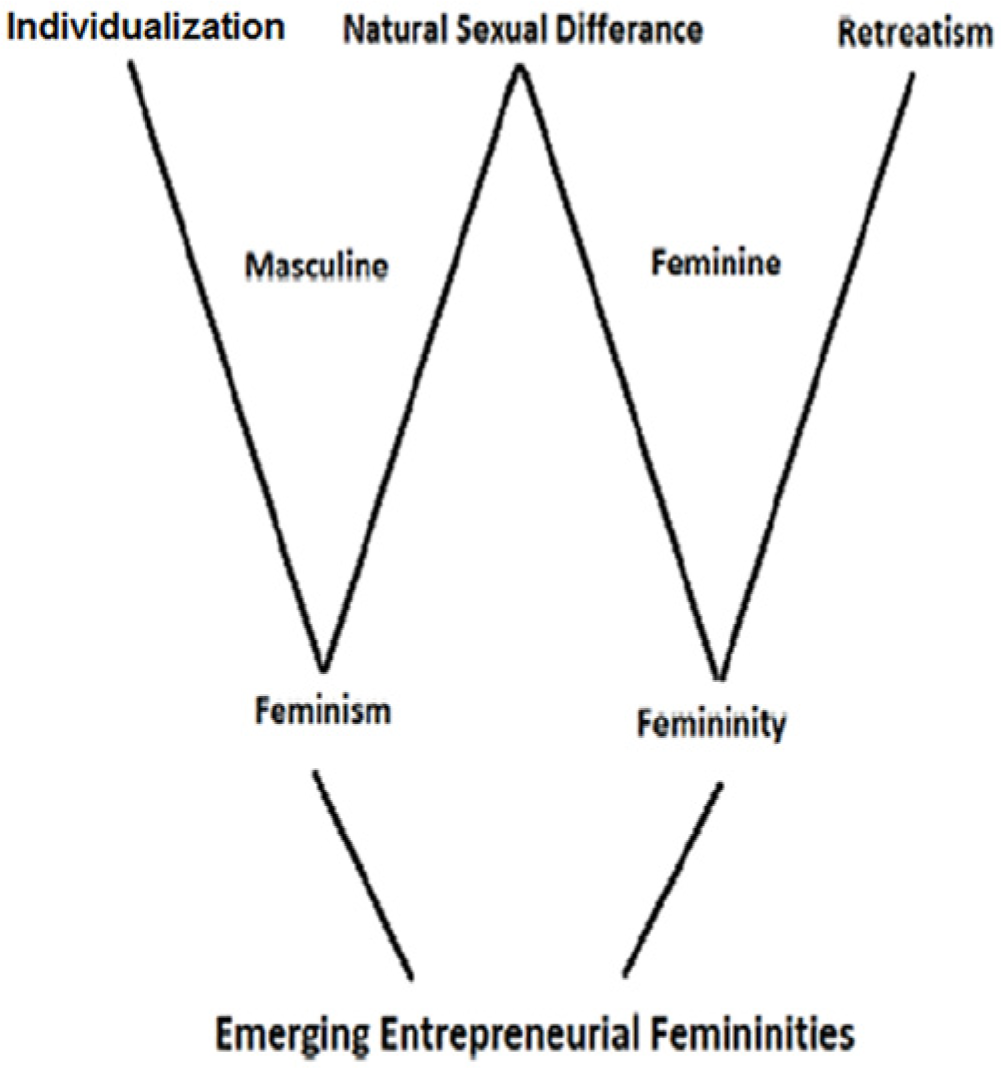
Positioning of Emerging Entrepreneurial Femininities in a Postfeminist Gender Regime.
Understanding postfeminism as a versatile discursive phenomenon which is a reworking and co-optation of feminism, opens up the possibility of it being used as a critical concept. Deploying postfeminism in these terms will contribute to our understanding of the positioning and impact of neglected concepts such as contemporary femininity within the organizational field. Used critically, postfeminism can facilitate the emergence of a better understanding not just of contemporary femininity but of multiple femininities in organizations, moving away from the long-standing unitary view which interprets femininity in terms of exclusion through the notion of Other.
Postfeminism and Emerging Femininities in Entrepreneurship
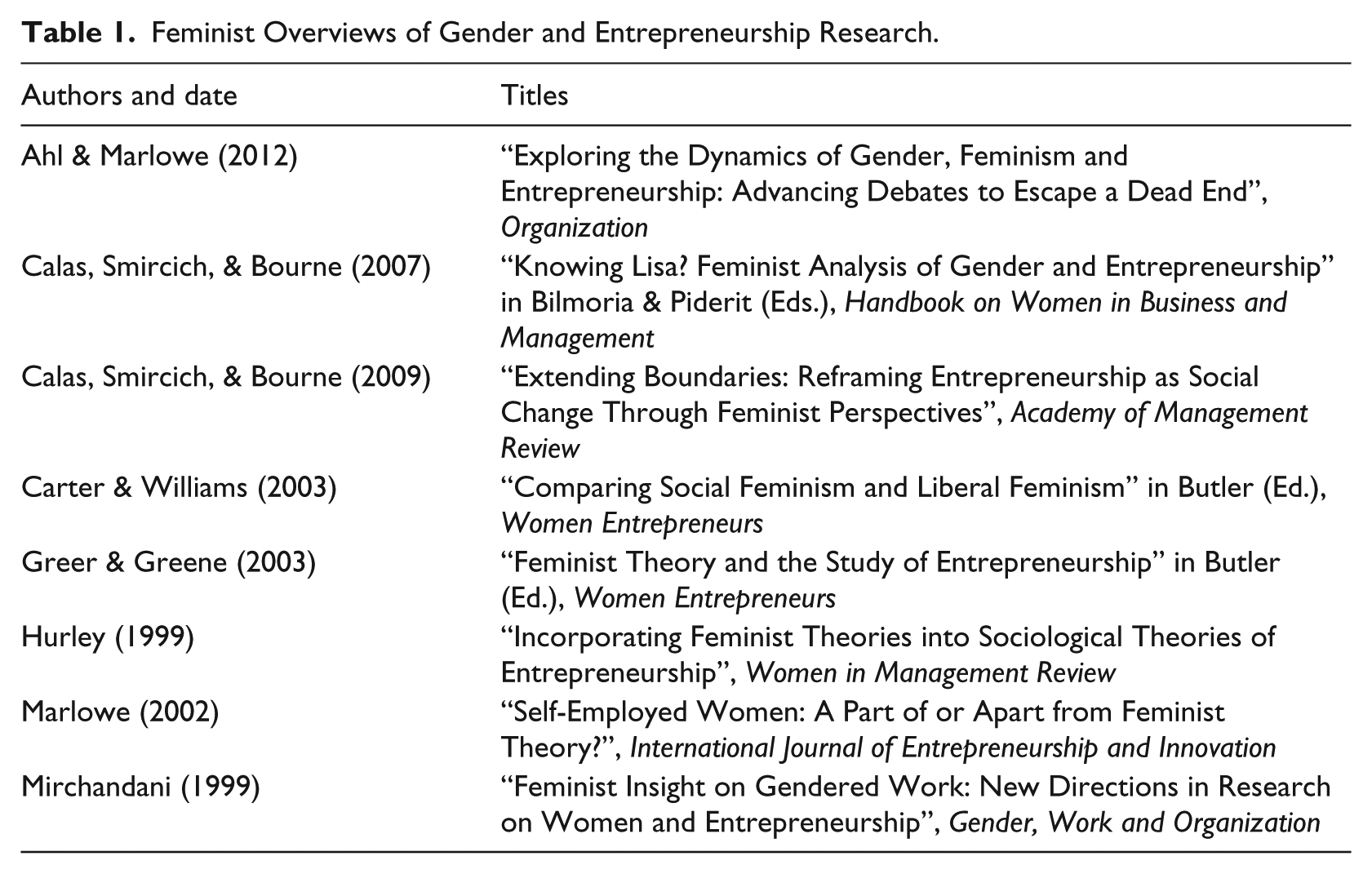
To provide an illustration of how critical use of postfeminism can provide insight into contemporary manifestations of femininity in organizations, the paper now turns to reviewing the literature on gender and entrepreneurship through a postfeminist lens. This literature is chosen as it is reflective of the dominant focus on masculinity within GOS in general while also paying some attention to femininity. The review does not seek to be exhaustive of the extant gender and entrepreneurship literature. As such it can be characterized as a narrative review being selective in the material it uses while also seeking to contribute to the development of theory (Cronin et al, 2008; Hammersley, 2001). Starting with a focus on overviews of the gender and entrepreneurship area, the review began with work that contained the words “feminism” or “feminist” in the title. This gave rise to eight texts (see Table 1) and from these texts key themes associated with identity and ‘doing’ entrepreneurship in the entrepreneurial field emerged and a further set of 33 texts (see Table 2) was identified.
Feminist Overviews of Gender and Entrepreneurship Research.
Locating Femininities in the Gender and Entrepreneurship Literature.
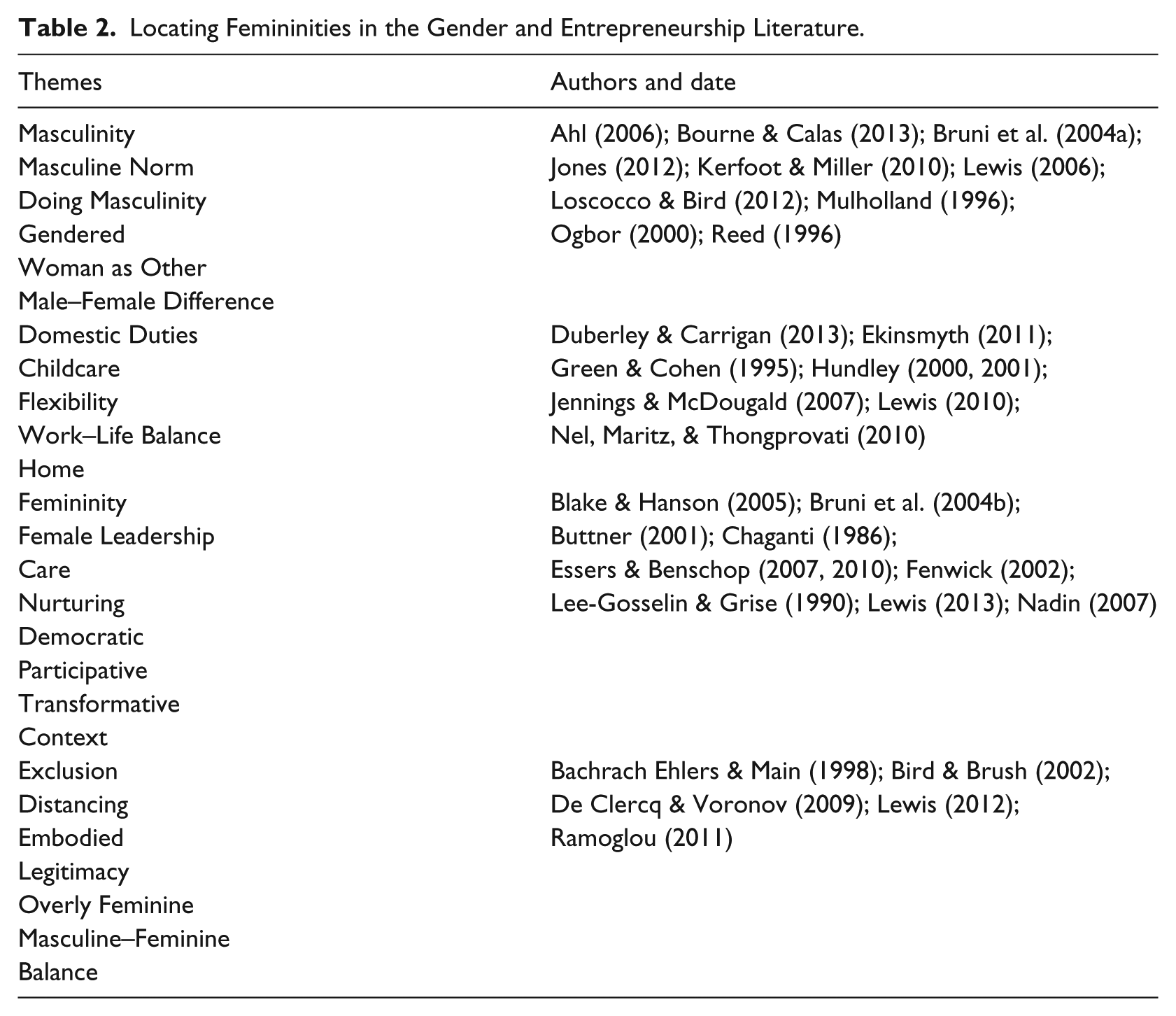
Out of these 33 texts, 26 are empirical studies, mainly qualitative data, while eight are discursive analyses or entail theoretical development of existing literature. These texts were approached with two questions in mind: how is “doing” entrepreneurship theorized and what entrepreneurial identity is “done” by respondents in the empirical studies? Themes including masculinity, domestic responsibilities, female leadership and femininity were identified within the literature, with the dominance of masculinity and the positioning of the feminine as subordinate being evident in accounts of how entrepreneurship is theorized and how entrepreneurial identity is done.
Taking these themes and the two main questions into account, the selected literature was read through the lens of postfeminism, with a focus on the postfeminist elements of individualization, “natural” sexual difference and retreat to home as a matter of choice. What this postfeminist reading of the gender and entrepreneurship literature foregrounds is that as entrepreneurs women now inhabit both masculine and feminine realms, juggling the “doing” of both masculinity and femininity. This involves performing and embodying the feminine characteristics of nurture, emotion, passivity and attractiveness alongside the masculine (individualized) traits of economic and emotional independence, assertiveness, rationality and autonomy (Carlson, 2011). Understanding postfeminism and its associated discourses as having a socially constructed influence that critically shapes entrepreneurial identity and the way women “do” entrepreneurship, four different entrepreneurial femininities summarized in Figure 2 below, were derived from the entrepreneurship literature. While the living of these entrepreneurial femininities by women means that they are engaged in “the strategic crossing of gender boundaries” (Carlson, 2011, p. 88) within a postfeminist gender regime, the location within and movement between masculine and feminine-marked realms varies across the modes of entrepreneurial femininity as we will see below.
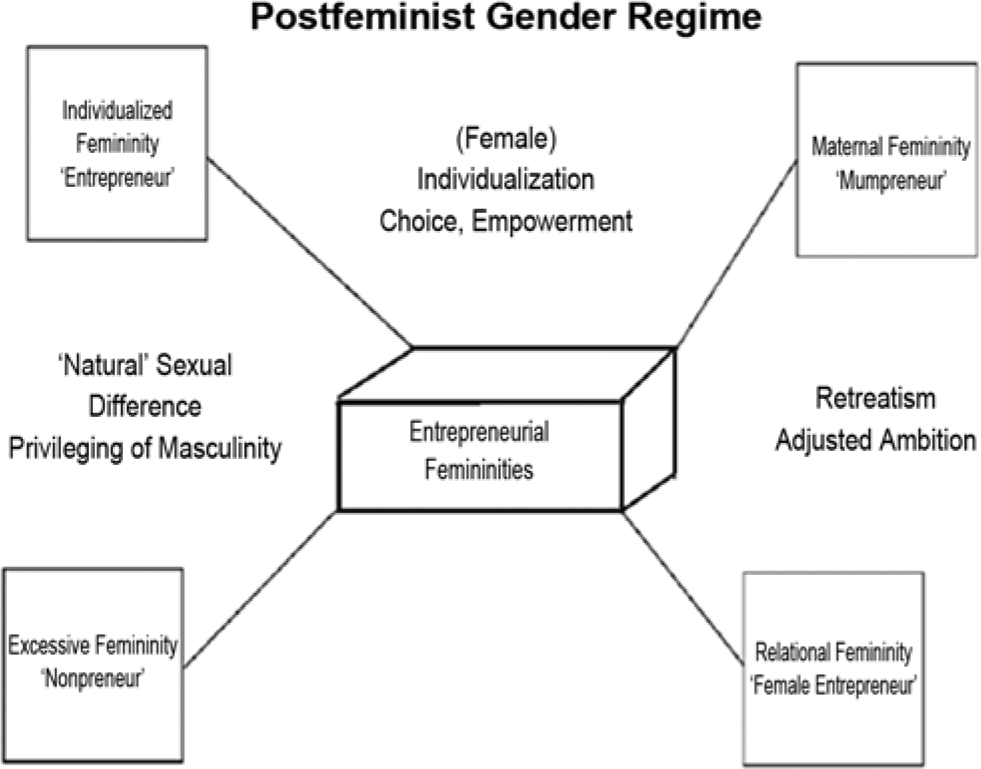
Postfeminism and Entrepreneurial Femininities.
As a note of caution, it is important to point out that these entrepreneurial femininities are not presented here as “types” which are available to be “chosen” by individuals. Neither are they presented as variations of a “constrained embodiment of oppression” imposed by men upon women or as a “fixed set of bodily practices (which) signify subordination”. Rather, these entrepreneurial femininities are better understood as “a set of available bodily and relational (entrepreneurial) performances” that can be embodied by women (and men) and will vary by context (Schippers & Sapp, 2012, p. 30).
Individualized entrepreneurial femininity: Entrepreneur
Individualized entrepreneurial femininity emphasizes the gender neutrality and meritocracy of the world of entrepreneurship and asserts that the “doing” of business basically requires “the ability to abide by ‘universal’ standards of good business” practice (Lewis, 2006, p. 458). Success in entrepreneurship is understood as the effective performance of fundamentally gender-neutral methods, routines and rituals, allied to the strong belief that individuals (male or female) have an equal chance to succeed if they are ambitious and hardworking. The emphasis placed on “choice” and “neutrality” in terms of “doing” entrepreneurship in the form connected to this particular entrepreneurial femininity offers a rational, unified and deliberate image of the women who perform it. Indeed, the autonomous, freely choosing subject who “does” this individualized entrepreneurial femininity and “does” entrepreneurship as a neutral activity “appears peculiarly affectless, apparently not governed by any force” except herself (Gill, 2007b, p. 76). The postfeminist subtext in this mode of entrepreneurial femininity is that women are no longer “oppressed”. Rather, they are active, dynamic individuals who can “choose” the nature of their entrepreneurial activities and overcome any restrictions they may encounter.
The claimed impartiality of the entrepreneurship field in general, which facilitates the claim of gender neutrality underpinning individualized entrepreneurial femininity, has been contested by the gender and entrepreneurship literature (Ahl, 2006; Bruni et al., 2004a; Jones, 2012; Kerfoot & Miller, 2010; Lewis, 2006, Mulholland, 1996; Ogbor, 2000; Reed, 1996). This literature treats gender as an analytical point of departure, exposing how masculinity is a vital aspect of entrepreneurial practices and processes, complicating “notions of ‘gender’ as primarily referring to specifically sexed bodies” (Calas et al., 2007, p. 90). However, while the women who do individualized entrepreneurial femininity are silent about the masculinist paradigm in which entrepreneurship is embedded (Bruni et al., 2004a), they indirectly acknowledge their doing of masculinity by distancing themselves from the practices and traits of traditional femininity (Johnson & Lloyd, 2004; Lewis, 2006). Distancing is manifest in the active ongoing separation they perform between the domestic sphere and the public sphere, highlighting their understanding of the gender rules they are subject to. The active detachment from home is done so that these women will not be perceived as being different from the (unacknowledged) masculine norm of entrepreneurship (Bourne & Calas, 2013; Loscocco & Bird, 2012).
In emerging between feminism and femininity, this individualized entrepreneurial femininity veers more towards the side of (liberal) feminism. Here, women who “do” individualized entrepreneurial femininity are seeking to become agentic individuals. This agency is connected to a discourse of individualization within which masculine characteristics and behaviours are conflated with individuality (Budgeon, 2011), a conflation identified within the entrepreneurship literature. Women who “do” individualized entrepreneurial femininity are trying to forge a way of being an entrepreneurial woman by demonstrably managing their association with the domestic, private world of home and femininity so that it does not interfere with their businesses. Thus femininity is present in individualized entrepreneurial femininity largely through a managed repudiation secured through the stress placed on the neutrality and meritocracy of the entrepreneurial world and the establishment of clear boundaries between home and entrepreneurial work. Nevertheless, it is important to point out that the location of individualized entrepreneurial femininity between liberal feminism and femininity implies that the latter should not be completely rejected. The women who successfully enact individualized entrepreneurial femininity must remain and actively embody a combination of feminine characteristics and behaviours in combination with masculine displays (Rich, 2005).
Maternal entrepreneurial femininity: Mumpreneur
Maternal entrepreneurial femininity is connected to what McRobbie (2009) refers to as female individualization which relates to the postfeminist requirement that women should create their own life in similar ways to their male colleagues while still maintaining a foothold in the domestic realm (Probyn, 1990). While securing flexibility around the execution of business and domestic responsibilities has long been perceived as a key reason for why women set up businesses (Crompton, 2002; Green & Cohen, 1995, Jennings & McDougald, 2007), the doing of maternal entrepreneurial femininity is more than an attempt to accommodate the separate spheres of home and work. Specifically, rather than providing flexibility around the running of the distinct domains of work and home, the doing of maternal entrepreneurial femininity represents the establishment of an explicit link between motherhood and entrepreneurial activities (Duberley & Carrigan, 2013; Ekinsmyth, 2011; Lewis, 2010; Nel, Maritz, & Thongprovati, 2010). This is manifest in the label of “mumpreneur” attached to the doing of this entrepreneurial femininity, with mumpreneur businesses often offering a product or service which is associated with family and motherhood. The mumpreneur’s focus is on what will not only fill a market gap but also connect to women’s traditional caring responsibilities of looking after home and children (Ekinsmyth, 2011; Lewis, 2010). Thus, while the symbolic space for entrepreneurship and the self-actualization associated with it is normally the public world of work, for “mumpreneurs” the symbolic space for doing maternal entrepreneurial femininity is the spaces and places of motherhood such as the home and school gate (Duberley & Carrigan, 2013; Ekinsmyth, 2011).
The location of maternal entrepreneurial femininity between liberal (masculine) feminism and femininity is connected to discourses of individualization and retreatism and constituted by qualities connected with them. While traditionally the dynamics of regulation and control around motherhood would have suggested that women should focus on their children and “ought not to” work, within a postfeminist regime regulation is “more about what (work) they can do” while caring for children. Viewed through a postfeminist lens, maternal entrepreneurial femininity explicitly and visibly incorporates both masculine and feminine aspirations and is held out to women as something which is “progressive but also consummately and reassuringly feminine” (McRobbie, 2009, p. 57). Nevertheless, despite this optimistic positioning of the mumpreneur and the positive media accounts of her entrepreneurial and mothering experience (e.g., Dodds, 2008; Williams, 2013), a challenge to this has begun in the gender and entrepreneurship literature. This challenge points out that the contradictions associated with being a business person and mother manifest in the doing of maternal entrepreneurial femininity, means that mothers who seek independence and self-reliance through entrepreneurship do so by setting limits on their participation in the business world. Thus domestic and childcare responsibilities are not something that are overcome on the way to entrepreneurial success, but rather create tensions and determine the limits of entrepreneurial endeavours (Duberley & Carrigan, 2013).
Relational entrepreneurial femininity: Female entrepreneur
The postfeminist emphasis on “natural” sexual variation has contributed to increased recognition of and value placed on the skills, attributes and leadership styles associated with women, giving rise to the notion of feminine management. The associated discourse of difference highlights the special contribution that women’s so-called uniquely feminine viewpoint can bring to management and organizations, emphasizing its dissimilarity from the conventional masculine character of managing and organizing (Calas & Smircich, 1993; Fletcher, 1994). This position is present in the gender and entrepreneurship literature where according to Bird and Brush (2002, p. 43), it is reasonable to assume that masculine and feminine aspects will be incorporated into … new venture[s] … [but] the feminine aspects of organizational creation and feminine dimensions of new ventures are not well articulated, and if articulated, not identified as feminine.
However, Bruni et al. (2004b) point out that there are studies which claim that an enterprise culture for women entrepreneurs has emerged which advocates that women should adopt a transformational leadership style that aims to share power, promote relations of trust with employees and pursue collective as opposed to individual goals.
Women who enact such an approach can be categorized as “doing” relational entrepreneurial femininity which differs from individualized entrepreneurial femininity through its rejection of a masculine, growth dominated orientation to business. Gender and entrepreneurship research which examines such women suggests that this feminine way of doing business challenges conventional definitions of what it is to be a successful entrepreneur by demonstrating commitment to an entrepreneurial model which advocates “small and stable” business. As part of this such women also reject the implementation of management strategies that establish a divide between home and business arguing instead for a more equal balance between the two realms (Buttner, 2001; Chaganti, 1986; Fenwick, 2002; Lee-Gosselin & Grise, 1990). While this latter element of relational entrepreneurial femininity connects those women who “do” this femininity to the maternal entrepreneurial femininity of the mumpreneur, they are not primarily concerned with bringing motherhood and entrepreneurship together. Rather there is greater emphasis placed on relational interaction, mutual empathy and mutual empowerment in the way women do business. Here, the aim is to insert a feminine way of doing business into the public world of entrepreneurship (Blake & Hanson, 2005; Fenwick, 2002; Lee-Gosselin & Grise, 1990; Nadin, 2007). While Bruni et al. (2004b, p. 264) are critical of such research, arguing that it is based on “essentialist or culturalist assumptions”, it has contributed to the notion of a masculine versus a feminine way of “doing” business. The suggestion is that women can draw on masculine or feminine discourses to either “masculinize” (individualized entrepreneurial femininity) their identity or go through a process of “femalization” by doing relational entrepreneurial femininity.
Relational entrepreneurial femininity, like all of the femininities identified here, is located between liberal feminism and femininity. However, its strong connection to the postfeminist discourse of difference means relational entrepreneurial femininity derives from a liberal feminism of difference as opposed to the original liberal feminism of (masculine) “sameness”. In common with the latter, a liberal feminism of difference continues to focus on equality of rights but in contrast emphasizes the complementarities of the sexes and the value of feminine traits and attributes to organizations (Calas et al., 2007). In this sense, this relational entrepreneurial femininity is strongly feminine. Yet despite the emphasis on a feminine way of doing business, Lewis (2013) highlights how women who can be categorized as doing relational entrepreneurial femininity also activate a project of masculinity. This is done by additionally drawing on a discourse of professionalism as a means of countering the danger that they will not be perceived as serious business people due to emphasizing their difference from the masculine norm of entrepreneurship. Combining the notions of professionalism and difference allows these women to distinguish themselves from the traditional masculine approach to business which they shun, while also demonstrating that they embrace the values of a competitive market world. Thus, while those women who enact individualized entrepreneurial femininity have to be careful of being too masculine in the way they do business, women who perform relational entrepreneurial femininity have to manage their difference by avoiding being perceived as too feminine.
Excessive entrepreneurial femininity: Nonpreneur
As argued by commentators such as McRobbie (2009) and Gill (2007a), the contemporary postfeminist gender regime has contributed to a reconfiguration of cultural understandings of femininity. Specifically, a new negotiation between the masculine and feminine, associated with the discourses of individualization, difference and retreatism connected to a postfeminist gender regime, is now argued to be constitutive of contemporary femininity. We have explored this constitution in the previous three entrepreneurial femininities and suggested that while there are sanctions for women who exclusively perform masculinity, doing femininity without doing (or having done) masculinity seems increasingly less tenable, less desirable and less (economically) liveable; rather an “independent” woman who can balance masculinity and femininity seems increasingly culturally validated. (Carlson, 2011, p. 80)
This hybridized notion of femininity is important when considering excessive entrepreneurial femininity which refers to those women who are deemed to display the wrong amount and wrong kind of femininity (Lawler, 2002) within a business context. While our delineation of the other three entrepreneurial femininities, particularly the maternal and relational versions, demonstrates how femininity has been inserted very firmly into the realm of entrepreneurship, it would appear that acceptance of “doing” femininity in the entrepreneurial arena is dependent on two things. First, the enactment of femininity within the world of business must be “measured” and not perceived as disruptive. In other words women must be “properly” feminine, that is, be feminine enough to benefit business but not engage in unnecessary or unwarranted feminine displays (Lewis, 2012). Second, when women do enact stereotypically feminine behaviours within the domain of entrepreneurship, this encroachment must be compensated for by other behaviours that conform to the masculine norms of the entrepreneurial arena. As De Clercq and Voronov (2009) argue, acceptance into the field of entrepreneurship is dependent on appropriate cultural and symbolic displays, without which the legitimacy of the individual to be present in the entrepreneurial field will be in question. Those who are deemed as being excessively feminine without the counterweight of masculinity will be interpreted as violating the hegemonic norms that are valued in an entrepreneurial context and risk being perceived as illegitimate, a designation which secures the label “nonpreneur” (Ramoglou, 2013).
In being positioned between feminism and femininity, excessive entrepreneurial femininity is firmly located on the side of femininity. Here, a woman who “does” excessive entrepreneurial femininity is in explicit danger of occupying a pariah position due to the enactment of traditional femininity characterized by dependence, vulnerability, passivity and a need for male approval, which prevents her from fulfilling her own ambitions and achieving entrepreneurial success. Left out of the enactment of this femininity are the elements of contemporary feminine behaviour— assertiveness, confidence, self-determination—which are valued in a postfeminist gender regime, the lack of which places women identified as traditionally feminine at risk of rejection. Further, what is notable here is that within a postfeminist cultural context it is likely that the experience of rejection will be connected to the perceived “shortcomings” of individual women and not associated with their minority presence in the ranks of entrepreneurs. The suppression of structural constraints which connect “individual fate to the ways and means by which society as a whole operates” (Bauman, 2001, p. 9) is, as we have seen, characteristic of postfeminism (Scharff, 2011). This means women who display what are perceived to be extreme (traditional) feminine behaviours will be designated as not legitimate business people and blamed for their own exclusion from the entrepreneurial field, with little attention directed at the structural and cultural constraints which act on them (Bachrach Ehlers & Main, 1998).
Conclusion
This article has sought to introduce the notion of postfeminism into the gender and organization studies field. While postfeminism is normally the object of feminist critique in the field of media and cultural studies, this paper argues that it can be used critically within feminist analyses of organizations, to direct attention at the neglected concept of femininity. In so doing, the paper has responded to a call from commentators such as Billing (2011, p. 314) to shift our critical thought away from an exclusive focus on masculinity and the male norm in organizational research, to facilitate the development of “more sophisticated ways of interpreting women’s experiences in management (and other organization) positions”. Matching the existing critical study of masculinities in organizations with similar extensive consideration of contemporary femininities can provide the called-for “sophisticated ways” of investigating women’s inclusion in contemporary organizations and the contention of this paper is that such an investigation is facilitated by the mobilization of postfeminism as a critical concept.
In asserting this position, the paper contributes to research in the area of gender and organization studies in general and to investigations of entrepreneurial identity in particular, in two specific ways. First, it maps out the various, conflicting interpretations of the postfeminist phenomenon, breaking through the definitional complexity surrounding this concept, by differentiating between postfeminism understood as a theoretical perspective connected to poststructuralism and the ongoing transformation of feminism, and postfeminism understood as a cultural discourse which has contributed to the complex reshaping of contemporary femininity. Viewing femininity through this second interpretation of postfeminism, which the paper argues is the most appropriate if it is to be used as a critical concept within gender and organization studies, provides us with the means to acknowledge femininity in its multiple forms (Gill & Scharff, 2011; Gonick, 2004; Nayak & Kehily, 2008). In understanding postfeminism as a cultural discourse through which we can explore contemporary femininities, it becomes clear that femininity “can no longer be defined in singular terms [being] characterised by hybrid qualities” (Genz, 2009, p. 7) connected to the reformed, postfeminist relationship between feminism and femininity.
However, in identifying the emergence of different forms of femininity within a postfeminist cultural context, it is important to point out that all femininities are not equally valued with a hierarchical relationship existing between different modes of femininity. This hierarchy manifests in two ways: first, there is an ongoing privileging of white, middle class, heterosexual femininity over femininities connected to other ethnic, racial, class and non-heterosexual backgrounds (Genz, 2009). This occurs through the celebrated depiction of the experiences and successes of white femininity as the portrayal of all women’s claimed success (Projansky, 2001). Second, there is not just one form of femininity associated with white, middle class heterosexual femininity; rather, there are alternative modes, some of which are privileged at the expense of others. As Genz (2009, p. 5) argues it is “at the centre of white, Western, heteronormative hegemony that femininity is the most fought over, contentious and contradictory”. Among white femininities, hierarchical ordering is achieved through judgements made about the extent to which they are feminized. Within a context of hybrid femininities those which are characterized as disproportionately on the feminine side are in danger of being ostracized. Thus, in investigating manifestations of femininity within contemporary organizations, attention should be directed at how overly feminine femininities are devalued and the impact of this on women’s experience of organizations. In addition, future research should explore how the privileged modes of femininity keep the feminine at bay and how access to these femininities may be blocked for some women.
The second contribution of this article relates to its mapping out of a set of entrepreneurial femininities derived from a postfeminist reading of the gender and entrepreneurship literature. This reading was conducted to provide an example of how postfeminism can be used critically to make visible the feminine subjectivities available to women within a particular business arena, that of entrepreneurship, and the implications of the enactment of these femininities. In mapping out the four entrepreneurial femininities—individualized, maternal, relational and excessive—the paper makes a contribution to the body of work on entrepreneurial identity by exposing the feminine entrepreneurial subjectivities that are currently available, highlighting the diversity among women business owners in terms of how they “do” entrepreneurship. However, caution must be exercised in the level of optimism which is attached to the doing of these entrepreneurial femininities for a number of reasons. First, while critical use of the notion of postfeminism can help make visible the “doing” of these multiple entrepreneurial femininities it is important to remember that this enactment occurs within a context characterized by the continued dominance of masculinity. Second, there are hegemonic forms of femininity within the sphere of entrepreneurship. Individualized entrepreneurial femininity is highly valued and more widely promoted than the other entrepreneurial femininities, though it is important to recognize that maternal entrepreneurial femininity in particular has the potential to challenge its hegemonic position. Third, access to any particular entrepreneurial femininity is influenced by the structural position of individual women in terms of class, ethnicity, race, age, sexuality and other forms of social difference. As Projansky (2001, p. 87) argues, despite the variation which makes up a postfeminist gender regime, at its heart is “the promotion of white, middle class, heterosexual women and men as culturally central”. Recognizing this means understanding that there is the potential for tension among women where access to embody and perform different entrepreneurial femininities may not be open to everyone. For example, conflict is certainly possible between those women who have to work and thereby enact an entrepreneurial femininity (e.g., individualized) which aligns with this need and those women who can choose to work by adopting an entrepreneurial femininity which encompasses this choice (e.g., maternal). So for example, access to maternal entrepreneurial femininity and the take-up of the identity mumpreneur can be dependent on the class position of the women involved. Specifically, possession of a partner/spouse who can provide financially for the family without requiring input from the mumpreneur is more likely to be associated with middle class women. Thus, in terms of the entrepreneurial femininities outlined above, access to each of them and the relations between them will be significantly affected by structural position.
This article has argued for the mobilization of postfeminism as a critical tool and provided an example of how this tool can be used. In doing this it has provided a way for inserting contemporary manifestations of femininity into the study of gender and organizations, while also facilitating the probing of the linkages between organizational femininities, the postfeminist cultural climate and women’s lived experiences of organizations.
Footnotes
Acknowledgements
The author would like to thank Ruth Simpson and Soo Hee Lee, as well as the Senior Editor Catherine Casey and three anonymous reviewers for their helpful comments on earlier versions of this paper.
Funding
This research received no specific grant from any funding agency in the public, commercial, or not-for-profit sectors.