



Abstract
This paper extends existing research on time and space in strategizing by combining the understanding of temporal-spatial activities from practice theory with the strategy-as-practice perspective. In practice theory, temporal dimensions incorporate the past, present, and future of temporality and objective time, while spatial dimensions involve the places and paths of spatiality and objective space. These dimensions are used to uncover patterns of everyday activities in service provision and the related deliberate and non-deliberate strategizing in a transnational professional service firm. Three overall patterns of practices are identified as a result, and a framework of the temporal and spatial dimensions of strategizing is developed. The contribution of this study is to identify how strategy is realized, modified and developed, simultaneously, through distributed agency. Attention to the temporal-spatial dimensions helps explain the enabling and limiting factors in strategizing.
Introduction
Most strategy-related research has focused on formal planning and explicit strategizing activities (Chia & MacKay, 2007; Jarzabkowski, 2008; Jarzabkowski, Balogun, & Seidl, 2007; Jarzabkowski & Spee, 2009; Kornberger & Clegg, 2011; Rasche & Chia, 2009; Whittington, 2006a, 2006b, 2007), whereas strategizing that is beyond the scope of explicit strategic practices has received less attention (Chia & Holt, 2006; Chia & Rasche, 2010; Mintzberg & McHugh, 1985; Mintzberg & Waters, 1985; Tsoukas, 2010; Vaara & Whittington, 2012). Researchers have highlighted that strategizing may be both deliberate and non-deliberate (Chia & Holt, 2006; Chia & Rasche, 2010). In non-deliberate strategizing, strategy emerges through everyday practical coping activities and practices (Chia & Holt, 2006) that are not necessarily performed at the same time or within the same space. The understanding of different times and spaces and of activities as temporal-spatial events is developed in practice theory, where Schatzki (2010) views the temporal-spatial dimensions of human activities as fundamental in social life. If innovation, customer relationship management and project acquisitions are activities of practical coping and non-deliberate strategizing, that occur at different times and in different places, then identifying the temporal and spatial dimensions helps to uncover how the various practices are related, and to differentiate between the enabling and limiting factors in strategizing. The temporal-spatial dimensions of human activity from practice theory thus provide an important theoretical and practical lens to view differences in strategizing.
Existing strategy research on temporal dimensions has explored temporal strategy work in relation to past or present decisions and to what extent these are directed towards the future (Kaplan & Orlikowski, 2013). In investigating five strategic projects, Kaplan and Orlikowski (2013) link the various organizational practices in terms of the temporal dimensions of past, present and future, and expose that temporal work in strategy-making occurs when the past and present are extended into the future as well as when the future has relations with the past and present. They employ the temporal embeddedness of agency to investigate strategy making; however, they do not relate their temporal focus to a spatial dimension. Such a relation could provide insights into how different spatial characteristics together with temporality affect strategy-making. In terms of spatial understanding, Regnér (2003) finds that emergent strategies play an important role at the periphery of organizations, where strategy is developed through externally oriented, explorative activities. This research focused on spatial differences of strategy-making at the centre versus at the periphery. Other authors have explored strategy workshops (Hodgkinson, Whittington, Johnson, & Schwarz, 2006; Johnson, Prashantham, Floyd, & Bourque, 2010) and meetings (Jarzabkowski & Seidl, 2008), where the spatial characteristics involve being physically located at the same place at the same time, and being brought together explicitly for strategy-making. However, despite these different insights, strategizing has not been explored in relation to both the temporal and the spatial dimensions.
This paper posits that a neglected element in the strategy-as-practice (SAP) perspective concerns the temporal and spatial dimensions of when and where strategizing occurs, and how the activities of strategizing are in themselves temporal-spatial. The conventional assumption which I am challenging is that, even though strategizing is understood as context bound, not something that a firm has but something that is enacted, this perspective has nonetheless overlooked that context inherently refers to time and space and also that all activities are temporal-spatial (Schatzki, 2006, 2010). Understanding the temporal and spatial dimensions of strategizing will allow researchers and practitioners to better consider the contextual nature of strategy work, which in turn provides insights into which factors that affect such work. Thus, I ask: How is strategizing organized temporally and spatially? and: How do temporality and spatiality affect the way strategizing is carried out?
This paper combines the understanding of temporal-spatial activities from practice theory with the SAP perspective to uncover everyday strategizing. Strategizing is understood as ‘actions and interactions by multiple actors and the situated practices they draw upon’ (Jarzabkowski et al,. 2007, pp. 7–8), and a practice is defined as ‘an open-ended, spatially-temporally dispersed nexus of doings and sayings’ (Schatzki, 2012, p. 15). What people do, including what they say, forms practices: this entails that doings and sayings are actions that form temporal-spatial activities, which again form a particular practice. Activities are thus understood as intentional and voluntary events with temporal-spatial aspects: ‘Timespace is an essential feature of activity and exists only when, and in so far as, activity happens’ (Schatzki, 2012, p. 18). Schatzki’s understanding of activity timespace is an interpretation of Heidegger’s (2008) analysis of existence in Being and Time. Activity timespace ‘is acting toward a way of being departing from motivating states of affairs at arrays of places and paths anchored at material objects’ (Schatzki, 2010, p. xii). ‘Acting toward’ involves the future dimension, ‘departing from’ involves the past dimension and ‘acting’ involves the present dimension of activity time, while ‘arrays of places and paths’ refer to activity space.
This paper reports an in-depth study of Verco (a pseudonym), a transnational professional service firm (TPSF) (Boussebaa, Morgan, & Sturdy, 2012; Faulconbridge, 2007, 2008; Greenwood, Morris, Fairclough, & Boussebaa, 2010), in which the everyday coping practices of service provision by practitioners occurs at different locations and across time zones. Three patterns of temporal and spatial strategizing are identified: first, operating groups where the participants are situated in different places, realizing existing strategy where the past informs present activities; second, other groups, where the participants are situated at the same and different places, modifying current strategy, since strategizing happens there and then through the project managers’ decisions; and third, still others travelling to the same place, forming and developing new strategies through the development of new products and services, where current experiences are highly relevant for future strategizing. The contribution of this study is identifying how strategy is realized, modified and developed, through parallel and distributed activities.
The paper proceeds with a theoretical interpretation of temporal and spatial elements from practice theory (Schatzki, 2010, 2012) and of the building and dwelling modes of strategizing (Chia & Holt, 2006; Chia & Rasche, 2010). In the ensuing section, the practice-based study in Verco is introduced, followed by an exposition of the practices of transnational service provision and an analysis of how the outcomes of performing these practices are linked to strategy. The development of a new theoretical framework of the temporal and spatial dimensions of strategizing follows. This is discussed in relation to the enabling and limiting factors of strategizing. I close by discussing how simultaneous strategizing extends SAP research.
Temporal and Spatial Elements in Practice Theory
Time can be understood as both objective time and temporality (Schatzki, 2010). Objective time is often measured through instruments, such as a clock and is understood as being independent of human perception, understanding, and action (Schatzki, 2010). For example, objective time might refer to the time required for the Earth to orbit the Sun or an apple to ripen (Schatzki, 2010). Objective time is referred to as the succession of time, in contrast to temporality. Temporality is understood through the dimensions of past, present and future, which coexist when a person acts (Heidegger, 2008; Schatzki, 2010, 2012). Temporality is thus not something objective and successive; the past, present and future occur together, since human activity is in itself temporal (Schatzki, 2010). For instance, for engineers working on a project, experiences occur while they perform activities; these experiences may be informed by earlier activities and experiences, and these current experiences may be relevant and may inform, but not dictate, how activities progress in the future.
Objective time is understood together with objective space. Objective space is defined as locations that can be specified: ‘In three-dimensional spaces, points are designated by a trio of coordinates and can be graphically plotted along three perpendicular coordinate axes’ (Schatzki, 2010, p. 7). Objective space differs from spatiality, as interpreted by Heidegger (2008). Spatiality is the world around an actor and the involvement in human activity: ‘Spatiality embraces arrays of places and paths anchored in entities, where a place is a place to perform some action and a path is a way among places’ (Schatzki, 2012, p. 19). Thus, temporal-spatial activities involve past, present and future dimensions, and embrace places and paths, while these activities are being performed in objective time and objective space.
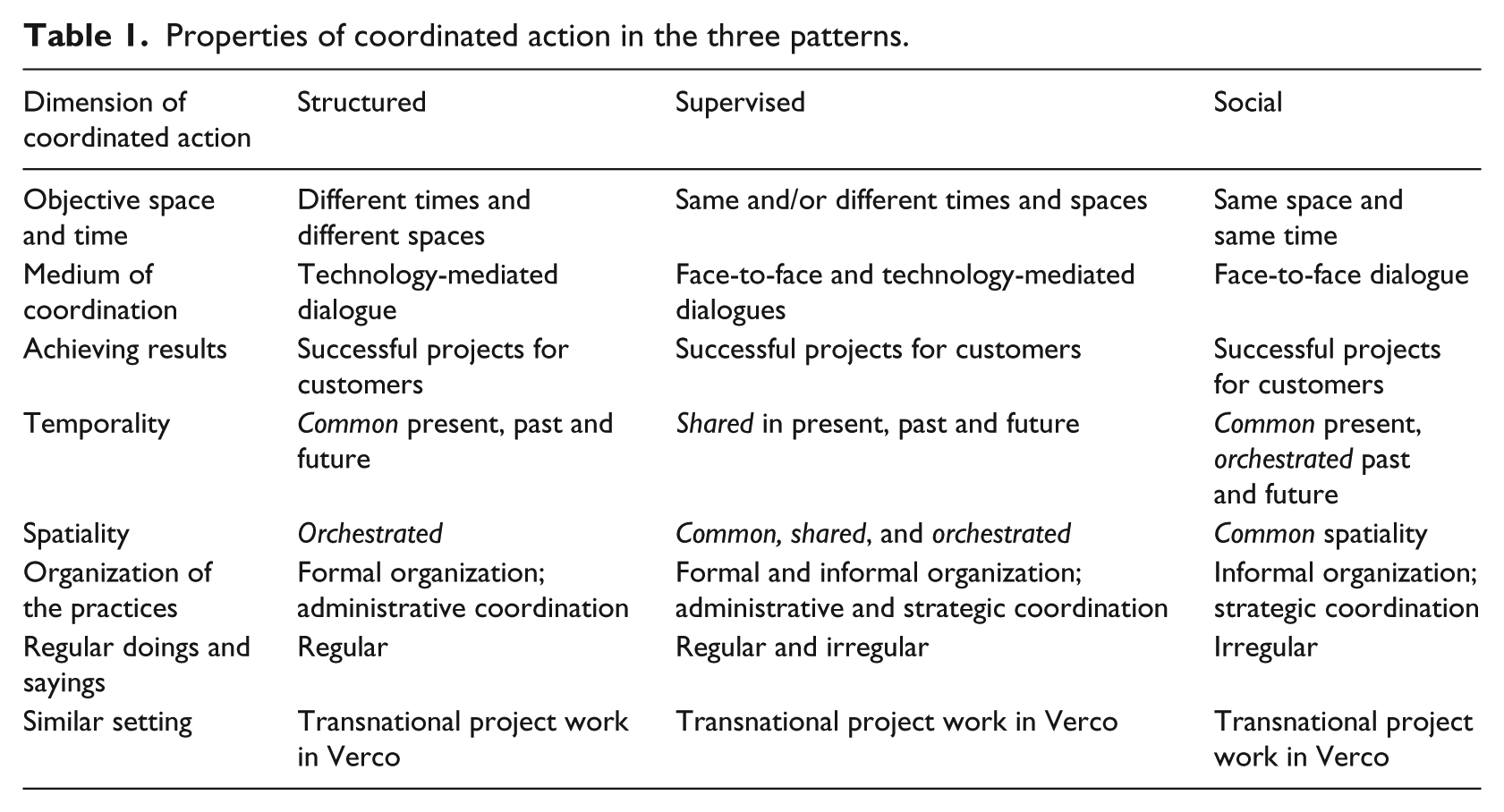
Humans understand and act in objective time and space. These concepts exist independent of human activity; the Earth orbits the Sun irrespective of human actions, but humans attune all their activities to these revolutions. Objective time and space and the social phenomenon of human actions can be understood through coordinated action (Schatzki, 2010). Coordinated action is defined as the ‘actions that combine to achieve a result that someone intends to be achieved’ (Schatzki, 2010, p. 69). There are three properties of coordinated action: (i) objective spatial-temporal forms of the actions, which include the same place at the same time, different places at the same time, different places at different times and the same place at different times; (ii) medium of coordination, such as technology-mediated or face-to-face dialogue; and (iii) achieving results, referring to whether or not the coordinated action achieves the designed or intended results.
According to Schatzki (2010), objective time and space are operationalized through coordinated action, while temporality and spatiality can be understood through (iv) the organization of a particular practice, (v) the regular doings and sayings composing that practice and (vi) the similar setting where the practice is performed. These six properties assist in analysing the temporal-spatial dimensions of practices. Further, to analyse temporality and spatiality in a given practice, it is necessary to view how these are related. Peoples’ activities are related in timespace through common, shared and orchestrated elements (Schatzki, 2010, 2012). When one person’s activities are related to another person’s activities, either in terms of the activities’ ends, purposes, motivations, places or paths, these activities are differently related to common, shared or orchestrated elements. Timespaces are said to be common when people follow a common way of doing things, such as when professional management consultants use PowerPoint presentations for presenting and discussing projects with customers. Timespaces are said to be shared when people do not follow a normal way of doing things, although they act acceptably: an illustration could be how a professional interacts too informally with a customer, by being personal, rather than acting in the usually formal manner. Elements of timespace are said to be orchestrated when two persons’ activities are not common, shared or independent of one another, but still related through their ends, purposes, motivations, places or paths (Schatzki, 2012): an illustrative example is how a manager tries to impose formal procedures while an experienced professional demonstrates how seemingly informal ways are more efficient. The elements of commonality, sharing and orchestration expose the interrelations of people’s activities within practices. For instance, when several people from two different organizations physically meet, they share a common spatiality, a common temporality in the present (being in the meeting room), an orchestrated past (not being involved in a project together) and a shared future (with a motivation to land a successful project together). Temporality therefore embraces common presents (with ends and purposes of discussing the project), orchestrated pasts (different reasons to be involved in the project meeting) and shared futures (being involved in a project from two different organizations without having established a normal way of cooperating). There are also common, shared and orchestrated spatialities, such as a common place (being in a meeting room), shared paths (using the stairs instead of the lift, or the way to get to the building where the meeting room is) and orchestrated places (using different meeting rooms connected with another participant through video conferencing).
This understanding of temporal-spatial activities through common, shared and orchestrated elements, performed in objective time and space understood through coordinated actions, will be used to uncover patterns of activities. These patterns will then be used to identify different temporal and spatial dimensions of strategizing.
Strategizing
According to researchers such as Chia, strategizing can be understood through the building mode or through the dwelling mode (Chia & Holt, 2006; Chia & Rasche, 2010). Stemming from Heidegger (1971, 2008), dwelling is related to the manner in which we exist, the ‘being-in-the-world’. Following Chia and Holt (2006, p. 637), the dwelling mode is how ‘our agency and identity arise through the actions we (mostly unconsciously) deploy’, whereas the building mode is the ‘idea that language and representations bridge these two worlds of mental activity and practice’. Dwelling and building are understood as two existential engagements in the world (Chia & Holt, 2006; Chia & MacKay, 2007; Chia & Rasche, 2010; Heidegger, 1971).
In relation to strategy, the building mode refers to building strategy through purposeful planning that, for instance, involves top management. Explicit and deliberate strategy-making and purposeful activities in the building mode can be understood through Aristotle’s ideas of episteme and techné. Episteme refers to context-independent, explicit and propositional knowledge regarding something (Chia & Rasche, 2010). By contrast, techné involves codifiable techniques and practical instructions (Chia & Rasche, 2010).
The dwelling mode refers to strategizing through purposive, everyday practical coping and, as such, can be performed by any practitioner (Chia & Holt, 2006). Dwelling is understood as especially relevant for uncovering the activities of strategizing that are not explicitly part of a strategy process: they are non-deliberate (Chia & Holt, 2006; Chia & Rasche, 2010). In the dwelling mode, actions are more context-specific and can be understood through the concepts of phronesis and mẽtis. Phronesis is understood as practical wisdom and is associated with goodness and virtue (Chia & Rasche, 2010). Phronesis is ‘acquired through experience, that accounts for the ability to perform expediently and appropriately in defined social circumstances’ (Chia & Rasche, 2010, p. 39). Mẽtis, on the other hand, refers to cunning intelligence and is characterized by agility and swiftness of action (Chia & Rasche, 2010, pp. 37–38). Mẽtis is the ‘practical intelligence required to escape puzzling and ambiguous situations’ and the ‘ability to attain a surprising reversal of unfavourable situations to achieve favourable outcomes’ (Chia & Rasche, 2010, p. 40). Following Chia and Rasche, phronesis and mẽtis ‘constitute the authentic art of strategizing that is peculiarly sensitive to time–duration as well as simultaneity’ (2010, p. 40). Their claim that strategizing is sensitive to time supports the need for a temporal-spatial understanding of strategizing.
In this paper, I seek to combine the concepts and notions discussed above. To identify deliberate and non-deliberate strategizing, I will apply Schatzki’s concepts of objective time and space, temporality and spatiality to uncover patterns of practices. Specifically, the properties of coordinated actions will be used to view objective time and space, while the common, shared and orchestrated elements of people’s activity timespaces will be used to view temporality and spatiality. I will then examine these identified patterns in relation to the building and dwelling modes, understood through episteme, techné, phronesis and mẽtis. I will thus follow patterns of practical coping that can, in retrospect, be understood as strategizing (Tsoukas, 2010). In the remainder of this paper, I will use objective time and space and activity timespace to uncover patterns of strategy-forming practices within the empirical setting of Verco.
Methods
Insights emerged from an open-ended and inductive research design, in which the initial focus was on distributed professional service work. Using a practice lens on service work led me to focus on the everyday working activities of practitioners (Schatzki, 2005), similar to Orlikowski’s study focusing on distributed organizing (2002). Being a practice-based study, the material is valuable not only in the early stages of research but also in uncovering certain organizational phenomena, which in this case are the temporal and spatial dimensions of strategizing. The practice-based study of Verco can be regarded as an extension of social constructivism (Berger & Luckmann, 1966; Rasche & Chia, 2009). It serves as an ‘extension’ because the social interaction of actors creates collective schemes of knowledge that are preconditioned to the constitution of the actor in their environment within social practices (Rasche & Chia, 2009, p. 720). Although temporal and spatial dimensions of strategizing were not explicitly addressed during the data collection process, the different times and spaces involved in the service provision as well as the implications for strategy became an important focus of attention in the concluding analysis.
Consistent with an inductive approach, the research questions emerged over time as I engaged with the empirical material and with extant literature that helped me make sense of the findings. The inference that guided the theory’s development can be referred to as abduction (Pierce, 1978). Following Alvesson and Kärreman, abduction consists of three steps: applying a theory, being surprised by empirical phenomena and articulating a new theory intended to resolve that surprise (2007, p. 1269). Alvesson and Kärreman (2007) address this through reflexivity, sensitive constructions and interpretive repertoires. A reflexive approach implies that a study aims at being an ‘interpretative, open, language-sensitive, identity-conscious, historical, political, local, non-authoritative and textually aware understanding of the subject matter’ (Alvesson & Deetz, 2000, p. 113). Alvesson and Kärreman’s (2007) explanation of a research process, which they label a mystery construction, as being a critical dialogue between the theoretical framework and empirical work, is in line with the journey I have made, which is elaborated below.
Case selection
The practices followed in this paper occur within the specific context of a TPSF. The reasons for selecting a TPSF is as follows: TPSFs are present in several countries, sell expertise and provide solutions to demanding customers on a global basis and are regarded as extreme cases of knowledge intensity and transnationality (Greenwood et al., 2010). The services provided are rendered by collaborations between dispersed professionals, and are embedded within the social and physical environments of and between several locations (Hydle, Kvålshaugen, & Breunig, 2014). Objective time and space and the activity timespace are obviously accentuated within the transnational context. However, I believe that findings in this context will also be relevant to local settings. Compared to a local context, the patterns of actions are easier to uncover in a transnational setting because practitioners are explicit with regard to when, where, with whom and what they do when they collaborate. An engineer from Aberdeen collaborating with a colleague in Korea is more explicit about what was done, where, when and how than when the same engineer collaborates with another colleague located in the next-door office. In an organization situated within a single building, the activities of and collaborations between various practitioners may be the same as those situated in different places, but these are not as visible.
Verco is a TPSF, providing local and transnational engineering services, including traditional ‘offshore’ locations. The firm comprises 300 offices in 100 countries, with about 9000 employees representing 86 nationalities. Providing global third-party services, Verco employs mainly highly qualified engineers and technical personnel. The core of Verco’s business is to provide quality and comparability in globally distributed services: that is, of the same standard and expertise worldwide, with a uniform quality, so that customers perceive Verco to be one company. The customers range from onshore to offshore large industrial manufacturers, automotive companies, shipping companies and companies engaged in the exploration and production of oil and gas. The services delivered to customers include those being provided at the customer’s premises in one place, such as field developments, pipelines, risers, subsea facilities and process systems, or at many places and ports, with regard to a shipping vessel for instance.
Verco’s management emphasizes internal collaboration across borders as strategically important for providing customers with its unique skills, regardless of where the customers are located. As a global operator, the company can tap into a large pool of expertise. The ways in which people share activities between themselves and collaborate within the organization to provide a service are understood to be of significant strategic importance for meeting customer demands, building customer relations, developing internal competence and maintaining market share.
Collecting empirical material
Verco was examined in two periods for a total of five years (from 2003 to 2005 and from 2007 to 2009). I began in 2003 by familiarizing myself with the setting through a few broad-ranging interviews and discussions with management (Alvesson & Kärreman, 2007). Studying Verco’s practices forced me to be reflexive about what I was doing, what I was studying, how I understood the data, how my understanding of the data changed and, finally, how I reported and described the data (Alvesson & Deetz, 2000). Over these five years, a total of 82 individual interviews and six group interviews were conducted, involving 33 practitioners in 12 different localities in nine countries across three continents. Besides interviews, over 40 days were spent observing daily work, internal workshops, managerial meetings and discussions with project management, middle management and top managers in different localities. The study also included access to internal documents, the intranet, surveys, project and process descriptions, and tailor-made systems and databases. The interviews and observations made me aware of the challenges in transnational collaboration; the material collected before 2007 made me familiar with the firm and the service provisions, and revealed particular difficulties encountered by the professionals in their daily work in Verco, due to the different times and spaces.
The empirical material specifically used in this paper stems from 2007 to 2009. This material comprises: (i) six group interviews, in five different localities and three continents, involving 33 participants; (ii) 11 individual interviews in three different localities; (iii) two days of observation involving 40 participants in a workshop, with one or two representatives per Verco country, covering 30 different locations; and (iv) over 10 meetings with management, project managers and top managers. The material was collected from one of Verco’s four business areas that provide professional services to onshore and offshore customers, using a mixed-method approach to ensure both breadth and flexibility (Balogun, Huff, & Johnson, 2003) in a research context that was multi-layered and distributed. The group interviews were structured and intended to elicit participants’ different opinions on a specific topic (Krueger & Casey, 2000); each group interview lasted four hours. The individual interviews were semi-structured and lasted between one and two hours; they were also recorded and transcribed. Empirical material was gathered from several locations not only for comparison purposes but also to obtain a coherent understanding of service provision and the practices performed (Hannerz, 2003).
Analysing the empirical material
Case stories were written up from the group interviews and every six months during the project. The aim was to employ the thick description mode of analysis (Geertz, 1973). These case stories were presented to Verco’s top management and project managers to validate the veracity of the empirical material, enhance the trustworthiness of the analysis (Lincoln & Guba, 1985) and facilitate feedback. Upon completion of the interviews, I developed coding frames to reflect emerging themes, and the material was coded accordingly. The observations, group interviews and individual interviews were analysed by using the NVivo qualitative data analysis software. The material was examined with specific attention to the services provided by several practitioners at different locations. Answers and observations were categorized according to whether they were local or transnational collaborations, since my focus was on distributed work and hence I stressed transnational collaborations. By continual in-depth analysis of the empirical material and theory (Alvesson & Kärreman, 2007), I paid attention to any surprises and puzzles that led me to further analysis and theorizing (Agar, 1996). My initial framework focusing on the practices of distributed work was further challenged during the collection of the empirical material and the analysis. Although I was aware of the different times and spaces involved in distributed work, I was puzzled by how projects diverged from one another. One event that offered me a new, interesting understanding of temporal and spatial dimensions was an internal workshop with 40 participants worldwide, where several participants described different projects they had been engaged in and how they differed substantially with regard to the systems and tools used, the way participants interacted and the set-ups. Their accounts motivated me to delve deeper into identifying the multiple ways in which they collaborated across borders. My puzzle was related to the empirical findings that could not ‘easily be accounted for by [the] available theory’ (Alvesson & Kärreman, 2007, p. 1270). After several rounds of examining the available theories on space, time and collaboration (Castells, 1996; Hernes, 2004; Lefebvre, 1991; Massey, 2005; Thrift, 2007; Warf & Arias, 2009), I delved further into practice theory, focusing on the understanding of coordinated action (Schatzki, 2010). By applying the notion of coordinated action, patterns started to emerge in the empirical material:
Objective spatial-temporal forms of the actions. In the empirical material, I found one pattern with different times and different places, another with a mix of both different and same places and times, and a third pattern of practices with the same time and same place.
Medium of coordination. Practitioners coordinated through face-to-face or technology-mediated dialogue. I found one pattern that used technology-mediated dialogue, another pattern that used both forms and a third pattern of practices that used face-to-face dialogue.
Achieving results. I found that the combined actions were performed to achieve service provision for their customers.
The interwoven timespaces of common, shared or orchestrated elements are features of these coordinated actions (Schatzki, 2010, 2012). The commonality, sharing and orchestration are circumscribed by the following (Schatzki, 2012):
Organization of the practice. Differences existed in the empirical material as to whether the organization was formal, informal, or both, and whether the coordination between people was mainly administrative or involved strategic decision-making.
Regular doings and sayings composing the practice. Differences also existed in the empirical material regarding the regular doings and sayings in the practice. One pattern showed regular activities, another showed a mixture of regular and irregular activities, and a third only showed irregular activities (being new to all practitioners).
Similar setting where the practice is performed. The practices I uncovered were performed in project work for Verco customers.
By using these three properties of coordinated actions, together with the three properties of interwoven timespaces, the coding that resulted from NVivo enabled me to uncover three patterns in the empirical material.
One pattern entailed the division of work across multiple locations, either from one place to another or from a single professional to a team. A second pattern involved a central project manager who coordinated all collaborations between professionals at multiple sites. A third pattern consisted of professionals who travelled to meet and collaborate with customers and colleagues at the customers’ premises. These three patterns, labelled structured timespace, supervised timespace and social timespace, are presented in Table 1.
Properties of coordinated action in the three patterns.
I was puzzled for a second time (Alvesson & Kärreman, 2007), during both the data collection and the analysis, with regard to the impact the work had upon strategy. While going through the data, I noticed that the practitioners undertook different strategic roles or acted strategically during their everyday work. During the data collection, several practitioners referred to projects that were strategically important, such as new service offerings, global reputation or new customers, due to a gas leakage that did not occur. These projects were referred to as ‘strategic project’, ‘enhanced reputation in the market’, ‘market leader worldwide’, ‘new industry solutions’ and ‘measure success with what does not happen’, with reference to potential major catastrophes with a possible consequence of lost lives and environmental disasters that did not occur. I looked for a theoretical understanding of how strategizing could be explained in relation to the particular patterns of practices formed through recurrent coping activities within an organization. In the SAP literature, non-deliberate strategizing through everyday practical coping is emphasized (Chia & Holt, 2006; Chia & Rasche, 2010). Applying the concept of dwelling to comprehend emergent strategizing in everyday practical coping actions involves understanding phronesis and mẽtis. To uncover strategizing, I found it necessary to view the enacted aspects of the activity timespace in order to determine whether the patterns of action followed the building mode and the related episteme and techné, or the dwelling mode and the related phronesis or mẽtis (Chia & Rasche, 2010). This was necessary because none of the everyday practical coping actions and related practices were part of the explicit strategy processes, although they had strategic outcomes. Strategizing became a second-order label to patterns of practices that I, as researcher, attributed in retrospect (Vaara & Whittington, 2012). By using temporality, spatiality, objective time and objective space, and how these are operationalized from practice theory together with deliberate and non-deliberate strategizing, I developed a novel framework for the temporal and spatial dimensions of strategizing (i.e. this paper’s theoretical contribution).
Findings
Verco’s management sought to capitalize on the company’s presence in many locations by providing important customers with top expertise, regardless of the problem to be resolved or their location. They therefore emphasized that transnational projects were important, and were either staffed by employees at several locations because of their expertise and knowledge or because of different customer locations. A top manager explained the company’s intentions in this way: ‘If Verco could only know who knows what and use that knowledge in specific projects, this would be of great strategic advantage.’ Many projects were transnational and differences existed in objective spaces and times such as different places and time zones. In the project discussed below, nine time zones were involved for the participating engineers. In terms of location, the project manager was situated in Aberdeen, other Verco engineers were situated in Korea (where the ship was being built), the customer was in Houston and Verco’s headquarters were in Oslo: The project was for an important customer in Houston, but the actual ship was built in Korea, while the safety had to follow UK specifications, as it would sail in UK waters. The project manager in Aberdeen described it as: ‘a large project running over two years. Here too, it was a customer we had to educate. They were good at building stuff, but knew nothing about UK safety case regulations, and technical safety studies in general. We had to get to know the people in Korea as well as their customer in Houston…The project ran into problems. We had a customer complaint, which we dealt with by email. However, many names were introduced that we had never heard of. It was challenging to solve this problem across nine different time zones. The result of this was that we spent six weeks on something that could have been solved with one hour of interactive discussion. …This was a huge customer for Verco, so it was of paramount importance that misunderstandings were resolved. HQ (Oslo) took the situation very seriously and assisted by getting top management involved. The customer was eventually satisfied and has asked us to do similar jobs on four new projects.’
Another project was described as follows: This project was about offshore security, harmonizing the health and safety environment for the Barents Sea. Several industry experts from Norway and Russia were involved in this cooperative project, all with a mission to agree on technical standards. A senior engineer explains an example of the challenges: ‘Moving oil platforms from one place to another creates a risk picture with cold climate challenges, and raises the question of which standards to use for this situation.’ There was a lot of coordination involved, such as relaying information between Verco’s headquarters in Norway and back to the project. The same processes occurred in Russia. The same senior engineer confirmed that ‘there were 10 of us involved from Verco and we all worked in the same way in Norway and Russia, with basic documentation’.
Although Verco’s projects presented different challenges regarding objective space and time, employees described similarities within projects. The identified similarities followed the three patterns of structured timespace, supervised timespace and social timespace (Table 1).
Structured timespace
One pattern of practices entailed dividing service provision between two or more professionals situated in different locations; contact between the professionals was one-on-one. An engineer explained: ‘We work in parallel in Oslo, and the grouping together is done in the East. We do not speak to each other.’ The professionals were involved either due to their different expertise or, if they used similar expertise in different regions, owing to the customer’s presence in those locations. An engineer in Oslo stated: ‘I was contacted by colleagues in China to work on a project. I, therefore, wrote an offer. Six months later, we got the project.’ Another engineer provided an illustrative example: ‘They [the other professionals in Aberdeen, Rio and Singapore] contact us if they need something.’
Interactions between professionals were technology-mediated. Collaborations were based on a division of labour, depending on the professionals’ knowledge, functions and capacities. The division of labour and activities was explained by one engineer: ‘A project about design approval in Norway was certified in Poland. We followed instructions from Poland. We have a common directory and use the tailor-made system and different tools.’ A senior engineer explained how approval of a performed service was divided between several engineers: ‘A situation where the approval was split up between several of us; I made my assessment, and sent it to someone.’ The other professionals understood these activities to be regular activities. In this case, the operation involved assigning the correct professional to the relevant activity. The evaluation and verification of each other’s work was part of the chain of cooperation. For example, a professional handed work to the next professional ‘because the system asks me to use a person who has the formal competence’. This division of labour according to competence requires formal organization and administrative coordination by the firm. One engineer explained: ‘The sharing of work is structured by Verco processes and legislation.’
The professionals were located in different geographical places and objective spaces, and the work was performed in different objective times. One engineer explained: ‘We deliver the report as our part of the scope, but we never hear from those who put it all together.’ I refer to this first pattern as structured timespace because of the existing division of labour that determines the activities. In structured timespace, following Schatzki’s properties of coordinated action (2010) (Table 1), the objective temporal-spatial forms were different times and different places, the medium of coordination was technology-mediated dialogue and the professionals were all trying to achieve results for customers. Regarding the properties of interwoven timespaces, the organization was formal, the coordination was administrative, there were regular doings and sayings, and the setting was similar (i.e. project work for Verco customers across borders). For the temporality of the pattern, the timespace held a common present, past and future. Professionals acted towards the same ends, performing regular actions as expected. The spatiality of the pattern seemed to be orchestrated because one element of a professional’s timespace was linked to a different element that formed part of another professional’s timespace (Schatzki, 2010, 2012).
Supervised timespace
Another pattern of practices involved the presence of a project manager who coordinated all activities performed by many professionals in multiple locations both simultaneously and separately in different places. An engineer explained: There is knowledge to get in Verco. John put together a team with a lot of competence. Some informal contact and informal meetings … It was different from what the customer had expected, as they had a solution that was modified. It was a concrete commission from the customer to solve a challenge. John understood that we needed Tim and Jim. After another meeting, we had to involve even more people, as we needed power technical competence. We never all met physically, as we were never assembled together. John, as project manager, collected the threads, and we all contributed with different parts.
The different aspects of the independent components were coordinated by the central project manager. One engineer explained: ‘The project was coordinated from different places, including Rotterdam, Oslo, Aberdeen, Bergen and Paris.’ Professionals provided their contributions to the project manager, without necessarily collaborating or being in contact with each other. In this pattern, both formal and informal organizing occurred, and there was one central project manager. A project manager explained: From my last job in another unit in Verco, I had a large network. I know people and their competence, which I can always take with me. There is an informal network of people to ask. The challenge is to collect the network.
However, some of the work was coordinated by others, occurring in workshops or through face-to-face dialogue with professionals or with customers, to improve coordination and solve challenges, as explained by an engineer: In order to have effective customer contact, I go to the customer location to better understand. Things often change over time, which we have misunderstood. There is a lot that needs to be verbally coordinated to be more effective.
The activities were both regular and irregular for the practitioners. Formal organizing was used when the activities were regular. Informal organizing was often needed when activities were irregular, because there were new challenges to solve and the professionals needed to meet personally. A project manager explained: As a project manager, I had to go to Rotterdam from Aberdeen for face-to-face interaction. They don’t understand verification, the customer had no idea. I had to bring it home to their place because of this inexperience. If [they had been] experienced, we would have needed to go there only once a month.
The coordination involved both face-to-face and technology-mediated dialogue. One engineer explained: ‘For collaboration, I use both the systems and the people.’ Work was performed both simultaneously and separately in different places, and I refer to this pattern as supervised timespace because of the project manager’s role as a decision-maker in the midst of the activities. In supervised timespace, the objective temporal-spatial forms were both the same and different times and the same and different places, face-to-face and technology-mediated dialogues were used as mediums of communication and the practitioners were all trying to achieve results for customers (Table 1). Regarding the properties of interwoven timespaces, the practices were formally and informally organized and the coordination was administrative; the project managers were decision-makers, deciding which activities to perform and how to approach and deal with customers; there were both regular and irregular doings and sayings; and the setting was similar. The temporality of the pattern was shared in the present, past and future, following the dimensions set forth by Schatzki (2010, 2012): practitioners acted for the same ends and motivations, not because it was instructed but because it was acceptable. The spatiality of the pattern was common, shared and orchestrated: some practitioners used the same places and paths in meetings, workshops and face-to-face dialogue, whereas others did not participate and were located in different offices.
Social timespace
In the third pattern, multiple professionals needed to be at the same place at the same time. An engineer explained: ‘In Indonesia, we were one from the UK, one from Singapore and one from China, travelling to Sumatra, talking to people at the plant, then looking at the procedures, solving the problems and reporting back.’ This pattern provides an example of Verco’s strength, whereby the firm was able to put together a team of people who typically travelled from different locations (e.g. Singapore, Shanghai and Aberdeen) to perform work as a team at the customer’s site (e.g. Indonesia).
In this pattern, the work consisted of serious engineering problems that required collaboration across professional disciplines with an informal organizational approach. A senior engineer commented: ‘Cutting-edge projects…offshore pipelines, yeah, we are a market leader worldwide. With a serious problem, it is only Verco. It is a real strength.’ Professionals were required to travel and meet at the customer’s premises and perform the job as one integral team, thus collaborating on-site. An engineer explained: ‘A project manager from Verco from Taiwan, then an expert from Oslo, then someone from Aberdeen… met physically, on-site. Paul would do the guidance. Very few companies could put together that kind of expertise.’ The organizing was informal; as one practitioner described the collaboration: ‘There were no egos; it was the team!’ The activities in these collaborations were often irregular; a senior engineer commented: ‘You go out to the customer site, you don’t know what to expect…and afterwards you find that you really have learned quite a lot’ while another engineer explained: ‘It depends on the projects. Some will be a very stressful time, some projects are incremental learning; others are a steep learning curve.’
As senior engineers teamed up with colleagues from other locations to overcome novel problems, they created new industry solutions that would serve as future services for other customers. Successful service provision also resulted in an enhanced reputation in the market and development of internal competence. A senior engineer explained: ‘In Verco, being part of multi-space projects is a continuous learning experience. For me, this is the best place to work, and I have been around a lot.’ The solutions achieved were disseminated internally in Verco through postings on the intranet, and managers used these as reference projects. Another senior engineer explained: Customers are so different, they are people. They have different experiences. Their needs depend on what kind of situation they are in. In one situation in Brazil, the solution we found was spot-on, and the project was a delight to take part in. Large projects posted on the intranet go across regions, such as a customer project in London and Angola.
I refer to this pattern as social timespace because professionals need to find solutions together as a team. In social timespace, professionals travelled to meet up with others, and the work was performed in the same objective space and time. The coordination was face-to-face, with informal organizing, and activities were irregular. As professionals acted for the same end and motivation at the same locations, and because they were part of the normative organization of that practice, this pattern showed a common present and a common spatiality, but an orchestrated past and future. The involved practitioner’s timespace was linked to that of other practitioners only through different elements: they only met up at the customer’s premises to perform the job in the present, and were not related, co-located, or within the same area of expertise before or after meeting up.
The timespace elements set forth by Schatzki (2010), namely commonality, sharing and orchestration, show not only how activities are interrelated but also how participants’ activity timespaces can be uncovered. Structured, supervised and social timespaces incorporated different objective temporal-spatial forms and different properties of interwoven timespaces (Table 1). The properties of coordinated actions varied in respect of the objective temporal-spatial forms and the medium of coordination, but were the same in terms of achieving results, such as providing services to customers. With regard to the circumscriptions of interwoven timespaces as features of coordinated action, variations were seen in the organization of the practices and their doings and sayings. For example, large variations exist in whether the activities were regular or irregular: in structured timespace, the activities were regular, whereas they were irregular in social timespace, as explained by one engineer: The project has been the toughest I have worked on. I had to learn the systems myself and then teach the customer what that entailed. We interacted on an hourly basis sometimes. We had to direct them and show them the information.
Strategizing in Verco
Analysing these three patterns of structured, supervised and social timespaces to uncover the related strategizing entails examining those patterns in relation to the building and dwelling modes (Chia & Rasche, 2010), as understood through episteme, techné, phronesis and mẽtis.
Social timespace, with its irregular activities, informal organizing and strategic coordination, resembles mẽtis. Problem-solving in teams was characterized by novelty; the teams travelled to the customer’s premises, showing agility and swiftness, and they managed to change unfavourable situations for their customers into favourable outcomes for both the customers and Verco, which reflects what can be referred to as cunning intelligence. This can be illustrated by a project finding solutions to possible undersea and offshore gas leaks and explosions; as one engineer explained: ‘I make the world a safer place, and that I identify with. The customer gets value creation. We measure our success with what does not happen. It is slightly strange, but it feels good.’ In reference to a different project, a senior engineer explained: The project was carried out for a gas company responsible for all the gas pipelines in that country. We developed key performance indicators to control for: ‘Do they have control of risk for major accidents?’ It was in need of continuous updating to measure it. We involved other disciplines from the beginning. Starting with blank sheets, we had some workshops with our resources and the gas company to propose the way forward.
The professionals solved challenges that became the source of Verco’s reputation in the industry worldwide. They learned from each other in the process, gaining important experience that could be learned and utilized by other professionals after the project’s conclusion. An engineer explained: For this oil and gas field, we conducted risk analysis for all installations. During a start-up meeting with four or five people, we were going through it all with different scenarios. It was in need of standardization, making a template for what is to be done in one installation, to be used in new installations. The result has big potential and it can be used as a steering-and-guidance system, not just a report read through and placed in a drawer.
By developing organizational assets through new problem-solving services, while being physically situated in the same objective space and time, the professionals managed to incorporate new services and build them into future strategies. A senior engineer from Aberdeen explained: I managed the customer project. Capturing the data and working with models according to the data we collected…It is an infant industry. We need a lot of guidance, procedures etc.; we need that in place. Hence, Verco is involved in international guidance and standards. … Verco’s involvement would be on a project basis. I will be involved in this. Tomorrow, we will do the guidance development. I am feeding [the experience] into a larger group in Norway. But the work is seen as internal work, not external. The focus here is external. I am the expert for Oslo, a mentor to the HQ developing this.
Based on these findings, social timespace resembles mẽtis. Social timespace is utilized for unknown service provisions by practitioners, who frame and develop future strategy through mẽtis, involving long-term value creation for the firm.
Supervised timespace seems to be more in line with phronesis. The project managers act as decision-makers by using the practical wisdom acquired during their experience in Verco and within their field of expertise. A project manager explained: It is strategic; constant strategizing. For example, I develop a business plan for site suitability, involving some other aspects, but with the usual customers. So my job is to persuade the management here what area is worth marketing and developing.
The project managers make decisions to allocate activities, and these decisions involve other practitioners and require communicating with customers through their networks. Another project manager explained: I need project management skills, organizational skills, technical knowledge, and ideas. Since I am coordinating people in time, dealing with subcontractors, I am a go-between for customers and sub-contractors. And timing is important; having a tower installed, I need to assure that the necessary steps are taken…time management.
These activities happen both within Verco and at the customer’s premises. Thus, phronesis characterizes the project managers’ behaviour in this timespace, as they act in the moment regarding what is useful and necessary, and make the project a success with all of the professionals involved. Supervised timespace is utilized for challenging service provisions by practitioners, where project managers modify present strategy to provide short- and long-term value creation for the firm. The project managers strategize not as part of an explicit strategy process, but when they perform their everyday work, through phronesis. This means that the existing organizational strategy was followed by employees, while project managers became strategists as part of their work in progress.
Structured timespace is different from the other two types of spaces because participants follow an existing division of labour, use ICT to communicate and follow what is expected of them. An engineer explained: Our projects are dealt with through the system. I get a job number from the project management system, which we use for all technical documents and correspondence. The work share is structured by our processes.
Neither mẽtis nor phronesis seem to be relevant to this pattern, but techné does. Techné is characterized by codifiable techniques and practical instructions that are followed by professionals (Chia & Rasche, 2010). In structured timespace, professionals use what is there, mainly through actions that depart from what is known. Another engineer explained: Through the systems, I learn discipline and quality. And the processes, I have to respect them, meaning discipline. I don’t like to be subservient to a person, I rather like to collaborate, but I can be subservient to a system. It is like a law.
Professionals provide work at their desks, in front of their PCs. Strategizing has been carried out in structured timespace in the past; therefore, strategy is realized through existing structures, ICT systems and division of labour. Structured timespace is utilized for known service provisions by practitioners, who realize past strategy by following techné and providing short-term value creation for the firm.
Temporal and spatial dimensions of strategizing
The temporal and spatial dimensions are differently highlighted in relation to strategizing. The temporal dimensions refer to the objective time and the temporality of when strategizing occurs, either in advance or in action, as well as whom should be supported as the active strategist, when appropriate. The empirical findings indicate that structured, supervised and social timespaces follow strategizing in the past, present and future, simultaneously. The activity timespaces show that: top managers who implement strategy are enhancing structured timespace, and are thus part of strategizing in the past; project managers who act as decision-makers in supervised timespace are strategists in the present; professionals with irregular activities, who need to physically meet, are innovators who are setting the strategy for the future. By understanding the temporal relevance, strategy can be established in advance and followed by professionals in structured timespace. In supervised timespace, strategizing is part of the present work in progress and part of the action. In social timespace, strategizing for the future is conceived when professionals become strategists through their common effort in developing new industry solutions and building future services. The knowledge of when strategizing occurs, when it is used and when networking is needed all reflect the relevance of temporality. Objective time and temporality are thus important aspects of strategy development.
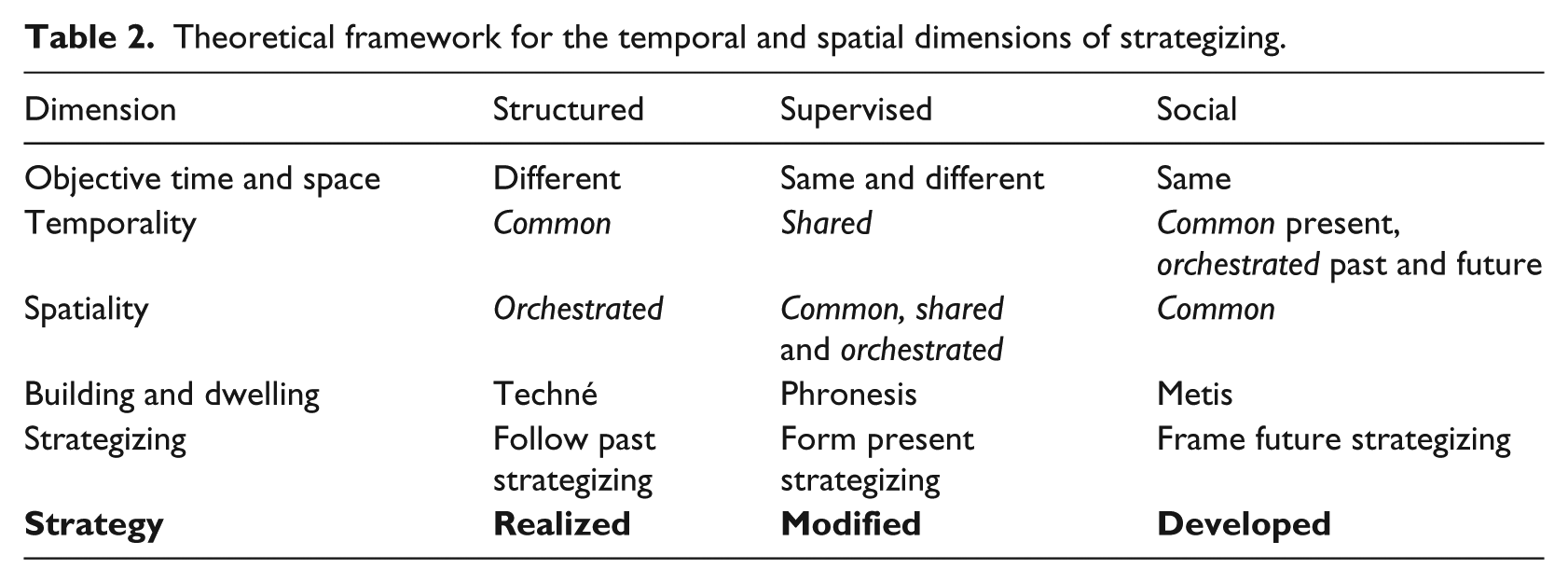
The spatial dimensions of strategizing show that the places and paths used when performing activities differed greatly across the three patterns. In supervised timespace, professionals used their PCs at their desks, and the paths were the ICT systems following strategy. In supervised timespace, the places and paths used were workshops and face-to-face meetings within the organization and at customers’ sites, together with the professionals’ use of PCs at their own desks following the decisions made by the project manager, who in turn was forming strategy. In social timespace, professionals were placed at the customers’ premises, and the paths were the travel to the customer’s sites, framing strategy. Together, the temporal and spatial dimensions of strategizing form a theoretical framework, as shown in Table 2. There are, in the same firm, groups realizing previously formed strategy (structured), other groups modifying current strategy (supervised) and still others forming and developing new strategy through the development of new services (social).
Theoretical framework for the temporal and spatial dimensions of strategizing.
Discussion and Conclusion
The objective of this paper was to answer the following research questions: How is strategizing organized temporally and spatially? and How do temporality and spatiality affect the way strategizing is carried out? Everyday coping activities were first viewed in relation to both temporality and spatiality, and objective time and space. Through these dimensions, three patterns were identified: structured, supervised and social. To answer the first question, the three patterns of strategizing are related to objective time and space, and temporality and spatiality, in different ways: structured timespace occurred in different objective times and spaces; supervised timespace occurred in both the same and different objective times and spaces; while social timespace occurred in the same objective time and space. With regard to temporality (Schatzki, 2010), the findings show how strategizing activities are temporal where the past, present and future occur together. The activities of the professionals within the three patterns all occurred in the present for the professionals involved, while: structured timespace reflected how existing strategy and the past informed present activities; supervised timespace exposed how strategizing happens there and then through the project manager’s decisions; and, social timespace highlighted how current experiences were highly relevant for future strategizing. With regard to spatiality (Schatzki, 2010), structured timespace happens in different places, supervised timespace happens in multiple places and by using multiple paths, while social timespace happens at the same place. Thus, strategizing varies in relation to temporal and spatial dimensions; these dimensions are conceptual tools to identify patterns of practices and distributed agency. Existing literature has so far only indicated that agency in strategy-making is highly distributed (Mantere, 2005; Vaara & Whittington, 2012). The findings of this paper confirm and support this by demonstrating how strategizing occurs since agency is distributed with various emphasis on the temporal and spatial dimensions.
In order to answer the second question, temporality and spatiality were operationalized through the notions of commonality, sharing and orchestration, to demonstrate the activities’ interrelationships (Schatzki, 2010, 2012), which also exposed the enabling and limiting factors for enactment. In structured timespace with different objective time and space and orchestrated spatiality, temporality was common. It involved common ends, purposes or motivations, which implies that to enable structured timespace there is the need for ICT tools, established procedures and processes to provide norms on how to provide the work. Therefore, to limit how employees follow past strategizing in structured timespace is to ensure the absence of processes, systems and tools that would guide their activities and not to facilitate the normal way of doing in that particular practice. The exact opposite is social timespace, with the same objective time and space, common present (ends, purposes or motivations), and orchestrated past and future in temporality, but with a common spatiality. The professionals were not only located at the same place but also established new ways of doing things that became the norm for how to do the work. Thus, to enable social timespace, professionals may be encouraged to team up and be trusted as professionals. To limit employees in developing and framing future strategizing involves restricting professionals from meeting, using their expertise and solving problems.
Supervised timespace involves the same and different objective time and space, with common, shared and orchestrated spatiality and a shared temporality, since people do not necessarily follow the normal way of doing things, but still act in acceptable ways, following the project manager’s guidance. To enable supervised timespace, the project manager’s activities and actions need to be supported. Project managers strategized and modified existing strategy through the processes of dividing the work, enabling internal learning, building and maintaining customer relations, and ensuring that service was delivered in accordance with customer expectations. Enabling such activities involves focusing on the project management role, while ensuring that different systems, processes and tools are in place to facilitate those activities, for resource allocation, informal and formal learning systems and customer relationship management, for instance. However, the most important enabling factor for supervised timespace is facilitating the project manager’s coordination activities between the professionals, since their spatiality is common, shared and orchestrated. To limit supervised timespace and how project managers form present strategizing means neglecting the role of project managers and not facilitating their activities, which in turn, and over time, will have a negative impact on value creation and customer satisfaction.
Using the temporal and spatial dimensions from practice theory thus reveals distributed strategizing agency and the factors that enable or limit strategizing.
Simultaneous strategizing
The three patterns were viewed in respect of the building and dwelling modes, which earlier research has emphasized in relation to strategizing (Chia & Holt, 2006; Chia & Rasche, 2010). Although Chia and Rasche (2010) present the two modes with contrasting and different epistemologies, they indicate that the two are not necessarily mutually exclusive. I have shown empirically that building and dwelling are not mutually exclusive within the same organization, while illustrating how these two modes and related patterns can be operationalized through temporal and spatial dimensions. I identified structured timespace and found deliberate strategy and techné. On the other hand, through supervised and social timespaces, I uncovered non-deliberate strategy formation and phronesis and mẽtis. Thus, following the everyday coping patterns of action in Verco, techné, phronesis, and mẽtis were found to be employed; yet, I did not identify episteme, which is context-independent, explicit, propositional knowledge (Chia & Rasche, 2010). If I had followed a deliberate strategy process and viewed the outcome (such as a formal strategy document endorsed by top management), I might have been able to identify episteme. Thus, strategizing involves different patterns of practices within organizations, where activity timespace, objective time and space, and the building and dwelling modes are constituent parts.
The findings of this paper extend existing research on the importance of temporal and spatial understanding in strategizing (Hodgkinson et al., 2006; Jarzabkowski & Seidl, 2008; Johnson et al., 2010; Kaplan & Orlikowski, 2013). Kaplan and Orlikowski (2013) found that temporal work in strategy-making occurs when the past and present are extended into the future as well as when the future has relationships with the past and present. Focusing on the temporal embeddedness of agency, Kaplan and Orlikowski (2013) identify how multiple interpretations of the past, present and future shape and influence outcomes, such as status quo or change. Their findings differ from mine in two ways. The first is linked to how the understanding of temporality and objective time expose different forms of strategizing (Table 2). When there are different objective times and temporality shows common past, present and future, the practitioners realize deliberate strategy (structured timespace). When there are same and different objective times and temporality shows shared past, present or future, the practitioners are modifying non-deliberate strategizing (supervised timespace). When there are same objective time and temporality is common present and orchestrated past and future, the practitioners are developing non-deliberate strategizing (social timespace). This understanding of temporality thus exposes differences in strategizing that have not been previously identified. Secondly, I view activity as a temporal-spatial event in itself (Schatzki, 2010). This understanding has both theoretical and practical implications. Theoretically, the temporal and spatial dimensions are useful for developing a framework for strategizing. Practically, this understanding helps identify enabling and limiting factors in strategizing. My extension is the consideration of how the temporality of activities may be understood together with spatiality, and objective time and space.
Moreover, my understanding of spatiality extends existing research on SAP, where places and paths to strategizing have so far focused on explicit strategy processes (Hodgkinson et al., 2006; Jarzabkowski & Seidl, 2008; Johnson et al., 2010). Emphasizing places and paths as well as objective space in relation to strategy, exposes important differences between deliberate and non-deliberate strategizing. Deliberate strategy is realized when practitioners are in different objective spaces and with orchestrated spatiality as in structured timespace, while non-deliberate strategizing occurs when practitioners are in the same and different objective spaces and in common or shared spatiality, as in supervised and social timespace. Hence, spatiality is useful to understand how it affects deliberate and non-deliberate strategizing.
The simultaneous presence of the three patterns (structured, supervised and social) thus implies distributed agency. These findings show that strategy is not necessarily formed, implemented and changed following a sequential logic in time and space; on the contrary, strategy is simultaneously realized, modified and developed temporally and spatially within the same firm through distributed agency as shown in the theoretical framework (Table 2). The theoretical framework for temporal and spatial dimensions of strategizing developed herein can thus be used by researchers to identify when, where and how strategizing is realized, modified and developed and by practitioners to support or hinder strategizing activities and potential strategists.
The findings of this study demonstrate that strategizing is determined by temporal and spatial dimensions. When differences exist in objective time and space and in a few interwoven activity timespaces, then structured and formal interaction by professionals is required. When places are the same, with common spatiality and common present temporality, for the participating professionals, social and informal interactions are more appropriate. In situations with a mixture of different and same objective spaces or times, shared temporality and different spatiality, facilitation and management, from, for instance, a project manager, is most appropriate. For securing enhanced performance, it is crucial to know if there will be differences in objective spaces or times and to understand the activity timespaces during transnational collaboration. Temporal-spatial understanding is required for the successful management of everyday coping activities and strategizing.
The service provisions and organizing reported in this paper are particular to Verco; however, I believe that these findings are relevant to other organizations engaged in projects and knowledge work and that would benefit from increased and better collaboration between practitioners. I suggest that even those organizations situated in only one place face challenges due to differences in objective time and space, temporality and spatiality between practitioners who realize, modify or develop strategy. This study’s focus on everyday coping actions is atypical in strategy research, and this is also a limitation. Future studies should focus on both explicit strategizing practices and everyday coping practices in parallel, in order to identify differences and similarities in the temporal and spatial dimensions. Studies on the temporal and spatial dimensions of strategizing in other firms than TPSFs could further nuance knowledge on how value creation is affected.
Footnotes
Acknowledgements and Funding
I wish to thank Organization Studies senior editor David Seidl for his excellent support and guidance. Further, the three anonymous reviewers offered suggestions that greatly improved the paper. I would like to acknowledge the kind sponsorship of the Research Council of Norway. I also acknowledge the contribution and involvement of the industry partner; their openness throughout the research project has been an exemplary basis for research collaboration. Helpful comments on the article were provided by Mary G. Billington, Randi Lunnan, Ieva Martinkenaite-Pujanauskiene and Robert Demir.
Author biography
Katja Maria Hydle is a Senior Researcher at International Research Institute of Stavanger (IRIS), Social Science. Her research concentrates on practices, strategizing, innovation and transnational service performance in multinational companies. She is affiliated with BI Norwegian Business School, Department of Strategy and Logistics.