



Abstract
Organizations operating in pluralistic institutional environments are facing ever greater pressures to adopt and implement policies and practices that have few if any benefits for their core functions. This situation is characterized by Bromley and Powell as reflective of means–ends decoupling. Current theory suggests that this form of decoupling can be difficult to sustain unless the logic of confidence in the policy/practice is maintained, i.e. actors believe that it is useful, relevant and important. In this study, I argue that part-time working in the UK police service illustrates a sustained case of means–ends decoupling in that its official purpose (to retain the skills and experience of (mainly female) police officers) not only appears to have few benefits for the subunits in which it is implemented, but the practice itself is seen to interfere with the achievement of operational goals, generating efficiency gaps. Despite this situation, the logic of confidence in this practice is maintained. Using Merton’s distinction between the manifest and latent functions of a policy, I argue that this situation can be understood by examining how the policy on part-time working functions latently to increase managers’ accountability regarding the accommodation of part-time working. This means that managers are unwilling to refuse requests for part-time working but its manifest function (the retention of skills and experiences) operates to ameliorate efficiency gaps through a process I term ‘institutional satisficing’. Furthermore, the manifest function of part-time working can be used as a rhetorical tool by managers to justify potentially controversial methods of accommodating part-time officers in frontline roles which can result in the serendipitous recoupling of part-time working to its intended purposes.
Keywords
Despite the fact that part-time working has been offered as a core practice in organizational policies aimed at family friendly management for at least three decades, and despite research which suggests that organizations see this practice as a major tool for improving female retention (Durbin & Tomlinson, 2010; Lawrence & Corwin, 2003; Tilly, 1992), it continues to be seen as something of a management problem (Friede, Kossek, Lee & MacDermid, 2008; Ryan & Kossek, 2008). Managers and co-workers struggle with managing workloads in groups that contain part-time workers (Edwards and Robinson, 1999) and part-time workers themselves may experience considerable marginalization and career stasis (Connolly & Gregory, 2008; Durbin & Tomlinson, 2014; Kelliher & Anderson, 2010; Lawrence & Corwin, 2003). Thus, while hailed in official accounts as an important tool for the retention of valuable skills and experience, in practice this may not be how part-time working is perceived and experienced by those that are party to the arrangement. While means–ends decoupling (where policies are implemented but ‘scant evidence exists to show that these activities are linked to organizational effectiveness or outcomes’ – Bromley & Powell, 2012, p. 496) of this sort is by no means rare in organizations, research has yet to address how and why this persists over time, especially where an implemented policy is perceived to interfere with the organization’s core task (Bromley & Powell, 2012). This is an important issue, however, if we are to more fully understand institutionalization processes, i.e. what influences how internal and external actors interpret the legitimacy of practices.
In this study, I use Merton’s (1968) concept of latent versus manifest functions of social institutions to explain how part-time working persists as a legitimate practice despite its perceived incompatibility with organizational requirements. Specifically, I argue that the manifest (or official) function of part-time working, as a means to retain female skills and experience, differs from its latent (or unofficial) function, which is to prevent grievances and law suits from employees who might perceive a refused request for part-time working as breaching their rights as enshrined in equal opportunities legislation. Based on a case study of part-time working in three UK police forces, I argue that at the departmental level part-time workers are generally not seen to be a source of valuable skills and experience but as a drain on the availability of human resources. When managers use part-time workers within teams and workgroups, they are not making decisions about their deployment based on matching the employees’ skills to the job at hand, but are making these decisions based on the quantity of time that the employee can devote to a particular task. I argue that in the few cases where part-time workers are deployed in ways that make optimal use of their skills and experience, this is an unintended consequence of managers’ on-the-ground efforts to resolve actual or potential problems arising as they attempt to accommodate part-time workers within systems of work that are designed for full-time employees.
The study contributes to our understanding of means–ends decoupling in organizations by illustrating that this can persist over time where the enactment of a practice satisfies some of the needs of the parties involved (i.e. via its latent functions) and where the manifest function of that practice possesses high levels of moral legitimacy (Suchman, 1995), preventing negative reactions to the practice feeding back into the institutional environment (Bromley & Powell, 2012). I use the term ‘institutional satisficing’ to characterize this situation. The study also illustrates how a tighter connection between, or recoupling (Hallett, 2010) of, means and ends can follow from managers using the official purpose of a policy as a rhetorical device to justify implementing that policy in ways that could be considered controversial. Thus official or institutionalized understandings of the means–ends relationship may evolve from rational myths to self-fulfilling prophecies.
Part-Time Working in Professional and Semi-Professional Occupations: Means–end Decoupling
There has been a steady increase in the number of female professionals opting to work part-time at some stage in their career. According to the Labour Force Survey conducted annually in the UK, 16% of the population working in managerial and professional occupations now works part-time, of which 77% are women (Labour Force Survey, 2014). Research on the impact of professional part-time working in organizations has produced mixed findings. While there is evidence that some women experience higher levels of life and job satisfaction after reducing their working hours (Ginn & Sandall, 1997; Hall, Lee, Kossek & Las Heras, 2012; Lee, MacDermid, Williams, Buck & Lieba-O’Sullivan, 2002), other women experience considerable marginalization and career stasis (Durbin & Tomlinson, 2014; Lawrence & Corwin, 2003). Moreover, despite the fact that organizations often introduce part-time working apparently on the basis that this will improve female retention, there is very little research that has examined whether female retention is improved (Frieda et al., 2008), although some studies have explored this issue indirectly by looking at whether access to family-friendly policies such as part-time working can predict intention to quit (Grover & Crocker, 1995; Masuda et al., 2012; Porter & Ayman, 2010). Moreover, there is evidence that some organizations do see part-time working as important in retaining top talent and, in some occupational contexts, are prepared to negotiate i-deals (idiosyncratic employment arrangements; Rousseau, Ho & Greenberg, 2006) to enable such staff to work reduced hours even in the absence of formal policy (Litrico & Lee, 2008).
Nonetheless, what is clear from the literature is that part-time working in some professional and semi-professional occupations can be difficult to manage, with managers and co-workers complaining that the presence of part-time staff increases workloads and places burdens on managers who have to more carefully plan and organize work so that part-time workers may be satisfactorily deployed (Edwards & Robinson, 1999; Friede et al., 2008; Van Dyne, Kossek & Lobel, 2007). This is suggestive that despite the official rhetoric propounding part-time working as an important tool for skills retention, this is not an outcome that is foremost in the minds of managers who have to accommodate such employees. This is underlined by research which suggests that part-time working is suitable mainly for particular types of job, such as project or support work, largely because these roles are temporally bounded and do not require much in the way of interdependencies with other staff (Friede et al., 2008).
If on the one hand, one of the primary functions of part-time working is to retain the skills and experience of (mainly) female staff and, on the other, these skills and experiences are understood to be valuable only within quite specific non-central roles, then there is something of a schism between what is intended by part-time working and what is actually happening in some organizations. One could ask, for example, why female retention is important if the skills that are retained are not seen to contribute to the organization’s core tasks and purpose. Indeed, despite the skills possessed by female professionals, once they start working part-time, they experience disadvantages in terms of job mobility in the external market as well as career stasis and marginalization in their employing organizations (Dex & Bukodi, 2012). It seems that, like many other policies with an officially stated purpose, there can be considerable means–ends decoupling which occurs when organizations implement policies where the outcomes claimed for these policies ‘have a weak relationship to the core tasks of an organization’ (Bromley & Powell, 2012, p. 485.
Decoupling in the Contemporary Era
Bromley and Powell (2012) differentiate means–ends decoupling from policy–practice decoupling which characterizes a situation where a policy is adopted but not actually implemented, sometimes referred to as symbolic or ceremonial adoption. They argue that means–ends decoupling is becoming more prevalent in contemporary organizations for two key reasons. First is the influence of ‘audit cultures’ which, via surveillance mechanisms such as monitoring and reporting procedures, prevent the ceremonial adoption of practices, once believed to be the most likely response from organizations pursuing legitimacy while attempting to protect their core activities from disruption (Meyer & Rowan, 1977). Second is the influence of increasing rationalization. Organizations in the public sector, facing pluralistic institutional environments and increasing demands for accountability, may adopt a range of apparently inconsistent practices and policies in their attempts to gain legitimacy from a fragmented range of uncoordinated stakeholders (Kraatz & Block, 2008). In such circumstances, the relationship between the practices adopted and the ends claimed for them are not based on any solid empirical evidence but on rational myths, institutionalized conceptions of the appropriate way to achieve goals that emerge from the environment (Dobbin, 1994; Meyer & Rowan, 1977). Part-time working, for instance, is frequently implemented in order to obtain external legitimacy (Goodstein, 1994; Ingram & Simons, 1995) and rationalized on the grounds that it will improve the retention of women, argued to be critical for enabling the organization to maintain vital knowledge and skills. Nonetheless, as already outlined, there is scant evidence that the retention of such skills is actually seen to be central to the achievement of organizational goals.
An important question relating to decoupling is whether and how it persists over time (Boxenbaum & Jonsson, 2008). Policy-practice decoupling can persist because the practice is not ‘peopled’ and hence produces no discernible internal effects, for example, stock option programmes in corporate governance policies (Boxenbaum & Jonsson, 2008). Means–ends decoupling, on the other hand, may persist either because the outcomes claimed for a specific practice are very difficult to evaluate or because the gap between means and ends goes unchallenged and the practice is governed by a ‘logic of confidence’ by which actors accept the legitimacy of the practice without requiring proof of its efficacy (Bromley & Powell, 2012).
There is a stream of research, however, which suggests that internal actors may become uncomfortable with the disconnect between what a policy is supposed to achieve and what it actually does achieve, motivating them to resolve this dissonance by aligning action with official policy ends (Edelman, 1992; Fiss & Zajac, 2006; MacLean & Benham, 2010). Moreover, where the implementation of a given practice is actively monitored by external audiences to ensure that it is being enacted as intended, actors may have no choice but to couple practices with performance over time (Sauder & Espeland, 2009), especially where, as is the case with part-time working, the policy is peopled by individuals who have a stake in ensuring that the policy achieves what is intended (Hallett, 2010).
On the other hand, when a newly implemented practice disrupts or is perceived to be at odds with an organization’s core activities, current theory suggests that this may be a potential source of institutional contradiction (Seo & Creed, 2002). For instance, in many professional and semi-professional organizations, professional conduct is frequently underpinned by institutionalized time norms, which emphasize face-time (i.e. visible presence in the workplace) and ever-availability (i.e. the necessity to be available for work 24 hours a day, 7 days a week) (see e.g. Epstein, Seron, Oglensky & Sauté, 1998). It is this norm violation that generates the difficulties managers face in accommodating part-time workers in contexts where it is assumed that individuals will be present at or available for work for extended periods of time. Given that part-time working is a practice that is introduced primarily as a response to institutional pressures for family-friendly organization (Goodstein, 1994), its incompatibility with these time norms can be understood to illustrate Seo and Creed’s (2002, p. 228) argument that organizations incorporate ‘all sorts of incompatible structural elements, practices and procedures in the search for legitimacy and stability’. Seo and Creed (2002) further argue that as actors gain awareness of such incompatibility, it may lead to the gradual loss of legitimacy and even dissolution or replacement of institutionalized practices. This occurs either as actors reflect on the efficiency gaps generated or because of normative fragmentation, whereby there is a gradual erosion of consensus regarding the meanings actors attach to their daily lives. In either case, the implications of this argument are that where a practice creates efficiency gaps, the logic of confidence in the practice may break down (Bromley & Powell, 2012) and actors may start to question its legitimacy and ‘search for alternatives’ (Seo & Creed, 2002, p. 233).
The literature thus suggests that the persistence of means–ends decoupling tends to be a consequence of the ‘logic of confidence’, but may be more difficult to sustain where actors experience dissonance as a result of this decoupling; where practice outcomes are monitored or evaluated by external audiences; or where the practice interferes with the accomplishment of the organization’s core tasks and generates dissonance due to inter-institutional incompatibility. Nonetheless, given that part-time working, particularly in some contexts, clearly creates efficiency gaps, there is little if any evidence that the legitimacy of this practice is in any sense eroding (as indicated by its steady increase over the last 10 years in both organizations generally and the police service in particular). This begs the question of how the logic of confidence in this practice is maintained despite the problems it generates for organizational efficiency and effectiveness.
Theoretical Framework: Manifest and Latent Functions of Social Institutions
One potential theoretical lens through which to explore this question is Merton’s (1968) notion of the manifest versus latent functions of social institutions. Merton argued that not only could the same end (e.g. increased efficiency) be achieved through multiple means, but also that any given formal means of achieving that end (e.g. team work in organizations) could have multiple outcomes, not all of which would be intended or functional. For example, teamwork may lead to a variety of functional and dysfunctional unintended outcomes such as conflict, creativity, organized resistance or improved gender relations. Thus Merton (1968) argued, an analysis of the manifest functions of a given social entity is not enough: attention must be focused on the latent or unintended functions as well.
Merton defines the manifest functions of a social institution as ‘those objective consequences for a specified unit (person, subgroup, social or cultural system) which contribute to its adjustment or adaptation and were so intended’ (Merton, 1968, p. 63). In this paper, I use the term heuristically to refer to the ‘avowed purpose’ (Merton, 1968, p. 64) and therefore the official function of a given social institution. While Merton (1968) does not provide much analysis of where such ‘avowed purposes’ originate, here I understand their emergence as a consequence of the dynamics occurring between sets of ideational, regulative and political forces (Zilber, 2006) in any given institutional field (i.e. populations of interconnected organizations), which lead to the specification of particular goals that ought to be pursued by organizations and the means through which they should be achieved (Meyer & Rowan, 1977). While such goals may have generic ideational roots (Zilber, 2006) (e.g. the retention of female labour is a dominant idea or logic in current circulation), their specific meaning varies locally (Binder, 2007). For example, as discussed above, in some contexts female retention may be considered critical only in the case of particularly talented individuals (Kossek & Lee, 2008).
The latent function of an institution was originally defined by Merton as those consequences of an institution that are neither ‘intended nor recognised’ (Merton, 1968, p. 64). In this paper, while I likewise conceptualize latent functions as producing unintended consequences, in contrast to Merton, I understand these also as recognized though unofficial functions (Armstrong, Dixon-Woods, Thomas, Rusk and Tarrant, 2012).
Armstrong et al. (2012) argue that a process they term ‘institutional scripting’ is critical to understanding the relationship between the manifest and latent functions of a policy. Institutional scripting refers to a backstage process in which official guidelines act to ‘prescribe and codify institutionalised expectations of practice and [provide] strong cues for the legitimate claims that can be made’ (Armstrong et al., 2012, p. 1235). Such scripting therefore functions to author a rationalized and, critically, evaluable account of what a given policy is supposed to achieve. Consequently, policies such as that on part-time working not only communicate what individuals in organizations can expect in terms of their rights and obligations, but also function latently to build transparency and accountability into the policy enactment process. In this paper, I use this theoretical lens to address the following question: ‘How does part-time working persist as a legitimate practice despite the fact that the outcomes claimed for it are only weakly connected to organizational goals, and the fact that the practice itself generates efficiency gaps?’
Research Context and the Emergence of the Manifest and Latent Functions of Part-Time Working
Part-time working was introduced into the UK police service in 1990 initially as an experimental pilot scheme in six forces, which was initiated by the Home Office and agreed to by the Police Advisory Board. While ostensibly this experiment was designed in response to disparities between resignation rates of men and women officers, it actually followed the successful outcome of an industrial tribunal on the grounds of indirect sex discrimination, brought by a female officer whose request to work part-time hours had been turned down (Tuffin & Baladi, 2001). To more fully contextualize this impetus for the introduction of part-time working, it is necessary to briefly consider the police service’s legitimacy concerns. As an institution, the police service, despite its remarkable endurance (in the UK, it has existed in more or less its current form since 1829), has suffered repeated legitimacy crises, often claimed to be a consequence of deep-rooted cultural problems such as racism (Bradford, Jackson & Hough, 2013; Weinberger, 1995) and sexism (McLaughlin, 1992). The position of policewomen, for example, has generated a huge literature over the last 50 or so years, documenting the problems that women officers face in terms of career mobility, acceptance and treatment (see Westmarland, 2001). There have also been high-profile cases of policewomen who have sued their employing force on the grounds of sex discrimination (e.g. Sharratt, 1992). At the time part-time working was introduced into the UK police service, it was facing mounting criticism from a number of external audiences, especially the government, about the position of women in the organization (HMIC, 1992).
The pilot scheme was quickly judged to have been a success and part-time working was introduced across all forces in England and Wales just two years later, in 1992. From the beginning, part-time working was officially constructed as a practice designed to help women combine their careers with their work, heralded as a practice which would retain ‘the contribution of officers who would otherwise be lost to the service’ (Stone, Kemp & Weldon, 1994, p. vi). These efforts at ‘institutional scripting’ (Armstrong et al., 2012) were related to the widespread cynicism expressed by many police managers with respect to part-time working, a cynicism that was seen by Her Majesty’s Inspectorate (HMIC) to be having a detrimental impact on the take-up of part-time working which, three years after its introduction, stood at around 1%. In a thematic report on equal opportunities in the police service (1995) the Inspector commented: The purpose of equal opportunities work is the creation of a Service grounded in fairness in which every member, irrespective of gender, race, sexual orientation, disability or background, can flourish, develop and give of their best. Unless and until this ideal permeates the workplace, much-needed skills and abilities will continue to go to waste. The view has to be eradicated that equal opportunities is a ‘bolt-on’ soft option, necessary to satisfy the law but related more to politically-correct ideas about race and gender than to ‘real police work’: it applies as much to white heterosexual males as to any other group. (HMIC, 1995, p. 9)
Despite these exhortations, within forces, the introduction of part-time working was seen by many officers as an equal opportunities measure (Tuffin & Baladi, 2001), disconnected from service delivery and more concerned with the protection of the organization from legal challenges.
We can therefore understand the efforts to institutionally script part-time working, and the emergence of its manifest function (the retention of female skills and experience), as a response to both external and internal pressures for legitimacy. Externally, this scripting spoke to dominant discourses about the importance of diversity and social justice to effective policing (Scarman, 1981). Internally, it was intended to convince cynical managers that a ‘business case’ for part-time working existed (Tuffin & Baladi, 2001) and could be supported. Effectively, therefore, the manifest purpose of part-time working emerged to enable the police service to build moral legitimacy with external audiences, that is, part-time working was being introduced as ‘the right thing to do’ (Suchman, 1995). This concern surfaced as a consequence of the organization’s reputation regarding unfair treatment of women. It also reflects an attempt to build pragmatic or exchange legitimacy (Suchman, 1995) with internal actors, that is, it was in the interests of the organization to adopt part-time working. Importantly, however, the emphasis on the centrality of skills retention to organizational effectiveness became a key component of the police service’s policy on part-time working, and policewomen (or men) wishing to work part-time were encouraged in official policy documents to approach their managers and explain how this arrangement could benefit the organization. Likewise, managers who wanted to refuse part-time working requests had to present a business case to the human resource management department explaining why part-time working would not be feasible in their units. The policy therefore, functioned latently to increase manager accountability regarding the implementation of part-time working which, as I will discuss below, explains why few managers refused requests for part-time working despite concerns they may have had about its compatibility with unit goals.
At the time this research was undertaken, part-time working had a take-up of around 2% in the forces that participated in this study, and has gradually increased to its current level of 6% (Brown, 2012). This is considerably below the national average for the take-up of part-time working across professional occupations (currently 16%; Labour Force Survey, 2014). The vast majority of part-time professionals are women both nationally and within the police service. There is evidence that in some professions, particularly financial and professional services, part-time working is seen as an important means to retain top talent and that such organizations are prepared to experiment with its implementation so as to generate optimal outcomes for all parties (Litrico & Lee, 2008; Litrico, Lee & Kossek, 2011; Lee, MacDermid & Buck, 2000). Meanwhile in the police service, part-time working continues to be seen as marginal to the central functions of policing, and women working part-time continue to lack access to opportunities for career progression and development (Fagan, Norman, Smith & Menéndez, 2014). A similar situation has recently been reported for part-time managers and senior officials in the UK (Durbin & Tomlinson, 2014), suggesting that part-time working in these contexts remains decoupled from the achievement of organizational goals. Hence, although the data collected for this study are around 10 years old, given the problems that the police service was experiencing with the implementation of part-time working at that time and the fact that these problems persist in both the police service and in other professional and professional service organizations, the study’s relevance is current.
Research Design
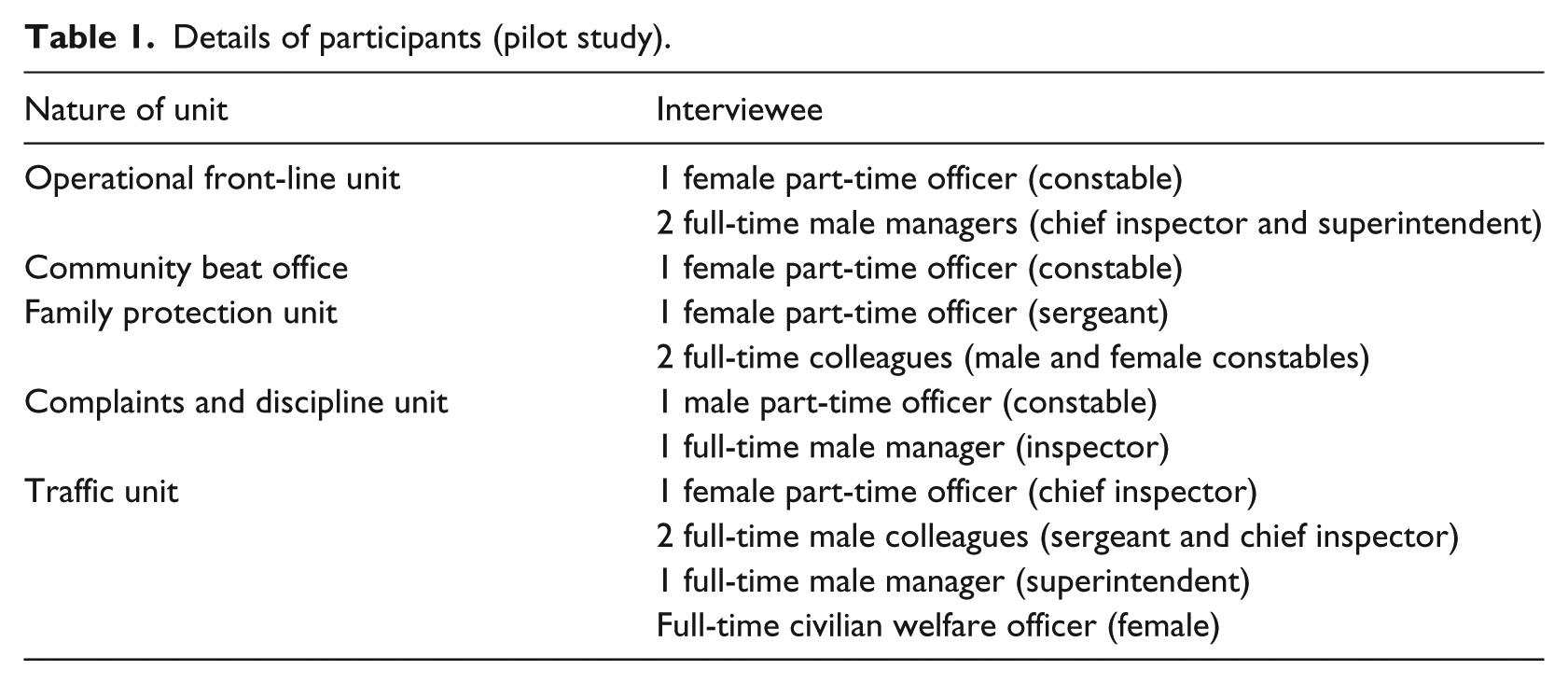
This study was originally designed to explore the experiences and management of part-time working in the UK police service. It was comprised of two phases: a small-scale pilot study conducted in one police force in 2002, and a larger-scale study extended to two further police forces from 2003 to 2005. For the pilot study, in-depth, semi-structured interviews were held with 13 police officers and the force welfare officer (see Table 1).
Details of participants (pilot study).
A focus group discussion was also carried out with the members of the force HR department. In addition, information was collated regarding national and force policy on part-time working and on the incidence of part-time working across the force.
The interview and focus group schedules were kept to a simple format:
Views of part-time working as a principle;
Experiences of working part-time or managing or working alongside part-timers;
Opinions of the force’s approach to the management of part-time working.
All interviews and the focus group discussion were tape recorded and transcribed verbatim. Among the findings from the first phase of the project was that, in corroboration of the literature (e.g. Edwards & Robinson, 1999) it was generally felt that part-time working was most successful in roles or departments that were not central to operational policing, such as the family protection unit, burglary squad, or community policing. Due to the reactive and demand-led nature of operational policing, part-time working was believed to be problematic in such roles, largely because part-time staff were not, unlike many full-time officers ‘ever-available’.
For the second phase of the project, the focus was on part-time working in central operational policing roles. The three participating forces were highly comparable in terms of size, geography and general policing demands. I will refer to them as force A, force B and force C for the purposes of this article. While part-time working had been available in the three forces for a decade at the time of the research, as discussed above, take-up was low at approximately 2% (compared to a 5% uptake of such practices within professional and professionalized occupations across the UK at around the same time period (Hogarth, Hasluck, Pierre, Winterbotham & Vivian, 2001). Over the three forces 98% of part-time police officers were female.
The primary sources of data collection were semi-structured interviews and focus group discussions. Semi-structured interviews were conducted with triads of police officers (the part-time worker, their manager and one colleague) within each force. This method of data collection has been used in previous research into part-time working (Lee et al, 2002; Litrico & Lee, 2008), and is extremely useful for generating multiple perspectives on the issue at hand, thus enabling a more nuanced analysis of any variability in the data as well as cross-checks for any claims that individuals make about specific, objective circumstances (e.g. number of hours worked).
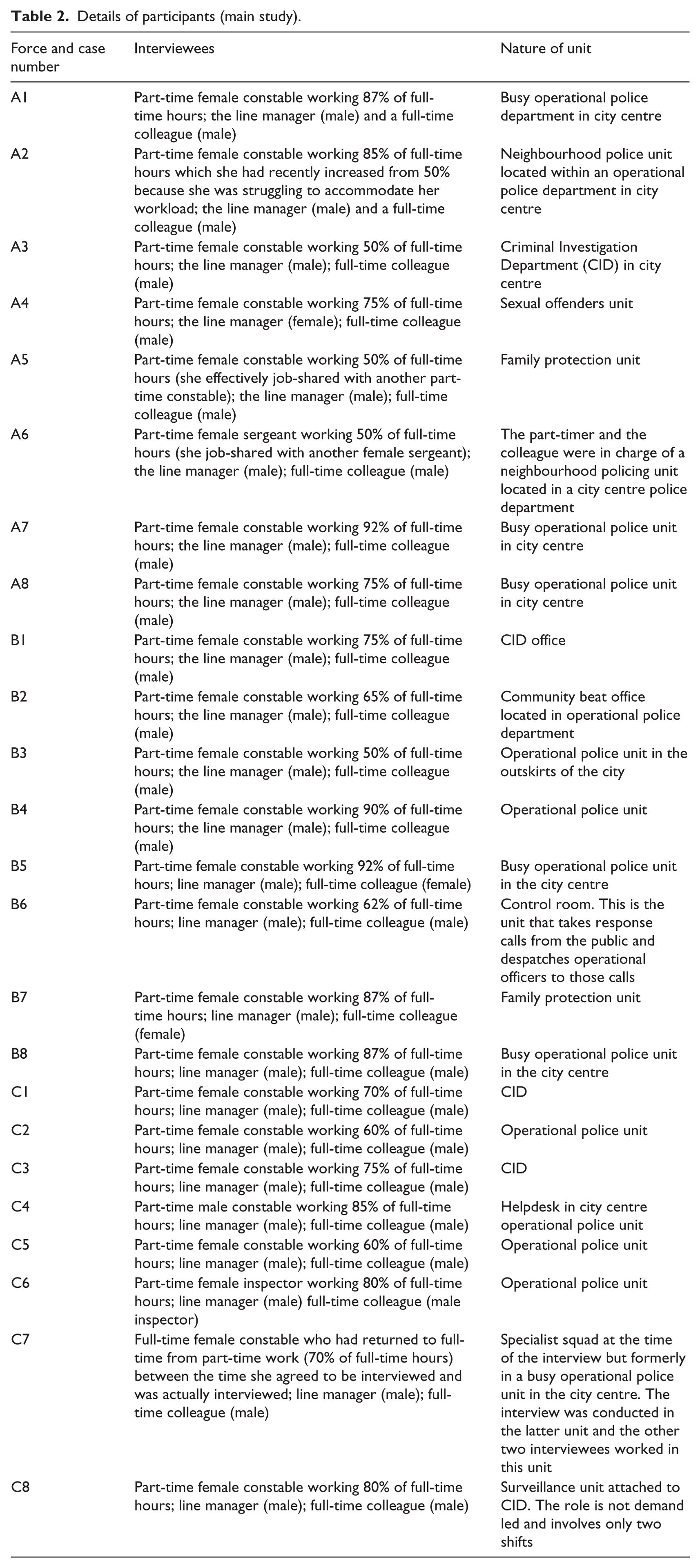
Each triad was located in a separate geographical unit. A total of 72 interviews were thus conducted, representing 24 separate cases of part-time working – 8 cases per force (see Table 2). Out of the 24 triads interviewed, 8 were not located in central operational police units. This deviation from the intended sample happened because the participating forces experienced considerable difficulties in getting people to participate in the research and the project timing was bounded by the requirements of the funding council. In addition to the triads, other stakeholders in part-time working from each force were interviewed, including a police officer responsible for designing individual schedules in force C, and three civilian members of the human resource management team from force B. The author and a research assistant travelled to different venues for the purpose of data collection. Interviews were conducted on police premises at times that were convenient to participants. Each individual interview took between 30 and 60 minutes to complete. Interviews were tape-recorded, fully transcribed and returned to the participant for checking prior to being used as data. See Table 2 for details of the sample.
Details of participants (main study).
The focus groups each comprised between 8 and 12 individuals (these were different individuals to those involved in the interviews) and were conducted twice, at the beginning and the end of the data collection period. The focus groups were conducted on police premises. The initial focus group discussion utilized the interview schedule which had been developed from the results of the pilot study, to generate prompts, and the responses obtained were used to modify and develop the schedule. Following the logic of confirmability, a core criterion through which the trustworthiness of qualitative data is evaluated (Bryman, 2004), the terminal focus groups were conducted in order to enable the researchers’ initial impressions to be offered and discussed. The focus group discussions took in the region of 60 to 90 minutes to complete. The discussions were recorded and transcribed and all transcripts were returned to participants for checking.
The interview schedule covered a range of issues broadly grouped into three categories: questions relating to the adoption of part-time working (for instance, what did participants believe to be the purpose of part-time working?), questions related to the management and experience of part-time working (for instance, who did actors believe to be the chief beneficiary of part-time working and why?) and questions related to policy (for instance, did the policy on part-time working help participants with requesting or managing this arrangement?).
In addition to the interviews, a wide array of documents on part-time policy both within specific forces and at national level and other documents, including academic papers, that had examined part-time and other flexible working practices within the police service were collected. Various HMIC (Her Majesty’s Inspector of Constabularies) documents that had reported on diversity initiatives and outcomes in the UK police service were examined. Additionally, the author and the research assistant attended a number of events, including the launch of a child-care co-ordinator service in force B and two internal conferences on part-time working in force B and force C. Field notes were taken during and after these events.
Data Analysis
Analysis of the data was principally informed in the first instance by the requirements of the participating police forces and the funding council, which were to provide in-depth information about the management and experience of part-time working in operational policing. The paper I present here, in contrast, emerged as a consequence of the data analysis and my attempts to make sense of some of the more puzzling aspects of the data (Eisenhardt, 1989), an issue I explore below. The analysis is based on information from the documents we (myself and the research assistant) examined and on the data from the focus groups and interviews. Because we had so much data, we organized it using a template (King, 2004). This involved first extracting the data question by question and looking for themes within the answers obtained, which we then coded using words that captured the theme. This was an iterative process which involved myself and the researcher developing codes individually, comparing these codes and, through a process of negotiation, refining them. We returned to the data several times as the coding progressed until we were satisfied that our coding scheme satisfactorily captured as much of the data as possible. The initial coding template generated 24 codes. Here, I focus on those codes (13 of the total) that are relevant to the analysis and these are presented in Table 3.
Final template showing data categories with descriptions and illustrative quotes.
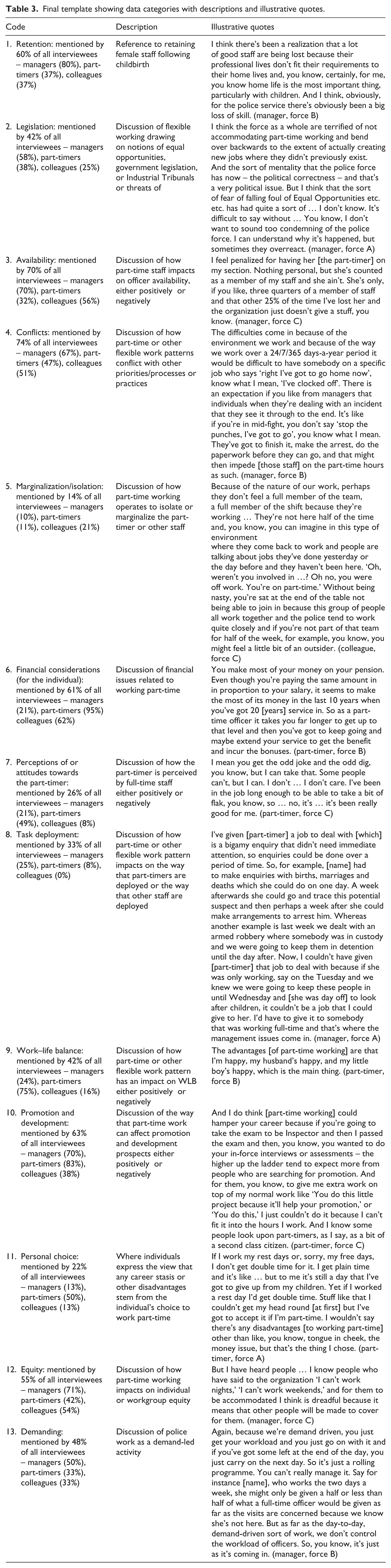
We then examined the coded themes across groups of participants (by force, role, gender and age) to ascertain whether there were any differences in the articulation of these themes, using matrices (Nadin & Cassell, 2004). There were no differences between forces in terms of the issues raised, but there were differences between members of the triads in response to the question ‘Why has the force adopted part-time working, in your opinion?’ (see Table 3 codes 1 to 2). Differences also emerged with respect to questions regarding the advantages and disadvantages of part-time working. We identified 11 themes (see Table 3 – starting at code 3 and ending at code 13) and found differences between managers, colleagues and part-timers with respect to the articulation of these themes. Table 3 gives details of the frequency of mention of these codes and illustrative quotes.
As illustrated in Table 3, in comparison to part-timers and colleagues, managers were more likely to mention issues coded ‘Availability’, ‘Conflicts’, ‘Task Deployment’ and ‘Equity’, while part-timers were more likely than managers and colleagues to mention issues coded ‘Financial considerations’, ‘Perceptions of or attitudes towards the part-timer’, ‘Promotion and development’, ‘Work–life balance’ and ‘Personal choice’. Colleagues on the other hand were more likely than part-timers and managers to mention issues coded ‘Marginalization and isolation’.
It was as I examined these themes and their different patternings across the various groups that I noticed a distinct contradiction between participants’ views and opinions of the reasons for the adoption of part-time working and their descriptions of and explanations for some the advantages and disadvantages of part-time working. For instance, the vast majority of managers cited skills retention as one of the primary reasons for the adoption of part-time working, but when talking about the advantages of part-time working, they tended to focus on the benefits accrued to the part-timer, while enumerating numerous disadvantages for the organization, particularly around conflicting priorities, goals or practices. Likewise, most part-time officers also cited skills retention as one of the primary reasons for the adoption of part-time working, but several complained that their skills and experiences were under-utilized (either in terms of deployment or career development) following their take-up of part-time work, or else, like managers, saw the advantages of part-time working as residing solely with themselves as part-timers due to improvements in work–life balance.
It was this aspect of the data that led me to Merton’s (1968) distinction between manifest and latent functions because it seemed that when participants cited skills retention as a reason for the adoption of part-time working, this reflected the official or manifest function of part-time working as written in policy documents and other formal accounts of this practice (discussed above in ‘research context’). On the other hand, issues around legislation were not mentioned in policy documents, but were raised by members of the triad as reasons for the introduction of part-time working. Hence, the absence of this issue in formal policy documents and its presence in verbal accounts was interpreted as reflecting the unofficial or latent functions of the policy which appeared to be a consequence of increased manager accountability, as discussed in detail below. Thus the initial codes and the contradictions that they revealed enabled me to make connections between different parts of the data and between the data and theory (Miles & Huberman, 1994). I used the literature on part-time working in professions (e.g. Charlesworth & Whittenbury, 2007; Edwards & Robinson, 1999; Epstein et al., 1998; Lee et al., 2000; Litrico et al., 2011), on means–ends decoupling (Bromley & Powell, 2012) and the literature on responses to institutional complexity (e.g. Greenwood, Raynard, Kodeih, Micelotta & Lounsbury, 2011) to develop further codes that could help me understand the possible relationships between the official (manifest) and unofficial (latent) functions of part-time working (detailed above) and how part-time working was both understood and managed by the actors participating in the study. I therefore drew on a number of concepts that were either present in the literature or developed inductively from the data. These concepts which are used to structure the analysis that follows, and their relationship to the template codes, are shown in Figure 1.

The relationship between relevant codes from the original template and the emergent concepts/outcomes generated from the data.
Analysis
When part-time working was introduced into police forces following the pilot, a core recommendation of the evaluation report was that ‘forces should consider how to match part-timers to those areas where they can best be used, rather than simply accommodating them in their existing departments as has been the case during the pilot’ (Stone et al., 1994, p. 57). This recommendation for coupling between the efficiency or performance needs of the organization and the use of part-time workers has not occurred in practice. Ten years on from the evaluation report, in the three forces that participated in this study, the vast majority of part-time officers were accommodated in their existing departments and there were no obvious attempts to try to use part-time staff more strategically.
Part of the issue here is the way that requests for part-time working emerge, which is ad hoc and unpredictable. However, despite the fact that the accommodation of part-time workers clearly had an impact on human resource availability, and that in some departments their accommodation was considered problematic (I return to both these issues below), there was little evidence of managers resisting or refusing to accommodate such staff, or attempting to deploy them to areas where they could ‘best be used’. This can be partly understood by the perennial shortage of staff that confronts the police service, rendering managers very reluctant to lose staff by encouraging them to relocate to roles perhaps better suited to part-time hours (33% of managers discussed this problem). However, there was also evidence in the data that even where managers believed that they had a business case for refusing a request for part-time working, this was very often dismissed or re-referred to the manager by the human resources department. This, coupled with the threat of potential grievance procedures, meant that many managers felt unable to refuse requests for part-time work on any grounds: They’ve [managers] not known what they can and what they can’t agree to and often there’s not support there from either Headquarter departments or divisions to say, ‘This [request for part-time working] is not reasonable.’ And sometimes they’re scared and they don’t like to ask. Quite often you will find that the manager is male and the part-time officer is female and it becomes a bit of a gender issue and it may be a case of, ‘Oh my word! You know, am I going to get into trouble by telling this policewoman she can’t work these particular hours?’ And they don’t like to challenge [requests for part-time working] quite often. (focus group participant, force A)
We can understand this conservative approach to the accommodation of part-time working to be a consequence of how, due to the institutional scripting discussed above, part-time working policy functions latently to hold managers accountable for their responses to requests for part-time working. In an organization renowned for its ‘command and control’ management style (Silvestri, 2007), the widespread capitulation to requests for part-time working that was evident in the data is vividly illustrative of these accountability processes. Institutional scripting not only explains the responses of managers to requests for part-time working but also how part-time officers were able to use the manifest function of the policy to make demands both about the number and scheduling of their hours and where they would be deployed. Several of the part-timers we interviewed (five in total), for example, had refused to accept administrative posts offered to them when they made requests for part-time working while on maternity leave, pushing to be accommodated in their existing operational departments on the grounds that this is what they were trained and qualified for: I mean, my main gripe [when the manager suggested the part-timer move to an administrative role] was I loved section. To me section is what you join the job for, and I didn’t want to get shipped off to an administrative role, it was like, ‘No! I want to carry on doing this.’ (part-timer, case B5)
The vast majority of participants were clearly aware of both the manifest (official) and latent (unofficial) functions of part-time working (see Table 3, codes 1 and 2) and saw these as highly legitimate reasons for the adoption of this practice. Nevertheless, it was also apparent that despite its legitimacy, many participants saw part-time working as incompatible with the requirements of operational frontline police work (see Table 3, codes 3, 12 and 13). This incompatibility was seen to be the consequence of the fact that police work relies not so much on the skills and experiences of officers (though these are obviously important) but on the availability of officers. Because part-time workers are both less available in terms of the number of hours they work and because they are often unwilling to work routine and planned overtime,
1
the police service’s standard methods of resourcing peaks and troughs in demand, this meant that considerable pressure was experienced in groups in which part-time workers were located as they struggled to cope with workloads: So if an officer is allocated a crime to investigate at the start of the week he’s, or she’s got 6 days to investigate that before she gets on to her days off. Obviously if you allocate a crime to a part-time officer then they might only have 3 days in which to investigate it and then have 9 days off. So that’s got a lot of implications for keeping complainants informed because they’ll ring up to speak with an investigating officer and they’re not available so then somebody else has to do that work for her. So, it then has a knock-on consequence onto her colleagues and then supervisors have to make a decision, of, well do we allocate half the number of crimes to [part-timer] as we would do to a full-time officer because if we do can she manage that, and if we don’t then we start to penalize her colleagues by giving them more than their fair share but are we penalizing the public if we do give it to [part-timer], and so it starts to have an impact pretty early on, in terms providing the key fundamental service that we’re here to do. (manager, case A7)
In summary, given that the official purpose of part-time work is to retain skills and experience, it would be expected that if this was seen to be strongly related to the achievement of organizational goals, managers would be expressing high levels of satisfaction with part-time staff in their units. As outlined, however, when managers discussed the impact of part-time working in their units, they often drew attention to the problems accruing from this policy. Moreover, in none of the three police forces that took part in this study were there formal mechanisms in place to monitor the outcomes of part-time working policy, such as how many requests are made each year and in which departments; destination statistics which show where part-timers are eventually employed following requests for part-time hours; the length of time part-time officers remain part-time prior to resuming full-time hours; promotion rates of part-time officers compared to full-time officers; and crucially, retention statistics. The absence of such monitoring mechanisms would suggest that, as predicted by Meyer and Rowan (1977), organizations avoid scrutiny of policy outcomes through the ‘logic of confidence’ whereby it is assumed that policies achieve their intended purposes without actually evaluating whether or not this is the case.
One of the core arguments in the decoupling literature is that where a new practice is inconsistent with and disruptive of traditional practices, organizations will work to create gaps between these traditional and newer practices often through ceremonial adoption – a situation where a practice is adopted in principle but in practice is not implemented (Bromley & Powell, 2012; Westphal & Zajac, 2001). Obviously, the very nature of part-time working means that ceremonial adoption is not feasible, since this would involve refusing to allow individuals to work part-time. One way of dealing with this problem is to compartmentalize new practices such that they have minimal impact on core tasks (Bromley & Powell, 2012; Greenwood et al., 2011) which, in the case of part-time working, could involve limiting it to non-central roles. Although the sampling strategy for this research deliberately focused on part-time work in operational units, there were several participants (see Table 2) who had either opted to work in less central roles to better accommodate their pattern of hours, or had been asked to work in these less central roles while on maternity leave. Nonetheless, we were told by the human resource department in each participating force that the vast majority of part-time workers were located in frontline operational roles. Hence while there is some degree of buffering evident in the data, it seems that no sustained efforts are being made to isolate part-time working from the core activities of the police forces studied here, despite the problems generated.
Part of this may be explained by the accountability issue discussed above and how this enabled part-timers to push to be accommodated in their existing roles, but part may be related to cost savings. The evaluation report that was published following the part-time pilot experiment stated that ‘individual managers will need to assess the impact of part-time working on department or unit strength when considering applications, especially where the acceptance of a part-timer would result in a reduction in strength in a small unit or department’ (Stone et al., 1994, p. vi). Yet, one of the most dominant messages from the managers who participated in this study was that the accommodation of part-time staff did reduce unit strength but they were not able to recoup those hours despite the claims of the human resource departments in each force that they were allowed, in principle, to do so. Contributing to this situation was that part-time officers often reduced their hours by around 20% and hence finding a replacement for, effectively, one day a week was not really possible. A further reason was that part-timers frequently worked reduced hours for a fixed period of time and eventually returned to full-time work. Some managers argued that this prevented them from recouping hours because they would be overstaffed should the part-timer revert to full-time hours. One respondent offered an alternative view of why the impact of part-time working on cover was never adequately addressed by the organization: Because at the end of the day it’s … they’ve budgeted for it. You know, if you can get away with paying someone 15 weeks less, but still count them as a strength [i.e. a number on a shift] then it’s a bonus, isn’t it? It’s just a massive game that you can’t really play, but they get away with it because no one … no one checks them. They’re answerable to no one. (colleague, case C8)
Thus a further latent function of part-time working is that it enables forces to claim that they are ‘up to strength’ whereas, in fact, they are under-strength when they count part-time staff as an equivalent resource to full-time staff, a practice that was highly prevalent at the time of this study. This, as the officer above points out, is a considerable cost saving. This finding echoes that of previous research into part-time working in professional contexts (Kossek & Lee, 2008; Litrico et al., 2011).
Hence, despite the fact that the manifest function of part-time working policy does not seem to be related to the operational goals of the units in which part-time officers are located, its latent functions go some way to explaining why part-time working is not more compartmentalized. Nonetheless, given the tensions and conflicts discussed by the participants in this study, a further puzzle concerns the lack of dissonance expressed by some managers when they articulated inconsistent beliefs about part-time work – that it is critically important for retaining skills and experience of, particularly, female staff but that they would prefer not to have part-time staff in their cadre, due to their impact on officer availability (see Table 3, row 3, for illustrative quote).
The tension expressed by managers with respect to part-time working in, particularly (though not exclusively), 2 frontline operational roles can be understood to represent a situation of inter-institutional incompatibility (Seo & Creed, 2002) between the institution of family-friendly organization (Goodstein, 1994), embedded in the practice of part-time working, and the institution of continuous coverage (Zerubavel, 1979), embedded in temporal norms such as working a full-time rotating schedule and working overtime. As discussed in the literature review, such incompatibility is theorized to represent a source of institutional contradiction which, if unresolved, can lead to de-institutionalization or dissolution of a practice (Seo & Creed, 2002). This occurs as actors reflect on the efficiency gaps created by the presence of inconsistent practices and work to better align practices with efficiency criteria.
What was notable from the data was that there was certainly evidence of critical reflection on these efficiency gaps as illustrated in Table 3, but there was little effort to make changes to either the way in which continuous coverage was provided or how part-time work was enacted, except in one case discussed in the next section. Some managers did, however, draw attention to the fact that incompatibility between part-time working and providing continuous coverage was the consequence of the headcount mode of resourcing policing units (85% of managers). That is, units are staffed according to the number of officers in the unit not in terms of the hours those officers contribute over any given period of cover, as illustrated by the quote in Table 3, row 3 and discussed above. Some managers (five in total) had attempted to argue for a full-time equivalent resourcing model (i.e. that they be allowed additional resource to fill the hours left unresourced because of the presence of part-time staff) in their efforts to address this issue, but only two managers succeeded in obtaining additional resource.
Nonetheless, despite both the critical reflections on the problems generated by part-time working and the failure of attempts to modify existing practices (i.e. full-time equivalent resourcing) so as ameliorate it, not one manager suggested that part-time work should be disallowed in operational roles or suggested that continuous coverage needed to be provided in a different way. That is, these problems did not invoke many instances of ‘critical evaluation of current practices or institutional arrangements and the search for alternatives’ (Seo & Creed, 2002, p. 233). To explain this situation, I use the term ‘institutional satisficing’ to illustrate how managers avoided dissonance as they reflected on the inconsistencies between part-time working and the provision of continuous coverage. Satisficing is a construct from decision-making theory in which a ‘good enough’ situation is achieved relative to a reference point: ‘poor performance below the reference point requires action, while performance above it is deemed satisfactory and thus does not’ (Arrfelt, Wiseman and Hult, 2013, p. 1083). In the data collected for this study, there was evidence that for many managers (55% of the total) the critical reference point was the number of part-timers in their units,
3
though this depended on the extent to which they perceived their units to be chronically understaffed (three of the four CID units participating in this study fell into this category) and on how they actually responded to significant numbers of part-timers. The two quotes below illustrate these different perspectives: I mean at the end of the day we are part of a best value authority as well so, we’ve got to be efficient and effective and if [part-time working] starts affecting that, having too many part-timers, then we’d have to look at it again but like I said there’s very few people who are part-time so it doesn’t create a massive problem. (manager, case A7) I’m a great champion for [part-time working] because the CID’s in such a state at the moment. We don’t have ready-made replacements for people that move on. It used to be that there was a big demand for places in the CID. That isn’t the case now and if I lose somebody on promotion or they retire or they go to one of the specialist squads, I don’t automatically get a replacement. So, if I’m offered somebody that’s going to work part-time, that is better than the alternative of probably being offered nobody, so from that perspective, yes it’s working. (manager, case B1)
Where part-time working was seen as problematic in units, as long as this was perceived as containable, managers were prepared to sanction and even endorse the practice. In doing so, some managers (54%) drew on the manifest function of part-time working to rationalize this perspective: I’m sure the organization does [benefit from part-time working] because as I say otherwise there’s probably a possibility they might have lost that expertise. So I’m sure they do benefit. Probably having a person for a part or three quarters of the time is better than not having the person at all, ain’t it? (manager, case A6)
Institutional satisficing thus reflects a situation in which the efficiency gaps generated by inter-institutional incompatibility are considered to be problematic only when these surpass a ‘zone of acceptability’, which is subjective (i.e. likely to vary from manager to manager), context-dependent (i.e. differs according to specific local conditions), dynamic (liable to change depending on circumstances – see next section) and embedded in a highly legitimate logic (i.e. that part-time work is both morally and pragmatically justifiable).
One of the unintended consequences of the understaffing often exacerbated by part-time working was the generation of in-group dissatisfaction with workloads. Many of the full-time colleagues we interviewed (45% of the total) complained that the part-time officer’s relative lack of availability meant that they were having to pick up work that the part-timer had not been able or was not available to complete. In one unit (case B8), there was an ‘unusual’ number of part-time officers and this had generated such a degree of disgruntlement that the manager had decided to intervene. He had held meetings with the full-time officers to, in his own words, ‘purposefully use the experience of the part-timers’ to persuade this group that the part-timers were of value, and then went on to tinker with the integration of the part-time staff by partnering them with more junior or probationer colleagues. According to the manager, not only did this ameliorate the intra-group conflict but also increased the group’s efficiency because part-timers could ‘use their experience to deal with things a lot quicker’.
Further examples of recoupling occurred in a similarly emergent manner. As discussed above, while managers were unwilling to refuse requests for part-time working, the vast majority did insist that the part-timer’s proposed schedule should align with the shift pattern of the group to which they were allocated. A variety of justifications were proffered for this insistence, chief among them the idea that the part-time officer’s welfare needs could not be adequately managed if they were working a pattern of hours that resulted in more than one supervisor being responsible for them. However, in three cases (B1, B4 and A7), there were part-timers who had been allowed to work a pattern of hours which meant they were attached to several groups over the course of a particular period of duty. The reason for this was that the manager and the part-timer had been unable to reach a satisfactory compromise and the manager was reluctant to push the part-timer into accepting the pattern they would have preferred. In one case this was because the manager did not want to precipitate the intervention of the HR department and, in another, because the unit was so short staffed the manager did not believe he had any choice. In these cases managers had had to seek approval from the head of division before approving this unusual arrangement, and in each case, they told us, had drawn on rhetoric concerning the skills and experience of the part-timer to obtain this approval: I didn’t have any problem at all. I discussed it with the divisional personnel officer, I mean she’s very receptive to it really. She was of the same opinion as myself, that, this was a good officer who’s well thought of, she’s experienced and she’s coming back, you know, she’s coming back, albeit with slightly reduced hours and, you know, she would be an asset coming back, so we would do, providing we can still effectively supervise her, which we are doing, there is no real issue for the division. (manager, case B4)
What was most interesting about these cases, however, was that because the part-timers were not counted as belonging to one particular group, they were perceived as bonuses to, not drains on, cover, because effectively the groups with which they worked, albeit for a relatively short stretches of time, gained an additional pair of hands. Additionally, because like many part-timers, these individuals were trained in some or other specialist skills (e.g. video interviewing – case A7, police driver – case B4), they were seen as providing especially valuable services to the groups they worked with.
In these cases then, the manifest function of part-time working is actually apparent – the skills and experience of the part-time staff are being retained in ways that are perceived to be closely aligned with what is needed for service provision in the groups with which they work. These cases, I suggest, illustrate how the legitimacy of the manifest function of part-time working can be deployed as a convincing rhetorical device which worked to assuage full-timers’ misgivings about part-time staff and to persuade power holders that part-time workers could be accommodated in what could be considered controversial ways. More fundamentally, the manifest functions of an institutionalized practice can be thought of as tools (Swidler, 1985) which actors can use, improvisationally, to define what counts as a problem (that part-time staff lack value in the eyes of full-timers) and/or to develop a viable solution to a problem (the value of part-time staff can be proven by partnering them with full-time staff; their levels of experience mean that they can be trusted to work across groups). What is important in these cases is that the recoupling of means and ends was not an intentional outcome of these managers’ implementation activities, but the rational appeal of this outcome works as a ‘clinching argument’ (Wetherell & Potter, 1992), a coherent and credible justification for activities that run counter to organizational norms.
Discussion and Contributions
In this paper, I have argued that the implementation of part-time working in the UK police service can be considered to reflect a case of means–ends decoupling. Despite the fact that the official goal of part-time working is to retain the skills of (mainly) female staff, in reality, it seems that these skills are not understood to be central to organizational performance in many of the units in which part-timers are accommodated. Thus although the adoption and implementation of part-time working certainly helps organizations satisfy external and internal pressures for legitimacy, like many practices implemented for such purposes its relationship to organizational goals and efficiency is at best unclear and, at worst, questionable. In an era where organizations are expected to be able to rationally account for their activities, this not only begs the question of why retaining female staff is important, but also produces a schism between the stated purposes of part-time working and the actual enactment of part-time working. The literature on means–ends decoupling, though very limited, suggests that this might be difficult to sustain when practices are not compartmentalized or isolated from the organization’s core tasks; when actors experience dissonance about the means–ends gap; or when a practice is monitored closely to ensure that means and ends are coupled. These processes, it has been argued, operate to generate conflict and debate which feed forward into the institutional environment, producing endemic reform (Bromley & Powell, 2012), or else incite actors to work (either willingly or unwillingly) towards a closer alignment of means and ends (Fiss & Zajac, 2006; MacLean & Benham, 2010).
I have argued that this persistence can also be understood by examining the relationships between the manifest (official) and the latent or unofficial functions of a given policy and how these are the products of ‘institutional scripting’ (Armstrong et al., 2012). Institutional scripting refers to the efforts of institutional actors, such as policy makers, to influence how external and internal audiences understand a given practice and its value, so as to protect the organization’s legitimacy. One consequence of institutional scripting is that it renders various aspects of an implemented policy evaluable and hence increases the accountability of actors responsible for policy outcomes. I argued that it was this process which explained why managers were prepared to accommodate part-time workers in frontline roles despite the perceived incompatibility between part-time working and the demands of such roles. This accountability process furnishes part-time staff with power resources, enabling them to push line managers to allow them to work in frontline units on the grounds that frontline work is what they have been trained to do. Thus, even though the majority of managers interviewed for this study did not see part-time working as enabling them to better meet the needs of their units by providing them with critical or core skills (its manifest function), it did enable them to avoid claims of discrimination or grievances (its latent function).
While the latent function of part-time working explains why managers were prepared to accommodate it in units where it was perceived to generate considerable efficiency gaps, less explicable is why managers expressed little, if any, dissonance about these gaps. I coined the term ‘institutional satisficing’ to explain this situation, which describes the process through which ostensibly incompatible institutions are reconciled. Satisficing is a term originally coined by Simon (1947) in his theory of ‘bounded rationality’. Rejecting the idea that decision making is an essentially rational process, Simon argued that individuals are constrained both by the limitations of their own cognitive capacities and by practical exigencies. Faced with the need to make decisions within such constraints, Simon argued that managers would engage in satisficing, a decision-making process in which pragmatically acceptable decisions are made that are not necessarily optimal. Based on these ideas, I suggest that managers will accept the disadvantages accrued by the presence of part-time workers as long as these do not exceed a subjectively calibrated ‘zone of acceptability’, a judgement about the relative impact of such disadvantages that is often based on the numbers of part-time officers present in the unit. That is, managers will tolerate part-time working as long as they believe that the pragmatic benefits of it (retaining an officer/preventing a grievance) are balanced with the needs of the unit (having enough staff to cover a period of duty).
But even this was not in any sense predictive of such tolerance. Contextual issues such as recruitment problems meant that some managers did not perceive part-time working as generating efficiency gaps despite the ostensibly identical problems of part-time working in the policing context, namely, limited availability. Moreover, despite the fact that several participants believed that part-time working enabled forces to save money on staffing, this did not in any sense impact on the perceived legitimacy of part-time working as these actors blamed the organization for this situation, not the individual working part-time. Thus a further contribution of this study is to understandings of the conditions that give rise to the experience of institutional contradiction. Specifically, the findings from this study suggest that the efficiency gaps theorized by Seo and Creed (2002) to proceed from inter-institutional incompatibility are contingent on local processes that are highly variable, contingent and dynamic.
The study also contributes to the literature on recoupling, which suggests that this may be the consequence of how particular actors intentionally align practices with outcomes either because they are ‘good soldiers’ determined to see this process through (Hallett, 2010), or else because while initially recruited to enable symbolic compliance, over time they acquire the power to institute practices as intended (MacLean & Benham, 2010). Here, I suggest that institutional scripting (Armstrong et al., 2012) can act as a further recoupling mechanism because of how it operates to shape both what actors come to understand as organizational problems and actors’ interpretations of the unintended consequences of their actions (Heimer, 1999). It was, for example, as units became stretched by the drain part-time working imposed on already limited resources that the manager in one unit decided to intervene in the disgruntlement he detected among full-time staff by coupling part-time work more closely to the performance needs of the unit. Similarly, while the primary reason for allowing cross-group working was simply to avoid problems caused by a lack of agreement between managers and part-timers regarding the scheduling of the latter’s hours, the manifest function of part-time working operated as a credible script both to justify this novel practice and to make sense of some of its outcomes. The desirability of means–ends coupling or, in other words, the rationality of the manifest function of part-time working may therefore be used as a tool (Swidler, 1985) by organizational actors as they strive to give coherence to their on-the-ground efforts to deal with the everyday mundane problems with which they are confronted. Such problems nonetheless are constituted as such through how the manifest functions of a practice direct actors’ attention to particular issues (e.g. how to best utilize the skills of the part-timer) (Heimer, 1999).
Finally, the paper also contributes to the literature on part-time working in professions. A number of studies have presented findings suggesting that organizations differ in their overall approach to the implementation of part-time working, which can be characterized using a continuum taken from the organizational learning perspective – exploiting vs exploring (Lee et al., 2000; Litrico & Lee, 2008). Firms favouring an exploiting approach to part-time working tend to be those who ‘treat individuals seeking reduced-load work as exceptions’ (Litrico & Lee, 2008, p. 997) and the focus is on maintaining established routines. Those favouring an exploring approach, in contrast, are keen to experiment with part-time working, often willing to adapt existing structures, such as career tracks, so as to learn from part-time working. This study suggests that these approaches to part-time working may also be apparent within as well as between organizations and that such approaches may be contingent on how invested actors are in existing institutional arrangements. For instance, while for all the managers in this study, the institution of continuous coverage was understood as unassailable (see Zerubavel, 1979, for a discussion of this situation), some were more willing than others to accede to alternative modes of providing such coverage. Some for example, recognized the limitations with headcount modes of resourcing, others were not married to the view that all officers needed to belong to a single team schedule, and one manager used the experience and skills of the part-timer as an opportunity to change how everyday routines were accomplished. Further research is needed to understand what influences different levels of investment in existing institutional arrangements. Kellogg (2005), for instance, in a study examining attempts to change a long hours culture in a hospital setting, argues that individuals with domestic commitments are more likely to support such changes, suggesting that such investment may be at least partly related to either gender (given that women in many societies continue to assume the primary responsibility for the domestic sphere) or role commitments (i.e. the extent to which the individual prioritizes work above home).
The study also has a number of limitations. First is that it was not designed to be longitudinal. The data were collected over a two-year period, which this involved making over 30 separate visits to various, sometimes widely dispersed, geographical locations across the three participating police forces. As a consequence, the processes leading to the emergence of the outcomes that are the focus of the analysis have had to be retrospectively pieced together using the interview data, which could be productive of bias (MacMillan, 1993). Nonetheless, the fact that the interviews were conducted with different stakeholders (part-timers, managers and colleagues) means that the analysis is based on multiple perspectives and thus reduces the potential for recall or motivational bias. Second, the study involves a relatively small sample of cases of part-time working and hence the extent to which the findings are generalizable across the three forces studied here and to other professional and professional service organizations is questionable. Nonetheless, the concepts developed as a consequence of this paper are likely to be transferable to other similar settings and hence their utility and scope of application can be assessed in future research.
Conclusion
Despite the persistent decoupling of part-time working from the achievement of organizational goals in the police service, the rationality of its manifest function (the retention of skills and experience) furnishes the practice with considerable moral and pragmatic legitimacy (Suchman, 1995). This works to maintain actors’ logic of confidence in part-time working in a context where managers perceive themselves as highly accountable for its implementation and outcomes. As managers wrestle with the problems of aligning part-time working with the needs of their units, the recoupling of means and ends can be an emergent consequence of such efforts, because of how the manifest function of the policy is used as a tool (Swidler, 1985) to justify novel enactments of part-time working and to make sense of the apparently positive impact of these enactments. The findings of the study are additionally relevant to practitioners who will be able to use them to help professional and semi-professional organizations wrestling with the implementation of part-time working to think more carefully about existing temporal and role structures and the extent to which these are, in themselves, preventing the optimal use of part-time staff.
Footnotes
Funding
This research was funded by the Economic and Social Research Council (ESRC) Grant Ref: 000-22-0336