




Abstract
Complex innovation processes such as drug discovery present challenges to innovators because they must proceed with limited feedback but face a system that involves enormous amounts of information and unknown interdependencies. Organizational scholars suggest that abductive reasoning fits complex situations and may address many of the challenges of complexity. Abductive reasoning is a form of reasoning that generates and evaluates hypotheses in order to make sense of puzzling facts. Existing research on abductive reasoning makes a number of important contributions, but does not explain how innovators can use abductive reasoning to formulate hypotheses for possible new products and then use these hypotheses to navigate in the labyrinth of complex product innovation. We interviewed 85 scientists and managers working in the biopharmaceutical industry and use grounded theory building to develop a new framework. Our framework identifies three social mechanisms that explain how innovators use abductive reasoning to detect useful information despite the noise, avoid competency traps and local optima, and accumulate insights in a holistic way. We contribute to existing research by explaining the systematic process that enables innovators to overcome the challenges of complex innovation and navigate effectively in the labyrinth.
Introduction
Many of society’s most pressing problems such as healthcare, poverty, and alternative energy are systems of complex innovation. However, complexity poses significant challenges for innovators because it involves searching for solutions to problems that are poorly defined. The search is characterized by protracted timelines, a great deal of uncertainty, and a lot of noisy information (Tsoukas, 2005). Most existing innovation practices were developed for incremental innovation and do not work for complex innovation (Leifer et al., 2000; Van de Ven, Polley, Garud, & Venkataraman, 1999). As innovators search complex systems, they need to evaluate alternatives and find workable solutions with no clear method to assess their progress. Innovators may settle on local optima with low performance, or overlook the many unanticipated interdependencies among components (Baumann & Siggelkow, 2013). To depict how innovators work on complex innovation, we adopt Denrell, Fang, and Levinthal’s (2004) metaphor of navigating in a labyrinth. Denrell et al. (2004) explain that predictable problems are like a T-maze, where actors choose one of two branches to go down and receive a reward with some probability. Complex problems are like navigating in a labyrinth, because feedback is available only after actors perform a sequence of actions that take them to another decision context, not to the outcome. Actors use mental models of the problem to navigate in the labyrinth, making predictions along the way and adjusting their models based on conditions en route.
Scholars suggest that abductive reasoning may enable innovators to navigate in the labyrinth of complex product innovation (Dunbar, Garud, & Raghuram, 1996; Garud, Gehman, & Kumaraswamy, 2011b; Grandori, 2010; Simon, 1977; Weick, 2005). Abductive reasoning “refers to reasoning that forms and evaluates hypotheses in order to make sense of puzzling facts” (Thagard & Shelley, 1997, quoted in Weick, 2005, p. 433). However, how innovators use abductive reasoning to formulate hypotheses for possible new products and then use these hypotheses to navigate in the labyrinth of complex innovation remains unknown.
Our research question is: How do innovators use abductive reasoning to create new products in the context of complexity? Our answer, developed through grounded theory building, is a new framework that explains how innovators use abductive reasoning to detect useful information despite the noise, spot minor perturbations that can escalate into major issues rather than get trapped in local optima, and accumulate insights rather than break the problem down into fragments. Our framework identifies three social mechanisms that define what it means to form and use hypotheses in the context of complex product innovation, and explain how to navigate in the labyrinth of complex product innovation. We also address why these three social mechanisms help innovators overcome the challenges of complexity.
The parts of our framework are labeled social mechanisms. The mechanisms require connections between people throughout the organization as they work to create and develop a new product. These mechanisms are considered social because people collectively carry them out. A mechanism, defined by Davis and Marquis (2005, p. 336) who quote Hernes (1998, p. 74), is “a set of interacting parts—an assembly of elements producing an effect not inherent in any one of them. A mechanism is not so much about ‘nuts and bolts’ as about ‘cogs and wheels’—the wheelwork or agency by which an effect is produced.”
Our study contributes in two ways. First, we develop a framework for how abductive reasoning provides the deliberate and methodical process that enables innovators to overcome the challenges of complex innovation and navigate effectively in the labyrinth. Our analysis indicates that abductive reasoning is the foundation for managing complex product innovation because it provides the qualitatively different approach to building knowledge about potential new products that complex innovation requires (Leifer et al., 2000; Van de Ven et al., 1999). Second, we develop new insights into how organizations use abductive reasoning for complex innovation problems. These insights extend the existing but mostly conceptual work on abductive reasoning in organization studies by articulating specific ways that people can formulate and evaluate hypotheses to make sense of puzzling facts. We do not resolve philosophical debates about abductive reasoning, but we do build on the perspective that situated social activity plays an important role in sensemaking (Tsoukas & Knudsen, 2005; Weick & Roberts, 1993). Our analysis opens the door to more in-depth empirical studies of how people and organizations enact this form of reasoning.
The context for our study is drug discovery in biopharmaceuticals. We look at the first six years of an approximately thirteen-year process that comprises all of the work from the discovery of a promising idea through “proof of concept,” where the drug is tested on a small sample of people (phase IIB of clinical trials). The process is concerned with the search for new molecular entities that have not been marketed before. Developing new drugs for unmet medical conditions such as cancer or Alzheimer’s is a complex process (e.g., Pisano, 2006; West & Nightingale, 2009). As an indicator of the complexity, the number of new drugs approved per billion US dollars spent on research and development continues to decline despite dramatic advances in the biomedical sciences underlying drug discovery (Scannell, Blanckley, Boldon, & Warrington, 2012). The average time from target discovery to approval of a new drug is thirteen years, the failure rate exceeds 95 percent, and the cost per successful drug exceeds one billion dollars after accounting for all the failures (Collins, 2011). Biotechnology has not produced the promised breakthroughs in the drug discovery process or in industry profits (Gittelman, 2014; Hopkins, Martin, Nightingale, Kraft, & Madhi, 2007; Sammut, 2005). A variety of possibilities underlie problems in pharmaceutical R&D productivity, but most industry experts suggest that something is wrong with the innovation process itself.
Theoretical Background
Complex systems involve many parts that interact in unpredictable ways, because relationships among causes and effects are unknown. The parts are interdependent, so even a minor change in one can trigger system-wide transformations (Plowman, Baker, Beck, Kulkarni, & Solansky, 2007; Simon, 1977). While much work on complexity examines the emergence of organizational collectives and other similar complex adaptive systems, these characteristics also apply to innovation processes that are themselves complex systems. Developing new drugs to treat unmet medical conditions such as cancer or Alzheimer’s is a complex innovation process that depends on the creation, combination, and recombination of knowledge about proteins that may be part of a disease, about chemical compounds that can mediate these disease processes, and about how targeted proteins and chemical compounds interact with the rest of human biology (Pisano, 2006; Sammut, 2005).
Denrell et al. (2004) suggest that complex innovation processes can be understood as navigating in a labyrinth, but they do not explain how innovators might deal with the challenges that complexity presents. We synthesize the many issues that these innovators face into three basic challenges that they must deal with: moving forward in spite of the enormous amount of information, avoiding competency traps, and untangling problems in manageable ways. Then we summarize the organizational research on abductive reasoning and outline some limitations of this research.
The challenges of complex product innovation
The first challenge is that innovators working on complex new products have to deal with an enormous amount of information, and they struggle to focus their search for solutions to the poorly defined problems they face. Uncertainty increases the amount of information that must be processed, and much of the information is noisy, surprising, and seemingly random (Tsoukas, 2005). In the case of drug discovery, large amounts of noisy information arise in part from the huge search landscape. Nightingale (1998) quotes one discovery scientist who suggested that there may be 10180 possible molecular entities, while there are only 1073 particles in the universe. Scannell et al. (2012) explain that there could be between 1026 and 1062 chemotypes that meet the criteria for an oral drug, each with many derivatives. In addition, each compound is intended to bind to a single protein, but there are anywhere from one to twenty million proteins in the human body that interact in unknown ways (Pisano, 2006). To overcome this challenge, innovators need a way to focus their search that encompasses and leverages, rather than ignores, noisy information.
The second challenge is the tendency to become stuck in competency traps or local optima. As Baumann and Siggelkow (2013, p. 129) explain: The challenge raised by complex systems is inherently perilous: because complex systems create vast and multi-peaked spaces of potential alternatives, the risk of ending up with a set of choices that create low performance, i.e., a low local peak, is significant.
People tend to land on local optima because they have a much harder time interpreting “alternatives, their consequences, and their possible impact on problem solving when conducting distant search” (Afuah & Tucci, 2012, p. 359). Weick (2005) uses the Challenger disaster and 9/11 to illustrate local thinking. The debris strike that caused the Challenger disaster was categorized as a familiar problem that could not cause serious harm to the vehicle while for 9/11, intelligence experts could not imagine that airplanes would be used as weapons. Familiar categories abstract the actual phenomena by stripping away details, but details are important for understanding new possibilities. Drug discovery has shifted from random screening to more “rational” or guided processes (Henderson, Orsenigo, & Pisano, 1999), which should help look beyond local knowledge. However, unless all these new search techniques are effectively integrated into discovery, they may only “stretch the landscape,” as Pisano (2006) suggests. The very long development time for new drugs introduces additional local optima from temporal complexity (Garud, Dunbar, & Bartel, 2011a). Asynchronies in developing different aspects of a product may make intermediary models look like useless mistakes to be weeded out, or like finished efforts to be pushed forward prematurely. To overcome the tendency to get stuck on local optima and search more broadly for good models, innovators need a way to examine more alternatives and build more effectively on intermediary models.
The third challenge for innovators concerns how to untangle the “knots” that complex systems continually create, and articulate the problems of search in manageable ways (Perin, 2005). The common method for untangling problems is to decompose them into separate parts. Decomposition presumes that parts are nested in an orderly hierarchy with defined connections, which is not the case in complex systems. Drug discovery is characterized by many unknown interdependencies among chemical compounds, disease processes, and the rest of human biology (Collins, 2011; West & Nightingale, 2009). Even a minor change in a compound (e.g., to make it more soluble) can create damaging side effects, but these consequences may not be discovered for some time. Because of the unknown interdependencies, the necessary untangling needs to be done holistically, so people can keep the possible interactions in mind even as they work locally (Pisano, 2006). But efforts to scale up steps impose some hierarchical decomposition on drug discovery (Scannell et al., 2012). To overcome the tendency to decompose the problem into separate steps, innovators need a way to keep the whole in mind as they work on different facets.
Most innovation practices that innovators typically draw on to deal with the challenges they face in their work were developed for incremental innovation processes and do not fit complex systems. For example, innovation management literature emphasizes the need to develop a very sharp and complete product definition at the outset of a project, which is used as a blueprint for integrating the various functions and for bringing the product to fruition and launch into the market (Cooper, 1998). This sharp, complete definition is a conceptualization of how the product might work, a holistic hypothesis. However, this practice overlooks the challenges of complex innovation because in complex contexts innovators cannot know at the outset of a project what specific functionalities are possible. Further, research suggests that innovators’ inability to get their arms around the full set of uncertainties involved in a project contribute to the ad hoc, crisis-oriented management practices found to dominate radical innovation processes (Leifer et al., 2000).
Studies of radical innovation (Leifer et al., 2000; Van de Ven et al., 1999) highlight practices that may be important in the context of complexity. Van de Ven et al. (1999) suggest that innovators cycle repeatedly between divergent searching that explores a broad product vision and a convergent search process to choose among elements via trial and error learning. Leifer et al. (2000) find that radical innovators iterate among a mosaic of organizational, technological, market, and resource uncertainties, and not in any linear or sequential fashion. While innovation management research does not comprehensively address the challenges outlined here, these few studies of radical innovation do provide some insight into practices that may be important in the context of complex innovation.
Abductive reasoning: Potential and current limits for dealing with these challenges
Organizational scholars also suggest that abductive reasoning fits complex situations and can potentially help address these three challenges (Abolafia, 2010; Garud et al., 2011a; Grandori, 2010; Dunbar et al., 1996; Simon, 1977; Weick, 2005). Abductive reasoning was defined at the outset of this paper as “reasoning that forms and evaluates hypotheses in order to make sense of puzzling facts” (Thagard & Shelley, 1997; quoted in Weick, 2005, p. 433). Others define abductive reasoning in similar ways. According to Magnani (2001), abductive reasoning or abduction is a process of forming an explanatory hypothesis for poorly defined phenomena. He defines it as “the process of reasoning in which explanations are formed and evaluated” (Magnani 2001, p. 18). Grandori (2010, p. 490) says: Abduction or ‘retroduction’ [as called by the original proponent of the concept, Charles Sanders Peirce, 1935] can in fact take two forms: ‘empirical’ (recognize patterns in data and posit laws that can regulate them) (Simon, 1977) or ‘theoretical’ (formulate theory based, casual hypotheses from which the observed or sought action/consequence chain would follow) (Hanson, 1958).
Locke, Golden-Biddle and Feldman (2008, p.907) also draw on Peirce, explaining that “deduction proves that something must be; induction shows that something actually is operative; abduction merely suggests that something may be” (emphasis in original).
Innovation, by definition, requires that people not only hypothesize a novel idea, but also bring that novel idea into use (Schön, 1967). To use abductive reasoning for innovation, we build on the understanding that it is not a single step of hypothesis formation, but the process of using that hypothesis to understand a puzzling situation, consistent with Magnani (2001), Locke et al. (20087), and Nesher (2001). Magnani (2001), Paavola, Hakkarainen, and Sintonen (2006), and Mantere and Ketokivi (2013), among others, argue that abductive reasoning also underlies the processes scientific discovery, which is our empirical focus. Other studies of science do not use the term abductive reasoning, but highlight scientists’ practices of knowing that are consistent with abductive reasoning (Grinnell, 2009; Latour & Woolgar, 1979). Nightingale (2004) argues that scientists cannot confirm hypotheses deductively when knowledge is limited and fragmented, because experiments will likely fail and the results provide no indication of where else to explore. Instead, scientists rely on a style of research based on discovery and understanding, not on prediction and testing. Scientists tinker with experimental conditions to identify and fine-tune more promising alternatives (Pavitt, 1987), and compare divergent implications of competing explanations.
Despite the potential of abductive reasoning for dealing with the challenges of complex innovation, the existing literature is mostly conceptual, and provides limited insights for how people actually use this form of reasoning for particular problems like complex innovation. Based on definitions of abductive reasoning, we expect that innovators would use abductive reasoning to formulate and evaluate hypotheses about possible complex products. We use the term “hypothesis” to refer to an unproved theory or supposition that explains, in the case of product innovation, how a possible new product might work, and provides the basis for further investigation. While the literature does not explain how innovators might formulate and evaluate these hypotheses, we synthesize conceptual ideas from organization scholars about abductive reasoning to specify some important contributions and limits to existing literature.
With regard to formulating hypotheses, Denrell et al. (2004) suggest that “mental models” of the problem are necessary to navigate because they seed the search with possibilities while constraining the search from less likely arenas. However, they do not explain how people can develop such mental models. Grandori (2010, p. 484) suggests that the problem should be defined as a performance potential. The problem is formulated as a theory-based causal hypothesis, with causes understood as available resources with potential for action (Penrose, 1959), and effects understood as useful consequences. “Alternatives are generated according to cause-effect hypotheses: certain resources (e.g. polyphenols) are hypothesized to be put to certain causes (e.g. food production), which in turn should produce consequences that may be evaluated as desirable (health) and valuable also in economic terms” (Grandori, 2010, p. 484).
Weick (2005, p. 433) provides a different approach for formulating a hypothesis, one that starts with a clue and then discovers or invents a world in which that clue is meaningful: Current use of this broadened sense of abductive reasoning is found in the work of people such as Ginzburg (1988), Harrowitz (1988), and Patriotta (2004) who argue that the conjectural paradigm, grounded in abductive reasoning, is the foundation of inquiry. The basic idea is that when people imagine reality, they start with some tangible clue and then discover or invent a world in which that clue is meaningful. Imagination “conceives a whole design almost at once, which it then fills out and gives body to by particular association…. The mind thinks simultaneously of specific parts and of their one organizing principle” (Engell 1981, 82–83). This act of invention is an act of divination that has a close resemblance to detective stories.
In Weick’s (2005) thinking, the hypothesis that is formed is a world or a whole design, which is different from Grandori’s (2010) hypothesis about potential, but not inconsistent. Garud et al. (2011a) use abduction to explain how people in organizations identify possibilities in narratives of unusual events that are relevant to their own situations. The narrative that is formed through abductive reasoning is similar to Weick’s imagined world, it entails a coherent set of events with a beginning, middle, and end. This research suggests that abductive reasoning involves formulating a hypothesis, one that would build on clues to a whole world and reflect potential, yet little research explains how a hypothesis might be formulated in the context of complex product innovation where the requirement is not only developing a novel idea, but also bringing that idea into use.
The next aspect of abductive reasoning is evaluating hypotheses “in order to make sense of puzzling facts.” According to Denrell et al. (2004), actors generate the feedback they need to evaluate their progress by making predictions from their intermediary models, and adjusting the models to accommodate deviations from those predictions that they discover as they navigate in the labyrinth. Grandori (2010) suggests that, rather than expecting results based on parameters that are fixed ex ante, people empirically inquire into the hypothesis with actual results, and look for surprises. Weick (2006, p. 786) quotes Harrowitz (1988, p. 88) who says that by using abductive reasoning, people are able to “leap from apparently significant facts which could be observed to a complex reality which—directly at least—could not.” Nightingale (2004) explains that scientists working in complex conditions create something new to learn from, and use that knowledge to move from simplified laboratory experiments that isolate particular mechanisms to increasingly complex settings. Knorr-Cetina (1999, p. 92) finds that microbiologists do not try to understand the numerous problems that arise in their experiments because “their attempts to understand a living organism, of which little is known, quickly reached its limits.” Instead, they treat problems by “varying components of the experimental strategy until things worked out, not by launching an investigation of the cause of the problem.” Abductive reasoning suggests that innovators need to leverage intermediary models to navigate systematically, examine alternatives, and build more effectively on intermediary models. Innovators should look for surprises, leaps, and varying experimental strategies to make sense of puzzling facts, but research has not studied how these general ideas are applied to the context of complex innovation.
Several scholars directly or indirectly extend the abductive reasoning process by suggesting a third aspect that would help accumulate insights—reframing. Tsoukas (2005) cites Orr’s study of copy repair technicians, in which solutions were discovered through reinterpretation of known facts and then following the new interpretation with new investigations. Denrell et al. (2004) also emphasize changing the mental model to create a fresh perspective and see new aspects of the problem. Grandori (2010) warns against lowering aspiration levels when results are not as expected. Instead, decision makers should reformulate their model and create new performance objectives that reflect new resource alternatives and consequences. Dunbar et al. (1996) suggest deframing by using abductive reasoning to reconsider assumptions and open up the reasoning process to alternate explanations. Majchrzak, Logan, McCurdy, and Kirchmer (2006) describe “spurts” of innovation by reframing a problem qualitatively, e.g., from building a bridge to affecting the flow of traffic.
Reframing would cycle back to the hypothesis formulation and evaluation aspects of abductive reasoning, and may be an important but challenging aspect in the context of complex innovation. Dunbar et al. (1996) summarize the extensive literature on how difficult reframing and deframing can be in organizations. It is not surprising that research on abductive reasoning does not explain how innovators might reframe their understandings, gather up and synthesize what they know, while they are in the thick of the innovation process, but it may be important to understanding the role of abductive reasoning in complex product innovation.
To better leverage abductive reasoning in the context of complexity, research needs to examine how these types of hypotheses are formulated, evaluated, and potentially reframed. Innovators need to understand how to apply ideas such as clues, intermediary models, leaps and surprises in their work on complex systems, if they are going to navigate effectively in the labyrinth. In the next section we explain the methodology that we use to address our general research question and these limits to the existing research on abductive reasoning.
Methods
We use a grounded theory-building analysis to address these issues. As a reviewer pointed out to us, grounded theory-building is a process of abductive reasoning, where researchers generate new understandings about what might be going on in a poorly understood phenomenon, evaluate those understandings empirically, revise them, and cycle again. Strauss and Corbin (1998) also explain that grounded theory-building cycles through developing, examining, and reframing hypotheses. Here we describe our own cycles of abductive reasoning that we used to figure out the role of abductive reasoning in complex innovation. We did not know at first that abductive reasoning would capture what we saw in our data. We began with the intent of understanding the complex innovation process of drug discovery. We noticed right away that scientists we interviewed were proceeding deliberately and sensibly, somehow. But how was hard to discern, because their approach differed from incremental product innovation, where innovators first define the innovation problem clearly, and then move through feasibility assessments, design, manufacturing, and launch (Bacon, Beckman, Mowery, & Wilson, 1994). We first summarize our data and then describe our analysis.
Data gathering
We focus on drug discovery, which is the first six years of an approximately thirteen-year process. Our primary data comprise 85 interviews with scientists, technologists, and managers. As Table 1 outlines, we interviewed people from a variety of large, integrated pharmaceutical firms and small biotechnology firms. We deliberately sought insights from people with diverse roles, experiences, and organizations, because sorting through differences enables the comparative analyses grounded theory-building uses to explore alternatives and sharpen the theory (Strauss & Corbin, 1998). These interviews contain a variety of insights and form an adequate basis for building theory for complex product innovation. By level, interviewees include vice presidents of R&D, scientific directors, project team leaders, and bench scientists. By role, some work on “therapy teams” that focus on developing drugs for particular disease areas (e.g., pain, metabolism, cancer). Others work as supporting technologists, and carry out high-throughput screens and assays, structural biology, genomics, bioinformatics, combinatorial chemistry, and pre-manufacturing. Ten people focus on R&D management and nine others work on business development.Of the 85, 82 hold a PhD in a chemistry, biology, physiology, pharmacology, biochemistry, or chemical engineering, so almost all interviewees are scientists.
People Interviewed Distinguished by Category.
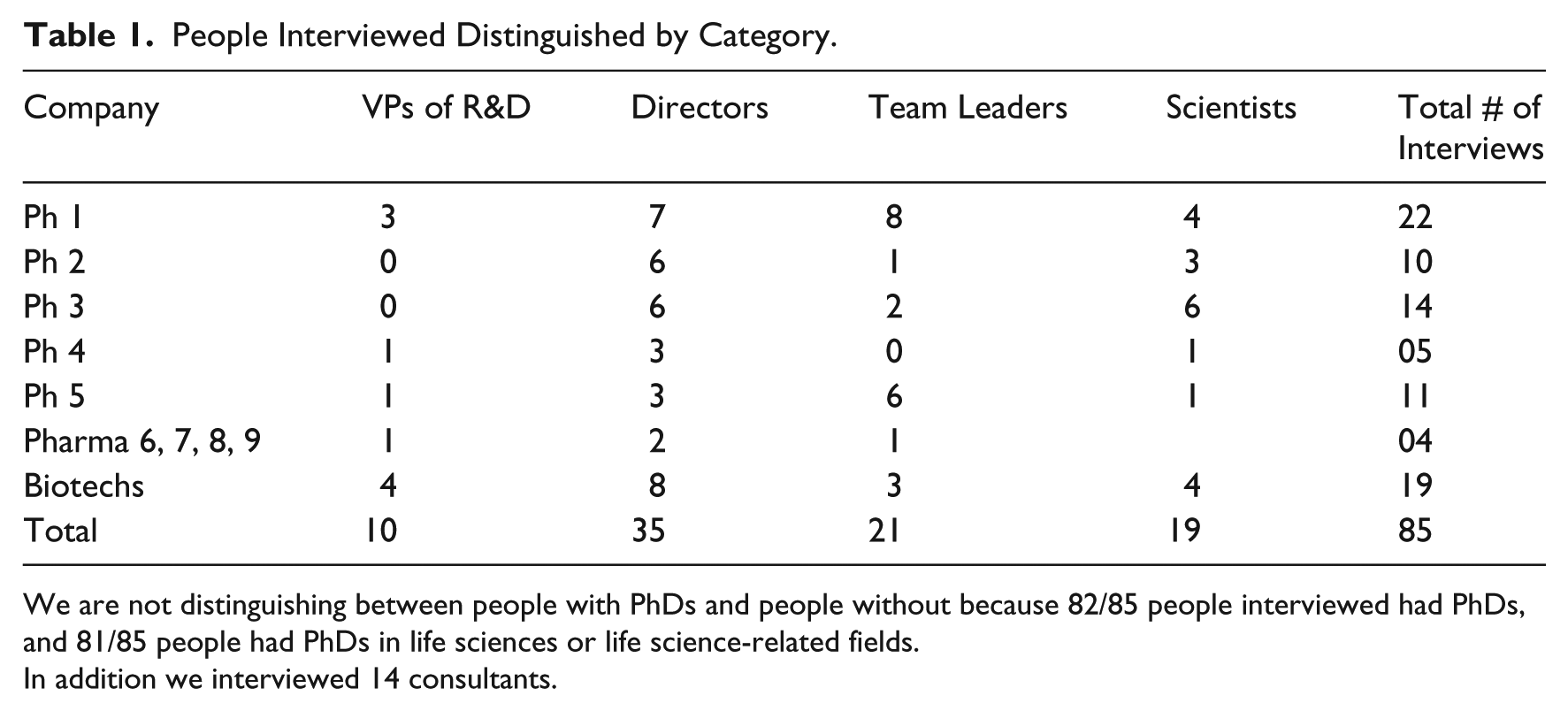
We are not distinguishing between people with PhDs and people without because 82/85 people interviewed had PhDs, and 81/85 people had PhDs in life sciences or life science-related fields.
In addition we interviewed 14 consultants.
The 85 interviews are people’s stories of how they do their work of drug discovery. The authors carried out 20 interviews together, the first author carried out 34 more alone, while the second author carried out another 26 interviews alone. We received 5 transcripts from colleagues working on a related project, who followed the same interview approach. These interviews show patterns that are very similar to the interviews we conducted. The similarity of the process across researchers provides additional support for the three social mechanisms that we find in these data. Of the 85 interviews, 79 were held at the person’s worksite and averaged about an hour, and 6 were done over the telephone. Of the 79 in-person interviews, 68 were machine-recorded and transcribed, and 11 were hand-recorded, filled in right after the interview, and transcribed.
We asked people to describe what they do, the approaches they take, problems they encounter, and differences across projects in their experience. We asked for concrete examples to keep people grounded in the phenomenon, and to aid our understanding of what they were describing. Our interview questions shifted over time as we learned more about some things and moved to probe other things more fully. Because the work is difficult for non-experts to understand, we used a “cheat sheet” of relevant scientific and technical terms, and built up an understanding of processes over the time we collected data. Throughout, we looked up terms in the interviews, discussed findings with colleagues who are also studying biopharmaceuticals, and read industry reports as well as many articles in scientific, industry, and business magazines on drug discovery. The stories also contain instances of problematic events, failed efforts, and concerns about the process.
These interview data are limited in several important ways that constrain the inferences we can draw from them. First, they reveal what people chose to reveal, and reflect their rationales and understandings for why things unfold as they do, rather than “objective” depictions of what they actually do. Second, the data do not comprise direct observations, compared to ethnographic studies where researchers observe what is happening. Third, the data are cross-sectional, depicting a snapshot of an evolving process, and we have no outcome measures of successful versus unsuccessful approaches. We rely on these experienced scientists’ insights regarding what seems more or less effective. However, the interviews comprise people’s rationales for how they work, and reflect their reasoning processes, which is what we build theory about. In the discussion section we suggest additional research to overcome these limits.
Data analysis leading to the grounded theory
We analyzed our data following the process described by Strauss (1987) and Strauss and Corbin (1998), which involves movement from data, to theory, to data collection, and back to theory over time. The analysis is an iterative process, involving extensive refinements and revisions to our theory as it emerged over time (Bailyn, 1977; Elsbach, 1994; Miner, Bassoff, & Moorman, 2001). The authors performed the initial analyses separately and together throughout the process of theory development, and included a number of doctoral students over time to code the data and provide additional input. Figures 1a, 1b, and 1c provide an overview of our coding process, initial open codes that eventually led to categories that became the three social mechanisms that make up the framework we develop in this paper.
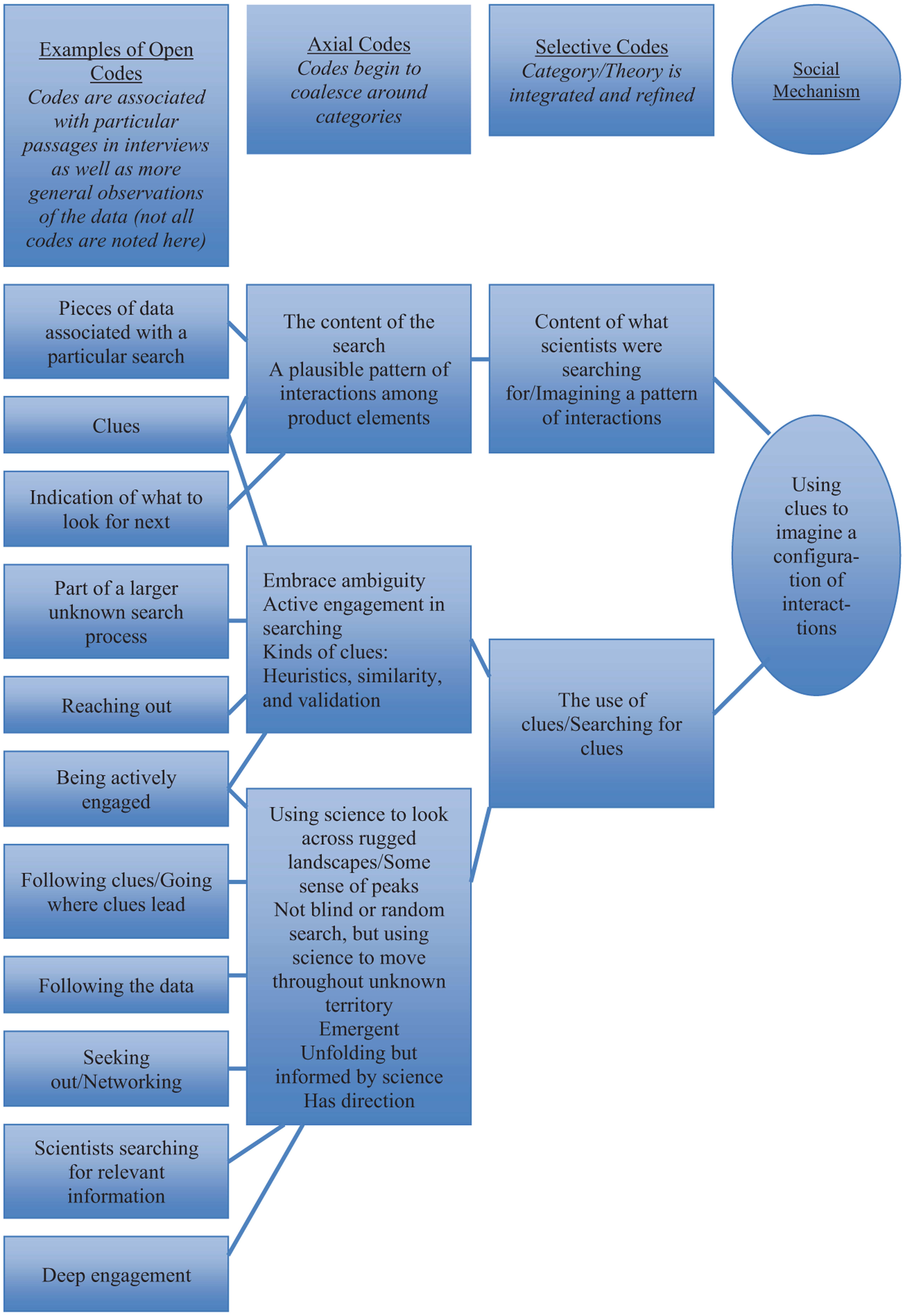
Overview of the Coding Process for the First Social Mechanism.
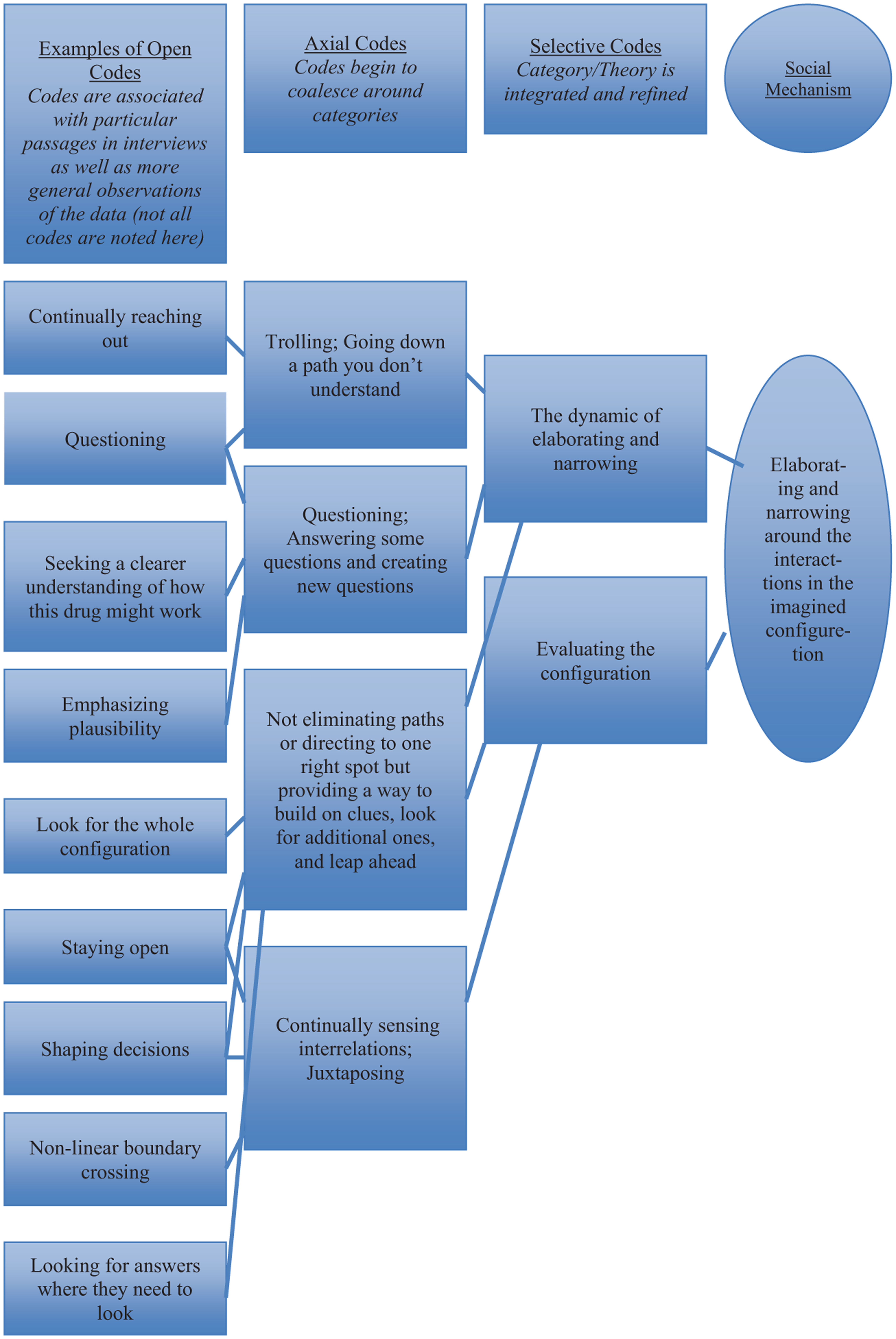
Overview of the Coding Process for the Second Social Mechanism.
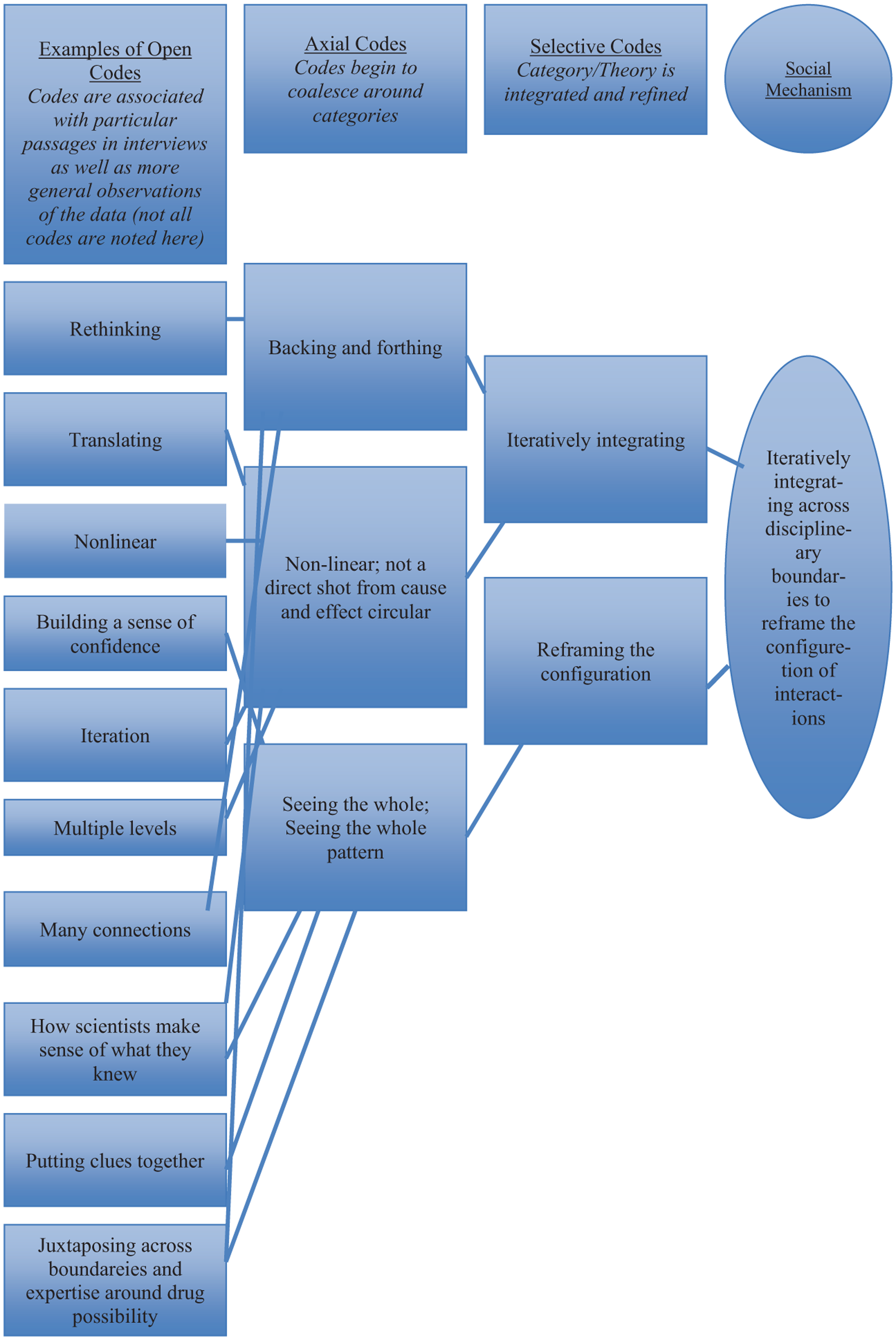
Overview of the Coding Process for the Third Social Mechanism.
Our theory about the essential role played by abductive reasoning in complex innovation emerged after many cycles of hypothesizing, examining the data, and rethinking. Through the coding process (open, axial, selective) we identified a number of categories that captured facets of the data and traced them through the data set (Denzin & Lincoln, 1998; Strauss & Corbin, 1998). One category is the use of clues. A second category is the content of what innovators are looking for—a configuration of interactions or what we described in earlier stages of analysis as a plausible pattern of interactions among product elements. A third category is a dynamic of “elaborating” and “narrowing”: e.g., focusing in on a category of compounds versus looking at diverse structures; narrowing in on a protein target versus elaborating different ways to express that protein. Additional categories include the surprising (to us) complexity of the work, and a tension between the ambiguities of navigating and the need to commercialize products for profit.
We iterated over time through several different theories to try and explain the deliberate way of proceeding with innovation that we saw, but each captured only some of the core categories and did not adequately explain this different form of reasoning. One early theory was that discovery scientists follow the logic of complexity, while managers prefer the logic of incremental innovation, but this highlighted differences in proceeding, not similarities that we were attempting to reveal. Then we hypothesized that scientific reasoning conflicted with the engineering reasoning. This too did not hold because, while the technologists in our data differ from therapy scientists, they also talked about the same underlying way of proceeding. We then centered on the clues and tried to describe different kinds and different approaches to using them. Several different colleagues who patiently listened to early presentations told us that we seemed to be talking about abductive reasoning, a concept that was unfamiliar to us. After iterating again with the literature on abductive reasoning, we figured out that abductive reasoning defined the way of proceeding that we saw. We compared the use of abductive reasoning by discipline and role, and while there were different degrees of use, everyone seemed to rely on abductive reasoning in some ways. The less successful events showed less abductive reasoning.
The first social mechanism of using clues to imagine a configuration of interactions between a drug possibility, a disease, and the human body developed from our initial focus on clues. We could see that they were using clues as guidelines to hypothesize a pattern of interactions among molecules, diseases, and human biology. We use the term “imagine” because, as Weick (2005) described, the scientists use clues to invent or discover a world in human biology where a particular molecule could moderate a disease. This first social mechanism brought together two of our initial categories of clues and what the innovators were looking for. As noted earlier, Figures 1a, 1b, and 1c provide additional details about our coding process.
The second mechanism of elaborating and narrowing around the interactions in the imagined configuration to examine alternatives and build on intermediary models emerged as we looked closely at descriptions of asking questions and “in vivo” discussions such as “trolling” in different areas or “going down a path you don’t know what it will be.” We contrasted these with examples where people did not elaborate but instead zeroed in, or emphasized “shots on goal.” To develop the social mechanism of iteratively iterating across disciplinary boundaries to reframe the configuration of interactions we examined people’s discussions of figuring out interactions, which typically involved boundary crossings. Many people used “iteration” to describe this process, so this in vivo code became part of the label for it. We compared descriptions of not surfacing interactions or not working across disciplines with those that do, to sharpen the process. We explain our findings next.
Findings
Our research question is: How do innovators use abductive reasoning to create new products in the context of complexity? We find that three social mechanisms enable the innovators we study to use abductive reasoning to create new products in the complex innovation system of drug discovery. The three social mechanisms are: (1) using clues to imagine a configuration of interactions between a drug possibility, a disease, and the human body; (2) elaborating and narrowing around the interactions in the imagined configuration to examine alternatives and build on intermediary models; (3) iteratively iterating across disciplinary boundaries to reframe the configuration of interactions.
The innovators we study are scientists and these scientists focus their search on a configuration of interactions between the parts of the complex system of drug discovery. A configuration refers to an arrangement of parts, and the parts for new drug products are interactions, not discrete elements. These interactions are the primary unknowns in drug discovery, specifically, the many possible interactions between a drug, the human body, and the disease process. Each new drug is a molecular system that interacts with a disease system but it must be absorbed, distributed to diseased cells in enough quantity to have a positive effect, metabolized, and excreted, all without interacting harmfully with other systems in the human body. Drug discovery has been described as a process of joint optimization among many different elements (Pisano, 2006).
These scientists use clues to imagine a configuration of interactions. The configuration is a particular kind of hypothesis, an abductive hypothesis that enables innovators to capture enough of the vast but noisy information in complex domains to proceed with product development. By hypothesizing about a configuration of interactions, scientists are able to capture the unfolding process of the drug in action, and can consider jointly optimizing the various links. The initial configuration that innovators imagine is not the final theory and may even be wrong, but it is an “intermediary model” that helps innovators navigate in the labyrinth of complex innovation and figure out useful next steps (Denrell et al., 2004). These scientists imagine their product in use, or how it works in the body and against a disease. But rather than execute this hypothesis, they use it to figure out more about the potential product, details, and specifications. This contrasts with other types of intermediary models that rely on modularity or hierarchical decomposition which break objects apart into static components that ignore ongoing functioning of the whole. Imagining a configuration of interactions pulls things together into a dynamic process.
The following examples of the first social mechanism, using clues to imagine a configuration of interactions, highlight the mechanism and the importance of the configuration of interactions. A director of biology at a pharmaceutical company describes the initial development of a project: They [the scientists on a team] start to say that this is a good target to work on because if I inhibit this protein—if I inhibit this process within this mechanism my end result is going to be that I have a potential therapeutic aim. I can modify the disease because I am now thinking that if I inhibit or if I actually promote the protein it can…I am going to have the therapeutic end and it is going to be good at the end…
The team does not focus on the protein target separately, but rather imagines the process through which a possible drug might work against the disease. In this example, they think that by inhibiting a particular protein to reduce a disease mechanism, they can achieve a good therapeutic outcome. The director describes a configuration of interactions that they think they can manipulate. They draw on a variety of inputs to figure out if they have a good idea, and they focus on numerous possible interactions that might explain the disease process. They try to explore why this might be a “good target to work on.” Their focus is on whether they have formulated a solid scientific rationale or developed a good hypothesis.
The hypothesis that scientists formulate in this complex innovation process is not about a single connection, but rather highlights the interactions among the elements that must be discovered and clarified. Another R&D director uses the idea of navigating: This is a twelve dimensional space to navigate in [he listed a number of properties]. The compound has to be right on every one to be any good. A lot of these tests are of limited relevance for what happens in toxicity. We do a test to see if there is a real effect, real biology or not.
As he navigates he draws on clues from a variety of tests, each of which is limited in its own right, and tries to assess if an imagined pattern or arrangement of parts is real or not. The clues he looks for will tell him if or how the configuration of interactions that he has imagined works.
A final illustration of using clues to imagine a configuration of interactions comes from the director of molecular biology at a small biotechnology firm, who describes how they initiate projects: You have to have enough scientific knowledge to understand that this phenomenon being investigated is real, and that you understand it a little, you know how to manipulate it a little. You don’t have to have the whole picture before you start putting together (a product)… This is biology, you’ll never get to the end. So at some point you have to judge whether you know enough to start putting together the product.
Their initial hypothesis encompasses “enough” existing knowledge about the phenomenon and an understanding of how it works, and an ability to manipulate it “a little.” They do not have a full picture like the detailed product definition recommended for incremental innovation (Cooper, 1998). They imagine a workable configuration of the possible drug in action with “enough” knowledge encompassed to enable them to proceed with product development, and they use their judgment about what is enough knowledge.
In the remainder of this section, we use three stories to explain the ongoing workings of the three social mechanisms that make up the framework for abductive reasoning. We provide additional examples of the three social mechanisms in the appendix in Tables 2, 3, and 4.
The framework: Using clues, elaborating and narrowing, and iteratively integrating
Clues are the foundation of the first social mechanism of abductive reasoning, using clues to imagine a configuration of interactions. Discovery scientists begin the innovation process with a hypothesis about the most critical interactions, which focuses their search and also encompasses possible variations that may be relevant. Scientists develop a hypothesis by leveraging clues from their science and experience, and imagining how those clues point to a possible configuration of interactions. As Weick (2005) suggests, abductive reasoning starts with some tangible clues that people use to discover or invent a world in which those clues are meaningful. We find that this “world” is the possible drug product in action.
The dictionary definition of a clue is something that leads out of perplexity; it is a fact or object that helps to solve a problem or a mystery. We find that clues synthesize otherwise noisy information about human biology and medical chemistry into implications for how a disease process works, and how a molecule can be distributed through the bloodstream to affect that disease process, and the scientists’ ability to manipulate some of the processes involved. Drug discovery teams pull these clues together to suggest a configuration and they explore the dynamics that the configuration suggests. Many scientists said that they were working with clues.
Our first story begins to explain the role of clues in imagining a configuration of interactions and comes from a biology team leader who was working on a drug to overcome a serious side effect of kidney disease. She and her team began with the natural ligand (the natural ligand normally binds to the receptor but is missing in people with the disease she is studying). Her team developed some clues from the ligand about receptors in the same family to imagine a configuration in which a smaller molecule could bind in the same way as a very large molecule (the natural ligand is very large). This was a breakthrough because they were imagining a new kind of drug. She describes their reasoning process: We wanted to try and find other molecules like that [pointing to a graphic on the wall of the natural ligand binding to a protein], but they must be smaller. The natural ligand that sticks to the receptor is much larger… Everyone said you can’t do it, you can’t find a smaller molecule because there are too many contact points. Like a basketball fits into your hand and your hand covers a good part of the surface of the ball, but what if you tried to attach a golf ball to the surface of the basketball? It does not bind with the same strength.
As she explains, the received wisdom was that it would be impossible to create a drug that could bind in the configuration that her team was imagining. But they used a clue to make an analogy (Gavetti, Levinthal, & Rivkin, 2005) and “find other molecules like that”—to figure out possibilities (Dunbar, 1995). She continues: We had some clues that we thought would be important… There were other receptors in the same family, and other clues about what could make a connection. Molecules are bumpier than a flat surface, and they have a lot of points of contact and different strengths of contact points.
Clues from similar receptors sugges ted plausibility, while clues from chemistry about the strength of contact points suggested that they could create a smaller biologic molecule (a peptide) that might bind like the natural ligand. Clues about combining amino acids, the specific contact points needed for binding with the receptor, and how that binding interacted with the disease process led them to imagine a configuration of interactions that might work. The team also drew on multiple perspectives to imagine a plausible configuration, and constantly negotiated possibilities. People in different units or disciplines see different aspects of the same configuration, so when they collectively negotiate the meaning of what they are looking for, they are less likely to become trapped in existing competencies.
The second social mechanism of abductive reasoning is elaborating and narrowing around the interactions in the imagined configuration to examine more alternatives and build more effectively on intermediary models. Scientists evaluate the imagined configuration of interactions to see how it might actually work, and to discover what else they need to know. They use their hypothesis to sift through all the noisy information and explore whether or not, and if so how and why, their configuration might actually work as a possible drug. The process of elaborating and narrowing forms the foundation of this social mechanism. Scientists use elaborating and narrowing to anchor on one interaction in the configuration and then reach out and around that to surface more information by exploring the various details that they find. Elaborating and narrowing enable the scientists to delve into details yet stay open to unexpected insights as they systematically look at related facts. Evaluating in this way contextualizes the innovation process, and captures some of the particulars (e.g., of disease processes, and of the diversity in genetic make-up in the human population). The exploration digs in to find the core dynamics of the possible drug in action, and opens up to more alternatives. Scientists in complex systems are not just searching, they are continually configuring and contextualizing as they elaborate out and narrow in on facets of the imagined configuration of interactions.
Scientists need to proceed without closing off potentially valuable pathways, because they do not know what might work. To examine their configuration, the team described above by the biology leader had to see if they could find this new peptide that was part of their imagined configuration of interactions: We had a collaboration with a biotech start-up. We used their technology to screen for peptides. You can go from 165 amino acids down to 20. That [the final new molecule in the picture] is a 20 amino acid peptide and that is the ribbon here. It is cyclic in on itself, and it binds to the molecule. This peptide has no identity at all with the original ligand. The peptide is not known in nature, we had to create it. We worked with this company looking through libraries with millions of possible ways of how to arrange peptides, and screened them to bind to this receptor. I remember very vividly thinking it was a waste of time. Also we were trolling in a couple of other areas like natural products, antibodies. Once we got the peptide and it [combined with the receptor], we did our first crystal structure [with a famous academic lab].
They empirically evaluated their imagined configuration of a much smaller peptide by trying many ways to build a small peptide that would also bind to the receptor, but they were also open to alternate possibilities such as natural products or antibodies. The team elaborated around many possible peptides and also narrowed down to the needed binding. They expanded existing understandings to see new contingencies and learn more about possible interactions. She doubted the searching, and was worried that all this empirical evaluation was a waste of time. However, according to Locke et al. (2008, p. 908), doubt is the engine of abductive reasoning because it drives and energizes people to generate possibilities, try them out, modify, and so on, until new concepts are generated that satisfy the doubt. This doubt also highlights the serendipity involved in complex innovation like drug discovery, because many drug possibilities never pan out. With no immediate feedback they did not know if they were on the right track, but they persevered.
The next story also emphasizes the second social mechanism of abductive reasoning, elaborating and narrowing around the interactions in the imagined configuration, because only through a systematic sifting of related insights can they identify and explicate the relevant biological mechanisms. Opening up around the configuration to look for unexpected contingencies keeps the scientists poised to spot new possibilities as well as emerging perturbations that might escalate into major problems or opportunities. A director of biology at another pharmaceutical company explained how they elaborated and narrowed around a configuration to evaluate their imagined configuration of interactions. They had imagined that a certain kind of molecule would bind to an enzyme and inhibit its ability to speed up a cellular process that may lead to a form of cancer. He explains how they proceed to examine this configuration: You want to know OK—you have now picked the most likely inhibitor of this enzyme. Now, I want to understand what it does in a cell—in a hepatocyte—a liver cell or a cancer cell.
He emphasizes the need “to understand” how the potential drug molecule behaves in the cancer cell and in the liver. He outlines a variety of next steps that they deduce from the configuration: One of the sets of experiments that I need to do to be able to understand what this drug does in a cell, then the next question is OK, I now understand what it does in a cell and it does what I want it to do—it lowers the ability of the liver to generate lipids or sugar or a cancer cell to grow.
They generated understandings through several sets of experiments that create new clues regarding “what the drug does in a cell.” He evaluates the configuration of interactions by opening up to explore several possible mechanisms. He identifies good questions to work on, and he reaches out around these questions to look for clues. He finds support for his developing understandings because “it does what I want it to do.” Then he narrows in on another question, and works to figure out if the prediction is actually operative. His questions keep the search open yet also provide focus. Elaborating and narrowing bounds the work systematically, so they do not amplify out endlessly and they also do not focus in on a single feature prematurely.
Elaborating and narrowing balances the processes of opening up to investigate new possibilities with closing in on some aspects to examine them more fully. Scientists might elaborate out around a certain interaction, for example, by exploring a variety of possible effects between the molecule and the cardiovascular system, and then narrow in on particular effects they discover to consider how to address them. The configuration of interactions is an important tool for navigating, because it keeps innovators open to new alternatives about how a molecule might behave in the body against a disease but also enables them to dig in to situated possibilities.
Next, the same scientist outlines the kinds of additional clues to look for: Now how do we understand how that [the effect they find] is going to translate into additional studies?… Is the drug metabolized in a way that it all gets broken down to something that is no longer effective, or can it deliver [results in] the right models? I want to study it in systems that seem to predict activity in humans, so what kinds of models do I need to understand [if the compound works in humans]? I need to develop, build, create and begin to test new compounds…
His clues suggest new questions and new experiments to be tried, new ways to think about the configuration.
Elaborating and narrowing around the interactions in the imagined configuration also draws on different parts of the organization. He explains how the project “touches on a lot of different expertise.” Different groups in the organization are actively engaged in the evaluation of this possible drug, integrating new knowledge into the project, and leveraging different perspectives: For chemists it is a different vision, for protein biologists it is a very much different vision but the morphing a program goes through—most of the steps go through kind of biology hands and then touches on a lot of different expertise until it ultimately gets toward the stages of becoming a drug that is going to go into people…
He explains how they accumulate knowledge. Different groups have a different “vision” of the possible configuration, so they can contribute unique insights.
This example also illustrates the third social mechanism of abductive reasoning, iteratively integrating across disciplinary boundaries to reframe the configuration of interactions. The imagined configuration of interactions goes through “morphing” as it goes through the hands of different experts, suggesting that they reframe the project over time as they move toward testing on people (clinical trials). The “morphing” is iterative, not linear, as it goes back and forth. Everyone involved in the project across the organization may be thinking of a slightly different version of the configuration of interactions, but they think about it as a whole rather than in discrete pieces. Iterating brings in diverse views and juxtaposes them to test and push ideas.
The project shifts and changes as they find new clues to the configuration, open up to evaluate and to create new understandings, and reframe as they leverage different perspectives. This scientist goes on to explain how the cycling continues and returns to the first abductive reasoning mechanism of imagining a configuration of interactions. The configuration they imagine in the next cycle is developed from the clues of the previous cycle. He emphasizes the need to interpret well. They are interpreting how well they have imagined a configuration of interactions: If they interpret well, then they have done the right experiment [and] that proves we have met the hurdle—again some of these are technical and some of these are more philosophical.
He explains further that “technical” hurdles refer to not being able to express the protein that is involved in the cancer (to carry out more tests). Philosophical hurdles arise when they need to decide whether or not to abandon the project because they cannot find a way to generate the protein to test the mechanism of the compound. He explains the ongoing navigating as additional surprises can arise: The trick is to understand what the problem is and to get it into the hands of people who know how to solve the problem for you. That is just one problem. The next problem is that you have expressed the protein and it has no activity and it does not do what you thought it did. How did you study that, did you do the right assays, did you have it under the right conditions and have the right substrate for it? … Every step of the way there is something.
The navigating involves encountering additional surprises and getting those problems “into the hands of people who know how to solve the problem for you.” They depend heavily on a network of internal and external experts to figure out, for example, how to generate enough of the protein for tests, or if they can work around possible toxic interactions they discover. They also continually question not only their findings but also their methods for developing those insights as they interpret the plausibility of the imagined configuration. This director of biology finishes his example by explaining a major event that suggests that they are on the right track: If you knock the gene out and the cell completely changes, reverts to a normal form of cell, we get real excited. Now let’s make the protein that the gene codes for and study it.
Experimentally knocking out a gene examines whether inhibiting the protein that the gene expresses in the cancer cell with a drug might stop the cancer. The cycle continues.
These innovators revise or reframe their imagined configuration of interactions by iteratively integrating across different disciplinary boundaries, to explore various facets of information from different perspectives. The iterative integrating accumulates the insights generated by the discovery process into a revised hypothesis about the configuration of interactions that animate the drug’s functioning in the body against the disease. The mechanism of reframing connects formulating and evaluating hypotheses into ongoing cycles of discovery that, over time, build up a clearer and clearer understanding of how this molecule will behave in the body against the disease.
The third story also illustrates how the three social mechanisms work but emphasizes the third mechanism, iteratively integrating across disciplinary boundaries to reframe the configuration of interactions. The scientists use this reframing to assess their work and identify next steps. They collectively determine what makes the possible configuration of interactions they are working on good enough to continue with, and what they should change as they proceed. For ease of exposition we start the third example with the second social mechanism of elaborating and narrowing. A chemistry team leader describes how he and his team are opening up and reaching out for clues by drawing on people in other parts of the organization: We can all make a prediction as to what kind of potency we think we need, but it is a reiterative process where the biologists will not only provide the data but can tell us a lot about our molecules that we could not foresee, such as how do they look when they dissolve? Do they dissolve? How did the cells look after they saw the molecule?… It is reiterative—it demands a lot of creativity and it is a very competitive area so we have to work well together and again try to develop molecular chemistry…
Notice the deep contextualization as he asks how do the cells look after they saw the molecule—they are looking at what animates the disease process, and delving into the specifics of possible mechanisms the molecule seems to have in the cells and how the cells react to the molecule. The potency of the potential drug is used to evaluate its effectiveness, but they elaborate out around that potency since “what kind of potency” they need is judged collectively. A similar level of intensively situating the evaluation and reframing is evident in the examples above as well. To generate these deep insights, the scientists work iteratively, back and forth.
As they work back and forth, they reframe their project and continue the cycle. The chemistry leader explains the reframing: [Early molecules] will be screened in an in-vitro setting against activity within the cell or it could be the cell membrane or an enzyme or whatever and we will get a quick readout on that. That kind of screening might take a day or two and then from there we pick our best molecules…and we try to build upon that activity. And as we improve the potency of the molecules, they got into tissue-based and then eventually [animal]-based models and so it is a reiterative process that really drives the science forward… You try to get potency there [in a tissue assay] because that is a little more complex of a system. So as you go to animals you hit different roadblocks or challenges so you go back and try to redesign your molecules and try to figure why the molecule is not doing precisely what you wanted it to do. Does it have good bio-availability in a body? Is it really potent or maybe it is also toxic because it is hitting some other targets that you don’t know.
Now they hit different roadblocks from evaluating their configuration in animals, and have to redesign the molecule to figure out why it does not do what they wanted it to do. They ask a variety of new questions to explore the configuration and go back and redesign the molecules. Throughout they are trying to get a “quick readout,” to indicate “our best molecules” and to indicate “potency.” They do this by iterating from one experimental context to another, “an in-vitro setting,” in a “tissue base,” and other models, he says it is a “reiterative process that really drives the science forward.”
These three stories suggest how the three social mechanisms cycle together over time to imagine, examine, and reframe a viable configuration of interactions. We have discussed all three social mechanisms together since they constitute the abductive reasoning process that we find in this complex innovation context. However, each mechanism is important in its own right and cannot be skipped. As noted at the outset of this section, the appendix contains a number of examples of each mechanism.
While we find that these three social mechanisms of abductive reasoning work in the context of complex product innovation, we have fewer examples of the third process of reframing. We agree with scholars summarized in our introduction that reframing is necessary, and think that the discovery scientists do not reframe their imagined patterns as often or as thoroughly as they might need to do. We speculate that the relatively limited use of reframing in our data might arise because scientists and managers alike are reluctant to rethink the project and start off on another trajectory. Instead, they seek to progress through the discovery and development process to get products commercialized.
Discussion
The process of abductive reasoning moves from surprising insights to formulate, evaluate, and reframe hypotheses by cycling through three social mechanisms: using clues to imagine a configuration of interactions; elaborating and narrowing around the interactions in the imagined configuration to examine alternatives and build on intermediary models; and iteratively integrating across disciplinary boundaries to reframe the configuration of interactions. Our findings provide an in-depth examination of the process of abductive reasoning in the context of complex innovation, and advance existing research on abductive reasoning by developing new theory about the activities that constitute this form of reasoning. The activities, which are the three social mechanisms, reveal previously unknown details of process. Our explanation of the three social mechanisms in action extends the existing but mostly conceptual work on abductive reasoning in organization studies because it specifies how people formulate and evaluate hypotheses in the context of complex innovation (Locke et al., 2008; Weick, 2005). By going beyond the general philosophy of abductive reasoning, we develop important new insights about how abductive reasoning is used and why these three social mechanisms solve the challenges of navigating in the labyrinth of complex product innovation. We begin by explaining how and why our findings advance existing research on abductive reasoning and address the challenges of complex innovation. Then, we discuss the barriers to abductive reasoning that we find in our data. These barriers suggest next steps in the study of how to apply abductive reasoning to the problems that innovators face every day.
The three social mechanisms explain how scientists use clues to formulate a hypothesis, how they develop and use intermediary models to evaluate that hypothesis, and how they might reframe their understandings. Our theory not only addresses the limitations of existing research on abductive reasoning outlined in the introduction, but also develops new insights. One new insight that advances work on abductive reasoning and on complex product innovation concerns the abductive hypothesis. Hypotheses that are formed and evaluated through these three social mechanisms are a particular kind of hypothesis, an abductive hypothesis. In drug discovery, the abductive hypothesis is about a configuration of interactions. We infer that simple, one-to-one hypotheses such as X causes Y (e.g., this gene causes this disease) cannot enable effective navigating for complex innovation because they do not reflect the whole world of human biology that needs to be explored. The elements in the configuration are not just parts of the product, they emphasize the interactions between the possible drug, the disease, and the rest of human biology. Focusing on the interactions keeps in mind a vivid sense of the drug in action, conveying more possibilities, and invoking more insights. The interactions reflect the dynamic unfolding rather than a static array of separable parts. This is critical in the context of complex innovation because the primary reason that complex projects fall apart is that the interactions are overlooked. The abductive hypothesis enables innovators to focus their search while encompassing enough of the uncertainty to avoid ad hoc and crisis-oriented management that is often problematic in this type of innovation (Leifer et al., 2000). The conceptualization of the abductive hypothesis adds to existing work on abductive reasoning, making it easier to contrast abductive hypotheses with other types of hypotheses. The configuration of interactions is a new conceptualization of a product concept or upfront product definition that adds to innovation management research by extending the idea of a product concept to the context of complex innovation (Cooper, 1998).
The three social mechanisms are not distinct steps to be executed in sequence. They cycle together over time and enable innovators to deal with the challenges of complexity in very specific ways. The first social mechanism, using clues to imagine a configuration of interactions, is how innovators formulate a hypothesis in a way that addresses the complexity of the work. The problem cannot be narrowly defined, and the configuration of interactions highlights the integral role of focusing on the interactions. Innovators use the imagined configuration of interactions to sift through potentially relevant but noisy information and surface critical ideas. The clues help codify the noisy information in complex systems (Tsoukas, 2005). Focusing on clues is hard because clues highlight what people do not know, and both scientists and managers are more comfortable with clear facts. But when clues are not used to guide the navigating, innovators and/or the managers may ignore a good deal of the information that is available because it is noisy and messy. As well, there are few if any clear facts or precise solutions during the development process. The drive for clarity in the early stages of projects may push scientists to stay with current results rather than reach out to learn more.
Using clues to imagine also captures more of the noisy information because it transforms data into clues, something meaningful. Clues point to a whole world in which they are meaningful, enabling them to conceive of a whole design almost at once (Weick, 2005). The holistic configuration helps scientists to contextualize (Tsoukas & Dooley, 2011) their understandings so that they can examine the implications of their hypotheses, and reflect on novel possibilities that go beyond existing ideas, while still keeping the whole in mind. This is consistent with suggestions from others—it is a “whole world” that is imagined (Weick, 2005), an understanding of potential (Grandori, 2010), a kind of narrative (Bartel & Garud, 2009).
The second social mechanism, elaborating and narrowing around the interactions in the imagined configuration, is how innovators evaluate hypotheses. Elaborating and narrowing enables innovators to delve deeply into the contextualized details of human biology that will define how their drug might work, so that they can surface important but unanticipated knowledge, avoid getting stuck in local optima, and assess the nature of the hypothesized interactions that may animate the drug. This mechanism helps innovators deal with the challenges of complexity because it enables them to develop and use intermediary models to navigate in the labyrinth (Denrell et al., 2004), examine more alternatives, and build more effectively on intermediary models without getting lost in potentially endless cycles of iterations (Leifer et al., 2000; Van de Ven et al, 1999). They empirically inquire into the actual effects of their hypothesized configuration in order to assess what governs the interdependencies that they imagine. Through elaborating and narrowing they surface new interdependencies and reconfigure the configuration.
Elaborating and narrowing also enables innovators to juxtapose distant search with local search. They are able to sort through the noisy information and open up around possibilities and narrow in on situated specifics, while still keeping the whole in mind. Through this social mechanism they are able to balance narrowing in to explore particulars with elaborating to look distantly, exploring how and why their ideas work in the context of action, the human body. However, elaborating and narrowing may be difficult. Efforts to drive to final answers and weed out bad ideas as early as possible are reasonable, but can weaken the dynamic of elaborating and narrowing that bounds the work by incorporating alternatives. Instead, people may focus in on a few elements, but that focus might eliminate alternatives before enough is known about them and close down important avenues for search. When scientists push for final answers too early in the process, they may not generate enough insights and understandings, and this can get innovators locked in to one track before enough knowledge has been accumulated about possibilities. Instead of identifying good questions to work on, scientists may look for specific results, which may lead to local optima.
The third social mechanism, iteratively integrating across disciplinary boundaries to reframe the configuration of interactions, is how innovators reframe their ideas. Iteratively integrating across disciplinary boundaries gathers up and synthesizes what innovators are learning while still keeping the whole in mind as they work. By iteratively integrating across disciplines and across experimental situations, innovators are able to accumulate and synthesize information in spite of the local and situated nature. Efforts to control the process by chopping it up into separate groups may seem appropriate in the very large pharmaceutical firms. But without actively iterating across boundaries to see possibilities from alternate perspectives and to include unique insights, innovators decompose the work and are less able to keep the whole pattern in mind. The scientists we study face pressures to hand off work in a linear manner rather than interact across boundaries, but iterating is important for dealing with the challenges of complexity. Iterating emphasizes that different people see different aspects of a project and can overcome competency traps by crosschecking possibilities and putting together different ideas. Reframing allows people to see what they know so far, develop new performance parameters, and maybe add in new interdependencies or even rethink the configuration itself based on collective learning.
In this study, we apply abductive reasoning to complexity, and this application opens up the idea of abductive reasoning by explaining what abductive reasoning involves and specifying particular social activities. Through these social mechanisms, people can collectively carry out abductive reasoning as well as focus on the integral role of interactions in the process. This process is by nature collective or social. As Nelson (2005, p. 127) explains, “formal knowledge systems like logic are possible only if there are knowledge communities that share symbolic systems.” Much like steering a ship (Hutchins, 1995), applying abductive reasoning in the context of complex product innovation is a cooperative and collective endeavor too. Our theory outlines not only the application of this type of logic, but specifies the actual activities, the skills and tasks that go together, and the connected and mutually dependent roles of innovators. Navigating in the labyrinth of complex product innovation involves numerous people with different knowledge, skills, and tasks to be performed, and they are all involved in deciding how best to move forward (Hutchins, 1995; Nelson, 2005).
To summarize, abductive reasoning is not just an abstract form of logic. It involves social practices that people can carry out, build experience with, and improve over time. In combination the three social mechanisms explain how innovators use abductive reasoning to detect useful information despite the noise, spot minor perturbations that can escalate into major issues rather than getting trapped in local optima, and accumulate insights holistically rather than break the problem down into fragments.
Barriers to the three social mechanisms
While these three social mechanisms advance existing research on abductive reasoning and address the challenges of complex innovation, they may be limited or hindered in practice because abductive reasoning generates only weak inferences about plausibility with indeterminate outcomes, and provides no guarantees that a viable new product will result. The scientists and managers we study need to create new products to generate revenues and that requires new drugs be materialized in concrete, efficacious forms (synthesized, mass produced, packaged, and distributed safely and effectively), and in a timely manner. Many managers struggle with the desire for more discipline, better planning, and better decision-making.
Our findings point to three specific barriers to abductive reasoning that, if removed, might enhance its implementation. One major barrier to using abductive reasoning is its unfamiliarity. No one we spoke to said they were using abductive reasoning, and some instead emphasized intuition and luck and spoke of clues, guesses, many stumbling blocks, and so on—all of which would certainly worry managers who are responsible for the expenditure of so much money as part of the product development process. If we are correct in our inference that abductive reasoning is essential for drug discovery, then improving its implementation will depend on more research that shows how and why it can work.
A second barrier is the limited use of reframing, which is necessary for the entire cycle of abductive reasoning. Reframing provides closure, either by pulling ideas together more fully for another round or by deciding to stop a project. Additional research is needed to understand why reframing is limited, but theory tells us that reframing is very hard to do (Dunbar et al., 1996). We speculate that scientists do not want to shut down projects prematurely, while reframing disturbs managers who need to show significant pipeline progression. The fact that many projects fail in late-stage clinical trials suggests that the “stopping rules” to shift or end the abductive reasoning for a given project are inadequate. Future research might address how these rules incorporate judgments about the viability of the configurations of interactions that projects are developing: are these configurations becoming clearer, what are the unknowns, and can we address them? Existing ideas about stopping rules that address information search in other contexts (Browne & Pitts, 2004) may also be useful for developing stopping rules that can be applied to complex situations. Innovators need to figure out how to shut down projects without shutting down projects that are going to be successful.
A third barrier to abductive reasoning is the preference for conventional or mechanistic decision-making that is based on confirmatory studies, or only on strict deductive logic. Conventional decision-making focuses on clearly identifiable goals and laying out the means to achieve those goals. In complex innovation there are not clear goals or a clear path to achieving those goals; the process is messy. Managers are worried and they are not familiar with abductive reasoning so, instead of searching for clues, they search for answers, instead of searching for clues to configuration they search for single facts. They try to simplify something that is complex. Instead of evaluating by elaborating and narrowing they hone in on particular results. Instead of iterating across disciplines to reframe they chop the process into parts and they do not cycle back through the process.
These barriers also suggest additional ideas for future research on the use of abductive reasoning for complex innovation. For example, future research might focus on how people can become more comfortable with the use of clues, and how they might better balance elaborating and narrowing to generate insights. Imagining a whole configuration seems to belie the calls for serendipity and creativity. However, new products are novel arrangements of parts, not a collection of separate parts, and we infer that innovators cannot create new products in complex domains working part by part, so future research could focus on different ways to focus on the configuration of interactions.
Future research might also continue to develop ideas about reframing. We can only speculate about reframing because our data are limited. For example, why may reframing not occur as often as it should? We suggest ethnographic study of complex innovation to explore why reframing may be difficult and how to reframe more effectively. We infer that the commercialization goal of drug discovery redirects attention from discovery to pushing products out into the market. People working with the intent of launching new products to generate revenue may feel pressured to move products forward linearly rather than cycle iteratively around possibilities. How innovators and their managers can more effectively balance the need for progress and revenues with the need for new products in complex domains needs more focused attention. The usual answer is to balance exploration with exploitation, but that may not be possible in complex domains like drug discovery because most new products will be complex (Pisano, 2006; Scannell et al., 2012).
Over the long term, producing continuous streams of innovation requires capabilities to support this process that are in line with an organization’s overall strategy. Garud and colleagues (2011b) find that the entire organization at 3M engages in and manages complexity to develop long-term technologies and strategies to continually support innovation. We suggest that this involves integrating the role of abductive reasoning. Further research into if and how organizations are able to do this would advance ideas for abductive reasoning and complex innovation.
Conclusion
This study is one of the very few empirical analyses of how people actually use abductive reasoning in complex product innovation. As such, we only open the door to this subject, and consider our framework to be an abductive hypothesis in its own right, to be evaluated and reframed over time in subsequent research. Navigating in the labyrinth of complex innovation will never be easy, but these three social mechanisms suggest that navigating can be systematic. Innovators and their managers can generate new products despite the complexity if they cycle effectively through the social mechanisms of using clues to imagine a configuration of interactions, elaborating and narrowing around the interactions in the imagined configuration to examine alternatives and build on intermediary models, and iteratively integrating across disciplinary boundaries to reframe the configuration of interactions.
Footnotes
Appendix
Iteratively Integrating.
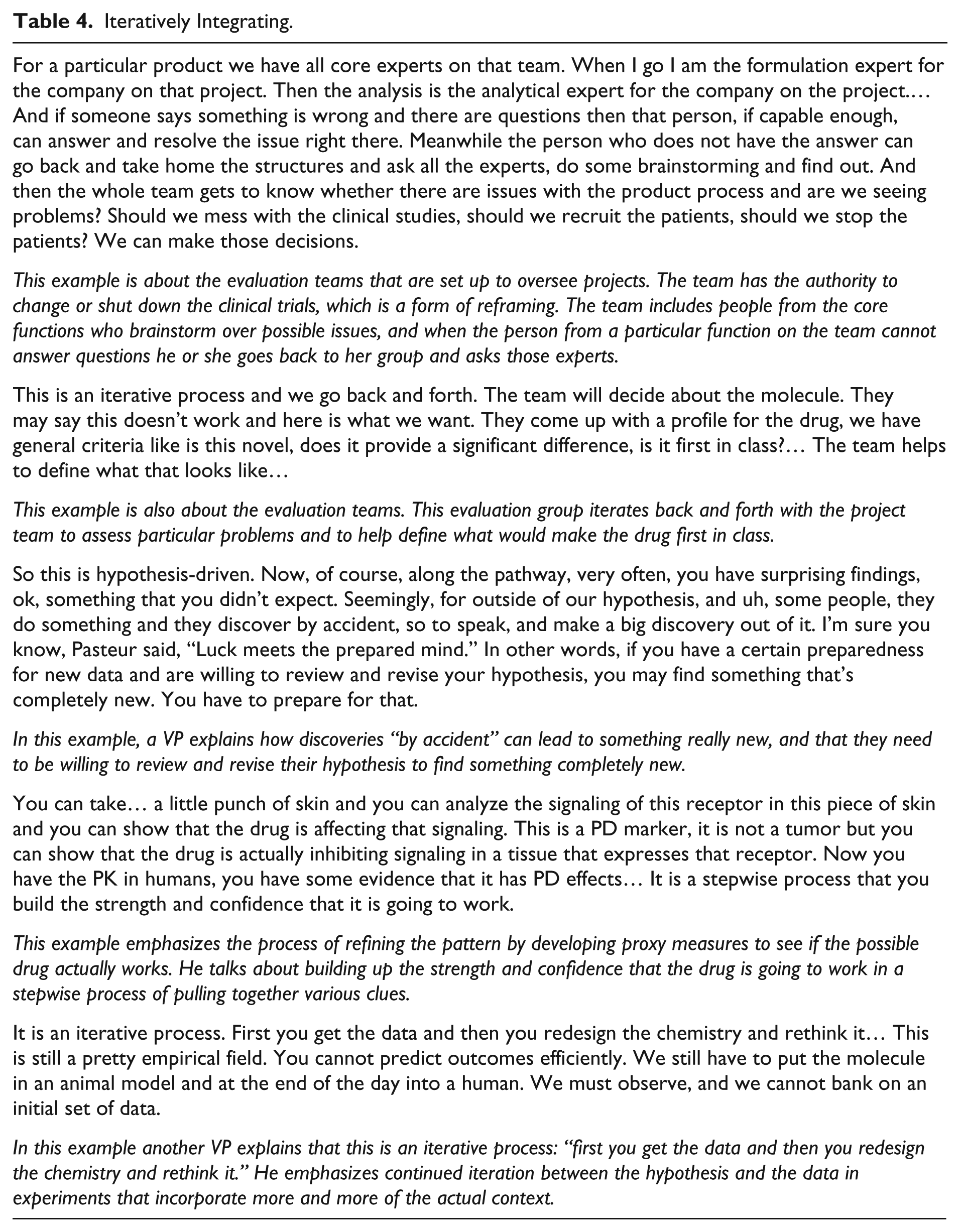
| For a particular product we have all core experts on that team. When I go I am the formulation expert for the company on that project. Then the analysis is the analytical expert for the company on the project.… And if someone says something is wrong and there are questions then that person, if capable enough, can answer and resolve the issue right there. Meanwhile the person who does not have the answer can go back and take home the structures and ask all the experts, do some brainstorming and find out. And then the whole team gets to know whether there are issues with the product process and are we seeing problems? Should we mess with the clinical studies, should we recruit the patients, should we stop the patients? We can make those decisions. |
| This example is about the evaluation teams that are set up to oversee projects. The team has the authority to change or shut down the clinical trials, which is a form of reframing. The team includes people from the core functions who brainstorm over possible issues, and when the person from a particular function on the team cannot answer questions he or she goes back to her group and asks those experts. |
| This is an iterative process and we go back and forth. The team will decide about the molecule. They may say this doesn’t work and here is what we want. They come up with a profile for the drug, we have general criteria like is this novel, does it provide a significant difference, is it first in class?… The team helps to define what that looks like… |
| This example is also about the evaluation teams. This evaluation group iterates back and forth with the project team to assess particular problems and to help define what would make the drug first in class. |
| So this is hypothesis-driven. Now, of course, along the pathway, very often, you have surprising findings, ok, something that you didn’t expect. Seemingly, for outside of our hypothesis, and uh, some people, they do something and they discover by accident, so to speak, and make a big discovery out of it. I’m sure you know, Pasteur said, “Luck meets the prepared mind.” In other words, if you have a certain preparedness for new data and are willing to review and revise your hypothesis, you may find something that’s completely new. You have to prepare for that. |
| In this example, a VP explains how discoveries “by accident” can lead to something really new, and that they need to be willing to review and revise their hypothesis to find something completely new. |
| You can take… a little punch of skin and you can analyze the signaling of this receptor in this piece of skin and you can show that the drug is affecting that signaling. This is a PD marker, it is not a tumor but you can show that the drug is actually inhibiting signaling in a tissue that expresses that receptor. Now you have the PK in humans, you have some evidence that it has PD effects… It is a stepwise process that you build the strength and confidence that it is going to work. |
| This example emphasizes the process of refining the pattern by developing proxy measures to see if the possible drug actually works. He talks about building up the strength and confidence that the drug is going to work in a stepwise process of pulling together various clues. |
| It is an iterative process. First you get the data and then you redesign the chemistry and rethink it… This is still a pretty empirical field. You cannot predict outcomes efficiently. We still have to put the molecule in an animal model and at the end of the day into a human. We must observe, and we cannot bank on an initial set of data. |
| In this example another VP explains that this is an iterative process: “first you get the data and then you redesign the chemistry and rethink it.” He emphasizes continued iteration between the hypothesis and the data in experiments that incorporate more and more of the actual context. |
Funding
This study has received support from the Managing Innovation in the New Economy (MINE) program; Roger Miller (Polytechnique Montréal) and Serghei Floricel (Université du Québec à Montréal), principal investigators, Social Sciences and Humanities Research Council of Canada (SSHRCC); the Technology Management Research Center of Rutgers University; the Lerner Center for Pharmaceutical Management of Rutgers University; and the Rutgers Business School Research Committee. The authors also thank the School of Management at Binghamton University, State University of New York, for their generous support.