



Abstract
We examine the case of a corporate spin-off, in which its reacquisition by the parent firm radically changed its structure and culture. Employing a discourse lens, we study paradoxical tensions of innovation as key members “talk into being” the paradoxical circumstances of their environment. From our analysis, we develop the concept of tensional “knots,” discursive formulations in which members construct tensions, not only as co-occurring, but as Gordian (inseparable) entanglements of interdependence. Knotted tensions can be amplifying (exacerbating) or attenuating (improving) in their effects on one another, but with very different consequences to innovative action. Specifically, knotted tensions and the way in which members manage them set up counter-intuitive logics that serve to justify courses of innovative action or inaction. We propose a process model advancing understanding of interlinked tensions in more complex ways than current paradox theory allows. We conclude with a discussion of our contributions to paradox theory in innovative contexts, along with suggestions for future research.
Introduction
Innovation processes are riddled with tensions (e.g., Andriopoulos & Lewis, 2009; Freeman & Engle, 2006; Lewis, 2000; Murphy & Pauleen, 2007; Smith & Tushman, 2005). Although researchers have recently examined paradoxical tensions underlying innovation processes, most studies to date focus on singling out paradoxical tensions for analysis. Studying single tensions has been a theoretically useful lens, especially in the search for broadly applicable or generic tensions (e.g., exploitation versus exploration). However, continuing such a focus hinders our understanding of how multiple paradoxical tensions might simultaneously emerge, interrelate, and be managed toward innovative outcomes.
This is an important omission because in complex environments, contingencies grounded in joint job performance produce multiple and interrelated tensions that affect innovation (cf. Jarzabkowski, Lê, & Van de Ven, 2013; Smith & Lewis, 2011). For example, what might happen when organizational members name one pole of a tension (e.g., exploitation over exploration), interweave it with a pole of another tension (e.g., interdependence over autonomy) that, in turn, produces still other tensions or constraints 1 (e.g., stability over change)? Further, what exigencies might bring about such interweaving of tensions—e.g., attempts to make sense of a complex problem such as a work culture that is perceived to stymie innovation? Thus, we argue that the combined effect of tensions constrains innovation in more complex ways than current theory adequately explains.
Specifically, we wanted to know how such intertwined tensions might conflict with or exacerbate one another. Such nuanced questions address paradoxical complexity (Schad, Lewis, Raisch, & Smith, in press) that compels investigation of how organizational members construct and simultaneously interrelate multiple paradoxical tensions. This is essential to “understand the dynamics through which paradoxes (and their tensions) [parenthesis added] are interlinked and the way they generate outcomes that shape the ongoing response to paradox” (Jarzabkowski et al., 2013, p. 250).
In order to address how organizational members combine tensions, as well as calls to investigate how paradoxes impact one another (Schad et al., in press), we examine how members voice and perceive multiple tensions and with what effects. In doing so, we adopt a discursive approach to examine the paradoxical complexity of multiple tensions because a discursive lens allows us to preserve the wholeness of the context as organizational members voice and perceive it (e.g., Tracy, 2004). Whether or not tensions are conceived of as existing in cognition or the environment (Lewis & Smith, 2014; Smith & Lewis, 2011), they are also made sense of in and through discourse. Often this is done retrospectively, as Weick’s (1979) aphorism suggests: “How do I know what I think until I see what I say?” Thus, a discursive lens is especially appropriate, given that our purpose is to uncover inductively how organizational members construct and link multiple paradoxical tensions in their everyday accounts (in this case, interviews) and with what effects.
To that end, we examine the combined effect of multiple tensions in the case of a corporate spin-off that, at the time of data collection, had been recently reacquired by the original parent company. The parent firm created the spin-off for the explicit purpose of developing innovative printer technologies and products (e.g., Rubera & Tellis, 2014), and then reacquired it for commercialization purposes. We know that a spin-off strategy aimed at fostering innovation can produce ambiguity and riddle the organization with tensions (e.g., Corley & Gioia, 2004). Moreover, subsequent reacquisition can compound newly imposed constraints by the parent that were not previously experienced as an autonomous spin-off. Given this scenario, the organization we studied was an apt context in which to examine multiple tensions of innovation—and how, in complex ways, organizational members managed them in and through their discourse.
Theoretical Background
We begin by defining four foundational terms—paradox, tension, innovation, and discourse—followed by a discussion about the importance of a discourse lens in examining tensions underlying innovation. Unlike a simple choice or dilemma, a paradox is seen as a non-resolvable tension, highlighting its persistence over time (Schad et al., in press). While all paradoxes are comprised of tensions with contradictory or contravening “poles” tugging in opposite directions, organizational members do not treat all tensions as non-resolvable. Thus, we use the more general term “tension” when many (but not all) of these tensions will be constructed as non-resolvable paradoxes. Innovation refers to the implementation of creative ideas (Anderson, Potočnik, & Zhou, 2014). Finally, discourse refers to constellations of language, logics, and texts rooted in day-to-day actions and interactions (Fairhurst & Putnam, 2014).
A discourse paradox lens focuses on how organizational members enact and respond to tensions in and through social interactions (Putnam, Fairhurst, & Banghart, in press). Because meaning is a central component of organizing within this lens (Weick, 1979), the naturalistic discourse of organizational members is an important source for theory development. Members are treated as knowledgeable actors who continuously orient to their circumstances and can explain them if asked (Boden, 1994; Garfinkel, 1967).
A discourse lens can thus be especially useful in the study of multiple tensions underlying innovation. As mentioned earlier, research on paradoxical tensions underlying innovation singles out tensions—as opposed to examining multiple tensions simultaneously. To be clear, scholars recognize that tensions co-occur (e.g., Andriopoulos & Lewis, 2009; Dameron & Torset, 2014; Huxham & Beech, 2003; Jarzabkowski et al, 2013; Tracy, 2004), but their analyses typically do not extend to studying how organizational members actually voice and perceive their co-occurrence (i.e., how they construct the dynamics of relationships among multiple paradoxes). For example, key innovation tensions of exploration (generating new knowledge and products) and exploitation (improving current capabilities and products) have been shown to co-occur 2 (Andriopoulos & Lewis, 2009, p. 697; Garud, Gehman, & Kumaraswamy, 2011; March, 1991; Smith & Tushman, 2005; Tushman & O’Reilly, 1996), but how organizational members actually make sense of and perceive their (situated) entanglements has been largely unknown. Some have argued that paradox theory building and research must balance the need for simplicity with that of increasing complexity (Schad et al., in press). A discourse lens provides needed paradoxical complexity for four reasons.
First, there is still much to learn regarding how organizational members approach paradox and how they experience paradoxical tensions (Trethewey & Ashcraft, 2004). As mentioned above, members frequently communicate their circumstances interactively in an effort at retrospective sensemaking (Weick, 1979); hence, in this view, communication precedes cognition, thus producing and modifying it (Cornelissen, Durand, Fiss, Lammers, & Vaara, 2015; Poole, 2013; Weick, 1979). Following in the traditions as ethnomethodology (Boden, 1994; Garfinkel, 1967), discursive psychology (Edwards, 1997; Potter & Wetherell, 1987) and, more recently, performative views of discourse (e.g., Cornelissen et al., 2015), members’ discourse regarding their practices is the starting point, the phenomenon to be explained.
Second, in discursive approaches, language is more than a portal or representation of some inner world, but is “consequential in the telling” (Edwards, 1997, p. 67). That is, we analyze discourse for what it accomplishes in constructing and legitimizing a certain version of reality (Potter & Wetherell, 1987). In discourse analysis, constructivist grounded theory methods (Charmaz, 2014) may aid in data analysis, but such analyses must allow for multiple readings of problems by different organizational members. Multiple readings are necessary to understand the differential bases upon which individual choices are made between and among tensional forces (Huxham & Beech, 2003). Not accounting for multiple readings can create problems with oversimplifying tensions in complex situations, including that of innovation (Huxham & Beech, 2003). It also risks closing off meaning, treating language as a simple mirror of reality rather than constitutive of it (Knights, 1997).
Third, given the need for sensemaking and the consequentiality of discourse, organizational members “talk” their paradoxical circumstances into being (Poole, 2013), much the way they talk their organizations into being (Boden, 1994; Heritage & Clayman, 2010). Regardless of the origins of tensions, they inevitably enter into the communication process whenever members attempt to define “the situation here and now” for themselves or others (Goffman, 1974). We argue, however, that the paradox literature has yet to exploit all of the ways in which they do so.
In line with a discourse lens, prior work in relational dialectics (Baxter, 2011; Baxter & Montgomery, 1996), based on the discourse theory of Mikhail Bakhtin (1981, 1984), suggests that “knots” form from ongoing tensions that are not easily separated. A discourse lens allows analysts to compare the tension patterns and sensemaking statements of members if they pose such knots. Because tensions and tension management often coalesce discursively (Dameron & Torset, 2014), a discursive lens enables us to identify members who find room to maneuver within such knots versus those who may feel entrapped by knots (Tracy, 2004). Innovation research thus benefits from learning how organizational members actually experience the potentially knotted entanglements of modern-day innovation pressures and complexities.
Finally, a discourse lens allows us to discern logics for action that go beyond the common single tension management strategies such as ambidextrous “both-and” approaches (Andriopoulos & Lewis, 2009) or “either-or” approaches (Tracy, 2004; Seo, Putnam, & Bartunek, 2004) that characterize much of the research on tensions of innovation (e.g., Lüscher & Lewis, 2008). This is because they take into account the wholeness of the organizational context as members perceive it. Logics give members both a way of talking and thinking about paradoxical complexity and change (Ford & Ford, 1994). Not unlike institutional logics (Besharov & Smith, 2014; Thornton & Ocasio, 2008), they can be strategies and sources of legitimacy, order or security (Giddens, 1984; Potter & Wetherell, 1987; Seo & Creed, 2002).
In line with the tenets of organizational discourse analysis to ask “how” and not “why” questions (Fairhurst & Putnam, 2014), we seek a deeper understanding of how members describe the wholeness of the tensional environment they face. Since empirical work is relatively scarce that “explores how actual organization members experience the variety of organizational tensions” (Trethewey & Ashcraft, 2004, p. 82) in individual approaches to paradox (Schad et al., in press), we respond to research directions suggested by this group of authors by asking:
RQ1: What tensions do organizational members experience and name?
RQ2: How do members position or problematize tensions as interrelating?
RQ3: How do members cope with and respond to tensions, and with what effects?
Approach and Method of Analysis
We use a discursive approach to investigate how organizational members both construct and manage multiple tensions simultaneously. We thus ground our approach in a social constructionist epistemology and a discursive analytic method. We utilize a case-study approach (Yin, 2003) to understand the contextual particulars our study’s participants were drawing on and variously constructing.
Context of the case
“GreatPrint” was created in the late 1990s as a research and development joint venture between its parent company, “ColossaCorp” (both pseudonyms) and a similar firm in the print industry. GreatPrint was to develop innovative print technologies primarily for the general commercial printing and pre-press services market. It was subsequently a spinoff of ColossaCorp in the late 1990s, operating autonomously and “left alone,” as described by interviewees. CollosaCorp’s 2004 decision to reacquire GreatPrint was in the process of being formalized in 2006, when we began to collect our data. Our study spanned this period of GreatPrint’s reacquisition as it was formalized and initially experienced by its managers and employees.
While we cannot reproduce GreatPrint’s mission verbatim for confidentiality reasons, its mandate was to develop highly innovative technologies and products for the commercial print industry. As such, GreatPrint became a highly effective company in its own right, as evidenced by its rapid development of groundbreaking printing devices. In an industry that typically requires a product development cycle of eight to ten years, GreatPrint’s development cycle of four years to introduce new technologies and products was remarkable. In 2006, ColossaCorp formally reacquired GreatPrint to commercialize its new products by manufacturing and marketing them on a large scale—while ostensibly maintaining GreatPrint’s R&D mission. The dual missions of innovation and commercialization produced both intended and unintended consequences, with both predictable and unexpected tensions.
Data collection
Over a period of 18 months (2006–2007), two of the authors conducted 30 in-depth, 60- to 90-minute interviews with members of GreatPrint’s senior leadership team (including CEO, HR director, and chief operations officer), division heads, middle-level managers (program managers, scientists, and senior engineers), and lower-level managers (engineers and systems operators). Out of the 300 employees of the GreatPrint subsidiary, our sample of 30 interviews (10% of the population) was representative of the various managerial levels and occupations of GreatPrint. We interviewed top managers (3; 10% of the sample); functional managers (6; 20%); first-layer supervisors (2; 6.7%); second-layer supervisors (5; 16.7%); commercialization managers (9; 30%); R&D scientists (6; 20%); engineers (7; 23.3%); software engineers (5; 16.7%) (totals over 100% because some categories overlapped). Of our interviewees, 27 were male and three were female, which is also representative for GreatPrint.
Regarding the tenure of our sample, only four of our interviewees (13.3%) joined GreatPrint as it was being spun off and did not have any prior experience working for ColossaCorp. Most (86.7%) had worked for the parent company prior to the spin-off with a range of 3.5 years to 25 years. GreatPrint employed all of the participants for its life span of five years, and ColossaCorp subsequently employed them after reacquisition.
Interviews were semi-structured in order to pursue interesting comments and themes. Earlier interviews were guided by “theoretical sensitivity” (Glaser, 1978) with questions designed to evoke descriptions of innovation-related processes; later interviews were more refined and structured around emerging themes. Each interview was audio recorded and transcribed for further analysis.
In addition to interviews, we drew on further data sources to enhance our understanding of the context. First, one of the authors conducted onsite observations and multiple in-person meetings at GreatPrint in order to understand the transition dynamics and material contexts of GreatPrint. Second, our interview protocol and understanding of GreatPrint’s historical and current contexts were further informed by archival data (e.g., CEO presentations from GreatPrint’s “town hall” meetings and company e-mails informing employees of the reacquisition) and ongoing news stories in mainstream media sources (e.g., Wall Street Journal, Forbes, The Economist). The latter covered GreatPrint both during and after the structural transitions.
Data analysis
We addressed Research Question 1 with a grounded theory analysis, in which categories of individual tensions emerged through coding of the data (Strauss & Corbin, 1998). More specifically, we deployed a constructivist grounded theory approach (Charmaz, 2014), in which “we change our conception of…a real world to be discovered, tracked, and categorized to a world made real [italics in original] in the minds and through the words and actions of its members” (Charmaz, 2000, p. 521). The 30 interview transcriptions totaled 648 single-spaced pages with 5,840 segments of coded text, many of which received multiple codes. Consistent with a grounded theory approach, our codes emerged iteratively as we moved between data collection, analysis, and theory (Glaser & Strauss, 1967). The first two authors coded each interview independently, initially with very open criteria for emergent coding. Later, as we compiled instances of interviewee discourse suggesting theoretical categories, we progressively developed an axial coding structure in the form of a coding hierarchy (Strauss & Corbin, 1998). Using the coding comparison feature in NVivo software (QSR International), the program returned a percentage agreement of 99% between the two coders (averaged across all coding categories), with an average Cohen’s kappa of .70. This reflects substantial inter-rater agreement taking into account the number of categories and codes (Landis & Koch, 1977).
For each of the interviews, coders shared their independently coded transcript with an opportunity for each to agree, disagree, modify, or add to the codes. From the resultant agreed-upon codes, we made a master copy of each transcript for further analysis in NVivo. This capability greatly facilitated our going back into the data to examine relationships among multiple types of coded tensions.
After coding 25 interviews, we reached “theoretical saturation” (Glaser & Strauss, 1967), as we then saw mostly redundant instances of concepts from our coding structure and overall themes. Even so, we continued coding through all 30 interviews in order to ensure beyond any reasonable doubt that we had reached theoretical saturation.
As Research Questions 2 and 3 explored concepts about which little is known theoretically (i.e., combined tensions), we adopted an iterative analysis (Tracy, 2013), a variant of grounded theory methods. In five iterative stages, we linked aspects of the data to emergent findings, but with a purposeful sensitivity to theoretical contentions in the literature on organizational tensions and paradox. The work of Miles and Huberman (1994) and others (Srivastava & Hopwood, 2009; Stoltzfus, Stohl & Seibold, 2011) inform the iterative analytic technique. Specifically, we drew from the literature to help us understand: 1) the extent to which individual tensions appeared alone or in concert; 2) naturalistic groupings of tensions in members’ discourse (which we later termed “tensional knots”); 3) how tensions appeared to impact one another; 4) tension management strategies and logics justifying such strategies; and 5) categories of knots based on primary subject matter or predominant tensions (e.g., finances, technology, simultaneous goals, and parent company influences).
Findings
To address our three research questions, we sought to examine precisely what tensions organizational members experience and name; how they problematize tensions; and how they cope with and respond to tensions and their consequences. We found that members often formulated multiple tensions as interwoven knots. They were sometimes mutually amplifying and at other times mutually attenuating, to justify taking courses of innovative inaction or action, respectively. We next explain our findings and later propose a process model integrating our propositions.
Identification of individual tensions (RQ1)
For RQ1, we wanted to identify how members voiced and categorized the individual tensions that they used to construct tensional knots. As such, we initially observed in our data a preponderance of “problem talk” (e.g., “The reason we come to work is really to solve problems”). Moreover, wherever we found “problem talk,” interviewees verbalized various tensions 100% of the time. We found that specific tensions set up in members’ problematizing discourse could be seen as contradictory tensions (simple opposition seen as needing resolution) or as a duality (interdependent and synergistic without goal resolution) (Farjoun, 2010; Schad, et al., in press).
Throughout our data, we coded multiple types of tensions impinging on justifications for different courses of (in)action. These tensions set up the enabling conditions for, or limits to, actions that organizational members pondered to produce innovative outcomes or justify trade-offs preventing them. They were grouped in the following sub-categories through our initial open coding: diminished resources (e.g., time, human, financial, knowledge, support services); leader/manager behaviors (praising, listening, screaming, coercion); organizational structure (small vs large, mechanistic vs organic); organizational culture (risk vs efficiency); organizational change (reacquisition, downsizing); and professional interests and goals (innovation vs commercialization, short-term vs long-term).
Two key points must be made with respect to the initial coding of tensions. First, analysts understandably have reductive tendencies consistent with the abstractions necessary for generalizing theory; however, organizational members have no such concerns. Discursively, the distinctions they make with respect to aspects of their environment are important to honor in order to discern what they have been practically orienting to in their contexts (Boden, 1994). For example, while analysts might prefer to see company financial goals as redundant with market concerns, members usually show no such inclination. Rather, they often prefer to see them as independent, perhaps because company financial goals as a lived experience are much more nuanced by virtue of taking into account company history and exigencies that “the market” fails to capture. Meaning is inescapably context specific. Therefore, throughout our data presentation, we privilege members’ language use in lieu of our coded categories, especially to understand precisely how tensions are impacting one another to form knots.
Second, our list of tension types were not the only tensions noted in our data; however, they were most often posed as oppositional to innovative actions in one or more of the four “knotted tension” foci we identified in addressing Research Questions 2 and 3.
Positioning tensional interrelationships: Knots (RQ2)
After coding for individual tensions in addressing RQ1, we pursued RQ2. The primary finding here was the discovery of intertwined and mutually amplifying (or attenuating) relationships among tensions, which led us to characterize tensions metaphorically as knots. As mentioned above, “knots” is a term from the relational dialectics literature (Baxter, 2011; Baxter & Montgomery, 1996). Yet, these scholars did little empirically to demonstrate how tensional knots form in and through discourse, and with what effects—and further studies are sparse (e.g., Norton & Sadler, 2006). Thus, we sought to advance a more empirically based understanding of knots.
We define knots as tensions that mutually impact one another in either prismatic (amplifying) or anti-prismatic (mitigating) ways. By prismatic, we mean co-present tensions that discursively interact to amplify each other’s effects (cf. Jamieson, 1995)— i.e., tensions that are made worse by or even generated by the presence of other tensions, as constructed by the member. Dealing with only one of the tensions—or dealing with them all, but at separate times—would be different than dealing with them simultaneously. In the compounded force of tensions interacting, we can see their amplifying impact on one another. Metaphorically, multiple interacting tensions are like the cacophony of discordant sound in blaring trumpets. Each new trumpet would be increasingly unbearable—amplifying the discordance of previous trumpets. By contrast, tensional knots constructed as anti-prismatic impact one another in mutually beneficial (or harmonious) ways to attenuate the negative effects of the tensions—to “make beautiful music” together, so to speak.
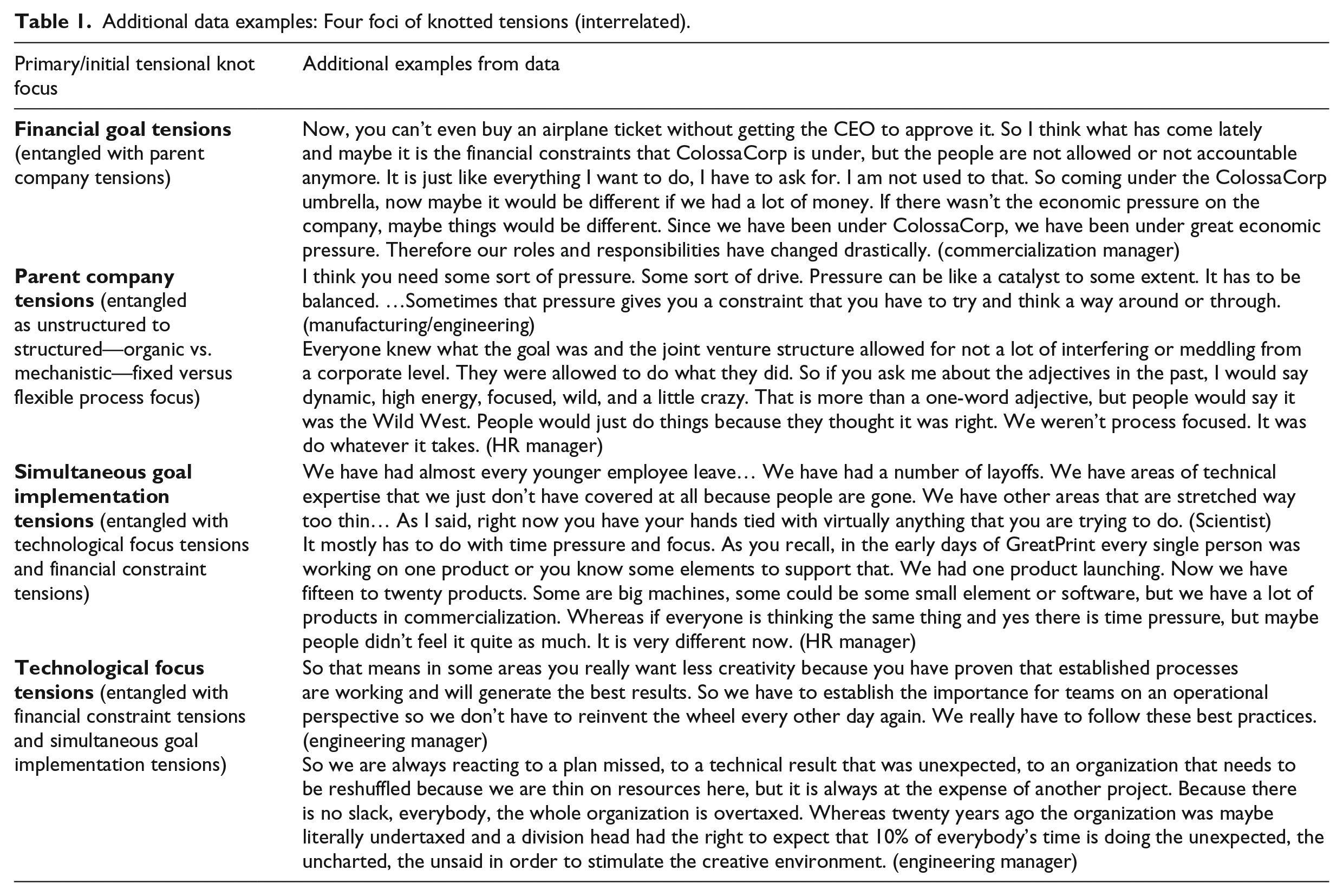
In the sections below, we present four examples of tensional knots, each with a primary focus and different prismatic or anti-prismatic relationships. Each of the examples also illustrates one of four major foci of knotted tensions found. We do not intend these to be exhaustive for all contexts; they are topically organized around the predominant or initial focus of the knotted tensions found in our analysis: (1) financial goal tensional focus, (2) parent company tensional focus, (3) goal simultaneity tensional focus, and (4) technological tensional focus. Our aim is show how tensions intertwine around a central tensional theme; however, the foci are not to be construed as “pure” types because they are rarely isolated in discourse, as Table 1 of additional examples from our data demonstrates.
Additional data examples: Four foci of knotted tensions (interrelated).
Financial goal tensional focus
As an example of prismatic tensional knots, the combined effects of overbooked workloads, time resources, lack of autonomy, financial constraints, reduction in personnel, and a number of other complicating factors intertwined to form many of the tensional knots in our data. Too many small, incremental projects developed from new commercialization goals of the parent company, ColossaCorp. These were often set as oppositional to longer-term, more innovative projects, causing interviewees to lament the loss of time and autonomy. In the example below, the bold-faced words designate these tensions, respectively. (Hereafter, we use boldfacing in illustrative quotes and their corresponding diagrams in Figures 1 to 4 to designate tensions as members articulate them as discursive constructions—not as objectively inherent in the system.) As one manager stated:
But I don’t think that we have that environment anymore [prior to reacquisition]. It is the inverse that all of us are charged, are overbooked to 125% or whatever it is. There is no way that we can take out 20% or 10% an afternoon of the week and say, “Okay, I set this aside more or less intentionally to do something that is not 100% correlated with what I should be doing.” So organizationally and the
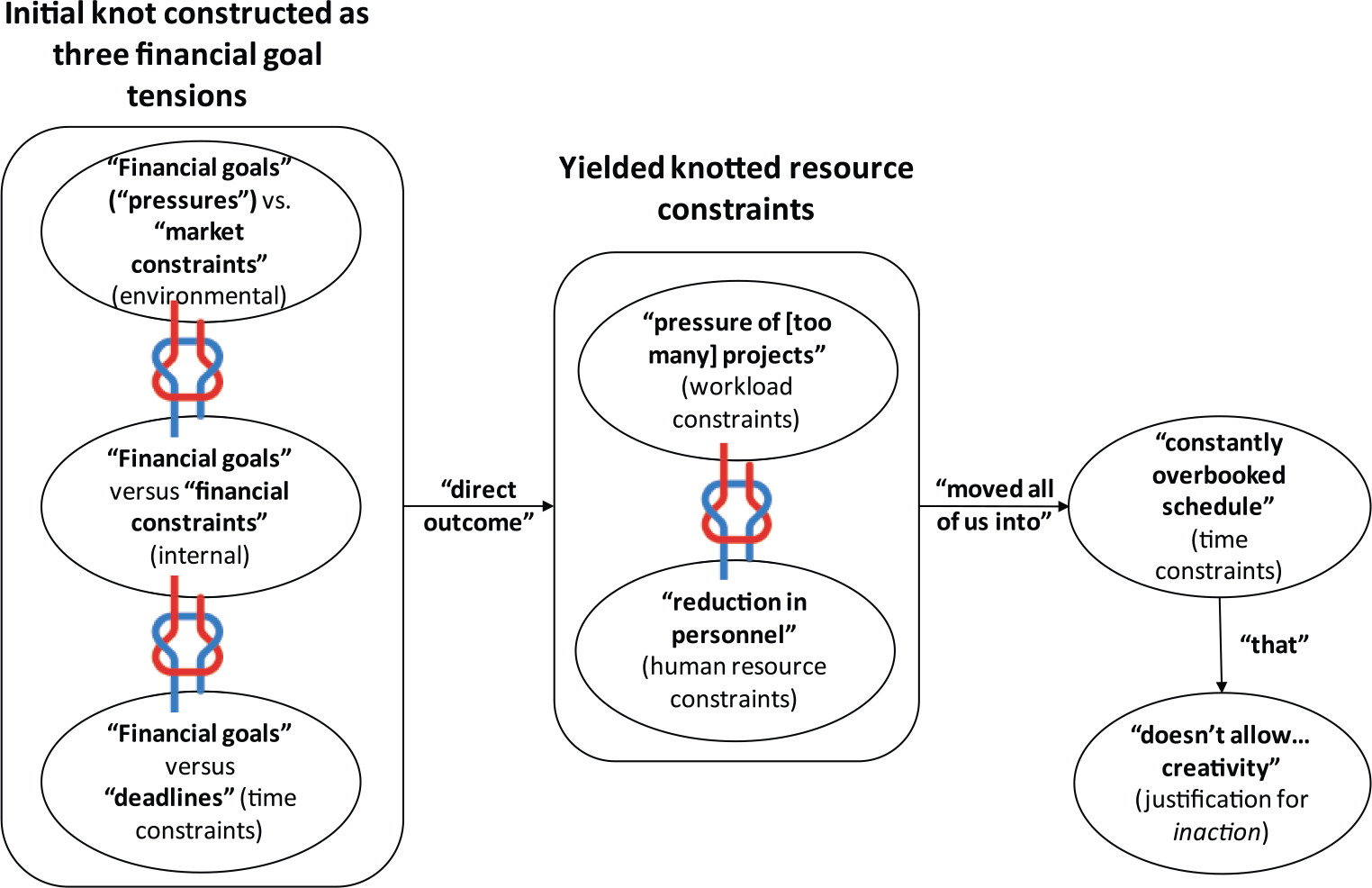
An example* of knotted financial goal tensions.
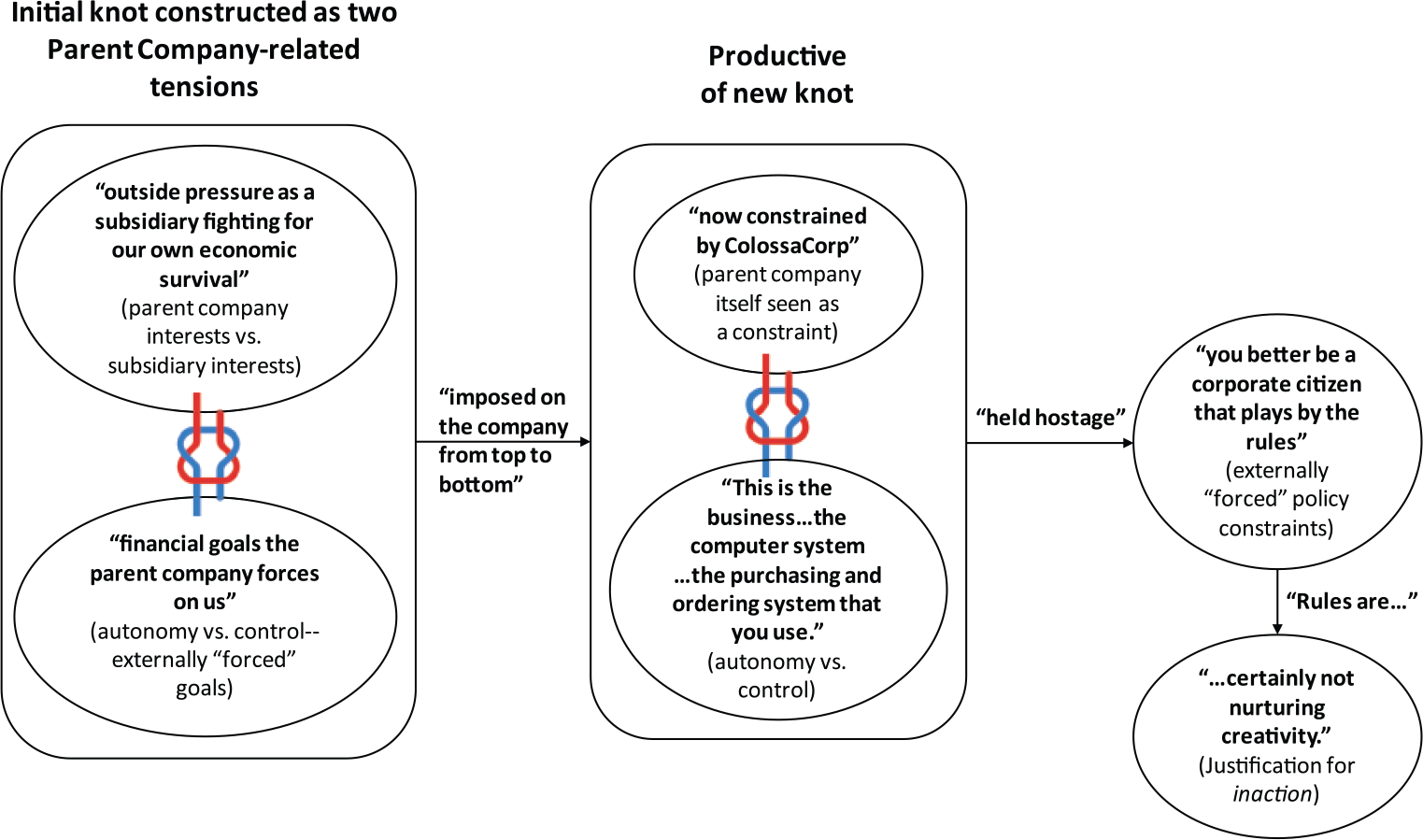
An example* of knotted parent-company related tensions.
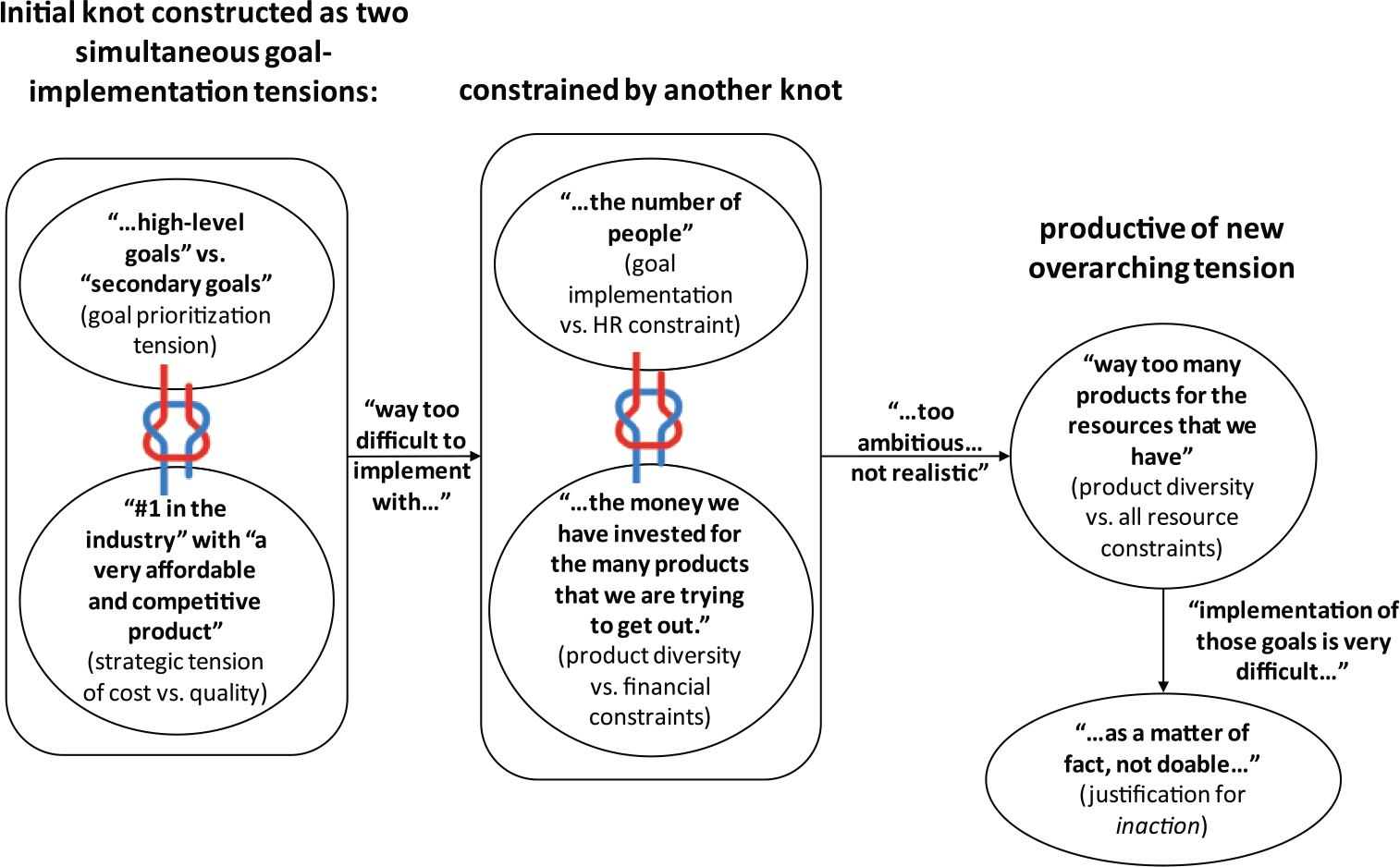
An example* of knotted simultaneous goal implementation tensions.
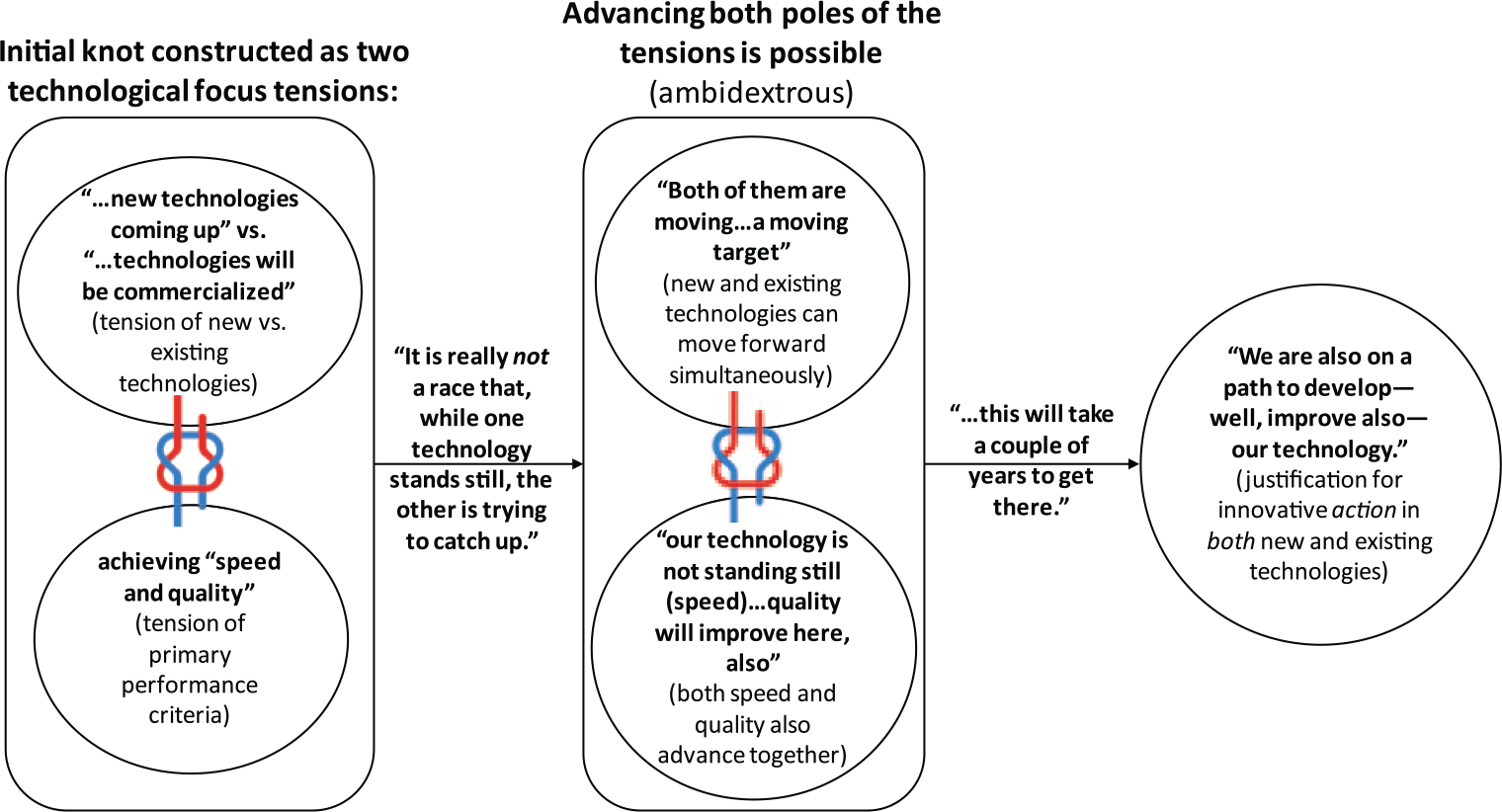
An example* of knotted technological focus tensions.
To be transparent in how organizational members, like this manager, discursively constructed multiple tensions as interwoven and knotted, we sought to account visually for the interrelationships among tensions in Figure 1 for the quote above (along with Figures 2 to 4 for subsequent examples). To do so, we created diagrams that map the relationships set up among tensions in interviewees’ own words, which is the hallmark of a discursive focus (Boden, 1994).
In our analysis, we coded for knotted tensions when interviewees voiced multiple tensions in what conversation analysts term discursive “formulations” (Heritage & Watson, 1979). That is, for tensions to qualify as a “knotted” formulation, interviewees had to: (1) name the relevant components of each tension in the knot; and (2) articulate relationships among multiple tensions in amplifying or attenuating ways, or construct causality in their generating new tensions or knots. Figure 1 identifies “initial” and “yielded” knots. The first knot is reflective of initial or overarching concerns over oppositional relationships, while the second knot is asserted by the member to be a “direct outcome” of the first.
Again, the discourse above makes it clear that tensions do not stand alone. The constant pressures of the “financial goals that must be met” are set in tension with the vagaries of the market, internal financial constraints, and deadlines without wiggle room. These tensions interweave discursively to create an intractable or “Gordian” knot, with the “direct outcome” of unrelenting commercialization pressures to exploit many projects, but with insufficient personnel to make success a possibility. The upshot is a “constantly overbooked schedule,” underscoring the combined effect of the multiple tensions. With financial goal difficulty, awareness of one’s resource deficiencies (i.e., time, people, and money)—and therefore one’s ability to articulate them simultaneously—becomes increasingly acute.
Trying to lessen even one of the tensions in this knot (e.g., the “pressure of projects”) diminishes the short-term financial returns to the parent, whose only recourse would be further belt-tightening, resulting in still more loss of personnel or other resources. The tensions are thus not only intertwined but also prismatic—both exacerbating one another and giving birth to new tensions as “direct outcomes.” The fact that the manager portrayed the knot’s tensions in a rapid-fire, cascading manner only reinforces the pressures of converging tensions.
Parent-company tensional focus
In the next example, and in other instances in our data (see Table 1), interviewees focused on the structure, culture, and leader/manager behaviors of the parent company, ColossaCorp. A typical scenario was that of a nimble, organic, and autonomous GreatPrint, but only in past tense. Prior to its reacquisition, GreatPrint was an independent spin-off seen as escaping what members variously described as the “stodgy,” bureaucratic, or controlling parent company, ColossaCorp. This construction often captured one of our initial tension codes that emerged—that of an organizational culture of risk (associated with innovative actions) versus efficiency (associated with reduced costs). Thus, another knot-like array of tensions emerged (after GreatPrint was reacquired), with changes in parent-company practices that now inhibited the risk and flexibility necessary for an innovative climate. This set up the perception of being “held hostage,” according to this program director who headed up a large team of engineers and technicians:
I think we are
Similar in format to Figure 1, Figure 2 maps the relationships articulated by a GreatPrint program director. For the parent company knot, we observed outside economic pressures requiring GreatPrint to “fight for our own economic survival,” financial goals of the parent that are “forced on us,” culminating in the autocratic policies of the parent company “imposed on us from top to bottom.” These tensions are constructed as prismatic because it is in the compounded force of the tensions being “imposed on” the subsidiary (now a part of the “company from top to bottom”) that we can see their amplifying impact on one another.
Metaphors evoking violence (“held hostage…parent company forces… fighting for our own…survival”) suggest a tightly bound paradoxical “cage” (Poole, 2013) for this program director who feels entrapped as a “hostage” and thus constructs another Gordian knot. Granting GreatPrint its “freedom” from ColossaCorp (no longer a “hostage”) would enable it to set more long-term goals. However, this would also mean fewer dividends in the short term for ColossaCorp, which would only exacerbate its financial plight—and further amplify the constraints it “imposes on” GreatPrint. However, not granting GreatPrint’s autonomy is no less perilous a course, as it struggles under the weight of its parent’s demands and its own survival concerns. GreatPrint’s lack of autonomy magnifies the experienced economic pressure imposed by the parent, while said pressure magnifies the peril of GreatPrint’s own economic survival. Thus, we propose:
Proposition 1: Organizational members are more likely to discursively construct knots when multiple organizational tensions intertwine in complex, interdependent ways, such as in contexts of rapid change and innovation.
In addressing RQ2, we found two other tensional foci—goal simultaneity and technology-focused. However, we present these foci under RQ3 because they also identify tension management strategies and local logics. Such “conflating” is to be expected because we have long known that organizational members often prefigure problems based on preferred solutions (Schön, 1983), including tension management strategies (Tracy, 2004). They do so in single problematizing statements, much as we show in the examples below that address RQ3.
To summarize, because members’ portrayals of their tensional environments are intertwined and potentially prismatic (i.e., magnifying), their tensional knots are not only resources for explanation of paradoxical cognition (Dameron & Torset, 2014); they are also phenomena to be explained in their own right. Just how consequential they are is further demonstrated in several more knots used to answer RQ3.
Tensional management and outcomes: Opposite-logics (RQ3)
A major finding for RQ3 involved the justification of (in)action via logics or “good reasons” for the courses of action prescribed by members (cf. Tompkins & Cheney, 1983). While early work by Schön (1983) and later work by Grint (2005) on problem setting/justification points us in this direction, tensional knots give us the levers to understand exactly how courses of action (or inaction) directed at exploration and/or exploitation are discursively legitimated through counter-intuitive logics.
As our examples below illustrate, tension management strategies often serve as discursive underpinnings that can set up the reasoning for the logics. Our data bore out common tension management strategies in the paradox literature: “both-and” (ambidextrous) as well as “either-or” (non-ambidextrous—that can also include “impossible choice” or a double bind) (e.g., Putnam, 1986; Seo et al., 2004; Tracy, 2004; Tushman & O’Reilly, 1996). How members portray how they manage tensions establishes their rationale for whether they believe tensions are part of the problem (a threat to be resolved) or part of the solution (to meet multiple needs). Such framings can serve as a basis for counter-intuitive logics that transform typically positive concerns into negative ones (due to seeing tensions as threats) or negative concerns into positive ones (due to seeing tensions as ongoing opportunities for creative solutions).
Goal simultaneity tensional focus
For instance, consider the following example of an either-or management strategy—i.e., what Lewis and colleagues would term a non-ambidextrous approach to tensions (e.g., Andriopoulos & Lewis, 2009). That is, two opposing alternatives pose an either-or choice that must be made (a win-lose proposition to resolve) or a double bind that presents an impossible choice. Note the knotted double bind set up in the following example that is used to justify inaction by a GreatPrint commercialization manager:
So it is very complex because we have
As visualized in Figure 3, the primary focus of the tensional knot constructed in this quote involves simultaneous achievement of multiple, competing goals. The tension between “high-level” versus “secondary” goals (a tension of prioritization), interwoven with the competing goals of affordability (cost) versus quality (features), forms the initial knot. This knot poses simultaneous goals that are “way too difficult to implement” due to constraints imposed by another tensional knot—“the number of people” as a human resource constraint and “the money we have invested” being spread too thin over “the many products we are trying to get out.” The seemingly impossible choices (“too ambitious…not realistic”) are alleged to render simultaneous goal achievement “not doable”—thereby justifying innovative inaction.
Thus, a tangle of resource constraints (human, financial, and product diversity) prismatically amplifies the severity of simultaneous goal achievement tensions to an extreme—“as a matter of fact, not doable.” Note this manager’s ironic understatement in the italicized words, which are key to his justification of inaction. He sets the solution as complex, circular, and unrealizable. Any otherwise positive concepts in this mix (e.g., #1 in the industry with a competitive product) become reframed or transformed into negatives (part of the overall problem) because of the double bind tension management set up in the member’s discourse among competing goals. In other words, these are all great goals, but they cannot be simultaneously implemented.
Technological tensional focus
By contrast, many organizational members constructed both-and or ambidextrous management strategies (e.g., Andriopoulos & Lewis, 2009; Raisch, Birkinshaw, Probst, & Tushman, 2009; Tushman & O’Reilly, 1996) for tensional knots. Here, they enable simultaneous paradoxical alternatives. Consider the following example from an engineering manager for whom resource constraints counter-intuitively broadened opportunities for exploration rather than threatening or negating it.
With all these
Figure 4 maps the fourth primary focus for knotted tensions in our data, that of a technological focus. More precisely, we should say “knot-like.” As with the above examples, we note a similar construction of the problematized appearance (e.g., “it is really not a race…”) of multiple, interrelated tensions. However, unlike in the previous examples, the manager here constructs an ambidextrous approach to the Gordian knot with very different discursive effects. As diagrammed in Figure 4, a both-and approach to each of the tensional aspects discursively allowed an optimistic appraisal of the organization’s capacity to manage the tensional knot. In Figure 3, the appraisal was decidedly pessimistic. What makes the difference?
Related tensions in this example are a matter of prioritizing performance goals (speed vs quality) and technological focus (new vs existing). With each tension, the member took a both-and tension management approach that enabled a degree of optimism regarding the ability to address these tensions simultaneously. Discursively, this was done by jointly casting exploration of new technology and exploitation of existing technologies as “moving targets” in a way that did not privilege one pole of the tension over the other (i.e., not cast as an either-or choice). This captures ambidexterity with an implicit optimism reflected in the phrase “we will catch up from a productivity perspective” (speed) and “quality will improve here, also” (quality)—even with having to manage multiple tensions over “a couple of years to get there” (signifying the persistence of this paradoxical tension). The ambidextrous tension management approach justifies a course of innovative action (“we are also on a path to develop…”), but it does so by setting up a rationale or logic that transforms what other members had construed as negative tensional scenarios into positive ones—all by casting tensions as “not in a race” but as both moving forward simultaneously.
The differences in tension management constructions thus enabled either a pessimistic or optimistic view of the knotted tensions. The overall difference in this assessment of the knotted “situation here and now” set up several discursive constructions in our data that we termed “opposite logics.” They are “opposite” because they are constructed counter-intuitively to conventional meanings, which we next discuss.
Opposite logics and process model
We define opposite logics as discursive transformations of concerns that typically have positive connotations into concerns that instead possess counter-intuitively negative connotations (or vice versa—negative to positive transformations). If the narrative reconstruction of experience involves a moral, right versus wrong way (Taylor & Van Every, 2014), then these logics are akin to the “moral” of the story, the discursive ends of which justify innovative (in)action.
We summarize these discursive patterns observed in our data (and examples above) in Figure 5. It is a process model in which the four major foci of knotted tensions (illustrated in Figures 1 to 4) led to a choice articulated by each member—how tension(s) could or should be managed (non-ambidextrous/either-or, or ambidextrous/both-and). As the upshot of that choice, members voiced one of two kinds of “opposite logics”: (1) non-ambidextrous management (and prismatic constructions) leading to positive-to-negative logics leading to courses on inaction; or (2) ambidextrous management (and anti-prismatic constructions) leading to negative-to-positive logics leading to courses of action. Two illustrative examples from our data (one for each logic) follow.
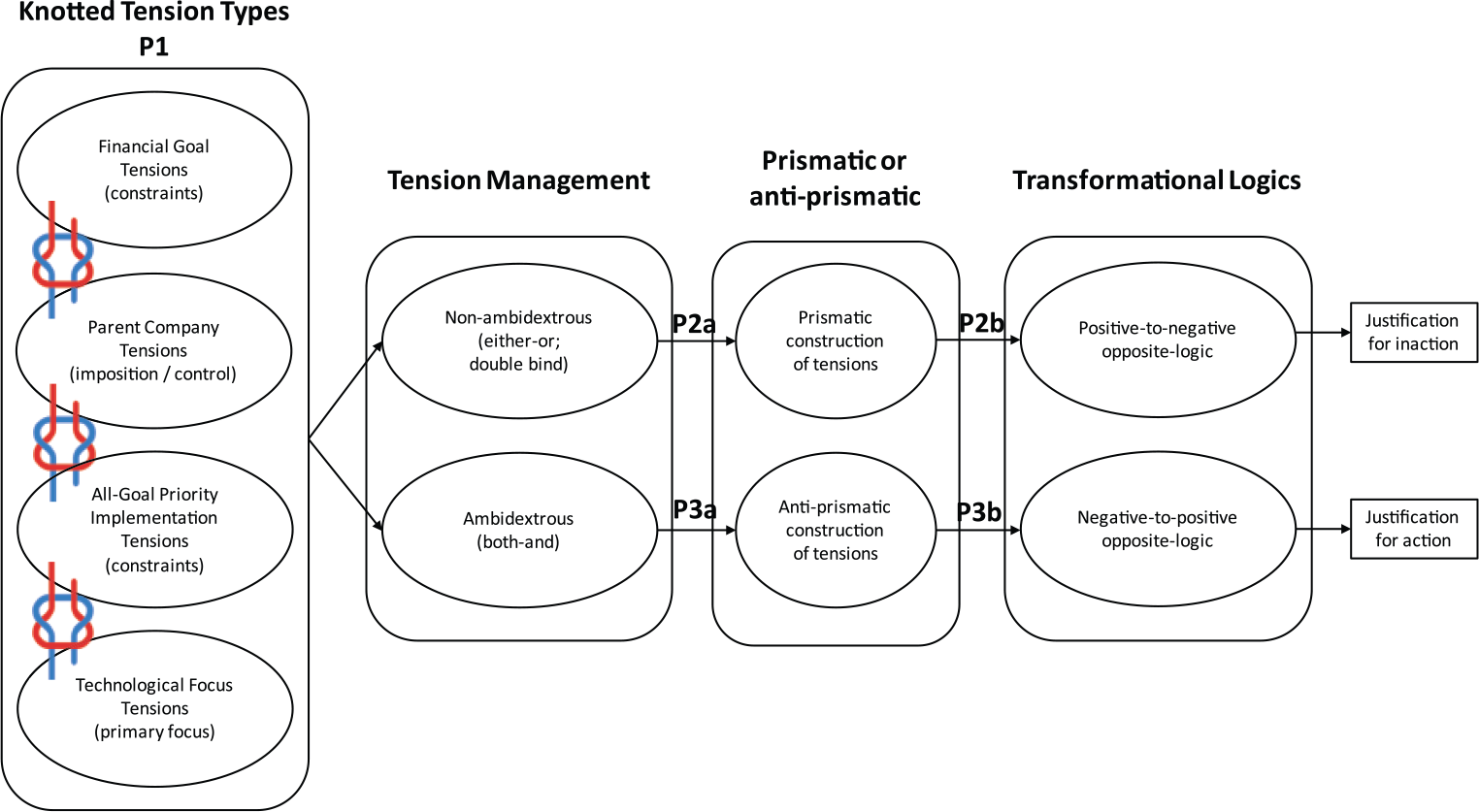
A Process Model for Discursive Construction of Tensional Knots, Opposite Logics, and Justifications for Innovative (In)action.
Positive-to-negative logics
The first set of logics justifies inaction, the goals of which can frequently be tracked across whole interviews. First, organizational members constructed multiple tensions as knot-like, as in the tension management examples above. Second, they used non-ambidextrous (either-or or double-bind) tension management strategies. Third, this led to counter-rationally constructed positive-to-negative logics, justifying innovative inaction or paralysis due to tensions trumping innovation, as detailed below.
We found three overall types of positive-to-negative logics constructed in our data: (1) knowledge is not power; (2) innovative accomplishments are just the beginning of cascading problems; and (3) the most innovative talent becomes the least innovative. For illustrative purposes, we detail the first of these, followed by a summary of the other two.
In the first positive-to-negative logic (knowledge is not power), we found that knowledge—typically construed as enabling power—was instead seen negatively as a constraint. Typically, the benefits of greater knowledge are so recognized that “knowledge is power” has become a well-worn catchphrase. However, this was clearly not the case in a knotted formulation from an engineering manager:
Years ago the entire focus was on creating a product. Now the entire company is
Prior to this abridged quote, the manager had identified a number of tensional forces in the environment, which is one way to demonstrate knowledge of it (Delia & Crockett, 1973). Unfortunately, this knowledge means little more than “running in place” or “inching one’s way forward,” as various managers described it in this technology-focused knot (as “focused” on “lots of different aspects” but “not a new design” or “radical changes”). The manager intertwines this tension with larger (versus smaller) organizational size after the reacquisition, magnifying the problematic aspect of another tension, customer orientation, being set in opposition to innovation. Taken simultaneously, these tensions hinder a culture of risk (difficulty in making “radical changes”)—quite a prismatic knot. Moreover, since the manager cast this knot with implicit double bind effects—with neither exploitation interests (customer service) nor exploration interests (new design, radical changes) being served very well—its opposite-logic effect stymied innovation. Unfortunately, increased knowledge of tensions (by being able to name so many of them) does not translate to power if perceived as producing trade-offs in a zero-sum game—or, in a worst-case scenario, double binds that block goal achievement in any direction.
We found two other positive-to-negative logics in our data that were similar in construction. First, some interviewees cast innovative accomplishments as just the beginning of cascading problems. In this opposite-logic, positive performance was counter-rationally seen as a negative constraint—i.e., positive outcomes of innovation were seen as liabilities. For example, similar to cascading consequences in wicked problems (Rittel & Webber, 1973), a highly successful product launch was viewed as a prismatic sequence of negative consequences that produced other problems. Those unintended consequences involved tensions between multiplied processes (product lines) and the increase in resources needed to accomplish them (all while the workforce was being downsized for efficiency).
A second positive-to-negative logic we found was that “the most innovative talent becomes the least innovative.” In this opposite-logic, human resource advantages became negative constraints through misapplication. The unintended consequences here began with misuse of talent. The most qualified people capable of innovating “next generation” products were instead seen attending to small, incremental improvements to satisfy customers to exploit the current product line.
In all of the positive-to-negative opposite logics, we saw an interactive effect among articulated tensions and their either-or (non-ambidextrous) management strategies. They produced what one manager called a “big sucking sound” on time available for both ideation and implementation phases of innovation. They framed tensions as a zero-sum game that forced an either-or choice.
In sum, in this first set of opposite-logics, members reframed typically positive concerns (knowledge, innovative accomplishments, and highly qualified talent) into negative outcomes (decrease in power, recurring problems, misuse of talent, and organizational liabilities). If the tensional knot was cast in a way that one or both poles of innovation-constraint tensions were necessarily undermined, the innovation side of the tension was usually cast as the loser—the pole that was diminished. The negative outcome regarding innovation was a justification for inaction. Thus, we propose:
Proposition 2a: Tension management strategies for knots constructed as non-ambidextrous (either-or; double-bind) will lead to a prismatic discursive construction of those tensions (i.e., tensions mutually amplifying one another with problematic effects).
Proposition 2b: Knotted tensions constructed as prismatic will produce positive-to-negative opposite-logics—leading to justifications for innovative inaction.
Negative-to-positive logics
The second set of logics involved discursive moves that culminated in accounts that justified innovative action. First, members constructed multiple tensions as knot-like. Second, they deployed both-and (ambidextrous) tension management strategies. Third, this led discursively to the construction of negative-to-positive logics, culminating in justifications for innovative action (innovation trumping constraints, as detailed below).
We found three types of negative-to-positive logics constructed in our data: (1) the constraint is the opportunity; (2); the problem is the solution; and (3) failure is necessary for success. As above, we explicate the first of these followed by a summary of the other two.
In the first type of opposite-logic (“the constraint is the opportunity”), members discursively transformed constraints into a positive path forward (opportunity). Indeed, the same tensional knots that some members saw as threats, others saw as opportunities for innovation. Consider the following example, in which a commercialization program manager had previously articulated an intertwined knot involving tensions of technical innovation vs commercialization, culture of risk vs efficiency, and autonomy vs connectedness. However, even in the context of that knot, this manager saw an opportunity emerging. Instead of threatening innovation, a mechanistic structure in which the parent company imposed standard processes (e.g., commercialization, efficiency, and connectedness poles of the related tensions) was counter-intuitively conducive to innovation (innovative, culture of risk, and autonomy poles of the tensions). He summed it up by contrasting the “process” structure now prevalent in the reacquisition mode with a former “Wild West” metaphor, alluding to when GreatPrint was still autonomous:
Twenty-four months ago it was like Wild West. Process wise, we are coming up the curve. … The Wild West, you get some
We see in this quote that a tensional knot (including innovation versus a structural constraint, implicating a culture of risk versus a culture of efficiency) was constructed as anti-prismatic as a consequence of its both-and treatment. Structural process constraints, typically seen as the nemesis of creativity, actually “helped” it. Thus, tensions did not amplify one another toward negative outcomes, but attenuated (harmoniously) one another toward positive outcomes—mitigating and even transforming the meanings of one another positively.
We saw this anti-prismatic pattern repeated in two other similar negative-to-positive opposite logics. First, we observed patterns in our data in which members expressed a heightened awareness that how we construct a problem can provide the solution. It becomes a counter-intuitive transformation of a problem (negative) into the makings of a solution (positive). Discursively, the tensions posed actually became the warrant for innovative action.
For example, one of the managers at GreatPrint justified a course of innovative action when he described GreatPrint as having “a constructive confrontational culture.” He achieved his ambidextrous approach by juxtaposing a seeming negative (a confrontational culture) as the way to move forward innovatively. The confrontational culture could not be at the expense of processes that made it “constructive.” It was indeed possible to have both.
Second, we saw in our data an opposite-logic transformation that has become a popular cliché in practitioner literature, the “inspiration” of failure being seen as enabling. This logic took on added meaning in the context of tensional knots. For example, a commercialization manager invoked Thomas Edison to illustrate that failures involve treating calculated risk—even when it might fail—as a required and positive antecedent to success. Cliché or not, “failure is a requirement for success” sets up a situationally plausible logic for action: the integration of a culture of risk and efficiency.
In sum, in the preceding three opposite-logics embedded within tensional knots, members reframed typically negative concerns (problems, constraints, and failures) into positive outcomes (constructive confrontations, bureaucracy that serves, and higher quality products). In addition, if the tensional knot was cast in a way such that both poles of innovation-constraint tensions were seen as integrative and mutually reinforcing, innovation was the winner. Thus, we propose:
Proposition 3a: Tension management strategies for knots constructed as ambidextrous (both-and) will lead to an anti-prismatic discursive construction of those tensions (i.e., tensions mutually attenuating one another with mitigating positive effects).
Proposition 3b: Knotted tensions constructed as anti-prismatic will produce negative-to-positive opposite-logics—leading to justifications for innovative action.
To summarize our findings for RQ3, we assert that the logics contained within tensional knots supply the premises for decisions leading to (in)action. Not only do tensional knots formulate intertwined and prismatic tensions as RQ2 discovered, but they justify courses of inaction deriving from positive-to-negative logics associated with either-or and double bind tension management. We differentiate these from the negative-to-positive logics associated with both-and tension management. The former resulted in prismatic amplifications that exacerbated the negative effects of intertwined tensions such that innovative inaction was in some way justified. However, the latter produced anti-prismatic effects among intertwined tensions such that their negative impact was not only mitigated, but also often harmoniously synergized to justify courses of innovative action. We next discuss the implications of these findings.
Discussion
Theoretical implications
We had a unique opportunity to study a reacquired corporate spin-off turned subsidiary during a period in which it struggled to innovate due to a host of tensions created by its financially strapped parent. We interviewed senior managers, scientists, and engineers of the spin-off, and they discursively formulated their circumstances in tensional knots. These knots demonstrated precisely how the tensions that befell the spin-off were multiple, intertwined and prismatic, and productive of counter-intuitive (opposite) logics that justified taking courses of innovative action or inaction. These findings address a “notable paucity of research exploring the processes inherent in creativity and innovation” and to answer the call for “proposition studies” involving “more radical conceptualizations of creativity and innovation processes and outcomes” (Anderson et al., 2014, pp. 22–23). As such, the theoretical contributions from this study are twofold.
First, researchers need new concepts for investigating multiple innovation tensions (as well as tensions, in general). Tensional knots allow analysts to study interrelationships among tensions rather than isolating them. In explicating a new concept of tensional knots, we demonstrated empirically how organizational members construct innovation paradoxes through members’ juxtaposition of multiple and interrelated innovative tensions.
Specifically, our discursive and constructionist theory–method combination elucidates the ways organizational members talk their paradoxical circumstances into being. As M. Scott Poole (2013, p. 120), of Poole and Van de Ven (1989), recently observed, it is precisely the “talk” surrounding paradox by which organizational members entrap themselves in ways that “intensifies their impact and ability to catch us.” We thus empirically demonstrated the value of a discursive lens towards innovation paradoxes by preserving the discursive whole of a tensional knot in organizational members’ accounts—rather than singling out individual tensions for analysis. In turn, we analyzed prismatic and anti-prismatic relationships among multiple tensions as articulated by members who are experiencing innovation tensions firsthand. With rare exception, this is a level of specificity we have yet to see in the paradox literature (cf. Jarzabkowski, et al., 2013), and will need more of in future research to show how tensions can and should be cast as triggers, mitigators, or amplifiers of other tensions. We believe that an awareness of how knots and their effects are formulated in innovation contexts can make the difference between an energized focus on new products (or more creative uses of old ones) versus “spiral death.” That is the term one of our interviewees used to describe a deteriorating, spiraling inertia toward innovative inaction.
While previous paradox research has begun to investigate co-occurring paradoxes (Jarzabkowski et al., 2013), such a concept does not capture the potentially Gordian qualities of a knot—the intractability of multiple, interwoven and potentially amplifying tensions, the effective synergy of which can only be approached by thinking outside the box (i.e., both-and ambidextrous tension(s) management and negative-to-positive logics). Because we believe there is (empirical) richness in the weave, we cast tensions as the most fundamental unit of analysis—and tensional knots as the precise manner in which organizational members discursively tie ongoing paradoxical tensions together. Such an approach has direct implications for understanding how individual members and organizational systems may experience paradoxes of innovation, especially in high-tension environments.
More specifically, at the individual level, we saw more than a hint of emotions in several of the quotes, which is ripe for further exploration. This is especially the case with anxiety and defense mechanisms (Lewis, 2000; Smith & Berg, 1987) that tensional knots with strong paradoxical qualities could provoke. Indeed, over- or under-reacting to this kind of paradoxical complexity may produce unintended outcomes even with ambidextrous solutions (Abdallah, Denis, & Langley, 2011).
At the system level, accounts that vary widely from one organizational member to another may increase disorder among tensions constructed as prismatic. In embracing multiple over unitary readings of tensional constructions, we gained an understanding of just how unsettled and contested both individual and knotted paradoxical tensions can become. Taken collectively, they can produce a state of wildly unbalanced pushes and pulls both within and between tensions with systemic implications. Divergently constructed versions of organizational reality reveal an ongoing discursive struggle among members to include and contain, while simultaneously to predominate and contest, the varying ways in which paradoxical tensions are being constructed for the organization. The persistent—yet unbalanced and unequal—stretch and contraction of tensional dualities constitute dynamic disequilibrium, a systemic condition affecting all.
We are only in the early stages of conceptualizing paradox in terms of disorder and dynamic disequilibrium (versus dynamic equilibrium; Schad et al., in press). We need to develop an understanding of paradox “far from equilibrium” (cf. McKelvey, 1999: Plowman et al., 2007) by examining the forces among multiple tensions. The study of tensional knots is one step in that direction because of its ability to help us understand the disordering properties of communication, which we continue to highlight below.
Our second theoretical contribution involves the local logics by which organizational members justify innovative action or inaction—especially as traced back to discursive constructions of tensional knots and their management. These are both theoretically and practically important advances in knowledge in the broader paradox literature. Local logics provide members with ways of thinking and talking about change. We make sense of what we see particularly within a given logic (Weick, 1979). When people have more than one type of logic available to them, they have alternative ways of responding. They also become fodder for organizational innovators and change agents seeking to shift the context towards change.
Innovation paradox research, in particular, could better appreciate how local logics are not just surface indicators of tension management (e.g., Andriopoulos & Lewis, 2009); they are justifications for situated (in)action (e.g., paralysis or simultaneous goal achievement). The local logics that turned positives into negatives are especially important because through conflicted and/or ironic, “opposite logic” accounts, they rationalized innovation processes that favored disorder over order. For example, “knowledge was not power” rationalized innovative inaction for organizational members who felt more and more stuck as they gained insights into their problem. “The end was just the beginning” rationalized inaction when innovative accomplishments were cast as a cascade of new problems associated with commercialization. Likewise, “the most innovative organizational members became the least innovative” rationalized inaction when the biggest innovators were asked to focus on small, incremental improvements linked to the current product line. By attending to the local logics embedded in tensional knots, we see the ironic rationalization of disorder to the detriment of innovation—but only when members construct knotted tensions as prismatic. In anti-prismatic constructions, disorder does not go away, but the way members attend to the disorder is transformed into positive logics. Depending upon which of these circumstances obtain, the collective consideration of these local logics are the bellwethers of innovation cultures or their decline.
While our findings point towards the need to focus on micro-level, local interactions and logics in the tensions underlying innovation process, innovation paradoxes are also a meso-level phenomenon. They could benefit from meso-level investigations of their knot-like conditions. For example, how do individually perceived knots become communally perceived and emerge as a dominant discourse or narrative to shape, define, and perhaps stymy an innovation culture?
Finally, we summarized all of these observed patterns from our data by developing a process model (Figure 5). Organizational members always act from within their own circumstances rather easily explaining why they do what they do even when others may find it confounding (Boden, 1994). Based on our propositions, the components of this model capture how this happens with respect to innovation, even though these components exhibit near-endless discursive variety. As discussed, meaning is inevitably, inescapably context-specific.
More generically, however, Figure 5 leads analysts to ask: How are innovation tensions knotting in complex environments—not just co-occurring, but interweaving? How do they amplify or attenuate each other’s effects? What proposed logics justify one tension (or set of tensions) management strategy over another? These are new questions to the paradox and innovation literatures.
Practical implications
Several studies also argue that managers should become experts in paradoxical thinking (e.g., Denis, Lamothe, & Langley, 2001; Hahn, Preuss, Pinkse, & Figge, 2014; Smith, 2015), and some work suggests that they are indeed better at this than team members (Gibbs, 2009). In discursive terms, “paradoxical thinking” requires discursive penetration (or consciousness), a term Giddens (1984, p. 374) defined as “awareness that has a discursive form.” In other words, how reflexively aware can managers be about the knot-like conditions of their own circumstances? This is a different kind of managerial skill than what the paradox literature already enumerates, such as behavioral complexity (Denison, Hooijberg, & Quinn, 1995), behavioral integration (Carmeli & Halevi, 2009), or even high-level communication skills (Fiol, 2002). Managers with high levels of discursive penetration have a heightened sensitivity to the subtleties of language, specific terminology, habitual forms of argument, and types of problem-setting (Schön, 1983) that are knot-producing.
Regarding innovation specifically, discursive penetration would enable managers to see innovative tensions as opportunities rather than threats (e.g., Rosso, 2014). To reframe threat as opportunity is more than a matter of cognition or environment; it often becomes a communicatively constructed reality and perception only when it becomes heard as a way of talking in discourse (Weick, 1979). Managers and employees can construct very different innovation climates based on the way they talk, day in and day out—and especially so during times of major change. Of course, it is never just a matter of talk or one’s discourse. As Shotter and Tsoukas (2014, p. 228) argued, the question that needs to be addressed is: “How do practically thinking agents, embedded in social practices, act in complex circumstances…in a way that ‘does justice’ to what the overall concrete circumstances seem both to ‘demand’ and ‘permit’?”
Since one of the limitations of this study is its single-case focus, other industries or types of organizations should be studied to explore knotted tensions, along with other multi-logic constructions. More ethnographic studies could deepen our understanding of in situ tension management and its consequences by comparing member accounts with participant observation (e.g., Cho, Mathiassen, & Robey, 2007). It would also allow us investigate tensional knots at other levels of analysis; for example, how do tensional knots constructed by individual organizational members “scale up” to the team or organizational level, or get modified by dynamics or structures at those levels (cf. Jarzabkowski et al., 2013)?
Conclusion
In this paper, we privileged the interweave of multiple tensions in organizational members’ narrative accounts by focusing on: (1) how organizational members identify multiple tensions that, in turn, intertwine and often prismatically amplify each other’s effects; and (2) tension management strategies and the logics that justify innovative action or inaction. In the process, we have learned that organizational members’ “tensional knots” are the phenomena to be explained in complex paradoxical environments. We believe this is a major step forward in the study of innovation paradoxes, which too often empirically relies on separating out single tensions only to speculate on their co-occurrences in theorizing. However, we are only at the beginning of what a focus on “tensional knots” can offer; a great deal more research is required to unearth their conceptual and analytic potential.
Footnotes
Acknowledgements
We express our gratitude to Elaine Hollensbe, Marianne Lewis, and, especially, Linda Putnam. We also thank the Department of Management at the University of Bath and the Discipline of Work and Organization Studies at the University of Sydney for their insights and feedback on this project. We also thank Holly Ferraro and Sandra Rothenberg for their participation in data collection.
Funding
This work was supported in part by a grant from the Printing Center, Rochester Institute of Technology.