



Abstract
This article presents results from a case study of media activities in a Swedish governmental agency where we illustrate a) how the media logic is translated and become embedded in the studied agency, and b) how different professional groups inside the organization shape the translation process. Theoretically we do this by re-visiting the notion of translation. Translation theory focuses on the local enactment and embeddedness of institutional models, ideals and practices. Institutional logics literature, on the other hand, focuses on the creation and flow of field-level meaning systems. By combining these two theoretical perspectives we are able to form a framework for understanding the local embeddedness and enactment of field-level institutional logics. The result of our study suggests that institutional logics – once they become introduced in a given context – consist of four elements that are interpreted and enacted differently inside organizations. We identify three local, profession-based value systems that shape the translation of the media logics, and we use this finding to theorize the role of professional value systems in shaping local translation processes.
Introduction
Translation has been used to theorize the process and movement of institutional elements in time and space (Czarniawska & Sevón, 2005). Within management and organization studies this literature focuses primarily on describing and explaining how manifestations of institutions (e.g. models, practices, management ideas) are transformed as they become embedded in local organizational practices and routines (Boxenbaum & Strandgaard Pedersen, 2009; Morris & Lancaster, 2006), transferred into new fields (Lindberg, 2014) and given meaning in relation to local problems and new institutional settings (Saka, 2004; Westney, 1987). A translation perspective particularly highlights how such processes are shaped by local interpretations and meanings, and by the values, interests and motives of the actors involved (Waldorff, 2013).
In a largely parallel research stream, the development, proliferation and influence of field-wide institutional norms, practices and principles – commonly referred to as institutional logics – has been theorized. Over the last two decades this body of literature has offered a rich and useful perspective through which the influence of norms and beliefs has been examined as underscoring institutional formation. As a field level concept, institutional logics point to the social construction, stability, historical patterns and extensive reach of belief systems and practices (Friedland & Alford, 1991; Thornton, Ocasio, & Lounsbury, 2012). As such the concept has provided significant insights into how institutional pressures influence and guide organizational actions and provide impetus for institutional change (Scott, Ruef, Mendel, & Caronna, 2000; Smets, Morris, & Greenwood, 2011).
Both of these theoretical traditions are concerned with one of the central questions in organizational institutionalism research; namely how institutional frames shape conditions for organizational activity, development and change. Here, the two approaches seem to start from opposing positions: translation stresses the local interpretation and embeddedness of wider institutional frames, whereas logics primarily focus on the disembedded flow and use of institutional materials. We argue that these two research streams can fruitfully be combined to provide an understanding of institutional logics as locally embedded and enacted, and to further theorize the role of field-level institutional frames in shaping local processes of translation. This will be particularly useful in unpacking the dynamics of how logics unfold inside organizations and the implications of such processes for organizational practice (Kirkpatrick, Bullinger, Lega, & Dent, 2013; Reay et al., 2013).
To develop our argument, we will focus on the ‘media logic’ – an increasingly potent phenomenon but one often neglected in organizational and management literature. The media logic is defined as a set of ideas, norms, principles, routines and activities guiding journalistic work but also – to an increasing extent – organizational activities. As news media have become the dominant means of communication between organizations and other actors, organizations have tended to internalize the media logic in their everyday practices (Altheide & Snow, 1979; Couldry, 2012; Hjarvard, 2008). As a consequence, we find organizations increasingly engaged in PR activities carried out to create and maintain a favourable image in different media outlets, including newspapers, TV and radio, but increasingly also social media outlets. But this also means that these outlets become an important source of information used by organizations when they are attempting to understand their environments. While we can assume that the media logic is influential, relatively little is known about the way the media logic plays out, is given meaning and is acted upon in individual organizations (Donges & Jarren, 2014; Fredriksson & Pallas, 2014). We use the development and spread of the media logic into organizational work procedures, routines and values to study how a specific institutional logic influences organizations and how it becomes embedded in local organizational practices.
Based on an ethnographic study of how media are used and made sense of in a Swedish public agency, this article seeks to enrich our conception of how logics are embedded in organizations. Research into translation has observed that the context of such embeddedness needs to be accounted for, pointing particularly to the role and influence of local interpretations and value systems. By focusing on the local interpretations and values involved, we aim to contribute to our understanding of how organizational contexts characterized by competing and conflicting value systems affect translation processes (Blomgren & Waks, 2015; Lindberg, 2014). The latter aims to explain how translation processes unfold depending on the interpretations and meanings ascribed to a logic by different professional groups. Our research questions can be formulated in two parts: 1) how is the media logic translated into an organizational setting?, and 2) how is this translation shaped by existing value systems belonging to different professional groups inside the organization?
Our approach makes two main contributions to current theorizing on translation and institutional logics. First, we note how logics are enacted in organizational contexts through an ongoing process of translation, whereby actors embed elements of logics into the working practices, routines and values of their work. This provides insights into ‘how micro processes of change are built from translations, analogies, combinations, and adaptations of more macro institutional logics’ (Thornton et al., 2012, p. 4). Here we draw parallels to studies that seek to understand how logics are ascribed meaning (Zilber, 2002, 2008), connected to practice (Lounsbury, 2007; Lounsbury & Crumley, 2007) and transformed as they move between contexts (Hinings, 2011). Second, we theorize the role of professions and professional groups in shaping such translations. We frame translation not exclusively as nationally or culturally bound (Boxenbaum, 2006; Kirkpatrick et al., 2013; Morris & Lancaster, 2006; Saka, 2004; Zilber, 2006), but as directed and supported by interpretations and meanings shaped by professional values and assumptions. Such a framing stresses the role of actors, not as strategic elaborators of institutional logics, but as local interpreters and translators who are themselves embedded in both organizational and professional contexts.
We proceed with a theoretical framework developing the notion of translation and institutional logics before turning to our empirical case of media logics and the methods we apply to our study. We then analyse how the media logic has become embedded in the practices and routines of an organization. The article is concluded with a discussion on translation of the media logic as a process in which four different elements of the media logic are translated and given meaning in relation to three co-existing, professionally-based value systems.
Translation and the Local Embeddedness of Logics
Literature on translation (Czarniawska & Sevón, 1996, 2005) has substantially contributed to institutional analysis by putting meaning, values and motives at the centre of its empirical, methodological and theoretical interests (Sahlin & Wedlin, 2008). Translation theories, with their roots in the sociology of science (Callon, 1986) and later also actor network approaches (Czarniawska & Hernes, 2005; Latour, 1996), refer to a never-finalized process through which institutions are noticed, selected and given meaning as they travel across different fields and organizational contexts.
Translation processes take place in dialectical relation to the needs and value systems of those being exposed to various institutional pressures – e.g. ideas, models and practices (Diedrich et al., 2013; Mueller & Whittle, 2011). This means that translation refers to transformation not only of the translated institutional models or practices (Reay et al., 2013), but also of the organizations in which these find their relevance – i.e. the context in which translation occurs (Czarniawska & Sevón, 2005; Waldorff, 2013; Werr & Stjernberg, 2003). Translation is then not only a process of adapting, adjusting or interpreting institutional models and practices to fit local needs and circumstances, but also a process in which the translating organization re-forms itself (Pipan & Czarniawska, 2010).
Recognizing the embeddedness of institutional models and practices, and translation as the process whereby such embeddedness occurs, provides important insights into the process whereby institutions are enacted and elaborated in local organizational contexts. This process is also an emerging theme in the literature on institutional logics. Here, logics are defined as sets of material practices and symbolic constructions that constitute guiding principles for organizational behaviour (Friedland & Alford, 1991, p. 248). From its original focus on field-level changes in organizing principles that help to frame collective action, institutional logic scholars have shifted their attention to the contexts of actors and the conditions under which institutional logics are accessed, activated, altered or collaborated around locally (Delbridge & Edwards, 2013; Reay & Hinings, 2009; Thornton et al., 2012). Consequently, the question of how logics are dealt with inside organizations, and how they thereby constitute organizational reality, has become a central concern of current institutional writings (Currie & Spyridonidis, 2015).
Logics in Translation
Traditional writings with the translation perspective have largely focused on the introduction of well-packaged institutional elements in the form of ideas, models, recipes and fashions (Czarniawska & Sevón, 1996, 2005). Such models and ideas tend also to be expressed in generalized templates for organizing (Wedlin, 2007), or even as quasi-objects expressed in mental images or conceptions of models and practices (Sahlin & Wedlin, 2008). Those taking a translation approach to institutional logics (Boxenbaum & Pedersen, 2009; Kirkpatrick et al., 2013; Lindberg, 2014; Waldorff, 2013) therefore meet an analytical challenge in conceptualizing what it is that is being translated. While recognizing that logics are macro-level meaning structures that become embedded in local practice through a process of translation, we usually struggle with the assumption that actors can use or invoke logics directly. Rather, actors see and respond to logics as these are materialized or become embedded in organizational models, norms, practices, routines and relations. Logics are dependent on translation processes to become visible and actionable inside organizational contexts. There is a dialectic relation between logics – as macro-level meaning structures – and the local context in which they are embedded.
To come to terms with this problem, we need to focus attention on the particularities of translation and how actors make sense of, interpret and use wider institutional material to solve local problems or perform everyday practices. To do so also means seeing logics as ‘bundles’ of both material and symbolic elements that need to be decomposed into smaller entities in order to become embedded in organizational practices.
For this purpose, we draw on the terminology used by Scott (1995, 2003) to define and elaborate on the notion of institutions. Thus, we consider institutional logics as consisting of – and carried by – four distinct elements: artefacts (including objects with specifications, conventions or standards for different types of products), routines (mainly instructions, procedures, duties and scripts associated with organizational processes), symbolical systems (rules, laws, values and categories) and relational systems (systems of governance, power and authority, identities). These elements provide the routes whereby a particular logic enters organizational contexts and processes, forming the platform for the translation of this logic in relation to ongoing work activities, actors and motives. An important argument in Scott’s terminology is that these different elements can be decoded by recipients who are necessarily embedded in different situations and possessed of different agendas (Scott, 2003). Thus, translation processes unfold with respect to each of these elements, in turn shaping the overall interpretation and meaning of the translated institutional logic.
Translation in Context
Sharing views with some of the latest institutional logic writings (Currie & Spyridonidis, 2015; McPherson & Sauder, 2013; Pache & Santos, 2013), translation theory emphasizes the importance of the context and the actors involved in translation – particularly and more elaborately stressing the variety of motives and interests connected to how institutions are understood and acted upon internally. These motives and interests have not, however, been directly theorized.
From current writings on institutional logics, we can understand that individuals and groups may have different interpretations, interests and strategies that can be elaborated and drawn upon in the local construction of meaning of wider institutional logics. Here the institutional logic literature has generated a number of studies examining how organizations and their members reflexively employ different sets of responses to prevailing and/or emerging logics (Greenwood, Raynard, Kodeih, Micelotta, & Lounsbury, 2011; Kraatz & Block, 2008). For instance, Pache and Santos (2010, 2013) suggest that individuals in different roles can ‘satisfy both their identity as well as organizational legitimacy needs’ as they selectively relate to logics permeating their organizations. Similarly Smets, Jarzabkowski, Burke, and Spee (2014) explain how individual practitioners are involved in segmenting, bridging and demarcating when they act to balance between competing institutional logics.
These and other studies – see, for example, McPherson and Sauder’s analysis of a drug court (2013) or Currie and Spyridonidis’ comparison of two UK hospitals (2015) – particularly suggest that different elements of logics are likely to be adopted, resisted or modified in relation to values and preferences propagated and negotiated in the organizations by different professional groups. McPherson and Sauder (2013, p. 187) refer to these processes as ‘fluid negotiations’ and point to tensions between different professional jurisdictions as a research agenda in need of more profound scholarly attention. Similarly, Bévort and Suddaby (2016), who illustrate how professionals within an accounting firm interpret logics differently, argue that individual cognition and interpretive subjectivity is a key to our understanding of how logics are enacted locally. Thereby, we find professions to be central in creating local interpretations and enactments of institutional logics.
To further theorize about the process of translation of logics in relation to professional values and systems requires a redirection of attention from the stable form of institutional logics to focus on the sometimes fluid and contextualized understanding and interpretation of such logics. Thus, we need a more detailed analysis of the processes whereby actors at the local level not only use – but more significantly also interpret and translate – (elements of) logics in ways that are consistent with professional values and local premises.
The Media Logic
What we analyse in this article is the media logic (Altheide & Snow, 1979), i.e. a set of principles that guides news journalism in promoting certain ways of ‘seeing and interpreting social affairs’. It endorses what media will portray, who it will portray, how actors will be portrayed and how these components are put together. On a more abstract level the media logic is to be seen as a set of principles, values and routines concerning among other things media source interactions, news production and evaluation of newsworthiness (Landerer, 2013). However, in its general form the notion of media does not qualify as a sovereign logic. To reach that point one has to restrict media to different forms of news media where the content is edited according to journalistic principles and values with a broad audience in mind. This is a not unproblematic differentiation – news media is an institution with vague borders – but there is no doubt that such a conceptualization of media logic has strong empirical support (Cook, 1998; Thorbjornsrud, Figenschou, & Ihlen, 2014; Schillemans, 2012).
The media logic’s centrality emanates from awareness that media have become the most important form of communication between actors in different fields (including politics, business, religion, sports and culture), with decisive effects on how different actors understand the world. This in turn means that an actor’s media image is often believed to be one of their most important assets (Kunelius & Reunanen, 2012; Pollock & Rindova, 2003; Rindova, Pollock, & Hayward, 2006; Westphal & Deephouse, 2011). Its significance is also supported by a general assumption that communication is equal to the transportation of meaning from a sender to a receiver via a medium. This means that the ability to create and package messages and distribute them via an appropriate channel to the right target group at the right time is seen as the most crucial aspect of communication. Organizations and their representatives therefore tend to see journalists and editors as a form of noise or even as a threat, limiting their opportunities to get their information to their audiences in the expected manner (Altheide & Snow, 1979). To overcome these obstacles it is often assumed that organizations need to adapt to the media logic and gain the capability to handle the media adequately. This includes media training, allocation of resources, recruiting personnel with particular skills, creating routines and other types of investments in structures, resources or processes that make it possible for organizations to operate appropriately in their media environments (Ihlen & Pallas, 2014; Thorbjornsrud et al., 2014). To a large extent, media activities are intended to be integrated with non-media activities. This also means that communication and media aspects are intended to be considered when other professional groups within an organization – such as accounting, HR, R&D, CSR and senior management – craft policies or make decisions. Expected media attention or the lack thereof is then seen as a legitimate reason for organizations to act in certain ways (Schulz, 2004).
Taken together, the media logic can be seen as a set of ready-to-use principles providing organizations and other actors with a recipe for how to relate to and interact with the media and with each other (Pallas, Jonsson, & Strannegård, 2014).
Research Context
To ensure that our analyses took place in a context where it was possible for us to be sensitive to how, where and by whom the media logic was translated and given meaning, we selected a public sector organization for our analyses (Schillemans, 2012). As most governmental agencies are the only public actor in a sector it makes them essential to the sector’s operations and positions them as an important intermediary between other actors (e.g. the government, the public and industry). Such a position – especially in the Scandinavian context – also makes the governmental agencies an important source of information for the media (Premfors, 2003). In our search for a specific agency, we sought an organization that actively related to the media and where the media were a central part of the agency’s activities. We were also actively seeking an organizational context where different professional groups were represented.
The organization we decided to analyse was one of Sweden’s most mediatized governmental agencies given the references, priorities and statements found in its strategic documents and policies (Fredriksson, Schillemans, & Pallas, 2015). It was also relatively visible in the Swedish media. In recent years (2009–2011) the coverage was on average 10 articles per week in the four largest Swedish newspapers with national distribution. Compared to other agencies it was the 31st (out of 238) most visible agency during this period of time. At the same time the agency could be recognized as a ‘normal case’ with respect to media coverage, with no significant or extraordinary scandals or scrutiny being reported over the last five years. That is to say, there was no publicly known event that would require noteworthy behaviour on behalf of the agency.
The agency had extensive responsibilities for public information regarding the issues for which it was responsible. The government ordinance stipulates that it should promote and enable the public in general – but especially children and young people – to make informed choices. In line with this the agency was also responsible for the sector’s crisis and emergency planning. The ordinance also instructs the agency to establish cooperation with three agencies in contiguous fields and it is assigned administrative, advisory and regulatory responsibilities with obvious connections to the public as well as to industry. In addition the agency is instructed to support entrepreneurship in the sector and assist companies that want to export their products or establish themselves in other countries or on international markets. It also provides legal support to companies. At the time of the study the agency had more than 500 employees, most of them working at the main office which also constituted the site for our observations.
Collection and Organization of Data
To study the complexity of how the media logic is translated in a context permeated by multiple value systems – as in the case of the agency in our study – we chose an ethnographic approach (Van Maanen, 2011). This offered us greater sensitivity with which to: 1) study the heterogeneity of internal motives, representations and understandings of the media (Pache & Santos, 2010, 2013; Yu, 2013); 2) study how the media were reflected and acted upon by the agency’s different professional groups (Scott, 2003); and 3) capture and explain the specifics and dynamics in which the media logic was translated within the agency. Drawing on studies of public sector organizations (Jensen, 2013; Levay & Waks, 2009; Yu, 2013) we used a combination of three data sources: participant observations of the agency’s media activities; semi-structured interviews with representatives of the agency commonly working with media-related issues; and the agency’s news material.
The observations, interviews and document analysis were organized around and analysed with the help of Scott’s (2003) four elements of institutions – i.e. artefacts, routines, symbolic systems and relations systems. Artefacts were defined as news products; for example, represented by texts, images or verbal accounts. We saw these artefacts as having been created and distributed in order to assist the agency in performing its tasks and responsibilities. Routines were conceptualized as routinized and formalized activities oriented towards the media. Various types of symbolic and cognitive schemata and values underlying the production and distribution of news material were defined as forms of symbolic systems. Finally, interpersonal and inter-organizational linkages, structures, technologies and tools that were used for organizing and coordinating the agency’s media activities both internally and with external interest groups were defined as part of relational systems.
The observations covered three months between April and June 2012 and one week in July 2013 during Almedalen Week – one of Sweden’s major political events. The observations were based on a semi-structured design in which the focus was the four elements of institutions (Scott, 2003), but without detailed specification of questions, activities, people or issues to be covered. The observations took place mainly within the communication department, but in cases where discussions or decisions about different media issues were located at another site, those involved in these issues were followed to these meetings (Czarniawska, 2007). Thereby the observer was able to take note of activities such as interviews with journalists, media meetings with other agencies or meetings between the communication department and other units at the agency, media coaching of different groups of employees and press conferences. This also meant that the observations included not only members of the communication department, but also heads of other departments such as human resources, finance and research, and spokespeople located in different parts of the agency. The observations were performed by one of the authors who followed the agency’s media activities three days per week on a rolling schedule. This meant that all weekdays were covered at least four times during the period studied.
The observer also conducted 19 interviews, including with all employees in the agency’s communication department (two PR officers, one communication strategist, five project leaders and assistants, two IT and social media experts, Head of Communications); four of the agency spokespeople (all of them experts/scientists with at least doctoral degrees), the Head of Human Relations, the Head of the agency’s financial section and the Director General. The interviews followed a semi-structured questionnaire in which the focus remained on how the respondents interpreted the motives and preferences that guided their behaviours in different communicative contexts (see Gubrium & Holstein, 2002). Of special interest was how the interviewees understood and related to different aspects of media activities. The interviews also included background data such as the respondent’s education and professional background, previous and current working experience and primary responsibilities at the agency.
The observation and interviews were supplemented with an analysis of the agency’s policy and strategy documents (including strategic planning, appropriation direction and the annual report, all for 2012), press releases published by the agency between April and July 2012 (42), internal documentation of the agency’s communication activities (two internal reports published in 2011), updates on the agency’s social media accounts during the period observed (10 Facebook updates, 48 Twitter posts, 10 blog posts and three YouTube clips). These documents were used as complementary data to reveal: a) how the agency translated the media logic into their formal preferences, values and strategies; and b) how the media logic was materialized in terms of the format and content of the agency’s news material.
The observations and interviews were documented as field notes – no audio/video recordings were allowed. The notes were transcribed into a Word document together with comments on the collected documents and press materials. At this point the whole of the transcribed material was presented to each of the agency’s employees who had participated in the study. This was done in order to ensure correctness in the observer’s field notes and to provide an opportunity to clarify and supplement the participants’ own statements and accounts. The transcriptions were then analysed, categorized and combined into thematic accounts representing the four types of carriers introduced above – i.e. artefacts, routines, symbolic systems and relations systems (Scott, 2003). For examples, see Figure 1.

Focus on different elements of media logic in the three types of material gathered.
In a first analytical step, the transcriptions were treated as one corpus in which each sentence or passage describing aspects of the media logic was coded as belonging to one of the four categories: artefacts, routines, symbolical systems and relational systems. The preliminary results of this coding were checked with the people who participated in our study. This analysis, presented in the first empirical section below, shows how the media were enacted and inscribed in the organization through different routes.
In a second analytical step, the material was categorized based on the different professional groups that took part in the agency’s media activities. Thus a focus was put on the interpretations of the different elements of the media logic and their impact on such aspects of the agency’s media activities as the content, form, framing and timing (Thorbjornsrud et al., 2014). Thereby, we sought to identify patterns in how the different parts of the media logic were understood and acted upon. In the final step we used iteration and comparison to create mutually exclusive categories of arguments and motives made by people we interviewed and observed in our study (Anand & Jones, 2008; Miles & Huberman, 1994). These categories were used as representations of different value systems by and within which the media logic was translated (Fredriksson et al., 2015).
For confidentiality reasons the material was stripped of information and formulations that would jeopardize the identity of individuals or the agency. The observations and interviews were translated into English. The final transcriptions were also adjusted with respect to length and wording so they fitted into the format chosen for publication (Van Maanen, 1995). However, in analysing the field material and the interviews we used the original transcriptions. We believe that this processing of the material has not significantly compromised the quality or strength of the examples and illustrations used for the study.
Results
The agency’s media activities were extensive. All members of the communication department were more or less directly involved in the production of media material, organizing media events and press meetings and carrying out media training of different representatives of the agency. The communication department also took part in the agency’s overall long-term planning and strategy development. And even though the agency had a number of other formal communication assignments, the media were seen an essential focus of this work and was given the highest priority. In the following section we will analyse how the media were translated into the organization through its different elements, how different professional groups within the agency understood and related to media issues and how they valued, organized and performed different media activities.
Artefacts
The agency’s communication department was occupied with the production and dissemination of texts, images and other types of materials. This work had two main purposes: informing the public, and creating a stream of appealing stories about the agency and its work. Alerts on the agency’s website (promoting forthcoming events, reports, presentations and warnings), presentations, website texts, press releases, resumes, brochures, flyers as well as media-related Q&As, executive summaries and scripts for public appearances were in most cases adapted to fit this dual purpose. As such they were intended to function as a reliable source of information, but also a media-friendly resource for creating and maintaining the agency’s reputation.
The communication department was involved in almost all events aimed at the media to ensure that communication efforts were in line with these goals. Regardless of whether it was a public speech by the agency’s director general or an interview given by one of the agency’s 12 spokespeople (predominantly academic/scientific experts), the material passed through the communication department. In addition to the informative requirements, such material was expected to consist of a specific style, form, dramaturgy, timing and frequency suitable for the media. As expressed in a comment from the agency’s press secretary: Our responsibility is, of course, to [continuously] provide the media with information that is correct, relevant and credible. But there is no contradiction between doing all that and putting the information into a format and style that is attractive for the media.
Frequent discussions between the head of department and a colleague responsible for the analysis of the agency’s press coverage revealed similar considerations. On one of these occasions their discussion focused on an article recently published by a major Swedish daily newspaper. The article brought to the fore some of the negative effects caused by national regulations based on directives from the EU. Since the agency was monitoring and evaluating the quality of the products subject to the regulation and was involved in shaping the regulatory framework at the national level, the article was an indirect critique of the agency’s work. The head of department and press secretaries were concerned not only about how to respond to the factual criticism posted in the article; they were also worried about how to ensure that the chosen angle, tone, frame and accent in the agency’s forthcoming reply (a press release and expected interviews) complied with media speak: We need to make sure that we have [for the planned interviews] people who can deliver ‘one-liners’ and explain the specifics of the regulations to laymen – clearly and simply!
Media training and briefings of spokespeople and members of the agency’s senior management teams represented another example of how such media speak became internalized in the way texts, speeches and materials were produced. When facing an important interview or preparing for a major public appearance, the spokesperson went through an authentic and exhaustive exercise in the form of a mock interview (sometimes lasting for a couple of hours), with press officers acting as journalists. The preparations for the release of a report revealing sensitive information about the dangers associated with a specific type of product illustrate how such training could play out: The agency’s press officer (PO): Good answers, well done! But make sure that you don’t get into unnecessary details. Keep it short and use the answers from the Q&A list [provided by the PO prior to the exercise]. The agency’s spokesperson (SP): OK, I understand.
All the other SPs have to switch off their phones when the report is released so you’ll be the only one giving the agency’s formal view on this.
OK, shall I refer to the pictures showing the contaminated piece?
No, we link to them in the press release so they’re presented in the right context. But you can strengthen our case by referring to the other agencies that are involved in the report. They’ve got the same Q&A list so it’s no problem if their spokesperson speaks to the press as well.
In contrast to this rather distinct focus on media speak, texts and documents also carried elements of a more formal, fact-focused and informative argumentation and language. Here, the agency’s main responsibilities – represented by the large number of experts and scientific personnel – clearly influenced the framing. This was most obvious in the agency’s formal texts and accounts such as press releases and research reports. In contrast to the media speak promoted by the communication department these were put together using formal and neutral language as well as fact-driven argumentation. Another example of this framing is the agency’s presence on social media. During the period studied, it published 10 updates on its three Facebook pages, posted 48 times on its two Twitter accounts, made 10 posts on its blog and published three YouTube clips. Similar to a majority of the 42 press releases, the purpose of these texts was to provide evidence-based information about individual products and their use.
As these channels were mainly the responsibility of the agency’s project leaders and scientific experts they were all – according to the head press secretary – following a simple idea about ‘consistent and continuous provision of material that was of relevance for the agency’s foremost customers [i.e. the taxpayers]’. This material was in this respect significantly different from the ten interviews and public appearances, two letters to the editor and four longer public commentaries that the communication department were involved in during the same period. While following the requirements for formal disclosure of public information, the interviews and the letters to the editor were clearly timed and framed to fit the preferences of the targeted media. These texts were also more argumentative and relied on emotions and moral to a greater extent than the formal texts, press releases and social media material that stressed primarily figures, facts and information.
Routines
The agency’s media work was not only enacted in texts and other media material; it also formed part of routines and practices. A prime example of such events was the morning news meeting at the agency. Every morning the communication department had a meeting – together with representatives for the information services (equivalent to a customer relations function) – during which the agency’s media coverage was discussed. Prior to the meeting the press officers prepared a review of how the agency itself, or the areas and topics that the agency was responsible for, were being portrayed. Each news article, TV spot, major blog post or Facebook comment was presented and discussed. It was then decided whether there was a need for specific (re)actions. Thereafter, the head of department made up a list of events and decisions to be planned or executed by the agency. These were often defined (by the senior management team) as needing a ‘communicative back up’, which in terms of media activities included, among other things: preparing media tool kits with relevant press texts, pictures, Q&A lists, planning and securing media coaching for those responsible for specific areas and drawing up risk assessment reports on possible media attention. Finally, the head of information services added a few points reflecting the most common and urgent questions the agency had received from the public and the industry. After finishing the list, the head of department assigned priorities and explained: Of course, urgency defines what needs to be handled first. But we follow a number of principles that guide our communication work, and our media activities in particular. And visibility at any cost is not all. The context in which we appear is more important. We prioritise spreading knowledge and creating debates around the most important issues. So even if the daily media coverage sets the agenda for our day-to-day work we are keen to be true to what is most important for our customers, that is to say the taxpayers.
On the basis of the final list, the head of department allocated responsibilities and resources (mainly in terms of working hours but occasionally also budgets for travelling, production of material or media space) for each point on the list. In this process, the different interest groups within the agency – i.e. information services, press secretaries, communication strategists and spokespeople – argued for their view of how the relevant issues and topics should be handled. In these debates, their different perspectives appeared quite clearly: press secretaries often pushed the notions of speed, timing and dramaturgic framing, whereas the spokespeople often urged a more evidence-based and neutral approach to how issues should be covered. This can be seen in the following discussion between a press secretary (PS) and the head of department (HD):
We need to find a twist in the text [an article published by a major daily newspaper about quality problems concerning a specific product] that we can question. So we need more material that can fit our view.
First, we have to come up with an idea about how we should get involved [in the article]. And the customer relations perspective must be taken into account.
There are many [experts at the agency] who also want [their] own interests to be represented. So this will be slow.
We have to move carefully in terms of our argumentation. And we need facts!
Working on a response to this particular article produced a number of perspectives. Subjectivity was discussed as necessary in order to make a good story; other people argued that the quality of the products needed to be discussed independently of how this would sound to and in the media. In line with this it was also argued that scientific results could not be reduced to anecdotes. The experts argued that facts needed to be correct and unbiased and give the whole picture. It was not appropriate to ‘pick and choose’ to satisfy the communication department’s preferences. Spending a whole day to find a relevant angle that would attract the media resulted in asking an external expert from a university to comment on the article from a scientific point of view. On other occasions, the communication department’s news material was commented upon and modified by people working with issues concerning the environment and sustainability, or by those responsible for cooperation with other agencies. Sometimes the agency’s director general altered the texts with a political view in terms of what, when and how to deal with different issues.
As we have seen above, it is obvious that the majority of the agency’s news material was ‘moulded’ and negotiated in interactions between different parts of the agency, and these negotiations were based on different practices, routines, tools and understanding of the media that specific groups applied in their work. The groups differed not only in terms of what aspect of an issue or topic to communicate. There were also significant differences in opinion regarding how to generate and validate information (e.g. media databases, online search engines, scientific reports, external experts), how to work with timing and rhythm (e.g. to follow the media rhythm, coordinate with other agencies, wait for a suitable political occasion), and what platform to use for the circulation and spread of the media material (e.g. specialized press, social media, major daily press, TV, radio). The agency’s use of social media such as Facebook and Twitter (see above) nicely illustrates how the alternative (non-media) perspectives on what, how, when and why to communicate – and to whom – were expressed.
Symbolic values
The agency’s media activities were influenced and shaped by a number of different professions. Journalists, communication professionals, political scientists and specialists within the agency’s field of expertise could all be found at the agency and in its communication department. If we include the professional background of the agency’s spokespeople, its director general and other members of the senior management, the list of professions covered everything from associate professor in science to marketing professionals. The different backgrounds of people involved in the work with the media came into play in different ways – or as the head of the communication department argued: Having worked at AGENCY and AGENCY [two other governmental agencies] as a strategist I’ve learned that you have to handle communication work holistically – every part of the organisation has to understand that they are part of a larger unit. And that is especially the case with the media. We try to educate and empower the different departments and groups at the agency [via the spokesperson system], but we still need to coordinate the media activities centrally.
This holistic view was contested in many ways. One example of this was during project meetings for communication activities aimed at changing consumer behaviours. Here the media became a central issue and project leaders often argued that their priorities were with particular groups (e.g. children or pregnant women). This perspective, according to the project leaders, was difficult to combine with the agency’s idea of coordinated communication activities to uphold positive media coverage. In one meeting the head of the communication department (HD) tried to convince one of the project leaders (PL) that there were trade-offs that needed to be made prior to a communication campaign:
This [a suggested communication activity in one of the ongoing projects] needs to be coordinated internally and with the other agencies.
But we need to be clear about this. My primary concern [as a specialist] is with women planning to get pregnant.
And that’s fine. But we have to think about how the others [spokespeople] can talk about this with the press. And we have to talk to the industry to ensure a dialogue.
I cannot compromise on this. They [the taxpayers] are our principals. That is what matters!
However, the different professional preferences influenced not only what to communicate and to whom, but also how to work with and relate to the media. The agency’s director general and the head of the communication department recognized the media as a strategic resource and an arena in which the agency could ensure the necessary support from other agencies, the government and industry. Others tended to see the media as an actor and channel that could help them to protect the interests of their target groups. The work of the professional communicators – often with a background in journalism or PR – was often mobilized by the idea ‘how would a journalist think in a situation like this?’. This was a recurring analogy in everyday comments.
An entirely different view was represented by the agency’s spokespeople. They were Understand me correctly. I like to work with the media. But you have to be very careful about what you say. They [journalists] misinterpret you because they are looking for a story to be told. The challenge is saying what you want to say in such a way that, when it comes out ‘on the other side’, people still get the most important and relevant part of it.
The spokespeople were, in general, critical of journalistic principles and tried to emphasize critical and reflexive approach to how the agency worked with the media as part of its public information assignment. They were reluctant to compromise their professional autonomy as experts and they argued that extensive simplification and popularization of the results threatened to decrease the quality of the agency’s information.
Relational values
The agency’s media work included a variety of artefacts, practices and professional values and to a large extent this was made possible by the project-based character of the communication department and its media activities. In this manner it could connect, coordinate and structure its activities with other departments as well as other agencies, the industry, the ministry and the media. To a large extent its work was organized according to the staff’s different specializations and their role in ongoing projects. Press secretaries, communication strategists, project leaders, technical support and the head of department coordinated their work so as to be able to handle several media-oriented projects simultaneously. At the same time, they were keen to be able to re-prioritize if required. The priority list drawn up during the morning meetings and the distribution of responsibilities could be re-evaluated – sometimes several times per day – depending on immediate needs. The communication department often followed a pre-defined activity scheme that specified responsibilities and order. However this was not written down – it was well incorporated into people’s minds and a lot of the work was routinized. Or, as it was put by the communication department’s strategist: Everybody knows pretty well what to do after we’ve decided the priorities at the morning meeting. HD [head of the department] assigns responsibility for the different texts or projects and then everyone goes onto ‘auto-pilot’. Yes, we talk a lot about our different perspectives or angles on specific issues, but at the end of the day we all do our jobs.
Central to these routines were the rhythm and working routines of the media, since much work at the department was organized around the production of news material. To make this possible the employment policy at the department was based on the ability to ensure representation of different aspects of news work. Skills in writing, research, interview techniques and news production were all perceived as essential and under normal conditions they were all coordinated with a final media product in mind. Timing was seen as essential and there were few ‘empty slots in our agendas once we have story to work on’ as it was put by one of the press secretaries. But it was not only the people in the department who acted as a news team. Through being connected to monitoring and distribution systems and various news services, the department was embedded in ongoing news production that took place elsewhere. Or, as a press secretary described it: The angle of a story can be changed depending on how the news evolves during the day. It happens that you have to re-think what you wanted to do and start again. And you really have to keep track of what is ‘in the air’ – so you can plan when you release your own material.
In addition the agency’s media work was structured and coordinated in symbiosis with other agencies, industry associations, companies and political actors on national as well as local levels. In some cases the agency received political directives on how to cover certain topics; it also became engaged in issues that involved other agencies’ responsibilities, or it was encouraged to work with industry representatives. Here, the organization of the agency’s media activities was modified (e.g. in cooperation with local authorities or industry representatives) or superseded (e.g. when dealing with governmental offices). In these situations one response was to assign an external project leader to plan and coordinate the media activities with local authorities. Another was to invite industry actors to organize a joint press conference. In dealing with a ministry the agency simply reorganized its media work to fit with the ministry’s routines. Or, as it was summarized by the head of the communication department: The media are essential to our ability to set the agenda – including in relation to the Ministry. If we get positive publicity it is easier to argue for extraordinary resources. But when, for example, I co-write a letter to the editor with the minister, it’s their (the Ministry and the Cabinet’s) rules.
One concrete example of this adaptation was the agency’s appearance at Almedalen. When the agency co-hosted a seminar with industry representatives and other agencies it had to adapt its (media) priorities to the policies and routines of the ministry. Security arrangements, the time schedule, decisions on the number and extent of interviews with the media are just a couple of examples of where the agency (at least partially) lost its autonomy. As a consequence, some of the agency’s specific concerns were left out of the programme.
Discussion – Debate Over the Meaning of Media Logic
The results presented above clearly indicate that the media logic made a decisive entrance into the agency studied. The artefacts, routines, symbolical systems and relational systems bear witness to what Schillemans (2012) describes as ‘mediatisation of the public sector’. We have described above how the media logic influenced the agency’s communication activities, variously shaping how, what and when to communicate. Along these four routes, the media logic was translated into an organizational context. However, in contrast to the majority of previous studies on mediatization we conclude that the process of translating the media logic into organizations unfolds unevenly as different professional groups inside organizations understand and interpret activities, routines and practices related to work with the media in different ways. To further probe this finding, this section will focus on how three groups of actors inside the agency argued for or against different aspects of the media logic as they understood them in relation to their professional associations and responsibilities.
An initial finding from this analysis suggests that the media professionals and senior managers took a relatively strategic view of media activity, stressing the role of the media for marketing purposes, creating and communicating an identity and for influencing relations with other agencies, public authorities and the general public. In this sense the media logic – as it is comprehended and understood by the agency’s management team – is very much compatible with a general idea of management (see Chandler, 1993; Pollitt, 1990). That is to say, the media were translated and understood as a tool for the agency to strengthen and increase its competitiveness, reputation and autonomy. This means that there was a belief that the media had to be managed properly and the results show that the agency’s media activities, particularly in terms of the content, format, framing and timing of the activities, were set and arranged according to the media logic.
A number of principles propagated by the management and the agency’s communication professionals supported the strategic translation of the media logic into an organizational context. The most dominant principle appearing in the material gathered is based on the notion that the most important functions of the agency’s communication activities were to create and maintain positive news coverage and coherency – i.e. that the agency had to ‘speak with one voice’ independently of how, where or when it communicated. Other interpretations made by media professionals and senior managers included a focus on reducing complex reasoning into comprehensible and dramaturgically appealing statements and stories. Such a focus was also emphasized by the support provided by strategic timing and the periodicity of the agency’s media activities. That is, the media professionals and the agency’s managers included the production cycle and rhythm of the most important news outlets in their conceptions of how to deal with media-related activities and issues (Thompson, 2005; Thorbjornsrud et al., 2014). As a consequence, many of the agency’s artefacts, working routines and relational values were transformed and continuously pushed to fit the conventional notion of the media logic as we recognize it from the majority of the mediatization literature.
However, the results also indicate that the media logic – or at least parts of it – was locally embedded in the value systems of other professional groups that argued for, and attempted to protect, other ideas, reflecting values and preferences that contrast with those of the management and communication personnel. These attempts can be seen as being made by two broad professional groups: 1) spokespeople and scientific personnel, and 2) project leaders and other middle level managers. These groups appear to translate the media logics in relation to two other distinct value systems: scientific correctness and civic utility, respectively (see Figure 2).
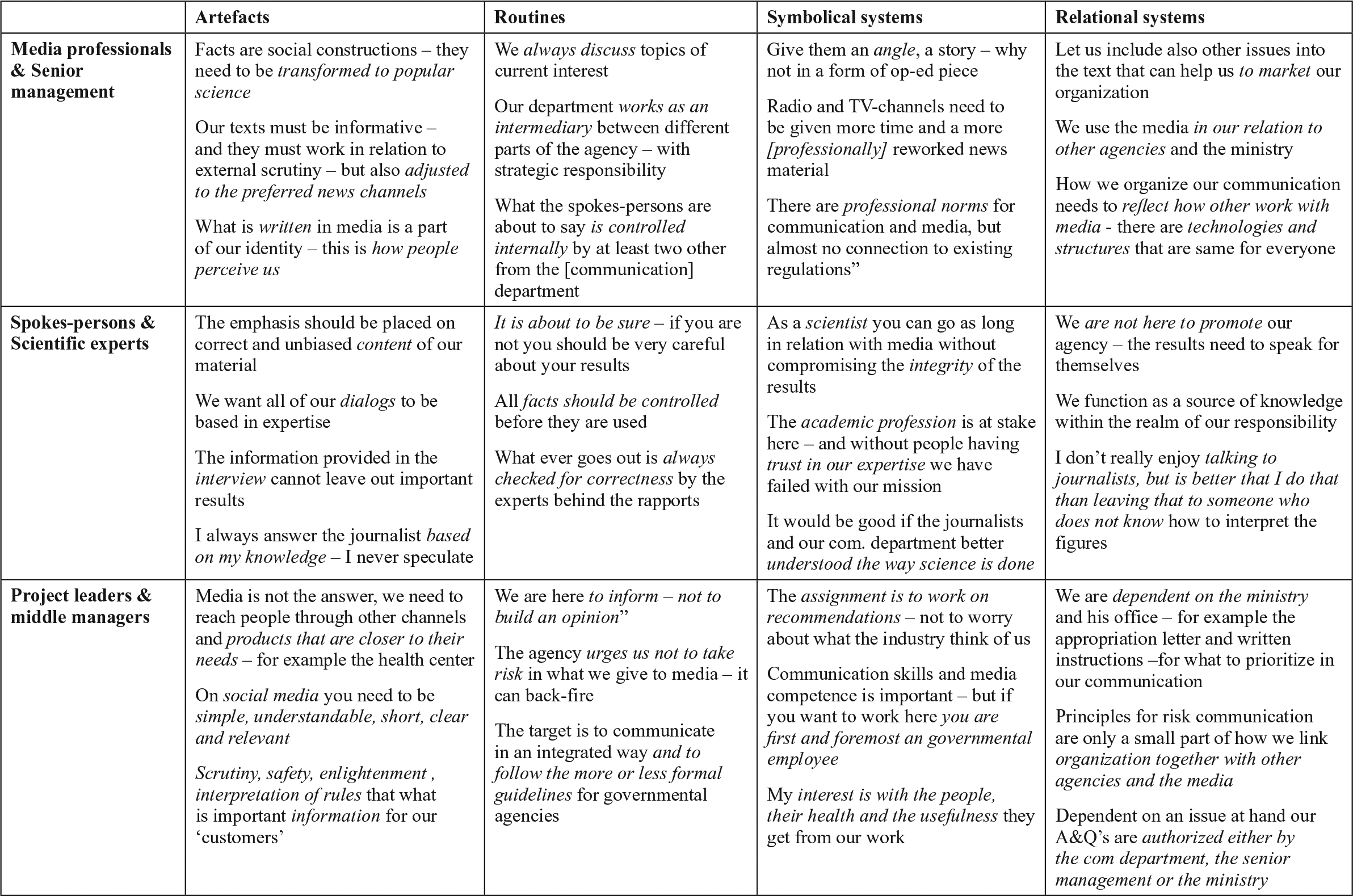
Different elements of media logic, as expressed and emphasized (in italics) by different professional groups in the interviews and during the observations.
Compared to managers and communication personnel (whose preferences clearly coincided), while recognizing the general role and importance of the media, the spokespeople and scientific experts took a much more overt position inclining towards fact-driven communication of scientific results; i.e. a position that was mainly given space in the written text material of the agency. In terms of format and framing this group had an obvious preference for de-popularized and de-simplified material. A common argument was that scientific results cannot – and should not – be reduced to popularized press releases, social media status updates, interview one-liners, decontextualized quotes or dramatically interesting formulations and headlines. The scientists and the agency’s spokespeople clearly regarded adaptation to journalistic values and preferences as threatening distinct, evidence-based and reliable knowledge dissemination.
This group further argued that the agency’s media activities should be based on thorough routines to check correctness, validate information and control facts before communicating. The timing and rhythm of the media was not really an issue for the scientific personnel and spokespeople who argued for releasing news material based on scientific results the moment the results were available, without any consideration of when and how often the agency wished to seek publicity. Thus the media logic was translated to fit the ideas and value systems of science and those of the scientific profession.
The third group, consisting of project leaders and other middle level managers in the agency, primarily stressed their formal role as civil servants and the role of the agency as a governmental agency financed by the taxpayer. They were also explicit about their work as based on the formal rules and regulations set by the government and the ministry – i.e. rules that were inscribed into the agency’s instructions, ordinance and guidelines for what to communicate and how to prioritize. In terms of how the media logic was translated into the content of written documents and communication efforts, the project leaders stressed the importance of providing trustworthy, relevant, and useful information to ‘customers’ (mainly taxpayers), in a format that was accessible and available to those most affected. That is, content was mainly framed with respect to the agency’s formal responsibility concerning testing, evaluating and regulating the quality of products available on the market. Understanding the media as a way of projecting formal, accountable and relevant information was defined as central to the agency’s work with recommendations for various target audiences. For this group, continuously positioning the agency in relation to other agencies and to the Ministry was a central concern. The rules and regulations of the government and the imperative of being ‘government employees’ influenced routines and practices and directed the translation of the media logic and, thus, the communication activities of the agency.
Translating the Media Logic
As we have suggested above, the process of translating the media logic into the organization bears significant implications for the content, form, framing and timing of media activities in the agency studied. The results also indicate that the ways the media logic was interpreted and enacted in the organization vary according to the process of translation. Depending on who carries out the translation, what element(s) are translated and what value systems shape and guide the translations, different results occur (see Figure 3). How the different value systems are mobilized by different professional groups thus plays a significant and hitherto less understood role. With our findings we can specify the process of translating the media logic. As was noted in the previous section, for instance, news material was framed mainly in accordance with the ideals of ‘the public’s need’ in combination with concerns for scientific rigidity, while other communication material aimed at the political and industrial agendas was significantly influenced by the ideals and principles of the media. Here, aspects such as newsworthiness, style, dramaturgy and timing were given a more prominent role (Schillemans, 2012). While many of the routines for the agency’s media activities were affected by journalistic procedures such as production planning, specialization, resource allocation, data gathering, writing and distribution, some of these were continuously challenged.
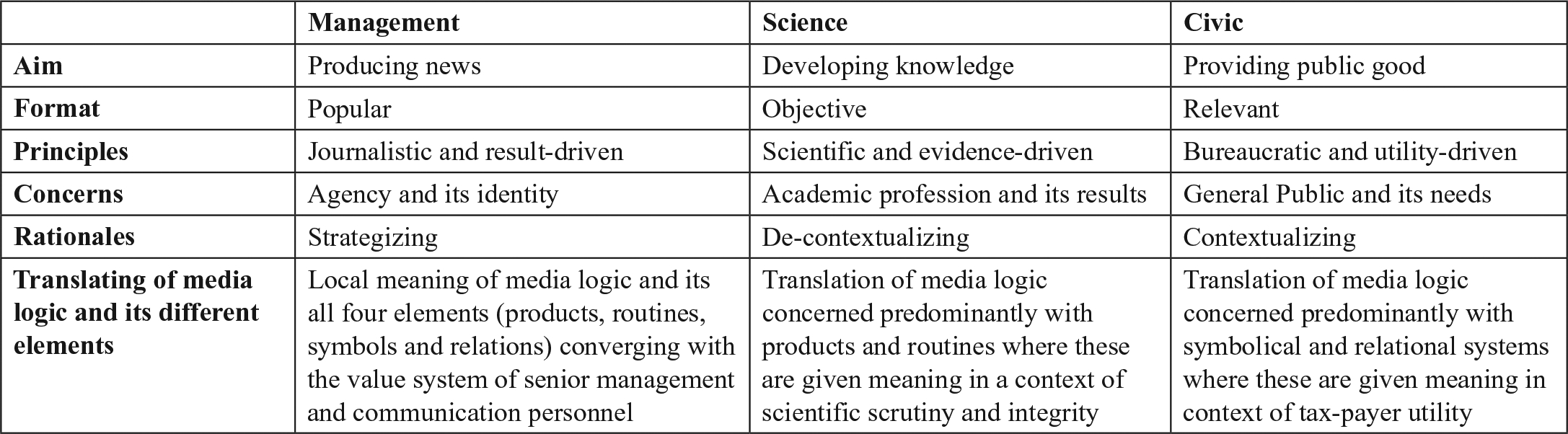
Management, scientific and civic value-systems through which (members of) different professions embed and translate media logic.
Cooperation with other agencies and coordination with political processes emphasized managerial routines for when and with whom to work on press releases, public statements, interviews and reports. In this context the scientific requirements for information reliability and validity pushed forward other strategies for gathering, evaluating and presenting data, often with a focus on facts, figures and de-contextualization (Rödder & Schäfer, 2010). Thus artefacts, routines and relational systems were variously influenced by the way people made sense of them in relation to how they understood their professional jurisdiction and responsibilities. As a result, the meaning of the media logic has been (re-)constructed in and through ongoing translation to fit the specific context and value systems available and mobilized by professionals inside the agency studied. However stable at the organizational level (the agency was de facto highly mediatized), the understanding of the media logic (i.e. principles, values, preferences and working routines) with respect to its different elements was constantly reformulated as it was given different meanings when specific media issues, activities or interactions were actualized.
Conclusions
To conclude this article we focus on the two main contributions this study makes to current theorizing on institutional logics and translation. First, we have highlighted the embeddedness of logics in local organizational contexts. Expanding on Binder, who suggests that ‘organisations are places where institutional logics combine with local, embedded meanings to produce particular variations of local action’ (2007, p. 551), we have shown how this happens through translation. As an ongoing process, translation describes the way elements of institutional logics are interpreted and given meaning locally, and how this continuously shapes the practices, working routines and principles of actors and organizations. By identifying the routes of such translation – through four elements of logics – we contribute to a more detailed understanding of how logics become – to paraphrase Lindberg (2014) – translated into being. Building on the growing recognition that logics should not be understood as monolithic entities (see Heusinkveld, Benders, & Hillebrand, 2013; McPherson & Sauder, 2013; Meyer & Höllerer, 2010), we suggest that they are better understood as loosely coupled systems consisting of several elements. Our study highlights how these elements can be translated differently, and to a varying extent, to produce a distinct, local enactment of a particular logic.
Second, we have shown in particular how such translation takes place in relation to professional value systems and assumptions. While professional jurisdictions have been shown to influence interpretations of institutional logics (Bévort & Suddaby, 2016; Binder, 2007; McPherson & Sauder, 2013), our study shows how these varying interpretations shape the process of translation to alter or adjust elements of the logic into different types of organizational practices and procedures. Thus, guided by professional value systems, actors engage in translating elements of the logic that they find problematic or silent (from their perspective) (Pache & Santos, 2013), thereby producing varying responses to the logic at hand. In this sense, logics are also somewhat elastic, being sensitive to local actors’ capacities and motives to actively and continuously interpret and enact their different parts. This allows an understanding of both conformity and variation as results of the influence of institutional logics.
Stressing the notion of translation, our study also suggests that, in order to be locally translated and eventually transformed, logics do not need to be challenged by other logics. The energy, and the focus for mobilization towards variation, for local translations and their subsequent travel outside local boundaries is not necessarily justified by, or made in relation to, competing or contradicting logics. Local, professionally embedded and contextually dependent value systems provide alternative sources of energy and mobilizing force. Logics thus do not necessarily acquire a fixed meaning (either by hybridizing and combining them with other logics or by creating new ones) as they are translated into organizational contexts, but are rather continuously elaborated, broken down into elements, and renegotiated as they move within and across organizations. This means that it is not only the context of translation that matters, but also the character, shape and form of the institutional elements that become translated. For translation theory, this insight opens new avenues for exploring how processes of translation unfold inside organizations and linking these to larger structures of meaning as shaped by professional systems.
Footnotes
Funding
This research received no specific grant from any funding agency in the public, commercial, or not-for-profit sectors.