



Abstract
What are the power/identity implications of the increasing Englishization of non-Anglophone workplaces around the world? We address this question using an analytical framework that combines a focus on micro/meso-level processes of identity regulation with attentiveness to the macro-level discourse of English as a global language. Drawing on reflexive fieldwork conducted at a major French university, we show how Englishization is bound up with processes of normalization, surveillance and conformist identity work that serve to discipline local selves in line with the imperative of international competitiveness. Concomitantly, we also show that Englishization is not a totalizing form of identity regulation; it is contested, complained about and appropriated in the creative identity work of those subject to it. Yet, moving from the micro/meso- to the macro-level, we argue that Englishization is ultimately ‘remaking’ locals as Anglophones through a quasi-voluntary process of imperialism in the context of a US-dominated era of ‘globalization’ and ‘global English’. We discuss the theoretical implications of these insights and open some avenues for future research.
Introduction
English – long considered to be the foremost global lingua franca – is increasingly being imposed as an everyday language in a variety of workplaces around the world (Neeley, 2012; Piekkari, Welch, & Welch, 2014). Driven by the imperative of ‘globalization’, this process of organizational Englishization may be seen as transforming the identities of non-Anglophone employees in ways (notionally) congruent with managerially-defined goals. 1 Yet, little theoretically informed research has examined the ways in which organizations are conducting such identity management and, complementarily, how employees enact the process. Vaara, Tienari, Piekkari, and Säntti (2005, p. 621) pointed to this deficiency a decade ago, calling for research on the identity implications of Englishization in different locales, but their plea remains largely ignored. This is surprising given the now voluminous body of scholarly work on the relationship between managerial control and identity in organizations (Alvesson, Ashcraft, & Thomas, 2008). A few studies do touch on questions of identity, with some usefully highlighting how Englishization represents a form of domination that (re)produces core-periphery identities (Boussebaa, Sinha, & Gabriel, 2014), but their focus is not specifically on matters of identity management or responses to it.
In this article, we focus directly on such issues, drawing on in-depth, reflexive fieldwork conducted at a major French university where the use of English was, as in the case of other European higher education institutions (Tietze & Dick, 2013), becoming increasingly common. To guide our analysis, we deploy a critical analytical framework drawing on insights from the Foucauldian-informed literature concerned with the dynamics of identity management in organizations (Alvesson & Willmott, 2002; Brown & Coupland, 2015; Ybema et al., 2009). This literature places the spotlight on ‘the role of organizational elites and discursive regimes in orchestrating the regulation of identities and the resulting political and material consequences’ (Alvesson et al., 2008, p. 16) and thus helps in approaching Englishization as a political process, not just a technical-managerial effort. In addition, we tap into studies by linguists examining the cultural politics of English as a global language (e.g., Hagège, 2012; Phillipson, 2009) to locate the organization-level power/identity dynamics of Englishization in their macro-level, world-societal context.
Our analysis extends understanding of organizational Englishization in two principal ways. First, we re-conceptualize the process as a form of identity regulation, more or less purposefully pursued. Specifically, we show how Englishization is bound up with practices of normalization and surveillance that serve to produce identities (supposedly) suited to the goal of international competitiveness. We also show how the targets of Englishization themselves contribute to the process through conformist identity work while simultaneously also contesting, complaining about and appropriating it in their creative identity work. Second, building on recent efforts to conceptualize Englishization as a form of imperialism, we link these meso/micro-level power/identity dynamics to global power relations in the contemporary world economy. We argue that Englishization, seen in the longue durée, is serving to ‘remake’ locals as Anglophones in line with a US-dominated era of ‘globalization’ and ‘global English’ and may be understood as a quasi-voluntary process of imperialism. These insights advance what we know about organizational Englishization by shedding light on its power/identity implications. They also advance identities research by providing the first account of organizational Englishization as a process of identity regulation and by responding to calls for research into how micro/meso-level processes of identity formation are informed by, and contribute to, macro-level discursive regimes (Alvesson, Hardy, & Harley, 2008).
We begin with a critical overview of existing research on organizational Englishization and then elaborate on our conceptual framework. Next, we describe our research methodology, including the organizational (and societal) context of our study. We then present our findings and, in a subsequent section, discuss their theoretical implications. Finally, we conclude with a consideration of how we (the authors) are caught in the same power/identity dynamics that we attempt to denaturalize and critique.
Theoretical Context
Existing approaches to Englishization
It is well established that English is the world’s most dominant language and there is growing evidence that it is displacing the languages used in non-Anglophone organizational settings. This is, perhaps, most evident in the corporate world, where multinational companies are increasingly expecting their non-Anglophone staff to communicate and work in English as a means of serving international markets and facilitating transnational collaboration (Neeley, 2012; Piekkari, Welch, & Welch, 2014). A similar phenomenon can be observed in the field of higher education: while English has long been a dominating presence in this sector, recent years have seen the gradual substitution of indigenous tongues with this language in universities worldwide (Hultgren, Gregersen, & Thøgersen, 2014; Truchot, 2002). As Altbach (2007, p. 3608) put it, ‘national academic systems [now] enthusiastically welcome English as a key means of internationalising, competing, and becoming “world class”’.
Since language and identity are intimately related, this process of linguistic adoption or imposition can be viewed as a (more or less intentional) managerially-defined process of identity change. Yet, the ways in which this transformation is being accomplished remain under-studied and under-theorized. The focus of research has thus far mostly been on understanding the status inequalities produced by the use of English as an official corporate language in multinational firms (Hinds, Neeley, & Cramton, 2014; Marschan-Piekkari, Welch, & Welch, 1999; Neeley, 2012, 2013). From this perspective, Englishization is typically seen as creating a situation in which Anglophones generally gain in status and power by virtue of communicating in their mother tongue while non-Anglophones experience a loss in status/power relative to the former. The overall outcome is a strained native/non-native relationship and, in particular, feelings of distrust and resentment on the part of non-Anglophones towards their native counterparts. A few studies provide a more relational view on this relationship, shedding light on ‘the multiple and often contradictory effects of Englishization as people come to terms with the complexity of multilingualism in everyday interaction and negotiation’ (Steyaert, Ostendorp, & Gaibrois, 2011, p. 271; Vaara et al., 2005). Although interesting and important, this body of work does not explore Englishization as a form of identity regulation, i.e., how the process works to shape identities and how it is, in turn, enacted by those subject to it.
Critical studies (Boussebaa et al., 2014; Meriläinen, Tienari, Thomas, & Davies, 2008; Tietze & Dick, 2013) provide important insights into Englishization as a form of (hegemonic or imperialist) domination but do not explore how requirements to work in English are translated into individual compliance. Further, in emphasizing the constraining aspects of Englishization, they devote little attention to processes of contestation and appropriation, a limitation that has also been observed in the work of linguists adopting Phillipson’s (2009) ‘linguistic imperialism’ perspective (Pennycook, 2007). The focus is generally on Englishization as a priori hegemonic or imperialistic and on the harmful consequences (cultural, material and epistemic) of the process rather than on issues of identity management. While useful in locating Englishization in its wider political-economic context, this corpus is fundamentally guided by research interests and theoretical approaches which do not permit focal attention on how Englishization is enforced and enacted locally. In what follows, we propose an analytical framework with which these phenomena can be explored.
An identity regulation approach to Englishization
Studies of identity regulation seek to understand how organizations work to shape the identities of their employees to achieve managerial goals. These studies do not regard identities as ‘fixed’ or given but as in-progress narratives (Giddens, 1991) constituted within discursive regimes (Cerulo, 1997; Costas & Grey, 2014; Coupland & Brown, 2012). That is, individuals continually ‘work’ on their identities as they grapple with questions such as ‘who am I?’ and ‘who do I want to be?’ This ‘identity work’ entails processes of shaping, maintaining, repair and revision through which people attempt to author coherent and distinctive identities (Sveningsson & Alvesson, 2003; Watson, 2008). Identity work is accomplished continuously by actors both in dialogue with others and personal soliloquy as they seek, not always fully consciously, to fashion desired versions of who they are (Brown & Coupland, 2015; Thomas & Davies, 2005). While some emphasize that people’s identity work is in many settings subject to intrusive ‘identity regulation’ (Alvesson & Willmott, 2002), several empirical studies show that professionals, such as academics, generally have some leeway to craft preferred versions of their selves (Humphreys, 2005; Knights & Clarke, 2014; Learmonth & Humphreys, 2012; Thomas, Tienari, Davies, & Meriläinen, 2009).
As Alvesson and Willmott (2002) and others (e.g., Thornborrow & Brown, 2009) have made clear, identity regulation is accomplished through ‘disciplinary power’ (Foucault, 1979), i.e., power which is enforced through entwined organizational practices and people’s identity work processes. Disciplinary power ‘seeps into the very grain of individuals’ (Foucault, 1979, p. 28) – it is productive, promoting notionally desirable behaviours and ways of life and prohibiting or marginalizing others through mutually reinforcing regimes of normalization and surveillance. Normalization refers to those subtle and banal practices by which individuals are subject to a framework for ordering and arranging them in relation to a norm or standard which stipulates minimum, average and/or optimum achievements. Processes of measurement, comparison and differentiation result in rankings, establishing individual differences and imposing a value on them, allowing those deemed to be too far from the norm to be identified, targeted and corrected through programmes of adjustment (or excluded). Key to the successful normalization and, by implication, homogenization of individuals is meticulous, continuous and unremitting surveillance, which affects both the overseers and the overseen, and which promotes ‘a particular way of life while pushing alternatives to the margins’ (Sewell & Barker, 2006, p. 935; see also Gagnon & Collinson, 2014; Townley, 1993).
Discipline, though, is not just externally imposed: through self-disciplinary processes, the individual ‘assumes responsibility for the constraints of power … [and] becomes the principle of his own subjection’ (Foucault, 1979, pp. 202–203). That is, people engage in identity work in conformity with disciplinary power. They do so through what Foucault describes as ‘technologies of the self’ such as self-examination, in which supposed ‘truths’ of the self are discovered, and confession (self-avowals) by which a speaker becomes tied to the intentions and behaviours that s/he affirms in fact constitute his/her identity. Technologies of the self are means by which individuals are ‘incited to change themselves by acting on themselves’ (Covaleski, Dirsmith, Heian, & Samuel, 1998, p. 298) using the categories, criteria, and languages made available to them by a disciplinary regime. They are intentional and (notionally) voluntary practices by which people not only set themselves rules of conduct, but ‘make their life into an oeuvre that carries certain aesthetic values’ (Foucault, 1990, pp. 10–11).
Yet, where there is power there is also resistance, which, like discipline, can come from everywhere: it is capillary, and is ‘distributed in irregular fashion: the points, knots, focuses of resistance are spread over time and space at varying densities’ (Foucault, 1986, p. 96). As Foucault asserts, ‘at the very heart of the power relationship, and constantly provoking it, are the recalcitrance of the will and the intransigence of freedom’, though ‘[r]ather than speaking of an essential freedom, it would be better to speak of an “agonism” – of a relationship which is at the same time reciprocal incitation and struggle’ (Foucault, 1983, pp. 221–222). As power and resistance are interpenetrating and mutually constitutive, so individuals may respond to discipline with creative identity work: unreflexive compliance is less likely than ‘gaming’ (Sewell & Barker, 2006), ‘resistance through negotiation’ (Upadhya, 2009), cynicism (Fleming & Spicer, 2003) and ‘paradoxical enjoyment’ (Kosmala & Herrbach, 2006). This said, processes of distancing, or ‘escaping from work’, may equally be regarded as people ‘escaping into work’ (Knights, 2002). When individuals desire to be a particular kind of person in relation to institutionalized aspirations for them, then, discipline is the price that is necessarily paid (Starkey & McKinlay, 1998, p. 231).
In analysing these micro/meso-level processes of identity regulation, it is important to also account for how people draw on, and contribute to, macro-level discourses in society more widely (Alvesson et al., 2008; Brown, 2015; Meriläinen, Tienari, Thomas, & Davies, 2004), particularly as they relate to organizational Englishization. This phenomenon is intimately related to the world-societal discourse of English as a global language, which is perhaps most evident in the corporate world, where companies are increasingly (re)producing the view that ‘global business speaks English’ (Neeley, 2012), but also in other sectors such as higher education (Altbach, 2007). Understanding Englishization as a form of identity regulation thus requires attending to how this process is informed by, and constitutive of, the world-societal discourse of English as a global language. This, in turns, requires being sensitive to the ideological and political-economic aspects of the global spread of English (Hagège, 2012; Phillipson, 2009).
Thus, we adopt a multi-level identity regulation approach that is attentive to not only the micro (individual) and meso (organizational) dynamics of Englishization but also the macro (world-societal) context in which this is occurring. This leads us to articulate three related research questions:
How are employees based in non-Anglophone workplaces subjected to identity regulation practices associated with Englishization?
What kinds of identity work do they undertake in relation to such practices?
How do these meso/micro-processes relate to the macro-discourse of English as a global language and the wider global political economy in which it is embedded?
Research Design
To address our questions, we used a qualitative research methodology. This is in line with other studies of identity regulation and identity work (Alvesson & Willmott, 2002; Brown & Lewis, 2011; Covaleski et al., 1998; Sauder & Espeland, 2009). We conducted our fieldwork in a major French public university – ‘FrenchU’. Until the mid-1990s, FrenchU had operated in a relatively stable national higher education system where the use of English was limited and academics generally published mostly in French-language journals. The rise of international university rankings together with the key role played by ‘high-impact’ international (Anglophone) journals in the compilation of such rankings, however, placed FrenchU under pressure to increase its English-language publications. This pressure intensified once FrenchU had secured major funding from the French government under the initiatives d’excellence (IDEX) scheme, which aimed at improving the international ranking of a select group of French universities. The University then had little choice but to make publishing in international (Anglophone) journals a strategic goal and, increasingly, a factor in recruitment and promotion decisions, thereby obliging (wittingly or unwittingly) its academic staff to work in English. FrenchU was thus a particularly suitable research site for our purpose.
The fact that FrenchU was located in France was doubly interesting. France has historically exhibited strong opposition to Englishization as reflected, for instance, in the establishment of the Académie Française and the Loi Toubon, which aim to enrich French and protect it against excessive ‘contamination’ from other languages (Truchot, 2002). The French government has been especially concerned with protecting French from Anglophone influence in areas including music, cinema, business and academia. In this context, the prominent linguist Hagège (2012) has been vocal about the link between Englishization and Americanization and raised concerns that these parallel forces are providing support to la pensée unique. 2 We expected this societal context would create complicated and theoretically generative processes of identity regulation at the organizational level.
Data collection
We relied mostly on interviews but also conducted some participant-observation and consulted internal documents to grasp power/identity processes based not just on talk but also situated practices and texts (Alvesson et al., 2008). Our fieldwork took place within FrenchU’s Faculty of Economics and Management. The Faculty had five internationally-recognized research centres (‘laboratoires’) and we conducted our research in three of these: one focused on the sociology of work (SocioLab), another on economics (EcoLab) and the third on management studies (ManLab). 3 Data collection began at the SocioLab where the first author (hereafter, ‘the fieldworker’) was provided with an office and a networked PC. He spent a few days introducing himself to the group, setting up interviews, and observing academics at work, especially in relation to their various uses of, and responses to, English. Shortly after his arrival, he also took part in a one-hour workshop organized by the SocioLab’s director on the theme of Englishization in French academia. This provided valuable initial insight into ongoing negotiations over the meaning and consequences of Englishization. The fieldworker attended internal research seminars and spent some time ‘hanging out’ (Barley & Kunda, 2001) with academics over coffee breaks, lunches and dinners, recording stories and insights. He also led a writing/publishing workshop which surfaced some of the ambitions and anxieties of the participants regarding publishing in Anglophone journals. This provided further opportunities to explore the Englishization process and its disciplinary/identity implications.
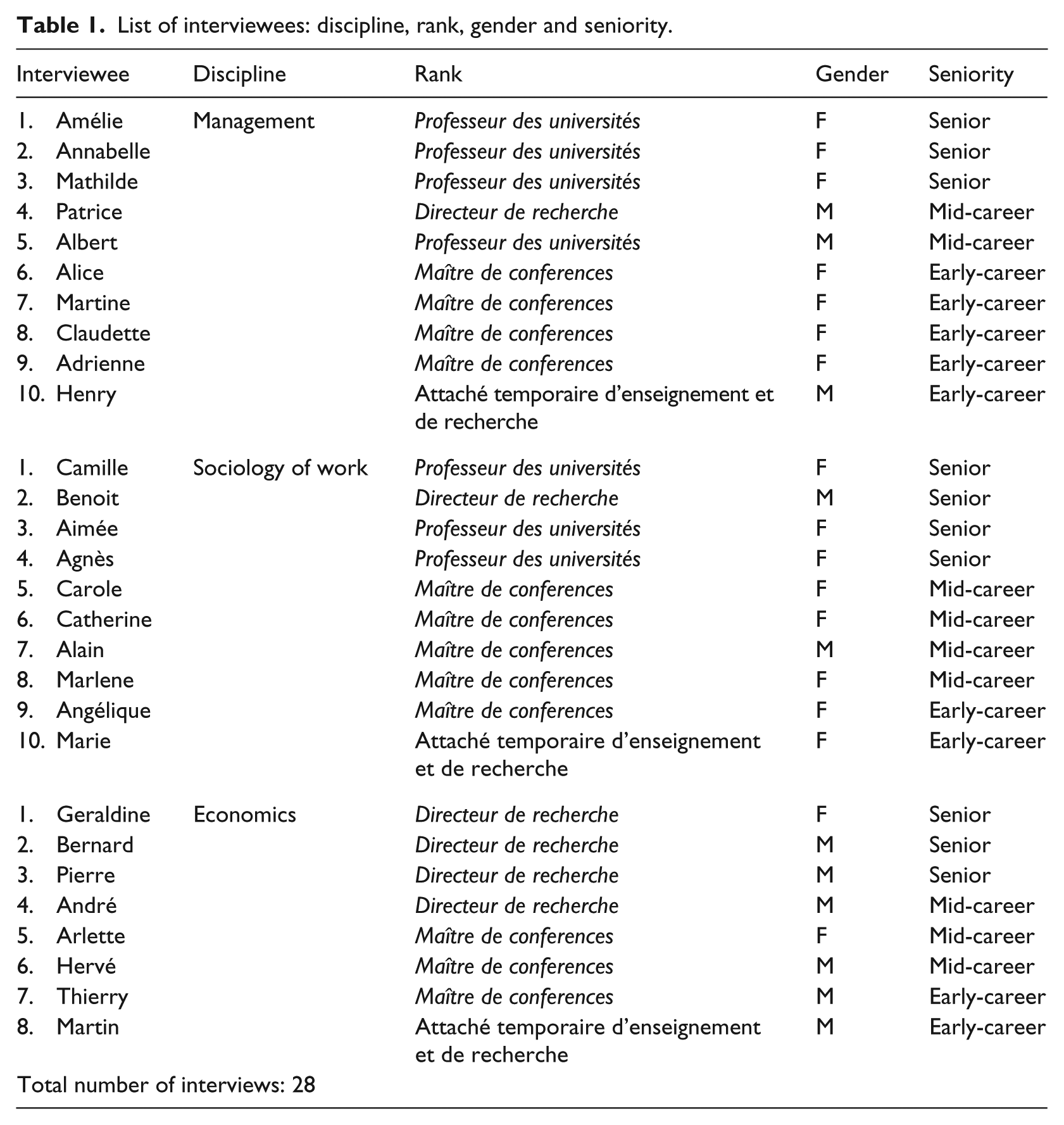
Building on, and in parallel with, this participant-observation work, the fieldworker conducted a series of 28 formal face-to-face interviews across the three labs (see Table 1): 10 from management, 10 from the sociology of work, and 8 from economics. The interviews were conducted at multiple career levels with 12 Maître de conferences, 8 Professeur des universités, 5 Directeur de recherche and 3 Attaché temporaire d’enseignement et de recherche. 4 Included in this sample were the directors of the three labs in which the fieldwork was conducted. The interviews took place on-site, were conducted in French, 5 digitally audio recorded, and of between 45 and 130 minutes in duration. Consonant with Fetterman’s (1989, p. 49) view that interviews are best conceived as ‘conversations with “embedded questions”’, our interviews were semi-structured, with the participants encouraged to help direct the flow of the conversation. Typical of the broad-ranging questions we asked were: ‘What has been your own experience of working in English?’ ‘What is your personal view on the increasing dominance of English in French academia?’ and ‘How is the advance of English impacting on who you are as a researcher?’
List of interviewees: discipline, rank, gender and seniority.
The interviews were transcribed verbatim by a native French speaker. To ensure no meaningful data were lost in the transcription process (and also as part of an initial round of analysis), the fieldworker read each of the transcripts while simultaneously listening to each of the interview recordings. The transcripts were then translated into English, yielding 146,718 words of transcript data. The translation was performed by a professional French-to-English Anglophone translator in order to produce full transcripts that both authors could read (Welch & Piekkari, 2006). 6 Linguistic translation is not unproblematic (Piekkari et al., 2014) – the process is ‘a creative practice of transformation and difference’ (Steyaert & Janssens, 2013, p. 138) involving ‘decontextualization’ in which a ‘loss of meaning’ can occur (Meriläinen et al., 2008, p. 592) and thereby potentially producing a denuded data set as local understandings are not fully recovered. Our research is bounded by the limitations enforced by such a process, though this was something to which we were attuned and which was to an extent mitigated by the proficiency of the first author and the translator in both French and English. 7
While at the SocioLab, the fieldworker devoted considerable time to gathering and reading internal documents containing information on its strategy, structure and human resource management policy as a means of understanding some of the disciplinary practices in place at FrenchU. He was provided with two substantial reports detailing the past achievements and future goals of the lab as set within the University’s overarching strategy. In addition, he consulted publicly available information on the three laboratoires’ websites, including newsletters and data about their histories, missions and internal management processes. These provided useful background information as well as confirmatory data on the growing importance of publishing in Anglophone journals and the disciplinary practices employed in the laboratoires.
Data analysis
Our analysis relied on a mix of induction and deduction. Initially, each of the two authors read the interview transcripts separately to get a ‘feel’ for this data and to generate provisional ideas. We then met multiple times to discuss emerging themes and to focus and refine our analysis. Consistent with Foucauldian analyses of disciplinary power, we interrogated the data using established terms and phrases such as ‘normalization’, ‘hierarchization’, ‘surveillance’, and ‘correction’. Concomitantly, we recognized that FrenchU academics engaged in creative as well as conformist identity work. While multiple themes were evident in people’s talk (e.g., ‘progress’, ‘domination’, ‘self-correction’, ‘contest’, and ‘gaming’), through discussion we refined these into three broad categories: resistance, complaining and appropriation. As with other studies (e.g., Tietze & Dick, 2013), we also analysed our data by academic seniority (‘early-career’, ‘mid-career’, and ‘senior’) and coded our data according to academic discipline (economics, management, and sociology of work). Throughout the process, we shared ideas, themes and transcripts in order to ensure a corroborated and coherent analysis. The first author also fed into the analysis insights derived from his observation notes and readings of documents.
As with other ‘language-conscious’ researchers in the field, we analysed the material in ‘a reflexive manner, engaging in dialog and debate’ (Śliwa & Johansson, 2014, p. 1141). Our analytical approach was spurred by a desire to understand how FrenchU scholars worked on versions of their selves in response to the questions we asked about the process of Englishization. Importantly, we recognize that these identity constructions are ‘co-productions’ between the interviewer and our interviewees (Coupland, 2001). Phenomenological and social constructionist researchers have long recognized that what we refer to as ‘data’ are constructions of both researchers – and their unique lived experiences – and those who are studied (Heidegger, 1962). Rather than risk becoming enmeshed ‘in an infinite regress of cognitive dispositions’ (Gergen & Gergen, 1991, p. 79), however, our primary focus is not internal (on ourselves) but outwards on the realm of discourse and shared meanings.
While our procedures were systematic, it is important to note that this was an exploratory, interrogative study, that our analysis incorporates (inevitably idiosyncratic) processes of authorial selection and omission, and that our article presents an (not the) understanding of the research site and its members. Moreover, as academics studying other scholars, we realize that interpretive research ‘is always shaped by the researcher’s own personal values’ (Bell, 1999, p. 17) and that producing a narrative based on such work ‘usually means writing oneself into the account to some degree’ (Cant & Sharma, 1998, p. 10). As Riessman (2008, p. 137) asserts, research of this kind is always ‘a dialogue between researcher and researched, text and reader, knower and known’ and its construction ‘always bears the mark of the person who created it’ (Riessman, 1993, p. v). We are sensitive to the issues at stake here and aware that our ‘representations bear as much on the representer’s world as on who or what is represented’ (Said, 1989, p. 224). These are concerns to which we return in our conclusions.
Findings
We present our analysis in three sections. First, we discuss the disciplinary practices (normalization and surveillance) through which Englishization was enforced at FrenchU, and how these varied by academic specialism and age. Second, we examine the conformist identity work through which FrenchU academics operated on themselves in accordance with the disciplinary practices they were subject to. Third, we consider the creative identity work by which they constructed themselves as resisting, complaining about, and appropriating Englishization in nuanced ways. While these three aspects of our analysis are dealt with separately this is a simplification that aids exposition, and they were, of course, intimately intertwined.
Englishization through disciplinary power
Normalization
All the academics we interviewed recognized that publishing in English was ‘an institutional expectation’ (Marlene
8
) and this was also reflected in the internal documentation we consulted; this included a list of ‘target journals’, the vast majority of which were Anglophone outlets, and made numerous references to the importance of raising publishing ambition, and of responding to pressures from external stakeholders to publish in ‘international’ journals. Relatedly, significant normative pressure was exercised by the directors of the laboratoires who increasingly prioritized publishing in Anglophone journals in group meetings and periodic reports, and who invited Anglo-American scholars to sit on international advisory boards. For instance, the director of ManLab explained how: ‘It’s me who exercises pressure. There are meetings, lab reports. I’ve also put in place a completely internationalised “international advisory board” which helps us move forward on this matter.’ (Amélie)
FrenchU academics were subject to processes of differentiation and hierarchization enforced through human resource management practices (e.g., recruitment, selection and promotion) as well as the composition of decisional committees. All these incorporated criteria that favoured those who were internationally active and published in English. As André said, to resist these pressures meant to be marginalized professionally: ‘people who we can see from their CV that they don’t have any English, they are effectively put directly to one side’. These practices acted in combination to (re)produce recursively a specific institutional order: ‘… in the constitution of examination boards, the members of selection panels, you have to have an international CV, otherwise you’re out, so there is in effect an elimination of certain colleagues on the basis that they are not sufficiently visible internationally.’ (Annabelle)
In addition, a range of initiatives were taken in the laboratoires to promote conformity to institutional norms. For instance, publishing workshops were conducted in which researchers were encouraged to discuss draft papers prior to submitting them to international journals and, on occasions, international faculty from Anglo-American universities, including the editors of ‘prestigious’ journals, were invited to address staff. EcoLab and ManLab were particularly active in the use of such ‘literacy brokers’ (Lillis & Curry, 2006), regularly organizing ‘writing workshops with-the-editors in chief of the largest international journals … One workshop alone is not enough. After the fourth time, people have really begun to understand properly … it already starts paying off. There are results’ (Amélie). 9 In the EcoLab, where English had very much become ‘la langue de travail’, doctoral students were now required to write in English. One postdoc, soon to take up an Assistant Professorship within this laboratoire, explained how he had completed his thesis ‘entirely in English. The PhD supervisor was French, we spoke French between us, but he sometimes wrote to me in English’ (Martin).
Normalization functioned too through the identification of a cadre of prototypically conforming individuals, referred to by Angélique as ‘a sort of caste … who write in Anglo-Saxon publications’ and who enjoyed great social esteem: ‘… people who like me have made the effort to move to the international [level] acquiring an international reputation who act like a boomerang in the Francophone world, that gives us an incredible legitimacy in France.’ (Annabelle)
Surveillance
Formal institutional surveillance and correction of faculty was accomplished (indirectly) through a national system of assessment referred to as AERES
10
, which had been put in place in 2007 to evaluate universities and laboratoires within them. In addition, individual evaluations were conducted by the CNU (Conseil National des Universités) for those applying for promotion. In the EcoLab and ManLab, faculty members were subject to additional biannual appraisals while in the SocioLab appraisals took place every two years, in which particular attention was paid to an individual’s publication strategy: ‘… we … assess researchers every two years and we look at publications and the status of the journals in which they publish.’ (Angélique)
Disciplinary power was also exercised through the surveillance of peers and commensurate threats to social status: ‘Basically, in the community, if you’re just a teacher doing a little bit of research, you’re a bit dominated by your colleagues. There’s a very strong social pressure and we all want to be recognised, and in this community, recognition comes from the quality of your research.’ (Agnès)
The surveillance and correction of the next generation of academics was exercised also by established professors who recognized reflexively that they and their similar-minded colleagues were means by which the use of English and ‘international’ evaluative criteria were used to enforce a new pattern of normalization on faculty: ‘Personally, I encourage my doctoral students to go to conferences and international workshops so they are familiarising themselves more with the language … English has become the principal language medium.’ (Benoit)
Specialism and age
There were important differences between academic specialisms and distinct generations. Disciplinary mechanisms that enforced normalization were particularly well developed in the EcoLab and (to a lesser degree) ManLab, due in part to the quantitative nature of the work being carried out in these units. The situation was, however, rather different in the SocioLab where scholars tended to conduct qualitative, interpretive and ethnographic work – here, some maintained that: ‘French academic research … still remains very Francophone. It’s quite possible to stay in this microcosm’ (Alice). Attitudinal differences were also marked between broadly younger and older generations. In general, older academics were said to find it hard (or impossible) to adapt to revised institutional norms and expectations: ‘for people in the middle or the end of their career who haven’t learnt how to write English it’s too late, it’s over…’ (Agnès). Established long-serving academics said that they were witnessing generational change, with a new generation of younger scholars emerging who were fluently Anglophone and determinedly careerist: ‘… you can really feel that younger people (around their 30s) that are coming up are already on another planet, another universe, so I am practically convinced that this other universe will become natural and generalised over the next 20 years.’ (Bernard)
In sum, the research participants described a highly coercive system in which they were objectified, made visible, and subjected to norms against which they were evaluated and targeted for correction through programmes of adjustment (such as writing workshops led by Anglophone scholars). This was a panoptic system in which even those who adjudicated were judged so that Englishization had become normalized with professors, including the directors of the laboratoires, subject to the same criteria for assessment as junior faculty. In this sense, Englishization at FrenchU served to produce new identities in line with the imperative of international competitiveness.
Conformist identity work
Englishization at FrenchU was entwined with disciplinary practices that prescribed what academics should aspire to be and ensured compliance through processes of normalization and surveillance. Yet, we also found that FrenchU academics were not just being institutionally coerced to comply with managerial directives; more often than not, they ‘willingly’ – and at times, enthusiastically – complied with such demands. Our interviewees avowed the ‘need’ to publish in Anglophone journals, described how they corrected themselves so that they were better able to meet this need, and justified/explained their actions as a form of gaming which positioned them as complying with disciplinary requirements on their own terms.
Avowal
Our interviewees commented on how there were academics who ‘are completely in it because they’ve interiorised the norm and wish to gain international visibility’ (Agnès). Bernard, for example, stated that ‘English has practically become an absolute criterion in the logic of personal assessment’, while Annabelle maintained that ‘You need to prove to yourself that you can publish at the international level and be recognised’. Several interviewees championed the ‘hegemony’ of Anglophone journals as a form of progress or modernity, depicted France as being ‘behind’, and described the increasing prominence of English at work as inevitable and even welcome. While apparently commenting on institutional trends, this talk also constituted these academics’ identities as favourably disposed to Englishization: ‘In the Middle Ages, the advances of science were made thanks to Latin; these days, it’s English, and fundamentally why not, that doesn’t bother me at all’ (Albert).
Typical in this respect was André who argued that modernity in Economics was associated with the use of English as a contemporary tool that facilitated the co-production of knowledge: ‘… it’s not about going to the American side which is modern, it’s going to the scientific side, thus to the Anglo-Saxon world … it’s a co-production of this evolution of Economics as a science. Today, it’s global; we’ve coordinated around this language.’ (André)
Self-correction
Avowing the requirement for organizational Englishization provided the rationale for FrenchU academics to change themselves through processes of self-correction. The interviewees explained that they ‘worked’ on their selves, engaging often in what they described as uncomfortable processes of adaptation, as they sought to improve their English: ‘I take care to allow English plenty of space in my daily activities so that I can continue to practice it. For example, I watch everything [on TV and at the cinema] in the original language (that used to be quite a limitation), I do things which I never did before. I look for any reason to better integrate English into my daily activities.’ (Adrienne)
The interviewees also reported that – often despite experiencing considerable anguish – they nevertheless coerced themselves to develop a publication record in English-language journals and to attend international conferences: ‘I experience it [presenting in English at conferences] very badly! But I do it. I work like a mad woman. It requires a lot more preparation … It’s a lot of stress’ (Catherine). Even those with (self-defined) weak English-language skills who had reservations about the wisdom of pursuing an Anglophone agenda maintained that: ‘my position has always been to tell myself that there was no purpose in burying my head in the sand … Personally, I really want to get on with it’ (Angélique). Despite their best efforts, however, many thought they would never reach the required standard – as Alice put it, ‘I don’t think that I will ever have the necessary level to be able to write [effectively] in English’.
Gaming
One dominant discursive framing of processes of avowal and correction was that of ‘gaming’, by which interviewees meant that they accepted and played pragmatically by the new ‘rules of the game’: ‘In general, people keep going and end up playing the game’ (Agnès). One Maître de conferences explained how ‘Personally, I think that the game is set and that we really need to get on with it’ (Catherine). Often interviewees positioned themselves as engaging institutional requirements in order to both conform and resist, and to assert their independence while pursuing a successful career: ‘It’s a game. I adopt a process of writing and production which does not correspond to my culture and I treat it as a game where I win in the end’ (Amélie). Gaming could sometimes be indistinguishable from covert resistance. For instance, some FrenchU academics were able to ‘dodge’ the use of English by merely having their French-language papers translated by a third party: ‘In ’94, I had an article come out in English in an American journal “Ethnography”, well I guess so, I didn’t actually write it myself … I explained to him [the Editor] that I had no command of English and that didn’t pose a problem for him; he brought in a translator.’ (Marlene)
Overall, then, FrenchU academics contributed to their own subjectification via conformist identity work. Even though many of them did not neatly ‘fit’ the identity mould that discipline imposed, and this was evidently disconcerting, they were gradually led to discipline their selves in relation to criteria, categories and effects associated with the imperative of international competitiveness and the associated requirement to work in English. As Foucault (1983, p. 216) has observed, we have often the power ‘to refuse what we are’, but we do so in relation to disciplinary practices, which while they may be resented are also simultaneously alluring. This was clearest with respect to the academics claiming to be ‘gaming’ the system, a begrudging accommodation that was seductive in that it allowed them to present themselves as sophisticatedly ‘choice making’, while not threatening – indeed, arguably reinforcing – the regime of power to which they were subject (cf. Sauder & Espeland, 2009, pp. 76–78).
Creative identity work
Englishization at FrenchU was bound up with disciplinary practices that served to regulate local identities in line with the managerial imperative of international competitiveness but the prescribed self was not reproduced mechanically by its targets. In practice, FrenchU academics drew on various discourses – for example, imperialism, national identity, betrayal, violence, infantilism, embarrassment, and fear – to resist, complain about and appropriate organizational Englishization and its associated disciplinary practices. 11
Resistance
Resistance to working in English often meant questioning the appropriateness of this language for scholars concerned that it implied a loss of their identity as uniquely ‘French’ scholars: ‘Does it really make sense to say that French researchers need to publish everything in English? Is it really necessary? Aren’t we betraying ourselves, well, not betraying but aren’t we losing a particular identity, a certain way of looking at things, of asking questions, of thinking?’ (Arlette)
This contest of disciplinary power was seen to be associated mostly with ‘the older generation [who] are putting up a resistance’ (Bernard). As Agnès observed, there still existed ‘people for whom having to publish in English is an act of great violence’ and ‘who don’t want to play the game’. Probably the most forthright questioning of Englishization came from established Professors of Sociology. Benoit insisted that ‘You’ve got to defend the French language’, though he apparently recognized the futility of this position, and asked rhetorically: ‘So, am I the last of the Mohicans?’ Marlene was clear that ‘basically, I pretty much disagree with this movement [to work and publish in English]’, but, like others who shared her view, was also pessimistic recognizing that the local-organizational imposition of English was championed by French political elites: ‘… our elites, our representatives, our ministers pile in to impose English on all of us, at University, in our courses, I find that unacceptable. I think we should defend our language … I’m not at all in favour of it. I’m in favour of resistance.’ (Aimée)
In general, though, academics such as Annabelle said that opposition tended to be muted, and that there was no longer ‘resistance for the sake of resistance’ because ‘the battle has been won’, although ‘there can be personal resistance’ by a few people unable fully to adjust to the new reality. As Agnès observed, ‘Those who are definitely against it and who at the moment are refusing it, are very, very few’. More frequent were articulations of sadness and even disgust and embarrassment as individuals sought to define their own (perhaps uniquely unenthusiastic) identity position: ‘It [Englishization] makes me a bit sad.’ (Adrienne) ‘… personally, I find that despite everything … it [Englishization] disgusts me. I can’t bear it, I tell myself, I am French.’ (Aimée) ‘… you’ve got to get used to the flavour of the day [English], but I’m embarrassed, because I want to be right on top of things.’ (Marlene)
Complaining
An alternative discourse by which the interviewees positioned themselves against organizational Englishization emphasized the difficulties (sometimes the impossibility) of conforming to institutional norms associated with the process. They highlighted that reading and, in particular, writing scholarly English was laborious, frustrating and even infantilizing. One scholar explained that ‘because my English is not sufficiently good … I get the impression I think like a 10-year-old child’ (Aimée). These difficulties were seen to be especially pronounced for interpretive, qualitative researchers such as Catherine: ‘I am a sociologist and I think that in contrast to Econometrics, in Sociology, we get things across, nuances through words, by an extended writing style, things that you cannot get across in a language which is not your own.’ (Catherine)
The interviewees complained that their problems with English were still greater at international conferences where they had difficulties both presenting their ideas and understanding questions from audiences
12
: ‘At the level of questions, it can cause great anxiety. I’m afraid that I won’t understand, that I won’t respond appropriately to the question, and I feel that my discourse remains at an oversimplified level.’ (Alice)
Perhaps most intractably, they grumbled about the difficulties they said were associated with learning how to write for Anglophone journals, which required the adoption of a very different mind-set to that acceptable to Franco-French journals. They explained that in contrast to domestic outlets, Anglo-Saxon journals required papers to be more structured and clearer, but also simpler and more reductive, and that in general ‘We don’t master the cultural model’ (Aimée) which was seen to be alien to French scholarly traditions: ‘The English are more pragmatic than us as well, and go quickly to the point, and this is very frustrating for a French person. In France we have an intellectual tradition whereby we indulge our thoughts.’ (Annabelle)
The interviewees raised a host of other matters that made it hard for them to succeed professionally in the face of Englishization. Some protested that they studied domestic concerns, such as French human resource management (HRM) practices and/or used theories and frameworks known and valued only in France, or employed terminology that did not translate easily into English. Most insidious, they said, was the marginalization of French academics from key international networks: ‘The problem … is that … in the world of management, there are power relations around the concern to achieve international ranking, which means that universities want to be as highly classed as possible. When they control the journals, they are not necessarily interested in letting researchers from other universities publish who might be competitors.’ (Albert)
Appropriation
In the main, FrenchU academics did not tend to author simple versions of their selves, for example as progressive ‘moderns’ who acquiescently self-corrected, and pragmatically ‘gamed’ the system. Nor did they describe themselves as merely subject to processes of domination which they sought to resist while emphasizing the difficulties which they faced working on an Anglophone career. Rather, they drew on locally available discourses to articulate what were often individually-specific positions. Enthusiastic adopters of English, such as the Director of the SocioLab, who claimed to be ‘in the multicultural space’ also said that being coerced into using a second language was ‘not fair and that we are handicapped in comparison to the native English’ (Agnès). Even the Director of the ManLab, who championed publishing internationally, considered that it was important to ‘abandon neither French works … nor good quality French journals’ (Amélie). Pragmatic adopters of English (‘it’s really absolutely necessary’ also said ‘I am sorry that it is not French that is the premier international language’ (Catherine). Some who recognized that it was important for them to work on themselves to learn English (‘I have taken a lot of courses and training in this language [English]’ argued that ‘we should defend our language [French]’ (Aimée). Conversely, those who were adamant that they disagreed profoundly with normative injunctions to publish in English acknowledged that ‘Maybe English will allow the popularisation of the social sciences, and I really want to take seriously such a challenge, and to do what I am asked to do’ (Marlene).
Overwhelmingly, however, like Mathilde, they maintained that, in evaluating the Englishization of French academia ‘I see both positive and negative aspects’. Even those who had no inclination or (self-assessed) need to write in English appreciated its strengths: ‘I really love English Sociology, the pragmatism and the slightly square side, less verbose’ (Benoit). And yet, perhaps most pervasive of all was French academics’ articulation of personal identity insecurity: ‘I just don’t feel legitimate in my discipline, I don’t feel like I’ve reached the expected academic standards’ (Arlette). This was best exemplified by the comments of senior individuals, who were – with others – locally responsible for enforcing practices of normalization and surveillance associated with Englishization, but who also recognized (apparently with some chagrin) that what they were doing had profound identity implications for themselves and their staff: ‘I am no longer French and no longer in the French networks, when they exist.’ (Bernard) ‘We are forgetting everything we learned and we are being formatted in a process which is typically Anglo-Saxon. That means a loss of identity.’ (Amélie)
The foregoing dynamics illustrate how organizational Englishization, as an act of disciplinary power, ‘is not a naked fact’ (Foucault, 1983, p. 224) but can be elaborated, transformed and organized by individuals through creative processes of identity work. This was most palpable in the apparent ability of older academics and those engaged in qualitative and interpretive research to continue to work in French (though often at some personal cost). It is not that academics’ resistance was opposed to the disciplinary power of Englishization, but rather that it was constitutive of relations of power that were ‘ubiquitous, multiple and local’ (Sauder & Espeland, 2009, p. 75). As Foucault (1983, pp. 216–218) insists, power is ‘relational’ or ‘capillary’, meaning that it is exercised – not possessed – in relation to subjects who are able agentically to draw on multiple intersecting discourses.
Discussion
Our findings show how organizational Englishizaton is entwined with (self)disciplinary practices that serve to regulate local selves, but that the process is also resisted/appropriated by those subject to it. Additionally, our findings indicate that Englishization is, seen in the longue durée, colonizing, gradually remaking its targets as Anglophone workers. In what follows, we elaborate on these two insights and discuss their implications for our collective understanding of organizational Englishization and also for identity regulation research.
Englishization as identity regulation
To date, studies of organizational Englishization have tended to portray this process as a neutral technical solution to communicative challenges arising from globalization efforts or, conversely, as a source of new challenges such as emotional distress and divisive ‘us versus them’ work relations. What our study shows is that the process is also a site of control and discipline, an act of disciplinary power seeking to produce new identities congruent with managerial goals. Our findings show that the laboratoires at FrenchU were systems of knowledge and power which, through various organizational practices (e.g., specification of criteria for recruitment, selection and promotion, doctoral training protocols, formal performance management systems, and peer pressure), worked to discipline French scholars in line with the imperative of international competitiveness. By differentiating them into categories – from high to low performing – according to normalizing rules based on their success in competing internationally in English-language journals and conferences, the process sought to fabricate them as ‘appropriate’ – Anglophone – subjects. More than just a technical solution aimed at changing behaviour, the process was an attempt to manage ‘the “insides” – the hopes, fears, and aspirations – of workers’ (Deetz, 1995, p. 87), constituting French scholars’ perceptions, judgements and actions, manufacturing their realities, domains and ‘rituals of truth’ (Foucault, 1977, p. 194). This emphasizes the need for analyses of organizational Englishization to broaden the current focus on technical-organizational concerns with attentiveness to the disciplinary function of the process, i.e., the ways in which Englishization works to normalize Anglophone-oriented identities while gradually eradicating others.
Our analysis also highlights how Englishization is not just externally imposed; it is also the product of conformist (self-disciplining) identity work at the individual level. As our case showed, through avowal and self-correction, FrenchU academics disciplined their selves (in accordance with the official Englishization discourse) and were thus complicit in their subjection, a phenomenon that Burawoy (1979) characterizes as strategizing one’s own subordination. The process was associated with a continuing sense of insecurity, inauthenticity and vulnerability (cf. Collinson, 2003) but this was the price FrenchU academics paid for seeking to reconcile understandings of their selves as native French-speakers (and French academics) with managerial demands that they embrace the English language and Anglophone networks. This insight points to how the subjects of organizational Englishization are not ‘cultural dopes’ but an active ‘presence’ within the power relations they find themselves in. As Knights and Vurdubakis (1994, p. 184) put it, ‘[p]ower does not mechanically reproduce itself. It presupposes and requires the activity/agency of those over whom it is exercised’ (cf. Covaleski et al., 1998; Sauder & Espeland, 2009). Importantly, this dynamic helps explain – in part – why local selves comply with the requirement to work in English despite the identity threat it poses and the deleterious cultural, epistemic and material consequences it produces.
At the same time, our analysis shows that Englishization is not docilely accepted; through processes of creative identity work it is also contested, complained about and appropriated by reflexive individuals. This resonates with prior work highlighting resistance to Englishization efforts (e.g., Harzing, Köster, & Magner, 2011) but also expands understanding of why and how such resistance occurs. The general view is that resistance results from a lack of proficiency in English – the greater the lack the more locals are inclined to resist through various forms of what Piekkari et al. (2014, p. 55) call ‘avoidance behaviour’ (e.g., ignoring, withdrawing, evading) as well as processes of inclusion and exclusion or what Hinds et al. (2014) label ‘us versus them’ workplace dynamics. Our analysis points to resistance and appropriation as a response to disciplinary efforts and as processes of identity work in which the subjects of Englishization are able to combine the coerced remoulding of their selves with a capacity to construct distinctive identities from multiple intersecting discourses. Our findings showed how few, if any, individuals assumed uncritically the identities made available to them in the laboratoires as their ‘own’ and most appropriated available discourses to construct distinctive versions of their selves. Approaching Englishization from an identity regulation perspective thus develops understanding of why and how the process is resisted and also permits a fine-grained, individually-specific analysis of subtle forms of resistance and self-construction that are not well captured by existing accounts.
In combination, these insights invite analysts of organizational Englishization to pay greater attention to, and incorporate within their frameworks an appreciation of, processes of identity regulation. This in turn highlights the need for more relational forms of theorizing about Englishization that understand the process to be inherently unstable and precarious and simultaneously an expression of power and resistance to it. At the same time, our insights contribute to efforts by Foucauldian-informed identity scholars to understand organizations as regimes of power. While such efforts have focused on how identities are managed to (notionally) enhance organizational efficiency and productivity or secure loyalty and commitment, our analysis shows that, in non-Anglophone contexts, competence in English as a means of international competitiveness is an increasingly significant target of identity regulation. Our analysis thus invites scholars to explore Englishization in different locales and how this operates as a feature of identity regulation within contemporary organizations. This is especially important, we argue, in a context of increasing globalization and, concomitantly, of increasing efforts by organizational elites to prioritize English and, by implication, to reduce linguistic diversity as a means of competitiveness. This said, in paying attention to Englishization as a process of identity regulation, it is also important not to lose sight of the macro-level context within which such a meso/micro-level phenomenon is located and unfolding.
Englishizaton as imperialism
Alvesson et al. (2008, p. 12) suggest that ‘close readings [of micro-level processes of identity construction] be balanced with consideration of broader contexts and macro developments to avoid myopic pitfalls’ (cf. Meriläinen et al., 2004). That is, dynamics of identity regulation need to be analysed as not just micro/meso (individual-organizational) phenomena but also as processes shaped by, and constitutive of, macro (societal) discursive regimes. This is especially important in our case given that organizational Englishization is inseparable from the world-societal discourse of English as a global language and also because this global discourse has been associated with contemporary imperialism (Phillipson, 2009) – not just in relation to developing countries but also with reference to advanced economies – and indeed former colonial powers, such as France (Hagège, 2012). Noguèz (1998), for instance, likens the spread of English in French society to a colonisation douce, a seemingly non-coercive but nevertheless destructive force working against cultural heterogeneity and, ultimately, contributing to the Americanization of the world (cf. Dutourd, 1999). In this context, to be focused just on the meso/micro-level power/identity dynamics of Englishization is to miss how the broader institutional environment – of the nation but also of the world political economy – informs, and is constituted by, such dynamics.
Our case shows how Englishization at FrenchU did not just occur at the organizational scale but was also shaped by the wider French context in which the use of English was promulgated (implicitly and explicitly) as a means of transforming the French higher education system to become more competitive internationally. That is, a macro-level discourse that promoted the ‘requirement’ for French universities to be ‘world-class’ aligned with the interests of academic elites who themselves engaged in implementing ‘rules of the game’ which promoted systematic discrimination in favour of Anglophone scholarly activities and outputs. In other words, Englishization worked to transform French academics not just to meet managerial imperatives but also to satisfy societal demands (as defined by the French government and French higher education officials). Individually, French academics had no easily available and wholly effective means of counteracting the advance of English and associated forms of knowledge production at the organizational level. They could contest, complain about and appropriate Englishization in their talk but were, nevertheless, being ‘remade’ by it.
Organizational and societal Englishization discourses themselves need locating in the context of the world political economy and, in particular, the historical process of global Englishization that began during the British colonial era and currently constitutes a key pillar of American imperialism (Phillipson, 2009). In promulgating Englishization, FrenchU – and the wider societal formation in which it was located – was in effect adopting and enforcing the language of the American empire, the language of global power (Hagège, 2012). Our findings show how this decision demanded – implicitly at least – that French academics become ‘less French’ (‘re-formatted’) and more Anglo-American in their academic activities (conferencing, networking, publishing, etc.). This was reflected in the self-narratives of several interviewees and perhaps best captured by the professor who rhetorically asked whether he was one of the ‘Last of the Mohicans’. It was also reflected in attitudinal differences between older (less enthusiastic) and younger (more accepting) generations and in differences between academic disciplines where Economics, having embraced English several decades ago, was more thoroughly colonized than Management and, to a still lesser degree, Work Sociology. Overall, then, Englishization at the level of FrenchU reflected wider conditions of empire in the world economy.
Yet, to portray the process as a stereotypical form of imperialism would be to provide an incomplete account, and indeed at FrenchU there was general recognition that theirs was not simply a case of an externally imposed domination. Aligned with several French analyses (e.g. Hagège, 2012; Noguèz, 1998), FrenchU academics pointed to the role of French political-economic elites in imposing English on them. In other words, Englishization reflected a voluntary servitude by ‘elites vassalisées’ (Hagège, 2012, p. 11) who accepted prevailing conditions of empire, and viewed English as a means of boosting societal competitiveness. Vaara et al. (2005, p. 621) observed a similar phenomenon in the context of a Swedish-Finnish merger, commenting how ‘English became constructed as the legitimate official corporate language’, how this represented ‘a normalization of Anglo-American cultural dominance in multinationals’ and how ‘English was sneaked in by the “voluntary” decisions of the dominated themselves’. In our context, Englishization was an attempt to ‘game’ the US-dominated global political-economic system to French advantage. The disciplinary practices associated with Englishization at FrenchU, and the associated identity work performed by FrenchU academics, shaped by organizational-societal imperatives, and also by the wider power relations in the world economy, may thus be appropriately described as a form of quasi-voluntary imperialism.
Taken together, these insights reinforce calls for greater attention to how micro/meso-level processes of identity regulation are shaped by, and constitutive of, wider societal discourses (Alvesson et al., 2008; Meriläinen et al., 2004). In particular, they highlight the role of the world-societal discourse of English as a global language (and wider conditions of empire) in shaping intra-organizational processes of identity regulation. While counter-discourses exist that interpret Englishization and its associated organization-level disciplinary practices as ‘colonizing’ and as calling for resistance, our analysis shows that identification with and instrumental compliance to it are common. We thus invite identity scholars to pay greater and more systematic attention to the impact of ‘global’ discursive regimes on ‘local’ identity regulation processes. We believe this link to be especially important in the current era of ‘globalization’ where processes of normalization extend beyond organizations and the nations in which they are embedded (Boussebaa, 2009, 2015; Boussebaa, Morgan, & Sturdy, 2012). At the same time, our analysis reinforces the view among critical scholars of organizational Englishization that the linkages between this process and imperialism need examining in-depth (Boussebaa et al., 2014; Tietze & Dick, 2013).
Conclusion
The aim of this study was to explore the power/identity ramifications of organizational Englishization. Our first contribution has been to re-conceptualize this phenomenon as a process of identity regulation. In contrast to the prevailing portrayal of it as a neutral organizational solution or, alternatively, a source of new problems, our study has shown how Englishization, through disciplinary practices, transforms local selves in ways deemed suited to the aim of international competitiveness. Allied to this, we have revealed how the process is not just meekly accepted but contested, complained about and appropriated by reflexive individuals, and in so doing developed a more refined understanding of how Englishization is enacted. A second contribution has been to link these meso/micro-level cultural struggles to wider relations of power in the world economy, thereby highlighting the need for a multi-level approach to organizational Englishization. Jointly, these contributions not only advance our collective understanding of organizational Englishization but also develop Foucauldian-informed identity research by offering the first analysis of the process as a form of identity regulation and by contributing to efforts to link micro/meso-level processes of identity formation to macro-level discursive regimes.
In advancing an identity regulation approach to organizational Englishization, we must be mindful that our analysis is based on a study of academics at a single French university. Future research should, therefore, explore whether and how far the observed power/identity dynamics operate in other organizations, countries and sectors of the economy. Intra-sector differences also need exploring. 13 Further, and importantly, research is required in organizational contexts such as multinational corporations where Englishization is generally externally imposed by central headquarters on ‘foreign’ subsidiaries – what kinds of disciplinary practices and forms of identity work are present in such a (arguably more directly imperialistic) context?
In closing, we suggest that organizational Englishization needs approaching more critically, with greater emphasis on the ways in which the process is bound up with power – at micro, meso and macro levels. We acknowledge that in choosing to publish in an English-language journal, we are vulnerable to the charge that we are ourselves subjects of power and perpetuating the very problem that we critique. While it has not been our aim to ‘interrogate in our writings who we are as we co-produce the narratives we presume to collect’ (Fine & Weis, 1996, p. 263), and ours is not a ‘confessional account’ (Seale, 1999), we are sensitive to the issues at stake here. As scholars interested in power and identity, not to reflect on what we are seeking to accomplish in writing this article would, arguably, constitute a form of ‘moral narcissism’ (Ford, Harding, & Learmonth, 2010). We are very much aware that, in submitting our work to a ‘prestigious’ English-language journal, we are entwined in the problematics of Englishization in much the same ways as those we sought to study. That is, we are, unquestionably, subjects of disciplinary power who have interiorised the norm – the supposed necessity to publish in putatively career-enhancing Anglophone journals – and who, if pushed, have few defences other than to protest that we have done so ‘unwillingly’ but ‘knowingly’ in order to ‘game’ the system.
In the face of such a critique we have no definitive answers: as others have noted before us, all reflexive practices have their limitations (Alvesson, Hardy, & Harley, 2008). Faced with few viable options we take our lead from Foucault, who argues that ‘it is not up to us [scholars] to propose. As soon as one “proposes” – one proposes a vocabulary, an ideology, which can only have effects of domination. What we have to present are instruments and tools that people might find useful’ (Foucault, 1988, p. 197). Even so, we recognize that our analysis is enmeshed in a particular matrix of social conventions and fashions, and ‘freezes’ a set of understandings that say as much about us as authors as they do the people and institutional processes we notionally studied. Moreover, in writing in English for an Anglophone journal, we are inevitably contributing to Englishization – if not at the local/organizational level, at least at the world-societal level – and, in so doing, helping to ‘reify and reinforce the status quo’ (Meriläinen et al., 2008, p. 585; Thomas et al., 2009). And yet, our hope is that in offering our study, and commenting critically on what we have sought to accomplish, we have authored a text that is not only verisimilitudinous but theoretically generative.
Footnotes
Funding
This research received no specific grant from any funding agency in the public, commercial, or not-for-profit sectors.