



Abstract
The relationship between the temporary and the permanent is a central issue in studies of temporary organizing. Recent research highlights that projects, as key forms of temporary organizations, both constitute and are constituted by their wider institutional contexts. However, there is still a lack of more detailed understanding of the actors and their activities through which projects produce and advance institutional change. To address this issue, we draw on extensive fieldwork to study the activities that constitute establishment of the Innovation University. This endeavour gained the status of a spearhead project and advanced nationwide university reform in one northern European country. Our central contribution is two-fold. We sediment a more robust approach to institutions within project literature by defining them as widely shared beliefs and practices that actors enact and (re)produce through their various activities. On this basis, we develop a model of an institutional project for regulative change and show that it is more parallel and multiplex and less sequential in nature than existing studies might convey. Our model also creates new understanding of the role of the ‘lock-ins’ shaped by projects to promote regulative change and casts light on the temporal linkages and temporal boundary objects in institutional projects. In closing, we discuss several future avenues for research in both project literature and institutional theory.
Keywords
Introduction
The relationship between the temporary and the permanent is of central interest in studies of temporary organizing (Bakker, Cambré, Korlaar, & Raab, 2011; Grabher, 2002; Sahlin-Andersson & Söderholm, 2002; Schwab & Miner, 2008; Sydow, Lindqvist, & DeFillippi, 2004). Studies highlight that, as forms of temporary organizations, projects are fundamentally embedded within their wider organizational and institutional contexts (Dille & Söderlund, 2011, 2013; Manning, 2008; Morris & Geraldi, 2011; Perkmann & Spicer, 2007). With this notion, project researchers have been able to complement the traditional portrayals of projects as ‘lonely islands’ – as organizations without linkages to their surroundings (see Engwall, 2003; Grabher & Thiel, 2015; Kreiner, 1996; Söderlund, 2004). In addressing the temporary–permanent relationship, these studies often draw on wider organizational and management studies and particularly on institutional theory. Such research has, for example, demonstrated the importance of projects in the institutional transformation of industries, regions, and economies (Dornisch, 2002; Grabher & Thiel, 2015; Hellgren & Stjernberg, 1995). These studies have also explored the roles of projects and project networks in global standard development (Manning & von Hagen, 2010) and mapped how stakeholders expose projects to institutional pressures and specified the responses of projects to such pressures (Aaltonen & Sivonen, 2009; Sallinen, Ahola, & Ruuska, 2011). By adopting the structuration perspective (Giddens, 1984), other scholars have also uncovered the recursive interaction between projects and their institutional contexts and highlighted that projects are both constituted and constitutive of institutions (Manning, 2008; Sydow & Staber, 2002; Windeler & Sydow, 2001).
However, while acknowledging these connections, there is still a lack of understanding of the internal activities of those projects that become conducive to institutional change. We have identified two reasons for this. On one hand, project literature is often ambiguous in its take on institutions, for example by granting such status to formal and regulatory organizations or treating institutions as an environment or level external to the project (e.g. Miller & Lessard, 2000; Morris & Geraldi, 2011; Sallinen et al., 2011). In contrast, institutional theory considers institutions as widely shared rules, beliefs and practices (Scott, 2001) that actors constantly enact and (re)produce through their various activities (Bjerregaard & Jonasson, 2014; Boxenbaum & Strandgaard Pedersen, 2009; Lawrence, Suddaby, & Leca, 2009; Lindberg, 2014; Lounsbury, 2008). Therefore, to understand how projects may impact institutions, studies should address how project actors produce these new rules, beliefs and practices and contribute to sustaining them over time.
On the other hand, a perspective addressing the actuality of projects, with the focus on the lived experience of project members, has emerged only during the past decade (Blomquist, Hällgren, Nilsson, & Söderholm, 2010; Cicmil, Williams, Thomas, & Hodgson, 2006). Thus, existing project studies with an institutional focus have paid only scant attention to elaborating the actual micro-level activities within projects. Again, this is despite the fact that, from the institutional perspective, such an approach is essential for understanding how projects may have particularly wide leverage in producing new rules, beliefs and practices. Hence the focus of this study is on addressing the activities within and across projects that directly produce institutional change. We combine project literature with a contemporary understanding of institutions to explore what kind of activities actors in an institutional project carry out; and how these produce institutional change.
To address this issue, we draw from extensive fieldwork on establishing the Innovation University – the first foundation-based, autonomous university in a northern European country. The Innovation University was used as a tool to advance nationwide reform of the entire university sector and, as a consequence, it significantly influenced the ensuing legislative change. As such, it is a revelatory case of an institutional project for regulative change, that is, a project with the aim of changing the regulations in a nested and relatively bounded institutional setting (see also Holm, 1995). Our focus on the Innovation University is motivated by a rare opportunity to empirically verify the occurrence of regulative institutional change and to trace the project’s role therein. Moreover, regulation and regulative change are of central importance for project management (e.g. Miller & Lessard, 2000; Morris & Geraldi, 2011) and thus the study casts light on an important phenomenon in this scholarship.
On the basis of our extensive data and analyses of the actual project actors, the activities they carry out, and their implications, we developed a model of an institutional project for regulative change, which has so far remained a ‘black box’. Our study makes several contributions to existing research, particularly to that examining the relationship between projects and institutional change (e.g. Grabher & Thiel, 2015; Manning & von Hagen 2010; Windeler & Sydow, 2001). Our model contributes by sedimenting a more robust ontological understanding of institutions in project literature. Our findings describe an institutional project for regulative change that is more parallel and multiplex and less sequential in nature than those depicted in previous research. Further, the study provides a new perspective on the role of ‘lock-ins’ that projects shape to promote regulative change, and develops understandings of the creation of temporal linkages and temporal boundary objects in institutional projects. We end by discussing several future avenues for research in both project literature and institutional theory.
Temporary Organizations as Drivers for Institutional Change
Projects as institutionally embedded temporary organizations
Projects are not ‘islands’, but are connected to their surroundings in intricate ways (Engwall, 2003; Grabher & Thiel, 2015). Thus, project researchers have explored the relationship between projects and their more permanent contexts by drawing on wider organizational research and focusing, for example, on the contingency factors and the influence of institutions on project organizing and management (Grabher, 2002; Manning, 2008; Orr & Scott, 2008; Sahlin-Andersson & Söderholm, 2002; Scarbrough et al., 2004; Sydow & Staber, 2002). These studies highlight the importance of taking into account the history, institutional, and organizational context of projects and the ‘external’ pressures arising from these in order to understand the effects of institutional embeddedness and various stakeholders on their progress (e.g. Dille & Söderlund, 2013; Engwall, 2003; Sallinen et al., 2011). However, studies have also begun to account for the ‘outward-oriented’ impact of projects on institutions (e.g. Grabher & Thiel, 2015; Morris & Geraldi, 2011). For example, Aaltonen and Sivonen (2009) described five distinct strategies – adaptation, compromising, avoidance, dismissal and influence – that projects may utilize to affect stakeholders external to the project organization and thus alleviate institutional pressures.
However, while studies have extensively addressed the role of institutions in project organizing and management, the definition and ontological status of institutions remain opaque in this literature. On one hand, existing studies sometimes grant the status of institution to formal and regulatory organizations – these including sponsors, banks, regulators, agencies and governments (e.g. Sallinen et al., 2011; Morris & Geraldi, 2011). Yet, in the wider institutional literature these are conceptualized as field organizations, albeit perhaps powerful ones (e.g. Greenwood & Suddaby, 2006; Greenwood, Suddaby, & Hinings, 2002). Hence, institutional theory makes a clear distinction between formal organizations and institutions – institutions referring to a broader set of shared rules, beliefs and practices governing social behaviour that go beyond formal organizations (Scott, 2001). On the other hand, existing project studies often treat institutions in essentialist terms as an external environment or context where the project needs to be purposefully embedded and anchored or as a ‘level’ of management which is the responsibility of the project managers (e.g. Manning, 2008; Miller & Lessard, 2000; Morris & Geraldi, 2011). In contrast, only a few studies portray projects as intrinsically embedded in their institutional contexts, where project actors constantly shape and are shaped by institutions (e.g. Sydow & Staber, 2002; Windeler & Sydow, 2001). It is this latter view that resonates with a current understanding in institutional theory, defining institutions as existing through their continuous enactment and (re)production in situated activities of actors (Boxenbaum & Strandgaard Pedersen, 2009; Lindberg, 2014; Lounsbury, 2008). This approach to institutions is also compatible with the process ontological understanding on reality (Langley, 1999; Langley, Smallman, Tsoukas, & Van de Ven, 2013), which allows accounting for the lived experiences of project actors.
As a result of this ambiguity, certain limitations remain in terms of understanding how institutions are enacted within projects and how projects may give rise to rules, beliefs and practices that may be sustained over time and become widely shared. For example, Perkmann and Spicer (2007), in their longitudinal study, establish a sequential process and specify how different types of projects (interactional, technical and cultural) link together to produce a novel organizational form. However, it is beyond their scope to explore specific activities and how these advance such institutional change within and across these separate projects. Similarly, Grabher and Thiel (2015, p. 328) acknowledge the importance of links between projects in the institutionalization of new professional practices and emphasize the significance of so-called ‘backward and forward connections’ as learning trajectories across projects. However, it is not in their focus to model micro-level activities producing these links or how they might advance change. Furthermore, focusing especially on the development of a new global standard and showing the importance of better understanding the role of projects in such regulative institutional change (cf. Scott, 2001), Manning and von Hagen (2010) examine this process across multiple projects in an emerging global project network. But their model produces such understanding as a multi-stakeholder process and does not conceptualize and model activities within individual projects and how they contribute to emergence of the new standard.
Thus a detailed examination of the micro-level activities in and across projects that produce such change is still lacking. As a result, there is little understanding on how projects become conducive to institutional change in general and how they produce changes in existing regulations in particular. Building on research on projects, and being guided by a contemporary understanding of institutions, we outline below our approach to explore the activities involved in such change.
Institutional projects and institutional change
Our approach to examining micro-level activities in projects draws from the seminal study of Holm (1995). In his study concerning changing institutions by actors who are conditioned by the very institutions they aim to change, Holm introduced the notion of an institutional project – a temporary organization that aims to change rules, regulations and beliefs within a relatively bounded institutional setting. He used professional soccer as an example. Soccer players may be unhappy with the rules decreed by FIFA, the international soccer federation. Changing the rules, however, is an entirely different game that requires influencing the policy-making bodies. This would also apply to changing the allegedly corrupt practices uncovered fairly recently within the organization. However, despite offering a definition and an example of an institutional project, developing an elaborate conceptualization and exploring the roles of actors and their activities is largely outside the scope of Holm’s paper. Therefore, in the following we draw on two related literatures – project research and institutional theory – to further develop the concept of an institutional project. While the majority of the studies reviewed below do not explicitly discuss institutional projects, they nevertheless inform on their several aspects.
In terms of project research, this body of literature casts light particularly on the composition and processes of an institutional project. Prior studies have highlighted that institutional change can be a consequence of a single (large-scale) project (Grabher & Thiel, 2015) or a series of interrelated projects (Manning & von Hagen, 2010; Perkmann & Spicer, 2007). However, even in single project settings, existing research has acknowledged the connections of a particular project to the past and the future through actors’ previous project experiences and future dissemination of new experiences (Grabher & Thiel, 2015). In multi-project endeavours giving rise to institutional change, these temporal linkages and bridges across transitions between consecutive projects are particularly important (Manning & von Hagen, 2010). Indeed, previous studies have shown the key role of boundary-spanning core teams or project networks that cut across multiple projects to secure continuity (Manning & von Hagen, 2010; Windeler & Sydow, 2001).
Further, existing research on projects has shown that projects contributing to institutional change can consist of various kinds of processes. For example, such projects may be characterized by bricolage where multiple actors and stakeholders engage in the project adaptively and in an emergent manner (Manning & von Hagen, 2010; see also Garud & Karnoe, 2003). In this sense, institutional projects may not begin as intentional endeavours for change. Also, Dornisch (2002) discusses switching, whereby early projects may have only very limited or non-existent effects on institutional change, but can be followed by others with a more radical reorientation. Thus, a progression of projects gives rise to increasingly significant change over time. This further underlines how institutional change may consist of several consecutive projects in addition to being a consequence of single projects. Such a succession of projects necessarily includes translation where, for example, previous actions are translated and interpreted differently in another context (see also Czarniawska, 2009; Lindberg & Czarniawska, 2006) and given new meanings that motivate consequent projects. However, it is apparent that, in the existing studies on influential projects, the activities that constitute such processes have not been elaborated to great depth.
Institutional studies, in turn, inform about agency, collaboration and the kinds of issues that characterize and motivate institutional projects. First, regarding actors and agency, research has linked success in institutional change to situations where a limited number of knowledgeable and centrally located actors with relatively targeted aims and organization promote change (Holm, 1995; Lawrence, Hardy, & Phillips, 2002). Moreover, while not always intentional, projects leading to institutional change often contain several different tasks that call for planning (Holm, 1995). Thus, studies relate successful change to the capability of actors to plan and to their power and ability to manage planned processes (Huy, 2001). Overall, research suggests that actors at the center of the field can leverage much influence in such endogenous change projects (Battilana, 2006; Greenwood et al., 2002).
Second, institutional studies have found inter-organizational collaboration important – it provides a foundation for the formation of coalitions and for the exchange of information across several field organizations (Lawrence et al., 2002, p. 282). In particular, collaboration around issues that are considered relevant and urgent by several field constituents has greater potential to result in permanent change (Dutton & Duncan, 1987; Hardy & Phillips, 1998). In this sense, projects are more likely to contribute to institutional change when actors are able to relate an issue to the interests of multiple stakeholders and align it with their routines (Holm, 1995; Maguire, Hardy, & Lawrence, 2004; Rao, 1998; Zietsma & Lawrence, 2010). Such collaboration and shaping of issues is indeed at the heart of this process.
In sum, drawing on both project research and institutional theory, we understand institutional projects as sites for collaboration among actors with suitable subject positions within and across the member organizations of an institutional field (Holm, 1995; Lawrence, Winn, & Jennings, 2001; Zietsma & McKnight, 2009). Although issues and aims are emergent and activities unintentional in the beginning, planning eventually assumes a larger role, especially when it comes to changing rules and regulations. Moreover, institutional projects are drivers of institutional change, which is typically promoted through a series of consecutive temporary organizations (cf. Manning & von Hagen, 2010; Perkmann & Spicer, 2007), although single projects can also result in this outcome. While previous literature casts light on some elements of institutional projects, we still lack a comprehensive understanding of the activities through which institutional change is achieved. In other words, research has yet to identify which actors carry out what specific activities, and particularly in multi-project settings, how actors construct linkages between past and future projects – and above all, how all this produces institutional change. For these purposes, we examine through an inductive, longitudinal study what kind of activities actors in an institutional project carry out; and how these produce institutional change.
Methods
Research setting
As in many Western economies, the university sector in our focal northern European country grew rapidly during the 1960s and 1970s, with all its major regions gradually obtaining universities of their own. In the 1990s, the business community assumed a central role in promoting the idea that, in order to educate a workforce to meet the needs of new, rapidly growing industries quickly, particularly within the information technology sector, greater university autonomy was crucial. Deans together with representatives of industry proposed mergers and privatization of universities, the latter ranging in form from fully private universities to foundation-based universities with some state control.
At this time, several initiatives and projects were set up to promote changes in the university sector. However, the outcome of these projects did not match their initial aim. These projects for mergers and privatization that aimed to cut down the number of units actually resulted in creating new organizations or adding administrative layers, including joint institutes or networks. Moreover, the activities of existing universities were broadened rather than focused. Cutting the number of units was a politically complex issue and it was easier to expand rather than contract activities. Furthermore, there was no major impetus at the time to amend the University Act in order to accommodate more private and autonomous forms of universities. Although they were not immediately successful, these failed projects accentuated discontent with the way universities operated by providing various alternatives.
During the early 2000s, the university institution in the country entered a period of transformation. This was partly a result of growing pressure for harmonization of higher education within the EU and OECD countries and for prospering in international rankings – and partly but more centrally, a consequence of growing discontent with the status of research and teaching among many key communities. Moreover, attitudes in politics had changed and become more favourable to reducing state control and increasing autonomy. In this context, in September 2005 Paul Helleberg, Dean of the Art and Design University, first articulated the idea of forming an Innovation University by merging three universities in the capital region of the country – the Technical University, Business School, and his own University of Art and Design. His suggestion for establishing a privately funded, semi-autonomous university was a major departure from the existing university institution, which was subject to state control. Significant changes in university legislation were necessary for both the merger and for a novel foundation-based form.
We explore how the Innovation University, as an institutional project consisting of two consecutive sub-projects, advanced and contributed to reform of the University Act in the country. This refers to the regulative institutional change of our study. We focused on the two sub-projects because they cover the entire time period from the beginning of the Innovation University project until reform of the university legislation and the founding of the new university under the new Act. Hence, our particular focus is on exploring reform of the university legislation as a regulative element (Scott, 2001) of the overall institutional change. In our analyses we traced the ways by which the institutional context – the broader university reform – created a setting for the Innovation University as an institutional project, while revealing numerous ways in which this project promoted change in the local university institution.
Data collection
We use various empirical materials for our examination. First, we conducted 44 interviews including all the central actors who participated in the institutional project and leveraged influence. We interviewed the deans and staff of the three universities, ministers and other public servants, members of Parliament, and representatives of industry, labour unions and students. We employed several methods to identify the informants – we examined various documents, reports and news stories and determined who they identified as key individuals. We also engaged in snowball sampling, for example by asking our informants who in various organizations had participated actively. To make sure that we included all voices (Hardy & Phillips, 1998) we interviewed opponents of the venture residing in different organizations.
The interviews took place between March 2008 and March 2010, with three supplementary interviews in 2013, and lasted between 45 minutes and two hours. Hence the interviews were made during what we have labelled the Design Project and at the time of the founding of the Innovation University and the initiation of its activities as a formal organization. This allowed participants to reflect on the events while they were still ongoing or fresh in mind. We used a semi-structured approach, covering certain themes regarding the reform of university education in the country, the events leading to the proposal for the Innovation University project, and subsequent events, culminating in both legislative reform and the founding of the Innovation University. We also asked questions about the implementation of changes within the new merged organization. Our interview method allowed flexible tracing of the experiences and perceptions of informants because it provided plenty of opportunities to address topics brought up by individual informants. At the same time, the semi-structured approach provided a focus on the general theme. To ensure reflexivity (Denzin, 2001), two interviewers, a main interviewer and a note-taker, were present in nearly all the interviews. All the interviews were recorded and transcribed, resulting in over 500 pages of material for analysis.
Second, to follow how events proceeded and how actors conceptualized issues at the time, we collected a wealth of archival data (Lofland & Lofland, 1995). These consist of 74 reports and memos of both the Innovation University project and the broader university reform, with more than 3000 pages of data for analysis. These documents include all the preparation documents from the key ministries regarding the Innovation University project and the university reform, all available university internal memos and other preparation documents, and texts and documents from the websites of the universities. We also acquired all the reports, research articles and news stories to which our informants referred. We traced speeches and reports on prior projects for university reform during the 1990s and early 2000s. Finally, we gathered all the news stories during the period of investigation – from September 2005 to December 2009. We searched the newspapers’ own databases with expressions (pseudonyms) such as ‘innovation university’, ‘top university’ and ‘northern institute of higher education’. Our search resulted in 641 news stories and 1010 pages for analysis. The newspapers have different profiles and included Daily (the largest daily newspaper in the country), Regional (the largest regional newspaper in the country) and Capital (the leading business newspaper). The archival material contributed to our interpretation by describing actual events during the Innovation University project and providing background information that was readily omitted, for example, in the interviews.
Data analysis
We began our fieldwork with a broader interest in tracing the university merger as an ongoing process. During the fieldwork, we identified recurring themes from our interviews and archival data, for example that the process was dependent on wider institutional change but also a driver thereof. These themes began to shape our perception and formed the basis for subsequent analyses. Once we had exited the field, we started by ordering and categorizing these empirical materials to further identify interesting themes and patterns. Our analyses followed the interpretive research tradition where the aim is to capture and model informants’ understandings of events and trace the meanings they associate with them (Gioia & Thomas, 1996; Langley & Abdallah, 2011; Lok & de Rond, 2013). In this regard, we adopted a grounded, inductive approach to organize the complex process data (Langley, 1999; Strauss & Corbin, 1997). Numerous challenges to theorization were posed by the process data because it requires identification of the complex relationships between various events, tracing connections across multiple and ambiguous levels and units of analysis, and an understanding of their multifaceted temporal embeddedness (Langley, 1999). We thus went through several rounds of recurrent, iterative immersion with the data, ranging from reading and re-reading the materials in the early stage to the systematic coding and creation of categories and subcategories during the later stages of analysis (Strauss & Corbin, 1997).
We began our analyses by writing a long narrative of how the events unfolded and were related to one another. We carefully analysed prior events by searching the interviews for narratives of the background and archival materials to minimize retrospective bias (Lofland & Lofland, 1995). Archival materials created the backbone of this narrative and a base for reflection on our interpretations of the interview data. This analysis also enabled development of visual maps to organize the actions and events and to understand the relationships between them (Langley, 1999). During this analysis, we discovered that the work of the informants around the Innovation University was embedded within the wider university reform in complex ways. We soon identified this as a puzzle with much potential for productive theorizing (Agar, 1986) and focused our attention on analysing the activities and temporary organizing that underlay formation of the Innovation University, but also seemed to drive university reform as the wider institutional change. In keeping with the nature of an inductive study (Lee, 2001), our research question emerged from our observations and analyses. We continued by coding our interview data for interaction within the Innovation University project and related to the wider reform. This analysis was influenced by our reading of the temporary organization and project literature and of the broader institutional literature as well.
It was evident in our data that within the time period under investigation, temporary organizing could be categorized under two distinct projects: the Pre-Design Project and the Design Project. The Pre-Design Project started when the Ministry of Education set up a committee to handle the preparatory work and thus formalized this group. The Pre-Design Project was officially dissolved when the current government left office. The Design Project started when the newly elected government established an organization to prepare the details of the Innovation University. The Design Project was to be dissolved once the university was founded and permanent staff appointed. Next, by tracing who did what, when and how, we identified a wide range of activities in which the key actors engaged in promoting both the institutional project and institutional change within and across these sub-projects. We also looked into the plans and formal documents that were created and examined how they were impactful or not impactful across various transitions in power and eventually how they influenced reform of the University Act. Thus, by tracing actions and codified objects such as project plans and law texts, we were able to follow the course of the institutional project and determine how it influenced reform of the university legislation. We reflected upon the existing literature in this analysis. This allowed us to create connections to and resonance with broader research on projects and institutions. In the following, we discuss our findings on interaction between the institutional project and institutional change and formulate an analytical model.
Findings
In our analyses, we explore two distinct sub-projects that took place within the Innovation University project. We begin by presenting the Pre-Design Project, a sub-project with the Ministry of Education emerging as the project owner and manager responsible for advancing both the university reform and organizing the Innovation University project. During this sub-project, the Ministry granted the Innovation University the status of a spearhead project for the university reform and a project team created a plan for wider implementation of the Innovation University. Moreover, through these actions the project members established continuity in the reform from one government to another before dissolution of the pre-design project organization. This was followed by the Design Project – a distinct sub-project with its own management and organization set up for designing and producing all the novel organizational structures, processes and practices required by the new university. Moreover, this sub-project was responsible during its life cycle for producing the specific contents of the new university legislation in order to enable and support changes in the necessary laws.
In the following section, we describe the activities that took place within the two sub-projects and explore how these interact, draw on and (re)construct the wider reform of the university institution in the country. Table 1 presents a chronology of events.
Chronology of events.

The Pre-Design Project: Creating the project plan for the Innovation University (September 2005–April 2007)
As described in the previous section, reform of the entire university sector was under preparation during the early and mid-2000s. The impetus for the reform originated, on one hand, from firms and industry, and also from the university management, who saw the need to expand the autonomy of universities in order to respond to changing educational needs. On the other hand, at the government level, a wider programme to improve the productivity of public sector organizations, including universities, was in the making. To increase productivity, officials within the Ministry of Education envisaged that a key element of the university reform would be a reduction in the number of universities by closing down and merging units.
During 2005, one such project was under preparation; that of the Art University, which would merge several universities teaching various forms of art in the capital region. In this context, Paul Olsen, Dean of the Art and Design University, stated in September 2005 that an ‘Innovation University’ would be a better way forward for his organization. Combining design (his school) with business (a business school) and technology (a technical university) would create more value for the public in terms of new product and business innovations. This suggestion aroused much enthusiasm in particular from industrial interests, which considered it a means of making the country more competitive. It also resonated with the Ministry of Education, which favoured reduction of the number of units, and the university management, which sought increased autonomy.
As the key governmental organization, the Ministry of Education was responsible for setting the broader university reform in motion. Enthusiasm among some of the central stakeholders convinced the social-democratic Minister of Education that the Innovation University offered considerable potential for advancing wider socio-political reform. However, the existing University Act did not provide for foundation-based universities. Hence promotion of the Innovation University also meant reform of the university legislation. The key people in the Ministry understood that legislative changes of this kind are long-term political processes, extending from one government to another and taking place across transitions in power. However, parliamentary elections would be held in a little over a year. This placed temporal constraints on progress in both the Innovation University project and the university reform.
Therefore, in December 2005, the Ministry of Education set up a team of two ombudsmen to explore reform of the financial and administrative status of universities. The timeframe for their work was the term of the current government. The work of the ombudsmen was directly related to preparations for changes in the university legislation and was thus necessary to ensure that the university reform and the Innovation University could go forward. Moreover, in October 2006 the Ministry of Education formally set up three high-profile projects to prepare university mergers in different parts of the country. This included the Innovation University in the capital region, for which the Ministry granted the status of spearhead project for these three ventures. As Jack (university management) stated, ‘The Ministry said very clearly … that they consider this the spearhead project and want more radical action.’ Hence the Innovation University became the central tool for promoting wider university reform.
The special status of the Innovation University project was further strengthened by the Minister of Education’s appointment of a high-profile, inter-organizational project team to lead its preparation. This highly exclusive project was staffed with key individuals representing the interest groups and power bases involved: the deans of the three universities, representatives of the key ministries, key people from the business community, and two experienced professors as a secretariat. The Ministry appointed Harald Strand, a secretary of state from the Ministry of Finance, to lead the planning team. Strand was renowned for his political experience and participation in several significant projects for public sector reform. Appointing him to lead preparations for the Innovation University symbolized to many the kind of power that supported the entire reform. Accordingly, the project team was popularly referred to as ‘the Strand Committee’.
The actual task given to the Strand Committee was broad: exploration of various ways to deepen collaboration among the three independent universities and to prepare a detailed implementation plan with clearly scheduled sub-projects. However, the project team was granted a very short time period – only three months – with the aim of finalizing their work while the current government was still in office. This forced them to focus on the merger idea right from the outset. The schedule was tight because the Minister wanted the implementation plan, including proposals for reform of the university legislation, to be ready in time for incorporation in the programme of the next government. Jacob (university management) put it this way:
Not knowing at all who is going to win, and to make sure the new government programme would make it possible to … establish the Innovation University … the whole work and the [Strand committee] proposal were scheduled to permit inclusion in the new government’s programme.
Hence, the Ministry wanted to make sure that preparations were well under way by the time their government left office. Setting a short timeframe for the Strand Committee was therefore part of an effort to ensure continuity of the Innovation University project and legislative reform across a transition of political power.
The Strand Report was published in February 2007. It created a de facto project plan for establishing the new university. The report also argued strongly for the university reform in laying out the premises of the Innovation University by examining the international principles of university rankings and creating benchmarks with the best universities worldwide. The report then articulated the legal status of the university – a foundation – and developed guidelines for its organization and management. This was followed by a detailed implementation plan containing the basic principles of the necessary changes in the university legislation and a plan including scheduled sub-projects to implement these changes. The report stated that the outlined proposal and legislative reform should be carried out in full and in the form presented in the report. The executive summary of the report explained this as follows:
In order to reach the set goal – that of a world-class university – the entity that these proposals form needs to be fully implemented. The committee stresses that it cannot be partially implemented.
If the plan was not to be implemented in full, the industry members declared that they would withdraw from financing the new university entirely, which would likely result in burying the venture and delaying or undermining the entire broader university reform. Hence, the Committee adopted an all-or-nothing approach to make sure the plans would not be compromised.
Parliamentary elections were held in mid-March 2007. The Social Democratic Party lost seats and ended up in opposition. Conservative parties gained ground, and the new Minister of Education was selected from the main centre-right party. While the Strand Committee was officially dismantled by this stage, its members engaged actively in securing the continuity of the Innovation University across the transition in political power. William (university management) described this process:
Both the members of the Strand Committee and industry sought to ensure inclusion of the Committee’s proposal in the government programme. And this happened.
As a result, the new conservative government, which was formed in mid-April 2007 just two months after publication of the Strand Report, included foundation of the Innovation University and implementation of university reform in its programme. This was an important institutional outcome for the Pre-Design Project, and to a large extent secured the continuity of both the Innovation University project and the broader university reform across the transitions in power. In this process, the Strand Report represented a temporal boundary object (Yakura, 2002) that would provide strong guidance during the next phase, the Design Project.
Design Project: Developing the organization and practices for the new university and the specifics of the new university legislation (April 2007–August 2009)
After the elections and formation of the new government, including appointment of the Minister of Education, a new phase began as the Ministry of Education gave an implementation order to establish the Innovation University in October 2007. The actions that followed were laid out in the Strand Report, stressing that the transition of power from the Ministry to a new university foundation should take place immediately:
It is important that the foundation is established as soon as possible so that the main responsibility for setting up the new university can be transferred to the board of the foundation.
Accordingly, after a period of preparation, the Ministry of Education established the foundation for the new university and appointed its board of directors in May 2008. In practice this marked the transition of the mandate to run the Innovation University project from the Ministry to the new board of directors. Establishing the foundation was enabled by the new laws approved by the previous Parliament, which were a direct outcome of the preparation by the ombudsmen.
Setting up the foundation and appointing its board also contributed to the legitimacy of the project as the members of the board were renowned local and foreign academics and industrialists, each holding a doctoral degree. As stated by Hans (university management):
I think appointment of the board was really crucial … it really is a convincing board, nobody laughs at it. I think it changed the tone of the discussions a great deal… and it really reduced criticism and resistance.
In what followed, the Strand Report – now the de facto project plan – stated that the Ministry would be responsible for setting up a project organization to prepare for the Innovation University:
The Ministry of Education should prepare and set into motion the founding of the project organization for the new university in collaboration with the three [merging] universities… The project organization will consist of a project management team, project managers and project teams responsible for sub-projects to be described later.
Accordingly, under the supervision of the foundation board, a ‘Transformation Organization’ was set up in August 2008. This formed the core project organization for what we label and will henceforth refer to as the Design Project. The Design Project consisted of eight separate sub-projects each with its own project team. These teams included fundamental functions and processes such as finance, HR, research, services and administration, and teaching. Their task was to carry out the specific preparations that would enable the Innovation University to commence operations. In contrast to the exclusivity of the Strand Committee, the teams were highly inclusive, consisting of multiple working groups and recruiting members through open calls to the three merging universities.
The Design Project encountered the kind of contestation and resistance that are often met during change processes. While during the previous project stage the preparation happened behind closed doors, the plans were now out in the open for everyone to comment on. Several people from different levels within the merging universities particular, voiced their concerns. But in many ways it seemed too late. To reduce the resistance, members of the Design Project could appeal to the ‘inevitability’ of the Innovation University due to its explicit inclusion, together with the university reform, in the government programme. Hans (university management) put it this way:
Now when it [university reform] is in the government programme, and when the national government says that this is a good thing, that it will be done, then it’s quite difficult for the schools to argue and fight against this change.
Hence, while getting the Innovation University into the government programme had been a constraint and a target for the Pre-Design Project, its inclusion had transformed the government programme into a resource for the Design Project. The Strand Report acted as the key temporal boundary object across the transition in power, outlining the form of the new university and the process for its implementation.
As the spearhead of the nationwide university reform, the key purpose of the Design Project teams was to develop new practices that would later be transferred to other universities in the country – thus the aim was to set up a proto-institution. This purpose had already been envisaged in the Strand Report, which stressed the Innovation University as a pilot experiment for developing new practices to be adopted by other universities. For example, as Jonas (university management) from one of the Transformation Organization teams, said:
I think that this is absolutely the only reasonable aim here, that whatever best practices we develop with the Innovation University, we will also eventually transfer to other universities in our country.
However, the work conducted within the Design Project and its outcomes were, in practice, uncertain and without solid grounding. The teams planned and prepared for the activities and practices of the new university that could not exist under the current legislation. Jonas (university management) put it this way:
First of all, the University Act, it is really important that it will now be approved. And it needs to be such that it will not pull the rug out from under all these changes that we’re trying to achieve.
However, inclusion of Innovation University and the university reform in the government programme provided a fairly strong foundation for the work conducted within the Design Project. Larry (project manager) explained that official status increased the likelihood that the reform and the legislative reform would eventually be carried out:
It is essential, that [the Innovation University and the reform] are included in the government programme, because these days the government doesn’t carry out anything else … the issues that are in the programme, they will almost certainly progress, so this has been a good background for the preparations.
More fundamentally, much of the work conducted within the Design Project was directly related to preparation of the new legislation. In addition to developing new practices, Design Project teams also developed an understanding of the specific ways in which the appropriate laws had to be changed. While laying out some key legislative texts, this additional work was clearly prescribed in the Strand Report:
Legislative amendments still require resolving and specifying a large number of details. This will be achieved in preparations of the sub-projects stated in section [X]… The overall need for legislative changes has already been brought out in section [Y]. It will be elaborated in more detail as the preparations of the sub-projects proceed.
This aim was organized so that some of the members of the Design Project teams were legislative experts from the Ministry of Education, as stipulated in the Strand Report:
The Ministry of Education would be responsible for the preparations necessary for the legislative reform. This would be carried out by the civil servants of the Ministry. The civil servants assigned to this task would take part in the work of the [Design Project] according to the need for judicial expertise.
However, there was only so much that the project teams could do in terms of planning without the changes in the existing law. Eventually the Design Project reached a point where it was not possible to proceed further. Fabian (university management) expressed this as follow:
[Passing] this entire University Act, and also the Act on the ownership and forms of funding for universities, at the moment this is really, really important. It’s because certain things can’t go forward until we know for sure when and what the law will say about these things.
Consequently, the Design Project teams were dependent on collaboration among the university heads and the Ministry of Education for supporting and promoting the planned changes. Larry (project manager) described how they were dependent on the deans and the Ministry in transferring the teams’ outputs to the legislative process:
It has been really helpful that the deans [of the three universities] clearly support this thing, and that they spend their time on it and understand this work… they are all working on the front line, putting their time into it… And naturally, support from the Ministry of Education is really important, all the political support for this [project], so that we don’t have to sell this whole thing to the Ministry. In fact, it’s been a little bit the other way around, so it’s the Ministry that’s very interested in getting ideas out of us, which is good.
Apart from inclusion of the Innovation University project and the university reform in the government programme, there were no guarantees whatsoever that Parliament would approve the new University Act. As mentioned above, the Social Democratic Party, which had held the Ministry of Education in the preceding government, had lost seats in the parliamentary elections of spring 2007 and was forced into the political opposition. This could have undermined the entire process. While parties in the opposition typically question government policies, the hands of the Social Democratic Party were tied in the matter because the party’s minister had prepared and promoted the Innovation University initiative. Thus, it was also in the party’s interests that university reform, including its spearhead projects, would continue. This created a curious situation in which the strongest party in the opposition supported this aspect of the new government programme – reduction of state control in the university sector – which would otherwise have been considered a controversial policy within the Social Democratic Party.
The unusual conditions for political succession from one government to the next explain the lack of opposition when Parliament voted on the new legislation. Parliament passed the new University Act in June 2009, which marked regulatory approval of both the university reform and the possibility to establish the Innovation University. As it was well planned and prepared, the formal establishment of the Innovation University took place in August 2009 and the new university began operations in January 2010 by appointing its own management. This also marked the termination of the Design Project.
The model of an institutional project
Based on the above analyses, we developed a model of an institutional project, with the focus on promoting change in an existing regulative institution (see Figure 1). As noted in previous sections, it is noteworthy that projects promoting institutional change can consist of either one large ‘mega-project’ or several ‘sub-projects’ (Czarniawska, 2009; Grabher & Thiel, 2015; Manning & von Hagen, 2010). However, drawing on the data, our model addresses an institutional project for regulative change that consists of consecutive sub-projects. In such cases institutional projects often confront transitions in power (see also Dornisch, 2002; Manning & von Hagen, 2010). We identified several such transitions at different levels: the transition of tasks from one project organization to a subsequent one; the transition of regulative texts from the temporary project organization to the more permanent legislative actors and bodies; and the transition of political power from one kind of political coalition to another. While the model closely draws on our empirical case, we nevertheless believe it provides a more generic understanding of several aspects of an institutional project for regulative change.
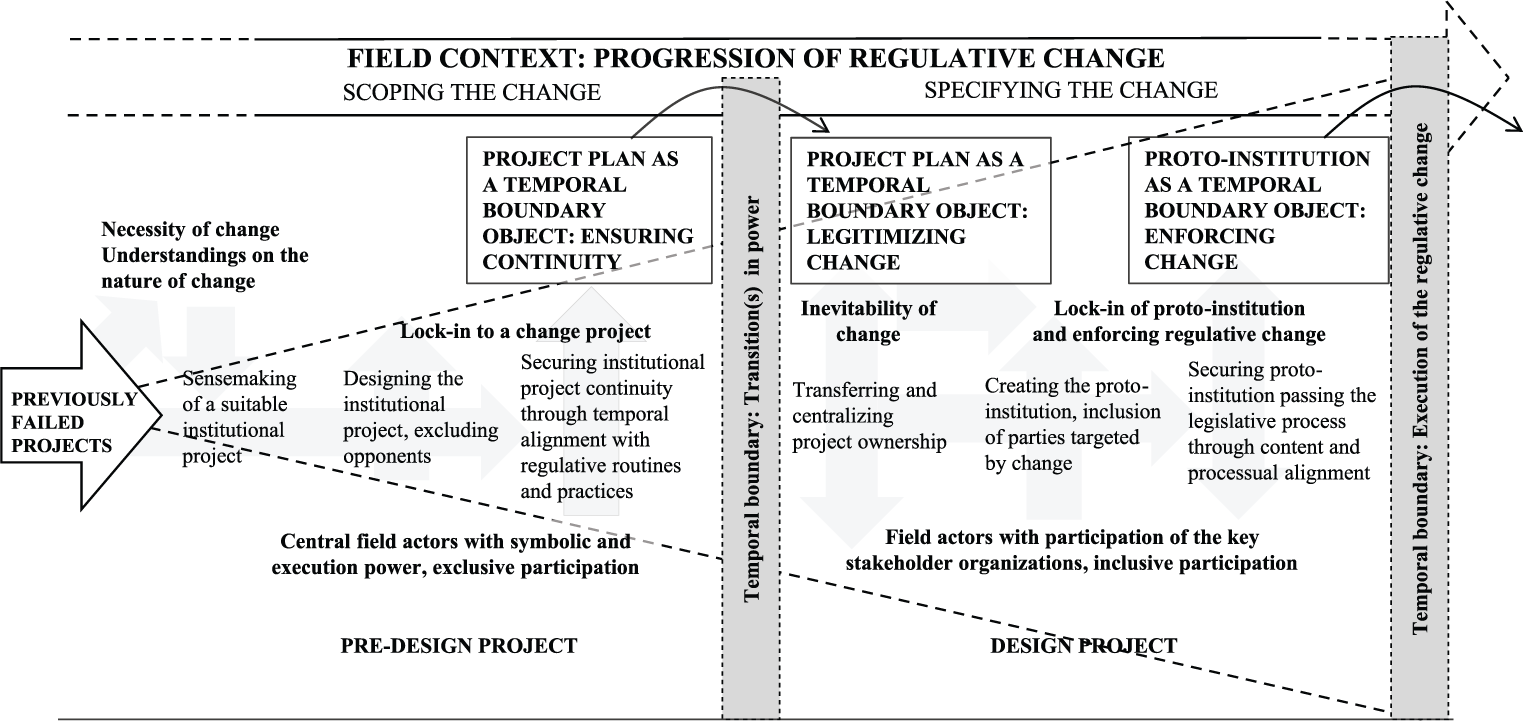
Model of an institutional project for regulative change: Interactions between consecutive projects and institutional change.
We will now discuss the two consecutive sub-projects in our model of an institutional project: the Pre-Design Project for scoping the change and the Design Project for specifying the particularities for creating and implementing the new regulation. As for the Pre-Design Project, our model suggests that the key actors are individuals with powerful subject positions in the central field organization. These actors share a perception that change is necessary and engage in making sense of a suitable project for promoting the change. This sensemaking can be both backward and forward-looking (see also Grabher & Thiel, 2015). This means that actors can build on previously failed projects, contrasting those with current and future needs when making sense of a suitable way forward. All this can build up to a situation where past failures lead to a more radical, emergent reorientation in the overall approach of the key actors in promoting change (see also Dornisch, 2002).
Indeed, our case indicates that successful institutional projects build strongly on previous attempts to engage with change and are thus likely to emerge when they can build on previous activities and learning. For example, it was because of the previous failures that a community of like-minded people began to form, shaping a closed group quite early on. Such an exclusive planning group may not only promote the perceived legitimacy and necessity of change but also contribute to its irrevocability. The central subject positions of the key actors were also important when aligning the institutional project with the routines and interests of stakeholders in the central field organizations and securing continuity. Notably in our case, the project plan produced by the Pre-Design Project was carefully crafted and temporally aligned with the governmental routines – specifically by including the institutional project in the new government’s programme. This made the project plan an important temporal boundary object (Yakura, 2002) that carried the change across the temporal boundaries created by the transition in political power.
The Design Project, which produced the specifics of the regulative change and the new proto-institution, began after the transition in political power. According to our model, the beginning of such a project is characterized by backward- and forward-looking activities (cf. Grabher & Thiel, 2015). In this process, the project plan developed during the Pre-Design Project was used as a temporal boundary object – a connecting resource between the two sub-projects that necessitated and legitimized activities during the Design Project. However, the key element of the Design Project was at the outset the appointment of a specific, dedicated project owner and a project organization. This organization included a high-profile top management team and specific project teams for developing the particularities of the change. This, in turn, contributed to the more widely shared perceptions that the regulative institutional change would indeed ensue.
However, in contrast to the Pre-Design Project, as the aim was to make the novel institution widely accepted and understood, the Design Project also set up inclusive teams with participants from all the relevant stakeholder organizations. The tasks of these teams included production of the templates for the practices, processes, structures, norms and even the values that shaped understandings of the novel way to organize universities. Through such inclusive work, the Design Project de facto produced a proto-institution (Lawrence et al., 2002; Manning & von Hagen, 2010). That is, the aim of the Design Project was to make such new operational templates that could then be enforced by legislative reform. Eventually these texts and plans indeed acted as the temporal boundary object across the next transition of power; the templates moved from the project organization and the legislation process to the Parliament, which then voted on and approved the new laws (see also Manning & von Hagen, 2010; Windeler & Sydow, 2001). Here, the specifics and details of the proto-institution were aligned with the routines of the public administration involved in the legislation process (i.e. the Ministry of Education, in our case). This ensured both the regulative change and the continuity of the broader institutional change.
Discussion and Conclusions
The aim of this paper is to increase understanding of how projects as temporary organizations may produce regulative institutional change. In the previous sections we concluded that while Holm (1995) introduced the concept of an institutional project – a project specifically set up to change existing institutions – extant research still leaves the internal activities of such a project a ‘black box’. Therefore, we set out to empirically explore the micro-level activities within an institutional project by examining the creation of the Innovation University. This project contributed not only to the birth of a new university but also to a regulative institutional change that produced new legislation governing the university field in a northern European country.
Overall, a growing body of research on temporary organizations stresses the need to examine and better understand the actuality of projects and project actors’ lived experience (e.g. Blomquist et al., 2010; Cicmil et al., 2006). Despite studies that have explored the creation of entirely new organizational forms (Czarniawska, 2009; Perkmann & Spicer, 2007) and standards (Manning & von Hagen, 2010) or the institutionalization of new practices from transient mega-events (Grabher & Thiel, 2015), studies that address projects and changes in existing regulative institutions still lack this perspective. In other words, activities within ‘influential projects’ purposefully set up to change existing regulation, in particular, have been overlooked. Therefore, our study is one of the first empirical efforts to conceptualize and model the ways in which such projects evolve internally. Hence, we add to the literature on project actuality by introducing and modelling a novel project form, namely an institutional project for regulative change. The more specific significance of this contribution is discussed below.
First, our study builds towards a more robust understanding of institutions in the project literature. As mentioned in the previous sections, some existing studies tend to grant the status of institution to formal and regulatory organizations (Morris & Geraldi, 2011; Sallinen et al., 2011) that are conceptualized in institutional theory as field organizations and, thus, not institutions (Greenwood & Suddaby, 2006; Greenwood et al., 2002). Moreover, project literature often treats institutions in essentialist terms as an external environment that needs to be ‘managed’ (e.g. Miller & Lessard, 2000; Morris & Geraldi, 2011), while simultaneously other studies adopt the structuration perspective, which portrays projects as intrinsically embedded in their institutional contexts, where the projects recursively shape and are shaped by institutions (e.g. Manning, 2008; Sydow & Staber, 2002). We conceptualize and model institutional projects by following a current approach in the institutional literature. According to this perspective, institutions exist as shared rules, beliefs and practices that are repeatedly enacted and (re)produced by various actors in a diverse range of situations (Boxenbaum & Strandgaard Pedersen, 2009; Lindberg, 2014; Lounsbury, 2008). Our conceptualization and model is also in accordance with the process ontological perspective (e.g. Langley et al., 2013). Our study therefore further sediments a more robust approach to institutions within project research.
As a result, by exploring the lived experiences of project members, we were able to conceptualize and model the progress of institutional projects in a novel way – as more multifaceted than what has so far been portrayed. The overall aim of mainstream project studies has been to produce understandings that assist in making projects more systematic, manageable and predictable in practice (e.g. Morris, 1994; Söderlund, 2004; Turner, 1999). Based on such ideals, these studies have often depicted projects as progressing in an orderly fashion through clear-cut steps and along distinct paths. Reminiscent of this, for example, is the study by Perkmann and Spicer (2007). While they acknowledge the challenge inherent in reducing a particular project into a single ‘project type’, because of their longitudinal data they portray institutional change as occurring through a sequential line-up of interactional, technical and cultural project types.
However, our conceptualization of an institutional project highlights that such projects actually consist of simultaneously occurring activities that represent such types. For example, in the Pre-Design Project the key actors engaged in justifying and legitimizing the Innovation University project and carefully analysed its potential with regard to the envisioned institutional change while persuading other field actors to accept and promote the Innovation University. In Perkmann and Spicer’s (2007) study these are characteristic of technical and cultural projects and occur only in later stages of institutionalization. In other words, instead of a sequential depiction, our study reveals how the institutional project proceeds through sub-projects drawing on and combining multiple types of activities within them. Thus, our study complements existing understandings of how projects may enable institutional change (e.g. Manning & von Hagen, 2010; Perkmann & Spicer, 2007).
This understanding of the multifaceted nature of institutional projects is particularly important as it also provides new insights into the role of lock-ins in such projects. According to Dornisch (2002), projects may be an efficient way to avoid or break out of lock-ins to ineffective institutional arrangements. In contrast, our findings show how lock-ins are created in the first place and establish that they are necessary to secure the continuity of institutional change across transitions in power. In our data, simultaneous progress on multiple fronts during the Pre-Design Project effectively led to the creation of a lock-in. Such activities included connecting previously disconnected actors with the work of the Strand Committee (an activity typical of interactional projects according to Perkmann and Spicer, 2007). These new actors made the committee analyse the feasibility and plan for the university merger (an activity typical of technical projects) and lobby for the merger idea so that it was included in the government programme (an activity typical of cultural projects). As a result, there was sufficiently widely shared awareness of the benefits of proceeding with the Innovation University that it survived the transition in power from one government to the next. Indeed, regulative institutional change usually requires overcoming several transitions in power. Our study shows that the simultaneous progress and combination of different types of activities may be highly effective and central in creating lock-ins that as shared beliefs and emerging practices may advance change.
Finally, our study produces a new perspective on the role of the timeline-based material objects common in project organizing (e.g. project plans and Gantt charts), stressing their importance in establishing linkages between the past and future in institutional projects and thus advancing change. Temporal linkages between projects are of central interest in the existing literature on projects in general (Engwall, 2003; Sahlin-Andersson & Söderholm, 2002) and in those addressing projects and institutional change in particular (Grabher & Thiel, 2015; Manning & von Hagen, 2010). These studies stress such linkages because of their importance for transferring learning and knowledge between projects through people moving from one project to another. However, our model of institutional projects establishes that such projects may involve one or more transitions of power, after which completely new project actors and owners may take over. For this reason, the continuity of change cannot rely only on the people carrying the ideas forward. Instead, our findings show how the actors in the Pre-Design Project used the project plan as a tool for securing the project’s survival across the expected transition of power. The new actors in the subsequent Design Project then used the same plan to legitimate and necessitate the consequent work of the Transformation Organization, thereby increasing the pressure for legislative reform.
We thus elaborate how links to the past and future between the sub-projects took shape through the interplay of both material objects (e.g. the project plan) and project actors. This is a significant notion as previous studies argue that, in dispersed project organizational settings, timeline-based project management tools can be limited as boundary objects because they lack the plasticity needed for situated adaptation by the various groups (Sapsed & Salter, 2004). In contrast, our study shows that carrying the project across transitions was enabled by the material object (e.g. the project plan) becoming a temporal boundary object with plasticity (Yakura, 2002); various project actors could construct it to serve their situated needs and legitimate activities later on in the project. This is a novel aspect and it adds to the existing project studies on boundary objects (Sapsed & Salter, 2004; Yakura, 2002) by showing how temporal boundary objects, such as a project plan, can be effective in advancing institutional change by serving to establish continuity between projects despite changes in people engaging in the process.
Limitations and future research on institutional projects in the project and institutional literatures
While our study makes several contributions to project research, it arguably has some limitations and specific boundary conditions. First, our study is one where the institutional project consists of two consecutive sub-projects. However, previous studies indicate that singular projects, for example megaprojects such as the Olympic Games, may have institutional implications (Grabher & Thiel, 2015). While we also believe that such projects consist of several transitions in power and may analytically be quite similar to the institutional project that we describe, further studies should explore other kinds of institutional projects for regulative change so as to develop a more robust approach by drawing on various cases with different project organizational configurations.
Second, our context was clearly affected by the specific political climate as change in the university sector was on the way, and the Innovation University was used as a tool to promote this change. Our study therefore addresses a particular moment during a longer period of institutional change. It may be that such an advanced stage of development of the wider institutional change provided the right timing for institutional projects, in that the change could then be envisioned and planned. This stage might have played a role, for example, in the sequence and organizing of the activities taking place during our case. Future studies could explore institutional projects in environments less hospitable to legislative change and uncover what their role might be during earlier or later stages of an institutional change. Moreover, our case was about regulative change. From an institutionalist perspective it is clear that socially more deeply ingrained, normative and cultural-cognitive institutions will take a significantly longer time to change (cf. Scott, 2001). Hence, future research could examine how institutional projects may produce changes in such elements of institutions over a longer period of time.
Third, for quite some time project researchers have discussed ‘projectified’ societies, referring to the widespread and ubiquitous use of projects to organize business, operations and social life in Western societies (e.g. Lundin & Söderholm, 1995; Sahlin-Andersson & Söderholm, 2002). It is apparent that our empirical study takes place in such a projectified context. Future studies could examine these projects and their differences in comparison with societies where project organizing is not an everyday phenomenon, for example due to a different cultural understanding of the concept of ‘time’ (e.g. Schneider & Barsoux, 1997). Such contexts may have higher likelihood of challenges or resistance in utilizing the project as an organizational form to promote regulative institutional change. Therefore the process of utilizing institutional projects for regulative change might be different in these contexts.
Finally, while not the focus of this study, our research shows that exploring projects and other forms of temporary organizing as both means and context of change may provide a fruitful path for future studies in institutional theory. To date, empirical research has rarely gone beyond analysing developments over time, in stages; to study a variety of temporal processes that enable and restrict institutional change (however, see Granqvist & Gustafsson, 2016). As a result, how institutional change proceeds as a series of temporary organizing is not well understood. Indeed, the very existence of a project ‘may be the best way of spreading a sense of urgency’ that change is necessary at a given moment in time (Lundin & Söderholm, 1995, p. 438). Future studies examining the temporal nature of these activities may cast light not only on the beginnings, but also on the sequences, phases and transitions in institutional change. Moreover, a project is a tool for creating and mobilizing concerted action around a particular issue. Issues and issue construction are underlying drivers for institutional change (Hoffman, 1999; Munir & Phillips, 2005) and project literature provides a good understanding of how issues are mobilized across several organizations, as a type of cross-position collective (Kellogg, 2009). Incorporating insights from project literature into institutional research may cast new light on how agency and power transfer from one project to another, how issues are interpreted and translated across these transitions, and how they may enable wider change.
In conclusion, by theoretically conceptualizing and empirically founding institutional project as a concept for research, we have contributed to opening up this ‘black box’ and examining the activities and actions that constitute such projects. By relating our findings to other relevant literature, our study makes important contributions to research on projects and opens up new paths for future studies in both project literature and institutional theory. Overall, we believe that temporary organizing is a ubiquitous phenomenon that underlies several constitutive processes within contemporary society and that room remains for many future studies to explore such dynamics.
Footnotes
Funding
This research received no specific grant from any funding agency in the public, commercial, or not-for-profit sectors.