



Abstract
This article, first, proposes critical grounded theory (CGT) as a way to develop systematically an array of methods and theoretical propositions into a coherent critical methodology for organization studies (and beyond). Second, it demonstrates CGT’s usefulness through a case study of competing recovery projects from the Icelandic financial crisis. CGT is developed in engagement with the emerging paradigm of cultural political economy (CPE) and its preferred method of critical discourse analysis (CDA). CPE analyses the evolution of ‘economic imaginaries’ in both their structural/material and semiotic/discursive dimensions. This requires a critical realist, multi-dimensional research strategy which emphasizes ethnographic methods and substantial theoretical and historical work. The proposed methodology of CGT enables a retroductive research process that combines deductive theoretical deskwork with inductive fieldwork enabled by grounded theory tools to analyse organizational process, stability and change.
Introduction
Organization studies, much like the other social sciences, has experienced considerable influence by postmodern thought since what is commonly referred to as the cultural turn (e.g. Chia, 1995; Westwood & Linstead, 2001), affording analytical primacy to the discursive construction of organizations against the perceived dominance of structuralism in the field. More recently, however, realism has returned, reasserting the material and structural features of organizations and the difference between these and our knowledge of them (Reed, 2005). Instead of reiterating the philosophical debate between constructionists and realists yet again, we want to demonstrate practically the utility of a third meta-theoretical position (one of several) that is capable of incorporating the most convincing features of both traditions – critical realism (see e.g. Al-Amoudi & Willmott, 2011; Archer, Bhaskar, Collier, Lawson, & Norris, 1998; Fairclough, 2005; Newton, Deetz, & Reed, 2011). To do so, we take two steps. First, we outline a substantive social theory to provide conceptual flesh to the abstract bones of critical realism, which we believe holds great promise for organization studies – cultural political economy (CPE) (Levy & Spicer, 2013; Sum & Jessop, 2013; Thompson & Harley, 2012). Second, we develop a methodology suitable for the operationalization of research underpinned by critical realism, which we suggest can inform critical realist research in organization studies more generally – critical grounded theory (CGT) (Belfrage & Hauf, 2015). In fact, much critical research in organization studies is, without being couched in these terms, implicitly critical realist with research processes resembling the retroductive movement of thought typical of critical realism, which is at the centre of CGT. Thus, our development of CGT does not provide a magic bullet resolving all issues arising from the meta-theoretical dispute between constructionism and realism. Rather, it provides a way of explicating, systematizing and reflecting on an array of critical methods and theoretical propositions, and thus developing it into a coherent critical methodology, which we claim would be useful for the study of organizations (and other social phenomena).
The paper proceeds in four stages. First, we introduce the Icelandic financial crisis as a case vignette highlighting the relevance of research founded on critical realism by analysing the interplay in this crisis between the discursive construction of organizational stability, crisis and change as well as these tendencies’ extra-discursive, that is, structural and material, features. Second, we briefly discuss key concepts of critical realism and CPE to show their usefulness for organization studies before, third, introducing CGT in abstract terms. Fourth, we illustrate concretely the process of CGT research by returning to the Iceland case and an empirical research project studying competing recovery projects from the financial crisis there. We conclude by making the case for CGT as a suitable method for critical realist research in organization studies (cf. Alvesson & Deetz, 2000), whether informed by CPE or other social theories.
Case Vignette
Before the 2007–8 global financial crisis, Iceland was presented as a poster child of ‘financialization’ (see van der Swan, 2014), ostensibly providing evidence of the riches attainable by promoting the centrality of the financial sector and debt-based growth in the economy. Iceland briefly enjoyed capitalism’s promised land of affluence, full employment and worry-free consumption. Yet, as the first sovereign casualty of the global financial crisis in October 2008, it also came to symbolize the crisis of financialization (Belfrage, Bergmann, & Berry, 2015). When minor emergency reforms failed to restore the credibility of the Icelandic growth model, the króna went into freefall and inflation sky-rocketed, rendering both foreign-exchange denominated loans and inflation-indexed mortgages unsustainable. The UK Brown government used special legislation for the prevention of terrorism to freeze the assets of Landsbanki, which had exploited the Icelandic Central Bank’s (Islandsbanki) high repo rates by offering high interest rate (Icesave) deposit schemes to British savers. The collapse of the exchange rate overwhelmed crisis-management routines. Economic, social and political crises followed.
Despite the introduction of a ‘progressive austerity’ regime requiring the affluent middle classes to foot much of the bill for the costs, rather than the working and lower middle classes, emigration and unemployment shot up exponentially. The coalition government led by the Independence Party (IP) and supported by the Social Democratic Alliance (SDA) was ousted in a series of ‘saucepan revolutions’ and was replaced in February 2009 by a fragile left-wing coalition government led by the SDA. A process of ethical scrutiny was initiated and representatives of elites, not least of IP and the financial sector, were prosecuted. The International Monetary Fund (IMF) was called in to assist in stabilizing the economy, not least through the introduction of capital controls, significant currency devaluation and by co-funding a loan package with Nordic and Polish governments. Banks were split up and part-nationalized in quick succession. In the so-called Icesave saga, bailing out bondholders was popularly rejected in referenda as a consequence of the repeated intervention by Ólafur Ragnar Grímsson in a constitutionally controversial move. The Icelandic crisis response remains not only one of the most dramatic of the crises of national capitalisms constituting the global financial crisis; it has also been celebrated by a range of commentators as representative of an alternative, economically less damaging and more equitable approach to crisis recovery (e.g. Krugman, 2011). From a realist perspective, the extra-discursive reality of this crisis should not be disregarded. Surveying these concrete phenomena from a critical realist perspective implies looking at them as symptoms or expressions of underlying mechanisms or relationships at a deeper level of social reality.
Yet, these crisis phenomena are not entirely objective or automatic with predictable outcomes; human agency is fundamental to any crisis, and agency is complex, discursively mediated and unpredictable. Crises bring their own forms of social organization and may, apart from begetting painful socio-economic adjustment, also conjure up opportunities for learning and transformative, path-breaking action and thus the shaping of new paths of development. Here, from a constructionist perspective, sense- and meaning-making are fundamental processes.
Crises thus display, in accordance with a critical realist position, an intensified interplay between the extra-discursive and the discursive that serve to shape organizational developments. In the Icelandic case, widespread economic disillusionment, distrust for elites and popular soul-searching have shaped an intricate struggle for credibility by means of bringing others into disrepute within a social system, which ultimately must be founded on trust. These intense meaning-making processes affect all forms of organization in Iceland today, the reconstitution of which hinges on projecting a credible future in this hostile environment.
Six years on, persistent crisis conditions have turned Iceland into a laboratory for learning about the recovery from capitalist crises. Debray (1973) has understood the moment of crisis as one in which the objectively overdetermined conditions for social struggle are such that the subjective indeterminacy of agency is accentuated and the future is of a relatively open-ended nature. To address this complexity, knowledge of the dynamics of crisis recovery should be based on attempting to grasp the dialectic between the extra-discursive or -semiotic and the discursive or semiotic. An abstract and initial understanding of this dialectic can be drawn from critical realist categories such as the ‘real’, deep-lying relational mechanisms, what things or events ‘actually’ take place and what is ‘empirically’ observed or experienced, as well as how these categories interrelate. Yet, the explanatory value of such meta-theoretical comprehension is limited when trying to explicate actual post-crisis organizational outcomes; the latter requires a conceptual apparatus that puts concrete flesh on these abstract bones, and a methodology that does so in a way that grounds knowledge of emergent social practices without losing sight of the interplay between discursivity and materiality. CPE is a very instructive such apparatus and CGT is a very useful such methodology.
Cultural Political Economy
Cultural political economy is an approach based on critical realism. It incorporates concepts from regulation theory, the Gramsci-inspired strategic-relational approach and critical discourse studies. Its critical realist foundations set CPE apart from more radically constructivist ‘cultural turns’ in political economy (Sum & Jessop, 2013). CPE holds promise for the study of organizations within capitalist social formations because it is attuned to analysing the interplay of structure, discourse and practice through the macro, meso and micro scales of societies, institutions and actors. It locates organization in wider societal and historical contexts and focuses on processes of organizational stability, crisis and change through structural and semiotic mechanisms (Levy & Spicer, 2013; Thompson & Harley, 2012).
In this section, the central concepts of CPE relevant to the case study are introduced. We start with its critical realist foundations before turning to its interpretation of the notions of ‘structuration’ and ‘semiosis’, ‘discourse’ and ‘imaginaries’.
Critical realist foundations
While there are several ways to navigate the realist-constructionist divide, critical realism provides a useful ‘third way’ between the naïve realism of positivist research and the radical constructionism of much postmodernism (Fairclough, 2005). Still, the differences between critical realism and social constructivism have been exaggerated (e.g. Holt & Mueller, 2011). We here refer to critical realism in general, acknowledging that it is an evolving and rich current of meta-theoretical thought. It nevertheless has a common core (cf. Al-Amoudi & Willmott, 2011). Critical realism differentiates ‘real’ structures or mechanisms, ‘actual’ things or events, and ‘empirical’ observations or experiences. It seeks to uncover ‘generative mechanisms’, often veiled from perception, capable of causing observable phenomena. Indeed, it aims at producing critical knowledge to enable social emancipation. Social reality is open-ended with multiple mechanisms co-determining events, overlapping, reinforcing or counteracting one another; it is impossible to close the system experimentally in order to isolate a single mechanism as in the natural sciences. While it stipulates the existence of a material reality ‘out there’, it maintains that all knowledge about that reality, all meaning it acquires for us, is socially constructed and thus historically contingent. (For an overview of critical realism, see Archer et al., 1998. For a discussion of critical realism vis-a-vis social constructionism in organization studies, see Newton et al., 2011.) While sometimes mistakenly labelled structurally determinist, critical realists are actually profoundly interested in the social construction of meaning through discourse or semiosis, and the discourses intended to render the contingent necessary (Sayer, 1998).
Going further, critical realism acknowledges that social relations and processes are dependent on our interpretation since the latter may have performative effects on the former. There are social structures conditioning the possibilities for actors to make sense of social situations and to act within them. Conversely, social relations have their own materiality and their own causalities that may exist independently of our knowledge of them. While our knowledge of material reality is independent of the latter, the discursive construction of knowledge can affect material reality (Oliver, 2012).
Methodologically, the critical realist research process follows a retroductive movement (Easton, 2010). To identify generative mechanisms, critical realists ask the question: What must be true for events to be possible? From observable phenomena, we go back to possible explanations. Retroductive arguments move ‘from a description of some phenomenon to a description of something which produces it or is a condition for it’ (Bhaskar 2009, p. 7, fn 26). To arrive at possible explanations for the phenomenon, the critical realist relies on analogies with already known phenomena and on pre-existing theories as cognitive raw materials. These pre-existing theories are called ‘proto-theories’ (Collier, 1994, p. 165), and can be either everyday theories making sense of people’s experiences or scientific theories (for a collection of critical realist reflections and applications in organization studies, see Fleetwood & Ackroyd, 2004). The retroductive movement, then, moves back and forth between observable phenomena and possible explanations in an endeavour to gain deeper knowledge of complex reality, making use of both qualitative and quantitative (e.g. to identify trends and quasi-regularities, as opposed to causality) data depending on their ‘practical adequacy’ for answering a particular research question, while being reflective of the role of the researcher in the process of producing knowledge (Sayer, 1992).
For all its ontological richness, critical realism is ‘an underlabouring’ philosophy of science, not a social theory; it can only provide a general idea of the relations that it is concerned with. Making substantive sense of ‘reality’ necessitates a theoretical apparatus and a methodology capable of analysing the interplay of discursive/semiotic and structural/material dimensions of the social. Our brief discussion of CPE below will provide a substantive conceptual framework complementary to critical realism.
A strategic-relational perspective of structuration and semiosis
CPE defines semiosis as the social production of meaning (Jessop, 2009). It systematically considers discursive or semiotic dimensions and analyses their interrelations with non-discursive dimensions. It understands economic categories as inherently semiotic and as partly discursively constructed without neglecting their structural and material dimensions.
Semiosis is one of two necessary moments of complexity reduction, the other being structuration (Sum & Jessop, 2013, p. 149). For social agents to operate in the world, they must reduce the complexity of the ‘real world’ to a set of calculable and manageable aspects of that world. Therefore, their lived experience is shaped by their imaginary, complexity-reducing relation to it. For instance, the ‘actually existing economy’ (the chaotic sum of all economic activities) necessarily becomes an ‘imagined economy’ (a discursively and structurally circumscribed subset of these activities) (Sum & Jessop, 2013, pp. 166–7). This complexity reduction occurs through the evolutionary mechanism of selection: out of the endless variation of possible elements (signs, social relations, organizational forms, processes, etc.) of an unstructured complexity, only some become selected to constitute (‘compossible’) elements, capable of co-evolving in a relatively stable and coherent structure. Compossibility explains the enabling of particular future developments and the prevention (or rendering ‘incompossible’) of potential others (Sum & Jessop, 2013, p. 259).
Selection occurs in relation to particular spatio-temporal structures and horizons of action; it happens through ‘strategic selectivities’, of which there are four modes: structural, discursive, agential and technological (Sum & Jessop, 2013, pp. 214–19). These refer to different mechanisms constraining or enabling social agents in their pursuit of interests. Here, specific organizational strategies and projects constrain or enable some enunciations to be made over others. The notion of technological selectivities is an outcome of CPE’s integration of Foucauldian concepts of technologies, a poststructuralist source of inspiration appropriated on critical realist terms.
A Foucault-inspired view of discursivity and materiality
Taking the cultural turn within the political economy of organization without falling into ‘soft economic sociology’ (Jessop & Oosterlynck, 2008) requires navigating between the ‘structuralist Scylla’ and the ‘constructivist Charybdis’ (Sum & Jessop, 2013, p. 148). Structuralism, à la Althusserian Marxism, is criticized for failing to account for human agency and historical contingency, one of the reasons for the emergence of post-structuralism. Some variants of post-structuralism and especially post-Marxism, however, overshoot the mark. Their radical constructivist critique of economism leads to losing sight of the economy as an external, indeed material referent. This brings what Sum and Jessop (2013, p. 180) call ‘discourse imperialism’: the complete conflation of the discursive and the social (Holt & Mueller, 2011). CPE, in contrast, conceives of the discursive as merely one, albeit a very significant, dimension of social relations, but also stresses the latter’s specific materiality giving rise to internal contradictions and crisis tendencies in capitalism.
Economic imaginaries
CPE is concerned with the symbolic-cultural forms, discourses and imaginaries that inform the constitution of institutional forms, through which social (including organizational) practices become subjected to norms and routines. Imaginaries are discursive elements that may materialize and be condensed into institutional forms (for ‘organizational imaginaries’, see O’Reilly & Reed, 2011). Thus, an ‘economic imaginary is a semiotic order…and, as such, constitutes the semiotic moment of a network of social practices in a given social field, institutional order, or wider social formation’ (Jessop & Oosterlynck, 2008, pp. 1157–8). Imaginaries are typically constructed in relation to hegemonic projects, which link economic success to the national/popular (or some equivalent) interest that ‘aims to mobilize a broader social constituency behind the growth strategy’ of the hegemonic class fraction (Sum & Jessop, 2013, p. 200). Which imaginaries are selected and retained by relevant actors, and which become discursively reinforced and finally materially condensed and institutionalized largely depend therefore on balances of power and constellations of interests in society.
In moments of crisis, in which (following Debray’s insight cited above) the objectively overdetermined conditions for social struggle are no longer convincingly captured by a previously selected and retained imaginary, the subjective indeterminacy of agency is accentuated and the future appears to be relatively open-ended. In crises, economic imaginaries can proliferate and compete, and thus constitute moments of variation. Crisis construals politicize (or depoliticize) the policy routines of a growth model, including its institutional support mechanisms and the wider political-legal system. These construals subsequently lie at the foundation of ‘imagined recoveries’, often drawing on previously marginalized imaginaries to construe recovery strategies (Sum & Jessop, 2013, p. 395f.). In this way, CPE helps us see crises as opening up space for the re-articulation of the historically specific relations within state and economy. This is enabled by building on regulation-theoretical and Gramscian concepts (see Sum & Jessop, 2013, p. 182).
While the semiotic is of particular importance in relatively open-ended struggles in the moment of variation, the future tends to close as structural tendencies compel capitalism’s reproduction through the selection of imaginaries.
Hence, material factors come strongly into play in the ‘subsequent’ moment of selection through structural selectivities, path dependencies and conjunctural or entrenched power relations. Here, semiotic factors influence ‘the resonance of discourses in personal, organizational and institutional, and broader meta-narrative terms and by limiting possible combinations of semiosis and semiotic practices in a given semiotic order’ (Sum & Jessop, 2013, p. 185). The moment of retention can involve an imaginary’s inclusion in an actor’s habitus, hexis and personal identity, enactment in organizational routines, integration into institutional rules, etc. This moment also involves an economic imaginary’s reinforcement by procedural devices serving to privilege an economic imaginary at the expense of competing discourses and practices, and its recruitment/inculcation by those social groups, organizations and institutions with predispositions fitting the existing requirements. This evolutionary, non-linear conception of capitalist social reproduction accounts for the path dependency of institutional change, but stresses the potential for path-shaping and path-breaking as a result of the dialectic co-evolution of semiotic and structural processes (Jessop, 2009).
The selection and retention of economic imaginaries are challenged as the construction and institutionalization of economic imaginaries come into question as a consequence of real events and/or disputing discourses. It also means that phases can overlap and be differentially extended (see Figure 1).

Variation, selection, and retention. Used with permission from Towards a Cultural Political Economy Putting Culture in its Place in Political Economy, Sum and Jessop, 2013, p.238. Edward Elgar Publishing.
Summing up, CPE holds promise for the study of capitalist organization in terms of both its structural and its semiotic dimensions. Its capacity to relate these dimensions dialectically is its most inspiring feature. It allows for appreciating the productive or performative power of agents and discourses vis-a-vis their objects without denying the structured materiality of these objects. This combination of the strategic-relational approach, Foucauldian discourse theory and regulation-theoretical concepts may appeal to a wide range of organization scholars, as it provides a substantive theoretical apparatus for situating organizational process, stability and change in contemporary capitalism.
In terms of empirical operationalization, much CPE work has adopted critical discourse analysis (CDA) as the method for studying discourse in its non-discursive context (esp. Fairclough, 2005, 2009). Next, we briefly problematize the limits of CDA before proposing a methodological framework that we believe will help both CPE and other critical realist approaches to reach their full analytical potential: critical grounded theory (CGT).
Operationalizing CPE
Fairclough’s (2005, 2009) ‘dialectical-relational approach’ to CDA has become a popular method/methodology in the study of organizations (Curtis, 2014). It aims to relate discourse to its non-discursive context dialectically. Yet, its focus remains the analysis of discourse; its non-discursive context is included because it is deemed necessary to adequately understand the discourse. This is unproblematic as long as the main research interest is located on the discursive level. If, however, the researcher positions the interplay between semiotic/discursive and structural/material dimensions of the social at the centre of analysis, as CPE and critical realist approaches do, CDA becomes inadequate since it cannot fully deliver on these objectives on its own. While Fairclough (2005, p. 924) is careful to argue that a critical realist approach to discourse analysis needs to scrutinize ‘how discourse figures in relation to other social elements’, he fails to specify how to analyse that which is not discourse. Thompson and Harley (2012, p. 1366) have thus argued that ‘the CDA/CPE approach is predisposed to overemphasize the discursive relative to the extra-discursive’. It thus tends to exaggerate the significance of particular discourses (Sum & Jessop, 2013). While the critical scrutiny of discourses is fundamental to CPE, and here CDA can still play a role, a suitable methodology should give more weight to social agents, especially their strategies and interests in the practical use of discourses in particular settings, by venturing out into these very settings. We locate the solution in a critical reworking of the methodology of grounded theory which combines, for instance, discourse-analytical, ethnographic, theoretical and historical work, as many critical organization scholars already do, in a more explicit, reflexive and systematic way.
Towards Critical Grounded Theory
Critical grounded theory is designed to operationalize theories underpinned by critical realism such as CPE. It critically reworks grounded theory, a popular but often uncritically adopted methodology in the study of organizations (Suddaby, 2006), to render it compatible with the ontology and epistemology of critical realism. CGT draws on the analytical tools of grounded theory without bracketing the critical-theoretical and discourse-analytical insights of CPE. Rather than mainly relying on discursive artefacts, CGT invites the theoretically equipped researcher to ‘go places’ and ‘talk to people’ in order to investigate what people actually do with discourses in particular settings and processes before working this grounded data up into critical grounded theory.
We introduce CGT in three steps. First, we explore grounded theory, a methodological tradition renowned for its capacity to produce and make sense of ethnographic data. However, we challenge both its original naïve realist foundations and the radical constructivism at the base of its more recent iteration. Second, we appropriate grounded theory from a critical realist perspective. Third, we develop an abstract model, centring on retroduction, of how CGT works.
Objectivist and constructivist grounded theory
A critical grounded theory sounds like an oxymoron. Grounded theory, as developed by Glaser and Strauss (1967), arose in opposition to logical positivism premised on quantitative research methods (Suddaby, 2006). Grounded theory, interpretivist and qualitative in its approach, however, retained a naïve realism, rejected by critical realism. Political economists have consequently disregarded grounded theory. Sum and Jessop (2013, p. 123) reject it because it
is a theoretically agnostic, empiricist research method that…claims to avoid preconceived hypotheses that are imposed on the data and aims instead to ground its theory in a naïve observation of ‘raw’ data gathered without prior theoretical contamination.
This critique, however, only holds for orthodox grounded theory. Associated with Glaser (1992), it posits pure induction as the only scientific road to knowledge where the adequate ‘theory’ is already there in the data, just waiting to be ‘discovered’ (Glaser & Strauss, 1967).
Grounded theory, however, has gone a long way since its inception. The defence of pure induction is now a rarity among grounded theorists (for an early attempt to move away from inductive grounded theory in organization studies, see Orton, 1997; for a more recent reiteration of the grounded theory method for organization studies, see Gioia, Corley, & Hamilton, 2012). It is recognized that observations are necessarily theory-laden and influenced by ‘pre-concepts’ – or ‘proto-theories’ in critical realist terms. Accessing reality in a pre-discursive or non-conceptual way is quite impossible. Moreover, in chime with critical realism’s cautious, but pragmatic, view of the employment of quantitative data, Glaser (1999) has afforded a role to quantitative data and methods in the process of producing grounded theory.
Other critiques have moved grounded theory away from positivism and towards social constructivism and postmodernism (Charmaz, 2006). They take orthodox claims about the method being ‘paradigmatically neutral’ (Glaser, 2001) literally to build alternative approaches to grounded theory. Charmaz (2006, p. 129) juxtaposes what she calls ‘objectivist grounded theory’ and ‘constructivist grounded theory’, the former wedded to the positivist tradition and the latter to the interpretivist tradition. What is missing here is the third epistemological position of critical realism, between the naïve realism of Glaser and the radical constructivism of these recent contributions (for a critical appraisal of grounded theory in management research, see Fendt & Sachs, 2008).
Critical grounded theory
In CGT, the choice of research problem is explicitly driven by moral and/or social concerns in an ambition to produce critical knowledge to enable social emancipation. The researcher sees herself not as a disinterested observer but as an active member of a society ridden with social antagonisms and relations of exploitation, domination and exclusion, the explanation of which is a precondition for changing them. The research process therefore starts with critical observations or experiences of a social problem, of an issue or a process that she wishes to explain, because she recognizes the need for social change and wonders what inhibits it (cf. Sum & Jessop, 2013, p. 481; cf. Delbridge, 2014; pace Alvesson & Willmott, 1992).
During an initial phase of deskwork, the researcher turns to proto-theories. While employing proto-theories is dismissed by objectivist grounded theory from the outset, it is embraced by constructivists as well as by CGT. As an initial act of interpretation, the researcher seeks an understanding of how the problem is discursively construed and represented in hegemonic discourses. Media discourses relevant to our problem need to be analysed, involving the collection, preparation and evaluation of discursive materials such as newspaper articles, online fora, policy papers, transcripts of parliamentary debates, etc. Such material may include quantitative data, produced with quantitative methods, capable of giving a sense of relevant tendencies and quasi-regularities. In a retroductive move, she then turns to existing scientific theories, compatible with critical realism, to produce tentative explanations. There is no claim to neutrality of choice of theory here as the researcher inclines towards theories she is already familiar with or finds convincing.
Turned into initial conceptualizations, these explanations are subsequently employed in dialogue with participants during repeated cycles of fieldwork. The initial conceptualization gently guides the researcher through the subsequent phase of ethnographic fieldwork and retains space for her to be surprised in the field. Unstructured or semi-structured interviews, focus groups, participant observation (or other ethnographic methods) can be employed to produce rich qualitative data to be evaluated using the tools and techniques of grounded theory. Here, field research is recognized as potentially emancipatory in and of itself as it provides space, time and potentially voice to social problems, both in the moment of data production and dissemination. Finally, the researcher revises, reconstructs or develops the initial pre-concepts in the light of empirical findings. In the latter two phases, reflexivity features prominently in the production of critical grounded theory.
CGT is therefore different from CDA, because its core is not textual analysis of fragments of discourses, from which other elements of the social are related to better understand the discourse. Fundamental instead is the conception of and immersion into the field, as the researcher actively, albeit gently, employs pre-concepts relevant for the analysis to understand better how particular imaginaries and projects are practically relevant and form part of social situations and organizational life. Here, retroduction is not some abstract movement of thought taking place far away from the field, but is implemented and experienced by the corporeal researcher. The researcher is the acknowledged vehicle of producing knowledge in a process which is carefully recorded, analysed and reflected upon. The researcher is subjective and socially positioned, yet reflexive. Retroduction, thus articulated, describes a continuous, spiral movement between the abstract and the concrete, between theoretical and empirical work, involving both an interpretive and a causal dimension of explanation.
It involves a deductive moment, in which existing theories and concepts are worked through and applied to the research object to generate initial conceptualizations that sensitize the researcher’s understanding of observations and guide dialogue with participants. Here, the perspectivity and subjectivity of the fieldworking researcher ‘create perturbations that are not noise to be expurgated but music to be appreciated, transmitting the hidden secrets of the participant’s world’ (Burawoy, 1998, p. 14). Retroduction thus also involves an inductive moment, in which the researcher immerses herself in the field before working up empirical data through deskwork into emerging conceptualizations, refining previous concepts, deepening understanding, altering explanations and reconstructing existing theory in order to appropriate the ‘real-concrete’ as a ‘concrete-in-thought’ (Sum & Jessop, 2013, p. 7).
In the production of critical grounded theory, emerging conceptualizations and interpretations are constantly compared to existing ones, thereby making the initial conceptualizations more and more refined and complex. Theoretical saturation cannot be fully achieved. Critical grounded theories are therefore always provisional, incomplete and subject to revision. Yet, as soon as critically grounded conceptualizations have been produced in the retroductive spiral (Figure 2), these can be used to explain the social problem at a given point in time. The result is not an objective grounded theory discovered in the data, but a critical grounded theory reconstructed through a retroductive research process.
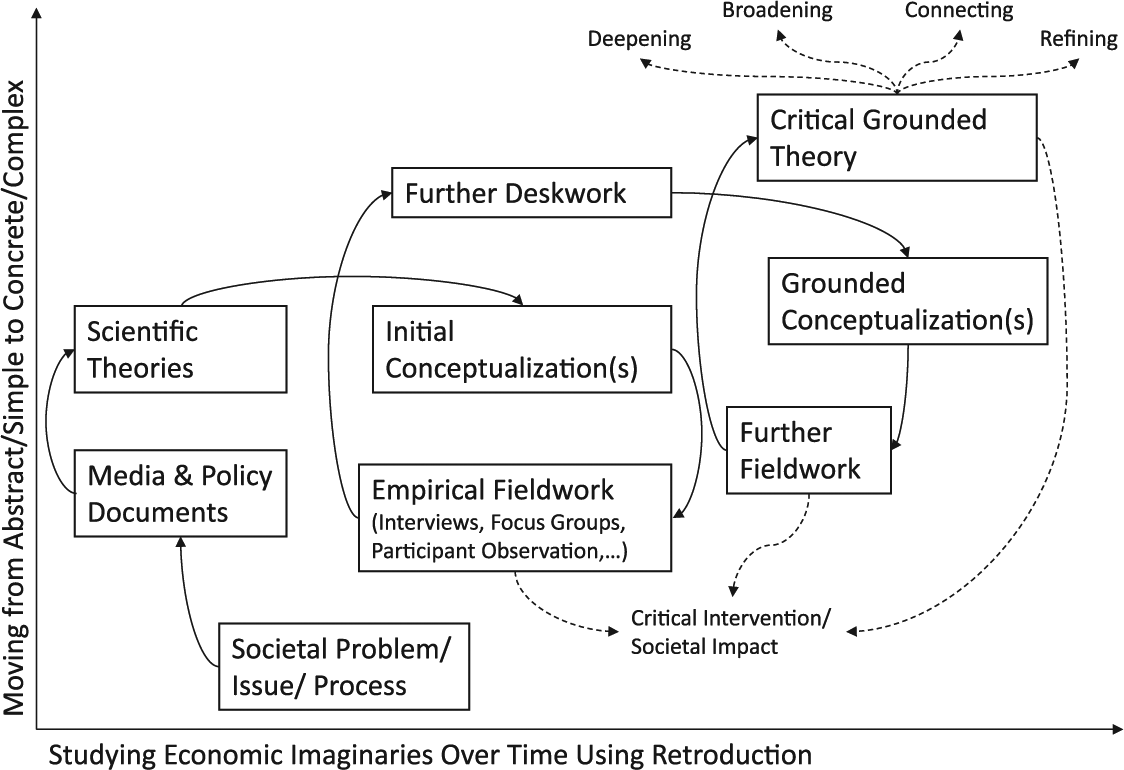
The retroductive research process of critical grounded theory.
The research thus brings about a number of potential outcomes: deepening or broadening of substantive knowledge; establishment of new conceptual connections; refinement or reconstruction of theory; and more profound challenges of existing theories. These outcomes improve the critical realist’s ability to explain how and why social relations of capitalism are being reproduced, how they become reified or naturalized and thus expelled from the realm of what appears to be discursively negotiable. With its emancipatory objective, this work seeks to contribute to the de-reification of the field and thus the identification of societal alternatives. From a CPE perspective, since the production of CGT contributes to the variation, selection and retention of social imaginaries and thus shapes relations of power and domination, the researcher should reflect on both her impact in the field and how her research results may be used, by whom and for what ends.
Illustrating CGT: The Icelandic Crisis, Imagined Recovery and Critical Order
To demonstrate the utility of both CPE and CGT, and hence critical realism in a practical sense, to organization studies, this section briefly summarizes a research project (see acknowledgements for the project team members) of exploring the post-crisis evolution of economic imaginaries in Iceland. We outline the retroductive process moving from initial social problem and abstract conceptualizations to the production of concrete data derived from ethnographic work and back to the abstract through grounded theorizing, eventually arriving at the construction of critical grounded theory.
Social problem
‘Financialization’ can be broadly defined as the growing pervasiveness of financial market influence in the economy as enabled by neoliberal reform (e.g. financial market liberalization and deregulation, the shareholder value revolution, labour market, tax and welfare reform) (see van der Swan, 2014). As financialization first appeared to benefit large segments of populations as consumption was financed in large part with cheap credit often secured against rising asset prices, it has turned out to involve a major redistribution of wealth benefitting primarily a small financial elite profiting from innovation in securities markets while enjoying less taxation and stakeholder influence. Yet, national crisis resolutions hit mass society the hardest, while financial elites were largely spared significant consequences. The global financial crisis therefore primarily spelt the crisis of the asset-based welfare regime increasingly relied upon by workers and households (Lapavitsas, 2009) with large-scale marginalization and considerable societal divisions resulting (e.g. Worth, 2013). Some asked whether this was the beginning of the end of capitalism (see Morgan, Froud, Quack, & Schneiberg, 2011). As the bulging financial sector collapsed in 2008, Iceland, like many other European countries, faced a severe sovereign debt crisis. In response to popular anger, the Icelandic ‘progressive austerity’ response was nevertheless radically different from elsewhere (see Case Vignette). Would this response lead to less popular disaffection and potentially the construction of an economic model based on a more equitable distribution of resources? In other words, would a more responsive and equitable crisis response save capitalism in Iceland, and if so, what form would capitalism take?
Proto-theories: media and policy documents
The team surveyed relevant media and policy discourses seeking to comprehend how the crisis was construed by contending forces, and which construals gain validity, become constructions (selection) and become embedded (retention). This exercise was continuous, tracking developments old and new, but was particularly intense before the first field trip in May 2010.
A striking find was how the pre-crisis policy discourse downplayed criticisms identifying problems and risks deriving from surging private foreign indebtedness, house prices, international investments, and the risk of sovereign default. Iceland’s defences against systemic crisis were described as unbreachable and late shots over the bow in 2008 were even censored to prevent bank runs. Once crisis hit in early October 2008 and crisis management failed, media and policy discourses became dominated by a blame game. The team identified two competing positions. The first, presented by much of the opposition as well as representatives of the Social Democratic junior government partner, accused the Central Bank of miscalculating its exposure, leaving future generations to shoulder the burden of recovery. In contrast, the position of the neoliberal IP core of the government, fiercely supported by the head of the Central Bank (and former Finance and Prime Minister) David Oddsson, along with some influential Icelandic economists, was that this exposure was not the responsibility of the Icelandic public, but of ‘reckless bankers’, who therefore should bear the responsibility for their gambles (Oddsson in Wall Street Journal, 2008). The latter position contradicted the previous confident proclamations about the Icelandic miracle, in which courageous financial market actors had been given a fundamental role along with strong property rights, privatization, tax cuts and competition (e.g. Gissurarson, 2004). Moreover, it testified to the breakup of the previous class alliance between neoliberal political elites and finance capitalists.
Following the early 2009 ‘saucepan revolution’, the government resigned and a SDA-led left-wing government took office. The team’s survey highlighted that the new accumulation strategy centred on ‘progressive austerity’ and investments in infrastructure. The government also sought a European solution to addressing the challenges of dismantling the capital controls erected during the crisis to protect the economy from the consequences of the collapse of the small currency by complementing its access to the European single market, seeking European Union membership and adopting the euro. It sought to show leadership in the process of moral purification of civil and political society from cronyism and excesses. The main initiative was a Parliamentary Investigative Commission (Iceland, 2010). Analysing its report, the team attributed particular significance to its highlighting of how finance capital interests had been allowed to influence policy-making.
The team also noted the National Forum, a grassroots initiative supported by the new government, as potentially significant in the evolution of imaginaries. A crowd-sourcing movement for democratic change, it pushed for constitutional reform (National Forum, 2010). Following open elections, 25 members were selected to form a constitutional assembly. If this initiative appeared quite interesting to the team at the outset, the team assigned transformative potential to it as the Assembly was first challenged by right-wing media for pursuing a left-wing agenda, and then legally challenged in the Supreme Court. The government intervened, claiming bias of the legal challenge and in the composition of the Supreme Court’s membership. Still, the assembly’s mandate was weakened, and a constitutional ‘council’ (Stjornlagarad) was instituted instead.
From this survey, the crisis appeared a cataclysmic event triggering both the collapse of the economy and a direct challenge to the rules set for the relationship between political and civil society. Attempting to simplify this complexity, the team returned to a more abstract level to develop an initial conceptualization of the state and crisis recovery.
Proto-theories: cultural political economy
Opting for CPE and its notion of crisis and evolutionary conception of imaginaries, the team of researchers assumed that the struggle over the path of crisis recovery would take an evolutionary form in which social forces seek the selection and retention of particular economic imaginaries. Accordingly, as previously operational economic imaginaries and adherent crisis management routines ceased to capture the workings of the real economy, the Icelandic crisis erupted.
Initial conceptualization
In seeking to understand the conditions for struggle and explain its outcome, a fundamental question emerged: was the crisis in Iceland a crisis of the ‘finance-dominated accumulation regime’ (Stockhammer, 2008), or was it a crisis of capitalism altogether? Stockhammer’s concept appeared to approximate the Icelandic accumulation process by highlighting how accumulation in many social market economies of Europe revolves around the financial sector, with growth driven by credit-facilitated consumption, while high debt levels create market volatility and accentuate crisis tendencies only potentially stabilized by high levels of public expenditure. This led the team to pose a further question: if it was a crisis of a particular form of (i.e. in) capitalism, the crisis could be, in the first instance, expected to lead to struggle over the institutionalization of another form of capitalism supported by a stronger ethico-political basis. If it was a crisis of capitalism, social struggle would revolve around the question of the ‘to be or not to be’ of capitalism.
Neither CPE nor organization studies provided clear answers. From CPE, it could be derived that a crisis was a moment in which the inherent improbability of capitalist regulation becomes conspicuous, with the result that imagined path dependencies and selectivities are weakened, which in turn enables radical change (Sum & Jessop, 2013, pp. 271–6). Alternatively, organization scholars Thompson and Harley (2012, p. 1376) suspected in critical conversation with CPE’s ostensible tendency to overstate the open-endedness of crisis that ‘financialized capitalism may have undergone a systemic crisis, but none of the fundamentals have changed…the power of financial elites and financial circuits of capital remain largely intact’. Judging by the outright condemnation of the role of the state before and during the crisis, the team speculated that Thompson and Harley’s critique of CPE was unfounded in the Icelandic case. The Icelandic finance-dominated accumulation regime appeared dead, and to a significant degree, this seemed to derive from the revelations of comparatively extreme forms of cronyism benefitting finance capitalist interests. CPE understands the state apparatus ‘in its inclusive sense’ as encompassing political society (state institutions) and civil society organizations (including the organizations of both capitalists and labour). It attributes the state’s fundamental source of legitimacy to its successful reproduction of its ‘relative autonomy’. In the operations of the state in wider society, the liberal promotion of the common interest in freedom and equality is inscribed as an ideological form. It uses this hegemonic position to protect the long-term interests of capital and to secure the reproduction of capital accumulation, but in order to do so it must serve capital in general, not capital in particular. Because the state’s own particular powers and resources, as well as liabilities, are produced outside the formal confines of the state apparatus, in wider civil society, its powers are always relational and conditional. Here, the state’s protection of capitalist social relations overdetermines its form in its institutional separation from the economic space of valorization. This gives the state ‘relative autonomy’ from civil society and economy, which prevents the state from appearing as a ‘class state’ (Jessop & Sum, 2006, p. 367). With the Icelandic state seemingly appearing as a ‘financial class state’, it would seem to have no legitimacy if attempting to revive the finance-dominated accumulation regime. Yet, since the team recognized that the social struggle in Iceland was unfolding in a context of sustained liberal hegemony with some sustained strategic selectivities constraining radical change away from capitalism, there was scope for the state to reconstruct the notion of ‘relative autonomy’ in order to be able to play a role in the reproduction of capitalist accumulation, albeit supportive of a different accumulation regime. To attain a deeper understanding of this situation, fieldwork was required.
Continued cycles of fieldwork and deskwork
Field research had to test the team’s conjecture that the finance-dominated accumulation regime could not be revived in Iceland, and that if capitalism was to be reproduced in Iceland it required a new accumulation regime supported by a state whose ‘relative autonomy’ had to be reconstructed. It needed to record the historical specificities of the Icelandic growth model, including which policy routines, or the absence of them, had given particular financial institutions and practices regulatory primacy over other social forces and institutions, and how the failure of crisis management was construed in constructing alternative economic imaginaries. To capture the continued crisis in Icelandic capitalism, the team undertook a series of semi-structured elite interviews on the basis of a small number of questions developed from the initial conceptualizations.
The team also decided to study the work of the Constitutional Council as an endeavour to reconstruct the state’s relative autonomy. The Constitutional Council had been tasked with writing a new constitution in just a few months, focusing on the distribution of power, transparency and responsibility. The team decided to seek to understand the conditions for the struggle played out in this state project as well as to explain its outcome. Semi-structured interviews were conducted with all members of the Council, as well as the one elected member to the Assembly who subsequently refused to take a seat in the Council following the legal challenge. This was undertaken during the work of the Council, which also enabled participant observation recorded through memos at the site of the Council. Electoral platforms were also collated.
Grounded conceptualization
The theoretically guided coding process that followed enriched our initial conceptualizations and provided some answers where uncertainty had been greater. Yet, it also led to surprises resulting in what we thought could be the deepening of knowledge of capitalist crisis and crisis recovery, broadening the understanding of responses to the crisis of financialization, and potentially enabling the challenge of dominant theories.
The coding of the first set of semi-structured elite interviews supported the team’s stipulation that economic imagination was still in a moment of variation; radical change remained possible. Other than from a small neoliberal faction, reviving the Icelandic finance-dominated growth model as an economic imaginary enjoyed no support. This model was now associated with excessive consumerism, mass indebtedness, loss of sovereignty and cronyism. The coding identified introversion and traditional livelihoods and values as orientations of resurging popularity in Icelandic society. This appeared to be driven by both the (outside) involvement of the IMF in continued crisis management, principally the implementation of austerity measures, however progressive, and capital controls, and a desire to return to trusted sectors in the economy such as fisheries, heavy industry (aluminium) and tourism. Yet, this ‘desire’ paradoxically created frustration as it also signified developmental regression. As unemployment shot up, especially in urban regions, and the number of households in financial difficulties reached alarming levels, disappointment with the new left-wing government rose. The brief honeymoon enjoyed by the left-wing government had only brought weak selection of an alternative economic imaginary. Disappointment with lack of economic recovery resulted in diminishing approval ratings. With few exceptions, the entire political elite, along with the financial fraction of capital, was now perceived as without credibility. The coding suggested that the initial post-crisis anger and re-ethicalization were becoming sedimented in society.
The team needed to return to a more abstract level for inspiration of how to reduce this complexity. CPE offered some answers. Along with the collapse of the accumulation regime, the state’s relative autonomy from particular (finance) capitals had come under sustained scrutiny. With the result that the integral state was, at best, in serious disrepair, and, at worst, on the brink of collapse. The Parliamentary Investigative Commission had given substance to popular protests against economic mismanagement, greed and cronyism. Thus, for new economic imaginaries to gain traction and for new accumulation strategies to be implementable, the state’s relative autonomy had to be reconstructed along with new ethico-political foundations to ensure the justification of capitalist accumulation. Yet, collapse of the accumulation regime renders any state project very challenging. Here, CPE’s notion that crisis is a relatively open-ended moment proved somewhat limiting in the team’s theorizing. What was not specified by CPE was that the structurally inscribed conditions for (differentially reflexive) strategic calculation may be such that actors can become inclined to embrace unconstructive criticism targeting existing discursive rules and routines as a strategic tool. This could then be used to outmaneuvre rivals with the objective of shaping discursive selectivity to expected advantage. However, with such a strategy of radical criticism widely adopted, the discursive selectivities required for actors to articulate alternative economic imaginaries, accumulation strategies or state projects were being undermined. This is so because if radical criticism becomes widespread, it can no longer be incorporated into any economic imaginary seeking the relegitimation of capitalism. The team conceived this paralysing state of affairs as a ‘critical order’, a concept that could serve to refine CPE. Yet, the team acknowledged that even in a critical order, key elements of liberal hegemony can persist. Further fieldwork had to pay close attention to the extra-discursive to grasp the impact of these remnants.
At this point in the fieldwork, the team was invited to comment on the state of affairs in the recovery process on a major political talk show on Icelandic national television (Belfrage & Berry, 2011), that is to produce critical grounded theory. The response to the introduction of the notion of ‘critical order’ in Icelandic public debate unsettled the team. Thanked in a personal communication from an extreme right-wing group (personal communication, 2011), the team was forced to reflect upon the impact of the research project, fearing that it had energized social forces with which it could not ally. This issue, as we will see, resurfaced at a later stage in the research process.
As the team saw the critical order capturing Icelandic political and civil society, the left-wing government’s promotion of constitutional reform was a crucial state project for positioning itself at the centre of moral rejuvenation and the reconstruction of the state apparatus, creating strategic selectivities shaping the direction of recovery and politics. The coding of interview and participant observation data were compared with electoral platforms to get a sense of how imaginaries fared in social practice in this ad hoc institution. Council members typically came from civil society, not political parties. Commonplace in electoral platforms were radical initiatives, including the re-nationalization of natural resources, most notably fisheries, which had been commodified through a quota system introduced by an IP-led government in 1990. Yet, many radical initiatives were marginalized. The final proposal was a set of checks-and-balances reforms of the politico-legal system and was presented for adoption by the Althingi in July 2011. Still, the new proposal became the centre of considerable controversy (Gylfason, 2012). Lacking strong support from a weak left-centre government, constitutional reform was suspended by the Althingi, a body pervaded by the discursive selectivity of radical criticism, as the proposal was criticized and filibustered.
The team’s analysis of the fate of the Council supported the concept of ‘critical order’. The team came to postulate that the critical order partly explained why the left-wing government had failed to push for a longer mandate period than a few months for the Council, insufficient for a detailed and carefully worked-through constitutional proposal. The failure of this state project buried any hope of the left-wing government redeeming its attributed economic mismanagement. The proposal’s shelving intensified popular distrust of political elites and deepened the crisis of the state.
As the Spring 2013 elections approached, the team saw its notion of critical order make further sense as the Progressive Party (PP) made populist overtures focusing on reconstructing elements of the finance-dominated growth model, including household debt relief and dismantling capital controls, as well as flirting with extreme right-wing groupings. By this time, the left-wing government’s approval ratings had dipped below even the previous government’s. PP and its junior IP partner were victorious. The economic imaginary promoted by the left-wing government had not been selected. The team concluded that the evolutionary process of recovery had returned to a moment of variation with only weak forms of retention identifiable.
Further fieldwork and deskwork
In CGT, methodological reflexivity and flexibility are crucial. Reflecting on the methodology employed thus far, the team recognized that the research had privileged elite discourses; the theory produced could be expected to reflect elite perspectives. Further approximation of reality required fieldwork, capable of creating an understanding of a broader set of experiences of the crisis. Research had to be designed and the produced data analysed in a way that the reality of the relationality, (inter-)corporeality, spatiality and temporality of the lived experience of crisis could be appreciated. The choice fell on semi-structured focus groups, allowing a now grounded conceptualization to gently shape data production.
Staff and students from Bifröst College, an institution modeled on Oxford’s Ruskin College located 110 km north of Reykjavik in a rural setting, were recruited. To ensure balance with regard to gender, age and region of origin, student participants were primarily drawn from its foundation programme, in which ‘ordinary’ individuals seeking a ‘fresh start’, often from crisis-related disruptive experiences, are enrolled. This diversity enabled the team to reproduce, albeit in a non-representative manner, the composition of Icelandic society.
By recording both visual and audio data, the focus groups allowed the capturing of both the speech and silences of participants, enabling the production of data on how Iceland in ‘microformat’, as a spatially and temporally specific community, interacted to create (dis)agreements, including common sense positions, conflicts and contradictions in the experience of crisis and recovery. This, the team believed, could provide a deepened understanding of the microfoundations of the critical order.
Grounded re-conceptualization
The focus groups produced data that confirmed as well as challenged the project’s findings thus far. The team identified two competing perceptions: alienation and appropriation (Jaeggi, 2014).
Several forms and sub-forms of alienation were identified in the coding process: fear, cynicism and fatalism. Alienation appeared to arise from shrinking opportunities in Iceland. Yet, some saw new life prospects emerging in the crisis aftermath. Some even identified opportunities to return to a life of riches. Alienation was expressed in relation to political elites and society, who were ascribed an inability and unwillingness to create a just society (Focus Group, 2013). The intensity of the alienation expressed in relation to both state and economy supported the team’s analysis that the post-crisis evolution of imaginaries was still, five years after the crisis, in a moment of variation. It became clear to the team that this difficult moment provided fertile ground for unwanted right-wing voices to secure support even among, relatively speaking, hopeful individuals.
Indeed, a second finding from coding was the notion of appropriation, or resuming a degree of command over life (Jaeggi, 2014), of which the team distinguished three principal forms: re-invention, re-ethicalization and re-socialization. Re-invention informed many of the participants’ decision to return to higher education. Education was perceived as enabling the re-channelling of energies in ostensibly more purposeful or fun ways. Pre-crisis careers were in some instances described as boring, safe or meaningless. The crisis had forced or inspired re-education, bringing new adventures and greater purpose to life.
The team paid particular attention to the notion of re-ethicalization, interpreted as deriving from the participants’ construction of the past as unethical (excessive consumerism, wastefulness, greed, lack of responsibility and respect, and disregard for the ‘spirit’ of the law), sometimes implicating themselves in these past excesses and malpractices (Focus Group, 2013). Moreover, this, the team inferred, implied presenting current and future individual lifestyles as ethical, simple, proper or purposeful. Re-ethicalization was also perceived as a commonsensical collective obligation: everybody ought to embrace re-ethicalization and return to empathy. Re-socialization came on the back of loss of family and friends and collapse of pre-crisis lifestyles and involved finding new constellations and principles for social relations.
The team also noted that in the identification of alienation and appropriation, the other featured prominently: fear of the other and his excesses, arrogance and disrespectful actions. There was a strong expression of distaste for previous, but also re-emerging, tendencies towards reification seen as embedded in luxury consumption, greed, escaping the law and fiscal responsibilities. Here, avoiding being like, or being seen as being like these others, including friends and family yet not ‘awoken’, was seen as important not to betray collective re-ethicalization (Focus Group, 2013).
Focus groups with ‘ordinary Icelanders’ served the research well by providing valuable insights into Icelandic society. It became clear that, on the scale of everyday life, the critical order was constituted by seemingly conflicting, but actually largely complementary characteristics: alienation and appropriation. The team ascribed particular significance to appropriation.
Critical reflections
Deep learning resulted from critically reflecting upon the work as facilitator of the focus groups. On the one hand, there was a growing realization that the facilitator was perceived as an outsider, as somebody who has neither experienced the global financial crisis in the same space nor as profoundly as the (other) participants. Yet, representing some of the difficult experiences in post-crisis UK brought perspective to the participants (Focus Group, 2013). On the other hand, the team reluctantly realized that it had been ‘looking in from the outside’, perhaps caused by a fascination with this peripheral Atlantis appearing to sink in the ‘Transatlantic’ crisis. This realization brought a new analytical dimension. Despite efforts to the contrary, the team identified a creeping methodological nationalism in the grounded theorizations tending to exaggerate ‘place’ at the expense of a critique of the social relations of the crisis that CPE seeks to alert us to. Conceivably, the team had been acritical in its appreciation of this literature, negatively affecting the research process. The team therefore undertook a critical literature review and could identify that some of the most cited work on the Icelandic crisis promotes precisely such methodological nationalism (e.g. Wade, 2009). The tentative construction of a critical grounded theory of recovery from the Icelandic crisis in the next section recognizes this limitation.
The tentative critical grounded theory
While Iceland has been celebrated as a success story of crisis recovery, the recovery from the crisis of Icelandic capitalism is, five years on, still in a moment of variation. The competition between elite constructions of economic imaginaries has failed to generate the progression in the evolutionary process towards selection and retention. However, it has produced a ‘critical order’ revolving around radical criticism and founded on alienation. The other, as so often, is the enemy within, but also beyond, Icelandic society. The other is not only identified as other members of this society, but also subjectivities jostling for dominance in ordinary life. However, the micro-foundations of this critical order are also based on appropriation: a desire to re-invent, re-ethicalize and re-socialize. This is not a discourse detached from social practice; it permeates it. While care has to be taken so as to avoid overstating this, and there are contradictions and conflicts in the expression of appropriation, there remains an emancipatory dimension that provides potential for radical change rather than an apathetic or amoral return to previous social structures, practices and discourses. While this order has become deeply sedimented in Icelandic society, it also structures elite discourse and practice, undermining the construction of economic imaginaries and short-circuiting any reconstruction of the integral state.
It should be acknowledged though that the re-normalization of Icelandic capitalism is still far from unlikely. For this to be possible, three extra-discursive problems have to be resolved:
The dismantling of capital controls 1
Continued high levels of indebtedness (both public and private)
Having a small currency while exposed to financial flows on the European single market
However, although no economic imaginary can be considered retained and the project of reconstructing relative autonomy remains far from successfully completed, elites are still able to rule; capitalist hegemony can draw on deep-seated national-popular sentiments embedded in the hegemonic project and is armoured by coercion (Candeias in Sum & Jessop, 2013, p. 107).
Conclusion
In this article we have demonstrated the practical utility of critical realism for organization studies and beyond. As an underlabouring meta-theory, however, this is not possible without the elucidation of two other elements: a substantive theoretical framework that can provide the concepts to help us in the approximation of the concrete ‘real world’, and a methodology that stipulates how that very approximation can be done. The article therefore briefly outlined the emergent theoretical framework of cultural political economy (e.g. Sum & Jessop, 2013) and the new methodology of critical grounded theory (Belfrage & Hauf, 2015).
CPE is, with its dialectic understanding of structuration and semiosis, an appropriate social theory for analysing the complex interplay of organizational structure, discourse and practice on different spatial scales and its impact on organizational stability, crisis and change. Second, we have developed CGT as a methodology for operationalizing critical realism in general and CPE in particular. CGT is a coherent critical methodology guiding a research process that brings abstract and concrete, macro and micro, structure and agency, discursivity and materiality into dialogue with one another, by combining conceptual, discourse-analytical and historical work with the immersion into the field (cf. Alvesson & Deetz, 2000). Combining substantial theoretical, historical and empirical work, CGT provides a way to think through and explicate what is often an unjustified array or implicit set of critical methods and theoretical propositions employed in critical organization studies and beyond. Meanwhile, CGT is a normative and reflexive methodology, which sensitizes the researcher to the field and vice versa, enabling the flexible incorporation of a range of different research methods.
The Iceland case illustrates the rich insights that a clear, yet gentle, navigation through retroduction can generate. We have demonstrated this by highlighting the retroductive process at the core of CGT, making abstract theory inform the analysis of concrete data, and also how grounded data feeds into the production of critical grounded theory. The critical grounded theory produced through this case study has shown how the crisis has set into motion social struggle at all levels which, despite the celebrated adoption of ‘progressive austerity’, is showing no clear sign of social settlement. Our CGT operationalization of CPE in our study of Icelandic crisis recovery has enabled an in-depth explanation of how different social forces in Iceland are constrained in the construction of economic imaginaries and state projects. While alienation is commonplace in this ‘critical order’, progressive austerity may just provide the institutional conditions for appropriation.
Footnotes
Acknowledgements
Members of the research team were Claes Belfrage, Eirikur Bergmann and David Berry. Their research was undertaken under the auspices of the research project ‘Imagined Recovery’. We would like to thank Eirikur Bergmann and David Berry for their support.
Funding
This research received no specific grant from any funding agency in the public, commercial, or not-for-profit sectors.