



Abstract
The article seeks to further our understanding of the process of organizing nascent social ventures. It builds upon current research on the political and collaborative nature of the social entrepreneurial process, and takes an ANT-inspired processual approach to follow the organizational practices carried by a nascent social venture in its efforts to mobilize stakeholders, bring about collaboration and ultimately secure resources. It draws upon empirical material generated during the first year of a social venture I founded and continue to chair. Findings highlight the adaptive and fluid nature of the organizational practices involved in nascent organizations and indicate that the capacity to continuously adjust the qualities of the eventual venture to the stakes of potential partners is instrumental to start up the venture. The article suggests the notion of tinkering to underscore the fluidity, the ongoing and piecemeal everyday work of such organizing processes. Further, findings highlight the extent to which social ventures, as well as the engaged scholar, are caught in the networks that contribute to reproduce the social problem they aim to change.
Keywords
Looking back to his previous five years as Editor for the journal Organization Studies, David Courpasson (2013) bemoaned the ‘lack of political and social relevance of much research conducted in the field’ and suggested that the study of communities’ entrepreneurial abilities has the potential to introduce political relevance to organization studies. In a similar vein, a variety of scholars are pointing to the political bearing of studies of entrepreneurship (Calás, Smircich, & Bourne, 2009) and social entrepreneurship (Martí, Courpasson, & Dubard-Barbosa, 2013; Sonnino & Griggs-Trevarthen, 2013), not only because of the social, political, civic and cultural agendas tied to entrepreneurial processes of organizing (Chell, Nicolopoulou, & Karatas-Özkan, 2010), but also because these scholars are experimenting with interventionist methods that create spaces for political engagement (Barinaga, 2016; Gibson-Graham & Roelvink, 2009; Steyaert, 2011).
Attentive to such demands, this article expands on extant efforts to connect the fields of organization studies and social entrepreneurship (Mair & Marti, 2009; Townsend & Hart, 2008) through the study of the process of organizing a nascent social venture. Actor-network theory (ANT) has been suggested as particularly suited to the analysis of processes of organizing in general (Czarniawska, 2008; Hassard & Cox, 2013) and entrepreneuring processes specifically (Jóhannesson, 2012). In the case presented here, an ANT approach allows me to elicit the socio-spatial practices that a nascent social venture engages in as it organizes for social change. First, cross-sectoral practices to enrol an ever larger and more varied network of actors to the venture; second, semiotic practices to qualify the venture and its work; third, material practices to provide some stability to the still fluid network of actors and qualities. These sets of practices work piecemeal, slowly but relentlessly adapting the arguments and qualities of the emerging venture to the stakes and qualities of the actors in the growing network. The first contribution of this article is thus to suggest the notion of tinkering to capture the sense of fluid adaptation characteristic of the process of organizing a nascent venture. These are relevant findings for organization studies as they highlight the organizational practices inherent in the process of building organizational agency and remaking space.
The adoption of a processual approach to study the organizing process of a social venture has three methodological implications. First, to be open to processes of emergence, processual scholars work with ‘looser, less abstracted knowledge claims’ (Hjorth, Holt, & Steyaert, 2015, p. 603). Ready-made concepts and models capture something as given. Instead, open concepts allow the observation of actors as they become, relations as they build up, movement as it proceeds, thus enabling description of the openness that comes with movement and ongoing transformation. Second, aware of the many tiny elements that unfold as processes emerge, processual methodologies incline to a sort of hyper-empiricism, one that is attentive to detail, describing the manifold negotiations, translations and adaptations that make up processual movement. Third, attention to emergence implies that we researchers acknowledge the performative effect of our methods and concepts on the processes and realities we study (Law & Urry, 2004; Mol, 1999). Process-oriented entrepreneurship scholars are thus suggesting interventionist methods that take responsibility for the ontological politics involved in our research practices (Barinaga, 2016; Steyaert, 2011). The social entrepreneurial initiative at the heart of this article (Förorten i Centrum, henceforth FiC) is one I founded six years ago and continue to chair, and the process of organizing for social change described here is one that I led. As such, the method adopted in this study puts the political and social aspects of our methods and concepts at the core of organization studies. In so doing, and this is the second contribution of the article, the study shows the extent to which engaged/interventionist scholars are caught in the reproduction of the reality we aim to transform – something that entrepreneurship scholars need to consider as they start experimenting with explicit interventionist methods.
The article’s first step is to turn to recent movements within the literature on entrepreneurship and social entrepreneurship. These literatures highlight the collective nature of the organizational work required to effect social change and point out the need to look into the organizational practices followed by nascent ventures to mobilize actors and build collaborations. Further, acknowledging the complexity of social change processes, both literatures stress the need to attend to the material, social and semiotic aspects of such organizing processes. Building upon these lessons, and using ANT to observe the organizational practices of a nascent social venture, the article follows the socio-spatial practices used to define the social venture and bring about cross-sectoral collaboration. The article ends with a reflexive note on the political challenges of adopting an engaged methodological approach.
Social Entrepreneurship: Organizing for Social Change
In the last 10 to 15 years, social entrepreneurship has emerged as a research field of its own. Attesting to the sudden interest is the creation of academic journals focusing on the topic, the institution of specialized professorships, the organization of thematic academic conferences, and the arrival of vibrant research networks on the topic. And, although social entrepreneurship (as most nascent research fields) is troubled by a lack of agreement concerning its definition (Aygören, 2014; Dacin, Dacin, & Tracey, 2011) and boundaries (Austin, Stevenson, & Wei-Skillern, 2006; Trivedi & Stokols, 2011), extant research on the topic is already pointing out several directions that may prove fruitful for both social entrepreneurship research and organization studies at large.
First, there is an increasing awareness of the political dimension of entrepreneurial processes of organizing and, with it, a parallel shift of attention from the economic to the social dimensions of ‘entrepreneuring’ (Calás et al., 2009). Accordingly, some scholars are reframing entrepreneurship into the more politically-aware formulation of ‘social change’ (Calás et al., 2009; Daskalaki, Hjorth, & Mair, 2015; Steyaert & Hjorth, 2006). These scholars argue for critical analysis that is able to elicit the ‘plurality of [entrepreneurship’s] ontological status’ (Calás et al., 2009, p. 553), consequently calling for ‘more rather than fewer theoretical frameworks … for exploring the varieties of social change that entrepreneurship may bring about’ (Calás et al., 2009, p. 554). Conceptual frameworks from the social sciences are increasingly called on in the effort to refocus entrepreneurship research towards eliciting the political and social aspects of entrepreneurial processes of organizing (Mair & Martí, 2006; Swedberg, 2000).
This argument is made with force within the subfield of social entrepreneurship. A definition of social entrepreneurship as a process whose primary object is to create social value (Dacin et al., 2011), bring about positive social change (Bacq & Janssen, 2011), or challenge the status quo (Light, 2009) is in line with the idea of entrepreneurship as engaged in social change processes (Fayolle & Matlay, 2009), which needs to be tied to social, cultural, civic and political agendas (Chell et al., 2010). That is, the study of social entrepreneurial initiatives has the potential to put the social and political dimensions of organizing processes centre-stage.
A second direction pointed out by research on entrepreneurship (social or not) is the collective nature of the work needed in processes of organizing. While the focus on the individual entrepreneur still dominates mainstream research, a growing number of scholars draw attention to the need to foreground the collaborative work entrepreneurial organizing implies (Montgomery, Dacin, & Dacin, 2012), whether concerning the co-creation of value (Austin & Seitanidi, 2012), the recognition of opportunities (Henry, 2015), the building up of entrepreneurial capacity (Daskalaki et al., 2015), or the development of legitimacy (Sud, VanSandt, & Baugous, 2009). In other words, organizational agency is a collective endeavour and, as many a researcher of social entrepreneurship has noted, we need to look at the strategies and practices used to mobilize stakeholders and resources (Di Domenico, Haugh, & Tracey, 2010; Sonnino & Griggs-Trevarthen, 2013) and bring about collaboration for social change.
Third, parallel to the momentum gained by processual approaches within organization studies (Helin, Hernes, Hjorth, & Holt, 2014), the field of social entrepreneurship is increasingly aware of the need to look at the social entrepreneurial process (Barinaga, 2012; Mair & Martí, 2006). The few extant studies on the social entrepreneurial process divide it into a sequence of phases, developing various stage-based models (Perrini, Vurro, & Costanzo, 2010; Zahra, Gedajlovic, Neubaum, & Schulman, 2009) or looking at the role played by either internal managerial governance (such as socialization policies; Battilana & Dorado, 2010) or inter-organizational systems (Haugh, 2007; Hulgård & Spear, 2007) in supporting the development of the social enterprise. With a focus on the organization itself, and offering somewhat static descriptions of either the development stages of, or the managerial practices used by, social entrepreneurial ventures, these descriptions tend to forget the embeddedness of social entrepreneurial initiatives in their socioeconomic contexts (Seelos, Mair, Battilana, & Dacin, 2011; Smith & Stevens, 2010). And yet, and this is a fourth lesson from the literature, recent studies point to the need to consider the local, social and historical contexts of the entrepreneurial organizing process (Dacin et al., 2011; Newth & Woods, 2014; Tapsell & Woods, 2010).
Finally, there is an embryonic alertness in studies of social entrepreneurship towards the material, social and semiotic dimensions of both the entrepreneurial process and the social issue aimed at. Building on the idea of entrepreneurship as the combination and recombination of resources to create new, innovative solutions (Swedberg, 2000, 2006; Taro & Rehn, 2014), resources are seen not only in the form of networks and economic assets, but also, and as importantly, in the form of affects (Foo, Uy, & Baron, 2009), traditions (Tapsell & Woods, 2010) and local communities (Sonnino & Griggs-Trevarthen, 2013). This insight, that processes of organizing for social change implicate more than the social and economic dimensions, lies behind the notion of bricolage in social entrepreneurship studies (Di Domenico et al., 2010) and the suggestions to reformulate ‘social entrepreneurship’ into ‘public’ (Hjorth & Bjerke, 2006) or ‘cultural’ (Dacin, Dacin, & Matear, 2010) entrepreneurship.
Building on the above lessons, this article suggests using an ANT approach to the analysis of the process of organizing a nascent social venture. It does so because of ANT’s sensitivity to processes and their material, social and semiotic dimensions. An ANT approach allows me to focus on the practices of organizing for social change: What are the organizational practices used by nascent social ventures to mobilize stakeholders, gain resources and bring about collaboration to work towards their intended social change? And how do these processes of organizing for social change help us highlight the political and social relevance of organizing processes in general? Attention moves away from impact, away from the organization proper and onto the myriad of everyday interactions, minuscule technologies, situated arguments and local imaginaries inherent to a process of organizing for social change. The article uses the ANT notions of ‘translation’ and ‘qualification’ to pay heed to the continuous mobilization of local socio-semiotic and material resources (Sonnino & Griggs-Trevarthen, 2013), enrolment of actors, detachment of qualities and translation of agents that constitute and develop an organizing process. It is in these ongoing negotiations, translations and qualifications that we can observe the political and social dilemmas involved in local entrepreneurial processes to organize for social change.
Studying Social Entrepreneurship from an ANT Approach
Along with an increased number of processual approaches within organization studies, organizational scholars have embraced ANT (Chia, 1995; Hassard & Cox, 2013) – from the study of markets as socio-material arrangements (Callon & Muniesa, 2005; Darr & Pinch, 2013) or the unravelling of the actor networks in which leadership presence or absence is attributed (Fairhurst & Cooren, 2009), to the analysis of building projects as the arrangement of human and nonhuman elements into a stable artefact (Suchman, 2000). In this tradition, processes of organizing are studied by following the many ways through which human actors and nonhuman actants are engineered together (Law, 1994).
Indeed, ANT’s approach seems especially well suited to the study of processes of organizing for social change because, if ANT allows us to see the continuous assembling of socio-material relations (Latour, 2005), then it can also help us see efforts at reassembling those relations into different networks. In line with ANT, and in tune with this article’s central concern, to study the process of organizing for social change requires that we follow the everyday practices of ventures that aim to catalyse social change; it means tracing the unfolding of new spaces which results from combining and recombining actors and things anew (Bingham & Thrift, 2000; Latour, 1997).
Within ANT, Callon’s notion of the ‘qualification of products’ in his analysis of market dynamics will be especially helpful for understanding the organizing practices of the social venture that is the subject of this article, a venture which aims to transform the stigma attached to specific neighbourhoods. With ‘qualification’, Callon refers to the process through which qualities are attached to a product; it concerns agents’ efforts to classify and ‘position the products they design, produce, distribute or consume, in relation to others’ (Callon, Méadel, & Rabeharisoa, 2002, p. 196); it is the process of associating characteristics to a product in order to distinguish it from similar products. A product transforms as successive qualities are attached to (or detached from) it by a variety of agents and through a diversity of specifications, tests, trials, catalogue descriptions, or other organized strategies to qualify products. Such a perspective highlights the active and reflexive role of actors in the qualification process and thus in the constitution of reality (markets in Callon’s analysis, neighbourhoods in the case analysed here).
Callon’s ‘process of qualification’ highlights two key insights relevant for the study of social initiatives aiming at social change. First, reality is a composite of material, social and semiotic dimensions such as the technologies, relations and categories in place to qualify, requalify and enact the reality at hand (the market in Callon’s case, the stigmatized suburb in this article’s case). Thus, when following processes of organizing for social change, we need to consider how these processes relate to the material, social and semiotic aspects of the reality that they aim to change. Second, social structures (markets, in Callon’s text) are not an independent sort of macro actor. Rather, social structures can be seen as the sum of a myriad of heterogeneous micro-interactions and micro-situations embedded in space. Chains of interrelations among micro-actors closely located ultimately translate into macro-structures. Through a process ANT scholars call ‘translation’, micro-actors transform into macro-actors, people into states (Callon & Latour, 1981). It is the situated local articulation of that myriad of actors that needs to be studied if we are to understand how social ventures organize to transform a macro-actor. These two lessons amount to emphasizing the centrality of following local socio-spatial relations in the study of processes of organizing for social change.
Applying these ideas to understanding social entrepreneurial initiatives that aim to overcome the stigma attached to certain neighbourhoods requires that we look at the process through which such efforts attempt to requalify space (the neighbourhood in the case studied). Following the process of qualification of the neighbourhood and of rearticulation of the category that so qualifies it (the stigmatizing ‘immigrant’ category) allows us to see the chain of actors mobilized, the new images attached to the neighbourhood, the logics of argumentation exercised, the shaping of a new constellation of interests, the articulation of a new set of socio-spatial relations. Building on these insights, the article follows the everyday efforts of a social venture to reorganize the string of associations tied to the neighbourhood and its residents; it traces the articulation of a new geographical imagery and the mobilization of social, semiotic and material resources in an effort to bring about the organization’s intended social change.
Engaged Scholarship: An Interventionist Approach to Methods
ANT distinguishes between intermediary and mediator. Intermediaries are entities which make no difference to whatever it is that is the object of study. Mediators, on the other hand, are entities which transform that which is studied (Latour, 2005). Method books most often treat method as an intermediary, as a set of techniques and practices to record a certain reality located somewhere outside the research process, a reality independent of the method applied. Articles often proceed in the same way, recounting the techniques used to ‘gather’ data, as if data were present out there in the field, independent of the researcher and her practices. Yet, as the performative turn has shown, and ANT scholars remind us, method does contribute to craft the very realities researchers may claim to merely record (Law, 2005). ‘Reality is a relational effect produced in arrangements generated in social science’ (Law & Urry, 2004, p. 394). Methods, that is, are not mere procedures to mirror the world; rather, methods mediate between the world and our descriptions of it, and in the process they contribute to both simplify and produce the reality thus described (Mol & Law, 2002). In this light, research becomes a continuous process of simplifying the world and crafting reality. This is the starting point for a scholarship of engagement (Barinaga, 2016).
Engaged scholarship takes an interventionist approach that builds on an analysis of the power structures embedded both in the research relation as well as in the realities being studied (and enacted; Barinaga, 2016). A scholarship of engagement, thus, moves away from the metaphor of vision that dominates most method accounts (observing reality from a distance, either as given or as already made) to a metaphor of intervention, of performance (Mol, 1999) in which the researcher becomes an active actor shaping the reality she describes. Reality, researcher and method become implicated in one another.
This has strong political consequences. For, what realities should we contribute to strengthen and what to weaken? And, what requirements should be put on the engaged scholar if we want to work towards more just, more equal and freer societies?
First, situated. Acknowledging the performative effect of our method mediations necessarily moves the starting point of our descriptions from an external, independent and previous reality (Law, 2005) to a reality in the making, made also by the scholar through her research practices and scientific descriptions. In line with ANT-inspired studies, engaged scholarship is uncompromisingly empirical, not only because the scholar is located in the midst of reality performance but also because she is an active actor in that reality. In the case at hand, I founded and chair to date the organization studied, thus contributing to enact the reality described here together with many others. This results in what Haraway (1988) calls ‘situated knowledges’, knowledge that ‘introduces variation, sets up contrasts, and … proposes shifts’, an approach that ‘adapt[s] the theoretical repertoire to every new case’ (Mol, 1999, p. 256).
Two, reflexive. If the scholar is part of constituting the reality about which she writes, what reality is she contributing to enact? And how? Considering the performative character of the categories she uses and dwelling on the concrete socio-material relations that she contributes to enact, the engaged scholar needs to be continuously aware of how her research practices shape the reality studied. This is however not to be done merely ex-post, as a sort of confession that redeems the researcher from responsibility for the effect of her actions. Throughout the article, I contextualize my own position and actions in the reality here described, ‘thereby making [my position] accessible, transparent, and vulnerable to judgment and evaluation. In this way, [I] take ethical responsibility for [my] own subjectivity and political perspective’ (Madison, 2004, p. 8) and, I would add, for the effect of my research practices. This is a move away from universalist pretensions which ‘stage the author [myself] as one of the sites where a text is situated’ (Mol, 2010, p. 254).
Third, intentionally political. Beyond an awareness of the ontological (and epistemological) politics in method mediations (Law, 2005), the engaged scholar is deliberately choosing a side in the making of a particular reality. Theoretical and methodological concerns are thus combined with a political commitment to enacting different (hopefully, more just) realities, a way to integrate academia with activism (Blomley, 1994). It is the answer to ‘what reality is the researcher contributing to enact?’ An answer that is reflected upon throughout the entire research process.
In sum, engaged scholarship starts from the insight of the ontological politics implied in our method mediations, is reflective of the power dynamics implied in the research process, and takes responsibility for the effects of its research accounts while they are being made. While being firmly empirical, a scholarship of engagement does not shy away from admitting its social and political involvement in the realities that it studies, intervenes in and enacts. Engaged scholarship is thus one answer to the call for situated and interventionist approaches in social entrepreneurship research (Steyaert, 2011).
Time frame
A brief note is due here. Although my engagement with the venture described here continues to this day, the focus of the article is limited to the very initial phase of the venture, up to the moment funding was secured, an initial constellation of partners settled and the qualification of both the target group and social challenge agreed upon. There are two reasons for this time delimitation. First, because it is in that initial phase that some of the most salient political aspects of organizing a nascent social venture were raised: from negotiating the focus of the social venture as well as the language to use to describe what we did, to agreeing on what partners to involve and how to involve them. The second is a more pragmatic one: attention to empirical detail that is the signature of ANT-inspired studies demands textual space. A solution to the conflict between space and empirical attention is to shorten the time period analysed to focus on the interval spanning from a vague idea to the securing of funding that gave some stability to the nascent organization.
Setting
Located twenty kilometres north of Stockholm, Husby, a neighbourhood of the Kista-Rinkeby Borough, is a so-called ‘million programme suburb’. Built between 1965 and 1975 in Sweden’s major cities – including Stockholm, Göteborg and Malmö – the neighbourhoods of ‘the million programme’ are overcrowded, mainly with people under great social and economic pressure, very often with roots in a foreign country (within the wider trend of an increased ethnicization of the urban periphery; Immerfall & Therborn, 2009; Wacquant, 2008).
Indeed, ‘the million programme suburbs’ have become synonymous with ‘immigrant ghettoes’ in the media and the popular mind (Ericsson, 2006; Pred, 2000). Similar to what has happened with the French banlieus, ‘the million suburbs’ are vilified in public debate, associated with inconsistent fears that are socioeconomic in nature, such as the crisis of the welfare state, the spread of unstable and part-time jobs, and mass unemployment (Wacquant, 2008). The ‘million suburb’ symbolizes this intractable set of meanings, thus obstructing any further inquiry into the social and economic relations that are at its root, and further exacerbating processes of territorial stigmatization (Wacquant, 1996) and spatial injustice (Harvey, 2000).
As a researcher located in the Kista campus of the Royal Institute of Technology (KTH), I had studied those social relations in the Kista region for a period of time, in the wake of state-driven efforts to redefine a traditional immigrant suburb as a high-tech region of international standard. Initially interested in the so-called ‘digital divide’, I became aware of the performative violence of a category – the ‘immigrant’ – which reformulation I had meant to study. The government’s attempt to re-label the immigrant suburb as a high-tech centre had fallen into the linguistic trap of replacing old dichotomies with new ones. The ‘Swede’ and the ‘immigrant’ had become the ‘techie’ and the ‘non-techie’, changing the categories without addressing the socio-spatial relations that grounded the divide (Barinaga, 2010). What’s more, I, too, had become a cog in the machinery of territorial stigmatization as, by studying the immigrant suburb, I enacted the space (and the bodies) whose very existence I so readily denounced.
If top-down state-driven initiatives were bound to reproduce territorial stigmatization, I wondered, are bottom-up initiatives able to create a platform that opens up to the heterogeneity within the stigmatized groups? How could the voices and experiences of the immigrant subject be involved in the articulation of a new geographical imagery?
An invitation to visit SCANCOR (at Stanford University) and a research grant allowed me to spend over one and half years in the Bay Area. Frustrated by the realization of my own role in perpetuating territorial stigma, I started to consider strategies, instruments, methods and concepts to work towards overcoming ethnicity, or rather, immigrant-ness. It was in San Francisco then that I one day found myself standing in front of a mural by the Precita Eyes Mural Arts Centre.
Precita Eyes is a mural arts association deeply committed to the communities it works with, educating them about the process and history of public community mural art and bringing art into the daily lives of its people. Apart from the community-building process set in motion by their mural work (Poon & Lai, 2008), I saw in their murals a way to take space in the public sphere and thus give room to the many voices of the suburbs. Expressing the shared stories of a community, community-based public art both reflects and shapes individual and social life in the neighbourhood, offering spaces for interaction (Askins & Pain, 2011; Lowe, 2000) and contributing to articulate the collective understanding of the community (Thomas & Rappaport, 1996). The painted wall becomes a space in which communities create their own stories, giving them the possibility to resist dominant (stigmatizing) imageries and constituting new modes and themes of resistance for disenfranchized communities (Moss, 2010). The process leading to the final painting locates situated community knowledges (Zebracki, Vaart, & Aalst, 2010), fosters community empowerment, and gives residents control and ownership over the stories about themselves (Newman, Curtis, & Stephens, 2003). By focusing on ‘giving voice to stories that not only challenge the dominant cultural narrative but also celebrate the community members’ own construction of reality’ (Thomas & Rappaport, 1996, p. 320) collective arts become a tool to challenge territorial stigma while developing a sense of community. This, I thought, could help nuance the often limited and biased dominant geographical imaginary of ‘the million suburbs’ and its residents, thus contributing to rearticulate the socio-spatial dynamic that constitutes them.
Findings 1: Tinkering
Analysis of the empirical material highlights ‘tinkering’ as a set of socio-spatial practices at the heart of the organizing process of the nascent social venture. The term ‘tinkering’ is used to refer to small but relentless practices of working with something, in this case the everyday tiny moves carried out in an effort to organize for the requalification of the stigmatized neighbourhood. Although less strategic than ‘coordination’, Mol (2010, p. 265) suggests the term because it better emphasizes an ongoing effort of ‘association’. ‘It suggests persisting activity done bit by bit, one step after another, without an overall plan’ (Mol, 2010, p. 265). Tinkering stresses the minute yet emergent practices that constitute the process of involving partners, agreeing on a common vision and finding resources. Tinkering captures the sense of fluid adaptation that characterizes such organizing processes.
More particular to the case at hand, tinkering practices worked to reorganize the socio-spatial process that constituted the immigrant suburb. This tinkering was performed in three directions. First, social or, cross-sectoral: to reorganize the institutional elements making up the stigmatized suburb, I and my colleagues worked to enrol a heterogeneity of actors that had previously not been associated with the neighbourhood. Second, semiotic: to rearticulate the meanings attached to the suburb, we reformulated the categories and qualities used to describe the neighbourhood and its residents. Third, material: to give some stability to the reorganization of the social and semiotic elements, we worked towards securing material resources (such as walls and funding). That is, while tinkering practices focused on rearranging the social, semiotic and material dimensions making up the stigmatized suburb, they also came to shape the partners, language and methods of the social venture. Committed to detail, I will recount this adaptive process as our tinkering practices developed and actors were associated with the venture.
Red Cross, Stockholm division
For over half a year, AB had worked on an internal report for the Swedish Red Cross. With a focus on social exclusion in present-day Sweden, the report argued that the Red Cross was weakest in the areas and with the groups that needed it most: the socioeconomically burdened city suburbs. Further, it recommended launching a ‘Big City project’ that focused on these suburbs, Husby being one of them. Tight collaborations with local actors and local residents were proposed in an attempt ‘to avoid divisions between “us and them”’ (Beckius & Hormazabal, 2007). AB was made responsible for initiating the Red Cross’s Big City project in Husby.
When we met in June 2008, AB was looking for innovative ideas, local partners and community-based methods to work with in the suburbs; that is, she looked for accomplices and strategies that could help her redefine the Swedish Red Cross’s work at home – both in the sense of how it worked and who it addressed. I, in turn, was looking for an organization from which to test the newly brought ideas; an organization from which to highlight the heterogeneity of the suburbs and from which to start the work of requalifying Husby and, in the long term, rearticulate ‘the million programme suburbs’.
With my concern for the stigmatizing categories qualifying those areas, the Red Cross’s striving for organizational change became the starting point in the work of organizing towards overcoming Husby’s territorial stigma. Tinkering with the Red Cross’s Big City project together with community-based mural art (and my interest in rearticulating stigmatizing categories) required agreeing on the target group of the eventual social venture, a process that involved mutual adaptation. To be sure, the one requirement of the Big City initiative was that it focused solely on youth. In line with Wacquant’s (1996, 2008) analysis of the social dynamics in these European suburbs as derivative of class position, I saw the need to requalify the challenges of the suburb’s residents from immigrant to class related. Accommodating both demands, FiC ultimately came to articulate its target group as ‘young residents of the socioeconomically vulnerable city suburbs’. In that doing, FiC juxtaposed three adjectives – ‘young’, ‘socioeconomic’ and ‘vulnerable’ – in a combination that identified the vulnerability to address – ‘socioeconomic’ – without ever mentioning an immigrant qualification. From that very beginning, the ‘immigrant’ name and adjective were avoided, moving the focus from a supposed immigrant boundary to one related to socioeconomic status. The choice of terms to describe our target group was, we thought, a first step into requalifying the suburbs and by extension, we hoped, into reformulating Sweden’s racialized integration debate (Pred, 2000) into one of class differences. The particular combination of terms – the result of our tinkering with socio-spatial categories – was also a first semiotic practice to organize the partnership that would eventually bring about the social venture.
Royal College of Art
In the hope of gaining recognition for the eventual community murals and, by extension, Husby and its residents, our next step was to associate with established art institutions. Through a local artist, we got in contact with F and T, two faculty members at the Royal College of Art with a personal interest in developing mural art in Sweden. While F looked for forms for ‘taking place in the urban space as a way to shape contemporary stories’, T lamented the neglect that had befallen such an ‘ancient technique’ resulting in the College of Art recently ceasing the only mural workshop that existed in Sweden. A standardized modular building technique had been used in ‘the million programme suburbs’, requiring an even terrain, for which numerous concrete walls had been erected. The women turned these into ‘excellent public spaces to develop mural art’, thus rearticulating the abandoned, derided and dull walls of the suburbs into potential canvases for expressing contemporary forms of urban misery. The derided concrete walls of the suburbs thus transformed into spaces for renewing mural art in Sweden.
Beyond personal and professional interests of individual faculty members, the Royal College of Art had been supportive of the idea. The College had the explicit mandate to broaden its student body, which consisted overwhelmingly of ‘children of middle-class Swedish families’. In engaging in community-based art in Husby, the College saw the potential to attract a more diversified student body. Once more, a derided quality of the suburbs – its mixed ethnic urban underclass population – was requalified in terms that facilitated associating the recognition of the Royal College of Art into FiC’s eventual work in Husby.
In the effort to organize to overcome the territorial stigma befallen Husby, two of the neighbourhood’s often denigrated qualities were elicited and requalified. First, the spatial dominance of concrete walls in the public space was qualified as an unused urban canvas for visualizing contemporary stories and for developing urban mural art. Second, its ethnic heterogeneous youth became repository for the College’s future student body. That is, organizing for the requalification of Husby proceeded through reformulating its derided traits to adapt them to the stakes of the Royal College of Art. In associating this institution with FiC, we hoped that the recognition granted to the College of Art could contribute to the recognition of the community murals in Husby. Once again, a semiotic practice was facilitating a cross-sectoral collaboration. It, too, constituted part of the process of requalifying Husby. Indeed, the process of organizing for the requalification of the suburb involved tinkering with the categories and traits associated with Husby. However, we would also have to rework what population groups were associated with the neighbourhood.
Two target groups
Most students at the College of Art came from middle-class families with a Swedish background, whereas the majority of the youth living in Husby came from families dependent on social welfare and with a background in South America, Africa or the Middle East. Most of the arts students had never been into the socioeconomically burdened city suburbs, while many of the Husby youngsters did not know of the Royal College of Art. The first group dreamt of becoming recognized artists, the second, simply of getting a place in society. These are, as it were, two population groups distant in terms of economic possibilities and social status. They, too, lie on different sides of the ethnic boundary that makes up the stigma qualifying Husby.
Aiming, as we did (and still do), to requalify stigmatized space, we needed to go beyond its material (the painted walls) and semiotic (reformulating established imageries) aspects to consider the social dimension of space: the hierarchy of social positions inscribed in sites (Bourdieu, 1999). Bridging population groups occupying distant socioeconomic positions, we argued, was key to the process of requalifying the ‘immigrant’ and articulating new geographical imaginaries to the suburbs. The collaboration with the Royal College of Art would be instrumental in this for its potential to bridge its students with Husby’s youth.
Thus, we planned to have both groups collaborate in the production of the first mural. The meaning attached to a label such as ‘immigrant’, we argued, was both the outcome and the source of underlying social relations structured along the ethnic boundary. To requalify the body of the person of foreign background and the spaces where she lived, we meant, work has to be done on both sides of the line, rearranging physically, socially and semiotically separate relations. Accordingly, while the mural was to be painted in Husby, some art workshops would be held at the College of Art.
We also contacted the arts and crafts teacher in the Husby School, a young man with a passion for working with the youngsters of the suburbs. He immediately liked the idea and introduced the mural as part of the fall term’s curriculum for the older students (15 years old). As he expressed it, he was interested in ‘an outsider com[ing] into the school environment. … The school is a closed environment. And now, they get to meet the Red Cross and the Royal College of Art and hear about the world outside.’ In his interest for collaborating, the teacher brought yet a new stake into the social venture and the requalification of the suburb: opening the school to the outside world and giving the youth the opportunity to learn about the larger society. Although his focus was not on overcoming the stigma attached to his students, the teacher’s articulation was yet another argument for rearranging interactions between groups that seldom meet. We adapted our arguments to his, and he tinkered with the class schedule to make hours available for mural workshops and class trips to the College of Art.
The wall
We still needed a wall, a physical space from which to continue the work of requalifying the stigmatized suburb and its residents. AB offered a wall in the Red Cross premises in Husby (Figure 1) – a big theatre room used by local associations and residents for a variety of activities, from associational meetings, dance classes and concerts, to baptisms, weddings and funerals. Although the wall was indoors, and so less public and less visible than the ones I had seen in San Francisco, it was an open space accessible to anyone. Further, the fact of the wall being indoors sidestepped the rather long, arduous and uncertain process of getting a permit for ‘change of facade’ for an outside wall that would be required by the City of Stockholm. The municipal property owner, Svenska Bostäder, owned the premises, which the Red Cross rented. And although Svenska Bostäder didn’t see the painting by youngsters of a wall in one of their premises with positive eyes, they trusted the Red Cross.
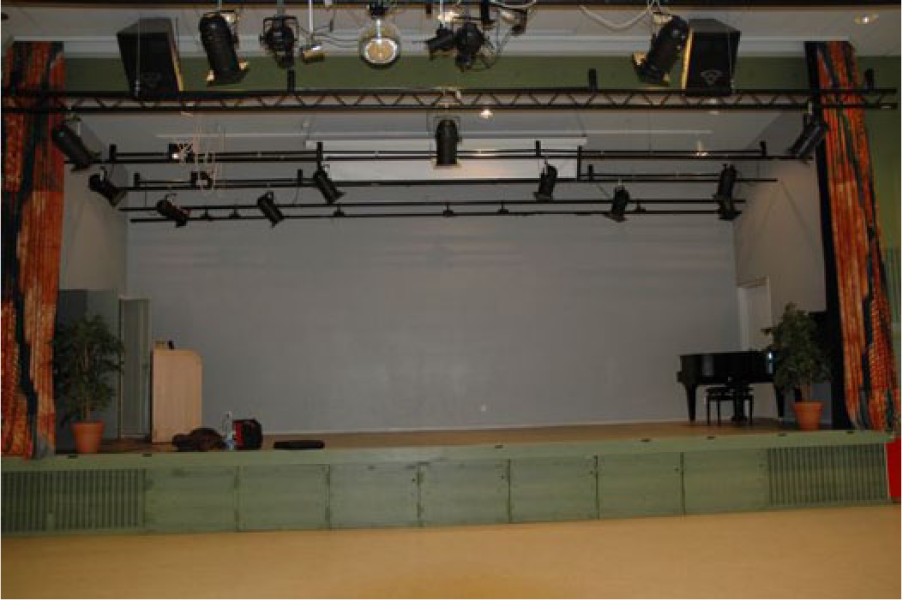
Wall in Red Cross premises, Husby.
It is at this point that AB and I became aware of an additional qualification that was attached to the ‘immigrant youth’ category. More accurately, the meaning was associated with the combination ‘immigrant youth + painting in the public space’. It was a quality that we would have to work to detach if FiC was to stay in being. Namely, graffiti. Or rather, ‘wall scribbles’, as they are called in Sweden. Svenska Bostäder, as well as other wall owners and established actors that I had been talking with (from the City of Stockholm to the Traffic Agency which owned walls along streets and bridges), closely connected ‘immigrant youth + painting in the public space’ with wall scribbles, vandalization of public space and citizen insecurity.
The public nature of community murals evoked a variety of meanings among established actors. Some worked in favour of the social venture: mural art in the urban space had interested the Royal College of Art and acted as a force for its enrolment. Others were working to its detriment: graffiti was radically condemned by property owners, feeding on the stigma imposed on those classified as ‘youth from the [immigrant] suburbs’. We were granted the wall thanks, only, to the association of the eventual community mural with the Red Cross. The cross-sectoral collaboration that had been made possible through tinkering with the semiotic aspects attached to Husby was now serving us to gain access to necessary material resources.
Foundations
Thus far, the social entrepreneurial initiative was a bundle of stated collaborations, frustrations over the Swedish integration debate, desires to change conservative organizational cultures, and dreams to develop mural art in Sweden. It encountered fears of vandalism on public walls, concerns for reproducing power relations structured along ethnicity, desires to open the world of the school, and lack of funding. The suburbs became host to an attractive multicultural non-middle-class youth, to inviting urban walls, to potential local communities. This set of meanings, images and associations, however, amounted to very little without economic capital that could give those agreements, dreams and qualifications a more material, and thus stable, existence. Semiotics and cross-sectoral associations needed funds if we were to carve spaces for political engagement. For this purpose, among others I approached the Swedish Inheritance Fund. The Fund aims to
support civil society associations and other non-profit organizations that want to test new ideas to develop activities for children, youngsters and people with disabilities in their own terms. … The goal is to develop welfare, quality of life, participation, equality of rights and opportunities as well as contribute to social, ethnic and cultural integration.
Our ideas matched well those of the Fund: we were a civil society organization introducing a novel idea – collective mural art – in Sweden to increase youth participation in the public space. Yet, the Fund also emphasized a quality we had purposely avoided thus far: an explicit reference to ‘ethnic and cultural integration’. Relating to ethnic integration, we felt, directly played on the division between Swedes and non-Swedes that the initiative aimed to requalify. That is, the initiative would have to qualify its target group as ‘immigrant’, segregated along ethnic lines, once more making them interesting by virtue of their ethnic otherness. For the initiative to be deemed worth funding, ethnicity would have to be reenacted, reminding us of the practical difficulties and the semiotic paradox implicit in processes of organizing to overcome stigma. That is, our efforts at requalifying the suburb and its residents were constrained by institutional demands on (and financial hurdles of) local social ventures imposed by major funders which need to account for the social benefit of their investments in terms of advancing (ethnic) integration.
To answer such financial and institutional constraints we adapted our application to the demands of the foundation and introduced it with a story of the frustration felt by Husby’s young residents at always being qualified by others as ‘immigrant’. We described this not as a problem of lack of ethnic integration, but as one of a dominant stigma that did not allow space to the voices of those so stigmatized. Once more, we tinkered with categories, requalifying what the foundation saw as a problem of integration into one of deficient participation in the public debate. Further, this semiotic practice also moved the onus for the social challenge from those that are seen as non-integrated towards the stigmatizing practices of dominant society. That is, to adapt the text to the constraints of the foundation while nonetheless maintaining the reformulation of the problem along class lines, we tinkered with the categories and qualities used to describe the target group.
Application for funding
In early spring 2009, I wrote an application for funding to the Swedish Inheritance Fund. It sought funding for a first pilot project through which to ‘investigat[e] the interest among the youth, develop work methods and engage partners’. The arguments deployed in that text referred to the actors already engaged as well as to the variety of qualities rearticulated thus far. In a sense, the application was the textual materialization of the process of requalification of the neighbourhood we had started. It also materialized collaboration agreements we had reached thus far. Accordingly, the application can be understood as a textual practice to give temporary stability to the qualification and cross-sectoral collaborative practices that made up the organizing process of the nascent social venture.
Concerning the actors, the application emphasized both our connection to the Royal College of Art and the art workshops to be held at the College with young residents of the suburb. The involvement of one class from the Husby School was also central to the proposal, given the fund’s focus on youth involvement. Formally, FiC’s pilot project was to be conducted as a Red Cross project. Further, the application stressed my affiliation to the Copenhagen Business School and close collaboration with the Stockholm School of Economics. The list of actors not only showed the broad associations of the initiative. Building on those actors’ reputation, the text translated their status into a sign of the initiative-to-be’s seriousness and quality, granting an institutional recognition to the initiative that we hoped could eventually transcend into a new geographical imagery of the stigmatized suburbs.
The arguments themselves, in that text, were intended to begin rearticulating the qualities commonly attached to the suburbs and its residents. Accordingly, the ‘walls of the suburbs’ were transformed into ‘a platform where the youth can express their identities, their everyday concerns and their dreams for the future’; ‘the young residents of the suburbs’ became active ‘actors in decisions concerning the public space in the suburbs’ and were to be appreciated for ‘bringing new ideas into urban art and city life’.
Another attempt to start requalifying the suburbs in the application was the explicit avoidance of the term ‘immigrant’ throughout the text. In the seven pages long application, the term ‘immigrant’ appears once, and then, it is part of a quote from a young resident of the suburbs in the ‘Background’ section. The quote is used to exemplify residents’ feelings of outsiderness, resignation and lack of sense of belonging connected to living in a stigmatized suburb. That is, it is used to illustrate the dissolution of place, the spatial alienation resulting from territorial stigmatization (Wacquant, 2007), and thus to stress the need to rearticulate the meanings granted to the ‘immigrant’ category that so qualifies those suburbs. Instead, the terms used throughout the application to describe the target group and its residential area were ‘youth living in socioeconomically vulnerable areas’, ‘suburban areas’, or ‘the youth of the suburbs’.
In other words, the application was the textual materialization of the network of heterogeneous actors that had been enrolled throughout the social entrepreneurial process. It was, too, testimony to the wide set of qualities and meanings rearticulated throughout the organizing process thus far. Finally, the application gave form to a geographical imaginary we were all putting together.
Findings 2: Reproducing Stigmatizing Practices
Hitherto, the article reveals the socio-spatial practices we engaged in to reconfigure stigmatized space: finding arguments to requalify the vulnerability of the group being addressed into an attractive quality to be sought by other actors; articulating a new geographic imaginary that engaged actors into action; mobilizing interests and stakes that could restructure the terrain of debate on the vulnerable suburbs; and associating with actors that could contribute with their reputation to the reformulation of the immigrant youth. Our ability to participate in these practices and organize for social change depended on the quality of our networks and the recognition granted to us. We used our social positions as a social researcher (me), a nonprofit organization manager (AB), and a recognized art institution (College of Art) to requalify Husby and its stigmatized dwellers.
Yet, in doing this, we also performed violence on those whose voice FiC aimed to empower. Throughout the entrepreneurial process, we had become part of the stigmatizing practices that reproduce the social reality we aimed to requalify. We had been caught in the productive force of a network of actors and actions that positions and authorizes us and our texts to speak in the name of the suburbs and its residents, but that does not concede the same authority to those voices themselves. The conflict concerning the film on the community process to be shown during the inauguration of the mural and its eventual resolution may serve as an illustration.
Having gained seed funding for the pilot project in late spring 2009, during the fall of that year we carried out our first community-based mural in the premises of the Red Cross in Husby. Young residents had participated through a variety of workshops, many of which had been filmed for the purpose of documentation. As preparation for the inauguration of the mural for public officials, partners and residents, the person in charge of video-documentation prepared a film of the process. A 24-minutes long heated conversation between the youngsters made it to the film as it ‘lifted many of the important questions showing how the youth feels’. In it, five young men, the artistic leader and myself discussed the anger the youngsters felt at being often referred to as ‘immigrants’ and prompted in the streets to ‘go back to your own country’. They despaired on how to cope with such situations. To the artist’s and my suggestion to not let others decide what categories to use to define oneself but to instead use the Swede category to identify oneself if we so pleased, they reacted with indignation. ‘Traitors!’ they shouted and endorsed the ‘immigrant’ tag.
The video showed the anguished relationship between a particular system of classification – ‘immigrant’ vs. ‘Swede’ – and the people stigmatized by it. The artist, the film-maker and I wanted to show it as part of the opening ceremony, to raise the voices and concerns of the youth. Yet AB adamantly vetoed it: ‘The content is too politically loaded and the Red Cross can’t stand behind it.’ For the sake of continued collaboration, which we still needed to secure future walls, we adapted to her request to edit the film anew.
These youth’s voices did not make it into the film. And although others did indeed make it to the final mural, their political implications were sanitized through the symbols used to represent them. For instance, their identity hesitations were captured by a big question mark on top of a band-roll with the word ‘identities’ in it; their pride in their cultural and religious distinction was symbolized by a roaring lion; and the constraining demands they felt from Swedish society were depicted as a pointing finger in the blue and yellow colours of the Swedish flag (Figure 2).

Final mural.
Their voices were included, and so we could still present the mural’s motif as grounded in a community process. Yet, the political strength of their voices had been compromised. In so doing, we replicated the socio-spatial practices that stigmatized the neighbourhood. ANT’s concept of translation helps us to understand our inability to escape the socio-spatial practices we aimed to transform. For Callon and Latour, translation refers to all sorts of means by which an actor accepts the authority to be a spokesman for another actor; it refers to the chain of actors and micro-situations that enacts social divisions and effects social hierarchy. Translation consists of:
all the negotiations, intrigues, calculations, acts of persuasion and violence, thanks to which an actor or force takes, or causes to be conferred on itself authority to speak or act on behalf of another actor or force. (Callon & Latour, 1981, p. 279)
Although looking for a new vocabulary, despite our attempts to elicit the heterogeneous realities hidden by the objectifying ‘immigrant’ category, our efforts to associate new actors to the suburb notwithstanding, my colleagues and I are part of the networks that reproduce territorial stigmatization: the academic field, the nonprofit sector and the field of established art. Furthermore, the continuous negotiations, calculations and acts of persuasion necessary to build FiC and gain funding conferred on us authority to speak on behalf of the (objectified) immigrant. That is, the successive enrolment of well-established actors into the actor-network FiC positions FiC as spokesagent of the immigrant other. Thus, the series of translations leading to FiC also entangled us further into the mechanisms productive of stigmatized space. And yet, as Wacquant argues, ‘only an immense, specifically political work of aggregation and representation … can hope to enable … [the territorially stigmatized] to accede to collective existence and thus to collective action’ (Wacquant, 2007). But the ‘political work of aggregation and representation’ that the social venture was organizing was embedded in the very stigmatizing socio-spatial networks that it aimed at transforming. Our move proved successful, however. At the inaugural ceremony both partners and young residents asked for more mural processes, and the foundation asked us to submit yet another application. Indeed, three months later, we gained substantial funding for the following three years.
Discussion
The article suggests that the study of social entrepreneuring processes may offer a response to recent calls to bring social and political relevance back to organization studies (Courpasson, 2013). It does so in three ways. First, studies of the processes of organizing nascent social ventures remind us of the need to ground studies in an appreciation of the embeddedness of organizing processes in their local socioeconomic and historical contexts (Dacin et al., 2011; Newth & Woods, 2014). Second, such studies are starting to emphasize the collaborative nature of the work required in processes of organizing nascent social ventures (Montgomery et al., 2012), thus reminding us that organizational agency is a collective endeavour. And third, building on the notion of entrepreneurship as the process of reorganizing resources to create innovative solutions (Swedberg, 2006), social entrepreneurship studies indicate the social and political mileage in such organizing processes (Chell et al., 2010).
In this vein, the article applies an ANT-inspired approach to follow the organizational practices carried out by a nascent social venture as it sets to mobilize stakeholders, bring about collaboration and ultimately gain necessary resources. In so doing, the unit of analysis is neither an organization proper nor the individual entrepreneur, nor the impact (social or otherwise) of the venture. Rather, focus is on the practices to enact collaboration (and the social venture with it) as well as the political implications of such organizational practices.
More specifically, the article uses Callon’s notion of qualification to theorize the process of associating (and dissociating) qualities to the nascent social venture. This allows me to trace the unfolding of new organizational possibilities which results from arranging collaborations and spaces anew (Bingham & Thrift, 2000). Hence, the article proceeds by describing some of the socio-spatial practices used to define the social venture and bring about cross-sectoral collaboration. Drawing upon empirical material generated during the first year of FiC, a social venture I founded and still chair, the article highlights the adaptive and fluid nature of the organizational practices involved in the process that goes from a vague venture idea to securing funding. These findings challenge mainstream organization and entrepreneurship research that emphasize strategy and business plans as ways to start organizing nascent ventures (for a more thorough critique, see Chia & Holt, 2011). Instead, findings indicate that the capacity to continuously adjust the qualities of the eventual venture to the stakes of potential partners is instrumental to organizing cross-sectoral collaborations and starting up the venture. Further, findings highlight the political bearing of the categories and arguments building up around the social venture and the venture’s relentless effort to navigate those arguments and requalify those categories. To underscore the fluidity, the ongoing and piecemeal everyday work involved in adapting qualities and requalifying categories to the interests of potential partners that is part of such organizing processes, the article suggests the notion of tinkering.
Tinkering practices involved three socio-spatial dimensions. First, the semiotic dimension: categories were reformulated, arguments adapted to the interests and stakes of the partners, and a new geographic imagery that engaged actors into action was articulated. Tinkering with the semiotic elements consisted in requalifying the stigmatized neighbourhood while attuning the emerging qualification to the eventual partners. Second, the cross-sectoral/social dimension: meeting and bringing a heterogeneity of partners on board, connecting distant groups and institutions to the suburb, and enrolling actors previously unrelated to the neighbourhood. Tinkering with the social aspects consisted in weaving new relations into the suburb. Note that to do this, aspects external to the neighbourhood itself had to be integrated into the emerging requalification of the suburb; namely, traits – such as an actor’s status – and stakes – such as organizational objectives and personal ambitions – of the actors successively enrolled into the initiative. Third, the material dimension: walls, texts, painted murals and eventually long-term funding successively provided a growing degree of stability to the social venture. Tinkering with the material elements consisted in crafting evidence that formally committed partners in a particular direction. Table 1 summarizes the various tinkering practices the social venture engaged in during its first one and a half years.
Table to be inserted in discussion section.
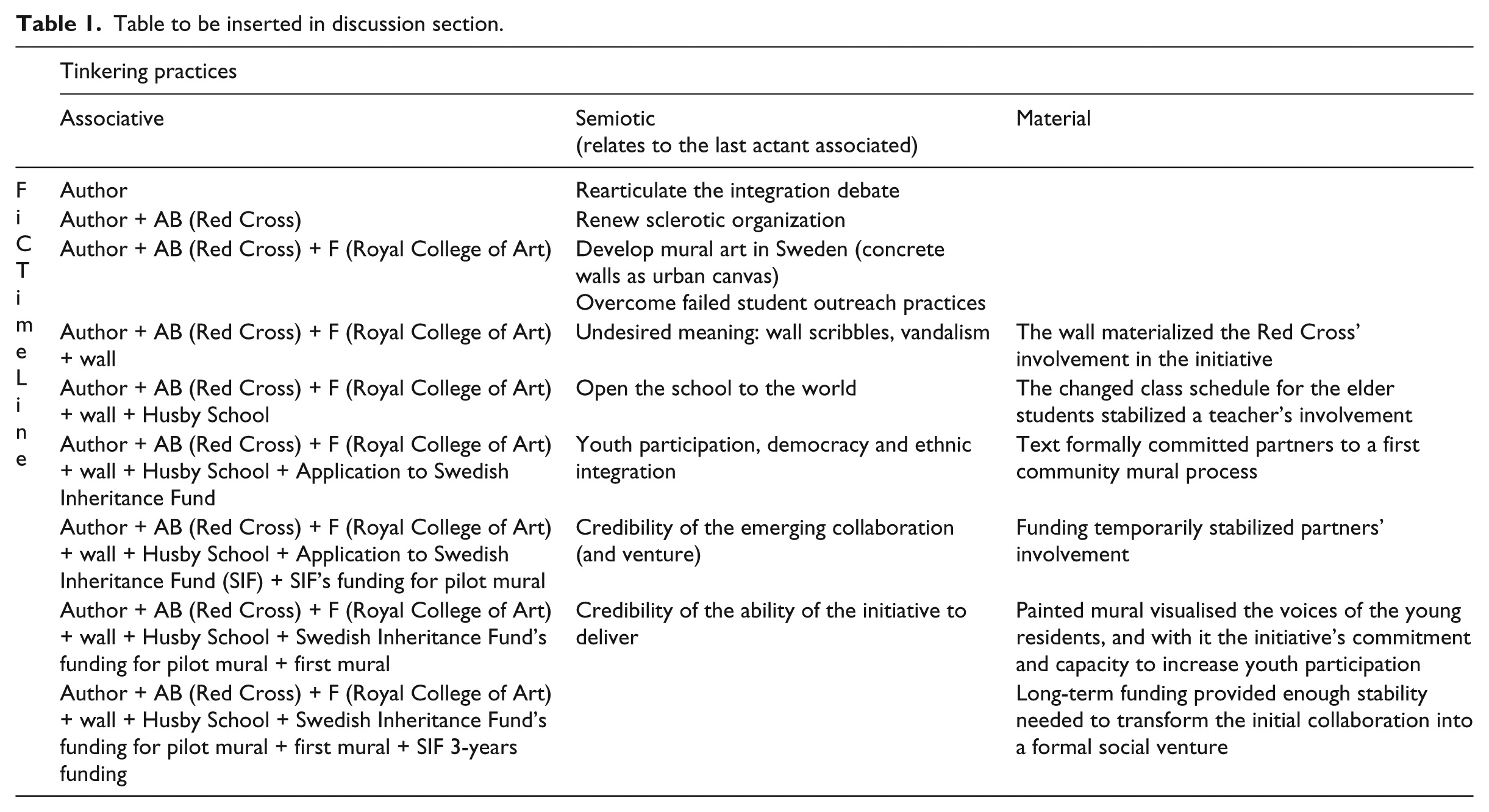
Summing up, the entrepreneurial process of organizing for social change focused on rearranging and tinkering with the semiotic, social and material elements that made up the stigmatized space that the venture aimed to change. Put differently, the social venture embarked on a process of reassembling the social piecemeal, crafting the material order and rearticulating the semiotic order that constituted the reality to be changed.
The study presented here, thus, complements and further develops the insights coming from the field of social entrepreneurship. The article acknowledges the collaborative nature of entrepreneurial processes observed by scholars, and pushes this lesson further to include non-human elements – such as categories, arguments, texts, schedules, walls and funding – in that collaborative work. It then identifies tinkering as a set of practices pivotal to putting together and organizing such assemblages. More particularly, tinkering involved rearticulating categories and images anew, adapting to the stakes of potential partners, reworking schedules, and crafting walls. It required requalifying the target group to be addressed, rearranging the actors associated with the neighbourhood, and rehearsing the arguments to be deployed in the effort to overcome the territorial stigma burdening the suburb and its dwellers. That is, tinkering consisted in organizing the semiotic, social and material elements that eventually would constitute the social venture. In other words, the social entrepreneurial process can be conceived as the process of tinkering with socio-material relations because, if the social is made of relations, then changing the social necessarily requires tinkering with those relations.
Political relevance
Insignificant as tinkering practices to reconfigure space and organize a nascent social venture may seem, they do have challenging political implications. Analysis of the empirical material highlighted the performative violence that social entrepreneurial initiatives (and us researchers with them) risk exerting on their target groups. In the case of FiC, and regardless of how well anchored in the community it may be, the social entrepreneurial venture is bound to reproduce the stigma that is also its impulse. As it enrolled an ever larger network of actors, FiC (and with it my colleagues and I) were recognized as spokesagents of the suburbs and its residents (although none of us lived there). This entailed first, a positional distance to the communities we represented; and second, an imposition of our particular principles of vision and division. That is, FiC played on the recognition granted to us to levy on the neighbourhood our ‘fiction of the possible’ – ‘ambiguous, performative and preliminary reorderings of what can be perceived, expressed and done’ (Beyes, 2015).
Certainly, we were in continuous dialogue with the people we represented and, hopefully, attuned to the effects of our principles of vision as experienced by the subordinated. Yet, at the end of the day, our own positional dispositions articulated a representation of the neighbourhood and its residents to agree to the stakes of those occupying homologous (dominant) positions to ours. And so, their stakes (those of the dominant) came to shape FiC and the arguments it presented in its final application to the Swedish Inheritance Fund.
This is the paradoxical position that traps social entrepreneurial initiatives as well as engaged scholars. FiC accepted the stigmatized suburbs as ‘places of the possible’, places that ‘contain the floating and dispersed elements of the possible, but not the power which could assemble them’ (Lefebvre, 1996, p. 156). While the recognition granted to actors occupying higher positions in the social space (the scholar, the professional nonprofit manager, the recognized artist) made it possible to assemble the latent potential hiding in these derided places, the same recognition granted to us also reproduced residents’ subordination. Becoming (through FiC) the spokesagent for the suburbs implied objectifying and unifying the many voices within that community, and brought us back to performing the very performative violence we aimed to avoid. Blomley’s question – ‘How can we contribute to and learn from progressive struggles without reinforcing the hierarchies of privilege, silencing those with whom we work?’ (Blomley, 1994, p. 31) – remains unanswered.
There might be solace in Judith Butler’s words: ‘social transformation occurs not merely by rallying mass numbers in favour of a cause, but precisely through the ways in which daily social relations are rearticulated, and new conceptual horizons opened up by anomalous or subversive practices’ (Butler, 2000, p. 14). The subversive practices in which FiC engages imply rearticulating the social relations enforced by the categories it aims to requalify (‘immigrant’, ‘Swede’). Thus, along the way it establishes relations between groups that otherwise would never meet, such as the students of the Royal College of Art and those of the Husby School. Overcoming territorial stigma, the initiative seems to propose, goes both through reformulating the categories we use to perceive space and through dislocating the relations at the origin of those categories. The first effort struggles to avoid the unifying effects of the category (‘immigrant’). The second strives to restructure the relations perpetuating those categories. Thus, although caught in the assemblages of territorial stigma, FiC may still be able to open new conceptual horizons and rearticulate the networks that Butler suggests are conducive to social change.
The very nature of engaged scholarship makes it difficult to generalize to social entrepreneurial processes in other places and committed to other challenges. Future research needs to address this and see if tinkering practices to reconfigure space also emerge in ventures that do not explicitly address the stigma attached to particular spaces. This exploratory study has however pointed out the relevance of tinkering practices for social entrepreneurial processes and highlighted the political implications of enacting a social venture as spokesagent of a vulnerable group. Future research needs to look further into other social entrepreneuring processes taking on different social challenges.
Footnotes
Acknowledgements
I would like to thank Åsa Beckius for her time and support during the project described in this article. I would also like to thank the anonymous referees for careful readings and insightful comments and suggestions on several drafts of this article.
Funding
This research received no specific grant from any funding agency in the public, commercial, or not-for-profit sectors.