



Abstract
Online communities have displaced or become complements to organizations such as churches, labor unions and political groups which have traditionally been at the center of collective action. Yet, despite their growing influence and support of faster, cheaper and more flexible organizing, few empirical studies address how online communities are built and become enduring agents of social change. Using Internet-based ethnographic methods, this inductive field study examines how an online community called Anonymous transitioned from being a small gathering of contributors focused on recreation to becoming a community of trolls, activists and hackers incubating myriad projects. Findings reveal that the interplay of digital technology and a culture of transgression supported experimentation that culminated with the adoption of a resilient organizing platform that enabled several community factions to coexist in continuous engagement. This paper infuses community building research with an important emphasis on the role of the techno-cultural, highlighting how online formation and maintenance processes are shaped and shape mutually contingent technologies and cultures.
Over the past two decades, organization scholars have attended to the important role communities play in both upholding social orders and inciting change (e.g., Rao & Dutta, 2012; Taylor & Whittier, 1992). Communities develop through involvement in increasingly challenging interactions, adapting to fluctuating pressures that reveal capabilities and shape shared resolutions. As they undergo a process of becoming, scholars have found that some communities may strengthen commitment to a common cause and solidify the means through which they might realize it, while others who fail to garner resources and a dedicated contributor base falter and disperse (Cohen, 2013; Speer & Hughey, 1995). With the advent of the Internet, however, paths to sustainable community engagement have been transformed and prompted scholars and organizers to seek out new community building models (Earl & Kimport, 2011).
Several empirical studies have captured how communities coalesce by marshalling the resources and persistent dedication that sustain engagement (Chen, 2009; Simon & Klandermans, 2001). Johnston (1991), for instance, describes how communities immersed in an outlawed Catalan culture and incensed by atrocities grew into a resistance primed to undermine the authoritarian regime of General Franco. Gould (1991) shows how the uprising against upper classes in the Paris Commune in 1871 was driven, in part, by inequity experienced by oppressed neighborhoods populated by the lower classes and eventually merged into a unified movement. In his study of the emergence of the civil rights movement, Morris (1986) examines how communities were tied together by a sense of injustice that placed members of black churches at the center of discourse on equal rights. Recently, Rao and Dutta (2012) used the case of regimental mutinies of the Bengal native army to elucidate several precursors of sustained community engagement: the availability of “free spaces” where individuals could gather, the ability to attract large numbers of committed contributors, the arousal of intense emotion, and the triggering of collective identities.
Although these historical case studies remain useful and generative, they precede and, therefore, do not account for changes to key dimensions of organizing that have been made possible by the advent of the Internet. Studies of online community organizing (e.g., Faraj, Jarvenpaa, & Majchrzak, 2011; O’Mahony & Ferraro, 2007; Ren, Kraut, & Kiesler, 2007) have not examined how communities take shape from their founding and, consequently, how the affordances of an online environment and the cultural elements that exist online influence community building processes writ large. We know that the Internet has enabled changes to how individuals interact with each other and form communities, calling many of the assumptions guiding organizers in the past into question (Earl & Kimport, 2011). For instance, Internet-based technologies make interactions necessary for community building less expensive and collective action faster to mobilize. Malleable personal identifiers, permeable boundaries to participation, and greater choice in how and when individuals interact are all part and parcel of the Internet age (Bimber, 2003). While physical engagements and relationships that characterized offline communities were lengthy and deeply rooted, online social ties may be ephemeral and interactions increasingly transitory as individuals hop from website to website following the latest cause célèbre (Wellman et al., 2003). When considered in tandem, these distinctions enable online communities, because they are qualitatively different from their historically relevant counterparts, to demand new research into how the building and maintenance of community takes place.
To address this gap, I conducted an inductive field study of the Anonymous online community—a collective of Internet trolls, hackers and pranksters best known for their transgressive hijinks and for supporting high-profile social change efforts over the past decade (e.g., Wikileaks, Arab Spring, Occupy Wall Street). Anonymous has been described as “an internet gathering” with “a very loose and decentralized command structure that operates on ideas rather than directives” (Kelly, 2012) and has become a community in which a “sea of voices, all experimenting with new ways of being in the world” (Norton, 2012), weigh in on a range of global conflicts and social issues. I capture Anonymous’s transition from a recreational community to one that, through engagement in increasingly ambitious projects and experimentation with ways of organizing, became an enduring assembly of tricksters and activists.
Findings illustrate how a process characterized by the continuous interplay of digital technology and a culture of transgression advanced or stifled the building of a sustainable online community. The process culminated with the adoption of an organizing platform that, by allowing diverse factions within the community to coexist and continuously contribute to several projects, made the community increasingly resilient to fluctuations in contributions and schisms. The study casts light on online communities as dynamic, emergent social actors beset by unique constraints and affordances and contributes to theories of community building by showing how the Internet can give rise to novel paths to sustained community.
Building and Sustaining Community on the Internet
Organization scholars have examined the community building process from a variety of perspectives. Many focus on how communities garner material resources and attract contributors (e.g., Hunter & Staggenborg, 1986; Zimmer & Aldrich, 1987). Some capture the construction of a shared collective identity and a growing sense of self-efficacy (Cohen, 2013; Taylor & Whittier, 1992). Others focus on the extent to which members come to pursue a shared purpose—defined as an orientation that guides actions and activities undertaken in pursuit of an objective (Rosenblueth, Wiener, & Bigelow, 1943). In this paper, I focus on community building as a process by which social groups progressively achieve a sense of shared collective identity and ensure the sustainable enactment of a shared purpose. I build on the work of scholars who have examined community building longitudinally (e.g., Chen, 2009; Morris, 1986) and who view the process holistically—as the building of a following, material resources and the enactment of shared purpose.
Distinguishing online and offline community
Scholars have begun to capture the various ways in which online communities leverage technologies to enable collective action (Earl & Kimport, 2011). As electronic communications have advanced, they have made it possible for communities to overcome time and distance constraints which stood as barriers limiting who contributes to community activities (Castells, 2003, Fulk & DeSanctis, 1995). Rich webs of interaction have proliferated on the Internet, allowing individuals to form strong bonds that support the spread of ideas and enabling those who with limited local influence to obtain global reach. The widespread view that the Internet was an impoverished source of relationships lacking a “human element” (Kozinets, 2009) was countered with empirical studies that revealed that online interactions are not only multifaceted, but rich in cues, content and culture (see Hine, 2000 for a review). Increased interconnectivity (i.e., the ability to reach out to anyone at any time) and interactivity (i.e., the ability to interface with others in ways that simulate real-world conditions) made distance a less onerous obstacle to communication, leading to a change in networks of relationships, boundaries within and between communities, and other dimensions that enrich social life.
Empirical studies have captured myriad differences between traditional, offline communities and their online, digitally-native counterparts. First, studies have noted that a shared, physical location is not inherently vital to meaningful interactions that support community building (Earl & Kimport, 2011). People in online communities “can be considered to be members of the same symbolic community, even if they have never met in person or lived in the same country” because they share cyberspace (Calhoun 1991, p. 108). In fact, metaphors related to “space” have been used to understand the connections that sustain online community by scholar and practitioners alike. Gieryn (2000, p. 465) notes that “it is fascinating to watch geography and architecture become the means through which cyberspace is reckoned by designers and users.” Second, markedly different social and symbolic boundaries from the well-delineated boundaries of physical communities have allowed individuals to turn their attention to and become embedded in different specialized online networks. Instead of engaging and becoming socialized by a single community with distinctive social norms, people increasingly operate in a number of specialized online communities that rarely seize their undivided attention or require exclusive commitment (Wellman et al., 2003). As such, online communities’ boundaries tend to be more permeable—individuals come together in community and disperse more often, contributing as much or as little as they would like to multiple communities and carrying norms from one community to another. Because these individuals can navigate between several communities in minutes, they can belong to and influence multiple, partial communities and polities. Third, communications-related developments have greatly influenced the nature of interactions. Increasing speed of interconnection shortens the effective social distance between individuals that may have otherwise not have met or interacted very often. The coordination of both work and play through varied communications channels by globally dispersed actors has become an accepted way to organize. Finally, in online communities, selves become more malleable: individuals can adopt new names, and create alternative identities or misrepresent their “true” selves in the physical world. Scholars have gone so far as to suggest that individuals engaged in interactions on the Internet gain the ability to become “disembodied,” i.e., they can create alternative identities unbounded by physical constraints or social boundaries (e.g., race, social class). To put it another way, online identities are oftentimes not authentic, but performative.
Although most studies focus on technology as the key differentiator between the types of activities taking place on the Internet, cultural elements that exist online ranging from behavioral norms to rituals and language are, in many cases, markedly different from those that appear offline. Scholars studying the intersection of culture and technology, for instance, note that digital technologies and norms, within and outside the Internet, are entwined with and integral to social processes, continuously shaping and being shaped by social actors (Leonardi & Barley, 2008; Orlikowski & Scott, 2008). Given the importance of both technological and cultural affordances and encumbrances to social life, the introduction and widespread adoption of the Internet and the myriad tools it provides requires research attention, particularly with regard to community building processes. For instance, Jordan and Taylor (2004) study forms of resistance to neoliberal globalization where participants adopted digital tools and relied on online forums to mobilize online community members. They do not examine, however, how the communities first became engaged with the cause and adopted relevant cultural elements that stoked continued engagement with the cause. Bennett and Fielding (1999) have studied how online communities and mobile social media have enabled “flash activism,” a new, ephemeral form of activism wherein organizers no longer need to cultivate the ongoing allegiance of participants and can instead mobilize in rapid, low-cost ways. Yet, they did not track how contributors to flash activism first became interested and engaged in the pursuit of a cause and how that process led to the building of an enduring community contributing consistently to address injustices. In short, although they comprise the new “building blocks of social movements and revolutions” (McAdam, McCarthy, & Zald, 1996, p. 3), we know little about how online communities come into being, how they become enduring agents of change, and why their process of becoming is different from what is experienced in offline communities.
Constructing community online: From formation to sustainability
Many studies of communities capture them empirically when they have already adopted a stable, explicitly stated purpose—i.e., when a community has already found answers to “what are we here for?”—and become a stable manifestation of that purpose. Terms such as “community of interest,” “community of practice,” “elective community” or “intentional community,” for instance, describe collectives with memberships, rules and norms that already share and enact a framework of understandings based on a guiding, shared purpose (Wenger, 1999). In these established communities, contributor activities include safeguarding the community’s continued existence, assuring the continued well-being of contributors, and maintaining an already internalized shared purpose, rather than activities that give a community form and function (Chen, 2009; Cohen, 2013).
The community building process takes root, nevertheless, at the instant a community is conceived. The initial imprint made by founders reflects the cultural and technological conditions that characterize a particular place in time (Stinchcombe, 1965) and frequently serves as guidepost, steering ensuing activity. The norms, rules and economic conditions that comprise the broader social environment of communities can become embedded and produce myriad changes over time. Johnson (2002) shows for instance how the artistic and political conditions in France during the creation of the Paris Opera House structured a community’s character and trajectory. At the same time, communities are in a constant state of “becoming” and can be conceived of as highly fluid, dynamic entities (Cohen, 2013). Marquis and Tilcsik (2013) have noted that they can experience several “sensitive periods” when the elements of an initial imprint, such as technologies and norms, can become susceptible to change. For instance, an influx of new transplants to New Orleans following hurricane Katrina changed many norms and power relationships that characterized the community before the storm. Following the devastation and exodus of a large part of the population, New Orleans found itself susceptible to the influence of aid organizations and new residents that introduced new, nontraditional ways of doing things (Gotham, 2008). Chen’s (2009) study of the “Burning Man” community illustrates community building by describing how a community that began as a group of friends burning effigies on a beach for recreation became a large-scale, activist community that expounds ideals of free expression and self-sufficiency. Burning Man became an “empowering organization”—that is, one in which members could reliably pursue multiple forms of professional, emotional and communal gratification.
Comprehensive, contemporaneous studies of community building are still few and far between, perhaps because of complexity inherent in tracking a community from its inception to when it becomes recognizable as a cohesive, stable social actor. This gap is even more pressing when considering online communities, despite how central they have become to social life. In short, even though entities ranging from protest groups to entrepreneurial ventures now emerge out of online communities or possess a major online component (Duggan et al., 2014), we understand little about why and how digitally native, online communities become established. I ask: How are online communities built and how do they become sustainable?
Methodology
To examine the establishment of an online community, I use an inductive, qualitative approach and draw on Internet-based, ethnographic methods. Both offline and online forms of ethnography are typically characterized by an immersive, prolonged engagement with communities, followed by an attempt to understand and convey their reality through “thick” description (Denzin & Lincoln, 2005). They are particularly well-suited to new, emergent, or poorly understood phenomena since they allow room for unforeseen findings and leeway for researchers seeking understanding through the eyes of a culturally distinct community (Hammersley & Atkinson, 2007). Online ethnographers adapt to the unique contingencies of computer-mediated interactions, which include but are not limited to the use of pseudonyms and alternate selves, the ephemerality of communications (Bernstein et al., 2011), as well as the physical distance between the researcher and the community of interest (Ward, 2001).
Research context
To select an appropriate site for the study of online community construction, I identified several online forums where contributors were actively engaged in seeking or discussing steps for community development and proposing activities that might be indicative of attempts to build community around a shared purpose. Preliminary selections were based on mentions in online and traditional publications that reported and cataloged online community activities (e.g., Wired magazine, Gawker.com). Following Kozinets (2009), sites chosen for observation had: research question relevant content; high “traffic” of postings; large numbers of discrete message posters; detailed or descriptively rich data; and a wide variety of between-member interactions. Over several weeks, 4chan (as the initial field site) and Anonymous (the community) emerged as the best fit for these criteria.
4chan was created in October 2003 by Christopher Poole, who was a teen-aged programmer and active contributor to several online communities and discussion boards. He envisioned 4chan as a place where he and other Japanese animation aficionados could trade images and discuss their favorite shows and comic books without constraints placed on contributions and reputational politics he had observed in other online communities (Poole, 2010). 4chan was designed as an unrestricted and minimally moderated website that did not require identifying information for participation. To prevent the aggregation of reputation, the use of permanent pseudonyms was also discouraged. This permissive forum would soon attract individuals seeking a place where they could exchange lewd images and plan elaborate pranks that challenged the boundaries of propriety. These “tricksters” (Coleman, 2014) called themselves “Anonymous” after the default username given to anyone posting on 4chan. While the moniker was first adopted by contributors to 4chan’s /b forum (an imageboard designed for the posting of images that did not fit other categories), what is now known as the Anonymous online community has expanded its scope of activities to include not only uncouth forms of recreation, but also political protest. Anonymous’ work has captured the attention of the media and helped launch large-scale social change efforts such as Occupy Wall Street, the Arab Spring, and Wikileaks.
Anonymous has lacked a visible hierarchical structure or formal leaders, instead relying on individuals to contribute to online discussions of their own volition and without any clear form of public acknowledgment. The media have referred to Anonymous as a collective consciousness manifest (Landers, 2008), and a legion of loosely connected individuals wasting massive amounts of time (Dibbell, 2009). Law enforcement has called Anonymous “a loose confederation of computer hackers and others”. 1 I purposefully selected Anonymous because it offered communicative acts that were sophisticated and transparent enough for the extrapolation of factors leading to and sustaining community (Patton, 1990). It qualifies as an “extreme case” (Eisenhardt, 1989), where the rich information necessary to examine the building of online community was not only accessible to outside observers, but distinct from those offered by any other cases considered for study.
Data collection
Before beginning data collection, I took steps meant to increase my acuity as a researcher and develop a less naïve understanding of the Anonymous community (Hammersley & Atkinson, 2007). I observed the rapidly changing and expanding selection of websites that became identified with the Anonymous moniker. As I became more comfortable with the online environment and developed a cursory knowledge of relevant contribution norms, I began taking field notes of interactions and content relevant to the role cultural elements and technologies might play in the constitution of the community. This observation period gave me the tools that would help me distinguish between “noise” and relevant data and, subsequently, to identify sites where individuals were interacting in meaningful ways. Importantly, I was not a “participant observer” (Spradley, 1979) or contributor to activities, choosing instead to “lurk,” or passively observe various forums as I became more familiar with my research context and field site (see Langer & Beckman, 2005).
Data was gathered in various forms starting contemporaneously in January 2008 and retrospectively for prior years. The main source of data were the computer-mediated communications, such as forum postings, chat logs, images and videos, produced by contributors to Anonymous (n = 1157 threads and chat logs containing at least 10 comments each and n = 167 images). I spent at least 10 hours per week surfing websites and researching artifacts such as viral videos, memes, argot and pranks (January 2008 to February 2011). I adjusted observation time depending on whether events would trigger additional contributions by visitors to key sites. Field notes inscribed regarding observations of the community and its contributors, interactions, and meanings (n = 46 pages with approximately 200 words per page) allowed me to keep track of observations. The notes helped me interpret data during the analysis phase by giving the computer-mediated communications a broader context and by capturing how all the data sources I was collecting made sense together. I used external media to supplement my own interpretations of ongoing events and postings and to understand the media environment to which Anonymous contributors were exposed. I searched Lexis-Nexis for articles related to the Anonymous community, 4chan and other Anonymous-frequented sites appearing in traditional news outlets (e.g., national and local newspapers in the United States and abroad), web publications (including e-zines and blogs), and on television (by conducting a search of available transcripts). False positives that contained references to “Anonymous” in uppercase or “anonymous” in lowercase but did not refer to the community were eliminated. Out of a total of 1683 articles, 178 fit the aforementioned sampling criteria. Finally, I collected Internet traffic data from aggregators such as Alexa.com that allowed me to track how the number of unique visitors to Anonymous websites fluctuated over time. These numbers aided in formulating informed estimates of when events began and ended and how much external attention they garnered.
What emerged, based on the triangulation of these data over a 38-month period (January 2008 to February 2011), was a picture of events that had taken place throughout several Anonymous campaigns, including a sense of why and how the community became involved in projects and of how each effort transpired. When combined with additional retrospective research into the early years of the community (starting in October 2003) using reports from founders, media reports and books released detailing aspects of Anonymous (e.g. Coleman, 2012; Olson, 2012), I was able to account for 8 years of activity.
Data analysis
To analyze this data, I used an iterative, grounded approach (Corbin & Strauss, 2007). I travelled back and forth between the data, pertinent literature, and emerging theory while developing a catalogue of relevant activities. I was also sensitive to techniques proposed by Spradley (1979), which helped shed light on Anonymous as a distinct culture. For instance, I attended to how Anonymous’ cultural domain (e.g., online community within the troll culture), with its distinct taxonomy (e.g., hacker argot deployed by contributors, technical language used to coordinate raids) and components (e.g., contributors, sites, objects, and activities) influenced the discovery of technological and cultural dimensions that affected community building.
To parse the content obtained during data collection, I used a qualitative software package (NVivo, 2008). Whenever possible, sources were time-coded (i.e., put into chronological order using time-stamps), allowing me to examine how events transpired in chronological order and to establish distinct phases in which events ensued and concluded. Using this data, I constructed a rudimentary timeline of major Anonymous projects (Table 1) that helped me put shifts in purpose into context and supported the notion that Anonymous was gaining contributors, as well as settling on and enacting a shared purpose through increasingly high-profile engagements and the adoption of technologies that allowed for them to manage greater complexity.
Abridged timeline of Anonymous community events.
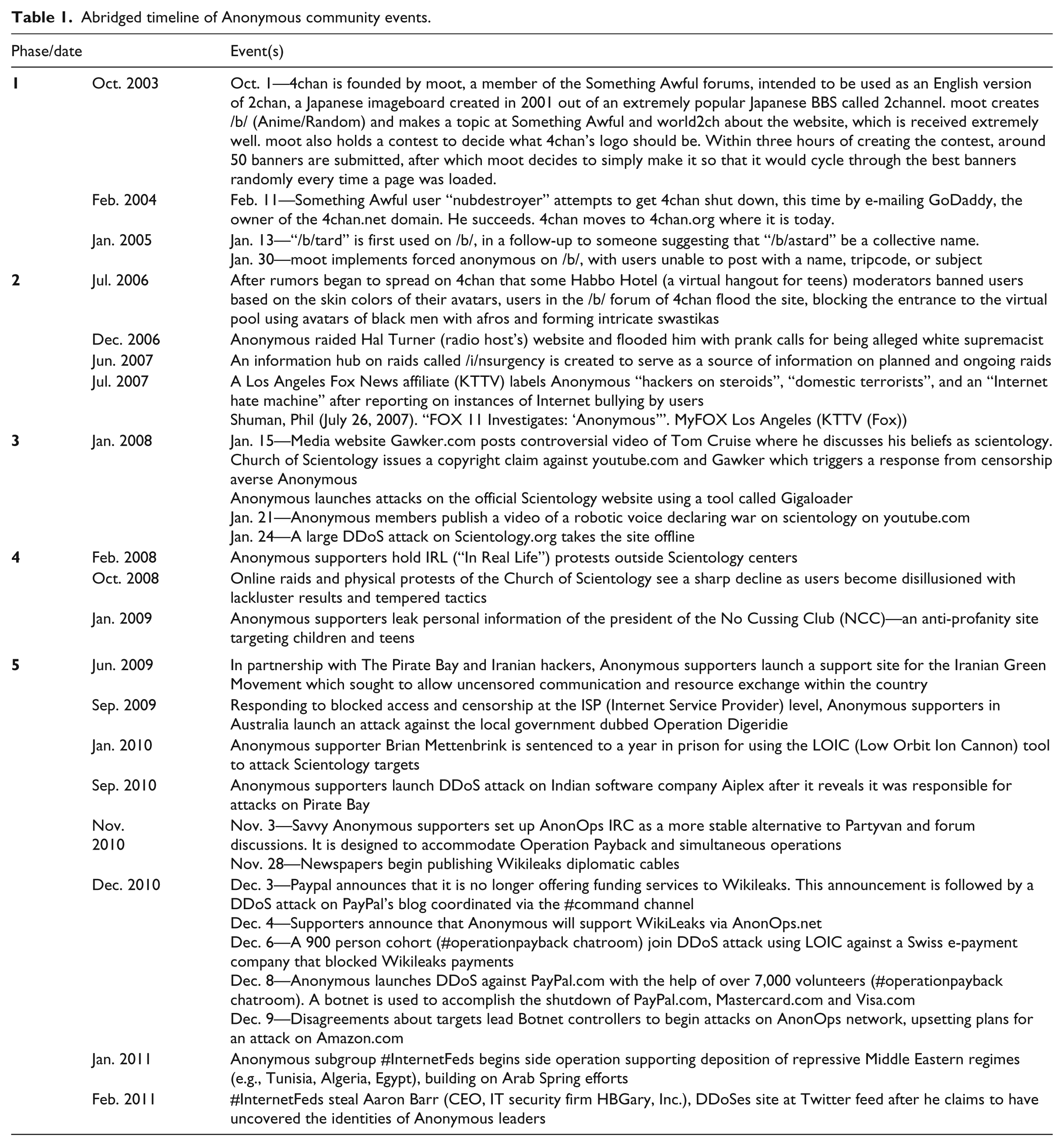
Phases were delimited through the identification of community transitions indicated by changes in purpose, as well as revealed through comments in online forums, media reports and field note observations. I attended to instances when Anonymous contributors explicitly noted the adoption of a new collective purpose or identity, as well as instances when they noted increases in contributions and expansion into new cyberspaces. This technique allowed me to identify phases that not only captured transitions significant to contributors, but that could be verified with website traffic and news report data. I identified five phases:
a phase (October 2003 to April 2005) characterized the creation of a free space and imprinting of transgressive norms;
a phase (June 2006 to December 2007) where the definition of a value system and repertoire of tactics took place through raids outside community boundaries;
a short-lived phase (January 2008) characterized by collective action asserting adopted free-expression values;
a disengagement phase (February 2008 to May 2009) in which contributors used traditional protest tactics and demobilized; and
a reconstitution phase (June 2009 to February 2011) characterized by the adoption of a more inclusive communication platform and the remobilization of a plural contributor base.
Once the trajectory of the community became clearer, I combined insights from web traffic analysis and coding of threads for topics with additional qualitative data analysis. Over multiple iterations, several key theoretical categories emerged based on open coding. These open codes were aggregated into themes that allowed me to link broad categories to emerging data. As I began to reduce the complexity through the elimination of non-recurring themes, key patterns began to emerge: (1) computer-mediated communications revealed a community seeking increasingly more ambitious challenges and engaging with higher-profile targets; (2) an ebb and flow of opinions and actions that led to intermittent cycles of mobilization and demobilization; (3) technology and cultural elements entwined to enable this dynamism and make the community more resilient to contribution lulls and schisms. Trend analyses supported these findings. Figure 1 reveals changes in web traffic that indicate demobilization following the adoption of traditional protest tactics and reconstitution following the adoption of a new contribution platform. Figure 2 shows that the types of discussions taking place within the community went from being largely “lulz” or recreation-centric to being more diverse—including both recreational and activism-related content. Together, these figures and qualitative codes show a community that faced fallout and was able to regain traction once technological systems were put in place that allowed discussion of a broad range of topics and both recreational and political activity to flourish in tandem.
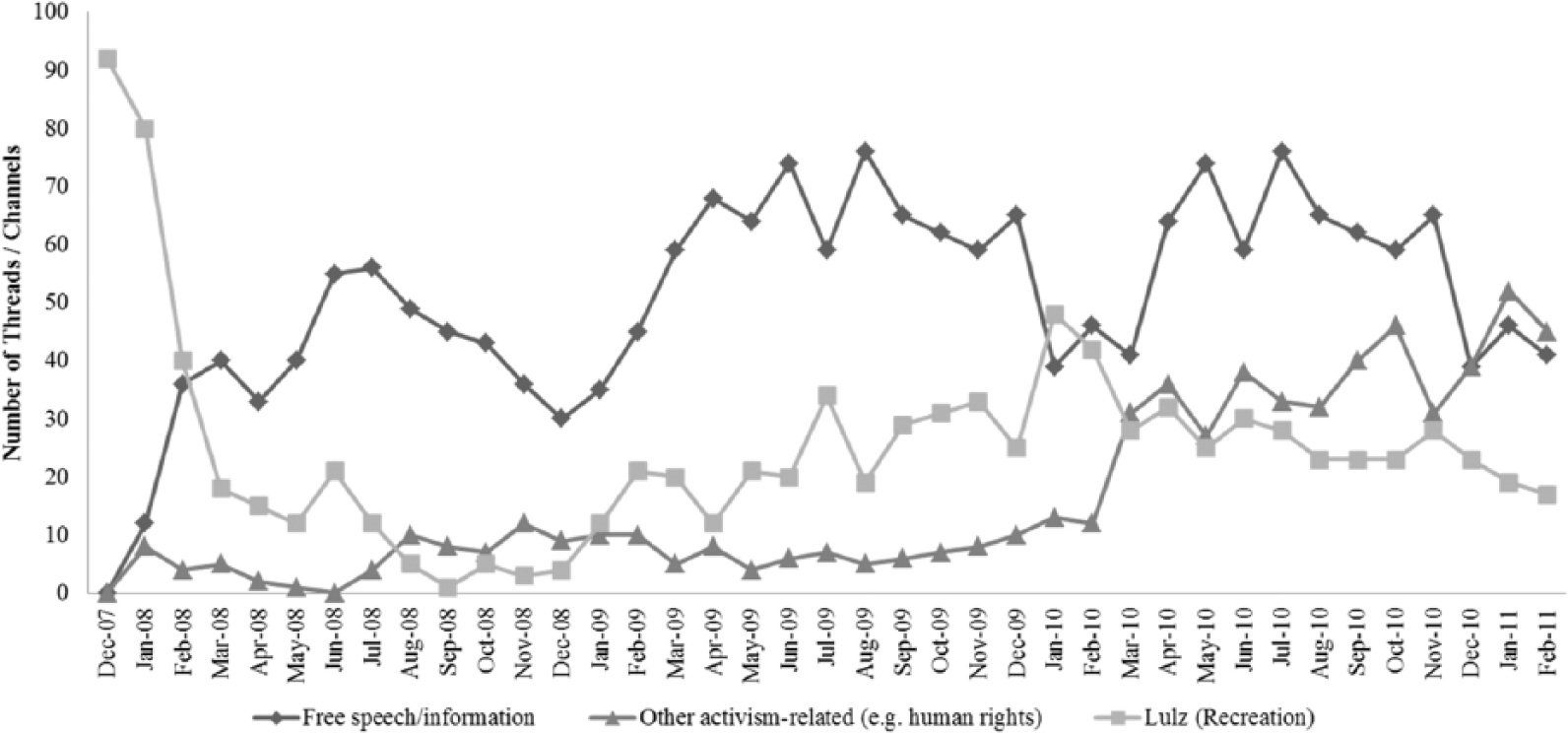
Trend of topics attended to in community interactions (n = 1157 threads/channels), December 2007to February 2011. This figure does not contain data prior to December 2007 because collection of this information could not be done retrospectively.
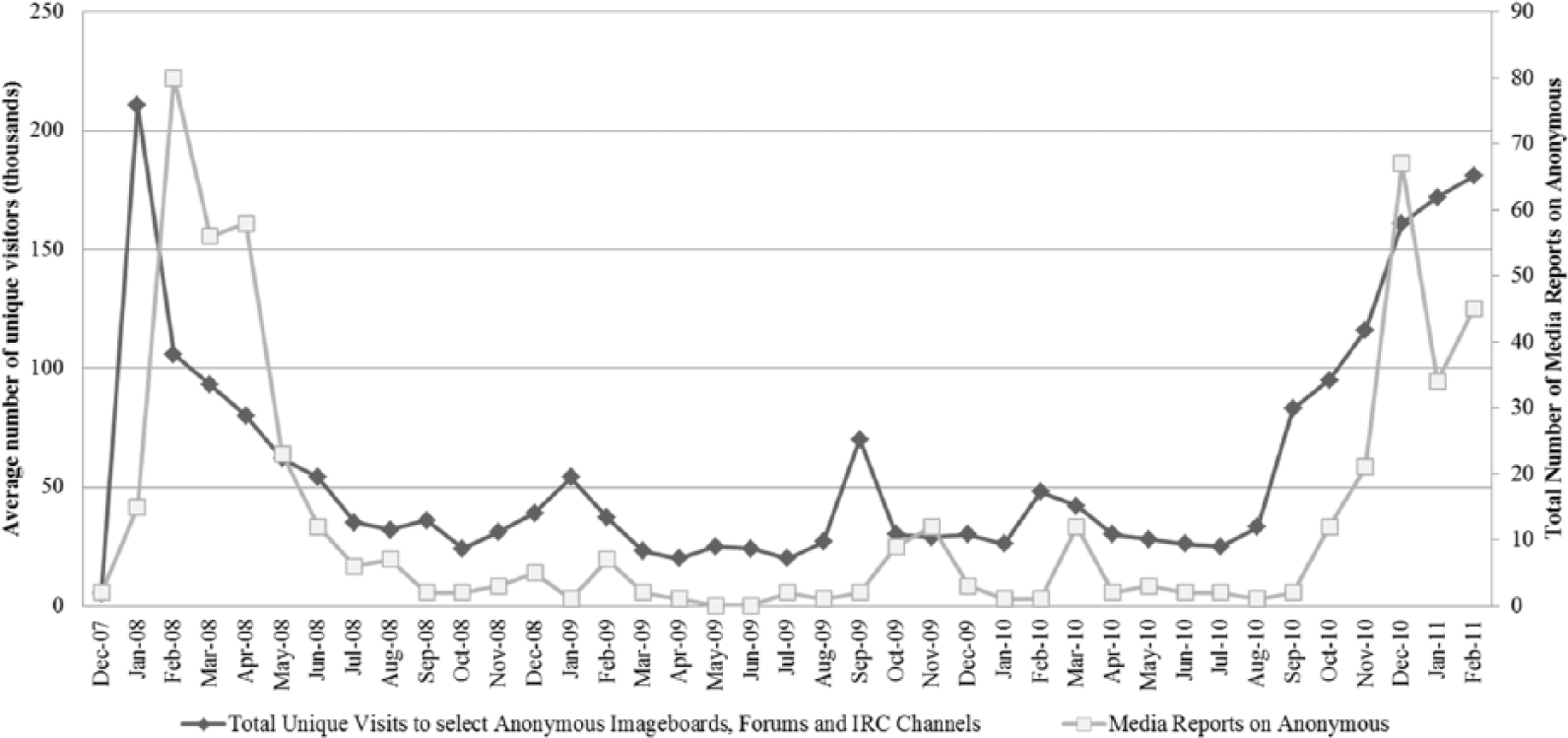
Trends in unique visitors to Anonymous sites and media reports on Anonymous.
Findings
The Anonymous online community was transformed from a small gathering of users exchanging images and comments about Japanese animation into a community of thousands of pranksters and hacktivists connected through a novel interaction platform. The community grew, attracting new contributors, leveraging technologies and enriching a culture of transgression as it grew to be more involved in affairs outside its own boundaries. I find that the transformation of the community took place across five phases characterized by shifting casts of contributors leveraging different technical tools and influenced by changing cultural norms. I describe what transpired in each of these phases in an “analytical chronology” (Pettigrew, 1990, p. 280) that is meant to balance two objectives: to provide a contextualized understanding of a case through thick description (Denzin & Lincoln, 2005) and to introduce theoretical insights whose impact on extant theoretical streams are elaborated upon in subsequent sections.
Phase 1 (October 2003 to July 2006): Online community formation
In October 2003, 15-year-old Christopher Poole created 4chan, a digital bulletin board that revolved around the posting of images and related comments. He designed it as a permissive forum for the exchange of content by fans of Japanese animation—an effort born out of his frustration with existing forums that he deemed to be excessively moderated and that revolved around the building of personal reputations and self-aggrandizement of contributors (Poole, 2010). 4chan was designed from its inception to be unfettered by personal identifiers, to have ephemeral threads 2 and to be only loosely moderated. Some of the features of 4chan, such as the ability to post without a name or stable form of permanent identification, were intentionally built into the site by Poole, and others were exploited by users due to programming oversights (Poole, 2010). Altogether, the introduction of this loosely structured, permissive environment fomented rampant experimentation with design elements, technology and emergent culture, by both the founder and eager contributors.
Poole anonymously posted his inaugural greeting, making a request: “I politely [ask] people not to post stupid stuff on these boards.” The appeal was not heeded. Contributors seeking a platform for interaction with as few restrictions on posting behaviors as possible began to gather on “/b”—4chan’s most popular—capturing one third of the site’s traffic (Poole, 2010)—and most controversial board. Although interactions in other 4chan boards remained relatively tame, those within “/b” were characterized by “rapid-fire conditions [that] magnify the need for audacious, unusual, gross, or funny content” (Coleman, 2012). Not only was the exchange of pornographic images, lewd jokes and purposefully offensive and often racist or misogynistic content tolerated within /b, it was encouraged by fellow contributors. /b became infamous for the ways in which users entertained themselves and observers through the production of a broad range of “memes,” i.e., entertaining artifacts that are propagated across the Internet and that sometimes make their way outside of 4chan and into the mainstream Internet (e.g., Lolcats, Rickrolling) and the exchange of various forms of pornography and gruesome photographs. Memes such as Tubgirl, a diarrhea-stricken woman in a bathtub, were typical. Allusions to self-referential jokes between contributors and the development of argot known only to those paying attention to the asynchronous dialogue on /b were also common. A growing contributor base of nearly 50,000 users (by September 2004) favoring /b’s lack of formal rules and seeking novel forms of what they deemed to be “unrepressed social interaction” (Encyclopedia Drammatica) quickly joined the fray. Despite the founder’s best efforts, the facilitation of anonymous contributions and an early commitment to minimal moderation made cooptation of the space by contributors committed to topics beyond Japanese animation possible.
The characteristic lack of moderation did not, however, mean that /b took shape in a normative vacuum. Intentional defiance of political correctness was characteristic of a widespread web phenomenon often referred to as “troll” culture. Trolling can be narrowly defined as the posting of inflammatory, extraneous, or off-topic messages in an online venue with the primary intent of provoking user response and causing general disruption. More broadly, the term can refer to acts that reveal disdain for rules and constraints on deviant behavior. Trolls often take action for amusement’s sake; they do it for the “Lulz”. Coleman (2012) describes the Lulz as the “motivating emotional force and consequence of an act of trolling” and as “a linguistic spectacle—one clearly meant to shock and offend”. Trolls revel in getting the better of one another’s transgressions, particularly in spaces like 4chan where they are free from the tethers of personal identifiers and couched in the safety and freedom anonymity provided. A troll’s emphasis on freedom of self-expression and information evokes the cyber-libertarian worldview described by Norris (2001) and others (see Coleman & Golub, 2008 for a review) as well as elements of a “hacker ethic” (Levy, 1994) centered on the idea that all information, no matter how offensive or disturbing, should be freely available.
By September 2004, the extreme content from the /b forum was spreading to other forums and causing 4chan users still interested in more tame pursuits, including Poole, upset. The proliferation of extreme content was not what Poole had intended for his creation, making clear that he was “not easily offended, but I have never sought out the grotesque” (Kushner, 2015). In response, Poole posted the following in an announcement to the entire site: “The other issue is the new crackdown on trolls. The Team, myself included, apologize for the way things have been; the problem is being addressed but we’re going to need help, i.e. Users need to stop breaking the rules on purpose. Stop trolling outside of /b/ unless the comment is WITTY and HILARIOUS (note: 99% of them are not), and start contributing more” (News and Views by Souldark—9/26/04, emphasis in original). The request did little to stop the spread of the content or to curb the imprinting of hyper-masculine, libertarian norms characteristic of the troll culture.
Further fueling and validating the growth of this element within the community were aggressive actions by users of other forums who threatened to shut down 4chan. For instance, on February 11, 2004, “nubdestroyer,” a user from the “Something Awful” site (www.somethingawful.com) succeeded in getting 4chan.net shut down by e-mailing complaints to web hosting company GoDaddy, the owner of the 4chan.net domain. The contributors to /b came together to denounce attacks and discuss the future of the community, strengthening the notion that /b was different from other forums. Importantly, albeit largely self-referential and insular, the building of distinct norms and of a distinctive shared space gave contributors to 4chan a claim to uniqueness, the pursuit of “Lulz” gave contributors to 4chan a purpose and attacks from external communities united them under a single banner. By January 13, 2005 discussions of a collective identifier of their own was advanced. “/b/tard” is first used on /b, in a follow-up to someone suggesting that “/b/astard” be a collective name for contributors to the image board. Soon thereafter, the name “Anonymous,” after the default user name under which contributors posted to /b, was adopted as an umbrella moniker for 4chan trolls.
Phase 2 (August 2006 to December 2007): Experimenting with community boundaries
By mid-2006, after several years of interactions reinforced troll norms within /b, several contributors to the community began clamoring for /b to focus less on developing memes and more on wreaking havoc on other sites, ranging from rival communities that had attacked 4chan in the past, to unsuspecting sites that would be fun to disrupt. Contributors were drawn into pranksterism by calls for new challenges and for less insularity: “all we do is sit at home waiting for Caturday. 3 Time to do something less passive don’t you think /b?” (/b, Aug. 2006). While the exchange of lewd comments and memes remained commonplace, and are now celebrated in centralized wikis such as Encyclopedia Dramatica, the central activity of users contributing to /b shifted to the planning and coordination of “raids” or attacks on online targets. Variety in both techniques and targets increased as each original poster suggested new and creative ways to generate “Lulz”. These pranks and forum interactions made no mention of advancing a single agenda. Instead, Anonymous contributors focused on a raid until they became bored; they would then turn their attention to whatever topic captured their interest.
To illustrate, among the earliest pranks conducted by 4chan posters were repeated attacks on Habbo Hotel, a social networking site designed as a virtual hotel populated by teenagers. The first raid (ca. June 2006) was triggered by the news of an Alabama amusement park banning a two-year-old toddler affected by AIDS from entering the park’s swimming pool. Following a suggested course of action by a contributor to the imageboard, users signed up to the Habbo site dressed in avatars of a black man wearing a grey suit and an “Afro” hairstyle. They then blocked entry to the virtual hotel pool, declaring that it was closed due to AIDS. Habbo was quickly flooded with memes created in 4chan and with users mockingly arranging their avatars in swastika formations. When the raiders were banned, they flooded the customer support section of the site with complaints of racism. Comments in Anonymous forums after the conclusion of the raid were self-congratulatory: focused on the Lulz obtained and not on any serious discussion of racism—any users that took offense were accused of self-righteousness and deemed, in the disparaging argot of the community, “moral fags.”
In fact, comments which sought to bring personal or moral issues to the attention of users quickly became the subject of ridicule. Calls for attacks on Facebook profiles, hacks of ex-girlfriends’ computers and other personal requests by posters were often met with a resounding “NYPA.” Urbandictionary.com defines NYPA as an acronym for “Not Your Personal Army.” Essentially, users attempted to communicate to posters of those requests that Anonymous wasn’t a resource to use for personal vendettas 4 but, setting clear norms for behavior, a playground where rules were bent and broken as long as they led to laughs. Calls for support of ongoing social movements ranging from the fight for net neutrality and anti-war campaigns were deemed boring. So, although the media repeatedly reasserted the notion that 4chan and Anonymous didn’t respect boundaries of any sort, the community’s avoidance of seriousness and hacks driven by personal gripes became habitually enforced normative constraints.
By setting these norms for behavior and creating local idioms and vocabulary, Anonymous contributors collectively enforced symbolic boundaries within which a sense of community and a distinctive collective identity could be strengthened. Displays of playfulness and pranksterism, for instance, were not only rampant but, more importantly, indicative of a burgeoning value system, the centerpiece of which was the pursuit of fun. Freedom of self-expression also became a pervasive component of the new “Anonymous” community. Raids perpetrated for the Lulz soon became rationalized as celebrations of a free Internet and the hallmark of a “prankster” (Coleman, 2014) collective identity built on bucking conventional behavior. A shared sense of purpose had emerged and been embraced by a large subgroup within 4chan not through the guidance of formal leaders, but through ongoing interactions and dialogue within /b. This purpose was enacted through unconventional pranks that gave contributors a sense of triumph and fed their ambitions, triggering calls for more daring hijinks and greater challenges.
Phase 3 (January 2008): Values-driven external engagement
In January of 2008, after /b had been conducting pranks for the “Lulz” for several years, a video of Tom Cruise discussing his beliefs as a Scientologist was posted to multiple online video-sharing sites. Attorneys representing the Church of Scientology (CoS) claimed the video was produced solely for internal use and threatened legal action against websites that carried it. These legal threats were immediately noted and interpreted by contributors to Anonymous forums as an affront to a shared conviction that had grown increasingly prominent in forum discussions (Figure 1), i.e., that information, no matter how offensive or independent of ownership by a private party, should flow freely.
Discussions that deviated from the “Lulz” and contained explicitly moral components were not only atypical in /b but anathema to many contributors. However, compelled by the Church of Scientology’s actions, users became engaged in exchanges about free speech, information distribution and self-expression on the Internet. Several users suggested that the actions of the Church of Scientology provided a timely opportunity for generating Lulz at a much more ambitious scale (users referred to these as “epic Lulz”). Discussions of “Lulz” in this phase became focused on how much fun it could be to attack an organization as mysterious and restrictive on member behavior as the Church of Scientology and that defending freedom of information was consistent with what being a troll was all about. One Anon commented that the Church of Scientology was finally “an opponent worthy of our skill” (/b forum, January 2008). Others suggested that the Church of Scientology was a “perfect nemesis,” an embodied antithesis to Anonymous values. Ultimately, the event prompted the initiation of an unconventional, large-scale experiment in organizing that diverged from business as usual for Anonymous. It would also mark the first time that Anonymous became engaged in an initiative that sought to address a perceived injustice instead of solely providing recreation. Contributors to the “/b” forum wrote:
“I think it’s time for /b/ to do something big. … I’m talking about “hacking” or “taking down” the official Scientology website. It’s time to use our resources to do something we believe is right. It’s time to do something big … Talk amongst one another, find a better place to plan it, and then carry out what can and must be done. It’s time, /b/” (/b) “Gentlemen, this is what I have been waiting for. … This is a battle for justice. Every time niggertits has gone to war it has been for our own causes. Now, gentlemen, we are going to fight for something that is right. I say damn those of us who advise against this fight. I say damn those of us who say this is foolish. /b/rothers, our time has come for us to rise as not only heroes of the Internet, but as its Guardians. /b/rothers. Let the demons of the Intarwebs become the angels that shall vanquish the evil that dare turn its face to us. /b/rothers … man the harpoons!” (/b)
Anons attending to interactions within /b quickly planned an ambitious nuisance campaign called Project Chanology and readily flaunted the notion that they were acting as “Guardians” of the Internet—a new identity that, for the first time, implied that Anonymous was taking on the mantle of do-gooders. Contributors collaborated in producing and distributing a video call to arms and warning to the Church of Scientology, using language (e.g., “angry masses of the body politic”) more reminiscent of a traditional collective actor than a group of trolls:
“Hello, Leaders of Scientology. We are Anonymous. Over the years, we have been watching you. Your campaigns of misinformation; your suppression of dissent; your litigious nature, all of these things have caught our eye. With the leakage of your latest propaganda video into mainstream circulation, the extent of your malign influence over those who have come to trust you as their leaders, has been made clear to us. Anonymous has therefore decided that your organization should be destroyed. … we shall proceed to expel you from the Internet and systematically dismantle the Church of Scientology in its present form … We are Anonymous. We are legion. We do not forgive. We do not forget. Expect us.”
5
As the transcript indicates, Anonymous adopted not only a shared collective moniker, but also a slogan that protrayed the community as a force to be reckoned with standing in judgment and seeing itself as “legion.” In addition to releasing the call to arms video, Anonymous contributors began posting about the topic in several other imageboards: 711chan.org, the partyvan.info wiki, Futaba and numerous Internet Relay Chat (IRC) channels. The decision by users to ask for the assistance of other forums was highly counter-normative: since the community’s founding in 2003, users had been wary of interacting with users of other forums and valued the notion that they had created a unique space of their own. The allure of the “epic Lulz” that could come of this campaign against the Church of Scientology, however, led users to relent, contravene insular norms and work to ensure the broad-based mobilization of supportive parties that were not in the original /b forum core:
“So you want to join Project Chanology eh? Fight the good fight for the Internet? Or perhaps you are a skeptic, doubtful we can do anything? I won’t lie to you. I am an /i/nsurgent first, a /b/tard second, and an all-around Anonymous, but I know that for a fight against the Beast it will take more than possible even every chan combined could muster. We might be rivals; hell, we might hate each other’s guts, but this goes beyond just us.”
6
Anons deployed tactics from a repertoire developed in the smaller-scale raids and pranks of phase 2. They unleashed distributed denial of service (DDoS) and Gigaloader 7 attacks on Scientology.org (and other Scientology sites), i.e., swamping web providers with access requests and making sites inaccessible to visitors. The initiative was successful in blocking access to Church of Scientology websites sporadically from January 18, 2008 until approximately January 25, 2008. The severity of the attacks and level of participation in them had been unprecedented and would provide the community with “bragging rights” and the Lulz they sought; they would also provide contributors with a sense that they had addressed an injustice. To mobilize the number of users required for this project, however, Anons created calls that appealed to a broad range of users and deviated from the Lulz-centric motives that sustained community involvement. New users, with distinct motives and little experience with hacktivism, would soon enter Anon forums in droves and imprint their own ideas onto the community. The ability to enact greater social influence came, in short, at the expense of their insularity and pure pursuit of “lulz.”
Phase 4 (February 2008 to May 2009): Contributor disengagement, decline, and abeyance
News soon spread of Anonymous’ exploits to various audiences including other critics of the Church of Scientology and media outlets. Their attacks on the Scientology websites became known to parties who weren’t attending to 4chan threads or exposed to Anonymous calls to action. By February 2008, long-time critics of the Church of Scientology—those who had been protesting the practices of the Church decades before attacks of the sort deployed by Anonymous were even possible—made their opinions of the recent attacks heard. Mark Bunker, a prominent figure among long-time critics, suggested that although the efforts of Anonymous were exciting and had been helpful in mobilizing a large cadre of supporters, several mistakes were going to “hurt the effort in the long run.” He suggested that Anons lobby congressmen to rescind Scientology’s tax exempt status, organize protests and hand out flyers, call up local radio stations and, in essence, employ more traditional, legal and peaceful tactics. Other critics of the Church of Scientology followed suit, issuing similar statements. The Economist compared the tactics employed by Anonymous to “cyberwarfare techniques normally associated with extortionists, spies and terrorists.” 8 Figure 2 shows that prior to the attacks in January, the media showed little interest in Anonymous—occasional reports in specialty blogs noted that an unknown actor was using an online community forum to engage in pranks. Attention spiked, however, when it was discovered that the perpetrators of the attacks on the Church of Scientology used particularly unusual methods and that they existed exclusively online. These negative audience evaluations marked the first major interaction between Anonymous and the long-time Church of Scientology critics, as well as with mainstream media. Although critics essentially agreed that the Church of Scientology should be dismantled, they disagreed on what means were most effective to achieve it. The legitimacy of Anonymous’ tactics was questioned not by antagonists, who did not yet publicly recognize Anonymous as a threat, but by potential allies who argued against their sustainability and ethics. Importantly, there was widespread misunderstanding of what Anonymous stood for and of the tactics they deployed.
These audience evaluations resonated with many Anons, particularly the under-socialized newcomers that had just begun to participate in community activities after having flooded the easy-to-access, password-free /b forum. In the absence of formal leaders to interpret input from supporters, allies, antagonists and the media, users were free to interpret comments on their own and suggest responses: even though some wanted to continue hacker-style attacks, others suggested alternative tactics and acknowledged the possibility that supporters provided a more viable course of action. Discussion over whether Anonymous should shift tactics to something more palatable to mainstream media and long-time anti-Scientology protesters became heated; frenzied comments, dissent and extreme proposals prevailed as ideas being offered that drew on hacker tactics grew increasingly tempered by the comments of newcomers hesitant to engage in illegal acts as well by those persuaded by critics’ advice. The stalemate was resolved after many hours as exhausted and frustrated users consented to try something different. The following is a post hoc summary provided by one of the wikis:
“At first, WBM (wise beard man) distanced himself from Anon, and was wary to directly help, out of fear that the Scilons would sic their extensive team of legal professionals on his ass again. Nonetheless, Anonymous took the advice he offered about peaceful protesting seriously, and helped ensure the subsequent successes … By successfully convincing Anon to change its strategy, Beardfag, in essence, managed to do the impossible: control the essence of chaos on the Intarwebs.”
9
Eventually, a call was issued on youtube.com and distributed between forums for new tactics to fight the war against Scientology. The call was not, however, acknowledged by contributors who believed in the effectiveness of hacktivist tactics. They reacted to what they perceived as an attempt to capitulate community values, claiming that new members had “corrupted” or “polluted” their efforts. One comment stated that “these newfags are ruining what we had here … it really isn’t the same since the boy scouts moved in” (7chan, March 2008). Meanwhile, new members entered the forums in droves and posted lengthy introductions and declarations of commitment to the destruction of the Church of Scientology. These comments were once again greeted with typical responses such as “lurk moar” (4chan, March 2008) or denouncing those who referred to mission and the importance of Project Chanology as “moralfags” (4chan, March 2008).
The efforts of those attempting to return Anonymous to its transgressive beginnings made little difference. Calls for Lulz were drowned out by cries for greater involvement in anti-Scientology protests. Figure 1 support this assertion—note that by August of 2008, topics coded as “Lulz” were being less discussed than both free speech and other less prominent activism-related topics. Comments began to signal acquiescence to the wishes of external audiences (e.g., Scientology critics and the mainstream media) and to take seriously the possibility of engaging in “IRL” (In-Real-Life) protests. In fact, by mid-March of 2008, calls for offline protests dominated the imageboards, culminating in the release of a video urging Anonymous members and allies to protest in front of Church of Scientology centers all over the world. In the video, a computerized voice stated:
“It has come to the attention of Anonymous that there are a number of you out there who do not clearly understand what we are or why we have undertaken our present course of action. Contrary to the assumptions of the media, Anonymous is not simply ‘a group of super hackers’. Anonymous is a collective of individuals united by awareness that someone must do the right thing … We want you to know about the gross human rights violations committed by this cult … We want you to know about all of these things that have been swept under the rug for far too long. The information is out there. It is yours for the taking. Arm yourself with knowledge … Anonymous invites you to take up the banner of free speech, of human rights, of family and freedom. Join us in protest outside of Scientology centers worldwide.” (http://www.youtube.com/watch?v=YrkchXCzY70)
In short, this announcement was indicative of another community transition: from engagement in pranks for recreation to engagement in values-driven activism. Radar online reported that over 7,000 protestors gathered in front of Scientology centers throughout the world 10 for the first protest. Many of the protestors wore masks to retain the anonymity they enjoyed in online forums and to protect themselves from CoS retaliation, in essence translating a portion of the culture they had developed online into the physical world. In addition to donning masks, protestors sang songs and carried signs that drew attention to CoS practices. Following the success of the offline protests, new demonstrations were quickly planned and executed, each highlighting one aspect of Scientology’s current or past practices and Anonymous’ critiques against these practices. Many high-profile defections from Scientology bolstered the efforts and led to increased commitment by many to traditional tactics.
With each additional offline protest, however, excitement seemed to dwindle in the online forums (see decreasing visitation on Figure 2 following the spike in early 2008). Many contributors, including many of the newcomers who had been initially attracted by the novelty and spectacle of Anonymous, found themselves bored with protests that had become “more routine than my day job” (Operation Clambake Forum) or “just like one of my parent’s protests but without the sex” (/b). As more protests were staged, the community found itself increasingly divided. The few reports that still attended to the community in the mainstream media (see Figure 1) began labeling Anonymous as a social movement organization. Even though they received expressions of support from media, contributors to early Anonymous efforts grew increasingly disheartened by a community they “didn’t even recognize anymore” (/b). Users noted that outsiders had led Anonymous toward conformity to traditional social movement tactics and that Anonymous was on its way to becoming increasingly formalized. Many publicly withdrew their support for Project Chanology, citing that “the chans have been taken over by newfags and they don’t bring the lulz” (/b). Demobilization of Project Chanology soon followed as users returned to /b to produce and exchange memes and street protest attendance bottomed (Figure 1).
Phase 5 (June 2009 to February 2011): Reconstituting the community
It took several months before new claims of Anonymous engagement in illicit activities were seen. Campaigns that garnered media attention were few, far between, and had limited impact on forum attendance. In June 2009, for instance, nearly a year after the demobilization of large anti-Scientology street protests, prompted by requests from Iranian nationals and the programmers behind the file-sharing site Pirate Bay, a handful of Anonymous contributors decided to support efforts of the Iranian Green Movement trying to remove restrictions to their Internet connections. Soon thereafter, Australian Anons declared the beginning of Operation Digeridie, an attack on Australian government sites that were attempting to censor Internet content. Although these international projects were small, they signaled a tentative re-engagement by some contributors in activism. Importantly, contributors engaged in these small projects began experimenting with new, increasingly sophisticated tools as they attacked new targets and engaged directly with users in other countries.
In September 2010, an incident lit the powder keg that reignited interest in Anonymous. An Indian security company hired by movie studios to protect online content from piracy launched a denial of service attack against The Pirate Bay, the most prominent illegal file-sharing website on the Internet at the time. Pirate Bay had, since its creation, been highly trafficked and discussed by contributors to Anonymous forums. Incensed by the attack and seeking retribution, Anonymous contributors finally called for a large-scale remobilization of the community using 4chan and many other sites where many Anonymous users that had become disenchanted with activism still gathered:
“Aiplex, the bastard hired gun that DDoS’d TPB (The Pirate Bay) needs to be put down! Rejoice, /b/rothers, the time has come for resurrection and for us to blow the shit out of those basterdz with our massive lasers.” (/b, June 2009)
Figure 2 shows a spike in both forum visitation and media reports about Anonymous beginning in late August and early September of 2010 related to this new shock. As Figure 1 shows, the percentage of threads about Lulz and free speech, i.e., the topics that had made Anonymous famous internationally, slowly begin to rise again in this phase as well. Instead of using third party servers that were vulnerable to attack and the whims of administrators, Anons began relying on IRC networks they owned and ran themselves, many of which were provided to their user base through interconnected international servers. Although over 65% of threads appeared in image boards and other asynchronous communication forums before the decline of contributions to Project Chanology, only 43% of threads collected in this phase took place outside of IRC networks.
IRC networks (e.g., Anonet, Anonops) became central to every aspect of Anonymous operations. Within each IRC network, scores of channels were created, although there were only a dozen or so that were populated at a given time. Each channel represented aspects of a larger project (e.g., logistics, media relations), so users who entered the network could select which project they wished to contribute to and which aspect of the project might benefit the most from their expertise. Some channels were devoted, much like the imageboards, to social topics and exchanges. Other channels existed to address technical issues and as a form of support system for new users or users with questions (e.g., #tutorials). Finally, there were channels where the many operations were coordinated (e.g., #command).
This new platform served several purposes: (1) it allowed Anonymous to pursue several projects simultaneously and better filter the expertise of members, allowing users to assign themselves to tasks in which they exceled; (2) it required slightly more technical know-how and effort to access than 4chan, meaning users that weren’t willing to take the extra time to understand how IRC networks function were defacto excluded from Anonymous. As such, a boundary for participation which excluded users that were unwilling to learn was erected; (3) the ability to see how popular certain topics were over others within the network—through the use of visitation indicators and counters—meant contributors began to gain a better understanding of which topics appealed to the community as a whole and which were niche topics sustained by a limited number of passionate users. Altogether, these features allowed contributors to time calls for new projects to match with lulls in other project offerings, ensuring that active users always had something available to which they could contribute their time. An Anonymous user contributing to a tutorial forum set up for newcomers to Anonymous suggested that “the new networks are able to better serve and understand Anons. Instead of being forced to participate in a raid you don’t give a shit about, go nuts at a vegas-style buffet of ops …” (Anonnet, December 2010). Moreover, the widespread adoption of these platforms empowered all contributors to Anonymous, independent of whether they were pranksters seeking Lulz or activists looking to address social problems.
It was only following the release of State Department communications on Wikileaks by Julian Assange and others in late 2010, however, that participation swelled to near Project Chanology levels once again (see Figure 2). Following the arrest of Assange and the withdrawal of donation support to Wikileaks from several companies, Anonymous decided to punish MasterCard, Visa, PayPal and others using LOIC (Low Orbit Ion Cannon) software and other “Denial of Service” tools. Unlike previous projects, Anonymous took on a support role, allowing Wikileaks to take the spotlight. Whyweprotest, one of the few remaining forums for Anonymous contributors outside of the IRC networks, contained several posts explaining that Anonymous could play a new role in the Wikileaks scandal:
“I think we are doing the right thing here. Assange is a douche but the mission is good. We should support it without making him look dirtier than he already is. The credit card companies are the real bitches here cause now he’s got no defense fund.” (Dec. 2010, Whyweprotest, Operation Payback forum) “We should play a support role. Anon is back with a thousand different masked faces and a primo network. Know what I mean? We can be the quarterback or we can be the ninja in your fucking wall fucking with the creditcard numbers.” (Dec. 2010, Whyweprotest, Operation Payback forum)
Attacks on the credit card companies that withdrew their support for donations to the Wikileaks Foundation ensued and attracted new attention to Anonymous. These attacks led to the arrest of several Anonymous contributors, but also led to PayPal supporting donations to Wikileaks. The arrests did not deter continued attacks on behalf of Wikileaks as well as efforts to raise awareness of content in the State Department documents leaked via the site (named Operation Leakspin). Concurrent with the Wikileaks efforts, Anonymous became engaged in the Arab Spring revolts through attacks on the Tunisian and Egyptian governments, both of which were coordinated with hackers in those countries who had joined the community months earlier. Perhaps just as important, projects designed just for the Lulz—such as attacks on vice-presidential candidate Sarah Palin—were welcome and popular.
The notion that Anonymous contributors were willing to take on activist and recreational projects at the same time reflects more than an expansion of collective identity to encompass pranksters, hackers and activists. It marks what one user referred to as “a maturing of Anonymous” which wasn’t only necessary for the community to avoid self-destructive conflicts but “made it so Anons saw themselves as part of something bigger than a single op, but as keepers of a gathering where all are welcome” (Anonnet, Jan. 2011). Another user remarked, in response, that “Anonymous is not about calling people out on shit, it’s a place where you go to get your lulz … and that is none of my business … it is what you want it to be” (Anonnet, Jan. 2011).
A Model of Sustainable Online Community Building
In this section, I blend findings with existing theory and clarify the connections between phases described in the previous section to develop an inductive process model of sustainable online community building that elevates the analytical chronology to a higher level of abstraction. The model (Figure 3) allows for the extension of existing research on community building by revealing how the mutual influence of technology and culture (detailed in Table 2) eventually produced an enduring, resilient online community.
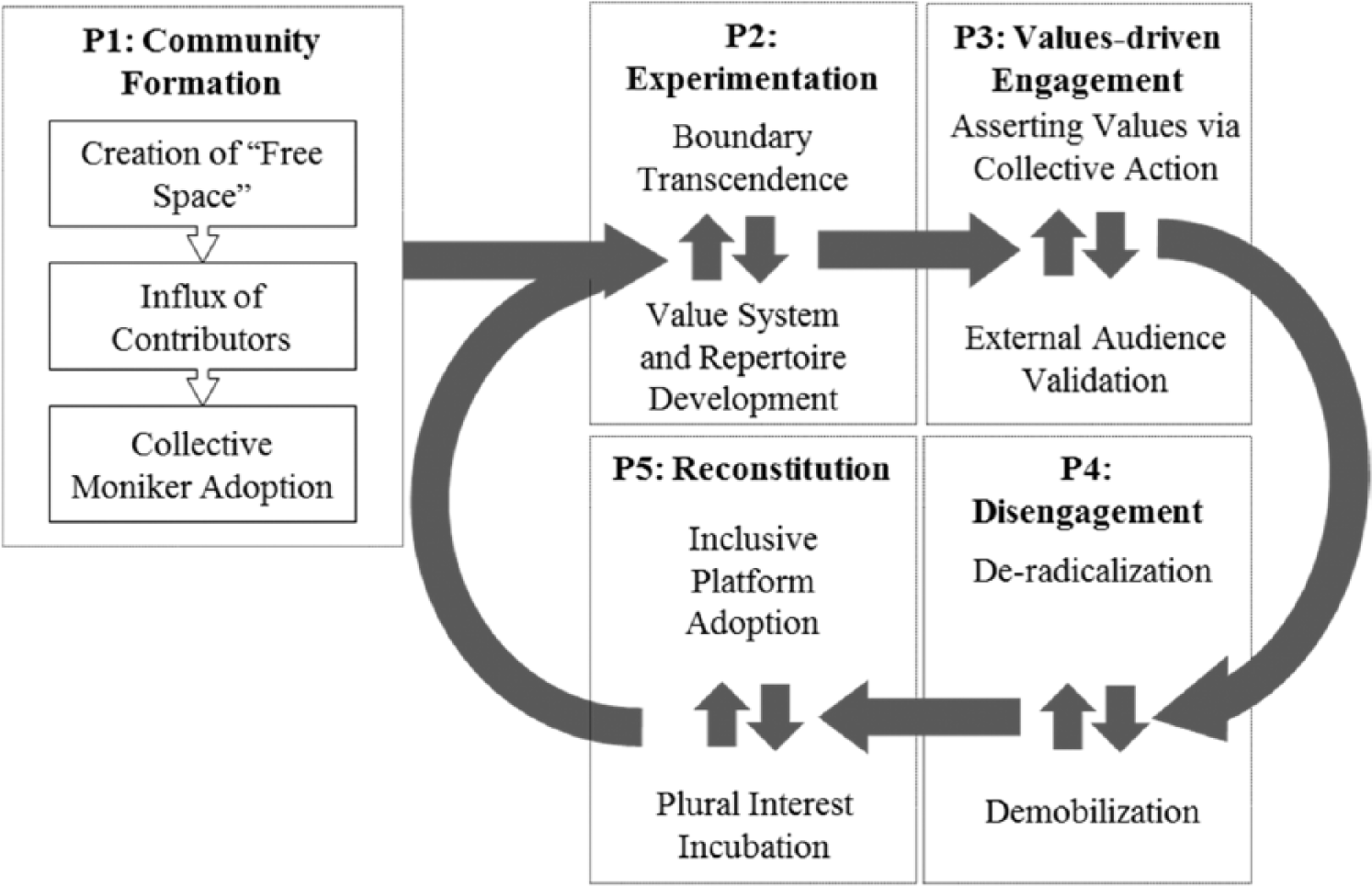
Process Model of Sustainable Online Community Building.
Technological and cultural elements driving community building process.
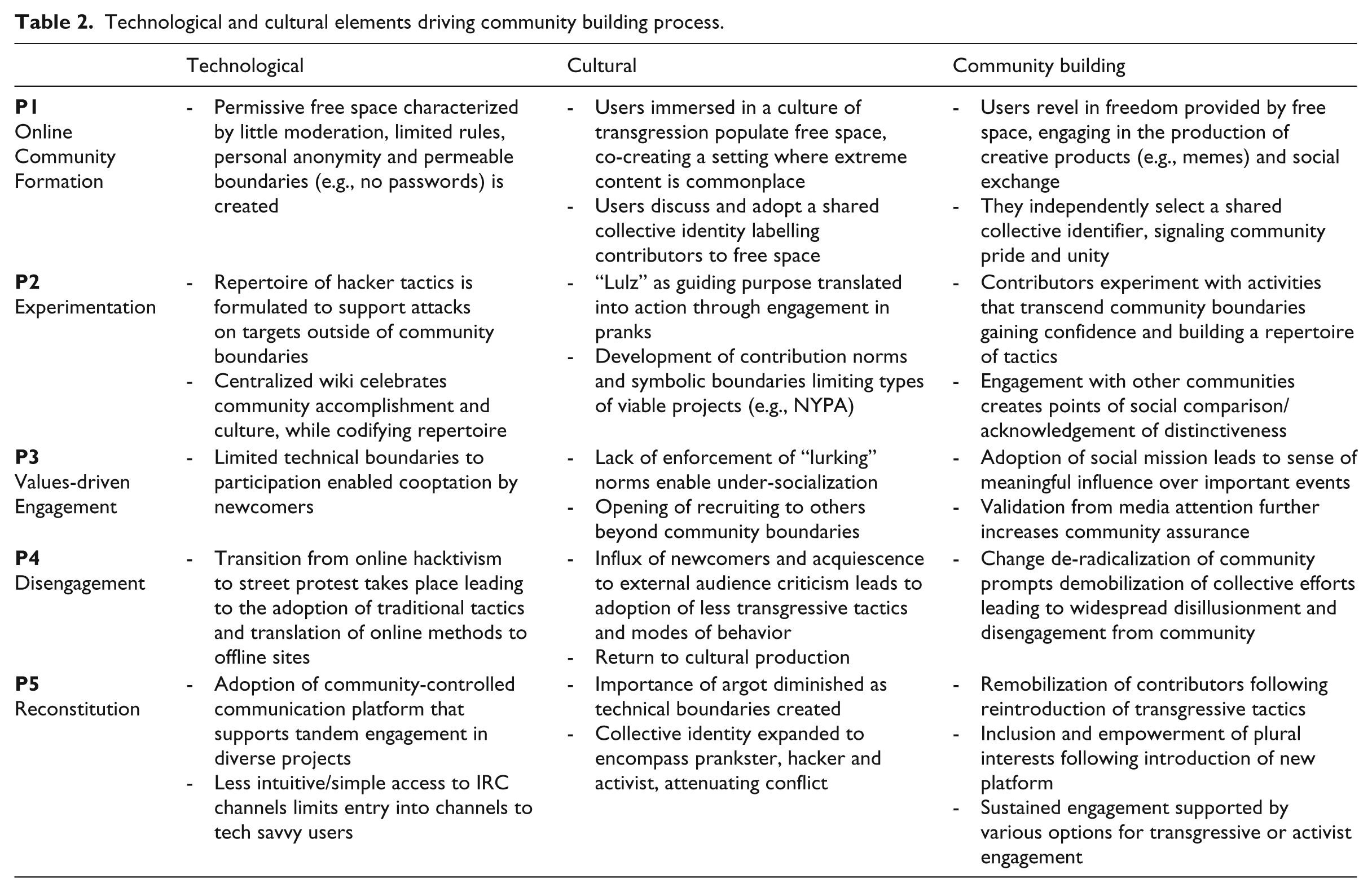
As Figure 3 illustrates, the Anonymous community underwent several transitions that title the various phases of the preceding chronology. Within each phase, interdependent action and response sequences built normative and technical aspects of the community enabling a transition to a subsequent phase. As the community developed, it entered a cycle that began with experimentation, was followed by engagement with external audiences, then disengagement and eventual reconstitution into a new version of the same community that took into account any pitfalls experienced during the community building process. At the point the community might stabilize and not continue experimentation but, if there is additional contributor influx or pending concerns over aspects of the community, a new experimentation phase might be triggered. In Anonymous, experimentation with other modes of interaction, tools and cultural elements continued even after the adoption of an organizing platform that allowed for the integration of plural interests.
The process outlined in the model (Figure 3) begins with the creation of what other studies of community building have referred to as a “free space” (Polletta & Kretschmer, 1999; Rao & Dutta, 2012), that was itself prompted by the frustration of the founder with existing alternative interaction spaces that by not allowing, through programming, for anonymous usernames led to reputation-driven contributions. By introducing a novel technological solution to address his frustration in the form of a highly permissive cyberspace (Calhoun, 1991), the founder inadvertently attracted those seeking a place where they could express themselves freely and investigate new ways of doing things without risking harm to their reputations. Technology in the form of the programmed space and cultural elements, transposed and imprinted (Marquis & Tilcsik, 2013) by those who populated the site enriched the space, made it even more distinct from other available options, and triggered a community building process. This distinctiveness is collectively expressed in the form of a collective identifier that unites the community under a single umbrella (e.g., Anonymous) and bookends the formation part of the process.
Once formed, the community enters a cycle of experimentation characterized by activities that define the value system and boundaries of the community. Contributors begin testing boundaries as they seek to understand this new space and set a tone for the activities and interactions that will come to define it. They use the site as a “cultural laboratory” (Melucci, 1989), developing a distinct taxonomy (e.g., argot deployed by contributors), rituals (e.g., sharing of cat memes on Saturdays), and other components of a culturally enriched domain. By allowing them to remain anonymous, the technology deployed during the formation phase supported contributor divestment from reputational concerns that might otherwise temper experimentation with extreme content and introduction of taboo cultural elements (Coleman, 2012). Calls to extend experimentation outside the boundaries of community soon followed, driven by increasingly boisterous and hyper-masculine contributors that had gained confidence from the community’s rapid growth. As they step outside the boundaries of their cultural laboratory, contributors begin to translate the extreme nature of their shared space into acts that showcase their unconventionality (Debord, 1967). In combination, their growing skills with technology and increasingly transgressive culture led them to seek out greater challenges and drive the community building process past existing boundaries in much the same way as other communities seeking rights and to address injustices had in the past.
Contributors began to see themselves as guardians of their newfound domain and discuss injustices and possible outlets for activism (Figure 1), similar to the way hackers had in the past (Levy, 1994). This ethic became increasingly entrenched, becoming imprinted in the community and a driving force for further repertoire development and experimentation. These discussions provided the enabling condition for another transition: triggered by an event judged as an affront to their hacker ethic, the community would seek “changes in social norms, behaviors, and ways of thinking among a public that extends beyond movement constituents or beneficiaries” (Staggenborg, 1998, p. 341). That is, the community transitioned from being largely insular and recreational to becoming activist and externally focused on asserting their values through collective action. These efforts were validated and reinforced by audiences that supported their efforts and encouraged more engagement.
Negative audience reactions to transgressive tactics and the influx of newcomers that were not fully immersed in the cultural milieu nor familiar with the repertoire development in the experimentation phase, however, led to a schism within the community. This, in turn, led to a disengagement cycle characterized by the de-radicalization and eventual demobilization of the community. The community lay in abeyance (Taylor, 1989) as contributors became disillusioned with their engagement in activism and retreated to their free space. The community was catalyzed once again after several months of inactivity by an attack on an ally and calls for re-engagement in the community free space. That is, the community became re-engaged by an attack on a site close to their free space and, notably, a target that advanced the ethic to which they had become attached.
The community transitioned once again, leveraging the affordances of the online environment and synchronous communication tools that they had full control over, to support reconstitution. This reconstitution did not simply replicate the form that had fallen into abeyance, but was programmed to ensure that the failures of the past did not recur. Anonymous developed a new purpose that enabled the community to accommodate “hacktivism,” traditional protest, and the original recreational purpose of the community under a single, virtual roof. As such, similar to architects who embraced modernism as a “big tent,” the online environment created conditions in which pluralism was embraced to resolve and prevent future conflict and allow for sustainable engagement (Jones, Maoret, Massa, & Svejenova, 2012).
Ultimately, the community building process detailed here reveals that community building did not lead to the formation of a monolithic community united in shared ideology and space. Instead, by leveraging technology Anonymous created a cyberspace that accommodated not only plural purposes but rapid shifts in interests that scholars have noted characterize modern collective action (Earl & Kimport, 2011). What is captured in the process model (Figure 3) is the building of a community that is sustainable because it is adaptable to fickle interests and broad enough in its collective identity to accommodate plurality. Anonymous, therefore, only became actualized as a community when, driven by a culture of transgression, they engaged in experiments with new ways of behaving, organizing and causing havoc that eventually led to a technological solution (Table 2). They settled on a purpose when they realized that they were stable and viable in the long term, using their technological prowess to include anyone who wished to contribute.
Discussion
By providing a rare examination of the building of an online community this paper elaborates theory around how technology-enabled individuals immersed in transgressive cultures can engender novel paths to sustainable community engagement. It goes beyond examining how online organizing is faster, cheaper and more flexible to reveal how the technological and cultural affordances and encumbrances of the online environment can produce qualitatively different development trajectories than those in extant research. In doing so, it infuses community building research with an important emphasis on the role of the “techno-cultural,” highlighting how building and maintenance processes are shaped and shape mutually contingent technologies and cultures.
Contributions to community building
This study contributes to the study of community building processes in several ways. First, while most studies of community building capture communities empirically when they have already settled upon a guiding purpose, developed stable memberships and access to resources, this study captures the development of the community from its very beginning. Because it captures the earliest rumblings of the community, the study allows one to extrapolate how the community’s purpose shifts, how technology and culture interact to influence development, and, ultimately, how community building and the path to sustainability begin and become viable. While historical cases that saturate the community building literature show how exogenous triggers activate existing ties and initiate cycles of engagement (e.g., Gould, 1991; Morris, 1986), this study complements the literature by connecting the values, technologies and key decisions made during the formation of the community to those that inform subsequent events relevant to its establishment: the transcendence of boundaries, engagement in action driven by core community values, etc. By doing so, the study lends support to the notion that founding imprints can be changed during “sensitive periods” (Marquis & Tilcsik, 2013) that occur several times during the building process. In fact, these sensitive periods were facilitated by decisions made at the inception of the community. For instance, Poole’s wish to create a community for Japanese animation fans was thwarted by his decision to make the boundaries of the community permeable and thus vulnerable to imprints from new cohorts.
Second, this study adds nuance to extant conceptualizations that have typically characterized community building processes as a gradual and undeviating aggregation of numbers, influence and unison in purpose over time (e.g., Morris, 1986; Rao & Dutta, 2012). Instead, this study, in part because it captures the community not only longitudinally but prior to adoption of a cohesive, shared purpose, shows the process as contentious and iterative. Anonymous did not follow a well-trodden cycle of protest, producing an increasingly bolstered community that added contributors reliably, adopted a single, cohesive collective identity at the onset or relied on a single free space throughout its existence. In fact, prior to the adoption of a stable purpose and platform for organizing, Anonymous experimented with different guiding purposes and adopted different collective identities, noting the gain and loss of influence by factions within the community and severe lulls in contribution. In fact, the concept of abeyance, which has been used to describe what happens to movements after they achieve or fail to live up to stated purposes (Taylor, 1989), expounds the lull Anonymous experienced following its first engagement in activism. Moreover, it is interesting to note that, in this study, fully inclusive, broad-based sustainability came only once lessons learned from demobilization were used to redesign the means through which contributors collaborated. Once the community was reconstituted, attention was paid, therefore, not to full-scale re-mobilization and movement formation (see Tilly, 1978), but to the maintenance of systems that support continuous involvement, ensuring continuous, enduring engagement in actions that supported community continuity. By capturing the process underlying how this solution was found and implemented, this study highlights the importance of failures in generating learning cycles that enable the long-term resilience of a community.
Third, by acknowledging the shifts in influence between different factions this study avoids capturing a community as monolithic and as united throughout the building process. Instead, gains in influence over a guiding purpose for new community members often came at the expense of established community members that were left scrambling for relevance. While extant studies emphasize the guidance of leaders or spokespeople in ensuring adherence to a guiding purpose (Morris & Staggenborg, 2008), in the non-hierarchical community presented here, influence over purpose flowed from one faction to another relatively easily. Importantly, this study finds that even without formal leadership or consensus over a shared purpose, communities can become established agents of social change. Anonymous developed a platform that enabled the community to accommodate hacktivism, traditional protest, and the original recreational purpose of the community. As such, similar to architects that embraced modernism as a “big tent” allowing for the coexistence of disparate styles within one moniker (Jones et al., 2012), the use of channels created conditions in which pluralism was embraced to resolve and prevent future conflict. It is interesting to consider that permeability in boundaries without inclusiveness may have been untenable and that Anonymous may have eventually come to realize that it had no means to disrupt extreme gains and losses in participation without embracing a more plural ethic.
Interestingly, whereas most communities that become involved in activism become formalized and tend to become social movement organizations, Anonymous settled for a different form of organizing to allow individuals to participate in what Polletta (2002) referred to as an “endless” meeting. Unlike formal organizations that disperse once interest in a cause abates, Anonymous remains active, with an unremitting inflow and outflow of projects—a “shopping mall” for different activism and recreational outlets. Importantly, this negates the need for a whole new group of social actors to be mobilized every time a new cause musters attention. Instead of focusing on championing a single cause and becoming isomorphic with traditional community-driven efforts, Anonymous challenged the notion that groups only survive at the expense of their most radical factions (Meyer & Lupo, 2010) because it showed that it is possible to become an incubation and support system for multiple activist causes and radical pranks simultaneously. It became a platform for broad-based participation rather than an activist group focused on a single cause.
Contributions to research on online organizing
By examining the formation, dissolution and reconstitution of an online community, this study explicates how affordances and encumbrances of the online environment can influence social processes. It contributes to the study of how both the technological and cultural elements that constitute online environments entwine to produce conditions that advance or preclude community building in several ways. First, recent studies have focused on the importance of “free spaces”—small-scale settings within a community or movement that are removed from the direct control of dominant groups, are voluntarily participated in, and generate the cultural challenge that precedes or accompanies political mobilization (Polletta & Kretschmer, 1999), to community building and maintenance efforts (e.g., Futrell & Simi, 2004; Rao & Dutta, 2012). This study reveals that free spaces (4chan, /b forum) that exist on the Internet can differ significantly from those that have been portrayed in past studies such as church basements (Morris, 1986) and family homes (Futrell & Simi, 2004). They are programmed and can be reprogrammed with different parameters, allowing those in control of the space to manipulate several aspects relevant to how interactions take places and who participates in them. Importantly, and as is shown in the reconstitution phase of the community building sequence, online free spaces can be designed to fit the needs and concerns of existing communities in ways that physical spaces cannot. That is, although some behavior can be controlled through the manipulation and design of physical space, this effect is accentuated when space is fully programmable. Thus, the freedom to develop a unique culture (Melucci, 1989), including unique artifacts, ideas and values, was a function of the creation of online spaces (e.g., 4chan, Anonnet, Anonops). Because they were malleable and could be reprogrammed to suit changing needs of the community, secure in that they allowed for anonymity and the use of argot, and playful because they lacked a predefined structure, requiring the imagination of users, Anons adopted and modified “space.”
Second, and related to the ability to manipulate space, was the malleability of identities. Correll’s (1995) study of an online “Lesbian Café” showcases how online spaces can provide a sense of safety and solidarity similar to what is experienced by those who attend physical gatherings. The café in Correll’s study, as its name indicates, was designed to emulate an actual café. Individuals posted using their actual names and could follow threads of conversations for months at a time. In the case of Anonymous, as its name implies, anonymity, i.e., the lack of personal identifiers, is built into many forms of computer-mediated communications, was designed into the website as a feature (Bernstein et al., 2011). Users without personal identifiers could post and exchange messages liberally, with little fear of reprisal from powerful actors, meaning that individuals felt free to adopt the deviant forms of behavior crucial to engagement in pranks. The experience of freedom and the unique culture that emerged because of this freedom was, as such, afforded by technology. And developments in technology emerged from free experimentation. By capturing this mutually dependent interaction between technology and culture, this study supports the notion that technologies and cultural elements, within and outside the Internet, are entwined with and integral to social processes (Leonardi & Barley, 2008).
In addition, by allowing users to contribute without aggregating reputations, Anonymous challenges extant notions of why individuals contribute to social causes. In contrast to Chong (2014), who argues that self-interested “reputational concerns” motivate participation, the fact that most members in Anonymous maintained their anonymity throughout the conflict casts doubt on some studies that focus on self-aggrandizement as a principal driver of mobilization and involvement in social protest. Importantly, without accruing individual reputations, or any other individual incentives, only those who were willing to take on a collective identity thrived. Anonymous, as collective identity buttressed by individual anonymity, trumped individual ambitions and allowed community values (e.g., Lulz, freedom of expression) to remain central rather than becoming marginal as a result of formalization (Zald & Ash, 1966). Ultimately, the malleability of identity made possible by technology and enforced by anonymity norms characterizes much of what drives continued interest.
Limitations and future research
Similar to other qualitative, inductive studies, I set out to build and elaborate theory from a single case and am, as such, careful to generalize these findings to other contexts. For instance, my focus has been on online communities and their path to sustainable engagement—which may differ from more traditional paths taken by communities that exist only in physical space. I contend, however, that understanding the role of emergent technological and cultural elements of the online environment is already crucial to understanding a large part of social change efforts in the developed world. Examinations of other online communities or even hybrid communities that organize only partly on the Internet should yield additional findings that solidify and bound the assertions made in this exploratory field study. All in all, the case presented here includes some non-statistical, naturalistic generalizations, because mechanisms and construct relationships elaborated in our theoretical model may be applied to and be elaborated elsewhere.
The research presented here was constrained by the fact that Anonymous continues to innovate and change after the conclusion of data collection. This provides researchers interested in extending the findings presented here with several opportunities for future study. We still know little, for instance, about what happens when alternative pluralistic platforms compete for contributor attention and when new, more radical, forums emerge. I also did not examine how the organizing practices and repertoires developed by contributors change over time and look forward to studies that will capture Anonymous from several theoretical perspectives.
Conclusion
By highlighting how online communities become enduring social actors, this paper elaborates theory on how technological and cultural elements influence shifts in purpose and a community’s ability to endure, remaining resilient to schisms and fluctuations in contribution. We shed light on the process by which online communities, settings increasingly critical to social innovation and change, are qualitatively different from their offline counterparts by capturing how a community that was transgressive and self-referential was able to retain its radical edge even after exposure to strong legitimizing forces and lulls in contribution threatened its existence. It did so by leveraging technology to reconstitute itself and embracing pluralism—a lesson that can be generalized to organizational and political settings unhinged by divisive conflict. We enrich conversations about the nature and possible paths to sustainable community, extending the spectrum of options for organizing that online and offline communities can select. We encourage research that continues to examine online community building across contexts, as well as the role of technologies and online cultures in the fomenting of social action and in supporting the introduction of social innovation.
Footnotes
Funding
This research received no specific grant from any funding agency in the public, commercial, or not-for-profit sectors.