




Abstract
In this article, we discuss temporal work and temporal politics situated between groups with different temporal orientations, arguing that attention needs to be paid to covert and unarticulated silent politics during temporal work. Drawing on a case study of a management consultancy project to redesign public health care, we explain how unarticulated temporal interests and orientations shape the construction of problems, which, in turn, legitimate tasks and time frames. We also show how task and time frames are temporarily fixed and imposed through boundary objects, and the way these may then be reinterpreted and co-opted to deflect pressure to change. Thus, we argue, unarticulated, covert and political temporal inter-dynamics produce expedient provisional temporal settlements, which resolve conflict in the short term, while perpetuating it in the longer run.
Keywords
Introduction
There is a nascent discussion in organization studies of temporal politics and temporal work (Granqvist & Gustafsson, 2016; Kaplan & Orlikowski, 2013; Raaijmakers, Vermuelen, Meeus, & Zietsma, 2015; Reinecke & Ansari, 2015; Tukiainen & Granqvist, 2016). Work within and between organizations involves social and occupational groups that often conceive of time and temporality in different ways. Yet little organizational research has examined the way they enact and manipulate temporal conceptions (Granqvist & Gustafsson, 2016) or how related temporal conflict and politics occur, or are resolved (Reinecke & Ansari, 2015). To this end, the concept of temporal work is helpful, defined as ‘negotiating and resolving tensions among different understandings of what has happened in the past, what is at stake in the present, and what might emerge in the future’ (Kaplan & Orlikowski, 2013, p. 965). However, we question whether and how temporal tensions are negotiated and resolved, suggesting instead that temporal work may be covert and unarticulated.
Drawing on an empirical case study of a management consultancy project involving diverse professional and occupational groups, we discuss the silent politics of temporal work. By this we mean covert or unarticulated political work to construct, defend, challenge or interpret conceptions of time and temporality in organizations. We examine how groups involved in a project to redesign public health care drew upon and constructed time and temporality. We found actors with different temporal orientations engaging in temporal work to construct problems in ways that legitimated their preferred solutions and time frames, reflecting unarticulated temporal orientations and related interests.
Examining these interactions revealed the way project task and time frames were fixed and imposed through boundary objects, rather than openly discussed or negotiated. We also found that change recipients responded to this mode of imposition by silently reinterpreting and covertly co-opting boundary objects to deflect pressure to change. Consequently, we explain how the silent inter-dynamics of temporal work produced an expedient provisional temporal settlement, which resolved temporal politics and conflict during a short-term project but unravelled in the longer run.
The paper is structured as follows. First, we introduce theory about time, temporality, temporal work and politics in organizations, before then introducing related literature on boundary objects, which we use to operationalize and analyse our case. We next explain why a management consulting project in health care provided an ideal case with which to examine the silent politics of temporal work. We discuss the qualitative methods we used to gather, analyse and theorize our data, before presenting our empirical case study. Finally, we highlight our theoretical contribution and its implications. We argue that attention needs to be paid to the way backstage temporal orientations silently frame political temporal work, how boundary objects are used to impose task and time frames, and the resulting expedient settlements resolving conflict in the short term. We speculate that our model may explain other consultancy projects, the limited success of public services reforms, and further complex problems involving divergent temporal orientations and interests.
Temporal Politics and Temporal Work
Social and occupational groups relate to time in different ways, drawing on objective, quantitative clock time or qualitative time, punctuated by irregular, subjectively defined events and activities. Management commonly involves measuring activities and imposing quantitative time deadlines to increase efficiency and control in organizations (Hall, 1983; Lawrence & Lorsch, 1967; Zerubavel, 1981). Conversely, professionals, like scientists, doctors or academics doing complex or innovative work, usually conceive of their work in more indeterminate, irregular and open-ended terms (Granqvist & Gustafsson, 2016; McGivern & Dopson, 2010; Orlikowski & Yates, 2002). Short and open time perspectives frame understanding of activities and behaviour in different ways (Bluedorn, 2002; Lawrence & Lorsch, 1967; Zerubavel, 1981). So, how do groups with divergent temporal orientations, defined as the intended time durations for carrying out planned activities (Das, 1987, 2006), collaborate when they understand time and temporality, and therefore organizational behaviour, in different ways?
An organizational literature on entrainment explains ‘the process by which rhythmic patterns come into alignment and then behave in a parallel fashion’ (Bluedorn, 2002, p. 147). Imposing deadlines (for example, the end of the financial year) may entrain activities and lead actors to switch from open to closed temporal orientations, focusing on the immediate and near present. However, the entrainment literature overlooks the difficulty of changing underlying temporal orientations (Orlikowski & Yates, 2002), which often involves temporal conflict, politics and resistance to change.
Das (1987) suggests that temporal politics may be unconscious or covert. Referring to ‘the silent politics of time’, he describes actors ‘silently involved in a tussle of innate preferences for long or short planning periods… adjusting the planning objectives to conform to these temporal preferences but without any clear awareness of it’ (Das, 1987, p. 208). Das (2006) later discusses purposeful temporal work, during a strategic alliance, where collaborations were temporary, risky and involving incompatible goals. Here actors covertly constructed short time frames and behaved opportunistically to produce quick results. However, Das’s brief discussion of the silent politics of time does not elaborate or extend this concept in ways applicable to a wider range of contexts.
Other scholars argue that actors may resist the imposition of short time frames that construct phenomena simplistically (Bakker, Boroşs, Kenis, & Oerlemans, 2013; Hall, 1983) or overlook complex, broader and longer-term factors (Huy, 2001; Reinecke & Ansari, 2015; Slawinski & Bansal, 2015). For example, Reinecke and Ansari (2015) describe temporal conflicts over the monitoring of Fairtrade products in quantitative time, linked to pressure to demonstrate quick results, which undermined indeterminate, longer-term processes leading to sustainable development.
How organizations and the problems they face are constructed also affects the legitimacy of time frames and related approaches to organizational change. Constructing urgent and critical problems legitimates a fast response in a short time frame and senior managers or external consultants imposing change to produce quick, quantitative results. Conversely, constructing complex problems, involving diverse actors with different perspectives, legitimates dialogue in a longer, qualitative time frame (Grint, 2005; Huy, 2001) because engagement, mutual understanding and co-creation of solutions are necessary for their implementation (Bartunek, Rousseau, Rudolph, & Depalma, 2006; Thomas, Sargent, & Hardy, 2011).
Kaplan and Orlikowski (2013) explain how through temporal work actors negotiate temporal settlements, which are coherent with wider understandings, plausible in context and politically acceptable to actors involved, enabling progress from arguing or debating meanings to implementing change. However, they note temporal settlements may only be ‘settled because they are stabilized enough to make it possible to take concrete steps and provisional because they are context specific, limited in time, and open to later reinterpretation’ (Kaplan & Orlikowski, 2013, p. 978). Temporal settlements may therefore break down, producing further cycles of temporal work.
Granqvist and Gustafsson (2016, p. 1012) define institutional temporal work as ‘purposeful actions by which actors construct, navigate and capitalise on timing norms in their attempts to change institutions’. Rather than constructing temporal work in terms of past, present and future orientations (Kaplan & Orlikowski, 2013), Granqvist and Gustafsson (2016) analyse how temporal work affects time frames and temporal pace. For example, through the work of constructing urgency, establishing ‘windows of opportunity’, and entraining organizational temporal norms with new government policy, actors changed institutionalized temporal norms in a university.
Whereas Kaplan and Orlikowski (2013) describe temporal work involving open negotiation and resolution of differing understandings about temporality, Granqvist and Gustafsson emphasize that temporal work may be more covert. They show actors pre-empting resistance to temporal change through ‘speed and exclusivity’ using ‘power, speed and secrecy’ to overwhelm opposition (Granqvist & Gustafsson, 2016, p. 1027). Indeed, conflictual relations during the negotiation of organizational change may produce covert and calculating forms of engagement (Thomas et al., 2011). Relatedly, Raaijmakers et al. (2015) found that it paid off for managers facing complex competing demands to covertly delay change, creating time to resolve differences, neutralize opposition, challenge coercive pressures and understand unfolding situations.
In sum, while covert and unarticulated silent politics are implicit in some descriptions of temporal work, we argue that they require more explicit analytical focus. Accordingly, we address the following research question: How do the dynamics of temporal work and politics involving actors with divergent temporal orientations manifest themselves in organizations?
Analysing Time and Temporality through Boundary Objects
Ancona, Okhysen and Perlow (2001) suggest that focusing on boundary objects may be a useful way to operationalize the study of time and temporality in organizations. Boundary objects are physical objects or abstract concepts, which serve as temporary or permanent bridges between intersecting social worlds. If boundary objects are available for discussion, and can be interpreted flexibly by different groups, they may foster common understanding and collaboration (Bechky, 2003a, 2003b; Kaplan, 2011; Nicolini, Mengis, & Swan, 2012). Temporal boundary objects, such as timelines (Yakura, 2002) or project plans (Tukiainen & Granqvist, 2016), may similarly prompt dialogue about time and temporality and facilitate collaboration (Ancona et al., 2001).
Yet boundary objects may also impose knowledge and meaning on communities, so subject to struggles for occupational jurisdiction (Bechky, 2003a, 2003b; McGivern & Dopson, 2010; Nicolini et al., 2012). For example, Bechky (2003a, 2003b) describes engineers using technical drawings as boundary objects to enforce their authority and jurisdiction over competing occupational groups. These engineers invoked abstract interpretive expertise to impose their preferred interpretations of objects and collaborative activity on other groups.
O’Mahoney, Heusinkveld and Wright (2013) describe procurement managers using a tender form containing pre-specified criteria to commodify the knowledge of management consultants tendering for work. They describe the tender form as a ‘self-confirming discursive boundary object, which integrates and disciplines disparate views of the world’ and ‘renders irrelevant forms of knowledge which are not specified’ (O’Mahoney et al., 2013, p. 229). By forcing consultants to use this boundary object, procurement managers imposed their preferred way of constructing knowledge and hence jurisdiction over consultants.
Discussion of temporal boundary objects in the management and organizational literature (Ancona et al., 2001; Tukiainen & Granqvist, 2016; Yakura, 2002) has focused on the way they facilitate collaboration between actors with different temporal orientations. Yet Huvila (2011, p. 2536) suggest that creating and shaping a boundary object is ‘always an attempt to make a hegemonic intervention’. Nicolini et al. (2012) note that, while conflict is backgrounded, analysing boundary objects may highlight interests related to forms of knowing. We therefore need more explanation of the political use of temporal boundary objects. Accordingly, we examine how boundary objects can be used to impose temporal orientations and time frames, and temporal politics that may result.
The Empirical Context of our Study
This paper is based on a case study of a short-term management consultancy project in a healthcare setting undergoing major organizational change. Efficient use of time is inherent to much consultancy work, which epitomizes a ‘time is money’ temporal orientation, where speed and billing time are a predominant measure of success (Kieser, 2002; Yakura, 2002). By contrast, healthcare organizations are complex, slow-changing and contain diverse powerful professional actors with differing temporal orientations (Denis, Dompierre, Langley, & Rouleau, 2011; Ferlie, Fitzgerald, McGivern, Dopson, & Bennett, 2013). Clinicians and healthcare managers may spend decades in their roles and organizations and therefore have long-term and historical temporal orientations (Zerubavel, 1981). Our case therefore provides an ideal setting in which to examine temporal work and politics involving powerful actors with different temporal orientations.
Management consultancies are prototypical temporary or project-based organizations (Bakker et al., 2013; Lundin & Söderholm, 1995). Lundin and Söderholm (1995) argue that bracketing and guarding task and time boundaries is fundamental work in successful projects, while attacking task and time boundaries and associated boundary-setting activities is a key mechanism for derailing projects. So, significant temporal work may revolve around the construction and maintenance of task and time boundaries during projects. Such temporal work may involve both overt and covert politics (van Marrewijk, Ybema, Smits, & Clegg, 2016).
Failure to complete a project on time can be disastrous for projects, with negative consequences for project managers’ careers. Project managers may therefore be more focused on completing projects on time than whether projects ultimately contribute to longer-term business outcomes (Lundin & Söderholm, 1995). Moreover, while a sense of urgency may elicit flexible behaviour enabling the completion of short-term projects on time, it may also focus participants on their own self-interests and objectives, particularly if they do not anticipate working with project partners again (Ligthart, Oerlemans, & Noordehaven, 2016).
Tavory and Elisasoph (2013) argue that project managers’ simultaneously relate to delivering short-term projects and their longer-term career trajectories. Where the interests of project and project managers’ career trajectories diverge, we may see covert political temporal work to protect careers, perhaps at the expense of longer-term project outcomes. So, as Bloomfield and Danieli (1995, p. 41) note, ‘the treadmill of project management, with its injunction to deliver on time… can become an end in itself and thereby displace the original objectives’.
Similarly, consultants’ use of time has been found to create tensions between the project outcomes consultants and clients aim to achieve (Kieser, 2002; Mintzberg, 2004). Thus there is a risk that when consultants leave projects, ‘everything collapses rather rapidly like a house of cards’ (Czarniawska-Joerges, 1990, p. 149). We examine these ideas, in our empirical project case study below.
Research Methods
The case study
Qualitative case studies are an appropriate research methodology when exploring how and why questions in novel settings, facilitating the development of new theory (Eisenhardt, 1989), including research examining time and temporality in organizations (Langley, Smallman, Tsoukas, & Van de Ven, 2013). This article is based upon a qualitative case study of a global management consultancy, which we refer to using the pseudonym Elmhouse Consulting, and a project it ran in the English National Health Service (NHS). The case study was part of a wider project examining how healthcare managers use management knowledge (Dopson et al., 2013).
Policy context
In the context of the 2008 global financial crisis and consequent strain on government finances, the English Department of Health commissioned a management consultancy to advise how to make major efficiency savings in the NHS. The consultancy published its recommendations in March 2009. In May 2009, the Department of Health then announced that it was planning an efficiency savings programme and in December 2009 informed NHS Chief Executives they needed to produce initial efficiency savings plans by April 2010. In March 2010, the Quality Innovation, Productivity and Prevention (QIPP) programme was formally launched, aiming to make £20 billion worth of efficiency savings (from an overall NHS budget then of £106 billion) during the period 2011–14; 20% of these efficiency savings were to be made by redesigning primary health care.
During our empirical research, Strategic Health Authorities (SHAs) were responsible for oversight of NHS services across large geographical regions and performance-managing NHS Primary Care Trusts (PCTs), which commissioned (purchased) and managed local primary healthcare services. The Department of Health set a deadline of September 2010 for SHAs to submit plans to redesign primary health care to make efficiency savings. Most SHAs hired management consultancies to advise them how to do so (National Audit Office, 2011). We note that midway through the empirical project we studied, the government announced that SHAs and PCTs would be abolished and replaced with new NHS organizations performing similar roles. We show a timeline of the events surrounding the project in Figure 1.
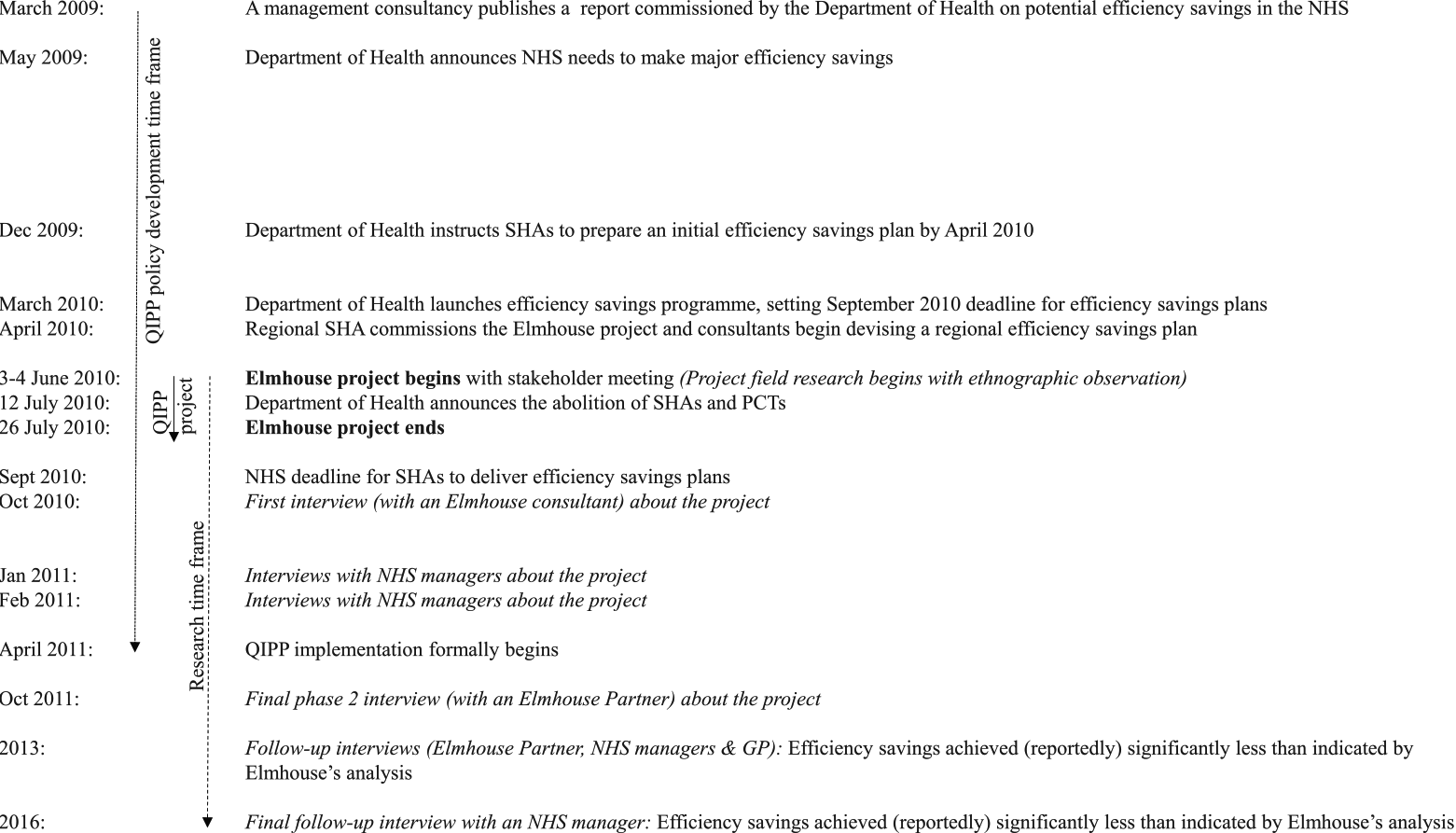
Timeline of project-related events.
Data collection
Our case study involved two main phases of data collection. First, in March and April in 2010, we conducted a day of ethnographic observation in an Elmhouse office, where we observed and informally talked with consultants to sensitize ourselves to issues affecting their work and use of knowledge to explore in formal interviews. We then conducted, recorded and transcribed face-to-face interviews with nine consultants and an Elmhouse advisor, asking questions about consultants’ careers, work, experiences and use of management knowledge.
We next conducted field research (June 2010 to October 2011) on an Elmhouse project commissioned by an SHA to redesign regional public healthcare services across the PCTs managed by the SHA. We focused on one PCT as an exemplar of project activity. Data collection during this second phase involved ethnographic observation of an Elmhouse region-wide project meeting for NHS managers (in June 2010). During this meeting, we observed how Elmhouse consultants presented their project rationale and plan, provided organizational redesign and change management training, and the way NHS managers reacted. We also informally discussed the project with consultants and NHS managers. We analysed documentation relating to the project too, including national QIPP documentation, information about the SHA’s and PCT’s context, plans and objectives, an Elmhouse project presentation and time plan (printed in a booklet), and final PowerPoint-based project report.
Our main source of project data was semi-structured formal interviews. We conducted 19 interviews with a range of stakeholders involved in the project about their experiences and perceptions of the project: three SHA managers; five PCT managers, a general practitioner (GP or primary care physician), two clinicians (including a GP) in NHS managerial roles, two Elmhouse consultants and an Elmhouse partner. In 2013, we conducted follow-up interviews with the Elmhouse partner, a GP and two PCT managers to assess the project’s longer-term impact; whether, how and why the project did or did not achieve its stated aims. In 2016, we conducted a final interview with a PCT manager, discussing the projects’ long-term impact and to validate our findings and theoretical explanation.
Data analysis and theorization
To manage analysis of our complex and divergent data, we initially developed an empirical project narrative (Langley, 1999), involving a sequence of events over time, different actors, evaluative frames and indicators of content, context and underlying generative mechanisms and structures (Pentland, 1999). We then thematically analysed and compared interviewees’ interpretations of events and phases in this narrative (Langley, 1999), looking for patterns of convergence or divergence and noting similarities and inconsistencies between accounts (Gioia & Chittipeddi, 1991). We identified three main stakeholder groups (combining groups and individuals) pursuing distinct forms of temporal work: Elmhouse management consultants (Elmhouse consultants hereafter); senior strategic SHA managers (SHA managers hereafter); and operational managers and clinicians based in primary health care (PCT managers and clinicians hereafter).
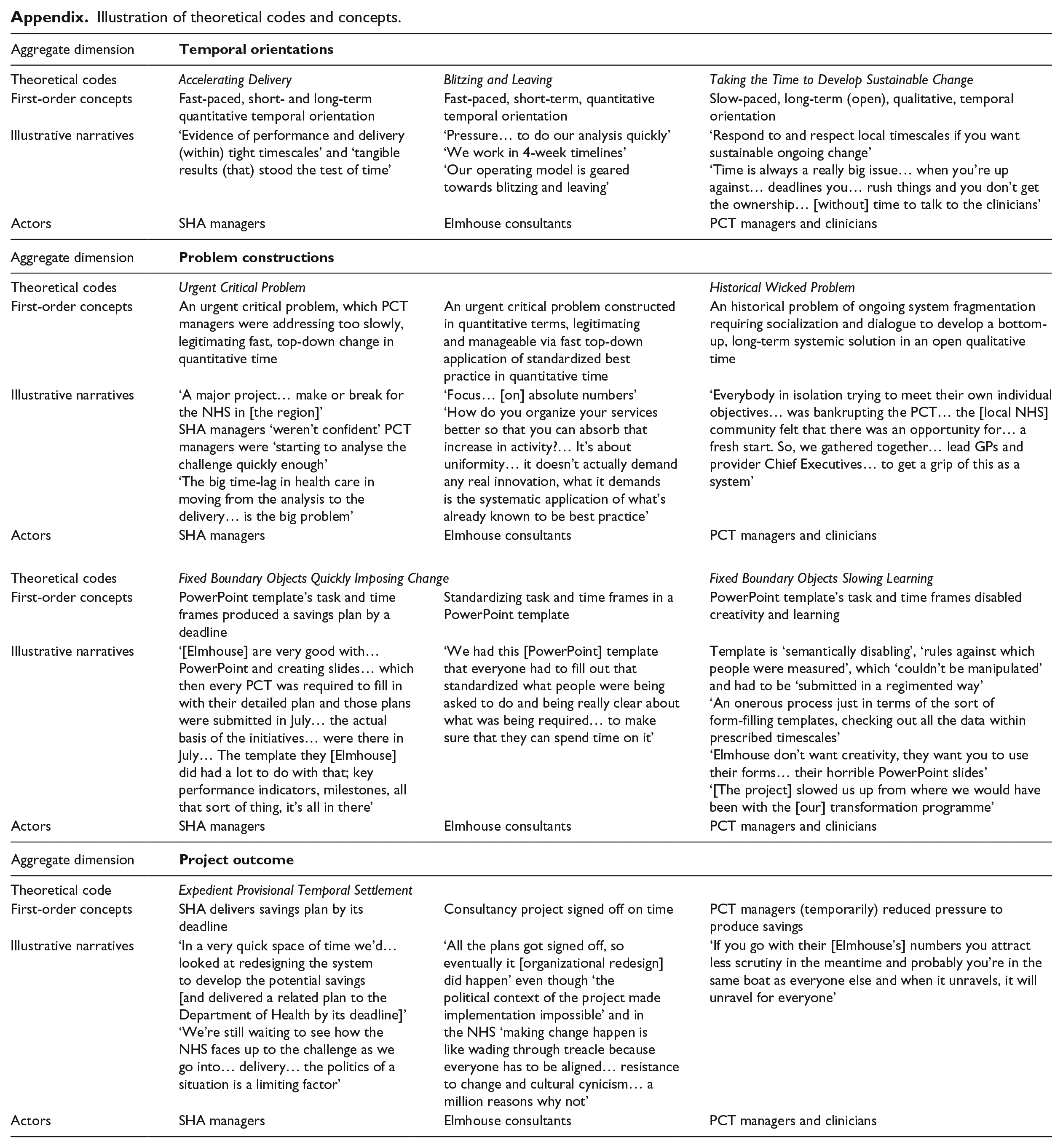
Our theorization was iterative (Eisenhardt, 1989; Langley, 1999), moving between theory and data to develop theory explaining our case. Our empirical research was initially framed by theory about management knowledge, research and evidence in health care, reflecting our broader research project (Dopson et al., 2013). However, thematic data analysis highlighted time frames and temporal orientations affecting management consultants’ and healthcare managers’ different views of knowledge, the project and its outcome. We then re-analysed data focusing on time and temporality. This highlighted groups’ distinct temporal orientations, shown in the Appendix, where we illustrate first-order constructs and theoretical codes with narrative interview extracts (Gioia, Corley, & Hamilton, 2012; Langley, 1999), and related ways of constructing problems, legitimating solutions and time frames.
We next examined groups’ interactions, drawing on Kaplan and Orlikowski’s (2013) theory about temporal work. Puzzling empirical data can problematize pre-existing theory, prompting the development of new theory (Alvesson & Karreman, 2007). Accordingly, we were intrigued about two aspects of our data. First, why there was no overt dialogue or attempt to resolve the diverse parties’ different temporal orientations during the project. Where was the temporal work? Second, why did the PCT managers agree to the consultants’ organizational redesign plan, when our data shows they neither fully understood it, nor believed it could be implemented?
These empirical puzzles led us to iteratively reanalyse our data and look to theoretical literature for explanations for unarticulated or ‘silent’ temporal work. While we found brief references to ‘silent politics’ in the literature on temporal orientations (Das, 1987) and to ‘secrecy’ in literature on temporal work (Granqvist & Gustafsson, 2016), these ideas were under-developed and did not fully explain our findings. We therefore enfolded ideas from wider literatures on temporary and project-based organizations (Lundin & Söderholm, 1995; Tavory & Elisasoph, 2013) and boundary objects (Ancona et al., 2001; Bechky, 2003b, 2003a; Huvila, 2011) into our novel theoretical explanation of the silent politics of temporal work.
Findings
We begin by describing the temporal orientations and interests of the three groups involved in the project, which framed their approaches to temporal work.
Temporal orientations
Blitzing and leaving: Consultants’ temporal orientations
Elmhouse consultants likened their work to competing at the Olympic Games, where ‘sometimes you don’t get a gold and get kicked out’ (Elmhouse advisor 10). Consultants typically lasted only two years in the organization. Elmhouse put consultants under ‘high pressure’ (consultant 8) to develop and perform, with performance ‘feedback twice a year, and then after every project’ (consultant 9). This heightened consultants’ awareness of rapid but precarious career trajectories in Elmhouse, producing a fast-paced, short-term temporal orientation, closely tied to project timescales.
‘Time pressure’ and ‘working to tight deadlines’ (consultant 2) affected how consultants diagnosed problems and developed solutions during client projects. They used a Pareto efficient ‘80-20 rule… to get to the 80% answer… in 20% of the time’ (consultant 9). ‘Pressure… to do our analysis quickly’ (consultant 4) also resulted in consultants ‘relying on the Elmhouse model as a way of thinking’ and ‘persuading’ clients to use it because consultants ‘simply haven’t got time to do it any other way’ (consultant 6).
Accordingly, Elmhouse consultants engaged in temporal work to construct and contextualize clients’ problems in ways persuading them that fast-paced, short-term projects provided their solution, drawing on established Elmhouse models and ways of thinking. Consultant 22 noted: ‘We’re not allowed to talk about selling… we talk about the context; we talk about what I think would be required to fix the context.’ Thus, Elmhouse’s unarticulated commercial and temporal imperatives framed its consultants’ advice to clients.
An Elmhouse partner (24) commented that clients ‘tend to use Elmhouse when it’s a very big problem… for as short as possible a time. Indeed, our operating model is geared towards blitzing and leaving.’ Some consultants acknowledged that Elmhouse’s fast pace could be problematic for clients. One noted: ‘Frequently clients have said… [Elmhouse] walk faster than they can run… it’s a huge whirlwind’ (consultant 5). Consultant 22 commented: ‘[Elmhouse] move at an almighty pace and it typically isn’t the pace our NHS clients move at.’ Yet other consultants believed differences in pace reflected consultants’ superior ability compared with clients: ‘One of the big problems you find in the public sector is that they… can’t keep up’ (consultant 23).
We label Elmhouse’s temporal orientation blitzing and leaving, with intensive time pressures, performance management and rapid but precarious career trajectories producing a fast-paced, short-term, quantitative temporal orientation, which affected how consultants constructed and managed projects.
Accelerating delivery: SHA managers’ temporal orientations
SHA managers were accountable to the Department of Health and their temporal orientation reflected the time-pressured measures with which it assessed healthcare performance. An SHA manager (18) noted that their organization’s temporal orientation involved ‘tight timescales’ with ‘focus’ on ‘evidence of performance and delivery’ and ‘tangible results’ which ‘stood the test of time’. Yet SHA managers also noted that ‘the big time-lag in health care is moving from the analysis to the delivery… that’s the big problem’ (SHA manager 13) and ‘we can’t really call it [a project] a success until it’s delivered’ (SHA manager 12).
In sum, SHA managers focused on constructing and providing evidence of short- and long-term delivery and performance in the regional NHS in timely quantitative terms, as well as accelerating the delivery of organizational change. We label SHA managers’ temporal orientation accelerating delivery.
Taking the time to develop sustainable change: PCT managers’ and clinicians’ temporal orientations
PCT managers and clinicians had an open-ended, qualitative temporal orientation. Many had been in their roles for years and their experience framed their view of the project. PCT manager 11, for example, likened health care to ‘a super tanker’ and PCT manager 14 noted that changing a health system involved ‘time and you need to hang around’. PCT manager 25 argued, ‘You have to respond to and respect local timescales if you want sustainable ongoing change.’
The PCT had contractual relationships with local GPs, from whom they commissioned the delivery of primary care, and operational responsibility for implementing organizational change, which affected PCT managers’ temporal orientations. GP 20 similarly argued that developing sustainable change was ‘all about relationships’ and ‘time together’. Another PCT manager (21) cautioned: ‘rush things and you don’t get the ownership’ because developing sustainable change required taking ‘time to talk to the clinicians’.
We label PCT managers’ temporal orientation taking the time to develop sustainable change, involving an open, long-term, qualitative, relational and processual temporal perspective. We illustrate these divergent temporal orientations in the first section of the Appendix.
The project
Constructing project task and time frames
We first examine temporal work establishing the project’s task and time frames, relating to how actors constructed the problem which the project was addressing, its solution, and the time frame necessary for its implementation.
PCT managers were aware of financial pressures on the NHS, which they diagnosed as resulting from historically ‘difficult relationships’ between local PCTs and GPs, with ‘everyone in isolation trying to meet their own individual objectives’ (PCT manager 21). Six months before the Elmhouse project, PCT managers were developing a bottom-up, ‘transformation partnership’ as a solution to this complex systemic problem, involving time-consuming dialogue and negotiation with local stakeholders.
With the Department of Health’s deadline for producing an efficiency savings plan approaching, SHA managers reportedly saw ‘debate and discussion going on for some time… without really reaching a conclusion’ (PCT manager 15). They ‘weren’t confident… [PCT] managers were starting to analyse the challenge quickly enough’ (PCT manager 14). SHA managers saw the problem as ‘make or break for the NHS’ (SHA manager 12), disrupting the way PCTs had previously addressed the problem. The SHA then commissioned Elmhouse for their ‘capacity… to work at a very fast pace… make progress far quicker than we could ever have on our own’ (SHA manager 13).
Here we see the SHA as challenging local clinicians’ and PCT managers’ long-term temporal orientations to increase the pace of change. This was to be secured indirectly; as a knock-on consequence of hiring in a prestigious management consultancy, whose independent analysis and solutions would be quick and difficult to contest, which supported the SHA’s agenda for accelerating delivery. We see this indirect intervention strategy as one element of the SHA’s silently political temporal work.
Elmhouse diagnosed the PCTs’ problem by focusing on ‘numbers’ (PCT manager 15), rather than using qualitative or contextual modes of analysis. They proposed its solution as delivering ‘uniformity’ and ‘systematic application’ (consultant 23) of what Elmhouse considered best practice for organizations such as PCTs. Elmhouse benchmarked local PCTs’ performance against national data and proposed that efficiency savings could be achieved through redesign of care pathways and the application of their ‘golden rules’ for service redesign and ‘prescriptions for change’.
We note Elmhouse’s discourse here, persuasively constructing their analysis in simple, apparently objective, technical and legitimate terms, based on previous successful projects, expert knowledge and global data. Yet, precisely how Elmhouse conducted their analysis and came to their conclusions was complex and only semi-articulated, hence difficult for managers in the client organization to understand or challenge during the short project period. We suggest that Elmhouse’s construction of the local NHS’s problem also silently reflected the consultants’ and SHA clients’ political interests, legitimating a top-down solution deliverable within their short project time frame.
In sum, the project involved actors with divergent constructions of the problem, framed by different career experiences, agendas and temporal orientations. The Department of Health deadline disrupted PCT managers’ and clinicians’ open temporal orientation towards the NHS’s problems, reflecting practical and complex experience of trying to change local clinical services by engaging stakeholders in change processes. The SHA engaged in backstage temporal work, constructing the productivity agenda as an urgent critical problem, driven by an impending NHS funding crisis and related deadline for an efficiency saving plan. This justified the SHA in hiring Elmhouse to analyse the problem and its solution in relatively abstract, quantitative terms, legitimating fast, top-down change.
We illustrate the way the three groups constructed the problem, its solution and necessary time frame in the second section of the Appendix. We label this an ‘urgent critical problem’ requiring a short time frame for SHA managers and consultants and an ‘historical wicked problem’ requiring an open time frame for PCT managers and clinicians.
Fixing the task and time frame in boundary objects
Having constructed their analysis of the NHS’s problem and its solution, Elmhouse then silently fixed the project’s task and time frames in a boundary object, a standardized PowerPoint template. We explain the fixing of task and time frames in this boundary object as another form of silent temporal work.
Elmhouse gave PCT managers a 62-slide PowerPoint template, containing pre-specified tasks, embedded modes for calculating potential efficiency savings and analysing how to implement related changes, and deadlines. PCT managers were tasked with completing the template, drafting service redesign plans using Elmhouse’s ‘golden rules’ and ‘prescriptions for change’ (PCT manager 17), getting agreement to their plans from local stakeholders, and submitting final plans within a 35-working-day timeline. At an initial project meeting, we observed consultants confidently explaining to PCT managers and local clinicians how the project would work.
PCT managers described themselves being initially open to dialogue with Elmhouse and ‘pleased to take advantage of some of Elmhouse’s expertise… to help us unravel some of the information’ (PCT manager 22). PCT manager 11 noted that Elmhouse was an ‘internationally renowned company’ and the project provided a ‘fantastic opportunity to learn something’. Thus, Elmhouse’s reputation for expertise initially provided legitimacy and power to quickly commence a process to change the local NHS.
Yet by the end of the meeting, GP 20 reported ‘the Elmhouse conversation… left a feeling of impossible disengagement’ and seeing ‘good [NHS] people looking extremely disengaged or distressed or puzzled’, asking ‘what did all that mean… the disconnect from rhetoric and reality?’ Thus, PCT managers and clinicians began to realizes that they were not having the two-way dialogue they had hoped for, and that the project’s task and time frames had been silently decided and fixed before their involvement.
While interactions around boundary objects may facilitate understanding of collaborative tasks, given sufficient interpretive flexibility, Elmhouse’s PowerPoint template and project timeline were developed and fixed before PCT managers’ involvement. Elmhouse consultants focused on legitimating and guarding their predetermined task and time frames during the project, rather than engaging in two-way dialogue to develop a common understanding of the local NHS and collaborative solutions. So, we see the construction of a predetermined and fixed PowerPoint template, linked to a 35-working-day implementation timeline, as an attempt to silently impose a taken-for-granted, fast and short-term temporal orientation on the local NHS.
Accounts of disengagement, distress and puzzlement convey a sense of shock and confusion among PCT managers and clinicians about how to deliver an efficiency savings plan by the deadline using Elmhouse’s proposed model. PCT manager 19 argued that Elmhouse did not ‘understand the context’ or NHS accounting rules, ‘that savings opportunity was lost, that rationale didn’t work’. PCT manager 21 commented: ‘you need lead time… strategic thinking space and… political permission to do these things’. Reflecting consultants’ descriptions of projects being like a ‘whirlwind’ or ‘blitz’, the meeting shook PCT managers’ and clinicians’ understanding of the NHS’s problems, their solution and the time frame required.
PCT managers complained about the lack of interpretive flexibility in Elmhouse’s PowerPoint template, which ‘couldn’t be manipulated’ and had to be ‘submitted in a regimented way’ (PCT manager 17) ‘within prescribed timescales’ (PCT manager 21). PCT manager 17 described Elmhouse’s golden rules as ‘semantically disabling’ and ‘prescriptions for change’ as ‘rules against which people were measured’. PCT manager 11 complained that Elmhouse ‘don’t want creativity, they want you to use… their horrible PowerPoint slides’. Thus, Elmhouse’s PowerPoint template, with fixed, pre-specified ‘performance indicators’ and ‘milestones’ (SHA manager 11), functioned as a political or discursive boundary object, imposing Elmhouse’s recommended analysis and related temporal orientation, undermining PCT managers’ ability to develop alternative solutions.
Elmhouse consultants guarded the project’s task and time boundaries, rebutting challenges to the proposed solution, drawing on their abstract technical expertise and the SHA’s hierarchal power: ‘dealing with reticence and cynicism… by going to the top… call the Chief Exec… another phone call, resistance gone’ (PCT manager 11). PCT Manager 25 noted: If you were going to push back and say I can’t deliver… you have to have got a better one [savings plan], and the lack of having locally a better [savings plan] … meant that we stuck to… the Elmhouse work.
Hence, despite doubts about its ownership and credibility, PCT managers overtly ‘accepted the analysis’ even though they ‘couldn’t make the figures add up’ because they ‘didn’t feel we had an argument that said no’ (PCT manager 19). PCT managers thus conceded the need for an efficiency savings plan, even though they remained unconvinced that Elmhouse’s plan would deliver the savings it promised.
As the final project deadline approached, PCTs formally ‘signed off’ (consultant 22) an analysis and redesign plan based on Elmhouse’s PowerPoint template. An Elmhouse presentation at the final project meeting concluded: Though consensus has not been reached [local NHS organizations] are fully aware of the scale of the challenge and recognise that a solution must be found… [The regional NHS] is now moving towards the fourth phase in its QIPP journey – full scale local implementation… [starting] tomorrow.
We show different perspectives on this boundary object in the third section of the Appendix. We label this a ‘fixed boundary object quickly imposing change’ for SHA managers and consultants and a ‘fixed boundary object slowing learning’ for PCT managers and clinicians.
The project outcome: An expedient provisional temporal settlement
SHA managers, who commissioned the Elmhouse project, were generally pleased with its outcome, which enabled them to deliver an efficiency savings plan to the Department of Health on time. A senior SHA manager (13) commented: ‘In a very quick space of time we’d… looked at redesigning the system to develop the potential savings.’ However, this short-term view overlooked implementation. Another SHA manager (18) commented that the SHA were ‘still waiting’ for ‘delivery’. He noted that Elmhouse’s project approach ‘fitted’ the SHA’s ‘strong delivery focus… with tight timescales’ but overlooked ‘the politics of a situation’ as a ‘limiting factor’. Thus, there was a risk that ‘as soon as the Elmhouse team have gone… momentum slips’ and Elmhouse’s plan would not deliver.
Significantly, just before the project ended, the Department of Health announced a major NHS reorganization, involving the abolition of both SHAs and PCTs. This created what an Elmhouse partner (28) described as a ‘political context’ that ‘made implementation impossible’ as the NHS went into a period of organizational turbulence. Furthermore, the loss of the SHA removed a strong layer of direct managerial pressure on the local NHS field. So, the local managerial and clinical field ended up surviving longer than either the Elmhouse project or the sponsoring SHA.
PCT managers were critical of the Elmhouse project. They reported a sense of ‘relief’ (PCT manager 11) when the project ended, describing it as ‘an intense period of planning in a relatively short space of time’ that ‘reached an artificial endpoint’, leaving ‘an awful lot of work to do’ (PCT manager 15). PCT manager 21 argued that the project had, paradoxically, ‘slowed us up from where we would have been with the transformation programme’, because ‘when you’re up against… deadlines you… rush things and you don’t get the ownership’. Differences between the local NHS’s and Elmhouse’s temporal orientations were central to the problems PCT managers and clinicians described.
While Elmhouse’s approach facilitated rapid change imposition in the short term by silencing dissent during the project, this approach also limited dialogue in a way that undermined its implementation in the longer run. Unable to openly discuss concerns about the proposed redesign, PCT managers and clinicians silently reinterpreted the project’s purpose behind the scenes: ‘The general conversation back amongst the troops was… by the time it got down to delivery, it was… fantasy that services could work on the budget proposed’ (GP 20), so ‘the message’ was ‘you’ve got to save… £183m’ (PCT manager 21). PCT manager 17 noted: ‘Elmhouse’s analysis would mean closing ten wards… risked a complete loss of credibility with local clinicians.’ Thus, the proposed redesign threatened clinical-managerial relations, patient care, became ‘toxic’ (GP 16) and was resisted in the local NHS, although this was invisible and undiscussable within Elmhouse’s project frame.
The language of troops, fantasy and toxicity convey a sense of disengagement, brooding conflict and resistance in the local NHS context, where Elmhouse’s analysis was believed implausible and its proposed redesign seen as likely to damage patient care. The project was also unacceptable in the face of local politics and likely resistance from powerful GPs and incompatible with the local NHS’s slower, longer-term, qualitative and relational temporal orientation towards change. A settlement should not have been possible. So, why did PCT managers sign off Elmhouse’s analysis and redesign plan?
Discussing this question during a follow-up interview, PCT manager 29 explained: Most of us [PCT managers] would come at those conversations with Elmhouse thinking, ok we’ll do it… but we know it won’t deliver within those timescales. In three months, it will be gone anyway. So, there was a certain amount of just bearing with it… [The PCT] was complicit in that we wanted, at the top level, to show that we have a plan that would stack up financially and it’s their [Elmhouse’s] numbers that would do that… If you go with those kinds of numbers, then you attract less scrutiny from the SHA in the meantime. And that probably you are in the same boat as everybody else, and when it all unravels, it will unravel for everyone.
Accordingly, the local NHS field adopted a strategy of superficial compliance, accepting the need to provide the second-order impression that efficiency savings were forthcoming, to temporarily reduce pressure. Yet backstage there was silent passive resistance, as PCT managers waited for the project to unravel by itself, as part of a blame deflection strategy. At this point the local NHS voice and temporal orientation could legitimately re-emerge. As noted above, the local NHS clinical and managerial field has a long-term, emergent temporal orientation. So, while during the short-term Elmhouse ‘blitz’, PCT managers felt powerless to resist pressure to impose fast-paced change, the longer-term ‘leave’ period provided opportunities to regroup, reinterpret and deflect the proposed change.
Elmhouse consultants were aware of potential difficulties in implementing their project plan. Consultant 23 described making changes in the NHS in general as like ‘wading through treacle’ due to ‘resistance to change and cultural cynicism’. Yet by promising a redesign plan, bracketing its implementation into a future time frame after the project ended, Elmhouse delivered a successful project unaffected by subsequent implementation problems.
A PCT manager (25), re-interviewed three years after the Elmhouse project ended, commented: ‘Elmhouse perhaps chose to ignore… messages about how difficult it would be implementing the analysis’ and thus ‘I don’t think we’ve achieved [efficiency savings] anything like what was indicated.’ We looked for published data to validate this view and see what efficiency savings the local project achieved, but none was available. We submitted a request under the UK Freedom of Information Act 2000 but were told that the NHS did ‘not hold this information’ after the PCT ceased to exist. However, the PCT manager’s comments do reflect data showing that nationally the QIPP-related health service redesign produced 7% efficiency savings against a 20% target (House of Commons Public Accounts Committee, 2013). Our explanation of the inter-dynamics of silent political temporal work, conducted outside the parameters of Elmhouse’s project frame, may explain the wider QIPP programme’s limited success. In the fourth part of the Appendix we show different perceptions of the project outcome, which we label as an ‘expedient provisional temporal settlement’ for all three groups, but for different reasons.
In Figure 2 we summarize a processual theoretical model of the project. We note senior (SHA) managers’ and middle (PCT) managers’ divergent temporal orientations (1) affecting how they constructed the problem that the project addressed and time frame necessary to solve it (2). An external deadline created temporal disruption and time pressure to resolve these differences (3), which senior managers temporarily resolved by hiring consultants (4). The consultants engaged in temporal work constructing, legitimating and fixing simple project tasks and a short time frame within a boundary object (PowerPoint template), around which the project was organized (5). Middle managers then engaged with this boundary object (6), challenging its task and time frames (7), which consultants defended (8), resulting in disengaged dialogue (9). A major system reorganization then created new temporal disruption and ambiguity (10). Consequently, middle managers reinterpreted the project and defensively co-opted its boundary objects (11), leading to an expedient provisional temporal settlement (12), which satisfied the project stakeholders’ short-term interests.
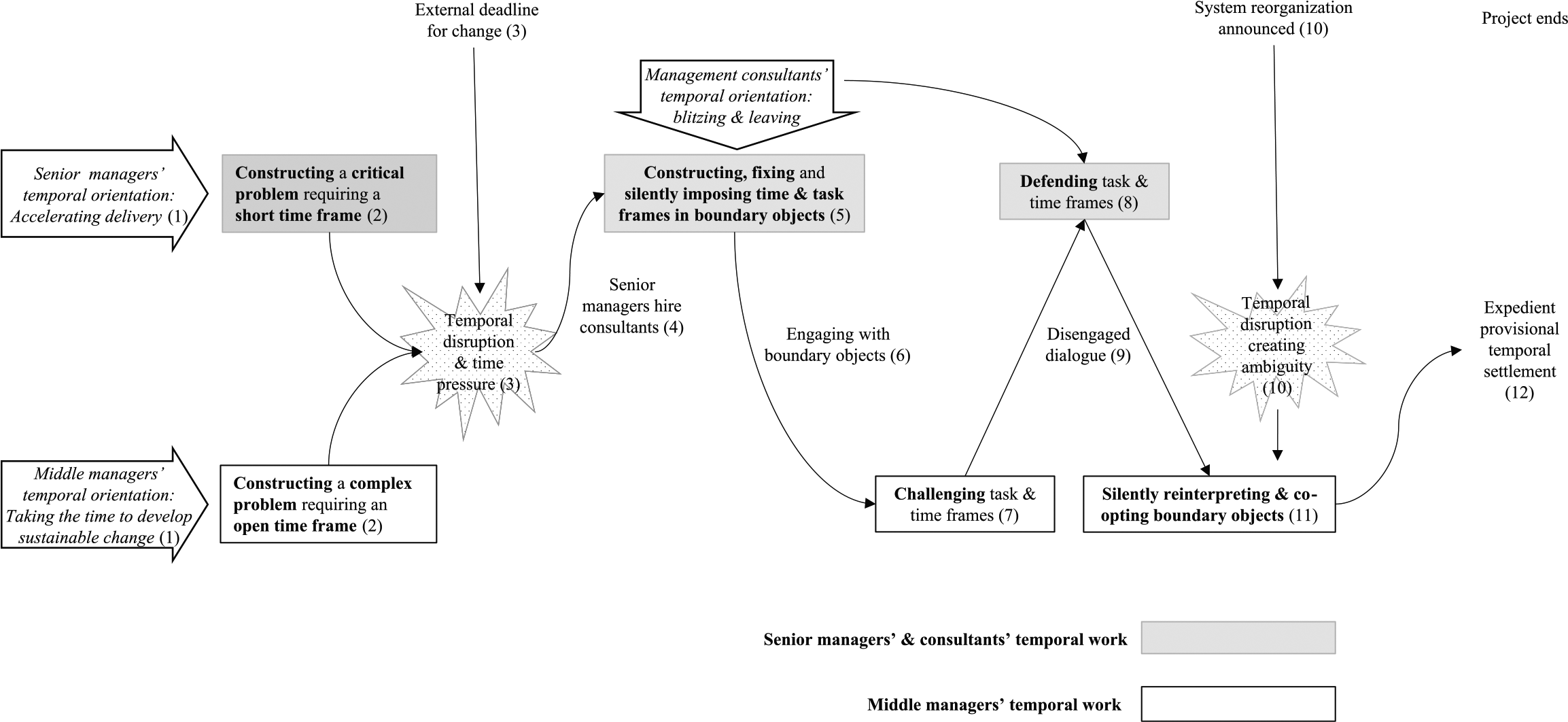
Processual theoretical model of the project.
Discussion
While temporal work is known to be inherently political (Kaplan & Orlikowski, 2013), we show it to be more covertly political than previously described. We explain the ‘silent politics of temporal work’, involving indirect, backstage and unarticulated efforts to construct, challenge or defend conceptions of time and temporality in organizations, reflecting underlying temporal orientations and interests. We also show how temporal politics is mediated through boundary objects. Thus, we contribute to theoretical literature (Granqvist & Gustafsson, 2016; Kaplan & Orlikowski, 2013; Raaijmakers et al., 2015; Reinecke & Ansari, 2015) on temporal work, conflict and politics in organizations.
Constructing task and time frames reflecting silent temporal orientations
First, drawing on Huy (2001) and Grint (2005), we suggest that the construction of organizational problems may be a form of temporal work because it legitimates solutions requiring a specific time frame and pace of change. Furthermore, we argue that such temporal work reflects organizational and individual temporal interests and orientations, which may be silent and unarticulated.
We discussed a management consultancy with an operating model geared towards blitzing and leaving, affecting consultants’ temporal orientation. They focused on selling fast-paced, short-term projects, and then delivering project outcomes within short time frames. Consequently, consultants’ temporal work constructed organizational contexts, problems and solutions in ways persuading clients to commission short-term projects that appeared to ‘fix the context’ but did so by bracketing complex, potentially problematic (implementation) issues into a future time frame. In our empirical case, consultants constructed an urgent critical problem and then delivered a successful short-term project, initially accelerating delivery of change, reflecting senior managers’ purpose for hiring consultants and their temporal orientation and agenda. Yet once the consultants left the client site, changes initiated during the project were unsustainable.
Middle managers in the client organization had a longer-term temporal orientation, focused on taking the time to developing sustainable change through dialogue with local stakeholders to establish understanding and ownership of a solution to an historical wicked problem. Where maintaining relationships with local stakeholders is important, delaying implementation of change may pay off in permanent organizations (Raaijmakers et al., 2015). Likewise, in our empirical case, middle managers saw the consulting project plan as likely to damage healthcare services and relations with clinicians, so there were reasons for them to delay the planned organizational redesign.
Our contribution here is not merely showing the way actors’ different temporal orientations, interests and temporal work affect perceptions and behaviour in organizations, which is inherent within temporal work (Granqvist & Gustafsson, 2016; Kaplan & Orlikowski, 2013) and provides a foundation for our explanation. In addition, we decribe problems and solutions discussed in overtly objective terms, as if temporal orientations, interest and temporal work were not affecting them in the background in the ways we show. We explain that such temporal differences are unarticulated, silent or silenced during temporal work, for political reasons.
Such silence may be because revealing underlying temporal interests, orientations and temporal work would undermine the credibility of consultants and managers in client organizations alike; consultants would not sell projects if they acknowledged that their recommendations reflected their own temporal orientations and interests; middle managers cannot admit that it may be easier and less painful to deflect change implementation after projects end than to overtly challenge plans as they are being devised. So, while underlying temporal orientations, interests, politics and related temporal work do affect organizations, as we have shown, they may be undiscussable (Argyris, 1980) and therefore take on an indirect or submerged character. Thus, we describe a first aspect of the silent politics of temporal work.
Fixing task and time frames using boundary objects
Second, we show how temporal work and politics are mediated through boundary objects, intended to fix task and time frames. Discussion of temporal boundary objects in the management and organization studies literature tends to emphasize their potential for facilitating collaboration (Ancona et al., 2001; Tukiainen & Granqvist, 2016; Yakura, 2002). Our case shows a PowerPoint template, based on complex, semi-articulated and therefore undiscussable backstage knowledge, datasets, models, tools and techniques, functioning as a political, hegemonic (Huvila, 2011) or discursive (O’Mahoney et al., 2013) boundary object. This imposed task and time frames fixed before the involvement of managers responsible for their implementation in the client organization.
Kaplan (2011) argues that while PowerPoint templates may function as boundary objects enabling discussion and negotiation of meaning, they also reflect, often invisibly, wider discursive practice. She notes that PowerPoint templates may be used for boundary work to promote individual or group interests by presenting selected information, set agendas and structured discussions. Our empirical data reflects a similar use of PowerPoint to promote consultants’ and senior managers’ interests.
An important aspect of covert temporal work in our case lies in fixing and defending predetermined task and time boundaries (Lundin & Söderholm, 1995) in objects, leaving little scope for negotiation that might slow or undermine the project. Granqvist and Gustafsson (2016) describe power, speed and secrecy during preparation work enabling actors to overcome change resistance. We suggest this mode of temporal work, silently imposing (rather than negotiating) predetermined task and time frames through fixed boundary objects is likely to occur in other instances.
Yet boundary objects may develop temporal dynamics of their own. Instead of facilitating change, imposing predetermined task and time frames through boundary objects may fuel cynicism and negative reinterpretations of projects among change recipients. Indeed, our case reflects a generic pattern of top-down organizational change implemented by middle managers in ways with unintended longer-term outcomes (Bartunek et al., 2006; Fischer, 2012; Thomas et al., 2011). The temporal dynamics in our case involved change agents and recipients accepting notional changes in the short term to manage immediate pressures they were all under. By doing so, they ignore implementation and sustainability issues, ostensibly fixed for the longer term. Thus, while boundary objects can be used to impose change, they may also be covertly appropriated and subverted by change recipients, viewing the same objects through different temporal frames.
Expedient provisional temporal settlements
Consultancy projects are difficult to evaluate because their outcomes are often co-constructed by consultants and clients, making attribution of responsibility for success or failure unclear. Moreover, consultancy is often commissioned for political reasons; to legitimate or take the blame for changes senior managers want to make anyway. So, those hiring consultants tend to view project outcomes more positively than those on their receiving end (Sturdy, 2011). Accordingly, participants viewed the project we studied in contrasting ways reflecting their own temporal orientations and interests.
Projects provide only a temporary window in which to change organizational temporal norms (Granqvist & Gustafsson, 2016). Short time frames and time pressure may also focus actors on achieving their own objectives before the collective interests of project stakeholders. Furthermore, where different groups only expect to interact during short-term projects, there may be little incentive to spend time developing common understanding (Das, 2006; Ligthart et al., 2016).
Thus, for project managers and consultants, quickly imposing temporal change may be the only way to achieve their own goals during short-term projects. Yet for actors with longer-term orientations, resisting change in permanent organizations, superficially agreeing ‘reified’ changes during projects, which can be later reappropriated or deflected in the longer run (Denis et al., 2011), may resolve short-term conflict and reduce pressure to actually change. Similarly, while unable to voice concerns about or resist top-town pressure to agree an organizational redesign based on consultants’ analysis during the project, middle managers were covertly planning for its implementation to fail in the longer term.
Kaplan and Orlikowski (2013) argue that temporal settlements break down as actors respond to and (re)interpret new and existing issues in different ways. We agree with their assessment but argue that such temporal settlements may covertly be more purposefully provisional, what we label expedient provisional temporal settlements. For different reasons, framed by unarticulated divergent temporal interests, it made sense for different actors to accept a reified organizational redesign in our case study. It enabled consultants to sign off a successful project, senior managers to deliver a savings plan by their deadline and temporarily deflected pressure on middle managers to make changes they believed damaging and difficult to implement. Agreeing a reified redesign plan as a provisional temporal settlement provided an expedient short-term fix for the stakeholder groups involved, while allowing unarticulated and unresolved issues to take their own course over the longer term.
Limitations and implications
Our explanation of the silent politics of temporal work is based on a single case study in a specific context, so further research is needed to validate and test its wider generalizability. However, we suggest that it is relevant to wider studies of management and organizations in several areas.
As far as the management consulting literature is specifically concerned, consultants have long been criticized for moving ‘from one situation to another, each time making a clever point or two, concerning issues he recently knew nothing about, always leaving before implementation begins’ (Mintzberg, 2004, p. 61). Consultants themselves have criticized near-sighted and myopic time frames, the tyranny of short-termism and dubious short-term placebos (Barton, 2011, p. 86). Our case study suggests that some management consultants’ fast-paced, short-term temporal orientations are implicated in this problem.
Acknowledging the diversity of consulting approaches and complications with their evaluation (Sturdy, 2011), our case suggests that process consulting (Schein, 1969), involving balanced relations between consultants and clients, aiming to help clients resolve their own problems (McGivern, 1983), may deliver more sustainable change in health care (also see Kirkpatrick, Lonsdale, & Neogy, 2016). This may mitigate the risk of problems arising from interventions being designed and implemented by different groups using different time frames. However, the level of consultants’ fees and their clients’ ability to pay may determine whether such an approach is feasible.
As management consulting, temporary and project-based organization and practices increasingly affect generic managerial norms (Bakker et al., 2013; Lundin & Söderholm, 1995; Sturdy, 2011), our findings may explain behaviours in other organizational settings and have relevance to the wider management and organizational studies literatures. While overt and covert conflicts and politics have been noted during projects (van Marrewijk et al., 2016), we suggest more attention needs to be paid to unarticulated and covert related temporal work, temporal conflicts and politics in organizations more generally.
While we focus on a PowerPoint template and a related timeline in our empirical case, a wider variety of boundary objects (e.g. new technologies or managerial practices, processes or strategies) are likely to be present in other cases. Further research examining how different kinds of boundary objects impose temporal orientations and related task and time frames in organizations, during projects and more generally, would be valuable.
Divergent temporal orientations and silent temporal politics may partially explain the limited success of government attempts to drive large-scale change in public sector organizations (Ferlie et al., 2013), like post-2008 financial crisis austerity programmes, often informed by ideas developed by management consultancies (Saint-Martin, 2012). Examining the silent politics of temporal work in other public sector contexts may illuminate and explain new organizational dynamics within such government reforms.
Finally, society faces a wider range of important complex problems (Grint, 2005) in diverse fields including health care (Ferlie et al., 2013), environmental sustainability (Slawinski & Bansal, 2015), social and economic development (Reinecke & Ansari, 2015) and the global financial system (Barton, 2011; Stiglitz, 2015). In all these issues, a focus on short-term performance may result in unintended, perverse longer-term effects. The theoretical ideas discussed in this paper may provide a partial explanation for these problems. In their efforts to resolve immediate conflicts through the silent politics of temporal work, actors store up problems in the longer term.
Conclusion
We contribute to the organizational literature on temporal work, politics and conflict by providing a theoretical explanation of the silent politics of temporal work, constructing, challenging and defending time and temporality in organizations. Our analysis provides an alternative account of temporal work as openly negotiated and resolved. First, it highlights unarticulated temporal orientations and related political interests framing temporal work. Second, it challenges the view of temporal boundary objects facilitating collaboration and dialogue. Instead, we explain how predetermined, fixed boundary objects silently impose time and task frames. We also show how these boundary objects may then be covertly co-opted to deflect change in the longer term. Finally, we explain how temporal settlements can be purposefully provisional, providing an expedient quick-fix, resolving political conflict in the short term, while allowing it to unravel in the long run.
Footnotes
Appendix
Appendix. Illustration of theoretical codes and concepts.
| Aggregate dimension |
|
||
|---|---|---|---|
| Theoretical codes | Accelerating Delivery | Blitzing and Leaving | Taking the Time to Develop Sustainable Change |
| First-order concepts | Fast-paced, short- and long-term quantitative temporal orientation | Fast-paced, short-term, quantitative temporal orientation | Slow-paced, long-term (open), qualitative, temporal orientation |
| Illustrative narratives | ‘Evidence of performance and delivery (within) tight timescales’ and ‘tangible results (that) stood the test of time’ | ‘Pressure… to do our analysis quickly’ ‘We work in 4-week timelines’ ‘Our operating model is geared towards blitzing and leaving’ |
‘Respond to and respect local timescales if you want sustainable ongoing change’ ‘Time is always a really big issue… when you’re up against… deadlines you… rush things and you don’t get the ownership… [without] time to talk to the clinicians’ |
| Actors | SHA managers | Elmhouse consultants | PCT managers and clinicians |
| Aggregate dimension |
|
||
| Theoretical codes | Urgent Critical Problem | Historical Wicked Problem | |
| First-order concepts | An urgent critical problem, which PCT managers were addressing too slowly, legitimating fast, top-down change in quantitative time | An urgent critical problem constructed in quantitative terms, legitimating and manageable via fast top-down application of standardized best practice in quantitative time | An historical problem of ongoing system fragmentation requiring socialization and dialogue to develop a bottom-up, long-term systemic solution in an open qualitative time |
| Illustrative narratives | ‘A major project… make or break for the NHS in [the region]’ SHA managers ‘weren’t confident’ PCT managers were ‘starting to analyse the challenge quickly enough’ ‘The big time-lag in health care in moving from the analysis to the delivery… is the big problem’ |
‘Focus… [on] absolute numbers’ ‘How do you organize your services better so that you can absorb that increase in activity?… It’s about uniformity… it doesn’t actually demand any real innovation, what it demands is the systematic application of what’s already known to be best practice’ |
‘Everybody in isolation trying to meet their own individual objectives… was bankrupting the PCT… the [local NHS] community felt that there was an opportunity for… a fresh start. So, we gathered together… lead GPs and provider Chief Executives… to get a grip of this as a system’ |
| Actors | SHA managers | Elmhouse consultants | PCT managers and clinicians |
| Aggregate dimension |
|
||
| Theoretical codes | Fixed Boundary Objects Quickly Imposing Change | Fixed Boundary Objects Slowing Learning | |
| First-order concepts | PowerPoint template’s task and time frames produced a savings plan by a deadline | Standardizing task and time frames in a PowerPoint template | PowerPoint template’s task and time frames disabled creativity and learning |
| Illustrative narratives | ‘[Elmhouse] are very good with… PowerPoint and creating slides… which then every PCT was required to fill in with their detailed plan and those plans were submitted in July… the actual basis of the initiatives… were there in July… The template they [Elmhouse] did had a lot to do with that; key performance indicators, milestones, all that sort of thing, it’s all in there’ | ‘We had this [PowerPoint] template that everyone had to fill out that standardized what people were being asked to do and being really clear about what was being required… to make sure that they can spend time on it’ | Template is ‘semantically disabling’, ‘rules against which people were measured’, which ‘couldn’t be manipulated’ and had to be ‘submitted in a regimented way’ ‘An onerous process just in terms of the sort of form-filling templates, checking out all the data within prescribed timescales’ ‘Elmhouse don’t want creativity, they want you to use their forms… their horrible PowerPoint slides’ ‘[The project] slowed us up from where we would have been with the [our] transformation programme’ |
| Actors | SHA managers | Elmhouse consultants | PCT managers and clinicians |
| Aggregate dimension |
|
||
| Theoretical code | Expedient Provisional Temporal Settlement | ||
| First-order concepts | SHA delivers savings plan by its deadline | Consultancy project signed off on time | PCT managers (temporarily) reduced pressure to produce savings |
| Illustrative narratives | ‘In a very quick space of time we’d… looked at redesigning the system to develop the potential savings [and delivered a related plan to the Department of Health by its deadline]’ ‘We’re still waiting to see how the NHS faces up to the challenge as we go into… delivery… the politics of a situation is a limiting factor’ |
‘All the plans got signed off, so eventually it [organizational redesign] did happen’ even though ‘the political context of the project made implementation impossible’ and in the NHS ‘making change happen is like wading through treacle because everyone has to be aligned… resistance to change and cultural cynicism… a million reasons why not’ | ‘If you go with their [Elmhouse’s] numbers you attract less scrutiny in the meantime and probably you’re in the same boat as everyone else and when it unravels, it will unravel for everyone’ |
| Actors | SHA managers | Elmhouse consultants | PCT managers and clinicians |
Acknowledgements
We would like to thank the National Institute for Health Research for funding the research project (08/1808/242) that this paper is based upon and research participants from the anonymous management consultancy and NHS organizations discussed in this paper. We are also grateful to our editor, Trish Reay, and anonymous reviewers at Organization Studies, as well as Juliane Reinecke and Hari Tsoukas, for their invaluable comments on earlier drafts of the paper. Jean Ledger is currently supported by NIHR CLAHRC North Thames.
Funding
This paper is based upon a research project funded by the National Institute for Health Research(08/1808/242).