




Abstract
According to Friedrich Nietzsche, artists impose restrictions on themselves to encourage creativity and even have a way of “making things difficult” – imposing new constraints on themselves within which they have to dance. At least in the arts, it is difficulty rather than ease which promotes creativity in accordance with this view. This goes beyond the well-known idea of rules and other structures not only restricting but also enabling creativity; it also goes beyond insight into the creativity-enhancing effects of constraints, as recently emphasized in organization studies. Nietzsche adds three dimensions to this dialectic: time and the process of dancing inspired and encouraged by constraints; the opposition of old and new constraints; and the quality of intended, stimulating self-binding. We see this as an opportunity to explore the inspiring potential of Nietzsche’s piece about arts, “Dancing in chains”, when it comes to the different realm of creative practices and creativity in and of organizations. Such an exploration can obviously not aim to offer recipes of how to bring about valuable novelty, but simply intends to identify pertinent themes, issues and questions for organization studies – topics and aspects brought into a new or sharper light when looked at from Nietzsche’s perspective and that of some other philosophers, including Jon Elster’s analyses of constraints in general and of the complications of self-binding in order to promote creativity in particular. Also, we consider Míchel de Certeau’s “silent production” and Martha Feldman’s improvisational routines as being cases of “dancing in chains”.
Introduction
The phrase “dancing in chains” is taken from Nietzsche’s (1986) Human, All Too Human, a book in which he philosophizes on, among other things, creativity in the arts. Nietzsche’s piece is about the creativity-provoking, generative potential of constraints, or to be more precise, of self-imposed constraints, and this is what we suggest be transferred to creative practices in/of organizations.
Dancing in chains. With every Greek artist, poet and writer one has to ask: what is the new constraint he has imposed upon himself and through which he charms his contemporaries (so that he finds imitators)? For that which we call “invention” (as in metrics, for example) is always such a self-imposed fetter. “Dancing in chains”, making things difficult for oneself and then spreading over it the illusion of ease and facility – that is the artifice they want to demonstrate to us. Already in Homer we can perceive an abundance of inherited formulae and epic narrative rules within which he had to dance: and he himself created additional new conventions for those who came after him. This was the school in which the Greek poets were raised: firstly to allow a multiplicity of constraints to be imposed upon oneself; then to devise an additional new constraint, impose it upon oneself and conquer it with charm and grace: so that both the constraint and its conquest are noticed and admired. (Nietzsche, 1986, p. 343)
For a long time it was, and in fact still is, common sense that freedom – leeway, time, room for maneuvring, and an open organizational culture as opposed to clear and unequivocal goals and a multitude of strict formal rules – and sufficient resources are inclined to promote creativity, while constraints and insufficient resources are more likely to inhibit it (cf. Amabile, 1996; Shalley, Zhou, & Oldham, 2004). However, Nietzsche, not dissimilar to recent analysts of constrained creativity and organizational ingenuity (Caniëls & Rietzschel, 2015; Gibbert & Scranton, 2009; Stokes, 2006; Hoegl, Gibbert, & Mazursky, 2008; Honig, Lampel, & Drori, 2014; Lampel, Honig, & Drori, 2014; Roskes 2015; Rosso 2014; Weiss, Hoegl, & Gibbert, 2011), had long since considered the dialectical relations between freedom and constraint. To be sure, some of these complications have by now become common sense: constraints such as rules both restrict and enable, as we know from Anthony Giddens’ (1984) theory of structuration; they are “enabling limits” (Weber, 2001, pp. 18–19, 292, 295, fn. 5).
Nietzsche’s piece, however, adds three dimensions to these dialectics. The first is time, temporality and the process of dancing inspired by constraints. Second, following the famous words in Karl Marx’s critique of Hegel’s philosophy of right (Marx, 2000, p. 74, commenting on German society) one may say that Nietzsche suggests forcing the “petrified relationships to dance by singing their own tune to them”; in our context, by drawing attention not only to the opposition of freedom and constraint – and the process of “dancing” – but in the same spirit to the relationship between old and new constraints, thus creating the new means by dancing in old chains, but forging new chains at the same time. Third, Nietzsche includes the dimension of intended self-binding. This is of particular importance for organizations because organizations intentionally impose many of the existing constraints upon themselves. For Nietzsche, these three dimensions add up to the guideline of “making things difficult” in order to provoke and stimulate creativity. How self-binding relates to creativity is what so different a thinker as Jon Elster (1984, 2000) has dealt with, too, like Nietzsche, reflecting on creativity in the arts. We will return to this issue later on.
These are the reasons why we, during our investigations into the problem of creations and creativity 1 in and of organizations, found it useful to take a closer look at Nietzsche’s metaphor and the sequence of “old chains – dancing – new chains” in the course of time. The following is organized according to this three-step approach and makes use of studies of organizations, several of which focus explicitly on creative practice.
In the section that follows this introduction, we take a short look at old chains (“old” in the sense of “given at the time of the attempt to be creative”), though just insofar as the issues of intentionality and self-binding are at stake: the well-known organizational inertia; difficulties to intend creations because of the Platonic search paradox – difficulties which are similar to Elster’s states that cannot be deliberately intended; and self-binding, intended by organizations but unintentionally constraining creative practices. This calls for the ensuing discussion of the problems of intentionality in general, and collective and even corporate intentions in particular. The aim of this section is to remind us of the traditional, yet already differentiated, view of constraints impacting creativity in and of organizations.
Our next, main section, however, is about dancing within these constraints. We initially try to elaborate on freedom and constraints and what it means with respect to organizational creativity. First, we suggest a typology of chains in which corporate actors may dance, concentrating, like Nietzsche, on intentionally self-imposed chains. While Nietzsche, however, is concerned with self-imposed constraints aiming at creativity alone, we also consider those which aim at efficiency and expectability because they allow for some form of “dancing” as well, namely for being creative within “improvisational routines” à la Martha Feldman and for what Michel de Certeau called “silent production”; we discuss these next. Then we come to the subject of self-imposed constraints aiming at creativity. We make a distinction between constraints in the sense of “making things difficult” à la Nietzsche on the one hand, and the similar though different principle “less is more”, as analysed by Elster, on the other. In the final part of this section, we present a historical example, taking the word “dance” not metaphorically, but literally: the creation by Afro-Americans of new ways of dancing by dealing creatively (and even with polemic intentions) with the old rules and conventions of dancing from the early decades of the last century. Some attention has recently been paid in historiography to the relation of dancing and working in view of (post-)Fordism and, as is of interest here, to resistance as a source of creativity. At the end of this section we draw conclusions, asking what this case yields for organization studies.
In the following section on new chains, we deal with intended constraints à la Nietzsche and Elster – intended to foster creativity. Here, our paradigmatic example will be the Japanese haiku. This example will be taken first of all as a metaphor for Nietzsche’s “making things difficult” and for Elster’s “less is more” being ways of promoting creativity, then literally as a means for organizational creation. On the other hand, we call attention to “intended passivity”, which could be considered as being in the spirit of Nietzsche and Elster as well. We hence devote a paragraph of this section to the issue of intentionally refraining from creation.
Finally, we offer a conclusion, discuss some limitations of our study and point to one particular desideratum of research on organizational creativity, namely the crucial question of determining the circumstances under which constraints will promote creativity, and when they will hinder it.
Old Chains
Organizational inertia
We take “chain” as a metaphor for the constraints which play a main role within models of rational choice in general and in Herbert Simon’s (e.g. 1955) behavioural model in particular (and, as we will see, an important but quite different part in recent research on organizational creativity). Organizations are sometimes considered to be “systems of constraints” (Buck, 1966) as they impose constraints on decisions and actions in order to secure coordination, alignment, efficiency, expectability, complexity reduction and repetition, an “again and again”, and insofar counteract creation and innovation. This is common sense, and is in accordance with theories and empirical findings regarding organizational inertia and the abstinence from innovation and creativity of certain bureaucratic and/or traditional types of organizations such as large corporations, public authorities, sport associations, and religious and educational organizations (e.g. Hannan & Freeman, 1984; Amburgey, Kelly, & Barnett, 1993). We do not have to go deeper into this matter but just emphasize that this is an emergent abstinence: the unintended result of organizational constraints, mostly intentionally self-imposed in order to fulfil functional needs such as coordination, efficiency and so on.
States difficult to intend
Not focusing on organizations, the Norwegian sociologist and philosopher Jon Elster (1983) emphasizes the role of certain states that are essentially by-products. These are states one cannot directly intend (intending spontaneity, for example, is paradoxical). Creation and being creative also can be intended only in a paradoxical way, though for other reasons as given by Elster, namely “because one can only intend what one can expect as being something already determined” (Waldenfels, 1990, p. 97; our transl.). To expect something as having already been determined (definite as opposed to indefinite), however, is impossible because of the Platonic search paradox. In the dialogue Meno, it reads: “(A) man cannot search … for what he does not know, because he does not know what to look for” (Plato, 1980, section 80e). An illustration taken from scientific creations would be: “an explorer can never know what he is exploring until it has been explored” (Bateson, 2000, xxiv). This Platonic inability to intend the new functions as a constraint on creation – though it is not in the black-and-white way of thinking of Meno. To get new ideas depends to a certain degree upon chance and on unforeseen powers released within the creation process – they cannot be triggered off by force or even by the fervent wish to evoke them. Because of the role of chance and unforeseen developments, no intention – in the sense of the German “Absicht” and in particular Elster’s paradoxical intentions (“willing what cannot being willed”, Elster 1983, p. 44) – can fully and precisely anticipate the intended state. Already Alfred Schutz (1967, pp. 63–68) emphasized that every plan of action (“Entwurf”) needs imagination and necessarily contains gaps (“Leerstellen”, empty space). While it is indeed impossible to intend the new as a fully and precisely anticipated new state, it is quite feasible, not least for organizations, to intend a more roughly defined state and to look for indirect or oblique ways of intending the new (for workplace creativity, cf. Zhou & Hoever, 2014). For this reason, indirect, oblique, entangled ways of bringing about something new and peripheral awareness are not at all outlandish in this area. Chia and Holt (2007, pp. 63–64) deliver an astute argument on why “the periphery is something that must be obliquely approached with stealth. … The periphery is a preceding horizon; the attempt to capture and represent it is indeterminable.” If focused on – which is to say intentionally observed – it is no longer peripheral at all. Peripheral awareness, 2 as dealt with by Chia and Holt, fosters organizational creativity, as does a combination of preparedness and openness, enriched by generative doubt (Pina e Cunha, Rego, Clegg, & Lindsay, 2015). These, however, are all states which cannot be aimed for directly.
Intended self-binding
In Nietzsche’s piece quoted at the outset he speaks of “The new constraint which he imposes upon himself”. This is the case of self-binding dealt with by Elster (1984) under the heading Ulysses and the Sirens. Note, that self-binding is much more at the disposal of organizations than of individuals, because organizational rules are self-imposed, as is the allocation of resources. Organizations bind themselves, for example by promising payments to their members, by setting standards for quality or compliance, by restricting – or giving leeway to! – time and/or money for creative practices, and by recruiting either cheap but unskilled, or skilled employees who may or may not contribute to organizational creativity. We may then consider the organizations, the corporate social actors (King, Felin, & Whetten, 2010), as being the Ulysses of modernity, and organizational self-binding as their means of coping with contingency and complexity. (Thévenot, 1984, too, referred to this myth as the paradigm of self-binding rules and institutions.) Of course, in many ways organizing depends on unintended constraints and will lead into unintended and even undesirable self-binding. Organizational path dependence, leading possibly into lock-ins, is a significant example of this (Sydow, Schreyögg, & Koch, 2009). Ulysses in the face of the Sirens, however, stands for intended self-binding, and that is what Elster (2000, p. 1) is interested in: “why individuals [and organizations! Our addition] may restrict their freedom of choice”. One reason is to overcome present contingencies and complexities. Another one, more future-oriented, is nicely put by Friedrich von Hayek (1960, p. 180) who dealt with the self-binding quality of state constitutions: “A constitution is a tie imposed by Peter when sober on Peter when drunk.” A state, in danger of falling prey to the temptation of breaking its own rules, binds itself in the knowledge of this fact by means of the constitution, just as does the alcoholic in the knowledge of the temptations to which (s)he may be exposed. Transferred to organizations and their rules and constitutions, this means: organizations “when sober” – dedicated to order, formal coordination, rationality, efficiency and reliability – know that they may or will get “drunk”: that disorder, informal coordination, irrationality, inefficiency (wasting, slack, shirking, etc.) and unreliability may or even will gain acceptance and get out of hand, and they consequently take precautionary measures. These intentions of self-binding aim at organizational functioning and pertinent imperatives such as efficiency and expectability. The unintended consequence of the self-binding of organizations, then, may be: hindrance or obstruction of creative possibilities. We, however, will deal with self-binding that allows for or even actually intends to stimulate creativity, when we turn from chains to dancing within them later.
Talking about intended self-binding, who or what is meant by the word “self”? We need to distinguish between either individuals (e.g. members of the organizations) or the organizations themselves as corporate actors who may or may not intend a certain kind of binding. 3 The self-binding of corporate actors is brought about not only by binding its members, via employment contracts for instance, but also by contracting with other organizations. But can organizations intend at all? 4 Most methodological individualists would deny it, but we consider the organization’s goals, plans, strategies and even employment contracts, unattainable and incomplete as they may be, as cases of particularly strong intentionality – of collective intentions as dealt with by, for instance, John Searle (1990, 2010, pp. 42–60) and Margaret Gilbert (1989, 2007) and even of corporate intentions (for the latter see, e.g., List & Pettit, 2011). Collective and corporate intentions represent an emergent kind of intentionality based on, but not reducible to, individual intentions. 5 We do not refer even to the latter as merely subjective intentions, but, extending Searle, as institutional facts depending on what counts as intention in the view of the actors and “the others”. Moreover, as Rolland Munro (1993, p. 264 puts it, “intentions are always linked to signification, legitimation and domination structures” and should never be taken as merely “internal”. Organizations are – in some sense more than individual actors – “capable of deliberation, self-reflection and goal-directed action” (King et al., 2010, p. 293), and this applies to the intention of self-binding in particular: organizations do impose their rules (on their members and) on themselves, and they do so not inadvertently, but intentionally in the sense of collective and corporate intentions. As mentioned above, these intentions necessarily lack fullness and the determination of anticipation, already stipulated by Derrida in Limited Inc. (1988, p. 56), who objected to Searle dealing with the intentions of authors of texts. This lack of telos is the unintended restriction of every intention and it sets up a certain hindrance of intending the new.
Dancing
We now move to the issue of dancing within these old chains, given at the time of creative attempts. “Dancing”, as we will spell out in this section, we take as a metaphor for “moving with ease and facility, partly playing by, partly deviating from, the old rules and creating new ones as well”.
The puzzling relationship between freedom and compulsion or constraint has often been examined. A basic consideration is: creation and innovation depend on what the German philosopher Bernhard Waldenfels (1985, p. 109) calls “Widerlager” (abutment, something to rest upon and to turn against). There is no such thing as a pure primary production, no creatio ex nihilo. This is true even for jazz improvisation, which has quite often been used by organizational scholars for analysing organizing and managing activities (Weick, 1998: Hatch, 1999; Kamoche & Pina e Cunha, 2001; Wilf, 2015a): “you can’t improvise on nothing; you’ve gotta improvise on something” bassist-composer Charles Mingus once said (Weick, 1998, p. 546). Improvising in jazz means: “highly disciplined ‘practices’” have to deal with “myriad conventions” (p. 544); it is “anchored in past experience” (p. 546). The new is dependent on “tradition as abutment”. Waldenfels (1990, p. 96) argues: “The paradox of innovation is that it requires what it is about to renew, to replace it” (our transl.). 6 We cannot bring about change and innovation but in the chains of the old. These chains may be either physical or material ones, including the human bodily capacity (Slutskaya & De Cock, 2008, with regard to samba) or embodied in products, tools or other artefacts, respectively. Or they may be of immaterial nature: rules, conventions, routines and relations, ways of thinking and acting, Nietzsche’s inherited formulae and laws of epic narration. “Creativity”, as Richard Feynman once said, “is imagination in a straightjacket” (quoted by Guntern, 2010, p. 54). Weick (1989), too, used a similar metaphor to describe theory construction, pointing to the inevitability of metaphors in the process: “disciplined imagination”. Hargadon and Sutton (1997) emphasized that creating something new by technology brokering is directed – enabled and restricted – by strong norms and routines. We, for our part, found it worthwhile to sort the constraints under discussion according to the question of how they relate to the intentionality of self-binding and the resulting ways of promoting creativity. This way, we ended up with the typology we suggest now.
A typology of chains to dance in
For organizations, there are many more cases of “dancing in chains” than those upon which Nietzsche focused. First of all, there are constraints which are not self-imposed, but externally imposed, e.g. by markets, the law and institutions of the field. Second, there are constraints which are not intentionally but unintentionally self-imposed, e.g. by tradition or unintended consequences of organizational action, a particularly important case being intra-organizational path dependencies.
But even when simply considering intentionally self-imposed constraints, Nietzsche’s case is a specific one. Intended self-impositions of constraints may either aim at efficiency, standardization and expectability, in these cases intentionally or unintentionally making leeway for creativity, or they may aim to enhance creativity in the first place – which makes a difference with respect to the chances of being creative. Moreover, aiming at creativity in the first place may be brought about either by forcing or by encouraging and inspiring creativity, again creating different conditions for creative practices. Only the last means of enabling creativity – encouraging, inspiring – is what Nietzsche had in mind. Taking these distinctions or oppositions into account puts Nietzsche’s case in a broader framework. We consider this as being important, because it is about the relationship of freedom and constraint more generally, drawing attention to differences in how creativity is affected by different ways and aims of the intentional self-binding put into practice by organizations.
One can systematize these distinctions in a way that allows one to recognize what Nietzsche specifically focused upon (see Table 1).
Nietzsche’s “Dancing in chains” within a broader framework of intentionally self-imposed constraints.
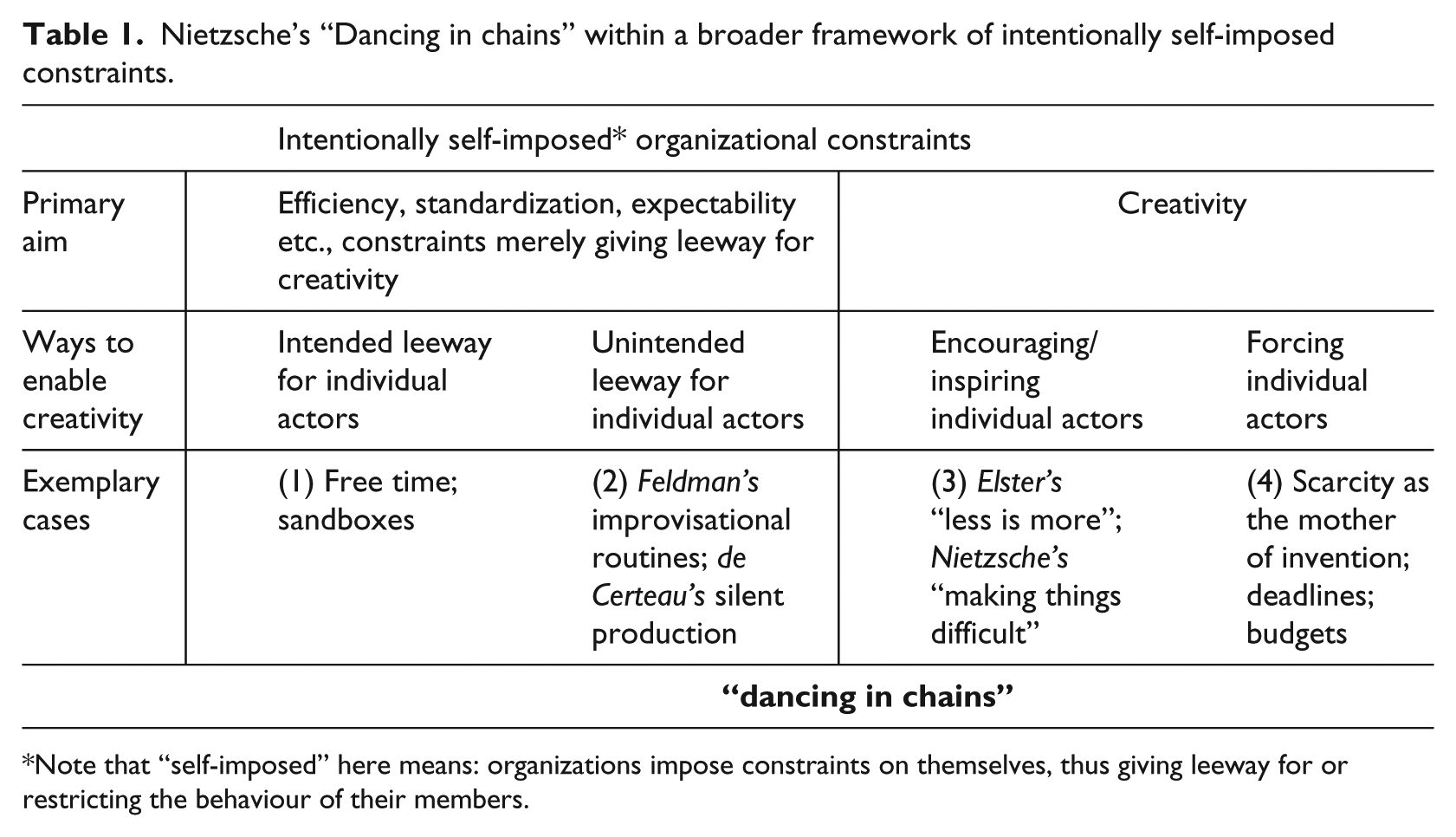
Note that “self-imposed” here means: organizations impose constraints on themselves, thus giving leeway for or restricting the behaviour of their members.
What we call the “dancing” of organizations – creatively acting in self-forged chains – is brought about by, but not reducible to, the dancing of the individual actors, enabled, inspired or forced by constraints. In the following we will deal with cases (2) and (3) only, i.e. the “de Certeau/Feldman case” and the “Nietzsche/Elster case”, because they best reflect the phrase “dancing in chains”. Seen from the standpoint of the individuals, case (1) – organizations giving leeway, such as free time – is a case of freedom being granted, rather than of constraints being imposed. Case (4) – scarcity as the mother of invention – is, on the contrary, more about forcing than about inspiring. We are reluctant to speak of “dancing” in this case because it is rather about bowing to necessity. Besides, this latter case has already been extensively explored in organization studies (recently, e.g., by Honig et al., 2014; Lampel et al., 2014; Roskes, 2015; Rosso, 2014).
Creativity in the “de Certeau/Feldman case” comes as a by-product seen from the organization’s standpoint; the constraints are self-imposed not from the standpoint of the individual, but just from that of the corporate actors. The individuals may dance but not within self-imposed constraints in this case. The “Nietzsche/Elster case”, on the other hand, refers to individual and/or organizational self-binding.
The “de Certeau/Feldman case”: Unintended leeway for creativity
Feldman: The case of improvisational routines
As mentioned above, constraints provide “abutments”, something to rest upon, to resist,and/or to jump or take off from. Old resources and competences function as such abutments and are necessary to create new ones and new ways of making use of them, and so do old rules and routines. They provide opportunity (e.g. to criticize, protest against, subvert, improve and/or learn from the old), orientation, inducement, pressure, motivation and commitment to create something new, while also focusing attention and imposing what counts as worth striving for.
By binding actors, rules and routines cause them to get into and keep in practice, acquiring new skills and possibly elegance – Nietzsche’s “ease and facility”, “charm and grace”. Moreover, these rules and routines are likely to exonerate organizational actors from paying attention to a multitude of questions, considerations and problems. This way, rules and routines set them free to concentrate on new and elegant ways of dancing within these very structures or of applying them in some new way – reproducing or transforming them in idiosyncratic ways (Feldman & Pentland, 2003; Giddens, 1984). Moreover, dancers, and “dancing” organizations as well, freed from paying attention to daily routines, are enabled to direct the focus of their attention to creative solutions for well-structured problems (Ohly, Sonnentag, & Pluntke, 2006). Or, because problems are often ill-structured, individual or corporate actors, enabled by rules and routines, rely on the contrary, i.e. on peripheral awareness and on scattering attention (cf. Weick, 1998, p. 552; Chia & Holt, 2007). It is quite interesting how such studies overlap with what practitioners of creative leadership such as Palus and Horth (2002, pp. 11–36) have to say about paying attention, recommending, for instance, that one should “attend to the periphery” (p. 33).
We firmly agree not only with Feldman and Pentland (2003) that “the particular courses of action we choose are always, to some extent, novel” (p. 102) but also with Sonenshein’s (2016) insight that creativity and routines do not constitute a dualism but rather a duality (see also Giddens, 1984; Farjoun, 2010). Nevertheless, we hasten to warn against applying (sic) their important ideas excessively. Three remarks seem to us to be in place here. First, and almost needless to say, it is and remains the predominant practical purpose of routines to provide for iteration, stability, reliability and coordination – to rely on the old: on tried, tested and proven ways of doing something (see, e.g., Becker, 2004; March & Simon, 1958; Weick, 1979, pp. 224–225, on thick layering of routines, and 1998, p. 552, on “Limits to Improvisation”). Second, as recent research on routine clusters and the possible path dependence implied by the complementarity of single routines within those clusters has shown, the stability of routines may even be strengthened at this level in which the single routines are entangled, at the extreme taking on the form of a lock-in (Kremser & Schreyögg, 2016). To be sure, the stability of the routines is due to processes, namely iteration; it is due to iteratively running through the same or similar courses of behaviour and practice. Third, and quite in line with the duality assumption, “regularly acting creatively produces structures that inevitably shape subsequent creative acts” (Sonenshein, 2016, p. 740); an insight often overlooked by creativity researchers because of their preoccupation with agency (less so, however, by routine scholars such as Feldman & Pentland, 2003). This is true even with jazz improvisation, as Weick once (1998, p. 543) mentioned: “order and control are breached extemporaneously … and a new order created ” (our italics).
De Certeau: Silent production
The most impressive example of unintended leeway and how to dance in it is, in our view, Michel de Certeau’s (1984) “silent production” – in some sense a subversive, almost invisible production of new ways of making use of rules, routines and resources, ranging from instructions for use to texts in general and up to urban architecture. These new ways are neither intended nor expected by the creators of the “first-order producers” – writers, rule-setters, architects etc. – but brought about by inventive users, consumers, readers, inhabitants of cities and other people subjugated to some systemic impositions. They follow informal rules which sometimes become formal ones, as in many cases of creative improvements of production procedures from below, for instance from learning communities in the sense of Wenger (2004, pp. 214–221, 241–262). These cases show that there is no sharp line between subversion and conformism. Munro (1993) analysed how “members of organizations consume control technologies for ‘moves’ within language games”, be it “in order to sustain a position of domination over subordinates” (p. 249) or in order to make use of those technologies “as a resource of resistance” (p. 267). These moves are very similar to de Certeau’s silent production. A more conformistic case is the silent production option which traders have developed, making unconventional, obstinate use of manipulated or adjusted versions of calculative instruments such as the Black Scholes formula and the Capital Asset Pricing Model (CAPM) in their daily work (Svetlova, 2006). De Certeau (1984) called pertinent practices “secondary production”, “poiesis”, “anti-discipline” and “poaching” and attributed to them a “dispersed, tactical, and make-shift creativity” (p. xiv) which “introduces dances between readers and texts (more general: between users and what they make use of, G.O., J.S., N.N., M.M.) in a place” (De Certeau, 1984, p. 175). Such “poaching” occurs on the territory of organizational texts such as records, written rules and instruction manuals (cf. Orr, 1996); and with regard to organizations and their resources in general as well; and it can be considered as its members dancing in chains and possibly being harnessed by the organizations. Daniel Hjorth (2005) even made a case for organizational entrepreneurship, referring to de Certeau and a project involving collaboration for workplace renewal between the A/S LK company in Ringsted, Denmark, and the Danish Superflex art group.
The “Nietzsche/Elster case”: Inspiring creativity by self-imposing constraints
Nietzsche’s argument, contributing greatly to a deeper understanding of how creative practices in and of organization can come about, partly anticipates and even goes well beyond insights into the enabling and even stimulating aspects of constraints within recent research on organizational creativity (cf. Caniëls & Rietzschel, 2015; Honig et al., 2014; Roskes, 2015; Rosso, 2014). To demonstrate this, we will supplement Nietzsche’s fundamental idea, which even goes beyond Karl Weick’s “reluctance to simplify” (Weick, Sutcliffe, & Obstfeld, 1999) principle, with a similar one analysed by Elster under the heading “less is more”. Although both ideas are similar and overlap, they are nevertheless distinguishable. Note that they postulate the opposite of the frequently argued assumption “that creators need to feel comfortable” (Rosso, 2014, pp. 554–555, is also critical to such a general view).
For Nietzsche, invention and creation mean finding or creating new ways of dancing in old chains – or, as we would translate: new ways to cope with old rules, routines and resources and, in this way, forging new chains. Think of tango as once having been a new way of dancing: new rules, new conventions, new steps, new postures, but of course invented on the basis of old ways of dancing (Littig, 2013) and thereupon establishing new dance conventions. Its novelty, including the quality of a new chain, comes out nicely by the remark of an observer, Sacha Guitry, who saw it for the first time in Argentina and is said to have commented on it: “It is fascinating, but why do people do it while standing?”
At the beginning we offered two important answers to the question as to why individuals and organizations choose to restrict their own freedom: to cope with contingency and complexity, and to restrict future wrong-doings to which they may be seduced. As Jon Elster (2000, p. 1), thinking of individual actors such as alcoholics, put it: “they may want to protect themselves against passion”. There are, however, still two other aspects to this thought, incorporated in the two guidelines “making things difficult” and “sometimes less is more”. Note that both guidelines recommend indirect, oblique ways of bringing about the new – exactly via a detour to difficulty and simplicity. For the latter, one may think of the increasingly reduced paintings of the late Joan Miró such as Blue II/III (1961) – just some black spots and a red stripe on the blue ground. For organizations, think of the frugal design of products, advertising or architecture, and of simplicity as a demand on product development, which is partly a matter of efficiency, but partly a matter of aesthetics and attractiveness as well. Insofar, it is about discipline within creative, innovative processes. For the former, “making things difficult”, instead of lengthy explanations we give an example for artistic self-binding. In poetry there is a sub-genre called anagram poems. The strict rule to follow – the self-binding – reads: In every line use exactly the same letters, using every letter with the same frequency. Look at the first lines of this one from 1936. Its title and subject refer to Emanuel Gottlieb Leutze’s painting with the same title. The author is David Shulman:
Washington Crossing the Delaware
A hard, howling, tossing, water scene: Strong tide was washing hero clean. “How cold!” Weather stings as in anger. O silent night shows war ace danger!
It is not by chance that a book on anagram poems is titled Making the Alphabet Dance (Eckler, 1997) – and, for that matter, an important book on strategy and organization When Giants Learn to Dance (Kanter, 1989). One will see the point: creativity is imagination in a straightjacket, and the straightjacket may be self-made and self-imposed in order to stimulate creativity. Elster’s second book on the subject is titled Ulysses Unbound (2000), and a chapter of it is about “Creativity and Constraints in the Arts” dealing with poetry, novels, dancing, composition and jazz. One may consider anagrams to be an exceptional case of poems and self-binding, but should bear in mind that Shakespeare’s sonnets also follow strict rules (e.g. the rhyme pattern abab cdcd efef gg), that the verses of every conventional poem end with a rhyme, and that even novels, stage plays and short stories are based on certain rules, let alone the limerick (aa bb a) or the haiku.
For Elster (2000), the most important reason why people – and, as we like to add, organizations – might want to restrict their freedom in general and when facing creativity requirements in particular is the need to reduce the feasible set of options. This, in his view, can provide for inspiration and focus on improvement (Elster, 2000, p. 209; see also Lampel et al., 2014, p. 474), and calm down the possibly paralysing “fear of freedom”, of having too many options (Elster, 2000, p. 2). One might add: it prevents actors from feeling too comfortable because of an abundance of resources (Csikszentmihalyi, 1997). Organizations parallel literature insofar, and one may ask: could there be such thing as a “haiku organization” or haiku ways of organizing practices in order to allow for and even provoke creativity? An organization that “makes things difficult” by opting for parsimony, simplicity and brevity of its rules and regulations as opposed to “mammoth bureaucracies”? We will come back to this issue in the next section.
“Dancing”, then, may have a double or even triple meaning. It may refer either to dancing – “with ease and facility” – within the boundaries imposed by the rules. This conception is not only reflected well in “replication as strategy” (Winter & Szulanski, 2001), “routinization of creativity” (Cohendet, Llerena, & Simon, 2014) or “routinized business innovation” (Wilf, 2015b). It is also particularly evident in the production and reproduction of “familiar novelty” (Sonenshein, 2016) to be achieved, for instance, by a boutique chain that successfully avoids the standardized offerings of retail chains but also the often inefficient idiosyncrasies of boutiques.
Or “dancing” may refer to the possibility and necessity to apply the rules in a new and possibly surprising way. In “application” “pli” is included, the root of which relates to “fold” (about the fold, see below). The German word for application, “anwenden”, includes “wenden”, which means to turn – like a dancer. This thought has prompted routine researchers not only to focus on their performative (in addition to their ostensive) aspect, but also to diagnose organizational routines as sources of change (Feldman, 2000; Feldman & Pentland, 2003; Sonenshein’s “familiar novelty” may also be pertinent here).
Strong examples of what “dancing in old chains” means are practices such as bricolage (Baker & Nelson, 2005), bootstrapping (Kannan-Narasimhan, 2014), borrowing, scavenging, amplifying, bootlegging and finagling (ibid.), all of them dealing with constraints in creative ways, circumventing rules, making surprising use of resources and the like. They are cases of “silent production” in the sense of de Certeau.
A third possibility is what is nowadays called “disruptive innovation” – a more revolutionary kind of conception, breaking and/or creating new rules in a way that shatters established practices. Thomas Kuhn’s (1962) “normal versus revolutionary science” comes to mind and may give an idea of how to distinguish these types of creativity. In the field of strategy and organization, disruptive innovations either create a new market or organizational form, or disrupt the status quo in existing systems. Incumbents are typically considered to be incapable of innovating in this manner; for that very reason, they are likely to be those who are most negatively affected (Christensen, 1997).
Dancing is about taking steps, turning around, moving (parts of) the body, improvising and relating to others following conventions and rhythm but (hopefully) with ease and facility, and this is why Nietzsche suggests using it as a metaphor. Because of this adjacency to organizing, artistic dance has already been investigated by organization scholars in order, for instance, to understand the interplay of externally given and self-imposed internal constraints such as limited budgets and striving for authentic expression respectively and, in face of the catalytic individual and institutional support structure, to comprehend its effect on the creative process (Montanari, Scapolan, & Gianecchin, 2016; Sagiv, 2014; Sgourev, 2015).
“Black dances”: From constraints to creativity (and new freedom?)
While Nietzsche took “dancing” as a metaphor (for playfully and creatively dealing with rules and conventions, possibly creating new ways to dance) we will take it literally now, drawing attention to a historical example of how old ways and conventions of dancing served as an abutment to create new and, in this case, polemical ways of doing so.
“Black dances”
As Astrid Kusser (2010, 2013) has convincingly shown, “black dances became popular in Europe and the United States not because they were exotic or different, but because they enabled a polemical attitude towards (self-)exploitation under modern regimes of mass labor” (Kusser, 2013, p. 41). The old gave Afro-Americans grounds and impetus to create something new. It would be short-sighted, however, to consider “the old” just as the traditional ways to dance. As Kusser makes clear, what was at stake in the dancing halls from around 1900 up to the roaring twenties was the relationship of dancing and working in times of Fordism and, moreover, of the implied subjugation of the Afro-Americans she dealt with going back to the days of slavery. 7 With Fordism in mind, Kusser (2013, p. 41; our transl.) summarized: “While the capacity of bodies to communicate and cooperate freely was increasingly supervised and instrumentalized on the shopfloor by disciplinary arrangements and racist discourses, people appropriated it on the dancefloor in radically experimental and non-instrumentalistic ways.” 8
Even these slaves were not mere victims, but in many ways resisted, demonstrating “dialectic of control” (Giddens, 1984). One way was imitating and ridiculing their masters’ dances. These “black dances” lie somewhere between the Elster/Nietzsche case (“making things difficult”) and “scarcity as the mother of invention”. Of course, the slaves’ chains were not self-imposed. Self-imposed, however, and a way of voluntarily making things difficult, was the fact that and how the African-Americans made use of the “white” dance conventions at the beginning of the last century. What they developed was exactly what Nietzsche had called “making things difficult”. The oppression on the slave ships and in plantations, as extensive as it has been, did not infringe on the way African-Americans made use of “white” dancing conventions around 1900 when celebrating and attending dance competitions. There, they voluntarily chose the “white” conventions as restrictions and literally danced within these chains. It was in this way that they created something new. “The aesthetics resulting was neither African nor European but polemic: the hands slackly hanging down and falling off, the partial stiffening of bodies leaned backward” (Kusser, 2013, p. 46; our transl.; italics added), the ironic combination of elegant strutting and improvised, virtuous breaks, surprising turns, funny posing, pelvis in motion, knees flapping (Kusser, 2013, p. 47; 2010, pp. 88–89). This may count as the birth of the new out of the spirit of resistance against the old.
Even if resistance of that nature is condemned to transience or threatened to be absorbed, what it generates is more than nothing. We are reminded by Bertolt Brecht’s warning in a small piece called “The dangers of the idea of the flow of things” in Me-ti (2016, p. 57): The proponents of development often have too low an opinion of what currently exists. The thought that it will disappear makes it unimportant to them. They consider all periods as phases and imagine they last for a shorter time. Because they see them in movement, they forget that they exist.
Becoming and passing away does not annihilate being. The latter has to be acknowledged in its own right, and not devaluated because it is to pass. Moreover, creation lives on stabilization (Farjoun, 2010; Fortwengel, Schüßler, & Sydow, 2017). Process thinking is seminal for organization studies – all the more if it avoids throwing out the (in some sense stable) baby with the (fluid) bathwater. 9
What Astrid Kusser asks us to consider is: there is no razor-sharp dividing line between the old and the new, convention and its negation, affirmation and resistance. Rather, as we would like to put it, the two are divided in the form of a fold (Deleuze, 1993; Derrida, 1981; Weiskopf, 2002). 10 This means, among others, there will be no pure convention and no pure negation but always reciprocal contamination and, therefore, a trace of the one within the other. It is not only that Afro-Americans’ resistance via dancing, when considered as a stage of becoming or development, does not delete the being or original existence of a dance. In addition, the old being or existence does not vanish without a trace – neither in dancing nor in working, nor in any other pertinent social practice. Similarly, the resistance against certain, e.g. Tayloristic/Fordistic, forms of division and organization of labour does not vanish without a trace in new forms, such as lean production. There is no creatio ex nihilo, but nor is there a creatio ad nihilum.
Yields for organization studies
What does all this yield with respect to organizing creative practices and creativity?
First, as is well known not least from the world of music (from blues and jazz up to rock, punk and hip-hop – and, at that, to breakdance), resistance is a potential source of creation and creativity (see also the distinction of avant-garde rebellion and revolution in Elster, 2000, p. 223). While it seems to be a paradoxical undertaking to integrate de Certeau’s silent and Kusser’s heterotopic production into organizations, there is considerable creative potential hidden there. What Hjorth (2016) calls “creative resistance” and “newness emerging from below”, both to be handled (coopted) by the management, is the issue here (see also Courpasson, Dany, & Clegg, 2012, about “productive resistance in the workplace”). Everyday resistance takes on a great variety of often inconspicuous but potentially creative forms. These range from remaining silent or reserved and getting out of the way or out of trouble, to making derisive remarks, resorting to ironic, joking mockery or by means of gossip, as already noted by Gouldner (1954) and later Lopez (2007), about bureaucracy in general and routinization in particular, until both workers and managers informally agreed to ignore the formal rules. Other examples range from playing games such as Michael Burawoy’s (1979) “making out” on the shop floor and tacitly deviating from the rules up to explicitly taking the option “voice” or even “exit” in the sense of Hirschman (1970). To organize for creativity insofar means to integrate at least some of these practices, without completely subjugating them to formal rules. This is difficult but not impossible, as Hirschman’s praise of raising the voice within organizations indicates. Another example can be found in communities of practice – the mavericks of organizations (Brown & Duguid, 1991, p. 50) – which adhere to “non-canonical practices” (p. 51). The crucial point in all the given examples is that there is no sharp line between resisting and conforming. By playing games the workers on the shop floor intended to put up resistance to the formal shopfloor rules, but by doing just that, according to Burawoy (1979), they consented to the rules of capitalistic production: Manufacturing Consent, as the title of the book suggests. Brown’s and Duguid’s communities of practice made a stand against the manual instructions à la Orr (1996), for example, and thus contributed in a creative way to the adequacy of organizational practices. All the individual actors were dancing in chains – in constraints that were self-imposed, that is, imposed upon them by their respective organizations which (as mentioned earlier) hence bind themselves by imposing constraints on their members.
Second, thinking about routine or conventions and creation in terms of a fold opens up the view on the flowing, Brecht’s flow of things, the state of becoming, without denying the being: without denying that there are at times, possibly for a long time, stable entities on each side of the fold – either routine as in bureaucracies or improvisation as in jazz, either the proven old or the risky new.
Third, pertinent practices are embedded in subtle historical, contextual and situational conditions and relations to other practices – a connectedness and entanglement that has to be acknowledged as, for example, in routine clusters (Kremser & Schreyögg, 2016). As Hernes (2014, p. 267), referring to Whitehead (1929), put it, “facts are residues of experiential events” and “no event can merely be itself, but creates itself relationally with other events, including past, simultaneous, and future events” (italics added; note that “create” has a far more encompassing meaning in Whitehead’s works than within our creativity discourse). 11 Organizing for creativity has to be about the connectedness and entanglement of things and events – in our terms: of practices (Fortwengel et al., 2017). The implication is that there are, and in some sense have to be, indirect, oblique and crooked ways of bringing about creative practices.
Fourth, dancing, taken literally or metaphorically, often requires, as one reviewer mentioned, “moves that are interwoven between partners as well as keeping them in concert”. This observation points to the interactional dimension of creation and creativity. This is not what Nietzsche had an eye on but is of particular importance for organizations which are dependent on keeping their members “in concert”. Earlier we mentioned tango, and it is not by chance that this is one of the examples of collective intentions: “It takes two not only to tango but even for there to be a shared intention to tango” (Bratman, 1999, pp. 116–117). The reviewer, however, referred to Lyotard’s (1984) analysis of moves and countermoves in games, not least in language games, and to Munro’s (1993) study of how control technologies, such as accounting, are made use of by members of organizations who, when interacting, make strategic, unexpected, creative moves. He thus emphasized the oppositional role of dancing partners and its possibly creativity-enforcing effects. These are brought about by dancers restricting, forcing and stimulating each other.
New Chains, Intended
The new chains forged by creative practices will be intended or unintended, welcome or unwelcome constraints. Creation – as creativity – is unavoidably ambivalent. What is novel and useful for whom and with respect to what is debatable. Today, even the dark sides of creativity are recognized, for instance, as “creative crime” (Cropley & Cropley, 2013). What is more relevant here: the pertinent typology of old constraints we suggested above, made up of the oppositions “intended versus unintended leeway”, “forcing versus inspiring” and “intended to promote efficiency versus intended to promote creativity in the first place” applies to the new constraints as well, because the new chains become the old in the next round of practice. It goes without saying that unintended consequences, external effects, new structures implying organizational inertia and even path dependencies resulting from creation and innovation are important issues. One is inclined to quote Goethe (Faust I, verse 1410) in this context: “The first we are given free, we’re governed by the second.” A more literal translation would read: “… within the second we are slaves” – in new chains, that is. Here, however, we will only focus on self-imposed constraints à la Nietzsche and Elster, intended to promote future creativity.
We now turn to haiku as a paradigmatic example. Above, we referred to “dancing”, at first metaphorically, then literally. This is what we will do with haiku as well.
Haiku as a metaphor
As a metaphor translated into western thinking and transferred to organizational self-binding to provoke and encourage creativity, one may say that Japanese haiku is all about brevity – Elster’s “less is more”; perfection, simplicity and depth at the same time. Moreover, it includes improvisation and a kind of “impressionism”. As a rule it would read: “Put what you see or feel into few words, bound to tradition and poetical rules, in order to create a new view on everyday things, situations and events.” Constraining language in this way, however, is what Nietzsche called “making things difficult” as well. According to him “the new constraint the artist has imposed upon himself” should evoke “the illusion of ease and facility”. Of course, in our context we do not talk about artists and poetical rules, nor are we speaking about poems. The justification for our, in some sense, crude maneuvre of extracting a distinctly western sense out of haiku is that it is the way metaphors work: transferring some concepts, terms or aspects from one subject (the “source”) to a quite different one (the “target”) in a different context. With a grain of truth this creative transfer applies to the design of products as well – Braun razors, Bang & Olufsen audio systems, Bauhaus architecture, to name just a few. Organizing à la haiku, however, had to be about simple (clusters of) procedures in order to foster creativity. It goes without saying that this cannot be taken as a general meta-rule for organizations, not even for the instantiation of “minimal structures” (Kamoche & Pina e Cunha, 2001). In view of the increasing, partly self-reinforcing complication of bureaucratic rule systems and even of “mammoth bureaucracies” (Lampel et al., 2014, p. 475) that hinder creativity, however, it can be regarded as at least one dimension of desirable organizational alignment – an antivenom. Examples of ways of stimulating internal communication are the Metaplan communication tools (just brown paper and about 10 × 20 cm cards on which to write ideas, comments, criticisms, questions and answers), the Visual Explorer, developed by Palus and Horth (2002, pp. 143–149) in order to promote imagination and communication on the basis of just one single colour image (to be selected out of about 200) and serving as a kind of visual metaphor, and some Scrum (project management) tools, e.g. the institution of short daily scrums (a planning and tracking tool for agile product development projects) of just 15 minutes. These three kinds of artefacts provide for brevity and producing a rich variety of ideas and hints and, in this way, for generating organizational creativity.
Haiku, taken literally
This is what authors such as Palus and Horth (2002) and Louise Grisoni (e.g. 2009) recommend. The former put haiku into the broader framework of creative leadership, imaging competency in the face of complexity and of poetry as being “a profound matter briefly stated” (Palus & Horth, 2002, p. 95). They report on managers of the Johns River Station, a coal-fired power plant, using haiku in order to quickly “capture the essence when ‘there’s been some weird thing [such as unplanned outages; our addition] happening’ and to pass on this essence to the next shift” (ibid., p. 97). Grisoni (2009, p. 98) recommends the use of poetry in general and haiku in particular “to provide a bridge between tangible, rational and explicit knowledge and tacit or implicit knowledge, providing opportunities to access new organizational knowledge, understandings and learning” in an, as we like to add, oblique way.
It goes without saying that, as already mentioned, the spirit of haiku is anything but a panacea of how to organize for creative practices. Of course, it concerns just one, specific dimension of creation and creativity. It is a pharmakon in the sense of Derrida (1981) – medicine or poison. Moderately measured, however, and applied with a sense of appropriateness, it includes creative potential, not least by combining playfulness and sobriety, which are both needed here, crossing over the fold that separates and connects freedom and constraint.
Intended passivity
Contingency can be considered as a form of freedom or as a threat, the latter because it creates an ever labouring mountain of possibilities that can paralyse actors – Elster’s “fear of freedom”. The resulting passivity, however, is not necessarily a bad thing. Freedom implies that an actor is free to do something but to refrain from doing it – or something else – as well. Being able to refrain from doing something is, as Giorgio Agamben has often emphasized (e.g. 1998, pp. 44–48), the other side of potency: the ability to “let it be”. In the face of this ambivalence, unintended consequences and the external effects of creations, to “let it be” could often be a reasonable option. This again raises the question of intendedness. The power exerted by organizations, from this point of view, may be the power to deprive their members of their ability to let something be – in our context, to refrain from certain new practices or from creating something new. One may think of the vast amount of new electronic devices and gimmicks in our cars, or of the second, third, fourth and fifth blade in razors, the development and manufacturing of which involve highly complex precision work and nanotechnology. This would call for a more let-it-be-inclined type or form of organization(s) – for intentionally letting things be and refraining from some (forms of) creation, which can be considered as being in the spirit of Nietzsche and Elster as well. 12 While in many cases to let it be will not be an option because of market or institutional constraints, in other cases it might work very well. This goes not least for organizational creations such as more and more sophisticated gratification systems and rituals of verification in the sense of Michael Power (1997). The better option may well be to refrain from these creations and pertinent practices and to rely instead on trust, loyalty and intrinsic motivation (Osterloh & Frey, 2000).
Conclusions, limitations, and next dance steps
Regarding favourable conditions of creativity in and of organizations, the accent is mostly put on “making things easier” – on freedom, leeway and the like. Friedrich Nietzsche, on the contrary, dealing with arts, put the accent on a self-imposed “making things difficult”. We have presented Elster’s more aesthetic guideline, “less is more”, as a special case of making things difficult, and explored what both might mean with regard to organizations. We also added Feldman’s improvisational routines and de Certeau’s silent production as ways of dancing in chains not intended to promote creativity. Under the heading “dancing in chains” we looked at the sequence “(unintended) old chains – dancing – (intended) new chains”, concentrating on “dancing” and applying distinctions or oppositions such as “efficiency-oriented versus creativity-oriented constraints”, “intended versus unintended leeway” and “forcing versus inspiring creativity”. We ended up at these features of the respective components:
Regarding old chains: the dependence of every creation on old chains, restricting and enabling as nicely captured in Waldenfels’ word “Widerlager” (abutment);
Regarding dancing: the stimulating, inspiring, challenging power of self-imposing constraints for individual and corporate actors and the significance of non-canonical creative processes and practices such as Nietzsche’s dancing, de Certeau’s poaching, Feldman’s improvisational routines, Kusser’s and Hjorth’s heterotopic production, Burawoy’s games, the productive and even creative resistance à la Hjorth and Courpasson et al., and not least Chia and Holt’s practices of peripheral awareness;
Regarding new chains: the insight that there is no creatio ad nihilum – that creation always means to create new chains which will restrict future action and in which it will be required to dance, and embraces the even more difficult question of how to organize for refraining from certain creations and for “letting go”, which is all the more important in the face of unintended and unwelcome new chains forged by creative practices.
The sequence “old chains – dancing – new chains” draws attention to time and the temporality of creative and innovative practices (Garud, Gehman, & Kumaraswamy, 2011) and, in particular, to the micro-analysis of “dancing”. The concept of (intended) self-binding also is of temporal significance because self-binding is about restricting the individual and/or corporate actors’ future action and in this way impacting creativity – in the face of necessary gaps within every intention and plan of action.
Particularly important to us is that there is not a sharp line, but rather a fold, separating freedom and constraint, resistance/subversion and conformity – and, at that, complementarity, supplementarity and recursiveness between these oppositions. One conclusion to be drawn from these complications is: it is far too simple to make creativity coincide with freedom and non-bureaucratic organizations. We, to some degree on the contrary, put the accent instead on the creativity-provoking, generative potential of constraints.
While the creativity-enabling aspects of constraints have recently become more readily acknowledged and studied by organization researchers (e.g. Caniëls & Rietzschel, 2015; Gibbert & Scranton, 2009; Hoegl et al., 2008; Honig et al., 2014; Lampel et al., 2014), Nietzsche’s “making things difficult” and Elster’s “less is more” are not referred to. In the light of these inferences from their reflection upon stimulating effects of self-imposed constraints, organization studies on creativity appear to be in need of a constraint theory that enables us to answer Jon Elster’s (2000, p. 1) question as to “why individuals [and, as we suggest should be added, organizations] may want to restrict their freedom of choice and how they achieve this end.”
Helpful in this context are distinctions between different kinds of constraints with which we have not been able to deal here, such as product and process constraints (Rosso, 2014), 13 structural, resource and temporal constraints (Lampel et al., 2014), domain-specific goal and task constraints (Stokes, 2006) and limiting and channelling constraints (Roskes, 2015). Onarheim and Biskjaer (forthcoming) propose to conceptualize constraints (or being constrained) with respect to (degree of) articulation, abstraction, complexity, flexibility, importance, origin and timing. Elster (2000, pp. 176, 200–201, 209–212) drew attention to the distinction between choice of and within constraints, which is of particular interest for organizations because, to some degree, they are in a position to decide upon the “of”-choice – upon process constraints, that is. This again raises the decisive question as to why and when constraints in general and “making things difficult” in particular will stimulate and not kill creativity in and of organizations. Above, we considered these provisional answers (which overlap to some degree), in particular: firstly, because necessity is the mother of invention, and secondly, because constraints call for ways to act which are unproven so far and can provoke creative forms of resistance, of silent and heterotopic production and a multitude of circumventing, deviating practices such as bricolage, bootstrapping, scavenging, bootlegging, finagling and others (Kannan-Narasimhan, 2014) or even different constraint-shattering practices (Lombardo & Kvålshaugen, 2014).
We do not know much, however, about the conditions under which necessity is the mother of invention (and not its killer); when “making things easier” is more pertinent than “making things difficult”; under exactly which conditions creative deviation or resistance will develop (and how it can be integrated in organizations); and, above all, about when difficulties will promote and when they will hinder creativity. One answer to the latter question is given by Elster (2000, pp. 1–7, 209–221): the stimulating, inspiring effect of self-imposed constraints is an inversed U-shaped function of their tightness: “having too many options works against creativity” (Elster 2000, p. 209). Quite similar suggestions and findings within management and organization studies are offered by Geiger and Cashen (2002) with reference to organizational slack of either an internal (available or recoverable) or external (potential) nature, and by Rosso (2014, pointing at further literature) referring to time and financial constraints. To be sure, the tightness of constraints is an important variable here. Taken in isolation, however, it would add up to an all too simple message: tight enough, but not too tight; difficult enough, but not too difficult. This misses what the inspiring quality of constraints might be, so we suggest taking it just as an example for the kind of answers we are in need of. Rosso (2014) in his instructive study considered whether product constraints tend to stimulate creativity, while process constraints tend to kill it. He remained cautious, though, and in the end stuck to the different distinction not of constraints but of enabling and disabling group dynamics, which is undoubtedly an important variable, too.
Dancing is about taking steps. Note that, as Schelling (1809, p. 256) already knew, going is averted falling. Ortmann and Salzman (2002) characterized big corporations in search of strategy as “stumbling giants”, an allusion to Kanter’s (1989) When Giants Learn to Dance. Dancing requires one, among other things, to focus on one’s own and one’s partner’s steps and to show peripheral awareness of the other dancers. This may otherwise make the other dancer stumble. With this caveat in mind, we suggest that more attention should be paid than before to the numerous and diverse inconspicuous ways of bringing about the new: silent, heterotopic, indirect, oblique, entangled, winding, crooked, serendipitous, polemic or even subversive ways which should be traversed with peripheral awareness. This may take place in the form of dancing, balancing, crossing, transgressing – and, unavoidably, sometimes even stumbling.
Footnotes
Acknowledgements
We are extremely grateful to the four reviewers and Mike Zundel, the OS Senior Editor in charge of our paper, for invaluable comments on former versions of this article. An early version was presented at WK ORG 2015 in Zürich, Switzerland, a later version at Forum für interdisziplinäre Forschung (FiF) of TU Darmstadt, Germany.
Funding
The authors acknowledge funding from the German Research Foundation (DFG) (Grant/Award Number: FOR 2161).