



Abstract
Scholars are increasingly seeking to develop theories that explain the underlying processes whereby leadership is enacted. This shifts attention away from the actions of ‘heroic’ individuals and towards the social contexts in which people with greater or lesser power influence each other. A number of researchers have embraced complexity theory, with its emphasis on non-linearity and unpredictability. However, some complexity scholars still depict the theory and practice of leadership in relatively non-complex terms. They continue to assume that leaders can exercise rational, extensive and purposeful influence on other actors to a greater extent than is possible. In effect, they offer a theory of complex organizations led by non-complex leaders who establish themselves by relatively non-complex means. This testifies to the enduring power of ‘heroic’ images of leader agency. Without greater care, the terminology offered by complexity leadership theory could become little more than a new mask for old theories that legitimize imbalanced power relationships in the workplace. This paper explores how these problems are evident in complexity leadership theory, suggests that communication and process perspectives help to overcome them, and outlines an agenda for further research on these issues.
Introduction
Despite the growing popularity of complexity theory in organization studies, attempts to apply it to leadership studies are is still in their infancy. It is therefore not surprising that complexity leadership theory (CLT) has yet to develop a coherent and internally consistent account of leader–follower dynamics in organizations. Moreover, as with other theoretical paradigms, there is no one overarching version of the theory to which all of its advocates entirely subscribe. That said, a significant body of the work that falls under its rubric retains an often-inadvertent preoccupation with valorized images of leader agency (e.g. Marion & Uhl-Bien, 2001). It remains in thrall to what Meindl, Ehrlich and Dukerich (1985) famously described as ‘the romance of leadership’ – that is, the tendency to over-attribute responsibility for organizational outcomes to the actions of individual leaders. A deeper engagement with process and communication theories helps to reveal leader–follower dynamics in a more consistently complex light than this acknowledges, and enhances our understanding of how mutual constitution is key to understanding the role of leadership in organizations. I therefore propose an engagement between CLT and the processual communication perspectives that have been developed elsewhere in organization theory.
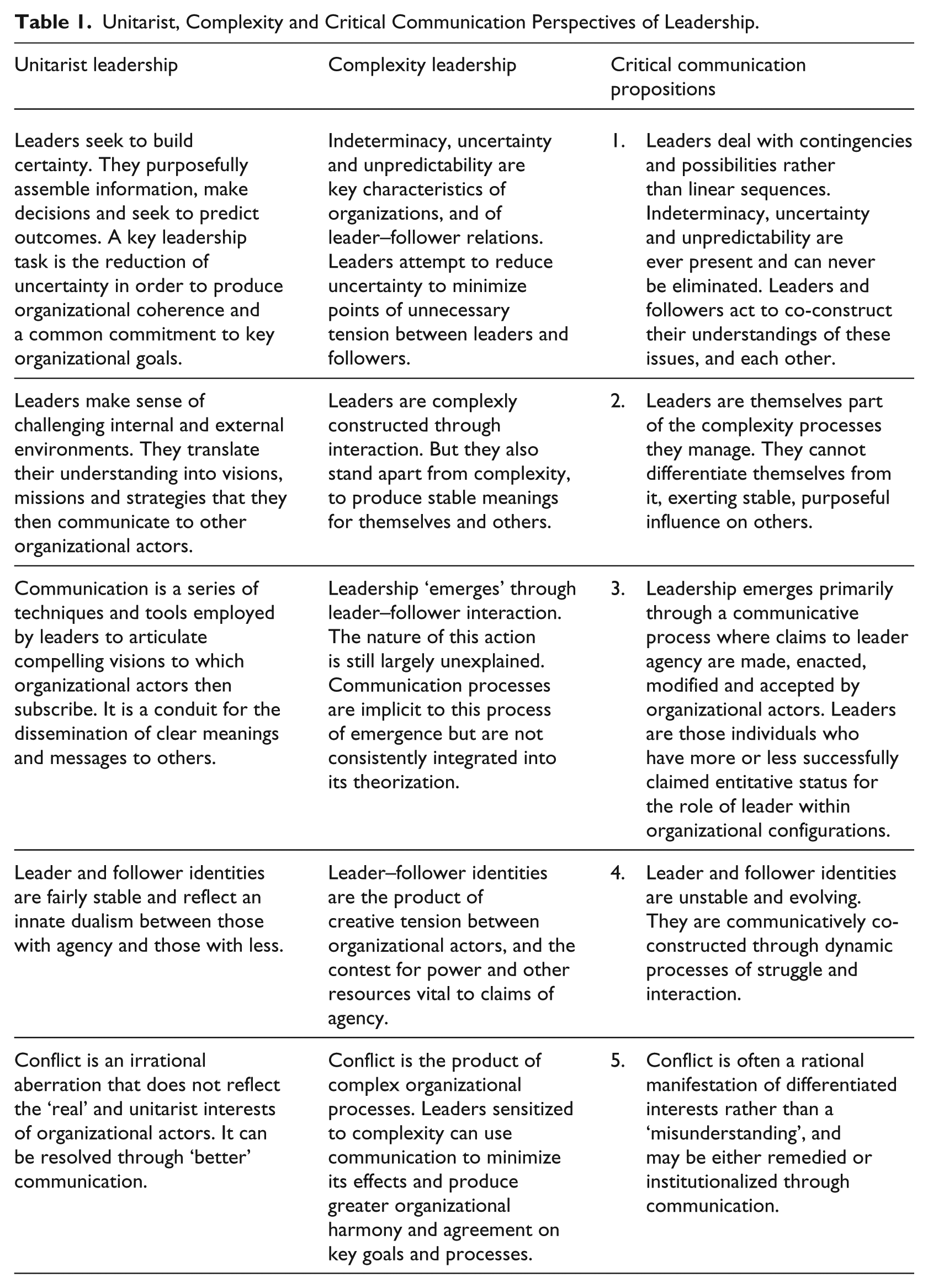
My contribution is summarized in Table 1. The table outlines five main tenets of mainstream leadership theory, and how these both exaggerate the agency of individual leaders and promote a unitarist view of organizations; contrasts them with CLT approaches that, in principle, challenge these assumptions; and outlines five propositions which suggests some paths for theory development by the adoption of a processual, communication perspective. I do not suggest that the distinctions between each of the three categories are mutually exclusive and fixed. They represent a continuum of assumptions and theoretical frames on leadership. Rather, I seek to explore the theoretical benefits gained from a deeper exploration of the paradoxes, tensions, contradictions and differentiated interests that characterize one of the most challenging phenomena in organizations – leadership. Thus, I outline some of the key notions of complexity in the social sciences, and discuss how these have been taken up somewhat tentatively by a number of leadership scholars. I then problematize aspects of CLT and elaborate on the five propositions contained in Table 1. These seek to show how at least some of the difficulties with CLT can be addressed.
Unitarist, Complexity and Critical Communication Perspectives of Leadership.
Complexity in the Social Sciences
Complexity science has been characterized as ‘one of the fastest growing topics of research in the natural and social sciences’ (Morrison, 2011, p. 1). It is therefore little wonder that some scholars have also seized upon its theoretical potential in the field of leadership studies. Complexity is described as ‘the scientific study of systems with many interacting parts that exhibit a global behaviour not reducible to the interactions between the individual constituent parts’ (Thietart & Forgues, 2011, p. 53). In organizational terms, this is depicted as the study of ‘dynamic systems governed by nonlinear relationships’ (Thietart & Forgues, 1995, p. 22). Organizations, it is argued, ‘are best understood as complex systems comprised of dynamic networks of relationships’ (Hogue & Lord, 2007, p. 373). Complexity theorists stress how behaviours, processes and outcomes are inherently hard to predict, although prediction remains one of the key objectives of positivist approaches to social science (Maguire, 2011). They focus on the potentially infinite number of variables that are at play when people interact with each other in an organizational context. Taken alongside the porous boundaries of organizations, the challenge of identifying definite causal relationships within clearly defined social systems is enormous (Morel & Ramanujam, 1999). Osborn, Hunt and Jauch (2002) point out that Each time an agent interacts with another, the agent is free to follow, ignore or slightly alter the institutional arrangement… Where the organization faces a dynamic and unpredictable environment, the feedback is nonlinear. Small changes could have very large consequences (the butterfly effect) for subsequent operations. (Osborn et al., 2002, p. 823)
The result is uncertainty about such issues as how systems can behave collectively when they are composed of unpredictable parts; how any system interacts with others; difficulty in delineating the environment in which a system finds itself; and uncertainty in any attempt to describe how elements of the system change over time (Allen & Boulton, 2011).
Explaining discontinuity and continuity in organizations
That said, organizations are complex but not chaotic. Certain norms of behaviour and rules endure as constraining and enabling influences on individual, group and organizational behaviour, to however limited an extent. As Tsoukas (1998, p. 292) expresses it, ‘unpredictability does not imply the absence of order… recurrence does not exclude novelty’. Consistent with this insight, complexity theorists have tended to describe complex organizations in terms of complex adaptive systems (Panzar, Hazy, McKelvey, & Schwandt, 2007) that are the product of interacting parts which produce higher levels of organization (Juarrero, 2011). Complexity resides in the interaction of the parts, however so defined. It is these interactions that require study, as well as the interactions within the parts concerned (e.g. within dyads, small groups and wider organizational systems).
For example, Kupers (2001, p. 16) proposes that complex adaptive systems can be thought of as ‘a system of semi-independent agents that interact more or less randomly to influence each other’s behaviour. The agents must realise when their interactions have left them better or worse off according to a fitness criterion.’ 1 However, the notion of a ‘fitness criterion’ assumes that there is some objective measure whereby performance and outcomes can be judged. It also assumes that organizational actors will readily cohere around the criterion in question, since they share an overwhelming unitarist interest. Yet as Grint (2005) has compellingly argued, how actors define problems and the nature of the solutions that may be available is a differentiated process of social construction. If a problem can be defined in radically different ways then it is hard to see how a common ‘fitness’ criterion can be developed to assess solutions. There is simply too much uncertainty and complexity in our social world for this to invariably happen. In the rest of this paper, I argue essentially that complexity leadership theorists have neglected to fully apply the logic of these issues to the main subject of their inquiry – leadership.
Problematizing Complexity Leadership Theory
CLT suggests that ‘leadership is an emergent event, an outcome of relational interactions among agents’ (Lichtenstein et al., 2006, p. 2). Implicit here is the view that leadership is a process and that the recognition of some people rather than others as ‘leaders’ is socially constructed through the communicative actions of organizational actors (Marion, 2013). It follows that a complexity leadership perspective requires that we distinguish between leadership and leaders. Complexity Leadership Theory will add a view of leadership as an emergent, interactive dynamic that is productive of adaptive outcomes … It will consider leaders as individuals who act in ways that influence this dynamic and the outcomes. (Uhl-Bien, Marion, & McKelvey, 2007, p. 299)
This line of inquiry has great potential to unlock our understanding of the processes whereby the emergence of leadership takes place.
However, and while acknowledging that transformational leadership theory has paid too much attention to individual leaders rather than the processes whereby they emerge, Uhl-Bien et al. (2007, p. 299) argue that ‘Complexity Leadership Theory (CLT) focuses on identifying and exploring the strategies and behaviours that foster organizational and subunit creativity, learning, and adaptability when appropriate CAS dynamics are enabled within contexts of hierarchical coordination (i.e., bureaucracy).’ This suggestion is also seen in Marion and Uhl-Bien’s (2011, p. 386) claim that ‘complex problems are best tackled by complex responses. Complexity theories of leadership explore strategies leaders can use for advancing and enabling such complex response.’ This appears to assume that complexity does not exist, or does not exist so strongly, at the level of the ‘parts’ (e.g. dyads, groups and larger organizational systems) that complexity leadership scholars have determined are interacting to produce complexity.
Moreover, how leadership emerges and the dynamics of the relational interactions among organizational agents are issues that remain largely unexplained. Leaders are simply attempting to minimize chaos and bring order to complexity (e.g. Lichtenstein & Plowman, 2009; Osborn & Hunt, 2007). The stress is on how leadership unifies people into social groups, rather than on foregrounding processes of domination and control (e.g. Hazy, 2011). Such arguments can easily cycle our thinking back to such leadership concepts as transformational and authentic leadership, whereby powerful leaders set visions and strategies, and establish ethics and identities for others (Avolio & Gardner, 2005, Bass & Riggio, 2006; Hartnell & Walumbwa, 2011). This is consistent with what Drath et al. (2008, p. 635) describe as the ‘dominant’ ontology within leadership studies that stresses the importance of common goals between predefined leaders and followers. Thus, it is simply assumed that such issues as ethics and identities can be unproblematically established for relatively compliant followers by more or less powerful leaders. Complexity, it is suggested, resides in the interaction of the parts, however so defined, rather than as a property ingrained within the parts themselves. Thus, CLT tends to adopt a somewhat primitive, realist view in which leadership is just ‘there’, and is produced by (relatively) unproblematic interactions between preconfigured agents. 2
As a result, complexity leadership still tends to be viewed as a means whereby, to list just some suggestions, leaders encourage experimentation, establish consistent routines, create clear chains of responsibility, promote a learning culture and one that also recognises accountability (Hazy and Uhl-Bien, 2013; 2014). This takes us back to more traditional conceptions of leadership, in which more and more expectations are placed on leaders who it is assumed have the power, cognitive space, skills and tenacity to deliver on them. There are multiple and growing expectations, but very few constraints seem to exist.
Complexity leadership, or leaders managing complexity?
McKelvey (2010) offers a particularly striking example of this thinking, in an extended discussion of Jack Welch’s leadership style that purports to show CLT in action. McKelvey (2010, p. 9) argues that ‘Welch was effective because his approach was – albeit unknowingly and inadvertently – drawing strongly and consistently on basic findings from complexity science’. This is a bold claim. Complexity science is far from straightforward, but Welch is depicted as, in effect, an ‘unconscious’ complexity scientist, aware of its main tenets without being aware that he was aware of them. In the process, he is given the main credit for General Electric’s financial success during his tenure as CEO. McKelvey (2010, p. 5) therefore aims to ‘rebuild leadership theory from the ground up by studying what Welch actually did that produced some $480 billion in GE shareholder value’. Complexity science is conceived in terms of 12 ‘action disciplines’ that Welch employed to ‘enable and steer GE to produce incredible wealth’ (McKelvey, 2010, p. 4). In violation of complexity theory, there is a straightforward view here of temporality. Events proceed in a linear fashion, from the visions and actions of the leader to the outcomes on the ground.
Organizations and the leadership processes within them are ultimately seen as a more or less rational means of achieving shared goals that necessarily reflect some kind of unitarist interest: a straightforwardly functionalist perspective (Burrell & Morgan, 1979). Ontologically, the assumption is that ‘leadership is something with an independent existence out there in the world and is located in a web of causal relationships’ (Alvesson & Spicer, 2012, p. 371). Epistemologically, it also suggests that Welch’s leadership, and that of others, can be studied in a value-free way: there is nothing here to really criticize, no substantial moral or ethical dimensions to consider, and no alternative voices worthy of attention. Such an approach airbrushes all issues of confrontation, oppression and differentiated interests between actors into oblivion. It ignores what Mumby (2000, p. 71) calls the ‘politics of epistemology’: that is, ‘the values and interests that underlie knowledge claims’.
For example, Welch’s early moves at the helm of GE saw him fire 130,000 out of 400,000 people, an approach which earned him the title ‘Neutron Jack’. McKelvey seems aware that this might disrupt his highly positive narrative: it would be hard not to. Despite this, his 33-page article devotes only 2.5 sentences to the issue. These lamely conclude that: ‘Divesting 130,000 employees is not for the weak hearted’ (p. 29). ‘Divesting’ is a curiously mild word in this context. A consistently complex perspective would be more inclined to denaturalize Welch’s leadership and critically interrogate the overwhelming priority that he consistently placed on financial metrics. Alongside Welch’s rationale, it would also explore what those affected by ‘divestment’ thought, felt and did about it. McKelvey’s (2010) reticence on these issues is far from unique, which is why it matters. It is becoming increasingly common to find papers which claim to describe complexity leadership in similar functionalist terms, including within the public sector (e.g. Murphy, Rhoes, Meek, & Denyer, 2016) and in health care (e.g. Ford, 2009).
My point here is that despite the stress within CLT on the relational dynamics that produce leadership, theorists still frequently treat the goals and actions of senior leaders as an unproblematic given that, as in this instance, require little interrogation. They are simply there, as immutable and unchallengeable features of the social landscape. This is consistent with a functionalist emphasis on ‘providing explanations of the status quo, social order, consensus, social integration, solidarity, need satisfaction and actuality’ in an attempt to ‘provide essentially rational explanations of social affairs’ (Burrell & Morgan, 1979, p. 26). From this standpoint, the negative effects on other people of Welch’s radical programme of lay-offs, and their responses to this, are relatively unimportant. Leadership is thereby employed as a term to suggest an observable, discrete phenomenon bounded by causal relationships, temporality and organizational constraints. Moreover, the leader is depicted as an all-powerful actor who is primarily responsible, by dint of their own particular super-abilities, for organizational success, and has the legitimate authority to define the criteria whereby success is determined. On the other hand, an interpretivist paradigm puts more stress on how organizational phenomena are socially constructed through the unpredictable and often innovative interactions of myriad organizational actors (Burrell & Morgan, 1979).
There is, of course, debate to be had about how mutually exclusive functionalist, interpretivist and other paradigms actually are (see Corman & Poole, 2000; Deetz, 1996; Knudsen, 2003; Moldoveanu & Baum, 2002). Researchers often seek to move within and between paradigms as they encounter complex organizational realities. As Fairhurst (2000, p. 121) suggests, ‘the world of organizations is far too complex for any single theoretical approach to fully grasp’. In this paper, I don’t wish to disappear down the rabbit hole of the paradigm wars that have erupted within our field since at least the 1980s. While paradigms have different assumptions, their boundaries are frequently fuzzy (Shepherd & Suddaby, 2017). Gioia and Pitre (1990) therefore suggest that we think of such boundaries as ‘transition zones’ rather than as markers of absolutely differentiated categories. But this does not displace a recognition that, at a minimum, there are tensions between paradigms (however these are defined). 3 Even if we grant some common ground, it remains the case that knowledge claims are advanced within particular theoretical frameworks that are indeed sometimes incommensurable (Mumby, 2000). For example, the functionalist and positivist claims of transformational leadership theorists – a relatively unproblematic statement of leader agency and authority – are in my view incommensurate with those that arise from more critical, interpretivist and, yes, complexity perspectives. In the interests of epistemological clarity and transparency, these tensions need to be acknowledged when theorists attempt to develop insights drawing from more than one of them. CLT writers have generally flunked this challenge. As one instance, a key edited book on complexity leadership (Uhl-Bien & Marion, 2008) contains over 400 pages and fourteen chapters. None cite Burrell and Morgan’s seminal work on this issue, and the words ‘ontology’ and ‘epistemology’ do not appear anywhere in the text. The reluctance of CLT researchers to seriously engage with these issues hobbles their own project of theory building.
‘The times they are a changin’ – But are they?
A key justification for the suggestion that so much rests on the shoulders of leaders – more, perhaps, than ever before – is that the world is more complex and changing more rapidly than it was thirty, forty or fifty years ago. This urgency is taken to justify reliance on individual ‘super’-leaders who can navigate us safely through turbulent waters. CLT theorists have bought into this view. Uhl-Bien and Arena (2017, p. 10) write that: In today’s environment, complexity is occurring on multiple levels and across many sectors and contexts… the underlying causes are greater interconnectivity and redistribution of power resulting from information flows that are allowing people to link up and drive change in unprecedented ways… Leaders… drive efficiency and results in the core business, while at the same time new competitors are emerging that threaten traditional core businesses.
There is little offered to substantiate this declaration of ‘unprecedented’ change other than assertion. But rhetoric, alas, is not evidence. The challenges society now faces may be different to those of the past. However, are they really more complex than those involved in emerging from the Great Depression in the 1930s, defeating fascism in a world war, rebuilding Europe after 1945, or coping with a world in which Communism held sway over the vast landmasses of Russia, China, Eastern Europe and elsewhere? I doubt it. It is the conceit of each new generation to imagine that the problems it faces are more challenging, more rapid and, yes, more complex than those that arose in earlier times (Hughes, 2014). Ansoff, widely regarded as the father of strategic planning, concluded (in 1965!) that the business environment was becoming increasingly ‘turbulent’, a change he dated from roughly 1950. Mintzberg’s (1994) seminal critique of strategic planning notes many similar assertions from the 1960s, 1970s and 1980s to the effect that the current business environment was somehow more turbulent than what had preceded it. This notion also has an intrinsic appeal for management gurus, who thrive by offering to ease a panic about the present that they themselves have partially created. For example, Tom Peters (1994) argued that ‘crazy times call for crazy organizations’ and urged what he called a form of ‘perpetual revolution’. Spector (2014, p. 305) refers to this as the ‘presentism and tranquillity fallacy’: that is, ‘the tendency to find the current era to be exceptionally, even uniquely turbulent and past eras to seem calm in comparison’. Since the interconnected nature of the challenges that we all face are more evident to us than those that confronted our predecessors forty or fifty years ago it is natural to assume that they are more ‘complex’. The strength of this belief doesn’t make it true.
Other problems flow from this sense of novelty and urgency, commonplace in the emerging CLT literature (e.g. Schreiber & Carley, 2006). Arena and Uhl-Bien (2016, p. 23) write that ‘the central question addressed by CLT is: How, in the context of bureaucratic organizing structures, can organizational leaders enable emergence of the new solutions and innovations needed to survive and thrive in today’s complex world?’ Such notions as the view that shareholder value is the ultimate criteria of organizational success are here exempted from any suggestion of complexity. If the world really is now more volatile, unpredictable, complex and ambiguous (VUCA) 4 than any time in the past, perhaps there isn’t time to reflect on issues such as the core purposes pursued by business. Nor is there the need to study other periods of turbulence, and perhaps draw lessons from them.
Moreover, leadership remains ‘out there’, and acts on various bodies to produce observable, measurable effects in pursuit of straightforward goals that simply exist. But why do these goals exist, why do they have priority over others, who sets them and whose interests do they represent? In essence, we are presented with what claims to be a complexity theory of leadership that paradoxically sidesteps the processes that produce leadership, and focuses instead on how powerful leaders should attempt to exert influence on organizational systems. Social constructions (such as ‘new solutions’, ‘innovations’ and ‘thrive’) are presented in realist and functionalist terms as advancing truth claims about an unobjectionable objective reality. In adopting this approach, CLT has more in common with conventional leadership theories than may be immediately apparent. Leaders are expected to intervene in everything, everywhere, at all times, and display mastery of a growing list of competencies that would stretch the powers of any CEO super-hero. In contrast, I argue that:
Proposition 1: Leaders deal with contingencies and possibilities rather than linear sequences. Indeterminacy, uncertainty and unpredictability are ever present and can never be eliminated. Leaders and followers act to co-construct their understandings of these issues, and each other.
How Leaders and Followers Emerge from Complex Leadership Processes
If we do live in a complex world, it makes more sense to see leaders and followers as interacting organizational actors whose identities as leaders and followers are simultaneously constructed and deconstructed by the force of their ongoing respective struggles to realize their agentic potential (Tourish, 2013). This communication-oriented perspective can be seen as a corrective to the tendency to reify organizations whereby they are treated as ‘a natural phenomenon transcending the communicative events that realised the organization’s purposes, reducing it to an out-of-focus parameter of research, a constant rather than a variable, a container for the communicative contents that were supposedly occurring “within” it’ (Taylor, 2011, p. 1275). Consistent with this shift in our thinking, leadership cannot be meaningfully depicted as a force that stands apart from complex systems, neutrally exerting influence and control to achieve putatively positive outcomes. Yet precisely this misapprehension appears frequently in the writings of complexity leadership theorists.
Thus, Solow and Szmerekovsky (2006) describe complex systems, and then suggest that our understanding of the behaviour of these systems should include the study of how central organization and leadership affect system performance. For instance, it is commonly accepted that one role of central organization is to exert control over the agents of a complex system. But how much control should be exercised to achieve optimal system performance; or, in other words, under what conditions do systems benefit from different amounts of central control? (Solow & Szmerekovsky, 2006, p. 53)
Their view sees leadership in traditional terms of control. Leadership continues to be conceived as purposeful actors directing the efforts of compliant others, in the value-free pursuit of enhancing system effectiveness.
Likewise, Uhl-Bien et al. (2007) describe ‘enabling leadership’ in terms of how it not only fosters internal tension, it judiciously injects tension as well – tension that derives externally in that it is not a natural function of informal dynamics. Upper- and mid-level enabling leaders inject tension with managerial pressures or challenges, by distributing resources in a manner that supports creative movements, and by creating demands for results. (Uhl-Bien et al., 2007, p. 311)
In a similar vein, Plowman et al. (2007, p. 352) discuss communication in terms of how ‘leaders can help to energise collective action through the use of words that are expressive and inspirational’. In all three instances, enabling leadership ceases to be a process and becomes an individual active agent, a leader, whose own emergence is somehow taken for granted, who holds a (legitimate) hierarchical position in which he or she exercises unidirectional influence over more or less compliant others, and generates forms of tension that it is assumed will remain predictable and manageable. This seriously limits its explanatory value, since on one of the key issues of all (how leadership itself emerges) it has little to say.
In addition, while communication is sometimes viewed as fostering conversations as a means of leaders ‘letting go of “message control”’ (Plowman & Duchon, 2007, p. 123), or as the use of ‘organizational life stories to create and manage visions setting in organizations’ (Boal & Schultz, 2007, p. 423) it is not consistently envisaged as a means whereby leaders and others co-construct their respective identities through cooperation, but also through conflict and resistance (Guney, 2006). Meanwhile, the range of issues over which leaders are expected to display mastery continues to grow, quite in line with the hyperbolic tone of much leadership writing over recent decades.
The danger is that practitioners and researchers may relabel elements of, for example, transformational leadership as ‘complexity leadership’ when they remain more or less the same. Recall that familiar practices once called ‘administration’ were rebranded as ‘management’ and many of them were then positioned as ‘leadership’ in a process of increasing grandiosity (Alvesson, 2013). Without greater care, the terminology offered by CLT could end up as little more than a new mask for old theories that legitimize enduring and not always healthy power relationships in the workplace. That much CLT writing is conceptually abstract, with a paucity of empirical illustration, reinforces this risk, since it means that its language can be appropriated for multiple, competing purposes.
In contrast to this, process and communication perspectives stress unpredictability, irregularities and the persistence of conflict over shared meanings between organizational actors (Hernes, 2014). Drawing from the critical literature on the creation of organizational routines (e.g. Dionysiou & Tsoukas, 2013), I suggest that leadership is manifest in routine and non-routine forms of interdependent action and sensemaking in which actors engage. The routine and non-routine interact to create novelty, conflict, resolution and breakdowns, so that leadership is never a fully accomplished, stable and enduring product of human interaction. Leadership is fraught with the omnipresent possibility of breakdown and its emergence is always contested, partial and tentative.
Leadership as a process of complex becoming
Acknowledging this, I propose that leadership is a process that is itself an integral component of the complexity that constitutes organizational action. This view is consistent with wider process theorizing in organization studies (Tsoukas & Hatch, 2001). Process theories offer a dynamic view in which an organization is viewed as ‘an ungraspable flow marked by its ongoing novelty’ (Hussenot & Missonier 2016, p. 523). Van de Ven and Poole (2005, p. 1377) capture its essence as follows: ‘A fundamental issue that influences how we look at change is whether we view organizations as consisting of things or processes.’ It is a position that is naturally sympathetic to complexity thinking and the view of leadership expressed in this paper in particular.
Thus, conventionally, leadership is often viewed as a ‘thing’. There are material human entities that we call leaders, who then exercise influence on others. McKelvey’s (2010) discussion of Jack Welch, discussed above, is a prime example of a CLT scholar reproducing this standpoint. Uhl-Bien and Arena (2017, p. 18) also do so, when they discuss how leaders can exercise influence on others by employing ‘a unique set of skills’ while also showing ‘deep conviction and humility’. 5 The sense of urgency is palpable, built on the familiar view that our times are more turbulent than those in the past. In a later paper, these same authors cite the executive chairman of Cisco, John Chambers, to support their view that ‘one of the biggest challenges facing leaders today is the need to position and enable organizations for adaptability in the face of increasingly dynamic and demanding environments’ (Uhl-Bien & Arena, 2018, p. 1). Moreover, while acknowledging that ‘a key contribution of complexity to organizational science is the concept of emergence’ (p. 7) they seem to view leadership as a more or less independent agent whose own emergence requires little attention. Consistent with this, some scholars associated with CLT have continued to produce research papers that ignore the critical literature on transformational leadership and seek to identify ever more positive outcomes that purportedly flow from it (e.g. Osborn & Marion, 2009). All this manages to suggest that we depend for our survival on a few very special people who resemble super-heroes, but disregards how leaders themselves emerge and how followers influence them. CLT is evidently viewed by at least some scholars as quite compatible with heroic leadership images rather than incommensurate with it.
From a process perspective, however, organizations are constituted through the relationships between people. The question here is: through what relational processes do people assume leadership roles? By what means do followers also exercise an influence on leaders? ‘Great man’ theories notwithstanding, people are not born as leaders. Rather, they assume that designation through their attempts to claim a leadership role, and the extent to which that claim is granted, withheld or withdrawn by others following subsequent events (Spector, 2016). A process view recognizes that entities, attributes and events change in meaning over time (Van de Ven & Poole, 2005). It stresses the importance of the political, historical, economic and temporal contexts in which leadership processes take place. As Marx wrote in 1852: Men make their own history, but they do not make it as they please; they do not make it under self-selected circumstances, but under circumstances existing already, given and transmitted from the past. The tradition of all dead generations weighs like a nightmare on the brains of the living.
This suggests limits on the agency of actors, including leaders. Any analysis that remains on the level of how individuals seek to influence events and other people by dint of their own particular abilities or weaknesses is inherently limited. It represents a failure to consistently apply the notion of complexity to functions that have become overly naturalized in the minds of scholars.
I draw here on the work of Tsoukas (2017) who argues in favour of conjunctive rather than disjunctive theorizing in organization studies – that is, for theorizing that makes connections between diverse aspects of human experience rather than studying them in terms of their ‘separateness’. Disjunctive theorizing encourages model building that is, of necessity, a simplistic rendition of reality, while conjunctive theorizing is more likely to probe interconnectedness, contradiction and interaction. The difference, Tsoukas suggests, is between viewing organizations as ‘trivial machines’ – that is, as ‘systems whose outputs and inputs are connected with a predetermined rule’ (p. 139) – and ‘nontrivial machines’, in which predictability, causality and stimulus-response effects vary from context to context.
Complexity leadership theorists often depict leadership in disjunctive rather than conjunctive terms. Marion (2012) offers a good example of this, when discussing the role of complexity leadership in facilitating creativity. The conjunctive nature of the social world in which leadership effects are exercised is recognized; that is, he acknowledges that ‘creativity… emerges from the interactions and conflicts of diverse people and ideas rather than from the mind of any given individual (p. 458). But this understanding seems to break down when leadership itself moves to the forefront of study: Enabling leadership functions to foster conditions in which complex dynamics can emerge… Formal leaders… are particularly well-positioned for this role because of their access to resources and authority, although one cannot assume that all positional leaders are capable of performing the enabling function. (Marion, 2012, p. 468)
Leadership becomes ‘trivial’ rather than ‘nontrivial’ in that its existence is assumed to be more or less self-evident. Theorists suggest ways in which leaders can ‘enable’ these complex processes, rather than offer a theory that captures the complexity by which leadership itself emerges. Leadership devolves from suggestions of complexity to the projection of quasi-heroic images to which few transformational or authentic leadership scholars would object. I can, for example, imagine leaders cast in a transformational mode continuing to behave as they have always done, but persuading themselves (and some credulous researchers) that they are now performing an ‘enabling’ function and therefore ‘doing’ complexity leadership.
In downplaying these issues, I suggest that complexity leadership theorists are so immersed in mainstream leadership theory that they have been unable to fully escape its framing effects. Thus, in communication and process terms, researchers commit a twofold category mistake when they use ‘leader’ as a synonym for ‘leadership’ and when they describe complex systems but position leaders/leadership as independent agents standing apart from organizational complexity. Rather than leadership existing as a fully-fledged phenomenon, a process and complexity approach registers that the position of actors in organizations is a crucial part of unfolding complexity processes (Tsoukas & Hatch, 2001). We need to step back and see how leaders are themselves complexly constructed and deconstructed over time:
Proposition 2: Leaders are themselves part of the complexity processes they manage. They cannot differentiate themselves from it, exerting stable, purposeful influence on others.
Proposition 3: Leadership emerges primarily through a communicative process where leader claims to agency are made, enacted, modified and accepted by organizational actors. Leaders are those individuals who have more or less successfully claimed entitative status for the role of leader within organizational configurations.
Complexity Leadership Theory, Resistance and Dissent
The bias towards a unitarist understanding of organizations means that the role of conflict, dissent and resistance within complex systems, including leadership processes, has been under-theorized. Rather, leaders are encouraged to find ways of capitalizing on employee heterogeneity while simultaneously maintaining ‘top-down, centralized control for the efficient exploitation of resources and markets’ (Panzar et al., 2007, p. 307). The possibility that this ‘exploitation’ and the notion of ‘efficiency’ might be contested is typically not considered. Complexity leadership theorists have themselves often underplayed the significance of this issue and its implications.
Thus, Harter (2006) describes the role of the leader in terms of his or her ability to act as a ‘unifying symbol’ that will enable organizations to handle complexity more effectively. Leader and follower identities are viewed as fairly stable, and as reflecting an innate dualism between people with agency and those with less. While complexity is often acknowledged in such approaches, the focus equally often reverts to the notion that the individual leader is paramount and can act effectively to influence values and the basic assumptions of followers who are more or less receptive to the leader’s intentions (MacIntosh & MacLean, 1999). The leader is thereby considered as a rational and objective actor who can influence other people with relative ease. In reality, it is important to recognize that: ‘The living present is as much about conflict and competition as it is about harmony and cooperation’ (Stacey, 2012, p. 27). It follows that any suggestion of complexity as inherently bounded and distinct from rational leaders who exercise purposeful influence on it risks simplifying and distorting the processes whereby complexity is actually manifest.
Accordingly, even when dissent is expressed or suppressed, we still see a mutually constitutive interaction between the leaders and followers in which communication is always present, since any attempt to avoid communication (e.g. by minimizing the overt expression of dissent) becomes itself a form of communication. This impacts on the identities, behaviours and feelings of both the other party and the message source. The same point holds in any consideration of resistance. Collinson (1994, p. 25) described how we can have ‘resistance through distance’, ‘in which subordinates try to escape or avoid the demands of authority’, or ‘resistance through persistence’, in which people ‘seek to demand greater involvement in the organization and to render management more accountable by extracting information, monitoring practices and challenging decision-making processes’. In either variant, neither of which is exhaustive, the behaviour of employees produces a set of impressions on others, who must respond accordingly. Leader identities, strategies and behaviours are thus partly constituted through the resistance strategies of employees.
Generalizing from this, I suggest that organizational phenomena, including leadership, can be viewed ‘as (re)created through interacting agents embedded in sociomaterial practices, whose actions are mediated by institutional, linguistic, and objectual artefacts’ (Langley & Tsoukas, 2010, p. 9). Leaders do not act on relatively inert organizational structures to produce compliance. Rather, they react to the acts of others, who in turn react to the ongoing reactions of those who hold formal leadership positions in an indefinite communication process that has a mutually constitutive effect. Temporality and flow are crucial (Langley, Smallman, Tsoukas, & Van de Ven, 2013). It is therefore vital to view the role of ‘follower’ as multidimensional. This involves recognizing that followers engage in ‘selective followership’, since they may buy into some of a leader’s communication but resist much of it as well. 6 Their role certainly does not consist only of paying close attention to the wishes and edicts of leaders, who exert control, distribute resources and create demands for results. For that matter, it is also clear that leadership itself is multidimensional, with leaders in some situations resisting calls to offer what some actors see as leadership (e.g. by refusing to make certain decisions, delegating decision-making authority to others, and themselves resisting change). Moreover, under certain circumstances, formal and informal leaders can become the followers of others. This may be frustrating for those who seek essentialist definitions of leadership. Rather, it accords with Kort’s (2008) view that leadership is built through the plural actions of multiple actors, rather than merely representing a manifestation of innate abilities and official roles within formal hierarchical systems.
This challenges the tendency to see leadership and followership as dichotomous categories, alongside other dualisms such as speaker/listener, agent/observer and active/passive (Collinson, 2014). Rather, while meaning and understanding may exist prior to an interaction between actors it is often affected and constituted by the nature of the interaction itself (Cornelissen, Durand, Fiss, Lammers, & Vaara, 2015). This perspective is not consistently adhered to by complexity leadership theorists. Thus, Marion and Uhl-Bien (2001, p. 409) suggest that ‘transformational leaders encourage followers to question ideas and take responsibility… because they show confidence in followers’ ability to take on assignments’. Such a depiction of transformational leadership minimizes the extent to which it legitimizes hierarchical relationships and the extent to which it directs followers to ‘take on assignments’ that may actually be inimical to their own best interests. But this view also continues to depict leaders as relatively immune to the influence efforts of others, while being capable themselves of transmitting direction to more or less compliant followers (Collinson, 2006; Ford & Harding, 2015).
As for how leadership emerges and what it is, all serious suggestions of complexity disappear. But if CLT really were a theory of complexity, then it is incommensurate with traditional leadership models and practice suggestions that urge powerful leaders to act on relatively compliant others in order to produce predictable effects. Approving references to transformational leadership undermines the argument that leadership itself emerges from complex interactions, since the practice of leadership being described by transformational leadership theorists is so (un)complex. There is a contradiction here, and a failure by CLT theorists to seriously engage with the epistemological and ontological challenges that their own work has thrown up. Rather, transformational leadership once more frames at least some of their thinking. It assumes its familiar position in leadership theorizing – centre stage.
The pervasiveness of paradox and contradiction
Organizations and leadership are riven by paradoxes, contradictions, tension and differentiated interests between actors (Smith, Erez, Jarvenpa, Lewis, & Tracey, 2017). These are key elements that drive complexity, and can never be fully resolved. But, in contrast to such a view, Uhl-Bien et al. (2007) speak of ‘adaptive change’ as something produced by the clash of existing but (seemingly) incompatible ideas, knowledge and technologies… A familiar form of this change occurs when two interdependent individuals who are debating conflicting perceptions of a given issue suddenly… generate a new understanding of that issue. (Uhl-Bien et al., 2007, p. 307)
While asserting that complexity leadership ‘does not support an “every person on the same page” assumption, preferring instead a heterogeneous environment in which there are healthy debates over ideas’ (Uhl Bien et al., 2007, p. 298), the preponderant assumption is that ‘healthy debate’ prepares the ground for ‘a new understanding’. While creative tension between actors and the contest for power and resources is acknowledged, we are still presented with a Habermassian view, in which ‘ideal speech acts’ enables the open ventilation of all opinions between actors in the course of which their ‘real’ common interests and therefore agreement comes to the fore (Fryer, 2011). Leaders sensitized to complexity in this way are purportedly able to re-energize ‘employees by valuing them as humans with freedoms, voice, equality and openness to participation’ (Morrison, 2011, p. 159). However, as critically oriented communication and leadership scholars have pointed out, communication generates dissensus as often (or more) than it generates consensus (Tourish, 2014). This draws upon what Kuhn (2012, p. 550) describes as a ‘logic of difference’ that sees disjuncture and dissonance as an ongoing feature of communication processes rather than an aberration that will be resolved through it.
From this perspective, organizations are complex, interacting processes dominated by paradox and contradiction (Cooren, 2015; Cooren & Fairhurst, 2008; Schoeneborn, 2011). Thus, a decision made in organizations ‘also communicates its own alternative. A decision cannot help but communicate its own critique (i.e. communicate that it could also have been made differently)’ (Knudsen, 2005, p. 110). Thus, if ‘to organise is always to reorganize’ (Latour, 2013, p. 42), it is also always to disorganize. The process of making and enabling or refusing entitative claims for leader roles in organizations likewise opens open multiple possible critiques and alternatives that are resistant to closure (Nicotera, 2013). A claim to leader agency affirms that other leader possibilities exist, while a given leadership style also affirms its opposite and a range of positions in between. Conflict, often irresolvable, is inherent to these processes.
This understanding is central to a deeper understanding of complexity leader dynamics. A processual communication theory of complexity is more inclined to see leadership as an inherently contested process whereby putative leaders are attempting to promote category convergence (shared meanings). But the dynamics of organizational life ensure that these efforts can only be partially successful at best, and that they often fail outright. There are always competing institutional logics from which actors can draw. The struggles around this process and that result from it constitute the essence of complex leadership dynamics. Additionally, to lead (particularly in the transformational manner advocated by many theorists) is to ensure that someone else does not. It is therefore inadequate to simply explore how leadership identities are constructed through the means whereby ‘claims and grants of leader and follower identities are endorsed with reciprocal grants and claims’ (DeRue & Ashford, 2010, p. 633). Rather, we need to explore more fully how the dis-recognition of leader and follower roles occurs. People also resist or reject the fostering of leader and follower identities. A dialectical process of conflict recognizes ‘the push-pulls between opposing forces that enact social reality’ (Putnam, 2013, p. 24), and acknowledges that such contestations are endemic to most people’s experiences of organizational life (Hargrave & Van de Ven, 2017; Putnam, 2015). Complexity leadership theories that minimize their presence are neglecting some of the most important dynamics that occur within organizations. Thus:
Proposition 4: Leader and follower identities are unstable and evolving. They are communicatively co-constructed through dynamic processes of struggle and interaction.
Within unitarist approaches, conflict appears as some kind of irrational aberration from a unitarist norm. 7 Leaders act to reduce it and produce consensus. However, within a consistently complex perspective, leadership cannot be viewed as the resolution of critique or its abolition, since critique is embedded in the act of decision. To decide means to choose and at least implicitly communicate to others that something else has not been decided. The quest for discursive closure is inherently self-defeating. The more closure is pursued, the more an implicit oppositional stance by some actors is likely to become explicit. Every organization has refuseniks. Sometimes they become a majority. Organizations are an ongoing series of continuous, interrelated communicative actions that are built around specific premises, commitments, decisions, expectations and processes for the further resolution of issues. This is an ongoing process rather than one with a defined endpoint. Thus, leaders’ roles are constituted and reconstituted by the demands of others as much as by the demands that the leader places on these same others, through championing visions, missions and strategies. Our awareness of these possibilities and the structural constraints within which they are realized is always mediated through communication (Fairclough, 2005).
Thus, the formal articulation of difference may sometimes be the product of misunderstanding, and may therefore be fixable through further interaction. Equally, articulating difference is as likely to reflect deeply entrenched and variegated interests on the part of the actors concerned, become endemic to their relationships, and generate ever greater complexity and discord as it develops. CLT needs to embrace a deeper process view of communication, in which communication is seen less in a traditional ‘transmission’ mode whereby powerful leaders manage meaning for others, and in which meaning is ceaselessly co-constructed, debated, iterated and ransacked by multiple competing interests among individuals and groups. Thus, and as summarized in Table 1, some conflict and dissent may be ephemeral and resolvable. But, at a deep structure level, conflict expresses variegated organizational interests. In such instances, further communication is likely to produce greater dissensus rather than consensus, and intensify the complexity endemic to leader–follower relations. Accordingly:
Proposition 5: Conflict is often a rational manifestation of differentiated interests rather than a ‘misunderstanding’, and may be either remedied or institutionalized through communication.
Discussion and Suggestions for Further Research
CLT has begun to explore relational dynamics in a more rounded form than more established approaches, such as transformational and authentic leadership theories, have been able to do. At the same time, it remains overly enthralled by functionalist mind-sets that are in fundamental contradiction to how complexity manifests itself in leader–follower relationships within organizations. This is a paradox. It illustrates how difficult it is to break from functionalist theories that have had a dominating influence on our thinking. They continue to constrain the imaginations of researchers, even as they acknowledge the limitations of the theories in question. I echo Chia’s (2011, p. 182) call to theorists to ‘wean our thought processes from the dominance of natural scientific thought on the nature of complexity’, in order to complexify how we think about complexity.
Thus, CLT has yet to become an actual theory of complex leader–follower interactions. It remains mainly a theory of how leaders, standing apart from complex processes, can attempt to exercise influence on them: an unwieldy halfway house between unitarist conceptions of organization and the more dynamic templates implicit within wider complexity theories of organization. Often, CLT is really traditional leadership thinking inserted into a complex organizational context. There is a risk that it may become little more than a buzzword, employed to add a veneer of sophistication to what remain overly heroic notions of leadership. To avert this, we need a consistent view of complexly constructed leadership in organizations. Over twenty years ago Thompson and Davidson (1995) pinpointed how the rhetoric of turbulence and unprecedented change was being used to mask uncannily enduring power relationships in the workplace, and also to legitimize the pursuit of this or that new fad. In exaggerating the turbulence of our times and the novelty of their insights, complexity leadership theorists may be treading a well-worn path.
The key theoretical challenge, therefore, is to proceed from the foundational assumption that leadership cannot be understood so long as it is envisaged as a means whereby powerful actors exercise more or less unidirectional influence on others and on organizational systems. Every aspect of leadership and the identities of those who hold leadership positions are themselves complex. As Tsoukas and Dooley (2011, p. 732) argued, ‘Complexity is generated when multiple agents interact in open-ended ways.’ The task for those interested in further developing CLT perspectives is to explore in more depth how these relational interactions are manifest in leader–follower dynamics, and how they combine to produce effects that are far more complex than current theorizing has acknowledged.
This raises the problem of how leadership complexity might be studied in an organizational setting. Positivist methods limit their scrutiny to what can be (most easily) measured, rather than what is most important. They are not always the same thing. Alternatively, I urge that we collectively pay much more attention to what Alvesson and Sveningsson (2003) described as the small and even mundane acts whereby leaders perform leadership and seek legitimacy, such as merely listening and chatting to others. Beyond this, researchers also need to abandon any suggestion that leaders are fully formed individuals whose goals are unproblematic, who have access to an astonishing range of toolkits that they deftly use to effect change, and who can manage complexity while in some unexplained way remaining more or less immune to it themselves. This also means foregrounding issues of power, control, dissent and resistance. Mainstream approaches have been neglectful of the complexity of all these issues. In doing likewise, CLT has blunted its own critical edge.
Progress has been made by complexity leadership theorists. However, this has been hampered by the ongoing influence of overly heroic models of leadership. So far, complexity theory has not been applied consistently to explore how leadership itself emerges as an organizational phenomenon. Its theoretical and critical potential remains to be realized.
Footnotes
Funding
This research received no specific grant from any funding agency in the public, commercial, or not-for-profit sectors.