



Abstract
We live in an era where models of governing are changing rapidly under multifaceted evolutionary pressures and where, at the same time, organizational fields are becoming increasingly networked. With this paper, we add to the field dynamics literature, focusing on the space where these evolutionary pressures coincide – the interactions of Governments and interorganizational networks. We examine the roles that interorganizational networks play in relation to Government actors under particular long- and short-term institutional and governance conditions. We articulate four roles that networks may play in relation to Government: advocate, technology, judge and ruler. We argue that long-term institutional logics, combined with short-term Government action in response to a particular field evolution, may predict the role that the interorganizational network will assume in relation to Government in that particular field scenario. We discuss flows through the typology as conditions change and we conclude by presenting an agenda for future research in the field dynamics and interorganizational networks research domains that leverages our proposed network role typology.
Keywords
Introduction
A ‘profound re-ordering of our world’ (Djelic & Sahlin-Andersson, 2006, p. 1) is affecting the social structure of organizational fields. Economic crises, shifts in expectations around the delivery of public goods and new economic and political ideologies have impacted on changing models of government (Arellano-Gault, Demortain, Rouillard, & Thoenig, 2013). Together with changes in innovation cycles (Dokko, Nigam, & Rosenkopf, 2012) and labour patterns (Helfen, 2015) these pressures have contributed to organizational field evolutions, where fields are becoming more heavily networked. In this paper we pick up our conceptual magnifying glass to examine in more detail the social restructuring of evolving fields (Beckert, 2010), focusing on the interrelationships between representative actors for two elements of our social-institutional world – interorganizational networks and Government. Interorganizational networks have long been considered important in the structuring of fields, contributing to both their organization and their stabilization (Ahrne, Aspers, & Brunsson, 2015). We define interorganizational networks as sets of actors (individuals, groups and organizations) with recurring ties (resource, friendship, or informational) that come together around a common concern or purpose (Oliver & Ebers, 1998). We argue that if Governments must deal with field changes, then interorganizational networks may offer vital assistance in this regard. In the healthcare field, for example, the introduction of new care models could depend upon the cooperation of interorganizational networks such as advocacy-led industry associations or vertical groupings of hospitals, community care organizations and private companies.
Although organization studies have clearly recognized the increasing role of networks in institutional structures, little is said throughout the networks or field dynamics literatures as to how institutional actors such as Government must engage with networks as actors, or how Government/network relationships are maintained (Arellano-Gault et al., 2013). While Government may have the power to affect field-level structures, field stability depends on the negotiation of new structures and logics between all field actors (Reay & Hinings, 2005). Indeed, the increasingly blurred relationship between public and private players in field governance (Büthe & Mattli, 2011; Scott, 2004; Wood & Wright, 2015) means that ‘the question of how to steer these self-organizing inter-organizational networks becomes crucial’ (Kjaer, 2004, p. 3). We set out to typify the roles that interorganizational networks play in coping with field evolutions, working with and against Government as it seeks an answer to these evolutions, for instance by introducing new regulations. Even where networks and Governments collaborate, sometimes Governments actively use networks to further their goals, whereas often the goals are the networks’ own and those of Government just happen to coincide. Our typology seeks to capture these and other nuances within the relationship.
The institutional contexts that frame these relationships build up over decades and centuries but can be disturbed or influenced by actions on any given day, week, month or year. And yet many organizational studies that deal with governance and social structure in the context of field evolution have focused on governance at a point in time, with less attention to its long-term context (Corbera & Schroeder, 2011). For an exception see Van Gestel and Hillebrand (2011) where long-term bureaucratic institutional logics clash with newer, market and corporate logics in the field of employment services. Their study shows that this clash does not always result in a stable field and that the interrelations between actors seeking to negotiate new arrangements are critical to an in-depth understanding of how organizational fields evolve. We develop a model of analysis for such relationships that is underpinned by two contextual time frames. We use the decisions that are made by Government at the time of the evolutionary response to carve out our contextual boundaries in both the long and short term. We then combine the long-term institutional logic in this decision-making context (whether dominated by state or market logics) with the short-term Government action in response to the field evolution (whether government-based or governance-based 1 ) to matrix possible relationships between Government and networks in this decision-making context.
To illustrate, let us return to the organization of healthcare in one particular context – the Republic of Ireland. Over the long term, decisions regarding the resourcing and organization of healthcare services have been dominated by the State. In the past decade, a heavy influx of digital technologies has seen the healthcare field evolve, and the Irish Government must decide how to govern this field evolution in the short term. Should they adopt a government (top-down, regulation- and legislation-based) approach to the reorganization of healthcare in the light of these pervasive technological changes, or a governance (devolved market- or self-regulated) approach? Our contention is that combining the pre-existing statist institutional logic in this particular area of decision making (the resourcing and organization of healthcare in Ireland) with a government-based approach to the short-term governing of the change will likely lead to different Government/network relationships than would a governance-based approach. A different long-term dominance within the field, such as healthcare in the United States where resourcing decisions have been dominated by market, rather than state, would see network roles and responses that differ from those in a more statist context such as Ireland.
By conceptualizing the relational stance and interactions of two actors that have hitherto been seen as adding context rather than action to the social structures of fields in evolution, Governments and interorganizational networks, our model answers Arellano-Gault et al.’s (2013) appeal to bring public organizing back in to organization studies. It also contributes to Provan, Fish and Sydow’s (2007) call for more emphasis on the interorganizational network as a ‘whole’ actor. Situating our typology in the context of field evolution adds to its value as a diagnostic tool to policy makers and network managers in situations where decision making may be time-sensitive.
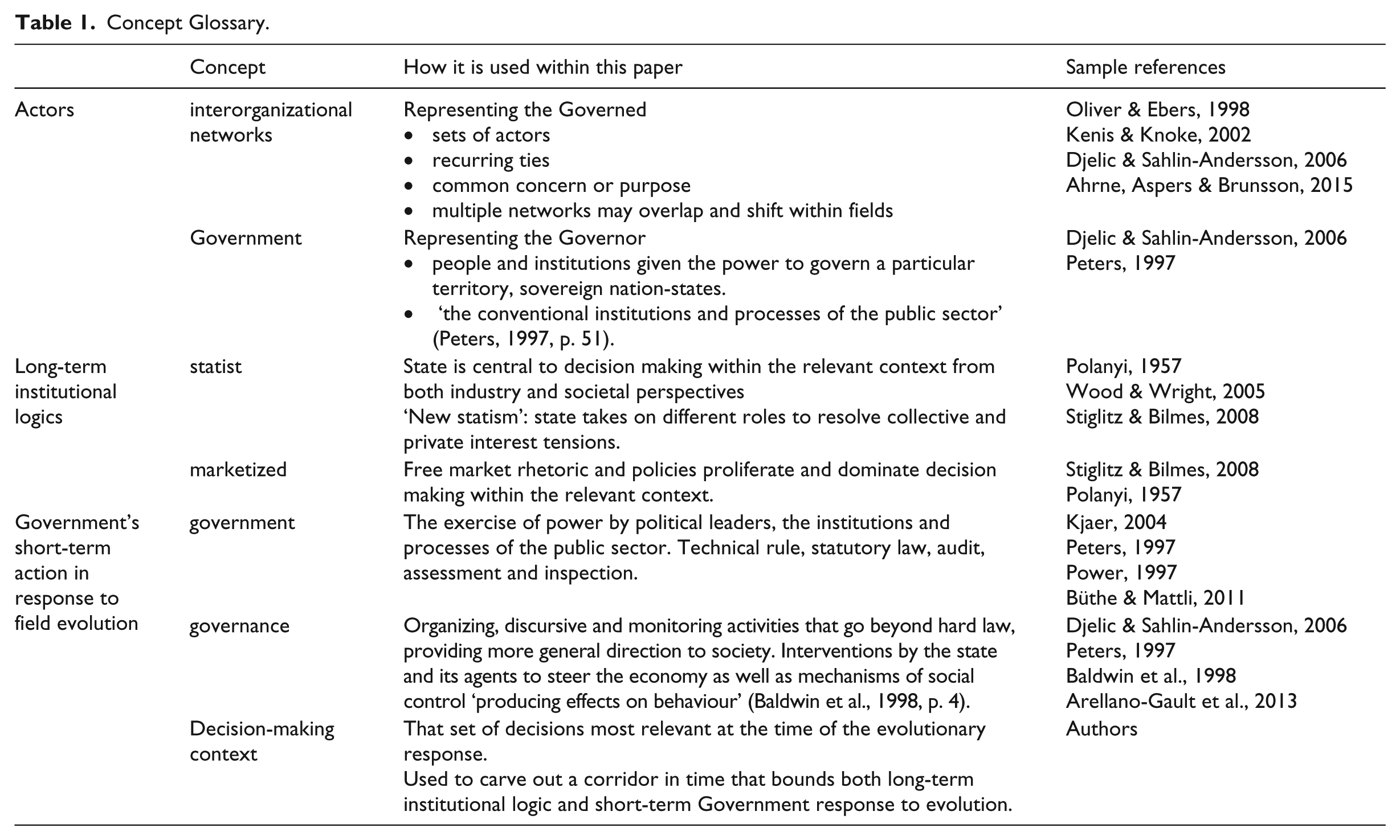
The remainder of our paper develops as follows. We begin by defining and describing the concepts that form the basis of our examination. Our second section introduces the network as a feature of changing government and governance approaches in statist and marketized decision-making contexts. The third section proposes a conceptual typology of four potential roles that networks play in relation to the Government actor in the context of evolving markets; it characterizes each type in terms of the relationship’s lead actor and the internal logics of the two parties involved. In the ensuing discussion section we outline how these types are at least partly predicated on the long-term centrality of the state in the field decisions affected by the evolution as well as Government’s short-term actions around governance and decision making. Interest alignment is added as a vector to distinguish two broad network responses within each role type – one where Government and network interests align, and one where they do not. These represent extremes of alignment, the start and finish points on a spectrum of possible responses. To conclude we return to the networks and field dynamics literatures and outline the research agenda that is opened up by this new typology. For the convenience of our reader, we offer a glossary of concepts used within this paper in Table 1 below.
Concept Glossary.
Governance and Interorganizational Networks in Evolving Fields
The evolution of organizational fields depends on their social structure, which affects the negotiation of new relations and norms as well as the way in which these are embedded in both practice and technologies (McKague, Zietsma, & Oliver, 2015). These wide-ranging adaptations and need for interpretation of new rules mean that governance should feature in any discussion of field evolution (Fligstein, 2001; North, 1990). If Government is at least partly responsible for the rules under which fields operate, then it becomes a key player in that evolution, and understanding its relationships with other key players is vital. Government’s approach – whether direct top-down legislation, or more distant bottom-up governance – will influence the relationships between it and other field actors.
Analysis of the interaction between governance and networks largely falls within two streams of literature. On the one hand, Network Governance theorists examine changing state–society relations at a macro level (Rhodes, 2007; Sørensen & Torfing, 2009). On the other, Policy Network Analysis researchers relate policy outcomes to network structure and membership at a more meso level (Fawcett & Daugbjerg, 2012). We recognize that Government influences the context in which networks operate, just as networks influence the context in which Governments must govern. Adding to these literatures, we argue that beyond simply providing context, Governments are increasingly reliant on networks for governance (Ruuska & Teigland, 2009). For instance, interorganizational networks can cultivate ‘sets of conventions’ that help to reduce or manage complexity (Loasby, 2002), making their response to Government action a key factor in shaping the evolutionary path of a field in transition. This supports Kjaer’s (2004) claim that the new use of the term governance, across multiple disciplines and contexts, is focused on the role of networks in the pursuit of common goals. While she distinguishes four kinds of network in this context – transnational networks, state–society networks, intergovernmental networks and interorganizational networks – we focus on the last of these.
The centrality of the state in the context of field evolution
How central the state is in the control of the field up to the point of an evolutionary turn matters greatly. Why? Because it influences the likelihood that field actors (including networks) will look to Government for direction, or identify Government as the source of the problem. For example, with the advent of digital health technologies, actors in the highly marketized US healthcare industry largely look to themselves, their competitors, or the ICT industry for direction as to how healthcare should reorganize around increasingly pervasive technology diffusion. Conversely, in Ireland, where healthcare organization has always been led by the state, actors rely on the state to navigate this new evolution of the industry in terms of purchasing electronic health records, sponsoring the development of new networks and interorganizational initiatives, and funding research and innovation activities (Mountford & Geiger, 2018).
We argue that in recent times state centrality has become more difficult to diagnose and narrower in its application. While Polanyian (1957) notions of state and market taking turns to dominate a field may hold true over history, current swings between regulation and deregulation dynamics are less clear-cut, more frequent and more localized to particular decision-making contexts. Decision making thus breaks down context by context within and across fields where one context is dominated by ‘statist’ regulation and another by ‘marketized’ industry-based standards. We therefore focus on the most relevant decisions at the time of the evolution – defined as those that are the subject of action or contention between Government and network in a given relationship. As Figure 1 illustrates, we use these decisions to frame both short- and long-term context, creating a boundary through time that allows us to look at one ‘slice’ of the field in analytical and conceptual detail.
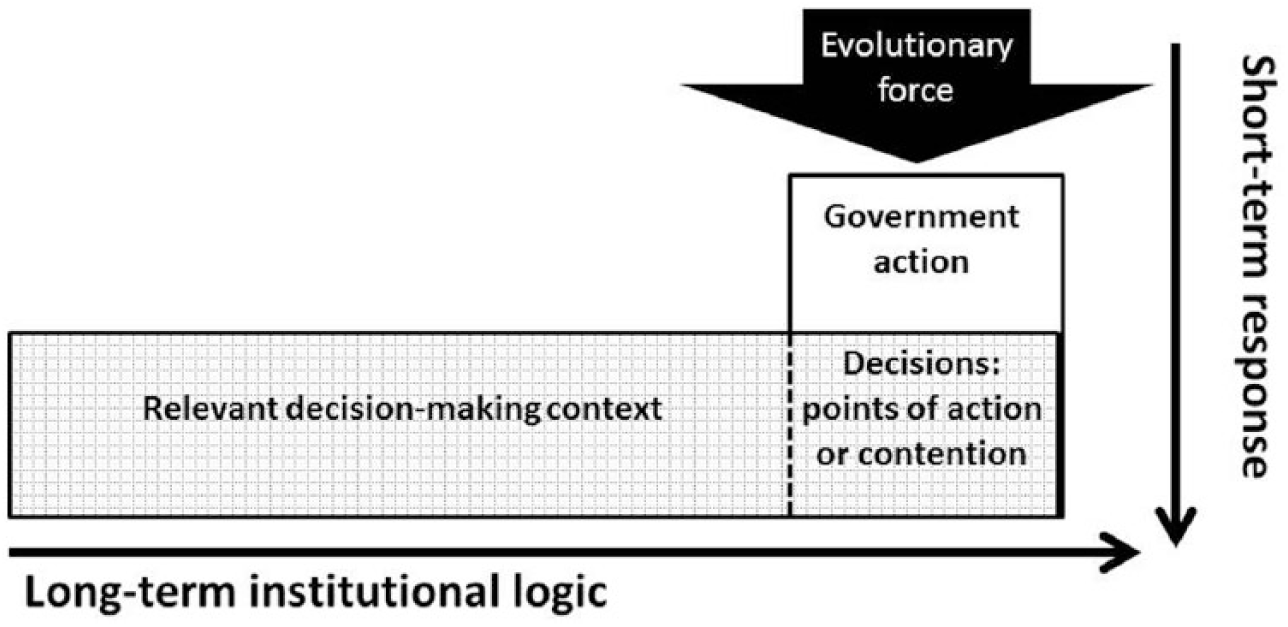
Decision-making context as a bounding concept.
We conclude that we must consider Government’s role in the field in two time frames. In the first instance we examine what happens when a specific field evolution occurs at a particular point in time and discuss Government’s approach to the short-term management of this evolution through government or governance approaches. We then discuss the long-term centrality of the state in decision making in the relevant context up to the point of evolution, considering whether the institutional logic underpinning that decision-making context is more statist or more marketized. We also consider the range of possible network reactions to the Government response, the internal logics from which the network might act, and the link between interest alignment and Government/network relationships. This approach will help us to understand what roles networks might play, under different conditions, in relation to Government actors.
A typology of network roles in relation to Government
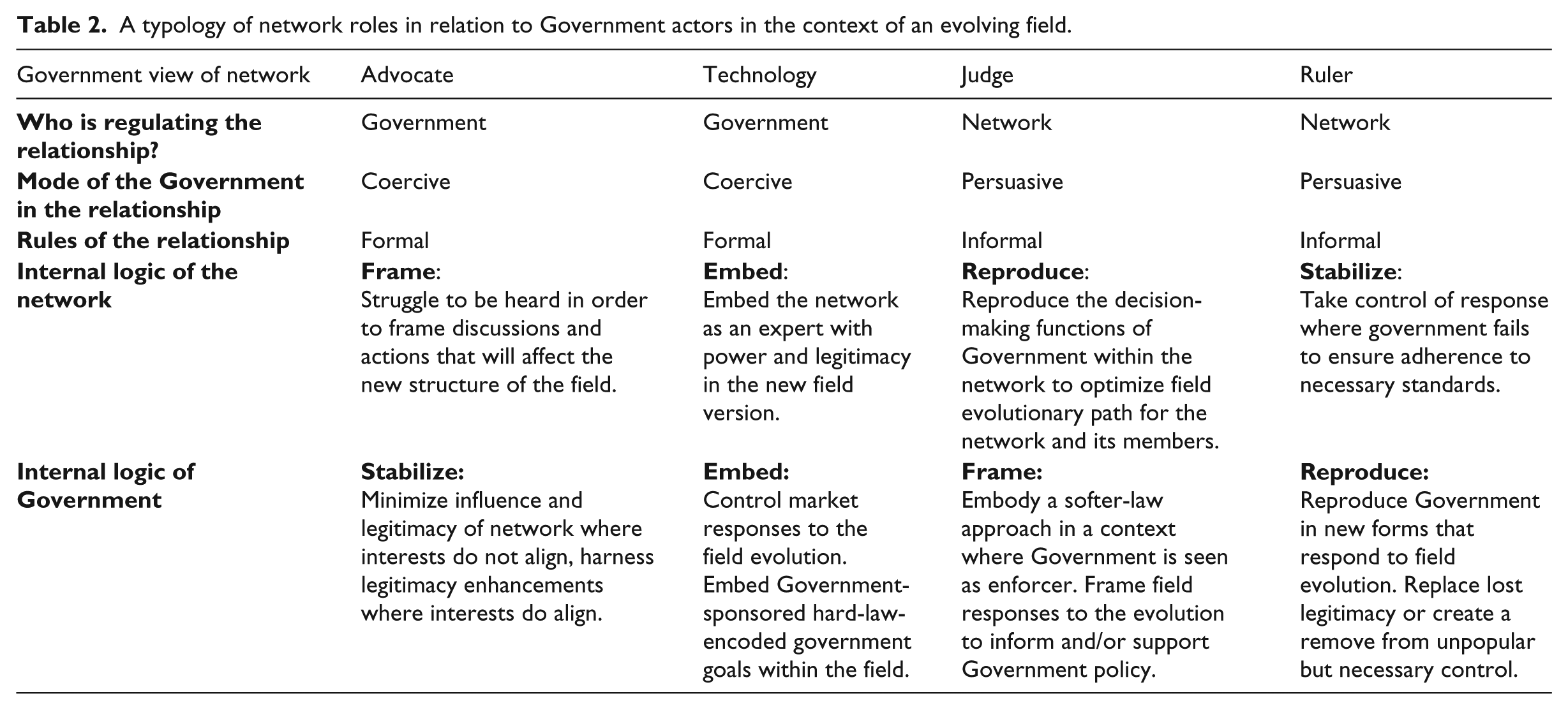
Djelic and Sahlin-Andersson (2006) present four dimensions of shifting regulatory patterns: who is regulating (from centrality of state to multiplicity of actors); the regulatory mode (hard laws to soft, non-binding standards and guidelines); the nature of rules (formal to informal); and compliance mechanisms (from threat of sanctions to membership resources, certification, socialization, acculturation and normative pressures). We adapt these dimensions to act as a characteristics map which we use to navigate the relationships that sit at the heart of governing within a shifting or evolving field. We characterize our governor/governed relationships based on who is regulating the relationship (Government or the network), the mode of the relationship (coercive or persuasive) and the rules of the relationship (formal or informal). We detail the internal logic behind each role in the relationship from both sides of the relationship, again borrowing from Djelic and Sahlin-Andersson (2006, p. 7) to speak in terms of both Government and network efforts to ‘embed, frame, stabilize, and reproduce rules and regulations’.
Table 2 presents an overview of our typology, while the subsequent sections will elaborate upon each of these types in turn and illustrate them through an example found in the course of our conceptual development phase. We emphasize that this is a conceptual paper and so, while important to validate our conceptual elaborations, our illustrations are based on secondary sources. Specifically, each example stems from a scholarly work that discusses Government/network interactions, which we supplemented and verified through our own recourse to the primary legislative and policy documents involved to ensure accuracy in our sketches of these Government/network relationships. While our examples are presented as relatively clear cut in terms of their typological dimensions and contexts, we take this approach in order to drive out the key facets of the type, trusting the reader to understand that relationships of any kind are rarely so black and white.
A typology of network roles in relation to Government actors in the context of an evolving field.
Network as advocate
Vehicle emission standards in Japan had been controlled by the Ministry of the Environment and the Ministry of Transport since 1968.2,3 Over 30 years later in December 2000, responding to an increased emphasis on environmental and public health, the Tokyo Metropolitan Government (TMG) took legislation to a local level and passed an ordinance prohibiting diesel cars over a certain emissions level. 4 The campaign had a severe negative impact on the perception of diesel cars in Japan (Hara, Endo, & Kobayashi, 2015). The Japanese car industry sought to reject the premise of the TMG’s hard government approach through mobilizing a network led by automakers, suppliers and trucking firms (Hara et al., 2015). This network pointed to European countries where diesel cars were promoted as less harmful than gasoline cars, to scientific research offering alternative views on the health impacts of diesel cars, as well as to the trucking industry’s reliance on diesel to maintain the industry (Hara et al., 2015). In a scenario where the car industry as a field was accustomed to looking to Government for guidance on emission standards, it campaigned against Government, protesting when TMG responded to a field evolution (the need for vehicles causing less harm to population health) with a hard government approach.
Networks as advocates are players in their own right ‘with significant day-to-day operational autonomy’ (Wood & Wright, 2015, p. 275). Government actors may use advocate networks as campaigners for the development of new field structures, harnessing the legitimacy that comes from their diverse perspectives and a remove from Government. Advocacy networks are those in which actors ‘collaborate on a particular issue and use informational and symbolic resources to influence power holders’ (Kraemer et al., 2013, p. 825). It includes activities such as ‘lobbying, hypermedia campaigns and marches’ (Acosta, 2012, p. 159). As a more apparently neutral actor than a clearly statist Government, the network can help to generate consensus around responses to a field evolution. Such consensus can then be used to frame field responses to the evolution to inform and/or support Government policy. This apparent neutrality is particularly valuable when attempting to set standards in an evolving field. The advocate network can mobilize field actors to agree on and implement standards that respond to the field evolution. While always extremely challenging, such efforts are often easier for an actor that is seen to be neutral.
Although the advocate network is broadly self-steering, Government judges the alignment of interest with the network and chooses the mode by which the parties will engage through legislation, funding, or public proclamations of support or protest. While the advocate network’s approach involves expert persuasion, this is ultimately a coercive relationship. Compliance is assured through legislation and hard law interventions which some networks will welcome (and may have had input into) and others will resent (and may have vociferously opposed).
Network as technology
In the late 1990s and early 2000s, the Swedish Government identified a need to increase innovation capacity if its key industries were to remain internationally competitive. While historically, decisions around innovation processes and R&D investment had sat within companies, in 2001 the Government development agency, Vinnova, launched the Vinnväxt ‘Regional Growth through Dynamic Innovation Systems’ programme offering funding to innovation networks that meet particular criteria and perform specific functions towards the achievement of national competitiveness in particular industries. 5 In 2004, ProcessIT, a research and innovation programme focused on IT-enabled innovations for process and manufacturing industries in Northern Sweden, received substantial financial support under this programme. 6 The ProcessIT network members (including universities, county boards, municipalities and companies such as ABB, Boliden, Komatsu Forest, LKAB, SCA and Skellefteå Kraft 7 ) are charged with driving innovation in the process and IT industries and are subject to a triennial evaluation process that assesses their progress against Vinnova-generated headline goals. 8 Where networks fail to meet such goals funding can (and has been) withdrawn. Government incentivized and recruited the ProcessIT network to harness its expertise in a bid to build a new innovation process. At the same time, it retained a presence on the board and demanded a focus on planning, management, evaluation and follow-up (Ylinenpää, 2009, p. 1163), thus casting the ProcessIT network in the role of technology. The network emerged from a combination of a previous IT industry network, InternetBay (Johanssen & Ylinenpaa, in Rickne, Laestadius, & Etzkowitz, 2012), and discussions between public authorities and a small group of researchers and firms (Levén, Holström, & Mathiassen, 2014). The positive alignment between the goals of this early version of the ProcessIT network and the Government agency, Vinnova, meant that the network responded to the Government call for a network as technology, facilitating the Government agenda.
Power (1997) draws a distinction between programmes, which have normative effects, and technologies, which impact operationally. Whereas programmes deal in ideas and concepts, shaping the mission of the organization, technologies deal in concrete tasks and routines. Where networks relate to Government in the role of a technology of that Government, the relationship (and often even the network itself) is regulated by Government. The network is supposed to achieve goals as laid out by Government, in a method approved by Government, with Government sanctions for a failure to do so including the threat of removal of resources, legitimacy, or both. The network in this instance is an embedding mechanism, used to control market responses to the field evolution. Networks are seen as a tool to accomplish a given task – wielded with differing levels of skill by Government actors. The specific network competence of the Government actor (as with any organization) is determined by the availability of resources, the network orientation of management, interorganizational communication and cultural openness (Ritter, 1999). These competences all speak to Government’s ability to maximize the value of the network as a technology.
Government actors may use networks-as-technologies to control market responses to the field evolution. The network embeds Government goals (often also given form in legislation and regulation) within the field by employing its expertise to identify and articulate benefits and minimize costs to business (Jordana & Levi-Faur, 2004). Networks may also be used to foster innovation in a targeted manner. When organizations are heterogeneous, in terms of their logics, values and mental models, they can share knowledge and secure progress through distinct collaboration and co-operation phases (Nissen, Evald, & Clarke, 2014). In fact, a combination of both diversity and commonality is required in order to design an effective innovation network and facilitate co-innovation (Dawson, Young, Tu, & Chongyi, 2014). Governments may use networks as a technology to access and drive such diversity and commonality at once. Where a public actor is in a position to set the agenda for the network, this offers a unique opportunity to ‘influence the relevant actors’ sense-making processes’ (Möller & Rajala, 2007, p. 905). Using networks as technologies maximizes the strategic rather than the technical and resource-intensive roles of Government as it now focuses on market leading, thinking, directing and guiding at the state level, while enterprising and service provision are devolved to the network.
Network as judge
In 1995 the Calman Hine report called for the reorganization of UK cancer services, highlighting the increasing cost of cancer care, variations in standards of care and the rising incidence of cancer due to an ageing population. 9 Historically, UK healthcare broke down into two broad sections; one dealing with strategy, policy and management, and the other with actual medical/clinical care, with the UK Government taking responsibility for the former (Grosios, Gahan, & Burbidge, 2010). Regarding care delivery, the UK healthcare field was characterized by an institutionalized model of medical professionalism, where ultimate clinical and co-ordination-of-care decision making rested with the physician, complicating and sometimes challenging Government action (see for example Waring & Currie, 2009). In 2001 the NHS launched its ‘NHS Cancer Plan’ stating that new networks would be established ‘to plan the strategic commissioning and provision of cancer services’. 10 One such network is described by Ferlie, Fitzgerald, McGovern, Dopson and Bennett (2013) as the ‘County’ Cancer Network. This network had the remit of (re)organizing cancer care in the county area. It had no Government representation on its board, no formal authority over its members and no Government funding on the table. Its success would be measured at a remove in both time and space through national cancer registry statistics tracking cancer outcomes. The network struggled, but ultimately succeeded in reducing cancer care delivery from four to two hospitals in a bid to improve quality of care. It did so in a partnership fashion, working within a climate of competition for resources and reputation and only looking to Government to rubberstamp decisions that had been made within the network.
In contrast to the network as advocate, the network as judge experiences a persuasive rather than a coercive relationship with Government. Such non-traditional, non-hierarchical networks potentially create the structural conditions required to equip change agents with the information and context necessary to convert rather than coerce peers and colleagues (Battilana & Casciaro, 2012). In doing so they frame field responses to the evolution in order to inform and/or support Government policy. The network regulates the relationship between itself and Government, returning to Government with fully formed proposals that may not adhere to the original Government policy template, as was the case in our example above where the network recommended two cancer care centres in place of the Government’s preferred single-site option. As the network has negotiated the proposed response between competing perspectives and demands and can fully justify the proposed course of action, Government is left with little option other than to accept the proposal or undermine the network as a site of future policy negotiation and implementation.
When Governments seek to partner with networks who act as judge, the goal is to align the strategic objective of the network with the strategic objectives of Government and then let the network reach the objective in its own way, employing political skills and leveraging relationships not possessed by the Government actor. The rules of the relationship in this context are informal in nature despite the fact that they reproduce the decision-making functions of Government within the network. This role of the network often extends to recruitment – changing minds and processes of actors within the market. It does so by promising to optimize field evolutionary paths for the network and its members.
Network as ruler
Until 1972, US accounting standards were ‘set on a piecemeal basis … by a private sector standard-setting body’ (Saudagaran & Smith, 2013, p. 1–5), in the form of the accounting profession, specifically through the American Institute of Certified Public Accountants’ Committee on Accounting Procedure and subsequently the Accounting Principles Board (APB). 11 In 1973, following ‘problems arising from the rapid expansion of accounting firms, the new issue boom, the development of increasingly complex and innovative business practices, and the corporate merger movement’ 12 the APB was replaced with three organizations – the Financial Accounting Foundation, the Financial Accounting Standards Board (FASB) and the Financial Accounting Standards Advisory Council (FASAC). This broadened the input base for standards setting beyond a single professional accounting organization to include financial executives, a financial analyst and an accounting educator on the FASB, and a variety of occupations on the FASAC. In the same year, the SEC affirmed that FASB pronouncements would be considered by the Commission as having substantial authoritative support and that actions contrary to such pronouncements would consequently be presumed misleading. 13 The FASB has ‘over time established itself quite unambiguously as the focal US institution for rule-making in accounting’ (Mattli & Büthe, 2005, p. 415). While in theory the SEC has the legal power to revoke the Board’s mandate, or override FASB standards, the FASB is three times bigger than the SEC, making any threat to reappropriate standards setting ‘an empty threat’ (Mattli & Büthe, 2005, p. 414).
In the network as ruler role, authority is devolved (voluntarily) or ceded (involuntarily) to the network to govern in a particular decision-making context. The network as ruler receives a formal acknowledgement and handing over of authority – sometimes in gleeful relief, at other times reluctantly begrudging. While the initial ceding or delegation of power to the network-as-ruler may emanate from Government, it is the network that subsequently controls the relationship. Due to the power of the network in this instance, compliance mechanisms from the Government perspective are weak, relying on a threat of removal of certification that could in practice be extremely difficult to effect (Patriotta & Spedale, 2009). For that reason, the mode of Government in this relationship is persuasive rather than coercive. The network endeavours to ensure that all field actors, including Government, adhere to the standards set by the network. Government transfers authority to the network to design and govern the field response to the evolution in an attempt, for instance, to replace lost legitimacy, complete competency gaps, or create a remove from unpopular but necessary control.
Network-as-ruler situations may arise in circumstances where the network holds knowledge that is inaccessible to the Government: ‘If decision makers are unfamiliar with the technical aspects of a specific problem, how do they define state interests and develop viable solutions?’ (Haas, 1992, p. 1). In these contexts, Government decision making can become ‘colonized by private firms’ and effectively captured (Wood & Wright, 2015, p. 279; Cavadino & Dignan, 2006; Finch, Geiger, & Reid, 2017). Where private sector control of service delivery or technological knowledge can lead to challenges in monitoring (Acerete, Stafford, & Stapleton, 2012), ruler networks are often tasked with self-monitoring. This growth in private regulation is recognized and investigated within the organization studies literature in the context of new legitimacy approaches (Castelló, Etter, & Årup Nielsen, 2016), social structures of markets (McKague et al., 2015) and the co-evolution of institutions and organizations (Butzbach, 2016). Power (1997, p. 1) recognizes that ‘methods of checking and verification are diverse, sometimes perverse, sometimes burdensome, and always costly’. Delegation of powers should not, therefore, be ‘a matter of technical expediency’ but rather must take account of the cultural, community-nurtured views of, and approaches to, accountability, approval and blame (Power, 1997, p. 2).
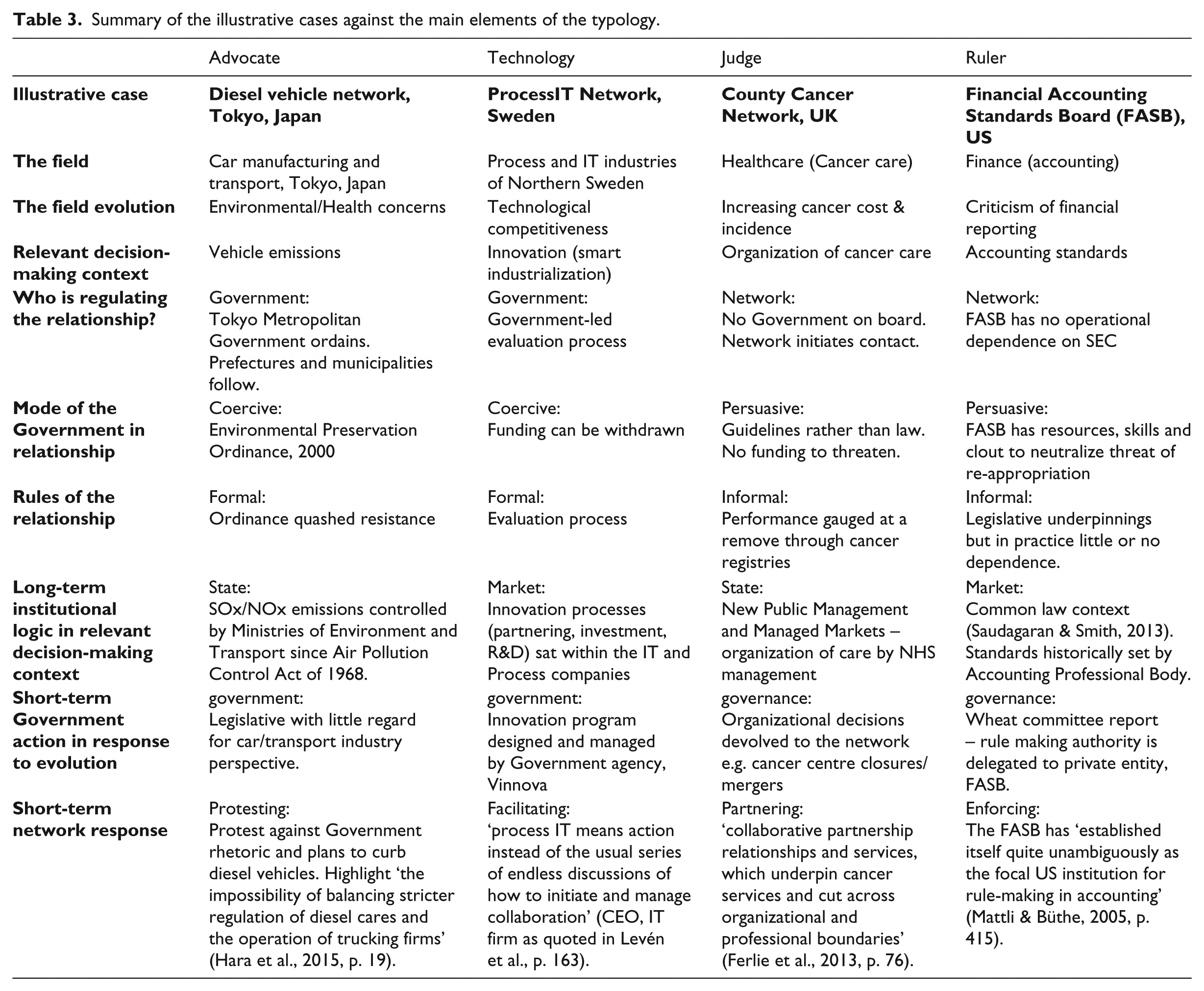
Table 3 presents a summary overview of the illustrative cases against the key elements of our typology as well as the decision-making context in which they are embedded. The table recognizes the dynamic nature of the relationships we seek to typify including reference to the short-term Government response to the field evolution and the network response to that Government action, as well as the impact of the longer-term institutional logic dominating that decision-making context. We will discuss these latter points in further detail in the next section.
Summary of the illustrative cases against the main elements of the typology.
The Impact of Context on Role Emergence and Network Response
Adding value with our typology requires some understanding of the circumstances under which a particular type of Government/network relationship is likely to arise and of the potential dynamics and overlaps between these types. We posit that together the long-term institutional logic of the relevant decision-making context and the short-term Government response to a particular evolution of the field will help us understand the nature of the potential Government/network relationship and of likely network responses.
Whether Government employs more government- or governance-oriented approaches to deal with a field evolution will clearly have an impact on the mode, rules and regulation of the resulting relationships and on the response or reaction by the network. Over these short-term dynamics we layer a consideration of the relevant pre-existing decision-making context. Differences exist where key decisions over the long term have been dominated by different institutional logics – market (where decisions have largely been led by private actors) or statist (where decisions have been driven by Government and its agents). This marketization/statism distinction will impact the internal logics of the key actors (Government and the interorganizational network) within the relationship. We discuss the impact of each of these two contextual time frames (long-term and short-term) and then go on to associate our four relationship types with particular combinations of context. Of course, whether or not the interests of Government and the network align will impact the valence of the relationship on a spectrum between positive and negative and will also colour the network’s likely reaction. The role type captures the nature of the relationship, while alignment refers to the extent to which actors pursue a common objective or the extent to which they enjoy internal and external ‘fit’ in terms of strategic choice and reputation (Dowling & Moran, 2012). We note that the perception or existence of alignment is ‘the result of an interpretation by some group’ (den Hond, Rehbein, Bakker, & Lankveld, 2014, p. 792); thus it is (perceived) alignment, or lack thereof, that will shape the network’s reaction to the Government’s short-term action. Finally, we discuss the flows and cycles through the typology as conditions and relationships evolve within the field.
Government’s response to a particular evolution in the short term, together with the network’s reaction to this response, will influence the type of relationship that survives long term. Relationships require co-created rules of engagement, especially where the parties involved draw on different institutional logics or demonstrate power asymmetries (Nicholls & Huybrechts, 2016). Like the institutional bases from which the partners emerge, the new relationship’s rules can be either formal or informal (Bachmann & Inkpen, 2011; Giddens, 1979). The nature of such rules contributes to defining the nature of that relationship. When Government leads the response to an evolution in a hands-on, hard government mode, the relationships that result will likely echo that modality. We therefore expect to see relationships that are regulated by Government rather than the network, where the relationship mode is coercive rather than persuasive and where the rules of the relationship are formal rather than informal. Where Government responds with a softer governance approach, the opposite holds true. Here we see a governance context of persuasive rather than coercive relationships characterized by the co-opetition of public and private actors where political skills help bring the collective round to shared mental frames, while social skills are used to ensure continued collaboration under often difficult co-opetitive circumstances (Garud, Jain, & Kumaraswamy, 2002).
From a long-term perspective, we have seen how state centrality influences the likelihood that field actors will turn to Government for direction in the first place. In statist decision-making contexts, Government will see itself leading active responses to the evolution, finding new approaches, charting routes to success or survival. In such scenarios, networks may respond mostly through symbolic support or protest, or mobilizing to partner with or undermine Government actions. In marketized decision-making contexts, the logics shift with Government still seeking to co-ordinate a response, but not necessarily presuming to manage that response, often delegating technical or rule-making authority to private bodies, who may become much more active in their responses and effectively take a lead in the relationship (Aguilera & Cuervo-Cazurra, 2004; Zald & Lounsbury, 2010). In this scenario the network sees itself, and is seen by Government, to have skills, influence and resources that Government lacks and therefore is essential to the response in an active capacity from an early stage.
It should again be noted that drawing a clean line between statist and marketized fields is increasingly difficult with fields that appear evidently statist (such as Sweden) proving to be marketized in particular decision-making contexts, such as the innovation partnerships and processes in our ProcessIT example above. We therefore take these concepts, initially developed at the level of the nation state, and apply them in the narrower realm of the relevant decision-making context. Even within one decision-making context there may be blurring of marketization/statist logics at the boundaries. While our theoretical typology imagines a clear divide and articulates likely relationship forms and responses on either side, in practice it is likely that there will be blurring of the edges between both contexts and types.
We now discuss each combination of long-term logic and short-term action, predicting the likely type, and valence, of relationship in each sphere of the matrix. As Figure 2 illustrates, we also indicate possible responses by the network to the Government’s action, depending on goal alignment.
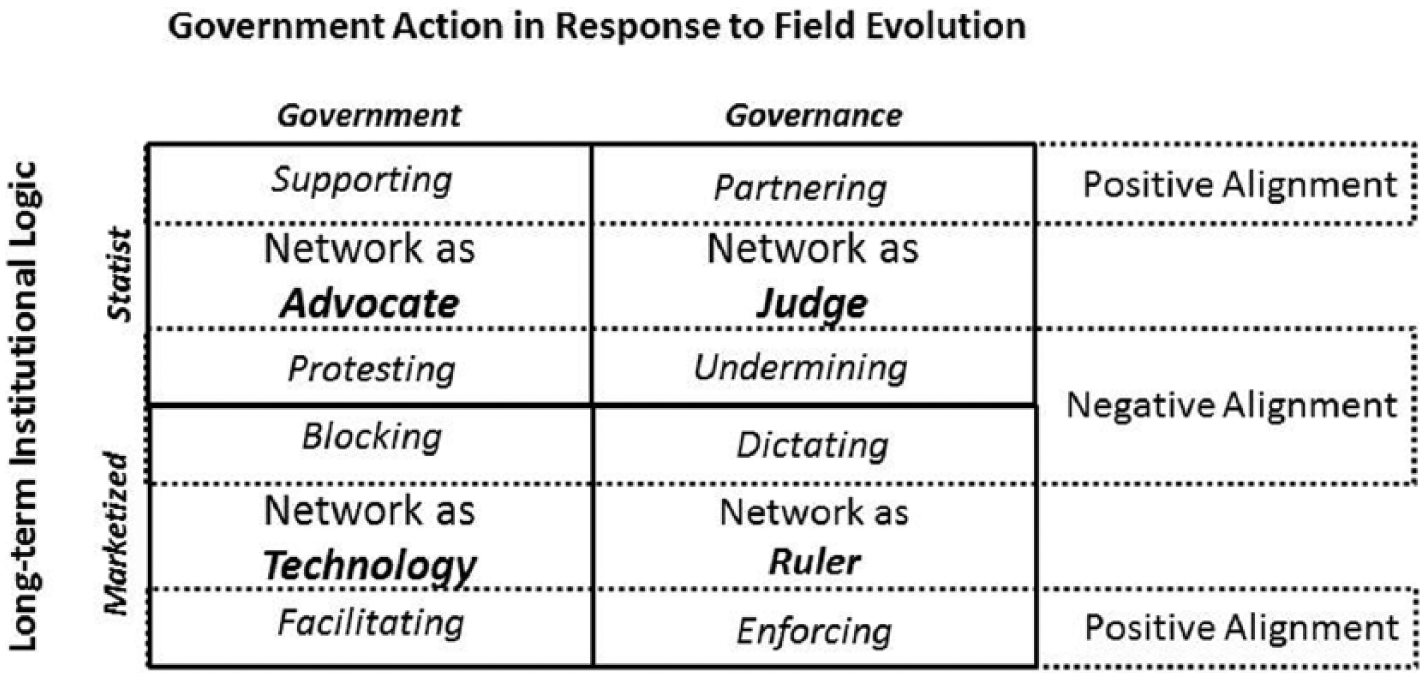
Likely manifestations of the role types under different decision-making and evolutionary response conditions.
Statist context with a government response
Where Government’s response relies primarily on government approaches to control, and where decision making has been characterized by a statist institutional logic in the long term, the network may manifest as advocate to the Government actor, challenging either the way in which Government or the field is reacting to the evolution or, indeed, the lack of a reaction to that evolution. In a statist decision-making context networks look to Governments to remedy emerging problems as they are seen as field organizers. Whether or not Government interest is in maintaining or disrupting the status quo will therefore influence the reaction of the advocate network to Government. Challengers who see Government respond to field shifts with protective hard laws or failing to remove obstructive hard laws will protest, struggling to make the voice of the network heard above that of Government and perhaps also mobilizing against Government actions. Where, however, Government seeks to justify and pass hard law in favour of the advocate network, it will likely become a Government supporter, helping to make their case and defend Government action. As the reactions of networks to one and the same Government action in a field will depend on their position on a spectrum of alignment with the Government’s goals, it is quite possible that one field may contain multiple advocate networks as warring tribes supporting and protesting against change, with Government adjudicating between them. For example, in our vehicle emissions decision-making context in Tokyo, a network promoting petrol-fuelled vehicles might be a supporting advocate network as their interests align with those of the Tokyo Metropolitan Government.
Marketized context with a government response
In a decision-making context that has been characterized by a marketized institutional logic over the long term, where Government nevertheless seeks to closely co-ordinate a response in hard government (legislative and regulatory) mode, it is likely to look to the network as technology, a ‘technocratic solution to the problem of (lack of) expertise of policy-makers and more generally their time constraints’ (Jordana & Levi-Faur, 2004, p. 12). When the interests of networks-as-technologies align with those of the Government actor, they may indeed work to facilitate Government goals, objectives and operational plans. Power (1997) warns, however, that such networks are typically ‘loosely coupled to the purposes which they are intended to serve and rarely function according to the official blueprint’ (Power, 1997, p. 8). Thus, networks may also act as a blocking technology to Government. In such cases the network continues to occupy a theoretically facilitative space in the field landscape, absorbing resources and claiming legitimacy, but in fact fails to deliver on the Government agenda – intentionally or unintentionally.
Statist context with a governance response
Maintaining a persuasive relationship with networks opens up a new form of influence, which can allow Government to develop alternative responses to a field evolution. In such contexts, networks acting as judge can take the lead in the governor/governed relationship. They observe and consider before making their contribution to the evolutionary response – either partnering with or undermining Government – dependent on the interest alignment between the two parties. Judge networks that partner with Government not only lend moral support to a Government’s stance on a field evolution, but they may also make hard decisions in furtherance of a Government agenda. Judge networks that undermine Government agendas may not only refuse to take action, but may also take opposing actions with strong justification of such alternative stances. They will challenge Government legitimacy where Government actions threaten network goals or reinforce legitimacy of Government actions where these support network goals.
Marketized context with a governance response
Globalization is giving rise to new regulatory forms that are often voluntary (at least in part), have little strong monitoring or enforcement mechanisms and display a disregard for ‘national sovereignty’ (Jordana & Levi-Faur, 2004). At the same time, researchers have evidenced trends towards consolidation and commercialization of traditionally public industries such as defence (Markusen & Serfati, 2000; Wilson, Mann, & Otsuki, 2005). Such marketization is traditionally understood to simplify rules (Svensson & Öberg, 2005) and reduce the discretionary power of Government officials (Shleifer & Vishny, 1993). In the face of such threats, governors may adopt less formal rules and relationships that offer new routes to regulation while the market responds by nurturing oligopolies in fields traditionally served by the public sector (Wood & Wright, 2015). These responses combine to position the network as ruler. Where Government fails to ensure adherence, or the interests of Government do not clearly align to promote the interests pursued by the network, the network will overtly or covertly dictate appropriate Government action, for instance through active forms of capture (e.g. Finch et al., 2017). Where Government and network interest do align, the network enforces Government objectives. Even in this latter situation, however, the network retains the upper hand in the relationship and may decide to withdraw this active support at any point, or even turn against Government should perceived misalignments arise.
Flows and Cycles Through the Role Typology
Finally, we examine the flows and cycles of network roles vis-a-vis Government in different decision-making contexts. While we have discussed how network responses might shift within one role type depending on alignment with Government agendas, in this section we discuss how networks might move between role types. This will also allow us to reflect on the fact that while certain network responses, as discussed above, are perhaps more likely under certain conditions, these are not deterministic and can change over time. Thus, the relationship that results from certain Government responses is neither fully predictable nor static.
Bernstein (1955) and Braithwaite (2000) each convincingly portray repeating and self-perpetuating cycles of statism and marketization, in a sense ultimately symbolizing heroic battles between capitalism and the public good at the field or state level. If such cycles hold true at the more granular decision-making level then the relationship between our network/Government interaction typology and such cycles could be revealing. Advocate networks, for example, may evolve to become judges in circumstances where Government shifts its approach from government to governance over time, and the hard law approach that requires active acceptance or rejection is replaced by a softer governance approach that facilitates more considered and persuasive mechanisms. Such a move can be seen in deregulation contexts, where we see the ‘reduction of economic, political and social restrictions on the behaviour of social actors’ (Jordana & Levi-Faur, 2004, p. 6). From a Polanyian perspective, however, deregulation almost inevitably leads to re-regulation rather than an absence of regulation, and so the network role may well be reversed once more, from judge to advocate for instance, in a future epoch. If we accept that there may be a correlation between these relationships and contextualized institutional dynamics, the interesting question then becomes the direction of causation. Does the network role vis-a-vis Government contribute towards moves from hard to soft regulation (Sunstein, 1997) and back again, as Government seeks to address over- or under-influence of those interests represented by the network in the market? Or do these institutional cycles ultimately dictate the roles of the network in relation to Government as a correcting response to Government over- or under-reach?
Such under-reach in the provision of public services, or ‘hollowing out’ of the state (Dunleavy, 1994), is associated throughout the literature with a number of dangers including the undermining of public values (Box, Marshall, Reed, & Reed, 2001; Giroux, 2004) and/or public rejection of such devolutions of remit (Lieberherr, Klinke, & Finger, 2012). As networks and Governments sense and respond to these dangers, their respective roles may shift to address them. Governments may, therefore, move more towards government in place of governance where they see that public acceptance of their devolution of governing to a network is low. This shifts the role of the network from ruler or judge to either technology or advocate. The response of the network to this new role type will depend on whether or not the network also senses the same danger and sees the Government response as reasonable. In this case it will become a supporter or facilitator of Government strategy. Where, however, the network either fails to see the danger, or disagrees on the correct course of action, it is likely to respond by protesting against, or blocking Government action.
A partnering network-as-judge may well become ruler under circumstances of increasing marketization. We could see, for example, how networks such as the County Cancer Network could begin to dictate innovation metrics and quality standards within their region of the UK healthcare market, were it to become more marketized. As state subsidies or ownership of such industries decreases, Government control weakens, market actors’ vulnerability to competition increases, and external validation of their standards becomes more important.
Toward a Research Agenda
Our proposed typology reveals and addresses new concerns in the social restructuring of evolving organizational fields. At the micro level we show that actors previously considered peripheral (Government) or ephemeral (interorganizational networks) in fact play pivotal roles in shaping field evolutions. Our multidimensional view of the interrelations between these two actors significantly alters our understanding of the impact of long-term institutional logics and short-term Government action on field evolution. This emphasis on composite time frames – both long-term and short-term – in the analysis of such interrelations suggests a reorganization of the causal maps employed by field evolution and organizational network researchers. We discuss the impact of these contributions in both scientific and practice realms below.
Situating new actors at the site of action
Field evolution researchers have already recognized the importance of a broader range of actors but, to date, have largely viewed the public actor and the ‘whole’ interorganizational network as contributors of context rather than action. In terms of the public actor, we move beyond seeing them in a purely organizational (e.g. Pablo, Reay, Dewald, & Casebeer, 2007), or regulatory (e.g. Hensmans, 2003) context. Rather, we borrow from the governance literatures to situate them at the site of action in the social restructuring of evolving fields, both in their relationships with other actors as well as in their responses to field evolutions. This dual conception of the public actor at both micro and macro levels offers a new way of framing future field evolution research that considers public organizing.
With regard to the interorganizational network, research to date has largely focused on understanding the place of the organization in the network, the impact of the network on the organization, or the impact an organization can have on a network (Provan et al., 2007). We join a small cohort to champion a fourth category of network research, concerning itself with ‘whole networks’ (Kilduff & Tsai, 2003, Provan et al., 2007), which we argue has particular research value in the context of field evolution. For instance, Provan et al.’s research typology can now be overlaid with the typology outlined in this paper to direct and specify future research in the area of networks and governance within evolving organizational fields. This includes research at both network level and the level of the organization. At the organizational level, we have yet to understand whether the role of the network in relation to Government impacts the place of the organization in the network and/or its ability to make an impact on or navigate within an organizational field. At the network level, we require research to improve our understanding of how whole networks’ ability to shape macro and micro field elements is influenced by the roles they play vis-a-vis Government.
The impact of a network’s composition and purpose
Interorganizational network researchers have developed empirically grounded models of different network structures and manifestations that examine vectors of integration (vertical, horizontal, diagonal) as well as network purpose (innovation nets, strategic nets, etc.). Our typology suggests that network purpose may either be compromised or enhanced by the role that network plays in relation to Government in a field that is faced with evolution. Future studies should investigate the relationship between a network’s manifestation and its role vis-a-vis Government in evolving fields. Such an approach may be able to more comprehensively answer network-related questions in evolutionary contexts such as how such interorganizational networks can manage uncertainty (Loasby, 2002). Relationships are, of course, characterized by complex dynamics and grey zones where networks’ perceptions of and responses to Government action may deviate from our conceptually clinical government/governance distinction. It is possible that different networks in the same decision-making arena may relate differently to Government action in one evolutionary period, depending on their individual composition and purpose. Empirical research is required in order to understand what this might mean for our typology.
Combining long-term institutional structures and short-term restructuring actions
Applying composite contextual time frames to the study of evolving fields can contribute to a greater understanding of the conditions and boundaries under which existing relationships change and new relationships emerge from and, in turn, shape such evolutions. Long-term field structures and short-term structuring efforts by institutional actors combine to add new depth to such research. As an example, consider the context of transnational governance of evolving markets. Jordana and Levi-Faur (2004) outline four levels and loci of governance and regulation: global, national, regional and sectoral. While our typology focuses on two of these (national and sectoral), international interorganizational networks such as transnational advocacy networks will likely interact not only with local fields and national Governments, but also with transnational governance entities. Future transnational governance research that classifies networks according to our typology may lead to the development of less field-specific and more generalizable theoretical contributions as we focus on the roles of Governments and international networks under specific conditions, rather than in specific sectors. In this case our framework may reveal new conceptual foci in terms of the long-term national and transnational institutional logics as well as the short-term national and transnational Government responses.
Practice implications
Our findings offer valuable avenues for policy-related research. Research into the production function of Governments could be strengthened through an intersection between it and the roles of networks vis-a-vis Governments (Fuenfschilling & Binz, 2018; Meyer & Rowan, 1977). A managerial, results-focused efficiency agenda may be best served by casting networks in the role of technology to justify new hard-law government interventions that challenge the status quo. On the flip side, effectiveness agendas that depend on democratic, process-driven change may be the natural forte of networks that act to enforce Government policy. Governments should work to build their network competences: allocating resources to network development and management, increasing the network orientation of employees, and encouraging and rewarding interorganizational communication and cultural openness among their agencies (Ritter, 1999).
Our typology can be used as a diagnostic tool by networks, Governments and researchers in both organizational networks and field evolution, to understand the conditions under which networks can contribute to the achievement of such agendas, leveraging interest alignment and managing nonalignment as appropriate. Network reactions to policy approaches can be modelled and adjusted prior to rollout with a view to triggering desired network responses. Governments can shift their approach or rebalance market and state influences to achieve these goals through networks, or to prevent networks from slipping from one quadrant to another. For example, limiting marketization where interests do not align may help to avoid a dictatorial ruler network, but may at the same time risk blocking networks becoming protestors. The risks and rewards of different Government strategies can be played out in relation to dominant coalition networks to inform field organization approaches. Governments can work with networks to manage evolution, together enterprising new sets of conventions that enable all market actors to better understand and work within the newly evolved field.
For networks, and their constituent organizations, our typology offers a menu of possible responses to Government action in particular institutional contexts. Networks should use our typology to examine and interrogate instinctive responses to a particular action and thus avoid a predetermined response to a set of contextual elements. Organizations can use our typology to characterize available field networks and select networks to join based on their role, deciding for example whether they wish to partner with, dictate to, facilitate or protest against a particular Government agenda.
Conclusion
We have combined theories of governance and regulation (e.g. Büthe & Mattli, 2011; Djelic & Sahlin-Andersson, 2006; Peters, 1997; Power, 1997) with theories of field evolution (e.g. Arellano-Gault et al., 2013, McKague et al., 2015) to typify and predict the relationship between governor and governed in fields that are facing evolutionary pressures.
In a world where evolutionary pressures are pervasive – technology, transnationalism, consumerism, marketization – understanding how organizational fields evolve is crucial (Djelic, 2006; Djelic & Sahlin-Andersson, 2006). With this paper we draw back the organizational curtain and examine attempts to structure and stabilize such fields. Our typology of Government/network roles makes three significant contributions to theories of field evolution. It demonstrates, first, that both the public actor and the ‘whole’ network require focal attention as actors on the field stage rather than simply context that other actors must navigate (Provan et al., 2007). Second, it brings public organization back into organizational studies (Arellano-Gault et al., 2013), showing how Governments can and do interact with networks and offering clues as to how such relationships might be initiated, maintained or exploited on either side. In doing so we address Kjaer’s (2004) question of how interorganizational networks may be directed, but we also caution that such steering will always require carefully mapping actions and reactions in specific situations and over time. And third, our dual contextual time frame gives nuanced insights into the negotiation of both field structures and institutional logics required to shape field evolution and effect field stability (Reay & Hinings, 2005). This extends existing research that focuses on a single time frame, which may fail to acknowledge the destabilization that results when new and old contexts collide (Van Gestel & Hillebrand, 2011). We highlight the importance of particular relationships in managing and navigating this collision.
We recognize that our paper, being conceptual in nature and employing purely illustrative examples, is limited in terms of the claims that it can make and therefore merits further investigation. Our conceptual typology can offer an access point into further empirical examination of the complexity of the social restructuring of fields in evolution for researchers, policy makers and private organizations. In doing so we hope to contribute to the robustness of their analyses as well as reducing the time it takes to analytically grasp and potentially intervene in evolving situations.
Footnotes
Acknowledgements
The authors would like to thank Jasper Hotho for his excellent insights and feedback on an early version of this paper, as well as David Arellano Gault and two anonymous reviewers for their exceptionally helpful comments and critique during the review process.
Funding
This research received no specific grant from any funding agency in the public, commercial, or not-for-profit sectors.
