



Abstract
The organizations and institutions with which we interact in our everyday lives are heavily implicated in the rising levels of global inequality. We develop understanding of the ways in which a preference in social structures for the free market over other forms of economic organization has made inequality almost inevitable. This has been accompanied by organizational practices such as hiring, promotion and reward allocation, that maintain and enhance societal inequalities. The mutually constitutive relationship between organizations and institutions in the reproduction of inequality are exposed throughout.
Increasing economic inequality has emerged as one of the defining issues of our time. By polarising populations and concentrating power, it threatens not only social stability but also the institutions of democracy and accountability (Piketty, 2014). Further, societies with higher levels of economic inequality – regardless of absolute wealth – tend to have relatively higher levels of social and health problems. These include higher rates of mortality, greater degrees of mistrust, higher crime rates, increased levels of obesity, increased levels of mental illnesses, higher levels of violence and greater incarceration rates (Wilkinson & Pickett, 2010). The prevailing evidence suggests that the relationship between such social ills and inequality is not merely correlational but causal (e.g. Dorling, 2015; Pickett & Wilkinson, 2015).
That wealth is becoming increasingly concentrated is well established. Oxfam (2018) recently reported that 42 individuals now have the same wealth as the bottom 50% of the world’s population, or 3.7 billion people; furthermore, 82% of all economic growth created in 2017 went to the richest 1% of the population, while the poorest 50% saw no increase at all. In the United States, things have been even more extreme with 95% of the income growth between 2009 and 2012 going to the wealthiest 1% (Saez, 2014). As recent data show, this is indicative of a broader and sustained trend (see Figure 1). Similar dynamics can be witnessed elsewhere, with Chile and Mexico having the highest levels of inequality in the world and Estonia showing the most rapid recent increase (OECD, 2016). Economic inequality thus affects countries from different regions of the world with very different forms of social, economic and political organization (see Figure 2). As Markus (2017, p. 211) summarised, we are faced with ‘ever-steeper social hierarchies and escalating global inequality’.
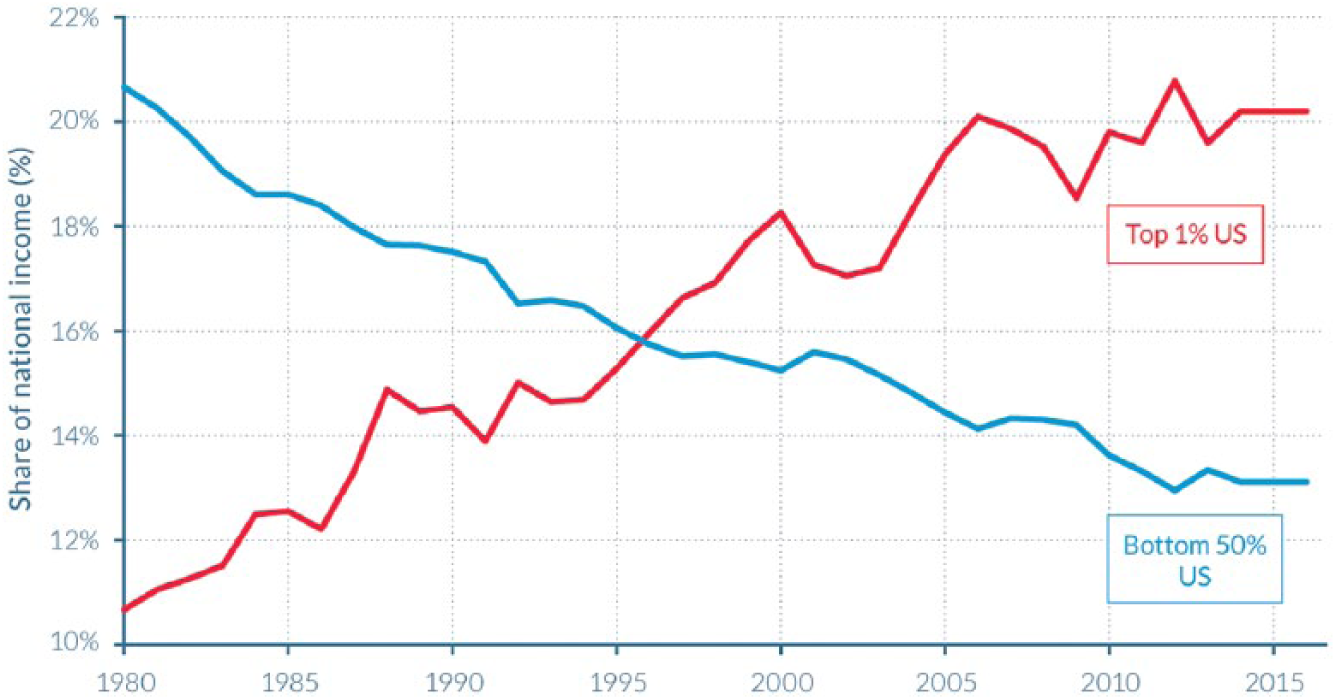
Top 1% vs. Bottom 50% national income shares in the US, 1980–2016: Diverging income inequality trajectories (Alvaredo, Chancel, Piketty, Saez & Zucman, 2018).

Global inequality and growth, 1980-2016 (Alvaredo et al., 2018).
As noted above, inequality has a pernicious effect on a wide range of facets of our physical and social existence. Wilkinson and Pickett (2010) were among the first to powerfully demonstrate how, in rich countries, it was not income levels per se that predicted health and social problems, but differences in income levels within these countries, arguing ‘the problems in rich countries are not caused by the society not being rich enough (or even by being too rich) but by the scale of material differences between people within each society being too big’ (Wilkinson & Pickett, 2010, p. 25). Evidence for the adverse consequences of inequality has rapidly accrued. Rufrancos, Power, Pickett and Wilkinson (2013), for example, demonstrated the positive relationship between inequality and murder rates. Higher levels of childhood obesity have similarly been associated with higher levels of economic inequality (Stamatakis, Zaninotto, Falaschetti, Mindell, & Head, 2010). The links between inequality and mental illnesses, including schizophrenia and depression, have also been well established (e.g. Burns, Tomita, & Kapadia, 2014; Johnson, Wibbels, & Wilkinson, 2015). Inequality has also been identified as a major impediment to economic growth (Stiglitz, 2013).
Our intent in this introduction to the Special Issue is to further understanding of how inequality is reproduced, and in particular to explain the ways in which the organizations and institutions that play such a prominent role in our lives are centrally implicated. To this end, in the next section we build a foundation for the special issue by detailing the salient societal structures that have resulted in an economic system in which inequality has become prominent. We then examine the ways in which organizations have developed into sites where the reproduction of inequality has often become an inevitable consequence of their modes of structuring and operation. This leads to a broader consideration of ways in which recent developments in institutional theory have allowed us greater understanding of why inequality is so pervasive. We then move on to introduce the eight papers in the special issue and suggest lines of future inquiry in which organization and institutional theorists can help provide much-needed insights into the (re)production of inequality.
The Maintenance of Inequality
Given the strong connection between inequality and the well-being of society, it is problematic to observe that inequality across social groups tends to persist and even increase from generation to generation – rich families tend to get richer while poor ones remain poor; gender pay gaps remain in place over generations; Blacks, Hispanics and other racial minorities tend to fare worse than their white fellow citizens. These dynamics imply the existence of underlying mechanisms that maintain inequality over time.
What is equally challenging is that organizations designed to enable economic development and progress often tend to exacerbate the effects of social inequalities that are embedded in underlying human systems. In general, theories of organization emphasise that the very purpose of organizations is to enable collaboration: organizations are founded to facilitate the interaction necessary for realising the value from new technologies, ideas and relationships. When this collaboration intensifies persistent social inequalities, then the actions of the organization amplifies economic inequality.
Scholarship into inequality has offered several explanations for the creation and perpetuation of inequality through the collective and independent action of organizations. At the broadest level, fingers have been pointed at free market capitalism and especially neoliberalism. In the United States, for instance, Bonica, McCarty, Poole and Rosenthal (2013, p. 104) argue that: Republicans and many Democrats have experienced an ideological shift toward acceptance of a form of free market capitalism which, among other characteristics, offers less support for government provision of transfers, lower marginal tax rates for those with higher incomes, and deregulation of a number of industries.
These political dynamics signal a sharp departure from the ideological environment that shaped much of Western Europe and North America following the end of the Second World War that resulted in economic inequality decrease in the United States, United Kingdom and other countries. The industrial and social policies of the period led to a rise in stable employment in large firms, particularly US manufacturing firms, and internal social pressure for equity across positions (Cobb & Lin, 2017).
The shift in US and UK economic philosophy coincided with the rise of Margaret Thatcher and Ronald Reagan and the fall of the Berlin Wall. Regulation was rolled back, allowing corporations more freedom to maximise the wealth of shareholders by, among other things, exploiting resources in the global south while downsizing at home (Levy, 2005; Stiglitz, 2013). This was accompanied by a decline in manufacturing and extractive industries in many parts of North America and Western Europe with a corresponding rise in the service industries as main sources of employment: ‘low-wage big box stores replaced high-wage manufacturers as the biggest employers, and inequality soared’ (Davis, 2017, p. 697).
A shift in the economic paradigm towards free markets was accompanied by an increasing hold of the private sector over policy agendas (Barley, 2007; Stiglitz, 2013) leading to a tightening of welfare provision and increased privatisation of public services (Barley, 2007). From this perspective, large corporations owed their profits less to their business acumen or innovativeness and more to rent-seeking regimes that the ruling classes established for themselves (Stiglitz, 2013). The deep entrenchment of these mechanisms is reflected in the worsening inequality since the global financial crisis: corporate leaders have used ‘their resources to influence electoral, legislative, and regulatory processes through campaign contributions, lobbying, and revolving door employment of politicians and bureaucrats’ to protect their interests, often at the expense of those already disadvantaged (Bonica et al., 2013, p. 105).
These arguments, focused on broad economic philosophy and the macro-politics of multinational corporations, help explain the increasing concentration of wealth in capitalist economies. But they fail to address how important inequities tied to gender, race and class are maintained, and especially how they are made acceptable in organizational and everyday life. Largely missing in these accounts is the complex role of organizations and how they normalise inequities in everyday work lives. This process where inequalities are hidden from view and even accepted occurs in multiple ways. Organizations bestow identities on us (as bankers, police officers, plumbers, secret agents, academics, etc.), influence our self-esteem and social status (positioning us in leading investment banks, ‘magic circle’ law firms, fast-food chains or online shopping warehouses), affect our motivation and commitment (through participation in top-level decision-making or exclusion from any real influence) and crucially impact our economic well-being through pay, benefits and pensions (or the lack thereof). By choosing who to recruit into particular positions, who to promote to top managerial roles and how to allocate rewards, leaders of organizations potentially ensure that inequality is not only created but sustained. As Stainback, Tomaskovic-Devey and Skaggs (2010, p. 226) argued, ‘organizations are the primary site of the production and allocation of inequality in modern societies’.
Why organizations have tended to sustain rather than overcome inequality in recent decades is a question beyond economics and efficiency-driven decision-making. As with all matters social and organizational, institutions play a key role in creating and sustaining conditions of inequality. Organizational practices and structures not only reflect broader societal practices but also contribute to their production and reproduction. It is thus surprising that despite the critical roles of institutions and organizations, discussion of inequality in society has been largely left to economists, sociologists and epidemiologists.
A recent wave of research on inequality by organizational scholars has found significant evidence of structures and practices that systematically disadvantage particular groups. For example, women are often found to be over-represented in lower-level front-line positions, significantly underpaid and severely under-represented in senior management positions (Belliveau, 2012; Chan & Anteby, 2016; Ryan & Haslam, 2007). Sexual harassment is still rife in many organization settings (Berdahl, 2007; Davies, 2018), hiring practices reinforce gender inequalities (Brands & Fernandez-Mateo, 2016; Cohen & Broschak, 2014) and promotion criteria remain highly gendered (Acker, 1990; Joshi, 2014). All of these conditions have exacerbated unequal compensation systems (Abraham, 2017; Briscoe & Joshi, 2017). Racial disparities remain similarly entrenched (Carton & Rosette, 2011; Cortina, 2008), with the whitening of resumes enhancing employment prospects (Kang, DeCelles, Tilcsik, & Jun, 2016) and identifiably ‘black’ names resulting in significantly lower compensation (Mithani & Mooney Murphy, 2017). Further, class differences affect recruitment opportunities (Rivera & Tilcsik, 2016), promotion chances (Bull & Scharff, 2017; Kish-Gephart & Campbell, 2015; Rivera, 2015) and levels of compensation (Cobb, 2016).
Thus, persistent and enduring inequities are amplified by organizations and institutions that are designed to enable collaboration in pursuit of economic gain. Because organizations and institutions are built on the underlying architecture of a society’s norms and beliefs, their success constitutes the enduring resonance of those norms and beliefs.
This special issue is motivated by the realisation that organizational and institutional scholars have much to offer in our quest to unveil the causes and consequences of economic inequality. We next explore the role of organizations and institutions in the (re)production of inequality. We then introduce the eight papers that comprise the special issue, and outline how they help us understand, and potentially begin to address, the pervasive systems of inequality that continue to characterise our societies.
Organizations as Sites for the Creation and Maintenance of Inequality
In the story of increasing inequality, organizations play a central role. Bapuji, Husted, Lu and Mir (2018) for instance, identify four sets of contemporary organizational practices that increase inequality: compensation arrangements, dividend payments to shareholders, avoidance of tax payments, and philanthropic choices. In their view, the first of these, compensation, has the biggest direct impact on inequality. With the emphasis on shareholder return, and an often distributed ownership across many shareholders, many firms use stock options and performance-related compensation to resolve the principal-agent problem. As a result, we have seen extraordinary growth in the salaries and bonuses for senior executives. Previously associated predominantly with executives in financial services industries, such as hedge funds (Dill, 2017), managers in other types of organization are now being compensated on a similar scale, exemplified by UK house-builder Persimmon which paid its chief executive a £110 million bonus in 2017.
Even if one believes that these extraordinary payments reflect an attempt to generate shareholder wealth by incentivising executives (Cobb, 2016; Lansley, 2012; Piketty, 2014; Stiglitz, 2013), these practices still create dramatic inequality, with CEOs paid up to 300 times more than some of their firms’ employees. Economic inequalities also reflect and exacerbate social and occupational inequalities: women and ethnic minorities, for instance, are generally less likely to occupy lucrative positions; investment bankers tend to earn many times what a nurse, teacher or retail assistant makes. Recent trends in the private sector that reward maintaining large cash holdings have also played a role in exacerbating inequality, as they result in larger dividends to shareholders at the expense of other claimants, especially employees. Similarly, corporate tax avoidance strategies lessen the redistribution of wealth in societies, effectively reducing funding to education, health and the social safety net (Bapuji et al., 2018).
The inequality produced by these differences in compensation is deepened by the shifts in organizational strategies associated with outsourcing and cost reductions in both public and private sector organizations, as well as the broader transformation of many Western economies from a basis in manufacturing to services. Cost reduction strategies have created organizations that are sites of growing inequality with, on the one hand, lower-level employees facing stagnating wages and, on the other, privileged elites enjoying the rapid accumulation of wealth (see, for example, Cobb, 2016; Lansley, 2012; Piketty, 2014; Stiglitz, 2013). As Leana, Mittal and Stiehl (2012, p. 901) noted, the ‘working poor … seemingly indispensable to the value creation model for firms in developed economies’ are constrained by those very systems and find themselves not only disadvantaged but also with little chance of advancement. These disparities are exacerbated by the shift from manufacturing to services, which Craypo and Cormier (2000, p. 23) describe as resulting in hourglass organizations: ‘large numbers of high-status professional and managerial jobs requiring formal credentials and qualifications occupy the top half of the structure and equally large or larger numbers of uncredentialed, low-status occupations inhabit the bottom half, with relatively small numbers of technical jobs in between.’ Thus, contemporary organizations often exist as bifurcated systems in which senior managers and some jobs requiring professional expertise are well rewarded while those, often in front-line positions, such as nurses, retail assistants and call-centre operatives, are not.
Recent shifts in the organization of labour have further exacerbated these dynamics. Some new organizational forms, especially those designed to intensify controls and monitoring, generate inequalities under the guise of innovation and efficiency. Technological advances have led to organizations breaking down tasks and closely monitoring their execution. Kaplan (2015), for example, describes how screen monitoring of contract workers, coupled with a worker rating system, leads some workers to decline to be paid rather than risk a low rating that might impinge on future opportunities. Newly emergent organizations that rely on remote monitoring and sensing technologies to manage contract labour exemplify how persistent social inequities become amplified into economic inequalities.
In the gig economy, individuals who would previously have been employed as delivery or taxi drivers are now hired as independent contractors, without access to many of the benefits required under employment laws, thus dramatically lowering costs for their employers. Arranging work in this way also minimises workers’ basis for social comparison that tends to maintain parity of wages across positions (see Bidwell, Briscoe, Fernandez-Mateo & Sterling, 2013, for a review). The economic, physical and psychological effects on those engaged in such tasks can be disastrous: with costs kept low, replacement of workers straightforward, employee fines for failure to complete assignments, and close monitoring possible through the use of technology, many workers not only earn less than they would under traditional employment arrangements, but also suffer physical and mental illnesses (Marmot, 2015). Such dynamics can lead to catastrophic outcomes, as in the widely reported case of UK delivery driver Don Lane who died after missing several scheduled health checks because he felt unable to take a day off from his delivery rounds (Booth, 2018). Led by charismatic entrepreneurs, and hyped up by exuberant market analysts, firms in the gig economy often hide new, oppressive power relations privileging the credentialled elite over workers on the other side of the digital divide.
The difference in opportunities and advantages enjoyed by elites is reinforced by the knowledge, networks and resources that more privileged organizational roles provide. Platform, remote-sensing and machine-learning technologies often substitute for labour, and thus the economic rents that would otherwise accrue to employees are channelled toward managers and owners. While some independent entrepreneurs and professionals benefit from the extra capital that organizations free up when jobs are converted into ‘gigs’ or outsourced (Bidwell et al., 2013; Keister, 2005), those people left working in low-level jobs are almost inevitably less fortunate. The tasks they are employed to perform prevent them from accumulating the varied experience that workers in other positions can accrue, and so a career ladder is almost non-existent. These jobs also provide few opportunities to meet and develop relationships with senior members of the organization, and thus to cultivate organizational mentors and sponsors. Even simple job performance measures, such as punctuality, can create difficulties for those unable to afford reliable transportation or childcare, potentially jeopardising employment and definitely limiting career progression (Leana et al., 2012). All these factors prevent those disadvantaged by their organizational positions from climbing out of them, perpetuating and amplifying economic inequality.
The Institutionalisation of Practices Promoting Inequality
Organizations develop numerous practices that embody the unequal power relations prevalent in society, including marginalisation based on gender, race and class. Within organizations these are reflected in, among others, hiring practices (e.g. Brands & Fernandez-Mateo, 2016; Kang et al., 2016; Rivera, 2015), promotion decisions (e.g. Acker, 1990; Bull & Scharff, 2017; Joshi, 2014; Pager & Pedulla, 2015), assignments of organizational roles (e.g. Acker, 1990; Ding, Murray, & Stuart, 2013) and decisions on how the organization will be structured and governed. The ways in which these practices become institutionalised is revealed in a number of different studies that draw on a variety of theoretical lenses. In addition to its immediate revelatory relevance, such work also has utility in demonstrating how institutional theorists might further contribute to our understanding of societal inequality.
Amis, Munir and Mair (2017), for example, explained how particular practices at the Bank of Scotland ultimately helped to dramatically intensify economic inequalities. They describe how the Bank adopted new practices that reflected a much greater tolerance for risk and the pursuit of growth through an aggressive sales strategy and a merger with the Halifax Building Society to create Halifax Bank of Scotland (HBOS). With other financial institutions employing similar tactics, a new approach to banking spread rapidly across the industry. As this approach proved unsustainable, banks around the world began to fail and many were eventually bailed out by governments, or taken over by a competitor, as was the case with HBOS. The institutionalisation of new banking practices led to hundreds of thousands of people around the world losing their jobs and homes. While many lower-level employees who retained their jobs suffered substantial pay cuts, executive pay rebounded quickly, as did share prices (Dorling, 2014). Thus, those in senior positions regained most of their losses, while those in more vulnerable positions will likely never see a similar recovery (Stiglitz, 2013). As a consequence, the system of economic inequality that differentially rewarded senior executives and lower-level workers became ever more pronounced.
Other scholars have used a discursive lens to look at the entrenchment of inequality. Central to this approach has been uncovering the ways in which particular texts (re)enforce systems of domination that advantage some groups over others. As Suddaby, Bruton and Walsh (2018) recently pointed out, the language that we use can frame the ways in which we understand inequality. For example, the discourse promoting a neoliberal agenda has created an environment in which anything other than the belief in the primacy of free markets is marginalised. This has led to a sustained channelling of profits to shareholders and an erosion of labour laws that have in turn enhanced inequality (Burgin, 2012; Chang, 2011).
Along with practices originating in organizations, inequality is also tightly tied to institutional logics which play out at field and societal levels (Friedland & Alford, 1991; Thornton, Ocasio, & Lounsbury, 2012). Particularly important in discussions of inequality is the market logic that lauds the maximisation of self-interest and the accumulation of wealth. Dorling (2011, 2014) and Piketty (2014) have demonstrated the power of this logic in creating societies in which the wealthiest are able to accumulate resources at an increasing rate. Similarly, research on job fragmentation and the gig economy have tied the emergence of these pulverising processes to the ascendancy of the market logic (e.g. Bidwell et al., 2013; Davis, 2017). Logics also interact to create more subtle systems of inequality, as illustrated in Martí and Mair’s (2009, p. 112) examination of how rural Bangladeshi women involved in commercial activities had to juggle ‘financial and business logics … [and navigate] cultural and religious norms’ that restricted women to a limited range of public activities.
More recently, Hamann and Bertels (2018) adopted an institutional work perspective to examine how South African mining companies maintained an exploitative position over their workers. Adopting a longitudinal approach, Hamann and Bertels showed how mining companies shifted employment relationships over time to preserve the legitimacy of their dominance over their workforce. The ways in which those in power strive to create legitimacy for their actions is also illustrated by Haack and Sieweke (2018). Blending theories of system justification and social judgement, Haack and Sieweke detail how inequality was legitimised following the reunification of East and West Germany.
An alternative approach to understanding the institutionalisation of inequality has been to examine the ways in which identities associated with a particular institution create and perpetuate systems of inherent advantage and disadvantage. These include, among others, age, disability and sexuality, but the majority of work in this tradition has focused on gender, race and class. Below, we discuss how inequalities across these three institutionalised identities have been created and sustained in organizations.
Gender-based inequalities
Of the three types of inequalities under discussion, gender has been most investigated by organization theorists. As a result, there has been a dramatic shift in how gender is seen in the organizational context. An early paper in Harvard Business Review which discussed women in managerial positions was titled ‘Are Women Executives People?’ It argued that women who got ahead acted like ‘people’ by not requiring any special treatment nor displaying any adverse temperament (Bowman, Worthy, & Greyser, 1965). This ensured that they were treated as ‘people’ within the organization. This article, which was based on a survey of men and women in management, highlighted that male managers felt that only women with exceptional educational qualifications and talent were considered capable of occupying managerial roles.
Bowman et al.’s (1965) article highlights the naturalisation of sex segregation within organizations during this period. It is reflective of most management literature of a time when organizations were regarded as rational entities operating in a neutral context (Becker, 1975); with this assumption it followed that organizations took neutral decisions and deployed individuals where they were best suited. Gender segregation within organizations, whereby women were limited to subordinate positions lower in the organizational hierarchy, was regarded as a natural congruence between the personal preferences of women, their inherent characteristics and organizational requirements. The management literature depicted organizational structures and processes as developing organically and regarded these as separate to the actors – mostly men of course – actively creating, and acting within, them. Men were seen as inherently having qualities that made them better suited to being in positions of leadership while women were seen as being more suitable for roles that required passivity and compliance. Such approaches continued to naturalise the lack of women in executive roles and explained this vertical segregation as being linked to women’s inherent disposition, which meant they did not have the desired traits necessary for executive roles (Davies-Netzley, 1998).
These views continued to dominate management theory until the 1970s when a few pioneering texts started to problematise the gender hierarchy within organizations (e.g. Acker & van Houten, 1974; Kanter, 1977). Kanter (1977) was one of the first scholars to identify the role of organizational structures, rather than individual differences between men and women, as being central to understanding gender differentiated positions within organizations. For Kanter (1977), women’s positions in organizational hierarchies had an influence on their perceived preferences; since women worked in low status positions, they attached less value to their careers and preferred working shorter hours. Joan Acker (1990, 2006), among others, identified cultural practices, divisions of labour, workplace interactions and organizational logics as important in contributing to gender inequality in the workplace. She argued that neutral terms such as job, role performance and task were deeply embedded within a gendered substructure and reinforced particular ways of being. These perceptions and practices within organizations, were as important as behavioural, psychological or social factors in explaining gender hierarchies and inequality within organizations.
Later research outlined how language within organizations constructed men as lead actors and women as emotional support. Language and discursive practices were seen as central to the framing and legitimisation of the status quo with organizational culture playing an important role in exacerbating gender inequality (Acker, 2012; Kornberger, Carter, & Ross-Smith, 2010). Gender segregation meant that women were seen to be suitable for lower positions within organizations and men were concentrated at the top of the organizational hierarchy. This gendered understanding of organizations laid particular emphasis on how leadership and entrepreneurship were linked to an ideal white, middle-class male normative standard (Acker & van Houten, 1974; Martin, 2000; Kelan, 2008).
Psychosocial accounts of gender inequality in organizations similarly came to be criticised for seeing patriarchy as being ‘a centrally identified, static construct residing at the top of organizational hierarchy’ (Townsley, 2003, p. 624). Furthermore, Townsley (2003) suggested that psychosocial approaches ignored the practices, discourses and performances through which gender was enacted by both men and women within organizational life. Acker (2006) attached importance to recognising the ways in which gender is imprinted on all aspects of the organizational structure. This criticism of an exclusive focus on biological or psychosocial differences between men and women as the primary explanation of gender hierarchy changed the focus back towards organizational practices and discourses as being central to perpetuating and maintaining gender inequality within the workplace.
We have made much progress towards recognising gender as a multi-level system of disadvantage which includes: at a macro level, socio-economic disadvantages and cultural norms; at a meso level, interactional practices within social institutions; and at a micro level, internalised traits and identities (Ridgeway, 1997, 2014). However, many studies within the management literature continue to attach importance to essentialised normative assumptions about gender difference, focusing on differences in the preferences and goals of women and men, as well as blaming women for not having qualities associated with hegemonic masculinity – such as assertiveness – as being the main reason for gender segregation and inequality (Due Billing & Alvesson, 2000). This includes even some of the female empowerment literature, such as Lean In by Sheryl Sandberg (2015), which encourages women to acquire traits associated with hegemonic masculinity to succeed. Organization theory could benefit tremendously if future scholars were to investigate gendering of roles and practices in organizations in a more nuanced context, keeping in mind the highly constructed nature of both organizations and the goals that are set for them.
Race-based Inequalities
Much of the work on how organizations provide systems of advantage and disadvantage on racial lines emanates from the United States, where a considerable racial gap still persists. Hanks, Solomon and Weller (2018), for example, reported that in 2016 African Americans had an average wealth of $13,460 compared to $142,180 for white Americans. With levels of wealth highly correlated with income, it comes as no surprise that research finds that race is an important characteristic in determining who is successful in the labour market (Pager & Pedulla, 2015) and that organizational processes are often implicated in this unequal standing. Several studies have drawn out the dynamics by which these disparities occur and result in ethnic minorities earning less than their white counterparts. For example, Mithani and Mooney Murphy (2017) showed how having an identifiable black name resulted in lower wages, pointing to institutionalised bias in compensation structures. Similarly, Kang et al. (2016), in a study of organization hiring practices, showed how ‘whitening’ a resume led to greater likelihood of being recruited.
In her seminal work on workplace discrimination, Kanter (1977) argued that minorities, women and other token employees with restricted opportunities ultimately lower their aspirations and commitment and engage in behaviours that reinforce negative opinions about their potential contributions to organizations. Ilgen and Youtz (1986) similarly proposed that minority members may internalise an organization’s negative evaluations of them and engage in ‘self-limiting behaviors’ – for example, refusing a challenging job assignment or declining an opportunity for additional training – that perpetuate performance differences between minority and nonminority employees. Such self-censoring by non-whites contributes in a significant way to why racial inequality is so persistent. Further, restricted access to power – through routine task assignments or exclusion from informal social networks – produces a cycle of disadvantage for minority members who are unable to influence organizational actions or the course of their own careers (Kanter, 1977).
Much of this work, however, replicates the essentialist tendency within gender-based research by treating race as skin colour. Thus, this research tends to use race as a variable to explain organizational outcomes such as performance (Hekman, Johnson, Foo, & Yang, 2017), hiring (Rivera, 2012), retention (Ely, Padavic, & Thomas, 2012) and promotion practices (McDonald, Keeves, & Westphal, 2018). This research can be problematic because discrimination unfolds in complex causal processes that cannot be fully captured in models that stipulate performance as a function of racial categorisations. Complex causality arises because particular qualities are inscribed into organizational roles that serve to marginalise people of colour, women and other minorities (Powell & Butterfield, 1997). Similarly, organizational practices often facilitate managers hiring more people in whom they see mirrored versions of themselves, resulting in the further exclusion of minorities. Recruitment and promotion thus reinforce and deepen racial divides. While some notable work has taken place in the organizational literature on how racial inequality is created and maintained in organizations (e.g. Nkomo, 1992; Hekman et al., 2017), much more is needed on how racial discrimination is normalised in everyday organizational life.
Class-based Inequalities
The importance of class in understanding inequality in organizations is well established, even if it has not been, with some notable exceptions, a topic widely studied by ‘organization science’ (Côté, 2011, p. 44). Going back to Marx’s (1867/1990) argument that the capitalist class owns the means of production and is thus able to exploit the workforce, there have been many studies that have shown how class influences organizational behaviour. Compared to those of higher status, those in lower socio-economic groups are less likely to gain a college education, are less likely to acquire the social, cultural and economic capital that is usually required for organizational advancement, have little power or autonomy, and have little control over the content and pace of their work (Gray & Kish-Gephart, 2013; Resnick & Wolff, 2003; Rivera, 2012; Zweig, 2004). As we noted earlier, these are conditions that are likely to be physically, psychologically and socially damaging (Marmot, 2015).
Gray and Kish-Gephart (2013) suggested that individuals in organizations who encounter those from a different class will engage in ‘class work’. For the upper classes, this involves a process of ‘autobiographical reasoning’ (Scully & Blake-Beard, 2006) which takes the view that the privileged position they have achieved is based on their individual effort and ability, and has therefore been earned and is well deserved. They point to the existence of a meritocracy whereby anybody can succeed irrespective of their background, disavowing any notion that ‘the game is rigged’ in their favour (Schwalbe, 2008). By contrast, those of lower social classes can feel shame, humiliation and disgrace when encountering those from upper classes. As Markus (2017, p. 217) observed, ‘those with lower social-class standing are most likely to be targets of objectification, prejudice, discrimination, and subject to a pattern of blaming, shaming, and dispositional attribution’. As a consequence, their ‘class work’ involves continually trying to overcome stigmatisation by ‘protecting and maintaining a positive identity’ (Gray & Kish-Gephart, 2013, p. 682). This is inevitably emotionally draining but becomes institutionalised so that neither upper nor lower classes see anything unusual with their positions or modes of interaction. As Gray and Kish-Gephart (2013, p. 691) note, ‘the meritocracy myth legitimises inequality’. Despite this recent work, class-based categories in organizations remain largely invisible in the literature and in need of greater investigation.
Intersectionality
While a focus on gender, race and class as analytical categories within the organizational literature has undoubtedly been fruitful for scholarly inquiry into inequality, considering each in isolation tends to reduce people to one category at a time, and thus fails to consider how people might be marginalised on multiple fronts in a more complex manner than a focus on only one of these would suggest. Fortunately, an increasing number of studies are considering intersections of categories in their research on inequality. For example, Wingfield (2009) examined the ways in which male nurses are perceived by patients. Male nurses were typically perceived as something other than nurses, but whereas white nurses were often mistaken for doctors, black nurses were often thought to be caretakers. Rivera’s (2015; see also Rivera & Tilcsik, 2016) study of hiring practices in elite law firms in the US also exposed discrimination based on gender and class. The firms were biased towards upper-class males, with upper-class women, lower-class men and lower-class women all disadvantaged. Rivera and Tilcsik (2016) argue that these findings hold true beyond law firms to professional service firms in general. A third example is provided by Friedman and O’Brien (2017) who identify how white, male, middle-class actors constitute British acting’s ‘somatic norm’: The somatic norm functions not only by establishing the primacy of the white middle-class male actor, but also by clearly designating the somatic ‘other’. This is achieved by ensuring that actors who deviate from the somatic norm only have access to a restricted set of socially caricatured roles that they frequently experience as offensive and discriminatory. (Friedman & O’Brien (2017, p. 360)
Friedman and O’Brien go on to note the importance of understanding intersectionality as those furthest from the somatic norm face the greatest barriers to success. As Acker (2012) similarly pointed out, intersectionality is essential to understanding inequality ‘on the ground’ and thus offers highly fruitful avenues of inquiry for organizational scholars.
It is thus apparent that organizations are sites in which processes leading to economic inequality have become institutionalised. In the next section, we build upon our theorising and present the papers that constitute the special issue. In so doing, we further develop insight into some of the mechanisms by which inequality is reproduced and offer suggestions for future investigation.
Understanding (and Addressing) the Organizational and Institutional Reproduction of Inequality
As we note above, our understanding of how organizations and institutions are linked to the reproduction of inequality, while still emerging, has begun to take shape. The increasing interest in inequality among organizational scholars was reflected in the 52 submissions from 22 countries that we received for this special issue. The papers that we ultimately selected for publication provide a range of diverse insights regarding the drivers and consequences of inequality, point to ways in which inequality might be reduced, and offer important suggestions for future research. The work stems from five different national settings – Canada, England, France, Ghana and the United States – allowing us to learn how inequality develops across national contexts. In introducing the eight papers, we highlight important themes that emanate from the work, and discuss potential directions for future research that have been prompted by the papers and other work in the field.
Gender
More than 40 years after Kanter’s (1977) landmark publication, women remain underpaid, under-represented in senior leadership positions, less respected and subject to more verbal and physical sexual abuse than men (Calás & Smircich, 2006; ILO, 2016). Two papers in this issue tackle this subject head on, and in new, innovative ways. First, Lauren McCarthy and Jeremy Moon (2018) provide a rare investigation of how inequality becomes manifest through a global value chain. McCarthy and Moon base their paper on a three-year qualitative study that draws on observations, interviews and documentary data collected in Ghana and Britain on Ghanaian farmers, a cocoa cooperative, an NGO partner and a British confectioner. This complex study allows them to provide fascinating insights into how gender is socially constructed through everyday practices. In providing a window on the construction of global inequality in the South, a focus that has been particularly lacking across the inequality literature, McCarthy and Moon direct our attention to attempts to reduce gender inequality by empowering female Ghanaian cocoa smallholders. McCarthy and Moon draw on the institutional work literature to help theorise ‘how individuals “do gender” and how they might “undo gender”.’ In so doing, they introduce consciousness-raising as an element of institutional apprehension, suggesting it is central to the development of self-awareness and the uncovering of how gender is (re)created through everyday practices by those in the value chain. These practices reveal the power relations inherent in everyday social interactions, particularly those embedded in a paternalistic Ghanaian culture. In turn, it shows how everyday organizational practices create and sustain institutions.
In the second paper, Sean Buchanan, Trish Ruebottom and Suhaib Riaz (2018) demonstrate how gender inequality was reproduced in US media coverage of credit card borrowers in the six years following the global financial crisis. Buchanan and his colleagues examine how linguistic descriptors used in categorisation processes in mainstream media discourse reinforce pre-existing gendered understandings. Male borrowers were depicted as being more financially savvy, having greater fiscal responsibility and being more strongly agentic than female borrowers. The authors show how this social construction of gender-based status differences reproduced institutionalised understandings of gender stereotypes, and what steps might be taken to overcome them.
Looking ahead
One of the most important issues highlighted by both papers has been the vexing question of how we tackle well-established cultural norms and expectations that continually entrench gender-based inequality. These studies highlight some particular difficulties we face in this area that suggest avenues for future research. For example, how do we engage with gender-based dynamics in settings such as Ghana on their own terms and not ours? How do we challenge and control discriminatory practices in organizations that span international jurisdictions? How do we build causal arguments connecting gender and outcome when individuals might be enacting roles that they think they are supposed to play in a particular position? Can we draw insights from comparative cases of organizations that might have achieved different outcomes in terms of gender? And how do we erode gender-identity stereotypes, that have established cultural norms over many years, in order to increase equality of opportunity?
Power Asymmetries
The ways in which power asymmetries are implicated in the reproduction of inequality are apparent, at least implicitly, in each of the papers in the special issue; they are tackled head-on by Niall Hayes, Lucas Introna and Paul Kelly (2018). Hayes and his colleagues show how a desire by a UK donor, Imagine, to develop a more formalised (neo-liberal/western) system of impact assessment of its work with rural Indian farmers helped to reify a system of inequality. Their work cleverly exposes the ways in which the development of calculative practices resulted in a shift in what counted as appropriate knowledge. As these apparently mundane attempts at governing action became widely accepted as ‘good practice’, so regimes of inequality became more entrenched. In looking at the processes that led to the creation and acceptance of these new practices, Hayes et al. show how the co-constitutive links between knowledge and power can lead to the institutionalisation of inequality even when the objectives of those involved are quite the opposite.
Looking ahead
The lack of attention to the ways in which regimes of power become established and reproduced has been a longstanding critique of institutional theorists (e.g., Lawrence & Buchanan, 2017; Munir, 2015). As we see in the paper by Hayes et al. (2018), such an understanding becomes particularly important if we are to attain a more complete understanding of the causes, and potential solutions, to inequality. This, therefore, constitutes an area in which institutional theorists can make a significant contribution to inequality debates. Further, the ways in which particular actors are able to establish ‘what counts’ as acceptable forms of knowledge, and subsequently determine how such knowledge is created, presented, and used, are pressing issues for understanding systems of inequality. Finally, as also raised by the McCarthy and Moon (2018) article, we need more work that develops ways of assessing norms and practices within their own contexts as opposed to imposing frames of reference established in very disparate settings.
Intersectionality
Understanding intersectionality in systems of inequality has emerged as a key issue for scholars of race, class and gender, and is the focus of two fascinating papers in this special issue. Barbara Gray, Tiffany Johnson, Jennifer Kish-Gephart and Jacqueline Tilton (2018) examine the ways in which first-generation US college students attempt to cope with identity threats emanating from incidents of microaggression – hostile messages delivered by individuals with greater perceived levels of power and privilege to reinforce points of difference. The authors draw on interviews with 31 students from both poor and wealthy families, over two thirds of whom identified as racial minorities. Gray et al. find that identity threats are directed on the basis of being different to the somatic norm of white, upper/middle class, and can have a profoundly destabilising effect on students who are already trying to cope with a vulnerable situation. Affected students developed coping strategies that included leaning on one’s core identity to develop resilience, ‘dodging’ and ‘code switching’ to hide one’s true identity, and drawing support from networks of peers.
In her paper on job search processes and the role of unemployment support organizations in the US, Angela Gist-Mackey (2018) shows how the system works differently for white-collar and blue-collar workers. Based on detailed ethnographies in two unemployment support organizations, Gist-Mackey shines the spotlight on the processes through which the unemployed sought to get back into the workforce, and the distinctly different experiences of white-collar and blue-collar workers. Whereas white-collar workers were provided with tools that presumed already effective communication skills and established professional networks, blue-collar workers were given communication coaching, role-playing opportunities and vocabulary training designed to overcome the perceived liabilities of their working class and African American identities and move them toward a white, middle-class norm. In so doing, Gist-Mackey explains how the blue-collar support organizations helped perpetuate inequality for the very people that they were trying to help.
Looking ahead
The limited work on intersectionality presents an array of opportunities for future study. We know very little of the ways in which gender, race and class, not to mention other identity markers such as disability, sexuality or age, intersect to economically disadvantage groups in different ways. For organizational scholars, this is an especially important issue as organizations provide distinctive sites of intersection, with potentially dramatic consequences for inequality. Intersectionality also points to the importance, and the complexity, of comparative studies that cut across organizations, industries, fields and specific identity intersections.
Exceptionality
An important theme that emerged somewhat unexpectedly in the papers in the special issue concerns the ways in which actors seeking to address inequality come up with strategies that allow them to, temporarily at least, bypass existing rules or norms. Drawing on ethnographic research at a drop-in day centre in Northern France that provides services for homeless and at-risk adults, Nevena Radoynovska (2018) develops the concept of ‘discretion work’: the efforts of staff to prevent unequal treatment of clients by making exceptions to organizational rules. Radoynovska shows how centre staff would regularly bend rules such as the provision of coffee or allocation of shower times in order to build relationships with potential clients. Discretion work involves the ongoing negotiation of the boundaries between formal rules and those ‘grey areas’ that are open to professional judgement. Along with developing this concept, Radoynovska’s study also provides a rare view of actors focused on reducing inequality having to distinguish between the needy and the exceptionally needy.
Radoynovska (2018) argues that even the best of intentions can lead to new forms of inequality, and thus requires conceptualising a distinction between principles of equity and equality: discretion work is the mechanism through which such a distinction takes place. She uncovers three types of discretion work: procedural, symbolic and evaluative. Procedural discretion work involves questioning how the application of rules, and particularly the allocation of scarce resources, should take place. Symbolic discretion work concerns understanding to whom resources should be allocated. That is, who should be subject to rules, and who should be granted exceptions. Finally, evaluative discretion work queries for what purpose the organization exists, and allows members of the organization a period of self-reflection and evaluation of the organization’s goals to assess how they are facilitating the accomplishment of the organization’s mission.
Juliane Reinecke (2018) provides an absorbing account of ‘prefigurative politics’ in her ethnographic exploration of protestors and homeless people encountering each other in the context of Occupy London. Prefigurative politics are contrasted with contentious politics that involve explicit conflict and contest; by contrast, prefigurative politics collapse ‘expressive and strategic politics so as to enact the desired future in the present’. Thus, an explicit aim of Occupy London was not only to protest features of contemporary capitalism and its impacts, but to model an alternative, more equal way of living. This aim was tested by the presence of homeless people, who might have provided exactly the opportunity to construct and demonstrate equality, but whose motivations and ways of being challenged the protestors’ ability to live those aims. Reinecke shows how the ‘macro-level inequalities that protestors set out to fight resurfaced in the day-to-day living of the camp itself’ and ultimately proved impossible to overcome.
Reinecke’s (2018) contributions to our understanding of institutions and inequality are grounded in both her intensive ethnographic commitment to the field and her innovative employment of prefigurative politics as a theoretical lens. Engaging in more than 280 hours as an occupier at the St. Paul’s and Finsbury Square camps, and conducting 42 formal and informal interviews, allowed Reinecke to uncover the profoundly personal and challenging experiences of protestors and people living homeless as they negotiated their relationships to each other, and to the ideas and values of Occupy. Based on her study, Reinecke proposes a model of prefigurative politics that requires both ‘exceptionality’ – ‘the creation of a temporary exception to prevailing norms’ – and ‘communality’ – ‘the experience of togetherness, feelings of social equality, and affective solidarity’.
Looking ahead
These studies show that the forms that exceptionality takes are contextually bound, but share common attributes including the ability to identify specific rules or norms that can be violated without causing excessive disruption and being able to negotiate their avoidance. An important direction for future research in this area would be to explore when, how and by whom exceptionality might be achieved, and thus to draw out ‘rules of engagement’ that stimulate and allow it to occur. A second question raised by these studies concerns the relationship between different forms of institutional work employing exceptionality – whether there are conceptual hierarchies of such work, as well as exploring how, when and in what (if any) order different forms of exceptionality work might occur. Finally, assessing the role of exceptionality, or exception work, and communality in establishing the broader applicability of Reinecke’s ideas about prefigurative politics also appears to hold great promise as an area of future endeavour.
Highlighting the local
The fourth theme that emerges in this special issue is the need to understand ‘localness’ in both the roots of inequality and the potential responses to it that provide a basis for institutional change. Despite its acknowledged importance, localness has been significantly understudied in the institutional theory literature.
The importance of localness is seen most clearly in Luc Audebrand and Marcos Barros’s (2018) study of funeral co-operatives in Quebec. Audebrand and Barros document how the arrival of multinational funeral firms in Quebec drove up funeral prices, demonstrating that the disruption of local businesses by retail chains is not limited to the likes of do-it-yourself and department stores. The response to this intrusion, however, is what makes the story a local one. As multinational firms purchased smaller funeral homes, consolidating the industry, local funeral co-operatives, established as far back as 1942 explicitly to reduce high funeral costs, worked to oppose inequality by drawing on local resources to disrupt what were seen as unfair economic models of funeral provision. Drawing on Fraser’s (1995, 2005, 2009) theory of social justice, Audebrand and Barros explore the cultural, political and economic bases of inequality and responses to it.
Looking ahead
While both inequality and potential responses are tightly tied to transnational political economies and cultures, inequality is experienced as a local condition, and is powerfully shaped by the work of local actors whose relationships and strategies may exacerbate or alleviate inequality. These local experiences and forces have been under-explored from an institutional perspective. This lack of attention to the local may stem from the prominence of economists and epidemiologists in debate around inequality, but it represents a significant opportunity for organizational and institutional theorists to uncover some of the characteristics that define how inequality plays out in particular settings. The studies in this issue by McCarthy and Moon (2018), Hayes et al. (2018), Gray et al. (2018), Gist-Mackey (2018), Radoynovska (2018), and Reinecke (2018), along with Audebrand and Barros (2018), provide different exemplars of how to do this effectively. We thus encourage work on inequality that furthers research in this direction.
Deep engagement
The final theme that emerges in this special issue is the importance of engaging deeply with specific contexts and situations in order to develop the subtle understanding and insights necessary to address vexing problems of inequality. McCarthy and Moon (2018), Radoynovska (2018), Gist-Mackey (2018), and Reinecke (2018) all devoted substantial amounts of time to the field, immersing themselves in complex situations through ethnographic methods. Gray and colleagues (2018) similarly gained an intimate familiarity with the research context through their experiences as college professors and students. Deep engagement can also be achieved through historical methods: Audebrand and Barros (2018) draw on a 70-year history in their study of Quebecois funeral co-operatives while Buchanan and colleagues (2018) examined hundreds of articles appearing in four national newspapers over a six-year period. In each case, deep engagement allowed the authors to develop nuanced understanding that provided the foundation for important theoretical advances that would otherwise not have been possible.
Looking ahead
While this point about deep engagement is of course applicable to other areas of research, it is particularly important in the study of inequality. The causes and consequences of inequality, and their relationship to organizations and institutions, represent a complex set of phenomena, understanding of which is not easily achieved but which is vital if we are to come up with effective policy prescriptions. Sufficient understanding of inequality does not require a specific method, epistemology or paradigm, but it does demand deep engagement with social contexts and situations that allows scholars to distinguish between symptoms and root causes, and between band-aids and enduring solutions.
Conclusion
In 2012, three of us (Lawrence, Amis and Munir) organized a sub-theme at the annual colloquium of the European Group for Organizational Studies (EGOS) titled ‘Institutional Work and the Institutionalisation of Inequality’, which represented an early attempt to explore the issues examined in this special issue. While inequality was a largely overlooked issue in institutional and organization studies research at the time, it has since emerged as an increasingly important topic for institutional and other scholars. Beyond our academic community, social and economic inequality has also enjoyed a widespread surge in interest in the popular press and broader academic discussions, triggered by increasing economic inequality and a recognition of its negative consequences. In supporting McGahan’s (2018) recent call for a commitment across the field to study issues of inequality, we believe that organizational and institutional theorists have much to contribute to the drivers of, and sustainable solutions to, inequality.
As we have shown in this introduction, and as detailed in the eight papers that constitute the special issue, the organizations and institutions with which we continually interact in our daily lives are centrally implicated in the rise of inequality, and in some extraordinary responses to it. Organizational practices, many of which have become taken for granted, perpetuate inequality by privileging some groups over others in hiring, promotion, reward and other decisions. Moreover, the neoliberal environment in which organizations are embedded further promotes exclusionary practices despite those who proclaim its inherently meritocratic basis. The somatic norm of the white, heterosexual, middle-class male remains the entrenched beneficiary of organizational decision-making. As we can see in the papers here, gender, race and class continue to be prevalent, though not the only, dimensions of exclusion, particularly as they intersect in ways that amplify and complicate exclusionary processes and structures. We also see that attempts to redress inequality in organizations often require exceptional practices in which deviance rather than rule following is prioritised.
We have also learned that there is much more to learn. The core constructs we use to understand inequality are themselves underdeveloped. Our understanding of the mechanisms by which inequalities are translated into economic inequities is insufficient. And our assessments of organizations and institutions often miss crucial elements of process through which inequalities are instantiated and amplified. What we do know is that inequality is increasing dramatically, and that organizations and institutions are complicit in many different ways. We hope this special issue will spark further interest across the organization studies community, and that the papers featured here will inspire and guide future research efforts as we seek to understand and address what has become a potential threat to our democratic structures, and our physical, economic, psychological and social well-being.
Footnotes
Funding
This research received no specific grant from any funding agency in the public, commercial, or not-for-profit sectors.
