



Abstract
Our study investigated how multi-centenary family firms in the area of Kyoto – collectively known as shinise – maintain a high social status in the community. Our analysis unpacks the socio-cultural practices through which the ongoing interaction among these actors re-enacts and reproduces the social order that ascribes shinise a distinct social standing in exchange for their continued commitment to practices and structures that help the community preserve its cultural integrity and collective identity. By doing so, our findings trace a connection between status maintenance and the expressive function that a category of firms performs within a community. At the same time, our study reveals a dark side of high status, by showing how their commitments lock shinise in a position of ‘benign entrapment’ that may impose sacrifices on family members and severe limitations to their personal freedom.
Status is a form of social evaluation that ‘reflects an individual, a group, or an organization’s publicly acknowledged social esteem and social worth relative to other individuals, groups and organizations in a social hierarchy’ (Chen, Peterson, Philips, Podolny, & Ridgeway, 2012, p. 300). Past research has widely examined correlations between the status of focal actors and various beneficial consequences, showing, for instance, that high-status organizations command a premium price for their products (Benjamin & Podolny, 1999; Malter, 2014), enjoy more influence on their peers (Castellucci & Ertug, 2010), and have greater access to tangible and intangible resources (Azoulay, Stuart, & Wang, 2014; Washington & Zajac, 2005).
Characterized by an ‘eagerness to document the consequences of status differentiation’ (Sauder, Lynn, & Podolny, 2012, p. 275), however, past research has paid less attention to the processes through which organizations acquire and maintain status. Little is known about how status hierarchies are constructed and negotiated through social interactions, and the broader institutional context within which these processes occur is often missing or significantly bracketed (see Delmestri & Greenwood, 2016; Lounsbury, 2002; Rao, Monin, & Durand, 2003 for exceptions). In this paper, we advance knowledge on this issue by examining the case of multi-centenary family-owned firms located in the Japanese city of Kyoto, collectively known as shinise, as an ‘extreme’ (Pettigrew, 1990) – highly visible and transparently observable – case of a group of organizations that enjoy high social status in the local community. We use this case to explore the socio-cultural processes that shape status ordering and allow the maintenance of categorical status.
Shinise are firms that have survived for more than a century (often for three or four), have retained ownership within the family, and focus on their traditional line of business. In Japan, Kyoto is the city with the highest proportion of century-old firms (Imperial Data Bank 2009, 2014), which, in this area, typically operate in traditional sectors (sake brewing, confectionery, temple ornaments, textiles, etc.). While similar firms are also located in other prefectures, the prominent standing that shinise possess in the community of Kyoto confers upon them (and the owning families) distinctive social and economic benefits.
Based on past research, one might attribute the high status of shinise to the quality of their products (Podolny, 1993). This explanation, however, ignores the observation that the advantages that shinise collectively enjoy and the maintenance of their social status are underpinned by a complex value system rooted in the very local community in which they operate. Thus, to more clearly understand the positioning of these family firms in Kyoto society and the persistence of their privileges, attention needs to be given to how status is maintained and the ‘role that hierarchy-enhancing belief systems play in stabilizing hierarchy’ (Magee & Galinsky, 2008, p. 352).
Our goal is to examine these processes, and illuminate the more general issue of how socio-cultural dynamics between organizations and communities contribute to maintaining the social standing of an elite group of firms. To this end, we integrate the status literature with Philip Selznick’s original insight that some organizations may acquire a superior social standing – in Selznick’s words, ‘become an institution’ – to the extent that the peculiar ‘character’ they reveal by their long-term commitments is consistent with the collective values of the community (Selznick, 1957).
Our analysis reveals the core mechanisms that enable the perpetuation of the superior standing of a group of firms, such as Kyotoite shinise, that are constituted as distinct from other firms – that is, they represent a distinct (and distinguished) social category (Glynn & Navis, 2013). It shows how maintaining their status impinges upon a delicate equilibrium in the relationships between these firms and their community. Relational dynamics of adjustment protect collective values from potential drifts, reciprocally strengthen commitments and mutual support, and, by doing so, maintain the integrity of the stratified system that these organizations and the community enjoy. However, our study also reveals that these commitments may ‘lock in’ these firms in a position of ‘benign entrapment’ that exerts economic and social pressures on these organizations, reduces managerial discretion, and may impose severe limitations to family members’ personal freedom.
These observations have important implications for our understanding of status in family firms and the maintenance of category status more generally. They show that, when classified within a value-laden category associated with the collective identity of a community, family firms may be valued not only based on the goods they produce or the wealth they distribute, but also on the expressive function that they serve. We refer here to the long-standing distinction in sociology between instrumental vs. expressive social roles: the former dedicated to accomplishing practical tasks within a social group, the latter dedicated to socialization, identity formation, and the maintenance of group values and social cohesion (Parsons & Bales, 1955). This distinction illuminates a way in which family firms may positively contribute to the community that goes beyond the traditional emphasis of family business research on proactive stakeholder engagement and philanthropy (e.g. Miller & Le Breton-Miller, 2005).
Our observations also offer the opportunity to elaborate and theoretically extend Selznick’s ideas from the intra-organizational level to the analysis of status-related processes at the inter-organizational level. They do so by showing that when a group of organizations come to serve an expressive function in a community because of their commitments, both group members and the community acquire a stake in the maintenance of a status hierarchy that enables these organizations to buffer market pressures and helps the community to maintain the integrity of the collective identity and cultural traditions.
Theoretical Background
Social evaluations in family business
Scholars generally agree that positive social evaluations, such as reputation, legitimacy or status (see George, Dahlander, Graffin, & Sim, 2016), are particularly important for family firms because, in addition to conferring social advantages to organizations, they are associated with the pursuit of non-financial family goals (Berrone, Cruz, Gomez-Mejia, & Larraza-Kintana, 2010). In family firms, work, business and family are closely intertwined. Positive (or negative) evaluations of the firm reflect on the owning family, and the accrual of social benefits may extend to family members. As ownership is passed down from generation to generation, cumulated social approval (or disapproval) is also transferred, rendering the actions of family leaders highly consequential on the social standing of their heirs (Ward & Aronoff, 1991).
While scholars recognize the distinctive importance of social evaluations for family businesses, they have largely focused on reputation (e.g. Deephouse & Jaskiewicz, 2013; Zellweger, Nason, Nordqvist, & Brush, 2013). Research on the construction and maintenance of status, instead, is still limited. A deeper examination of status processes in family firms, however, is needed. Because family members are particularly interested in preserving socio-emotional benefits, being associated with a firm that enjoys a high social status is likely to matter more to family owners than to members of non-family firms. Distancing oneself from status dynamics affecting the firm may also be more difficult for family owner-managers than non-family managers.
Recent work also suggests that – in addition to the status-related processes that characterize organizations more generally – family firms may be socially constructed as a distinctive ‘class’ (Binz, Hair, Pieper, & Baldauf, 2013, p. 4), or category of firm that is ascribed particular features, such as trustworthiness and authenticity, and held in distinctive regard. For example, Craig, Dibrell and Davis (2008) and Gallucci, Santulli and Calabrò (2015) show that highlighting the ‘familiness’ of a brand tends to be associated with above-average performance. Similarly, Zellweger, Eddleston and Kellermanns (2010) argue that family firms may capitalize on the status they enjoy in certain social settings – collectively, as a social category (see Delmestri & Greenwood, 2016) – to build a distinct corporate brand and strengthen an extended network of stakeholders who support the ideologies and values of these firms.
Research has not only offered converging evidence that family firms may constitute a distinctive category in certain social settings, but has also begun to examine the acquisition and maintenance of positive social evaluations of family firms. Research in this line of work, however, is still in its infancy. Some scholars suggest that maintaining favourable social evaluations becomes increasingly problematic as family firms age, because the refusal to abandon traditional practices may reduce their responsiveness to changing societal expectations (Richards, Zellweger, & Gond, 2017). Other scholars argue that the intensification of family conflicts due to the growing number of generations involved in management may negatively affect a firm’s social standing (Cirillo, Romano, & Ardovino, 2015).
Research also suggests that not only time but also space matters, as family firms tend to show relatively stronger commitments to local business partners and communities (Naldi, Cennamo, Corbetta, & Gómez-Mejía, 2013; Niehm, Swinney, & Miller, 2008), and to develop stronger relationships with local suppliers and customers (Lyman, 1991). In family firms, ‘social action is embedded within the most immediate context’ (Berrone et al., 2010, p. 89), because there is relatively little buffer between a firm (and the family) and the immediate community. Thus, family firms operating in a local community for a prolonged period of time may have the opportunity to gain and maintain positive social evaluations. However, social pressures are also likely to be more personal, concrete and difficult to escape.
The case of Kyotoite shinise is noteworthy because it aligns only in part to the received wisdom from past studies. In Kyoto, these firms enjoy a social standing that goes way beyond what stakeholders would ordinarily ascribe to family firms. This standing is reflected in a web of formal and informal practices that sets them apart from other local firms and makes them an elite class of organization. Interestingly, their status is not apparently harmed, but enhanced by age and their ability to successfully transition the company to the next generations. Thus, the high social status that this particular type of family firm enjoys cannot seemingly be explained by existing knowledge on social evaluation of family firms.
In order to examine in more depth the socio-cultural processes that may induce stakeholders to confer a particular social standing to family firms as a collective category of organizations (Delmestri & Greenwood, 2016; Sharkey, 2014), we now turn to organization theory and, specifically, to research on status as well as Selznick’s theory of organizations as ‘institutions’.
Status: Determinants, consequences and processes
Management scholars have devoted significant efforts to understanding how organizations are evaluated by their stakeholders and how social evaluations shape interactions between organizations. Status, understood as ‘the position in a social hierarchy that results from accumulated acts of deference’ (Sauder et al., 2012, p. 268), is a central theoretical construct in this endeavour. It assumes a stratified social structure (Deephouse & Suchman, 2008) and unique categories that actors occupy within this structure (Piazza & Castellucci, 2014, p. 287).
Research on the determinants of status has developed in parallel at the micro and the macro levels of analysis. At the micro level, scholars have highlighted how individual characteristics (such as age, education, gender, race and nationality) provide those who possess them with recognized social distinction because of their association with widely shared belief systems about value and worth (Berger & Fisek, 2006; Neeley, 2013). Research at the organizational level has focused instead on actors’ status within their network of affiliation (Podolny, 2001; Shipilov, Li, & Greve, 2011; Stuart, Hoang, & Hybels, 1999). At a very general level, these lines of inquiry have shown how status positions advantage or disadvantage actors (Bianchi, Kang, & Stewart, 2012).
These studies, however, have not fully considered that the characteristics that lead some actors to accrue or lose status in a particular social setting are reflections of processes of social construction (Gould, 2003; Sauder, 2008). The implications of this idea are relatively underexplored (Piazza & Castellucci, 2014) and the influence of the social and institutional context within which these processes occur is rarely acknowledged. If we accept this idea, examining how field-level contextual factors shape status dynamics (Sauder et al., 2012) becomes important to understanding how and why certain characteristics confer distinctive advantages to some actors in a particular social setting. Fields, communities and organizations represent environments with shared belief systems that profoundly shape what is regarded as worthy and, therefore, play an important role in processes of status accrual and maintenance. Selznick’s theory of organizations as ‘institutions’, we argue, offers a useful analytical lens to examine these socio-cultural processes.
Organizations as institutions: Values and value infusion
Selznick’s book Leadership in Administration (1957) is widely viewed as one of the foundational sources of organizational institutionalism (Kraatz & Flores, 2015). Selznick’s theory is particularly apt to illuminate processes of accrual and maintenance of status, because it offers interesting insights into how and why social groups infuse some organizations with particular significance. Selznick explains how organizations may become ‘institutions’ when the community in which they operate attributes to them ‘value’ that goes beyond the technical and economic terms of the exchanges in which they engage. As a consequence, these organizations are perceived as less ‘expendable’ – that is, their possible disappearance is experienced as more significant than the simple loss of the jobs they offer or the products they provide. The community is therefore willing to offer them extraordinary support.
According to Selznick, organizations become institutions to the extent that they are recognized as embodying the values of a community – understood as ‘human beliefs about the things that are worth having, doing, and being’ (Kraatz & Flores, 2015, p. 356). They do so by making long-term ‘commitments’ – defined as ‘choices which fix the assumptions as to the nature of the enterprise, its distinctive aims, methods, and role in the community’ (p. 55). Commitments represent consistent choices that reveal the organization’s priorities and values, because of their public and/or irreversible nature, the opportunities they forgo, or the considerable costs they imply. Generic examples of commitments may include refusing to downsize the workforce when business is low, or adhering to strict rules for quality control that lead to rejection of all but the flawless products.
Commitments represent the way through which values are ‘actually built in the social structure’ of the organization and, critically, they define its ‘character’ (Selznick, 1957, p. 56). Character confers on the organization an enduring understanding of its essential properties, which inform internal and external evaluations of the appropriateness of its actions (King, 2015). In this regard, commitments are a ‘mixed blessing’ (Kraatz & Flores, 2015, p. 358); they crystallize purpose and keep the organization on track, avoiding potential drifts, but they come at the price of narrowing down future paths. They ‘can be changed, if at all, only at the risk of severe crisis’ (Selznick, 1957, p. 40).
These ideas are particularly appropriate to guide the investigation of status processes in family-owned firms because, more than any other type of organization, family business encapsulates the centrality of core values, long-term commitments and the endurance of the firm across generations (Miller & Le Breton-Miller, 2005). More generally, they offer an insightful perspective on the socio-cultural underpinnings of status acquisition and maintenance because they begin to connect the significance of organizational action (in the form of ‘commitments’) within a local belief system about value and worth with the acquisition of a distinguished social standing within a community (that is, becoming an ‘institution’, valued beyond technical or economic considerations).
What is not sufficiently elaborated in Selznick’s work or in family business research, however, is the relational nature of these processes; that is, how commitments made by organizations shape and are shaped by the ‘local, value-forming context’. As Kraatz and Flores (2015) recognize: Selznick’s institutionalism is profoundly limited in that it focused only on the internal dimension, and said very little about either the macro societal causes of organizational actions or their symbolic implications for legitimacy (p. 362, emphasis in the original) … This means that studies of organizational values would have to situate the organization within the macro-institutional environment (as well as its local, value-forming context). It also implies a clear need for new theory that clarifies values’ relationship to the macro-institutional context. (p. 365)
Our investigation offers an opportunity to apply Selznick’s ideas to understand how organizations embedded in local communities maintain status through their commitments and engagement with the community. By drawing on the case of shinise, we can also heed Kraatz and Flores’s call and extend Selznick’s theory of institutionalization to examine relationships with the macro-institutional context.
Methodology
Research setting
In Japan, firms older than 100 years constitute a high percentage of producers and retailers of sake and other spirits (more than half of the total of those listed in the directory), and of soya sauce, miso and sugar (more than a third of the total) (Imperial Data Bank, 2014); several hundreds of them also operate in the production and retail of clothing, and in general building work and timber construction. 1 In 2014, according to COSMOS 2, Kyoto was the Japanese prefecture with the highest concentration of long-lived firms (Imperial Data Bank, 2014). 2 More importantly, Kyoto is the city where ultra-centenary firms were first officially recognized by political authorities in 1968. We therefore selected this region as an ideal setting for our investigation.
According to Nihon Kokugo Daijiten, the largest Japanese language dictionary, the term shinise first appeared in the late 17th century in popular Japanese fiction, and was defined as ‘gaining trust through business, or successful business’, or ‘protecting and inheriting the family business’. In the mid-18th century, the term shinise meant ‘the principle or policy of continuously protecting’ in several traditional puppet theatres, kabuki theatres and pre-modern Japanese literary genres. It was only in the late 19th century that the term came to be associated with a particular type of firm, and was loosely understood as ‘a shop that has tradition, social status, trust, and prosperity’ (as reported by the first Japanese-English dictionary in 1872).
In 1968, shinise earned official recognition as the Kyoto prefectural government started to confer this title to firms that had been in operations for more than 100 years. The number was selected as a highly symbolic one. As an informant explained, ‘for both humans and firms, 100 years is associated with longevity and it is a number worthy of celebration in life’ (Kyoto prefectural government, officer). The year 1968 also marked the 100th anniversary of the opening of the Kyoto prefecture and of the completion of the Meiji Restoration in 1868, which modernized Japanese society and economy. According to informants, firms that had survived through the tumultuous changes that had characterized the previous century ‘deserved commendation’ (Kyoto prefectural government officer). Informants explained how this act conventionally established a threshold ‘for administrative purposes’ (Kimura Oshidou, Vice President), which began to formalize what was, until then, an informal categorization.
Between 1968 (first official recognition of shinise firms in Kyoto) and 2017, the Kyoto prefectural government has recognized 1924 firms as shinise, a large number of which operate in retailing, crafts, textiles and manufacturing. For the sake of simplicity, political authorities and economic surveys adopt a criterion based on age. Any business that has survived for more than 100 years (and kept a record of good conduct) is eligible to be celebrated and recognized as shinise; this threshold is also used to quantify the diffusion and economic impact of this type of firm (Imperial Data Bank 2009; Kanda & Iwasaki, 1996; Yokozawa 2000). Our study, however, revealed that not all long-lived firms enjoy the same social standing in the community, and more restrictive criteria apply informally. As we discuss later, only long-lived firms that had preserved continuity in line of business and family ownership (Hiramatsu, 2004; Nagasawa & Someya, 2009) are recognized as ‘true’ shinise.
Data collection
Our study drew on multiple data sources, summarized in Table 1. Our primary data sources are 74 in-depth, semi-structured interviews with 56 different informants from local shinise (owner-managers, family members and employees) and 36 interviews with 33 representatives of the local community (see Table 1).
Data sources.

Our investigation focused on three industries: sake-brewing, confectionery and traditional Japanese crafts (wooden dolls, woodblock printing, temple altar fitting, etc.), because in Kyoto the highest number of shinise, as well as the oldest and most respected ones, operate in these areas (see Table 2 for more information on the firms in our sample).
Summary of the case firms.
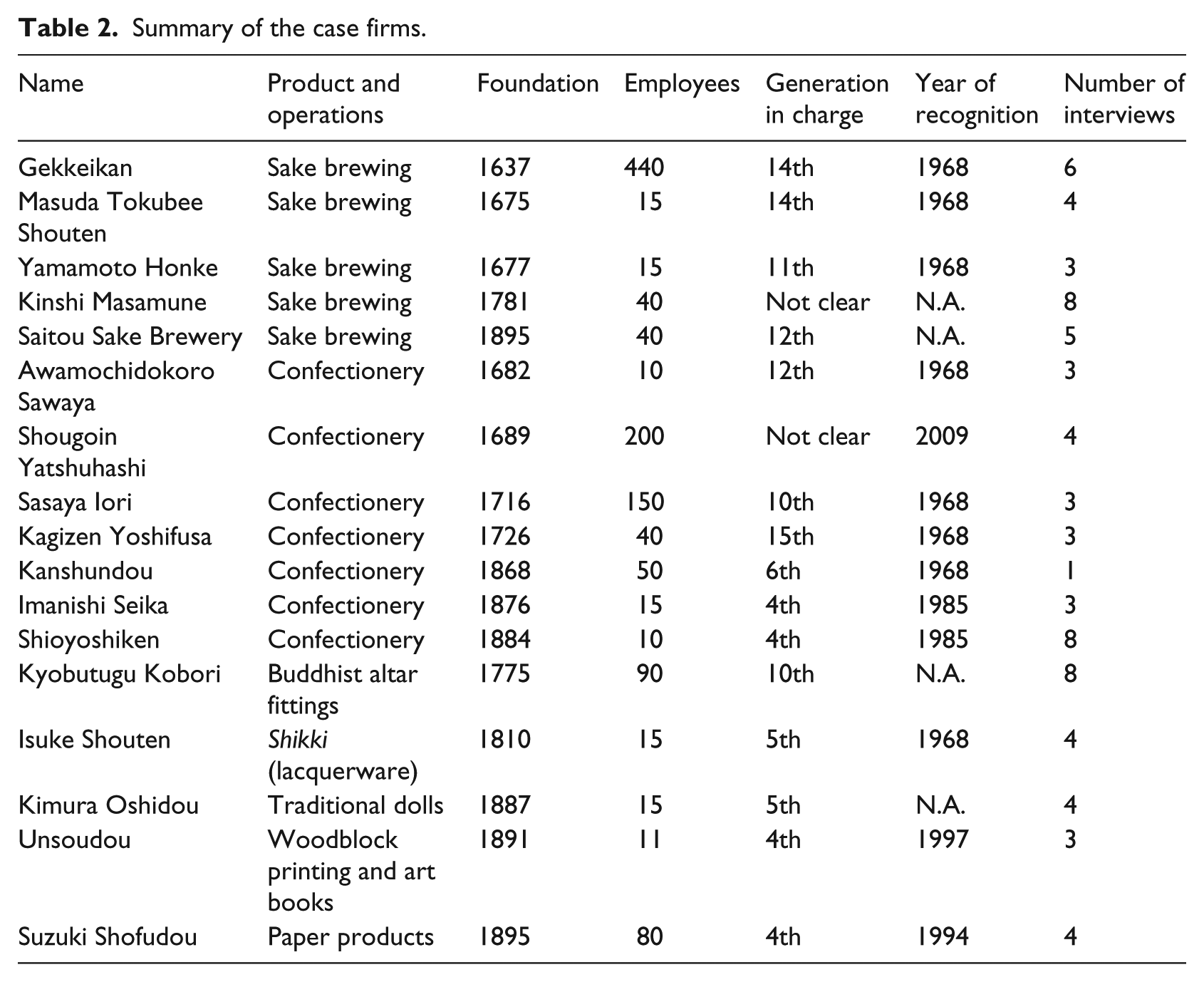
In order to cover the most relevant local constituents, we also interviewed community members from the political (local prefectural government, city council members), cultural (monks, parishioners), and economic (trade associations, the chamber of commerce, local department stores) spheres. To enrich our understanding of the phenomenon, we also contacted knowledgeable local citizens such as experts of shinise, owner-managers of neighbouring non-shinise firms, and tourist guides (see Table 1).
Interviews were conducted in Japanese by the first author, who taped, transcribed and later translated them to English. As is customary in qualitative research, we periodically revised interview questions in order to pursue insights stimulated by earlier rounds of data collection and analysis. The length of the interviews varied from fifteen minutes (with some members of staff) to two hours. The second author had the opportunity to participate in a few interviews, which helped him gain familiarity with the setting, while at the same time preserving detachment from the local culture.
We supplemented the interviews with archival materials collected from both shinise and the local government, as well as more general sources (e.g. symposia handouts, research papers, industry reports, internet pages). This material was important to integrate and corroborate what we heard during interviews and helped us reconstruct the history of sake, confectionery and traditional products sectors in Kyoto. To contextualize our findings, we also collected secondary data (books, articles and statistical data from the popular press, academic journals and government websites) that helped us deepen our understanding of the historical and cultural context in Kyoto and in Japan more generally (see Table 1).
Finally, the first author attended various company events, such as religious celebrations, factory tours, museum visits and various events in the local community, such as the New Year’s festival (see Table 1). These social activities allowed interactions with owner-managers and family members in a less formal way and helped her grasp in a nuanced way the history, heritage and customs of shinise in Kyoto. The first author recorded summaries of the most memorable conversations from these events in field notes, which informed data analysis.
Data analysis
Our analysis followed recommendations for case-based research (Yin, 1994). It relied on multiple sources and proceeded iteratively between successive rounds of data collection, searching for converging support for our provisional, emerging interpretations, while using past literature to inform the interpretation of empirical observations (Eisenhardt, 1989).
After the first round of data collection, we began to systematically map the various ways in which, according to informants, shinise contributed to the community – as producers of goods, contributors to local celebrations, keepers of traditions, etc. – and the community in turn contributed to their long-term viability. Early in this analysis, two core themes emerged. First, informants consistently referred to shinise as the embodiment of local values and carriers of tradition; second, they recognized that the long-standing practices that shinise engaged in implied the conscious sacrifice of freedom, flexibility and opportunities for profit and growth, and praised them for that. It was at this stage that we found in Selznick’s theory of institutionalization a useful lens to frame emerging interpretations and direct further analyses. Specifically, we built on his ideas to identify the ‘commitments’ that, in the eyes of informants, characterized shinise and the values that these commitments revealed (Selznick, 1957).
Building on these intuitive ideas, we proceeded to code our data more systematically, searching for patterns that could support and elaborate (or possibly reject) our early interpretations (Miles, Huberman, & Saldaña, 2013; Yin, 1994). The first two authors carried out the analysis independently, as they separately coded interview transcripts. After a first round of coding, we merged and discussed our interpretations to form a tentative common perspective on emergent themes. These coding efforts were informed by analytical categories drawn from Selznick’s theory, such as commitments and values, but remained open to the emergence of new categories, such as cultural erosion and benign entrapment.
Multiple iterations led to the gradual aggregation of raw data that referred to symbolic and material benefits that shinise enjoyed, the expressive function they perform, the broader challenges faced by these firms and the local communities, as well as the implications for family members, and eventually produced a summative framework, resulting from the clustering of lower-order codes into higher-order ‘pattern codes’ (Miles et al., 2013, pp. 86–7), which became the building blocks for the framework itself. Throughout this process, we periodically returned to the field to gather additional data, sent follow-up e-mails to elaborate emerging lines of inquiry, discussed our interpretations with key informants, and constantly reviewed them in light of new evidence.
Findings
Our study indicates that the distinctive social standing that shinise enjoy in Kyoto rests on a mutually supportive relationship between these family firms and the local community. Borrowing from biology studies, we describe this relationship as ‘symbiotic’, a term we use to highlight the mutual benefits that the constitution of shinise as a high-status category of firm delivers to the actors involved. The high social standing that the community confers on these firms grants them access to exclusive social and material benefits, and enables them to deflect the market pressure they confront from larger and more resourceful competitors. In turn, the preservation of shinise – their products, structures and practices – helps the community maintain its cultural integrity by enabling the reproduction of cultural values and collective identity, threatened by a process of cultural erosion of traditional Japanese society. The high categorical status that these firms enjoy, then, is inherently linked to their expressive function (i.e. their role as protectors of values and custodians of the cultural integrity of the community), and supports them in their economic function (i.e. as providers of goods and services). Our findings, however, also point out a drawback of this symbiotic relationship, in the form of a ‘benign entrapment’ that restricts action for these organizations and requires personal sacrifice by family members.
In this section, we illustrate our empirical observations. They are organized around the conceptual building blocks of our emerging framework and articulate the theoretical underpinnings of the interactions we observed (see Figure 1 for a visual representation of our framework). We provide additional illustrative evidence in Tables 3 to 5 and Appendix 1.
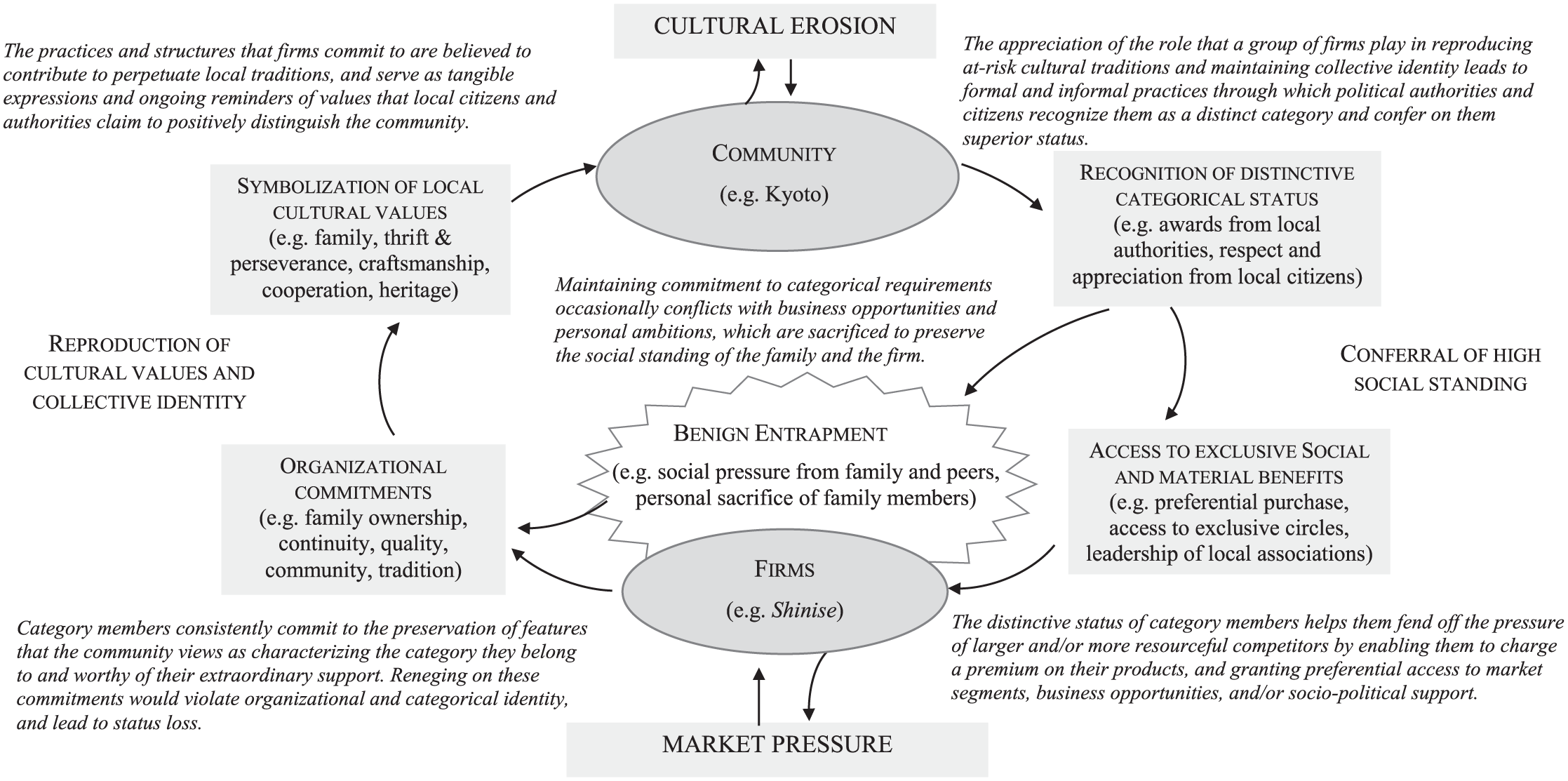
Social recognition, cultural reproduction, and the benign entrapment of firms serving an expressive function in the community.
Conferral of high social standing.

Conferral of high social standing (category status)
Converging evidence supports the observation that, in Kyoto, shinise are recognized as a distinctive category of firm and collectively held in high regard. Their categorical status is reflected in formal practices (e.g. awards from local authorities) and informal attribution (e.g. shared understanding of these firms as deserving admiration and respect). Such a distinctive social standing provides shinise with access to exclusive social and material benefits, such as preferential purchase, access to exclusive circles and leadership of local associations, that symbolically reproduce the privileged position of the category (and category members) in the local social hierarchies (see Table 3).
Recognition of distinctive categorical status
In Kyoto, the recognition of shinise as a distinctive category of firms is underpinned by a set of formal and informal practices through which the community officially establishes category membership and informally bestows status and respect to these companies. As our informants (and our direct participation) confirmed, the ceremony where newly qualified shinise are formally recognized as ‘exemplary’ companies (KyoButugu Kobori, Sales Manager) is held in high consideration by community members. The awarded shinise proudly display the plaque they receive during the ceremony in their facilities, and citizens express ‘pride’ and ‘respect’ for local shinise (see Table 3 for examples). Even before this important achievement is obtained, firms approaching the symbolic age of 100 years gain increasing respect as ‘shinise-in-the-making’. As informants mentioned, their owner-managers feel increasing pressure to conform to expectations about what represents a ‘real’ shinise.
In Kyoto, however, not all companies officially recognized by political authorities as shinise command the same respect. While all the citizens we interviewed generally expressed appreciation for local shinise, it was also evident that some of these firms had a higher standing than others, suggesting that subtler status hierarchies exist even within this category. These differences depend in part on factors, such as a recognized mastery of the craft or intense community engagement, that reflect the particular ‘commitments’ (discussed later) that constitute these firms as collectively deserving high social status in the eyes of the community. They also depend to a large degree on the sheer longevity of the firm, with older firms commanding comparatively more respect and admiration than younger ones. Owner-managers of firms of 150 to 160 years, for instance, behaved deferentially toward their counterparts running multi-centenary firms, and informants from some of the oldest shinise belittled the formal recognition of the prefectural government, by saying that a history spanning several centuries and several generations is required to be a ‘real’ shinise.
Access to exclusive social and material benefits
As a result of the respect and esteem that community members hold for shinise, these family firms enjoy exclusive advantages, primarily in the form of preferential purchase, access to exclusive circles and leadership positions in professional associations. Exclusive access to these social and material benefits contributes to promulgating the perception that these firms belong to an elite group, thereby reinforcing their high categorical status.
The widespread respect that these firms enjoy in Kyoto is reflected, for instance, in the preference awarded to their products by citizens and authorities alike, in particular for products intended to be used, exchanged or consumed in traditional or special social occasions (e.g. confectionery or traditional crafts). As the manager of a small, but highly regarded producer of traditional confections (wagashi) observed: Our customers usually repeat their purchase. However, they do not come to buy our products on a daily basis. Rather, they come back every time they have something special, such as weddings, New Year’s celebration or other parties. They choose our products for the most important occasions. (Shioyoshiken, Vice President)
Local government and trade associations also support the use of the traditional products that these companies make. For instance, they highly encourage the use of sake for official celebrations and kimonos for formal occasions (see Table 3). As the leader of a local trade association told us: I promoted a new rule for the municipality of Kyoto, together with the Mayor, that says that official toasts should be performed using sake. This rule was approved with common assent. Introducing locals to a culture of sake connects to the promotion of Japanese traditional food, traditional dishes, and even wearing kimonos. All cultural activities are connected with each other. This kind of activity can protect the tradition in the local region. (Fushimi Sake Brewing Union, President)
The preferential purchase that shinise enjoy is therefore only partly explained by the trust that their products are of the highest quality. In part, it reflects the institutionalized recognition that these producers belong to a special, superior category, whose products are the only ones appropriate for special occasions, formal events and celebrations.
An embarrassing experience from one of our interviews reinforced our awareness of the distinct symbolic value attributed to shinise and their products in the local community. In Japan, it is a common custom to bring a gift to business meetings. One day, on our way to an interview with the president of one of the oldest sake brewers, we realized we had forgotten our gift. All the local shinise stores were closed, so we had to buy a confection from a local, non-shinise store. As our informant opened the packaging, he politely indicated that this particular firm did not have a long history and set aside the gift without further comment.
Importantly, we noted that other locations in Japan do not exhibit the same preferential treatment for the products of local shinise as Kyoto does. In Kyoto, large retailers and department stores reserve a specific section of their food departments for the products of shinise, thus visibly reinforcing the special categorization of these firms. This is not a common practice outside Kyoto. For instance, when we asked the managers of the three largest department stores in Tokyo how they make decisions about the assortment of products on the shelves, they confirmed that it is based on ‘what the customers ask for’. Products from shinise and non-shinise high-end brands are often mixed together. This observation is important because it supports our interpretation (discussed later) that the community in Kyoto confers a special status on local shinise because they are perceived as the embodiment of distinctive local values; other communities in Japan, who do not share the same values, do not attribute a comparable status to these family firms.
Another important implication of the recognition that shinise receive in Kyoto is obtaining access to exclusive circles and the leadership of local associations. In the highly stratified Kyotoite society, business and social relationships are conducted through a multitude of professional associations and social salons. Inclusion in these social circles underlines and reinforces one’s social standing, and provides access to business opportunities: The merits of belonging to associations of shinise is that we strengthen relationships in the local community. It leads to strong trust. For example, some firms might decide to do business with another firm just because that firm belongs to our association. Belonging to an association means that that firm is supported by the local community. (Shogoin Yatsuhashi, President)
Some of these associations are newer and easier to join, while others have histories dating back to the Edo period, and are exclusive to particular shinise. Older shinise hold leadership positions in the most exclusive associations, where they influence decisions about membership and sit at the top of internal hierarchies.
Reproduction of cultural values and collective identity
The majority of our informants – among political authorities as well as owning families – explained the high standing that shinise enjoy in the Kyotoite society with the important symbolic and cultural function that these firms perform in the community. The continued existence of these firms, they explained, helps the community maintain the memory and the integrity of cultural values that distinguish Kyoto within Japan. By doing so, they argued, shinise help preserve the collective identity of the community.
In Kyoto, many shinise manufacture products, such as traditional garments, sake, confectionery, altar fittings and other religious objects, used in the formal and informal rituals, ceremonies, and festivals that reproduce culture in a visible and tangible way. Several informants, however, mentioned how shinise contributed to keep tradition alive not only by offering the physical artefacts required by the performance of cultural practices, but by more generally embodying fundamental cultural values that helped the community preserve a distinctive identity.
According to informants, the respect and support that shinise enjoy in Kyoto are associated with patterns of choices and behaviours that reflect what Selznick refers to as ‘commitments’. Five commitments, in particular – to family ownership, the continuity of the household, the quality of the products, the welfare of the community and the perpetuation of traditions – featured frequently in our informants’ accounts. When discussing the relevance of these commitments, informants linked them to particular values that characterize the local culture, i.e. a sense of duty toward the family and ancestors, thrift and perseverance, craftsmanship, heritage and tradition, and collaboration and mutual support, respectively (see Appendix 1 for selected evidence of these commitments and the corresponding community values).
Informants acknowledged that these commitments led shinise – as we discuss later – to voluntarily restrict managerial discretion and growth. However, they also importantly underlined how it was this important social function – more than the actual quality of their products or the persistence of their viability – that explained their distinctive standing and the support they garnered. ‘Because shinise maintained such values’ the President of Saitou Sake Brewing explained, ‘they are supported by society and, consequently, they are long living.’
Commitment to family ownership, and the value of family
Keeping family ownership and control is a fundamental requirement to be considered a shinise (Hiramatsu, 2004; Nagasawa & Someya, 2009). Maintenance of family ownership is considered critical to transfer the philosophy of the founder infused in the firm to the next generation. The owner-managers of shinise, therefore, feel a strong imperative to keep the business within the family. As one informant from one of the most highly regarded producers of wagashi, purveyor to the imperial court, observed, ‘There is no point in continuing the business, if it is not in the name of the family’ (Sasaya Iori, wife of the President).
Both owner-managers and representatives of the local associations linked the commitment that family members displayed to the family business to the traditional notion of patriarchal ‘family’, as well as the sense of duty towards one’s family and devotion to ancestors, which characterize Japanese culture in general, and the prefecture of Kyoto in particular (see Appendix 1 for examples). In all the firms that we investigated, for instance, it was customary that the eldest son would eventually become the leader of the firm. He would be groomed and prepared from an early age, working for many years alongside his father and, often, his grandfather.
This succession practice reflects the patriarchal nature of Japanese society and a traditional Japanese family system, called ‘ie’, that dates back to the feudal Edo era (1600–1868). The term ie refers to the ‘household’, which consists of the extended family, including grandparents, the eldest son and his wife and children, living within the same premises, with clearly defined roles based on gender and seniority. According to this system, when the head of a family is no longer able to manage the family estate, authority is passed to a successor, typically his eldest son, who is expected to take care of his parents and continue the ie. Daughters and the younger sons are instead expected to leave the ie to begin a family elsewhere (Bhappu, 2000; Marshall, 2017). The national family registry continues to preserve and reinforce the ie system, by requiring every household to officially appoint a head, typically a male family member (Mackie, 2014). Indeed, some informants explicitly declared how they supported this system. For example, the President of Kanshundou stressed that ‘to continue the tradition, it is very important that the three generations live near one another. Without including grandparents in the family, continuation is impossible.’
Commitment to continuity, and the value of thrift and perseverance
Another common theme in our interviews was the strong commitment towards the long-term continuation of the business, as opposed to the pursuit of short-term opportunities for growth that could put the business and the household at risk (see Appendix 1). In two-thirds of the firms, informants expressed their concern at the ‘greedy’ attitude of some non-shinise firms. Eight of them offered examples of how, in the past, they or their predecessors had rejected opportunities for expansion and short-term financial return so as not to endanger the continuity of the firm.
Usually, in a firm, the CEO holds the position for two to four years, and he has the mission of satisfying the expectations of shareholders in that short period. We do not publicly list our stocks. Our way of doing is the opposite of this. We do not want to make profit in the short term… I am grateful to my ancestors, because we are doing business with what they left us. I feel very strongly about this … If there is a business opportunity, I do not reject it. However, I do not think exploiting this opportunity is always the best option, because it is just a small part of a long history. What is important is to create a business that can live for a long time. (Unsoudou, President)
Local citizens acknowledge and appreciate the perseverance that these family firms display. The president of a small confectionery, which had been in operation for around four centuries, observed that ‘shinise are respected, because it is hard to continue… It is hard to pass down the firm from one generation to the next’ (Awamochidokoro Sawaya, President).
Typically, informants linked this parsimonious attitude and commitment to continuity to the values of thrift, modesty and perseverance that distinguish Kyoto from other large cities in Japan. Various sources describe locals as valuing being ‘humble’, ‘modest’ and ‘thrifty’. ‘People in Kyoto,’ a politician observed, ‘do not like to show off’ (Prefectural Assembly, Deputy). A citizen explained the thriftiness of locals with the historical position of Kyoto as the capital of Japan. ‘Because Kyoto used to be the center of politics for centuries,’ he told us, ‘people experienced many wars … and they learned that they have to save in good times in order to overcome the hard times.’ Informants frequently linked the value ascribed to continuity and perseverance to the longevity of the Imperial family, whose lineage is believed to date back over a thousand years: The Japanese, and especially Kyoto’s tendency to value longevity or continuity has its roots in [the longevity of] the Imperial family. In Kyoto (and largely in Japan) a person is admired if he/she is able to continue one thing for five to ten years. In order to continue one thing, it is necessary to put in a lot of effort away from the limelight. (Prefectural Assembly, Deputy)
Commitment to quality, and the value of craftsmanship
While most shinise are relatively small, they are considered exemplars of excellence in their respective fields. The superiority of their products is generally ascribed to their staunch commitment to quality and perfection. These organizations typically hire craftsmen on the basis of long-term, trust-based relationships that sometimes continue from one generation to the next. ‘In Kyoto,’ an informant explained, ‘craftsmen do not change firm very often. We value more the continuity and loyalty here.’ The same informant offered a powerful story that illustrates the level of commitment and pride of these craftsmen: One day, there was an order from Tokyo for eighty traditional sweets called houraisan. The occasion was the wedding of the customer’s daughter. Our products should be consumed as soon as possible, so I told the customer that we would make them on Saturday and bring them by Sunday morning. He insisted for us to make them in advance on Friday, because he was worried that they would not arrive on time. He explained that it was fine if the sweets were a bit dry. He insisted so much that I accepted. On Friday, the elder craftsman made eighty of those sweets. When I told him that they would not be consumed the following day, he decided to make all of them again the next day. He begged me to call the customer once more and explain the situation. The customer was moved and said it was ok. The craftsman was very happy. It was much easier for him to make all the sweets again than to imagine a customer saying ‘it is not delicious’… This craftsman is 75 years old and he still works in our firm. (Sasaya Iori, wife of the President)
Similarly, another informant, the manager of an old confectionery, mentioned his pride in the creation of high quality products and explained how he places absolute priority on quality over profit: We value product quality more than short-term profit making. In ‘regular’ firms, they cannot set a goal that does not achieve economic profit. In the case of my firm, if we cannot manage to produce a large quantity of products, we decline the order. If we cannot make products that meet the quality standard I am satisfied with, it is better not to make them at all. (Shioyoshiken, Vice President)
In two thirds of the cases, informants offered stories that pointed to how their commitment to the quality of their products had led them to refuse opportunities for growth that could have compromised their capacity to respect the high standards they set for themselves (see Appendix 1).
More than one third of our informants – owner-managers and representatives of local associations alike – suggested that the local admiration for shinise and their exceptional commitment to quality is linked to the pride that locals have for the ‘culture of craftsmanship’ of Kyoto and its glorious past as the capital of Japan and residence of the Imperial court for over a thousand years (e.g. Murayama, 2008; Takashina & Oonogi, 2006). The locals still consider the superior skills of Kyoto’s craftsmen a trait that distinguishes the region from the rest of the country (see Appendix 1 for examples).
Commitment to community, and the value of cooperation
Blending in and respecting the local norms and traditions of the community is considered particularly important for businesses operating in Kyoto. Shinise, however, receive the appreciation of the locals because they do not simply blend in, but also contribute tangibly and visibly to the well-being of the community. Owner-managers in nearly all cases mentioned how this commitment runs deeply in the family. As the manager of a famed local sweet store that has been in operation for more than 300 years explained: My father used to tell me to always be useful to the local community. That is why I do all kinds of things to help. In this way, we contribute to the stability and safety of the local community. (Shogoin Yatsuhashi, President)
Several shinise donate to welfare facilities, patronize artistic and cultural events, and regularly sponsor and personally attend local festivals (see Apppendix 1 for examples). During the three days of the Setsubun festival in the Kaso shrine, for instance, the company presidents serve free tea and sweets to the local citizens. One of them explained how, by doing so, they set an example for their employees about the importance of contributing to the community.
The president of the traditional products association explained how this attitude reflects a distinctive business philosophy that emphasizes collaboration and community involvement rather than profit seeking. ‘In Japan, traditionally,’ he explained, ‘there is something that people are proud of, more than just making money.’ The philosophy of sampo yoshi (‘three-way-satisfaction’) he alluded to was established in the 16th century by merchants from the Ohmi prefecture, who believed that business should not be conducted only for the benefit of buyers and sellers, but also for society at large (Takehara, 2010).
Informants remarked that, in Kyoto, this philosophy is still largely embraced by shinise, who have preserved traditional customs (see also Murayama, 2008). Some pointed out how this emphasis on collaboration and social relationships distinguishes Kyoto from Tokyo, where the culture places much more emphasis on money-making and competition (see Appendix 1). As an informant put it, ‘this is a town where you must do things together. Here you must take responsibility towards the local community’ (Kagizen Yoshifusa, President), and the community appreciates shinise for doing that. ‘No one thanks me [for what I do], and I do not boast that I work for the local community’ – he told us – ‘But people are watching, and little by little they understand who is doing what. This is the culture in Kyoto.’
Commitment to tradition, and the value of heritage
A final commitment that characterizes shinise is to tradition. Most informants mentioned the care they place in protecting traditional skills, production methods and the defining characteristics of their products (ingredients, taste, materials, finishing, etc.), even in the presence of evolving technologies and changing lifestyles. Indeed, several informants noted that owner-managers of shinise no longer recognize other firms as shinise if they introduce changes that violate their heritage: Kyoto’s shinise are strict towards other shinise. It is not enough that the shop has been standing for a hundred years. If the original product is different from today’s product, if the product has changed many times during history, or if the owner of the company has changed, other shinise in Kyoto will not accept a firm as a shinise simply for its long life. Kyoto’s shinise are very proud of being called shinise, and not all companies can be called so. (Local person)
Shinise are recognized and appreciated locally for their commitment to the preservation of traditions: not only their own traditions, but, more importantly, the local heritage and traditions of which the community sees them as an embodiment. As a local politician explained: In Kyoto, people cherish their long history and tradition. They have the pride that comes from having been the capital of Japan for over 1000 years … and I think shinise do embody these values … and are respected for it. (Kyoto prefectural government, Department of Industrial and Labor Affairs, Deputy Section Chief)
Although Kyoto is no longer the capital city, it is still considered its cultural centre. ‘In Kyoto,’ an informant told us, ‘there is a sense that Kyoto is at the centre of Japan’ (Takara Holdings, employee). This strong collective pride nurtures an obligation to protect the local heritage. ‘Even if it is fading little by little these days,’ the leader of a trade association observed, ‘people in Kyoto have a mindset to protect their tradition’ (Traditional Products Association, President). Others suggested that this ‘sense of duty to appreciate and protect tradition’ (Takara Holdings, employee 2) is unique to Kyoto because of the high concentration of shrines, temples and other historical buildings, festivals, and traditional crafts; they view shinise as playing an important role in the maintenance of this unique heritage: Many shinise support the maintenance of various tangible and intangible cultural assets in Kyoto. Shinise have been repairing and maintaining traditional architecture and gardens in temples and shrines. … Kyoto is home to the headquarters of many Japanese cultural activities such as the tea ceremony and flower arranging, and shinise in Kyoto prepare tea cups and kettles, tea spoons, hanging scrolls, flower baskets, flower-cutting scissors and other tools used by them. This culture is preserved because shinise protected traditional production technologies. (Kyoto prefectural government, Department of Industrial and Labor Affairs, Deputy Section Chief)
Representatives of the local political authorities also indicated that these organizations serve as carriers of Kyoto’s cultural traditions and reinforce the local pride in them (see Appendix 1). The president of an association of producers of traditional products similarly highlighted the importance of these firms in constructing a distinctive local identity that is appreciated and expected by visitors. Indeed, shinise are conscious and proud of their important role of passing down local traditions and educating people about their heritage (see Appendix 1).
Cultural erosion and the threat to community collective identity
The expressive function that shinise perform by symbolizing distinctive local values was considered particularly important by informants in light of the perceived threat that unwelcome forces for cultural change, such as the modernization and westernization of Japanese culture, pose to the integrity of traditional values and collective identity – a threat that we refer to as cultural erosion.
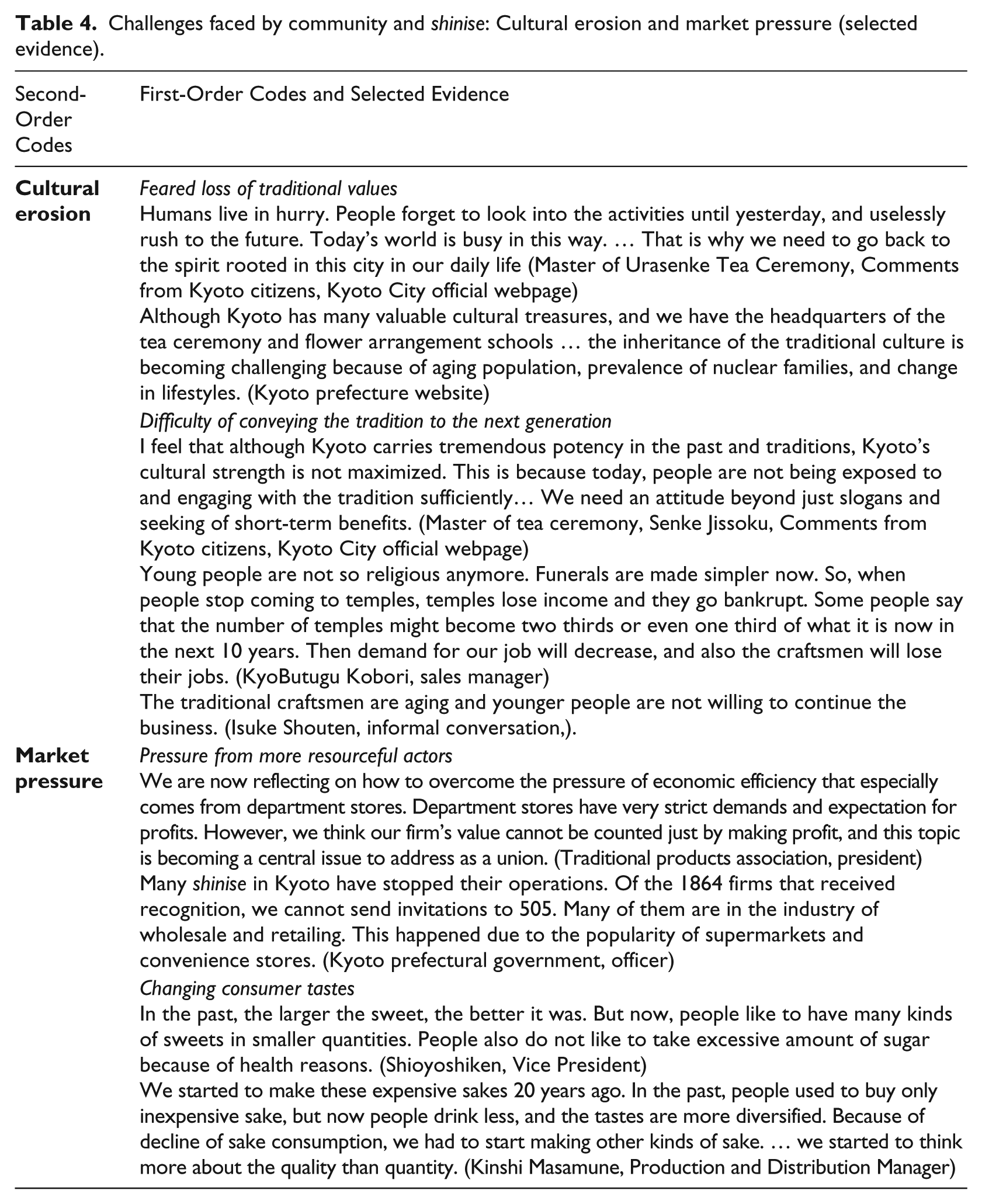
The modernization of Japan and westernization of its customs began at the end of the 19th century during the Meiji Restoration, which marked the end of the feudal society, and introduced elements of Western capitalism in the legal system and the economy. A second period of westernization followed the end of World War II, when the Allied Powers imposed the liberalization of political parties and pushed corporations to modernize employment systems. Part of the nation felt that, by more or less implicitly advocating individualism and self-interest, these changes were inconsistent with traditional values and the social structures that they underpinned (Satou, 1993). Still, at the time of our study, political and religious authorities, businesspeople, as well as local citizens of Kyoto expressed serious concerns about changes in customs and lifestyles driven by modernity, and complained about the challenge to protect traditional values and transfer them to younger generations (see Table 4).
Challenges faced by community and shinise: Cultural erosion and market pressure (selected evidence).
Scholars have long recognized how ‘Japan, as a nation, is proud of and strives to protect its cultural heritage’ (Ford & Honeycutt, 1992, p. 29). This ideology can be traced at least as far back as the Meiji restoration, when – similarly to what occurred elsewhere in the world (Anderson, 1983) – a national identity consolidated, partly as a response to the forced opening of Japan to foreign trade and influence. During this period, the promotion of a return to Shintoism and the constitution of the Imperial family as a symbol of national unity served to counterbalance the introduction of Western elements in the legal and economic system, and to preserve the established social order and cohesion as the country was modernized (Hobsbawm, 1983; Samuels, 2003).
Cultural nationalism rekindled in the early 1970s, when the Dentou kaiki (‘return to the tradition’) intellectual movement sought to counter the second westernization wave that followed World War II by promoting a return to traditional institutions, social structures and forms of interaction. Japanese scholars turned their attention to the long-lived shinise, attributing their longevity to the preservation of their foundational cultural values (Ashida, 1974; Miyamoto, 1980), just as some attributed the post-war ‘economic miracle’ to Japan’s unique culture (Kumon, 1982). These trends advocating a return to traditional values also coincided with the rising interest of political authorities in local shinise.
In our study, informants remarked that the sentiment that heritage and tradition are essential to the collective identity is particularly felt in the Kyotoite community. Kyoto is home to the headquarters of multiple religious sects and cultural institutions, as well as the national Agency for Cultural Affairs, and it is widely recognized as the cultural capital of Japan. This notion is central to the identity of the local community. A ‘message to Kyoto’ from the city’s official webpage at the time of our study, for instance, read: Today, the Western countries are creating a ‘global standard’… Kyoto is the city where hiragana and katakana were created. The city that groomed the Japanese language, [is] the hometown of Japanese culture … Even in the global standard, it is hard to find a city like Kyoto where history is preserved as the foundation of the national culture … Many Japanese might feel that the reality of the competition-based society, and prevalence of egoism … are making it extremely hard to protect the Kyoto’s culture. (Kyoto City official webpage)
Kyotoites consider themselves the custodians of national traditions, and see adherence to traditional values of modesty, sobriety, manners, perseverance, solidarity, spirituality and respect for ancestors as distinguishing them from what they describe as the fast-moving, risk-taking, showy, greedy cultures of Tokyo and Osaka. It is against this backdrop, then, that we can better understand the particular admiration that shinise – with their long-standing commitments and uncommon longevity – enjoy in Kyoto, as a symbol of the viability of a way of doing business that is respectful of traditional values and offers an alternative to what informants referred to as the ‘western’ or ‘American’ standard. Supporting shinise – and the traditional values that they embody – therefore, is also a way for Kyoto to protect its distinctive identity and its sense of (cultural) superiority, compared to much larger and more economically successful rival cities that paved the way to the modernization of the country.
Market pressure and the threat to organizational survival
Just as the symbiotic relationship between shinise and their community helps the latter alleviate threats of cultural erosion, so the social and material benefits that the former enjoy help them alleviate market pressures from aggressive competitors and shrinking markets. The owner-managers of shinise deeply feel competitive pressures and the challenge to remain relevant as tastes and consumer habits change (see Table 4 for examples). Sake brewers and producers of temple fittings, for instance, lamented declining consumption as lifestyles changed. Confectioneries lamented the increasing scarcity of yellow millet – a key ingredient in the production of many traditional sweets. Deteriorating market conditions pressurize these firms to adopt more efficient production methods or to modify their products, and reduce the resources available for community involvement.
Nonetheless, nine informants mentioned how the benefits that accrue to their firm because of their social status provide relief from these pressures (see Tables 3 and 4). In some cases, shinise enjoy a shrinking, but relatively stable market, because their products continue to be requested for religious (ceremonies, festivals) or mundane (gift-giving, toasting) ritual practices. As the Deputy Governor remarked, these practices ‘maintain the foundation of a market in which shinise could survive and prosper’.
The recognition of shinise as a separate high-status category shelters these firms from the competition of younger producers of relatively lower status, and enables them to claim a premium segment of the market. As we discussed earlier, the status hierarchies that underpin market interactions reflect the expressive function that shinise perform, a function that the community is very much interested to preserve beyond economic considerations, to the extent that it considers these organization less ‘expendable’ (Selznick, 1957).
Many of the local citizens we interviewed expressed the willingness and desire to ‘protect’ shinise by buying their products or spreading good words about them, and reported feeling a sense of loss when one of these firms closes. Some informants also reported how, in times of crises, shinise receive support by the community as preferred suppliers, and how local community members occasionally take action to help a shinise experiencing temporary difficulties to stay in business. Others told us stories of clients placing special orders to help shinise overcome financial difficulties. As the President of a large brewery, Saitou Sake Brewing, observed, ‘community members will help a firm if they feel that the firm has value to be kept’.
Benign entrapment
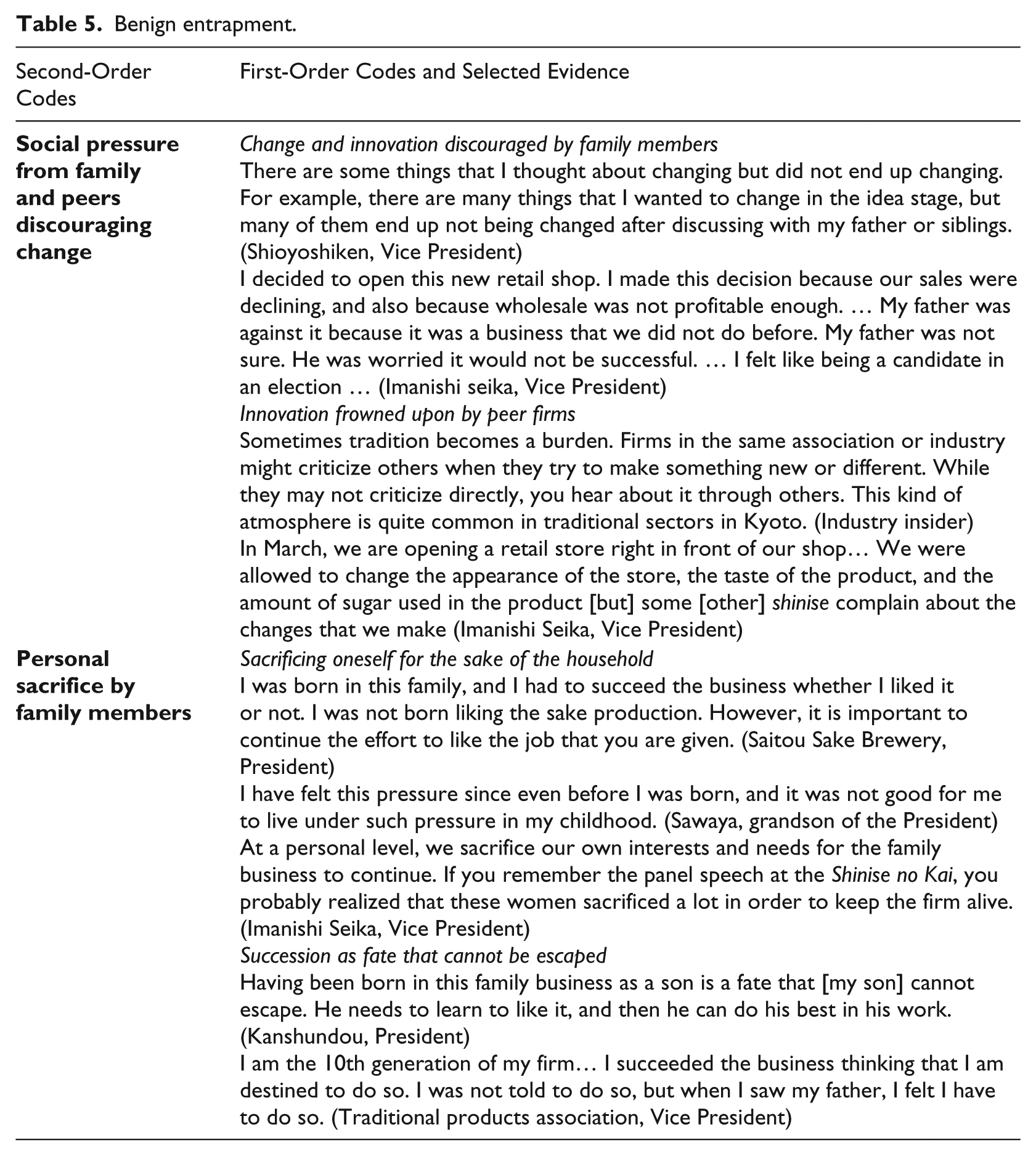
Interestingly, our prolonged engagement in the research site gradually revealed a ‘dark’ side to the superior status that shinise enjoy in the local community. While not denying its numerous advantages, in almost half of the case firms, informants drew our attention, more or less explicitly, to the fact that high social status and the cultural function of shinise put pressure on these companies to meet the expectations of the community. This compliance may entail economic and personal costs to the organization and its family members. We theorize this condition as ‘benign entrapment’, whereby the privileges that these family firms enjoy also impose severe restrictions on their business operations and on the personal freedom and latitude in decision-making of family members (see Table 5 for selected evidence).
Benign entrapment.
Social pressure from peer family firms and the local community
Shinise are expected to conform to the social norms and expectations associated with this exclusive category and to be ‘exemplary’ for other firms. The prefectural government, for instance, expects them to contribute extensively to the local community, which may restrict their discretion in the use of the wealth they produce. Older shinise, a priest observed, may be more influential, but social expectations are also higher for them.
Commitment to preserve one’s character and tradition also imposes constraints on the latitude that owner-managers have when trying to change and innovate. Four informants reported their frustration when the innovations they proposed were frowned upon by other shinise and their efforts were discouraged (see Table 5). As the manager of a small producer of traditional candies, who encountered disapproval for his decision to introduce new flavours and open a refurbished store with a more contemporary style, reported: In the association, there are people who say things like the Kyo-candies have to be made in the most traditional way using a kettle. But I think it is important to take the good sides of both tradition and new ways. (Imanishi Seika, Vice President)
While their distinctive status shelters shinise from competitive pressures, then, the social pressures and expectations that come with it can induce them to ultimately forgo opportunities to increase profitability and sales, if the pursuit of these opportunities is regarded as betraying a firm’s commitment.
Personal sacrifice of family members
In addition to restricting potential business opportunities, numerous informants mentioned how commitment to family ownership put an enormous pressure on the designated successors, who are often forced to prioritize the continuation of the family business over their own individual ambitions and happiness. ‘Sometimes they inherit the business because they want to … but often they inherit because of a sense of crisis and a sense of duty not to end the business’ (Kyoto prefectural government, Department of Industrial and Labor Affairs, Deputy Section Chief) (see Table 5 for examples).
Three informants mentioned that they did not particularly like their line of business, but had to ‘learn to like it’; two discussed the sacrifices they had to make for the sake of the family business, and the emotional burden they felt to secure a successor for the business: In a shinise, the firm is the same as the family. We need to sacrifice our own will and our own feelings and what we want to do … Inheriting and continuing the household is very important. … We do not continue the business because we particularly like that industry. The fact that our family makes sweets is a coincidence. What is important is to continue the household as it is. (Shioyoshiken, Vice President)
An informant described the succession as ‘a fate that cannot be escaped’; four others mentioned how they, or their sons, had to set aside their personal wishes and ambitions. An informant, who had experienced considerable stress, explicitly referred to how much sacrifice was required for these businesses to be kept within the family: One of the daughters of a shinise firm had to give up her personal happiness … maybe she had someone she loved … in order to continue the business as the next successor. So, there is a lot of sacrifice at the individual level. (Imanishi Seika, Vice President)
According to our informants, these types of personal sacrifices are required not just from the heir of the firm who could not choose the career he truly wanted to pursue, but also from the spouses who are in the position to ‘teach about the tradition to the next generation within the family education’ (Kanshundou, President), and the siblings of the heirs who are often ‘discriminated’ in order to secure a smooth succession (Sasaya Iori, wife of the President). Taken together, these stories reveal the typically hidden tensions and sacrifices that family members of shinise may endure to commit to the categorical requirements and continue to be the living embodiment of local socio-cultural values.
Discussion
Using an in-depth qualitative analysis of multi-century family-owned firms in Kyoto, we have begun to unpack the socio-cultural processes (summarized in Figure 1) that enable a group of ‘elite’ organizations to maintain their privileged standing in the local community.
Our findings draw attention to how a community may confer a distinctive social standing on a group of organizations because these organizations help community members preserve the integrity of their collective identity and cultural heritage, in the face of what we have referred to as cultural erosion. As the case of Kyoto shows, broader forces for cultural change and homogenization of values may induce younger generations to embrace new values and lifestyles imported from outside, and to abandon local traditions – thereby threatening the collective identity of a community. In these circumstances a group of organizations, such as Kyotoite shinise, may serve as tangible expressions and ongoing reminders of values that local citizens and authorities claim to positively distinguish the community.
As the case of shinise suggests, these organizations do so by displaying consistent commitments (Selznick, 1957) to features (in the case of shinise, family ownership, continuity, quality, community, tradition) that are aligned with these community values (in the case of Kyoto, family, thrift and perseverance, craftsmanship, cooperation, heritage). By doing so, the social function that these organizations collectively perform goes over and above the technical and economic utility of their products and services; it becomes a symbolic – ‘expressive’ (Parsons & Bales, 1955), – function whereby these organizations serve as carriers of tradition and unifying symbols, as they support cultural reproduction and social cohesion.
We describe metaphorically this relation as symbiotic because – as illustrated by the case of shinise – a group of organizations that comes to perform an expressive function for a community will enjoy substantial benefits and will be ascribed a distinctive standing in return. By being regarded as ‘institutions’ (in Selznickian terms) that help the community preserve its cultural traditions and collective identity, these organizations are collectively considered ‘less expendable’ and worthy of extraordinary support. In recognition of their commitment to practices and structures that reflect and symbolize deep-set collective values, community members will confer on them a high collective (categorical) status. In Kyoto, political and religious authorities, citizens and other local actors do so through a combination of formal and informal practices that draw boundaries around this group of organizations, establish criteria of inclusion, and symbolically segregate them from competitors.
In turn, as our study indicates, the superior standing conferred on these organizations will grant them privileged access to the material resources they need to survive, and will help them fend off market pressures that could jeopardize their existence, such as larger and/or more resourceful competitors, or technological or market changes that may render their products obsolete and anachronistic. As the case of shinise in Kyoto illustrates, benefits may range from a premium price, preferential access to market segments and business opportunities, and continued economic and socio-political support. These practices also contribute to consolidating their status as a high-status category by signalling and reinforcing their distinction.
These observations suggest that the maintenance of a status hierarchy that confers a distinctive position to a group of organizations in return for the expressive function that they serve may be essential to the survival of these firms and the integrity of the community, in the face of competitive pressures and cultural and demographic changes (hence our labelling of this relationship as symbiotic). Interestingly, however, our study also reveals that the high status and privileges that these organizations enjoy is counterbalanced by ‘negative’ elements. Firms may experience economic and social pressures that reduce their managerial discretion. As the case of shinise illustrates, when commitments conflict with growth opportunities or personal ambitions, family members may make personal sacrifices to ensure the preservation of the social standing of the family and the firm. We have referred to this condition as a benign entrapment, to underlie the coexistence of extraordinary benefits and restrictions associated with this social position.
These findings reveal how organization theories and family business theories can be fruitfully integrated to better understand status-related processes in family firms and in organizations more generally.
Socio-cultural processes of status maintenance
Our study begins to shed light on the underexplored processes and mechanisms through which status hierarchies are maintained. Past studies have conceptualized status maintenance in terms of actions that high-status actors take in response to threats and disturbances to their position (e.g. Duguid, Loyd, & Tolbert, 2012; Pearce & Xu, 2012). Our observations offer a complementary perspective, by pointing to the ongoing dynamic interaction that underpins the maintenance of a status hierarchy. Specifically, they draw attention to the socio-cultural practices that both high-status actors and their constituents engage in to re-enact a status hierarchy, to protect the symbolic and/or material stakes they have in the reproduction of this social order.
Consistent with recent developments in institutional theory, our findings highlight the inhabited nature of status hierarchies (Hallett & Ventresca, 2006) by foregrounding the social interactions through which the cultural meanings that status hierarchies rest upon are continuously reproduced by local actors. At the same time, they reveal the pressures that macro-level arrangements exert on the choices of actors inhabiting shinise as local institutions.
By bridging micro and macro level, our study improves our understanding of the role that local communities play in the maintenance of status hierarchies. Communities are believed to shape how status is acquired and maintained because each community ‘tends to develop its own unique shared belief system, which inculcates actors with beliefs about status characteristics’ (Piazza & Castellucci, 2014, p. 299). Our findings extend this idea, by drawing attention to how a community may also have a direct stake in how actors acquire or maintain status, insofar as the establishment and maintenance of a particular status hierarchy is instrumental to the construction and preservation of its collective identity.
Our observations, therefore, invite us to revisit and extend current conceptualizations of the interrelations between business firms and local communities to account for the symbolic and value-laden (‘expressive’) function that the former may perform. Past research has either emphasized the mobilization and resistance of communities against business practices that are seen as violating local values (e.g. Greve & Rao, 2014; Marquis & Lounsbury, 2007), or the material contribution of business firms to local communities through philanthropy and social action (Marquis, Glynn, & Davis, 2007). The case of shinise reveals how business firms can positively contribute to local communities symbolically (as well as materially), as they help them reproduce local values and traditions and preserve the integrity of the collective identity.
Finally, our study contributes to organizational research on status by adding to the burgeoning literature that examines status-related processes at the collective level (e.g. Delmestri & Greenwood, 2016; Lockwood, 2017; Sharkey, 2014). This line of inquiry points out that the status of an organization may depend also on the position of the social category it belongs to in social hierarchies that reflect its constituents’ belief system about value and worth. Social categorization may depend on the product one produces (e.g. grappa, whisky, cognac) (see Delmestri & Greenwood, 2016), the institutional logic it adopts (e.g., classical cuisine vs. nouvelle cuisine) (see Rao et al., 2003), the ‘class’ of organizations it belongs to (e.g. family firms vs. non-family firms) (see Binz et al., 2013), or other features that constituents use to compare and evaluate organizations. Consistent with the idea that ‘wider socio-cultural associations and practices are important components not only of a category’s institutional meaning but also of its value and thus its status’ (Delmestri & Greenwood, 2016, p. 510), our findings illuminate the relationships between processes of category status maintenance and the broader macro-cultural context within which they are embedded.
Recent research has shown how producers may use a range of symbolic strategies to enhance the status of their category, by disassociating from undesirable category-specific features, and suggesting association with high-status categories and practices (Delmestri & Greenwood, 2016). This research portrays category status as relatively malleable and the cultural resources these strategies draw upon as relatively flexible. The status hierarchy that shinise are part of, instead, seems less open to strategies that stretch categorical boundaries, for instance, to adjust to changing consumer preferences and rising market pressures. It is possible that the expressive function that this category of firm performs makes the category less amenable to change, not to endanger the integrity of the local community. In fact, one could argue that the successful repositioning of grappa as a high-status category depended in part on the capacity of producers to symbolically enhance the relevance of this category for regional and national collective identities by claiming associations with local traditions and a web of practices that characterized other identity-relevant categories (design, fashion, winemaking, etc.) to the extent that ‘Italians now proudly associate grappa with the prestige of their country’ (Delmestri & Greenwood, 2016, p. 530).
Status-related processes in family firms
While recent research highlights that, in some settings, family firms may be perceived as a distinctive type of organization, and collectively held in higher regard (Binz et al., 2013; Craig et al., 2008; Gallucci et al., 2015), we know little about the broader implications of this recognition for firms and families. Our findings contribute to this line of inquiry by shedding light on the positive and negative implications of status in family firms.
Our study highlights the mutually beneficial relationship that may form between the local community and an elite group of family firms, whose practices contribute to perpetuating local traditions and values. While in theory any type of firm could become part of the symbiotic relationship we theorize, family firms may be more likely to do so than non-family firms because owner-managers in the former may find the enhanced position of the firm in local social hierarchies comparatively more attractive, to the extent that the related socio-emotional gains accrue to the family as well. Because of their relatively higher propensity to preserve traditions and higher value attributed to social engagement (Miller & Le Breton-Miller, 2005), family firms may also be more likely to be recognized by local communities as carriers of institutional legacies (Greve & Rao, 2014) and elements of the collective identity.
It could be argued that some of the commitments that characterize Kyotoite shinise reflect traits that some scholars have ascribed to family firms more generally, such as the prioritization of family harmony and control (e.g. Klein, Astrachan, & Smyrnios, 2005; Kotlar & De Massis, 2013), or an orientation to the long term (e.g. Miller & Le Breton-Miller, 2005). In fact, family business scholars have pointed out that family firms are more heterogeneous than traditionally acknowledged (Jaskiewicz & Dyer, 2017; Melin & Nordqvist, 2007). Also, second- and third-generation family firms often fail because of short-termism, internal conflicts and personal greed (e.g. Schulze, Lubatkin, Dino, & Buchholz, 2001). These studies suggest that the received characterization of family firms may be somewhat stereotyped, possibly reflecting features that may be common to highly successful, celebrated, long-lived firms (not unlike shinise), but not typical of the ‘average’ family firm.
Our findings also indicate that examining the interface between the organization and the community may be a fruitful direction to illuminate how values operate in family firms. A handful of studies have discussed the role of values in family businesses (e.g. Aronoff, 2004; Klein et al., 2005; Koiranen, 2002; Parada, Nordqvist, & Gimeno, 2010), but less attention has been paid to the provenance of values. Scholars typically assume that cultural values of organizations are extensions of the personal values of the founder and other family members (Zwack, Kraiczy, von Schlippe, & Hack, 2016). We revisit this assumption by showing how family firms may be induced to commit to values that are cherished by their community, insofar as by doing so, they come to embody a collective sense of identity and, over time, achieve the status of ‘institutions’ (Kraatz & Flores, 2015; Selznick, 1957).
At the same time, our findings draw attention to how the institutionalization of family firms may result in a benign entrapment that has more profound consequences for family members than Selznick (1957) originally envisioned. By doing so, they add to our limited understanding of the potential detriments of status as experienced by focal actors. Research has gradually recognized that high status can be a ‘mixed blessing’ (Piazza & Castellucci, 2014, p. 298), to the extent that the sense of complacency and entitlement that status provides may lead to decreasing performance (Bothner, Podolny, & Smith, 2011), and high-status actors may face limitations in their choice of affiliations and ability to capture market opportunity (Podolny, 1993). Our findings add to this line of inquiry, by unveiling the loss of economic opportunities and personal sacrifices that may be required in family firms to maintain the status of the firm (and the family).
Our findings suggest that the same conditions that created a munificent socio-cultural milieu for Kyotoite shinise simultaneously ‘trapped’ them (and their families) in a web of institutionalized practices and obligations that required some family members to sacrifice their personal freedom and ambitions to honour the firm’s (and family’s) long-standing commitments. When Selznick (1957) and the literature he inspired (e.g. King, 2015) describe the limitations that organizations face as they become institutions, they do so in relatively neutral terms, as additional constraints to strategic decisions and the narrowing down of a growth path, making an organization more ‘rigid and predictable’ (King, 2015, p. 157). These constraints manifested in our setting as social pressures restricting the capacity of shinise to pursue opportunities for growth that could be construed as inconsistent with tradition.
Our findings suggest that, in family firms, these constraints may importantly extend to the very personal life of family members and have profound emotional consequences, manifested in the pain and suffering that informants reported as a consequence of these restrictions. Family owner-managers (especially designated successors) cannot easily sever their ties with the firm, if they are no longer willing to meet the expectations of the community, and can do so only to the detriment of the social standing of the firm (and possibly the family). While Selznick emphasized the anxiety triggered by actions that betray the character of the organization, our study suggests that even acting in character may be emotionally taxing in family firms.
In family firms, these impositions may eventually have important consequences, to the extent that new generations may feel compelled to take the helm of business operations that they have no passion (or talent) for. In addition to the personal suffering, therefore, these pressures may eventually undermine the economic viability of the firm. In our study, we found no evidence of such cases – possibly because the pressure to continue the business was sufficient to motivate even the most reluctant of successors, possibly because, in fact, shinise were exceptionally allowed to disregard conventional succession practices (for instance, by ‘adopting’ a worthy successor into the household, who would then change his family name), when they would manifestly endanger the continuity of the firm.
Family business research has acknowledged the potentially negative consequences of family ownership and control (e.g. Cennamo, Berrone, Cruz, & Gomez-Mejia, 2012), and the strong constraints that families can impose on family members and heirs (Kellermanns et al., 2012). In this respect, our data provide additional support to the contention that family ownership can be a source of stress for family members (Freudenberger, Freedheim, & Kurtz, 1989; Schulze, Lubatkin, Dino, & Buchholtz, 2001) but also indicate that the source of these pressures may not reside entirely within the boundaries of the family firm, but in the relationship with the community. Whereas research to date has emphasized endogenous drivers of family firms’ behaviour, then, our study draws attention to external factors. Specifically, it enriches our understanding of the complexity of the relationships between family firms and the local communities, shedding light on both positive and negative dynamics (Naldi et al., 2013).
Elaborating and extending Selznick’s theory of institutionalization
By investigating Japanese shinise as exemplars of the relatively abstract notion of organizations as ‘institutions’, we have been able to mobilize Selznick’s ideas in the empirical realm. Our findings, however, also enable us to elaborate and extend his ideas. We do so, not only by contextualizing his theory in the particular case of family business, as discussed earlier, but also by extending the analysis of the external dynamics associated with institutionalization, and showing the relevance of his theory to the investigation of status-related processes.
While Selznick’s theory advanced the original insights that organizations may acquire a particular symbolic significance for the broader community because of the congruence between the organizational values that their commitments reveal and the values of the community (Selznick, 1957), he did not elaborate further, focusing instead on intra-organizational dynamics (Kraatz & Flores, 2015). Our findings enrich this idea by suggesting that the infusion of value that Selznick alludes to – as well as the social implications that he leaves largely undeveloped – is motivated by the expressive function that the organization-as-institution comes to acquire. Organizations become less ‘expendable’, our findings suggest, to the extent that they help a community preserve its integrity, in the face of the threatened erosion of local values and traditions. Organizations, in other words, are not infused with significance only because through their commitments they signal conformity to the collective values of the community, but because of the important role they play in the collective reproduction of the local culture and collective identity.
Our study begins to address a recent call for ‘new theory that clarifies values’ relationship to the macro-institutional context’ (Kraatz & Flores, 2015, p. 365), and complements prior emphasis on internal mechanisms through which organizations maintain their ‘character’ (King, 2015) by beginning to unpack external ones. Selznick’s theory emphasized how organizational character emerged through the interaction between competing actors inside the organization (Selznick, 1943, 1957). Later work similarly theorized ‘value commitments’ as the allocation of organizational resources reflecting the interests of different internal groups (Greenwood & Hinings, 1996; see also Gehman, Trevino, & Garud, 2013, for similar emphasis on intra-organizational value dynamics). Our findings suggest instead that even external actors may have a stake in the perpetuation of commitments and indirectly pressure managers to honour organizational commitments.
Our study also illustrates the relevance of Selznick’s theory for our understanding of how organizations acquire and maintain status. Considering that scholars explicitly recognize that status hierarchies and positions rest on local belief systems about value and worth, it is surprising that Selznick’s theory about how some organizations come to be ‘infused with value’ – not because of generic conformity to expectations (legitimacy) or technical or economic achievements (reputation) – has never been brought to bear on the analysis of status. In this respect, our findings show the potential of using Selznick’s theory to bridge the micro and macro levels when analysing the socio-symbolic processes that shape status hierarchies and the positioning of organizations within them.
Finally, the fruitful application of Selznick’s theory of institutionalization to the case of shinise indicates that his core ideas can be extended to the analysis of the status-related processes also in the case of social categories. Applied to this case, Selznick’s idea of institutionalization encourages us to shift attention from the socio-cultural processes that infuse particular labels with meaning, so that they can be used to distinguish among different social entities (Weber, Heinze, & DeSoucey, 2008), to the processes that infuse these labels with evaluative content (‘value’), reflecting the expressive function that these entities perform in the community. These processes, we argue, may contribute to explaining the social processes that underpin the acquisition and/or maintenance of category status.
Conclusions, scope conditions and future research
Our study shows how Selznick’s ideas can offer a useful theoretical lens to examine status-related issues in family firms. Our study focused on an ‘extreme’ case, and therefore our theoretical insights are sensitive to the peculiarities of the Japanese context. Our findings, however, speak more generally to any group of firms that is ‘infused with value’ and come to represent the socio-cultural values and collective identity of their community.
Similarly intertwined relationships between family-owned firms and their communities have been suggested, although not fully explored, in other studies. For example, the examination of the fixed status ordering provided by the Chateaux of the Medoc wine classification system in France (Malter, 2014) and the historical analysis of the decline and re-emergence of the Swiss watchmaking industry (Raffaelli, 2015) point to the critical role of powerful ‘institutional guardians’ in the community (e.g. the Chamber of Commerce of Bordeaux) in conferring high social status to long-lived family firms. In these settings, we observe symbiotic relationships between old family firms and the communities that, as in the case of shinise, revolve around status processes and expressive function, and provide both critical advantages and constraints to family firms (i.e. benign entrapment).
Extending this line of reasoning to adjacent literatures reveals a critical scope condition of our study. The examination of legitimation processes initiated by family businesses in the Ontario wine industry (Reay, Jaskiewicz, & Hinings, 2015; Voronov, De Clercq, & Hinings, 2013) and the creation of markets for artisan cheese in Quebec (Boghossian, 2017), for instance, reveal that strong interdependencies can exist between regional communities and local family firms. However, when other social evaluations rather than categorical status are involved (i.e. legitimacy) and the expressive function is relatively less salient (although still important), family firms are shown to have more leeway and to be able to shape more prominently the evaluation of important community audiences. In other words, the positive benefits that firms enjoy are less pronounced, but so is the ‘benign entrapment’ that these firms experience.
The vast literature of industrial districts reveals similarly intertwined relationships between family firms and their communities (Bellandi & Santini, 2017; Lazzeretti & Capone, 2017). This literature, however, emphasizes how family firms belonging to these districts are particularly vulnerable to the negative consequences of globalization and competitive pressures, exerted through mechanisms such as innovative lock-in (Grabher, 1993), cultural erosion from other immigrant ethnic groups (Lazzeretti & Capone, 2017) and lack of innovative ideas due to too little diversity (Menzel & Fornahl, 2010). In other words, these studies indicate that when family firms in a tight-knit community have primarily an instrumental, rather than an expressive function, and cultural mechanisms of social evaluations (e.g. status and legitimacy) have no salient role, organizations are more ‘expendable’ as the cultural underpinnings of the protection that these companies enjoy tend to vanish faster under market pressures and processes of cultural erosion.
Collectively, these insights point to fruitful opportunities for future research to extend our research. Our analytical focus on collective status dynamics, for instance, could be extended to different national contexts and/or different types of firms (even non-family ones). Future studies may also compare and contrast national settings where the relationships between family firms and their communities are driven by different mechanisms of social evaluation (i.e. status, legitimacy and reputation), or explore different settings where family firms perform a more or less pronounced expressive versus instrumental function.
Footnotes
Appendix
Reproduction of cultural values and collective identity.
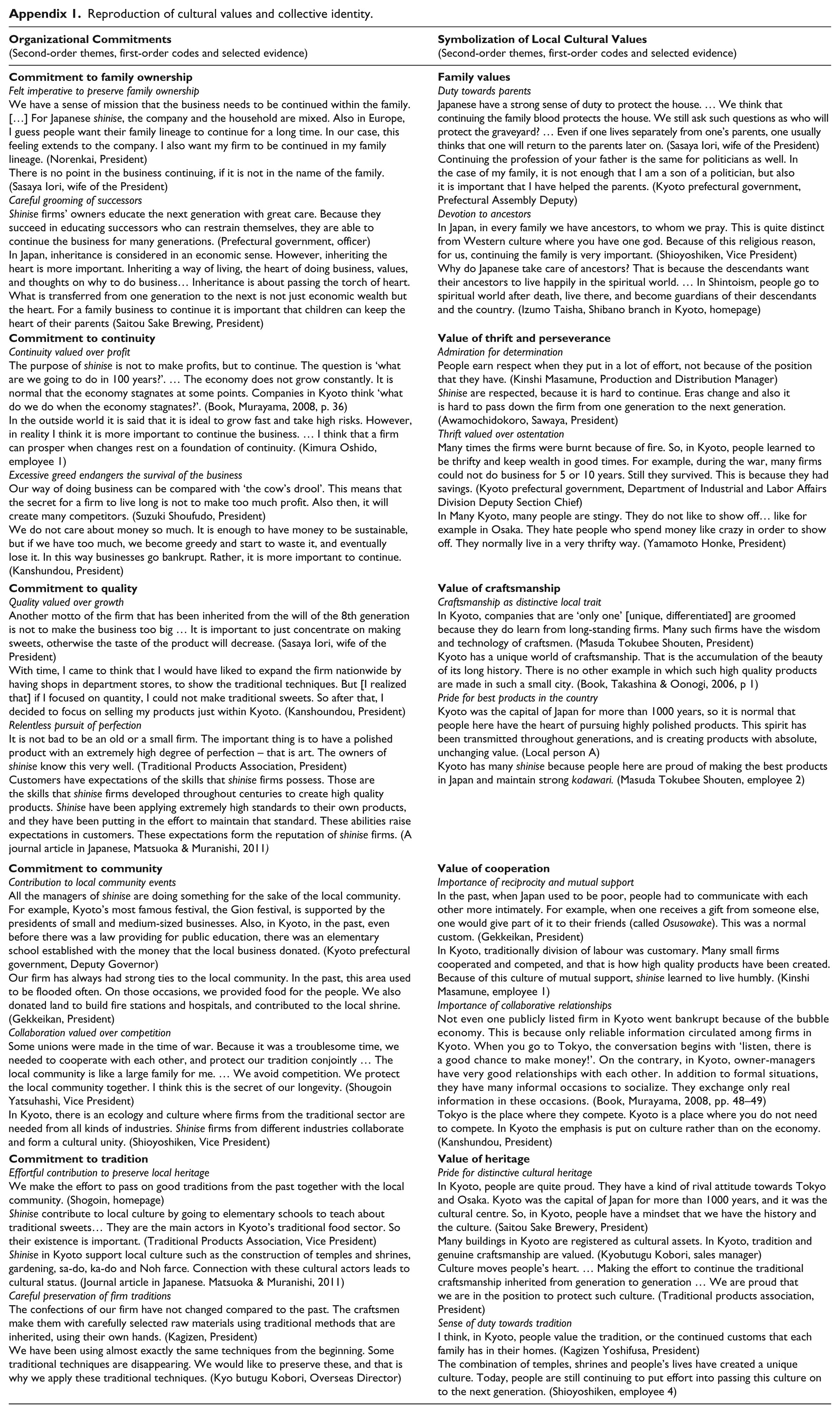
Felt imperative to preserve family ownership We have a sense of mission that the business needs to be continued within the family. […] For Japanese shinise, the company and the household are mixed. Also in Europe, I guess people want their family lineage to continue for a long time. In our case, this feeling extends to the company. I also want my firm to be continued in my family lineage. (Norenkai, President) There is no point in the business continuing, if it is not in the name of the family. (Sasaya Iori, wife of the President) Careful grooming of successors Shinise firms’ owners educate the next generation with great care. Because they succeed in educating successors who can restrain themselves, they are able to continue the business for many generations. (Prefectural government, officer) In Japan, inheritance is considered in an economic sense. However, inheriting the heart is more important. Inheriting a way of living, the heart of doing business, values, and thoughts on why to do business… Inheritance is about passing the torch of heart. What is transferred from one generation to the next is not just economic wealth but the heart. For a family business to continue it is important that children can keep the heart of their parents (Saitou Sake Brewing, President) |
Duty towards parents Japanese have a strong sense of duty to protect the house. … We think that continuing the family blood protects the house. We still ask such questions as who will protect the graveyard? … Even if one lives separately from one’s parents, one usually thinks that one will return to the parents later on. (Sasaya Iori, wife of the President) Continuing the profession of your father is the same for politicians as well. In the case of my family, it is not enough that I am a son of a politician, but also it is important that I have helped the parents. (Kyoto prefectural government, Prefectural Assembly Deputy) Devotion to ancestors In Japan, in every family we have ancestors, to whom we pray. This is quite distinct from Western culture where you have one god. Because of this religious reason, for us, continuing the family is very important. (Shioyoshiken, Vice President) Why do Japanese take care of ancestors? That is because the descendants want their ancestors to live happily in the spiritual world. … In Shintoism, people go to spiritual world after death, live there, and become guardians of their descendants and the country. (Izumo Taisha, Shibano branch in Kyoto, homepage) |
Continuity valued over profit The purpose of shinise is not to make profits, but to continue. The question is ‘what are we going to do in 100 years?’. … The economy does not grow constantly. It is normal that the economy stagnates at some points. Companies in Kyoto think ‘what do we do when the economy stagnates?’. (Book, Murayama, 2008, p. 36) In the outside world it is said that it is ideal to grow fast and take high risks. However, in reality I think it is more important to continue the business. … I think that a firm can prosper when changes rest on a foundation of continuity. (Kimura Oshido, employee 1) Excessive greed endangers the survival of the business Our way of doing business can be compared with ‘the cow’s drool’. This means that the secret for a firm to live long is not to make too much profit. Also then, it will create many competitors. (Suzuki Shoufudo, President) We do not care about money so much. It is enough to have money to be sustainable, but if we have too much, we become greedy and start to waste it, and eventually lose it. In this way businesses go bankrupt. Rather, it is more important to continue. (Kanshundou, President) |
Admiration for determination People earn respect when they put in a lot of effort, not because of the position that they have. (Kinshi Masamune, Production and Distribution Manager) Shinise are respected, because it is hard to continue. Eras change and also it is hard to pass down the firm from one generation to the next generation. (Awamochidokoro, Sawaya, President) Thrift valued over ostentation Many times the firms were burnt because of fire. So, in Kyoto, people learned to be thrifty and keep wealth in good times. For example, during the war, many firms could not do business for 5 or 10 years. Still they survived. This is because they had savings. (Kyoto prefectural government, Department of Industrial and Labor Affairs Division Deputy Section Chief) In Many Kyoto, many people are stingy. They do not like to show off… like for example in Osaka. They hate people who spend money like crazy in order to show off. They normally live in a very thrifty way. (Yamamoto Honke, President) |
Quality valued over growth Another motto of the firm that has been inherited from the will of the 8th generation is not to make the business too big … It is important to just concentrate on making sweets, otherwise the taste of the product will decrease. (Sasaya Iori, wife of the President) With time, I came to think that I would have liked to expand the firm nationwide by having shops in department stores, to show the traditional techniques. But [I realized that] if I focused on quantity, I could not make traditional sweets. So after that, I decided to focus on selling my products just within Kyoto. (Kanshoundou, President) Relentless pursuit of perfection It is not bad to be an old or a small firm. The important thing is to have a polished product with an extremely high degree of perfection – that is art. The owners of shinise know this very well. (Traditional Products Association, President) Customers have expectations of the skills that shinise firms possess. Those are the skills that shinise firms developed throughout centuries to create high quality products. Shinise have been applying extremely high standards to their own products, and they have been putting in the effort to maintain that standard. These abilities raise expectations in customers. These expectations form the reputation of shinise firms. (A journal article in Japanese, Matsuoka & Muranishi, 2011) |
Craftsmanship as distinctive local trait In Kyoto, companies that are ‘only one’ [unique, differentiated] are groomed because they do learn from long-standing firms. Many such firms have the wisdom and technology of craftsmen. (Masuda Tokubee Shouten, President) Kyoto has a unique world of craftsmanship. That is the accumulation of the beauty of its long history. There is no other example in which such high quality products are made in such a small city. (Book, Takashina & Oonogi, 2006, p 1) Pride for best products in the country Kyoto was the capital of Japan for more than 1000 years, so it is normal that people here have the heart of pursuing highly polished products. This spirit has been transmitted throughout generations, and is creating products with absolute, unchanging value. (Local person A) Kyoto has many shinise because people here are proud of making the best products in Japan and maintain strong kodawari. (Masuda Tokubee Shouten, employee 2) |
Contribution to local community events All the managers of shinise are doing something for the sake of the local community. For example, Kyoto’s most famous festival, the Gion festival, is supported by the presidents of small and medium-sized businesses. Also, in Kyoto, in the past, even before there was a law providing for public education, there was an elementary school established with the money that the local business donated. (Kyoto prefectural government, Deputy Governor) Our firm has always had strong ties to the local community. In the past, this area used to be flooded often. On those occasions, we provided food for the people. We also donated land to build fire stations and hospitals, and contributed to the local shrine. (Gekkeikan, President) Collaboration valued over competition Some unions were made in the time of war. Because it was a troublesome time, we needed to cooperate with each other, and protect our tradition conjointly … The local community is like a large family for me. … We avoid competition. We protect the local community together. I think this is the secret of our longevity. (Shougoin Yatsuhashi, Vice President) In Kyoto, there is an ecology and culture where firms from the traditional sector are needed from all kinds of industries. Shinise firms from different industries collaborate and form a cultural unity. (Shioyoshiken, Vice President) |
Importance of reciprocity and mutual support In the past, when Japan used to be poor, people had to communicate with each other more intimately. For example, when one receives a gift from someone else, one would give part of it to their friends (called Osusowake). This was a normal custom. (Gekkeikan, President) In Kyoto, traditionally division of labour was customary. Many small firms cooperated and competed, and that is how high quality products have been created. Because of this culture of mutual support, shinise learned to live humbly. (Kinshi Masamune, employee 1) Importance of collaborative relationships Not even one publicly listed firm in Kyoto went bankrupt because of the bubble economy. This is because only reliable information circulated among firms in Kyoto. When you go to Tokyo, the conversation begins with ‘listen, there is a good chance to make money!’. On the contrary, in Kyoto, owner-managers have very good relationships with each other. In addition to formal situations, they have many informal occasions to socialize. They exchange only real information in these occasions. (Book, Murayama, 2008, pp. 48–49) Tokyo is the place where they compete. Kyoto is a place where you do not need to compete. In Kyoto the emphasis is put on culture rather than on the economy. (Kanshundou, President) |
Effortful contribution to preserve local heritage We make the effort to pass on good traditions from the past together with the local community. (Shogoin, homepage) Shinise contribute to local culture by going to elementary schools to teach about traditional sweets… They are the main actors in Kyoto’s traditional food sector. So their existence is important. (Traditional Products Association, Vice President) Shinise in Kyoto support local culture such as the construction of temples and shrines, gardening, sa-do, ka-do and Noh farce. Connection with these cultural actors leads to cultural status. (Journal article in Japanese. Matsuoka & Muranishi, 2011) Careful preservation of firm traditions The confections of our firm have not changed compared to the past. The craftsmen make them with carefully selected raw materials using traditional methods that are inherited, using their own hands. (Kagizen, President) We have been using almost exactly the same techniques from the beginning. Some traditional techniques are disappearing. We would like to preserve these, and that is why we apply these traditional techniques. (Kyo butugu Kobori, Overseas Director) |
Pride for distinctive cultural heritage In Kyoto, people are quite proud. They have a kind of rival attitude towards Tokyo and Osaka. Kyoto was the capital of Japan for more than 1000 years, and it was the cultural centre. So, in Kyoto, people have a mindset that we have the history and the culture. (Saitou Sake Brewery, President) Many buildings in Kyoto are registered as cultural assets. In Kyoto, tradition and genuine craftsmanship are valued. (Kyobutugu Kobori, sales manager) Culture moves people’s heart. … Making the effort to continue the traditional craftsmanship inherited from generation to generation … We are proud that we are in the position to protect such culture. (Traditional products association, President) Sense of duty towards tradition I think, in Kyoto, people value the tradition, or the continued customs that each family has in their homes. (Kagizen Yoshifusa, President) The combination of temples, shrines and people’s lives have created a unique culture. Today, people are still continuing to put effort into passing this culture on to the next generation. (Shioyoshiken, employee 4) |
Acknowledgements
We are grateful to Royston Greenwood, Kiyohiko Ito Matt Kraatz, Simon Learmont, Niina Nummela, Peter Zettinig guest editor Carlo Salvato, and two anonymous reviewers for their thoughtful comments on previous versions of this manuscript.
Funding
Data collection was funded by the Academy of Finland, Foundation for Economic Education, and Turun Kauppaseuran säätiö in Finland as part of the first author’s funding for her doctoral dissertation. Davide Ravasi is grateful for the support of the Pump Priming programme of the Cass Business School, which enabled his participation in data collection.
