




Abstract
What is the impact of rhetorical history on employees? We address this question by interviewing 29 workers in two organizations. Our critical interpretation of the findings suggests that managers willfully craft historical narratives to regulate workers’ identity and, ultimately, advance the organization’s agenda. Managers achieve this by peddling historical narratives that instill certain logics in workers. These logics, in turn, influence workers’ identification and involvement with the organization. The first logic, reflected glory, exploits the idea that what is historical is prestigious and coaxes workers into basking in their organization’s historical glory through identification. The second logic, preservation, exploits the idea that what is historical must be preserved and urges workers to be involved in their work to stave off the demise of the organization’s legacy. We further contend that organizations reinforce these logics using narrative resources—concepts that lend historical narratives more persuasiveness—such as place or longevity. Nevertheless, workers do not remain passive. While some engage in traditional resistance tactics, others leverage their collective memory as a counter-narrative to the organization’s narratives. While much has been said about the strategic uses of rhetorical history, we conclude by discussing its limitations and hitherto overlooked moral implications.
Introduction
In the 2009 movie The Invention of Lying, Mark Bellison lives in an alternate world very similar to ours, except that its inhabitants have not developed the ability to lie, or, in their words, “say what isn’t.” In this fictionless world, the movie industry consists entirely of history lectures—the assumption being, of course, that history is a factual and objective account of the past. Many historians would disagree, arguing that history is inevitably an interpretation, or reinterpretation, of the past (Carr, 1961/1987; Kieser, 1994). Well aware of this fact, organizations routinely narrate their history to advance their agenda (Ooi, 2002; Suddaby, Foster, & Quinn Trank, 2010). Wells Fargo, Cadbury, IBM, and Wrigley are but a few examples of organizations that have deployed historical narratives as rhetorical devices (e.g., Keulen, 2013; Rowlinson & Hassard, 1993).
Furthermore, most research on organizations’ historical narratives has focused on strategy and culture (Foster, Coraiola, Suddaby, Kroezen, & Chandler, 2017; Ooi, 2002). We know, for instance, that organizations craft stories about their past to shape collective identity, woo outside stakeholders, develop an internal culture, and focus people’s attention on select issues (Mai, 2015; Nissley & Casey, 2002; Suddaby et al., 2010). Little research, however, has focused on the employees’ perspective—a key audience for organizations’ historical narratives. Accordingly, we tackle questions about what, why, and when different facets of historical narratives influence employees. Our motive goes beyond addressing a research gap—we also aim to examine the moral implications of using historical narratives (Clark & Rowlinson, 2004; Zald, 1993). Because of their particularly persuasive nature (Danilov, 1992; Ooi, 2002; Suddaby et al., 2010) historical narratives can be used as a rhetorical tool to control worker identity (Alvesson & Willmott, 2002). Accordingly, we adopt a critical perspective (Alvesson & Deetz, 2006) to reflect on how historical narratives can disguise management ideology and, ultimately, enhance managerial power. In so doing, we investigate the logics behind historical narratives that facilitate managerial control. We also explore the limits of managerial rhetoric by revealing the different ways employees resist the lure of historical narratives. Overall, this approach examines the rhetorical power of historical narratives and lays bare its dark sides at a time when interest in the subject is surging (Rowlinson, Jacques, & Booth, 2009).
We tackle our research questions by interviewing 29 employees in two Canadian companies, Massive Dynamics and Milky Way (pseudonyms). Employees reported that historical narratives stoked their identification and involvement with their companies. These feelings, employees claimed, were fueled by two logics—reflected glory and preservation. In the former logic, employees framed historical narratives as a source of prestige, which encouraged identification and the desire to bask in the organization’s reflected glory. In the latter logic, preservation, employees construed historical narratives as evidence of heritage, which encouraged involvement with the work of one’s organization to uphold and sustain its prosperity.
Our study further contributes to the rhetorical history literature by revealing how organizations enhanced those logics of reflected glory and preservation with narratives resources—concepts that lend historical narratives more persuasiveness. One organization in our study, for instance, made historical narratives more compelling by playing up its ties to the local area, using a spatial narrative resource—place (Brown & Humphreys, 2006)—to appeal to a pride in their hometown among the mostly local workforce. Both companies also drew on a second narrative resource—longevity (Carroll, 2002) —which endows historical narratives with prestige and a sense of heritage.
Nevertheless, the allure of historical narratives was not boundless. Some employees resisted organizational control by cynically distancing themselves from historical narration; others leveraged a counter-narrative rooted in the collective memory of shopfloor workers. We discuss these modalities of resistance to managerial rhetoric, thus contributing to the literature on critical management studies and humanistic aims in organizational research (Alvesson & Willmott, 2002; Zald, 1993).
Overall, studying historical narratives from the workers’ perspective has enabled us to tease out what the impact of historical narratives is (i.e., employee identification and involvement). Our findings also afford a better understanding of why historical narratives influence workers—through the inculcation of logics (i.e., reflected glory and preservation) supported by narratives resources (i.e., place and longevity). Finally, we identify when historical narratives are more likely to control workers by discussing contextual factors that affect the persuasiveness of historical narratives. Our work thus contributes to the broader literature on historical perspectives in organization studies (Clark & Rowlinson, 2004; Rowlinson, Booth, Clark, Delahaye, & Procter, 2010) by showing that the use of history for strategic purposes can augment conventional forms of organization yet is also limited by its ambivalent impact on employees.
In what follows, we introduce the main concepts that we use to make sense of our findings, followed by a description of our methodology. We then proceed to interpret our findings in light of the push-and-pull of control over workplace identity between management and employees.
Historical Narratives
The way history is conceptualized in organization studies has come under growing scrutiny over the past two decades, featuring several calls for a new approach (Godfrey, Hassard, O’Connor, Rowlinson, & Ruef, 2016; Kieser, 1994; Mills, Suddaby, Foster, & Durepos, 2016; Rowlinson et al., 2010) and some even pointing to what has been called a “historic turn” (Clark & Rowlinson, 2004). While the dominant view in management research sees history as rigid and deterministic (Ericson, 2006), we understand history as an interpretation of a firm’s past, rhetorically constructed in the form of a narrative (Suddaby et al., 2010). In other words, our research interest is in the stories that people in an organization tell about its past, not official corporate history.
Historical narratives can take many forms, from corporate museums to coffee-table books to internal bulletins (e.g., Anteby & Molnár, 2012; Delahaye, Booth, Clark, Procter, & Rowlinson, 2009; Nissley & Casey, 2002). For example, one of the firms in our study, Milky Way, had assembled a museum display of its history, cobbled together from corporate and public media archives, in which photographs and stories reflected management’s account of the organization’s past. Similarly, the management at Massive Dynamics routinely narrated versions of its past at the annual Christmas celebration and organized anniversary ceremonies every decade.
Historical narratives typically involve a political agenda aiming to influence target audiences (Nissley & Casey, 2002; Suddaby et al., 2010). We focus on how managers influence employees through identity control (Alvesson & Willmott, 2002). We contend that managers engineer historical narratives to construct their preferred versions of the past and cultivate organizational identity (Assmann & Czaplicka, 1995). These narratives exert systemic power over workers by prodding them to take on an identity congruent with organizational objectives (Alvesson & Kärreman, 2007; Townley, 1993). Systemic power operates by encouraging employees to remember certain facets of the past that are intended to shape their images about the origin of the organization and its path through time (Anteby & Molnár, 2012; Mai, 2015; Rowlinson, 2002). The selected memories thus induce employees to construct organizational identity because participating in historical narration about the in-group invites people to engage in a shared construction of the past (Welzer, Moller, & Tschuggnall, 2002; Zundel, Holt, & Popp, 2016). To enhance the persuasive impact of organizational history narratives managers use narrative resources—rhetorical devices that surreptitiously appeal to the identity aspirations of an audience (Alvesson & Willmott, 2002) and thus affect employees’ willingness to construct organizational identity.
This conception of managerial influence, however, assumes that employee identities are robust and monolithic, that employees passively accept influence without resistance, and that paternalistic organizational influence yields an unmitigated sense of security (Mumby, Thomas, Martí, & Seidl, 2017). In order to provide a balanced account of the persuasive power of rhetorical history, we therefore consider also that employees confront the disciplining power of managerial narratives with compartmentalization and cynicism (Fleming & Spicer, 2003; Ybema & Horvers, 2017). By exploring such responses, we intend to document the kind of narrative resources that employees reference as they construct conforming or opposing organizational identities. In the investigation that follows, we thus examine both identity appropriation and resistance by employees in response to managerial narratives about their organization’s history.
Methodology
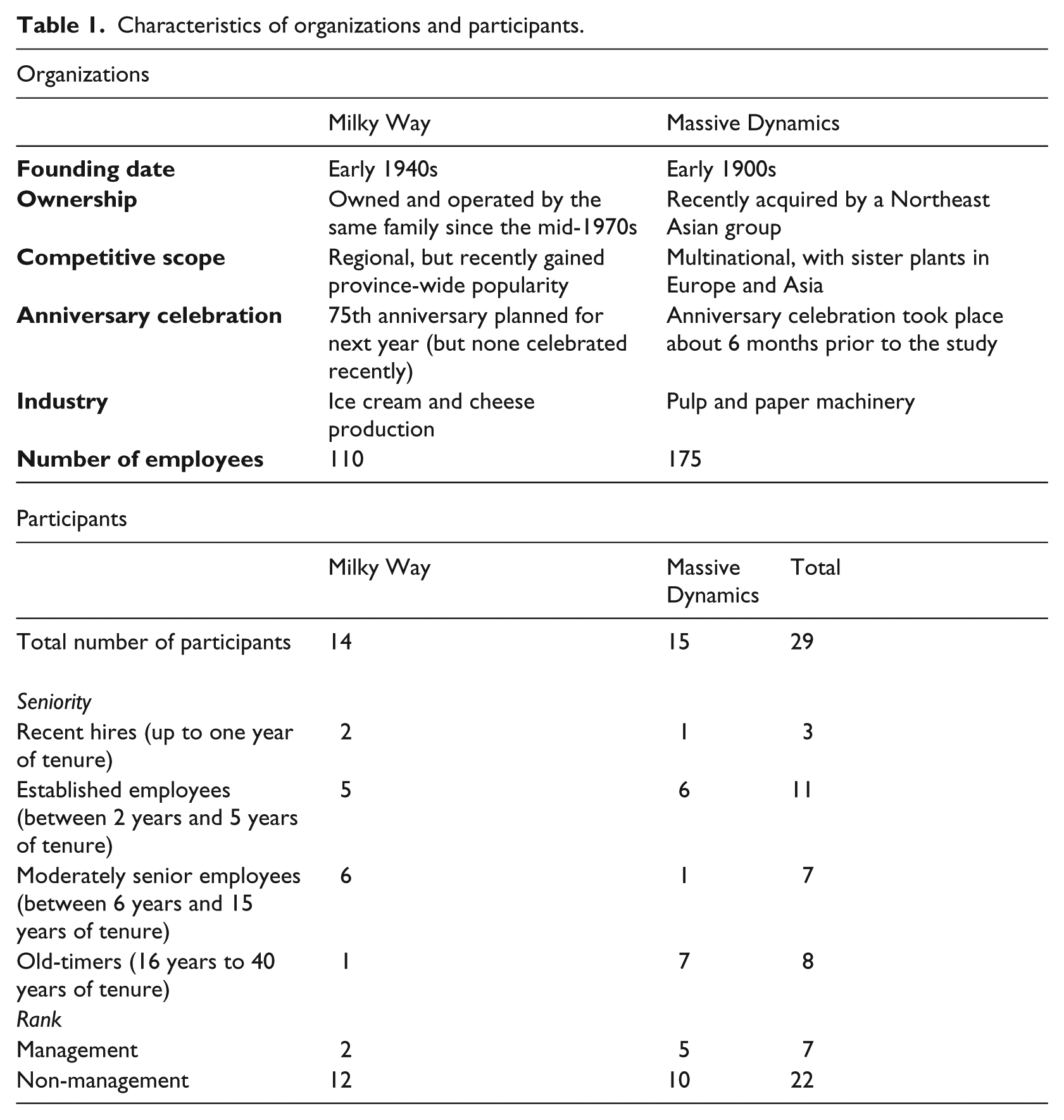
Our exploratory qualitative study uses interviews from employees at two firms located in Québec a French-speaking Canadian province. We chose the two organizations at the recommendation of the executive director of a local university’s entrepreneurship center, who identified them as being extensively involved with historical narration. The two organizations were comparable in terms of size, and each had been operating for over 70 years. They also differed in key aspects, such as strategic scope and cultural practices of historical narration (see Table 1).
Characteristics of organizations and participants.
In studying these companies, our goal was to understand the impact of historical narratives on employees. Accordingly, we used a combination of interpretive (Gill, 2014) and humanistic inquiry (Zald, 1993) to understand how respondents make sense of their organization’s past by crafting a narrative about its meaning in everyday life (Kvale & Brinkmann, 2009). We started our research as a conventional interpretive study into organizational symbolism. However, during the course of refining our analysis, we became more aware of our own role in the research and developed a more critical approach. Specifically, while exploring the stories employees reported, our focus shifted from only interpreting the meanings they were trying to convey to also questioning the managerial meta-narratives we were reading into those interpretations. The resulting analysis juxtaposes themes of managerial control with themes of employee acquiescence and resistance (Alvesson & Kärreman, 2007; Alvesson & Willmott, 2002).
Data collection
In order to capture various perspectives, we collected data from a stratified sample, interviewing both supervisory and shopfloor personnel, as well as employees with varying degrees of seniority. The first author conducted all interviews in person at Massive Dynamics and via phone at Milky Way, as the latter firm was located in a remote area. Altogether, we conducted 29 interviews (see Table 1), which we subsequently transcribed and analyzed in French. Interviews produced on average six single-spaced pages of interview transcript directly related to historical narratives per respondent.
Our interview protocol included open-ended questions about respondents’ attitudes toward their organization’s history and about their experience of that history during their daily life (Giorgi, 2009). Our main question was: Can you please describe with as much detail and precision as possible situations in which you thought about [Company Name]’s history? What were your thoughts specifically? What were your emotions and feelings while thinking about it? A situation could be a specific moment or your day-to-day life in general.
We supplemented the interview data with history-related documents from the companies’ websites as well as internal documents obtained from the HR managers.
Historical narration at the two companies
Managers in both companies were surprisingly candid about their instrumental use of historical narratives to influence the workforce. The human resources manager at Massive Dynamics, for instance, unabashedly pointed out that “It really sells to say that we’ve been here in city B for 110 years. When we hire people we talk about it proudly and we explain that this is the original building and that we were here in 1905… so for sure, [history] really sells.” Managers also seemed shrewdly aware of how historical narratives could be used to engineer preferred impressions about the past among current and future employees. For example, the same Massive Dynamics manager explained that her goal in using historical narratives was “to instill pride and a feeling that [employees] belong here.” Similarly, the human resources manager at Milky Way made it clear that employees “appropriate the company’s history, they appropriate it in a way that makes them feel like they’re part of a big family.” The managers’ choice of words thus heavily suggests that management used history as a form of organizational control, aimed at coaxing employees into developing identities and a sense of involvement congruent with managerial objectives (Alvesson & Willmott, 2002).
Both companies used a variety of channels and carriers (Mai, 2015) to convey their historical narratives. Most commonly, narratives were embedded and presented in museums, on websites, during job interviews and informal conversations, at year-end traditions, in hallway photographs, and so on. The two organizations crafted their historical narratives using different strategies. Massive Dynamics’s approach to building its narratives was intentional (Poor, Novicevic, Humphreys, & Popoola, 2016): the company had commissioned the local History Society to explore its archives and assemble a historical account to be used as a basis for anniversary celebrations, including its 110th anniversary a few months prior to the study. This event comprised a day-long celebration featuring old photographs, videos, and speeches by retired employees. In contrast, Milky Way’s approach was emergent (Poor et al., 2016): an executive had gradually assembled a museum exhibit, featuring various corporate and media publications (e.g., old photographs, newspapers clippings, historical overview, etc.). The museum was located at the entrance of the factory, catching the eyes of employees coming to work every day and customers visiting the company’s ice cream bar.
Besides managerial communications, employees were exposed to historical narratives in their daily jobs via historical artifacts (e.g., antique machinery and old technical drawing books) or discussions about organizational routines and infrastructure that had changed over time (e.g., new work technologies, product improvements, plant upgrades). Historical narratives thus worked in conjunction with other organizational symbols and practices, which provided the background stage (Goffman, 1959) for the rhetorical power of historical narratives by framing the relevance of the past for better understanding today’s organization and the work it does.
Finally, with regard to themes and content, Milky Way’s historical narratives boasted a tradition of making quality products, the role of the Milky Way family, and the regional roots of the company. Massive Dynamics’ historical narratives, on the other hand, focused on the longevity of the organization, its global outreach, the role of the founders, and technical innovation.
Analysis
Two steps in our analysis were to (1) report what employees thought of historical narratives, and (2) interpret those materials by focusing on how employees positioned themselves and the organization in relation to the organization’s narrated past. As the latter necessarily relies on our selection of contextual materials, we first worked extensively with respondents’ verbatim accounts to build a set of empirically grounded materials for further interpretation.
We transcribed and analyzed all interviews using NVivo 10, a software program for qualitative analysis. Prior to analysis, we read all of the interviews to get a general sense of respondents’ experience of historical narratives. We then used a multi-step coding procedure (Neale, 2016) to identify segments of relevant text for analysis. In this first step, we selected interview passages in which employees reported their thoughts about organizational history narratives and the occasions or everyday practices in which those narratives were salient to them. In total, we extracted 170 text segments, averaging six segments per respondent and covering 16% of the interview transcripts.
Next, we performed an open coding procedure (Miles & Huberman, 1994) to categorize the text segments in terms of descriptive themes and prepare them for the main interpretive analysis. This procedure did not involve any inferences on our part but relied on respondents’ own words (Giorgi, 2009) and yielded 31 different coding categories. Through multiple comparisons and cross-case analyses, we clustered these categories into themes that reflected commonly reported experiences.
To commence the interpretive analysis, we first extracted the narratives employees used to construct accounts of history-related organizational identity and identification. This work was iterative, involving close consultation of the research literature about the key ideas that emerged. We selected a subset of nine interviews that represented all key themes originally coded, independently read the relevant passages, and met to discuss our interpretations. During these discussions, we used the first-order themes to help us understand what meanings employees attributed to historical narratives in the context of their everyday working life. We then examined the remaining interviews to seek further clarification and elaboration to strengthen and nuance our interpretations.
As part of this last interpretive step, we also reflected on the potential for organizational control and worker resistance through narratives of the past. The spirit of this final step was to examine the moral implications of narrating history in employment relations, assuming that cultivating a version of the past and presenting it to the workforce as if it were a factual account constitutes an exercise of disciplinary power (Alvesson & Willmott, 2002). We carried out the analysis by interpreting employees’ and management’s narratives in light of the literature on critical management studies (e.g., Alvesson & Deetz, 2006; Rowlinson et al., 2009).
We discuss below employees’ accounts of identification and involvement with the organization (or lack thereof). We also emphasize that the organizations’ use of narrative resources—place and longevity—served as important bases for constructing these forms of identification and involvement. We discuss two logics, reflected glory and preservation, that employees used to link narrative resources with their expressed organizational identification and involvement. The crux of these findings is that organizations use history narratives to facilitate ideological control and orchestrate work (Kärreman & Alvesson, 2004). We further explore contextual differences that lend credence or cast doubt on historical narratives. For instance, Milky Way’s use of place as a narrative resource matches the company’s family-owned structure and reputation as a local stalwart. Massive Dynamic’s appeals to place, by contrast, did not sit well with many as the company started out as an international venture seeking cheap land and labor and is now a multinational—hardly a paragon of locality. Finally, we discuss employee resistance to this furtive influence and reveal what our findings suggest about additional avenues for employee emancipation.
Results
Identification
Reflected glory logic and identification
Through historical narratives, both organizations sought not only to establish their own identities (Coupland & Brown, 2004) but also to elicit employee identification (Alvesson & Willmott, 2002). People often identify with their organizations for self-enhancement purposes: organizational identification allays anxiety by offering meaning at work (Humphreys & Brown, 2002). In this respect, historical narratives make identification more alluring to employees by heightening the perceived meaningfulness of work—historical narratives veneer daily work with a patina of time-honored significance. Shrouded in historical momentousness, even mundane tasks can be seen as meaningful.
“Around here everything is about history […] I’m a designer and sometimes I have to consult very old technical drawings, printed on very old paper formats… So I’m amazed, like wow, it’s impressive in all its details.” — MD1
In more abstract terms, the underlying logic driving identification was reflected glory. The lure of basking in the reflected glory of historical greatness enticed employees to narrate strong identification with their organizations. Ultimately, identification fuses organizational history and personal biography: employees believe that their company’s history is their own history.
“… and at the same time, I feel validated when I realize that I am part of this history” — MD13 “I’m part of the group of people who contributed to the evolution of this company. So in a certain way, it gives me the feeling that I belong to the history of this company.” — MD9 “Yeah, I mean, that’s it, there’s a certain pride in belonging to [history] and achieving things throughout the years and adding your own touch to the whole thing to make this company last” — MD2
The data further showed that this logic of reflected glory seemed to be reinforced by a powerful narrative resource: that of place.
Place as a historical narrative resource
Research suggests that organizations ride their historical narratives on the coattails of broader themes that audiences can relate to (Poor et al., 2016). Canadian restaurant Tim Hortons, for instance, incorporates Canadian hockey into its narratives (Foster, Suddaby, Minkus, & Wiebe, 2011), while American whiskey-maker Jack Daniel’s weaves its narratives with those of the Wild West (Holt, 2006). Because hockey and the Wild West are fixtures of Canadian and American society, respectively, they constitute broad, abstract narrative resources that make storytelling more likely to elicit identification.
In this study, however, organizations seemed to capitalize on a more local, concrete, spatial narrative resource (Taylor & Spicer, 2007). Specifically, historical narratives in both organizations drew heavily from the concept of place (Brown & Humphreys, 2006).
The appeal of drawing on place as a narrative resource is that a geographic location is not only concrete and tangible, but also fillable with familiar meanings that intimately appeal to audiences (Kornberger & Clegg, 2004) and evoke feelings of shared memory (Zerubavel, 2003). In this case, virtually all workers were born and raised in the city where their organizations were located. For this reason, infusing historical narratives with references to a place held dear to most workers (i.e., their hometowns) was particularly likely to be persuasive. Interestingly, the use of place in historical narratives appealed even to workers who were not originally from city A (Milky Way’s location) or B (Massive Dynamics’s location). Such workers reported seeking a source of identity that the rampant “individualism in liquid modernity” (Ybema et al., 2009, p. 299) of large cities could not offer. Historical narratives drawing on place seemed to cater to that need: “…this pride of working for a regional company… You know, I’m not a city A native, I’m not from around here, so to speak, I moved here from [large Canadian city] so… [you quickly learn that] even if you don’t work here … you have to know this company because it’s part of the area, it’s here. So I learned a lot about its history… and it makes me proud.” — MW5
We believe place is a resource that facilitates reflected glory by making historical narratives of success more personal. Stories of success are a central theme in historical narratives (Delahaye et al., 2009; Gatti, 2011; Mai, 2015), stories which workers gladly appropriate in order to bask in their reflected glories (Ashforth, Harrison, & Corley, 2008; Elsbach, 1999). By supplementing stories of success with a relatable narrative of place, however, organizations reduce the social and psychological distance between themselves and workers. In so doing, organizations further intensify the process of reflected glory: the organization’s historical successes are seen as the local city’s successes and, by extension, the workers’ as well.
Appeals to place thus amplify identification by linking organizational successes with employees’ sense of origin or residence. As a result, many employees internalized their company’s rise to success as their own and often used the pronoun “we” when talking about the company’s success story: “[Milky Way] is from around here, you know, and we live here… [I have much] pride in seeing a local … company that managed to pull through and shine throughout the whole province.” — MW5 “We’re proud because we’ve come a long way, especially these past ten years […] we’re a small dairy producer with an excellent product, and throughout the years we knew how to play our cards right and compete against big players like Nestlé and Breyers to reach and even surpass them in sales in [this province].” — MW14 “… there is a certain pride, because I’m from city A, to know that Milky Way is a local company that started out from nothing and … there really is a certain sense of pride here for our region, that’s pretty much how I feel about it.” — MW1
These quotes highlight how compelling narratives of historical success become when woven with appeals to place. Yet, in some cases, stories of success are not even necessary. Some workers reported identification with regard to place and history, but without explicit references to success narratives: “… a sort of pride… it’s our thing, it’s from around here, you know, we live in this area. It’s been around here forever…” — MW3 “It’s really, for me at least, really impressive but also very important and part of the local culture… Often people would ask us ‘where do you work?’ and we tell them Massive Dynamics… [and they go] ‘Oh yeah yeah I know that place it’s in city B’ so you know most people know [that Massive Dynamics is an important part of city B].” — MD1
These quotes illustrate the persuasiveness of place as a narrative resource. But they also reveal a discrepancy: Milky Way workers were more likely to buy into the place narrative than Massive Dynamics workers. In what follows, we outline the contextual differences that helped or hindered the conditioning potential of appeals to place.
Contextual differences and appeals to place
References to place in historical narratives did not always incite identification—they were more prevalent among Milky Way employees than Massive Dynamics employees. We identified a few contextual differences to explain this discrepancy.
First, Milky Way derives its company name from city A—in fact, Milky Way is the namesake of city A. This homonymy strengthens the persuasiveness of appeals to place and, in so doing, facilitates the process of reflected glory. Second, the story of Milky Way’s recent success and its position as one of the largest local employers seemed to make the company a great source of pride for many. All of the company’s executives are locally known as the Milky Way family, being born and raised in city A, as are virtually all of Milky Way’s employees. Milky Way’s past thus tightly intertwines with that of city A.
In stark contrast, Massive Dynamics is currently owned by a foreign multinational group with no ties to the local culture. In fact, from its very inception the company had always been an outsider: It was initially founded as a Canadian subsidiary of an American machinery manufacturer owned by an American magnate. An internal document sent to us by the HR manager suggests that the main reasons for opening a subsidiary in city B were multi-year tax exemptions and free factory sites. The document also briefly mentions that only in 1969 did French-speaking employees start to earn as much as their English-speaking counterparts. Echoing the frustration of that epoch, a Massive Dynamics employee with close to 30 years of seniority lamented the time when there was harsh discrimination from “extremely conservative Anglo” employers toward linguistic and ethnic minorities as well as women. (In Québec French is considered more “local” than English; a history of discrimination toward French speakers does little to make appeals to place compelling.) Interestingly, Massive Dynamics’ website does not feature a French translation of its pages, which is extremely rare for a company in Quebec. In contrast, Milky Way’s French website does not include an English translation, which is surprising given the company’s popularity, but reflects pride in its provincial roots.
In sum, its multinational structure and history of linguistic discrimination show how disconnected Massive Dynamics is from its local environment. It is for this reason that we believe appeals to place in Massive Dynamics’ historical narratives did not, overall, succeed as a control device.
Involvement
Preservation logic and involvement
In addition to identification, history narratives seemed to elicit employee involvement in the organizations’ present and future operations: “…maybe in a way that’s what’s pushing me to make quality products, you know, so we can keep doing this for years…” — MD3 “[The company’s history] makes me want to take it [the company] further. It makes me want to make it work and succeed… We have competitors around the world now, we’re global, we’re not just in Canada or the United States anymore like we used to. We have to compete against the whole world, it’s a global competition, it’s a price war, a quality war, a customer service war, so yeah we always have this drive to do more, do better, and grab the market… to keep, if possible, to keep it [the company] running for another 100 years.” — MD15
These quotes suggest two things about history-fueled employee involvement. First, the consenting character of employee involvement (Alvesson & Deetz, 2006) is striking. Many workers reported a strong, seemingly self-motivated drive to achieve goals. Such goals, however, invariably tend to be fully aligned with organizational objectives (e.g., make quality products, increase market share, compete globally). Second, when mentioning involvement, employees frequently referred to a duty to preserve a longstanding organizational heritage of quality and prestige.
This last point brings us to the logic underlying involvement: an expressed duty to work toward the preservation of a longstanding organization and avert its extinction. We believe employees expressed this pressure because they framed what is old as valuable, and what is valuable must be preserved. We term this pressure the preservation logic. Just as the reflected glory logic draws on place as a narrative resource, so too the preservation logic draws on a powerful narrative resource: longevity.
Longevity as a historical narrative resource
Many employees claimed that the longevity of their organizations was a source of superiority over younger organizations.
“The fact that this company has been around for more than 100 years makes you more comfortable about working here compared to a small company that … is 5 years old and would eventually disappear.” — MD4 “[talking about similar companies in the area that have now shut down] … and they used to manufacture a type of machinery with our parts. They all closed down. They were bought out, they got closed down, they moved out, but we’re still the only survivor in the region. So that’s also a source of pride.” — MD15
From management’s perspective, however, longevity constitutes a powerful conditioning device. As Blombäck and Brunninge (2009) point out, organizations can leverage historical narratives to highlight their longevity and extract involvement from workers. In the previous section, we argued that both organizations drew on a spatial narrative resource (i.e., place) to feed reflected glory. In this section we show how both organizations drew on a temporal narrative resource—longevity—to sustain a preservation logic. As a narrative resource, longevity creates an illusion of competence, uniqueness, stability, and most importantly, heritage (Blombäck & Brunninge, 2013; Burghausen & Balmer, 2014; Hall, 1959; Urde, Greyser, & Balmer, 2007).
“If you last for a certain amount of time it means you must be doing something right […] we’ve been making quality products for a very long time.” — MW5 “…we’re the oldest manufacturing company still alive in city B. So, it’s a big deal because today factories close down; it’s rare to celebrate factories that have been around here for 110 years.” — MD8
The heritage that longevity affords is often perceived as something that must endure, and thus must be maintained and sustained (Balmer, 2009, 2013). Many employees claimed that it would be a tragedy if an organization that had survived that long were to close down. To avert that possibility, they said, involvement and hard work are crucial: “We always try to make sure things go smoothly and everything because it’s been around for 110 years, you know, I want this history to go further and endure, and don’t want it to stop… so it creates a sort of pressure… a sort of challenge to succeed… We’re 110 years old now, you know, we don’t want it to stop at 111… so there’s definitely a certain pressure.” — MD13 “There’s a standard to live up to and to always maintain… so yeah it [history] definitely influences my conscientiousness and attention to detail and all things that can affect the production process… [This company’s history] makes me want to keep this lineage of quality alive.” — MW5 “I want to work hard to keep it alive, you know, I don’t want this [company] to end. I tell myself ‘God, this company has been around for so long’ and I’m going to do everything I can to make it last because I know it’s possible. It survived recessions and all kinds of things… so I work hard with that kind of mindset.” — MD11
Emphasizing longevity in historical narratives can thus stoke involvement by eliciting a sense of duty, or pressure, to maintain the organization’s heritage through a logic of preservation. Furthermore, while it is managers who typically act as the custodians of organizational heritage (Balmer, 2013), it is interesting to note that the onus of maintaining the heritage has been appropriated by the workers themselves. This further highlights the power of historical narratives as ideological control devices.
The set of quotes presented so far, however, lopsidedly features Massive Dynamics workers. In what follows, we outline the contextual differences that helped and hindered the effectiveness of appeals to longevity.
Contextual differences and appeals to longevity
Both organizations had enjoyed decades of continued existence and could, on the face of it, equally deploy longevity as a narrative resource. Massive Dynamics, however, being 110 years old at the time of the study, was older than Milky Way, which had been operating for about 74 years. The 35-year difference might seem inconsequential, but we contend that Massive Dynamics enjoyed the significant advantage of having survived the symbolic centennial mark: 100 years, we argue, is a milestone that carries far more gravitas for the audience than 74.
Furthermore, the working environment at Massive Dynamics was substantially more redolent of longevity than Milky Way’s. Omnipresent historical symbols at Massive Dynamics served as constant reminders of the company’s longevity. For instance, office walls and hallways were adorned with vintage photographs of the company. Because workers had to walk through those hallways to access the manufacturing facilities, they were constantly exposed to those visual reminders of longevity. Some participants also identified the obsolete machinery on the shop floor as another reminder of the company’s longevity. These observations, interestingly, show how objects can participate in the production of historical narratives (Humphries & Smith, 2014). In the same vein, the premises themselves evoked longevity. Some workers, for instance, pointed out that many areas of the factory are palimpsests of bygone times (e.g., large marks in the floor indicate where a long-gone foundry used to be located). This shows how even architecture can support historical narratives (Decker, 2014).
Milky Way’s premises, by contrast, were hardly evocative of longevity, save for the tiny museum. Since 2004, the company had been investing heavily in new, sterile, state-of-the-art production facilities to keep up with the ever-swelling demand. Workers have to don modern-looking gum boots, white coats, masks, and plastic caps. To the casual observer, Milky Way’s work environment looks futuristic and bears no resemblance to the old-timey premises of Massive Dynamics. Most importantly, Milky Way had not celebrated anniversaries prior to the study. Massive Dynamics, by contrast, had recently celebrated its 110th anniversary as well as its centennial 10 years prior.
For all these reasons, longevity was much more salient at Massive Dynamics, which is why we believe appeals to longevity seemed to be more persuasive among Massive Dynamics workers.
Collective memory as resistance
For all their persuasiveness, historical narratives did not hold everyone in thrall. When asked about their feelings toward history, many senior employees exhibited cynicism (Fleming & Spicer, 2003), instrumental compliance (Alvesson & Willmott, 2002), and dis-identification (Elsbach, 1999; Humphreys & Brown, 2002): “Nothing matters anymore, nothing… today no one really cares. It’s over. You know, that feeling of attachment and belonging here, it’s not the same anymore, you know.” — MD7 “We don’t feel like we belong here anymore… [we don’t really care about history] because we have to work. We get paid every Thursday… So I don’t think about it. I don’t think about it. I come here in the morning till my shift is over… You know what I mean… I don’t think about this company.” — MD6
While cynicism and disidentification were the most salient forms of resistance (Ezzamel, Willmott, & Worthington, 2001), many workers also engaged in more subtle resistance tactics (Fleming & Sewell, 2002) pitting organizations’ historical narratives against employees’ collective memory.
Specifically, workers deployed collective memory as a way to foster a group identity (Halbwachs, 1980) in opposition to the identity encouraged by the organization’s historical narratives. For many workers, sharing a given set of memories (e.g., “that time when we all suffered from back pain because the machine had stopped and we had to do everything by hand”) implied group membership. The implication is, as Wood (1994, p. 126) put it, that shared memories also served “as a key mechanism of social differentiation among groups.” In other words, workers used their collective memory as a marker of social demarcation from management and their rhetorical narratives: “We don’t have the same history as the one we would if we were the boss or the president… it’s not the same history… the history that was actually lived by people, is at the end of the day the history of the company in my opinion. That’s what makes up the true history of the company.” — MW9
Collective memory thus functions as a resistance device that arms workers with a counter-narrative to the organization’s historical narratives. Organizational narratives, especially in the case of Massive Dynamics, constitute a dead past (Olick & Robbins, 1998), a past that no worker has lived long enough to experience first-hand; a past that is recreated and reinterpreted in decennial celebrations and corporate museums; a simulated past (Baudrillard, 1994) foisted on workers by managers, disconnected from lived experience. Collective memory, on the other hand, constitutes a living past to which workers have an organic relation (Olick, 1999): the materials of collective memory are usually workers’ recollections from their own life or that of their colleagues rather than archives and artifacts.
Explaining how workers keep collective memory alive, many participants cited discussions with senior employees, who were seen as purveyors of an unbroken chain of oral history—senior employees often mentioned that upon joining the organization, they themselves obtained many historical facts and anecdotes from those who were then senior employees.
“There are some people here who’ve been around for 40 years. They’ve seen so much, heard so much… And 40 years back they themselves learned a lot from senior colleagues, and now they’re passing history on.” — MD1 “I think there’s quite a huge collective memory going on here. There’s quite a substantial knowledge that has been passed on because people tend to stick around in this organization.” — MD8
The last quote notwithstanding, workers usually referred to their collective memory as “history” rather than memory. At the same time, workers also acknowledged that “their history” is not the same as “the boss’s history.” This reveals how workers managed to elevate their collective memory to the status of “true history of the company” (see MW9 quote above). This highlights the power of collective memory as a resistance tactic and counter-narrative against organizational narratives—collective memory enables workers to erect a boundary (Zerubavel, 1991) between themselves and management.
In sum, just as organizations can engage in “politics of exhibition” of historical narratives (Nissley & Casey, 2002), workers can engage in “politics of memory” (Schwartz & Kim, 2002) that can be leveraged as a preservation mechanism against managerial rhetoric.
Discussion
The organizations in this study fortified their historical narratives with narrative resources (i.e., concepts that lend historical narratives more persuasiveness) to advance their agenda—fostering identification and involvement to better control workers.
To achieve these goals, our findings suggest, historical narratives instilled in workers a logic of reflected glory. This logic elicits identification by harnessing place as a narrative resource, which makes the organizations’ historical successes more relatable and thus entices workers to bask in the reflected glory of their organizations. As a result, workers appropriate those successes and, ultimately, gladly identify with an organization that allows them to boast about past successes. Historical narratives also encouraged workers to articulate a logic of preservation. This logic elicits employee involvement by harnessing longevity as a narrative resource. Longevity conveys prestige, competence, and legacy. As a result, workers construe organizational longevity as a heritage that must be preserved through hard work to prevent its demise. The logics of reflected glory and preservation thus helped workers manufacture the consensual advancement of organizational goals, highlighting the controlling power of historical narratives.
In addition, we view employee identification and involvement as intertwined, providing the foundation for the systemic power at work through historical narratives. Specifically, many respondents cited pride as the key reason for wanting to preserve the organization’s heritage through their future involvement. Pride involves a positive self-reflection in the eyes of others that results from living up to the expectations of a social role—the expectations of an identity (Goffman, 1959). Expressions of pride thus link identification and involvement: history-induced identification generates pride among workers, a pride that workers seemed to repay by narrating their obligation for involvement into the future. In that sense, preservation is not just about organizational continuity but also about balancing the give-and-take in the employment relationship—what the organization had given to employees through the reflected glory of its past accomplishments should be reciprocated by contributing to its ongoing survival and success.
We also note that the systemic power in historical narratives operates differently than that of conventional employer narratives. The systemic power of conventional narratives operates by constructing an ideal employee subject that serves as the model for performance and career aspirations (Alvesson & Kärreman, 2007; Alvesson & Willmott, 2002). The subject of historical narratives, however, is a venerated organization, not an employee. Its past is cloaked as a benefit that accrues to employees who, as subjects, strive to repay that benefit by working to ensure the organization’s future survival. Through historical narratives, systemic power thus combines the backward gaze of historical accomplishment with the normalizing power of aspiration into the future. Ironically, employees’ efforts to maintain organizational heritage also increase the organization’s longevity. As a result, historical narratives sustain a perpetual forward obligation to reciprocate through involvement for the reflected glory of identifying with the past.
Clearly, then, historical narratives hold sway over workers. A key rhetorical device used in historical narratives, as we mentioned, is narrative resources, such as place and longevity. Yet the effectiveness of narrative resources, our study reveals, seems to hinge heavily on context. Massive Dynamics employees, for instance, seemed less enthused about appeals to place because Massive Dynamics, with its multinational structure and historical discrimination toward local French-speaking workers, is patently disconnected from its local environment. As a result, appeals to place are likely to be met by skepticism. A blatant incongruence between historical narratives, narrative resources, and an organization’s context can thus backfire, highlighting the limits of rhetorical history. By studying how historical narratives interact with context, we thus advance our understanding of why and when historical narratives influence workers.
By taking a critical approach, our study has examined some moral implications of historical storytelling in organizations. Managers in both organizations overtly conceded that their chief motive in using historical narratives was to stimulate employee identification and involvement. Worryingly, our interviews suggest that workers themselves readily appropriate historical narratives to justify their identification and involvement with the organization. Furthermore, our reading of unpublished internal documents suggests that embarrassing historical events (e.g., the discrimination toward French-speaking employees in the case of Massive Dynamics) were left out of official historical accounts, echoing other scholars’ view that historical storytelling is as much about “strategic forgetting” (Anteby & Molnár, 2012; Nissley & Casey, 2002) as it is about remembering.
We further contribute by revealing the modalities of resistance available to workers to reject the grip of historical narratives. The most salient forms of resistance—cynicism and detachment—emerged not from a reaction against historical narratives, but from the doleful realization that the good old days are gone. Some senior employees were disillusioned with their current situation when compared to their reminiscence of the good old days. As a result, they disengaged from anything related to the organization’s history, preferring to see their jobs as little more than a source of income. Cynicism and detachment, in these cases, did not challenge the organization’s historical narratives; rather, they made workers indifferent to narratives. Less salient forms of resistance, however, directly challenged the organization’s historical narratives by providing a counter-narrative based on workers’ collective memory. Using collective memory as a source of group identity (Halbwachs, 1980; Zerubavel, 2003) allowed workers to have their own history, distinct from the history of the managers. In fact, almost all workers referred to their collective memory as “history,” some even going as far as claiming their collective memory to be the “true history of the organization.”
This distinction between workers’ collective memory and the organizations’ historical narratives allows us to reframe the connection between identification and involvement as inspiration for resistance tactics. As has been noted in the literature, resistance to management control can lead to contradictory outcomes (Mumby et al., 2017), where such acts of resistance as irony can serve to reinforce existing domination because irony is carried out backstage, while frontstage compliance normalizes the public performance of subjugation (Fleming & Spicer, 2003). Hence, some degree of emancipation is possible if public displays of identification and involvement are attributed to group memberships other than those of the organization. By framing past success as the accomplishment of co-workers and former employees, it is possible to link the benefits of identification with solidarity among an autonomous workforce rather than contributions to the organization’s future. Similarly, flipping the logic of historical association with place by framing the local town as a key contributor to the organization’s success permits employees to express pride in community membership and focus their future involvement on building connections to municipal interests and neighborhoods.
Notwithstanding our excitement about our findings, we are aware of the limitations of this study. While we have framed our research in part to help better understand the role of history in organizations, the construction, reconstruction, or deconstruction of organizational history was not our aim (Rowlinson et al., 2009). In this paper, we interpret employees’ reported representations of the past as mediated by their workplace experience. The approach is best called an integrationist strategy for incorporating history into organizational analysis (Üsdiken & Kieser, 2004). Any contribution that our study makes to what is called a “historic turn” (Clark & Rowlinson, 2004) is thus limited because our data comprise the respondents’ narratives about their past experiences as constructed in the present (Rowlinson, Hassard, & Decker, 2014). Our representation of those narratives must therefore be understood with the caveat that they are not historic but “fictionalized” in line with the conventions of interpretive organizational research (Rowlinson et al., 2009, 2014). To counterbalance this important limitation, we have made an effort to present our interpretations in reference to historical sources and organizational context (Zald, 1993), using the resulting reflections to critique mainstream organization thinking (cf. Rowlinson et al., 2009).
In addition, although we have taken steps to enhance the quality of the data analysis, qualitative analysis by nature focuses on interpretation and discovery, rather than confirmation. Our results may thus not generalize beyond other, similar contexts (Guba & Lincoln, 1981). For example, both companies were in the manufacturing sector and most participants had at best a high school degree. As a result, our findings might not be applicable to better-educated employees working in the service industry. The study included only a small number of participants, and while our data comprised rich interview materials, they were collected during only one interaction occasion over a relatively short period of time. Consequently, inferences remain tentative, and future research should seek to collect data through multiple interactions with participants, spanning weeks or months (Miles & Huberman, 1994). We view our study as only an initial step in a larger program of research to better understand the impact of organizational historical narratives on audiences. Much future work remains, including replication in other organizations with different histories, extreme cases, consideration of different audiences, a closer inspection of the linkage between the experience of history and the sensemaking process of identification, as well as an exploration of how time affects the way audiences respond to history.
Conclusion
In Nineteen Eighty-Four, George Orwell famously wrote that those who control the past control the future. Echoing Orwell, this study explored how organizations’ narration of the past allows for control over employees’ future. Specifically, we argued that historical narratives elicit two logics in employees’ minds that foster identification and involvement with organizations. The first logic, reflected glory, equates history with prestige, which entice workers to identify with the organization by construing its successes as their own. Organizations reinforced this logic by using narrative resources—concepts that lend further rhetorical impact to historical narratives. For instance, one organization leveraged the notion of place as a narrative resource by emphasizing its local roots. This move facilitated the logic of reflected glory by making identification easier—highlighting regionality in historical narratives appealed to a mostly local workforce who readily identified with an employer from their hometown. The second logic, preservation, equates history with responsibility to preserve and sustain the heritage that comes with history. Workers adhering to this logic claimed that it was their duty to be involved in their work, lest a lack of involvement lead to the demise of the organization’s precious legacy. Both organizations reinforced this logic with longevity, a narrative resource that adds prestige and gravitas to historical narratives. The longer the perceived history of the organization, the more critical the need to preserve its heritage. Our study thus contributes to the literature on rhetorical history by revealing the logics underlying the influence of historical narratives on employees. We also contribute by revealing a critical but hitherto unexplored aspect of rhetorical history: the role of narrative resources. Our critical perspective, furthermore, adds to the literature by exposing how rhetorical history can be used—unabashedly, as some of our quotes reveal—for managerial control purposes. This study thus sheds light on the oft-overlooked moral implications of deploying rhetorical history to influence an audience.
Toward the end of Orwell’s novel, Winston Smith is tortured by a secret agent. While being tortured, Winston is told that the Party controls all historical records, and thus the past, to which Winston defiantly retorts “how can you stop people remembering things… How can you control memory? You have not controlled mine!” Memory, in Orwell’s dystopian future, serves as a last-ditch path to resistance. In the same way, some employees in this study harnessed collective memory as a tool for resistance and emancipation. Specifically, shopfloor workers deployed their collective memory as a counter-narrative to their organizations’ historical narratives, arguing that only the workers’ collective memory counts as “true history.” We thus further contribute to the literature by discussing the modalities of resistance against rhetorical history.
Overall, this study explored the influence of historical narratives on employees, an under-researched dimension of rhetorical history. Though much has been said about the strategic function of historical storytelling, we show through our interviews that what is strategic to one group can be oppressive to another.
Footnotes
Acknowledgements
We acknowledge the thoughtful guidance and suggestions of André Spicer, Roy Suddaby, Bill Foster, Peter Jaskiewicz, Rick Molz, Sjoerd Keulen, and Olof Brunninge. We also thank Michael Rowlinson and three anonymous reviewer for their insightful feedback.
Funding
This research received no specific grant from any funding agency in the public, commercial, or not-for-profit sectors.