



Abstract
In this paper, I study an epitomic case of institutional carriers of ideas: revolving door lobbyists. In a multi-directional interview study, I follow 25 ‘revolvers’ as they move back and forth between two institutional spheres that seem starkly at odds with each other: politics and corporate lobbying. My findings indicate that carriers do not just carry things, but they themselves are transformed as they move. In fact, the revolving door constitutes a cognitive-cultural shift, making ‘revolvers’ into persons who think and act differently as they enter new spheres. Seeing carrying as a socialization process, I contribute to translation theory by developing a theoretical model detailing how socialization of institutional carriers can enable institutional carrying in cases where carrier and knowledge are impossible to separate. By redirecting attention to the somewhat forgotten aspect of socialization, I also contribute more widely to the theoretical discussion of the role of individuals in institutional change. Finally, my findings speak to cultural perspectives on the revolving door, emphasizing that scholars should embrace the organizational and institutional embeddedness of regulators and lobbyists in order to gain a full understanding of how policy is formed. I also discuss potential practical implications of revolving door lobbyism from a socialization perspective.
Keywords
Introduction
I have gained a completely new understanding of how my clients work, and what is driving them, how the relation between owner and board works. And then I have become a much better salesman too. Apparently, I had some seller instincts. We produce politics in taking in analyses, numbers and thinking about how we should talk about a certain issue, if we are to do something around it. There is much to learn from the target group analyses that marketing organizations such as Procter & Gamble are doing.
The expression ‘revolving door lobbyists’ commonly refers to a group of individuals moving between politics and corporate lobbying. In the United States, more than half of outgoing Congress members and political staffers have taken up employment in lobbying firms since 2000 (LaPira & Thomas, 2016; Parker, 2009), and a similar trend can be seen in Europe, where a sizeable group of former top politicians and their clerks have taken up corporate lobbying as a second career (see Draca, 2014; Pollack & Allern, 2014). Although transitions from politics to lobbying have garnered the most attention, the door is increasingly revolving in the opposite direction, as people with corporate lobbying experience are being recruited back into politics.
To scholars of organization, the revolving door is empirically interesting for at least two reasons. First, by dint of physically moving knowledge, revolving door lobbyists epitomize institutional carriers, actors that function as ‘travelling salesmen in ideas’ (Czarniawska & Joerges, 1996) and extract, universalize and commodify institutional knowledge, enabling it to cross geographical and industrial boundaries (Rovik, 2002; Wedlin & Sahlin, 2017), causing ideas to travel (Czarniawska & Joerges, 1996) and institutional spheres to take on the traits of others (David, 2012; Himick & Brivot, 2018). As carriers, revolving door lobbyists are unusually visible and typically move institutional baggage of high societal relevance. By studying them, organizational scholars can gain insight into pressing societal issues (Etzion & Gehman, 2018; Stackman & Hannah, 2017) and, more specifically, into the dynamic relationship between politics and corporations (Barley, 2007; Martí, Etzion, & Leca, 2008).
Second, in virtually all contexts where it occurs, the revolving door is portrayed as a phenomenon that is simultaneously devoid of and filled with conflict. On the one hand, former politicians and political staffers are depicted as relatively unscrupulous sellers of political networks (Etzion & Davis, 2008; Makse, 2016) and political knowhow (Parker, Parker, & Dabros, 2013; Svallfors, 2016a) in a commercial market. On the other hand, the macro-level consequences of converting political capital into economic capital (Blanes i Vidal, Draca, & Fons-Rosen, 2012) are described as deeply problematic by critics, some even labelling it ‘institutional corruption’ (Draca, 2014), arguing that ‘revolvers’ are selling things that ought not to be sold. From an institutional point of view, ‘revolvers’ move between two archetypical institutions, the political sphere and the corporate sphere, each with its own organizational forms, main tasks and role expectations (Brunsson, 1994; Scherer & Palazzo, 2011; Thornton, Ocasio, & Lounsbury, 2012) – a situation that can potentially erode important symbolic boundaries between spheres (Sahlin-Andersson & Engwall, 2002) and cause ‘institutional confusion’ (Brunsson, 1994).
The case of the revolving door hence constitutes an excellent opportunity to explore a hitherto ignored aspect in literature on the travel of ideas: carriers’ own experiences of translating and carrying institutional change. What happens to carriers as they move between institutional spheres, and what happens to the ideas that they supposedly carry? Is the transition from providing public good, with ideology and compromise as its organizing principle, to suddenly producing private good for corporate clients really as morally unproblematic to ‘revolvers’ as critical accounts suggest? And what consequences does this transition have for the spheres between which the carriers move?
To better understand the transition of carriers between two juxtaposed institutional spheres, I explore the role of socialization in the translation and travel of ideas. Defined as ‘the comprehensive and consistent induction of an individual into the objective world of a society or sector of society’ (Berger & Luckmann, 1966, p. 150), socialization is a crucial process in making the world comprehensible and coherent to actors (Berger & Luckmann, 1966; Schein, 2003; Van Maanen & Schein, 1977), transmitting values and norms across different spheres (DiMaggio & Powell, 1983) and potentially making them work together in new, hybrid formations (Battilana & Dorado, 2010). In concrete terms, I examine the role of socialization in the travel of ideas by focusing on the experiences and personal trajectories of 25 revolving door lobbyists who have been moving back and forth between formal politics and corporate lobbying, as conveyed in a series of semi-structured interviews.
My findings show that the revolving door is more than a door: ‘revolvers’ do not simply carry institutional knowledge such as networks and knowhow across institutional borders, they also bring with them ideas and values and make these a part of the new institutional setting. Moreover, they internalize and embody new practices and worldviews in the corporate sector, which they may bring back to politics. Generalized into a theoretical model of the socialization of institutional carriers, I specify the itinerary of individuals ‘learning the ropes’ of a new institution (Schein, 2003) in a socialization process that allows carriers to reconcile institutional conflict, not only with others but within themselves – a process that also, at least partly, transforms them as institutional actors.
In this way, this study contributes to translation theory by questioning the assumptions of separability between knowledge and carrier. By demonstrating how socialization enables carriers to solve institutional dilemmas, it can also help speed up translation in cases where inseparability prevails. I also shed further light on the importance of socialization in bringing about institutional change (see Battilana & Dorado, 2010). The study also speaks to more constructivist theory on the revolving door by detailing mechanisms by which ‘cultural capture’, that is, the process by which regulators actually change their minds as they socialize with corporate representatives, might occur (Kwak, 2014).
In the following section, I review earlier theory on institutional carriers and socialization respectively. I then proceed to describe the research context and my multi-directional research design, which captures carriers’ movements from politics to corporate lobbying, and also back to politics. After presenting my findings, I go on to outline the model and discuss its generalizability and limitations. In the final discussion, I concretize the theoretical contributions and discuss their potential implications for public policy.
Institutional Carriers of Ideas and Socialization
The notion of carriers has been closely related to theories of institutionalization. The term was briefly mentioned in early texts on institutionalism (Berger, Berger, & Kellner, 1973; Berger & Luckmann, 1966) referring to both technologies and people who spread institutional knowledge, and the concept was later taken up by organizational institutionalists who wished to direct attention to the role of agency in the diffusion of institutions (Jepperson, 1991; Scott, 2003).
The role of carriers has since been explored in a stream of micro-level case studies showing how actors mediate institutional knowledge (Wedlin & Sahlin, 2017) by being ‘travelling salesmen in ideas’ (Czarniawska-Joerges & Sevón, 1996), carrying suitcases filled with institutional knowledge from one context to another. Carriers perform important work by extracting and universalizing locally specific knowledge, often codifying it into generalized concepts that they can commodify and transport to other organizations and industries where they unpack it (Rovik, 2002). In this unpacking process, carriers translate (Czarniawska-Joerges & Sevón, 1996) ideas to make them fit the new sphere of implementation in order to make them ‘flow’ better (Sahlin-Andersson & Engwall, 2002). As a result, carriers assist in the overall spread of macro-level processes (Scott, 2008) while simultaneously producing local variation.
Most empirical studies of carriers have concerned management knowledge. A special empirical interest has been shown in management consultants and gurus (Abrahamson, 1996) and similar professional service providers (see Suddaby & Greenwood, 2001), and specifically their role in perpetuating corporatization, that is, the ‘spread of corporate beliefs, values and practices to areas previously dominated by other institutional logics’ (David, 2012, p. 78). According to this narrative, sectors previously governed by political concerns, such as education or health care, are increasingly run according to principles originally developed for for-profit corporations as a result of carrying consultants’ implementation of management concepts such as TQM, ‘lean’ or new public management. Other related macro-level institutional processes such as financialization (Himick & Brivot, 2018) and modernization (Meyer, 1996) are deemed to have been diffused by carriers.
In other words, earlier analyses have theorized carrying efforts and their consequences. However, as David (2012) points out, carriers’ transmission of institutions also entails transmission of beliefs and values, implying deep-seated cultural-cognitive change that transforms not only people’s behaviour but also their worldviews. Here, theory on carriers is surprisingly silent on how this transmission of deep-seated values occurs, other than implicitly suggesting that individuals are the vehicles of such transmission as the carrying actually demands their physically moving the knowledge. Little is said about the actors themselves and their predisposition to carry or adjust to new contexts. This blind spot of carrier theory is particularly precarious in cases where carriers move between spheres with starkly differing logics (see Brunsson, 1994; Friedland & Alford, 1991), supposedly at odds with each other, as in the revolving door case. How do carriers cope with and reconcile conflicting demands as they move? In order to better understand how carriers respond to institutional demands, we need to turn our attention to the learning processes they go through as they carry; we need to look at socialization.
Socialization processes in organizational theory
Berger and Luckmann defined socialization as ‘the comprehensive and consistent induction of an individual into the objective world of a society or sector of society’, portraying it as the main process by which individuals internalize seemingly objective values as their own, and the vehicle by which they are ‘taking over the world in which others already live’ (Berger & Luckmann, 1966, p. 150). As institutional knowledge is ultimately manifested through language, individuals undergo socialization by learning new, institutionally specific languages. These languages differ between spheres – ‘the language of the cavalry will become different from that of the infantry’ (pp. 158–9). Thus, socialization allows individual actors to make up personal ways of translating the language of new institutional spheres into the language of spheres they already know. Socialization provides ways to solve contradictions between conflicting bodies of knowledge; only in this way can new institutions ‘begin to have reality’ for them (p. 163). While complete socialization, entailing full identification of the individual and full symmetry between objective and subjective realities, is rarely witnessed in real life, most individuals go through multiple socialization processes in their lives – in the family, educational system, civil society engagement and careers.
DiMaggio and Powell (1983) cast socialization as one of the main mechanisms behind organizational isomorphism. Instantiated by the normative pressures of work life standardization and the professions, socialization is a key mechanism that makes individuals into carriers of institutional knowledge. Recruitment, or ‘filtering of personnel’, is a crucial instance of socialization allowing organizations to reproduce social patterns within and across sectors. Candidates that are similarly socialized will tend to ‘view problems in a similar fashion, see the same policies, procedures and structures as normatively sanctioned and legitimated, and approach decisions in much the same way’ (DiMaggio & Powell, 1983 p. 153). For people who have not received prior professional training, on-the-job occupational training will be more important. In short, socialization underpins and perpetuates the mental and cultural structures of the ‘iron cage of rationalization’ defining what is perceived as both possible and right.
Socialization theory has since been developed further in literature on organization culture. Here, it is seen as a peer-to-peer process of ‘learning the ropes’ of an organization, whereby the newcomer who enters an organization is dependent on getting behavioural cues from incumbents on how to act, dress and think in the new environment (Van Maanen & Schein, 1977). The strength of socialization is partially dependent on an organization’s ability to hold new members physically ‘captive’. For instance, in a survey of business school students, Schein (2003) found that students’ political views became increasingly aligned with the faculty’s the more time they spent in school. Another measure of the strength of socialization is how intensely an organization or sphere can make an individual commit behaviourally; having a new organizational member act in a certain way forces him or her to defend or at least relate to that practice morally. Such techniques of occupational socialization have been portrayed as powerful instruments for organizations to exert cultural control over their employees (Czarniawska & Kunda, 2010; Kunda, 2006).
But beyond the organizational level, work-life socialization is also an institutional endeavour. Among the most fundamental elements of socialization, Schein stresses, is individuals’ tuning in to the underlying ‘pivotal values’ of the institutional sphere to which the organization belongs. To organizations in the corporate sphere, pivotal values are ‘belief in a reasonable profit […], the free enterprise system and competition’ (Schein, 2003, p. 15), that is, values without which working in a for-profit business becomes virtually impossible. In an analogy, working in the political sphere assumes practical knowledge of regulatory work, but also underlying devotion to the principles of democracy and weighing different needs against each other to produce public good (see Brunsson, 1994). Such pivotal values are embedded in practices and routines; the act of selling things in a free market puts the seller in relation to the underlying institutional values of capitalism. From a socialization perspective, then, institutions are exacting social structures that require new members to learn new skills, but they also demand cultural adherence and loyalty in the form of shared worldviews, as expressed in language and identity. Entering a new institutional sphere is hence a simultaneously material and symbolic endeavour with the potential to transform an individual.
Despite the close relationship between institutions, carriers and socialization, and its prominent role in organizational culture studies, institutional analysts have recently paid scant attention to socialization. Indeed, there have been mentions of the socializing power of professional organizations (Greenwood, Suddaby, & Hinings, 2002) and the crucial role of educational institutions in serving as knowledge bases for carriers (Sahlin-Andersson & Engwall, 2002), but few studies have directly addressed the dynamics of socialization. In a rare exception, Battilana and Dorado (2010) return to the importance of organizational socialization in institutional processes. A comparison of socialization strategies opted for by two organizations working in the tension field between two institutional spheres – humanitarian development and finance – shows that extensive on-the-job socialization can help overcome conflict and tension between different institutions by providing cultural tools for integrating them both into a new, hybrid identity. This study also connects a socialization perspective to the concept of carriers, arguing that ‘because of their previous training, experience, and general exposure to the workings of organizations embodying existing archetypes, these hires are also likely to become carriers of the institutional logics that these archetypes incarnate’ (Battilana & Dorado, 2010, p. 1420).
To summarize, the role of individuals in transporting institutional ideas has been developed by the theoretical concept of carriers – actors who move between institutional spheres. But even the literature on institutional carriers has refrained from delving into carriers’ experiences and the socialization processes they may undergo. I argue that considering socialization dynamics bears great potential to enrich our knowledge on how ideas travel between institutions. The research question guiding this paper is therefore: What is the role of socialization of carriers in the translation of ideas? Below, I explore this question through the lens of one of the most institutionally charged and contested cases of institutional carriers: revolving door lobbyists.
Data and Methods: Reconstructing carriers’ movement between politics and corporate lobbying
The research context: Revolving door lobbying in Sweden
As mentioned above, movement between political and government offices and the corporate sphere has increased substantially in recent years in both the United States (LaPira & Thomas, 2016; Parker, 2009) and Europe (Draca, 2014; Pollack & Allern, 2014). But whereas in the US revolving-door lobbyists tend to work in niche lobbying firms, in Europe many find jobs in the burgeoning public relations (PR) industry.
In Sweden, the research context for this paper, PR consultancy has quickly become the most popular career choice for former politicians and clerks. While only 4% of the highest political appointees (cabinet members and political staffers) joined a PR company after leaving their government positions in 2002, 34% did so after the 2014 elections (Bergling, 2015). A survey of 153 public relations consultants revealed that 40% had either been working in government or for a political party previously (Garsten, Svallfors, & Rothstein, 2015). While in the 1990s the ‘revolving door’ was mostly known as a conservative phenomenon, 1 the PR industry has increasingly become a popular job option among left-wing politicians also; almost the same percentage of people coming in to positions in the 2014 left-wing government came directly from jobs in the PR industry (Sundling, 2015). In other words, there is a sizeable group, of all political colours, moving between political appointments and PR jobs in Sweden today.
Data collection
The data consist of 25 semi-structured interviews with individuals who have, during their careers, worked both in the political sphere and in the PR industry. As a base of sampling, I used several media articles in which political ‘converts’ are regularly listed by party affiliation. An aggregation of four such published lists during the period 2003–2012 rendered a total of 419 names, with 166 single mentions. Most of them concerned people leaving politics for corporate lobbying work in the PR industry, but a few also included people who had returned to politics after a spell in PR as well as multiple ‘revolvers’, that is, people who have gone back and forth multiple times. I also read through background descriptions in the media of incoming governments’ members and staffers to detect corporate lobbyist backgrounds. In the text, the subjects of my study will interchangeably be referred to as respondents and ‘revolvers’, or even ‘returners’ when applicable.
The sample was drawn from the total aggregated list with a view to capturing a variety of characteristics. Double career experience was a primary condition for sampling. Also, I wanted a broad variety of party backgrounds. At the time of the first round of 15 interviews (2006) there were seven parties in the Swedish parliament, and the government was Social Democratic, supported by the Green Party and the Left Party. By the second round of 10 interviews (2012–2013), carried out by two research assistants, the parliament had one more party, the Sweden Democrats, and the government was a conservative alliance between the Moderates (Conservatives), the Liberal Party, the Centre Party and the Christian Democrats. In the complete list as well as the sample, all parties are represented except the Sweden Democrats. 2 Respondents’ characteristics are listed in Tables 1 and 2.
Political party affilation of respondents.

Respondents by career characteristics and gender.

In Table 2, we see that by the time of the interviews, almost all respondents (24/25) had moved from politics to PR, and almost half (11) had moved from PR to politics. Only one respondent had started out in PR, without prior political experience, and then entered politics. 3 Most of the respondents worked in public affairs, a business area within PR mainly concerned with political advocacy and lobbying for large corporations and business organizations, in a variety of sectors. More than a third of respondents (9) had started their own PR agency, and as many had at one point been elected politicians; the rest were staffers and political experts. The sample size is small, but gender composition roughly corresponds to gender composition in the total population as proxied by the aggregate lists and by the percentage of ‘returners’.
By sampling ‘revolvers’ moving in both directions, I was able to reconstruct a movement cycle showing the movement from politics to PR, and potentially back to politics again. This design facilitates the mapping of characteristics of each phase of the transition and a more complete understanding of the travel and impact of ideas that are carried. Questions were adapted to the stage of transition that respondents were currently in at the time of the interview: respondents who had made the transition from politics to PR were asked about the skills that they brought to their new job, and about skills they had to acquire in order to perform their new job. Respondents currently working in the PR industry were asked about the practical tasks they carried out in their everyday work, areas where they felt confident and also what they found challenging in their new position. Those who had not returned to politics were asked whether they could imagine returning. ‘Returners’, that is, people who had returned from PR to politics, were asked about the skills they had acquired in the PR industry, whether and how they put them to use in the political sphere. All respondents, regardless of stage, were asked how they label and identify themselves professionally. Interviews were semi-structured, recorded and fully transcribed verbatim. An interview typically lasted between 45 minutes and 2.5 hours, averaging 1.5 hours.
Data analysis
The interview transcripts have been coded according to principles of thematic analysis (Braun & Clarke, 2006; Guest, MacQueen, & Namey, 2011), whereby patterns associated with the research question were examined in the material, aggregated and developed in several stages, allowing both deductive and inductive stages of coding. In the first stage, responses were simply categorized as applicable to one of the three stages of transition: from PR to politics, in the PR industry and, if applicable, back to politics. In the next reading, for each of these phases of transition in the empirical model, I coded for replies that directly accounted for the institutional knowledge carried: material skills such as personal networks or practical ‘know-how’ and also symbolic dimensions of institutional knowledge. As expressions of the broad code ‘symbolic institutional knowledge’, I count both claims of values and understandings (‘this is the way we do it’) and institutionally specific language (i.e. specific vocabularies, imagery and tropes). Identity claims, responding to the question ‘How would I describe myself professionally?’, could also be seen as an expression of respondents’ worldview, but as this element of identity is so significant in theories of socialization (see Berger & Luckmann, 1966) it has been coded separately. In line with my processual design, I paid special attention to any signs of changes in material and symbolic dimensions of institutional knowledge.
In addition to this more deductive coding, I then carried out a third, more inductive, round of coding. At this third stage, I read the material again, and this time I let themes emanate from the data. These were codes that did not fit neatly into any of the theoretically deduced codes but instead were gathered more on a ‘this is surprising’ criterion, resulting in codes that were later aggregated into higher-level codes of meaning (Corbin & Strauss, 2008). From reading and rereading interview transcripts and reiterating between the emerging themes and theory, it eventually became apparent that these responses were mostly about individuals’ strategies for managing institutional pressures of socialization, especially when these were at odds with their old institutional set of values from the political sphere. Analysing these inductive themes, it became apparent that they actually constituted a catalogue on how to resist, acquiesce with or negotiate such pressures, playing out in both the material and symbolic dimensions of revolvers’ lives. These findings are summarized below.
Findings
In the following, the experiences of revolvers in each of the phases of movement are conveyed.
Bringing politics to the corporate sphere
As stated above, almost all respondents had gone from politics to PR. Perhaps not surprisingly, they largely confirm earlier research regarding skills transferred (see Makse, 2016; Etzion & Davis, 2008): respondents are highly aware that their political networks are a part of the deal, and that the PR industry’s clients are willing to pay for them. A senior consultant with a background as a central staffer says that leaving a government administration still in power was a conscious move on his part: ‘I was the first to leave [the government administration] under constructive circumstances. Of course, that created an enormous value on the market for me. That is, I had the contacts, and I knew the system’ (R20). Other respondents, without networks within the sitting government, report that they feel at a disadvantage as a result. Even so, general political expertise is widely marketable as it is, and it does not require extraordinary political prowess to be a good PR consultant: it is enough to know the political system, produce good text and have experience in handling media contacts. Respondent 4, who had been active in the youth wing of a conservative party, admits: ‘Politics was a good school for PR.’
Inside the PR industry – where political and corporate spheres meet
Once inside the PR firm, revolvers meet corporate customers for the first time. Although the work content itself does not offer any surprises, new revolvers are astonished to discover the commercial demand for what they consider to be basic knowledge. And it is precisely the gap between clients’ needs and their lack of knowledge that revolvers can fill, by making complex political reality comprehensible to action-oriented corporate managers: What surprised me was that the knowledge was so pitiable outside politics. Knowledge about what mattered in political decision making and the process around it was so poor. That overwhelmed me somewhat. I thought these were things that everyone knew. But they didn’t. Which was good for me. (R19) A press release by a consultant costs 15–20,000 SEK. The parties laugh; they do a couple every day. (R1)
Earlier work on politicization has suggested that interfaces where business and politics meet, such as multi-stakeholder cooperation projects and public–private partnerships, might function as ‘schools of democracy’ for the corporations involved; a place where they learn about the political process and conditions (Scherer & Palazzo, 2011). My findings suggest that revolving door lobbying also might constitute such a school, where former politicians act in the most concrete manner possible as teachers (Drutman, 2015) instructing corporate clients who wish to influence the political system. In line with Parker et al. (2013), ‘employability’ for revolvers seems very high to begin with, and this part of the new job comes at a relatively low learning cost.
But while revolvers entering the corporate sphere do not have to learn many new facts, their challenge lies on another plane. It is instead about acquiring an understanding of the new clients’ worldview, which is starkly at odds with the sphere they come from. One respondent describes the spheres as two worlds operating according to different logics: Politics has a uniqueness and a special task, namely to synthesize all interests. That is really the uniqueness of politics, its mission in society, while corporations have very clear vested interests. […] And just that inability to see the task of politics, to weigh all interests, is an explanation for why it is difficult to understand each other. (R19)
To be able to communicate their expertise to clients, it is not sufficient to just deliver crude accounts of the political process; revolvers also need to adapt and adjust it, and put it into language that clients can understand. They are no longer generalists but experts, and corporate clients are not willing to pay for advice communicated in vague terms: As a politician I used to be able to say ‘on the one hand, and on the other…’ But clients will not buy advisory services from someone who says that! They can say ‘on the one hand and on the other,’ but they ask me to answer: ‘What do you think?’ (R20)
Notably, this adjustment is not a universalization of the content of services into an objectified concept or work method, which scholars of translation have traditionally studied (see Rovik, 2002), but rather an adaptation of the carriers’ own demeanour, and the very language used.
Balancing political and commercial interests
Once the revolvers enter more deeply into the PR organizations that hired them, they are faced with yet another challenge: how to deal with situations where their primary socialization into the political sphere comes into direct conflict with pivotal values in their new context. Revolvers are usually people with long political track records, politically active since early youth and steeped in a specific party’s culture and ideology. In fact, clients contract revolvers as lobbyists exactly because of this institutionally and organizationally specific knowledge.
The PR industry also allows revolvers to retain their old political identities to a certain extent through a number of organizational arrangements. PR agencies are usually generous with granting leaves of absence for political campaigning; an employee’s temporary stint in politics is good for upgrading the agency’s political networks. And should that consultant’s party win the elections, and he or she be offered employment in the government offices, such contacts could potentially turn out to be extra useful for future business purposes. Moreover, there is also some latitude for employees to say no to specific missions: if a consultant does not concur with a project’s ideological content, she or he can turn it down. The option of exerting a ‘political veto’ is reportedly one of the most commonly discussed questions in job interviews with former politicians and is often a precondition for recruitment from the political sphere in the first place. Several respondents also report having used this right to pass on projects that do not fit with their ideals.
But there is a tacit understanding among respondents that this ideological ‘emergency brake’ should only be used with great care. As one recruiting PR manager, himself once a revolver, reminds the interviewer: the PR industry, after all, is for-profit, and ‘if you say no to everything, you won’t have much to do’ (R21). A few respondents felt so strongly pressured to conform with their new employer that they worked against their own convictions in virtually all client projects: ‘[I understood that] either I work here and then I will have to put my principles on hold, or I don’t work here. So I took whatever was offered to me’ (R16).
These two extreme stances, either totally rejecting or detaching from a client’s views, are uncommon in the material, however. Most respondents report making great efforts to actively balance the institutional pressures of their old sphere, the political one – emphasizing ideology, compromise and a generalist mindset – against the institutional pressures of decisiveness, profitability and ideological flexibility that their new role as a profit-generating expert exerts on them.
In fact, the empirical material conveys a range of individually developed heuristics by which carriers cope with such socialization dilemmas. One strategy is to calculate the ‘political cost’ of a project, that is, how much their participation in a commercial project would hurt their own party. Respondent 7, for example, had a party different from his own as a client at the PR firm, but concerning a political issue not at odds with his own party’s stance: ‘Of course it made [the other party] more visible, which is a positive effect for them, but neutral for [my party].’
Another strategy was to base selection decisions on personal salience, that is, on how salient the specific issue is for the individual revolver. Respondent 23 describes how he was asked to play the devil’s advocate – to come up with pre-emptive objections to the client’s arguments, which were in direct opposition to the official policy of his own party. In this rather delicate situation, the revolver justified his participation in the project by stating that the issue was not so big and therefore not worth a fight with his employer, a large PR firm. ‘I mean, it is not about munitions but minor tax changes […] So I opted for this model – I was paid not to agree with [the clients] and it was good for them’ (R23).
A third response strategy to socialization dilemmas among revolvers was simply to gradually revise their own views to acquiesce with the client’s. One respondent, personally very committed to environmental issues, describes how she initially had problems with working for a specific large energy corporation because of its stance in the energy debate around fossil fuels. However, she eventually changed her mind after some ‘soul searching’: ‘I read their arguments and saw that they made sense and were overall stringent, linked to reality. And then I bought into it. So then I could work with them and now I agree deeply with them’ (R18).
All three coping strategies – calculation of political cost, personal salience calculation and ideological acquiescence – are ways for individuals to relate on a practical level to the fact that the socialization into a new sphere presents them with new institutional demands that differ from their old ones; deliberate or not, these strategies are ways to translate and reconcile differences between different institutional realities. The last strategy of ideological acquiescence is the one that most closely resembles what Berger and Luckmann (1966) would call complete socialization. In this strategy, revolvers actually internalize the values of their corporate clients so that they align not only their behaviour but also their views with those of their employers. Moreover, the mere occurrence of this strategy points to the disciplining symbolic power immanent in concrete practice; the respondent integrated the views of the client by making them her own so as to avoid conflict between contradictory institutional values.
The importance of socialization pressures, and hence the pivotal values governing the PR industry, are perhaps most visible in cases where socialization has not worked. The inability to conform with the pivotal values of the PR industry actually makes certain candidates unfit for corporate lobbying work. One respondent, who today works for a political party, explains that he quit the PR industry altogether because he could never completely accept the degree of ideological compromise it demanded: …when you work so incredibly much and so incredibly hard and then you feel that you sit there late at night and on weekends and don’t really believe in what you do… That is heavy. So I wanted to start working for something I believed in. (R16)
A recruiting manager at a PR firm claims that the greatest risk in recruiting from the political sphere is that recruits won’t be good at selling. Ironically, this risk mostly applies to senior revolvers. Top politicians, for example, might be well recognized by the general public but still costly for the firm if they’re unable to yield to the norms of salesmanship: We call it the ‘old men’s bench’ – those who come here and sit here and then I don’t know… We don’t make money on them! It’s more this celebrity thing, which I find sick, and which I think is on its way out. We don’t make money! […] We need bloodhounds who really know how to run.
The recruiting manager adds that she prefers to hire political clerks rather than, for example, state secretaries, as they have similar networks and knowhow but are younger, easier to integrate and cost less than half the money. Speaking on the same point, the revolver cited in the first introductory quote of this paper explains his success in the PR industry by referring to his ability to understand the corporate preconditions and his discovery of his own qualities as a salesperson: ‘Apparently, I had some seller instincts’ (R19). The ability to submit to pivotal values of the corporate sphere, and to adopt corporate practices, hence seems highly consequential for any former politician wishing to become successful in a corporate lobbying organization.
Bringing the corporate back to politics: A corporate gaze on policy
Almost half (44%) of respondents have returned to politics after working in corporate lobbying. Swedish revolvers are mainly politically motivated; politics is where most of them want to be, and they happily return if they can (Selling, 2015). But although the returners in my sample in all cases returned to work for the same parties in which they had been active before joining PR, they report doing politics differently. One respondent, herself a revolver who now works as a campaign manager in her old party, says: When these people come back with their views it can become much better, the level of competence is raised and the communication becomes sharper and better […] I’m doing this job that I’m doing now much better than I would have done five years ago. (R6)
But what does ‘better’ actually mean? Revolvers have surely gotten more practice in dealing with mass media. But the real gain, it soon becomes clear, concerns the multiple skills and insights gained from working in a corporate environment. Earlier research on the revolving door has focused on unique political know-how being in high demand in the corporate sphere (Parker, 2009; Parker et al., 2013; Svallfors, 2016a). But my findings show that the reverse is also true: the political parties hire back revolvers with corporate knowhow and new analytical skills that could be put to political use. A multiple revolver, who by the time of the interview was employed by a conservative party, points out that many of her colleagues in the party management – the deputy party secretary, the head of communications, the party leader’s chief of staff and the respondent herself – have all spent time in consulting. She describes her experience of corporate lobbying as having had a crucial effect on how she sees the world. She especially mentions how it has made her less naive when it comes to analysing corporations’ attempts to influence their political context: When I started working at [a PR agency], then I could see how the debate and public opinion were orchestrated by one and the same company. […] We learned who our stakeholders were, who our friends were, how to get certain enemies to enter the arena by getting one of one’s friends to debate with them. In this way they created a debate that did not really exist. […] Having seen that, and then come back to politics, then you will not be as seduced by ‘Oh now there’s a big debate surrounding the company car taxation …’ Then you know that there is probably someone, somewhere who actually spins this. (R9)
This newly acquired ‘corporate gaze’ on policy is manifested in the import of corporate practices; one campaign manager reported using the common marketing technique of focus groups, but applied to potential voters instead of consumers. Another respondent reported using team management practices from the PR industry in his small left-wing party’s internal work. The returner cited in the introduction to this paper mentions marketing giant Procter & Gamble’s target group analyses as a role model in mapping and profiling of potential voters.
Just as revolvers bring political networks to corporate clients, returners bring new corporate networks back into politics, which they use in their daily political work to gain corporate perspectives on policy. One respondent claims he lunches at least once a week with former colleagues from the PR firm who have since moved on to various corporate and public organizations: ‘I want to know – how do people look at my party from the outside?’ (R16). Another respondent, with several sojourns in the PR industry behind him, draws on his vast corporate network within PR, advertising and marketing to discuss new ideas as he tries to popularize the public image of his own party: I have my own reference groups with marketing directors, who also work with [brands quite similar to ours], more to bounce off concepts with. They work with very broad brands. Like experiences, trips, it can be clothes, consumer-oriented brands, not high-end… (R15)
Nested in these imports of new world views, practices and networks is the most striking theme among returners, which is symbolic in nature: how the moral institutional juxtaposition between corporate and political spheres, so apparently problematic for revolvers in the first phases of transition, appears at least partially dissolved. Transcending institutional boundaries is no longer discussed as problematic as they discuss politics. This shift, which is simultaneously cognitive and cultural, is clearly reflected in carriers’ use of language (see Berger & Luckmann, 1966). Through language, returners make comparisons that equate corporations and parties with each other, and they make ample use of corporate metaphors. Statements like ‘we produce politics’ or ‘our product can be purchased only once every four years’, comparisons of political elections to ‘one-day sales’ and claims that political parties are ‘production units’ for politics are prevalent in the material. When policy fails, it is because something essential has been ‘skipped along the production line’. One returner, who is otherwise quite critical of the PR industry, reports ‘efficiency’ as his most cherished take-away from PR.
In other words: the corporate knowhow, networks, language and worldviews carried by revolvers back into politics purportedly influence them and the policy processes that they engage in. Much as revolving door lobbying can function as a ‘school of democracy’ (Scherer & Palazzo, 2011) for corporate clients hiring politically versed consultants, it could also be theorized as a ‘school of corporate thinking’ for political appointees, where they learn much more about how corporations act and think than they would be able to in the political world alone.
Interestingly, socialization into a corporate sphere has also had a clear influence on respondents’ self-identification. Respondents, whether or not they have returned to politics, rarely describe themselves as ‘politicians’ or ‘PR consultants’. When asked to define themselves professionally, they instead come up with various labels that downplay essential differences between politics and PR, such as ‘an expert on public opinion, but a generalist in most things’, ‘an opinion-builder’, ‘an opinion-maker’, ‘an expert in social studies’ or even ‘a teacher of political science’. Perhaps the multiple-revolving respondent 14 best summarizes this fluent identity: ‘All my life I have had employers who sponsored my political interest.’
Analysis: Towards a model of socialization of institutional carriers
Although an unusually conspicuous case of institutional carrying, revolving door lobbying is certainly not the only example of professionals transcending institutional boundaries on a regular basis. Modern professionals stay for a shorter time in one job than in the past and often work in multiple sectors during their professional careers (Barley & Kunda, 2004; Svallfors, 2016b). Many of these moves are motivated by the need to move knowledge. Often, hiring people from a different institutional sphere is a way to get hold of knowledge that is not easily attainable otherwise, as organizations hope to adopt desirable traits from that sphere (see Brunsson, 1994). State agencies might want to become more efficient and hence employ carriers from the corporate sphere to reorganize them. Corporate organizations might want to gain more authenticity and so hire people from the non-profit world to provide this. Corporate law firms compete to hire young lawyers who have gone through tax authorities’ trainee programmes in order to import knowledge on regulation, and so forth.
My study suggests that viewing such moves as mere transactions of skills is largely misleading; carriers do not just carry things; they themselves are transformed as they move. Taking this inseparability of knowledge and carrier into account, the carrier herself becomes the product, as new skills, worldviews and identities become engrained in her. This element of embodiment, I argue, is crucial to much carrying, and it points to the importance of analysing it as a socialization process.
I have generalized my findings into a theoretical model detailing the socialization process that carriers undergo as they move between different institutional spheres. The model (Figure 1) consists of four distinct phases, mapping the gradual transformation of both practical and symbolic knowledge of the carrier. In the first phase, primary socialization, carriers are not yet carriers; they are active in the first institutional sphere into which they are deeply socialized (IS1). They know this institution inside out; in fact, extensive knowledge of IS1 is a prerequisite for the second phase, transition, in which the carriers move from IS1 to a second institutional sphere (IS2). This second phase is crucial, as it introduces novelty to the carriers, who get to meet a new sphere in the form of new organizational and institutional cues. In doing so, they also acquire a new perspective on IS1: for the first time, carriers begin to render explicit the tacit norms upon which their prior institution has rested, seeing it from the outside. In this phase, what in socialization theory are called ‘upending experiences’ (Schein, 2003) can occur – events that seem so culturally foreign to the individual that they cause her to question old assumptions about reality in a more fundamental way. Above, respondents described how they were stunned by their clients’ low level of political knowledge and how they were faced with situations that would have been unfathomable in their previous sphere. In this phase, transformative change already starts to happen, as carriers start the translation endeavour by adapting their prior knowledge into formats that fit IS2. But in contrast to earlier studies on carriers’ role in translation (Czarniawska-Joerges & Sévon, 1996; Rovik, 2002; Wedlin & Sahlin, 2018), this adaptation is not something that can be completely objectified into trademarked work packages or ‘lean’ charts, separate from the carrier. Instead, translation takes place as the carrier herself becomes transformed, adapting the way she speaks, thinks and relates, and perhaps even dresses. If she does not, she will not be understood by her new peers and clients, or perhaps not even hired in the first place.
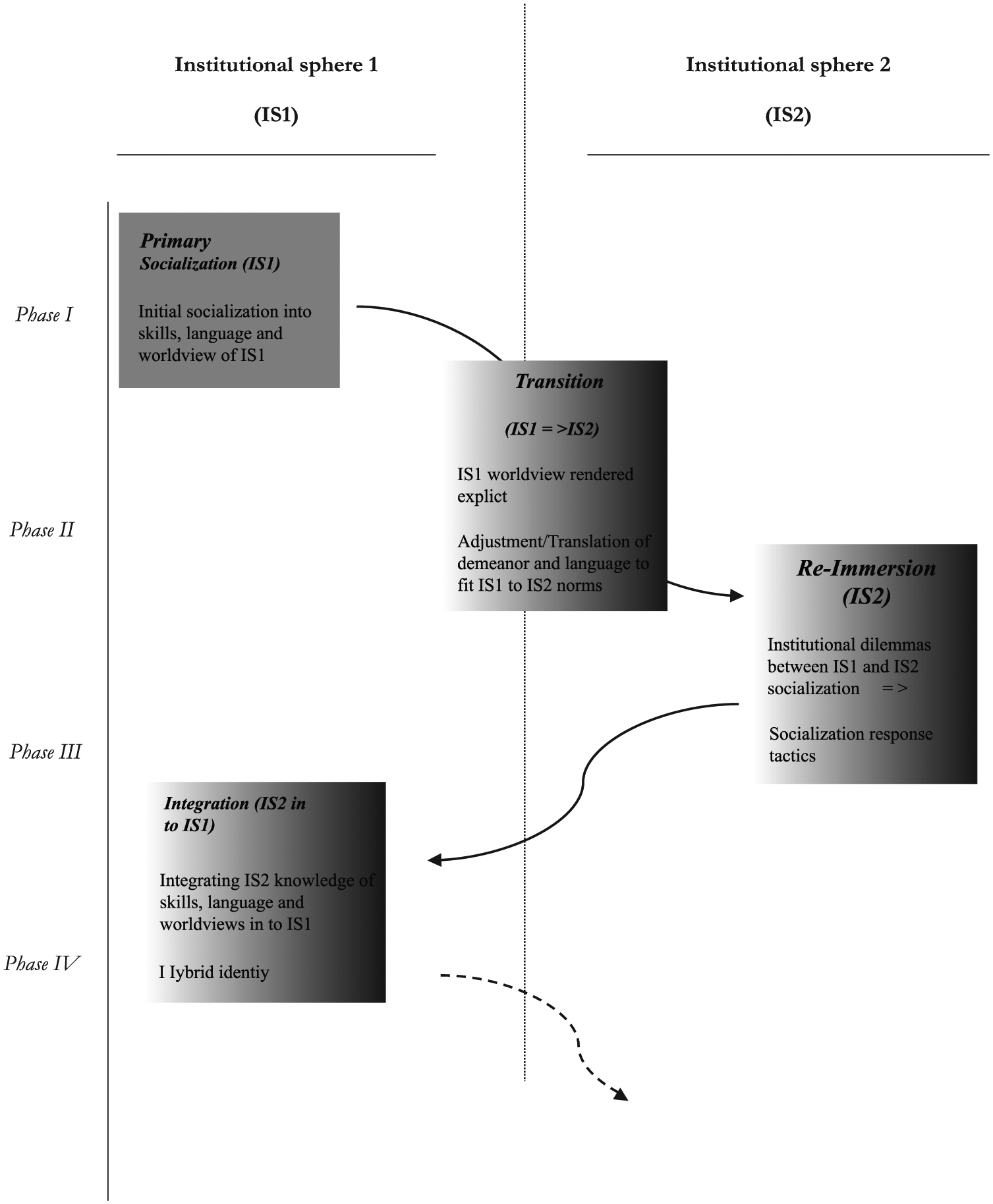
Institutional carrying as a socialization process.
In phase III, re-immersion, the carrier has entered the new institutional sphere and starts to learn how to be an institutional actor at a deeper level – in Schein’s terms, ‘learning the ropes’ of IS2. As Battilana and Dorado (2010) show, if the organizational goal in this phase is to create stability and a new fixed hybrid, it is wise to recruit individuals with less institutional baggage from before. But for many carriers, as mentioned above, prior institutional knowledge is the deal itself; this is why they are hired. In these cases, the ‘tabula rasa’ strategy described by Battilana and Dorado (2010) is not an option: socialization of the already socialized becomes necessary and hence requires a meticulous balancing act on behalf of both carriers and organizations.
In the re-immersion phase, different ‘depths’ of socialization can be expected. Some carriers might try to resist socialization and completely detach from the new pressures, such as senior politicians coming into the PR industry expecting ‘politics as usual’ and not being able to adapt to the strict norms of salesmanship and profitability, or revolvers who use their political veto power to decline client projects too often. These people will not last long in IS2, as individuals normally have difficulty resisting the pressures of socialization and experience a strong need to relate to the social norms of the new context. When skills are inseparable from the carrier, conflict between opposing institutional pressures occurs, not between different types of carriers within the same organization, but inside the same person: the mind of the individual carrier becomes the arena where institutional battles are fought. In order to reconcile potential conflicts concerning skills, worldviews and identities between IS1 and IS2, carriers will hence develop socialization response tactics that allow them to reconcile institutional pressures from old and new institutional spheres while keeping a coherent narrative of who they are, what they do and why, becoming at least partially socialized into IS2. As a result, new hybridized carrier identities start to emerge, allowing the individual carriers to encompass both the new and the old institutional demands (see Pache & Santos, 2013).
The fourth and final phase, integration, happens if and when carriers return to their initial institutional sphere. They are now ‘institutionally bilingual’ and have an ability to see the sphere they enter anew from the inside and outside, simultaneously. In the case of revolving door lobbyists returning to politics, they come back with new networks, work methods and language from the corporate sphere that become integral parts of their political mission.
The model is an archetype considering only two spheres, but it is of course fully possible to imagine carriers going between several spheres. In that case, layers of institutional identities and knowledge will be added to the previous ones. Moreover, there is no limit to how many transitions may occur over the course of a carrier’s professional life, and carriers may change spheres multiple times – many of the revolving door lobbyists have indeed already revolved a second, third or fourth time. In those cases, the zigzag path in Figure 1 will take on the shape of a spiral, in which each hiatus provides the possibility for a potential shift of skills, mindset and identity. The point, however, is the same: the inseparability of carrier and knowledge requires us to study carrying efforts as transformational acts that can be both practical and symbolic in nature.
Discussion
This study speaks to theories of translation (Wedlin & Sahlin, 2017) in at least three ways: by directing attention to the carriers themselves, by pointing to the varying strength of socialization pressures, and by emphasizing the nature of ideas carried. First, this study highlights the constraints of casting institutional carriers as ‘travelling salesmen’, distinct subjects who carry an object, in this case institutional knowledge, at arms-length distance across institutional contexts. By showing how carriers do not always respond uniformly to socialization pressures, the study’s analytical focus is on the characteristics and experiences of the actors involved, and the importance of their experiences and attachment to pivotal values for the carrying process. Moreover, the strength and nature of the pressures to which carriers are exposed is not uniform. Organizations vary in their emphasis on archetypical, institutional values and how much they expect carriers to commit behaviourally. In other words, depending on the dynamic between individual carriers’ prior socialization and the demands exerted on them by the institutional sphere to which they move, carriers will take on and undergo resocialization differently and hence hold, carry and translate their institutional knowledge in variable ways.
Also, the study informs translation theory by questioning the assumption that all institutional knowledge can be objectified and universalized. By studying a highly profiled and contested type of institutional carrier, revolving door lobbyists, and discovering the inseparability that prevails between them and the knowledge they carry, it becomes essential to assess the differences between various ideas. While it seems that some knowledge (e.g. management work methods) is more easily codified into universalized concepts, reports or generalized process descriptions and is able to travel on its own, other types of knowledge might need to be moved exclusively by specific carriers. Exactly what conditions need to be met for such inseparability to apply remains to be explored, but the presented case suggests that the more tacit, culturally specific and surrounded by symbolic conflict a body of knowledge is, the more likely it is that carrying will be an embodied process. Personal networks, for example, or specific knowledge of an organization’s policy agenda or culture cannot be easily generalized. In cases where such inseparability between knowledge and the individual applies, successful socialization of individual carriers is a necessary precondition for carrying, and ‘becoming the other’ is the process that makes carrying possible, and one that makes it possible to speed up, and deepen, the process of translation of ideas.
The paper also speaks to a broader discussion about the role of socialization in institutional change. One central conclusion of Battilana and Dorado (2010) was that bringing into organizations people who had previously been deeply socialized into other institutional spheres has consequences for the organizations. To this conclusion, the present study makes one caveat and one addition. First, the finding of inseparability points to the fact that the ‘tabula rasa’ strategy they suggest – that is, extensive on-the-job socialization of co-workers as trumping prior institutional knowledge in creating stable, new institutions – is not possible in many cases of carrying. Instead, there are numerous cases where socialization of previously socialized actors is inherently unavoidable. Whether this condition makes for more unstable institutions is an interesting question that deserves further scholarly attention. Second, the study contributes theory for cases where inseparability applies by detailing the way that socialization processes can evolve and by accounting for different response tactics that carriers can develop to solve institutional conflict. In this way, the study aims to reinvigorate the discussion about socialization as a mechanism of institutionalization so central in early institutional writing (Berger & Luckmann, 1966; DiMaggio & Powell, 1983).
Practical implications of revolving door lobbying
Like all studies, this one raises new questions. One important question for future research is whether individual carriers’ transformation has any lasting, stable influence on the spheres between which they move. Carriers have repeatedly been theorized to drive society-level institutional isomorphic change (David, 2012; DiMaggio & Powell, 1983; Meyer, 1996). Moreover, carrying has the potential to blur institutional boundaries (Sahlin-Andersson & Engwall, 2002) and cause long-term loss of legitimacy for the institutions involved (Brunsson, 1994). Against the backdrop of isomorphic forces of carrying, and given the politically sensitive nature of the revolving door case, we should ask what consequences revolving door lobbying has for the spheres between which carriers move and, in the long run, for the societies in which it occurs (see Etzion & Gehman, 2018; Martí et al., 2008).
One obvious potential consequence is that it changes corporations. From a deliberative democracy point of view, corporate–political dialogue is not necessarily problematic (see Mäkinen & Kourula, 2012); as employers and taxpayers, corporations should be heard by decision-makers in the democratic discourse, along with individual citizens and other types of organizations. But the present study suggests that hiring former politicians could help give corporate clients disproportional influence. Especially considering earlier indications that revolving door lobbyists influence policy more efficiently than others (Baumgartner, Berry, Hojnacki, Leech, & Kimball, 2009; Lazarus & McKay, 2012), such a proposition should not be ignored.
Also, the revolving door has the potential to change politicians, and thereby policy. Even though my study does not compare policy proposed by returners with that proposed by non-returners, it suggests a proposition to be explored: that the disciplining power of socialization alters revolvers’ language, process skills and networks in a way that makes them carriers of corporatization (David, 2012). If that is the case, the revolving door has the potential to transform the political system from within, influencing both the content of policies and the way they are communicated. In the long run, politicians who talk and think about politics in terms of corporate production risk contributing to voter alienation.
Moreover, passing through the revolving door is more complex than previously theorized. The traditional political science narrative of the revolving door is that it provides an incentive for regulators – political money – to ignore voters’ wishes and instead pursue a self-serving agenda (Draca, 2014). This might be true. But the findings here point to the perils of seeing the revolving door solely from a transactional perspective, in which actors make rational choices to further their own material gain. In fact, the process is more similar to what has been described as ‘cultural capture’ (Kwak, 2014), a paraphrase of the more recognized term ‘regulatory capture’ used to denote the complex cultural process by which regulators actually change their mindset and identities as they socialize with corporate representatives. In many ways, the revolving door is an extreme case of such cultural capture, allowing politicians to become ‘captive’ not only by fraternizing with corporate actors but by becoming one of them. Hence, to any actor interested in understanding or even regulating the revolving door, considering the institutional and cultural conditions surrounding politics might be as important as minimizing bad economic incentives.
Footnotes
Acknowledgements
The author would like to thank Corrie Hammar for excellent research assistance, Linda Wedlin and Stefan Svallfors for their insightful suggestions on how to improve the paper, the participants of the SRC 2017 Democracy Conference and the SCORE research group at Stockholm University for reading and commenting on earlier versions of this text, and OS editor Frank den Hond and three anonymous reviewers for their support and excellent feedback throughout the review process.
Funding
This research received no specific grant from any funding agency in the public, commercial, or not-for-profit sectors. The author wishes to thank the Swedish Research Council and Handelsbanken Research Foundations for financial support.