




Abstract
Scholars and critics tend to regard social enterprise as a paradoxical organizational form. And yet those who are closest to the apparent paradox in at least two prominent social enterprise industries—fair trade and socially responsible investing—are not inclined to regard their work as paradoxical. How is this so? Drawing upon, and then extending, the sensemaking literature, I argue that practitioners of social enterprise do not experience their working conditions as paradoxical because they frame away the potentially paradoxical elements of their work. Specifically, they employ three frames: looking at the big picture, engaging with potentially paradoxical conditions rather than turning from them, and making favorable comparisons that ease the paradoxical strain. These insights form the basis of a refined model of sensemaking in organizations, which accounts not only for how members of organizations deal with paradox but also how they come to recognize (or frame away) paradox in the first place.
Keywords
Social enterprise organizations try to accomplish two desirable goals that are often seen as being incongruent: social welfare and financial profitability. A rich literature has emerged that tries to account for how these ventures accomplish their work (see, for example, Battilana & Lee, 2014; Battilana, Sengul, Pache, & Model, 2015; Birkinshaw, Foss, & Lindenberg, 2014; Ebrahim, Battilana, & Mair, 2014; Santos, Pache, & Birkholz, 2015; Smith & Besharov, 2019). In this article, I build on this research by asking not how social enterprise is tenable but, rather, how it is that scholars and critics regard social enterprise as problematic when so many practitioners—at least the ones included in this study—do not. I articulate a set of conditions under which practitioners might view social enterprise organizations as unproblematic while scholars, policymakers, funding agents, and even beneficiaries could understandably view them as paradoxical. The immediate benefit of pursuing this line of questioning is that it helps us better understand the worldviews of those who occupy a fast-growing social enterprise industry.
A second benefit, one perhaps with wider appeal, is that this pursuit opens the door to thinking more deeply about paradox (Bednarek, Paroutis, & Sillince, 2017; Lewis, 2000; Sharma & Bansal, 2017; Smith, Gonin, & Besharov, 2013) and sensemaking (Brown, Colville, & Pye, 2015; Maitlis & Christianson, 2014; Weick, 1995; Weick, Sutcliffe, & Obstfeld, 2005) in organizations. Scholars have already connected them by arguing that the existence of paradox can trigger a process of sensemaking, which then leads members of organizations to rethink their practices and, ultimately, to innovate new ways of reconciling what might have at first seemed irreconcilable (Jay, 2013; Lüscher & Lewis, 2008; Miron-Spektor, Ingram, Keller, Smith, & Lewis, 2018; Smith & Besharov, 2019; Smith & Lewis, 2011; Weick, 1995). Here, I build on this research by examining how conditions come to be framed as paradoxical (or not) in the first place.
Proposing a revised model of how paradox and sensemaking work together, I argue that organizational actors must first make sense of potentially paradoxical conditions. Only when these potentially paradoxical conditions are understood as, in fact, paradoxical does a second round of sensemaking begin in which an organization’s members are left to decide how to deal with the paradox in question. By identifying two moments of sensemaking instead of only one, I am able to accommodate, theoretically, not only how sensemaking helps sensemakers deal with paradox (Jay, 2013; Lüscher & Lewis, 2008; Miron-Spektor et al., 2018; Smith & Lewis, 2011) but also how sensemaking may involve framing potentially paradoxical conditions as in fact not paradoxical (the focus of this study). Conditions are rendered nonparadoxical as practitioners adopt framings that allow them to “disattend” (Goffman, 1974) to potentially problematic aspects of their work.
I therefore use the case of social enterprise organizations to hypothesize three ways in which potentially paradoxical conditions are made unproblematic. Potentially paradoxical conditions can be understood as nonparadoxical when sensemakers “work to understand” (Maitlis & Christianson, 2014, p. 57) their situations by (a) looking at the big picture, (b) engaging with the potentially paradoxical conditions rather than turning from them, and (c) making comparisons that work to ease the paradoxical strain—all three of which are insights derived from the data and developed below. The conclusion I arrive at is that seeing paradox is contingent. The same set of conditions that are viewed by some as paradoxical can be framed by others as nonparadoxical. Below, I show how that is done.
Background
Social enterprise, paradox, and sensemaking
Conceptualized here as more than corporate social responsibility, social enterprise is the organized effort on the part of for-profit firms to produce both profits and social value. That is, the pursuit of social good is built into the business model (see Kerlin & Gagnaire, 2009). Some scholars and critics see social enterprise organizations’ dual goals—achieving a social mission and seeking profits—as being in competition with each other. They have therefore started characterizing social enterprise as paradoxical (Pache & Santos, 2013; Sharma & Bansal, 2017; Smith & Besharov, 2019; Smith et al., 2013; Smith & Lewis, 2011), the word paradox referring to “contradictory yet inter-related elements … that seem logical in isolation but absurd and irrational when appearing simultaneously” (Lewis, 2000, p. 760; see also Hargrave & Van de Ven, 2017).
Conceiving of social enterprise as paradoxical opened the door to connecting it to scholarship on sensemaking. Building on Weick (1995), the scholarship on sensemaking is particularly well-suited to gaining insights into how organizations can manage working in and through complex, paradoxical conditions (Jay, 2013; Lüscher & Lewis, 2008; Miron-Spektor et al., 2018; Quinn & Cameron, 1988; Smith & Lewis, 2011). Jay (2013), for instance, argued that complicated organizational paradoxes—such as outcomes that could be described either as successes or failures depending on how one chooses to frame them—caused members of an organization to rethink what their organization was and what it was trying to do. In Lüscher and Lewis’s (2008) case, members of the research team helped an organization’s members manage their challenges by talking them through a sensemaking process. And in Miron-Spektor et al.’s (2018) study, employees with a “paradox mindset” (p. 26) had better job performance and were better innovators in situations characterized by high tension. In all cases, sensemaking addressed the difficulties associated with organizational paradox.
Moving the paradox and sensemaking scholarship forward
The problem with much of the scholarship on paradox and sensemaking is that the beginning point of analysis is the existence of the paradox itself. In the case of social enterprise, scholars tend to assume the organizational form is to some degree vexed, and they then work to uncover how social enterprise organizations manage (or should manage) their dual obligations to the social and financial aspects of their work (as in Bednarek et al., 2017; Beech, Burns, de Caestecker, MacIntosh, & MacLean, 2004; Miron-Spektor et al., 2018; Sharma & Bansal, 2017; Smith et al., 2013), which are understood as being in problematic competition with each other (e.g., Battilana & Lee, 2014; Battilana et al., 2015; Ebrahim et al., 2014; Galaskiewicz & Barringer, 2012; McInerney, 2014; Santos et al., 2015; Wry & Zhao, 2018). That approach, however, takes paradox as a given. There is little room for the apparent disagreement about paradox that we sometimes see, such as in the case of social enterprise.
The sensemaking perspective can help us think through this shortcoming, but it requires making modifications to the typical sensemaking model. According to Maitlis and Christianson (2014), the standard sensemaking perspective involves three “sensemaking moves” (p. 59; see also Brown et al., 2015; Hahn, Preuss, Pinkse, & Figge, 2014; Weick et al., 2005). First, a member (or members) of an organization perceives an inconsistency between expectations and reality, creating a violated expectation. Second, the violated expectation motivates members of the organization to make sense of it. And third, the organization’s members develop a line of action based on the sense thus made (Weick et al., 2005, p. 412). This model is represented in Figure 1. Applied to social enterprise (and paradox generally), the standard model does not question paradox but, instead, views it as a trigger that then activates sensemaking (as in Lüscher & Lewis, 2008).
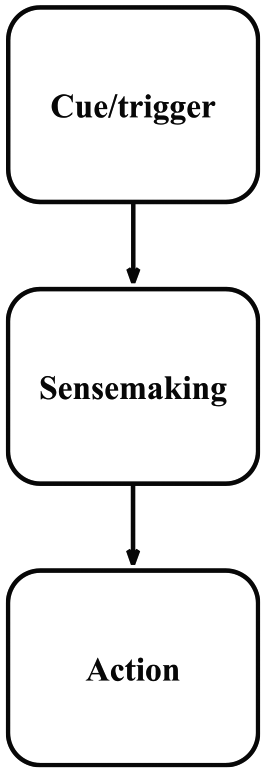
Standard Model of Sensemaking.
In order to understand how conditions come to be seen as paradoxical (or not) in the first place, it is necessary to expand the standard sensemaking model. Whereas the standard model (Maitlis & Christianson, 2014; Weick et al., 2005) starts with the existence of paradox, an expanded model would begin with the possibility that in an initial state, the actor(s) confronts a set of potentially paradoxical conditions (Brown et al., 2015; Goffman, 1974; Weick et al., 2005)—a set of Zerubavelian (1993) things. The situation is fluid and continuous, and not yet lumped and split into meaningful chunks. It is here that “problems,” as Weick et al. (2005) observe, “must be bracketed from an amorphous stream of experience” (p. 415); it is here that raw conditions are then framed as (un)problematic or (non)paradoxical (Cameron & Quinn, 1988; Cornelissen & Werner, 2014; Goffman, 1974). Thus, when Goffman (1974, p. 8), and later Weick and colleagues (2005, p. 412), asks, “What is it that’s going on here?” the question could mean not only “What is it that’s going on with this paradox?” but also, more fundamentally, “What is it that’s going on with these raw conditions (which have yet to be construed as paradoxical)?” For some, the answer to the question might indeed be “paradox.” But to others, it might instead be “nothing at all.”
To Goffman (1974) and the sensemaking scholars that followed him (Cornelissen & Werner, 2014; Weick, 1995), the answer to the question “What is it that is going on here?” is contingent on the frames that people adopt. Of particular concern in this article are the ways in which actors come to understand potentially paradoxical conditions as not paradoxical—an account implied in some (Hargrave & Van de Ven, 2017; Lewis, 2000; Schad, Lewis, Raisch, & Smith, 2016) but largely neglected in much of the sensemaking-through-paradox scholarship (Beech et al., 2004; Jay, 2013; Sharma & Bansal, 2017). Seen through a Goffman (1974) lens, members of organizations will come to see potentially paradoxical conditions as nonparadoxical as they apply a frame that situates a social mission and financial goals as complementary pursuits. Elements of those pursuits that might be considered incompatible with each other are, by virtue of the frame, “disattended” to, the word disattention meaning “the withdrawal of all attention and awareness” to “competing events” (p. 202). This does not mean that the potentially inconsistent elements are resolved, just that they are framed outside of the actors’ “chief concerns” (p. 201).
In short, although others have already connected the paradox and sensemaking literatures in useful ways, the scholarship has dealt inadequately with how paradoxes come to be constructed as such in the first place. Fortunately, the conceptual tools are readily available for accommodating this broader set of issues (i.e., examining how paradox is constructed), which requires looking no further than the sensemaking scholarship itself. What remains is to examine the issue empirically and then to revise the sensemaking model conceptually. Unpacking the social enterprise frames that allow disattention to take place occupies the remainder of this article. Those frames provide an answer to how it is that scholars and critics regard social enterprise as problematic when so many practitioners do not.
Method
I selected two of the most prominent social enterprise industries in the United States for this study: fair trade (FT) and socially responsible investing (SRI). FT businesses are for-profit companies that have committed to abiding by a set of internationally shared standards for working directly with small-scale producing communities. The SRI firms referred to in this study primarily offer mutual funds, the portfolios of which are screened according to religious or ethical criteria. Both types of firm evolved from social movements motivated by concerns about conventional capitalist practices (Child, 2015), so both are part of a tradition that takes the pursuit of social welfare seriously. I draw on data from two industries, rather than just one, in the hope of increasing the analytical transferability of the findings (Lincoln & Guba, 1985).
Data come from interviews with 57 FT and SRI practitioners at 45 participating businesses, as well as observations and informal interviews at industry conferences and other events. Twenty-eight of the organizations were in the FT industry, and 17 were in the SRI industry. The majority of interviews took place face-to-face. The majority of interviews in the FT industry were with small- to medium-sized business owners and other employees who interact with producing communities. In the SRI industry, the majority of interviews were with research analysts and portfolio managers of mutual funds that specialize in offering SRI products (see Tables 1 and 2.)
Sample Characteristics for FT Businesses and Interviewees.

Sample Characteristics for SRI Firms and interviewees.
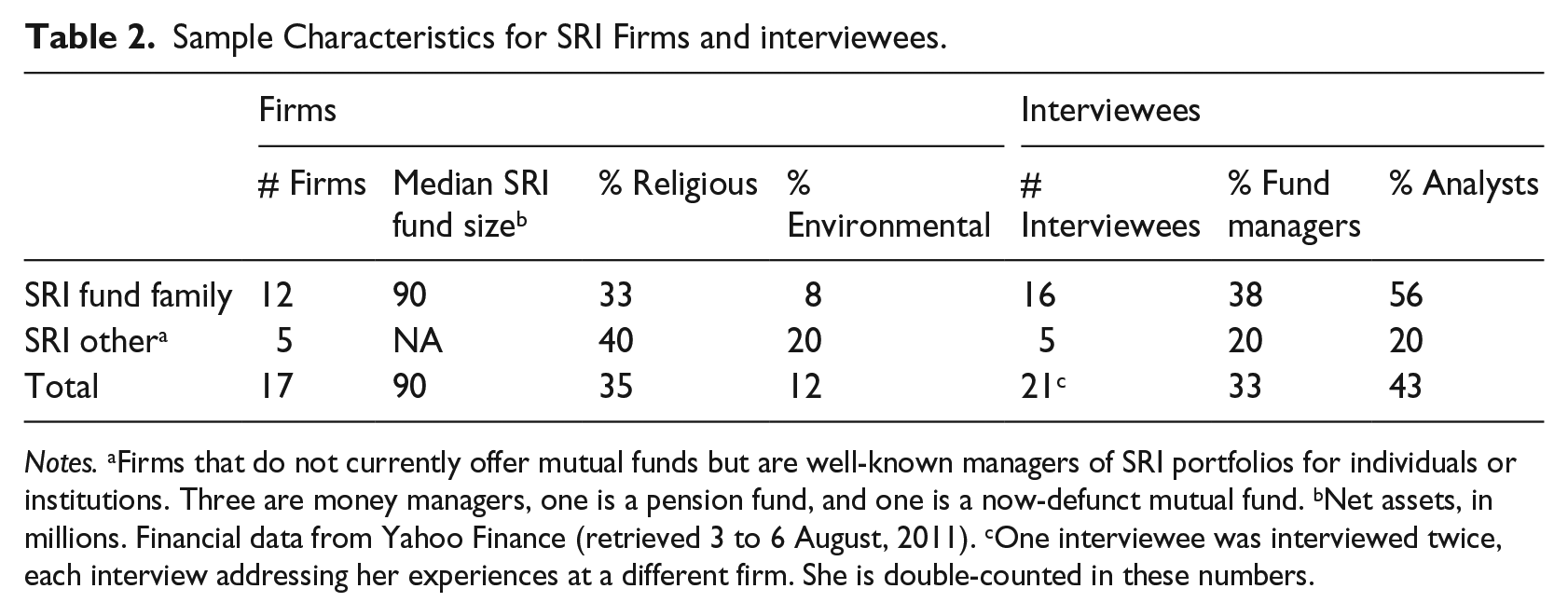
Notes. aFirms that do not currently offer mutual funds but are well-known managers of SRI portfolios for individuals or institutions. Three are money managers, one is a pension fund, and one is a now-defunct mutual fund. bNet assets, in millions. Financial data from Yahoo Finance (retrieved 3 to 6 August, 2011). cOne interviewee was interviewed twice, each interview addressing her experiences at a different firm. She is double-counted in these numbers.
I chose interview sites from a list of FT businesses and SRI firms in the United States compiled from online databases, Internet searches, and referrals, based on two criteria. First, I focused on areas where alternative businesses tend to locate (i.e., New York City, Boston, the San Francisco Bay Area, and Chicago). Second, for FT businesses, I selected for-profit businesses (a) that work directly with farmers or artisans and (b) at least half of whose product offerings were fairly traded. For SRI firms, I selected those for whom at least half of the portfolios were screened according to social, ethical, or religious criteria. Using these criteria increased the likelihood that the organizations exhibited more than a passing commitment to FT and SRI, thus ensuring that these were social enterprise organizations in more than name only.
After compiling lists of potential interview sites, I worked through them by trying to make contact and, when I was able to do so, by extending an invitation to participate in the study. Sampling purposefully (Weiss, 1994), not statistically, I proceeded until I had established a sufficient number of interviews or site visits that met my sampling criteria and allowed for a productive research trip to the area. In both industries, I made every effort to speak with individuals who would be knowledgeable about the challenges of balancing profits and missions—such as owners, managers, analysts, and coffee buyers. Interviews lasted slightly longer than an hour.
I conceptualize the interviews as moments when the interviewees provided me, the interviewer, with insight into how they made sense of their work. We discussed how their organizations were similar to (and different from) conventional for-profit businesses and, alternatively, philanthropic enterprises; how they determined if their organizations had struck the right balance of pursuing profits and social mission; how customers perceive and respond to their efforts; whether the members of their organizations ever have disagreements about the role of the organization; how responsibilities are divided within the company; whether it is difficult to pursue profits and a social mission at the same time (and why); whether (and in what contexts) they make tradeoffs; and how they respond to skeptics.
My status as an outsider to the organizations raises questions about whether the interviewees provided accurate representations of the frames they used to make sense of their work or, instead, simply told stories that justified their (or their organizations’) actions. These are issues endemic to interview-based research, and while the concerns are important to consider, scholars continue to find value in asking people to reflect on their internal worlds in interviews (e.g., Binder & Abel, 2019) for many reasons (Pugh, 2013). For the purposes of this study, whether interviewees were providing me with frames that they truly believed versus frames that were useful strategically is less important than the fact that they were providing me with access to frames that they felt would render their work unproblematic. The frames are the focus of the study, not necessarily interviewees’ deep internal commitments to them.
As is typical in qualitative research, the research question evaluated in this paper evolved over time (Luker, 2008). Initially, I saw the interviews as an opportunity to discuss with practitioners how they reconciled their commitment to social welfare with the pursuit of profits. Consistent with the literature on how organizations can struggle to reconcile goals that are perceived to be incongruous with each other (e.g., Battilana & Lee, 2014; Battilana et al., 2015; Ebrahim et al., 2014; Galaskiewicz & Barringer, 2012; McInerney, 2014; Santos et al., 2015; Wry & Zhao, 2018), my early assumption was that the dual purposes of social enterprise would create problems for my interviewees. The goal, therefore, was to document how interviewees negotiated the tensions that would no doubt afflict their businesses. However, as I became more enmeshed in data collection, analysis, and writing, it became clear that many of the individuals I interviewed did not see their work as fundamentally paradoxical. Although I was at first skeptical of their position, interviewees’ repeated declarations, supported by their considered explanations, motivated me to shift my focus away from how they manage the paradoxical nature of their work and toward how they came to understand their work as not paradoxical when much of the writing about social enterprise proceeds from the assumption that it is.
Modifying the research question in this way encouraged a different approach to the research process. What was at first a deductive enterprise—with a research question derived primarily from the literature—became an abductive one, now motivated by an interest in accounting for an empirical surprise (Tavory & Timmermans, 2014). I found the literature on sensemaking especially useful in addressing this particular surprise because of its focus on human interpretation. Although not developed in a way that would answer the specific question, the literature nevertheless provided a set of conceptual building blocks (Figure 1) that, with some modification (in Figure 2), allowed me to arrive at a satisfactory understanding.
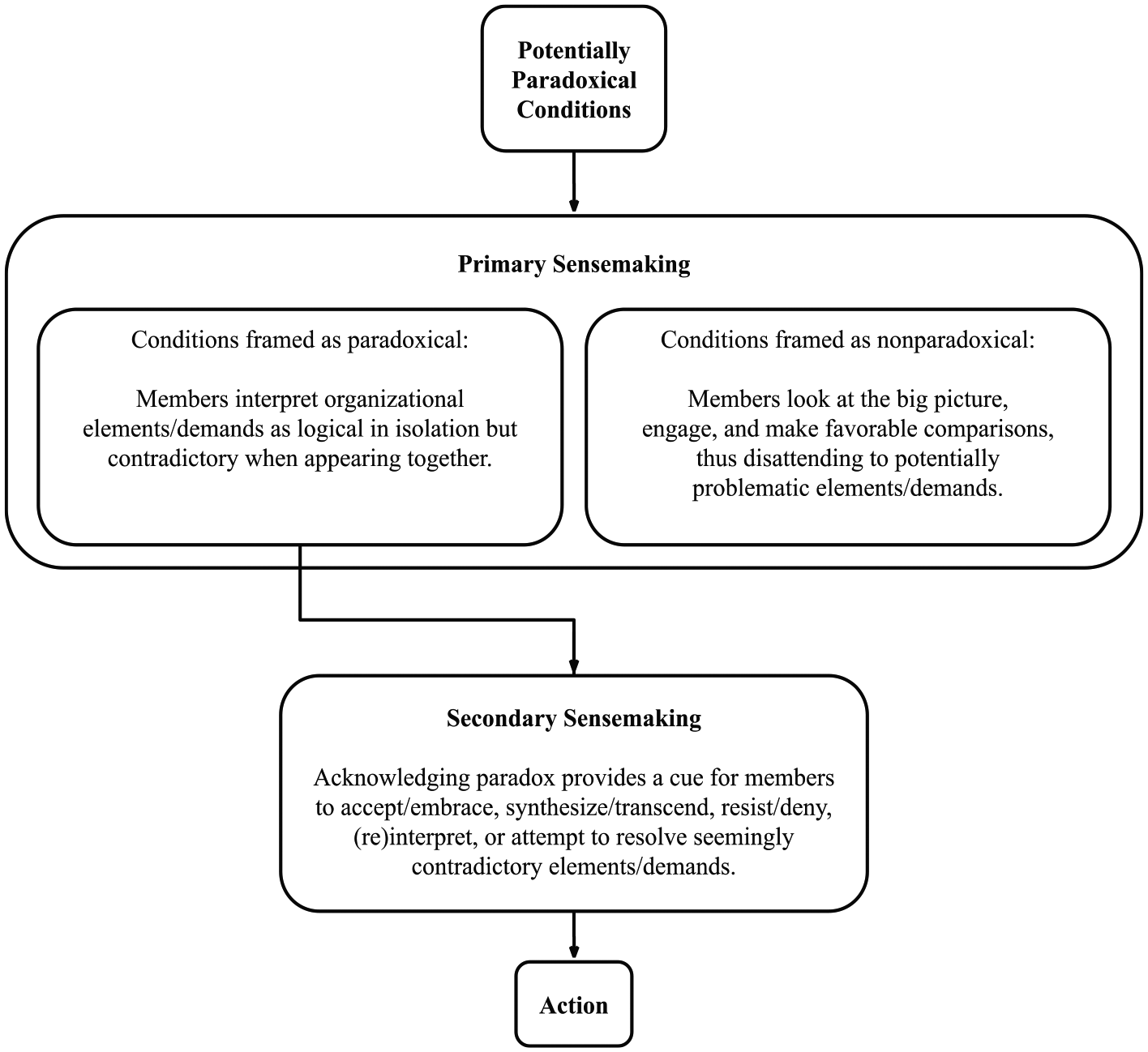
Revised Model of Sensemaking.
Following a logic of discovery rather than one of verification (Lincoln & Guba, 1985; Luker, 2008), I began analysis by open coding hundreds of passages and ended when I identified the central concepts on which this article is based. Reducing data in this way was a multistep process, documented below. Although I present the steps as happening in a linear progression, in practice the analytical journey was circuitous, as I moved among data, writing, and literature, as well as among different levels of abstraction.
First, I identified the ways in which the interviewees made the work of social enterprise unproblematic by coding instances when respondents provided accounts of their (and their organizations’) actions and when they engaged in interpretive work related to reconciling social mission and profits. After coding the transcripts and interview notes, I had identified over 500 relevant passages. Example quotes are listed in Table 3.
Data Structure.
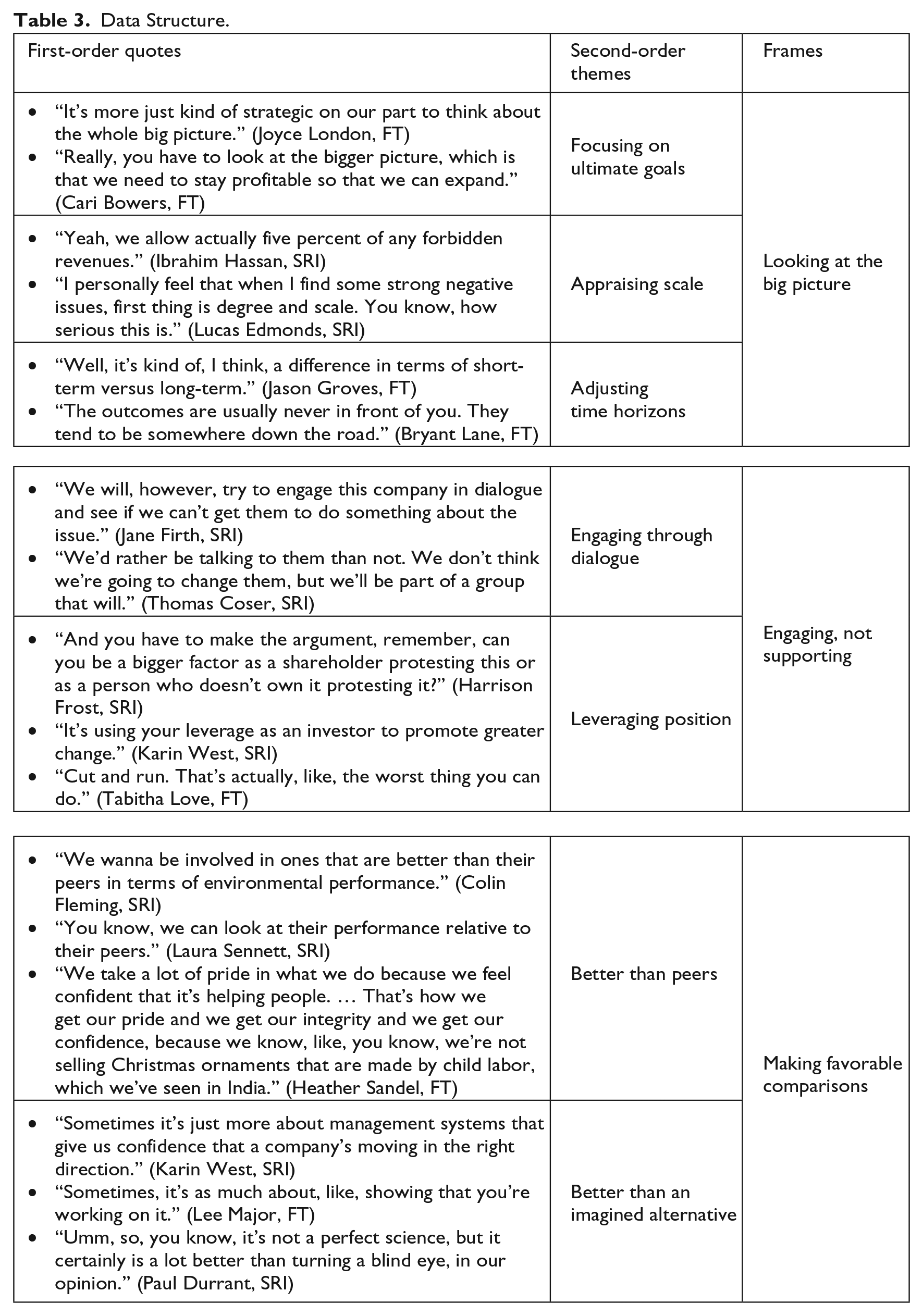
Second, I looked for themes within the data. This resulted in a list of codes, or what are sometimes called second-order themes (Gioia, Corley, & Hamilton, 2012). After generating a list of these themes, I read all of the segments again and, through a process of focused coding (Charmaz, 2006), assigned to each at least one code label. For instance, when developing the concept “Looking at the big picture” (see Table 3), the analysis moved from coding data to recognizing themes. When interviewees spoke about looking at matters of degree and scale, or when they spoke about short- and long-term outcomes, I created codes that represented each of these orientations. Conceptualizing the data also went the other way, from broad categories to more specific themes within those categories. For example, in the case of the concept of engagement (see “Engaging, not supporting”), the broader dimension became clear while working through the data—it appeared and reappeared in numerous passages that I coded—so the analytical task was then to understand how the larger concept (engagement) was manifest in different ways thematically, such as through leveraging position or dialogue. Example themes are listed in Table 3.
Third, I wrote memos (Corbin & Strauss, 2014) about the patterns I was seeing in the data, how different concepts overlapped or were otherwise related to (or distinct from) each other, and how the data might be speaking to the questions that motivated the study. For example, I wrote memos about how practitioners and professionals used perspective to navigate social enterprise, how they talked about being pragmatic, the manner in which they made comparisons or engaged in problematic issues, and the like. Along with memos, I also mapped out the ways in which themes clustered and related to each other (Miles & Huberman, 1994).
Fourth, I considered the concepts in relation to the existing literature. Moving among scholarship, the data, and through the writing process, I came to understand these concepts as related to sensemaking: They each captured a way that interviewees made sense of their work. As I studied the sensemaking literature, however, it occurred to me that the interviewees were not only sensemaking but framing their work in a patterned way. Of particular note, I became interested in how interviewees framed away, or (in Goffman’s [1974] terms) disattended to, potentially paradoxical conditions. This thus became the organizing frame of the article.
All proper names in this manuscript are pseudonyms, and identifying information has been altered to conceal identities. Where an interviewee’s industry is ambiguous in the surrounding text, I use “FT” to signify fair trade and “SRI” to identify the socially responsible investing industry.
Results
The potential dilemmas of social enterprise
Potentially paradoxical conditions are abundant in the FT and SRI industries. Increasing attention to social welfare, for instance, may require decreasing the level of financial returns. A US-based, FT coffee-roasting firm could source beans from new and struggling cooperatives, thereby increasing the likelihood of social impact but jeopardizing higher profits. Or it could source from well-established cooperatives, thereby weakening its social influence but protecting financial investments. Either choice is generally acceptable according to FT principles, but the potential tradeoffs are apparent. There are many potential tradeoffs in SRI organizations as well, such as whether a fund should allow some degree of a prohibited activity among its investments or, instead, divest of all companies that engage in the activity. Either option in such situations might be justifiable financially or morally, so the point here is only that potentially paradoxical conditions exist.
While acknowledging the potential for paradox in their work, most interviewees denied that their work was fundamentally paradoxical. One-third of the interviewees I asked said that it was easy to reconcile social mission with profit, and, when asked directly if they believed there was a conflict between earning profits and creating social value, three-quarters of the men and women I spoke with said that they did not see a conflict between the two. “Object[ing] to that dichotomy,” Shana Kerr (SRI) insisted that it is “artificial” to treat social goals as different from financial ones. James Levine (SRI) noted, “It’s really not one at the expense of the other.” Miguel Hernandez (FT) agreed, explaining that “it’s the same thing. In one economic transaction … we try to achieve the social elements of it.” Chloe Reeve (FT) also concurred, saying, “The two, the business and the social mission, are completely melded together.” Indeed, throughout the interviews (not only when they were asked directly), interviewees expressed opinions, made assertions, and told stories that framed away inherent contradictions between pursuing a social mission and earning profits.
If the potential for paradox is present—if both goals could be clamoring for attention—and if practitioners recognize the demands that are placed on them, how is it that so many can also speak in ways that reveal a lack of deep apprehension about their work, denying that it is fundamentally incoherent or paradoxical? Reconciling mission and profits in these industries is aided by adopting frames that make disattending to paradox not only a possibility but also a reasonable position. The following sections document how practitioners understand and therefore reconcile the seemingly competing demands of social welfare and profit-seeking.
Framing away paradox in Fair Trade and Socially Responsible Investing
This section reports on three patterned ways that entrepreneurs view their work, each of which frames away potential incompatibilities between prosocial and financially profitable goals. The purpose of documenting these frames is to provide an empirical basis for the theoretical modifications developed below—suggesting what sort of sensemaking about potentially paradoxical conditions shapes whether they are ultimately seen as paradoxical or not. In each case, entrepreneurs demonstrate how they view potentially paradoxical conditions in ways that make them seem nonparadoxical. Such acts of sensemaking are not anticipated well in the standard model (Figure 1), which is better suited to account for how people respond to accepted paradoxes. I argue that these frames, outlined below, are themselves forms of sensemaking, just ones where the outcome is not a recognition of paradox but a rejection of it.
Looking at the big picture
First, FT practitioners and SRI professionals are able to frame away the tensions between mission-oriented and for-profit pursuits when they engage in big-picture perspective-making. Situations or issues that might otherwise seem to create a point of tension between the demands of social welfare and the pull of the market are understood not as paradoxical but, instead, as matters of limited importance by keeping an eye focused on ultimate goals. This frame is common among FT practitioners and SRI professionals alike. Two variations on this theme are appraising scale and adjusting time horizons.
Focusing on ultimate goals
To justify their attention to financial incentives at the possible expense of social goals, FT practitioners have come to understand their market-oriented pursuits as consistent with the overarching prosocial goals of the business. If the business does not survive, FT interviewees explained to me, then it would not be able to pursue its mission-oriented goals, and survival of the business requires attending to the market.
Conversations with Naima Hastings and Hunter Heath illustrate this logic. When I asked Hastings, an importer and seller of fairly sourced African handicrafts and textiles, whether financial considerations outweigh the social ones in her business, she explained: Am I going to become homeless so that a child in Africa can eat? No. That wouldn’t be serving the other child[ren] in Africa. It’s in the interest of my social agenda to maintain a healthy business so that I can keep doing the work that I’ve been doing.
Likewise, Hunter Heath (FT) observed that his business “maximizes [its] social impact” by working with new farmer cooperatives. He conceded, however, that his business cannot always work with novice groups because doing so might “endanger [his] company.” Acknowledging that this position could be interpreted negatively—that is, recognizing the potential for interpreting the company’s position as a paradoxical one—he offered a defense. While looking at things narrowly might make it seem like there is an inconsistency between the company’s social and business goals, “When you pull back and look at the big picture,” said Heath, “there’s nothing altruistic about putting [our] company at risk.” Sensemaking about social enterprise in the FT industry thus takes the form of accounting for actions by emphasizing the greater good, the big picture. This makes it easier to frame away any tension between doing good and earning profits and is a common way for FT practitioners to understand their work.
An interview with Shana Kerr, an investment analyst, further illustrates framing away as a form of sensemaking, but this time the example comes from the perspective of an SRI professional. When I asked how her firm balances its social and financial commitments, she mentioned one of their fund’s financial positions in a waste management company. Preempting any questions I might have about why an SRI firm would invest in a company that she had earlier described as running “essentially a dump … that is almost by definition not sustainable,” she explained, “Well, there’s a lot of big picture stuff happening in providing waste solutions” (emphasis added). She went on to describe how the company is working productively in an area that “clearly need[s] better solutions.” The company is practicing good corporate governance, she explained, and, generally, the risks of investing do not outweigh the benefits. In other words, looking at the big picture helped her frame away the notion that the conditions were paradoxical, which, in turn, made the investment a justifiable one.
Looking at the big picture is used to account for what might seem to the outside observer to be excessively profit-motivated behavior. However, big-picture justifications can go the other way as well. Thus, favoring the social mission (over financial priorities) is also understandable when one takes a broader perspective. This is why Lynda Reynolds, a portfolio manager, was able to say that foregoing financially desirable investment opportunities does not create problems for her: It’s a big world. … So you miss one, who cares. … That’s why I always feel like it’s just not a big deal. So there’s a stock, you know, dang it, I really wanted to buy that stock and you guys [referring to the branch of the firm that screens investments according to social and other criteria] are saying I can’t. It’s just… there’s a lot of other stuff [laughs].
By developing a sense of the big picture, FT practitioners and SRI professionals are able to reconcile what might otherwise seem like incompatible—even paradoxical—demands, those of social welfare and the market.
Appraising scale
There are two variations on the theme of focusing on ultimate goals: appraising scale and adjusting time horizons. Practitioners are able to frame away paradox through the regular appraisal of magnitude in evaluating what is good or bad, acceptable or unacceptable. In big-picture perspective-making, the individual offers a broad appeal to ultimate ends, for example, by keeping the business afloat so that it can help more people. In contrast, in taking scale into account, the individual identifies a potential incongruity and then dismisses it as inconsequential. It is so inconsequential that its presence does not constitute any real contradiction for the organization.
With few exceptions, SRI firms will not typically exclude a company from its buy-list simply because the company has engaged in what the SRI firm considers a prohibited activity. Rather, SRI analysts pay attention to how much of the activity has taken place. Evidence for this is found in the ubiquity of thresholds for screens, whereby potential investments are evaluated according to, for example, what percentage of a firm’s revenues is derived from alcohol sales—and whether that percentage is higher or lower than a pre-determined level—rather than according to whether the firm earns any revenues at all from alcohol sales. In this way, nearly every SRI firm takes scale into account; what is good or bad is a matter of degree.
Scale is evaluated both in concrete and in generic terms. Exemplifying the first, Ibrahim Hassan, the portfolio manager of a religious fund, explained that his fund “allow[s] actually five percent of any forbidden revenues”—meaning that companies in the portfolio are permitted to earn up to five percent of their revenues from prohibited activities. At other times, investment professionals understand scale more generically. Google does not violate the pornography screen of a Catholic fund, for instance, because pornography “is such an insignificant amount of [Google’s] business” (emphasis added). When I pressed Harrison Frost, the Catholic fund’s manager, to explain how his firm balances its social and financial missions, he exclaimed, “I’m an investment guy, okay? And so I take this seriously, but I’m not going to stay up nights and worry about the tiny little things” (emphasis added). Likewise, it is not uncommon to hear investment professionals speak about how “widespread” problems are (Laura Sennett) and whether they are “big pattern[s]” (Karin West) or a “one-time deal” (Paul Durrant).
Framing away paradox by taking scale into account was not as ubiquitous among the FT organizations I studied. Where present, evaluating scale took different forms but shared a common concern with relative magnitude. For example, Tabitha Love, the CEO of an apparel company, explained how the manufacturer of the shoes the company retails was suspended by an international body governing FT for violating its principles. Her company kept working with the manufacturer, however, because the violations “were so minor.” The seemingly obvious contradiction of a justice-oriented apparel company sourcing from a manufacturer with past fair trade violations was thus reduced to a nonissue by framing the violations as minor infractions.
Another FT practitioner, Tara Perry, justified purchasing child-made products because they are “small things” or items “that one could finish in a short period of time”—again making an appeal to scale to account for the legitimacy of the action. And, when Bryant Lane said that they had never compromised his business’s social mission—except when they stopped paying rebates back to a farmer cooperative—he also called upon scale to account for the decision: “But that, you know, those were small amounts. … The money was smaller amounts.”
Adjusting time horizons
In a third variation on looking at the big picture, practitioners of social enterprise frame away paradox by looking to the “long run.” What differentiates this mode of rejection is its temporal emphasis. As one FT practitioner put it, “In the end it all balances out” (Kristy Manning). For these interviewees, inconsistencies between mission and profits seem like inconsistencies only when one’s time horizon is too short. Both fair traders and investment professionals demonstrate this type of framing.
James Levine, an executive at an SRI firm, explained, “We accept what I would call … short-term costs in order to produce what I would call long-term benefits to society.” Reflecting on this, he said of “business and broader social concerns,” “You go out far enough and they come together. Short term and they seem like they’re divergent, but the further out you look the more likely they are to converge.” Karin West (SRI) shared a similar sentiment about whether there is incongruity between social impact and financial returns: “Over the long term, over a market cycle, it washes out.”
When I asked Levi Gould (FT) what keeps him from focusing too much on the social or financial goals of his business, he explained that he’s not “gonna screw this guy over here and make sure that he doesn’t make any money … because how is that gonna work in the long term?” He continued, “It may work a little better for you on the short run, but on the long run it just doesn’t work, you know?” Jason Groves (FT) agreed: “It’s kind of, I think, a difference in terms of short-term versus long-term. … You may win the battle but lose the war.” Karin West (SRI) explained, “It’s using your leverage as an investor to promote greater change. We can do that because, in part, we are long-term investors.”
FT practitioners spoke about focusing on the short-term financial situation in order to secure the future of the firm and to thus attain long-term social benefits for the cooperatives with which they were working. Lana Freeman, for example, mentioned the challenge of keeping the business afloat during the recession. While not confessing to abandoning their social ambitions, her comments revealed a preoccupation with getting her company’s financial house in order in the short term so that long-term goals can be met. Focusing especially on the financial aspect is unproblematic, Freeman said, because of the long-term view: I am trying to bring in as much of a social aspect as possible. … We are running into rough waters right now. We are going to try to survive, and when we get there it is going to be [a] good kind of thing. … I wouldn’t say that the humanitarian aspect has taken a second step, but it is like for the humanitarian aspect to mushroom and blow into ten times the size that it is now, we really need to make sure that we are grounded over the next few months.
This quote—accompanied by the quotes above—demonstrates, again, that the work of social enterprise is made unproblematic by adopting a pragmatic, flexible perspective. In this case, however, the flexing is a temporal move. Whatever conditions might immediately seem paradoxical, in the long run those paradoxes recede.
Engaging, not supporting
A second way of framing potentially paradoxical conditions is mostly unique to the SRI industry, due to the nature of investing. It involves SRI professionals embracing those things that their unique identities suggest they should approach with caution. They do this in two ways: by engaging with the companies they invest in through dialogue and by leveraging their position as investors to influence the companies in which they have invested.
Engaging through dialogue
In the context of holding investments in companies that have questionable or documented social, environmental, or governance issues, SRI fund managers regularly choose to take an ownership position and then “engage” the company in dialogue or shareholder advocacy (see also Markowitz, Cobb, & Hedley, 2012) rather than refrain from investing in it (or outright divesting of it). By so doing, investment professionals are, in their actions and words, disattending to potential conflicts between social good and profitability by embracing both. They might recognize potentially paradoxical conditions but then dismiss them as nonparadoxical by incorporating, at least discursively, the potentially opposing elements of the (non)paradox into their strategies.
Understood as a pragmatic solution to a potentially antagonizing dilemma, engagement, a common practice in the SRI industry, provides a useful tool with which to navigate a wide swath of moral gray zones that differentiate unsavory companies from exemplars. For example, because the company did not technically violate the fund’s screens, Jane Firth, the head analyst of a religious socially responsible pension fund, was able to come to terms with investing in a mining company that had allegedly committed human rights violations: “We did not want to set a precedent of keeping it out [i.e., excluding the company from the fund] because we didn’t like it,” she explained. “So, we did the investment, but we committed to engaging the company in dialogue.”
Leveraging position
Implied in the preceding example, engaging through dialogue is effective only because the investment firm has a financial stake in the company. By using that financial stake as leverage to influence the company, the investment firm’s members are able to frame their work as inherently unproblematic. A paradoxical position, from the perspective of the interviewees, would be holding an investment in a questionable company and not taking any steps to address it. By taking steps to address the grievance, the paradoxical strain is eased.
For instance, after conceding that “some of the stuff on there can be a little bit raunchy” and outlining the constraints of the situation, Tim Davies, the portfolio manager at a religious mutual fund, justified investing in Internet and media companies that might sell or provide access to pornographic material with which religious investors could well take issue. He concluded ultimately that taking an ownership position was the best way to make a difference: Let’s say for example that one of the organized groups comes to us and says, “Would you co-sign with us for a shareholder vote for this company on this issue?” Okay? The only reason we can do that is because we’re a shareholder. And so is that a good idea or not a good idea? Well, you know, if the company is probably on the bubble, maybe we can help them push it over here a little bit and get this thing straightened out.
Thus, engaging as a pragmatic effort allows fund managers to postpone making difficult buy/exclude investment decisions—to frame away any inherent inconsistency—by occupying a middle position, the duration of which is open, sometimes lasting for several years. Importantly, it allows the fund to enjoy the full financial benefits of an investment while it presses, however assertively, for change. As Laura Sennett, a social research analyst at a major SRI firm, explained, See, we can hold a company and reap the profits that they’re making, but at the same time we’re giving them a really hard time in the social and environmental area. That’s the beauty of it. [Laughs.] That’s the beauty of the business model.
SRI firms, then, will at times choose to embrace the very things they say they avoid in distinguishing themselves as different from conventional businesses. Framing away the paradoxical tension here means understanding that engaging in suspect activities or practices, and then using their leverage to advocate for change, is preferable to withdrawing from them. Similar to looking at the big picture, by tolerating the undesirable for more noble ends, these interviewees perceived little contradiction between pursuing a social mission and earning profits. Pragmatically, they frame away the notion that the two goals are essentially in conflict with each other because they are actively working through them.
Making favorable comparisons
A third and final way of framing away potentially paradoxical conditions is through viewing the work of social enterprise comparatively. By acknowledging that all of the organization’s goals might not be achievable, the entrepreneur accepts modified, perhaps diminished, outcomes. Accepting these diminished outcomes, which might seem to signify an acceptance of paradox, is framed instead as adequate because the outcomes are better than what others, or some imagined alternative, have to offer. Here again the potential for paradox might be acknowledged, but the individual rejects that it is a problem because other organizations are seen as worse—doing more harm, being less effective, and the like. The potentially paradoxical nature of the endeavor is downplayed because it is seen as comparatively better than how other organizations—those conventionally understood as not paradoxical (such as businesses and nonprofit organizations)—might approach their work.
Better than peers
For example, interviewees compared social enterprises to other types of organization, suggesting that regardless of a social enterprise’s inability to achieve all of its goals, at least it was doing something better than conventional businesses and, in several cases, nonprofits. Although the comparison was usually implied, interviewees portrayed conventional businesses and market actors in a negative light. Focusing on the problematic aspects of these other types of organization allowed them to disattend to the potential problems in their own organizations. Businesses were thus characterized variously as: “hyper” (Oscar Cresswell, FT); “get-rich-quick” and “profit-driven” (Naima Hastings, FT); profit-maximizing; focused only on numbers; interested only in making money; uninterested in quality; obsessed with the short-term; “sell out” (Connor Sparrow, FT); not transparent (e.g., characterized by “smoke and mirrors”) (Glenn Watts, SRI); “opportunistic” (Miguel Hernandez, FT); externalizing entities; prone to “pillag[ing] and plunder[ing]” (Bryant Lane, FT); mass producers; “ruthless” (Ella Barnes, FT); pushy; “sweat shop[s]” (Corina Bains, FT); and “negative influence[s]” (Marshall Johnston, FT). “They don’t care about the grower” or employees, Luz Torres (FT) explained, so “if you’re no longer needed, they’ll cut you.” In the end, Laura Sennett (SRI) concurred: “They don’t really care about social justice except to the extent that it becomes unprofitable.” Nonprofit organizations were also criticized, albeit less frequently.
The SRI firms I studied were especially likely to rely on favorable comparisons in their day-to-day work. Nearly all of them did. For example, in a group interview with three employees of a mutual fund with an environmental focus, one employee reflected on when she learned, as a new hire, that their fund held stock in a trucking fleet that she usually associated with environmental pollution. Acknowledging the possibility of paradox, she recalled, “When I first started, the trucking company was kind of, was kind of a surprise to me because all I see in my head is a big huge truck going down the highway with tons of smoke coming out.” But before these conditions could be accepted as paradoxical, her superior stepped in to help frame the conditions as nonparadoxical by making a favorable comparison to other companies’ actions: Oh, down the road they’re spewing diesel or whatever, but their fleet, average age of the fleet, was not that old, and of course they’re providing a very important service and that is bundling loads to take rather than having individual companies run their own fleets, perhaps not on a fully efficient basis.
Likewise, Quincy Baxter, an analyst at a major SRI fund, explained his firm’s approach to investing as one that is more comparative than absolute. He told me that a company with “some very large violations in the past” was introduced as a potential investment for the fund. Reports from the company relevant to its environmental impact were in short supply, which made the decision difficult. Ultimately, his fund decided to proceed with the investment even though there were “still some serious concerns about the fact that these violations were so large and … were happening as frequently as they were.” His fund “certainly would have wanted to see more from that company about what they were doing,” he explained. However, “When we looked at other companies in the industry, we also found that this was the norm. … You know, their record was okay” (emphasis added). As this quote illustrates, the decision was not based on the fund manager’s decision that the firm was a satisfactory investment option in a fixed, universal sense. Indeed, for Baxter, investing in the company was “a little gut-wrenching in a way because you don’t want to own companies in your portfolio that are bad.” Nevertheless, the investment went through based on a favorable comparison that rendered less problematic the notion that investing in the company was essentially paradoxical.
Through their negative characterizations of conventional for-profit and nonprofit organizations—including specific comparisons to other organizations—interviewees sustained the belief that social enterprises were doing good work, that they were not essentially flawed organizations. Social enterprise is not perfect, and it may not be able to accomplish all of its social ambitions, but it is at least doing something better than other types of organization. Focusing on that point allowed interviewees to disattend to conditions that may have caused them to feel that social enterprise is in fact problematic.
Better than an imagined alternative
Interviewees also made comparisons to an imagined alternative. For example, an interviewee might suggest that what her organization is accomplishing is at least better than what it could be doing. Doing “better” in this sense would not mean accomplishing a mission, outperforming a competitor, or even scoring well on a predefined metric but would be understood nevertheless as a positive outcome; even effort counts. Thus, whatever lofty prosocial ambitions motivated an enterprise originally, specific outcomes can be traded for trying (Heather Sandel, FT, said, “We try to keep the prices down”), having good intentions (Quincy Baxter, SRI, proclaimed, “the people here are very committed to getting things right”), doing “the best we can” (Kristy Manning, FT), and “moving in the right direction” (Karin West, SRI). Even if progress is slow—“You have to be an incrementalist in this business,” Karin West (SRI) explained—at least something is being done. As Paul Durrant (SRI) said when I asked him about the stakes of failing to screen potential investments accurately, “It’s not a perfect science, but it certainly is a lot better than turning a blind eye.” This is the sensemaking that reinforces the legitimacy of sincere effort, even if the ultimate goals are not yet achievable.
Discussion
There is a flourishing scholarship on social enterprise (Battilana & Dorado, 2010; Battilana & Lee, 2014; Ebrahim et al., 2014; Pache & Santos, 2010; Santos et al., 2015; Smith & Besharov, 2019; Smith et al., 2013), in which studying the unique challenges of hybrid organizations has become popular. Although the study of hybrid organizing is not limited to social enterprise organizations (e.g., Smets, Jarzabkowski, Burke, & Spee, 2015), social enterprise organizations are interesting analytically given the presumed challenges of being both prosocial and profit-motivated—two goals that are often characterized as being in competition with each other (Galaskiewicz & Barringer, 2012; Pache & Santos, 2010; Smith & Lewis, 2011; Wry & Zhao, 2018).
Research on social enterprises as hybrid organizations has benefitted from scholarship on paradox and sensemaking (Bartunek, 1988; Beech et al., 2004; Miron-Spektor et al., 2018; Sharma & Bansal, 2017). With its dual goals understood as being fundamentally contradictory, social enterprise becomes a paradoxical endeavor par excellence (Battilana et al., 2015; Smith et al., 2013). Thus, scholarship on social enterprise is increasingly framed in terms of paradox and therefore benefits from the insights about how organizations deal with paradox. Several recent studies document the advantageous aspects of engaging (Smith et al., 2013) or embracing (Sharma & Bansal, 2017) paradox in organizations (Bartunek, 1988; Smith & Besharov, 2019)—accepting paradox (Miron-Spektor et al., 2018) or at least not trying to solve it (Beech et al., 2004). Implied in some of this research, but explicit in other studies, work on paradox suggests that members of organizations can deal with their paradoxical situations through a process of sensemaking, which can help an organization’s members deal with change (Lüscher & Lewis, 2008) or precipitate change (Jay, 2013)—all in ways that are beneficial to the organization.
As promising as these developments are, it is easy to overlook the fact that the construction of paradox itself is routinely neglected in the literature. Even when scholars hint at paradox’s contingent nature (Lewis, 2000), they tend to focus more on what happens after a paradox is identified (Battilana et al., 2015; Beech et al., 2004; Jay, 2013; Sharma & Bansal, 2017; Smith et al., 2013). This oversight limits our ability to understand empirical observations and then to generate useful theoretical models that account for them. The puzzle that opened this article is a case in point of the type of problem that an incomplete account of paradox within organizations allows: How is it that scholars and critics regard social enterprise as problematic when so many practitioners apparently do not? More than a clichéd discrepancy between scholars in the ivory tower and practitioners on the ground, this difference in perspectives actually points to a much larger issue: that we do not yet possess compelling accounts of how potentially paradoxical conditions come to be framed as paradoxes in the first place.
As a first step in addressing these concerns, Figure 2 provides an improvement on the standard model of sensemaking, represented in Figure 1 (as suggested in Hahn et al., 2014; Maitlis & Christianson, 2014; Weick et al., 2005). Figure 1 situates paradox as a trigger that activates sensemaking. The model begins with the existence of a paradox, however, so it does not shed light on how paradox comes to be. Figure 2 emphasizes that paradox comes to be as members of organizations interpret, or frame, a set of conditions as paradoxical, which is implied (Hargrave & Van de Ven, 2017; Lewis, 2000; Schad et al., 2016) but not developed in other research. Alternatively, raw conditions may be framed away from paradox (Goffman, 1974), in which case the potential paradox is not realized.
Four points of explanation about Figure 2 are necessary. First, for the sake of simplicity, Figure 2 identifies framing as paradox and framing away from paradox as two ways of interpreting potentially paradoxical conditions. In reality, it may be useful to see the acceptance of paradox as existing along a continuum (see Miron-Spektor et al., 2018). The fact that this is not a binary choice is evident from the quotations above. Looking at a set of conditions with a long-term time horizon in mind, or making a comparison to more problematic organizations, was not a way for interviewees to say that paradox is inconceivable. Instead, it is a way of viewing their situations as within the realm of workable challenges. Second, numerous conditions could initiate primary sensemaking. Besides the existence of seemingly competing goals, other conditions, such as volatility in the environment or new external pressures, could provide the fodder for primary sensemaking (Maitlis & Christianson, 2014). Third, although Figure 2 separates primary and secondary sensemaking moments conceptually, they may take place in temporal proximity. Fourth, the revised model should not be taken to mean that framing conditions as nonparadoxical can happen only during primary sensemaking. It could be the case, for example, that members of organizations first acknowledge the paradox and then deal with it by revising already-existing frames, as in Smith and Besharov’s (2019) case study of Digital Divide Data, a successful social enterprise (see also Hahn et al., 2014). The difference between their account and mine is that the individuals they studied fully acknowledged that they were operating in paradoxical conditions, whereas mine did not.
The revised model (in Figure 2), and the framings discussed as part of it, suggests three implications for future research. First, these insights imply a more complex sensemaking process, and a more complicated view of paradox, than previous scholarship has recognized. The innovation is to allow for two, not one, sensemaking moments and to allow for the contingency of paradox. Acknowledging two sensemaking moments opens up new conceptual territory for research, thus helping to improve the conceptual models we use to understand sensemaking in organizations (as in Maitlis & Christianson, 2014; Weick et al., 2005). Indeed, earlier studies have focused primarily on responses to paradox, which is only one part of the larger interplay between potentially paradoxical conditions and sensemaking. Wry and Zhao (2018) make a similar point about the contingency of paradox in their finding that the degree of tension between social and business pursuits is contextual. I take that claim a step further by arguing that the tensions themselves may be framed away altogether. Before paradox can be engaged (Smith et al., 2013), embraced (Sharma & Bansal, 2017), accepted (Miron-Spektor et al., 2018), transcended (Bednarek et al., 2017), or otherwise worked through (Smith & Besharov, 2019), conditions must first be framed as paradoxical.
From a normative standpoint, those interested in how organizations can deal productively with potentially paradoxical conditions might benefit from shifting their attention away from the second part of the model and toward the first part of the model. The challenges of dealing with paradox might be addressed not only by dealing with the paradoxical elements but also by framing conditions differently at the outset so that the conditions are not initially conceived of as paradoxical. More cynically, such frames might blind an organization’s members or its stakeholders to the potential tradeoffs that the organization is making, even if unwittingly. Either way, understanding these nuances of paradox and sensemaking are important for scholarship and practice.
Second, the research here joins with other research (e.g., El-Sawad, Arnold, & Cohen, 2004) to provide a more complex and holistic view of the members of organizations, particularly those who confront potentially paradoxical conditions. Without a model that views seeing paradox as contingent, researchers are at risk of assuming that what they (the researchers) see as paradoxical is also seen as paradoxical to those whom they (the researchers) study. This assumption is limiting, as it leaves the analyst to conclude that members of organizations are either candid about confronting the paradox or are being disingenuous if they say no paradox exists. While certainly a possibility, such a perspective offers a rather narrow account of human action, blinding analysts to the possibility that their research subjects might possess frames that allow them to consider their work in unique ways.
If paradox is contingent (Wry & Zhao, 2018), then researchers would do well to substantiate their claims that the paradox that the researcher sees is the same one that the researched see. Smith and Besharov (2019) make a similar point in their “call for greater attention to how informants themselves experience and interpret the multiplicity of core organizational elements and the implications of these frames for action” (p. 30). They also model it nicely (as do Bednarek et al., 2017). Documenting the perspectives of those being studied in their own words helps provide a check against researchers projecting their views onto the views of their subjects.
Finally, this research illustrates the value to sensemaking and paradox scholars of paying close attention to the frames that people in potentially paradoxical situations use to conceive of their work. Frames are more than “bundles of rhetorical practices” (Bednarek et al., 2017, p. 91), even if rhetorical practices are an important part of negotiating potentially paradoxical conditions. Likewise, frames are more than “doublethink” (El-Sawad et al., 2004, p. 1180), although frames may help us make sense of the doublethink phenomenon. In other words, a focus on frames is not inconsistent with concepts like these but, rather, helps situate such phenomena as part of a larger framing phenomenon.
Moreover, seeing frames as such points our attention to not only what gets said or seen but also to what gets framed away, or disattended to (Goffman, 1974), in the course of sensemaking. The insight that sensemaking requires framing away certain elements of the observed world is not in itself novel (Dunbar, Garud, & Raghuram, 1996). That fact is fundamental to the framing perspective, and it is always implied in the sensemaking one (Weick, 1995), even if often neglected as a focus of study. Yet this research hearkens back to the framing tradition on which much of the sensemaking literature is based (Czarniawska, 2006) and reasserts one of Goffman’s essential points: that the elements framed outside of view are as interesting, if not more so, than the elements framed within view. While the point is often hinted at in the sensemaking scholarship, it has not been emphasized sufficiently in the paradox literature. As the paradox and sensemaking scholarships continue to coevolve, it will be useful to consider not only how situations are framed, broadly speaking, but also what those frames leave out, including how the out-of-frame elements allow the work of organizations to move forward.
Conclusion
The research presented here begins the process of articulating how members of an organization perceive paradox/nonparadox, addressing how it is that scholars and critics regard social enterprise as problematic when so many practitioners do not. It suggests specifically that looking at the big picture, engaging with potentially problematic issues, and making favorable comparisons are frames that make it possible for members of organizations to conceive of their situations as nonparadoxical. These frames allowed interviewees to frame away, or disattend to, paradox, a phenomenon that is absent from standard theoretical models of sensemaking (Maitlis & Christianson, 2014; Smith & Lewis, 2011) and other scholarship that aims to account for how members of organizations negotiate potentially paradoxical conditions (Kraatz & Block, 2008; McPherson & Sauder, 2013; Pache & Santos, 2010; Smets et al., 2015; Smith et al., 2013). Acknowledging the socially constructed nature of paradox, and allowing for the possibility of framing potentially paradoxical conditions as nonparadoxical helps us understand what might otherwise seem like perplexing actions or accounts given by members of organizations.
There are limitations to this study that future research could address. First, I adopted an abductive, hypothesis-generating, rather than a hypothesis-testing, approach (Lincoln & Guba, 1985; Luker, 2008; Tavory & Timmermans, 2014). In such research, it is always possible that the findings may not be generalized beyond the specific research sites. The fact that analogous frames were found among practitioners in two different industries suggests that this is not the case, but future research will be able to confirm whether or not this is so. Moreover, I have documented only three frames in these industries. Other researchers studying like industries could, no doubt, identify more and thus shed further light on these matters. Finally, other less invasive methods, such as ethnography, might provide useful supplementary accounts of how people frame paradox naturally, thus providing insight into the extent to which the frames presented here are deeply internalized.
Footnotes
Acknowledgements
Many thanks to Tim Bartley, Eric Dahlin, Jon Jarvis, Jane Lopez, Brian Steensland, Frank den Hond, and the reviewers for comments on earlier drafts.
Funding
This research was supported by the National Science Foundation (award number 0926887).