



Abstract
Practice-based studies of organization have drawn attention to the importance of the body as a site of knowledge and knowing. However, relational encounters between bodies and objects, and the affects they generate, are less well understood in organization studies. This article uses new materialist theory to explore the role of affect in embodied practices of craft making. It suggests that craft work relies on affective organizational relations and intensities that flow between bodies, objects and places of making. This perspective enables a more affective, materially inclusive understanding of organizational practice, as encounters between human and nonhuman entities and forces. We draw on empirical data from a qualitative study of four UK organizations that make bicycles, shoes and hand-decorated pottery. We track the embodied techniques that enable vital encounters with matter and the affective traces and spatial, aesthetic atmospheres that emerge from these encounters. We suggest that a concern with the vitality of objects is central to the meaning that is attributed to craft work practices and the ethical sensibilities that arise from these encounters. We conclude by proposing an affective ethics of mattering that constructs agency in ways that are not confined to humans and acknowledges the importance of orientations towards matter in generating possibilities for ethical generosity towards others.
Introduction
Practice-based studies of organization and learning highlight the importance of the body and embodied knowledge as sites of knowing (Hindmarsh & Pilnick, 2007; Strati, 2007; Yakhlef, 2010). This literature emphasizes the role of collective competence in the emergence of organizational knowing from the situated everyday skilled actions of social actors as they engage with the world (Orlikowski, 2002). Bodily practices form the basis of learning and knowing by providing a connection to the practical, i.e. social and material, world (Yakhlef, 2010). Previous research highlights the importance of sensible knowledge which relies on ‘perceptive-sensory’ awareness and aesthetic judgement and ‘brings into sharp focus the artefacts and material culture, the bodies and the objects that take part in the everyday lives of organizations’ (Strati, 2007, p. 75). The learning on which skilled making relies cannot be acquired individually or cognitively and instead resides in the organization as a whole (Cooke & Yanow, 1993). As a consequence of dynamic relations between organizational members in situations of intersubjective accomplishment, the body becomes a source of intercorporeal knowledge (Hindmarsh & Pilnick, 2007) and a means of embodied action (Strati, 2007). Practice-based scholars see the body as a source of knowledge that is generated through ‘formativeness’, as the process of realizing objects of practice while activities are being performed (Gherardi & Perrotta, 2014).
While the body is taken seriously as a source of knowledge in practice-based organization studies, materiality has been largely ‘neglected or treated as mere background’ in areas such as strategy as practice (Lȇ & Spee, 2015, p. 582). Although it is acknowledged that materials and ‘bodily doings’ are ‘entangled and cannot be treated separately’ (p. 583), this literature has yet to acknowledge the potential of new materialist perspectives in appreciating matter’s agentic capacities. Theories of practice enable acknowledgement of the possibility that ‘agency is distributed between humans and non-humans’, and ‘assert that the entanglement between the social world and materiality can be subjected to inquiry’ (Gherardi & Perrotta, 2014, p. 136). However an understanding of material encounters enabled by the ‘ontological turn’ to matter (Bennett, 2010a), including how matter affects us, remains underdeveloped in organization studies.
The approach taken here follows Gherardi (2017) by linking the ‘practice turn’ in organization studies to the affective turn which focuses consideration on matter and its capacities (Clough, 2010, 2007; Grossberg, 2010; Wetherell, 2012). Both the practice and affective turns are characterized by an epistemological and ontological shift that decentres the subject and seeks to overcome traditional binaries of human/nonhuman, social/natural, mind/body and cognitive/affective. Organizational scholars have used affect to focus on aesthetic, spatial and ‘transindividual’ forces (Michels & Steyaert, 2017, p. 82) that exist between bodies, objects and affect (Fotaki, Kenny, & Vachhani, 2017; Kenny & Fotaki, 2014). These interdependent relations are developed further in new materialist scholarship that focuses on the force of materiality (Barad, 2007; Bennett, 2010a,2010b; Coole & Frost, 2010; De Landa, 1997). By radically problematizing traditional binary relations between subject and object, new materialism offers new ways of surfacing relational, material encounters and the affective engagements that they generate. It thereby provides a unique way of attending to embodied organizational relations through physical materials and bodies, their agential qualities and interactions (Dale & Latham, 2014; Harding, Ford, & Lee, 2017).
Craft work, as a form of ‘collective knowledgeable doing’ (Gherardi, 2017, p. 347), provides an important site for an affective and more materially inclusive conception of embodied encounters in organizations. The craftsperson is driven by what a material can do, rather than by a desire to know what a material is (Korn, 2013; see also Ingold, 2013). The hand provides a starting point for improvised conduct when the precise action to be taken cannot be known in advance (Sudnow & Dreyfus, 2001). The practice of craft relies heavily on embodied knowledge as the basis for practically and skilfully transforming ‘lively and inconsistent’ (Gibson, 2016, p. 74) materials into useful objects. Such embodied techniques are ‘not merely a repeated pattern or set of rules but an area of practical and technical knowledge’ (Spatz, 2014, p. 40) that is transmitted and repeated based on the ‘relatively reliable possibilities afforded by human embodiment’ (p. 16). Craft making is also suggested to give rise to deeper, more profound human connections between objects, producers and consumers than are enabled by industrial production and consumption (Luckman, 2015).
The research problem addressed here concerns the development of ways of attending to the force of matter in organizational life and the affective relations and intensities that flow from this. We use new materialist thinking to consider how organization studies can respond to the agenda of taking matter seriously by exploring ‘fundamental questions about the nature of matter and the place of embodied humans in the material world . . . as well as attending to transformations in the ways we currently produce, reproduce, and consume our material environment’ (Coole & Frost, 2010, p. 3). This requires attending to the reciprocal shaping of human and nonhuman agents, including through engagement with material objects that are conventionally assumed to be passive and inert – set in motion by human agents who modify them for aesthetic and practical purposes. Through this we seek to understand how matter matters (Ahmed, 2010b) by focusing on ‘encounters between ontologically diverse actants’ (Bennett, 2010a, p. xiv).
Our contribution is twofold: by considering the force of matter in shaping embodied encounters in craft work, we argue for a more affective and materially inclusive notion of embodied organizational relations that attends to how matter pushes back and disrupts. We also contribute to understanding the ethical importance of affect in organizational life which we suggest arises from centralizing the vitality of matter.
We begin by exploring the importance of matter in understanding craft work and tracing the development of new materialist thinking, using this to draw attention to the vitality, force and wilfulness of matter. We draw connections between recent scholarship on affect and new materialism and use this to explore embodied, relational encounters that are central to craft work. Having set out our theoretical focus, the next section outlines our methods. By exploring the affective traces, embodied techniques and affective atmospheres that constitute craft work, we consider the ethical sensibility that arises from encounters between bodies, materials, objects and places of making. In the discussion we examine the implications of new materialism for practice-based organization studies by enabling conceptualization of an affective ‘ethics of mattering’ (Barad, 2007, 2008) which is necessary to enact ethical aspirations (Bennett, 2001).
Vital Materiality and Affective Encounters in Craft Work
New materialism offers a way of rethinking the relationship between bodies and other matter by ‘paying attention to corporeality as a . . . series of emergent capacities’ and revealing the agentic capacities of non-living, supposedly inert matter to arouse ‘visceral responses and prompt forms or judgment that do not necessarily pass through conscious awareness’ (Coole & Frost, 2010, p. 20, see also Grosz, 2010). This provides an alternative to traditional modes of thinking which divide the world into dull matter (objects or things) and vibrant life (living beings). Bennett’s use of the term ‘thing-power’ alludes to the ‘strange ability of ordinary, man-made items to exceed their status as objects and to manifest traces of aliveness’ (Bennett, 2010a, p. xvi). As De Landa (1997, p. 16, cited in Bennett, 2004, pp. 351–2) observes, ‘even the humblest forms of matter and energy have the potential for self-organization’ and ‘inorganic matter is much more variable and creative than we ever imagined’. By emphasizing ‘the vitality, wilfulness, and recalcitrance possessed by nonhuman entities and forces’ (Bennett, 2004, p. 347), new materialism provides ‘a philosophical and scientific language’ (Coole & Frost, 2010, p. 37) that acknowledges the inherent liveliness of matter and takes seriously its consequences.
Three propositions inform our analysis. First, the material world is not comprised of fixed, stable entities; rather it is relational and in constant flux as materials assert their potential in the social world (Stewart, 2007). Second, because new materialism is based on a monist rather than a dualist ontology (Fox & Alldred, 2017, p. 4), nature and culture are seen not as ‘distinct realms’ but as ‘parts of a continuum of materiality’. Rethinking reductive dualisms of human/nonhuman, natural/cultural and embodiment/objectivity positions relations of responsibility and accountability at the centre of human subjectivity as ‘integral to the nature of knowing and being’ (Barad, 2007, p. 37, emphasis in original). Consequently, embodied encounters are understood not as a matter ‘of being specifically situated in the world [as an I, specific and distinct from others], but rather of being of the world in its dynamic specificity’ (Barad, 2007, p. 337). Third, the ‘capacity for “agency” – actions that produce the social world – extends beyond human actors to the nonhuman and inanimate’ (Fox & Alldred, 2017, p. 4). To treat non-living things as vital is to acknowledge the limitations of humans in their engagements with matter and the risky nature of encounters with matter (cf. Law & Hassard, 1999). Hence for new materialist scholars such as Bennett (2010a, p. viii), material things have the capacity not only to block ‘the will and designs of humans’ but also to ‘act as quasi agents or forces with trajectories, propensities, or tendencies of their own’.
Crucially, matter must be studied ‘not in terms of what it is, but in terms of what it does: what associations it makes, what capacities it has to affect its relations or to be affected by them, what consequences derive from these interactions’ (Fox & Alldred, 2017, p. 24, emphasis added). For Bennett, what a body, of any kind, can do is a question of affect, as a ‘material vibrancy’ that creates ‘a field of forces’ that do not necessarily ‘enter and animate a physical body’; hence matter is equated with materiality rather than treated as separate from it (Bennett, 2010a, p. xiii). To appreciate the vitality of matter, it is therefore necessary to focus on the affective flows that connect human bodies to their physical and social environments. This involves paying attention to affective atmospheres as the spatial and aesthetic formation where affect emerges (Wetherell, 2012). Affective atmospheres bring a specific feel to encounters and events as collective phenomena that cannot be reduced to individual bodies (Anderson, 2009). They occur ‘before and alongside the formation of subjectivity, across human and non-human materialities, and in-between subject/object distinctions’ (Anderson, 2009, p. 78, emphases in original). Atmospheres do not necessarily have a single tone or feeling but can ‘coexist alongside one another without fusing or melding together’ (Anderson & Ash, 2015, p. 40). The study of matter also invites consideration of affective relations that arise from embodied engagements with matter, as they are pre-reflexively experienced, ‘directly manifested in the skin – at the surface of the body, at its interface with things’ (Massumi, 1995, p. 85). By focusing on patterns of movement, the flow of materials and the intensities and resonances they invoke (Gregg & Seigworth, 2010), it becomes possible to explore how affect passes from body to body, human and nonhuman, as a relational ‘field of forces’ (p. 1).
In comparison to other social sciences and the humanities, organization studies has been slow to respond to the potential of new materialism. Gherardi (2017) makes a case for the importance of materiality in producing affect, using the example of architectural forms that enable affective atmospheres to be ‘physically inscribed’ in a building or architectural space and ‘realised through the participation of people who embody a feeling and express it through situated practices’ (p. 7). Michels and Steyaert (2017) demonstrate how affect is brought into being through atmospheres that emerge from urban cultural performances. Based on a study of the organization of a live music event, they expose the tensions between the deliberate designing and staging of atmospheres and the unintended, erratic and excessive consequences that can emerge from assemblages of artists, musicians and audiences in particular moments and places; however, they do not dwell on the effects of nonhuman entities and forces. An explicit focus on nonhuman matter as lively and agentic is provided by Harding and colleagues (2017) in an analysis of leadership and practices of the corporeal self. Using the example of a ‘business suit’, and drawing on Barad (2007), they argue that the suit ‘intra-acts’ 1 with bodies, histories, desks, discourse, etc., such that ‘manager’ and ‘suit’ are entangled together in a complex network of co-constitution’ (p. 1213). However, overall, the potential of new materialism as a way of exploring the affective dimensions of embodied, material encounters involving nonhuman entities and forces remains under-explored in organization studies.
Treating matter as inherently vital raises ‘fundamental questions about the nature of matter and the place of embodied humans within a material world’ (Coole & Frost, 2010, p. 3). In a study of a non-profit organization that supports people with disabilities, Dale and Latham (2014, p. 166) use new materialist theory to understand human and nonhuman others as ethical embodied subjects that are based on ‘multiple materialities’ and ‘co-constituted within dynamic processes of entanglement’, rather than ‘self-contained and bounded’ (p. 178). They attend to the ‘shifting materialisations of what counts as a suitable “body”’ in this organizational context, as well as the denigration and dismissal of other bodies, suggesting that this produces a ‘fixed and stabilised resolution of what Barad (2003, p. 815) describes as the “inherent ontological indeterminacy”’ between subject and object (Dale & Latham, 2014, p. 176).
It is also important to acknowledge the importance of other, nonhuman matter in forming ethical relations. Reflecting on ‘how we are touched by what we are near’, Ahmed (2010a, p. 30), writes about the table as an ordinary, everyday, useful object. She suggests the ways in which bodies are oriented towards things is important in determining ‘how certain things come to be significant’. This is an effect of the ‘proximity between bodies and objects as things that matter’ (Ahmed, 2010b, p. 235). By exploring how matter matters, new materialist theory presents an alternative to the philosophical and ethical preoccupation with human agency by drawing attention to ‘the constitutive outside – the nonhuman, in its entanglement with the inhuman, the differentially human, and the otherwise than human’ (Barad, 2008, p. 313). Through this, an ethical challenge arises, as agency inevitably becomes ‘thought and rethought once again in terms of the human’ (Barad, 2008, p. 313). Bennett’s work (2001, 2010a, 2010b) is relevant here in highlighting possibilities for ethical engagement with the world that arise from affective encounters with things. Moral codes, she suggests, are insufficient as a basis for ethical action. Instead an ‘embodied sensibility’ or affective disposition is needed. This is facilitated by moments of ‘enchantment’, surprising encounters that result from ‘active engagement with objects of sensuous experience’ (Bennett, 2001, p. 5). The mood of enchantment is a ‘pleasurable feeling of being charmed by the novel’ or a more uncanny feeling of ‘being disrupted’ that results in ‘fullness, plenitude, or liveliness’ (p. 5). Through this, new circuits of intensities can form between material bodies. Thus, as the work of Ahmed and Bennett highlights, new materialism does not privilege the agency of human actors and attests the ethical significance of human and nonhuman relations (Coole & Frost, 2010).
Craft work provides an important site for understanding material, embodied encounters as ‘a co-subjective circuit of feeling and sensation’ (Fotaki et al., 2017, p. 4). To write affectively about embodied encounters between matter and bodies in organizations, we use an imaginative, ficto-critical approach to convey and evoke everyday, sensory affects (Stewart, 2005, 2007). Stewart’s writing is ‘grounded in an intense attention to the poesis, or creativity of ordinary things’ (Stewart, 2005, p. 1027). By presenting a series of everyday events, people and scenes, her purpose is to ‘track’ rather than explain the ‘affective dimensions of everyday life’, using the author as a ‘point of contact’ (Stewart, 2007, pp. 2–5). The purpose, she notes, is to open and sustain ‘a curiosity about objects and subjects . . . [a] space where objects are oblique, noted in passing out of the corner of the eye, barely sensed but oddly compelling too, like punctums or punctures in the hum of the ordinary’ (Fannin et al., 2010, p. 929). Such writing ‘works best when you immerse yourself in it, when you let it affect you rather than trying to pin it down and force it to make sense’ (Fannin et al., 2010, p. 922). While ‘writing differently’ can be risky (Gilmore, Harding, Helin, & Pullen, 2019), we emphasize its importance in seeking to represent the vitality of encounters with matter in a manner that is consistent with new materialist theory.
A Methodology of Encounters: Engaging with Matter
New materialist scholars argue that research tools, technologies and theories are entities within ‘research assemblages’ which set in motion intra-actions between matter and affect how things come to be known (Fox & Alldred, 2017; St. Pierre & Jackson, 2014; St. Pierre, Jackson, & Mazzei, 2016). To address this methodological challenge, our approach is informed by a ‘methodology of encounters’ (McCoy, 2012) through which we seek to experience and understand relational materiality between human bodies and other matter in craft work. This orients the researcher towards creatively assembling affective traces and dwelling in the affective qualities of encounters, rather than attempting to name and fix them (Anderson & Ash, 2015). The emphasis is on tracking moving objects, attempting ‘to record the state of emergence that animates [cultural] things’ and on tracking the effects of ‘this state of things’ (Stewart, 2005, p. 1027). A methodology of encounters thereby ‘affects not just what it is possible to see but what is possible to be and do’ (Davies, 2014, p. 735, emphasis added) as a researcher in the field. Reading materials in this way relates to states of being that consider the atmospheres, textures and ‘maps of intensity’ (Fotaki et al., 2017, p. 4) created through affective encounters in the field. As Henriques (2010, p. 58) notes, affective relations can be expressed rhythmically through relationships, resonances and reciprocations with matter. The ‘rhythmic materialism’ (Henriques, 2010, p. 58) of making a pot, for example, is crucial in understanding the material and embodied practices of craft work which rely on forming patterns to create performances.
Fieldwork involved four organizations. ‘PotCo’ (250 employees) is an independently owned maker of hand-decorated pottery; ‘Lastings’ (300 employees) is a European-owned shoe maker and the third case is comprised of two cycle companies involved in a supply chain relationship, independently owned ‘Greens’ (60 employees), and ‘Blacks’ (30 employees), owned by a European company. Craft and industrial manufacture are often positioned dichotomously: craft is seen as having been subordinated and marginalized as a consequence of industrialization (Adamson, 2013). However, craft discourses are currently being used to accommodate ‘mechanised practices that once embodied the very antithesis of craft’ (Luckman, 2015, pp. xiii–xiv). Hence we suggest the idea that craft has been subsumed by machine innovation risks exaggeration; instead, we see craft as a ‘relational condition’ that can exist in industrial settings (Holt & Popp, 2016, p. 9). The focus of this study was on medium-sized businesses in places with a historical reputation for traditional practices of making which draw on discourses of craft and rely on embodied techniques of hand making.
The research focused on exploring the making process in its entirety via observation, interviews, fieldnotes, documents and photographs. A total of between five and eight days was spent in each organization. Ten qualitative interviews (each lasting 30–60 minutes) were conducted in each case with owners or managers and a stratified sample of workers. Interviews were recorded and transcribed, producing around 300 pages of transcription. Contextual documentary analysis (Forster, 1994) was carried out using company archives and publicly available documents including local and national newspaper articles and books related to the company and the history of making in the locality.
Gaining insight into the ‘intensities’ and ‘forces’ of organizational life requires embodied, corporeal methods that focus on events ‘from which sensible experience emerges’ (Beyes & Steyaert, 2012, p. 52; see also Hoedemaekers, 2017). Fieldwork was therefore oriented towards the lived and felt experiences of workers as they engaged with other matter. The first author approached this task intuitively through her senses (Koro-Ljungberg & Mazzei, 2012). She sought to immerse herself, becoming aware of ‘smells, tastes, sounds and textures’ (Stoller, 1997, p. 23) in the organizations and spending time ‘being with’ (Pink, 2011) crafted objects, using fieldnotes to record experiences, perceptions and feelings. Seeking to know matter and affect using methods of representation that rely only on written language alone is problematic (Beyes & Steyaert, 2012). The ability of photographs to generate affect arises from the immediate, multisensory and emotional impact that comes from encountering an image (Spencer, 2011). Over 500 photographs were taken of making processes and practices, in collaboration with research participants to determine how images were selected and framed (Pink, 2007). The images were used to make connections between craft work encounters and the sensory information they generated. This provided a basis for understanding how sensory states are constructed by craft workers (via bodily gestures and affective states) and how the meaning of craft work is ‘subsequently represented in textual forms and human performances’ (Pink, 2011, p. 263; see also Knudsen & Stage, 2015).
Data analysis relied on closely studying photographs and repeatedly reading and annotating interview transcripts, fieldnotes and organizational documents. Analysis of photographs drew on Barthes’ (2000, p. 26) exposition of the punctum, as an element that ‘punctuates’ established, predictable meaning of objects and bodies represented in photographs. The punctum is useful in pointing towards sensory traces and affective encounters because it enables ‘attunement to the movements, pleasures, and poetics of . . . things’ (Stewart, 2007, p. 6). Repeated handling of the data formed the basis of a poietic approach to research (Ingold, 2007). Drawing on Stewart (2007), we attempted to craft a more sensuous, resonant and relational approach to writing that reflected our ‘embodied apprehensions’ (Beyes & Steyaert, 2012, p. 47), captured through the feelings of intensity provoked by relational encounters with matter in craft work practices. We cultivated a ‘sensory practice of alertness’ (Fannin et al., 2010, p. 924) and attended to the ‘material and affective emergence of things that come together as shared sensibilities, or fall apart, perhaps leaving traces, or dominant trajectories’ (p. 929). The first author sought to dramatize these encounters by ‘using the third person [to] turn herself into a character who moves through and happens upon “scenes”’ (p. 924). The analysis that follows is organized into five scenes: (i) affective traces; (ii) how things come to matter; (iii) crafting affective atmospheres; (iv) practising embodied technique; and (v) vitalism and the hand of making.
Relational Encounters in Craft Work
Affective traces
The organization of craft work is attuned to affective traces. Ordinary objects like shoes, mugs and bicycles ‘fascinate because they . . . exert a pull on us’ (Stewart, 2007, p. 4).
Affective traces of craft work can be found in specific moments and places. Situated in a brick-built Victorian factory next to a canal, workers at PotCo make pottery on a site where raw materials and people have periodically been assembled for over 130 years. Annabel founded PotCo in 1985, travelling from London to the post-industrial landscape of the Staffordshire potteries to find skilled makers, many of whom had been made redundant in the 1980s, who could translate her designs into material objects. Disused but still standing kiln chimneys decorate the skyline. The potential stored in this place engenders attachments that are ‘as palpable as a physical trace’ (Stewart, 2007, p. 21).
Affective traces of meaning are stored in surfaces and materials. The main entrance to Lastings is a large stone-carved doorway decorated with faces of Native American warriors in feathered headdress. They signify that this was a place that once made moccasin slippers. Raw materials for tanning leather and making shoes (water, leather, wood) have been assembled here for 145 years. More than 300 workers are employed in this former family business, now owned by a European designer fashion label. Workers at Lastings say the parent company is committed to making shoes on this site, where transfers and relays between bodies and other matter arise, and the vitality of crafted objects emerges.
Greens is a former family-owned firm led by a former engineer turned CEO following a management buy-out in the 1990s. They have been making cycles in the UK for nearly a century, taking ‘special’ materials and making them into ‘a beautiful lightweight. . . frame’ in ‘a style that is quintessentially ours’. 2 Blacks has been making bicycle saddles for 150 years, the last 50 in a factory in an industrial metalworking district of Birmingham. Fifteen years ago the organization was sold by its UK owners to a European headquartered company. Between them Greens and Blacks make 200 cycles and 4,000 saddles per week in an area, described by Greens’ CEO as the ‘heartland’ of UK manufacturing.
Affective traces enable understanding of how crafted objects become meaningful. Fragments of broken pottery from the late eighteenth century decorate the walls of the PotCo factory café. Annabel explains that this gave her the idea of reviving the forgotten practice of spongeware decoration. Images or motifs are made by hand using a sponge dipped in ceramic colour, dabbed onto the ware in simple repeat patterns. A weight of received meaning is carried by these shards, ordinary objects which shimmer with intensity. They animate and give force to newly crafted objects, rows of neatly stacked ware drying on trolleys; 250,000 pieces per week.
How things come to matter
Craft making gains form through assemblages of relations with the capacity to affect. At Lastings workers assemble shoes from raw materials: leather, cork and glue. The process of transforming matter begins in the ‘skin room’ where leather is checked and graded and its capacities are assessed. A shoe passes through eight other rooms and 260–350 operations before ending up in the polishing room. Raw materials are transformed into objects (shoes, cups, bicycles), through relational encounters with bodies and tools that affect what matter can do. The affective nature of encounters between human and other matter is what renders crafted objects distinctive.
She 3 interviews employees in the boardroom with the droning sound of factory machinery below. Men’s shoes are assembled in neat pairs in expensive back-lit wooden cabinets, their curved shapes shining. She sits at an expensive-looking antique table made of lacquered wood. She has been told not to place any cups on it because they will mark the surface. She picks up the shoes and touches them; they feel alive, like the feet for which they are intended.
‘Things come to matter’ affectively ‘through and in the labor of others’ (Ahmed, 2010b, p. 243), gaining form and continuity through the unfolding of bodies and materials over time. Generations from the same family have worked at Lastings. Steve is a ‘clicker’, a leather cutter who uses a ‘clicking knife’. He joined Lastings aged 16 and has worked here for 40 years. Steve is one of only two remaining hand cutters, mainly making sample shoes to identify any potential problems before they go into production. He also makes special commissions, including for famous celebrities.
The perceptual presence of bodies that are no longer present remain as affective energy – traces, residues or resonances. Steve learnt the job from his father, a foreman on the section where he still works. He has a shoe box under his workbench containing old photographs of himself and his father in the factory. These are ordinary objects. They confirm the past of things that have been here. In a photograph of Steve as a younger man cutting at a workbench, the clock in the photograph still hangs above Steve’s head (Figure 1). The punctum of the photograph is contained in the ‘partial object’ of the clock. Steve is caught up with the clock. This touching detail reminds us of our vulnerability.
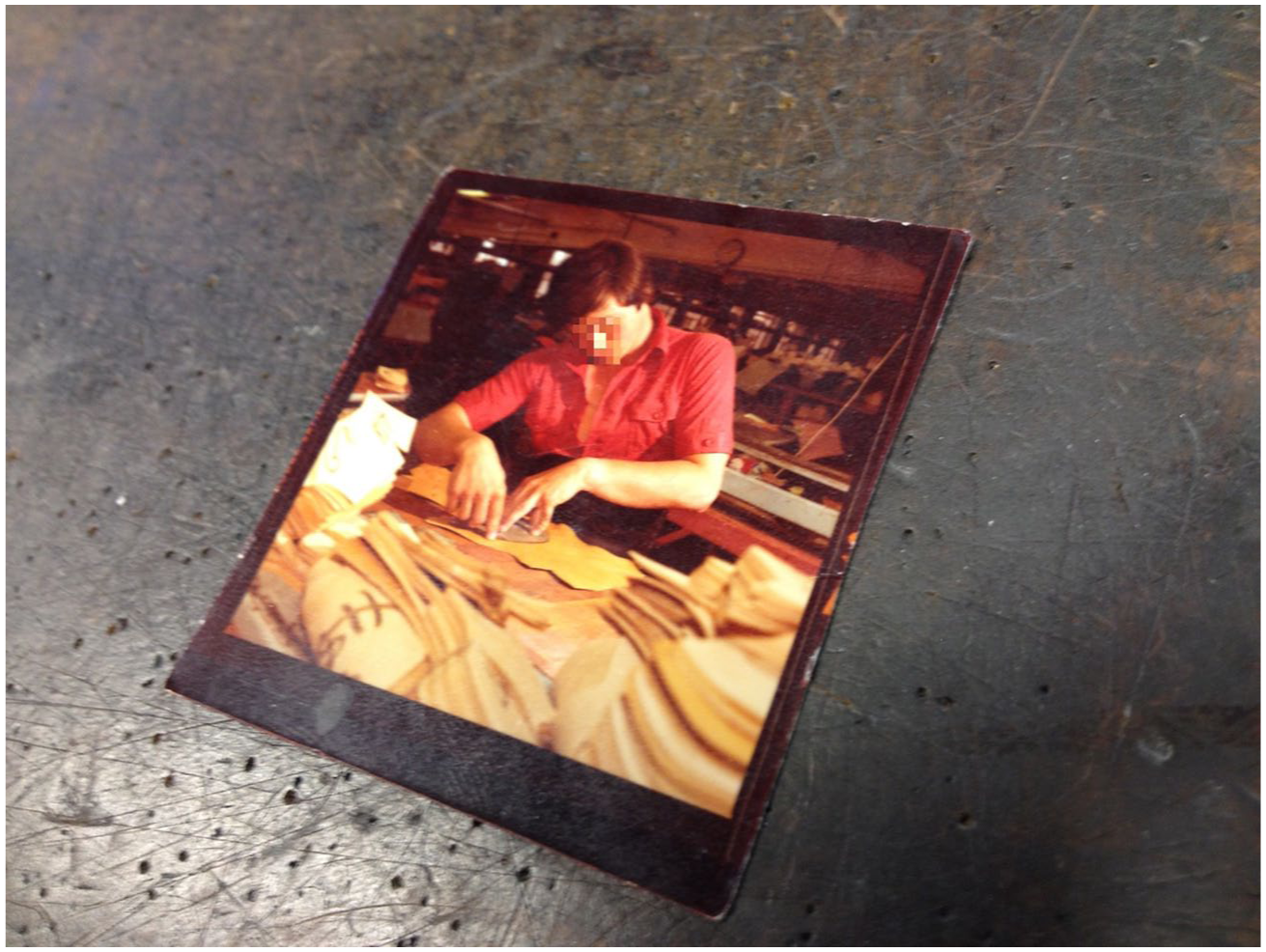
Tony and the clock, Lastings.
Crafting affective atmospheres
She is standing in a cottage garden in the sunlight surrounded by flowers, purple alliums, forget-me-nots and orange calendulas. There are apple trees, willow structures for plants to ramble up, dozens of zinc planters. Hens wander freely from their coops. She finds it hard to remember this is a Victorian factory. A message on a chalk board explains the connection between the garden and PotCo’s designs which is based on the founder’s ‘deep love of gardens and farmyards’.
She walks through the factory. Liquid clay gets everywhere; it spatters walls, floors, tools and bodies: matter colliding with other matter. White-aproned workers stack teapot lids and mugs in neat rows on trolleys, ready for biscuit firing overnight, turning them from grey to cream, ready for decorating. She doubts these bodies assemble in the garden. PotCo employees describe the factory tour as the ‘theatre’ of making. The tour, shop, café and decorating studio form part of a deliberately staged affective atmosphere of craft. This does not emerge spontaneously. PotCo employees know that seeing how pieces are made is an important source of affect for customers.
When they come round and they see all the effort that goes into it, they see just how many processes it’s been through and [how] it started literally . . . from that ball of nothingness. And you come out with this beautifully decorated, handmade piece . . . [and] every piece has its own slight pattern . . . It makes them realize what goes into it. . . (Michelle, decorator, PotCo)
Occasionally, a visitor is so enchanted, they break away and ‘hide’ from their tour group, so struck are they by their encounters with the decorators of these ordinary everyday objects. Once Barbara was asked by the owner of a teapot she had decorated to sign a postcard for them to display alongside it. Another time, Barbara met a PotCo collector who lived in Spain. ‘It was nice’ but Barbara was ‘embarrassed’ by the attention and could feel her face ‘getting redder and redder’.
She enters the factory meeting room for a research interview. There is a large pine dresser on one wall crammed full of pottery. The room is decorated with heavily patterned wallpapers featuring PotCo designs. There are large leather sofas strewn with floral cushions, and rugs on the floor. A long meeting table is the only sign that this is an office rather than a living space. She knows what she is supposed to feel – PotCo designs are supposed to make you feel like you are ‘at home’, eating toast and drinking tea. This is a space in which to dwell and absorb these traces. The affective traces she encounters in these meeting rooms don’t seem to touch employees. They are not at home in these spaces talking to her. Only when they are entangled with crafted objects do they become animated, such as when picking up a shoe or a plate and using it to show her a detail or illustrate a point. She senses the vitality that emerges from this contact.
Shoes, ceramics and bicycles are made using techniques and machinery that have remained largely unchanged for generations. Forty years ago, ‘the same machines would be there’ as when Mark, a skilled worker at Lastings, first ‘walked in the door’. Contact between human bodies and these machines is a source of affect that contributes to a crafted object’s potential.
Affective atmospheres condition how making happens. Workers tell her that ‘hand done’ making at PotCo creates a very different atmosphere from other potteries where pieces are ‘mass-produced’ (Harry, skilled worker, PotCo). Doug says in highly automated potteries ‘sometimes you don’t even touch a piece of clay until it comes off the kiln’. Doug is worried that his job is ‘dying out’. In other potteries, making is now being done by ‘robots’.
[At] Staffwood when it was all automated. . . [they] will do. . . a plate in about five seconds . . . Plates would be spewed out and a robot would stack them up. They even had robot labourers . . . they’d be loaded up and someone would call them . . . They’d have electric tracks shooting them around. (Bill, mould maker, PotCo)
Laura, a production manager at PotCo says people don’t necessarily ‘realize’ that ‘it is a hand-made product’. One of the ‘challenges as the company grows’ will be to find ways of hand decorating ‘in the way that we are now’.
Through these encounters, affective atmospheres of craft work create spaces of intensity that carry a sense of loss. The weight of the atmosphere arises from the assemblages of entities, including bodies of workers that have assembled here in the past. PotCo owner Annabel says ‘coming [to the factory] gives [visitors] a very poignant sense of loss, or imminent loss. . . As a nation, we’re very unhappy about not making.’ The transmittable affect in these spaces of making draws attention to the disappearance of affective atmospheres of craft work from everyday life.
Practising embodied technique
Embodied technique focuses attention on what connects and structures bodies and other matter in concrete moments of practice. Practising embodied technique requires skill and takes considerable time to acquire. It relies on practice, the rhythm of routine repetition and willingness to commit error. This enables craft workers to discover specific material possibilities and repeat them with a degree of reliability.
Cycle frames at Greens are made through a process of fine welding or ‘hand brazing’, using molten brass to seal joints between frame tubes. Having the ability to handle molten brass and use it in this way easily and efficiently is something not everyone has. Despite the use of machines, making shoes, pots and bicycles is described as skilled, ‘hands-on’ work, ‘you get a feel of the clay. . . you can feel it by the touch’ (Doug, skilled worker, PotCo). Hands act as a point of contact between bodies and other matter in craft making through which they come to know and understand materials. The process of moulding is integral to making slipware at PotCo. Moulders work at a long, slatted table or ‘trows’. They fill plaster moulds, for mugs, lids, teapots, etc. with liquid clay, or slip, and leave them to stand long enough for the clay to dry partially. Excess slip is poured away leaving a pot of the right weight. The mould is left to dry further before being ‘cracked’ (open) and the piece removed. Each piece is then ‘fettled’, removing the seam lines of the mould using a knife and a wet sponge. Deciding exactly when to open a mould relies on knowing when things ‘feel’ right: When you’ve been doing it for a few years, I can tell just by having a feel of it if it’s cast off or not . . . You can tell just by dipping your finger . . . what kind of thickness it is . . . Down on the moulds, we are all just tempted to just do it . . . You sort of get into a routine with it. (Adam, moulder, PotCo)
The handwork of craft is not just a means to an end but an action of co-presence that involves the hand and materials unfolding. An object’s being is constituted through its becoming. Embodied technique is characterized by rhythm that resides in the body and is realized through relational encounters with materials: You find it hard at first, because you can’t get a rhythm. . . But once you get that rhythm, you’re all right with it. (David, skilled worker, Blacks)
The labouring body is connected to its tools (Figure 2). Patterns of movement enable the form of the object to be gradually realized. Such embodied technique is the practical knowledge through which everyday life is lived. The worker’s body becomes a textualized surface (skin) that can be marked, traced or written upon. Embodied techniques of making are repetitive and arduous, leaving marks on the body.
[People] don’t want to come . . . here. They don’t want to get their hands dirty, rough skinned and shoulder pains, the aches. Because they’ve been warned by their nanas, their dads, ‘don’t go on the pots’ . . . I’ve said to my kids, ‘don’t go on the pots’ . . . My shoulders are knackered, my back’s knackered, my neck’s knackered . . . years of physical work. It catches up with you in the end. (Doug, skilled worker, PotCo)
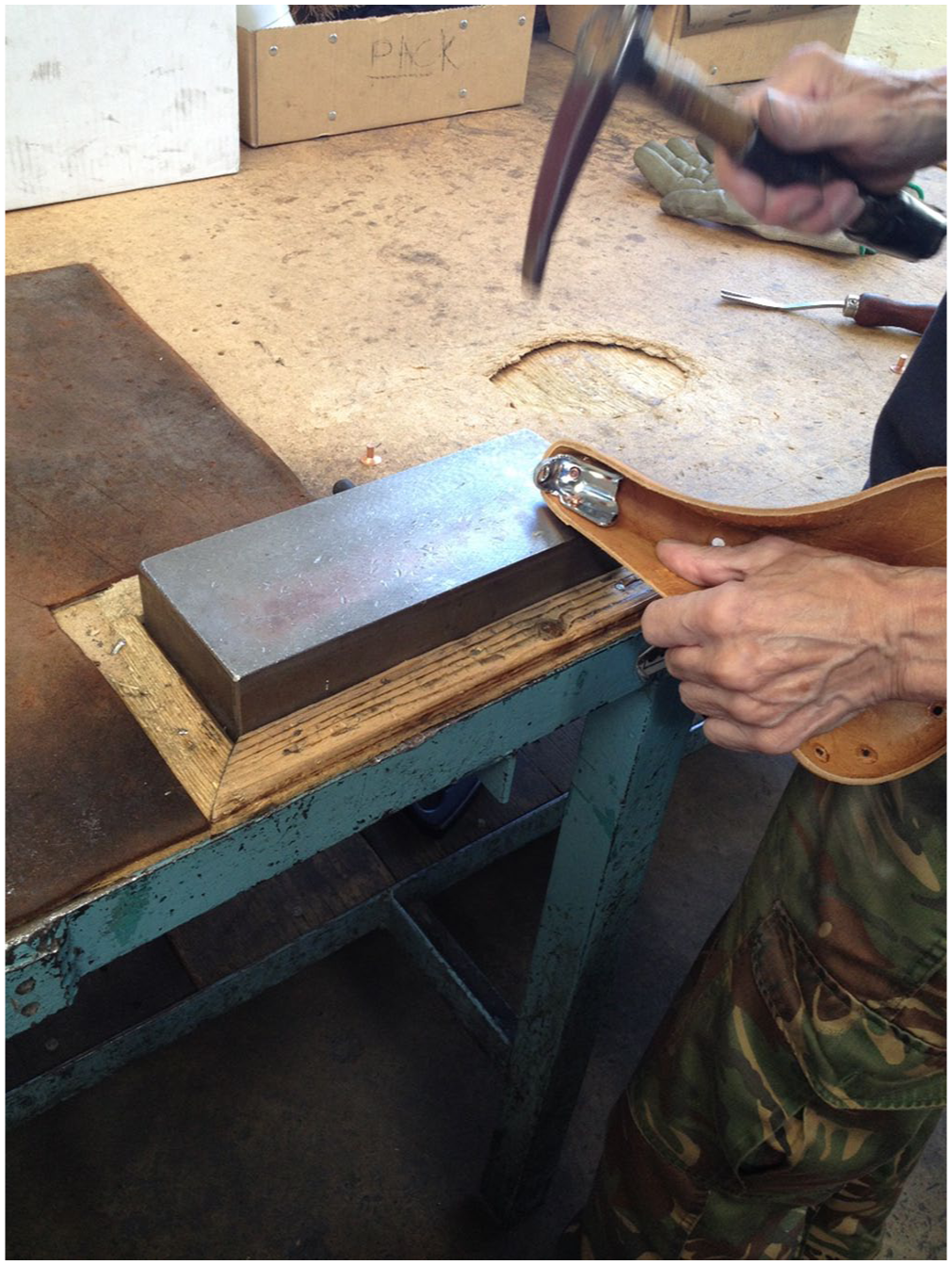
Hand riveting, Blacks.
Bradley, a young apprentice at Lastings, explains how his shoe design project was inspired by a tattoo on his arm (Figure 3): You have to [make a] design [for] the. . . toe part of the [brogue] shoe. . . so we used the machinery at college to . . . build a solid metal block that we could punch the holes through . . . Mine was . . . based . . . on aliens because I’ve got this tattoo . . . [shows tattoo] So mine’s like an alien ship . . . It’s got . . . a crop circle as its centre. (Bradley, closing room apprentice, Lastings)
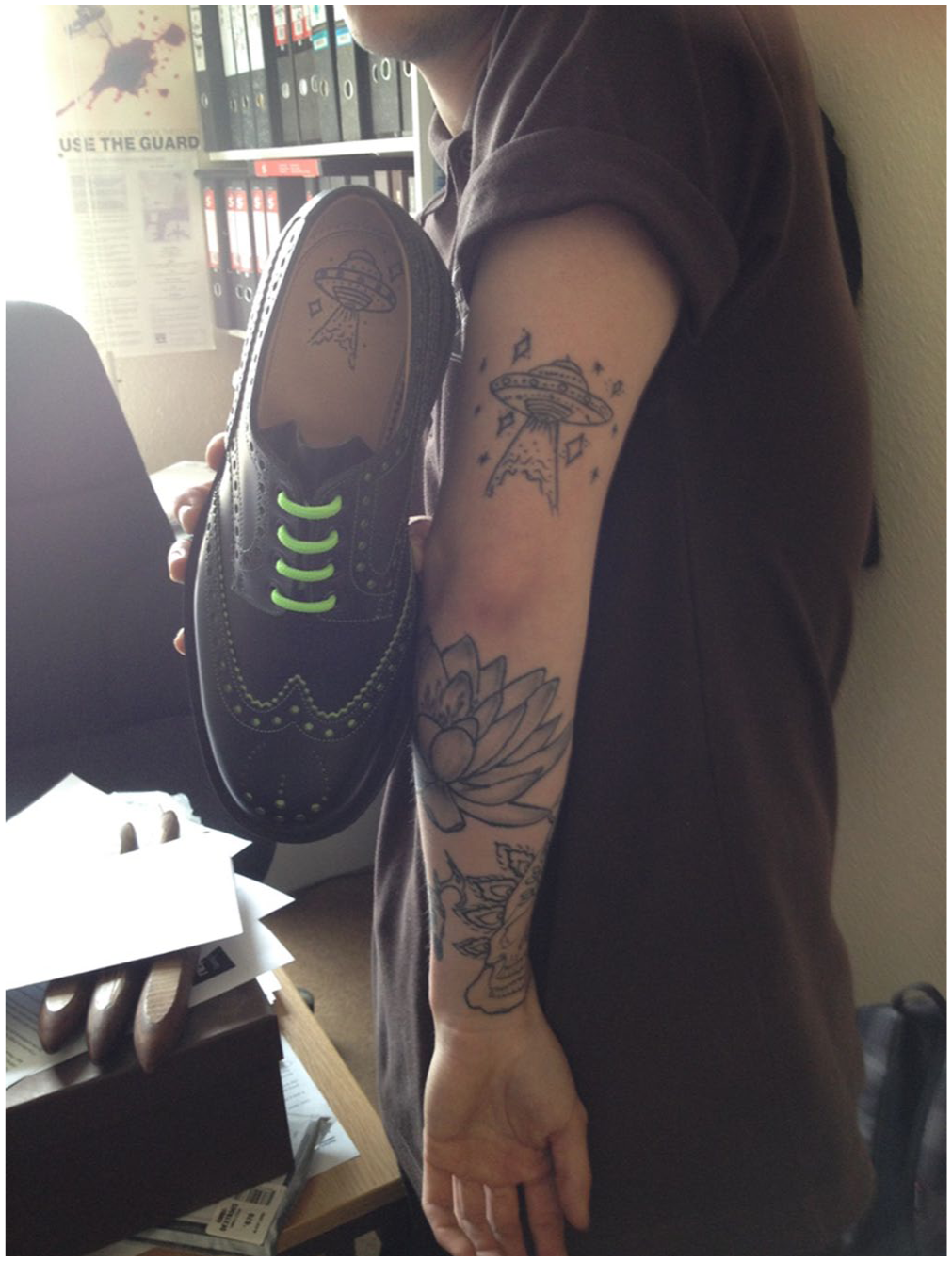
Bradley, Lastings.
Bradley’s tattoo produces ordinary affects – a connection that produces impact. The tattoo shapes Bradley’s physical body which shapes the surface of the crafted object. Such sensory encounters illustrate the jump of affect as the transfer of meaning through which an animated thing with affective potential is realized. In this way, human bodies affect other matter through their attunement.
Vitalism and the hand of making
The distinctiveness of craft work arises from the role of the hand as a meeting point between material surfaces and a point of exchange of affective intensities. Relational encounters between bodies and other matter involve pre-reflexively experienced, immediately embodied reactions to things that are encountered through the skin. The handling of things enables sensory or ‘sensible’ knowledge, perceived and judged through the senses. This is how the human body experiences the world. Variations that arise from how the hand moves, whether wielding a brush or a hammer, contribute to the meaning of a crafted object. Meaning also arises from knowing the maker who handled an object. At PotCo, hand decorating is mostly done by women. Decorators add their initials to the base of the piece, making it uniquely traceable to them. This creates an affective connection between the maker and the person who encounters a crafted object.
That’s the one thing I love about PotCo because I’ve worked [in other ceramics firms] and it’s all mass produced . . . But these . . . you’ve got your signature [on] . . . You can go anywhere, pick it up and go, ‘ah, I’ve done that’ . . . I were [on holiday] once with my family and I took my son into a shop. I said, ‘that’s what I do, son’, and I picked one up, it was mine . . . (Barbara, decorator at PotCo)
Even if the hand of the maker is not obvious, an object may be connected to them. At Lastings highly skilled workers visit stores to give hand-stitching demonstrations: I’ve worked in Jermyn Street . . . [The customers are] so interested . . . They come up and . . . shake me hand and have their photo taken with me . . . There was one chap actually had the pair of Winchesters on . . . And I said, ‘I’m sewing the same as what you’re wearing . . . And he said ‘Did you sew these?’ I went, ‘well . . . I can’t say for definite that it was me. There’s eight of us, nine of us that sew.…. You’ve got a one in eight chance.’ ‘No, no,’ he said. ‘I take it you did these.’ (Craig, production manager, Lastings)
The unique hand of the maker can also be an affective presence for co-workers that forms part of the aesthetic language of objects. Michelle speaks of the uniqueness of each worker’s paint strokes and David speaks of the distinctive nature of his hammering technique: I can tell mine just by looking at them . . . [Designs where we] hand paint . . . even though we’re all trained to do them the same way . . . by the same person . . . they’re all totally different. You can recognize your own . . . instantly . . . I quite often get a [co-worker] friend . . . come to me and say ‘Michelle, I saw your tendrils today, I knew they were yours, straight away.’ (Michelle, decorator at PotCo) When I hammer [rivets] . . . as this woman put it, when she sees me do it . . . ‘ah’, she says, ‘that’s a diamond shape’, because it’s got like . . . little squares on them . . . But then . . . Barry . . . his won’t look exactly like mine. And then Harold’s, his . . . might look a bit similar, but . . . you can see slight differences . . . (David, skilled worker, Greens)
Details enable connections that generate affect. At PotCo decorators display photographs of children, grandchildren and family pets on their workbenches. Figure 4 shows a woman’s hand as she sews brogue details onto a boot; it speaks through the detail of wedding and engagement rings on her fingers. Through this punctum a ‘blind field’ (Barthes, 2000, p. 57) is created. A whole life unfolds beyond the hand, the object and the image.
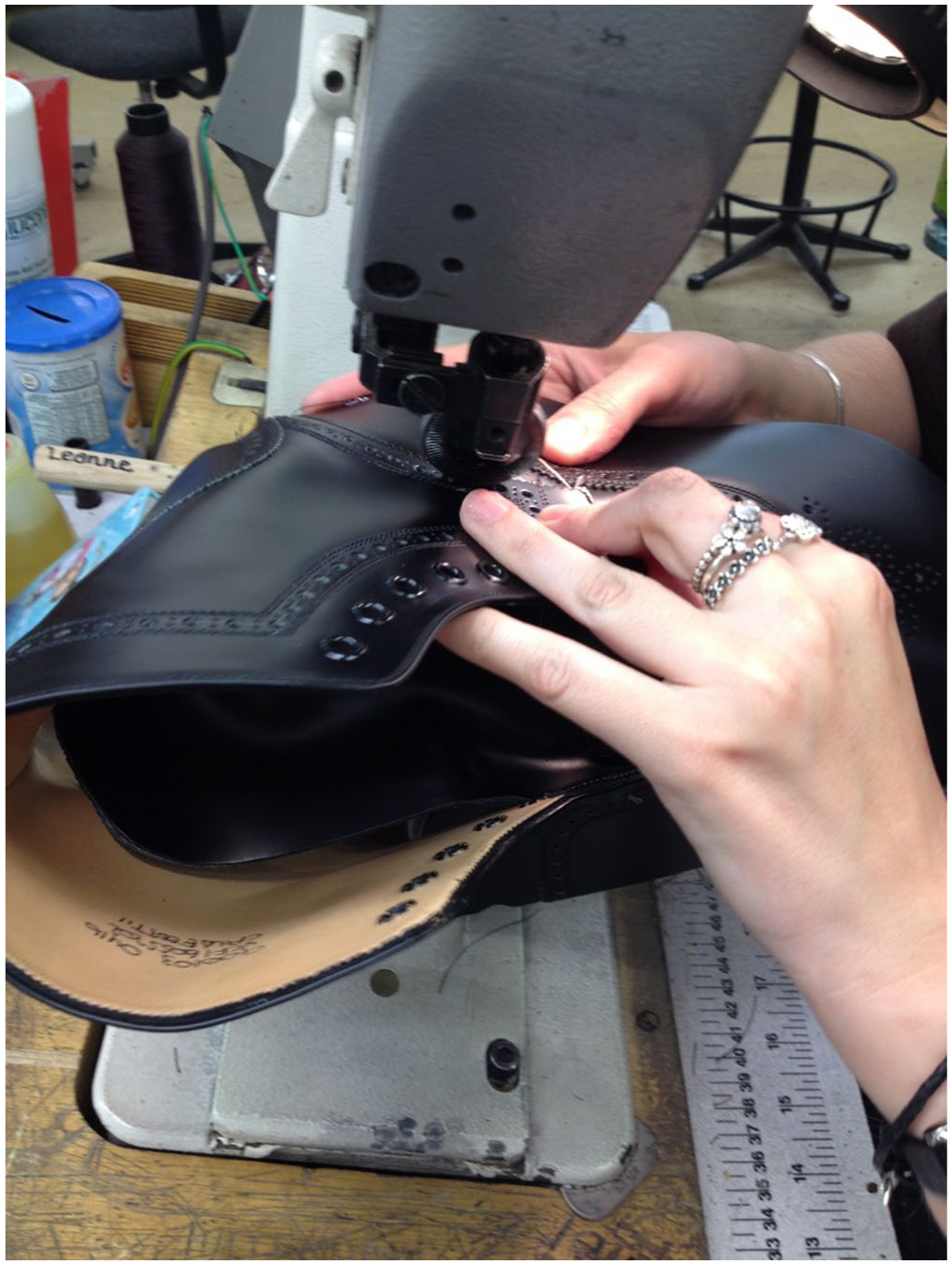
Stitching uppers in the closing room, Lastings.
Affective intensities generated through craft work also draw attention to relational encounters in other places: All bicycles are made by hand no matter where you are in the world . . . There is no machine that you can press a button and out pops a bicycle . . . Every frame that’s made is welded . . . or brazed by hand . . . They’re all hand assembled . . . I’ve been to several factories in China where they make five million bicycles a year. That’s an unbelievable number when you see how they make them . . . Maybe five or even ten production lines [where] they’re being assembled by hand . . . there is really no difference at any basic level between how a bicycle is made here or . . . elsewhere . . . I’d like to say ‘no, no, no, our craft is completely different and no one else in the world can do it’ but . . . it’s the same process . . . I don’t think we can crow about we’re superior in terms of craft. (John, manager, Greens)
As John emphasizes, crafting things is an inherently material, relational process that once physically encountered cannot easily be dismissed. By drawing attention to other matter with which we are corporeally intertwined, and the affective intensities this generates, the vital materiality of craft work has ethical implications that arise from being touched by what is near. These affects leave an impression on those who experience them through being ‘struck and shaken by the extraordinary that lives amid the familiar and the everyday’ (Bennett, 2001, p. 4). In the discussion that follows, we draw out the implications of these findings for practice-based organization studies.
Discussion
Practice-based theories of organization demonstrate the significance of the body in acquiring sensory knowledge and enabling organizational learning (Cooke & Yanow, 1993; Orlikowski, 2002; Strati, 2007). By developing an understanding of knowledge as inherent in practice, and embodied practice as a source of transmissible knowledge, the practice turn has shifted attention towards understanding what bodies can do in organizations (Hindmarsh & Pilnick, 2007; Yakhlef, 2010). This article has sought to further enrich practice-based theories of organizational knowing and learning by drawing attention to the importance of embodied encounters and materiality in forming affective organizational relations.
Craft work practice relies on encounters between human and nonhuman forces that take account of the entangled nature of materializations ‘of which we are a part’ (Barad, 2007, p. 384). This draws attention to the creative self-organization of matter and its lively, inconsistent nature (Bennett, 2010a). By studying assembled relations between bodies, materials, objects and places of craft work practice, we have argued that the sensual, experiential and being-centred qualities of craft animate our relationship to objects. This enables appreciation of the vitality of matter as having incipient qualities that external agencies, including craft workers, bring out and facilitate. Thus, the affectivity of crafted products is not an ‘essential attribute’ but an emergent property that arises through relations between ‘human and non-human elements’, including those that emerge after an object has been produced (Fox & Alldred, 2017, p. 90). Such connections are the consequence of relationships between bodies that are ‘webbed’ in the context of ‘force-relations’ (Gregg & Seigworth, pp. 2–3, emphasis in original).
A broader question arises concerning whether these connections are specific to craft work, or a broader feature of making practices more generally, including in industrialized practices of production (see also Holt & Popp, 2016). To address this, we turn to the concept of affect as the vital forces that are generated through encounters between bodies, other matter and practices in craft making. Craft work can be understood as a site where feeling and desire for crafted objects intersects with the bodies of others and is transformed into a source of affect. Affective forces provide a means through which things are oriented towards us and produce interactions of desire (see also Berlant, 2011). Such affect arises out of desire for objects and the sensory encounters they invoke. This defines orientations towards matter in ways which ‘lead us towards things’ (O’Connor, 2017, p. 223). In this sense, desire describes a state of attachment to something or someone, and the cloud of possibility that is generated by the gap between an object’s specificity and the needs and promises projected onto it. . .Your style of addressing those objects gives shape to the drama with which they allow you to recounter yourself. (Berlant, 2012, p. 6)
Crafted objects become objects of desire and a point of intersubjective connection through which awareness of human feeling is experienced. ‘When we talk about an object of desire, we are really talking about a cluster of promises we want someone or something to make to us and make possible for us’ (Berlant, 2010, p. 93). Objects of desire allow ‘us to encounter what is incoherent or enigmatic in our attachments, not as confirmation of our irrationality but as an explanation for our sense of our endurance in the object’. As a consequence, crafted objects carry affective traces of desire and attachment (Vachhani, 2013) that we suggest are less likely to emerge in industrial manufacturing practices.
To justify this proposition we consider the role of the hand in craft work. ‘Handwork’ is the ‘heterogenous gestural system of corporealities and materialities’ that enables an object’s form and gives meaning to the idea of making (O’Connor, 2017, p. 228). We suggest that the emergence of affects of desire in craft work practice is closely related to the physical presence of the hand as an observable presence. This provides a point of contact ‘at the surface of the body, at its interface with things’ (Massumi, 1995, p. 85). The hand enables bodies to affect one another and generate intensities. This is ‘not about one person’s feelings becoming another’s’ (Stewart, 2007, p. 128) but a relational means through which affect becomes transpersonal. This brings us back to ethics. The material presence of the hand in practices of craft making enables perception of ‘the mundane corporeality of the other, by grasping them “perceptively” as present’ and feeling them ‘close by’ and able to be touched (Strati, 2007, p. 63). What is perceived, produced and reproduced through the senses thus not only ‘generates dialectical relations with action’ (p. 62) but also produces potentially close, emotional and ethical relations with other organizational actors, including nonhuman bodies.
As Bennett writes, The starting point of ethics . . . [is] the recognition of human participation in a shared, vital materiality. We are vital materiality and we are surrounded by it, though we do not always see it that way. The ethical task at hand here is to cultivate the ability to discern nonhuman vitality, to become perceptually open to it. (Bennet, 2010a, p. 14, emphasis in original)
Global capitalism depends on preventing sensory engagements with matter, in other words on ‘antimateriality’ (Bennett, 2010a, p. 5, emphasis in original). It is through an enchantment with things in the everyday world, a feeling of surprise and a state of wonder, that Bennett suggests ethical engagements with things may be realized. By drawing attention to the importance of orientations towards matter which acknowledge its animacy or lively materiality, this article contributes to understanding craft work as based on ethical, as well as sensory and affective, encounters. We use the concept of an affective ‘ethics of mattering’ (Barad, 2007; see also Bennett, 2001) to draw out the implications of new materialism for organization studies.
An affective ethics of mattering focuses on cultivation of an ethical sensibility or dispositions that enable generosity towards others (Bennett, 2001) by ‘striving to enhance our embodied capacities to affect and be affected in ways that help ourselves and others flourish’ (Thanem & Wallenberg, 2014, p. 245). The ‘presumptive generosity’ towards others that is enabled by the flow of affect, and the enchantment that this generates, renders one ‘more open to the surprise of other selves and bodies and more willing and able to enter into productive assemblages with them’ (Bennett, 2001, p. 131). Consequently, the ethics of mattering ‘is always a call for inquiring deeper into situations thereby recognizing the inherent complexity and the plurality of human and non-human voices that are always present’ (Boje & Jørgensen, 2014, p. 46). An affective ethics of mattering can thus be considered a form of care(fulness) that emerges through situated, embodied encounters (Bennett, 2010a; Dale & Latham, 2014). Key to this is a theory of distributive agency that ‘depends on the collaboration, cooperation, or interactive interference of many bodies and forces’ (Bennett, 2010a, p. 21). What arises from this is an understanding of agency that is not confined to human bodies or human efforts. Such a theory of human/nonhuman action and responsibility raises questions about how to engage with matter in ways that are more ethical and sustainable while still responding to the enchanting effects of objects enabled by craft work.
This enables us to consider the theoretical implications of these arguments for practice-based organization studies. The significance of new materialism is related to its rejection of dualist oppositions, including between human subjects (as rational, free, self-aware, autonomous) and other (dull or passive) matter, that constrain our understanding of the social world. Instead, new materialism is characterized by a monist, non-anthropocentric ontology. By advocating and advancing new ways of thinking about what matter is and does, a ‘flat’ or ‘monist’ ontology rejects traditional dichotomies of mind/body, human/nonhuman and nature/culture. This ‘opens up the possibility to explore . . . how things other than humans (for instance, a tool, a technology or a building) can be social “agents”, making things happen’ (Fox & Alldred, 2017, p. 7). New materialism thus has significant epistemological and methodological implications for organization studies researchers. Unlike realist accounts of the external world (as independent of human construction) and constructionist positions (which view reality as produced through human – cultural and social – action), new materialism invites a focus on relationality rather than essence; ‘this has the effect of re-making the relationship between research data and the object of inquiry, cutting across the realist/constructionist dualism that has divided social research approaches’ (Fox & Alldred, 2017, pp. 152–3; St. Pierre et al., 2016). The ‘transversal’ epistemology of new materialism thereby displaces the human researcher/observer from her/his central position (and hence as key arbiter) in the interaction between the world of events and the processes of research . . . Instead . . . both events and research processes are considered as material, relational and interacting networks comprising human and non-human components. (Fox & Alldred, 2015, 1.3)
Such an epistemological and ontological repositioning has significant implications for organizational research, as embodied, enacted, lived and felt encounters with other matter. It entails radically rethinking not only the methods that researchers use, but also the validity of rationalistic, linguistic modes of communication as the primary way of representing knowledge in organization studies. Humanities scholars like Stewart (2007) have demonstrated how conventions associated with academic, social scientific writing can be rethought to produce texts that are more sensuous, resonant, liberating and affecting (Fotaki, Metcalfe, & Harding, 2014; Gilmore et al., 2019). We have argued that writing affectively about craft requires a language and vocabulary that activates the inanimate and ordinary through description of matter’s agentic potential and the feelings and desires that arise from embodied engagement with things. Through this we have sought to demonstrate the importance of writing from such an epistemologically different stance as a means of producing affective understandings of organizational practice.
A final implication for practice-based organization studies relates to the ethical importance of a more inclusive understanding of embodiment, as the experience of being affected by objects and other bodies. Traversing reductive dualisms, new materialism positions relations of responsibility and accountability at the centre of human subjectivity. As Coole and Frost (2010) write, phenomenological approaches to embodiment in new materialism focus ‘on the way power constitutes and is reproduced by bodies’. They emphasize the active, self-transformative, practical aspects of corporeality as it participates in relationships of power. They find bodies exhibiting agentic capacities in the way they structure or stylize their perceptual milieu, where they discover, organize, and respond to patterns that are corporeally significant. (Coole & Frost, 2010, p. 19)
By exploring agentic capabilities, new materialism complements ‘ontologies of immanently productive matter by describing how living matter structures natural and social worlds before (and while) they are encountered by rational actors’ (p. 20). This brings together the importance of corporeality alongside enabling matter to speak, rather than affording primacy to one or the other.
Conclusion
New materialism creates possibilities for more diverse ways of thinking about objects and bodies as sites of knowing and feeling in organizations by focusing on the affects that are generated through relational encounters with matter. This enables an understanding of the vitality of materials and objects of making and the affective intensities that flow between makers’ bodies, objects and places in craft work practices. Our analysis has shown how affective traces and atmospheres emerge through the embodied techniques practised in craft work that enable vital encounters with matter. We have also sought to surface the politics of the ordinary and energizing potential of objects by attending to their affective sensibilities. We contend that recognition of the vitality of objects is central to the meaning that is attributed to craft work practices. By highlighting the significance of material, relational encounters in practices of organized craft making, we have demonstrated the importance of affect in practice-based organization studies and proposed a more materially-centred conception of practice that acknowledges human and nonhuman forces. An affective ethics of mattering acknowledges the vitality of matter and its affective capacities, and shows how matter comes to matter through embodied organizational practice. It thereby offers a way of thinking about organizational practice that attends to the ethical importance of embodied sensibilities and recognizes the importance of orientations or dispositions towards matter in transforming the ethics of organizational encounters.
Footnotes
Acknowledgements
We would like to thank the editor and anonymous reviewers for their careful and constructive comments throughout the editorial process and Steve Brown for commenting on an earlier version of this paper. Thanks too to Eda Ulus and participants at ‘Responding to the Affective Turn in Organization Studies’, University of Leicester and Michelle Greenwood, co-organizer of the 7th Annual Australasian Business Ethics Network (ABEN) Conference, RMIT University, Australia, where earlier versions of this work were presented and feedback given.
Funding
The author(s) received no financial support for the research, authorship, and/or publication of this article.
