



Abstract
The aestheticization of organizational space is a growing phenomenon with organizations carefully designing the aesthetic engagement in space to invoke specific values and behavior. Simultaneously, however, the traditional workspace is disappearing as work is performed increasingly in multiply-located, hybrid spaces combining corporate, domestic and public spaces. This paper seeks to understand the aestheticization of hybrid spaces by theoretically drawing on the notion of atmosphere as proposed by the philosopher Gernot Boehme. By ethnographically exploring how an urban film festival creates its unique atmosphere, we identify three intertwined aesthetic practices that underpin the aestheticization of hybrid space: the interrelation of different aesthetic codes and expressions, the processual guidance of the aesthetic experience, and the provision of a centre of experience. We discuss how ambiguities, multiplicities and diversities may become a resource when aestheticizing hybrid space, reminding us to be critical even when atmospheres emerge beyond the careful aesthetic design of space.
Keywords
Introduction
Of these times, I most remember the atmosphere at the Grand Hotel. [. . .] We slipped into the various receptions and took advantage of the free food and drinks. The Grand Hotel had [. . .] a dream-like atmosphere, as in The 1,001 nights, and it was like being part of that dream. [. . .] The beautiful thing is that, at these receptions, you may meet the actors whom you have just seen on the big screen in the Piazza Grande. Locarno has this advantage; not only can film lovers see films, but you can also enter this dream-like atmosphere. [. . .] Being part of this dream has never left me, and I believe this atmosphere takes over the whole region that otherwise is utterly residential, tertiary sector, a place for pensioners. (Interview 29, April 2016)
Today’s organizations are increasingly subject to processes of aestheticization involving an ‘aesthetic manipulation’, not only through the organization’s smells, tastes, lights, colours and sounds, but importantly also through the design of its organizational space (Beyes, 2016). The aestheticization of organizational space is intended ‘to seduce’ (Dovey, 1999) users of space by involving them in a particular atmosphere, as per the above quote regarding the dream-like atmosphere of potentialities and The 1,001 nights. Through aestheticization, organizations may invoke specific goals or identities (Dale & Burrell, 2010), and aim to stimulate employees’ creativity, entrepreneurship and motivation (Alexandersson & Kalonaityte, 2018).
Simultaneously, organizations are currently tending to move away from traditional workspaces (Felstead, Jewson, & Walters, 2005), as work is increasingly being performed outside of the physical buildings of organizations, being displaced to the home, to co-working spaces and to public spaces such as cafés, old city centres and parks (Felstead et al., 2005). These ‘hybrid workspaces’, being ‘multiply located’ with people working from the workplace and third places (e.g. home, cafés, trains) (Halford, 2005, pp. 20–22), blur the boundaries between private and public spaces, and between spaces of work and leisure.
Nevertheless, hybrid workspaces are proving to be a challenge to managerial attempts to aestheticize space, as it is unclear how this process can transcend the physical boundaries of the organization and incorporate public parks, private homes and urban spaces. The notion that the aestheticization of space cannot be entirely crafted and controlled by the organization (Michels & Steyaert, 2017) becomes thus even more evident when acting in a hybrid space, as the organization has to deal with the simultaneous presence of diverse ‘aesthetic codes’ (Gagliardi, 1999).
The simultaneous reconfiguration of the traditional workspace into hybrid spaces, and the growing organizational focus on the aestheticization of spaces, requires organizational scholars to critically re-examine the relationship between organizational space and its aestheticization. In particular, it remains unclear as to how aestheticization takes place in hybrid organizational spaces, and how organizations can build on the diverse aesthetic codes that a hybrid space entails in order to aesthetically engage users in its organizational atmosphere. In this paper, we aim to address this issue, and ask: How do organizations deal with aestheticization when acting in hybrid space?
We address this question by following the orientation of a ‘new aesthetics’ (Böhme, 1993; Strati, 1999) in organization studies, one which is essentially concerned with sensory experience (e.g. Küpers, 2002; Wasserman & Frenkel, 2011). In particular, we will take up the concept of ‘atmosphere’ (Julmi, 2017; Michels & Steyaert, 2017), defined as ‘what is experienced in bodily presence in relation to persons and things or in spaces’ (Böhme, 1993, p. 119, italics added). We suggest that we can better understand the aestheticization of hybrid space by focusing on the atmosphere’s quality of ‘in-betweenness’ (Bille, Bjerregaard, & Sørensen, 2015; Böhme, 1993), and we will analyse how an atmosphere emerges in the context of hybrid space.
Empirically, we will draw on an ethnographic field study of the Locarno Film Festival, a major European film festival, where we studied the aestheticization of the festival’s space between 2014 and 2018. Film festivals, and more generally urban festivals, present an interesting context in which to explore the aestheticization of hybrid space. Indeed, an urban festival space is not produced ex nihilo by the organizers of the festival, but is built upon the urban context, often making use of urban qualities to define those of the festival (Quinn, 2003). The Venice Film Festival, for example, benefits from the ‘sinking city’s’ irresistible charm, not only as a background for photo opportunities, but also because of its unique atmosphere (Rooney, 2018). Urban festivals are prime places in which to study processes of aestheticization and the engineering of aesthetic engagement (Ryan & Wollan, 2013). Undoubtedly, the current flourishing of such festivals (Bennett, Taylor, & Woodward, 2014) is part of the larger wave of ‘aesthetic capitalism’ and ‘experience economy’ (Beyes, 2016, referring to Raunig, 2013; Reckwitz, 2017) as, through a process of the ‘festivalization of everyday life’, entertainment and experience have become embedded within daily and work life. These festivals are no longer something occasional and limited to the cultural sphere (Bennett et al., 2014). A better understanding of the aestheticization of the hybrid spaces of urban festivals may thus help to contribute to a wider debate on how the ‘mobilization of the aesthetic [. . .] work[s] in contemporary society’ (Beyes, 2016, p. 119).
The remainder of this paper is structured as follows. First, we situate our argument theoretically within the organizational research on the aestheticization of hybrid space, postulating the notion of atmosphere (Julmi, 2017; Michels & Steyaert, 2017), and in particular atmosphere’s reference to ‘in-betweenness’ and its need for ‘thresholds’, in order to better understand it. We then discuss the methodological issues related to an aesthetic study of organizational space, drawing upon the empirical case of the Locarno Film Festival. In the subsequent findings section, we will present three intertwined aesthetic space practices that underpin the aestheticization of the Festival’s space, namely, (a) the interrelation of different aesthetic codes and expressions, (b) the processual guidance of the aesthetic experience and (c) the provision of a centre of experience.
These findings further our understanding of the aestheticization in new, post-industrial forms of working spaces, such as hybrid spaces (Halford, 2005). Our study shows that the aestheticization process of organizational space cannot be understood merely as the co-creation of managerial design and users’ resistance, as has been found in earlier studies (e.g. Wasserman, 2011); nor can it be accounted for by the almost ‘spontaneous emergence of unplanned atmospheres’ (Michels & Steyaert, 2017, p. 79). Rather, the aestheticization process in hybrid space requires us to address the in-betweenness of multiple ambiguities (Anderson, 2009).
The Co-production of the Aesthetics of Space
Research into the aestheticization of commercial and retail environments such as shops, supermarkets, airports, restaurants and entertainment spaces has demonstrated the seductive or manipulative power of space aestheticization (Biehl-Missal & Saren, 2012). Therefore, organizational scholars have critically reflected upon the engineering of the aesthetics of space, stressing the political nature of the aesthetic experience (e.g. Alexandersson & Kalonaityte, 2018).
Through aestheticization, employees are ‘“framed” in a situation which may appear to offer free choice [but where there is] a concealment of intent’ (Dovey, 1999, p. 11). For example, the practice of engineered aesthetics of play in workspaces, taken from non-work space-times (e.g. nightlife, childhood), may suggest the possibility of play by rendering labour invisible. However, the design practically delimits the possibilities of play, such that organizational members end up ‘playing without play’ (Alexandersson & Kalonaityte, 2018, p. 313). What is more, aestheticization can reinforce – with some concealment – disparities within the workplace, as differences of space aestheticization (e.g. different standards of finish, materials used, design styles, location) may serve to strengthen the distance not only between different status groups, but less overtly also between genders (e.g. certain female-dominated professional groups working in relatively less-decorated spaces) (Wasserman, 2012). This suggests that aestheticization can transmit an organization’s values, identities and norms by aesthetically involving employees in a coherent aesthetic corporate climate (e.g. Küpers, 2002; Wasserman, 2011).
Employees, however, are not entirely passive receivers of the aesthetic engineering; through their own embodied experience, they can resist the aesthetic regulations imposed through organizational space. For example, ‘workers may use forms of aesthetic jamming as part of the struggle over the dominant social identity outside the organization in their attempt to reject the identity of the “ideal worker” that the management seeks to advance’ (Wasserman & Frenkel, 2011, p. 505). This suggests that the aesthetics of space are produced not only by how spaces are designed by planners and managers, but importantly also by how they are used by employees. What is more, there have been recent indications that the aesthetics of a space are produced through multiple performances, such as through unplanned encounters or other unanticipated atmospheric developments (e.g. the weather) (Michels & Steyaert, 2017).
This co-production of spatial aesthetics is particularly important as regards hybrid organizational spaces (Halford, 2005), where organizations have to actively deal with diverse ‘aesthetic codes’ (Gagliardi, 1999) (e.g. of the home and corporate spaces) (Felstead et al., 2005), and where the aesthetics of space emerge ‘in-between’ (Bille et al., 2015) the ambiguities of, for example, the enclosures of the corporate space and the openness of a public place, or the intimacy of the home and the professional, formal qualities of the corporate space.
We suggest that, within the aesthetic tradition, the notion of atmosphere – being ‘in-between’ multiple ambiguities (Michels & Steyaert, 2017) – can serve to better understand how aesthetic engagement works in hybrid spaces and involves the interaction of multiple aesthetic codes. With the aim of outlining how the emergence of atmospheres ‘in-between’ different ambiguities and aesthetic codes can be translated into an organizational analysis, we will then draw upon Walter Benjamin’s (1927) notion of ‘thresholds’.
Atmosphere’s ‘In-betweenness’ and the Role of Thresholds
The contemporary philosopher Gernot Böhme (1993) proposes a ‘new aesthetics’ that – in contrast with the judgmental aesthetics developed in Kant’s Critique of Judgement (1790) – is essentially concerned with sensory experience, and refrains from any discourse on judgement. Re-appraising the Greek etymology of aesthetics (from αίσθητικός, meaning ‘pertaining to sense perception’), Böhme repositions aesthetics as ‘a theory of perception in the full sense of the term, in which perception is understood as the experience of the presence of persons, objects, and environments’ (Böhme, 2016, p. 24). In organization studies, the ‘new aesthetic’ (Böhme, 1993) approach was first taken up by Strati (1999), and subsequently by other scholars (e.g. Ottensmeyer, 1996; Wasserman & Frenkel, 2011), in order to emphasize the individual’s and the collective’s embodied, material and affective engagements with organizations (Strati, 1999). As a consequence of the central notion of this ‘new aesthetics’, organizational scholars have taken up the concept of ‘atmosphere’ (e.g. De Vaujany, Dandoy, Grandazzi, & Faure, 2019; Michels & Steyaert, 2017; van Marrewijk & Broos, 2012).
The concept of atmosphere has its origins in the field of meteorology, where it refers to the gaseous layer that surrounds the earth (etymologically stemming from the Greek words ἀτμός, meaning ‘vapour’, and σφαῖρα, meaning ‘sphere’). Today, the term is mainly used in a metaphorical way to refer to the perceptible sensations or moods ‘in the air’, similar to what the German sociologist Walter Benjamin (1927) described as the ‘aura’ of an object or a place. For Böhme (1993), atmospheres are ‘spheres of the presence of something, their reality in space’ (pp. 121–122). As such, an atmosphere is the primary ‘object’ of perception that, upon entering a new place, is immediately perceived, even before feeling the shape of the objects, or perceiving their colour in the place (Böhme, 1993). By ‘breathing’ in an atmosphere, one enables it ‘to permeate the self’ (Böhme, 2016, p. 26) and ‘feel oneself enveloped by a friendly atmosphere, or caught up in a tense atmosphere’ (p. 113). As it is a primary ‘object’ of perception, an atmosphere acts upon the self and constitutes ‘the common reality of the perceiver and the perceived’ (Böhme, 1993, p. 122). Böhme goes on to specify that the ‘atmosphere is what relates objective factors and constellations of the environment with my bodily feeling in that environment. This means: atmosphere is what is in between, what mediates the two sides’ (Böhme, 2016, p. 13, italics added). In other words, the atmosphere belongs neither to the subject (the person that experiences it), nor to the object (the space); rather, it exists in between them (Böhme, 1993). With the notion of atmosphere constituting an experience of this ‘in-betweenness’ (Bille et al., 2015), it becomes central to the sensory and affective experience.
Given that atmospheres occur at the intersection of people, gestures, places and things, it can be said that an atmosphere is a ‘connective factor’ that holds together (in a direction towards indeterminacy) multiple ambiguities (Michels & Steyaert, 2017), or opposites in tension, such as ‘presence and absence, subject and object/subject and the definite and indefinite’ (Anderson, 2009, p. 77). For example, when studying the atmospheres that emerge in urban street performances, Michels and Steyaert (2017) suggest that an atmosphere can only be partially designed and crafted; it may be influenced by the weather conditions, by the ways the audience participates in the performance and by how the musicians improvise during the event. Thus, atmospheres can only be ‘crafted as moments of potentiality and promise’ (Michels & Steyaert, 2017, p. 98), and are dependent upon the interactions that emerge in the moment.
The notion of atmosphere’s ‘in-betweenness’ allows us to critically re-examine whether hybrid spaces are simply ‘multiply-located’ (Halford, 2005, p. 22), as if existing next to each other. Atmospheres invite us to focus on what happens ‘in between’ the ‘multiple’ spaces, which feature, for example, both the intimate and the corporate, the private and the public. Similarly, we are asked to enquire into the dynamics and interactions between the different ‘aesthetic codes’ (Gagliardi, 1999) present in hybrid spaces, for example how they clash or enhance each other. While there have been initial organizational studies (see De Vaujany et al., 2019; Michels & Steyaert, 2017) that have analysed the production of atmospheres in between spaces, gestures, people and things, their analyses are restricted to very specific organizations (i.e. artistic performances, guided tours of collaborative spaces); they are not focused on hybrid space. In particular, while it has been suggested that atmospheres build concomitantly on ‘openness and closure’, ‘inclusion and exclusion’, ‘continuum and rupture’ (Philippopoulos-Mihalopoulos, 2016, p. 153), we know little about how these multiplicities play out and interact in hybrid space.
Finally, because of atmosphere’s fleeting quality (similar to air), it requires a ‘protective membrane’ (Borch, 2009, p. 2). In the same way that islands exist as such only through the isolation of the sea, ‘atmospheric islands’ require seals or enclosures which separate the protective and meaningful ‘interieur’ from the outside world (Sloterdijk, 2004, p. 338). In order to better understand the role of enclosures in the development of atmospheres in hybrid spaces, Walter Benjamin’s Passagenwerk (arcades project) (1927) is of particular relevance. Investigating the paradoxical synthesis of the public world of goods and intimacy (Sloterdijk, 2004), he suggested that ‘thresholds’ were required in order to transition atmospherically from the outside world to the interior. He studied Parisian ‘arcades’ (the first glass-covered commercial galleries that initially appeared at the end of the eighteenth century across Europe), and argued that these passages acted as ‘thresholds’ between the chaotic streets of the city and a child-like state of dreaming, with the promise of luxury shops with new possessions (Benjamin, 1927). The relevant difference here between Benjamin’s notion of thresholds and the idea that atmospheres need isolation (Sloterdijk, 2004) is that, for Benjamin, thresholds are not closed barriers, but rather zones of transformation, of change. They enable a transitioning from the outside world to the protected interior. In fact, the passage from one aesthetic experience to another in the galleries is orchestrated through their use of various spatial and optical ambiguities. In the case of the arcades, this is achieved through the architectural use of glass and iron, which facilitate the inclusion of historic, natural and new elements, such as – on the one hand – the sky, natural light, or the historic architecture and – on the other – the modern world of consumerism. Thresholds thus bring together multiple ambiguities (e.g. the past–present, interieur–exterieur, dreaming–being awake, collective–private) (Benjamin, 1927), and help us to understand how ‘in-betweenness’ is constitutive of atmosphere. As regards the context of hybrid spaces, the notion of ‘thresholds’ becomes of particular significance when aiming to empirically study the in-betweenness of atmospheres (Böhme, 1993). Here, multiplicities prevail, and a hermetic sealing-off of one space from another is practically unfeasible, since multiple spaces are co-present and interact.
In synthesis, the notion of atmosphere, both for its insistence on ‘in-betweenness’ and on the need for thresholds, seems particularly useful to improve our understanding of aesthetic engagement in hybrid space. It allows us to focus on the dynamics of interaction between ‘multiply-located’ spaces (Halford, 2005, p. 22), and enables us to better understand how atmospheric enclosures, transitions and continuities are achieved in hybrid space. After clarifying our research context and methodological approach, we will use both notions in order to address our research question empirically.
Methodological Reflections
An empirical analysis of how aestheticization takes place in hybrid space poses methodological challenges. In particular, these challenges are linked to the difficulty of analysing an atmosphere that can be ‘simultaneously defined as an effect that only emerges from the encounter between bodies [and other material elements of space], and also as a force external to these bodies’ (Seyfert, 2012, p. 29). The implication here is that, in order to study atmospheres, one has to study materiality and its affective experience not as distinct, but rather interrelated, phenomena ‘feeding on each other’ (Bille et al., 2015, p. 36). With the aim of studying the ‘co-existence of embodied experience and the material environment’ (Bille et al., 2015, p. 36), we analysed – via an aesthetic approach (Strati, 1999) – the urban space (e.g. material and shapes) of the city, as well as the physical interventions by the festival (e.g. installations and road signs), the ways in which these various elements combine, and – importantly – how the users not only experience and feel in these spaces, but also how their collective actions contribute to creating a specific atmosphere. We thus developed an understanding of the aestheticization of space that takes into account not only the space’s aesthetic practices as applied by the organization, or how the aestheticized space is utilized and lived in by festivalgoers, but also how these elements build upon each other.
Research site and data collection
The Locarno Film Festival is a ten-day international film festival which has taken place every August since 1946 in the city of Locarno, a small town located in the Italian-speaking region of Switzerland. Together with the festivals of Venice (1932) and Cannes (1946), it is one of the oldest film festivals in the world, attracting thousands of people annually (155,700 in 2018).
During its initial years, the Locarno Film Festival took place in the majestic gardens of the historic and glamorous Grand Hotel, located in a panoramic position overlooking the city centre. During the 1960s, the festival began to expand, and thus required more space. In 1971, therefore, it was relocated to the city centre, where a big screen was installed in the main square of Locarno – the Piazza Grande – where more than 8,000 festivalgoers could watch films beneath a starry sky. From this moment on, the Piazza Grande would become the heart of the festival. Since then, the festival has further expanded, temporarily occupying and transforming public buildings, squares and parks, taking over the city centre with its temporary buildings, its colours (the symbol of the festival is a yellow and black leopard called pardo), bars and throngs of visitors.
Photo-ethnographic observations
Following Warren’s (2008) suggestions of using a visual approach when conducting research on organizational aesthetics, we adopted a photo-ethnographic approach. We analysed the festival’s space during the festival – in August of 2014, 2015, 2016 and 2018 – as well as outside the festival season – in January and March of 2015, May and July of 2016 – for a total of 34 days. Usually, observations started at around 8.00 a.m. and lasted until 11.00 p.m. Initial observations served to provide an understanding of how urban spaces are transformed during festival time, and their characteristics both with and without the presence of the festival (e.g. their function and how they are used). We focused in particular on those urban areas (22 in total) that the festival temporarily occupies during festival time in order to carry out its activities (e.g. screening rooms, welcome spaces or press conference areas). We soon realized that even the urban spaces that connected one festival location to another were used by the festival to move festivalgoers from one location to another, and consequently decided to explore these spaces too. In total, we took over 1,556 photographs.
Imaginary participant observation
One of the main issues in exploring spatial aesthetics is to understand how the atmosphere is perceived by users and how it affects their actions (Warren, 2008). In order to address this challenge, we complemented our observations with ‘imaginary participant observation’ (Strati, 1999), a method based on the notion that the researcher can experience places him- or herself. Using this method, the researcher imagines what it might be like to be one of the space-users whom they observe, which helps them to understand the users’ aesthetic engagement in the environment under study. Adopting this method, we ‘lived in’ the festival’s space as users, noting our own sensations (e.g. how we were carried by the smells, the sounds and the touch of the objects or the images that we encountered) and trying to imagine the sensations of the people around us. We spent hours in the lounge areas, walking through the city centre and attending numerous events, moving within the urban spaces occupied by the festival. While carrying out all these activities, we observed the space users in an attempt to determine whether they were sharing our own sensations. We took field notes during the observations and, early in the morning of the day after each observation, we individually noted down comments and reflections on what we had witnessed the previous day in order to remember details and to incorporate our emerging insights into the subsequent phases of data collection.
Interviews
As the researchers’ sensitivity alone might not be sufficient to capture the aesthetic engagement (Taylor, 2002) of the space users, we also interviewed these users. Taking into account the considerations of convenience and theoretical sampling (Eisenhardt & Graebner, 2007), we interviewed the festival’s organizers (8), visitors (13) and local residents (24). Of the visitors, 8 were attending for the first time and 5 were frequent visitors; 17 of the 24 residents were frequent festivalgoers. By interviewing the festival’s organizers, we sought to establish why they had designed and constructed the festival’s space as it is (e.g. to identify their aims and the messages they wished to convey). Moreover, we wanted to comprehend not only how frequent festivalgoers, but also first-time visitors, perceive and relate to the temporal intervention of the festival in its urban space. Furthermore, by including non-participating residents, we obtained a more critical view of the users’ perceptions of the festival and its use of space. Almost all the interviews were conducted in Italian (except for four in English), recorded and finally transcribed. In total we conducted 45 interviews (27 semi-structured, 18 in-depth).
Given that we live in and appreciate built spaces by moving within them with our physical bodies, we generated data whenever possible by using the ‘go-along’ interview method (Kusenbach, 2003), so as to gain a better understanding of how people live in, use and experience spaces while moving within them. Thus, we walked with each interviewee through the spaces under study, asking them to convey their perceptions, feelings and emotions. Immediately after each interview, the researchers wrote down their thoughts (e.g. on the interviewee’s reactions toward our specific questions) and personal impressions.
Data analysis
In line with previous aesthetic research on organizational space (see van Marrewijk, 2011; Wasserman, 2011) and spatial atmosphere (see Bille et al., 2015; Michels & Steyaert, 2017), our data analysis followed the principles of inductive theory-building through an interpretive approach (Yanow & Schwartz-Shea, 2014). The focus of our theoretical interest emerged through multiple iterations between data collection and theoretically informed reflections. After our observations of the first edition of the festival, we started to focus on the aesthetic qualities of the festival space and how these emerged from the interaction between the urban space and temporary objects positioned by the festival organizers. More particularly, we followed Gagliardi’s (1999) suggestion of studying aestheticization by focusing on the writing of an ‘aesthetic code’ on the physical place (e.g. by placing artefacts). Such an analysis involves analysing what a place ‘displays and hides’, and what ‘articulations’ and ‘sequences’ it provides (p. 318). This led us to scrutinize our data in multiple ways. For example, we inductively coded pictures in NVivo (qualitative data analysis software) for articulations of aesthetic codes in the urban spaces and the materials adopted by the festival, such as symbols (e.g. of counterculture, of historic grandeur, of creativity), colours, font types, materials (e.g. plastic, wood), architectonic features (e.g. arches, patios, tents, catwalks, squares). We also coded the interviews with festivalgoers and our own observations, asking ourselves not only how they referenced and perceived aesthetic codes, but how the festivalgoers’ collective actions (e.g. ‘speaking often with strangers’, ‘relaxing in the public environment’), contributed to their perceptions of the festival space (e.g. ‘intimate’). In our aesthetic approach, it was crucial to understand how the material and the affective perceptions ‘fed [..] on each other’ (Bille et al., 2015), such that, through subsequent interviews and observations, we would explore not only whether these interpretations were also shared by others, but also how users (re)acted according to that particular spatial feeling.
Strengthening the processual understanding of space, we also examined our data in terms of the aesthetic experience of the festival space in time and through space, since walking through the festival space, going from one cinema to the next, was an integral aspect of the festivalgoer’s experience. This led us to review earlier interpretations, for example, revisiting patios and squares as dwelling spaces, or catwalks as corridors, and we examined how they function in the aesthetic experience of the festival space. Our analysis became more abductive, as Benjamin’s (1927) reflections on ‘thresholds’ proved very useful in understanding the festivalgoers’ experience through space. Likewise, with ‘atmosphere’ emerging as a key to understanding the aesthetization of the festival space, we also refined our emerging findings via atmosphere’s central notion of ‘in-betweenness’. This helped us to revisit the interactions between the urban space, the measures taken by the festival organizers and the collective actions and perceptions of the festivalgoers. Table 1 illustrates how we more systematically analysed how the festival atmosphere emerged out of multiple ways of being in-between, such as between the determined and undetermined or between the accessible and the elite.
Festival atmosphere constituted through multiple ways of being ‘in-between’.
In order to provide a reading of space that can sufficiently grasp the complexity of space’s aesthetic engagement, we adopted an open text, allowing the reader to embark on our exploration of the festival’s aestheticized space.
Findings: The Festival’s Atmosphere – Aestheticizing Hybrid Space
When festivalgoers reflect on their experience of the festival, what is remarkable is that they do not recall a particular film; rather, they mostly refer to the atmosphere that is specific to the festival. Their characterizations of this atmosphere are strikingly similar. They frequently refer to the possibility of an encounter with an otherwise unreachable world ‘where everything is possible’ (interview 43, August 2018). This world is not so much the world of film stars (in fact, Locarno has few stars compared to Cannes, Venice or Berlin), but the world of cinema: ‘I think it’s a festival that is very close to cinema because regular people too can watch the films, understand and debate them’ (interview 44, August 2017). As the initial quote in this paper suggests, the Locarno Film Festival transforms an otherwise closely knit, provincial town south of the Alps into a dream world, a place where people temporarily extend their horizons and open up to stimulating debates and encounters. In the interviews, this atmosphere is further described as being ‘intimate’, ‘informal’, ‘relaxed’, yet simultaneously ‘surprising’, ‘magical’ and ‘engaging’ (interviews 2, 9, 13, 15, 26, 29 and 41).
How does the festival create this atmosphere? In the following section, we will present three central practices through which the festival creates its atmosphere: (1) interrelating different aesthetic codes and expressions; (2) guiding aesthetic engagement through thresholds, interiors and corridors; and (3) creating a centre of experience.
Interrelating different aesthetic codes and expressions
Let us consider the first experience of a young film distributor at the festival: The atmosphere [in Locarno] is very original. This atmosphere is between. . . it’s very informal, but everything is ‘de bon gout’: it’s chilled, it’s not too posh, everything is nice, easy, it’s very small. And the landscape here, of course, is a kind of magic! [. . .] [Up in the old town] I felt like I was in a kind of adventure, like ‘Wow’! You have this original experience [. . .]. It’s a bit other-worldly. It creates something very peculiar. For me, [Locarno] is natural and simple. [. . .] I noticed that people mix a lot. I saw local people, filmmakers and actors, all in the same garden. So, straight away, you don’t have the same atmosphere. (interview 44, August 2017)
The quote provides a first indication that the festival creates its atmosphere by intensifying and directing certain qualities of the place in which it is embedded (its urban landscape), thus facilitating openings and surprises (‘Wow’) and enabling encounters between different people (‘people mix a lot’). At times, the urban environment and the festival seem to become one and the same, such as when festivalgoers declare: ‘Look at these majestic mountains! I love being at the festival!’ (interview 3, August 2016).
As the festival has very little space of its own, the construction of the festival space is necessarily reliant upon public spaces (e.g. squares, parks), publicly owned spaces (e.g. schools and municipal rooms) and also the private spaces which it temporarily rents (e.g. cinemas). These spaces bring in their own and rather diverse aesthetic codes, given their everyday uses outside festival time (e.g. public administration, education), as well as the different historical periods of their construction (e.g. historic 19th century buildings and courtyards, functional buildings from the 1960s and 1970s, as well as contemporary buildings).
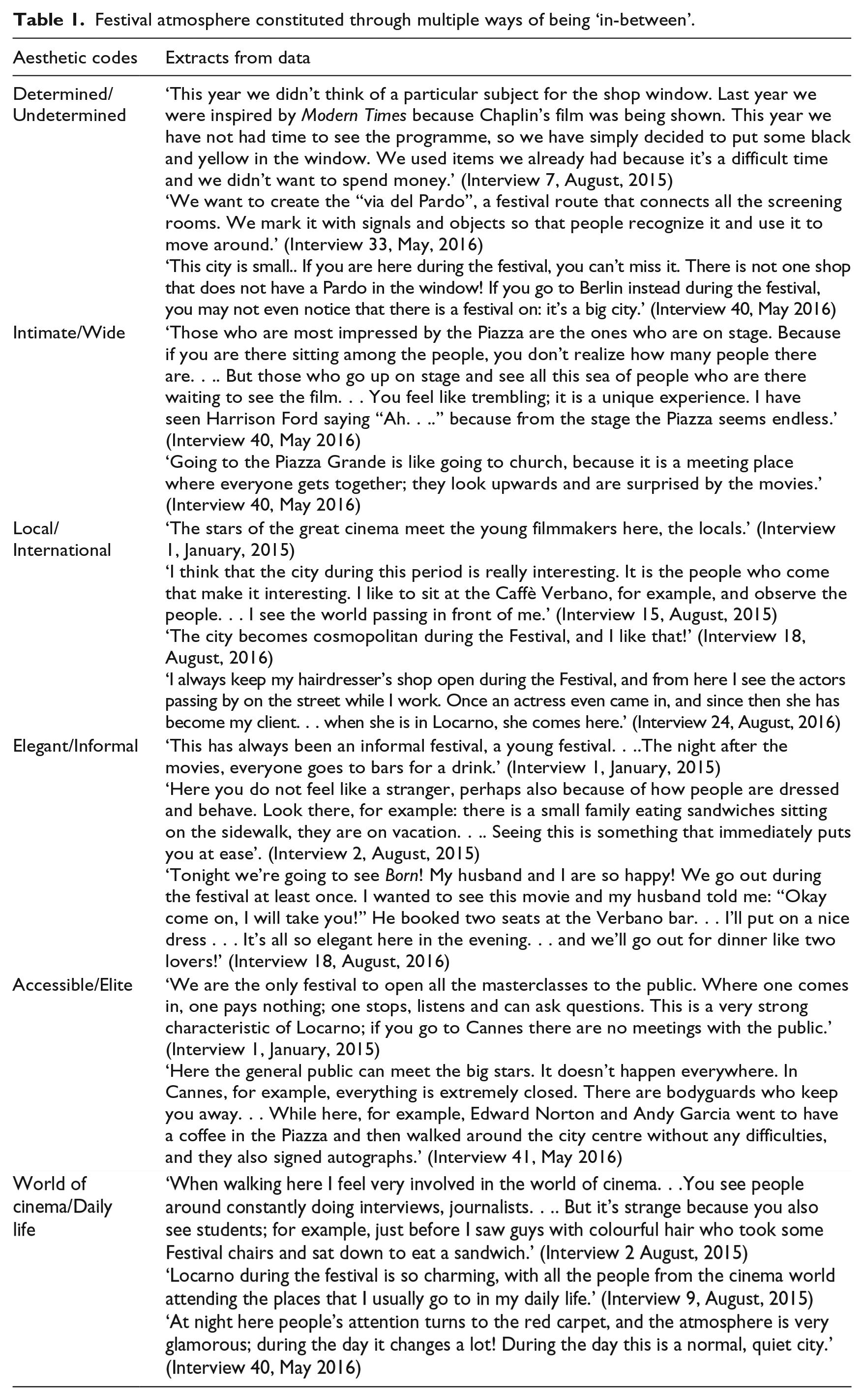
Conscious of the hybridity of the festival’s space, the festival management utilizes tailored interventions in space to highlight specific elements of the environment, and to make them contribute to the festival’s atmosphere (see Figure 1). As the logistics manager of the festival explains: One of the main entrances to the festival is located in front of the lake; it was built to look like a port with boats (the information corners are built in the shape of boats) which, merging with the natural environment, welcomes visitors [. . .] We have also the idea of bringing attention to the lake and moving people there by projecting videos directly on the surface of the water. (Interview 33, May 2016)
The festival’s interventions to make use of elements of the hybrid space and transform them into the festival space.
Other examples of spatial interventions that aim to combine elements of the festival with elements of the place include, for instance, the Piazza Grande, where ‘we use plastic chairs to create black and yellow spots on the Piazza, as if a leopard were passing over it’ (interview 33, May 2016). These chairs not only mark the presence of the festival in the urban square; their materiality also contributes to creating the festival’s atmosphere. The festival organizers insist that the chairs be plastic and not numbered, not only for practical reasons (i.e. so that they are stackable), but also to provide a sense of equality of access to the festival, of encounter and informality. Yet, being plastic, these chairs are not particularly robust and, as they occasionally break, some festivalgoers created a spoof advertisement to satirize their precariousness: ‘Enjoy it, but beware’, thus referring to a famous regional public warning cautioning bathers of the risks when swimming in a beautiful, but dangerous, local valley river where bathers die every year (interview 1, January 2015). In this way, the chairs bring in not only the international festival to the urban square but, through their appropriation by locals, also the ongoing local debates. These intricate material references of the festival and its local context provide a first indication of how the festival’s atmosphere emerges as an experience of in-betweenness.
The festival organizers are aware of the importance of the active participation of locals and festivalgoers, and they also interrelate the material transformation of the urban space into the festival space through rituals of participation. One such example is the big screen in the Piazza Grande, the setting up of which has become a local ‘ritual’ (interview 33, May 2016). Despite taking place at 6 am – when the air is cool and the lack of wind prevents the screen from being damaged – this event is attended by many people. The ritual allows the population to witness the transformation of its main square into the world’s biggest film screening venue, thus contributing to the atmosphere of ‘intimacy’ and ‘engagement’ (with the local population).
These examples indicate that the festival deliberately exploits the hybridity of space, and actively incorporates and transforms elements of the environment. Festivalgoers may respond to these interventions, with the festival often embracing these re-appropriations, such that the festival’s atmosphere takes form in these openings and emergences, and, as we show next, between the determined and the undetermined.
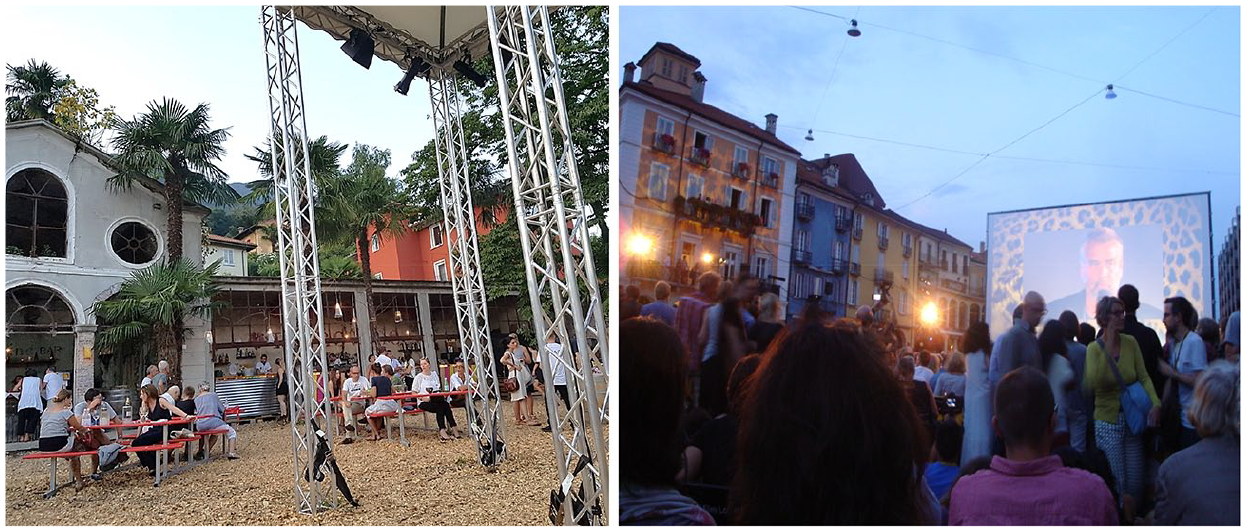
The festival intentionally leaves part of its space unoccupied and undetermined to provide the opportunity for others to participate with their own installations, decorations and events in the construction of the festival’s space. Consider Figure 2, for example, which shows how the owners of shops, bars and restaurants in the city centre decorate their shop windows during festival time. A toy store, for example, reconceptualizes the open-air cinema of the Piazza Grande by arranging wooden animals staring at a big screen; a pastry shop sells spotted pastries in boxes that resemble film reels, and even the local police affix festival stickers to their vehicles. While these idiosyncratic, material re-interpretations of the festival’s colours, logo and themes may not be entirely in line with the festival’s aesthetic code, they nevertheless play a vital role in creating the festival’s atmosphere. They signal to festivalgoers that the festival is not an international event isolated from the city; rather, the festival is embedded in its local environment, allowing room for the aesthetic expression of others, thus providing the sense of originality and intimacy cited by the young film distributor above. The aesthetics enacted by locals and festivalgoers within the festival’s space contribute to creating the atmosphere in the festival’s hybrid space, which is achieved through material practices, rather than being externally prescribed or being an abstract aesthetic concept imposed by the festival organizers.
Local organizations contribute to the construction of the festival’s space taking up the festival’s colours, logo and themes in their decorations of shop windows and means of work.
In summary, we find that, as regards the hybridity of the festival’s space, the festival’s atmosphere emerges ‘in between’ (see above quote from interview 44, August 2017); that is, between the different aesthetic codes of the city, those of the festival, the aesthetic expressions of locals, between the ‘presence and absence’ of the festival and between the ‘definite and indefinite’ (Anderson, 2009, p. 137). More specifically, the atmosphere emerges from a combination of elements of the festival (e.g. corporate colours, temporary installations in space, the films it features), elements of the environment (e.g. natural and architectural elements), and the collective practices of locals and festivalgoers who participate in the emergence of the festival’s atmosphere. The festival organizers, aware of the hybridity of the festival’s space, work with the in-betweenness of the festival’s atmosphere by encouraging participation, as well as by welcoming different aesthetic codes and expressions.
Guiding aesthetic experience through thresholds, interiors and corridors
The second way in which the festival creates its atmosphere is by processually guiding the users’ aesthetic expierence of the festival space, providing ‘thresholds’, ‘interiors’, and ‘corridors’ (Benjamin, 1927). In the following section, we will show how ‘thresholds’ help festivalgoers to transition between the world outside and the world within the festival, how ‘interiors’ provide festivalgoers with the sensation of being within the intimate space of a cinema and how ‘corridors’ connect interiors, providing a sense of continuity to the festival.
Thresholds – Entering (and leaving) the festival’s space
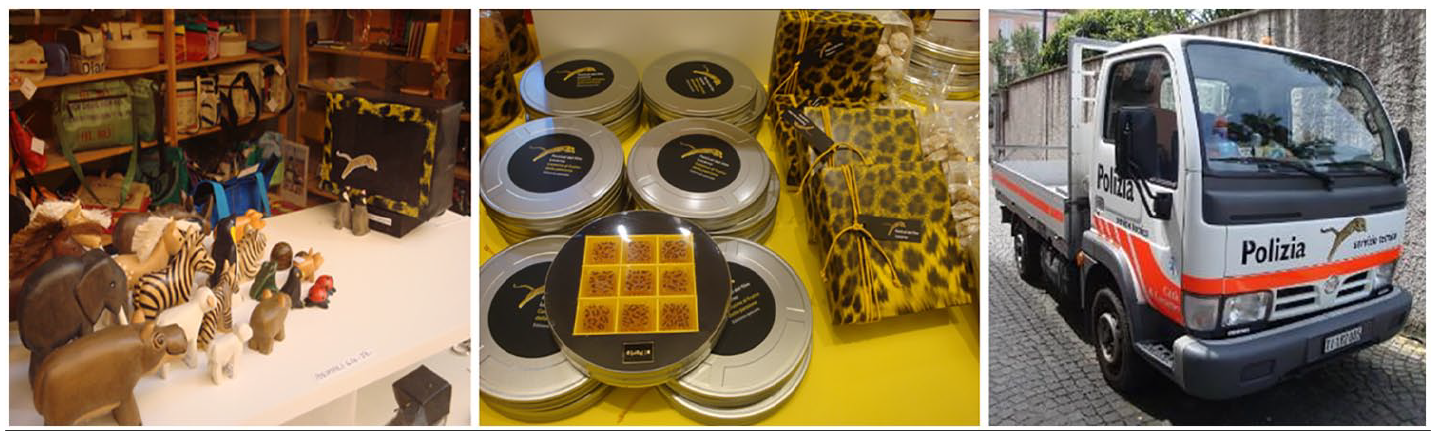
When arriving in Locarno for the festival, the train station and central road leading to the city centre feature several festival posters and banners that signal to people that they are gradually entering the festival world. Later, at the main ticket office, festivalgoers orient themselves with the festival guide, and chat and linger before slowly entering the world of the festival (see Figure 3). This threshold does not act merely as a barrier (e.g. to check festival tickets); rather, it becomes a zone of passage from the outside world to the interior world of the festival. A similar threshold was observed at the ‘info desk’, a glass-covered courtyard that is transformed into a welcome area for journalists and industry professionals, where they can linger, study the festival guide, and meet and talk to acquaintances. In the field notes we observed: ‘The entrance is plastered with newspaper articles covering the festival. Inside, we find plants, chairs and small tables; the floor has been covered with a soft material, giving one the sensation of being in an interior room, in the reception of a hotel, with the reception desk and a little bar in the corner’ (field notes, August 2015). Here, the journalists and industry professionals become festivalgoers via the threshold by obtaining their accreditations and welcome packs, symbolic representations of their professional status.
Thresholds.
Users often refer to thresholds such as the info desk as the ‘entrance’, ‘door’ (interview 29, April 2016), or the ‘check-in of an airport’ (interview 2, August 2015), elements which share the sense that this threshold marks a passage. The festival organizers carefully manage the aesthetics of these thresholds by providing enclosures, carpets and a ‘protective membrane’ (Borch, 2009, p. 2) in the form of a tent or a roof, which not only protects festivalgoers from the sun and rain, but also helps their eyes to adjust when moving from the glaring sun to the darkness of the cinema, and vice versa. These thresholds thus allow one not only to functionally enter the festival’s space, but also to gradually leave the everyday world and become part of the festival world through the ‘magic of the threshold’ (Benjamin, 1927, p. 88).
Interiors – Being immersed in the world of cinema
The festival, with its need for operational spaces, temporarily transforms municipal rooms, schoolyards and the halls of historic buildings into screening areas, press conference rooms, bars and reception areas. Having chosen these spaces for predominantly functional reasons (e.g. screening rooms must be sufficiently large to accommodate a certain number of visitors) the festival then has to perform minor alterations so that one feels is entering the ‘interior’ (Benjamin, 1927) of the festival. Therefore, in the same way that the interiors of a house have walls that define their borders, the festival’s interiors are clearly marked with borders that are physical (e.g. barriers) and symbolic (e.g. the entrance door of each interior is framed with a yellow and black motif).
Moreover, the festival scrupulously manages the aesthetics of its interiors; their atmosphere is described by festivalgoers as ‘informal’, ‘sober’ and ‘simple’ (interviews 1, 2, 7, 24, 29, 32, 34 and 40). When entering an interior, festivalgoers physically step into these confined spaces, becoming immersed in an environment that is aesthetically rather different from that outside: I part the dark, heavy velvet curtains; suddenly it’s dark all around me and I feel the cool air of the air-conditioned space. Once my eyes have adjusted to the darkness, I search for an empty seat in the vast room. There is almost no noise and people speak softly. Waiting for the film to start, and not being able to see who is sitting around me, I feel thrown back into myself. (field notes, August 2018)
This extract from the field notes shows the individual, while simultaneously collective, festivalgoer’s experience in the interiors of the festival’s space. Festivalgoers pass from daylight into the darkness of a cinema, from the warm summer temperature into a cooler environment, from the crowded and noisy exterior into a more intimate interior. ‘When the lights go out, the festival’s leopard takes over the screen, walking sinuously from left to right, and his dangerous roar foreshadows the beginning of the film’ (field notes, August 2016). Like a ‘dreaming collective’ (Benjamin, 1927, p. 546), people immerse themselves in the experience of the film. Finally: When the film ends, people burst out into extended applause. I am not the only one excited about the movie! I walk out of the cinema following the flow of people, but emotionally and mentally I am still inside, immersed in the film. I step again into the daylight, the heat and the large crowd of people. Here I am, outside again! (Field notes, August 2016)
Interiors of different types (see Figure 4) facilitate the immersion of festivalgoers into the world of cinema. They represent temporary, enclosed spaces where a more concentrated, intimate – albeit collective – experience is possible. We find that the festival’s atmosphere is nurtured by the oscillation between the confined, intimate, controlled spaces of the interiors and the wider, permeable and diverse spaces of the exteriors. The festival harnesses this oscillation not only by guiding the transition from interiors to exteriors (and vice versa) through thresholds, but also by providing a degree of continuity of experience, creating ‘corridors’ between interiors, as we will show next.
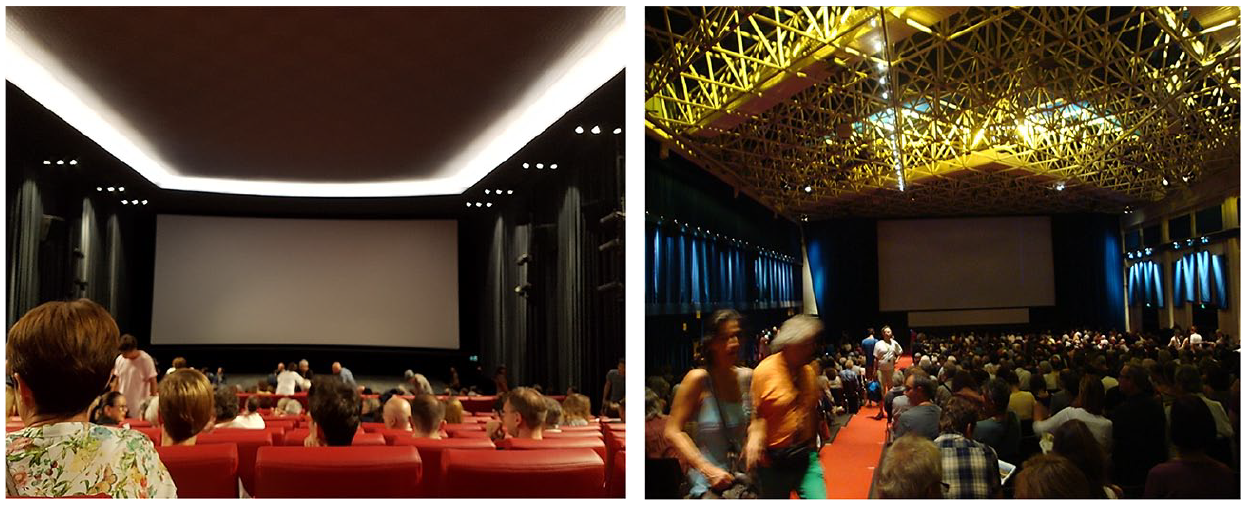
Interiors.
Corridors – Connecting interiors for a continuity of experience
The festival creates interiors in those spaces of the city that can satisfy the festival’s needs in terms of capacity, equipment or adaptability, and which the festival can temporarily occupy and transform. Interiors are therefore located in different areas of the city, between which the festival creates a network of paths that we call ‘corridors’ (Benjamin, 1927) (see Figure 5).
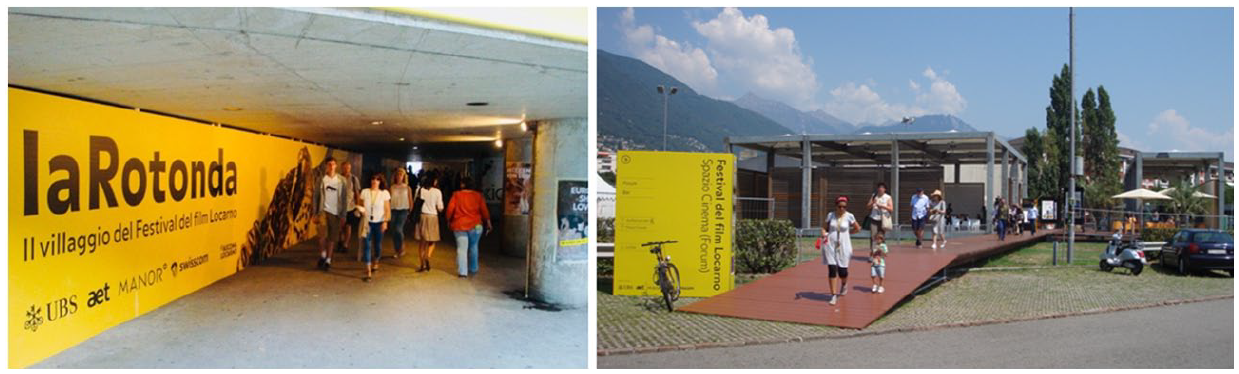
Corridors.
Similar to ‘the long corridors’ described by Benjamin, which guide the bourgeoisie from one room to another of their own homes (Benjamin, 1927), the corridors of the Locarno Film Festival guide festivalgoers from one interior to another through urban spaces. The festival utilizes signs, builds wooden footbridges and operates bus services to connect the various interiors. The signs are highly visible, branded with the festival’s colours and numerously displayed. The idea of the festival is ‘to create La via del pardo [The route of the leopard], a path that connects all the festival’s locations’ (interview 33, May 2016). The long-term goal is to create connections ‘so that the locations could not be considered any more as separate. It will be The Village of the Festival’ (interview 41, May 2016). The ‘village’ metaphor suggests that festivalgoers do not use these paths solely to orient themselves around the festival’s space; rather, the corridors additionally represent an attempt by the festival organizers to create a sense of unity, belonging and intimacy.
Festivalgoers enjoy moving within the hybrid spaces and along the corridors, as if the walks were necessary to leave one ‘interior’, emotionally and cognitively, before entering another, new interior. ‘I enjoy very much, after having seen a film, to walk for half an hour to another location. [. . .] This place is just wonderful’ (interview 9, August 2015); ‘It gives me the opportunity to move, think and meet people’ (Interview 13, August 2015). Festivalgoers also enjoy being in the flow of people along corridors: I came alone but now I am walking with many people. We all have the festival badge hanging around our necks and walk in the same direction to where a film is about to start. Even though I could leave the path at any moment, I don’t. I prefer to continue walking with the flow of people, of which I feel part. (field notes, August 2016)
Corridors are not only manifested through signs and physical objects, but also through the aesthetic engagement that they create. They make festivalgoers feel part of the festival and through this spatial practice of moving within the flow of festivalgoers also contributes to the creation of such corridors. Indeed, although there are only few physical restrictions to the paths a festivalgoer may take through the city of Locarno and the festival’s space itself, our observations show that the majority of festivalgoers stick to the designated festival paths. These paths not only orient users’ movements within space, but they also affect their perception and use of space through multi-sensorial stimulation (van Marrewijk, 2011), providing a continuity of experience of the festival’s space, notwithstanding its hybridity. While the aesthetics of these corridors are not entirely predefined, they foster a particular relationship between the festivalgoers themselves and with the interiors, forming an experience of the festival that is – in part – shared collectively.
Providing a centre of experience – intensifying in-betweenness
With the festival’s various spaces scattered across the city like the spots of a leopard, we find that, in terms of the emergence of the festival atmosphere, a centre of experience is necessary, one where the aesthetic engagement is intensified not despite, but because of the spaces’ hybridity. Indeed, the Piazza Grande serves this purpose for the Locarno Film Festival. It is the main public square of Locarno and, during festival time, it is transformed into a unique open-air screening venue, featuring a large screen and hosting up to 8,000 people at night. Festivalgoers undisputedly regard the Piazza Grande as ‘the heart of the festival’ (interviews 1, 2, 9, 15, 17, 18, 22, 29, 34, 39, 40 and 41). When asked about the one defining aspect of the festival, the festivalgoers repeatedly reply: the Piazza. Festivalgoers describe the central square as ‘magical’ or ‘dreamy’ (interviews 2, 9, 15, 17, 18, 24, 29 and 40). ‘Being here at night. . . being part of this,’ [a woman says], ‘is magical! It takes your breath away!’ (interview 18, August 2016). There is something impalpable permeating the air (Anderson, 2009), and it is here, the Piazza Grande, where the festival’s atmosphere is most strongly felt.
In the Piazza Grande we observed an intensification of the aesthetic practices described above to create a magic atmosphere (see Figure 6). The practices of cultivating in-betweenness are particularly intense in the Piazza; the festival does not seek to conceal the existing architectural, cultural and scenic features of the central square. Consider the following notes from our observations: I have managed to get a seat on the Piazza Grande. Around me, people are chatting, eating, reading, greeting some friends. It’s a relaxed, friendly, but also vibrant atmosphere. A camera is capturing some of the faces in the audience, projecting them onto the gigantic screen in front of us, as if the public and the movie stars were no different. [. . .] It’s gradually getting dark and the historical buildings around us are now illuminated in blue, yellow and pink. The piazza is even more packed, with thousands of people. Then, finally, the projected church tower with the clock shows it’s 22.30, then comes the iconic acoustic symbol of the festival and the lady presenter appears in the spotlight on stage. (field notes, August 2018)
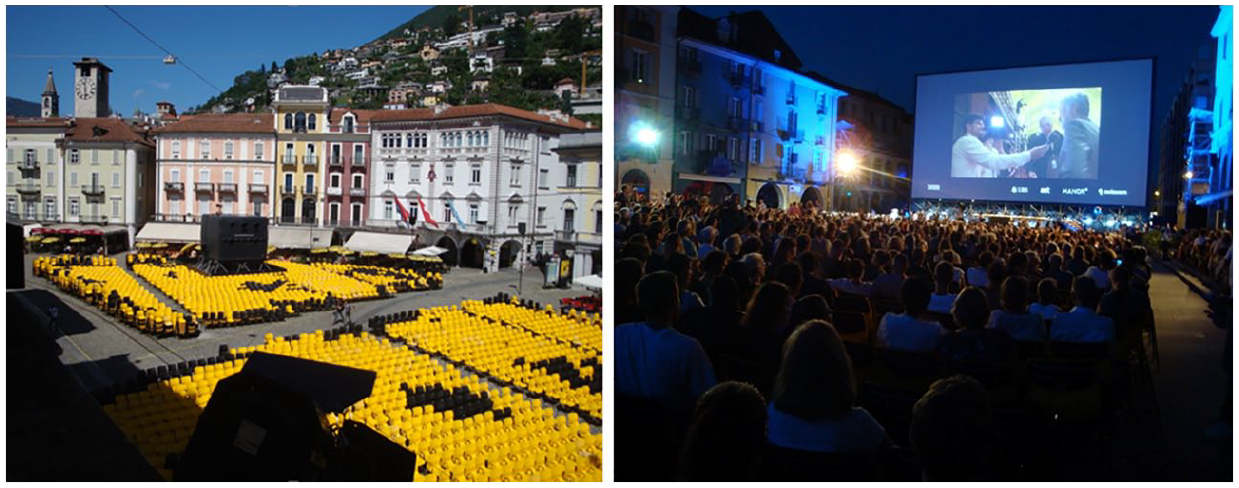
Magic room.
With the use of lights and projections, the festival organizers actively assimilate the urban surroundings into the festival, and carefully orchestrate an atmosphere of ‘in-betweenness’. The practice of illuminating the nearby church tower, for example, not only signals the beginning of the show, but also intensifies the moment that the 8,000 people have been anticipating. It is by making the long wait a necessity for festivalgoers, leaving them thus to chat to neighbours and greet acquaintances, that the festival harnesses the historical and social function of the central square of a city as a meeting place, as well as capturing a visible sense of community. Moreover, while sitting on the chairs in anticipation, festivalgoers witness the darkness that gradually overtakes the square and, little by little, perceive the transformation of this social space into the more intimate world of cinema. With the heat slowly subsiding and a ‘pleasant fresh breeze coming down the mountains’ (interview 43, August 2018), festivalgoers can move from the hot summer day to enter the dream world of the night.
Even as the film in the Piazza eventually begins, and the festivalgoers finally find themselves at the centre of the festival, the festival space is neither sealed off nor insulated from the outside; rather, it continues to be permeable to unexpected events: Sitting yesterday at Spike Lee’s screening in the Piazza with this crazy amount of people around [. . .] it was so fascinating! It was raining, there was thunder and lightning all around. [. . .] There is something very romantic about being in the Piazza during a very late evening in a storm. (interview 42, August 2018)
Not only the weather, but also the audience participates (Michels & Steyaert, 2017) in creating the aesthetic experience, for example by loudly criticizing a film: In the Piazza, you never know what is going to happen in terms of the reaction of the audience! Provocation could happen from both sides: from the stage and from the audience, who could ‘boo’ the film loudly. The reactions could be so loud that they could not even continue [screening] the movie. This gives a thrill because you really have the impression you are part of it. (interview 43, August 2018)
While heated debates or stormy weather could be conceived of as distractions from the smooth execution of the festival, they do in fact contribute to creating a magical and engaged atmosphere. ‘It’s magical because, despite every now and then when it rains, the fact of being outdoors, under an umbrella, shivering with cold [. . .] watching a movie on such a large outdoor screen [. . .], this is what makes the public live the experience’ (interview 41, May 2016).
When considered together, our data suggests that the Piazza Grande serves, both spatially and atmospherically, as the nucleus of the festival, where the aesthetic practice of creating an in-between atmosphere is intensified. The fact that the festival takes place in hybrid spaces, in geographically distributed and functionally differentiated locations that are expressive of different aesthetic codes, means that the risk of the specific atmosphere of the festival dissipating is ever-present. For this reason, the festival needs to mark a tangible centre of its experience. Interestingly, the festival organizers achieve this centrality not by sealing off the main square from its environment, but rather by intensifying its aesthetic practice of creating an atmosphere in-between. In other words, faced with a hybrid space, rather than providing insulation (Sloterdijk, 2004), the festival works towards an intensification of the atmosphere, and thus creates a centre of experience.
Concluding Discussion
In this paper we have examined the process of aestheticization of the Locarno Film Festival’s hybrid spaces. Drawing upon the work of Benjamin (1927), Böhme (1993) and scholars of organizational aesthetics (Gagliardi, 1999; Strati, 1999), we have developed an aesthetic engagement approach that enables us to understand the aestheticization of hybrid space as the production of atmospheres in-between multiple ambiguities. Our findings show that the atmosphere of the Locarno Film Festival is created by three aesthetic practices in the production of the festival space.
The first is interrelating diverse aesthetic codes and expressions: the festival organizers do not attempt to homogenize the different aesthetic codes (e.g. the colourful facades of the historic palaces of the Piazza, or the restaurants from the 1960s, with their intense smells and outdated styling). Nor do they homogenize the different aesthetic expressions of the space users (e.g. their practice of decorating their shop windows with colours or objects that recall the festival). Rather, the organization allows for interrelations between different aesthetic codes and expressions, thereby leaving room for the participation of locals and festivalgoers.
The second practice we identified in the aestheticizing of hybrid space is the processual guidance of the aesthetic experience by building thresholds, interiors and corridors. We have demonstrated that these spatial interventions are not only guided by functional concerns, but are central to transitioning in (and out of) the festival space, to transforming the attendees into festivalgoers, to becoming immersed in the world of cinema, thereby achieving a continuity in the festival experience.
Finally, through the third practice of providing a centre of experience, festivalgoers become part of a ‘dreaming collective’ (Benjamin, 1927). Thus, the festival’s atmosphere becomes experienced more vividly, through the intensification of the aesthetic practices of creating an atmosphere in-between.
Space production through atmospheres
These findings further our understanding of the aestheticization of hybrid organizational space. The process of the aestheticization of organizational space cannot be understood merely as the co-creation of managerial design and users’ resistance, as has been found in earlier studies (e.g. Wasserman, 2011); nor can it be described with the almost ‘spontaneous emergence of unplanned atmospheres’ that occurs ‘in erratic, ephemeral and excessive ways [. . .] through a series of encounters between various bodies and their specific affective capacities’ (Michels & Steyaert, 2017, p. 79). Rather, the aestheticization process in hybrid space requires one to address the in-betweenness of multiple ambiguities (Anderson, 2009). In our case, this involved not only working in between the determined (e.g. the spatial interventions to mark the festival’s space) and the non-determined (e.g. leaving space for others to express themselves and become part of the festival’s space); it also required a moving in between different ‘aesthetic codes’ (Gagliardi, 1999) (namely those of the festival, those of the urban environment) and expressions (e.g. those proposed by locals and festivalgoers) and creating the festival’s atmosphere between objects (e.g. the festival’s spaces) and subjects. Beyond aesthetic engineering and actions of resistance, festivalgoers’ and locals’ actions, bodily appropriations and ‘capacities of sensing and relating’ (Michels & Steyaert, 2017, p. 45) actively contribute to the festival’s atmosphere.
This in-betweenness of atmospheres allows us to revisit our understanding of hybrid space. In our case, the ‘hybrid space’ of the festival was not simply ‘multiply located’ (Halford, 2005), as if space had fixed locations and spatial boundaries. Rather, hybrid space involves the co-presence of multiple aesthetic codes; it is qualified more processually by the continuous rearrangement of relations between co-present, yet different spaces. Through these three aesthetic practices we have shown how the festival and the urban space interrelate on an aesthetic level. In addition, we have provided certain indications that these relations are not in fact stable, but evolve as the various social, material and affective relations rearrange themselves. The blurring of boundaries in hybrid space is therefore not merely a functional issue (e.g. my home is used as my workplace), but is, critically, an aesthetic phenomenon (e.g. a sense of home and a sense of work becoming enmeshed).
Moreover, our study provides some indication of the role of ‘insulation’ in the creation of atmospheres in hybrid spaces (Sloterdijk, 2004). Contrary to traditional workspaces, which have clear physical boundaries, hybrid spaces are more ‘unbounded’ and ‘fluid’ (De Vaujany et al., 2019), so sealing off such spaces from the outside is less viable. Organizational members frequently move between spaces, or work in multiple spaces at one time (e.g. virtual and physical spaces). Our study has shown how the guidance of the space users’ aesthetic engagement through thresholds, interiors and corridors, as well as the intensification of the aesthetic experience, can allow one to transition between spaces, providing a continuity of experience and facilitating a sense of being in a protected interior. Indeed, while our case was characterized by the in-betweenness of confined, intimate interiors and wide, permeable exteriors, this ambiguity may be due to the particularity of the context of a film festival (where screening rooms are required); future research is needed to ascertain whether insulated islands of interiority are in fact a more general phenomenon of hybrid spaces. What is of particular interest in this regard was that the centre of experience was not particularly insulated in aesthetic terms, but functioned, significantly, with the intensification of the aesthetic experience via in-betweenness (i.e. intimate, but open). This suggests that Benjamin’s ‘thresholds’, whose in-betweenness of being both interieur and exterieur, modern and historic, collective and private, become more relevant in terms of atmospheric insulation. For Sloterdijk (2004), while Benjamin’s thresholds provided a ‘good fit’ with the 19th century’s architecture of consumption, they are less successful in adequately capturing the atmospheric insulation required in today’s enclosed temples of consumerism (e.g. shopping malls). Our study suggests, rather, that thresholds as zones of transformation – rather than of hermetic insulation – regain importance where spaces are hybrid in nature, and where people have to constantly navigate between worlds.
Organizing as an atmospheric phenomenon
Our study contributes to the emerging interest of organization scholars in atmospheres (see Julmi, 2017; Michels & Steyaert, 2017). We concur with Reckwitz (2012) and Beyes (2016) that the notion of atmosphere has a rich potential for analysing how the process of aestheticization operates in today’s organizational arrangements and for understanding organizing as an atmospheric phenomenon (Beyes, 2016). Atmosphere-making is not limited to film festivals or ‘creative industries’, but has become part of experience-based consumption, transforming into what has been called ‘aesthetic capitalism’ (Beyes, 2016, refering to Raunig, 2013).
The findings from this study may be particularly important to improving our understanding of how to aestheticize new, post-industrial forms of working spaces, such as hybrid spaces (Halford, 2005). Our study proposes that ambiguities, multiplicities and diversities need not be a problem in terms of enabling a specific atmosphere; rather, they can be harnessed as a resource to shape atmospheres in-between. We suggest that we might best understand hybrid spaces as ‘open environments’ (Philippopoulos-Mihalopoulos, 2016), which are spaces infused in the everyday urban landscape. While these spaces – in our case those of the film festival – may present as desirable and pleasurable social-spatial configurations, thanks to their atmospheric qualities, and have proven extremely successful in their capacity to attract people, we must nevertheless maintain a critical stance towards such perceptions (Reckwitz, 2012). Since atmospheres have fuzzy borders, they have a tendency to occupy and even ‘colonize’ public space (Böhme, 1993, p. 114). By contrast, we have focused on the aesthetic practices of space that produced the festival atmosphere, how this atmosphere colonized the urban space beyond the occurrence of the festival, providing new meanings and identities to the city (Quinn, 2003). Future research could usefully investigate such branching out effects of atmospheric phenomena. In addition, because – as our study has shown – atmospheres do not emerge merely out of the careful aesthetic design of a space and its resistance to it, but develop in the absence of design, on the non-determined, the multiplicity of aesthetic codes and distributed participation, it might prove to be more problematic to identify intentionality and attempts at managerial control. Our study therefore suggests that future studies should embrace relational and processual accounts to further investigate the in-betweenness of atmospheres.
In conclusion, we should not forget the political nature of aesthetic experiences (e.g. Alexandersson & Kalonaityte, 2018). Even in carefully managed aesthetic spaces, diverse social groups can utilize space differently. In their study of resistance, Courpasson, Dany and Delbridge (2017) found that the meaning of a place was as important as the absence of organizational control, and therefore suggest foregrounding the issue of the meaningfulness of places. In contrast to this and other studies (e.g. Wasserman, 2011), and much to our own surprise, we did not observe significant attempts to resist the festival’s aestheticization and atmosphere. This might be attributable to the temporality of the Locarno Film Festival’s space, or because festivals are not ‘meaningful places’ for resistors (Courpasson et al., 2017), since festivalgoers choose ‘freely’ to attend for the purposes of pleasure. Further research is needed to clarify whether this sort of coherence between the organization of space, users’ aesthetic engagement and action is evident in open-environment workspaces. Future research will therefore need to analyse how the two aesthetic practices of interrelating different aesthetic codes and expressions, and the guiding of aesthetic engagement, play out when the work in hybrid spaces is less voluntary in nature. For example, the issue of the intensification of aesthetic engagement through a centre of experience will need to be appraised more critically in terms of its seductive and manipulative power (Dovey, 1999). Notwithstanding these limitations, our study proposes an interesting avenue of how the aestheticization of hybrid space can be addressed, and how organizations can benefit from the in-betweenness of organizational atmospheres.
Footnotes
Funding
This study was supported by Swiss National Science Foundation (SNSF) under grant number 100018_162733 and by the USI Equal Opportunities Service under grant “Shadowing 2018”.
