



Abstract
This paper develops the idea of neocolonialism as organizational identity work in multinational corporations (MNCs). We argue that neocolonialism – the ethos and practice of colonialism and western superiority in contemporary society – is a means through which identity is worked on at MNC headquarters (HQ). In contrast to extant neocolonial studies of western MNCs, which focus on the subsidiaries (the colonized) and how their identities are shaped by the HQ (the colonizer), we analyse how the HQ is shaped by the subsidiaries. We elucidate two versions of neocolonialism at play: a traditional neocolonial ethos, which prevails at HQ, and a more contemporary version, which is silenced. Our findings show that nurturing a shared and enduring organizational identity across all units of an MNC is a quixotic task. Nevertheless, HQ managers in western MNCs keep attempting to do this, suggesting that neocolonial ethos and practice continue to be relevant in these organizations.
Introduction
We are witnessing a trend of anti-globalization and protectionism (Alvarez & Rangan, 2019), which is reflected in ‘a rediscovery of the local’ in many walks of life (Ginty, 2015, p. 845). The revival of nationalist sentiment in North America, Europe, Asia and beyond has encouraged many multinational corporations (MNCs) to emphasize their local roots, identifying openly with their countries of origin (Dahles & Stobbe, 2004; Storgaard, Tienari, & Piekkari, 2014). The ‘global mindset’ that was once seen as the pinnacle of MNC evolution (Gupta & Govindarajan, 2002; Perlmutter, 1969) is challenged by ethnocentric attitudes and practices in the subsidiaries (Ailon & Kunda, 2009; Koveshnikov, Vaara, & Ehrnrooth, 2016) as well as in the corporate headquarters (HQ) (Michailova, Piekkari, Storgaard, & Tienari, 2017). While MNCs from emerging markets are oriented towards their home country in their dismissal of western virtues of management (Guillén & García-Canal, 2012), MNCs from new global powers such as China are openly nationalistic (Cheng, 2011; Jackson, 2014). Western MNCs seem to be following suit in reconsidering their ‘global’ discourse.
International business and management research has traditionally referred to ethnocentrism as a sense of superiority regarding one’s own nationality and ethnic group and hostility towards others (Perlmutter, 1969). However, what the extant literature tends to address as ethnocentrism in western MNCs can take the form of neocolonialism: a contemporary continuation of colonialism ‘with elements of political, economic and cultural control’ (Banerjee & Prasad, 2008, p. 91; Boussebaa, Sinha, & Gabriel, 2014; Mir, Banerjee, & Mir, 2008; Prasad, 2003). While geographical dispersal is pulling MNCs apart, neocolonial identity seems to hold MNCs together, at least in the short term (see Kreiner, Hollensbe, Sheep, Smith, & Kataria, 2015).
Management’s efforts to hold the MNC together have largely passed unnoticed in the mainstream literature on organizational identity due to its apolitical and ahistorical nature. This stream of research is only starting to move beyond Albert and Whetten’s (1985) conceptualization of organizational identity as something central, enduring and distinctive. Recent questions about identity stability and change (Corley & Gioia, 2004) as well as endurance (Anteby & Molnár, 2012) have produced vibrant research on ‘organizational identity work’ (Anteby & Molnár, 2012; Basque & Langley, 2018; Kreiner et al., 2015; Kreiner & Murphy, 2016). Nevertheless, our understanding of ‘what it takes for organizational identities to stay the same’ remains limited (Anteby & Molnár, 2012, p. 516). This is particularly the case with MNCs and their neocolonial ethos as the ‘global’ discourse is increasingly questioned across the world (Alvarez & Rangan, 2019).
In this paper, we focus on organizational identity work in an MNC and link it to neocolonialism. Our case study of a Danish MNC tells the story of members of an ingroup at HQ who attempt to retain a distinct organizational identity. We show that identity endurance in the MNC is maintained through a traditional neocolonial persistence in spreading a local version of identity to all units worldwide. However, we also elucidate how this approach is questioned within HQ by an outgroup with a more contemporary version of neocolonialism. As such, we offer three contributions in this paper. First, by conceptualizing neocolonialism as organizational identity work we contribute to research on western MNCs in general and to understanding identity work in these organizations in particular. Second, by showing how different versions of neocolonialism play out as tensions and struggles within the HQ we contribute to the increasing body of neocolonial analyses of MNCs. Third, we outline implications of struggles over neocolonialism for organizational identity work in MNCs more broadly.
The remainder of the paper is structured as follows. We first discuss the need to study MNCs in the light of neocolonialism (instead of ethnocentrism), and offer ideas on how to do this with regard to organizational identity work. We then present our methodological choices, offer our key findings, elaborate on the contributions of our study and suggest ideas for future research.
From Ethnocentrism to Neocolonialism in MNC Research
The European colonial period across the world lasted from the 15th and 16th centuries to the mid-20th century. Colonizers justified their ideas and actions by claiming to bring a ‘superior’ civilization to colonial peoples (Said, 1978). Today, most colonial powers have withdrawn but colonialism has ongoing significance for people’s lives in both the West and non-West (Prasad, 2003). The practice and ethos of colonialism has evolved into what is referred to as ‘neocolonialism’ (Boussebaa, 2015).
The bulk of mainstream research in international business and management has largely avoided discussion on neocolonialism, and has instead studied the local and the global in MNCs through the concept of ethnocentrism. Perlmutter (1969) argued that managers’ ethnocentric attitudes influence organization structure and staffing of key positions, decision-making and communication, as well as the identity of the firm. Much of the subsequent research has applied Perlmutter’s (1969) model to understand how MNCs are managed and how they evolve towards higher degrees of multinationality. The focus has been on relations and interaction between the HQ and foreign subsidiaries and especially on the negative consequences of HQ ethnocentrism (see e.g. Caligiuri, Baytalskaya, & Lazarova, 2016; Muratbekova-Touron, 2008; Pocovnicu & Vasilache, 2012). Perlmutter’s (1969) ideas have been valuable in alerting scholars to the potential perils of ethnocentrism (if not neocolonialism) in HQ–subsidiary relations. However, Michailova et al. (2017) criticize the notion advanced in much of the MNC literature for its simplistic treatment of power relations. In many cases, ethnocentrism can be intentional (Mayrhofer & Brewster, 1996) and it can take the guise of the ‘global’ (Storgaard et al., 2014). In this sense, the mainstream international business literature has hardly addressed the ‘global’ windowdressing or dealt with the rising trends of parochialism, nationalism, ethnocentrism and neocolonialism in MNCs and their operating environments (Ailon & Kunda, 2009; Koveshnikov et al., 2016).
Neocolonial studies on MNCs are developed for the most part outside the mainstream international business research. These studies offer a critical lens through which to analyse how key actors at HQ work on organizational identity in relation to foreign subsidiaries or ‘colonies’. Understandings of neocolonialism are rooted in postcolonial theory 1 that has gained ground in organization and management studies (Jack, Westwood, Srinivas, & Sardar, 2011), but less so in international business research (Boussebaa et al., 2014). Said (1978) argued that colonial discourse was upheld by systematic reproduction of binary distinctions of ‘us’ (the ontologically superior and progressive western colonizers) and ‘them’ (the ontologically inferior, backward, and colonized non-western Other). In addition to material domination, then, colonial discourse justified the conquest and control of identities in the colonies (Frenkel & Shenhav, 2006). These core–periphery relations live on in contemporary societies (Banerjee & Prasad, 2008; Jack et al., 2011), not least in and through the actions of MNCs (Boussebaa, Morgan, & Sturdy, 2012). With our empirical focus on the HQ of a Danish MNC, we build on Said’s (1978) insight that colonization did not (and does not) only happen in ‘faraway places’, but at the heart of Europe, too.
Research building on these insights tends to focus on subsidiaries (or ‘colonies’) of western MNCs outside the West (or Global North) rather than the HQ. Ulus (2015) shows how neocolonial dynamics and power relations are reproduced daily in the Indian context, and Dar (2018) illustrates how such power relations are sustained by using the English language. Hopkinson and Aman (2019) offer an analysis of micro-political contests and struggles in Pakistan in relation to MNCs’ actions, while Boussebaa et al. (2012, p. 480) explore ‘inter-office conflicts’ in management consultancies where western consultants pre-structure their world as a ‘postcolonial hierarchy’. As such, MNCs are among the most significant carriers of neocolonialism worldwide (Boussebaa et al., 2014; Boussebaa & Morgan, 2014; Garfolo & L’Huillier, 2014; Petras & Veltmeyer, 2001).
According to Boussebaa (2015), contemporary MNCs exercise ‘imperial power’ through false claims to universalism, that is, HQ elevates particular local western cultural standards to the status of trans-societal norms. Localisms that do not match such norms are portrayed as backward and in need of reform (see Said, 1978). Boussebaa (2015) argues that neocolonizers’ claims are suspect as they ignore cultural and institutional heterogeneity, and marginalize local subjectivities and forms of knowledge that do not conform to what is considered to be universal. As such, ideologies sustained by neocolonial relations ‘permeate the lives of people who were not directly caught in the colonial encounter’ (Liu, 2017, p. 782). This includes HQ managers in contemporary MNCs who draw from colonial discourse and practice.
Banerjee (2011, p. 328) argues that neocolonialism exerts its power ‘through organizational practices of extraction, exclusion and expulsion’. Referring to ‘internal colonialism’ within nation-states and the suppression of indigenous peoples’ rights in particular, Banerjee (2011) opens up the debate on MNCs and their management practice for more critical inquiry. He argues that MNCs extract resources from locations across the world, and exclude those in the peripheries from the decision-making that concerns them and their lives. MNCs also force expulsion on their subsidiaries – often in terms of practices and activities – as they conquer more ground. In brief, MNCs reproduce distinctions between cores and peripheries established in colonial times, and perpetuate colonial-style power relations in contemporary society (Boussebaa, 2015; Özkazanc-Pan, 2008).
While the consequences of neocolonialism can be devastating for individuals (Prasad & Qureshi, 2017) and communities (Banerjee, 2011), neocolonial processes are also subject to a degree of subversion and resistance (Boussebaa et al., 2014). As such, neocolonialism affects the colonizers, too. This is an issue we discuss in the next section.
Organizational Identity Work and Neocolonialism
The complex processes through which organizations and organizational members engage in self-definitions have attracted keen research interest (Pratt, Schultz, Ashforth, & Ravasi, 2016). Researchers have sought to understand the complex connections between organizations and identities (Albert & Whetten, 1985; Gioia, Schultz, & Corley, 2000). Working on identity is about remembering and forgetting (Anteby & Molnár, 2012) and recent research has specified how history and the past are evoked in organizational identity constructions and how they impact claims of present and future identity (see e.g. Anteby & Molnár, 2012; Basque & Langley, 2018; Hatch, Schultz, & Skov, 2015; Schultz & Hernes, 2013). These insights are important for theorizing on organizational identity and neocolonialism in MNCs because they draw our attention to temporal (past–present–future) as well as spatial (core–peripheries) complexities in the way identities are enacted and challenged.
Gioia et al. (2000, p. 76) urge researchers to study ‘how organizational members work to maintain continuity’. Anteby and Molnár (2012, p. 515) agree that ‘how identities actually endure over extended periods of time remains empirically poorly understood’. Kreiner et al. (2015) argue that organizational identity is experienced, and comes into being, by constant negotiations as changes in the operating environment and within the organization affect the way organizational members experience and interpret who they were, are and are going to be. Negotiations and shifts in considerations of organizational identity over time – or the ‘ebbs and flows’ as Kreiner et al. (2015, p. 982) call them – have led scholars to conceptualize the construction of identities in organizations as identity work.
Although the concept of identity work was originally used in reference to individuals (Snow & Anderson, 1987), there are recent examples of research on ‘organizational identity work’ (Anteby & Molnár, 2012; Basque & Langley, 2018; Kreiner et al., 2015: Kreiner & Murphy, 2016). Individuals’ identities are typically viewed as fluid and evolving constructions, which are worked on to establish a temporary sense of coherence and distinctiveness in the face of uncertainty and insecurity. Organizational identities, too, can be understood as socially constructed as they are worked on by various actors and through multiple attributes and processes (Glynn, 2000; Kreiner et al., 2015). Basque and Langley (2018, p. 1687) define organizational identity work as the efforts ‘engaged in by organization members individually or collectively to form, repair, maintain, strengthen or in other ways influence understandings of the central, distinctive and enduring characteristics of a specific organization’. These authors address how particular constructions of identity are promoted by actors such as top managers, ‘without assuming that these are shared or immutable’ (Basque & Langley, 2018, p. 1687).
While research on organizational identity work provides important insights into organizational life, it leaves many crucial questions unanswered. For instance, in many if not most western MNCs organizational identities are worked on in neocolonial spaces that set particular conditions for it. While neocolonial discourse and practice attempt to fix and stabilize knowledge about difference (thus legitimizing asymmetrical power relations between the colonizer and the colonized), they are never homogeneous and stable. Critical research has drawn attention to hybrid identities under conditions of neocolonialism (Jack et al., 2011) that emerge from the interweaving of elements of the colonizer and colonized. It highlights the ambivalent nature of identity construction among organizational members in the subsidiaries or ‘colonies’ (Yousfi, 2014).
We assume that neocolonizers, too, are influenced by the colonized in processes of organizational identity (re)construction (see Bhabha, 1994). Neocolonizers’ sense of superiority at HQ is constantly subverted and resisted, and this is likely to influence their identity work. McKenna (2011, p. 390) holds that ‘neocolonial discourse regulates the identity of those who use it, shaping how they view developments in the global business environment and informing their response to it’. In neocolonial encounters, then, both the subsidiaries (the colonized) and the HQ (the colonizers) are affected and changed through subversion of the HQ neocolonizers’ authority. The outcome is that ‘the colonizer’s identity, far from being stable, unambiguous, and confident, is characterized by a fluctuation between self-confident universalism and the anxiety of being imitated and mocked’ (Sayed, 2016, p. 61). In our empirical study, we focus on this very aspect of organizational identity work in the MNC headquarters.
Research Design
Context
Our empirical study is set in a Danish MNC. As a Nordic country, Denmark draws its value system from the narrative of progress in the Enlightenment, and defends its values ‘sometimes even more forcefully than the former colonial centres’ (Mulinari, Keskinen, Irni, & Tuori, 2009, p. 1). Denmark is portrayed as an ethnically and culturally homogeneous nation with strong internal cohesion, national identity and sceptical attitudes towards the outside world (Lauring, 2011; Selmer & Lauring, 2013). Recent governments in Denmark have introduced more stringent immigration laws. The ‘model of Danish society’ is referred to as ‘provincial smug ethnocentrism’, where prejudice and xenophobia are widespread (Andersen, 2002; Selmer & Lauring, 2013, pp. 9, 12). Denmark is also a colonial nation, albeit a relatively minor one. In contrast to some colonial centres, Denmark has never gone through a ‘clear period of critique of colonialism and its presence in everyday environments and encounters’ (Mulinari et al., 2009, p. 2). Due to its small size, and its location in the ‘semi-periphery’ of neocolonialism (Eidsvik, 2012, p. 15), the country was never a major driving force in colonial conquest. However, Denmark was (and is) complicit in the knowledge production and performance of power that were (and are) instrumental in promoting the interests of colonial nations. These features make Danish MNCs interesting subjects of inquiry with regard to organizational identity work and neocolonialism.
Data collection
From 2005 to 2012, we conducted a case study of a family-owned MNC established after the Second World War and headquartered in Denmark. For reasons of confidentiality, we refer to the case company, a mature and successful MNC, as Dancom. As an illuminative case of a western MNC, Dancom’s HQ has made an effort to spread its way of operating throughout the geographically scattered organization. Dancom consists of dozens of subsidiaries, over 15,000 employees, and several billion US$ in annual turnover. We opted for a single case design because it allows us to gain rich insight into the empirical phenomenon through multiple sources of evidence (Stake, 2005). In line with the case study tradition, our aim is not to generalize to a population of MNCs, but instead seek analytical generalization (Yin, 2014, p. 40), that is, to compare our findings and insights with extant theory.
Table 1 provides an overview of the data sources. The first author conducted 41 individual face-to-face interviews, of which 37 took place in 2007–2008: 12 at HQ (one repeat interview) and 25 in the subsidiaries. In 2012, four additional interviews were conducted at HQ to follow up on recent developments at Dancom: three with former Danish expatriates and one with a representative of a major subsidiary. The interviews lasted 46 hours and 35 minutes in total. They were recorded and transcribed with the aim of capturing the accounts of the research participants verbatim. Moreover, the research relationship between the first author and Dancom was close and ongoing, as the openness of the interviewees shows. She also had informal discussions with managers at the HQ and used these opportunities to ‘test’ our interpretations as the research process unfolded.
Overview of data sources.
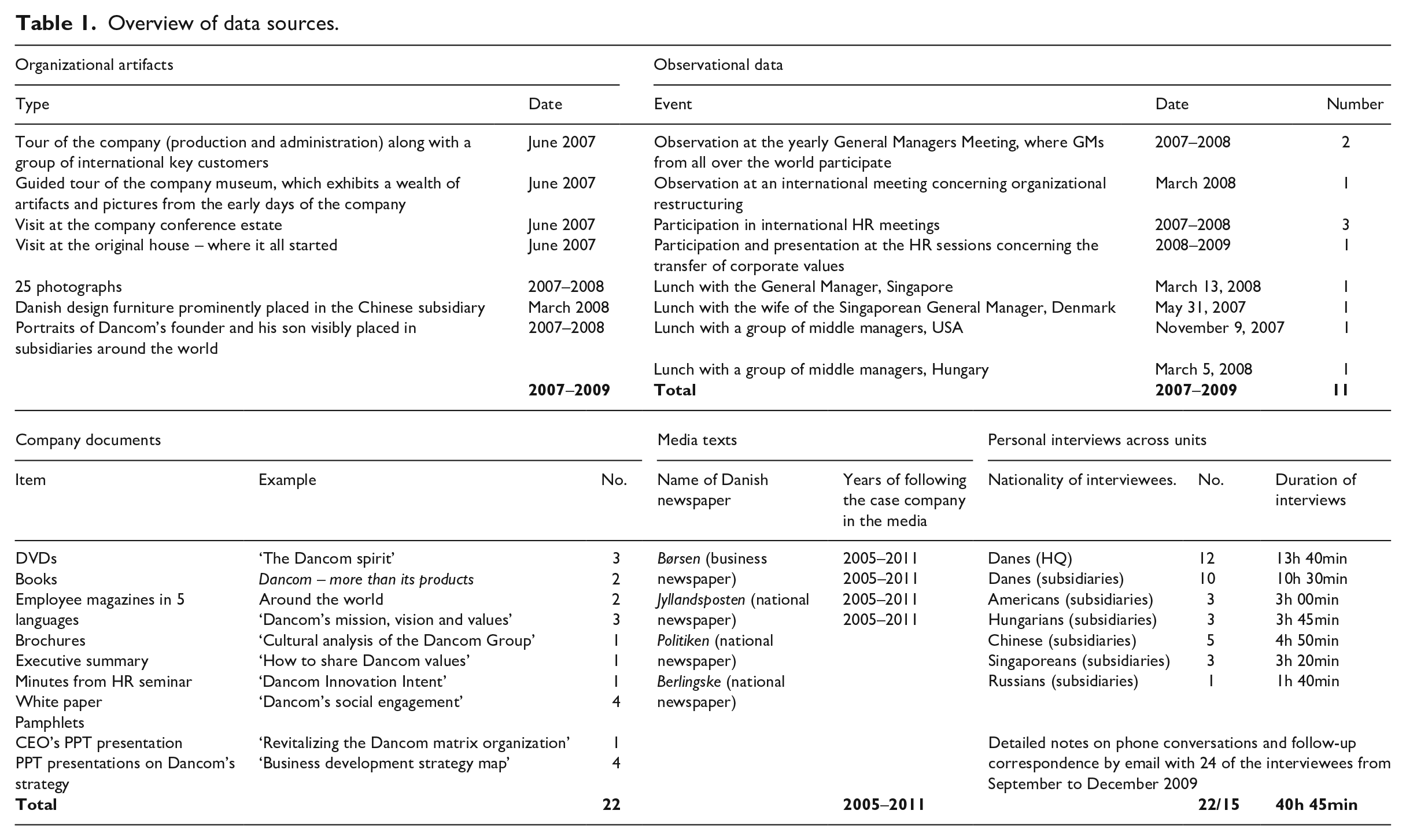
Danish language was used during the interviews of native Danish interviewees in order to improve the openness of research participants; otherwise English was used. However, the HQ management consisted exclusively of Danes. While some of them had been on foreign assignments and repatriated to HQ, others were based in foreign subsidiaries at the time of the study. Many had never been stationed outside the HQ. A conversational approach allowed all respondents to interpret the questions freely and pursue the themes they themselves regarded as central. The respondents from both the HQ and the subsidiaries talked about challenges in working with each other. When the transcripts were sent back to them for factual verification and approval, their reactions generated new data about Dancom. Dancom’s top management approved of the study although some top managers were not happy about certain findings. We took this to mean that ‘a reasonably well-done study will make some people mad’ (Van Maanen, 1982, p. 147).
Data analyses
We relied on abductive reasoning in analysing our data and in developing our theoretical arguments. Abduction emphasizes researchers’ familiarity with the relevant literature as a starting point in the research process (Tavory & Timmermans, 2014). This familiarity allows researchers to be surprised and to recognize the limits of existing explanations when confronting data with theory. We embarked on the study with an understanding of ethnocentrism based on Perlmutter (1969), and initially framed it as a story about Dancom’s challenges in the mature stage of multinationality. We analysed our empirical material expecting to find clashes between the globally minded HQ and the local subsidiaries. We were surprised that our respondents in the subsidiaries portrayed the HQ as distinctly ethnocentric and that many of our HQ respondents seemed to confirm this in the way they talked about ‘themselves’ and ‘others’. This was contrary to what the mainstream international business literature asserts on mature and successful MNCs and, indeed, different from the external image of Dancom in Denmark. Hence we engaged with writings in anthropology, sociology and psychology to broaden our understanding of ethnocentrism. We also began to form an understanding of what we were seeing in the data as an issue of organizational identity.
With these theoretical insights we undertook a new reading of our empirical material. We focused our analysis on the HQ and distinguished between an HQ ingroup consisting of key decision-makers (most of whom had never been stationed outside Denmark) and an outgroup, mainly consisting of Danish repatriates as well as Danish expatriates based in the subsidiaries. We began to form an interpretation of how the ingroup conceived of Dancom and its identity, and explored how they worked on this identity by drawing on history, by representing ‘self’ and ‘others’ in the present, and by envisioning possible futures in, and for, the MNC. However, our analysis also revealed an alternative conception of Dancom and its identity expressed by what we call an HQ outgroup, which challenged the dominant conceptions. This led us to question the relevance of the concept of ethnocentrism and to turn to postcolonial and neocolonial theories as a potential resource in making sense of what was going on at Dancom HQ. At this point, we also revisited our empirical material.
The reviewers for this paper further challenged our interpretations, and shaped the direction of the most plausible theoretical framing (Golden-Biddle & Locke, 2007). Neocolonialism proved to be the most promising way forward in understanding the case. We refined our analysis by combining it with insights from the literature on organizational identity work. We located two forms of neocolonialism, which illuminate how identity work is done at Dancom HQ. The first, traditional form of neocolonialism is about the HQ ingroup trying to elevate organizational identity from local to global. It recreates the past in the present, and seeks stability in retaining an enduring identity in the global organization. The second, contemporary form of neocolonialism is founded on an understanding that identity may retain its core elements but is never stable; it is constantly evolving. This approach to organizational identity is more focused on the present and the future, and more open to negotiation with subsidiaries across the world than the first one. These different understandings of organizational identity work – and different neocolonialisms – played out as tensions and struggles in and around Dancom HQ. Figure 1 depicts our abductive analytical process.
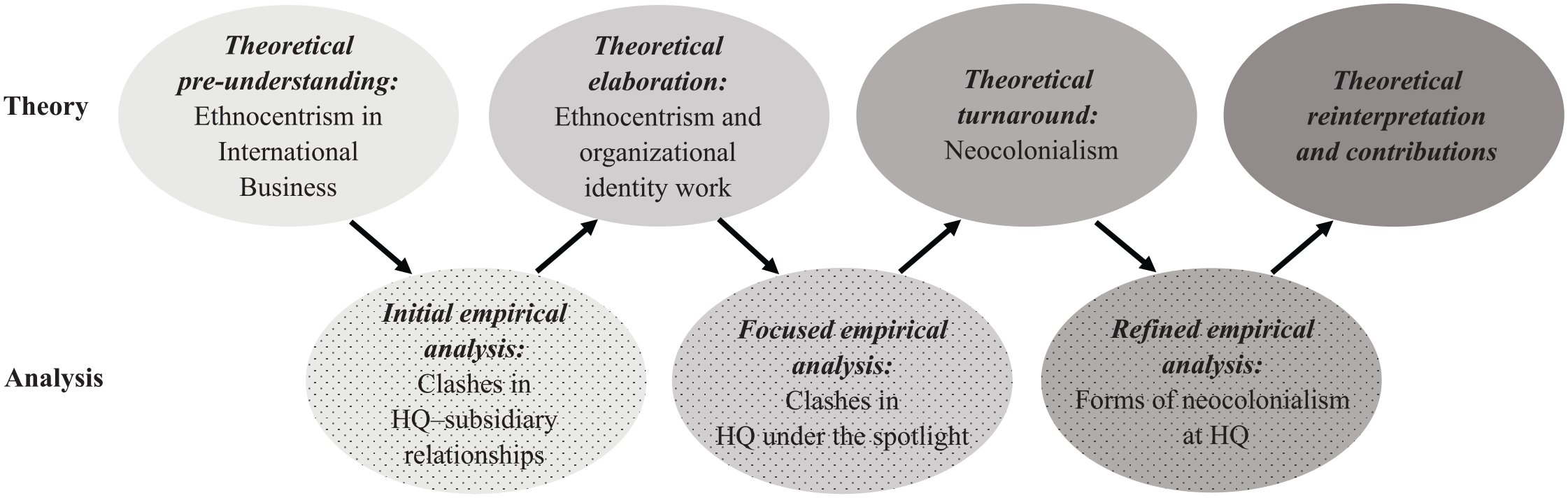
Studying neocolonialism as identity work in Dancom: our abductive process.
Next, we outline the HQ’s general strive for cohesion and endurance in terms of Dancom’s organizational identity. We then specify traditional and contemporary forms of neocolonialism as organizational identity work, and illustrate tensions and struggles between them.
Organizational Identity Work in Dancom
We are a good solid company from rural Denmark. Everybody knows each other, and everybody has this Danish mentality. We are all friends, we like each other. If you help me, I’ll help you.
A top manager at HQ summarizes the ethos of Dancom thus. After decades of profitable international growth its HQ is still located in a small town in rural Denmark. As a family firm, Dancom was built on a distinct identity, an idea of what the company is all about, which has served as a key element in disseminating core values and principles to its increasing number of foreign subsidiaries. A presentation screen in the company museum shows a variety of pictures of harmony in the workplace. The pictures are introduced with this text: Since the company was established, employees at Dancom have developed a very special kind of fellowship. [. . .] Employees enjoy a special kind of solidarity here.
In a growing and globalizing MNC, a sense of loyalty to an all-embracing organizational identity is difficult to maintain. The HQ continues to strive for global cohesion through a shared identity, which builds on foundational rural Danish values such as integrity and hard work. As expressed by the CEO: We must make sure that we are not evolving from being one large business into becoming a large number of small businesses that just happen to have the same owner. All units need to move in the same direction.
As such, the HQ takes on the responsibility to communicate to the entire organization what the core content of the Dancom identity is. However, retaining an enduring sense of identity in an MNC involves a lot of identity work. Dancom demonstrates how history and memory are important elements of an enduring identity and how historical reflections on those who founded the company are crucial resources for family firms in particular (Blombäck & Brunninge, 2013). By telling and retelling a particular version of the founding of the company and its subsequent growth and success, Dancom HQ aims to establish and invoke a ‘truth’ about history through which they can legitimize their actions in the present (Mordhorst, 2014).
Traditional neocolonialism: Elevating organizational identity from local to global
For the HQ ingroup in Dancom, insisting on local heritage appears to be a deliberate choice and it is seen as a strategic asset that enables global growth. It is applied to secure a sense of common identity. The chairman stresses this in our research interview: We strongly emphasize the uniqueness of our cultural values. If we didn’t, we’d risk establishing foreign subsidiaries that create their own cultures and their own set of values. That is not desirable. We want the opposite – a common set of values, a shared Dancom culture and a collective experience that we are one corporation.
Pride over local heritage is also illustrated in a pamphlet on ‘Mission, vision and values’, where the chairman addresses his staff in the following way: Dear employees, an important reason for why our company is among the most successful in our industry are the principles and values our founder has laid down. [. . .] As employees we need to feel that we are co-owners of this success.
Dancom’s organizational identity work undertaken by the HQ ingroup, in its traditional form, focuses on the stability of its local principles and values. Its ‘global’ identity is based on an understanding that was originally developed in the small rural town in Denmark. The ambition is that this local version of MNC identity is elevated to the global stage to spur cohesion and loyalty across all units. In our interview, the chairman of the board underscores the importance of such identity endurance: The cultural uniqueness, which we have built into our company and which we try to transplant to our many subsidiaries, must be preserved. This is done when key employees from abroad come to Denmark, or when they participate in seminars and other events where they meet Danish employees. This is also done when Danish employees are expatriated, thereby disseminating a little piece of Dancom and a strong cultural foundation, which they spread in their everyday life out there.
A manager at HQ describes ‘the company story’ and its humble beginnings as a central part of his devotion to everything that Dancom stands for. Using a religious metaphor he emphasizes how this story affects customers and visitors as well as employees at the HQ: There is something holy about our company story. I can’t find a better word for it. [. . .] It is fantastic what the top management represent, what they do for the local community and what they do in terms of social responsibility.
Managers are explicit about their efforts to ‘spread’ or ‘transplant’ the essence of Dancom’s identity into the subsidiaries. The CEO asserts: I think that we are rather good at making our overseas employees feel like a part of the company. They show a willingness to set aside their own cultural preferences. There are some cultural differences that may be in conflict, but only because we choose a set of rules that hail from our part of the world. And we do not intend to change that!
HQ ingroup managers expect Danes to set the agenda in all important matters. The rationale seems to be that only Danes can disseminate appropriate standards and identity across the world. A top manager asserts: One of the greatest risks we could ever take is to change our Dancom culture by replacing our senior management with foreign people. [. . .] This is the reason for why we at Dancom, without exception, only promote people to top management through internal channels.
A key aspect of the way the HQ ingroup enacts organizational identity is also whom they listen to when they discuss and define what constitutes ‘shared’ values and practices. HQ members can quickly fall out of favour if they are seen to no longer represent the espoused values of the company. A Danish expatriate says that he suddenly realized that he was pushed out of the HQ ingroup: I experience that Danes no longer trust me, the same way Danes do not trust Asian colleagues. [. . .] I believe they think of me like this: ‘He has been away for years, so he no longer understands how we do things here.’ [. . .] I think I have been away for too long. I no longer speak the same language as they do at home.
To summarize, organizational identity work at Dancom is dominated by the HQ ingroup, and this domination is based on neocolonial assumptions of the superiority of Danes over others. HQ ingroup managers take on an identity as colonizers whose aim is to alter the conduct of the subsidiaries (colonized) and to reconstitute organizational identity in the subsidiaries in the image of the HQ (see Bhabha, 1994). By insisting on ‘transplanting’ the local identity globally, the HQ ingroup expresses a need to ‘educate’ the colonies so that they can reach the same level Danes reached decades ago. The ingroup is reluctant to consider any resistance to their ideas and efforts.
Contemporary neocolonialism: Negotiating organizational identity
Parallel to traditional neocolonialism, there is also increasing awareness at HQ that in the future it is not possible to cling onto such a static approach to identity in a globalizing MNC: Strategically, we are in the midst of a changing paradigm. [HQ management will have to] actually listen to people from outside – people who are normally just told what to do. I think that is going to be hard for some of the top managers.
The above quote from a top manager at Dancom HQ shows a degree of reflexivity about how the world is changing. It articulates a concern over HQ managers who are not ready to adjust to this change. Another HQ manager describes how the development will lead to Dancom’s organizational identity becoming ‘more globally influenced’. The identity work here is about finding a way to retain the superiority of Danish ways of managing the organization, but to do so in a way that will survive future challenges: We are turning less and less Danish. Our units around the world are growing and so are the voices with which they speak. In terms of our values, our units around the world will have more impact. Our organizational cohesion will be more globally influenced and not only influenced by the Danes.
One source of criticism among what we term the HQ outgroup is the policy that the dominant ingroup only considers Danes for expatriate positions. Overall, there seems to be a contradiction between the views of locally based top managers in the HQ ingroup and the more globally experienced expatriates and repatriates in the HQ outgroup. In principle, the latter represent HQ but they also give voice to the subsidiaries in their considerations of organizational identity. Some describe their colleagues at HQ as being ‘naïve’, ‘unaware’, and ‘ignorant’ of local contexts outside Denmark: Not many in our top management team have been expatriates. If you want to be global, you should have more interaction with other cultures than just attending board meetings twice a year. That’s not enough, but I don’t think they are aware of this. Having been abroad is not something they see as a strategic advantage. It works as it is, so why change it?
A repatriate at HQ goes a step further. He describes how Danes are xenophobic in their suspicion and how they disregard ‘other cultures’: At HQ there is a lot of Danish scepticism towards other cultures. There is doubt about whether others are as good as we are. I wouldn’t call it racism, but it is close. People use expressions such as ‘We’ll just have to wait until the Asians have learned to think like us.’
Another HQ outgroup manager tells us: In Denmark, people curse how stupid Asian employees are and what stupid questions they ask. Yet many regions in the world are politically instable, have a lot of corruption and a lot of issues that we are normally not concerned about in Europe. I guess this is why people at HQ have a hard time understanding what we are dealing with in Asia.
Our study shows increasing self-awareness within the HQ outgroup, although stereotypical assumptions of the superiority of Danes and Danishness nevertheless prevail. A top manager points to the need for his colleagues to learn from people outside the HQ: A vast amount of resources are spent on making new managers understand the Dancom culture. At the same time, very few resources are invested into finding out what new people can contribute and what they can change.
Addressing the need for change at HQ, another repatriated manager questions the identity of HQ as the superior colonizer and the views of his close colleagues: There is a great deal of self-esteem at HQ. If you ask people here, they would say: ‘We know how things should be done.’ I think HQ needs to have a more realistic self-image. People at HQ should have a better understanding of what we are good at and what we are maybe not quite so good at. We have to be careful not to be too much [taps himself on the shoulder]. I have to say that in this matter HQ really has a lot to learn.
Coming from within the HQ – and delivered by HQ outgroup top managers who point at themselves as well as their colleagues – this critique is important for organizational identity work. A Danish expatriate describes how the more contemporary neocolonial approach is open to mutual learning as it starts from being ‘more humble’ and ‘listening’: We need to relate to foreigners and think that they have a message worth listening to. It comes down to being humble and listening. It is about moving to their side of the playing field and finding out how they play ball.
These voices advocate a somewhat more reflexive and forward-looking approach to organizational identity work in Dancom. HQ outgroup managers challenge existing HQ practices, if not the neocolonial assumptions underlying them: We work a lot with sharing best practices in Dancom. At HQ we have a lot of people who work with identifying what they think are best practices. However, we tend to forget that calling something a best practice doesn’t just mean that it works well in Denmark. It has to make as much sense in China or in Finland.
Despite the differing approaches to organizational identity work within HQ there seems to be widespread acceptance that the history of Dancom’s founding family and its success remains a defining feature of its organizational identity. This applies even to those HQ outgroup managers who are otherwise critical of the status quo. It is evident that both the ingroup and the outgroup draw on neocolonial identity work. Pictures of the founder and his son hang on the walls of all subsidiaries across the world, and the founding family remains an intricate and central part of the storytelling about the company history (Blombäck & Brunninge, 2013). Historical imagery of the family helps create a sense of cohesion and loyalty (Mordhorst, 2014). This is exemplified by an expatriated HQ outgroup manager. He appreciates that Dancom is holding onto its local roots while he also calls for more self-reflection at HQ. This manager describes how the organizational identity will ‘always’ rest on Danish values: One of the basic values in Dancom is what we know as Danish humanity and respect for the individual. I don’t think there’s anything wrong with that. We shouldn’t throw away our roots. Just because we are now turning global, that doesn’t make us a Russian company or an Indian or a Chinese company. . . I am not ashamed to have the Dannebrog [Danish flag] hanging at the front of the building. On the contrary!
Another HQ outgroup manager who has been expatriated in different parts of the world describes how informal management style and ‘freedom, trust and loyalty’ are important elements of Dancom values that work well globally and across all subsidiaries, irrespective of local context. He emphasizes what to him is the universal nature of Danish ‘values’: The good thing about the values in Dancom is that they revolve around issues of freedom, trust and loyalty. It is not hard to identify with our values because they are based on respect for the individual. The ideal of respecting other people, other religions and approaches to life translates across cultures.
To summarize, based on their overseas experiences in the ‘colonies’, members of the HQ outgroup challenge the established understanding of organizational identity and how it is ‘spread’ across the world. They speak for learning and opening up, but their identity work is still based on Danish superiority and retaining control at HQ in the small rural town in Denmark. The key issue here is that while the HQ managers (the colonizers) at Dancom attempt to influence people in the subsidiaries (the colonized), the influence is also reverted, meaning that the managers and their views on identity are also influenced by the subsidiaries (see Bhabha, 1994).
Struggles between two forms of neocolonialism
Different forms of neocolonialism – traditional and contemporary approaches – leave the HQ ingroup with an identity work challenge. Many tell us that they know that control is gradually slipping out of their hands, but they are not ready to give up their power and privileged position. They cling onto a traditional neocolonial position as colonizers in determining Dancom’s organizational identity, and this contributes to tensions and struggles. The HQ ingroup switches to ‘global’ discourse in external communications and silences criticism internally.
Externally, the HQ ingroup managers hide their neocolonial approach as they try to keep up an appearance of a modern, globally thinking and constantly learning MNC. The chairman of the board is aware of developments that are undermining his local stability-seeking approach, but he is nevertheless determined to stick to his guns: At HQ, we want to maintain a clear culture, as we have built it and as we find that it works well for Dancom. The culture changes, of course, but only gradually and slowly. We want change to be slow because we are successful with the culture that we have built.
The struggle is also illustrated in Dancom’s pamphlet setting out the ‘mission, vision and core values’ in which its identity is portrayed as open to differences: We believe that it is not possible to run a global corporation from one central office. We want to show respect for local values, cultures, and ways of doing things. We do not do this by forcing the Danish culture upon international subsidiaries and their environments, but by creating an optimal space for their own cultures.
Internally the organizational identity challenge is handled by silencing the more contemporary form of neocolonialism. While we find evidence of relatively widespread critique of the status quo, we also note that people are keeping their voices down. The gradual shift towards letting go of the traditional HQ role as the colonizer and educator of subsidiaries seems to represent a threat to the HQ ingroup. Challenging the long-held sense of organizational identity within Dancom (and the identity work that supports it) is considered controversial and is not welcomed.
Overall, forces within the HQ ingroup seem to suppress efforts to challenge their idea of what the company is and represents. This experience is exemplified by Hans (a pseudonym). We interviewed Hans during his expatriate assignment. He was outspoken and critical of the HQ’s traditional neocolonial approach. Hans later repatriated to HQ. Provided with a synopsis of his interview, he was shocked and reluctant to discuss the issue further. Once he had returned to the HQ, there was no longer room to explicitly criticize the way local Danish ideas about values and principles are to be spread globally. Another HQ member reflects on silencing by using a religious metaphor: In many ways the HQ is a nice place to be in, but it is like being in a sect where you preach a gospel that you know must be preached.
This interviewee goes on to explain how the practice of disseminating a local Danish approach to organizational identity – the devotion and cohesion established at HQ – can lead to missed learning opportunities: We say that ‘We want to be global, we want to work with different cultures, and we want to understand the different cultures.’ But first others must understand the Dancom culture. We require that [people in the subsidiaries] live by the Dancom culture, no matter where in the world they are. That’s what we want. . . I have experienced it myself.
This may not appear as criticism at all. However, by challenging the way HQ ingroup leads the organizational identity work, this interviewee shows that he knows that he is breaking an unwritten rule of silence: Now, of course I don’t know how you are going to report this. It is rather explosive. But I do feel that we as managers have to behave in a certain way if we want to survive in this system.
The storyline returns to Danes as colonizers. Many of our Danish respondents tell us that they are aware that they are viewed as such in the subsidiaries, but emphasize that this is not discussed at HQ: Danes have a total lack of tolerance. You don’t tolerate other people. You don’t tolerate strangers at all. So, that’s racial intolerance. Indeed, you hear this when you are abroad. They say that ‘Danes don’t like strangers.’ That’s a stamp we’ve got.
In our interviews, several HQ managers express critical opinions about elevating the local into a global organizational identity. However, they tell us that this is something that cannot be said in the open. It is the ‘most public secret in Dancom’. This is evident in the first author’s field notes written after the transcripts were sent to the respondents for factual verification.: Several managers said that they were surprised about how openly they had told me about some very delicate issues. As one manager wrote to me, ‘You have interviewed an interesting, and very, very honest man! :)’Another told me that ‘When I read my quotes, I realize that we are dealing with some really serious issues here. Not that I don’t mean what I said, but. . ..’ I get the impression that I am closing in not only on a central problem in the organization, but a problem that cannot be talked about. A couple of expat managers even called me to stress that I am, as one manager puts it, ‘dealing with an issue that is taboo in the organization’. A few managers asked me to delete parts of their quotes from my material. They felt uncomfortable with what they said, although they clearly meant it. The case seems to have changed ‘now that I see it in writing,’ as one manager said.
The struggle appears to be played out between two opposing camps, but several respondents show ambivalence as they are able to shift back and forth between different forms of neocolonialism. One HQ manager first speculates whether aiming for global cohesion through organizational identity work is obsolete: We could ask ourselves: is it necessary that our identity survives in order for us to stay successful? I am not sure what to think, but I do think it is worth a debate. Just because it has taken us far, it might not be the foundation for our work in the future.
However, reverting to the traditional view the same respondent concludes that there nevertheless needs to be ‘some form of a shared foundation, something that ties us together’ in the organization. As such, individual HQ managers can represent both the traditional and the contemporary approaches. For example, while the CEO works on traditional neocolonial identity, he also reflects critically on the practice of spreading the locally based identity across the world: I think that 80 percent of what we consider to be our organizational identity is in fact something that we can justify being spread to the rest of the world. As for the remaining 20 percent, I think that this just came along because we who decided it are all Danish. I think there are elements of ‘well, this is how we do it in Dancom,’ which doesn’t have to be like that. It just comes natural to us Danes, because this is how we think it should be.
To summarize, two forms of neocolonialism, traditional (stability-seeking) and contemporary (more forward-looking), characterize organizational identity work at Dancom HQ. Due to the apparent pressures on top management to devise and promote an enduring organizational identity (Anteby & Molnár, 2012), they sustain traditional neocolonial identity work in the face of challenges. However, it becomes an object of tensions and struggles in the complex MNC organization (Hopkinson & Aman, 2019), where the more contemporary version of neocolonialism is effectively silenced, and the HQ ingroup are reluctant to give up their power and privileged position.
Discussion
Anti-globalization and protectionism gain ground across the world, and established understandings of the ‘global’ are increasingly challenged through MNC practices (Alvarez & Rangan, 2019). In this paper, we have explored questions that have passed unnoticed in extant literature, and offer three contributions to research on MNCs from the perspective of neocolonialism.
First, by conceptualizing neocolonialism as organizational identity work we contribute to research on western MNCs in general and to understanding identity work in these organizations in particular. We have elucidated how neocolonialism – the ethos and practice of colonialism and western superiority in contemporary society – is a means through which identity endurance is negotiated in the MNC (see Anteby & Molnár, 2012). We have explored how HQ management work to maintain a distinct and enduring organizational identity by embracing the company’s foundational values and principles, by establishing practices that draw from the history of the company and its founders and by emphasizing its local and socio-culturally specific character. Anteby and Molnár (2012, p. 531) argue that the ‘making of a collective memory is a form of collective identity work’. Navigating identities thus has a distinct temporal as well as a spatial element (Basque & Langley, 2018). However, despite a general tendency within HQ to work for identity endurance through a neocolonial ethos, our study highlights that the organizational identity of the MNC is inherently unstable.
Second, by showing how different versions of neocolonialism play out as tensions and struggles within the HQ we contribute to the increasing body of neocolonial analyses of MNCs. We have specified struggles between the HQ ingroup that represents a traditional approach to neocolonialism and the HQ outgroup that represents a more contemporary approach. The ingroup and outgroup are not necessarily fixed positions, however, as HQ managers can juggle and switch between them when they try to articulate what is distinct and enduring about the organization (see Albert & Whetten, 1985). Kreiner et al. (2015, p. 1004) posit that organizational identity work is undertaken to ‘manage a set of ongoing dialectic tensions’, and argue that navigating these tensions can change organizational members’ constructions of identity. We have elucidated how tensions and struggles between different forms of neocolonialism leave the dominant HQ ingroup with an identity work challenge, which they handle by hiding their approach in external communications and by silencing the HQ outgroup’s contemporary approach internally. These insights add to our understanding of neocolonialism and MNCs as it shows how different forms of neocolonialism coexist in the organization and how they ultimately shape the MNC as a tensioned space.
Third, we have outlined implications of struggles over neocolonialism for organizational identity work in MNCs. Our findings indicate that HQ outgroup managers in particular are influenced by the subsidiaries or the ‘colonized’ (Bhabha, 1994; Frenkel & Shenhav, 2006); their sense of superiority is subverted, which influences their identity work (McKenna, 2011; Sayed, 2016). Simultaneous cohesion and disruption in identity work at HQ extends our understanding of MNC identities and how they are worked on today. We have highlighted contradictory dynamics when the HQ negotiates whether or not to hold onto a given aspect of identity and when it attempts to control identity work throughout the geographically scattered organization in the face of challenges. Our findings suggest that nurturing an enduring, coherent and shared organizational identity across all units of an MNC is a quixotic task, perhaps even an impossible one. As HQ managers in western MNCs nevertheless attempt to do this testifies to the continued relevance of neocolonial ethos and practice in these organizations. A sense of superiority over ‘others’ prevails.
We argue that researchers in international business and management must address epistemic colonialism or coloniality more generally (Ibarra-Colado, 2006). Epistemic colonialism refers to the institutionalization of particular forms of knowing in and through actors such as MNCs as well as the legitimation of the conditions that produce and disseminate this knowledge. MNC studies from a neocolonial perspective must be sensitive to varieties of domination and responses to it. Boussebaa (2015, p. 1228) emphasizes that the periphery is not an ‘undifferentiated fringe’ and the core is ‘by no means a homogeneous space’. He suggests that differences among colonizers and colonized are likely to influence how dynamics of power and resistance play out. Denmark is complicit in epistemic colonialism (Mulinari et al., 2009) and while our analysis of a Danish MNC is a modest attempt to elucidate the prevalence of a traditional form of neocolonialism at HQ, it also shows how HQ members are increasingly aware of this. On the one hand, we have shown how difficult it is for HQ management to let go of their sense of superiority. On the other, we have highlighted how much explicit identity work is required to maintain the status quo and to keep critical voices at bay. Organizational identity work at the MNC HQ is thus a truly complex endeavour. It takes a lot of work ‘for organizational identities to stay the same’ (Anteby & Molnár, 2012, p. 516) and, in the end, these efforts likely lead to (even) more tensions and struggles. Contemporary western MNCs exemplify these complexities in vivid ways.
The fact that the MNC we studied is a family firm may be a boundary condition for our arguments. Retaining total dominance of one nationality in the upper echelons of the organization for an extended period of time is perhaps more difficult for companies with diverse ownership bases. However, this remains to be studied from the point of view of organizational identity work. Our study also begs the following question: is there something particularly Danish here? We contend that Denmark is not an exception in the revival of nationalist sentiment that is sweeping across North America, Europe, Asia and beyond (Vaara, Tienari, & Koveshnikov, 2019). We suspect that we are not dealing with a specifically Danish phenomenon and that our findings encompass a wider issue in and around contemporary MNCs. However, if we understand forms of neocolonialism to be born out of specific socio-historical power relations (Boussebaa, 2015), these are likely to take somewhat different forms under different conditions, involving different colonizers and colonized. This remains to be explored through comparative studies in a variety of MNCs.
Finally, a characteristic feature of organizational identity work and neocolonialism in Dancom is that virtually all our research participants were men. Male domination in HQ management is typical of MNCs (Frenkel, 2017) and this is reflected in international business journals that for the most part remain gender blind (Koveshnikov, Tienari, & Piekkari, 2019). We found that tensions and struggles around the identity established at HQ did not undermine male dominance in the various units of the MNC. Although the HQ’s sense of superiority was called into question, the gendered hierarchies that enable particular forms of organizational identity remained intact. Hence future research could draw from feminist theory in analysing the gendered nature of identity work in neocolonial MNCs and the gendered consequences of management discourse and practice at HQ as well as in the subsidiaries. This could be extended to studies of intersectionality that offer ways to make sense of how gender, race and social class are connected in sustaining and legitimating practices of domination and oppression in the functioning of MNCs as tensioned neocolonial spaces (see Acker, 2006; Crenshaw, 1991).
Conclusion
In this paper, we have extended the understanding of organizational identity work in western MNCs. These organizations are constantly confronted with the complexity of conducting business across borders and we have argued that neocolonialism is a key concept in understanding how these organizations are managed today. MNCs provide an extreme setting for often quixotic attempts to maintain an enduring sense of common identity in the face of organizational complexity, geographical distance, different languages and cultural diversity. While the HQ of western MNCs as research sites of neocolonialism have received limited attention in organizational identity research, we believe further work on struggles between the local and the global would advance knowledge in this area.
Footnotes
Funding
The author(s) received no financial support for the research, authorship, and/or publication of this article.
