




Abstract
Drawing upon an in-depth analysis of two bio-tech annual conferences in Israel, we explicate the exertion of power in convening. Event organization involves three narrative mechanisms: (1) telling stories which construct the field, and enacting them through different genres that channel participants to perform these stories in the unfolding of the event; (2) setting the stage and a space of possibilities for certain stories to be told in certain ways, and limiting others; and (3) grounding the stories in meta-narratives that confer plausibility on some of them over others. Our contribution lies in explicating how diverse narrative mechanisms allow organizers to exert various faces of power in organizing an event, how organizers use power to construct their own and others’ resources, and how power is used not only through words, but also through space and embodiment. Taken together, self-serving constructions of the field are turned into a taken-for-granted reality, while constraining participants’ ability to negotiate or refute it.
A workshop on innovation tools. Hundreds of aspiring bio-tech entrepreneurs sit in long rows in front of a huge stage. The moderator, Drew Boyd, teaches us how to innovate “by subtraction.” To exercise what he just taught us, he asks us to pair up with a person sitting next to us, and work together on the “futuristic concept, what’s going to really crack the band. . . in the eye-care industry.” The exercise involves subtracting one of the components of a product used in eye cataract surgery. An ophthalmologist, Brian Levy, Chief Medical Officer from Bausch & Lomb, explains that in such lens replacement procedures, a tiny implantable lens is inserted through minimal incision. The product includes a plunger, a body, a transition cell, an insert, the lens itself, and hatchets—the stabilizers. I can hardly follow the details. Luckily, I sit next to a woman who tells me she has a PhD in chemistry. She’s been writing down notes all through the opening of the workshop. When I tell her I find the medical terminology elusive, she answers that for someone in the field it’s actually a basic set of concepts. She is excited and in seconds has this great idea—seems great to me—to remove the hatchets and manipulate the polymer of the lens. She explains that if properly designed, when outside the eye the lens will be of liquid form and when inserted it will stabilize due to the unique environment of the eye. Boyd, the moderator, then asks for volunteers to present their ideas to the scrutiny of the panel. He cautioned: “Now I’ll warn you. . . it takes practice. You’ll probably apply it incorrectly at first, if you don’t mind I’ll point out where you may not have applied it correctly. I’m not being critical. I’m trying to be more instructional.” No wonder people hesitate, and my neighbor is quiet. A few ideas are suggested, embraced by Levy the eye expert for their medical plausibility, yet critiqued by Boyd for not following the exact steps of “innovation by subtraction.” (Field notes of 1st author integrated with transcripts from a workshop on Innovation: Developments and Renewals in Drug Device Products, 2005. Led by Director of Marketing Mastery from Johnson & Johnson, SP)
The cultural and scientific discourses about entrepreneurs glorify them for thinking “out of the box,” seeing opportunities where others do not, and harnessing people and resources to turn dreams into reality (Nicholson & Anderson, 2005; Ogbor, 2000). Entrepreneurs are at the center of high-tech and bio-tech ecologies of innovation, equal participants in both power struggles and sensemaking (Garud, 2008; Zilber, 2007), with a subject position that allows them to engage in meaning-making for the benefit of their entrepreneurial activity (Lounsbury & Glynn, 2001). Yet our experience at two field-wide bio-tech conferences in Israel was different. 1 Entrepreneurs were hardly represented among the speakers, panelists, and moderators on the stage. They were positioned as a passive audience, in dire need of knowledge and connections of service providers and venture capitalists to shape their ideas and bring them to the market. Throughout the conferences—as in the activity described in the vignette above—we wondered why the entrepreneurs in the audience cooperated with the devaluation of their knowledge, networks, and roles? This puzzle directed us to the literature on field configuring events (FCEs; Lampel & Meyer, 2008), and to exploring the role of power in how conferences are designed and executed.
Employing a narrative approach and following Lukes’ (2005) three faces of power (see also Haugaard, 2010; Hay, 2002), we interpret the conferences as conveying three narrative mechanisms of power: (1) telling stories and enacting them; (2) setting the stage for stories; and (3) embedding them in meta-narratives. The projective stories (Garud, Schildt, & Lant, 2014) told in the conferences portrayed entrepreneurs as lacking, and service providers (SPs, accounting and law firms)—in virtue of their resources, knowledge, and networks with venture capital (VCs)—as critical players at a turning point (McAdams & Bowman, 2001) that determine the story outcome (Gabriel, 2000). Performed through different genres—plenary lectures, panel discussions, and workshops—the enacted stories enhanced entrepreneurs’ passivity, and VCs’ and SPs’ expertise. Moreover, organizers’ choices regarding speakers, design, and layout of the conferences set the stage for VCs’ and SPs’ stories, while silencing the entrepreneurs. And, grounding the stories and their enactment within a business meta-narrative, further served organizers’ interests. Through these narrative mechanisms, the world of the conference privileged the organizers’ construction of the field, to be consumed by the audience.
Our contributions lie in explicating how diverse narrative mechanisms allowed organizers to exert various faces of power (Lukes, 2005) in organizing an event; how organizers’ use power to construct their own and others’ resources; and how power is used not only through words, but also through space and embodiment, all working to turn self-serving constructions of the field into a taken-for-granted reality.
The Exertion of Power in Field-Level Events
Faces of power in the organization of field-level events
To ground our study, we highlight two separate yet related aspects of the literature on field-level events. 2 One is a conceptual transition between three foci: from a focus on events as catalysts of field-level changes, to an interest in what takes place during events, to the exploration of how events work. The other is a gap between much empirical interest in power, politics, and conflicts as central to event dynamics, yet under theorization of the exertion of power and its different forms in field-level events.
Conversations that constitute fields (Hoffman, 1999) come to life through various trans-organizational structures (Anand & Watson, 2004), like field-level events. Early on, such events were conceptualized as field-configuring events (Lampel & Meyer, 2008), highlighting their role as turning points in the evolution of fields (Maguire & Hardy, 2006; Nissila, 2015; Oliver & Montgomery, 2008; Rao, 1994), or participate in fields’ maintenance (Henn & Bathelt, 2015; Schüßler & Sydow, 2015).
Studies of field-level events that relate to their power to shape field trajectories touch upon Lukes’ (2005) first face of power, which is visible and relates to the ability to affect how decisions are taken or understandings are negotiated. Conflicts over Grammy awards, for example, resulted in adopting a new category (Anand & Watson, 2004).
A second wave of research focused on what actually happens during field-level events (Leca, Rüling, & Puthod, 2015). For example, in contrast to Glynn’s (2008) study of the Atlanta Olympic games that pointed to their longitudinal effects in forming corporative elites in the hosting city, Thiel and Grabher’s (2015) study of the London Olympics explored how learning took place during the event, especially in highly observed moments such as the opening ceremony. Focusing on what happens in field-level events, researchers found that they redirect participants’ attention (Anand & Watson, 2004), facilitate interactions, negotiations, and expressions of conflict (Anand & Jones, 2008; Hardy & Maguire, 2010; Jolly & Raven, 2016; Lazega, Quintane, & Casenaz, 2017; McInerney, 2008; Zilber, 2007), and affirm membership (Lena, 2011). Field-level events, then, constitute certain understandings of the field.
Studying what happens within events also relates to the first face of power by highlighting explicit power struggles and how they are resolved. One example is the “consensus panel,” comprised of “eminent researchers, scientists and clinicians” who formulated “a draft statement” that resolved the main controversial issue within the emerging field of cochlear implants (Garud, 2008, pp. 1076–1077; see also Jolly & Raven, 2016).
Recently, researchers have been focusing on how field-level events work. For example, how discursive spaces reflect “different rules and understandings regarding appropriate forms of text production, distribution, and consumption” (Hardy & Maguire, 2010, p. 1372), and how participants utilize various social spheres to engage in a variety of sensemaking activities (Zilber 2011), including using the interplay between front-stage and back-stage interactions (Mair & Hehenberger, 2014).
Attending to these structural aspects relates to Lukes’ (2005) second face of power which focuses on the hidden and less formal processes of setting an agenda, including selecting who can raise an issue and the prevention of issues from being raised. This face is particularly relevant to convening, “the activity of formally organizing events and bringing together dissimilar actors who do not meet habitually” (Mair & Hehenberger, 2014, p. 1177). Organizers of field-level events use this form of power since they are “the orchestrators behind the ‘collective performances’” (Schüßler & Sydow, 2015, p. 287), and they have specific interest in shaping the event in certain ways (Anand & Jones, 2008; Schüßler, Dobusch, & Wessel, 2014). Organizers’ work begins prior to an event (Lena, 2011; Mair & Hehenberger, 2014), continues in between a series of events and sets the ground for future events (Leca et al., 2015). Their work shapes the dynamics of both sensemaking and power relations in the events (Leca et al., 2015). Organizers choose event locations (Moeran, 2011; Rüling, 2011; Schüßler et al., 2014), determine how exclusive or inclusive an event will be (Lampel, 2011; Lena, 2011; Mair & Hehenberger, 2014; Rüling & Pedersen, 2010), shape the spaces for participants’ interactions (Hardy & Maguire, 2010; Mair & Hehenberger, 2014; Schüßler, Rüling, & Wittneben, 2014; Zilber, 2011) and affect the visibility of other actors (Moeran, 2011; Rüling & Pedersen, 2010). Organizers may use various markers to re-enact—and constitute—value and construct political standing (Schüßler & Sydow, 2015). They may design events to create drama (Lampel, 2001), or navigate between high stakes and regular events to achieve desired resolutions (Schüßler et al., 2014).
While field-level organizers are important actors, their work is “routinized” (Schüßler & Sydow, 2015, p. 291). Further, events are collectively constructed and only partially controlled (Lampel, 2011; Schüßler & Sydow, 2015). Moreover, field-level conditions (Rüling & Pedersen, 2010; Schüßler et al., 2014) influence events. Thus, events are characterized by “predictable unpredictability” (Lampel, 2011) and are emergent (Henn & Bathelt, 2015).
Lukes’ third face of power—shaping thoughts, wishes, and meaning systems that constitute actors and their motivations—the “most effective,” as it is “least observable” (Lukes, 2005, p. 1) was hardly studied in field-level events. Still, McInerney (2008) related to this dimension of power by noting actors’ efforts to turn their own accounts of the field into the taken-for-granted understanding thereof. Zilber (2011), exemplified how SPs and VCs in the Israeli high-tech field built on a national discourse to construct business interests as national ones, to enlist government representatives. Yet we still lack insights into how the third face of power is actualized in events—how participants’ motivations and preferences are shaped while building on the structures and discursive opportunities embedded in these events. Further, we lack an understanding of how the three faces of power are combined in event organizing. Our integrated approach to power focusing on convening, allows us to follow the “spider at work” (Obeyesekere, 1990), 3 exploring a fuller array of power organizers use, going beyond words to include the power laden effects of space and the body (Zilber, 2018).
Field-level events and power: A narrative approach
To highlight the pragmatics of the three faces of power and gauge their exertion and co-existence in field-level events, we use a narrative approach. Researchers of field-level events demonstrated how sensemaking is carried out through stories (Garud, 2008; McInerney, 2008; Zilber, 2007, 2011). In order to complement this focus on story content, we use a fieldwork method to attend also to the social dynamics of storytelling, that is often missed in retrospective studies (Polletta, Chen, Gardner, & Motes, 2011).
Stories construct realities they seemingly only describe (Vaara, Sonenshein, & Boje, 2016). Narration involves selection (Spector-Mersel, 2011), as stories are told by interested actors and audiences, in specific contexts (Gartner, 2007; Mumby, 1993). Through plotlines (Gabriel, 2000), stories integrate the past with the present, and offer a “projection” of the future (Garud et al., 2014). Comparing stories, their explicit and implicit contents (Zilber, 2007), along narrative dimensions like plotlines and characters point to narrators’ different stands in conflictual issues, Lukes’ first face of power.
Narratives “do not just describe things; they do things” (Potter & Wetherell, 1987, p. 6). To tell a story is to act in the world (Polletta et al., 2011) and both telling and hearing stories are “constitutive acts” (Vaara et al., 2016, p. 499). Some stories are countered by alternative versions (Lundholt, Maagaard, & Piekut, 2018, p. 4). However, only those who have the power to position themselves appropriately have the voice to construct and share stories (Phillips & Hardy, 1997). Exploring who tells stories and on what stage, who sets the stage for stories to be told, and how this is achieved then follows Lukes’ (2005) second face of power.
Stories are intertextual (Fairclough, 1992), as concrete stories build upon meta-narratives (Zilber, Tuval-Mashiach, & Lieblich, 2008), a repertoire of narrative template available in a given culture (Polkinghorne, 1988, p. 153). Meta-narratives “operate as a filter through which a group understands its world . . . both structur[ing] and limit[ing]what can and cannot be seen” (Fligstein, Brundage, & Schultz, 2017, p. 880). While meta-narratives are implicit, they give stories their coherence and legitimacy (Zilber et al., 2008). Meta-narratives echo Lukes’ (2005) third dimension of power, the invisible discourses that constitute motivations and preferences of actors.
Methodology
Bio-tech conferences in Israel
Bio-tech is a relatively new phenomenon, evolving from academic research in molecular genetics and biology (Kenney, 1986; Pisano, 2006). While in the United States the industry started growing in the early 1970, in Israel this happened mostly from the early 2000s. Up until then only a handful of companies were founded per year and the field was dominated by three large-scale companies, Teva, Taro, and Dexcel Pharma, which developed a number of successful drugs for the worldwide market (Israel Advanced Technology Industries [IATI], 2010). In 2000, the Israeli government identified bio-tech as a national priority towards which governmental grants were strategically dedicated and the first bio-tech incubator launched in 2004 (Office of the Chief scientist [OCS] 2009). By way of comparison, in 2004 there were already 20 such incubators dedicated to the high-tech industry (Bell, Freireich, Heyman, Tamutunu, & Zaharudin, 2006). The Israeli government’s dedicated investment in bio-tech doubled from five to ten percent of all industry funding between 2004 and 2005 (OCS, 2012). In 2005, the Israeli government formed the National Institute for Biotechnology (OCS, 2012). Of the 1,351 bio-tech companies in Israel in 2018, the vast majority were founded between 2007 and 2016 (Ministry of Economy and Industry [MEI], 2018, p. 11). Even as the industry has developed significantly, it is not yet considered mature, and calls for financial collaboration between different actors (government, VC funding) continue to be made (Milken Innovation Center [MIF], 2015).
Two field-wide bio-tech conferences held in Israel in 2005 and 2006 serve as our case study, for they offer a rich opportunity to explore power in field-level events. First, like the US and other hubs, the “anatomy” (Pisano, 2006) of the Israeli bio-tech field is fraught with tensions among a network of actors: scientists, entrepreneurs, established pharma firms, VCs, and SPs. Embedded within different worldviews—science, medicine, and business (Bud, 1991)—and constantly competing over the meaning of bio-tech (Kaplan & Murray, 2010) these field-level actors are co-dependent (Powell, White, Koput, & Owen-Smith, 2005) in the innovation process (Bekelman, Li, & Gross, 2003; Yitshaki, 2008). As these different actors have diverse understandings and interests, it is a rich case study to explore how power works in field-level events.
Second, though small in scale, Israeli bio-tech is known for its achievements. At the time of our study, the number of per capita patents granted to Israeli bio-tech entrepreneurs by the US Patent and Trademark Office in bio-tech was second only to the US; 8.5% of all patents registered in Israel were in this field, and the Israeli specialization index in the field of bio-tech was among the highest in the world (OCS, 2009). Israeli bio-tech included 160 companies, the majority with fewer than 50 employees (OCS, 2009). While being significant enough, Israeli bio-tech is thus small, which makes field-level dynamics easier to discern.
Finally, the studied conferences were the central business conferences in the field, 4 “championed and organized by institutional entrepreneurs with an overt field-building agenda” and “a view towards private gains” (Lampel & Meyer, 2008, p. 1030). While inviting all actors in the field, the organizers were SPs affiliated with the accounting firm Ernst & Young and Globes, Israel’s largest business newspaper, with the co-sponsorship of a leading VC firm. They had been organizing the high-tech track of the conference since 1996. Covered in Israeli media as the leading high-tech event (Grimland, 2006; Hermony, 2005), they are business conferences offering a meeting space for the major actors in the field. In 2005, the organizers added a bio-tech track to the conference. Our study focuses on the 2005 and 2006 conferences, capturing this early attempt by the organizers to build a track targeted at the bio-tech field.
The studied conferences were both held in Tel Aviv, Israel’s financial center, and were attended by a few hundred participants (the conference fee was US$75). The organizers aimed to share the “viewpoint of key actors in the industry, people with rich experience and from large companies,” and to serve as a “unique and wide networking platform,” helping “CEOs and entrepreneurs meet with the financial industry to fund their ventures and achieve their business objectives” (Berger, personal communication, December 11, 2012). Most participants held a doctorate degree and, like bio-tech entrepreneurs in Israel, come from academia (Kaufmann, Schwartz, Frenkel, & Shefer, 2003).
While our study is based on only two business-oriented conferences (as opposed to more scientifically or medically oriented ones), any selection would have been partial. However, this choice suits our research rationale, as our interest is in mechanisms that enable organizers to provide specific, and partial, field-level accounts.
Data collection: Fieldwork
Exploring power is challenging (Hathaway, 2016), especially in its less visible faces (Lukes, 2005, p. 1). It entails looking not only at how power makes people do things, but also at “what the exercise of power prevents people from doing” (Lukes, 2005, p. 50), and at the undeliberate exercise of power (Lukes, 2005, p. 52). We focused on observations to overcome the shortcomings of both archival and interview data in this context. Archival data enable exploring only “sedimentations” (Ventresca & Mohr, 2002) of field-level conversations. Interviews as a verbal, retrospective account (Lawrence, Leca, & Zilber, 2013) may be a “poor indicator(s) of what actually goes on in a setting or a line of work” (Barley, 2016, p. 473), fusing understandings with actual behaviors (Jerolmack & Khan, 2014). Observations allowed us to follow what actors actually say and do, in real-time interactions, and thus capture the various faces of power, including those that are less visible.
Participating and observing the conferences, the first author documented the activities, space, actors, and practices (Spradley, 1980). All formal activities—seven sessions with 26 presenters—were recorded and transcribed (250 double-spaced pages, and 150 pages of slides). The first author also took notes of her observations of the setting (spatial arrangements), actors (presenters and audience), and practices (use of technology, social interactions).
Narrative analysis of Lukes’ three faces of power
Our initial analysis revealed that the two conferences were similar and could thus be analyzed together. We carried out our systematic analysis in four stages:
Telling stories (Lukes’ 1st face of power). The stories told by certain actors and their enactment express visible power, for they relate to issues of participation, interests, and authority (Hathaway, 2016). We analyzed each story for its explicit and implicit content (Zilber, 2007) and in reference to characters and plotlines (Gray, 1992, pp. 188–191; Prince, 1987, pp/ 58–60). Characters include the protagonist who constitutes the chief focus (Prince, 1987, p. 12) and others, including supporting heroes (Gabriel, 2000). Plotline includes the story-world (Herman, 2005, p. 570), initial exposition, rising action, a climax, and ending with a reverse movement and conclusion (Beaty, 1997). Analyzing how narrators “set future expectations” by plotting a sequence that suggests a plausible future (Garud et al., 2014, p. 1489) revealed the turning points in which the protagonist experiences a significant change in their trajectory (McAdams & Bowman, 2001), after which the story is directed towards an epic end with heroic achievements or a tragic end when protagonists bring about their own downfall (Gabriel, 2000).
Our approach was relational, based on the understanding that all stories are constructed in interaction (Vaara et al., 2016). Thus, we explored both the content offered and how it was consumed and responded to by the audience. Further, attending to stories as social action (Polletta et al., 2011) we followed the events as enacted narratives, analyzing how stories were performed, using genre analysis (Orlikowski & Yates, 1994). Based on the analysis of the time, place, and setting we identified the genre repertoire (Orlikowski & Yates, 1994) of storytelling in the conferences, and the power structure (Levina & Orlikowski, 2009).
2. Setting the stage (Lukes’ 2nd face of power). Hidden and less formal power can be detected by analyzing who is invited to tell stories, and whose stories are silenced (Hathaway, 2016). Based on the program, e-mail exchanges with the organizers, field notes, and the Internet, we noted the affiliations of speakers and chairs and the audience as these represented the ecology of the field (Kaghan & Lounsbury, 2011, p. 75). We also analyzed the physical layout and the artifacts used, and how these channeled the speakers’ and audience’ bodies, behaviors, and interactions.
3. Meta-narratives (Lukes’ 3rd face of power). Invisible power can be detected by attending to the underlying discourse that support the powerful and undermines resistance (Hathaway, 2016). Accordingly, we analyzed the underlying system, the meta-narrative, that gives stories meaning and makes them sound plausible (Zilber et al., 2008, p. 1054).
4. Counternarratives. Since often narratives are accompanied by counternarratives (Lundholt et al., 2018), we analyzed these alternative stories. This analysis sharpened our understanding of the majority of stories and pushed us to explore the underlying power relations.
Constructing the Field in Bio-tech Conferences
The studied events may seem quite ordinary. There was no political drama: no apparent conflict was detected between the SPs, VCs, Big Pharma, entrepreneurs, and scientists. Yet underlying the seemingly neutral discussions of managerial and business considerations, power was exercised, allowing the organizers to offer an exclusive version of the field. Their depiction was achieved through three narrative mechanisms that together related to different faces of power (Lukes, 2005).
Between epic and tragic stories: SPs and VCs as critical to the entrepreneurial fate
SPs and VCs who delivered most of the 26 presentations talked explicitly about field-level trends, innovation, partnerships, marketing, leadership, building global companies, and strategy. Twenty-two presentations shared the same implicit message: while entrepreneurs lack crucial knowledge and connections, SPs and VCs can help them bridge these fundamental gaps. The projected stories (Garud et al., 2014) situated entrepreneurs at a critical turning point (McAdams & Bowman, 2001) in their career. Drawing on SPs’ knowledge and networks, some stories offered a plausible epic end. Other stories, with a tragic end, depicted what happens to entrepreneurs who fail to follow the SPs’ advice.
Let us exemplify these two plotlines, using a lecture titled “Introduction to systematic innovative thinking tools,” aimed at instructing the audience on “how to invent the next blockbuster billion-dollar product” (we presented a short vignette from this lecture in the introduction). The speaker, Drew Boyd, began by setting up the goal of bio-tech start-ups, referring to the coronary stent: It’s a fabulously successful product, it’s a billion-dollar product, and it’s tempting to ask . . . why was that product so successful? I don’t think that’s the right question at all. . . [We] should be asking . . .how do we invent the next billion-dollar product. (J&J, SP, workshop on “Innovation development and renewals in drug-device products,” 2005)
He then asked the audience how they “innovate, come up with ideas.” Someone shouted out: “Brainstorming” to which he responded: brainstorming “hasn’t proven to be very effective” and results in “silly ideas.” By contrast, he offered “innovation by subtraction”—which involves mapping the different components which comprise a product and then imagining what happens when a component is removed. He told the story of Johnson & Johnson’s engineers who had been building an anesthesia machine. As they reached the final phase of design, they were asked to apply innovation tools. The anesthesia machine they designed included a screen, keyboard, drug cartridge, power supply, and backup battery. Applying Innovation by subtraction, the engineers suggested getting rid of the backup battery by connecting the machine to a cable of another device’s backup battery. As the engineers became excited at the potential of creating a cheaper, lighter product, they then thought about perhaps removing the monitor as well: You could use this monitor here (showing a slide), which by the way is exactly what the doctor is looking at, during the GI procedure.
5
So now we take this device, which has been engineered for two years, we have removed the battery backup, we’ve thrown the screen out, we’ve been able to take advantage of other components in the environment, dramatically reduce the cost, the footprints. Now these engineers who weren’t interested in changing the product, by lunch time of the first day they had redesigned it.
The projective story (Garud et al., 2014) offers two plausible trajectories. Entrepreneurs may become heroes and have an epic end if they implement tools of innovation provided by SPs (Gabriel, 2000). A darker, hinted-at possibility, is a story with a tragic end (Gabriel, 2000), should they continue to use traditional tools of innovation. Both plotlines cast the entrepreneurs as protagonists lacking crucial knowledge and de-evaluated how entrepreneurs, associated with the engineers, approach innovation. Two years of product design resulted in an inferior product, to be replaced in a few hours when using tools of innovation as invented and taught by SPs.
Most presentations (22 out of 26) shared the same plotline. Situated within different story worlds, the stories introduced various complications, including expensive drugs that cost the company “hundreds of millions of dollars” that only worked well in pre-clinical trials (MIT and Harvard, academic, “Bringing innovative products to the market,” lecture, 2006); or investors that “run away” from companies when entrepreneurs fail to prepare them for the inevitable dip in worth upon entering the FDA process (Globes journalist, SP, “Trends in biotechnology investing,” lecture, 2006). Most complications ended with protagonists—entrepreneurs—in an impasse, and SPs cast as supporting heroes offering crucial resources, namely knowledge and connections.
Some stories offered entrepreneurs a glimpse of an epic future: succeeding in building a global company “just as NASA succeeded in putting a man on the moon” (SPs, VCs, and seasoned businessmen, “Managing a global company”, panel discussion, 2006), or using SPs’ connections and understanding of VCs, what “makes their palms sweat” (Young consulting group, SP, “What’s hot for investors,” lecture, 2005) to approach VCs as “out of town investors” (Globes, SP, “Trends in biotechnology investing,” lecture, 2006). Other stories suggested a potentially tragic fate: if entrepreneurs fail to implement knowledge on partnerships, they would stumble into the “deadly dozen pitfalls” (SPs, VCs, and one entrepreneur, “Strategic development partnerships: when, why and how to partner,” panel discussion, 2005); if entrepreneurs fail to manage investors’ expectations they may lose them (SP, “Trends in healthcare investing,” lecture, 2006); and if they lack marketing strategies, they may develop a useless academic product that will kill their start-up (academic, “Bringing innovative products to the market,” lecture, 2006). Implicitly, each story could be turned around: an epic fate could turn tragic if entrepreneurs fail to follow SPs’ advice, and avoiding a tragic fate is achieved by adhering to them. VCs’ importance was mostly implied as their goals, desires, and standards were embedded in the story’s progression, without being explicitly acknowledged (for more examples, see Table 1).
Narrative Analysis: Supporting Data*.
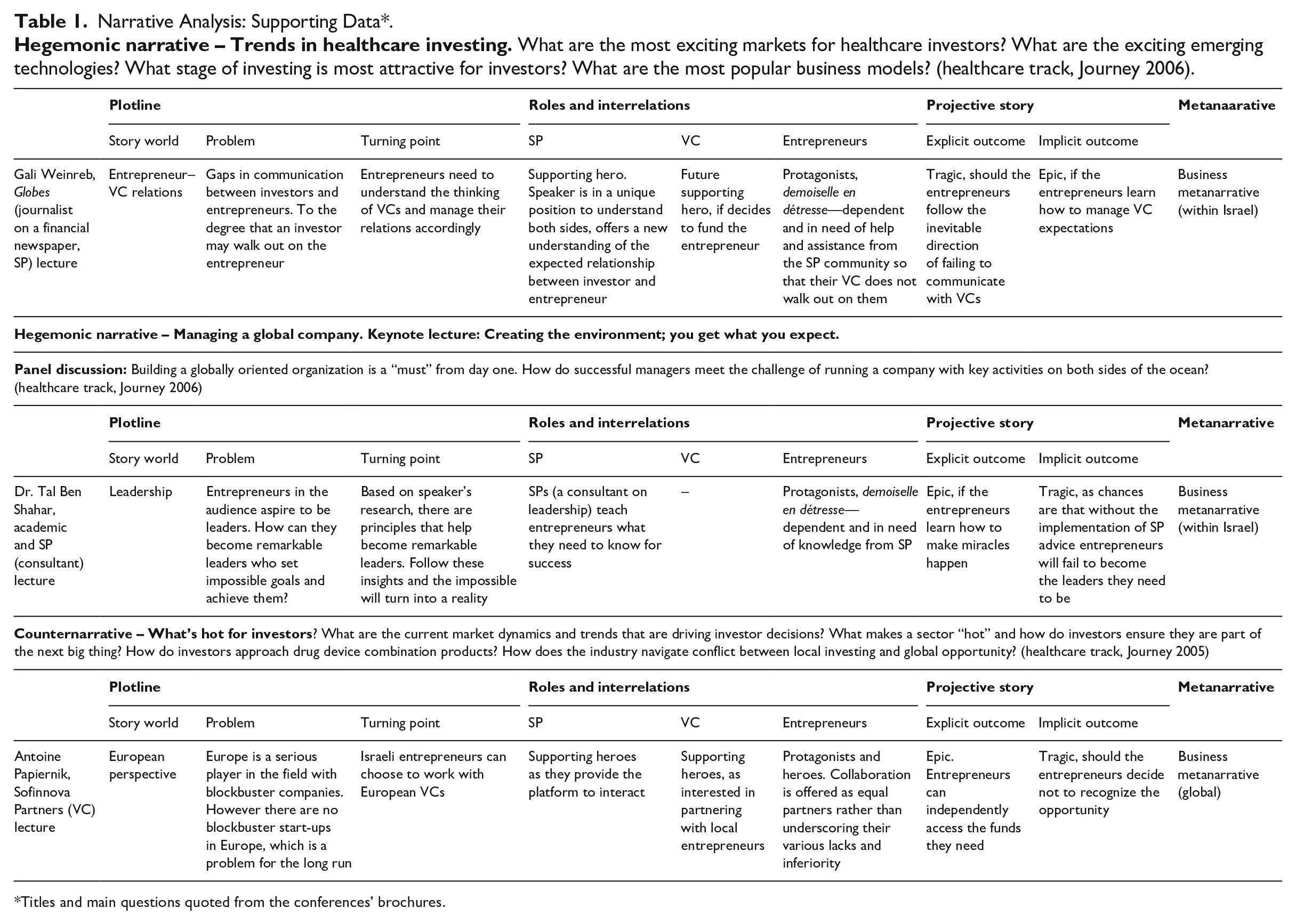
Titles and main questions quoted from the conferences’ brochures.
Enacting the stories: The construction of agency and the lack thereof
The organizers enacted the stories they told by using a limited genre repertoire (Orlikowski & Yates, 1994). Plenary lectures, in which leading SPs and VCs used oral and graphical presentations to transfer knowledge to the audience of entrepreneurs (Shalom, 1993), were most common in the studied conferences. Lecturers formed a hierarchy between themselves, as experts, and the audience (Goffman, 1981) by standing at podiums that separated their body from the audience, using amplification devices, and by not opening the floor for questions. Whereas research highlights opportunities for interactive technologies (Doherty, 2010), the lecture genre followed suit with archaic expert monologues. As learning new knowledge is also about learning “proper behaviors” (Simon, 1990, p. 1666), understanding the expectations of the VC community was associated with accepting the centrality of SPs’ advice and connections to VCs. Thus, plenary lectures in the studied conferences were enacted in a way that further highlighted the SPs’ (and to a lesser extent, VCs’) depiction of the field.
Panel discussions involve a host, a broker who mediates a conversation (Guillot, 2008, p. 183) by posing questions to panelists who share expert views in a personal tone (Patrona, 2009). Whereas this genre allows in principle for different voices to be heard, the four panels in the studied conferences involved panelists who sat in a half circle on the stage, and reached quick agreements regarding basic assumptions. In a panel on strategic development partnerships (2005), the two moderators (a representative of an established firm and a VC) posed questions to panelists that formed a linear sequence, reinforcing the basic assumption that partnership between startups and established firms is essential. For example: Why partner? When is the best time for partnership? How important is the term sheet? When to bring top management together? Panel members may have differed in their viewpoints, but all shared a plotline: entrepreneurs are dependent on SPs to avoid pitfalls in partnerships.
The audience hardly participated and rare invitations extended to collect responses were only made towards the end, once the basic hierarchy was established. No microphone was set up for the audience, so even when an audience member spoke, one could not hear what was said, unless in close proximity. Further, panel members repeated and paraphrased the responses, reinforcing their role as the critical field-level players.
Workshops
As exemplified in the opening vignette, even the workshops—an interactive genre, involving participants in hands-on experiences (Levina & Orlikowski, 2009)—enacted the same power relations. SPs provided and monitored the tools for innovation, brought together experts to introduce medical-based concepts which may be improved through subtraction, and provided critical feedback. Whereas in a business setting, consultants are expected to build upon the organization’s needs and knowledge (Levina & Orlikowski, 2009), the workshops in the studied conferences resembled a lesson, in which the teachers (SPs) dismissed their pupils’ (entrepreneurs’) knowledge and pushed them to “adopt” the SPs’ ways of thinking and acting.
The genre repertoire (Orlikowski & Yates, 1994) enacted the story told in the presentations. SPs assumed the roles of experts, insiders, and teachers, vis-a-vis the entrepreneurs who were channeled to enact the role of laypersons, outsiders, and pupils, in need of SPs’ connections and knowledge to follow an epic trajectory or stumble into inevitable hardships.
Setting the stage: Enabling and constraining agency
Both the content of the stories and their enactment created a specific hierarchical depiction of the field, serving the organizers. Setting the stage- Lukes’ (2005) second face of power - may explain how the organizers managed to tightly control the events. By deciding on the agenda, speakers, format, and spatial arrangements, a foundation was created for the organizers’ depiction of the field. While entrepreneurs comprised 60 percent of participants they accounted for only 12 percent of speakers, who were mostly SPs and VCs. Moderators were mostly investors, either VCs or representatives of major bio-tech corporations; one was a SP; none were entrepreneurs. Furthermore, all sessions were held in the same large conference hall. The audience was seated in a packed conference room throughout the day on long rows of chairs, facing an elevated stage accessed only by moderators and presenters. Behind the stage was a huge screen with the organizers’ logos and, as speakers were introduced, the screen showed their picture and a list of their accomplishments. Huge amplifiers were set up at three corners for the speakers alone. The audience—their very bodies—was thus channeled into compliance. Our observations of audience behaviors, as recorded in our field-notes, are very telling: the room remained packed and silent, unlike the cultural norm in Israel. Audience members came in on time, listened carefully, and took notes. When the first author reached into her bag in the middle of a lecture on leadership that offered a string of anecdotes all exemplifying McGregor’s theory X and theory Y (academic and SP, “Creating the environment: you get what you expect,” lecture, 2006), she was hushed by people around her.
By setting the stage the organizers enabled and constrained the possibilities for stories to be told and enacted, thus forming specific interdependencies between SPs (and VCs) and entrepreneurs. This hierarchy was constituted even before the first story was told.
Meta-narrative: Constructing bio-tech as business
Lukes’ (2005) third face of power—the least visible and formal—was expressed in the meta-narrative. While bio-tech integrates business, scientific, and medical discourses (Bud, 1991), the majority of stories were grounded in a business meta-narrative. The presentations related mostly to market trends in both the US and Europe, funding and investments, innovation, partnerships, leadership, marketing and sales, and legal considerations, thus suggesting that bio-tech should be understood solely as a business endeavor.
An SP said: What is not hot? Large joint reconstruction is not hot. It’s a loser’s game for new technology. Why is it a losers’ game? Because when a patient comes in, they have their knee replaced, they will be happy ten years later 98% of the time. (Young consulting group, SP, “What’s hot for investors,” lecture, 2005)
The speaker hints at, and negates, a medical meta-narrative that highlights bio-tech’s healing potential. Speakers related then to diseases as business opportunities, not as causes of human suffering to be cured. Entrepreneurs were taught to invest efforts in products that bring profits by having patients returning for ongoing care. Within a medical meta-narrative, large joint reconstruction is a big success; not so within a business meta-narrative.
The spatial arrangement of the conferences also expressed the business meta-narrative –reflecting a sense of exclusiveness by situating the events in a glamorous hotel on the coast of Tel Aviv, serving lavish food throughout the day, and greeting the attendees with a conference kit full of freebees. State-of-the-art technology (closed-circuit television and sophisticated sound systems) further alluded to a profit-based prestige.
Hardly voiced counter stories: Entrepreneurs as independent and active
Four stories out of 26 offered an alternative construction, conveying a cooperative plotline in which entrepreneurs’ success was the expected outcome. These stories were embedded in different meta-narratives, and were told by outsiders.
Professor Ran Kornowski provided some “background about the billion-dollar market, you know, the stent.” Kornowski, professor of cardiovascular medicine in Tel Aviv University, distinguished between seeing illness as a problem that needs to be cured and as a business opportunity: I’m a physician you know, and maybe I’ll learn a little bit about business during this morning. I would like to take you on a journey on the topic of coronary atherosclerosis or coronary artery disease. (. . .) For you it might be a billion-dollar market opportunity, for us it’s a big medical fight, day and night.
Hinting at a potential conflict of interests between himself as a physician, and the business-minded bio-tech industry, he discussed the simple, already existing solutions to prevent heart illness: And there is a lot to be done which is not high-tech, it’s not very expensive. Cigarette smoking obviously needs to be treated, treating lipids using all kinds of modalities, and work reduction, exercise, (. . .) hypertension control, and for those that have thrombotic tendency to take anti-platelets such as aspirin. (. . .) Again it’s not high-tech but this works, it works very very well in many many people.
Referring briefly to medications, Prof. Kornowski turned to the stent, explaining how it changed the standard of care. Replacing open heart surgeries with a noninvasive procedure that improved clinical results and allowed short hospitalizations. “So why did it become a billion-dollar market?” he asked and then replied: Because “it works.” Unlike the common business meta-narrative, the medical meta-narrative offered in two talks appealed to the audience as knowledgeable researchers, perhaps even more important than VCs or SPs.
Two additional stories remained within the business meta-narrative, yet offered a different depiction of the interrelations within the field, viewing Israeli entrepreneurs as business people whom European VCs and American stock exchange (AMEX) representatives would be happy to cooperate with.
Out of the 26 presentations given in the events, only these four did not align with the dominant depiction of bio-tech as a business endeavor in which SPs and VCs are essential players.
Discussion: Power and the Configuration of Field-Level Events
How do field-level conferences work? Connecting research that pointed to the importance of event structures and the crucial role of organizers, we focused on the exertion of power in convening field-level events. We offer three contributions, relating to narrative mechanisms, resourcing, and the modalities through which power is exerted.
How power is narrated in field-level events
We look at the conferences as narratives both epistemologically and ontologically, as platforms for the telling of stories, and as unfolding narratives in and of themselves. This approach highlights a rich variety of ways to exert power in field-level events, corresponding to Lukes’ (2005) model. Organizing field-level events is an opportunity to theorize the field (Greenwood, Suddaby, & Hinings, 2002, p. 60; Lawrence & Suddaby, 2006). Actors offer their depiction not only by telling stories during the proceedings—as found in other studies (e.g., Hardy & Maguire, 2010; McInerney, 2008; Zilber, 2007)—but also through constructing the events to privilege their stories.
Organizers do so by using diverse narrative mechanisms, including telling stories and enacting them, setting the stage, and embedding the stories in a specific meta-narrative. These narrative mechanisms echo Lukes’ (2005) three faces of power: explicit control of meanings; implicit use of power by setting the agenda; and the invisible that expresses the power to manipulate others’ viewpoints.
Projective stories (Garud et al., 2014) told during events construct a specific understanding of the field. By constructing characters and plotlines that fit their interests, narrators offer specific understanding of actors, their roles, lines of action, and plausible fate. The SPs positioned themselves at turning points of the stories (McAdams & Bowman, 2001) and as central actors who have the crucial knowledge and connections vital for entrepreneurs’ success.
Narrated roles, interrelations, and lines of action were enacted in the world of the conference through a limited genre repertoire (Orlikowski & Yates, 1994)—plenary lectures, panel discussions, and workshops—in which entrepreneurs were positioned as passive with restricted opportunities to perform an independent, successful-in-their-own-right type of action. While interdependencies were conveyed and enacted they were never declared, reflected upon, or refuted, all enhancing the power to construct meaning in line with Lukes’ (2005) first face of power.
As events unfold in time, organizers’ also express Lukes’ (2005) second face of power, consisting of setting the agenda and preventing some alternative issues from being raised. Organizers’ choices in setting the stage (like location, décor, schedule) have further consequences for the ability of other actors to act, allowing for only preferred experiences to circulate, be developed into stories, and consumed, while silencing and devaluing others’ perspectives (Peterson & Langellier, 2006, p. 176).
The third, least visible, face of power (Lukes, 2005) is expressed in the use of particular meta-narratives that offer a specific tacit understanding of value, standards, and evaluation. Meta-narratives tap into a hidden, taken-for-granted level of awareness and complement other layers of perception (Zilber et al., 2008). Indeed, incorporating such dual routes of persuasion (the explicit and the implicit) was found to be most effective (Petty, Wegener, & Fabrigar, 1997; Wood, 2000).
Field-level events and the power of resources
Organizing a field-level event requires social resources to allow for gathering all the major actors in the field, and financial resources to secure space and equipment. Current studies of FCEs tend to treat these resources as fixed and given (Shu & Lewin, 2017). For example, Hardy and Maguire (2010) detailed the discursive spaces within a United Nations conference regarding the insecticide DDT. However, they did not analyze who organized these discursive spaces and what resources (e.g., regulative power of the UN) were used to that end.
Contrary to such a functionalist approach to resources, we follow a social constructionist tradition (Feldman & Worline, 2012), defining a resource “not by what it is, but by the practices through which it is enacted” (Feldman & Orlikowski, 2011, p. 1249). Resources are understood then as dynamic and transferable, embedded in context and narratives, and determined by their association to values (Howard-Grenville, 2007). Focusing on the “processes of resourcing” (Wiedner, Barrett, & Oborn, 2017, p. 826), we shift our thinking away from the role predetermined resources play in field-level events towards highlighting how organizers construct resources before, during, and after field-level events. The SPs attributed worth to two resources: professional knowledge and networks. Repeatedly, they portrayed entrepreneurs as facing difficulties because of inadequate knowledge and lack of connections to VCs. In turn, SPs’ business knowledge and social networks were presented as valuable resources for filling these gaps.
Knowledge and networks, symbolic and social capitals in Bourdieu’s terminology, are politically laden (Voronov & Vince, 2012) and are the ultimate combination of professional competency (Leicht & Fennell, 2008; Sandberg & Pinnington, 2009). They are also considered to be determinants of startups’ success in bio-tech (e.g., Baum, Calabrese, & Silverman, 2000). Yet this construction of success serves the organizers. Further, success was defined as going public through an initial public offering necessitating VC financing, which is actually a relatively rare event (Aldrich & Ruef, 2018). Most entrepreneurial enterprises struggle with much more mundane challenges of running the day-to-day business (Aldrich & Ruef, 2018), but those concerns were neglected. Moreover, SPs depicted knowledge and connections selectively. Networks are important but research shows that bio-tech companies need both scientific and business networks (Niosi & Bas, 2001; Oliver, 2001), including within the Israeli context (e.g., Kaufmann et al., 2003). The SPs, by contrast, related only to connections with VCs and to business knowledge, while devaluing the scientific knowledge and connections of their mostly academic audience. SPs then narrated the importance of networks and knowledge in a way that was instrumental in highlighting their own importance in the entrepreneurial process, while downplaying those of others.
Resources are interrelated with power (Magee & Galinsky, 2008). Actors shape resources to favor certain decisions (Valentine, 2018) or set an agenda for decision making (Wiedner et al., 2017), thus relating to Lukes’ (2005) first and second faces of power. Exerting power by attributing value to a certain resource, actors also relate to taken-for-granted worldviews, including interdependencies and expected behaviors from different groups (Contu, 2014), thus reflective of Lukes’ (2005) third dimension.
The multimodality of power dynamics in conference organizing
A modal is the medium or semiotic field through which meaning is constructed (Goodwin, 2000; Literat et al., 2018). Most studies focus on words (Pickering, 2017), but many other modalities are at work,including the visual, spatial, emotional, and the embodied. Each modal offers a unique window into the world and a way to experience (Literat et al., 2018) and perform (McVee & Carse, 2016) social reality. Various modalities, working together, constrain, enable, and co-construct understandings (Höllerer, Jancsary, & Grafstrom, 2018; Meyer, Jancsary, Höllerer, & Boxenbaum, 2018). As such, each modal mediates power and the “ideas and beliefs that support it” (Machin & van Leeuwen, 2016, p. 244).
Our findings highlight how conference organizing involve multiple modalities that together offer a political construction of the field. Beyond words that convey stories-as-content detailed above, we identified two additional salient modals: space (Hardy & Maguire, 2010; Mair & Hehenberger, 2014) and embodying (Stowell & Warren, 2018) the event in the “here and now” experience of the participants (Höllerer et al., 2018, p. 636). Space impacts sensemaking (Cornelissen, Mantere, & Vaara, 2014) and is “crucial to the understanding of the more subtle and process-driven ways by which identity categories and hierarchies are ‘done’” (Wasserman & Frenkel, 2015, p. 1488), and distinctions between insiders and outsiders are made (McVee & Carse, 2016). As space is latent, actors tend to reproduce embedded expectations (Wasserman & Frenkel, 2015). The spatial constructions seemed to channel participants and organizers into passive and active roles, respectively, and constructed a link between bio-tech and business.
The events were also embodied, experienced by “living, breathing, moving bodies” (Stowell & Warren, 2018, p. 789) in the “here and now” (Höllerer et al., 2018, p. 636) of interactions. Embodiment allows powerful actors to push novel and even conflicting messages without unpacking them verbally (Wenzel & Koch, 2018) and without accounting for the immediate, direct nature of the physical (Hull & Nelson, 2005). Entrepreneurs were thus streamlined into a passive position, trapped in chairs in a huge hall, publicly undervalued yet hardly able to voice any resistance. Unlike everyday conversation in which listeners have the opportunity to counter-argue a point (Mumby, 1993), such audiences are less likely to form counter narratives (Polletta & Lee, 2006). These embodiments of meanings that were also delivered through story content brought the organizers’ ideas into being (Woolgar & Lezaun, 2013).
These various modalities—words, space, and body—further relate to Lukes’ three faces of power (2005). While the stories told through words express an explicit use of power to offer understandings of the field, the spatial choices set the agenda in a less explicit form of power, and constructing specific bodily experiences express the third and most latent face of power.
The stories—delivered through words, space, and embodiment—reinforced the message through “gradual repetition and habituation” (McInerney, 2008, p. 1111), making it difficult for consumers to identify the power relations underlying them. Further, these modalities worked together, strengthening the same construction of the field in explicit and latent ways. Their cumulative effects transcend their distinct nature (Hull & Nelson, 2005) and offered a comprehensive message regarding field-level dependencies.
Boundary conditions and future research
Some field-level events have a strong mandate, organized by actors who have formal authority (Lampel & Meyer, 2008), such as UN conferences (Maguire & Hardy, 2006; Hardy & Maguire, 2010) in which participants agree upon a decision which then becomes a law. While the decision process is rife with political maneuvering (Schüßler et al., 2014), it is regulated and known to all, which sets up certain constraints for the construction of resources. Our case is an event with a weak field mandate (Lampel & Meyer, 2008) as the organizers lack formal authority over the field and their informal authority is limited to the field-level event. Also, unlike the National Institutes of Hea;th in Garud’s (2008) study of cochlear implants, the organizers were unable to orchestrate decisions that would normatively bind other participants. Their only hope to influence the field was by persuasion and construction of the messages during the event. Under such conditions, the hidden exertion of power (Lukes’ third dimension), through meta-narratives and embodiment, may be especially important in establishing organizers’ desired hierarchy. Other events, organized by actors in different subject positions and formal authority, may involve a different constellation of the three faces of power.
Under what conditions should we expect explicit or implicit exertions of power? When should we expect opportunities for negotiation or even resistance? Further research may map how different fields (e.g., mature versus emerging) and organizers (e.g., central or peripheral, with or without formal power, representing either a diverse or a narrow set of actors) use narrative mechanisms, resourcing, and modalities, and to what effect.
In the studied events, the narrative mechanisms, construction of resources, and the use of different modalities were in sync, thus further promoting a specific depiction of the field. However, they do not necessarily have to work concurrently (Wenzel & Koch, 2018). Future studies may explore when and under what conditions these different mechanisms and modalities are in sync, and what happens when they are not. When power is exerted less effectively, different segments of the audience may react differently, following their own interests. Those participants chosen by the organizers to have an active role in an event may follow organizers’ depiction of the field; however, those channeled into a passive role may reject it. Thus, future research may delve specifically into the potentially disparate interests of audience members to explore how each group exploits narrative mechanisms, resources, and modalities in different ways, to different degrees, and in the service of diverse interests.
Based on previous studies of FCEs, we know that events do affect the trajectory of fields. However, our focus was on the world of the conference, on the here and now. This is why we used in vivo and in situ observations, and did not collect longitudinal data. Future research may further connect different narrative mechanisms and faces of power exerted by event organizers, and their effect on fields for the long run.
We studied only field-level events, which have unique characteristics. Yet exploring power through narrative mechanisms, resources, and modalities may be relevant to a wide array of social events. For example, research has explored the importance of storytelling for understanding entrepreneurship (Gartner, 2007; Lounsbury & Glynn, 2001) and decision making (Abolafia, 2010; Gibson, 2011). In these contexts, it is worthwhile exploring the narrative mechanisms we explicated and their political effects.
Scholars started to unpack how stories entrepreneurs tell affect the support they get from stakeholders (Clarke & Cornelissen, 2014), like raising funding for their venture (Manning & Bejarano, 2017; Martens, Jennings, & Jennings, 2007). These studies portray entrepreneurs as skilled cultural operators (Lounsbury & Glynn, 2001) and the delicate balancing act that is involved in telling projective stories (Garud et al., 2014), between enchanting and raising too high expectations; and between local stories and wider field discourse (Garud, Lant, & Schildt, 2019). The narrative-political lens we are offering complements these current studies of entrepreneurial storytelling by going beyond content, calling attention to how entrepreneurs gain an opportunity to tell stories.
Further, previous studies demonstrate how decision making (the original site upon which Lukes (2005) developed his model of three faces of power) involves the telling of stories (Abolafia, 2010; Gibson, 2011). Understanding how decision-making events are designed and embedded within specific meta-narratives, how the experience is embodied, which roles actors are channeled into, and how all these serve specific motivations and goals, will widen our understanding of the role of stories in decision making.
While we cannot anticipate which mechanisms will be at play, and how effective they will be in constructing power relations, our analytic generalization (Tsoukas, 2009) calls for more attention to the narrative dynamics and the related resources that are constructed and modalities at play. Each of these aspects offers organizers visible, hidden, and invisible opportunities to exert power.
Footnotes
Acknowledgements
We are indebted to our associate editor Professor Jean Clarke and three anonymous reviewers for their most valuable comments. We wish to thank Yehuda Goodman for the ongoing discussion on this project and Beth Bechky for her inspiring comments. We also wish to thank the Asper Center in the Jerusalem School of Business and the Arthur Beckler Foundation at the Hebrew University’s rector’s office for their support.
Funding
The author(s) received no financial support for the research, authorship, and/or publication of this article.
