



Abstract
In this essay, we trace the evolution of the field of sustainability in management and organization studies and narrate its epistemological twists and turns. Concerned by the current trajectory that tends to diminish a focus on political concerns, we propose a new research agenda, an ecological case for business, that transforms our paradigmatic orientation in four shifts: (1) altering our epistemological lenses from managerial to critical perspectives; (2) altering our ontological lenses from realist to relational view; (3) changing the way we design and conduct research from discipline-focused to interdisciplinary knowledge; and (4) transforming our scholarly stance from value-neutral to engaged scholarship. We argue that these shifts have capacities to overcome the conceptual limitations of the business case and, more fundamentally, help us question our scholarly positioning to the ongoing socio-ecological crises.
“We have become, by the power of a glorious evolutionary accident called intelligence, the stewards of life’s continuity on earth. We did not ask for this role, but we cannot abjure it. We may not be suited to it, but here we are.”
As Gould makes clear, humanity is facing a new ecological responsibility for which it is unfamiliar and unprepared. Climate change, species extinction, and ocean acidification are just some of the markers of what scientists call the Anthropocene, a geological period characterized by a dominant human influence on the functioning of the ecosystem. At the same time, it is important to problematize who the “we” are because the dangerous ecological conditions we all face today are the product of particular political and economic policies and practices aimed at exploiting nature for the benefit of a few. The Anthropocene is not a story of unintended consequences but is a direct result of a political economy that privileges wealth accumulation at the expense of environmental destruction. In fact, some have proposed that the term “Anthropocene” should be replaced by the term “Capitalocene” (Moore, 2016) or “Econocene” (Norgaard, 2013) to indicate the almost divine status of markets, and “Technocene” (Hornborg, 2015) or “Plutocene” (Glikson, 2017) to represent the gross inequalities in material consumption and greenhouse gas emissions.
Unfortunately, our prevalent discourses and practices around sustainability carry such political and economic premises, and they limit our abilities to think and act outside of existing approaches. As scholars researching and teaching sustainability-related phenomena in business schools, we are disturbed by the dominant business case orientation of our scholarship on environmental and social issues. In this essay, we aim to unsettle the field’s direction 1 and argue for its paradigmatic transformation to foster a radical scholarship that can enable a more meaningful engagement with the ongoing socio-ecological devastation.
Acknowledging the importance of corporate practices on the stability of our natural environment, there has been a potent effort to examine how business organizations impact the natural world through a research domain called “business and the natural environment,” which started in the early 1990s. With its subsequent reorientation around “business sustainability” in the 2000s, the corporate influence on the social world has been added to the research effort. However, despite its growing success in gaining legitimacy, its analytic approaches are not equipped to handle the grand challenges of the Anthropocene, which are fundamentally about survival of human and nonhuman life on Earth and preventing socio-economic inequalities. While seeking ways to “green” or make organizations “sustainable,” the field has failed to pay attention to the root issues that produce our present crises. The existing literature has focused predominately on incremental change without problematizing its political-economic premises, 2 yet the problems of the Anthropocene require transformational change at the systemic level that reconsiders how humans relate to the natural world and how wealth is distributed among diverse populations.
In this paper, we make this case, explaining why this may be so and how we might redirect the field’s emphasis to focus more directly on the root of the sustainability challenge. To do that, we first offer a brief history of sustainability and the natural environment in organization studies, covering its origins in the 1990s, its evolution into sustainability in the 2000s, and its present state. Further, we discuss the two epistemologies that marked the field’s origins—critical and managerial—and show how the managerial view took precedence by gaining legitimacy within the political institutions of academia. 3 As concerned scholars of organization studies, we argue that we must reconsider our intellectual approaches and propose a new research agenda, one that foregrounds the political and that has capacities to engage with our ongoing socio-ecological collapse. Specifically, we call for four fundamental shifts that act as political interventions to transform the prevailing business case orientation and to prompt research for an ecological case for business. These shifts are: (1) from managerial to critical epistemologies; (2) from realist to relational ontologies; (3) from discipline-focused to interdisciplinary collaborations with natural sciences; and (4) from value-neutral stance to engaged scholarship. We close our essay with a challenge for scholars—to redirect one’s field of inquiry towards addressing the systemic causes of our environmental problems even if that means moving in a direction that is contrary to the political, economic, and academic institutions in which we reside.
A Brief History of (Un)Sustainability in Organization Studies
While some studies on the natural environment in management can be traced back to the beginning of the modern environmental movement in the 1970s (i.e., Gladwin & Welles, 1976), the topic did not become an object of significant research interest until the early 1990s with the first efforts to build a research community among management scholars (e.g., the Greening of Industry Network in 1989 and the Organizations and the Natural Environment special interest group of the Academy of Management in 1994, later to become a division in 2007) and the creation of academic journals dedicated to the interface between managerial action and environmental protection (e.g., Organization & Environment which was created in 1987 from its predecessor Industrial Crisis Quarterly, and Business Strategy and the Environment in 1991. 4
The original agenda of organizations and the natural environment research
Much of the early work on organizations and the natural environment was fragmented and diverse, driven by scholars who were concerned about environmental dangers like the Bhopal disaster in 1984, the discovery of the ozone hole in 1985, and the Exxon Valdez oil spill in 1989. Given the rising concerns about corporate complicity in environmental harm, the topic could no longer be considered outside the realm of management research but compelled a shift in corporate posture from a reactive to a more proactive approach to environmental issues in the 1990s. Driving forces for this shift included enhanced corporate reputation, lower compliance costs, and stronger competitive advantage in markets in the United States and globally (Banerjee, 2001; Hoffman, 2001; Schmidheiny, 1992). While the natural environment became a focus of business research in 1990s (Hoffman & Bansal, 2012), it remained on the fringes of management and organizational scholarship (Ehrenfeld & Hoffman, 2013) with a focus on “greening organizations” (Shrivastava & Hart, 1994) to study the intersection of managerial and environmental concerns. As the field began to develop, research took two epistemological perspectives: critical and managerial.
Critical epistemological research
This stream offered a critique of corporations’ role in environmental degradation (Gladwin, Kennelly, & Krause, 1995; Stead & Stead, 1994; Welford, 1997). Paralleling developments in environmental sociology, this work viewed environmental pollution as a negative consequence of the dominant economic paradigm and called for a fundamental restructuring of economic and political systems (Schnaiberg, 1980). Building on the “new ecological paradigm” (Catton & Dunlap, 1980), Gladwin and his colleagues proposed that “modern management theory is constricted by a fractured epistemology, which separates humanity from nature and truth from morality” and concluded with the provocation that management theory should act “as if sustainability, extended community, and our Academy mattered” (Gladwin et al., 1995, p. 874).
Other early critical works argued that the dominant economic focus of management and organizational research prevented genuine engagement with ecological issues because the managerial and human-centered premises underlying organization theory and strategic management tended to rely on a profit motive that prioritized the interests of shareholders and managers (Shrivastava, 1994), perpetuated endless consumption-based economic growth (Purser, Park, & Montuori, 1995), created asymmetrical wealth distribution in societies (Levy, 1997), and focused primarily on the needs of consumers and corporations from the Global North while denying the interests of marginalized populations (Banerjee, 2003). The central theme of this critical stream was that environmental issues were inseparable from political corporate interests and addressing them required challenging the political-economic premises of existing management frameworks.
Managerial epistemological research
This second stream integrated environmental concerns into existing theoretical frames of economic performance and profit maximization that the critical research found problematic. In this way, environmental issues became “strategic” in that they were related to corporate resources and capabilities, competitive advantage, organizational performance, stakeholder pressures, and institutional legitimacy (Buysse & Verbeke, 2003; Russo & Fouts, 1997).
A defining characteristic of the managerial research was its focus on corporate environmental strategies as a solution to environmental problems (Forbes & Jermier, 2010). This research emphasized win-win market-based solutions where firms could reduce costs through energy efficiency, waste reduction, and recycling initiatives, or increase profits through a premium pricing strategy for green products. Focused on variants of the question “Does it pay to be green?” this work sought to merge the drive for competitiveness with the demand for environmental protection as a means to gain economic advantage (Schmidheiny, 1992).
Emergence of “sustainability” and mainstreaming of environmental research
As the field continued to grow through the 1990s and 2000s, the managerial and critical streams both forwarded an imaginary of ecologically sustainable organizations and aimed to transform the dominant models of management and organization research. However, they were coming from different intellectual backgrounds, thus suggested different approaches to achieve sustainability. While the managerial works sought to integrate environmental issues into conventional corporate imperatives of profit maximization, the critical accounts acknowledged that economic activity was embedded in a larger network of political systems which privileged profitability over ecological sustainability.
Over the years the managerial perspective became the dominant paradigm, and in the mid-2000s, the terms “sustainable development” (World Commission on Environment and Development [Brundtland Commission], 1987) and “corporate sustainability” began to gain currency in redefining the field. Informed by the values of liberal humanism and Western environmentalism, this redefinition drew attention to fundamental social concerns including poverty, inequality, health and food insecurity, in addition to the prior portfolio of environmental concerns upon which the field had devoted its attention. Corporate sustainability become the defining marker of the field to describe “the inclusion of social and environmental concerns in business operations and in interactions with stakeholders” (van Marrewijk & Werre, 2003, p. 107). However, this new conception reinforced the managerial priorities that privileged economic growth, and suggested that sustainability could be achieved by corporate strategies and “sustainable” or “green” growth (Banerjee, 2011). More recent accounts have proposed “sustainable business models” that integrate stakeholder interests into value creation (Schaltegger, Hansen, & Lüdeke-Freund, 2016). While this research seeks to facilitate radical transformation, it elides the contradictions between creating economic value for the firm and preventing unsustainable levels of resource extraction, material consumption, and asymmetrical wealth distribution at a systemic level.
As research on corporate sustainability became increasingly aligned with the dominant economic approach of the broader management field in the 2000s, environmental issues began to gain institutional legitimacy as a distinct area of management scholarship, one in which scholars could offer courses, publish in top-tier academic journals, secure tenure-track jobs, and fill chaired professorships (Ehrenfeld & Hoffman, 2013). Today, in business schools, most deans are supportive of sustainability curricula under the umbrella of “responsible management education” (Forray & Leigh, 2012), and a significant number of management courses include at least some coverage of corporate sustainability.
Discrepancy between managerial research and socio-ecological system needs
While research on corporate sustainability continues to proliferate, two worrying trends have emerged. One is the limits of corporate sustainability in addressing the root causes of the problems we face. For many, it has become nothing more than a label for actions or strategies that are actually driven by conventional economic principles of competitiveness and profitability (Jacobs, 1993). And while this dilution of the concept continues, the environmental and social problems that it is designed to address have worsened on a global scale. Climate change and the attendant emergence of the Anthropocene (IPCC, 2019) coupled with growing income inequality (Stiglitz, Fitoussi, & Durand, 2019) are two overriding systemic problems that are reaching epidemic proportions which the current dominant political economy seems unable to address. The designer label of corporate sustainability proposes industry-focused technological fixes that do not respond to socio-ecological system needs (Dyllick & Hockerts, 2002; Whiteman, Perego, & Walker, 2013). Recycling, waste disposal, and energy efficiency only reduce unsustainability to a limited extent as they do not take into consideration ecosystem cycles and nature’s regeneration capacity as well as negative impacts on disadvantaged populations. 5
The systemic problems of climate change require more radical approaches, as the managerial approach will only slow the velocity at which we are heading towards a system collapse but will not change the trajectory of that inevitability (Ehrenfeld & Hoffman, 2013). Mitigating harms and doing less bad will not be enough as these approaches still rely on the industrialized production and consumption towards the impossible goal of unlimited economic growth. While there are recent calls for moving beyond such a prevailing orientation (Bansal, 2019; Hahn, Figge, Aragón-Correa, & Sharma, 2017), the analytical tools of corporate sustainability reinforce the managerial view and do not capture the contradictions of market-based ideals and socio-ecological wellbeing, and therefore reproduce the illusion that we can pursue unlimited economic growth while managing the natural environment and creating equitable societies.
At this critical juncture, the field of business sustainability must reengage with radical approaches that explore the systemic basis of our sustainability challenges. The Anthropocene is not simply an environmental problem to be managed; rather it points to systemic breakdowns. Human systems are now dominating natural systems with disastrous effects as sea-level rise, ocean acidification, and species extinction make clear. At the same time, economic and political systems have become skewed towards the interests of the elites, to the exclusion of those who suffer its pernicious effects (Gilens & Page, 2014). Solving these issues requires deeper questions about power relations: “Who gets to set the rules? What values should they reflect? What’s fair? What do we owe to one another?—and reshape our society accordingly” (Stiglitz, quoted in Kehoe, 2016).
Climate Change and the Anthropocene: The Move Towards Radical Approaches
Scientists have set a boundary limit for atmospheric carbon dioxide (CO2) at 350 ppm to maintain a stable environment and we are now over 400 ppm and climbing (NOAA, 2020). These elevated concentrations are increasing the frequency and intensity of wildfires, droughts, hurricanes, temperature fluctuations, sea-level rise, and more. But climate change is one marker of a more expansive systemic shift that scientists believe represents a new geologic epoch. Scientists have proposed that we have left the Holocene and entered the Anthropocene—the Age of Humans—to note the dominating influence that the world’s 7.5 billion people (10 billion by 2050), are having on the planet (Crutzen & Stoermer, 2000; Zalasiewicz et al., 2016). To empirically describe this shift, scientists have identified nine “planetary boundaries” (Rockström et al., 2009) which represent “thresholds below which humanity can safely operate and beyond which the stability of planetary-scale systems cannot be relied upon” (Gillings & Hagan-Lawson, 2014, p. 2). Nine interrelated dimensions have been identified: climate change, ocean acidification, ozone depletion, atmospheric aerosol loading, phosphorus and nitrogen cycles, global freshwater use, land system change, loss of biodiversity, and chemical pollution. Four have already been exceeded: climate change, biodiversity loss, land system change, and the biogeochemical flows. And one is on the mend: ozone depletion (Steffen et al., 2015). More recently, scientists are considering a “hothouse Earth” scenario when ecological changes create self-reinforcing effects that may intensify the disruption at a much faster rate than current predictions (Steffen et al., 2018). As these markers make clear, the Anthropocene is not an environmental problem like those we have faced in the past. It is a systemic failure of our dominant political economy which maintains the conditions for unlimited raw material extraction, energy use, material consumption, and waste releases in a continuous pursuit of profits and economic growth.
These dangerously unsettling realities make clear that 30 years of research on corporate sustainability has had only modest impact on shifting the course of society’s damage to the natural and social worlds. While academic studies are not designed to provide direct contributions to practice, there is a growing pressure for scholars to provide useful analytic tools that could help students and future decision-makers organize sustainable socio-ecosystems. The rising tide of research produced by the dominant management paradigm on “whether it pays to be green” does not lift all boats but instead drowns all alternatives by reinforcing the very managerial priorities that created the environmental and social problems in the first place. As such, the solutions it proposes will be unable to achieve the ends it seeks.
The field’s present course, which promotes incremental change without questioning the political-economic system that is responsible for the current crisis, cannot lead to novel conceptualizations necessary to create sustainable organization–environment relations. It is time to move beyond the narrow focus on the business case and alter the field’s orientation towards new ways of organizing around systems thinking (Whiteman et al., 2013), sufficiency and de-growth (Banerjee, Jermier, Peredo, Perey, & Reichel, 2019). To facilitate this change, we propose a new agenda that is equipped to handle current alarming ecological and social conditions. 6
Towards an Ecological Case for Business in the Anthropocene
To capture the full scope of the Anthropocene, we argue for a radical agenda that takes us beyond traditional theories, models, and frameworks and that problematizes the foundational principles of our current political economy. What if we were to take socio-ecological wellbeing as our central focus, and make an ecological case for business, instead of the business case for sustainability? 7 Flipping the words is not a linguistic sleight of hand but requires a paradigmatic transformation of our intellectual field. Fundamentally, it compels the foregrounding of the political in our scholarly endeavors and the justification of organizations’ existence based on socio-ecological needs instead of economic growth aspirations. To facilitate such transformation in management and organization studies (MOS), we propose four shifts that can act as political interventions and initiate productive conversations for future research. While all four shifts are necessary and ought to be pursued in tandem in order to fully embrace the ecological case, they are neither an exhaustive list nor a finished template. Rather, these shifts are a few important initial steps that will dislocate the naturalized business case orientation and foster research for socio-ecological wellbeing.
From managerial to critical epistemologies
Drawing on insights from early accounts of critical epistemologies, the first shift we propose is from managerial interests to vital concerns that have become marginalized in business sustainability research (Ergene, Calás, & Smircich, 2018; Wright, Nyberg, Rickards, & Freund, 2018). Broadly, this would entail transforming our analytic attention to matters that are fundamental to ecological wellbeing and environmental justice, in order to create alternative forms of organizing that channel efforts for building livable ecologies for all in the Anthropocene (see Table 1).
From managerial to critical epistemologies.
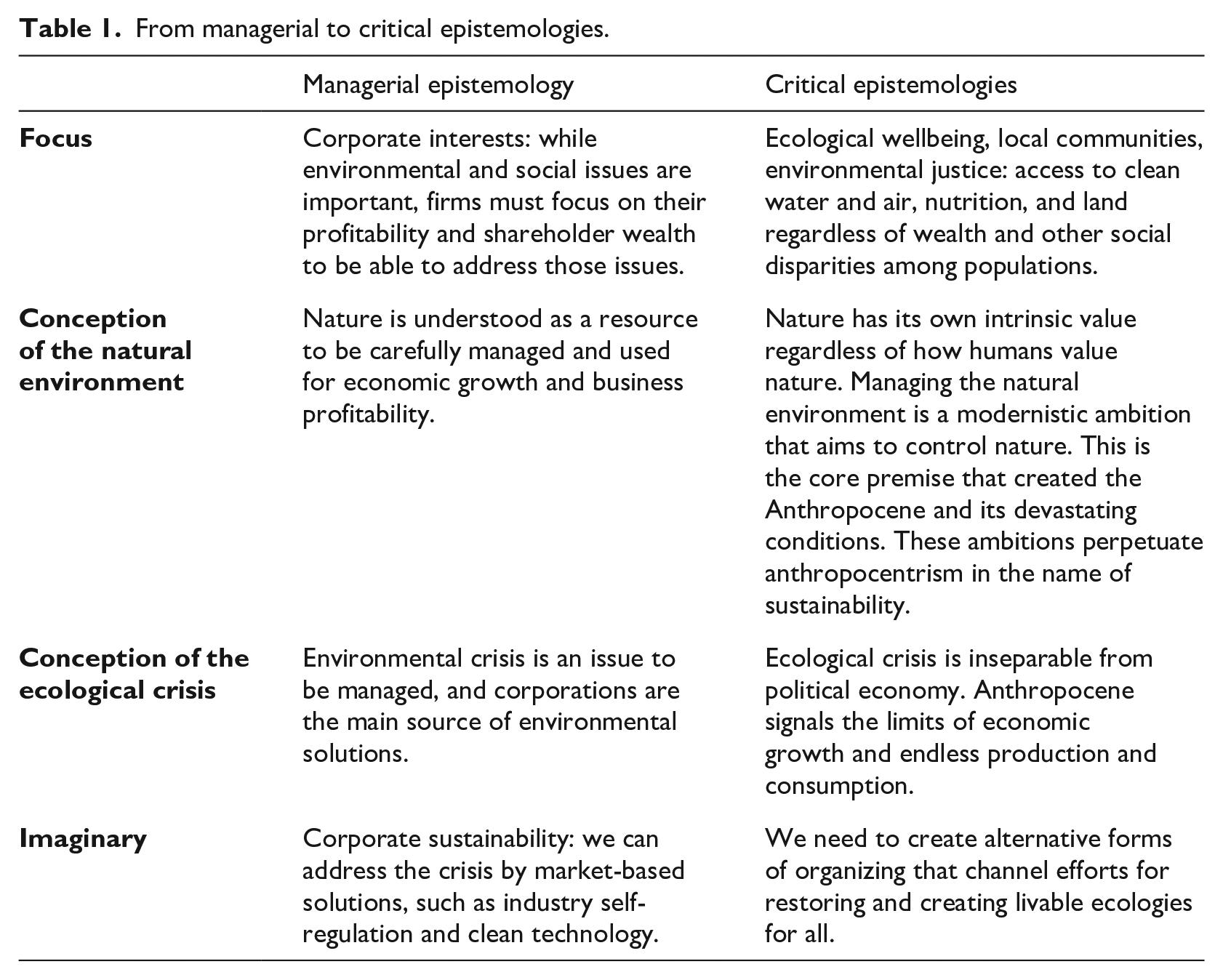
Addressing environmental and social problems in the Anthropocene requires the acknowledgment that our current political economy, which is based on consumption-based economic growth, competitive relations, shareholder wealth, and exploitation of nature, privileges wealth accumulation at the expense of environmental destruction and social equity. Ultimately, the Anthropocene is a result of an economic capture of nature and represents a story of domination. To recover what has been lost, political struggles for environmental justice must be central to our inquiries. In this regard, the analytic tools of critical management studies are helpful for articulating different forms of domination and exploitation and problematizing those premises (Adler, Forbes, & Willmott, 2007). There are various intellectual traditions, each emphasizing different modes of power, such as capitalist, colonial, patriarchal, discursive, and others. A critical research agenda aims to transform existing power relations and to envision new possibilities of organizing economies and societies (Zanoni, Contu, Healy, & Mir, 2017).
While we suggest ecological and social concerns as a focus for future research, we are not proposing to reject the study of corporations and industry altogether. On the contrary, we think that management and organization studies are well positioned to pay close attention to the negative consequences of industrial production and consumption. Studies from within organizations can help us critically analyse sustainability solutions forwarded by the industry and identify their limits in order to incorporate those insights for formulating viable alternatives. 8 Instead of asking whether it pays to be green, future research from critical epistemologies would ask whether the proposed green solutions are sufficient to create livable human–Earth ecologies where access to clean water, clean air, and arable land are available for all populations regardless of wealth and other social disparities.
From realist to relational ontologies
The Anthropocene makes visible the ecological destruction of our human-centered lifestyles and industrialized consumption habits. Earlier accounts had suggested that the main premise of industrialism and much of our consumption-based living rely on a conceptual separation of humans from the rest of nature and the positioning of our species as the controller of nature (Purser et al., 1995; Shrivastava, 1994). Overcoming such an anthropocentric basis of our theories requires new analytic capabilities that can bring focus to planetary-scale human–Earth relations. To foster research that begins from the socio-ecological needs and to facilitate theorizing novel ways of relating to nature, our second proposal is an ontological shift towards a relational view of the world (e.g., Bergson, 1907; Deleuze & Guattari, 1987; Whitehead, 1929) (see Table 2).
From realist to relational ontologies.
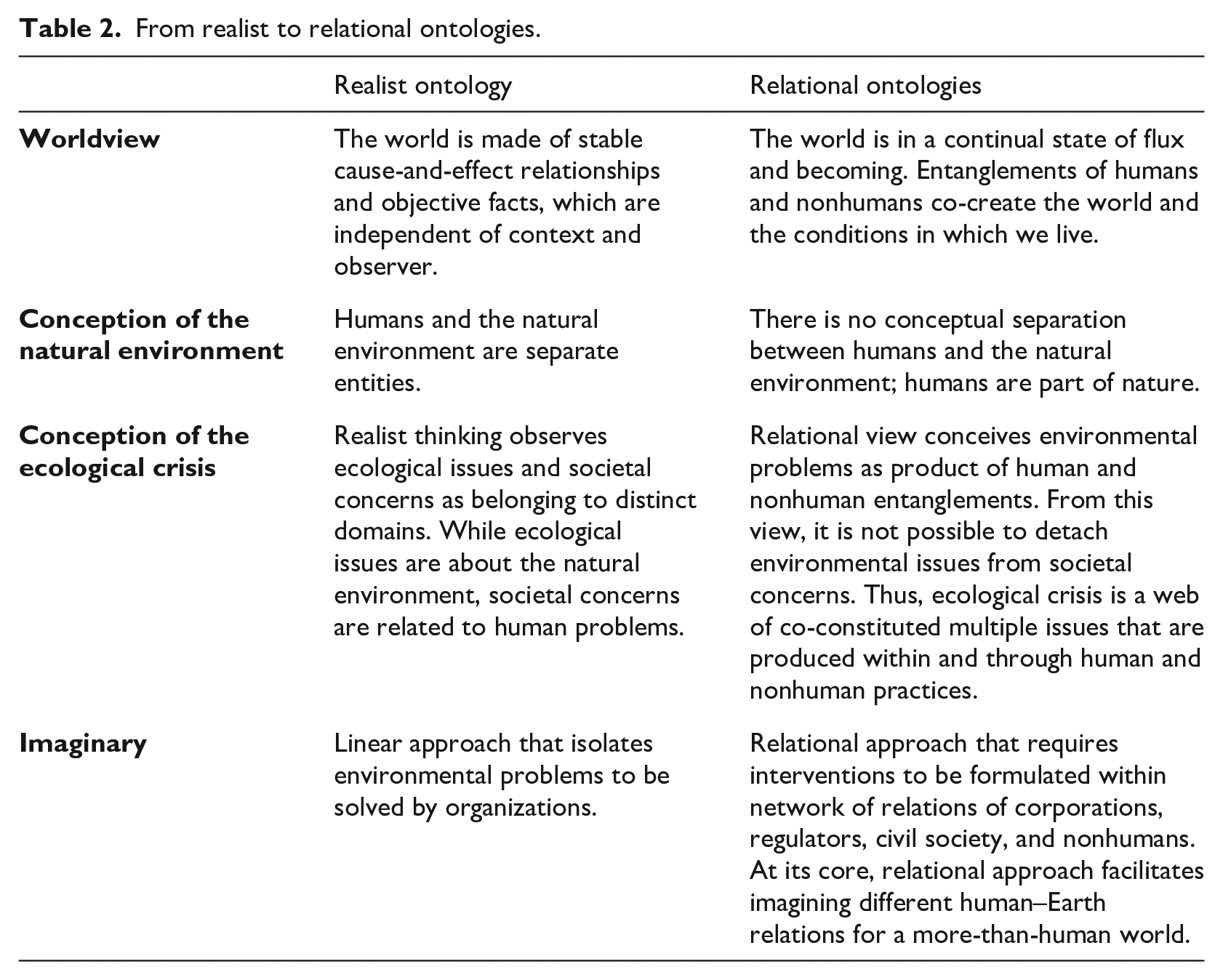
Relational ontologies conceive the world as made up of complex and contingent webs of entanglements, and the analytic focus is on unfolding practices through which these relations are produced (Helin, Hernes, Hjorth, & Holt, 2014). This view does not discern human and nonhuman entities in describing or explaining phenomena; rather it is the relations of humans and nonhumans (e.g., animals, plants, rocks, nitrogen, carbon, etc.) that co-constitute the world. Thus, relational ontologies allow us to theorize nature as a political subject, challenging the longstanding liberal humanist dichotomy of nature and culture (Kalonaityte, 2018). Relational philosophy also converses with various strands of environmental ethics. For instance, Deleuze and Guattari’s “ecosophical subject” (Shaw, 2015), Whitehead’s “ethics of creativity” (Henning, 2005), and Bergson’s “creative evolution” (Simonetti, 2019) contribute to contemporary environmental thought, and provide foundations for conceptualizing different human–Earth relations (e.g., Gibson-Graham & Roelvink, 2010; Tsing, 2015).
While the language of relational philosophy may appear abstract, there are clear examples that illustrate the politics and value of processual thinking for sustainability research (e.g., Heikkurinen, Clegg, Pinnington, Nicolopoulou, & Alcaraz, 2019; Newton, 2002). For example, Beacham (2018) brought attention to the shifting biogeochemical flows in soil due to heavy use of chemical fertilizers in industrialized agriculture. By unpacking the entanglements of human and material elements within the everyday practices of community-supported agriculture, he illustrated that it is possible to develop a more-than-human ethics of care in growing food if we avoid imposing human timescales over nature’s temporality. As this example shows, relational ontologies offer analytic capabilities to disentangle planetary-scale socio-ecological dynamics within practices and guide us to imagine human–Earth relations that respect nature’s temporality and regeneration capacity.
From discipline-focused to interdisciplinary collaborations with the natural sciences
Current ecological conditions have produced irreversible changes for life on Earth, with many species facing extinction due to unprecedented rapid changes in life-supporting ecosystems. At the same time, access to clean water and arable soil for crop growth are major concerns affecting many communities. These extraordinary challenges require us to learn the nature–human ecosystem functioning and ground MOS research on the interdependency of ecological and sociocultural systems. In this purpose, our third proposal calls for a shift from discipline-focused to interdisciplinary collaborative research with the natural sciences (see Table 3).
From discipline-focused to interdisciplinary research.
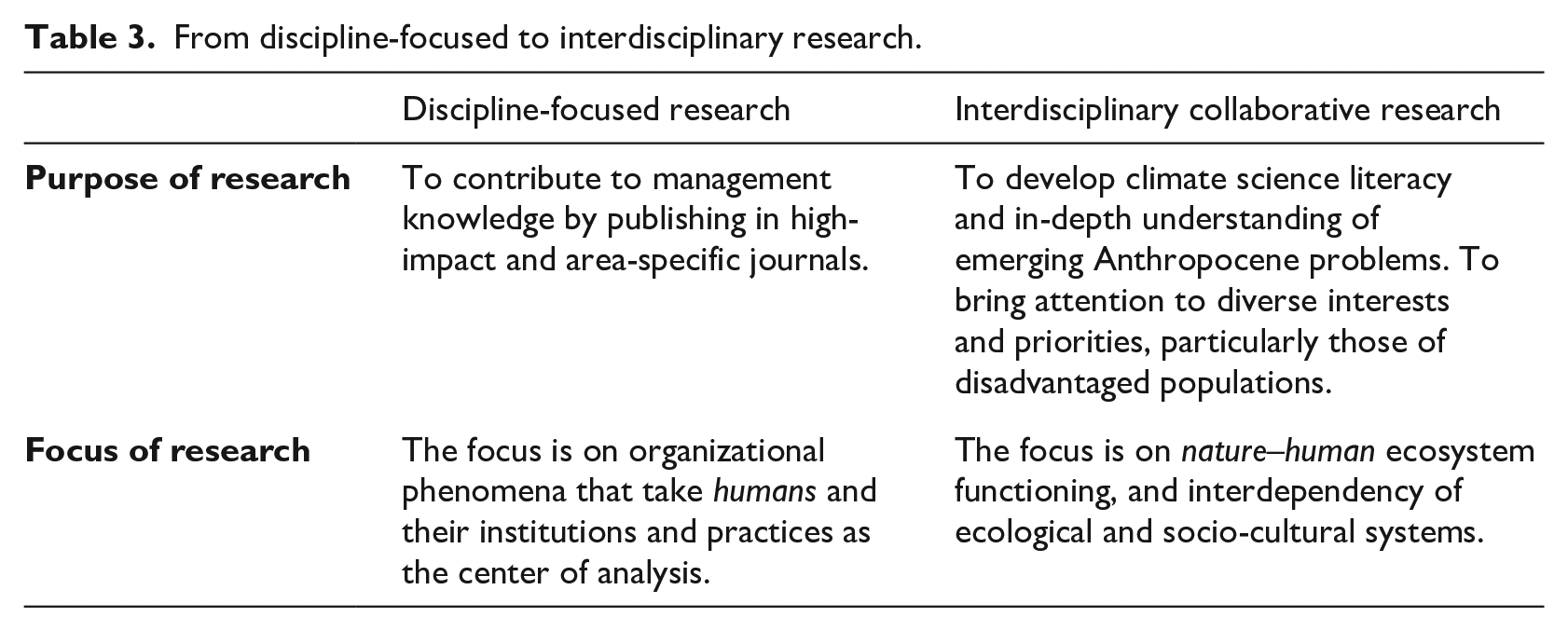
We are not alone nor the first to propose this shift. There have been several accounts that called for a deeper engagement with the earth sciences and to “infuse management theory with biophysical foundations” (Starik & Kanashiro, 2013, p. 14). Scholars have introduced key concepts from the field of ecology (Winn & Pogutz, 2013), called attention to planetary boundaries in management research (Whiteman et al., 2013), proposed developing “climate social science” (Skoglund, 2015), and argued for a science-based approach that focuses attention on dangerous changes in the Arctic (Whiteman & Yumashev, 2018).
However, there are several institutional and political impediments that need to be recognized. Most fundamentally, the ontological and epistemological differences between the assumptions underlying natural and social sciences create political tensions around which questions to ask and how we study them. At most universities, social scientists are seen as “supporting” faculty rather than the core, and face legitimacy challenges in interdisciplinary projects. Also, the evaluation parameters for tenure and promotion are narrowly based on contribution to disciplinary literatures, penalizing early career scholars who are willing to pursue interdisciplinary projects that require much more effort to coordinate and translate different forms of knowledge across disciplines (Felt, Igelsböck, Schikowitz, & Völker, 2016).
Despite these challenges, exemplary projects show how such efforts can succeed (e.g., Tsing, Swanson, Gan, & Bubandt, 2017). We are seeing more calls for interdisciplinary knowledge production in journals to bridge ecological knowledge with organization studies (Wasieleski, Waddock, Fort, Costa, & Metz, 2017). While we join these calls, we do not mean to cast a role for ourselves as “managers of the technoscientific solutions.” On the contrary, we call on MOS to demonstrate climate science literacy and join interdisciplinary project teams as critical thinkers who would bring focus to the diverse interests and priorities, most importantly, of immediate community and disadvantaged groups. At the same time, due to the above-mentioned challenges, such research must be reflexive and acknowledge the political processes involved in conducting interdisciplinary research with natural sciences.
From value-neutral stance to engaged scholarship
Early research on environmental issues reflected personal concerns of scholars who explicitly acknowledged that the natural environment was a “value-laden topic” (Gladwin et al., 1995, p. 878). While such questioning guided the initial orientation of the early works, the field has evolved within the prevalent positivist paradigm that encouraged conducting research from a disinterested stance. Unfortunately, such an arms-length approach limited passionate scholarship, which could help overcome the preoccupation with making the business case for sustainability. The Anthropocene conditions through which we currently live are undeniably material and are not captured by existing MOS theories. To shift our attention to these concrete conditions and begin research from within them, our fourth proposal is to reject the notion of a value-neutral science and embrace engaged scholarship in our academic endeavors (see Table 4).
From value-neutral stance to engaged scholarship.
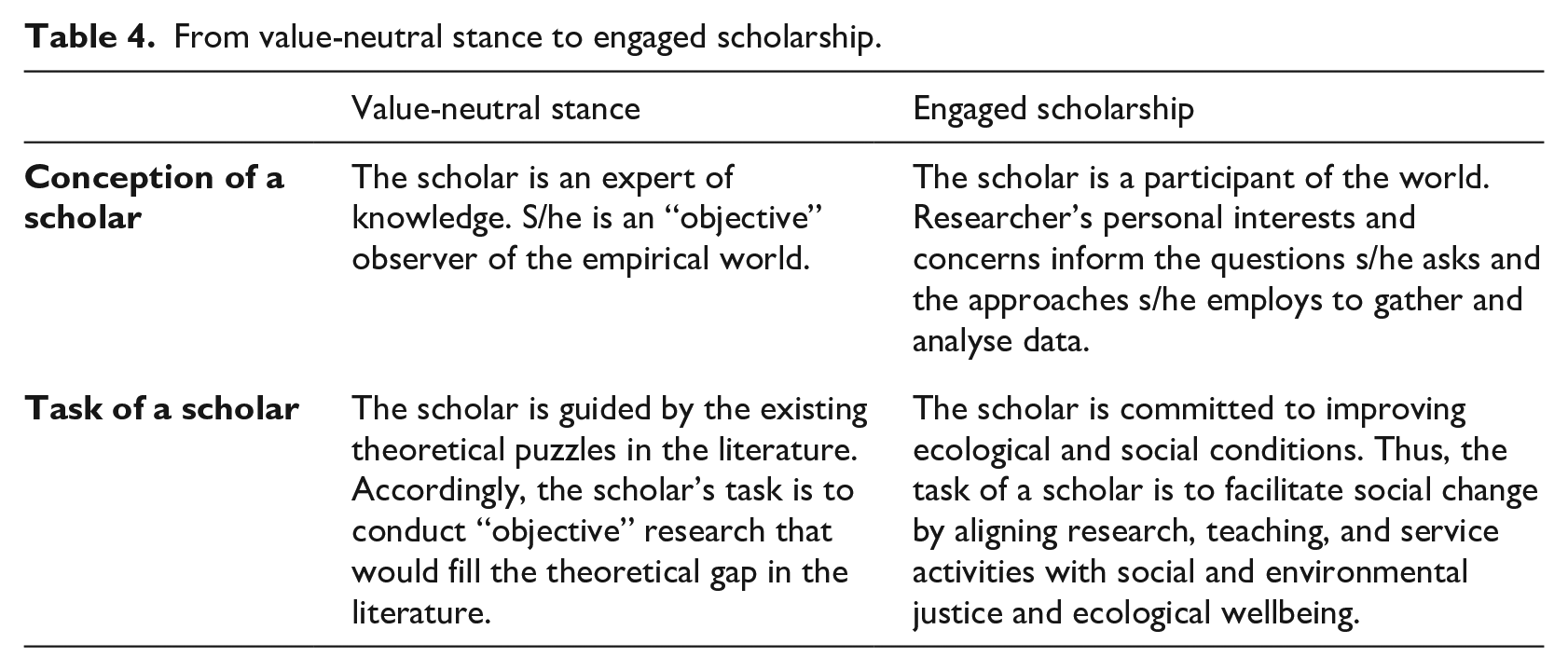
The expectation for dispassionate research is rooted in the principle of objectivity in positivism (Jones & Bartunek, 2019). The disciplinary foundations of management knowledge were established within a positivist approach in order to claim rigor and achieve institutional legitimacy for the business school in the broader academy (Khurana, 2007). As in the natural sciences, business schools demanded replicable research that is conducted by inquirers who are “unbiased” and capable of producing “objective” knowledge that would preclude any personal values to influence research findings.
The value-free versus value-laden debate has a long history in social theory (Weber, 1949). While some argue that social theory is based on scientific facts that are independent of values (Campbell, 2014), others suggest that it is impossible to conduct value-neutral social science research (Gouldner, 1962). Although most journals in MOS favor value-free knowledge, there are calls for “engaged scholarship” that disrupts the narrative of a detached observer. Engaged scholarship begins with the assumption that “no form of inquiry is value-free and impartial” (Van de Ven, 2007, p. 14), and is based on a relationship where researchers and participants co-produce knowledge about common concerns.
Taking a step further, other scholars have called for praxis interventions by academics to facilitate social change. For instance, Contu (2018) argues for reframing academic praxis towards an “intellectual activism,” which is about making a stand and becoming accountable for putting our work to the service of social justice. According to Contu, intellectual activism not only involves researching marginalized concerns but also requires aligning teaching, service, and leadership with social justice aims. In climate change debates, Rhodes, Wright, and Pullen (2018) suggest different modes of academic activism that can contribute to political transformation, such as media engagement, political campaigning, advising non-academics, and engaging in activist research. Other scholars argue for collaborating with influential decision-makers, policy-makers, activists, think tanks, and NGOs to make interventions on the ground (Fleming & Banerjee, 2016; Hoffman, 2016; Whiteman & Yumashev, 2018). In short, these accounts call for rethinking our scholarly position and role in society.
However, the institutionalized norms of academia create disincentives for this transition. Evaluation norms and practices that prioritize “A” publications discourage engaged and activist-oriented scholarship. Tenure and promotion are more influenced by journal impact factors than by contributions to socio-ecological welfare in communities. But, to study an issue that is inflicting untold harm on present and future populations and nonhuman life forms without any concern for the implications of our work denies our humanity as scholars. Instead, management scholarship must develop a “political-academic” orientation that transforms our scholarly identity to becoming “politically engaged scholars” (Esper, Cabantous, Barin-Cruz, & Gond, 2017, p. 681). Making ecological wellbeing and social justice the guiding compass of our field, we call for building broader connections in society that contribute to creating alternative modes of researching, organizing, and living as academic activists.
Final Notes on Survival. . .
“If our species does not survive the ecological crisis, it will probably be due to our failure to imagine and work out new ways to live with the earth, to rework ourselves and our high energy, high-consumption, and hyper-instrumental societies adaptively. [. . .] We will go onwards in a different mode of humanity, or not at all.” (Plumwood, 2007, p. 1)
If our species is indeed worth saving, then the fundamental challenge of management and organization studies today is to delink our intellectual foundations from the hegemony of corporate thought. It is absurd that we continue to prioritize the financial bottom line when the very practices that contribute to it, such as the endless pursuit of economic growth, fueled by relentless resource extraction and mindless consumption, threaten the survival of the planet. Corporate capitalism, even with its much-touted green credentials, cannot deliver a sustainable and livable world. Demoting the centrality of the business case in our schools, our scholarship, and our society is another grand challenge as the spread of corporate values has been all-encompassing. Yet, as management scholars concerned about environmental and social catastrophe, it is our responsibility to contribute to those efforts which challenge “the conceptual blockages that keep our minds closed to options for change” (Plumwood, 2007, p. 1).
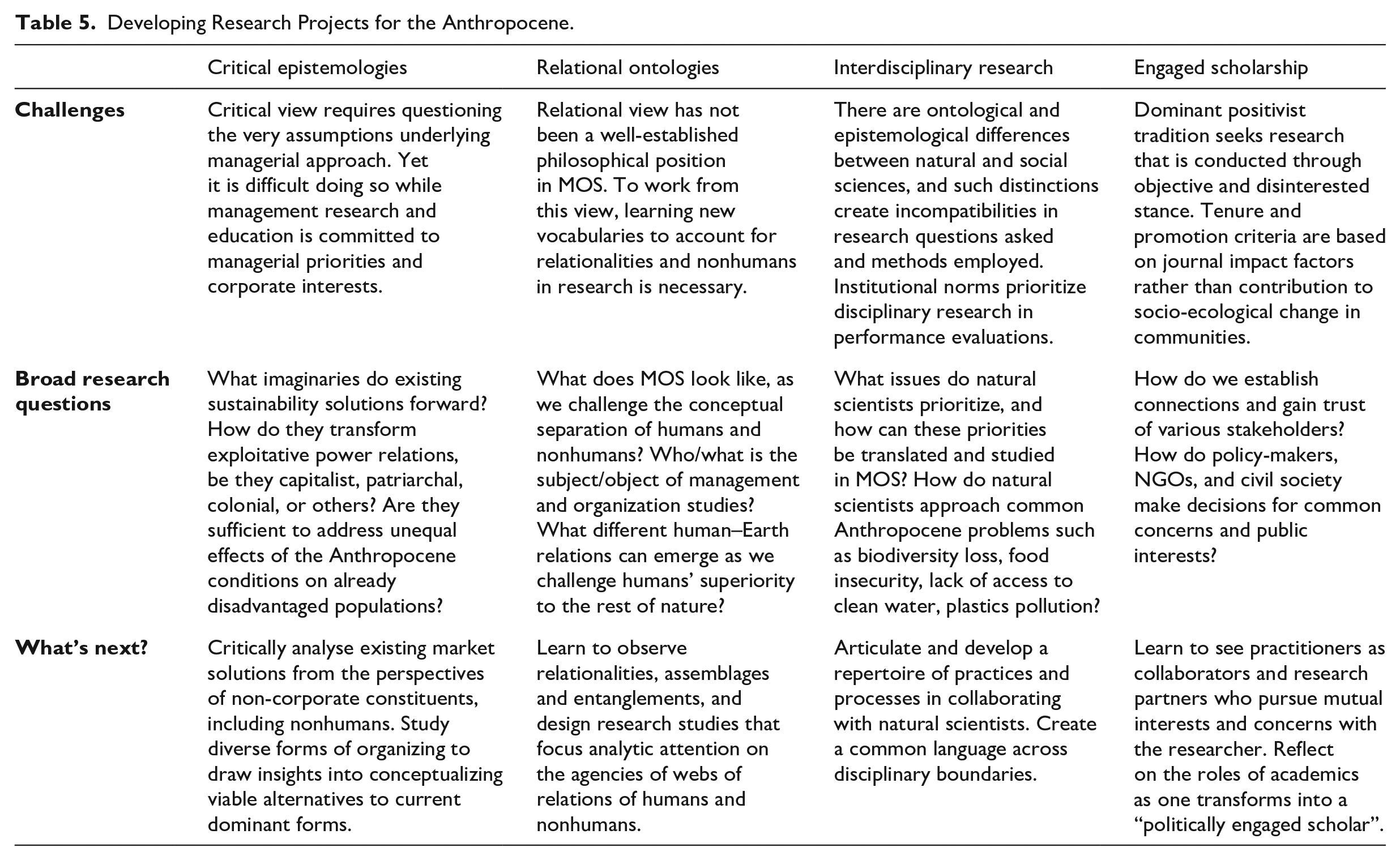
Transitioning to a new research agenda based on the ecological case for business requires learning to observe in new ways and asking different questions that facilitate imagining and creating new ways of living, going beyond market-based interests and anthropocentric concerns. It requires a deep look into our contribution as a field and learning to collaborate across disciplines and stakeholders to address the actual matters of concerns of our worlds. To facilitate such transition and create dialogue, in Table 5 we outline some broad research questions and action items.
Developing Research Projects for the Anthropocene.
The challenge of sustainability is not just economic, social, and environmental—it is fundamentally political in nature. It is our hope that the shifts we propose in this essay will facilitate developing a radical scholarship that is informed by new ways of relating to the natural world. Otherwise, we will run the risk of becoming the only species on the planet that is sufficiently intelligent to recognize our own imminent demise but too foolish to prevent it.
Footnotes
Acknowledgements
We would like to thank the Senior Editor Charlene Zietsma and the three anonymous reviewers for their insightful guidance on the earlier versions of this manuscript. We also would like to thank the panelists of the 2018 Academy of Management session “Researcher’s Guide to the Anthropocene: Learning from Foundations of ONE” for inspiring us to write this essay.
Funding
The author(s) received no financial support for the research, authorship, and/or publication of this article.
