




Abstract
This study explores how multinational enterprises (MNEs) take advantage of their ownership-based political capital – political ties and political identity – in responding to institutional voids in host country contexts. Investigating multiple cases of central and local Chinese state-owned enterprises in Africa, we identify unique responding strategies comprising allied fleet and co-dependent alliance formations to overcome human capital voids, and dual management and closed-door management strategies to address industry standard voids. We propose a typology which extends the theory of MNE responses to institutional voids not only by adding the political dimension to strategy formation in responding to institutional voids, but also by providing greater insights into MNE strategies to convert home-based political capital for better response to host country institutional voids.
Keywords
Introduction
Many developing and transitioning economies are characterized by significant institutional voids, a term defined by Khanna and Palepu (1997) as the absence or underdevelopment of market-supporting institutions. While this term does not imply a vacuum of institutions (Mair, Marti, & Ventresca, 2012) or superiority of any rule systems over other alternatives (Bothello, Nason, & Schnyder, 2019), the absence of formal market-supporting institutions poses challenges for international businesses from a transaction cost perspective, triggering various responses from multinational enterprises (MNEs) (Doh, Rodrigues, Saka-Helmhout, & Makhija, 2017; Kim & Song, 2017; Marano, Tashman, & Kostova, 2017; Regnér & Edman, 2014). Studying MNEs’ response to host country institutional voids, researchers emphasize the active agency of MNEs in employing a range of strategies to evade (Boddewyn & Doh, 2011), remedy (Regnér & Edman, 2014), shape or even take advantage of institutional voids (Doh et al., 2017) in international business operations.
The theoretical development of MNEs’ responding strategies to institutional voids has diverged into two streams of research. One stream explores MNEs’ home-based institutional capabilities, ranging from network penetration to political skills, and argues that these capabilities can be transferred to host countries to address similar institutional voids (Carney, Dieleman, & Taussig, 2016; Cuervo-Cazurra, 2016). Another stream focuses on MNEs’ efforts that are freshly engendered in the host context, including adaptation (Marquis & Raynard, 2015), internalization (Elango & Pattniak, 2007) and firms’ social responsibility behaviour (Young & Makhija, 2014) to compensate for institutional voids. Notwithstanding their respective insights, there is a missing link between these two research streams, overlooking the strategies that MNEs may employ to convert their home-based institutional capabilities into advantages when dealing with host country institutional challenges. This knowledge gap limits our understanding of a wide range of MNEs’ strategic responses to institutional voids in host countries.
We address this knowledge gap by revealing the strategies of converting home-based political capital in the context of internationalization of state-owned MNEs. We focus on state-owned MNEs because of their increasing significance in international business, and the potential insights this novel context may offer to challenge and extend existing theories (Cuervo-Cazurra, Inkpen, Musacchio, & Ramaswamy, 2014). Currently, little is known about the role of state-owned MNEs’ distinctive political capital, acquired through their home-country state ownership, in shaping their strategies to overcome, or even take advantage of, host country institutional voids. This study aims to expand our understanding of firms’ strategic response to institutional voids, particularly the strategies that allow firms to convert their home-based political capital into the knowledge and capacity to overcome and exploit host country institutional voids. Specifically, our research question asks: How do state-owned MNEs convert their ownership-based political capital from home to host countries to overcome host country institutional voids?
By answering this research question, our study contributes to the intersection of two existing streams of studies, one on MNEs’ strategic responses to host institutional voids, the other on the internationalization of state-owned MNEs. Existing literature provides limited understanding of how state-owned MNEs respond to host institutional voids. Our study reveals the strategies that enable the conversion of home-based political capital into host country capabilities of overcoming institutional voids. Using a case study approach, we investigated how Chinese state-owned MNEs deploy their ownership-based political capital in responding to underdeveloped institutions in host countries. Our findings inform the development of a typology that elaborates the converting strategies state-owned MNEs may adopt to overcome or even take advantage of host country institutional voids. Specifically, the typology reveals four converting strategies of state-owned MNEs which correspond to the type and source of ownership-based political capital they possess and the types of host country institutional voids they have to address.
Literature Review and Theoretical Background
Institutional voids and MNE responding strategies
Institutions serve as ‘rules of the game’ (North, 1990) that influence the transaction costs of MNEs in their operating environments. Although institutions usually guide firm behaviour and protect investor rights, there are conditions in which institutions are either not working or absent, undermining the effective functioning of the market (Chacar, Newburry, & Vissa, 2010; Khanna & Palepu, 2010). Khanna and Palepu (1997) referred to this situation as ‘institutional voids’, which particularly characterizes emerging markets due to their pervasive deficiency or absence of market-supporting institutions. When these critical institutions fail to operate effectively, they not only hamper the ease of buyer–seller interactions, but also increase transaction costs for procuring materials, capital, information and so on (Doh et al., 2017; Khanna & Palepu, 2010; Manikandan & Ramachandran, 2015).
Facing institutional voids, certain MNEs can outperform others or even create monopolistic power if they possess the skills and resources to address them (Doh et al., 2017). An overwhelming body of research has identified MNE responding strategies using three broad approaches: The first relates to transferring home-based institutional knowledge and capabilities to address similar institutional voids in host countries. For example, Cuervo-Cazurra and colleagues (2008, 2016) argued that emerging market MNEs could transfer home-developed capabilities in managing corruption and navigating weak institutions into host countries with poor regulatory quality (e.g. weak enforcement of laws against bribery) to gain competitive advantages. In the same vein, Carney et al. (2016) suggested that emerging market firms could develop network penetration and relational skills at home and transfer them to proximate contexts with weak institutions.
The second approach relates to adapting to host conditions through internalizing functions to compensate for external market failures (Doh et al., 2017). Studies have stressed the important role of business groups to function as an internal market for resource allocation, information sharing, opportunity discovery and exploitation within incomplete strategic factor markets (Hu, Cui, & Aulakh, 2019; Manikandan & Ramachandran, 2015). However, this approach emphasizes developing business groups within the host context (e.g. with local business actors) to adapt to external market imperfections (Elango & Pattniak, 2007; Siegel, 2009). For instance, examining MNEs from India, Elango and Pattniak (2007) found that these firms benefited from foreign partnerships to increase market power in dealing with weak market-supporting institutional systems.
The third approach is shaping or altering void conditions through strategies initiated in host countries. These strategies include coupling interests with the local government to co-evolve institutions for a sector (Child, Rodrigues, & Tse, 2012), collaborating with local not-for-profit organizations to jointly provide public goods (e.g. healthcare, education) (Boddewyn & Doh, 2011) and form such partnerships to create and legitimize new standards in emerging markets (Fortwengel & Jackson, 2016; Teegen, Doh, & Vachani, 2004). All these strategies support missing market functions and generate positive externalities for MNEs.
The extant literature has approached MNE strategies to institutional voids from either the lens of transferring home-based institutional capabilities, or via developing host-based capabilities in the local context. The missing link between these two perspectives limits our potential to investigate the conversion efforts of MNEs to reconfigure and transform their home-based resources to address host country institutional voids. Given the increasing international presence of MNEs with state ownership from emerging economies (Li, Cui, & Lu, 2014) and the widely recognized value of state ownership to firms especially in underdeveloped institutional environments (Carney et al., 2016; Estrin, Meyer, Nielsen & Nielsen, 2016), it would be important to know how state ownership can enable MNE strategies to overcome, or even take advantage of, institutional voids in host countries. While prior studies have shown that state ownership can create distrust and institutional pressures (Cui & Jiang, 2012; Meyer, Ding, Li, & Zhang, 2014), how firms facing market institutional voids can turn state ownership into an advantage remains unexplored. This lacuna brings our attention to state-owned MNEs’ agency in converting their ownership-based political capital from home to host countries in dealing with institutional voids.
Political capital and state-owned MNEs’ responding strategies to institutional voids
Compared to other types of firm, state-owned MNEs enjoy a wide range of privileged benefits acquired from their distinctive ownership background with the home government. Research on the role of state ownership in the internationalization of MNEs has emerged in two divergent directions. One examines the political ties of state-owned enterprises (SOEs) from a home-country support perspective (Luo, Xue, & Han, 2010; Peng, Wang, & Jiang, 2008), while the other examines the political identity of SOEs perceived by host country stakeholders and institutional actors (Meyer et al., 2014). Following previous research, we consider political capital originated from state ownership includes political ties and political identity, and explore how state-owned MNEs convert such political capital from home to host countries to overcome or even take advantage of host country institutional voids.
Political ties can be defined as ‘boundary-spanning personal and institutional linkages between firms and the constituent parts of public authorities’ (Sun, Mellahi, & Wright, 2012, p. 68). Due to the structural affiliation with the government via ownership, SOEs’ political ties can be formal organizational linkages to central and local governments, as well as managerial linkages to political agents and institutions based on formal ownership arrangements (Chen, Li, & Fan, 2018; Cui, Hu, Li, & Meyer, 2018). Studies have shown the benefits offered from ownership-based political ties for SOEs’ internationalization, ranging from privileged access to government funding and tax relief (Luo et al., 2010), home-country loan and policy support in adverse situations (Cui & Jiang, 2012), to home-host political relationships and overseas consulate services (Pan et al., 2014). Yet, these studies focused on a home-country support perspective without exploring the possibilities of converting ownership-based political ties from home to host countries for proactive management of host country institutional challenges and deficiencies.
Political identity concerns firm characteristics of ownership with political institutions and the associated legitimacy and credibility of such ownership structure for business operations (Cui & Jiang, 2012; Meyer et al., 2014). While investing overseas, SOEs may be viewed as political agents that carry state objectives than purely commercial organizations (Cui & Jiang, 2012). This could trigger distrust by host business actors due to ideological conflicts, perceived threats of political invasion, or unfair competitive advantage from home government (Li et al., 2014; Meyer et al., 2014). Local media and communities may also stereotype the political image of SOEs so a low-profile strategy is usually adopted by those firms to minimize public focus on their political identity to avoid associated risks (He & Lyles, 2008). Although this strand of literature centres on the liability of political identity for SOEs’ foreign operations, what warrants further research is how SOEs could turn such liability into an advantage, particularly in the face of host country institutional voids to maintain and enhance their distinctive competitiveness.
The above discussion leads us to explore the role of ownership-based political ties and political identity in shaping state-owned MNEs’ strategic responses to host country institutional voids in pursuit of competitive advantages. In so doing, we contribute to the institutional voids literature not only by adding the political dimension to strategy formation in responding to institutional voids, but also by providing deeper insights into MNE strategies to convert home-based resources for better response to host country institutional voids. The converting strategies for a certain void may vary according to the type and source of home-based political capital to create new organizational structures and practices. By unravelling the theoretical linkages between the key components of MNE ownership-based political capital, firm converting strategies and the host institutional voids enacted, we obtain useful insights into how MNEs utilize a wider range of resources for strategy formation in response to host country institutional weakness for survival and prosperity.
Methods
Our intention to explore the role of ownership-based political capital in shaping MNE responding strategy to institutional voids led us to adopt a case study approach for compiling rich sources of context-embedded information and firm-specific behaviours (Eisenhardt & Graebner, 2007; Yin, 1994). Case studies allow for context-specific understanding of firm–environment interactions (Yin, 1994) which is essential for exploring patterns of strategy formation in the face of institutional voids. In particular, following the replication logic, we compared multiple cases to provide a stronger base for theory building compared to a single case study (Eisenhardt, 1989; Eisenhardt & Graebner, 2007; Yin, 1994). Cross-case analysis increased external validity and analytical generalization of the findings (Gibbert, Ruigrok, & Wicki, 2008; Welch & Piekkari, 2017).
Research context and case selection
We chose Africa as the host context due to the severity of institutional voids within it which enable better observation of state-owned MNEs’ strategies to address these voids. Recent strategic management scholars have increasingly placed Africa as a new frontier for theory advancement on how these voids affect MNEs’ global strategies (Mol, Stadler, & Arino, 2017; Stevens & Newenham-Kahindi, 2017). The voids that have been shown to affect MNE strategy include political and legal voids (Stephan, Uhlaner, & Stride, 2014), financial market voids (Shinkle & McCann, 2014) and human capital voids represented by low level of skilled individuals at the country level (Wang & Cuervo-Cazurra, 2017). Despite these voids being identified, scholars have agreed that the context of Africa warrants further research as it offers ample opportunities to deepen our insights into the dynamic interactions between MNEs and their environments, particularly in the presence of institutional voids (Mol et al., 2017; Wang & Cuervo-Cazurra, 2017; Zoogah, Peng, & Woldu, 2015).
We chose state-owned MNEs from China because state-owned MNEs are mainly from emerging markets (Li et al., 2014) and China is one of the largest emerging economies. In addition, the magnitude of institutional reforms in China (i.e. in administrative and fiscal decentralization, market liberalization) allows us to capture the differing nature and degrees of ownership-based political capital possessed by state-owned MNEs (Wang, Hong, Kafouros, & Wright, 2012). We conducted an extensive literature review and archival analysis of Chinese investments in Africa. The review identifies that SOEs owned by central government started their investments early on as part of a rapidly growing trend in Chinese government development assistance projects, which rose to prominence in the 1980s. These projects were mainly in construction and infrastructure building industries (i.e. hydropower stations, roads, ports and airports) under formal state-to-state agreements which led to central SOEs’ subsequent self-determined investments (Gu, 2009). SOEs owned by provincial governments started exploring the African market in the mid-1990s mainly as commercial vehicles for generating profits. We therefore targeted the construction industry due to the active involvement of Chinese SOEs in this sector. In addition, the construction industry has MNEs associated with both the central and local governments which allows for theoretical contrast and extension following the replication logic.
Using the Engineering News-Record 1 Top Chinese International Contractors list as a reference, we searched each company’s profile and narrowed the list down to those investing in Africa. Most of the companies in the list had African investments. We then grouped the companies based on their central or local state ownership. Through the authors’ ongoing participation in a large-scale research project on Chinese MNEs investing in Africa, we formed collaborative relationships and personal networks with a few firms. We chose three central SOEs (SOE1, 2, 3) and two local SOEs (SOE4, 5) to participate based on strong personal ties. The personal ties with senior managers enabled us to access vital information and ensured the reliability of the data source.
Data collection and validity
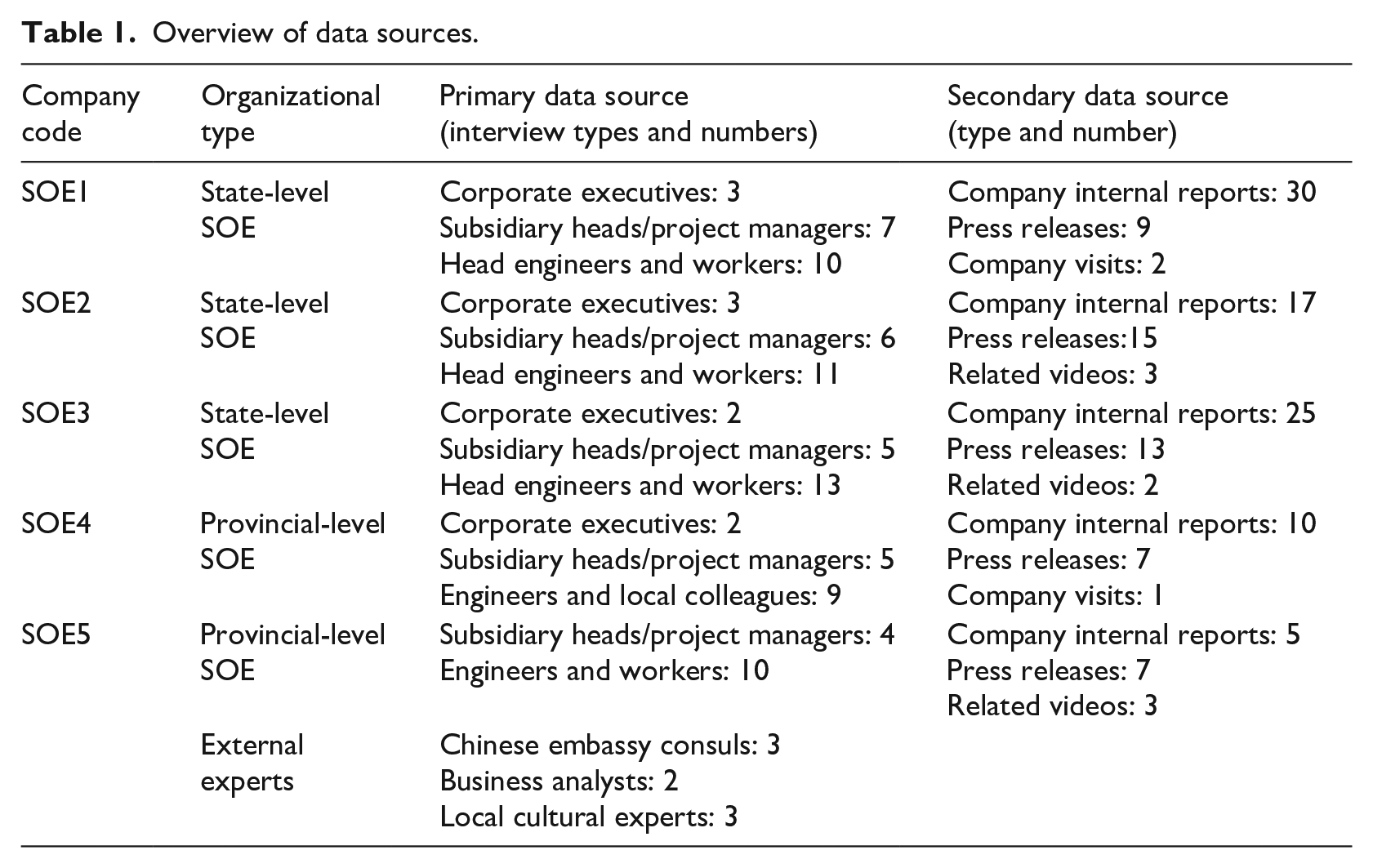
Data collection lasted for more than three years, which includes interviews, company visits and archival materials. Table 1 summarizes the data sources.
Overview of data sources.
Interviews
We conducted 98 interviews between 2012 and 2015. To triangulate insights from different sources, we included informants from various levels in the company (Gibbert et al., 2008) including regional and subsidiary executives, project managers, senior engineers stationed in the field, as well as external experts such as Chinese consulate officials in Africa, local cultural consultants and business analysts. We first interviewed the regional and subsidiary managers, and they introduced us to other information-rich interviewees. Interviews lasted between one and three hours. During semi-structured interviews, we first started with structured questions to ask for firms’ strategic objectives, their challenges when operating in Africa, and their strategies to address those challenges. As the interviews progressed, we began focusing on the nature of the challenges from the local context, and how the SOEs responded. We asked the interviewees to give detailed examples where possible and pushed for concrete illustrations to increase the data’s trustworthiness (Eisenhardt & Graebner, 2007). External experts were interviewed to seek confirmation and clarification of the information we obtained from internal informants of the case firms.
As the researchers were located far from Africa, interviews were done mainly through video and phone calls. Due to the strategic and political sensitivity of the issues, interviews were recorded strictly based on informants’ permission. Where written permission was not given, the researcher took extensive notes and typed up the notes as soon as possible, which conveyed trust and accuracy (Miller, Cardinal, & Glick, 1997). In a few cases where informants were suspicious and withdrew halfway from the interviews, we excluded those data to ensure data quality and validity. Interviews were conducted in Mandarin with the Chinese informants, and in English with non-Chinese informants to ensure sufficient understanding of the questions.
Company visits
The first author visited SOE1 (a central SOE) and SOE4 (a local SOE) in their headquarters after most interviews were done. In SOE1, the researcher spoke with the human resource manager in charge of the overseas assignments to learn the company’s policies and guidelines on African operations. The researcher also spoke with executives and asked questions to check inferences from interviews. In SOE4, the researcher sat in on executive meetings to observe issues on their African projects and spoke with executives during breaks to get more details on their African operations. The consistency in the observations from company visits and the interviews reinforces confidence in the data quality (Gibbert et al., 2008).
Archival materials
We collected archival data including company history, internal reports and publications, government reports, and media releases on case companies’ African projects. We established a file for each case firm. This allowed the researchers to triangulate our understanding of each case firm’s strategic objectives, general operations, challenges encountered in host countries and corresponding strategies.
Data coding and analysis
We developed thick descriptions on each case SOE, which incorporates various types of data (Langley, 1999) to describe their ownership-based political capital, their strategies enabled/confined by political capital, and the context they face to implement their strategies. Our data analysis and theory development were interwoven by continuously revisiting old data and emergent constructs and gathering new information (Regnér & Edman, 2014). We shared case descriptions with key informants to assess reliability and comprehensiveness. Following that, we conducted cross-case analysis by looking for consistencies within the central and local SOEs. This extended the validity of the findings (Yin, 2009). Then we compared findings between central and local SOEs to sharpen findings and generate new insights for theoretical extension (Yin, 2009).
Our findings emerged from a three-stage process. Figure 1 provides a schematic overview of the coding progression, which includes the raw data in the first column and first-order categories and theoretical constructs in subsequent columns. Following the interpretive approach to theorizing from qualitative data (Langley, 1999), we began with detailed coding to make sense of the individual bits of information provided by respondents. This process generated initial categories around actual meanings, mechanisms and activities. This yielded several hundred categories for each firm. In the second stage, we extracted emerging codes by grouping categories with similar meanings and continuously checking for internal consistencies.
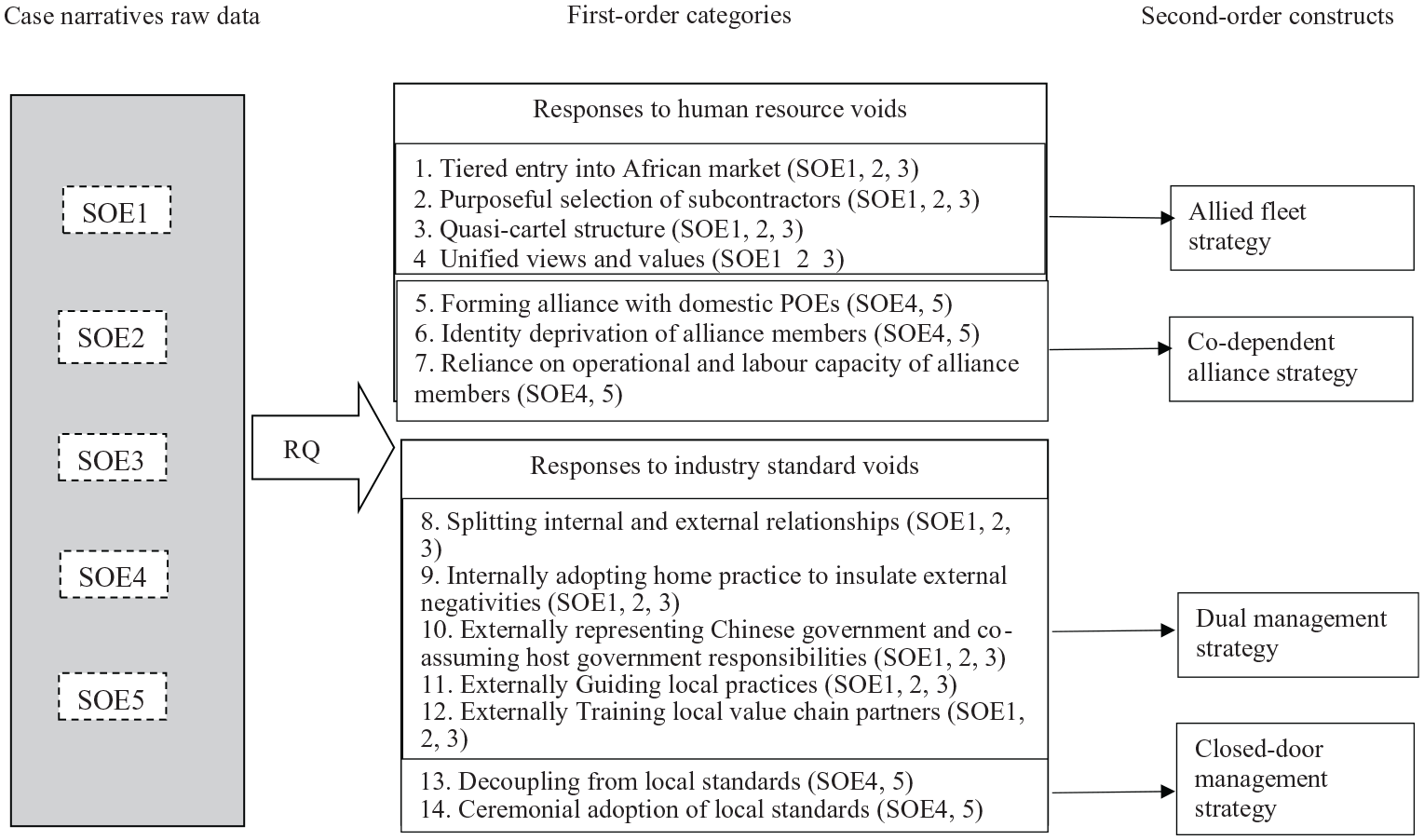
Progression of data coding, categorizations and constructs.
In the third stage of the analysis, we compared and combined first-order categories with one another to create and clarify theoretical constructs. This was an inductive, incursive process through which we identified more abstract, theory-rich constructs (Mair et al., 2012). For example, we noticed that central SOEs exploited their ownership-based political capital to develop a home-based network and managed the network through a quasi-cartel structure in responding to human capital voids in host countries. We created a theoretical construct of ‘allied fleet strategy’ to capture their behaviours.
Findings
Our qualitative data show two prominent institutional voids in the construction industry in Africa. The first is human capital voids, reflected in employees’ skill deficiencies at the firm level and in underdeveloped human capital ecosystems at the country level (Wang & Cuervo-Cazurra, 2017). The second is industry standard voids, which refers to the lack of standardized industry norms and inconsistent enforcement of such standards (Doh et al., 2017). We characterize these situations as institutional voids, not to suggest that labour market or industry standards do not exist in Africa. Instead, our findings show that the functioning of labour market and industry standards in Africa is not sufficiently supported by formal market institutions commonly found in mature market economies. The absence of such formal market-supporting institutions leads to significant transaction costs for MNEs when they need to access human capital or implement industry norms in Africa. To overcome these institutional voids, Chinese SOEs employed various strategies associated with converting their ownership-based political capital.
Leveraging political ties to overcome human capital voids
One of the institutional voids that was most emphasized by our informants relates to human capital voids, reflected in the lack of a qualified and skilled workforce in the construction industry in Africa. The underdeveloped local labour market poses significant constraints on collaboration and specialization along the value chain of construction projects. This problem is prominent in Africa and is rooted in local institutional deficiencies regarding education and vocational training, which lead MNEs to fill the local institutional voids with internal skill development and labour training (Cooke, Wang, & Wang, 2018; Jackson, 2014; Zoogah et al., 2015). Our findings show that, to address the human capital voids in the African construction industry, Chinese SOEs leveraged their ownership-based political ties to deploy inter-organizational arrangements that internalize the labour market. As central and local SOEs possess different types of political ties with home government (that is, ownership-based organizational linkages with either central or local government), they employed different strategies, as discussed below.
Allied fleet organizing strategy
This strategy was employed by all three central SOEs, namely SOE1, SOE2 and SOE3. They are leading companies in the Chinese construction industry and focused on securing large projects and high-end markets in Africa. All three SOEs emphasized selecting projects based on political significance, and they suggested that their political ties with the Chinese central government enabled them to benefit from bilateral relationships and government agreements between the home and host countries in securing large projects.
After securing large projects, central SOEs innovated an allied fleet organizing approach to further take advantage of institutional support generated from political ties with the Chinese central government to overcome human capital voids in host countries. This approach features a flagship SOE to carry domestic companies as second-tier players to make unified and coordinated moves under the direction of the central SOE and the Chinese embassy. The allied fleet approach not only helps central SOEs build their own labour network to obviate the need for an external market but also pre-empts competition by increasing joint market power in the host country and consequently raising the entry barriers for other competitors.
For example, to support the national ‘going abroad’ policy, SOE1 conceived the ‘going out together’ strategy, using its international division as an engine to drive the internationalization of its domestic subcontractors. The international division worked closely with the Chinese embassy to procure large government projects and to develop new markets, while the detailed project tasks were subcontracted to existing subcontractors of SOE1. This approach established an internal labour market based on networks surrounding SOE1 in the host country where previous relationships, interaction norms and guidelines can be inherited and leveraged to overcome voids in the local labour market. In addition, difficulties associated with cross-cultural communication and coordination were solved by not directly interacting with host country subcontractors. One executive from SOE1 commented:
The subcontractors we use are all Chinese ones which we worked well with before. Local subcontractors are quite small and usually not qualified. They do not follow Chinese practices, and they speak French which most of us do not understand, so these barriers create significant institutional costs.
SOE2 and SOE3 adopted similar practices and engaged subcontractors to piggy-back on their political ties to form their own people network. In a social housing project in Angola, SOE3 worked together with the Chinese embassy to select 29 companies from China to become members of the fleet. The Chinese embassy helped identify and contact possible companies in different industries (i.e. finance, consultancy, logistics) to establish a collaborating platform for SOE3. None of these companies had worked with SOE3 before but they were willing to follow the embassy’s direction to access the lucrative African market. Each subcontractor specialized in a different area such as finance, design, construction, transportation, logistics and services to bring in their own people. With the embassy’s support, SOE2 was also able to form new fleets very quickly to suit the varied needs of different projects. The Chinese Premier visited SOE2’s projects while on a diplomatic visit to the host country and highly complimented the role of the central SOEs in helping other companies/industries to go out together. Through this model, those central SOEs not only successfully bridged human capital voids in the local labour market but also expanded new market opportunities by providing possible new services (i.e. an ‘all-in-one’ package to local clients through integrating activities along the value chain).
While choosing fleet members, all three central SOEs purposefully selected domestic companies without overseas experience who were largely dependent on their flagship SOE for accessing and navigating the African market. Such dependence created a structural power between the leading SOE and its subcontractors which enabled the SOE to reap more benefits from the internal labour network compared to the regular business groups structure (see Manikandan & Ramachandran, 2015). All three central SOEs organized their subcontractors using a quasi-cartel approach which is featured with highly unified views and coordinated actions among fleet members, directed by the flagship SOE. The SOE controlled all subcontractors’ schedules, resource allocation and progress to ensure high efficiency and synergy of operations. To better coordinate this strategy, the SOE initiated regular meetings with executives from all subcontractors to share information, provide instructions and monitor progress. One manager from SOE3 explained:
In the allied fleet, all members need to exhibit unified views, unified standards, unified orders, and unified actions. Such tactics used in the “large formation warfare” guaranteed the effective coordination and smooth implementation of large-scale construction works. This business model created a new platform for collaborating and gaining common interests which helped to pre-empt competitors due to the scope and speed of our projects. Our fleet members all achieved high profit rates, and they were satisfied with their African experience under our direction.
Although the fleet members were tightly bonded by this quasi-cartel structure, the contractual relationship between the leading SOE and the fleet members was nominal. The subcontracting agreement separated the responsibilities of the subcontractors from the leading SOE, such as in human resource terms, so that when labour conflicts and disputes happened, the central SOEs were not bound by contractual liabilities. They could only provide voluntary support. The versatility of the allied fleet model hence granted the flagship SOE power to control and coordinate subcontractors’ key decision-making, while at the same time passed down labour-related risks to subcontractors. Compared to the studies on consortia which focused on the form and effects of networks (Garg & Delios, 2007; Tan & Meyer, 2010), the allied fleet approach provides nuanced insights into the agency role of the flagship firms in creating and modifying network structure and nature to exercise power in inter-organizational relationships (Clegg, Josserand, Mehra, & Pitsis, 2016). More specifically, while consortia focus on winning contracts, allied fleets concern operational matters beyond the contracting stage. Also, unlike the loose and flat network structure of consortia, allied fleets are organized into networks with explicit hierarchical power structure and coordination mechanisms. Hence, the unique features of the allied fleet suggest that political ties can be leveraged in this process, where central SOEs can take advantage of their ownership-based political ties to access large projects and to create a human resource network through a fleet model. The findings also extend our understanding of using business networks to overcome institutional voids (Manikandan & Ramachandran, 2015; Teegen et al., 2004) by illustrating how networks can be formed and exploited through taking advantage of ownership-based political ties with home government.
Co-dependent alliance strategy
This strategy was employed by both local SOEs, namely SOE4 and SOE5. Local SOEs have ownership-based political ties with lower levels of government at home (i.e. provincial government). They may enjoy institutional support from home government and embassy when entering and operating in host countries. However, these two SOEs were not allowed to bid for certain projects, as one manager from SOE4 commented:
We are not allowed to bid for large government projects in the host market. The Chinese embassy only grants permission for a few central SOEs to bid. Using an analogy, the central SOEs can enjoy big fish and we can only have shrimps.
Under such circumstances, both SOEs focused on maximizing the return on their ownership-based political ties while outsourcing operational activities. For example, SOE4 is a SOE affiliated with a provincial government. It has expanded into Africa since the 1990s and focuses on construction projects. Executives of SOE4 reported that the company may lack frontline workforce and equipment to run certain projects but being a government agency provided access to local government officials and helped it win construction projects. Using subcontracting arrangement, the company partnered with privately owned enterprises (POEs) from China which had operational capability but lacked the credibility to operate overseas independently. By leveraging political ties with Chinese local government and perceived credibility for doing business overseas, SOE4 successfully utilized a co-dependent alliance relationship with its home-market subcontractors to cope with risks associated with human capital voids in the host country.
The co-dependent nature of the relationships was particularly reflected in denying individual identities of the subcontractors by SOE4 in the host context. As one executive from SOE4 in charge of the Equatorial Guinea market explained:
After we gain projects, we subcontract to POEs from China to do the work. This is done internally and the property owners do not know this. We need to pretend and maintain the SOE image in front of them to preserve our credibility. We ask the workers from the subcontractors to wear our uniforms and reveal the identity of our company to the public whenever asked to. . .The reasons to use them are that they are obedient and always follow our directions. They are easily managed.
Through this approach SOE4 rapidly expanded in the African construction market despite the lack of skilled labour in the local industry. Although this approach helped to avoid costs of human capital voids, it increased reputation risks and other hazards arising from such co-dependent relationships. On one occasion a subcontractor of SOE4 had a labour strike which went out of control; the manager of the subcontractor did not go to the local police but contacted SOE4 for help. Executives of SOE4 intervened and solved the crisis by negotiating with the workers. One executive of SOE4 explained:
According to our agreement with the subcontractor, labour management is their responsibility. However, if any problems arise, the government and clients would think it’s our problem not the subcontractor’s. . .So we have to help them solve the problems.
SOE5 was separated from a central SOE in the early 1990s due to administrative decentralization in China, and since then became re-affiliated with a local government. Using its organizational political ties with Chinese local government, it was introduced to a few local officials in Kenya to secure construction projects. It then subcontracted to POEs from China, and only deployed ten staff on site to manage the subcontractors and their problems. One executive explained further:
We collaborate with companies from China which do not have the qualifications to work overseas but have the people and skills to conduct those projects. We are responsible for gaining and managing the business contracts and they are responsible for the actual construction work. . .This undisclosed subcontracting approach is very common among Chinese [local] SOEs. I suspect 90% of the Chinese [local] SOEs used this approach to expand their African market.
Accordingly, our findings suggest that to avoid risks associated with human capital voids in host countries, local SOEs leveraged their ownership-based political ties using a co-dependent alliance strategy to form a home-based network for enhanced operational capabilities and to remove host country constraints in the local labour market. From a resource dependence perspective (Pfeffer & Salancik, 1978), this strategy differs from central SOEs’ allied fleet organizing strategy regarding the relative power, and thus the mutual dependence, between the focal SOE and its subcontractors. In the latter, central SOEs actively exploit their superior (sometimes monopolistic) power relative to their subcontractors to reap greater benefits from the fleet’s foreign operations while minimizing their own risk exposure. In the former, subcontractors are resource-dependent on local SOEs for government support and political legitimacy to enter foreign markets while local SOEs depend on subcontractors’ operational capacity to overcome human capital voids in the host country. Following the resource dependence theory, the local SOEs’ co-dependent alliance strategy can be considered a kind of constraint absorption strategy through inter-organizational arrangement (Casciaro & Piskorski, 2005, Hillman, Withers, & Collins, 2009). Our findings show that this strategy can be employed by local SOEs when entering foreign markets with weak human capital ecosystems.
Managing political identity to overcome industry standard voids
Apart from the ineffective functioning of the local labour market in Africa, another prominent aspect where institutions fail in the local construction market relates to the deficiency and inconsistent enforcement of relevant laws, rules and standards that govern the industry. Industry standards capture the generally accepted requirements followed by the members of an industry and comprise a set of criteria relating to the standard functioning and the production process (McKendrick & Carroll, 2001). In the construction industry in Africa, our informants reported industry standard voids regarding operational procedure, labour support and safety, and technical specifics for quality assurance. Our findings revealed two aspects of industry standard voids: lack of articulated standards and inconsistent enforcement of standards. Chinese SOEs with different ownership-based political identity employed two strategies of managing their host country legitimacy to overcome these voids.
Dual management strategy
In responding to industry standard voids, all three central SOEs leveraged their political identity with Chinese central government to protect their legitimacy, credibility and power internally and externally. All three SOEs adopted a dual management model, which features two parallel executive roles (project representative and project manager) assigned to one project. The project manager is responsible for protecting legitimacy and power internally towards alliance partners to bring the industry standards up to Chinese standards. Meanwhile, the project representative is responsible for building a positive image out of political identity to external stakeholders to shape and alter local standards. Executives from SOE1 explained:
Initially we used to have one project manager for each African project. However, that does not work well and we then innovated on a dual management model where two parallel executive roles were assigned to one project. . . This really worked for us as it sufficiently realized our synergy in internal operations and immunized us from external risks. We used this model widely in our African and Middle Eastern projects. The local government and employees usually view our practices as ‘the best Chinese practices’ supported by the Chinese government. They are willing to learn from us and we set up criteria for internal operations following the Chinese standard.
In situations where the Chinese standard for certain construction tasks may not be allowed due to host government licence restrictions, central SOEs modified and created new procedures to protect their credibility. One manager from SOE2 gave an example based on a bridge project:
The Chinese licence for use of explosives cannot be used in Tanzania. It must be a local licence. So we recruited two local workers with a blasting explosive user licence, and they were willing to be trained to the Chinese standard due to our perceived credibility as a Chinese government-supported agent. These two workers then led four workers, and gradually eight workers to form a blasting explosive team. We trained some other types of technical workers using a similar approach for operating bulldozers, frontloaders, levellers and excavators.
To leverage their political identity with Chinese central government when addressing industry standard voids, all three central SOEs invited top government officials from host countries to visit their work sites and used such opportunities to promote the legitimacy and credibility of their political identity. SOE2 once invited the host country president to make a speech at the opening ceremony of their hydro power station. A senior executive from SOE2 stated:
We invited the host president to visit our project and he made a speech on the strategic and political significance of our hydro power station to the local agricultural industry and a wider community. The local people were encouraged and they welcomed us with traditional dancing. The local media was also there and made the event a headline in the newspaper.
Central SOEs actively constructed their identity as representing the Chinese government and made it a core mission to consolidate Sino-African friendship by showing ‘China’s love and responsibility’. In view of the lack of green technologies in the local industry, SOE1 invested heavily on a range of projects to innovate their design and operations for reduced pollutants, reduced carbon emission and increased energy saving. The company then invited world-leading consultancy agencies to monitor, assess, publish and promote these new practices and their environmental benefits to the local industry and community. Through such procedures, SOE1 successfully influenced the leading technologies in the local construction industry and garnered positive host perceptions on the company’s state-owned identity. SOE2 built free training centres and trained tens of thousands of local young people as part of their social responsibility. Chinese standards of practices and work ethics were transferred to host employees through such large-scale training. The central SOEs also promoted their organizational values, Chinese food, cultural festivals and celebrations to foster host employees’ acceptance of the SOE’s political identity. Although SOE3 is not as resourceful as the other two central SOEs, the company invested its limited resources in improving the social welfare of the host country to fulfil its socio-political obligations and enhance its legitimacy and credibility in the eyes of local stakeholders. As one manager commented:
Our projects are mainly foreign aid projects and we have an obligation to improve the welfare of the local society. Therefore, profits are not a big concern for us. We consider the socio-political implications more in the projects. We initiated education and exchange programs between local young people and Chinese universities and helped hundreds of them to upgrade their skills and academic achievements. These are costly for us, but we invest resources to best fulfil our objectives and obligations.
Closed-door management strategy
In contrast to central SOEs, none of the local SOEs adopted a dual management model; instead, they used a closed-door management approach, which focused on leveraging their political identity with Chinese local government only for internal operations but detaching from external institutional voids particularly where enforcement of rules or standards were inconsistent. Executive teams of SOE4 and SOE5 reported that their main tasks on site were to coordinate alliance partners and resolve their problems to protect its political identity and associated legitimacy/credibility for business operations in host countries. They have power relative to their alliance partners based on the legitimacy derived from their political identity but lack the motivation to influence host country institutions for external image building due to their weak political identity.
For example, both SOE4 and SOE5 set up their own rules and applied Chinese standards of operations in construction activities. All alliance partners followed the rules which alleviated the risks associated with lack of standards for operations. One executive from SOE4 commented:
We are their [alliance members] backing in host countries. Whenever they have problems, they do not go to the local police or government agencies but come to us. Our state-owned identity gives us internal legitimacy and power to create our own rules against alliance partners.
In areas where the local rules are not consistently enforced, both SOEs adopted ceremonial compliance to bypass institutional risks. For example, both SOEs used fewer local workers while dispatching more Chinese workers than the labour law permitted to enhance productivity and internal efficiency. Once SOE4 received the notice of inspection from the local labour department, it immediately requested subcontractors to temporarily hire local workers to pretend to work on site to address this unexpected situation. One executive from SOE4 commented:
The labour policy requires foreign companies to use nine local workers versus one Chinese worker, but no Chinese company can do that. . . Local workers are low skilled and costly. It’s also problematic to fire them because they can sue you. That’s why we mainly use Chinese workers as they work very hard while their protection level is considerably lower. . .Luckily these labour policies are not well enforced so we can bypass them.
This approach matches the bridging role of corporate political activities argued by Meznar and Nigh (1995), by which incidences of non-compliance are avoided on a case-by-case basis. It is neither possible nor necessary to systematically alter a firm’s internal operation for full compliance if there is no articulated and consistently enforced industry standard in place. In this situation, most bridging effort is ceremonial in nature – formally complying with host country requests but not reviewing them as valuable nor internalizing them into practice.
Both local SOEs showed a lack of motivation in influencing external institutions due to their identity constraints and passively responded to industry standard voids through ceremonial compliance to protect their public image. One manager from SOE4 explained:
We are not obligated to perform social activities as the central SOEs are, and we do not have the same level of perceived credibility in the eyes of locals. Therefore, we are not willing to invest in the area of changing local industry standards, whether or not we have resources to do so.
Kostova and Roth (2002) suggest that ceremonial adoption is rather common in MNEs, as it is likely to result from high uncertainty about a practice combined with external pressure to adopt that practice. In our context, with industry standard voids, foreign investors face operational requirements that are subject to interpretation by local stakeholders and are selectively enforced. Although buffering activities can insulate firms from such external uncertainties or even mould the external environment to fit firm internal practice, these activities will require a sufficient alternative source of legitimacy, such as a strong political identity that is perceived and respected by host country stakeholders. For foreign investors who lack this alternative source of legitimacy and therefore cannot form ‘institutions in their own rights’ (Greenwood, Raynard, Kodeih, Micelotta, & Lounsbury, 2011, p. 349) to replace or change external institutions, they are likely to resort to decoupling and ceremonial adoption as a more cost-effective bridging strategy.
Towards a Typology of State-Owned MNEs’ Responses to Institutional Voids
Our findings suggest a typology of state-owned MNEs’ responding strategies to host country institutional voids according to the type and source of home government ownership-based political capital (see Table 2). This typology comprises allied fleet and co-dependent alliance strategies to address human capital voids and dual management and closed-door management strategies to address industry standard voids. Firms leveraged political ties to address human capital voids and political identity to address industry standard voids.
A typology of state-owned MNEs’ responding strategies to host country institutional voids according to type and source of home government ownership-based political capital.

In responding to human capital voids, firms having political ties with central government deployed the allied fleet strategy while firms having political ties with local government deployed the co-dependent alliance strategy. In the allied fleet strategy, political ties with central government provided firms (1) legitimacy/credibility to access business opportunities from bilateral political connections and (2) legitimacy and power to form home-based human resource networks (with the support of the embassy) and dominate the network relationship in a quasi-cartel manner (more hierarchical and long term). In the co-dependent alliance strategy, political ties with local government provided firms (1) legitimacy/credibility to access business opportunities from home and host local authorities and (2) legitimacy and power to form home-based human resource networks. However, the inter-organizational relationship is mutually dependent and ad hoc (project-based rather than long term), aiming at exchanging political capital for human capital.
In responding to industry standard voids, firms having political identity with central government deployed the dual management strategy and firms having political identity with local government deployed the closed-door management strategy. In the dual management strategy, political identity with central government provided firms credibility, power and motivation to actively shape and alter host industry standards through (1) exercising domestic industry standards in internal project management and (2) actively engaging in public image building to influence standards in host industry; the first aimed at reinforcing their legitimacy/credibility and power with internal stakeholders while the second aimed at promoting their legitimacy/credibility with external stakeholders. In the closed-door management strategy, however, political identity with local government only provided firms (1) power and motivation to set industry standards in internal project management in order to reinforce their legitimacy and power with internal stakeholders; and (2) motivation to ceremonially comply with local requirements without engaging in institutional work in order to protect their legitimacy/credibility with external stakeholders.
Discussion and Conclusion
This study responds to recent calls to advance the understanding of international business responses to institutional voids (e.g. Doh et al., 2017; Kim & Song, 2017; Pinkham & Peng, 2017), a concept that reflects the pluralistic, unfamiliar and therefore challenging institutional environments MNEs face in their international operations (Bothello et al., 2019; Mair et al., 2012). By investigating Chinese state-owned MNEs in Africa, we offer novel theoretical implications to multiple streams of organization studies. Four theoretical contributions emerged as below.
First, this study contributes to a new typology of MNE responding strategies to institutional voids, which shows how MNEs convert their home-based political capital to address institutional voids in host countries. Existing MNE responding strategies to institutional voids have primarily focused on either transferring home-developed institutional capabilities to host contexts (Cuervo-Cazurra & Genc, 2008; Carney et al., 2016) or adapting to and shaping the host environment to address institutional voids (Marquis & Raynard, 2015; Regnér & Edman, 2014). Different from previous efforts, our study highlights firms’ strategies to convert ownership-based political capital for successful responses to host country institutional voids and how these initiatives vary according to the type and source of ownership-based political capital. It unpacks the ‘black box’ of how firms can convert, rather than simply transfer, their political capital from one context to another to overcome and take advantage of host country institutional voids (Doh et al., 2017; Kostova, Roth, & Dacin, 2008; Martin, 2014).
Second, our study provides new insights to the source of firm agency in institutional theory (Kostova et al., 2008; Marquis & Raynard, 2015; Regnér & Edman, 2014). The agency perspective views MNE responses to affect external institutions mainly backed up by resources related to firm-specific advantages (Kostova & Roth, 2002; Oliver, 1991). Yet, political capital inherited from ownership affiliation is rarely explored in the context of altering and addressing institutional challenges in foreign countries. Our study reveals that ownership-based political ties and political identity can significantly shape MNE strategies in responding to host country institutional voids. It adds new insights to the sources of MNE agency, by directing attention to firm-endowed political factors rather than resources relating to specific advantages or those accumulated over time. This explains why state-owned MNEs can internationalize and succeed very quickly in underdeveloped institutional contexts without necessarily having firm-specific advantages, which the current agency perspective fails to explain.
Third, we contribute to the approaches to institutional voids, a popular yet heavily debated concept in management and organization literature (Bothello et al., 2019; Doh et al., 2017). While researchers adopting the new institutional economics perspective maintain a transaction-cost focused conceptualization of voids (Meyer, Estrin, Bhaumik, & Peng, 2009; Peng et al., 2008), others from the sociological tradition adopt a greater emphasis on the role of informal institutions in contexts often characterized by a lack of formal institutional development (Bothello et al., 2019; Mair et al., 2012). Prior studies of MNE responses have mainly adopted the transaction-cost perspective with the assumption that MNEs respond to institutional voids to fulfil economic goals and to reduce their transaction cost (Doh et al., 2017). By considering the Chinese and African factors, our study challenges this assumption by revealing broader political and societal goals MNEs need to consider over economic goals in their responses to institutional voids. It highlights the need for a more inclusive and holistic approach in understanding the complexity and diverse range of MNE responses to institutional voids.
Finally, our study contributes to research on SOE internationalization from an emerging market perspective. Existing studies (e.g. Cuervo-Cazurra et al., 2014; Cui & Jiang, 2012) proposed that SOEs from emerging markets may face negative host perceptions and identity illegitimacy. Our findings show that political ties from state ownership can enable firm agency in addressing human capital voids to generate advantages, which alters previous knowledge that political ties were mainly used for channelling regulatory support from the home government (Luo et al., 2010; Pan et al., 2014). In addition, we found that political identity from state ownership can enable identity reframing and switching for firms to take advantage of host country industry standard voids, which contradicts previous understanding of SOEs’ political identity as a source of illegitimacy (Meyer et al., 2014). The findings challenge the fundamental assumption that SOEs are constrained by their ownership background, by showing how SOEs are empowered by their ownership-based political capital in strategy formation when operating in countries with underdeveloped institutions.
Managerial implications
The theoretical advances generated by this study can guide managers from state-owned MNEs to adopt innovative organizational modalities and structures to deal with institutional voids in foreign countries in pursuit of competitive advantages. Although SOEs may encounter host country resistance due to perceived liability or illegitimacy (Meyer et al., 2014), they are nonetheless abundantly equipped with political resources acquired from their ownership-based political connections with the home government at different levels to overcome and take advantage of institutional voids in host countries. SOE managers’ awareness of their firms’ distinctive political resources may open up possibilities for designing innovative strategies that go far beyond conformity to missing or malfunctioning host institutions. Resourceful SOEs can generate advantages from human capital voids and immature industry standards by adopting allied fleet and dual management strategies. Less resourceful SOEs might avoid the risks associated with those institutional voids by preserving and magnifying their ownership-endowed advantages in host countries.
The findings have implications for organization studies as well. The value of innovative organizational architectures informs contemporary organizations to better mobilize resources in their relational web, intra-organizational power and micro-level institutional processes to create ecological clusters for competitive advantages. The cutting-edge research bridging international business and organization studies (e.g. Geppert, Becker-Ritterspach, & Mudambi, 2016) also emphasized the need to explore the complex structures of organizations and the micro-level foundations of organizational network and power. Incorporating these insights reveals potential to cross-fertilize the international business and organization studies fields in future research efforts to investigate how firms leverage and convert their political capital by designing new organizational forms, practices and institutional processes (Whitford & Zirpoli, 2016).
Limitations and future research directions
As our study focuses on state-owned MNEs’ strategic responses to institutional voids, the findings may be less applicable to SOEs investing in advanced markets with mature institutions. Nevertheless, the study offers important theoretical insights for evaluating the behaviour of state-owned MNEs investing in other similar institutional environments, with apparent institutional voids, such as Indonesia, Malaysia and certain Latin American countries, apart from Africa. Our study paves the way for future studies which could test the replicability of the propositions in other host contexts, and could further identify a wider range of possible institutional voids with firm responding strategies. It encourages a deeper assessment of the diverse strategies MNEs employ to respond to institutional voids, particularly by taking political capital into account. Moreover, the influence of these strategies to address institutional voids may be far-reaching. Future research could investigate how host country environments experience normative and cognitive changes in response to strategic exchanges with state-owned MNEs. This would facilitate a broader understanding of the social and economic impacts of the internationalization of SOEs.
Footnotes
Acknowledgements
We would like to thank three anonymous reviewers and Senior Editor for Organization Studies, Jasper Hotho, for their constructive guidance on revising this paper. Our thanks also go to Minghua Li for her valuable inputs on earlier drafts. We thank the industry experts and corporate executives who shared their insights in our interviews.
Funding
The author(s) received no financial support for the research, authorship, and/or publication of this article.
