



Abstract
Drawing on insights from Judith Butler’s writing on the dynamics of subjectivity, vulnerability and resistance, this paper explores how older workers negotiate organizational recognition schemes that are based on age-related ideals. The paper draws on observational, documentary and interview data from an Australian call centre where older workers are both championed as a valuable potential recruitment pool and managed through age-biased discourses. Our analysis shows how older workers’ resistance to being positioned as simultaneously valuable and vulnerable leads them to disrupt the normative conditions upon which organizational recognition is premised. We emphasize the importance of an ‘aged’ perspective on workplace recognition in order to better understand how the dynamics of vulnerability and resistance not only shape older worker identities and experiences but also disrupt organizational recognition regimes, exposing the mutual vulnerability of older workers and their managers.
Introduction
Our starting premise in this paper is the view that ageing shapes the dynamic relations through which other people and organizations recognize us as subjectively viable. Subjective viability is understood here as the basis of reciprocal recognition, that is, of a mutual accordance of rights and responsibilities that is always ‘dialogical, situated in cultural and social contexts and generated through embodied practice’ (Harding, Ford, & Fotaki, 2012, p. 57). As underlined in studies exploring the potential value of older workers, as well as the challenges and inequalities faced by older workers (Abrams, Swift, & Drury, 2016; Cuddy & Fiske, 2002), ageing dynamics suggest that older workers might be recognized as simultaneously valuable and vulnerable. In this sense, ‘age’ constitutes an important component of the dynamics of recognition and the situated positioning through which relations of vulnerability and resistance are experienced and enacted. The terms according to which we hope to be affirmed as having value or ‘mattering’ (Butler, 1993) are not age neutral, but must be situated with reference to ‘cultural and social contexts’, as well as organizational settings and embodied practices that are age-biased. This means that age is central to the identity work we undertake, and to how we strive to be perceived by others. Because ‘there is no wishing away our fundamental sociality’ (Butler, 2005, p. 31), we are both bound into relations of mutual vulnerability and enmeshed in power relations that position our subjectivities as more or less vulnerable or agentic than others. Taken together, this suggests that we desire recognition of ourselves as socially, culturally and organizationally viable ‘age situated’ selves, and this desire situates us within complex and dynamic relations of vulnerability and resistance.
Considering what this means for organizational recognition and relations, this paper adopts and advocates an ‘aged’ approach to understanding the ways in which organizational subjectivities are shaped by dynamic relations of vulnerability and resistance. By ‘aged’, we mean a perspective that is sensitive to workers as temporally situated embodied subjects (Riach, Rumens, & Tyler, 2014). Such an approach emphasizes that processes of organizational recognition are themselves aged, in so far as they are embedded within age-biased norms and are animated through embodied organizational practices that shape the construction of viable organizational subjectivities, those deemed worthy of recognition.
Our ‘aged’ critique of organizational recognition regimes, norms and practices draws on observational, documentary and interview data in an Australian call centre, where older workers are simultaneously championed and subject to age-biased managerial interventions. Our analysis shows how the dynamics of recognition are temporally situated according to commercial imperatives that value older workers as a potential recruitment pool, at the same time subjecting them to chrono-normative assumptions that associate ageing with increasing vulnerability.
Like gender, race or physical ability, age is central to securing a culturally intelligible position in the world (Butler, 2000) and is subject to a set of normative expectations. For example, Baars (2007, p. 26) argues that ageing does not fit well into the preferred vision of the human condition and ageing is problematized as something that needs to be ‘organized and financed’ in order to be ‘fixed’. Similarly, discourses that frame older workers as ‘fragile and brittle’ position them as vulnerable, change averse and difficult to manage (Ainsworth & Hardy, 2008; North & Fiske, 2015; Spedale, Coupland, & Tempest, 2014; Thomas, Hardy, Cutcher, & Ainsworth, 2014). Such biases lead to unequal or discriminatory organizational outcomes surrounding recruitment, performance management and retention (Abrams et al., 2016; Cuddy & Fiske, 2002; Turak & Henkens, 2020; van Dalen, Henkens, & Schippers, 2010) and to perceptions of older workers as not ‘fitting’ with organizational and cultural ideals (Gullette, 2004; Thomas et al., 2014). Relatively limited attention has been paid to the ways in which the aged dynamics of recognition, resistance and vulnerability are played out between older workers, their younger colleagues and their managers in ways that accentuate and potentially resist this positioning. The ‘aged’ critique of recognition schemes developed here provides important insight into the ways in which organizational discourses and practices ‘fix’ older workers chrono-normatively at the same time as purporting to value them as a resource, a ‘splintering’ process that, in turn, opens ways for older workers to resist this positioning.
We develop this ‘aged’ critique of organizational subjectivity by engaging with Judith Butler’s (1997a, 1997b, 2000, 2005, 2016, 2020) work on the dynamics of recognition and subject formation. We draw particularly on Butler’s writing on language and the power of injurious speech, un/doing, and the dynamics of vulnerability and resistance to consider the capacity of ‘placing’ (as a situated hailing, in Althusser’s terms) to provoke unexpected responses, fault lines or ‘splinters’ as the poet, Denise Riley writes. 1 Specifically, we draw from Butler’s (2016, 2020) writing on vulnerability and/as resistance to suggest that, on the one hand, the terms of organizational recognition offer subject positions to workers that render them increasingly vulnerable as they age. Yet at the same time, older workers’ own experiences of and responses to this positioning makes it possible for them to resist these modes and terms of recognition. Going back to insights from Butler’s (1997a, 1997b) earlier writing on the linguistic politics of subject formation, we explore what this means for older workers and their managers. We show how this dynamic not only destabilizes age-biased discourses and practices; it also offers the potential for a more fundamental renegotiation of the ascribed otherness of older workers. Specifically, we ask: How do older workers experience and respond to the ways in which they are ‘placed’ in relation to organizational recognition regimes, and how might they disrupt or challenge the conditions upon which organizational recognition is premised?
In addressing these questions, we begin by considering Butler’s (1997a) writing on subjectivity and discourse, before drawing on her recent work on vulnerability in/as resistance (Butler, 2016, 2020) as providing valuable insights into the dynamics of recognition shaping older workers’ subjectivities. We then introduce our case setting – an Australian call centre – to explore the dynamics and desires surrounding the targeted employment, and subsequent experiences, of older workers in that organizational context. Our findings identify three aspects of ‘placing’ older workers that provide insight into the dynamics of recognition, vulnerability and resistance: (i) organizational recognition as an ‘aged’ phenomenon; (ii) managerial responses to older workers that render their ways of being and of working ‘unrecognizable’, thereby ascribing a position of vulnerability to them as organizationally Other; and (iii) the aged dynamics of vulnerability and resistance experienced by older workers as disruptive of organizational recognition schemes and as a challenge to the subjective norms on which they rest. Discussing our findings with reference to organization studies literature on ageing and insights from Butler’s writing on subject formation, we conclude by emphasizing the importance of an aged perspective on the dynamics of older worker subjectivities, organizational recognition and of vulnerability and/as resistance.
Recognition, Vulnerability and (Ageing) Subjectivity
Older workers have predominantly been situated as materially vulnerable to economic downturn, labour market reform and changing employment relations, and as subject to pejorative discourses. Lain, Airey, Loretto, & Vickerstaff (2019) explore how the political economy of ageing results in a situated precarity for older workers, while Moulaert and Biggs (2013) highlight how neoliberal discourses such as ‘active-ageing’ foreclose any possibility of valuing older people beyond employment or work-related activities. Active-ageing discourses work alongside other popular work-related discourses, such as entrepreneurialism (Whiting & Pritchard, 2020) to limit the diversity of later life identities. Successful ageing discourses can coalesce with other culturally informed organizational expectations that naturalize older workers’ feelings of being out of time, out of place or ‘out of step’ (Leonard, Fuller, & Unwin, 2017) in ways that make it increasingly difficult to be recognized as an organizationally viable subject. While accounts by Irni (2009) and Foweraker and Cutcher (2015) suggest that older workers may either resist unfavourable perceptions or be ascribed unfavourable labels because of their resistance to certain organizational practices (such as being ‘cranky’), this resistance often involves individuals sidestepping rather than dismantling normative age regimes through denial, distancing or leaving the organization.
We suggest that Butler’s work offers a useful, critical lens through which to understand how the pejorative ‘placing’ of older workers evolves within struggles for recognition, extending ways of understanding how and why older workers become negated or marginalized. In particular her writing on subject formation helps to articulate the simultaneously affirming and negating experiences of recognition as a dynamic, dialectical process (Harding et al., 2012; Harding, Ford, & Lee, 2017; Kenny, 2012, 2019; Riach et al., 2014; Tyler, 2019a, 2019b; Tyler & Cohen, 2010). It also helps us to foreground the possibilities of resistance or refusal (Harding et al., 2017) attached to them, and to think through how these are shaped and experienced in age-related ways.
Butler’s work provides a rich foundation for understanding the way that individuals are driven by the desire to be recognized as socially viable, arguing that systems of subjection require not only compliance from those who are subjugated; they also depend upon our cravings to comply and the vulnerability this engenders (Butler, 1997b). What Butler calls our ‘passionate attachments’ are those that render us most vulnerable, feeding on our need for recognition and deriving sustenance from our conformity to norms that we know are psychically or physically harmful (Kenny, 2019; Tyler, 2019b). Butler (1997a) connects this desire for recognition to her account of the speech acts through which we are constituted discursively as subjects. The purpose of speech acts is to produce the social contours of the subject ‘in space and time’ (Butler 1997a, p. 34, emphasis added). We draw from this a concern to understand the ways in which older workers – as socially contoured subjects – are ‘placed’ in ways that subject them to age-biased norms that render them relatively vulnerable, but also, as we will explore later, open up the possibilities of resisting this positioning.
The impact of speech or discourse that is biased, discriminatory, exclusionary, or even hateful within an organizational context has ontological effects. While age-biased discourses do not necessarily constitute ‘hate speech’ in the way that Butler writes, the negation of older subjectivities can be considered as an organizational instance of injurious interpellation, one that illustrates how the dynamics of subject formation and linguistic vulnerability take place in organizations. For Butler (1997a, p. 4, emphasis added), to be injured by speech means to lose a sense of one’s place, and of one’s placeability: ‘to suffer a loss of context, that is, not to know where you are . . . to suffer the disorientation of one’s situation’; it involves being exposed and, as she puts it, ‘shattered’. Yet the dynamics of subject formation, and the complex linguistic vulnerability that ensues from being subject to injurious speech, mean that ‘one is not simply fixed by the name that one is called’ (Butler, 1997a, p. 2). While injurious address may appear to fix those it hails, ‘it may also produce an unexpected and enabling response’. As she puts it, ‘if to be addressed is to be interpellated, then the offensive call runs the risk of inaugurating a subject in speech who comes to use language to counter the offensive call’ (Butler, 1997a, p. 2). In other words, the dynamics of subject formation are experienced and enacted in ways that enable responses that open the possibilities of countering offensive calls, at the same time revealing the fallibility of the hailing process involved. In this instance, an age-biased discourse that articulates the terms of organizational recognition in ways that attempt to ‘fix’ older workers’ subjectivities negatively can be ‘shattering’ for those subject to it. Yet it can also be ‘countered’ in Butler’s terms, that is, revealed as fallible.
Drawing on these ideas, we explore below how the dynamics of ageing and organizational recognition potentially produce a specific set of conditions for ‘aged’ subjection and resistance, precisely because the pursuit of recognition is temporally situated. In Vulnerability in Resistance and The Force of Nonviolence, Butler (2016, 2020) takes up the challenge of rethinking vulnerability as resistance, considering how we might enact the promise of alternative ways of living and working together in which vulnerability ‘would cease to be a curse and would instead constitute the very ground for modes of solidarity’ (Butler, Gambetti, & Sabsay, 2016, p. x). This involves reformulating vulnerability and resistance beyond two pervasive assumptions prevalent in popular and theoretical discourses that, we would suggest, have particular resonance for understanding how ageing is perceived and experienced in organizational life, not least as a ‘problem’ of recognition. These are, first, vulnerability – as a passive site of inactivity – is the opposite of resistance and cannot be conceived of in terms of action, and second, vulnerability as deserving of protection, a presumption that shores up paternalistic forms of power (those that limit autonomy ostensibly in the name of protection), and disempowers subject positions, reinforcing established hierarchies and power relations.
Drawing together insights from Butler’s (1997a, 1997b, 2016, 2020) writing on injurious speech and the dynamics of vulnerability and resistance in our development of an ‘aged’ critique of organizational recognition schemes, we can begin to see how the latter reify both vulnerability and those designated as ‘vulnerable’. This has the potential effect of fixing subjects into a position of powerlessness, in need of protection, and of delimiting their possibility for agency and resistance (see Butler & Athanasiou, 2013).
Ageing is an important site to explore this fixing of the vulnerable subject, particularly within the context of organizational power relations and managerial discourses that hail subjects in age-biased ways. Fixing the older subject as passive and in need of protection shores up the myth of the invulnerable, autonomous subject (e.g. the ‘invincible’ younger worker). It also becomes a licence to exercise paternalistic power in a way that reinforces the other’s vulnerability through claims to ‘know better’ what the other needs and wants. Yet Butler et al. (2016, p. 1) allow us to call into question the basic assumption that vulnerability and resistance are ‘mutually oppositional’, instead highlighting the potentially transformative relationship between the two. In other words, reimagining vulnerability as the basis of social and political action, they ask: What forms of subjectivity might emerge outside of, or against, this binary?
This is a question that has important possibilities for understanding how ageing is experienced and perceived within organizational life. Previously, Ainsworth and Cutcher (2008) found that the accumulated experience of older workers provided them with a moral authority from which to challenge managerial regimes. Elsewhere, Irni (2009, p. 680) connects this to gender, suggesting that ‘the position of an older woman may also mean the possibility, offered by oncoming retirement, of raising difficult issues that others do not dare to express’. Yet while Irni (2009) shows that women often choose leaving an organization to resist processes of organizational recognition, we would suggest that resistance within recognition systems of vulnerability is possible.
Here, insights from Butler’s writing provides a theoretically rich basis for developing an aged account of the dynamics of organization recognition as they are played out within the context of organizational relations. Such an approach is not only about ‘calling out’ older worker stereotypes and norms in and of themselves (Jack, Riach, & Bariola, 2019; Pritchard & Whiting, 2015; Spedale et al., 2014), it involves understanding how the situated dynamics of subjection and recognition impact on and are experienced by older workers in organizational settings. We also show how the dynamics involved offer an opportunity to consider how ageing operates as simultaneously a site of vulnerability and of potential resistance to recognition regimes, a theme we now consider with reference to our empirical study.
Researching Organizational Recognition in an Australian Call Centre
Our discussion of the themes considered thus far draws on an Australian Research Council-funded project focusing on the management of age in an Australian insurance company. Initial access to the organization came through an MBA student who contacted the first author to discuss an assessment examining age diversity in their organization. This initial conversation led to an invitation from the organization to conduct six two-hour focus groups across three areas of the company: corporate head office, the brokerage area of the business, and the call centre operation, to explore both younger and older employees’ experiences of working for the organization.
The way in which age is discursively produced was apparent from the earliest stages of the research. The head of the diversity and inclusion group had pre-selected participants into ‘older’ and ‘younger’ focus groups, and as a result we had to reassure the participants in the ‘older’ focus groups that we personally had not chosen them for this group. This alerted us to the problems age researchers themselves face with being complicit in reproducing and ‘fixing’ aged subject positions.
The thematic findings from the focus groups fell into three broad foci – (i) older worker motivation, (ii) older worker engagement and reward, and (iii) shared intergenerational respect. These initial findings were presented to the Diversity and Inclusion Advisory Group (DIAG) of the organization who suggested a more focused period of research in the organization’s call centre. The company wanted the focus to be on the call centre because they saw a strong business case for employing older workers who matched their older customer base, an incentive echoed in national policy and public debates (e.g. Australian Chamber of Commerce and Industry, 2012; Department for Work and Pensions, 2017), but they were having trouble recruiting older staff to the call centre. The difficulties associated with cultures and conditions that support recruitment and retention in call centres are well documented (Brannan, Parsons, & Priola, 2015; Brophy, 2017), but in this particular case, the problem seemed to be particularly acute with regard to older workers. We were keen to continue the research to explore an issue that we had observed in the focus groups, namely that performance management regimes seemed to engender different responses from younger and older workers.
A recruitment advertisement emphasized the long history of the company and its focus on customer service. Applicants needed to have ‘strong experience in retail or hospitality’ and ‘a passion for delivering exceptional service’. Desirable characteristics were ‘relationship building skills’ and ‘resilience’. Interestingly, the advertisement that was posted during the time we were engaged in the research made no mention of sales skills despite the fact that a new system had been introduced which emphasized selling alongside service and placed a greater focus on sales targets as a measure of performance. 2 The daily performance management targets were overlaid with an organization-wide performance management system that emphasized employee development. Our research focuses on the ways in which both performance management regimes intersect with discourses shaping ‘being younger’ and ‘being older’. In studying these discursive intersections, we adopt an interpretative approach that examines language use as a form of social (organizational) practice, exploring the ways in which age-specific discourses intersect with processes of recognition by ‘constructing versions of the social order’ (Jaworski & Coupland, 1999, p. 63). We consider how these discourses beckon, or ‘hail’ subjectivities into being (Butler, 1997a) in age-normative ways that serve to position or ‘place’ older workers as problematically vulnerable, as well as the possibilities attached to this ‘placing’ for older workers to resist these positions and subsequent ascriptions.
Data collection
We collected observational data over a six-month period focusing on two teams in the company’s call centre located in Sydney and following ethical protocols of informed consent, anonymity and right to withdraw. We also conducted interviews with two senior managers and members of the two teams (see Table 1). The observational research involved taking notes of changes to the office and workspaces, as well as changes in staff attitudes, roles, work practices and interactions. It involved spending time in team meetings – once per week – where the team would meet to discuss their goals and progress, as well as sitting with staff while they took calls. Data collection also included observation of the call centre recruitment process and observing an induction day for new staff members. Access was also given to a recent anonymized, internal ‘people health check’ survey and a culture survey that had been administered by an external consulting firm.
Team Observation and Interview Data.

In total, the paper draws on the two focus groups conducted with older and younger employees in the call centre: one 80-minute focus group with six older employees and one 90-minute focus group with seven younger employees, as well as interviews with managers (n2), team leaders (n4), and their older (n10) and younger direct reports (n4), and observational material including field notes, company documents and photographs (see Table 1 for a summary of the team interview and observational data collected). The interviews lasted between 30 minutes and two hours and were recorded with the permission of the interviewees (see Table 2 for a full list of interviewees and their demographic details).
Interviewees.

Data analysis
We analysed the data using reflexive thematic analysis from a constructionist paradigm (Braun & Clarke, 2020, 2006). This analytic process involved immersion in the data, reading, reflecting and questioning our own underlying assumptions (Braun & Clarke, 2020). We began our analysis from our explicit interest in the management of age in the call centre. Initially this involved exploring the ways in which ‘older’ and ‘younger’ age categories were discursively produced through processes of ‘othering’. We found that younger aged workers were associated with being ‘energetic and dynamic’, ‘inexperienced’ and ‘lacking in commitment’, while older workers were talked about as ‘experienced and knowledgeable’, ‘resistant to change’ and ‘content and stable’. This early analysis also identified instances where organizational discourses such as ‘change’ and ‘targets’ were woven in with age-related discourses. The lead author undertook this initial thematic analysis of the interviews and field notes. Data tables were generated using the qualitative analysis tool Maxqda and taken to team meetings to explore links between the theory, data and new themes. As a team we focused on clusters of discursive attributions, contradictions and connections across our data sources. For example, induction day material stressed that the targets were ‘challenging but achievable’, yet we observed a general perception among all members of the teams that the targets were increasingly difficult to achieve; we also observed that managers were more likely to ‘discipline’ older workers for not meeting targets. It was in this analysis that the signalling surrounding the subjective positioning of vulnerability emerged.
Therefore, in the next stage of our interpretative, thematic analysis we returned to the data and looked for patterns of meaning in accounts of vulnerability. These varied from affective and emotional accounts (e.g. being ‘uncomfortable’, ‘worried’, ‘nervous’, ‘relentlessly hammered’) to accounts of actions taken by others (‘performance managed’ and ‘put on a performance plan’). We were able to identify how recognition regimes were interwoven with organizational regimes. These exposed multiple modes of vulnerability, including experiences of younger managers, especially the team leaders. It was within these dynamics that we identified how vulnerability was an analytical site to explore the dynamics of subjection and resistance. We discuss the findings of this analysis in the sections below, referring to people using pseudonyms.
Recognition, Vulnerability and Resistance
Our findings identify three aspects of ‘placing’ older workers that provide insight into the dynamics of recognition, vulnerability and resistance discussed in this section. First, we explore how the organization’s recognition regimes were shaped by age-biased parameters, considering how these were experienced and negotiated by older workers and their (younger) colleagues and managers. Second, we focus on how these age-biased parameters were articulated through recognition schemes and managerial responses to older workers that rendered their ways of being and of working ‘unrecognizable’, thereby ascribing a position of vulnerability to them as organizationally Other. Finally, we discuss how the aged dynamics of recognition and vulnerability provided older workers with possibilities for resistance, examining how those possibilities enabled them to disrupt the recognition regimes, and hence subjective ‘placing’ of them.
Recognition as an ‘aged’ phenomenon: ‘There’s really nothing you can put down in that development space’
Senior management’s desire to recruit more older workers to the call centre was centred on a belief that these workers would draw on their life experience to empathize with the largely older customer base. The older team members themselves talked about the benefits to the customers that flowed from their many years of life experience – ‘being able to think outside the square to solve a customer’s problem’ (Ruth) and ‘to see the bigger picture’ (Dean). However, while ‘experience’ was articulated in largely positive terms in the abstract, when connected to worker subjectivity, it became something of a double-edged sword, hailing workers into a position of implied authority due to their accumulated knowledge, yet at the same time acting as a euphemism for being inflexible, ‘past it’ and weighed down with ‘baggage’. This meant that while the organization was keen to recruit older workers because their life experience helped build rapport with its largely older customer base, the frontline managers in the call centre held less regard for older worker experience. ‘Old heads’, as they were referred to, were not always valued and could ‘bring habits that people have moved on from, or processes, or certain views that the organization has moved from’ (Bradon, manager). Older operators were criticized for ‘over-thinking and analysing things’ and ‘taking everything too seriously’ (Max, team leader). These attitudes were a source of tension between older operators and their managers, positioning the former as ‘Other’ to who and what the organization valued.
Managers and team leaders also described older team members as ‘reliable’, ‘dependable’ and ‘loyal’, characteristics that would, in other contexts, be perceived positively but which in this setting were associated with the negative connotation of lacking ‘drive’. This is because the organization’s performance management system measured final outcomes in terms of progression and self-autonomy. Internal company documents used to measure performance discursively associated ‘constructive styles’ with ‘achievement’, ‘self-actualization’ and with ‘being affiliative’. A participant in the younger worker focus group explained: ‘we are really encouraged here to drive our own sort of success, so where do you see yourself and how are we going to get there?’ In contrast, ‘defensive styles’ were associated with ‘dependence’, ‘being conventional’ and ‘seeking approval’. These ‘defensive styles’ echoed the discourse used by managers and team leaders when describing older team members, again positioning them as not valuable.
Some of the older operators explained that they were at a stage in their life where they were not focused on moving up within the organization but on coming in each day, doing their job well, and then being able to go home without taking any stress from work. As Sarah (an older operator) put it, ‘I come in every day with a happy face and I just do my day and I go home peaceful.’ Jenny (older operator) also talked about stepping back and enjoying less pressure: I’d been a team manager for 25 years. I’ve got no ambition to go to that next level again. I am as high up as I want to get. I get satisfaction out of helping people by doing what I currently do. I earn enough money to be able to live my life the way that I want to. (Jenny, older operator)
While both Sarah and Jenny commented that money wasn’t a concern for them, most of the other older operators talked about needing ‘job security’ (Yasmin), ‘money to support parents’ (Ranjit) and regular income because they ‘didn’t have enough money to retire on’ (Ruth). It is important to note that while the older operators in the focus group had been labelled older by the organization and those interviewed had self-identified as older, most of them were many years away from retirement, 3 with the majority in their late forties or early fifties. This left them feeling vulnerable to the vagaries of the labour market, as articulated by Griffin (older operator): ‘when you turn 50 it is dangerous to become unemployed, you have to keep looking for work, and convince people that you are willing to work for lower pay’.
In the focus group, several of the older workers talked about ‘not getting recognition’ and ‘being left behind for sitting down and doing a good job’. This is (not surprising) because the performance management system was set up in such a way that was not commensurate with the older workers’ life course situation, one that (quite literally) created a negative space for them where organizational recognition ‘should’ be, as Diana alludes to here when she describes the age-biased orientation of the performance management form, highlighting its mandatory space for development plans: The performance management [form] has a mandatory development section, but when you get to that stage where you’re fantastic at what you do, you’ve learnt everything that you need to learn, get along with people in your team really well, and you don’t want to get to another higher level of managing more people, there’s really nothing you can put down in that development space. (Diana, older operator, emphasis added)
Having older team members who performed well but could not be recognized created a bind for some managers, who acknowledged that organizational systems surrounding reward and performance were problematic but they could not see an alternative way to recognize ‘being good at the job and wanting to stay doing that job’ (manager, younger focus group). This evoked different responses from the team leaders and managers. Some team leaders acknowledged that older workers were doing a good job, but the organization’s systems do not allow them to recognize the contribution they are making: ‘I had an older team and worked great with them. It was good. The only thing I found difficult with the older team was that none of them wanted to further their career. How do I manage that?’ (Victor, team leader). Even the centre manager, Bradon, admitted that he found ‘it difficult to know what to do with older team members who don’t want to further their career’. One way in which managers and team leaders responded was to frame the older operators’ attitudes as problematic – ‘they had no drive’ (Bradon, centre manager) – or that ‘they’re set in their ways, it’s harder to try and get them to change their customer conversations’ (Naakesh, manager). Shayne (a younger team leader), expressed frustration with the older members of her team who she described as ‘not playing the game’. She offered the following example: Whenever we spoke in the coaching session, he would start with how excited he was about ‘not that long to go’. I think he was turning 65. He had a lot going on outside and it was hard to pull him back into that work performance and ‘what are you going to do when you’re here?’ He always said to me, ‘You tell me what to do and I’ll do it.’ He had that sort of mentality. (Shayne, team leader)
Here Shayne articulates her struggle to deal with older colleagues who do not conform to the organization’s terms of recognition (playing the game), including the expectation that workers will identify with the organization (‘he had a lot going on outside’) and focus proactively on making a contribution that will be accorded managerial recognition (‘it was hard to pull him back’). The idea that older workers have a particular mindset is reflected in Shayne’s reference to ‘that sort of mentality’ as her final concern in the age-specific problems she lists. Of particular interest to us is that Shayne hints at both the struggle to secure recognition-based compliance from older workers, at the same time as alluding to them as potentially resistant to the forms and terms of recognition on offer.
Despite the stated commitment to diversity in the organization’s ‘code of ethics’ to ‘value rather than tolerate difference’ and to ‘treat our people fairly and on an equal basis regardless of age, gender, race or religion’ (The Way We Choose to Do Business, Code of Ethics, company documentation) the call centre’s way of measuring performance bifurcated the terms of recognition, and the subjective characteristics, that would be formally recognized as being of value, or ‘mattering’ (Butler, 1993). The place that most of the older call centre workers carved out for themselves was at direct odds with this organizational discourse and the age-biased terms of recognition that it articulates.
Rendering older workers vulnerable: ‘Are we recognizing them enough?’
Systems such as the performance management regime rendered older operators ‘unintelligible’, raising concerns (as noted above) about their commitment and leaving them occupying a negative space. This meant that older workers were displaced by a discourse that distanced them from any productive role, labelling them as having ‘no drive’ (younger worker focus group) and setting up conditions that resonate with Butler’s (2016) account of a non-agentic mode of vulnerability. This othering of older workers helped to affirm younger operators as more ambitious and competitive than their older colleagues, and therefore as more worthy of recognition. For example, in the ‘younger’ focus group there was an exchange where older operators were labelled as ‘helpers’, whereas the younger focus group participants described themselves as ‘going in for the kill’ and as ‘more motivated by the business’. In her interview, Erica, a younger operator, explained that older operators were slower to pick things up and this allowed her to position herself as ‘quick’, and as ‘faster’ than older operators. Yet with our untrained but ethnographically informed eye we observed a similar speed and a comparable ease with which all operators navigated between the different scripts and screens as they dealt with customer calls (observational field notes). Older colleagues were described by younger operators as ‘more formal’, ‘robotic’ (Eve) and as ‘better suited to service calls’ (Erica), which allowed the younger operators to construct themselves as ‘more cruisy’, ‘relaxed’ and ‘natural sales-people’ (Aleshia). Sam even went as far as to argue that younger operators were inherently motivated by ‘stats’ whereas older operators found them discomforting, ‘even paralysing’. The younger operators’ recognition was predicated, in part therefore, on not being older and their aspirations were articulated in ways that intersected with the values underpinning the recognition schemes and the discourses through which they were articulated.
Younger operators were cognisant of the negative effects of this on their older colleagues, most notably of how it placed limits on their ability to participate in reward mechanisms, including having the opportunity to be the floor support walker (a sought-after role) and running a weekly competition, including choosing the competition theme and prize. For instance, Diana (an older operator) recounted how, just the day before her interview, she had asked her team leader, Max, why she never got to be on the floor. One younger, male operator in the focus group suggested that this lack of recognition was the result of a preference for younger employees and it was holding older operators back: I’ve noticed that older operators have expressed an interest to do something more but won’t be picked. I’ve asked, how about we give this older person the opportunity? Only to be told, oh no, they’re on a development plan, they can’t run a competition. Are they on a development plan because they are only picking a certain type to do something because they’re the future of the business?
Other younger operators agreed, with one commenting that he felt self-conscious about being chosen to be off the phones and ‘walk the floor’: ‘I’m always getting up, what’s so and so that’s 60 sitting over there thinking when it’s always me? They’ve made comments like, are you off the phone again?’ However, in discussing the ‘need to share the love around’, a paternalistic mode of recognition ensued, one that effectively situated agency beyond the older operators and required someone else to speak up ‘on their behalf’, subsequently reproducing the limited parameters of recognition available: Like Griffin, if he was on the floor spot, he would be amazing. He knows everything about the product. If you were to put that to your manager, okay, Griffin’s really good, how about we give him a go? You’re promoting his capabilities, so he (the manager) may also go, oh wow, Angela’s recognized it, then your manager might go, okay, we’ll give him a chance. Are we recognising them enough, I guess, is the question? (younger focus group, emphasis added)
While older operators may have eschewed the normative terms of recognition, by not engaging with opportunities to progress inscribed in developmental presumptions, this did not mean that they were ambivalent about who did progress in the organization. Indeed, they were alert to instances when the organization was seen to be inconsistent about who it rewarded through progression: A couple of years ago we had a night team. They were university students who came to work at random times. Suddenly, these new ones were on the floor as seniors. I resented that because I was thinking, ‘I’ve got so much more experience here than you and you’re a senior.’ How’s this work? (Ruth, older operator)
Ruth went on to explain that this instance had caused her to rethink her motivation, and, she decided to put herself forward for a senior role: ‘I thought, I’m going to do this. I deserve to be a senior. Whereas, I’d never really thought that way before.’ Ruth’s experience highlights how recognition was premised upon a demonstrable willingness to ‘progress’ (to ‘play the game’, as Shayne describes it above), and conversely how the subjective positioning of older workers might be challenged, or at least problematized.
Hints at this dynamic also emerged in our data on ‘honest conversations’ which were a key aspect of the organization’s recognition regimes, and which were promoted in team booklets (see Figure 1) and posters that were displayed throughout the call centre (see Figure 2).

Team Booklet (‘Having Honest Conversations’).
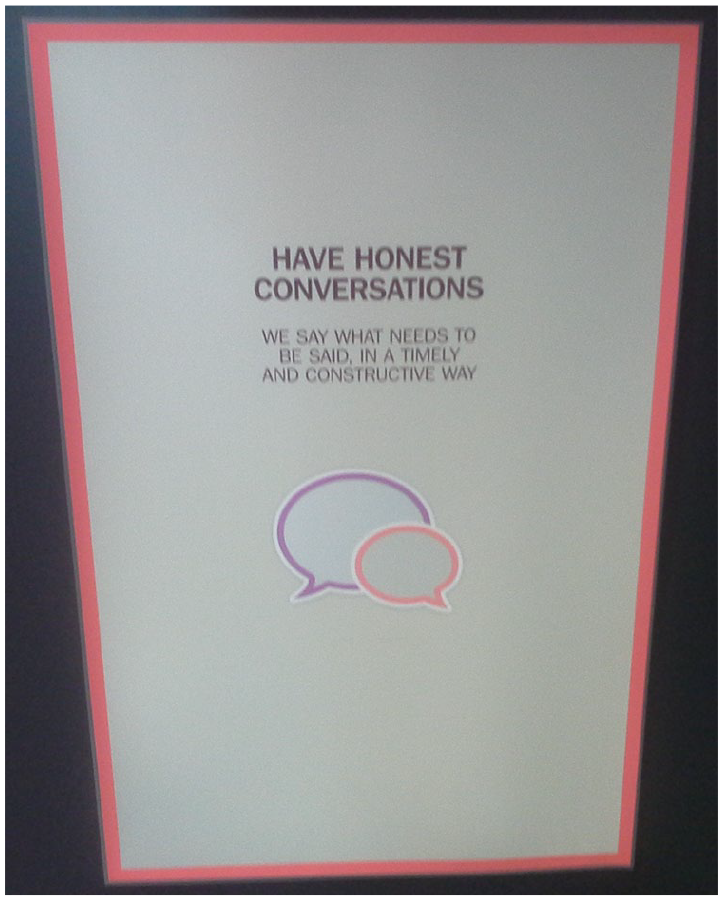
Motivational Poster (‘Having Honest Conversations’).
Managers complained that older operators challenged their values and authority; because ‘they had been with the organization for a long time, they feel like they know everything and “I don’t need you to tell me”’ (Ranjit, older operator). This was despite evidence from the company climate survey that showed that the most ‘oppositional’ behaviours were demonstrated by employees under the age of 20, and the lowest scores for ‘oppositional’ behaviour were in the over-60 employee age group. These conflicting accounts suggest that younger operators may also experience a mode of vulnerability associated with fear of non-recognition (Butler, 1997b). Younger managers in the focus group and interviews articulated anxieties about managing employees with more life and work experience and talked about having to change their approach. Max, for example, explained: ‘it was tough managing an older team, I had to adapt my management style’ (Max, younger team leader) while Ruth (an older operator) observed: ‘the older person’s experience also means they know how to overcome that fear of being managed’. While the lack of recognition might be a source of frustration to the older operators, a perceived lack of ‘fear’ (taken here to refer to recognition of managerial authority) engendered a sense of vulnerability for some of the (younger) team leaders and managers.
Team leaders felt wedged between responsibility for implementing performance management, creating a steady and safe team environment to support productivity, and limited enforcement capacity. For example, Shayne, Griffin’s team leader, had explained how after putting Griffin on a two-week improvement plan which he failed to meet she was ‘directed not to take the next step (termination) and to monitor his performance’. The team leaders’ position in the managerial hierarchy meant that they had primary responsibility for implementing the performance management system, yet with limited authority; this added both to their own sense of relative vulnerability and to the tensions that existed in the relationship between the younger team leaders and the older team members.
Vulnerability and/as resistance – ‘ASK HERE!’
The interplay of vulnerability and resistance, notably between the older operators and their (younger) team leaders, coupled with the ambivalence expressed by younger operators and managers towards their older team members, suggests that the older operators had the potential to disrupt the subjectifying regimes upon which (age-based) recognition schemes depended. We explore this disruption next by examining how wider organizational processes exacerbated the subjective positioning of the older operators, but also opened up a space in which other possibilities and ways of being could potentially emerge, ones that revealed the fallibility of the recognition schemes and the age-biased norms on which they rested.
As suggested above, older operators were more exposed to the metricized and target-orientated culture. As Lynette, an older operator, explained, ‘Hardly anyone’s meeting the targets, but they are not reassessing. If anything, they are pushing the targets up. I think we are going to see a lot of people leaving because people are saying they just can’t cope.’ Paternalistic discourses and greater ‘aged’ positioning rendered the older operators as vulnerable; however, some older operators resisted this positioning and its equating with under-performance. For example, Griffin, who younger colleagues thought should have more recognition, and who had been placed on a performance plan by his team leader, Shayne (as noted above), resisted attempts to get him to push sales, declaring: ‘I don’t feel ashamed of my statistics, because at least I can go to bed at night knowing that I’ve done the right thing because doing the right thing is more important to me.’ Nevertheless, Griffin’s resistance makes him vulnerable; he admitted that despite being close to retirement age, he could not afford to lose his job: ‘I need to keep the money coming in.’ As a result, he explained that he was looking to move to a claims role in a different branch of the company. This is but one example of how the constant threat of not meeting targets, and the performance management consequences of this, meant that older operators felt anxious, largely as a result of the increased attention by team leaders and being ‘looked after’ (a paternalistic euphemism for scrutinized). Yasmin (an older operator) emphasized this when recalling an exchange she had recently had with her younger manager, Kim, that had left her feeling displaced and in need of escape: One day she (Kim) told me she had listened into my calls and that I hadn’t given the customers any features or benefits of our products, and because I hadn’t met my monthly targets, she was putting me on an action plan. She said, at the end of the week I’ll come and sit down with you and see how you go. At the end of the week, she comes and she was listening in and I just rattled off every feature and benefit I knew in the book. At the end of the call, she said, ‘Good, lovely greeting, but, oh god you overloaded the customer.’ I said, ‘I can’t win with you Kim, can I?’. I threw my headset, I ran away. I borrowed a cigarette from somebody. I’m thinking Yasmin, your health is getting ruined. Why are you doing that for someone else? (emphasis added)
At the same time as articulating her sense of vulnerability, Yasmin’s parodic ‘rattling off all the benefits’ highlights the effects of the unrealistic expectations placed on her by her manager, laying bare the values underpinning a mode of recognition that, she feels, fails to take into account her many years of doing ‘the hard yards, of getting the customers over line without a problem’ (Yasmin).
Other older operators talked about the precariousness of their position and the risk of ‘being kicked out’ (Ruth, older operator) or ‘told to bugger off’ (Lynette, older operator) when they could not afford to lose their jobs. Yasmin recounted how some work colleagues had helped her find accommodation so that she could leave her abusive husband, and how ‘job security’ was essential to her independence.
Regardless of this vulnerability, these older operators resisted recognition regimes by asserting their presence and drawing on a situated historicity that undermined future-orientated terms of recognition, emphasizing the value of, as Yasmin puts it, their accumulated years of doing the ‘hard yards’. Yasmin animated this further by displaying a handwritten sign, ‘ASK HERE’ on her workstation. To contextualize this, Victor and Max who had been Yasmin’s team leaders explained that Yasmin was once ‘on top of the charts’ and was given the additional responsibilities of walking the floor and training new staff. To signify this achievement, and recognition of Yasmin’s contribution, she had been entitled to place a large ‘ASK HERE’ sign on her desk. Since shifting from a service to a sales-oriented role however, Yasmin was not meeting her performance targets, and consequently was no longer allowed to put up the official ‘ASK HERE’ sign. Yet Yasmin explained that she had made her own ‘ASK HERE’ sign because she felt that she still had much to offer. By displaying the sign, Yasmin continues to demand recognition as an experienced, knowledgeable and helpful operator. She is also challenging the managers’ right to have the final say over how she is positioned and perceived by her colleagues; in other words, Yasmin herself is seeking to set the terms on which she wants to be recognized, and is refuting her managers’ authority to say and do otherwise.
Older operator resistance was also evident in the recrafting of managerial discourses and rearticulating recognition schemes. For example, rather than accept the managerial discourse of older operators as ‘change averse’ and ‘set in their ways’ several described themselves as ‘questioning the rationale’ (male, older focus group), ‘taking a cautious approach’ (male, older focus group), ‘calling out inconsistencies’ (Lynette, older operator) and identifying ‘values clashes’ (Dean, older operator), thereby questioning the terms of recognition on offer, and the ways in which they were articulated. As a female participant in the older focus group observed, ‘We question it a wee bit more because we just want to understand a bit more about it, rather than oh, okay it’s the latest thing, so off we go.’ Older operators stressed their view that responses to change are not aged-based per se but related to tenure in the role, industry, and life more generally. As Lynette pointed out: ‘If you’ve worked in insurance all your life, you’ve got lots of knowledge and constant changes to policies is an accumulation of that knowledge.’ In some ways, these claims of accumulated knowledge were difficult to contest because most of their line managers were new to the call centre, preventing them from challenging accounts of the past, thereby feeding into the age-based dynamics of vulnerability and resistance.
In sum, the above findings indicate that, on the one hand, older operators are othered by the dominant terms of recognition, and by the context-specific discourses and embodied practices of their relatively younger colleagues. Yet on the other hand, and often through the same discourses and practices, older operators are able to challenge attempts to ‘fix’ their subjectivities as problematic; their accumulated life experience enables them to ‘call out’ the fallibility of the recognition regimes. This ‘calling out’ of the recognition regimes allow them to counter their positioning and limited the ability of team leaders and managers to enforce the terms of recognition. It was through the older operators’ embodied presence and their demand for recognition of their years of experience (e.g. ‘ASK HERE’) that the older operators’ vulnerability could become a form of resistance (Butler, 2016), as we now discuss.
Discussion: Ageing, Recognition, Vulnerability and/as Resistance
Focusing on the dynamics of recognition, vulnerability and resistance, we have shown how the (older) self is performatively constituted through organizational discourses and practices that ‘place’ older workers as simultaneously valuable and vulnerable. We have done so by exploring the organization’s (albeit instrumental) desire for recruiting and retaining older workers, alongside the older operators being rendered ‘unintelligible’ in Butler’s terms, by not being ‘in the right place for their time of life’ (Griffin, older operator), and by not wanting, or being able, to subscribe to this normative fiat of organizational recognition. In this sense, we have also shown how their ‘splintered’ positioning makes it possible for older workers to resist ageist organizational recognition schemes and practices. We have also highlighted how this caused frustration and fear for their (relatively younger) managers and team leaders, exposing their own vulnerability, and the fallibility of the normative regimes through which they conferred recognition and hence staked their own claim to authority.
Drawing on Butler (1997a, p. 5), we can think of the experiences and interactions described above as moments of ‘condensed historicity’ in which older worker subjectivities are fixed in the present by three related reference points: (i) their own pasts and futures (you are no longer what you were, you will not be again), (ii) their co-workers (you are less competitive, dynamic and effective), and perhaps most crucially in this example, (iii) the espoused terms of organizational recognition (you cannot and will not meet our expectations). Yet precisely because of the ways in which they are fixed, older workers were able to challenge and resist this positioning, reclaiming their subjectivities in ways that demanded recognition (‘ASK HERE!’) and by undermining existing terms and parameters of intelligibility.
As an account of the dynamics of aged subjectivities and relations of vulnerability and resistance, our analysis brings to the fore the importance of an aged perspective on the dynamics of recognition, and its implications for how we understand the organizational dynamics surrounding older workers. Specifically, our study highlights how the dynamics between unfavourable and ageist ascriptions that have been previously identified (Jack et al., 2019; Spedale et al., 2014) are deeply intertwined with broader organizational regimes of recognition. These emerge in practices of authority and control (such as performance management systems), and therefore the stakes in resisting them are far higher than injurious effects for the older workers. Managers and younger colleagues are inevitably connected to this as they are frustrated and unnerved by the older workers’ response to the performance management techniques and hence are also rendered simultaneously (relatively) powerful and vulnerable as their struggle for recognition and credibility is exposed.
This also highlighted how, at the same time as – and in many ways through – being relatively vulnerable, older workers resist their positioning as against, or as ‘Other’ to, organizational regimes. Extending recent accounts of older worker resistance focused on individualized strategies such as side-stepping stereotypes, denial or exiting organizations (Foweraker & Cutcher, 2015; Irni, 2009) we can understand the actions of the call centre operators as an un/doing in Butler’s (2005) terms. Here, older workers are rendered simultaneously vulnerable and resistant through the ways in which their subjectivities are fixed in aged terms. 4
Our focus on the aged dynamics of recognition, vulnerability and resistance attests to how organizational processes premised upon ‘normative’ modes of recognition might be unsettled through different strategies that do not necessarily involve overcoming or dismantling age stereotypes or biases (Jack et al., 2019; Leonard et al., 2017). The findings considered above suggest that the different orientations to the conditions of recognition render older workers simultaneously vulnerable and resistant. On this basis, we emphasize the need for a temporally attuned, ‘aged’ account of workplace recognition, one that is sensitive to the ways in which our desire, or not, to be recognized is intertwined with, at least in part, our situated positioning in the life course. Rather than simply classify such tensions between older and younger workers as interpersonal, inter-cohort or intergenerational differences (North & Fiske, 2015), we might also look to the way that age relations are the result of specific organizational practices and regimes. Our data suggests how these practices and regimes render vulnerable those who are unrecognizable on organizational terms, while at the same time providing scope for resisting the modes and terms of recognition on offer, or at least revealing their fallibility.
Our findings also indicate how a person’s location in their own situated world potentially disrupts the normativity upon which organizational recognition is premised, frustrating its basic presumptions. For our participants, a distinct sense of drawing on both an accumulative experience of life and a situated reflexive capacity for introspection and critical evaluation challenged modes of recognition that relied solely on organizational attachment and (apparent) unquestioning identification. The older operators, whose experiences we consider above, suggest that they were aware of the rewards but also the risks attached to the form and terms of recognition on offer. Their rejection was often on the basis that recognition was conditional upon values and practices that did not fit with what work meant to them. Further, older workers’ capacity to problematize the process of conferring or denying recognition also challenges the epistemological basis on which this process is played out, namely within power struggles over who ‘knows better’. In this sense, older operators’ resistance is potentially disruptive, not as a deviation from the norm, but in showing up the norm for what it is: a set of assumptions that not everyone ‘buys in’ to. Their differential positioning in relation to the espoused norm is shaped in part by the older operators’ situated presence within their working life course. The accounts and insights discussed above therefore show that while older operators’ experience accentuated vulnerability, that vulnerability also contains within it the potential for resistance (Butler, 2016).
Our data illustrates how this happens through navigating the rejection of the terms and modes of recognition on offer. In this sense, with reference to an aged critique of the organization’s target-based recognition scheme, it provides an empirical illustration of Butler’s point that ‘the terms that facilitate recognition are themselves . . . the effects and instruments of a social ritual that decide, often through exclusion, . . . the linguistic conditions of survivable subjects’ (Butler, 1997a, p. 5). In this instance, those who are anticipated to survive the organizational ritual of the performance management scheme are presumed not to be the older workers, and this presumption is built into the way in which the scheme is articulated discursively and the way in which it hails, or calls, particular subjectivities into being. This means that older workers, on the one hand, are valued rhetorically and instrumentally as an organizational resource, yet at the same time are denigrated as too ‘brittle’, ‘slow’ and ‘robotic’ to be of use in situ. Yet in surviving – in simply asserting their continued presence in the organization, older workers question the very terms of intelligibility that Other and ‘splinter’ them in this way. In the accounts considered here, this results in team leaders and managers being responsible for enforcing a recognition scheme that is not seen as credible by those subject to it, and ridiculed accordingly.
If what hate speech does is to ‘constitute the subject in a subordinate position’ (Butler, 1997a, p. 18) through discursive means, we show how the possibility of disrupting and subverting the effects produced can emerge. In this case, within an organization setting in which the aged dynamics at stake provide an opportunity for exposing the ‘fault line’, the flaw in the presumptions underpinning the terms of subject formation. This exposure potentially leads to an undoing, in Butler’s (2005) terms, of this process of discursive constitution, in so far as the mutual vulnerability of those involved – older workers and their managers – is brought to the fore.
We are aware that we are potentially taking liberties with Butler’s (1997a, 2016, 2020) analysis of injurious speech and vulnerability in/as resistance, but we would argue that what Butler’s ideas imply is the possibility that the linguistic practices involved in inaugurating workers deemed worthy of recognition reveal the incommensurability between what is intended and what is experienced. This incommensurability exposes the performative contradictions at the heart of organizational discourses about older workers and their ‘placing’ according to the dominant terms of recognition. They are valuable commodities but cannot be fully interpellated and this undermines the capacity of the regimes to which they are subject ‘to be the last word’ (Butler, 1997a, p. 126). For Butler (1997a, p. 153) interpellations ‘hail’ a subject into being, they are ‘social [organizational] performatives that are ritualized and sedimented through time’. They are also, we have shown here, situated within particular contexts including specific points along the working life course; ‘sedimented through time’ not only in a chronological sense but also a phenomenological one. The latter means that older workers are perceived as Other to who and what the organization values in its ‘developmental’, future orientation, as ‘fixed’ in opposition to this momentum.
At the heart of the older operators’ resistance is their potential to expose age-related managerial presumptions based on their years of experience. This is highlighted most notably in relation to the performance system where competence is abstracted to numerical targets that threatened to undermine espoused value-based behavioural practices and discourses. Here misrecognition is enacted by transforming concerns about organizational processes into questions of personal disposition; in other words, by individualizing resistance to an age-determined capability (or lack thereof). This is arguably the enactment of epistemic violence premised upon stereotypical perceptions of older workers and an exploitation of their attributed incapacity. Older workers’ embodied presence, and ways of relating to their co-workers and managers, undermine the disciplinary regimes to which they were subject, mobilizing their relative vulnerability as a form of resistance to organizational attempts to hail them into subject positions that were at odds with espoused values and terms of recognition.
Conclusion
We have considered how organizations respond to the challenges associated with ‘placing’ older workers subjectively, and the ways in which normative regimes render older worker subjectivities discursively necessary but problematic. We have also examined instances where older workers are able to disrupt the conditions upon which organizational recognition is premised. We have shown how older workers’ positioning as simultaneously vulnerable and/as resistant disrupts the recognition schemes through which they are managed. Drawing on Butler, our analysis has suggested that recognition is not simply about an ‘inescapable desire for recognition as a “passionate attachment” to power’ (Butler, 1997b, p. 7), but about complex – socially and chrono-normatively situated – relations of recognition, vulnerability and resistance. The participants in our study indicate how these dynamics are subject to change over time, rendering organizational recognition and performance management schemes that rely on them, also vulnerable to resistance and/or ridicule.
Our research indicates that organizations wishing to genuinely engage with tackling inequality (as opposed to simply promoting diversity or inclusion) need to recognize that the embedded mechanisms that reproduce ageism are the same mechanisms which organizations and managers rely upon for their own sense of value and identity. While challenging stereotypes or age biases is an important practice (Ainsworth & Hardy, 2008; Jack et al., 2019; Pritchard & Whiting, 2015), we suggest that recognizing these tensions provides opportunities to reflect more broadly on how employers might acknowledge older workers’ ways of being and expand the terms of recognition on offer.
Footnotes
Acknowledgements
We are grateful to Simon Witkop who worked as a research assistant on this ARC funded research project (DP120100513) for his gentle and careful engagement with the research respondents in this study. We also acknowledge and are thankful for the clear editorial guidance and encouraging and insightful reviewer feedback we received during the review process.
Funding
The author(s) received no financial support for the research, authorship, and/or publication of this article.
Notes
Author biographies
 ).
).