



Abstract
We shed new light on the processes through which institutions are created and changed by investigating the question how does institutional entrepreneuring unfold in an already organized world. We conducted a longitudinal case study of the field of scientific research production in Australia, which changed over three decades through entrepreneuring processes associated with the creation of a new ‘Smart State’ place in the city of Brisbane in Queensland. A new place is a form of organizing human activity that has materiality and meaning at a specific geographic location. Our findings showed how field change was interwoven with place creation through four processes of entrepreneuring: structural emancipation, dissociating and reimagining place meanings, bricolaging of place forms and co-evolving place identities. These entrepreneuring processes constituted the field as a flow of ‘becoming’ that spilled over into temporary and provisional settlements in local places. Our findings make important contributions through: (1) deepening understanding of how organizational fields change through multilevel, distributed, cascading and often unreflexive processes of entrepreneuring in an already organized world; (2) bringing attention to a relationship between institutions and place, in which place is both the medium and outcome of institutional entrepreneuring; and (3) providing new insight into embedded agency by illustrating how institutions in ‘becoming’ continually (re)produce the resources and possibilities for agency within gradual institutional change over time.
Keywords
Over the past decade, researchers have sought to better understand the entrepreneurial processes of how institutions are created and changed (Hardy & Maguire, 2017). Yet existing explanations ‘still fall short of their promise’ (Bouilloud, Perezts, Viale, & Schaepelynck, 2020, p. 154), depicting ‘heroic’ actors (Hardy & Maguire, 2017) and conceptualizing institutions as inherently stable (Bjerregaard & Jonasson, 2014), which perpetuates the paradox of embedded agency (Battilana & D'Aunno, 2009; Seo & Creed, 2002). Moreover, process explanations have under-theorized the ‘patchwork’ nature of institutions that arises as multiple and diverse actors, organizations and fields are interwoven in societies (Abdelnour, Hasselbladh, & Kallinikos, 2017) and across different places (Lawrence & Dover, 2015; Wright, Meyer, Reay, & Staggs, 2021).
We argue that addressing these deficiencies requires bringing the analytic lens of entrepreneuring to the study of institutional entrepreneurship. Scholars introduced entrepreneuring specifically to correct for the elision of broader, multi-level, processual explanations of change and innovation in an already organized world (Helin, Hernes, Hjorth, & Holt, 2014; Rindova, Barry, & Ketchen, 2009; Steyaert, 2007). Through encouraging a conceptualization of entrepreneurial innovation as an ongoing process of ‘organization-in-creation’ rather than achievement of a well-defined end by one or two sufficiently motivated and resourced actors (Hjorth, 2014), entrepreneuring implies a more inclusive conceptualization of the diverse actors and organizations involved in creating and changing institutions. Moreover, entrepreneuring attends to how processes play out across levels of analysis and across geographic places in society (Steyaert & Katz, 2004), as people ‘come to identify a specific place with specific values, resources and behaviors’ (Kaufman & Kaliner, 2011, p. 121). Importantly, the entrepreneuring lens fosters a concern with how entrepreneurial action is ‘always embedded in . . . the streams of the past’ from which it emerges (Steyaert, 2007, p. 472). Seeking to advance theorizing of institutional creation and change, we ask: How does institutional entrepreneuring unfold in an already organized world?
We conducted a longitudinal case study of change within the field of scientific research production in Australia. Our findings reveal how the flow of institutional entrepreneuring processes involved a diverse and distributed array of government, university and philanthropic actors whose piecemeal, cascading and not always intentional or successful entrepreneurial actions played out in the becoming of a new place for bioscience research in Queensland, Australia’s second-largest state by land mass, known for its history of anti-intellectualism (Evans, 2007). Consistent with the literature in humanistic geography and sociology (Gieryn, 2000), we define place as a distinct geographic location populated by ‘natural and built resources, material objects, and organizing routines’ which inhabitants come to associate with ‘a common enterprise and . . . enduring meanings’ (Wright et al., 2021, p. 44). We observed institutional entrepreneuring processes of a place-in-creation which disrupted and changed the field status quo by repositioning Queensland and its flagship university, the University of Queensland located in Brisbane, closer to the centre. We identified four processes in which the field, local places and people were entangled in entrepreneuring: structural emancipation, dissociating and reimagining place meanings, bricolaging of place forms and co-evolving place identities. Through these processes, what was once the ‘flyover’ state for scientists became the ‘Smart State’ place, made material and meaningful through iconic buildings in a campus precinct housing world-class researchers.
Our study makes three contributions. First, we develop a theoretical model which deepens processual explanations of field change and shines light on how entrepreneuring in an already organized world ebbs and flows in distributed and fragmented ways across levels and actors. Second, we contribute to the emerging literature on place in organizational institutionalism (Lawrence & Dover, 2015; Wright et al., 2021) by revealing a previously hidden relationship between organizational fields and local places. We find that fields shape, and are shaped by, local places as both medium and outcome of entrepreneuring. Finally, our study highlights one partial answer to the paradox of embedded agency by characterizing the entrepreneuring associated with institutions as a continual process of ‘becoming’. We find that this flow produces temporary accumulations of people, material objects and meanings at a specific place and, in doing so, provides resources for institutional entrepreneuring ‘which were created without any intention to disrupt institutions’ (Colombero, Duymedjian, & Boutinot, 2021, p. 3). This finding points to the value of an entrepreneuring lens of becoming in accommodating for both structure and agency in institutional theory (Seo & Creed, 2002).
Theoretical Background
Scholars of institutional entrepreneurship, defined as ‘the activities of actors who have an interest in particular institutional arrangements and who leverage resources to create new institutions or to transform existing ones’ (Maguire, Hardy, & Lawrence, 2004, p. 657), have begun to pay more attention to process after offering predominantly actor-centric accounts. Actor-centric accounts emphasize the role of rational, reflexive and ‘heroic’ change agents who manipulate the higher-order patterns of action and systems of meaning which constitute organizational fields (Hardy & Maguire, 2008). Institutional entrepreneurs are depicted as those who can recognize and exploit uncertainty, contradiction or opportunity in fields (Garud, Jain, & Kumaraswamy, 2002; Wright & Zammuto, 2013) by offering compelling justifications for field creation or change (Greenwood & Suddaby, 2006; Prasad, Prasad, & Baker, 2016).
Researchers have recently expanded beyond these actor-centric accounts to include more process-centric approaches (Hardy & Maguire, 2017). Studies have drawn attention to the multiplicity of actors that play a part in socio-culturally embedded changes across different fields (Feront & Bertels, 2021; Perkmann & Spicer, 2007), and the relationships and contests among multiple actors that animate entrepreneurial processes (Ben-Silmane, Justo, & Khelil, 2020; Qureshi, Kistruck, & Bhatt, 2016). Other studies have emphasized temporal relationships between institutional entrepreneurship and government policy breakthroughs (Buhr, 2012), potential for co-evolution between the state and institutional entrepreneurs (Olsen, 2017), and the unplanned and often resisted nature of institutional entrepreneurship (Khan, Munir, & Willmott, 2007). Many process studies account for multiple levels of analysis, although these studies have focused almost exclusively on where an entrepreneur’s interest in change originates (e.g. Henfridsson & Yoo, 2013; Rothenberg, 2007) or the macro-cultural source of the discursive resources entrepreneurs use to enable change (e.g. Lawrence & Phillips, 2004; Prasad et al., 2016). Missing from many studies is ‘an evaluation of unfolding socio-historical structures’ in processes which are ‘iterative, messy and non-linear’ (Delbridge & Edwards, 2008, p. 302).
While acknowledging that advances have been made in developing process explanations of institutional entrepreneurship, we argue that the literature has not gone far enough in theorizing how institutions are created and changed in an already organized world. Four criticisms suggest a new point of departure is needed. First, process accounts of institutional entrepreneurship still tend to depict ‘heroic’ actors (Hardy & Maguire, 2017). Second, institutions are conceptualized as stable ‘beings’, which simplifies institutional entrepreneurship to the ‘rather exceptional creation or disruption of a relatively stable structure’ (Bjerregaard & Jonasson, 2014, p. 1508). Third, processual accounts continue to be theoretically challenged by the relationship between structure and agency (Battilana & D’Aunno, 2009; Seo & Creed, 2002), with some scholars suggesting that researchers are ill-equipped to avoid the embedded agency paradox without studying institutions as ‘becomings’ (Bouilloud et al., 2020; Colombero et al., 2021). Finally, scholars have under-theorized the heterogeneous ‘patchwork’ nature of the relationship between actors and institutions (Abdelnour et al., 2017). Patchwork institutions arise because diverse actors, organizations and fields are intertangled in societies over time and across levels (Lounsbury & Crumley, 2007) and across distinct geographic places imbued with meaning as people interact with ‘the material and social stuff gathered there’ (Gieryn, 2000, p. 472). Place has recently been identified as an important, but largely unexamined, piece in the ‘patchwork’ of institutional arrangements in an already organized world (e.g. Lawrence & Dover, 2015; Wright et al., 2021).
We contend that redressing these criticisms and taking the literature forward requires the adoption of an institutional entrepreneuring lens. Scholars have begun to engage with entrepreneuring as a generative concept for understanding entrepreneurial processes (Hjorth, 2014; Steyaert, 2007), suggesting that it is likely to be theoretically profitable as a new point of departure for understanding processes associated with creating and changing institutions. Process thinking about entrepreneurial phenomena attends to emergence, movement and change in the ‘becoming’ of the new alongside the transformation or loss of the old (Hjorth & Reay, 2017; Tsoukas & Chia, 2002). Researchers suggest entrepreneuring unfolds fluidly as a creative process of emancipation, in which individuals and groups engage in actions to break free from constraints in economic, social, institutional and cultural environments and bring about change (Rindova et al., 2009). Studies show, for example, that entrepreneuring opens up potentialities for something new and/or different to emerge through ‘playful’ experimentation (Hjorth, 2004; Pallesen, 2018), for recombining resources that happen to be at hand through bricolage (Baker & Nelson, 2005), and for reflexively recreating and reimagining different aspects of organizations (Hjorth & Steyaert, 2009). Entrepreneuring emphasizes the multiplicity of actors in any given case of change, the organized world in which entrepreneurs are embedded, and the emergent, happenstance and contingent nature of the innovations that entrepreneurs – often unintentionally – introduce (Hjorth, Holt, & Steyaert, 2015).
Overall, the entrepreneuring lens seems well-suited to developing a richer understanding of how institutions are created and changed as the ‘patchworks’ in Abdelnour and colleagues’ (2017) description and the ‘becomings’ conceptualized by critical institutional scholars (Bjerregaard & Jonasson, 2014; Bouilloud et al., 2020; Colombero et al., 2021). This is because the concept of entrepreneuring ‘situates entrepreneurship in a new form of connectivity and assemblage where both human and non-human elements are included to give form to the trajectories of a world in its becoming’ (Steyaert, 2007, p. 471). Toward more comprehensively theorizing entrepreneuring processes as they apply to institutional creation and change, we explore the question: How does institutional entrepreneuring unfold in an already organized world?
Methods
‘Smart State’ case study
We conducted a longitudinal case study of institutional entrepreneuring in the field of Australian scientific research production. Historically, Queensland, Australia’s most northern state, was positioned at the periphery of this institutional field. With an economy based in mining and agriculture and political governance dictated by rural-conservative coalitions (Evans, 2007), Queensland was associated with anti-intellectualism and parochialism (Charlton, 1987). Cutting-edge scientific research, by contrast, was associated with Australia’s southern states, in which a small group of elite organizations and universities in large metropolitan cities such as Canberra, Melbourne and Sydney undertook research largely funded and supported through historical patronage relationships with the national government (Jones, 2007). Queensland’s flagship university located in the capital city of Brisbane, the University of Queensland (UQ), was primarily focused on teaching activities (Larkins, 2011).
Our case explores how, over three decades from 1977 to 2006, the field of scientific research production was changed as a new place emerged in Queensland. Consistent with the literature in humanistic geography that defines a ‘place’ by locality, materiality and meaningfulness (Gieryn, 2000), the ‘becoming’ of a new place in our case is characterized by: (1) locality at a specific geographic site on the UQ campus within the city of Brisbane within the state of Queensland; (2) materiality through landmark buildings housing state-of-the-art equipment and laboratory facilities where world-class scientists work together with government and industry; and (3) meaningfulness through shared interpretations and identifications of the place with ‘Smart State’ among actors within university, government and community. By the end of 2006, the university’s campus and the state of Queensland had become interconnected and coherent as a new ‘Smart State’ place for scientific discovery and had shifted closer to the centre of the field of scientific research production. As one national chief scientist reflected, ‘Queensland has taken itself out of very obvious research mediocrity to having important leading positions in Australia and globally.’ Thus, Smart State is a compelling empirical case to explore institutional entrepreneuring processes in an already organized world.
Data collection
We collected data through archival documents and interviews with a breakdown presented in Table 1. A total of 450 documents were collected across the national government, Queensland government, UQ, and other sources. The first author used these documents to generate a sample of people with relevant knowledge and lived experience of institutional entrepreneuring associated with Smart State. These individuals were approached for interviews, after which interviewees suggested additional people who might be recruited. Snowballing continued until interviewees began recommending individuals who had already been interviewed (Flick, 2002). Interviews were typically 45 minutes to one hour in length, with some lasting up to four hours. Three informants were interviewed on two occasions. With the exception of two interviews, all interviews were conducted face-to-face by the first author and were digitally recorded and transcribed. In total, 64 interviews were conducted with 61 informants associated with national government, Queensland government, UQ, and other private and public sector organizations.
Data Types, Sources and Details.
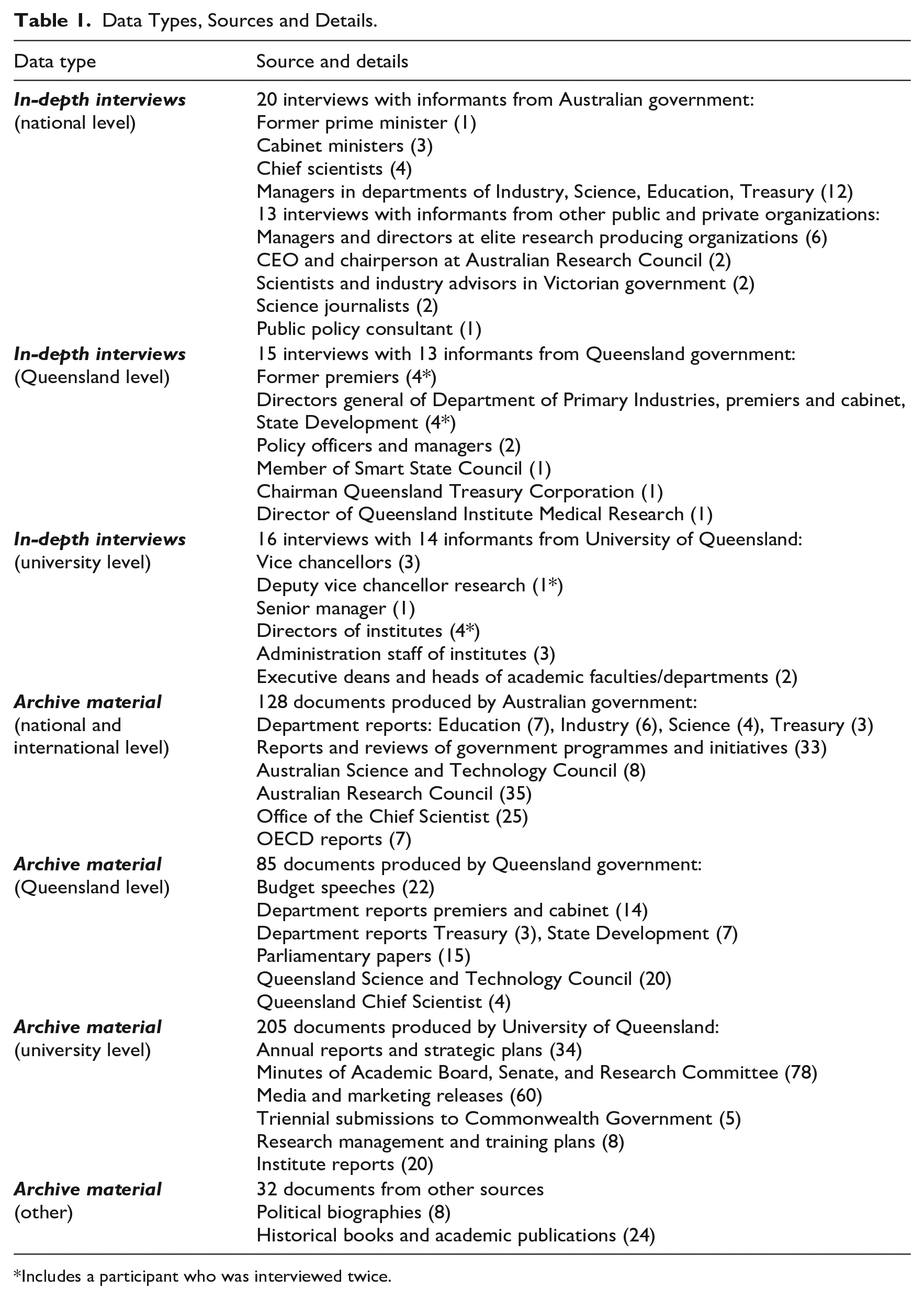
Includes a participant who was interviewed twice.
Analytic approach
Our initial attempts at data coding were oriented toward establishing a narrative of events which in aggregate comprise Queensland’s and UQ’s transformation in the field of Australian scientific research production (Langley, 1999). However, it became clear that our data did not reflect a ‘clean’ linear narrative. The major events shaping the field – for example, policy and funding decisions, organizational restructures, commitments to constructing buildings, new staff recruitment and changes in government and university leadership – were out of sync with existing patterns of activity in the field, cascading, and often represented only one trajectory along which the field could evolve among many potentialities. From 1977 to 1987, significant changes appeared to have occurred in national government and university policies and structures; from 1988 to 2000, the university’s trajectory seemed to shift towards prioritizing research strengths and working with national and state governments on the first Smart State building; and from 2001 to 2006, the state government and the university were developing more buildings on campus.
Aware that a linear narrative poorly mapped onto the ebbing and flowing events our data described, we adopted a process approach (Hjorth et al., 2015). This encouraged us to inductively code the data, paying particular attention to the situated activities and contingent trajectories of different groups of actors, the way these activities and trajectories built on one another, and the paths of field evolution that were possible at different stages but eventually unrealized. That is, our analysis was guided by the insight that ‘concretely observed outcomes are often only one of a multitude of “potentialities” that coexist in a particular situation’ (Cloutier & Langley, 2020, p. 5). While our interview data offered some insights into the multiple potentialities that had coexisted at these earlier moments in time, we also remained cognizant that contemporary interview data are subject to the limitations of individuals retrospectively accounting for their lived experiences of an unfolding process (Flick, 2002).
By tracing the patterns of university and government activities, events, experiences and potentialities across our empirical material over time (Jarzabkowski, Le, & Spee, 2017), we developed a sense that four emergent, ebbing and flowing entrepreneuring processes had resulted in new place creation, moving UQ and more broadly Queensland closer to the centre of the field of Australian scientific research production. We labelled these processes structural emancipation, dissociating and reimagining place meaning, bricolaging place form and co-evolving place identity.
In the next section, we present our findings related to how these four entrepreneuring processes unfolded over time to change the field and create a new place in an already organized world. Guided by Berends and Deken (2021), we connect process data and process theory using temporal coherence embedded in the case history. This means we introduce the four processes in the order we first noticed them in our empirical case, beginning with structural emancipation. We adopt a narrative style of interspersing our interpretations with illustrative data and use identifier codes to distinguish our interview (I1 to In) and archival (D1 to Dn) data sources.
Findings
Structural emancipation processes
The first entrepreneuring process which emerged as salient in our case study was structural emancipation. This form of entrepreneuring described the process by which persons became emancipated from structural financial and bureaucratic constraints, freeing up multiple new possibilities for organizing places of and for scientific research. These constraints had historically bolstered Canberra, Sydney and Melbourne as elite places of scientific research production in Australia and simultaneously sidelined the state of Queensland and the campus of UQ as places of mining and agriculture and of teaching, respectively. As an interviewee explained, structural emancipation over the period 1977 to 1987 involved many big and small acts of disruption within national government and university coalescing into ‘a trigger to [say] hey, let’s do something about science and technology’ (I8), creating multiple potentialities for the UQ campus to evolve into a new local place.
Breaking through entrenched policy structures
Interactions and activities flowing through the work of the Australian Science and Technology Council disrupted the normal continuity of policymaking for scientific research at the level of national government. The council, established in 1977 as a high-profile advisory body to the national government, ‘was made up of knights of the realm, leaders of industry, and the most senior people in academia, science, and technology’ (I6). The council met six times a year, and these interactions informed the writing of reports and recommendations for national research reform. Initially, the council’s activities were disconnected from the formal structures and everyday processes of government.
Over time, council members used their personal connections to cultivate closer relationships with the prime minister’s office. The council’s advising and reporting activities broke into normal policy coordination processes when the prime minister’s office began including the council ‘in the coordination comment round’ (I9). Gaining advance notice of submissions going before Cabinet allowed council members to offer a scientific perspective on each submission. These comments could shape the trajectory of government decision making because ‘most politicians have very limited knowledge of science and technology and they have to rely on the experts’ (I1). From 1977 to 1987, the council tabled in parliament thirteen reports and two occasional papers. While not all of them ‘had much dramatic influence’ (I6), seven reports connected basic research to national socioeconomic objectives and recommended university involvement in basic research. This flow of council activities channelled government attention to the need for national policy architecture to liberate universities to become places for both basic research and higher education. By ‘encourag[ing] a much higher degree of inter-penetration of the two systems’ (D2), a fissure for new place emergence opened up.
Breaking down institutionalized resource allocations
Processes that broke through national policy structures were entangled with the breakdown of institutionalized modes for allocating government resources to scientific research. As political ideology associated with economic rationalism spread globally in the 1980s and penetrated thinking in Australia’s national capital in Canberra, the Treasury and Finance Departments of the national government gained influence. These ‘bean counters’ (I1) questioned why public funding for science and medical research was confined to a few historically privileged places located in the cities of Canberra, Melbourne, and Sydney. Historical patronage meant scientists ‘could get the support of the Prime Minister for scientific research over a few brandies’ (I32), which (re)produced ‘insular’ and elite research organizations (I6). Believing scientists working in these organizations positioned at the field centre ‘lived in a bubble . . . with taxpayer’s money’ (I7), Treasury and Finance implemented new evaluation procedures to make public expenditure for research more accountable: ‘our role is to look across all of the stakeholders, all the views on the table, all the economic outcome . . . [and ask] is this the best place to put the money?’ (I45).
Treasury and Finance’s new procedure aroused ‘angst in the science community, who resisted the idea of being directed by . . . the bean counters as to where they should direct their [research] efforts’ (I7). Holding elite research organizations located in Australia’s southern states to greater financial account coincided with the council challenging the government’s traditionally non-competitive funding model for allocating resources. The council recommended the establishment of a central body to administer competitive research grants open to both historically elite organizations in the field and universities to ensure that ‘funds flow into research of highest quality and value’ (D4). Leaders and administrators of these elite organizations responded by working antithetically to reinforce the field status quo, lobbying government to retain their ‘unique funding status’ (D4) and appearing ‘in the press a lot [doing] self-promotion’ (I42). Outraged scientists from elite research organizations also staged a protest march in Canberra: ‘You have some of Australia’s brightest [minds] standing in the rain with their placards’ (I2).
With latent conflicts in the field brought to the surface, the government ‘needed to show that something happened as a result’ (I1). In 1987, the Australian government introduced a new system for funding research, which authorized universities to compete with the field’s elite organizations on the merit of their research strengths and priorities. The government combined this new research system with higher education policy reform and endowed Australia’s universities with access to financial resources to develop their research capacities, freeing them to potentially evolve their campuses into local places of both higher education and research.
Breaking up organizational hierarchies
These government-level processes of structural emancipation – breaking through policy structures and breaking down resource constraints – opened fissures for new place emergence within Australia as a nation. At UQ in particular, university administrators deepened these fissures through processes of structural emancipation playing out at the organization level. At the beginning of our empirical case, UQ’s hierarchical structures were rigidly bureaucratic. Decision-making was headed by a small, elected academic committee which had ‘vast control over money but no personal responsibility’ (I34). The committee’s activities continuously (re)produced UQ as ‘a dinosaur’ (I53) that could not adapt.
This changed following the appointment of a new vice chancellor in 1977. The new vice chancellor initiated an administrative restructure which introduced senior executive managers, putting decision-making ‘in the hands of individuals who could be held accountable rather than a committee’, although ‘there were all kinds of protest [from academic faculties] about the loss of democracy’ (I34). New funding practices that tithed a percentage of the operating budgets of academic faculties into a strategic research fund added to the internal conflict. Although the vice chancellor’s attempt to break up organizational hierarchies ‘was a real struggle’ (I53), it released a pool of strategic funds and decision-making authority that could potentially be used to support the development of research priorities. In 1987, when the national government encouraged all universities to take ‘a step back and say . . . where are we going to focus our attention?’ (I29) as places of research and higher education, UQ’s leadership had the structural freedom to reimagine the university’s position in the field of Australian research production and its campus as a local place.
Potentialities for place creation
For the first decade of our empirical case, entrepreneuring of a new place was opaque as structural emancipation processes for policy, resource and hierarchical constraints ebbed and flowed to open up fissures in the already organized world of university–government relationships in the field of scientific research production. Each fissure had multiple potentialities for becoming filled with more imaginative processes of entrepreneuring. One precarious potentiality was biosciences research. Senior leaders at UQ speculated that bioscience might potentially become an increasingly important growth area in research internationally, but the university ‘didn’t have strong molecular biologists’ on campus and materiality was limited to a set of ‘butterfly collections’ rather than a dedicated laboratory (I55). While the potentiality of the UQ campus as a place for bioscience research was indeterminate and coexisted with many other potentialities, the general disruptive processes of structural emancipation ‘laid the groundwork’ (D1) for new place emergence. An interviewee recalled: ‘It was important to get the right structure for the senior people [at UQ but] . . . it was only when the Federal Government took over the entire funding process [after 1987] . . . that the whole thing changed’ (I34).
Disassociating and reimagining place meaning
Entrepreneuring in the field of scientific research production shifted from 1988 when new processes at the university level adapted to, and intermingled with, ongoing structural emancipation processes. At the field level, government actors continued to break policy and resource constraints in an effort to free scientific research production from historically elite organizations at the field centre. As the national government considered ‘where do we need to sprinkle the fairy dust of public policy on those structures’ (I7), our data described new processes emerging on UQ’s campus in Brisbane to fill the fissures opened up by structural emancipation.
Freed from narrowly defined regulations and historical assumptions about what a university in Australia should be, UQ’s leadership began collectively reimagining what a university geographically situated in their particular spot on the map could be. The UQ campus was located in Brisbane, the capital city of Queensland. This region had historically contingent meaning and materiality among its residents, government and outsiders as a place of coal, cane, copper and tourism that ‘believed in good, old-fashioned big projects like rail-lines’ (I19) rather than science and technology. A senior leader at UQ (I16) recalled, ‘Queensland at the time in this field was the second last place in the country you would go to . . . but we had a vision about doing some new things’ in biological sciences as a potential area of research strength for the university. UQ administrators’ reimagined vision involved disassociating the place meaning of UQ from that of Queensland, a region which conveyed a place meaning of ‘very obvious research mediocrity’ (I30).
The senior leadership team at UQ had, through breaking down organizational hierarchies via structural emancipation processes, ‘gained a lot in terms of flexibility and consequently on the capital side was able to build [a new building]’ (I34), which the university did in 1988 after lobbying national government to contribute funds. UQ’s leaders dedicated the new building to biosciences to favour specific uses through which the university’s research capabilities might be expanded for national benefit and disassociated from Queensland’s inward-looking regional economic focus. By including state-of-the-art laboratories alongside offices and teaching spaces, the building’s design supported the university’s ‘entrepreneurial’ (I16) vision of becoming a nationally significant place for biotech research.
UQ’s attempts at disassociating place meaning unfolded as a process of material and social construction in and around the new bioscience building. The senior leadership team used the building to house a new Center for Molecular and Cellular Biology alongside academic departments in science and hired an internationally esteemed bioscientist to lead the centre. The centre’s leader leveraged the university’s strategic research funds – liberated earlier in the entrepreneuring process – to recruit ‘hot shot’ early-career researchers from overseas: Melbourne in particular – which was our main competition – had very established [organizational] hierarchies and these [early-career scientists we recruited] were people that wanted to flex their wings after doing five or six years of postdoctoral work overseas . . . So we drove a truck through the recruitment practices of [historically elite research organizations]. (I16)
Early career researchers with ‘fantastic CVs’ arrived on campus and ‘really excelled’ (I53) as they interacted with the materiality of the bioscience building (laboratory facilities and equipment) and with other researchers. The centre’s leader supported these recruits to apply for competitive fellowships under the national government’s new policy initiatives. Recouping a researcher’s salary costs through a fellowship allowed the centre leader to release the university’s strategic funds to recruit more staff and buy additional equipment. An interviewee described how ‘that money kept going around in a circle’ (I18), bringing more expert researchers, specialist research equipment and national recognition to the centre. As people inhabited the bioscience building and expressed and shared meaning through performing their research work, a small and nascent place for biosciences research was emerging on campus.
These processes of endowing this embryonic research place with materiality and meaning ebbed and flowed alongside structural emancipation processes at both the government and university levels. The national government directed more funds for cooperative research centres to UQ, bringing more expert researchers with international reputations and advanced equipment to the campus and further disassociating place meaning from Queensland ‘as a backwater’ (D5). The university’s acquisition of a Drug Design and Development Center led by a second internationally acclaimed bioscientist, which another university had disbanded, conveyed how UQ was reimagining place meaning: ‘we had strength and provided something you can convey to the outside world’ (I55).
Potentialities for place creation
Entrepreneuring in this stage played out in UQ’s strategic efforts to exploit the national government’s ongoing structural emancipation processes and better position itself in the field of scientific research production. This involved disassociating the University from its historical place associations in Queensland and reimagining the meaning of UQ’s Brisbane campus as a local place. As these university-level processes streamed into the fissures opened up by structural emancipation, an embryonic place for bioscience research was emerging in an already organized world. The potentialities of this new local place remained fluid, shaped by the continuous rhythms of human experiences and sociomaterial interactions in the bioscience building and broader university campus.
Bricolaging place forms
A third process of entrepreneuring began pushing to the forefront in the mid-1990s. Core to this process was the bricolaging of place forms, which reflect the distinctive arrangements for organizing social relations and resource flows at a local place. In our empirical case, the place form of a ‘centre’ had come into existence through new policies unfolding in structural emancipation processes at the level of national government. As part of the processes to disassociate and reimagine place meaning at the university level, centres were translated into a place form of specific organizational arrangements for producing scientific research at the UQ campus in Brisbane. Yet these entrepreneuring processes did not ‘fix’ centres as the accepted place form for organizing and materializing the reimagined place meaning. The data suggest the organizing elements of centres as a place form were available to be recombined or cobbled together into new place forms through creative processes of bricolaging.
Conceptual bricolage
At the UQ campus, university leaders and researchers in centres engaged in ‘optimum foraging behaviour . . . [in which] people are alert to what is available and look to opportunities to put together proposals for that’ (I9). These actors’ proposals included recombining the Center for Molecular and Cellular Biology and the Center for Drug Design and Development into an Institute to create a critical mass of research. However, when the incumbent vice chancellor retired in 1996 after 17 years in the role, the new UQ senior leadership team ‘shelved’ (I12) the idea of bricolaging centres into a biosciences Institute while they reviewed the university’s operations.
Their review found that UQ’s organizational structures were becoming overburdened: ‘a rapidly growing university [that] had a plethora of faculties and departments, schools, [centers] and goodness knows what else . . . there were too many structures’ (I4). University-level structural emancipation processes again resurfaced as the new senior leadership team broke up organizational hierarchies to create ‘flatter, leaner, more strategically responsive and effective structures, policies and practices’ (D7). They asked administrators and leaders in academic departments and centres to identify research priorities for external funding: ‘any decision to prioritize [also] implies a decision to de-prioritize’ (I4). These organizational interactions prioritized biosciences research, reinforcing the ongoing processes of reimagining place meaning.
Leaders’ efforts to free up organizational structures released decision-making flexibility and momentum for bricolaging an Institute as a new place form. Multiple possibilities became apparent for recombining the human and material elements of six existing centres – including the Center for Molecular and Cellular Biology and the Center for Drug Design and Development – with institutional forms, practices and ideas that were already available as stock for bricolage in other fields. Senior leaders and bioscientists creatively pieced together concepts from US-based research institutes and institutions such as Stanford with the people, expertise, practices and equipment of the six centres already on UQ’s campus (D8). The place form they conceived of – an Institute for problem-based biosciences research housed in a new centrepiece building – was ‘unusual in scope outside the global pharmaceutical industry’ (D9). The proposed place form was ‘forward-looking and strategically innovative’ (D10) for an Australian university. To materialize this place form on campus, the processes of conceptual bricolage expanded into financial and political bricolage as the vice chancellor transferred practices of external advocacy from American universities: I wrote all the proposals for funding myself. As vice-chancellor, I thought if I don’t write this in my own words [it won’t work] since I’m going to be advocating to outside sources. The American presidents of universities are expected to have an advocacy role [but typically] that isn’t done here in Australia. (interview)
Financial and political bricolage
Bricolaging of the new place form spread across business and political boundaries. UQ’s vice-chancellor and leading bioscientists met an Irish-American businessman who had founded Atlantic Philanthropies, a multinational organization focused on supporting medical research that benefits society (D11). The vice-chancellor recalled, ‘The philanthropist and I got on well because I had the practice of being the primary advocate, speaking jargon-free about the significance of these sorts of things.’ The philanthropist offered to match UQ’s financial investment in a biosciences institute if both the national and Queensland governments contributed matching funds.
The processes of bricolaging involved different actors – including UQ’s vice-chancellor and bioscientists, the philanthropist, and government ministers and administrators – working to (re)shape the proposed place form and to find ways to combine philanthropic and government funds to finance it. This was especially challenging in Queensland, where the Treasury Department had historically exerted ‘stranglehold control’ (I40) to privilege ‘traditional forms of infrastructure support in the Queensland tradition’ (I38). The philanthropist was ‘thrown out’ of the Treasurer’s office in an early pitch meeting (I22). Despite Treasury’s protests, the Queensland government publicly pledged to match contributions from UQ and the philanthropist. When a new government came to power in the 1998 Queensland election, UQ leaders and the philanthropist had to repitch the proposal, adding to the precarity of the nascent bricolaged place form: ‘We were conscious of getting knocked out at any point’ (I19). Through these meetings, the premier and ministers in the new Queensland government came to understand that UQ’s bioscientists were ‘starting to be able to read the code of molecules . . . [and] the important thing about this knowledge is that it will transform all the biologically-based industries’ (I34). The Queensland government agreed to commit matching funds to the institute.
At the level of national government, UQ’s bioscientists submitted multiple national grant proposals for an institute without success. The vice-chancellor and the philanthropist also lobbied national government representatives to match the Queensland government’s contribution. These activities became interlocked when actors in the national and Queensland governments exploited an existing Australia-wide funding scheme ‘which usually finances large-scale public works such as roads, railways and dams’ (D13) as a resource for bricolage. The national government was actively looking to fund public works situated in Queensland, and the Queensland government was interested in developing its research infrastructure in biotech. The institute proposal included physical construction of a 14 000 square metre building on UQ’s campus (D14). The fissure for new place creation widened as government actors ‘understood that this was one thing on which Queensland would work with the Commonwealth’ (I25) and leveraged the existing public works scheme to finance the national government’s contribution to the institute’s centrepiece building.
These processes of financial and political bricolage across a diverse group of actors gave materiality to the emergent new place form. Atlantic Philanthropies gifted $10 million, the Queensland government pledged $15 million, and the national government contributed $15 million to build an Institute for Molecular Bioscience on UQ’s campus (D15). Additionally, UQ committed $15 million of its strategic funds towards recruiting world-class researchers to work in the Institute: If you take up a hare-brained idea, political leaders are right to throw you out. But if you take up a substantial idea, and you can demonstrate that the university [and philanthropy] is prepared to put money into it and that you are looking for matching support, [governments will listen]. I spent a lot of time at the State level of government, and then Federal government. (interview, vice-chancellor)
Potentialities for place creation
As bricolaging intermingled with processes of reimagining place meaning and of structural emancipation, the fissures for entrepreneuring a new place opened wider. The Queensland government’s ‘commitment to bio-medical and biotech research was one of the few things that were congruent and not opposed to Commonwealth policy at the time’ (I25). Interviewees described how the university filled the widening fissures with an emerging place form of an institute: ‘We made very deliberate decisions to go with Institutes . . . reshaping this place, putting it on another trajectory’ (I57). This quote suggests that the trajectory of place creation on UQ’s campus was becoming progressively more fixed around excellence in biosciences research, materialized in the place forms of institutes. Yet even as the university established the Institute of Molecular Bioscience and physically constructed its centrepiece building with state-of-the-art laboratory facilities on campus, the new place defied fixedness. Place form was in motion and ‘Centers were the forerunner . . . to go to these bolder forms’ (I55). The first institute was now part of the stock of ideas, resources and practices that could be creatively recombined in ongoing processes of bricolage and reimagining of place meaning.
Co-evolving place identities
The analysis shows that as the entrepreneuring processes continued, the trajectory of place creation on the UQ campus co-evolved with the shifting meaning and identity of Queensland as a regional place. For the newly elected government, interactions surrounding the first institute opened up multiple potentialities for reimagining Queensland as a place. Government leaders envisioned Queensland becoming a place in Australia of exceptional knowledge production named the ‘Smart State’. An interviewee described how ‘the Smart State came across as a brand [to symbolize Queensland’s reimagined place meaning] when there was a move beyond biotech . . . to broaden it into research and innovation at a broader level’ (I35). A government minister recalled, ‘We played this through, realizing we could pull all this together as a strategy and actually do what we wanted to do, which was introduce new prospects into Queensland’ (I19). Queensland as the Smart State was ‘a good thing for the state’s future and for their kids . . . there was an economic benefit’ (I22).
Aligning the symbolic and material meaning of Queensland as the Smart State required government and university actors to cooperate in building infrastructure for scientific research. In the already organized world of Queensland government, the Treasury Department exerted dominant control over infrastructure decisions. Rigid application of economic rationalist methodologies ‘did not support significant game-changing infrastructure’ (I22), as demonstrated by Queensland Treasury’s opposition to the first institute: ‘They didn’t want to do it’ (I40). Since it was impossible for Queensland to develop a place identity as the Smart State without research infrastructure, the processes of reimagining Queensland’s place meaning intersected with structural emancipation processes. The Queensland government liberated decision-making authority for knowledge-based infrastructure by shifting control from Treasury to the Department of State Development (D16). They also established a dedicated ‘Smart State Research Facilities Fund’ to prevent bureaucratic constraints ‘dragging the chain’ (I22) on budget allocations.
These processes of bringing material substance to Smart State shaded into the processes of bricolaging the place form of institutes on the UQ campus. As part of its actions to become the Smart State, the Queensland government tendered with the Australian government in 2001 to build a national synchrotron facility but were outbid by the Victorian government (D17). Since the Queensland government had already staked its claim to the Smart State place identity, the premier approached UQ’s senior leaders for ‘a pretty quick announceable’ (I27). UQ’s leaders proposed building an institute in nanotechnology, which they had already begun considering through recombining some existing centres in bioengineering with areas of research strength across the departments of science and engineering: ‘We had the Institute in our back pocket not clearly delineated . . . but we had the concept of the Institute that had biology, chemistry, engineering as our reading of the future’ (I55).
As before, these initial acts of conceptual and political bricolage motivated financial bricolage. The Queensland government committed $24 million from the Smart State Research Facilities Fund to build the Australian Institute of Bioengineering and Nanotechnology on the UQ campus. The landmark building would contain 15 700 square metres of floor space and game-changing equipment (D18). Atlantic Philanthropies pledged $17.5 million to the building and UQ contributed $30.5 million of its strategic funds to employ 340 researchers.
The spread of institutes as a place form continued as both a medium and an outcome of the ‘fortunate convergence’ (I22) of (1) Queensland’s aspirational place identity as the Smart State, and (2) the UQ campus becoming known among the international scientific community as a local place bringing together state-of-the-art buildings and facilities with world-class researchers. When working with UQ and Atlantic Philanthropies on the proposal for the nanotechnology institute, the Queensland government expressed interest in a third Smart State institute. The philanthropist began actively ‘lobbying on behalf of the projects he wanted to fund’ in medical research (I27). For UQ, neuroscience was ‘an area of nascent strength but it was scattered’ (I34) across multiple centres and academic departments in medicine, psychology and science, so potentialities existed for recombination into a Smart State institute that investigated brain function. These bricolaging processes continued the co-evolutionary trajectories of Queensland and UQ as places of excellence in bioscience research: ‘This is the logical bringing together of some strands of things that are happening or could happen and to see how one might knit them together and use them to drive the next set of developments’ (I19). Through these bricolaging processes, the Queensland Brain Institute emerged as the third Smart State institute in 2003. The Queensland government committed $20 million from its Smart State Research Facilities Fund and Atlantic Philanthropies pledged $20 million to construct an 11 500 square metre building housing researchers from diverse disciplines (D19). UQ allocated $23 million of its strategic research funds to employing 240 scientists and 60 support staff (D20). With the construction of the third institute, a new Smart State place had become coherent at UQ.
Potentialities of place creation
In this final stage, entrepreneuring through structural emancipation, reimagining place meanings, and bricolaging place forms played out in co-evolving trajectories for Queensland and UQ around place identities anchored in Smart State. The already organized world of university–government relationships in the institutional field had cracked wide open for the becoming of a world-class scientific research precinct in a historically anti-intellectual region of Australia: ‘Scientists used to fly over Brisbane in order to get to Sydney and Melbourne – now they are just coming here’ (I53). Through institutional entrepreneuring, a new place had become coherent in its meaning, form and identities across Queensland and UQ. This coherence was materially represented in landmark buildings that transformed the geography of the university campus and of Queensland’s capital city of Brisbane. This Smart State precinct was both a human and material construction. An interviewee explained, ‘While the building is a great centrepiece, the whole concept of having the ability to recruit people into the university through this concept of a new Institute was a driving force [of place creation across Queensland and UQ]’ (I38). The new research place on campus had become coherent, yet nevertheless remained fluid as people were recruited and continuously interacted in and around the Smart State buildings in ways that offered new potentialities for reimagining place meanings and bricolaging new place forms.
Discussion
We sought to better understand how institutional entrepreneuring unfolds in an already organized world through a case study of the Smart State initiative in Queensland. Our findings revealed how change in the organizational field of scientific research production in Australia was interwoven with the creation of a new ‘Smart State’ place through four processes of entrepreneuring: structural emancipation, disassociating and reimagining place meanings, bricolaging place forms and co-evolving place identities. Abstracting from the detailed tracing of these processes in our empirical case, we integrated our findings into the theoretical model depicted in Figure 1. Our model theorizes how entrepreneuring shapes and reshapes the interactions between field-level institutions, organizations and places in an already organized world, generating temporary, provisional settlements through the entanglement of different multi-level processes of becoming while retaining possibilities for disruption, change and new creation.
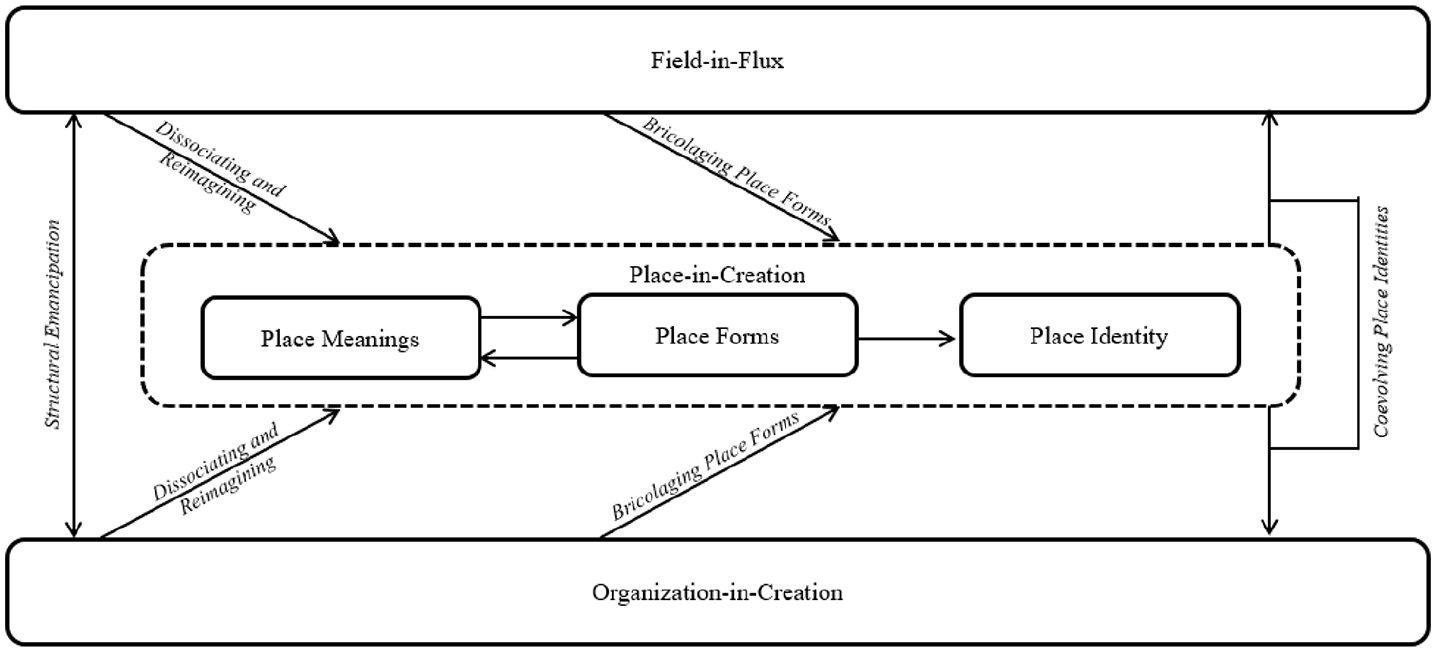
Model of institutional entrepreneuring process.
As the model shows, fields are not inherently stable. Instead, they remain in flux as policy and resource structures are emancipated and the historical status quo is challenged, opening up multiple trajectories along which the field can evolve and both enabling and constraining the organization-in-creation. The organization-in-creation may also free up existing structures and modes of resource allocation and pursue strategic innovation – as the University of Queensland did in our empirical case – which redirects some field trajectories and makes other new trajectories appear possible. Structural emancipation disrupts the field-in-flux and enables the organization-in-creation to reorient its field position by disassociating meanings from existing local and regional places and reimagining new possibilities. Elements of place forms that already exist locally at the place, and more broadly in the organized world, are available as a stock for bricolage and can be pulled apart, wholly or partially recombined, or otherwise patched together to materially reproduce – or further change – the reimagined place meaning. If the identities of local, regional and national places co-evolve through these unfolding processes, the place-in-creation becomes more aligned with the field-in-flux and the organization-in-creation.
We found that a temporary and provisional settlement is reached through the ongoing ebb and flow of these entrepreneuring processes when (1) field-level structures, resources and actor positions constrain the possibilities for innovation at the level of the organization and the place, (2) organizational actions reinforce a particular trajectory of the field-in-flux and the place-in-creation, and (3) place identities align the field-in-flux and the organization-in-creation. Yet any apparent settlement is never permanent. New possibilities for institutional change and creation are ever-present in the entanglement of field, organization and place because: (1) ongoing interactions between diverse field actors and institutional structures can enable (rather than constrain) the place-in-creation and organization-in-creation; (2) changes in an organization’s structure, leadership and strategy can disrupt (rather than reinforce) the field-in-flux and the place-in-creation; and (3) bricolage of new place forms from the stock of available material objects, resources, meanings and practices can unsettle (rather than align) the field-in-flux and the organization-in-creation.
Theoretical contributions
Our study makes three contributions. Our first contribution is to bring the analytic lens of entrepreneuring to the institutional literature to provide a more nuanced explanation of the processes involved in institutional change and creation. Processual studies have been criticized for continuing to portray ‘heroic actors’ working for and against institutions as stable structures (Bjerregaard & Jonasson, 2014) and failing to adequately account for the ‘patchwork’ of diverse arrangements and actors that cut across fields and society (Abdelnour et al., 2017; Lounsbury & Crumley, 2007). Our study builds on the small body of prior research that casts the processes of institutional entrepreneuring as iterative (Delbridge & Edwards, 2008), co-evolutionary between the state and other actors (Olsen, 2017), and unfolding through windows of opportunity created by government policy shifts (Buhr, 2012). Advancing these insights, our model explains how institutional change and creation occur in an already organized world through entrepreneuring processes which ebb and flow in distributed and cascading ways across diverse and only partially reflexive actors situated in and across fields, organizations and local places.
Building on prior studies that have shown how entrepreneuring in organizations can unfold as emancipation (Rindova et al., 2009), bricolage (Baker & Nelson, 2005; Wright & Zammuto, 2013) and reimagining (Hjorth & Steyaert, 2009), our study reveals how these processes remain salient when entrepreneuring involves institutions. Yet our findings also shed light on the complexity of institutional entrepreneuring processes which arises because emancipation, bricolaging and reimagining can occur simultaneously and become entangled across multiple levels during field change. When institutions are conceptualized as a ‘patchwork’ of open social spaces (Abdelnour et al., 2017), our model suggests that institutional entrepreneuring is the thread that haphazardly stitches and unstitches different forms of human activity and resources across fields, organizations and places. Existing forms of organizing – which involve field governance structures and resources, social positions and actors, organizational structures and strategies, meanings and material objects, and place forms and identities – can be disrupted, and new forms of organizing can emerge tentatively and experimentally out of and alongside the ‘patches’ of the old in fields, organizations and/or places. Thus, our model provides a richer processual account of how institutional forms of organizing are created and changed in an already organized world, resonating with notions that entrepreneuring can involve ‘experiments in new organizational form and different purposes which make sense of the experience of being organized’ (Hjorth et al., 2015, p. 601).
Our second contribution is to the emerging literature on place in institutionalism (e.g. Lawrence & Dover, 2015; Wright et al., 2021) by revealing a previously hidden relationship between higher-order organizational fields and local places. We find that fields-in-flux shape, and are shaped by, local places-in-creation as both medium and outcome of entrepreneuring. Our findings show that as institutional entrepreneuring constitutes place by investing it with meaning and materiality in a temporary settlement, the becoming of a new place changes the flow and trajectory of the entrepreneuring process for the field. This finding extends notions in humanistic geography and sociology that new places emerge when people ‘recognize themselves and others as part of a common enterprise with mutual meanings and experiences’ (Kaufman & Kaliner, 2011, p. 122). While this literature has long privileged place as ‘a center of power and meaning relative to its environs’ (Tuan, 1977, p. 422), our models shows that human endeavour that is productive, meaningful and entrepreneurial is intertwined with both places and fields in an organized world.
Our identification of this relationship between local places and entrepreneuring invites researchers to reflect on prior understandings of entrepreneurial processes influencing higher-order institutions. Our findings suggest, for example, that the institution-building projects undertaken by institutional entrepreneurs in Perkmann and Spicer’s (2007) study of the Euroregion’s emergence appeared effective because they were aligned with entrepreneuring processes that gave meaning and materiality to local places in the border towns of the Euroregion. In a similar vein, our findings intimate that while macro-cultural discourse provided preconditions for institutional entrepreneurship in Lawrence and Nelson’s (2004) study, the field of whale-watching emerged as entrepreneuring processes flowed through local places in and around Vancouver Island and produced temporary settlements in the field. Thus, our model offers insights into the relationship between place and institutional change processes which may help to clarify and refine theories of how and when place matters in institutions. In doing so, our study advances a growing agenda in the entrepreneurship literature by offering fresh insight into spatially oriented aspects of entrepreneurial processes and practices (Steyaert & Katz, 2004; Trettin & Welter, 2011).
Finally, our third contribution highlights how conceptualizing institutions as becomings provides one partial answer to the tension between structure and agency. Solving the paradoxical question of how actors, whose agency is shaped and directed by institutions, can work to change the very institutions they are embedded in has been at the heart of much institutionalist research across the last two decades (Battilana & D’Aunno, 2009; Garud, Hardy, & Maguire, 2007; Seo & Creed, 2002). This literature has traditionally stressed idiosyncratic interests and access to resources as a potential source of agency. However, this does more to refine the terms of the paradox than resolve it: how do interests and resources with potential to subvert institutions come to exist in fields shaped by those very institutions?
Building on arguments offered by critical institutional scholars (Bouilloud et al., 2020; Colombero et al., 2021), our findings show how the continuous flows of people, material objects and meanings at a specific place may unintentionally and temporarily produce assemblages that can provide resources for institutional entrepreneuring. The assemblage is coincidental and happenstance and has not been gathered together with a deliberate intention to disrupt institutions. This conceptualization of institutional change reveals that institutions are not inherently static ‘constraints’ on heroic actors’ agency, but ‘platform[s] for unfolding entrepreneurial activities’ that are produced by the ebb and flow of institutional life itself (Garud et al., 2007, p. 196). That is, institutions, constituted as they are by constantly shifting arrangements of people, materiality and symbolic systems, are themselves perpetually in the process of ‘becoming’ (Colombero et al., 2021; Tsoukas & Chia, 2002). This flow produces the institutional ‘flotsam’ and ‘jetsam’ that is available to be bricolaged by a diverse array of distributed actors along multiple potentialities and emergent trajectories (Garud & Karnoe, 2003; Schneiberg, 2007). In this way, our study helps resolve the tension between structure and agency by showing that institutions in becoming continually (re)produce the resources and possibilities for agency within gradual institutional change over time.
Future research directions
Our data collection and analysis is limited to a single case study of a research precinct in Australia and entrepreneuring was traced retrospectively rather than in real time. Future research is needed to explore the generalizability of our theoretical model. Our model suggests that institutional entrepreneuring is intrinsic to field change and new place creation, inviting researchers to explore this interplay at other sites associated with government, universities, organizations and professions. Research is also needed to examine whether and how institutional entrepreneuring processes differ when structural emancipation is triggered by regulatory and political shifts like those in our study or by other sources such as technological, economic, sociocultural or demographic shifts. We encourage researchers to investigate these and other questions following our approach of using longitudinal data collection of a sufficient lengthy time to trace the institutional entrepreneuring process across field, organization and place in temporary settlements and new becomings. Attending to both time and place offers a fruitful pathway for opening up novel insight into institutional entrepreneuring processes.
Footnotes
Funding
The author(s) received no financial support for the research, authorship, and/or publication of this article.
