



Abstract
Research shows that embedded relations can facilitate the resource acquisition process in entrepreneurship. Yet, as relations are dynamic and subject to change, it remains unclear how entrepreneurs can acquire necessary resources when pre-existing ties may not yet or no longer be relevant, sufficient or accessible. Under these circumstances, acquiring necessary resources is a challenge and one that novice entrepreneurs in project-based enterprises face repeatedly as they seek to sustain their businesses. Evidence from 123 projects developed by six newly formed independent television production companies in the United Kingdom shows that new entrepreneurs can manoeuvre around constraints by engaging in one of four counter-fate relational practices: posturing (i.e. exaggerating interest from key ties), status sequencing (i.e. developing key relations in sequence based on status), geographic sequencing (i.e. attaining key ties in sequence based on location), and opportunistic manoeuvring (i.e. manipulating the opportunism of potential resource holders). We contribute to entrepreneurship research by showing how resources can be acquired despite a lack of key embedded ties, and highlight enabling conditions; and to project studies by illustrating how projects progress past nascence to launch and acquire new clients or repeat commissions.
Introduction
I left my job thinking, ‘I can do this, I know a lot of people who have worked in the business’ … but one person now working [for client X] wouldn’t even take my call. So, I couldn’t rely on people I knew for support. I didn’t know the right people I suppose … but you’ve got to get around that if you want to stay in business.
This testimony raises important questions about how novice entrepreneurs can access resources to develop new projects when they cannot rely on former relations. In the absence of relevant ties, they are fully exposed to the liabilities of newness which negatively impact resource acquisition processes (Stinchcombe, 1965). Acquiring resources (e.g. finance, referrals, staff, clients) during early stages is an enduring challenge that scholars in many fields have grappled with, notably in strategy (Pfeffer & Salancik, 1978) and innovation management (Kannan-Narasimhan & Lawrence, 2018) contexts. However, given the focus on survival and growth, resource acquisition has been studied most extensively in entrepreneurship contexts (Clough, Fang, Vissa, & Wu, 2019). Relational embeddedness research shows that new entrepreneurs’ embedded or pre-existing relations play a critical role in resource acquisition (e.g. Elfring & Hulsink, 2007; Hite & Hesterley, 2001; Uzzi, 1996) by facilitating access to tangible and intangible resources controlled by others (Clough et al., 2019), such as clients (Starkey, Barnatt, & Tempest, 2000) or legitimacy (Zimmerman & Zeitz, 2002). These resources in turn decrease vulnerability to liabilities of newness. Defined as ‘the personal relationships people have developed with each other through a history of interactions’ relational embeddedness (Nahapiet & Ghoshal, 1998, p. 244), can engender trust, shared identity, closeness, or solidarity that can shape willingness to provide resources (Moran, 2005). The importance of pre-existing relations is underscored in entrepreneurial perspectives (Obstfeld, Ventresca, & Fisher, 2020) such as bricolage, where new entrepreneurs rely on ‘pre-existing networks’ (Baker, Miner, & Eesley, 2003, p. 265), and effectuation, where ‘whom they know’ is as pivotal as ‘what they know’ (Sarasvathy, 2001, p. 250). But what happens when pre-existing relations cannot be leveraged?
Whereas resource-seekers can call on those they already know, it is not clear what happens when embedded relations become irrelevant, insufficient for new resource needs or unavailable. This might occur because in the dynamic context of entrepreneurship, relations are ‘seldom stable’ (Obstfeld et al., 2020, p. 150). Embedded relations can become less salient in entrepreneurial contexts for various reasons. For example, entrepreneurs who leave employment to develop new businesses may face disruption to embedded relations because employers impose restrictive covenants prohibiting access to former resources (Rauch, 2016), or because ex-colleagues regard new entrepreneurs as rivals (Gardner, 2005). They may also become outdated as new opportunities emerge in different areas (Kleinbaum, 2018), and may decay when they are no longer relevant (Burt, 2000).
Such constraints are particularly difficult for ventures in project-based industries because projects, defined as ‘temporary systems’ (Goodman, 1981; Lundin et al., 2015), rely more heavily on resources embedded in their institutional and interorganizational environments than other organizational forms (Bakker, DeFillippi, Schwab, & Sydow, 2016; Sydow & Staber, 2002).
This is important, not only because project-based enterprises are proliferating across diverse industries from new media to film (Ferriani, Cattani, & Baden-Fuller, 2009; Grabher, 2002b), but also because they necessitate elaborate constellations of collective knowledge and skill sets that reside outside organizational boundaries (Grabher, 2002a). Nevertheless, clients with the ability to commission projects are the most important ties to attain (Starkey et al., 2000; Stjerne & Svejenova, 2016). Yet, despite its salience in business-to-business (B2B) contexts the initial stage of attaining project clients is often neglected (Söhnchen & Albers, 2010). Project-entrepreneurs, those engaged in attaining external resources in a serial manner for each new project (Ferriani et al., 2009), face this challenge repeatedly (Ebers & Maurer, 2016; Schwab & Miner, 2008). But, as project existence is time limited (Janowicz-Panjaitan, Bakker, & Kenis, 2009) and termination dates are predetermined (Lundin & Soderholm, 1995), many project-entrepreneurs lack time for ‘confidence-building activities’ (Grabher, 2002a, p. 205) including developing key relations. Even when such relations exist, they may not be relevant. So, project-entrepreneurs who cannot rely on embedded ties must establish new ones, thereby exposing themselves to liabilities of newness. Understanding how they acquire resources is important, not only in contexts involving project-based organizing where project failure rates are high (Söderlund, 2011), but also in new ventures more broadly. Thus, we ask: How do project-entrepreneurs counter resource acquisition challenges during nascence to launch new projects when prior embedded ties are no longer relevant, sufficient or available?
To address this, we focus on the independent television production sector in the United Kingdom, which is highly project-based. In this context, new project-entrepreneurs are typically former employees of larger production houses who break out on their own to become founder-producers. To sustain their businesses, they must repeatedly acquire new projects from broadcaster clients that may differ each time. This provides multiple opportunities to study how project-entrepreneurs overcome resource attainment challenges associated with liabilities of newness. The single most important relationship they must establish is with a commissioner who makes the final go/no-go decision to fund and broadcast their projects. Efforts to establish these relationships lie at the heart of project launch attempts (Manning & Sydow, 2011). Given how little is known about this process, we induct theory using rich qualitative data from 123 television production projects pursued by six new production companies as they sought TV commissions.
Our findings suggest that new project-entrepreneurs manoeuvre around constraints associated with a lack of relevant embedded relations by employing four relationship creation approaches that we collectively label counter-fate relational practices: posturing (i.e. exaggerating interest from potential key ties), status sequencing (i.e. pursuing key ties in a specific order based on status), geographic sequencing (i.e. pursuing key ties in a specific order based on their location) and opportunistic manoeuvring (i.e. manipulating the opportunism of potential resource holders). We contribute to entrepreneurship research by highlighting how new project-entrepreneurs can acquire key resources even when they do not have relevant embedded relations, and by detailing conditions that facilitate this. We also contribute to research on projects by showing how novice project-entrepreneurs can repeatedly attain vital client ties that enable progression to the project launch phase.
Theoretical Background
The challenge for project-entrepreneurs who need resources is to wrestle them from the hands of those who control them (Villanueva, Van de Ven, & Sapienza, 2012). This is a perennial battle for entrepreneurs seeking to launch new projects, because liabilities of newness (Stinchcombe, 1965; Tornikoski & Newbert, 2007) deter potential resource holders, including clients who tend to prefer certainty and low risk (Clough et al., 2019). Yet, attaining client ties in B2B contexts is decisive for project launch (Starkey et al., 2000).
Overcoming liabilities of newness in entrepreneurship by using embedded relations
Social relations play a critical role in the entrepreneurial process because they can act as conduits, bridges and pathways to resources held by others, such as clients (e.g. Batjargal, 2003; Elfring & Hulsink, 2007; Hite & Hesterley, 2001). This is evident in key perspectives in entrepreneurship, such as bricolage, whereby entrepreneurs make do with resources at hand including: ‘pre-existing networks’ (Baker et al., 2003, p. 265); effectuation, whereby entrepreneurs leverage not only who they are, and what they know, but also ‘whom they know’ (Sarasvathy, 2001, p. 250); and bootstrapping, whereby entrepreneurs first exploit their own finances (Bhide, 1992) or those of close associates, i.e. ‘the triumvirate of “friends, family and fools”’ (Alvarez & Barney, 2007, p. 20). These perspectives suggest that entrepreneurs seek to shield themselves from the full force of liabilities of newness during initial stages by using resources currently at their disposal, such as embedded relations.
Ties that are relationally embedded are important for entrepreneurs because they can engender trust and solidarity, and thus facilitate the resource acquisition process (e.g. Hite, 2005; Hite & Hesterley, 2001; Uzzi, 1996). By capturing the quality of social ties, relational embeddedness can explain ‘how much’ and ‘to what extent’ network resources can be harnessed (Moran, 2005, p. 1135). However, complex demands may necessitate resources that lie beyond the immediate reach of entrepreneurs or their existing embedded ties. Moreover, although relations can change, their dynamic character tends to be under-emphasized in entrepreneurial perspectives (Obstfeld et al., 2020). As Obstfeld et al., (2020, p. 150) observed, network relations tend to be treated as ‘relatively stable’ even though they evolve and are ‘seldom stable’ in reality.
Overcoming liabilities of newness using embedded relations during project nascence?
In project-based enterprises where projects are short-lived, the challenges of resource acquisition in the face of liabilities of newness during crucial early stages are intensified, because resources must be attained repeatedly for each new project in order to sustain such businesses over time (Ferriani et al., 2009). As Ferriani et al., (2009, p. 1546) highlighted, project-entrepreneurs are ‘exposed repeatedly’ to the problems and tasks of the entrepreneurial process because they must ‘rewire’ their projects with every new opportunity. This is not the same as the repeated problem-solving of stable or established ventures that can rely on established routines (Levitt & March, 1988). In B2B contexts, projects are typically discontinuous, unique and complex (Cova & Salle, 2007), or tailored to fit prospective clients, necessitating ‘idiosyncratic’ resources for each new project during nascence (Newbert, Tornikoski, & Quigley, 2013, p. 282), so new project-entrepreneurs are less able to draw on established routines or resources. As an example, in television content production, project-entrepreneurs seeking to develop factual content may require ties with victims of domestic abuse in one project, and circus clowns in another. Neither may be attainable via existing embedded industry relations, but without them the ability to attract target clients may be impaired.
Research that considers repeat project collaborations offers important insights into the process of resource acquisition for emerging projects. Some projects operate in what Grabher (2002a, p. 208) called a ‘milieu of recurrent collaboration’ wherein successful prior collaboration (Ebers & Maurer, 2016) facilitates connections to new teams and capabilities over time (Schwab & Miner, 2008). In this vein, research on temporal embeddedness shows how shadows of the past (i.e. prior collaborations) cast a shadow over future project prospects (e.g. Ligthart, Oerlemans, & Noorderhaven, 2016; Stjerne & Svejenova, 2016). However, it remains unclear how new ties can be attained initially when new project-entrepreneurs have not yet launched projects or when embedded ties are unsuitable or unavailable. We refer to this critical early stage as ‘project nascence’ to capture the project development process from concept to launch or abort. Researchers nevertheless take this early formative process for granted in project studies, focusing instead on post-launch topics (Bakker et al., 2016; Burke & Morley, 2016).
Despite the importance of client ties, new project-entrepreneurs typically lack these during nascence (Stinchcombe, 1965). In a study of another key tie, Tomaselli, Ebbers and Torluccio (2021) indicated that during nascence, project-entrepreneurs’ commercial and artistic reputations enhance prospects of tie formation with investors. Nevertheless, it is little understood how without these attributes ties with these key resource holders are established. Given the constraints of acquiring relevant resources and the need to do so repeatedly, project-entrepreneurs cannot simply rely on ‘passive resource endowments’ but must actually do something (Tornikoski & Newbert, 2007, p. 312). We suggest that ties are established through consistent engagement in practices rather than one-off events.
Methods
Our research setting is the UK independent television production sector, acclaimed for originating such hit shows as Big Brother, The X Factor and Who Wants to Be a Millionaire? This is an ideal setting, because content production is organized on a project basis, where independent production companies (also known as ‘independents’) seek to acquire resources in order to produce programme content for potential broadcaster clients (Windeler & Sydow, 2001). They must engage in this process for each new potential project to sustain their businesses; however, as projects are bespoke and designed to fit individual client needs, project-entrepreneurs cannot simply reconfigure pre-existing ties.
We adopted an inductive, multiple case study approach (Eisenhardt, 1989; Yin, 1994) to investigate how project-entrepreneurs counter the constraints of acquiring resources to launch new projects during nascence. This design is appropriate when existing theory that could explain a phenomenon is underdeveloped, thereby making it difficult to formalize expectations of what approaches project-entrepreneurs could take. A multiple case-study design follows a logic of replication, as each case can be used to confirm or disconfirm insights drawn from other cases in the study (Eisenhardt, 1989) and thus may yield more accurate generalizable theory (Yin, 1994). Scholars who study temporary organizing also call for designs with portfolios of cases as they facilitate greater depth of interpretation (Bakker et al., 2016).
In creative project contexts (Obstfeld, 2012) such as television content production, projects typically begin life as ideas that independents initially support themselves to cope with resource scarcity. However, if these are to progress from nascence project-entrepreneurs must obtain resource support from commissioning editors (hereafter, commissioners) who serve as project-gatekeepers by sourcing content on behalf of their channels (Starkey et al., 2000). As creative outputs are uncertain, these gatekeepers must take ‘a leap of faith’ when commissioning new projects from unknown and untested new independents. Nevertheless, once they decide to commission a programme, full funding is provided upfront even before production begins to cover costs associated with project execution. In this way, new project-entrepreneurs’ projects can progress from nascence to launch. Consequently, the outcome of interest is attaining a commission by creating a critical tie to the client.
Industry background
Medium- and small-sized production companies comprise the majority of firms in the UK independent television production sector, although it is dominated by a few large players. Under the current industry regime, production companies can opt to receive full funding for their programmes prior to production on a cost-plus basis in return for granting the commissioning broadcaster an exclusive but time-limited licence to transmit their programmes. This model is favoured by most independents, as upfront funding means that broadcasters assume the risks by committing to bear all production costs, leaving producers free to distribute their programmes internationally once a channel’s exclusive licence expires. As an alternative funding model, independents may source other funders who are willing to share production costs, such as programme distributors or foreign broadcasters. These funders pay an upfront production fee in return for territorial sales rights. A third but less popular and riskier model entails independents entirely funding projects themselves but retaining all rights and options.
Once a project is funded, new project-entrepreneurs must build a portfolio of network resources to execute content creation and delivery before production begins (Hirsch, 2000). Required resources can include creative onscreen talent such as actors and contributors (e.g. whistle-blowers in documentaries), as well as off-screen talent such as directors, writers and camera crews. Others, based on ability to pay, such as post-production facilities can be sourced via the market. Project budgets are usually predetermined by broadcasters and may differ across channels, genres and timeslots; typically, budgets are higher for primetime transmission slots which attract larger audiences. This can influence the amount of compensation that project-entrepreneurs can offer for the best talent. Ultimately, it means that they must perform a balancing act between attracting valuable contributors so as to maximize the prospect of a commission on the one hand and offering projects which have a viable chance of winning a commission given pre-set project values, on the other.
Sample selection and data collection
As a first step, we conducted a pilot study. We interviewed informants representing a broad cross-section of the sector, including senior broadcaster and production company executives, industry experts, trade association representatives and venture capitalists. Information from these interviews was then used to inform and shape data collection in the main study. The first author was able to draw on her own experience as a former executive producer to gain industry access. This enabled her to leverage ‘interactional expertise’, facilitating communication with those who have expert knowledge (Langley, Smallman, Tsoukas, & Van de Ven, 2013, p. 6).
Our data collection centred on programme projects sought by newly formed independents in the UK. We identified our population using a database provided by the independent producers’ trade association, PACT. This led to meetings with some 20 independents that expressed initial interest in our research. From these, we selected six that met our selection criteria of being new and operating within the UK. To reduce variance in external conditions, we selected those specializing in a broadly similar programme genre, albeit with overlaps in other areas (Eisenhardt, 1989) (see Table 1). For controlled contrast, we selected one firm, Argos, from a different but related genre based on the age range of target viewers. We further sought to identify new project-entrepreneurs who had attained different levels of seniority in the industry. All were former employees.
Company profiles.

Indicates remaining project-entrepreneur following the departure of co-founder partner.
Company age at the commencement of study.
The unit of analysis in this study is the relational practice adopted by new project-entrepreneurs seeking to acquire resources to launch new projects. Because the level of analysis is the project, we classified these as new even if they were initiated several years after the firm was established. Moreover, researchers suggest that firms six years old or younger can be viewed as new (e.g. McDougall, Oviatt, & Shrader, 2003). Each project represents a potential television programme or series to be commissioned by a broadcaster. We collected data on 123 projects developed by the six independents including details about the nature of each project: single programme or series; type of broadcaster (e.g. terrestrial or cable/satellite broadcaster), budget, repeat commission status, and value to an independent. We focused primarily on projects where new project-entrepreneurs had no prior ties with target commissioners; however, to aid theorizing, we also included projects where such ties already existed.
The time required to attract and execute a project ranged from 10 days to several months and varied between programme genres. We collected data in four phases over a five-year period from the spring of 2006 through to the summer of 2012. This allowed sufficient time for projects to accumulate while enabling respondents to recall key details (Leonard-Barton, 1990). We conducted 74 in-depth interviews with founder-producers (project-entrepreneurs) and their commissioner clients. These lasted between 1.5 and 2.5 hours and were each recorded and transcribed (see supplemental material A; all supplemental materials are available online).
At each stage of data collection, interviews were supplemented by a questionnaire designed to capture project-level data. Initially, this included firm information such as date of incorporation, number of directors, funding received and projects commissioned. We also documented all projects won by independents between interviews, including licensing fees, programme genre, programme duration and number of episodes and transmission time slots. In addition, the questionnaire asked project-entrepreneurs to identify all relations that were instrumental in winning each commission. This was followed up with questions about the role of each tie and any previous links with them. Finally, we explored approaches that new project-entrepreneurs adopted as they pursued project launches.
We probed respondents about the nature of each project, starting with open questions about how each project had been won, the role of ties perceived as key, challenges faced and how they were resolved. We specifically explored how project-entrepreneurs established relations with commissioners, and how other ties influenced this process. During the second round of data collection, we revisited emergent themes, such as the extent to which project-entrepreneurs felt constrained in developing new ties and how this affected contact decisions in the absence of pre-existing relations. In the third and fourth data collection phases, we collected data on new projects and captured reflections on the process of building relations and winning commissions. This work was supplemented with archival records such as annual reports, correspondence between directors and target clients, and press articles to facilitate verification.
Whereas interviews with project-entrepreneurs were conducted retrospectively and/or prospectively, all interviews with commissioners were conducted retrospectively so that we could capture their decisions about specific projects. Nevertheless, we took several steps to mitigate bias by: (a) triangulating data from different respondents; (b) combining retrospective data with real-time accounts of current resource acquisition attempts whenever possible (Leonard-Barton, 1990); and (c) adopting techniques such as courtroom-style questioning to help informants focus on actual events, actions taken and dates. Finally, we offered anonymity to encourage openness.
Data analysis
Using the research question as a guide, we broke down the data by phrases, sentences or paragraphs with the aim of capturing key ideas (Strauss & Corbin, 1998). The initial set of first-order concepts emerging from the data included verbatim or descriptive phrases such as ‘using others to prise open doors’, or ‘informing contributor a broadcaster was already on board’. We used axial coding to iteratively group or regroup these concepts based on similarities and differences and in light of new data (Strauss & Corbin, 1998). This led to the emergence of several second-order themes which seemed to fit well with the data (Lincoln & Guba, 1985). For example, we found that first-order codes such as ‘first finding high-profile talent to attract target director’ and ‘identifying valuable talent attractive to broadcasters’ aligned with a second-order theme, ‘identifying stepping stones’. Likewise, the second-order theme ‘timing portfolio relationship development’ included first-order codes such as ‘progressively building valuable ties’ and ‘securing access to valuable ties before approaching commissioner’. Together, these second-order themes formed the dimension, status sequencing, which emphasized actions aimed at establishing high-status ties. Other second-order themes began to coalesce around geographic location of key ties, third-party opportunism and the exaggeration of interest from others. Engaging in continuous comparisons with the data, we labelled these respectively geographic sequencing, opportunistic manoeuvring and posturing (see Figure 1 for our coding structure; and supplemental material B for first-order codes).
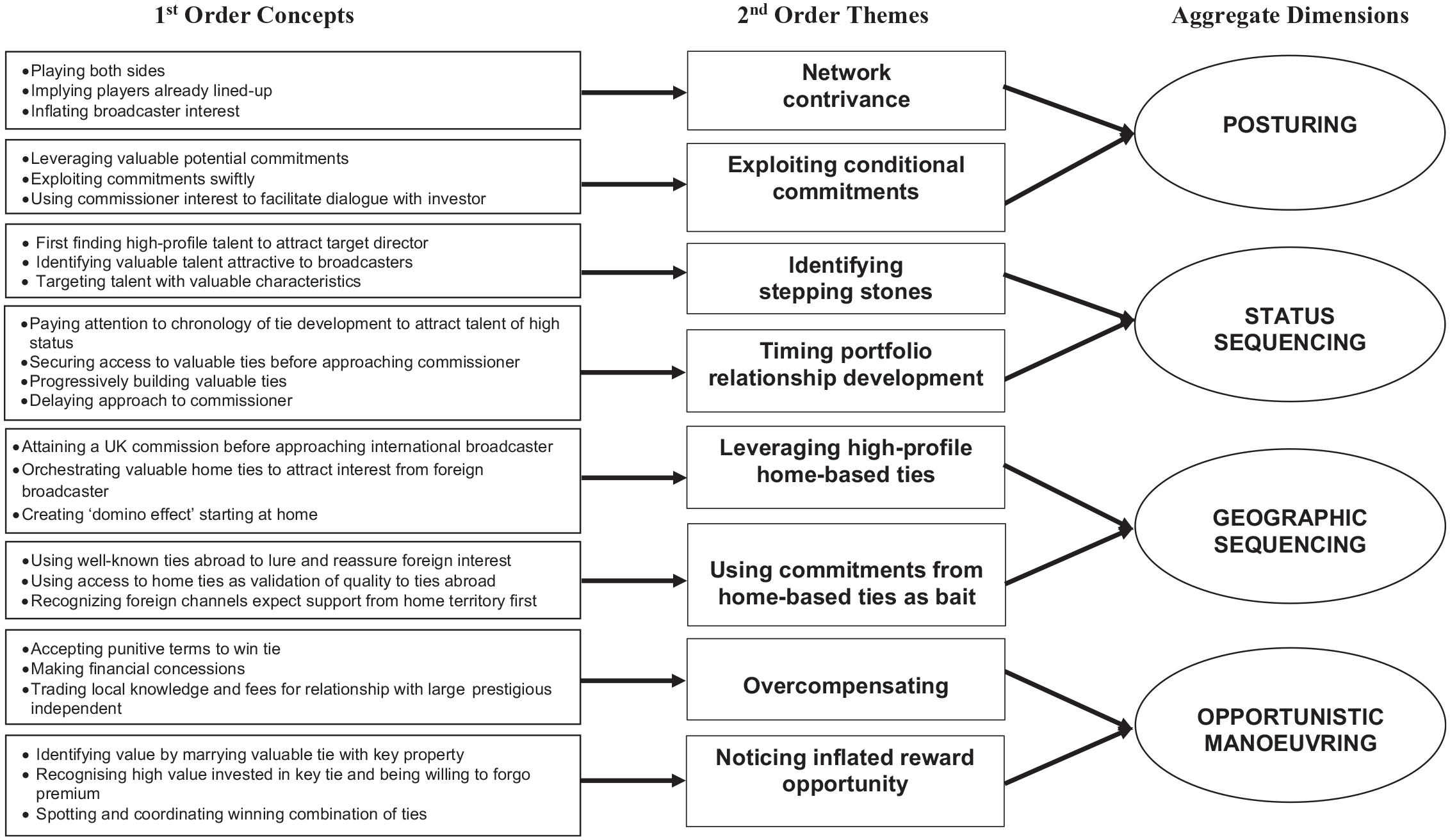
Data structure: counter-fate relational practices.
In the final step, we pursued theoretical abstraction of the four constructs until an overarching theme emerged: counter-fate relational practices. This captured a process of project-entrepreneurs establishing relations to influence impressions of their projects and acquire resources. By relational practices, we mean recurrent activities that entrepreneurs can engage in to form relations with external resource holders, in line with notions of relational work (Zelizer, 2012). This entailed identifying and leveraging interactions between third-party ties and tailoring them to fit each specific project, thereby requiring individual interpretation. Such activities are distinct from practices that are standardized, formalized or routinized, such as staffing practices involving attracting, selecting and retaining competent employees (Ployhart, 2006), or accounting practices that require meticulous adherence to prescribed activities.
We analysed each theme across all 123 projects using within-case and cross-case replication to verify their applicability and identify patterns across the data (see supplemental materials C to F online for results of this analysis). Supplemental material C provides a snapshot of each project, it is colour-coded to emphasize patterns in the data and captures the key relational practice that was decisive in each project leading to a tie with a commissioner; supplemental material D captures the key relational practices applied across projects, these are categorized based on the extent to which project-entrepreneurs emphasized their importance; supplemental materials E and F respectively identify projects that failed to launch despite employing relational practices, and key conditions associated with each relational practice.
Counter-Fate Relational Practices
Our data revealed the inventiveness of new project-entrepreneurs as they sought to attain resources by strengthening perceptions of their projects as high quality, thereby minimizing risk for potential resource holders. In practice, they faced two distinct challenges when competing for project commissions: (a) obtaining project commitments from commissioners, and (b) attracting key production or content ties to execute project delivery. To overcome this project-entrepreneurs engaged in four approaches – posturing, status sequencing, geographic sequencing and opportunistic manoeuvring – labelled counter-fate relational practices. We saw that they resorted to relational practices when pre-existing ties with commissioners were absent. Without these the transmission of knowledge and information could be hampered in both directions: project-entrepreneurs had limited insight regarding the precise nature of projects being sought by commissioners, and commissioners had no first-hand knowledge about project-entrepreneurs and the quality of their projects. In the following we examine each relational practice in turn.
Posturing
Intriguingly, we found that new project-entrepreneurs occasionally took some creative licence with their profiles, creating the impression that they had occupied more senior positions in the industry than they had actually held. In this process they used intransitive 1 ties to convince commissioners that they had both access to key production resources and strong ties with commissioners. This relational practice was more tenable when windows of opportunity were narrow, forcing stakeholders to decide quickly. We identified this practice as posturing, defined as exaggerating the extent of commitments from third parties to enhance the prospect of attaining valuable resource commitments. Posturing has two aspects: network contrivance and exploiting conditional commitments. We observed this in just over 14% of successful cases involving counter-fate relational practices (see supplemental material C: rows 47–53).
Network contrivance
We discovered that network contrivance surfaced in two circumstances: (a) when developing a relation with a commissioner (e.g. to directly influence a commissioner’s impressions about a project or to accelerate decisions under time constraints), and (b) when developing intransitive ties to influence a commissioner tie, especially to convey interest from rivals. For example, Chariot’s project-entrepreneur used network contrivance when an opportunity arose unexpectedly in a programme genre in which they had no prior experience. Realizing that the window of opportunity would close quickly and that they were in a race against the clock before rivals recognized the same opportunity, the new project-entrepreneur set about convincing a target commissioner of the project’s credibility and potential by conveying the impression that a highly critical and valuable talent tie had already been established. The new project-entrepreneur gave an impression of being better connected with the target talent than they actually were in order to position themselves as ideally suited to deliver a potentially valuable project. On recognizing the potential creative value of the onscreen talent, the project-entrepreneur contacted them with the goal of forming a collaborative relationship even though no tie had existed beforehand. To speed the process, the project-entrepreneur behaved as if they had already been in contact with a commissioner, which was not exactly the case. The project-entrepreneur explained: I said, ‘Look, I’m in discussion with [channel M]. I believe that this is something that I could get commissioned, but I’d need to know whether you are interested first’ . . . I was clear that I had interest already . . . and the access depended on [him].
Afterwards, the project-entrepreneur contacted the commissioner via email and aroused the commissioner’s interest by exaggerating the extent of the critical contributor’s commitment and emphasizing the rarity of the access and the time-limited nature of the opportunity. The project-entrepreneur followed up by delivering a full project proposal the next morning, within hours of identifying the opportunity, and attached key talent to the project, including a director that had also been attracted by alleged interest from the other players: I said to [the commissioner], ‘I’ve already got a discussion going with him’. I’d emailed him; he’d emailed back Sunday night. So, I said to her, ‘I’ve already got a discussion going with him’ . . . and I’d spoken to a director.
Here, we see that the project-entrepreneur attempted to convey impressions of deep discussions implying commitment, when in reality only one or two emails had been exchanged, thus providing a fig leaf. When the project-entrepreneur later discovered that a rival production company with more experience in this genre of programmes had pitched the same idea on the same day, they stepped up impressions of the degree of commitment from the contributor, this time presenting it as ‘exclusive’ access. The commissioner now had no choice: if they wanted to develop this project, they could only do so with the project-entrepreneur. In this case, time was of the essence, as the narrow window of opportunity limited the commissioner’s chances of finding an alternative strategy to gain access to this key talent. The project-entrepreneur ultimately won the project despite a lack of experience and being new to the genre. The commissioner later commented, ‘[They] had great access . . . and ultimately that was critical.’
Exploiting conditional commitments
If they could get a commitment from one key tie, albeit conditional upon the involvement of another key relation, new project-entrepreneurs could begin to attract others. We saw that this sometimes occurred with the tacit consent of a commissioner in complex projects. Conditional ties were leveraged, for example, in cases where commissioners could not support the full costs of a project by themselves. A project developed by Argos with one of the largest budgets in the study (£4.2 million) drew on a posturing relational practice. The project-entrepreneurs were developing a complex and valuable project that required a portfolio of different skills, as well as a foreign broadcaster and distributor that could absorb some of the production costs. To build the portfolio, the project-entrepreneurs exploited the conditional interest of the writer to lure valuable talent. Again, they signalled interest from a target broadcaster even though it had not been formally expressed. They further established a co-production relationship with other key talent and used this to engage a foreign broadcaster. Once the project-entrepreneurs had demonstrated that they could assemble the key production talent, they established important ties with investors who could contribute to the budget and help secure international distribution support. However, each engagement typically depended on some expression of interest by the first broadcaster. Argos’s first commissioner, who was interested but not yet formally committed, was aware that his conditional support could prove decisive: I was able to make that [conditional] commitment knowing that it would help them internationally, and that third-party funding could be secured more easily . . . [it was] subject to them securing third-party funding, to guarantee that the series was going to be delivered.
With a full project portfolio of talent and financial resources, Argos’s project-entrepreneurs were now well placed to win the commission from the first broadcaster, whose early conditional support had been used as a carrot to assemble the portfolio.
We saw that successful posturing depended on project-entrepreneurs’ ability to establish separation between prospective project ties and a target commissioner. If they failed to appreciate this condition, the relational practice would fail. A project developed by Felix’s new project-entrepreneur highlights the consequences when this condition is ignored. When a potentially attractive project opportunity presented itself, the project-entrepreneur contacted critical non-celebrity onscreen talent and gave the impression that a commissioner had expressed interest. By not restricting access between the talent and the series executives to whom the project was pitched the project-entrepreneur was vulnerable to being circumvented: We found out then that [channel series X] had started making the same story. [They] just ploughed through and did the story with no regard to us whatsoever. [They] completely screwed us over.
Dominion’s project-entrepreneurs made a similar error by discussing their fifth project directly with the producers of an existing programme series without first establishing separation between the parties. They too were taken by surprise when they discovered that the producers were developing their project without them.
Even though new project-entrepreneurs were marginalized by industry networks, they were able to mitigate challenges by paying attention to the sequence of activities aimed at establishing new resource-bearing external relations. By building their project portfolios in carefully thought-out sequences, they could dampen network effects and potentially establish ties that could tip the balance in favour of commissioner support. Our data reveal two different counter-fate relational practices associated with sequencing: status sequencing and geographic sequencing.
Status sequencing
A substantial literature underlines the constraints that status can impose on all levels of social organization (e.g. Podolny & Baron, 1997). The findings we report here are consistent with this work and affirms status challenges faced by novice project-entrepreneurs with no prior experience running their own businesses. This is crystallized by the following observations made by two commissioners: What’s their standing, and then down to the financial and business side, are they going to be able to do this? Running your own production company is not the same as being employed by a large established indie with all the backup support at your fingertips. (Commissioner) If we were to commission somebody . . . who didn’t have a track record but had a fantastic idea and we just loved them, that would be incredibly risky. And I’m not sure that we would. (Commissioner)
Nevertheless, we saw that new project-entrepreneurs were not entirely constrained by such inertia. They found ways to negotiate around these challenges by adopting status sequencing relational practices, these were used in 54% of successful projects (see supplemental material C: rows 54–80). Status sequencing entailed attempting to establish ties of increasingly higher status to build a pathway to lock in prospective key resource holders. It involved two dimensions, identifying stepping stones and timing portfolio relationship development, in which the commissioner is the catalyst for relational practices.
Identifying stepping stones
Argos relied heavily on this relational practice and became adept at identifying key constitutive players. Even though the two leading project-entrepreneurs had held senior positions as former employees in the industry, they believed commissioners would nevertheless view their projects as risky in light of their status as new independents. To enhance the prospects of winning their first project, they sought to establish high-status ties before approaching a commissioner. The lead project-entrepreneur explained: People can say no to ideas, but if you say ‘I’ve got this idea with this person attached to write it and this person attached to star in it and this person attached to direct it’, they go, ‘How can I say no to that?’ So, it’s then finding the key writer . . . that has a fantastic track record and opens doors with broadcasters. You know, the [top writer Y] of this world. Then it’s finding key cast.
Frequently, new project-entrepreneurs first pursued easier-to-establish ties with people whose statuses were closer to their own, gradually leveraging these ties to attract increasingly valuable, more difficult-to-attain ties with people who were not easy to approach directly due to large status differences. Such ties served as stepping stones in approaching target relations, in effect creating a sequence of inflexion points. In the following excerpt, Argos’s lead project-entrepreneur illustrated their use of status sequencing by beginning with a tie that had some TV experience but currently had no work: It’s very difficult to get [project Y] . . . with unknown talent . . . so that’s why we went for [writer A] who had already done stuff the channel would know . . . But we saw they had no shows going on and might be keen for more work . . . So, that was our starting point . . . Once [the writer] had bought into the [project] we went to [director K] who we knew from before. I don’t imagine [media celebrity J] had ever heard of either of us . . . but what got his attention was the fact that [director K] had agreed to get involved . . . [The successful commission] was because [celebrity J] was attached, and the reason [they were] attached was because [of] the director.
Timing portfolio relationship development
We observed that timing the development of a portfolio of key relations prior to seeking commitments from commissioners helped to not only create impressions of project value and enhance the standing of project-entrepreneurs, but also to mitigate risk for commissioners, the final target relationship. Dominion adopted this relational practice with its second series. The firm’s second project commissioner, impressed by Dominion’s ability to mobilize access to highly regarded players before approaching him, explained how their project rose in stature: They had already secured the access and were able to talk to me with authority and certainty about one or two of the characters that they’d already engaged with … it gave a great boost in terms of comforting me that [members of] this new fledgling company were on the ball.
Sometimes, project-entrepreneurs were not able to establish ties despite careful sequencing or had to start again if a key tie changed jobs or roles. This was the case when Eros established key ties only to find that the commissioner had moved to another department. In another instance, Dominion’s project-entrepreneurs serendipitously and unexpectedly were invited to an event where a key target tie would be present. This led to the initiation of a relationship that later paved the way to other ties. Nevertheless, we documented instances where new project-entrepreneurs did not deploy this relational practice and consequently failed to launch their projects. For example, Felix’s lead project-entrepreneur used a more expansive approach and sought to cultivate many relationships simultaneously without paying attention to sequencing dynamics. He explained that his approach was to ‘scatter [many] seeds to the wind’ randomly without regard to timing in the hope that one would ‘grow’. Although this new project-entrepreneur did keep himself busy cultivating more relationships than others in our study, this ad hoc strategy did not lead to a single successful project commission. In fact, as he wryly noted, commissioners seemed to raise the bar even higher for his projects when he approached them directly: They’re waiting for me to come up with something so brilliant they can’t refuse it. . . . It’s not about the individual idea … I don’t feel I have formed strong enough relations with individual commissioners which end up with me getting commissioned work.
During an interview one commissioner confirmed these sentiments: To get to see me … you have to have good ideas. … You can’t just pitch up and say ‘Tell me what you want’, because that’s not good enough. … So if someone doesn’t get a recommendation to see me, they have to have a very strong idea.
Geographic sequencing
Our findings also show how new project-entrepreneurs exploited spatial isolation across networks through a third relational practice, geographic sequencing. Television production often involves collaboration dispersed around a given physical location; thus, television networks are often clustered, typically close to regional broadcasters. However, to fully develop opportunities, producers may need to access resources beyond the local environment. This can mean developing network ties at the national or international level. Counter-intuitively, we saw that spatial isolation across networks could help new project-entrepreneurs overcome challenges stemming from their novice status because the flow of information concerning status signals is inhibited over geographic distance. In our study, information asymmetries created by inhibited information flow had two effects. First, non-local alters (typically, foreigners) had less information available to accurately determine the quality of novice project-entrepreneurs. Second, and specific to our sample, new project-entrepreneurs were sometimes able to benefit from positive impressions generated by a UK broadcaster’s strong international reputation.
We observed a pattern of spatially distant tie formation in 16% of commissioned projects in our data (see supplemental material C: rows 81–88). Two dimensions emerged in this relational practice: leveraging high-profile home-based ties and using commitments from home-based ties as bait.
Leveraging high-profile home-based ties
New project-entrepreneurs sought to establish local ties with international visibility before attempting to establish ties overseas. Spatial separation and the need for both local and international resources was a key condition in the use of this relational practice. Although status signals typically do not travel well over geographic distance, this does not apply equally to all ties. Similar to the movie industry and other ‘celebrity’ industries (Kurzman et al., 2007), a select group of industry stakeholders are widely recognized beyond their local networks. Some new project-entrepreneurs were able to establish high-profile local ties and use them as leverage to attract international partners. For example, Blitz’s project-entrepreneur established a highly visible local tie with a UK broadcaster in its fourth project prior to attempting to form a relationship with a new international stakeholder. The project-entrepreneur described this as critical to securing the international relationship: They have huge nervousness . . . about editorial standards, so they want to know who they’re dealing with. And in a sense, the fact that Channel 4 or the BBC are working with you immediately says these people are kosher, these people are serious. It removes a whole raft of issues for them straightaway. Straightaway! You just wouldn’t get a seat at the table if you weren’t known to British broadcasters.
Using commitments from home-based ties as bait
International stakeholders are aware that local broadcasters are selective about the relations they establish, so domestic confidence in a project can reduce uncertainty. As a result, even commitments that hinge on acquiring resources from international ties can enhance leverage. Aware of this, broadcasters sometimes used conditional commitments to support projects for which they had insufficient resources: It demonstrates a commitment that the idea is good first, and secondly that somebody is making a financial commitment to a project. And that helps them feel comforted. . . . it lessens their risk. … Internationally, everybody has got their own domestic production industry. It doesn’t matter how big or small. And so they would always go to their domestic market first. (commissioner, Blitz)
Some project-entrepreneurs who were not able to move swiftly enough found that commissioners’ preferences could change, thereby necessitating significant revisions and different resources to facilitate their project. Furthermore, project-entrepreneurs who did not mindfully apply relational practices relevant to the conditions they faced when establishing key relations faced the prospect of stalled projects. For example, when Felix’ project-entrepreneurs sought to develop several unsolicited projects in the United States, they had not first developed a key resource-bearing relationship at home. When they could not show support from a broadcaster at home, their projects failed to attract vital contributors.
Opportunistic manoeuvring
Our data indicate that the prospect of an attractive payoff in return for relatively little effort could incentivize prospective resource holders to relax concerns about project-entrepreneurs’ novice status. Prior research shows that the short-term nature of temporary networks can heighten fears of opportunism (Lundin & Soderholm, 1995). However, we observed that opportunistic tendencies induced by tie temporality could also be exploited by new project-entrepreneurs because temporality limits the risk of being locked into relationships with those of unproven status, and short-term relationships often require less effort.
In opportunistic manoeuvring, a compensation approach was often used to increase the attractiveness of an opportunity to valuable resource holders. Thus lured, a valuable tie could be exploited to either kickstart or accelerate the creation of a valuable portfolio of ties and leveraged to secure a commission. Although compensation is not a form of opportunistic manoeuvring in and of itself, the act of combining opportunistic tie creation with a coordination strategy in a short timeframe means that this practice can be characterized as such in our context. We observed several instances where this practice was used by new project-entrepreneurs to establish crucial ties (see supplemental material C: rows 89–96). Opportunistic manoeuvring was present in 16% of projects commissioned using counter-fate relational practices. We identified two dimensions: overcompensating and noticing inflated reward opportunity.
Overcompensating
The following excerpt illustrates how Dominion’s lead project-entrepreneur who lacked specific expertise used this relational practice to ‘cut’ a deal with a senior executive producer who it was hoped could play a critical role in gaining a commission: We went to [the executive producer] and said: ‘Listen, we know you have a very good relationship with [the channel]. Would you help us get the commission? We’ve no problem in coming to some sort of agreement about how the money is split, but we need the experience.’ . . . We cut a very rough outline of what a deal would be. He would become an executive, and he would get half the production fee.
This was not a simple referral strategy, because a share of the proceeds was a crucial component of the deal. By overcompensating, the project-entrepreneur had created a lucrative proposition within a short timeframe that the collaborator would likely find difficult to refuse. Although they could have approached the commissioner directly with their project proposal, they calculated that they could more effectively leverage the influence of the more senior producer to advance their position. Indeed, the project-entrepreneur commented, ‘He is going to be the Trojan horse, if you like, who’s gonna take us . . . inside.’
Noticing inflated reward opportunity
Following completion of a project that was screened late at night Blitz’s project-entrepreneur noticed a potential opportunity to update and rebroadcast it. With new footage shot abroad and funded by a target foreign broadcaster, the project-entrepreneur argued that the programme could be transmitted quickly in a more valuable primetime slot at a much lower cost and with very little effort from the commissioner concerned.
I said, ‘Look guys, you’ve got a cracking programme. You could take something that you’ve put out at 11 pm . . . and update it with some sharp interviews from the States. You would then look very smart. Run it at 8 pm, [and] you’d have a programme that most people haven’t seen.
The project-entrepreneur attracted both the UK and foreign commissioner by using reduced costs, high rewards, quick turnaround and the interest of each party as bait, thereby demonstrating how opportunism of valuable potential ties could be leveraged.
Sometimes, however, opportunistic manoeuvring could break down, even when valuable facilitators who could increase the likelihood of attracting commitments from commissioners were willing to engage. Evidence shows that this could occur when the price was considered excessive. Chariot’s project-entrepreneur, for example, considered the price of attaching a valuable contributor to be unreasonable: ‘He originally said, “I want lots of money.” And I said, “Well, I’m not paying you any money because we just can’t pay [you that]. You want more than we would earn.”’ Shortly afterwards, the project was shelved. Eros’s project-entrepreneur also declined an opportunity to develop a potential key relationship because it would entail being warehoused 2 within a larger more established company: ‘We had a meeting with [media partner J]. . . . They said that because they didn’t have a relationship with us already, we needed to warehouse it through an established [local] production company that they had worked with before.’ However, this was considered too high a price to pay as the project-entrepreneur feared it would mean ceding control.
Other patterns not explained by counter-fate relational practices
When new project-entrepreneurs failed to engage in counter-fate relational practices, their projects tended not to be commissioned, as was the case for 26% of all submitted projects (see supplemental material C: rows 1–32). That said, we identified four cases where this relational practice was not employed, yet projects were successfully launched: three projects developed by Blitz, and one by Dominion (see supplemental material C: rows 33–36). Consistent with extant research, our evidence shows that embedded ties can lead to resource acquisition. In particular, Blitz’s project-entrepreneur had developed a good working relationship with a commissioner while managing a key project during his employment with another independent. When he left to set up his own indie, he leveraged this former commissioning relationship to build support for his business. By drawing attention to the loss of rare and specific production expertise which was highly valued by the broadcaster and possessed by the producer, he destabilized the commissioner’s certainty about continuing the project with his former employer. This approach to a strong embedded tie obviated the need for counter-fate relational practices: Blitz was a company set up by [producer B] who I knew very well and who had done absolutely brilliant work for me. [Producer B] was somebody who understood what sort of programme I want, but a really important thing was [producer B] was somebody who didn’t let me down, who, if [they] said I’ll make sure that programme’s alright, [they] made sure that programme was alright.
Former seniority also should explain differences in new project-entrepreneurs’ ability to acquire resources. However, we observed that this was not a sufficient explanation in our study. Argos’s project-entrepreneurs who were the most senior in the study, engaged in counter-fate relational practices, in contrast Dominion’s project-entrepreneurs were more junior but able to eschew such practices for their first project. Argos began with an extremely ambitious and complex project for which multiple resource holders were necessary, and their lack of a relevant prior commissioner relationship necessitated a counter-fate relational practice. Dominion’s lead project-entrepreneur was able to fit the ambitions of a more modest project with the firm’s level of expertise and anticipated the demands of a commissioner with whom he had deliberately cultivated a relationship prior to starting the business.
Counter-fate relational practices were also not prerequisites to gaining access to commissioner resources in other instances, such as when project-entrepreneurs sought to win repeat commissions of earlier projects. This occurred in 22% of cases (see supplemental material C: rows 97–123), regardless of the firm’s age. Blitz again dominated this category, as its lead project-entrepreneur was able to exploit his embedded relationship to win repeated series from the first commissioner. Nevertheless, a strategy of focusing on just one commissioner carried risks by creating overdependence on a single client. For Blitz’s project-entrepreneur, a counter-fate relational practice became salient when seeking to attract new commissioner clients. Perhaps counterintuitively, in a few cases, new project-entrepreneurs adopted counter-fate practices yet did not win commissions (see supplemental material E). We believe that this can be attributed largely to missteps in status sequencing. Although it may be the most fruitful counter-fate practice, determining which interactions between ties can be leveraged is likely challenging.
By exploiting counter-fate relational practices, project-entrepreneurs were able to acquire resources that created impressions of their projects as potentially valuable, thereby enhancing prospects of creating ties with clients that could lead to fully funded projects. Value creation could engender either financial or nonfinancial resource mobilization. For commissioners, nonfinancial project value could reside in the establishment of relations that provide access to valuable knowledge or talent, thereby enhancing a project’s quality and reducing uncertainty. This was underlined by an Argos project-entrepreneur: I am like an alchemist. … I bring together the ingredients, which would be a writer, an actor, a broadcaster, maybe another broadcaster from overseas, a book – the key things which, together, create something that is going to excite and take off.
Figure 2 provides a model of how when new project-entrepreneurs do not have key embedded ties counter-fate relational practices can enhance their prospects of acquiring those they need to launch. While they could draw on aspects of different counter-fate relational practices we saw that just one dominated in attempts to launch each project.
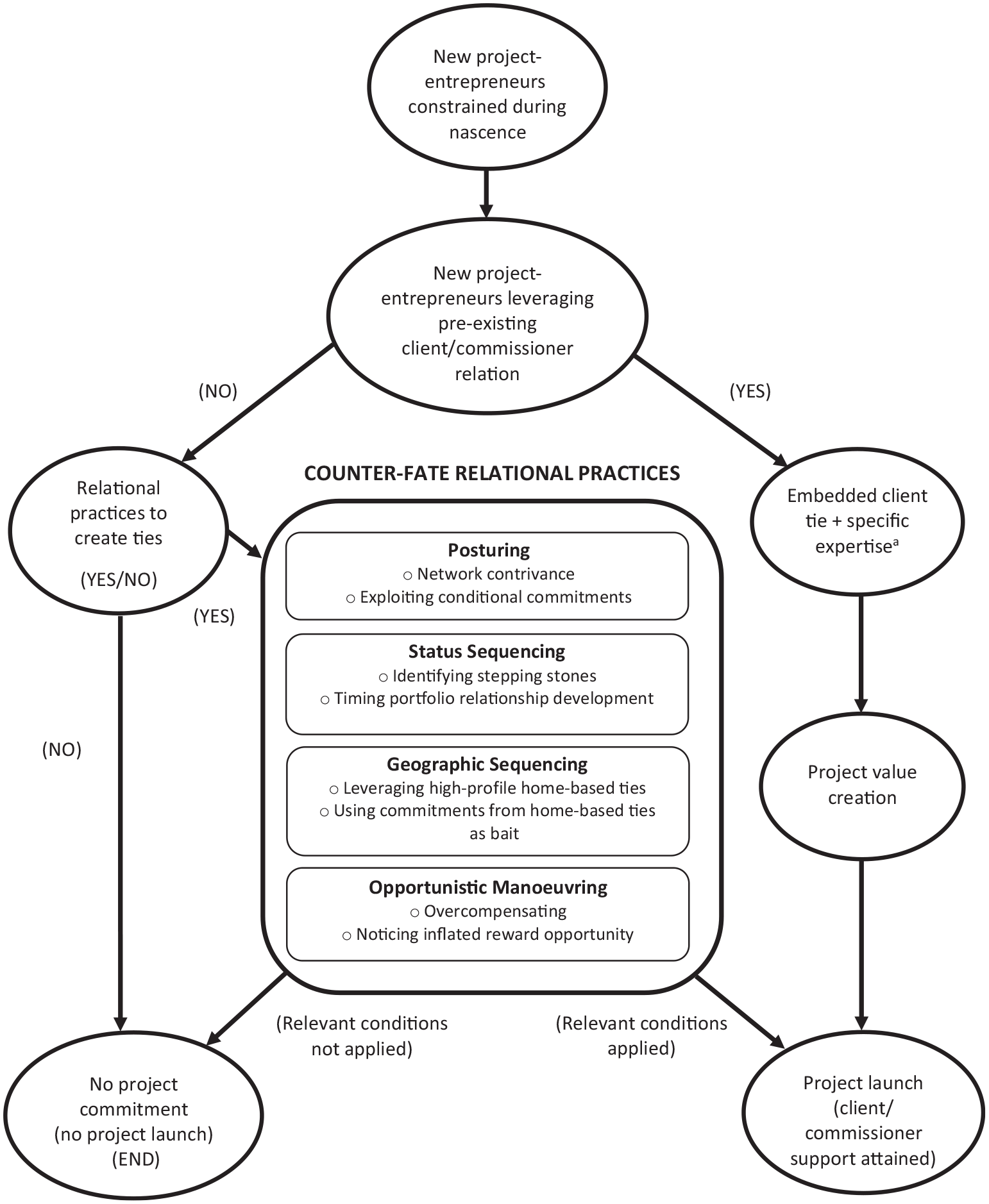
Model of resource acquisition during project nascence.
Discussion
The aim of this study was to build theory to explain how project-entrepreneurs can mitigate resource acquisition challenges associated with liabilities of newness as they attempt to launch new projects. Although social relations can facilitate the transfer of resources, extant research stops short of explaining how ties can be established during project nascence when embedded relations are not relevant, sufficient or accessible. Our study uncovers four counter-fate relational practices that new project-entrepreneurs can employ to overcome the challenges they face. Collectively, these practices constitute a process of relational manoeuvring whereby new project-entrepreneurs entice resource holders into exchange relations using the signalling value of prospective third-party ties. These relational practices – posturing, status sequencing, geographic sequencing and opportunistic manoeuvring – enhance prospects of acquiring resources from the single most important tie that project-entrepreneurs in B2B contexts must ultimately establish: a client.
Contributions
Our findings contribute to the literature in several important ways. First, we contribute to entrepreneurship research by introducing the notion of counter-fate relational practices to explain how project-entrepreneurs acquire resources despite liabilities of newness, and we outline the conditions under which these practices can be employed. This complements existing entrepreneurship perspectives which suggest that entrepreneurs can ease their exposure to liabilities of newness by exploiting resources to which they already have access (e.g. Baker & Nelson, 2005; Bhide, 1992; Sarasvathy, 2001). However, this work does not explain how resource acquisition challenges are overcome when entrepreneurs do not have access to necessary resources. Drawing on research that underlines the importance of relational embeddedness to resource acquisition (e.g. Hite, 2005; Obstfeld et al., 2020; Sydow, Lindkvist, & DeFillippi, 2004; Uzzi, 1996), our study suggests that the way in which new project-entrepreneurs negotiate the resource acquisition process is key to establishing client ties. Although parallels can be drawn with extant literature, our findings have several key points of departure that extend it in important ways.
For example, we identified a posturing relational practice whereby new project-entrepreneurs distort impressions of a prospective project’s quality by exaggerating interest from key external ties to attract interest from other target ties. This resonates with notions of bluffing and exaggeration identified by scholars of ethics in negotiations research which amount to providing misleading cues or misrepresenting facts (e.g. Allhoff, 2003; Carr, 1968; Carson, 2005; Lewicki, Barry, & Saunders, 2016). Posturing also aligns with Kuemmerle’s (2002) finding that successful leaders are willing to bend the rules or use subterfuge to advance their businesses, and Rutherford, Buller and Stebbins’ (2009) notion of ‘legitimacy lies’ told to establish legitimacy during nascence, which can become a ‘slippery slope’ (Baron, Zhao, & Miao, 2015, p. 107; Theoharakis, Voliotis, & Pollack, 2021) leading to moral disengagement (Baron et al., 2015). However, by building on a grain of truth, no matter how tenuous, project-entrepreneurs in our study who engaged in posturing sought to remain within the boundaries of ethical behaviour and avoid complete moral disengagement. Unlike competitive business negotiations aimed at gaining advantages over another party, the central task for project-entrepreneurs in our study was to gain access to the negotiating table in the first place by sending signals that suggested they had access to sufficient resources. Scholars continue to argue about whether bluffing is unethical or simply an accepted rule of the business game, akin to poker (see Allhoff, 2003; Carr, 1968; Carson, 2005). However, our findings suggest that dynamic relationships necessitating constant negotiation may have blurred lines. Posturing is not about extracting advantage over an opponent or competitor, for example, by using power plays (Mintzberg, Ahlstrand, & Lampel, 1998), but about creating mutual benefit from a weaker position. Our findings also reveal how the existence of structural holes between key parties, short time frames and ability to respond quickly created conditions that enabled project-entrepreneurs to act.
Status sequencing also fits with the notion that new entrepreneurs can creep ‘towards the centre’ of networks where resources are more readily accessible by developing relations with loosely embedded third parties and leveraging these to establish relations with fully embedded ties (Ahuja, Polidoro Jr, & Mitchell, 2009, p. 956). By sequencing the establishment of third-party ties starting with those that are closer in status, project-entrepreneurs could operate within status thresholds and leverage those ties to migrate incrementally towards those with greater status differences. Relational characteristics such as trust (Meyerson, Weick, & Kramer, 1996) or tie strength (Uzzi, 1996) can be used to signal endorsement (Stuart, Hoang, & Hybels, 1999), which in turn can be interpreted as a signal of project quality. In our study, the status sequencing relational practice was most appropriate when one or more target project ties enjoyed high status, project-entrepreneurs sought to build portfolios of ties, or interactions between ties could be identified. Our findings on geographic sequencing support research highlighting the importance of substitutes for relational embeddedness such as industry associations for firms seeking to internationlize (Meuleman, Jääskeläinen, Maula, & Wright, 2017). We specifically outline how project-entrepreneurs can orchestrate and coordinate tie signals in different territories to attract target relations.
Consistent with a small stream of work suggesting that valuable resource holders may be induced to establish relations with new entrepreneurs who are willing to expend greater effort (Castellucci & Ertug, 2010) or who have created ground-breaking technology (Ahuja, 2000), our notion of opportunistic manoeuvring indicates that new project-entrepreneurs seek to create an unfavourable balance with key resource holders. This specifically exploits opportunistic tendencies on the part of potential resource holders by underlining intrinsic project value that can be readily extracted. Project-entrepreneurs can facilitate this by accepting smaller fees and offering a larger share of project returns. Opportunistic manoeuvring is conditional on the existence of potential project value that can be readily extracted, and on the identification of potential resource holders motivated by such value. Our insights highlight the enabling role of opportunism in counter-fate relational practices for network entry: new project-entrepreneurs are able to attract key ties not because their novice status does not matter, but because such ties are enticed by prospective positive outcomes. Whereas scholars have discussed compensation in the context of individual ties (e.g. Castellucci & Ertug, 2010), our findings illustrate how project-entrepreneurs also may use this practice to kickstart the coordination of previously unconnected ties or to develop valuable tie portfolios.
While some conditions are specific to a given counter-fate relational practice, others are common to counter-fate practices overall. For example, time pressures may create opportunities for action. Indeed, our evidence suggests that the exploitation of such conditions constitutes the essence of relational practices for network entry and for resource acquisition during project nascence.
Our second contribution is to project studies and research on temporary organizing. Our findings show how new project-entrepreneurs can acquire client ties that ultimately play a critical role in projects launching. Studies indicate that to attract client ties, contractors engage in project marketing practices such as co-creation, where they seek early involvement from clients (Cova & Salle, 2011). However, despite emphasizing the importance of maintaining ties during periods of project inactivity when relations are ‘sleeping’ (Hadjikhani, 1996), initial stages of establishing ties with clients are often neglected (Söhnchen & Albers, 2010).
Like sleeping ties, latent ties, defined as ‘established relationships that are currently inactive in terms of exchange’, are of interest because they may be reactivated in the future (Mariotti & Delbridge, 2012, p. 512). They may serve as a repository for future potential resource-bearing embedded relations, as may be the case for latent organizations that bind together constellations of individuals or groups (Starkey et al., 2000). Overall, our study adds to this body of work by detailing the relational process by which project-entrepreneurs establish client ties, regardless of whether they are embedded in project networks. We highlight a two-step relational process in which project-entrepreneurs (a) seek to develop third-party project ties, and then (b) leverage these signals of endorsement to establish client relations. This attempt to prise open the process of tie creation by strategically sorting and assessing the attainment of key ties helps new project-entrepreneurs compete for client ties. Notwithstanding the value of pre-existing ties, our study shows that what really matters is the ability to act and to develop relevant relations when they do not already exist. Research on repeat collaborations also offers insight into the process of client and project attainment. Prior successful collaborations lead to repeat partner selection that can in turn can facilitate new projects (Cater & Schwab, 2008; Ebers & Maurer, 2016). In this vein, researchers also highlight how ‘shadows of the past’ are cast on future project prospects (Grabher, 2002a; Ligthart et al., 2016; Stjerne & Svejenova, 2016). Our study complements this stream of work by showing how the cycle of repeat projects begins with the earliest projects before new project-entrepreneurs build track records of collaboration with target clients. Our account uncovers how the process of repeat projects is initiated for novice project-entrepreneurs.
The relational practices that we have identified reflect notions of relational work developed in economic sociology by Zelizer (2012) and colleagues (e.g. Bandelj, 2020). This captures the creative effort involved in establishing, maintaining, transforming or ending interpersonal relations, thereby recognizing that relations are fluid (Bandelj, 2012; García, 2014). We show that in this process, project entrepreneurs must strategically acquire resources by employing relational astuteness (i.e. social skills in reading and communicating with audiences; Obstfeld, 2017), leveraging political astuteness (i.e. employing political skill when identifying and mobilizing external relations; Fang, Chi, Chen, & Baron, 2015); and remaining alert to opportunities to apply relational practices under appropriate conditions (Adomako, Danso, Boso, & Narteh, 2018). This suggests that relational practices can be learned, and skills refined with each new project (Grabher, 2004). One implication of our study is that even when project-entrepreneurs launch successful projects, counter-fate relational practices become relevant once again when seeking to enter new areas.
Boundary conditions and limitations
Our empirical focus on one industrial sector in one country limits the applicability of these findings. Notably, many of the commissioning procedures described are specific to television content production. Whereas our findings may not transfer to standardized industrial settings, we nevertheless anticipate that they would be generalizable to creative industries where the need for novelty and subjective judgements are high.
Although we examined tie sequencing by project-entrepreneurs, we did not consider tie content. Further, our focus on individual counter-fate relational practices overshadowed instances where relational practices may have overlapped. While this emphasis facilitated the identification of conditions when a given practice might dominate, it also provides future research opportunity to consider varying combinations of relational practices. It would also be fruitful to investigate when the significance of nascence declines, and what happens when project-entrepreneurs’ opportunistic behaviour is discovered. We suggest that although counter-fate relational practices are valuable, they carry risks of relational disruption that merit further attention.
Supplemental Material
sj-docx-1-oss-10.1177_01708406211069435 – Supplemental material for How counter-fate relational practices mitigate resource acquisition challenges during project nascence
Supplemental material, sj-docx-1-oss-10.1177_01708406211069435 for How counter-fate relational practices mitigate resource acquisition challenges during project nascence by Celina Smith and Erkko Autio in Organization Studies
Supplemental Material
sj-docx-2-oss-10.1177_01708406211069435 – Supplemental material for How counter-fate relational practices mitigate resource acquisition challenges during project nascence
Supplemental material, sj-docx-2-oss-10.1177_01708406211069435 for How counter-fate relational practices mitigate resource acquisition challenges during project nascence by Celina Smith and Erkko Autio in Organization Studies
Supplemental Material
sj-docx-3-oss-10.1177_01708406211069435 – Supplemental material for How counter-fate relational practices mitigate resource acquisition challenges during project nascence
Supplemental material, sj-docx-3-oss-10.1177_01708406211069435 for How counter-fate relational practices mitigate resource acquisition challenges during project nascence by Celina Smith and Erkko Autio in Organization Studies
Supplemental Material
sj-docx-4-oss-10.1177_01708406211069435 – Supplemental material for How counter-fate relational practices mitigate resource acquisition challenges during project nascence
Supplemental material, sj-docx-4-oss-10.1177_01708406211069435 for How counter-fate relational practices mitigate resource acquisition challenges during project nascence by Celina Smith and Erkko Autio in Organization Studies
Supplemental Material
sj-docx-5-oss-10.1177_01708406211069435 – Supplemental material for How counter-fate relational practices mitigate resource acquisition challenges during project nascence
Supplemental material, sj-docx-5-oss-10.1177_01708406211069435 for How counter-fate relational practices mitigate resource acquisition challenges during project nascence by Celina Smith and Erkko Autio in Organization Studies
Supplemental Material
sj-docx-6-oss-10.1177_01708406211069435 – Supplemental material for How counter-fate relational practices mitigate resource acquisition challenges during project nascence
Supplemental material, sj-docx-6-oss-10.1177_01708406211069435 for How counter-fate relational practices mitigate resource acquisition challenges during project nascence by Celina Smith and Erkko Autio in Organization Studies
Footnotes
Acknowledgements
We are grateful to Ruthanne Huising, Jean Clarke and Nevena Radoynovska for their unceasing helpful feedback on earlier drafts of this article. Our work also benefitted from insightful advice and guidance from the editor, Jörg Sydow, and three anonymous reviewers who pushed us to reach ever further.
Funding
The author(s) received no financial support for the research, authorship, and/or publication of this article.

Supplemental material
Supplemental material for this article is available online.
Notes
Author biographies
References
Supplementary Material
Please find the following supplemental material available below.
For Open Access articles published under a Creative Commons License, all supplemental material carries the same license as the article it is associated with.
For non-Open Access articles published, all supplemental material carries a non-exclusive license, and permission requests for re-use of supplemental material or any part of supplemental material shall be sent directly to the copyright owner as specified in the copyright notice associated with the article.
