



Abstract
Encounters between materials and bodies matter throughout the creative process. This paper contends that creative work depends on these encounters generating and filling the atmosphere with affect. Based on an in-depth ethnography within a fashion design studio, the article empirically traces such affective encounters and corresponding atmospheres. In the studio, designing is performed through artefacts as well as experimental and collaborative gestures that inspire affective reactions and spark creative work. The creative body is part of a complex and atmospheric space where materials, bodies and external influences circulate via affective encounters and prompts. The analysis reveals the spatial and affective materiality of creativity and contributes to the recent interest in atmospheric organizational inquiry.
This paper joins a recent yet growing movement that embraces a relational ontology (Bradbury & Lichtenstein, 2000) to rethink organizational creativity as a phenomenon existing in-between people and objects (Hjorth, Strati, Weik, & Drakopoulou Dodd, 2018). Creativity is simultaneously emergent (Lombardo & Kvålshaugen, 2014), embedded (Glǎveanu, 2014; Ortmann & Sydow, 2018) and distributed (Duff & Sumartojo, 2017). This relational movement calls for creativity studies to pay even more attention to the contingent aspects of creativity, such as affect (Bell & Vachhani, 2020; Sage, Vitry & Dainty, 2020). In this paper, I adopt a spatial approach (Beyes & Steyaert, 2012) to tackle the material and affective origins of creativity and its atmospheric constitution.
The paper thus relates its focus on creative action to atmospheric theory (Anderson, 2009; Böhme, 1993; McCormack, 2008, 2018) and an analytical attunement to the affective atmospheres of organizational life (Beyes, 2016; Borch, 2010; Jørgensen & Holt, 2019; Michels, 2015). Anchoring the paper in atmospheric thinking helps to address the ‘texture’ of creativity as it frames the encounter of materials, bodies and the space in-between. This leads to a decidedly spatial understanding of creativity and its relations that goes beyond the metaphor of entanglement (Duff & Sumartojo, 2017; Glăveanu, 2014; Hjorth et al., 2018; Islam, Endrissat, & Noppeney, 2016). This paper therefore contributes to organizational scholarship on creativity by proposing a new materialist theory of creativity, where materiality is understood as atmospheric. Moreover, creativity’s atmospherics raises political concerns that resonate with the more critical calls to reach beyond rationalist, homogeneous and instrumental approaches to the concept of creativity (De Cock & Rehn, 2009; Jeanes, 2006; Osborne, 2011). ‘Power has long operated affectively’, Ashcraft notes (2021, p. 580), and I return to such critical considerations at the end of the paper.
I proceed as follows. First, I dwell on the notion of creative work’s relational encounters, and how they relate to affective atmospheres. Specifically, this section is focused on the spatialized affects of creativity and thus its atmospheric dimensions. These dimensions have often been neglected by the existing approaches to material thought in general terms and, more specifically, to materializing our understanding of creativity. Second, the empirical setting is described: an ethnographic study of a fashion house covering the three-month process of designing a new collection. Third, the method section discusses the challenges involved in studying creative, atmospheric work. Fourth, the empirical findings demonstrate how a creative practice emerges through a series of affective encounters with artefacts and between various bodies. Three intertwined dimensions are identified that underpin the atmospherics of designing, namely fabric, experimentation and collaboration. Two stories show how these three dimensions interact. The first revolves around the happenings of the material and the importance of the unexpected, while the second focuses on spatialized affects and how a surrounding milieu is also porous to outside influences. Fifth, the discussion section more broadly maps the implications of an atmospheric critique of creativity for research on the politics of organizing. Conceptualizing materiality as atmospheric paves the way for future investigations into the affective atmospheres of organizations, to study their richness, multiplicity and heterogeneity.
Theoretical Framework
This paper proposes opening up creativity research to atmospheric thinking. By thinking atmospherically, the sociomaterial constitution of organization can be approached in tandem with its spatialized affects, so as to more fully register the complexities of creative life.
Creativity: the entanglement of activities, interactions and sociomateriality
The recent turn towards relationality (Bradbury & Lichtenstein, 2000) opens up new opportunities to reconsider and elaborate upon how cognition and aesthetics jointly shape creative outcomes. Broadly put, relational studies seek to extend beyond the cognitive and the rational, and this is reflected in the surge in research on the various material agents involved in creative work (see Duff & Sumartojo, 2017, on creative assemblages or Wohl, 2021, on how cognition interacts with materiality in the work of contemporary visual artists). Here, the creative process is understood as a creative intuition driven by collective reactions to environmental stimuli and emergent formal solutions (Louisgrand & Islam, 2021; Rosso, 2014; Stigliani & Ravasi, 2018). This paper follows the argument for a more distributed picture of creative work, where the assumption of creativity as discrete event is contrasted with a continuous and ‘connectivistic’ view (Harvey, 2014; Sawyer & DeZutter, 2009). Drawing on scent innovation, Islam and colleagues (2016) explore how perfumers develop scents that are inspired by synaesthetic associations relying on mental imagery as well as olfactory stimuli. In a case study on the lauded Rutz restaurant in Berlin, Koch, Wenzel, Senf and Maibier (2018) highlight ‘entre-relating activities’ that lead towards the attribution and recognition of creativity itself (see also Louisgrand & Islam, 2021, and their relational-epistemic approach to aesthetics in haute cuisine). There is an increasing emphasis on the sociomateriality of bodies and the experiences of play, of bricolage, of tactics, and, hence, relations (Hjorth et al., 2018). Taking English Romantic literature as a starting point, Thompson (2018) shows that even though the Romantics celebrated individual genius, they nevertheless had a clear understanding of the shared and collective effort of imagination and creativity. In their focus on process rather than output, these studies apprehend creativity as embedded, existing in-between people, objects and places as a movement of collaboration and contingency (see also Glăveanu, 2014, on distributed creativity or Lombardo & Kvålshaugen, 2014, on constraint-shattering practices). It is the multiplicity of daily actions and realities which matter here. The creative process is non-linear and perpetually occurs through performative actions between human bodies and material things in constant interplay.
Yet these ‘things’ cannot be removed from the organizational atmospheres they belong to. Interplay needs to be understood not in relation to a determined and fixed space, but in relation to an atmosphere in which the actions of coordination momentarily take place. Here, things unfold within ‘surface matters’ (Bruno, 2014), producing a thick space of possibilities. In this sense, the renewed interest in the relational side of artefactual and environmental matters in creative settings has yet to include atmospheres and the affective connections that emerge when working within those settings (Bell & Vachhani, 2020; Sage, Vitry, & Dainty, 2020). The potential of atmospheric thinking as a way to explore the spatial and affective dimensions of material encounters remains under-investigated in organizational and creativity scholarship (Beyes, 2016, 2017; Julmi, 2017). Thinking through an atmospheric lens implies engaging with the intersubjective, intertwined and relational forces of organizational life (Beyes & Steyaert, 2012; Thompson & Willmott, 2015), and specifically those that lead to creative endeavours. The study of atmospheres can capture ordinary and intimate moments that actually speak volumes about how creative activity unfolds.
A materialist theory of creativity would then have to recognize creativity’s atmospheric conditions. Wetherell (2012) and Banks (2014) talk about a ‘zone’, as in ‘being in the zone’, a privileged space for creative actors to experiment with intensities of experience. Atmospheric processes enable creative teams to move gradually from early individual insights to collective accomplishments (Jones, Svejenova, Strandgaard Pedersen, & Townley, 2016; Stigliani & Ravasi, 2018). They imply a peculiar materiality (of creativity), one that is affective and spatial. By focusing on patterns of movement, the effect of materials and the resonances they invoke (Gregg & Seigworth, 2010), atmospheres make it possible to explore how a relational field of forces might pass from body to body, human and non-human (Bell & Vachhani, 2020; Yakhlef, 2010), all along (with), and shaping, the creative process.
Atmospheres: bringing in (affective and spatial) texture
To approach atmospheres, this paper adopts a spatial approach (Beyes & Steyaert, 2012; Hydle, 2015) that involves seeing atmospheres as the spatial formation where affect emerges (Beyes & Holt, 2020; Bille, Bjerregaard, & Sørensen, 2014; Wetherell, 2012). Atmospheres align with affect theory by pointing to the productive intermingling of objects and space in organizational life (Böhme, 1993). Atmospheres are spatialized affects; they are ‘affect-transmitted, as well as affect-directed’ (Philippopoulos-Mihalopoulos, 2013, p. 40). They can be described as transpersonal intensities (McCormack, 2008; Stewart, 2007) or envelopments (Anderson, 2009) in which non-sentient and sentient things and their situation are thrown together and mutually encoded (Jørgensen & Holt, 2019; Ratner, 2020). Constituting what Gernot Böhme terms a spatial sense of ambience (1993), they are filled with ‘sensory, emotional and semantic multidirectional flow[s]’ (Philippopoulos-Mihalopoulos, 2013, p. 40).
Atmospheres – which, etymologically, are spheres of air and mist – are not conceived as free-floating but as something that proceeds from and is created by things, persons, or their constellations (Böhme, 1993; Sloterdijk, 2017). The anthropologist Kathleen Stewart states that ‘every attunement is a tuning up to something’ (2011, p. 448, my emphasis). In this sense drawing on a musical intervention in the streets of Berlin, Michels and Steyaert (2017) render the organizational and contagious force of the atmospheric. De Molli, Mengis and van Marrewijk (2020) explore the interplay of aesthetic practices and experience that underpins the design of a unique atmosphere at the Locarno Film Festival, giving flesh to ‘the existential in-betweenness’ of subject and object so dear to Böhme (1993, 2016). An atmosphere has – and is – this capacity to affect and be affected that pushes the present into a composition, an expressivity, the sense of potentiality and an event (Michels, 2015; Stewart, 2011).
This ‘sense of potentiality’ is especially apposite to the study of creativity. Indeed, atmospheric thinking squarely lends itself to thinking about the ‘texture’ of creativity and framing the coming together of materiality and creativity in a non-static way, reflecting a processual and neo-materialist notion of organizing (Beyes, 2018). The ‘gathering of mood, human practice, material and environmental conditions’ (Jørgensen & Holt, 2019, p. 1), or atmosphere, allows thinking and apprehending the multiplicity inherent in creativity. The new materiality of creativity appears when elaborating (on) and touching this texture which surfaces in material encounters and the affective engagements that they generate.
Methodological Orientation: Affective Episodes as Entry Points
The ethnography took place in the independent fashion house Elle Fonta, which has specialized in high-end fashion design for 20 years. In the creative studio, Elle – the founder and CEO of the brand – works in tandem with Ada, the assistant designer. They complete two collections per year, each made up of roughly 60 pieces. Elle attends fairs in Paris and New York twice a year to sell her collection. Once the orders are placed, the collection is sent to three manufacturers in France for serial-run production. An average of 1500 pieces are produced each season, most of which are exported abroad – to Europe, Asia and the United States.
Most of the time, it is just the two designers working in the studio. Elle and Ada work with freelancers – an accountant and a model-maker – but these are not often present. The studio, where the ethnography took place, is where everything happens. Bright and calm, it is tucked away in a cobblestoned impasse in the heart of a historically industrial area of Paris. It has two separate rooms. The studio entrance opens out into a spacious and bright room, dedicated to core design work such as sewing and designing patterns. The second room doubles up as an ‘office’ and a depot (full of rails, hangers, ribbons, reels of thread, textiles).
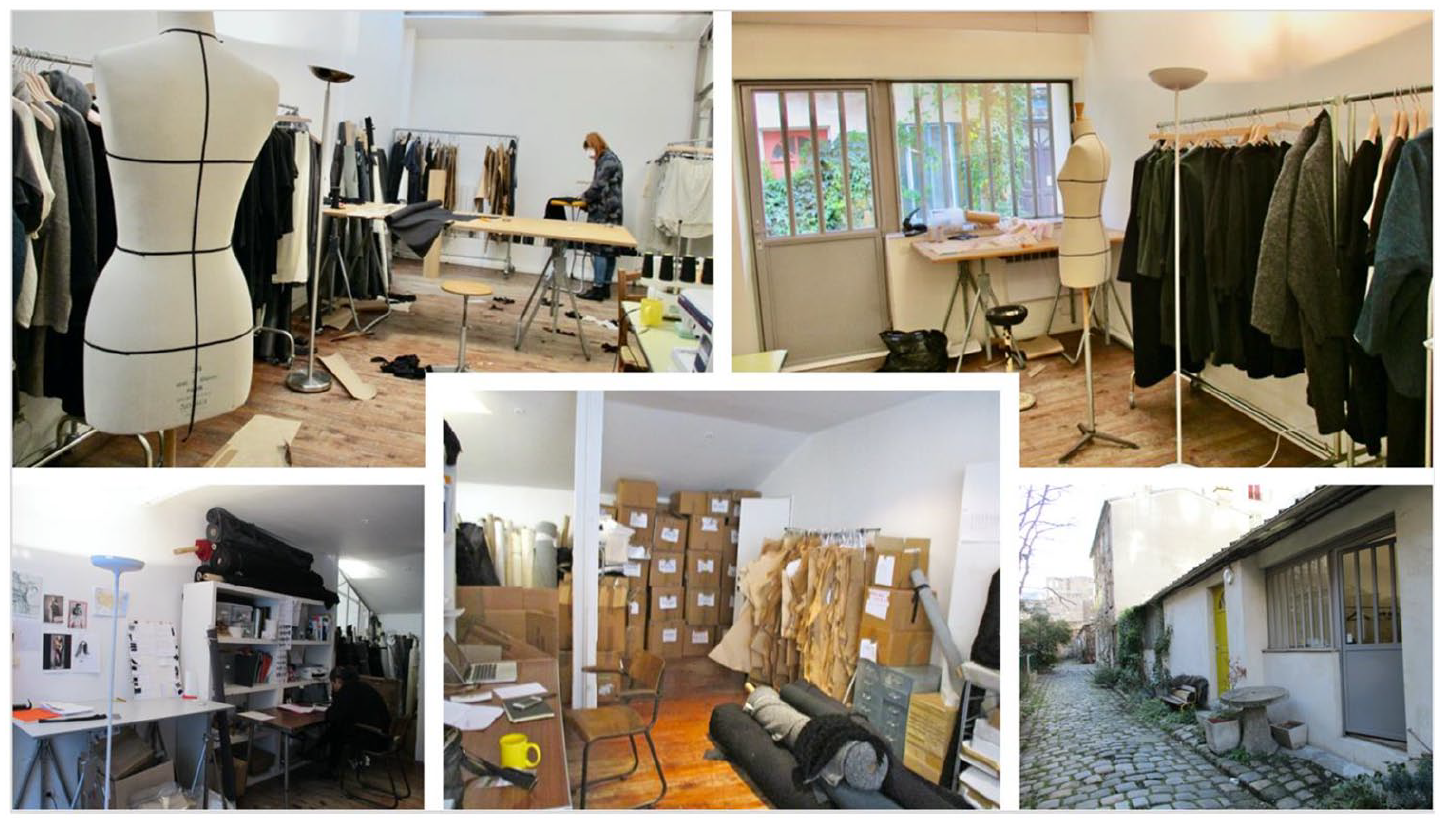
Atmospheres are characterized by their spatial form. They are intertwined with forms of enclosure and particular forms of circulation – enveloping, surrounding and radiating (Anderson, 2009); they disseminate within a sphere. Observation in the delimited space of the studio appeared especially relevant, as did the intern-al condition of the fieldwork.
Collecting empirical material
As intern, I participated in all the designers’ activities (drawing lines on pattern templates, cutting fabric, sewing buttons, contributing to office work), while taking notes on the side about ongoing activities and interactions as well as verbatim quotes from conversations with participants. Every evening, I cleaned up my notes and diarized my first thoughts and basic ideas about anything potentially involved in the various creative episodes. Ethnographic work offers a personal and physical connection to the world of designers through their day-to-day activities (Kenny, 2008; Kunda, 2013). As an affectively attuned activity (Mears, 2014; Stewart, 2010), it is a suitable method for creativity research (Jones et al., 2016) and fashion studies (Czarniawska, 2011). However, the empirical difficulties of capturing moments of creation and its affective intensities often surfaced in the field.
Exploring affective intensities
How can these conditions that shape – but do not determine – creative life be researched? Different articulations of contingencies remain difficult to put into words (Stewart, 2007). I draw inspiration from Stewart (2007, 2010) in attending the ‘object’ of analysis by writing out its inhabited elements in a space [in my case: the studio] over time [the three months covering the design of a new collection]. 2 Michels and Steyaert’s discussion of empirical research on affect also proved invaluable help for gathering material (2017). Mobilizing the concept of ‘affective atmosphere’, they advise building a research account that is both well connected to the empirical material and sensitive to affective experiences during the research process. Access to ‘new possibilities of feeling’, they explain, can happen when seeing the constellation of material and immaterial elements at play. Michels and Steyaert advocate tracing the process through which affect emerges by ‘identifying affective episodes that form in a spontaneous encounter with a varied palette of sensations and feelings’ (2017, p. 80).
The ethnographic research process allowed me to immersively inhabit the affective qualities of encounters (Bell & Vachhani, 2020), going along and ‘feeling with’ things (Stewart, 2007). Materiality and its affective experience should be studied as interrelated phenomena ‘feeding on each other’ (Bille et al., 2014, p. 36), rather than as distinct phenomena. I tried to focus on such atmospheric attunements, to resonate or tweak the force of the ‘material-sensory something’s forming up’ (Stewart, 2011, p. 452). I was attentive to how senses are mobilized through human and non-human interactions and to how moods and feelings are revealed and considered (Reckwitz, 2016; Sumartojo, Pink, Lupton, & Heyes LaBond, 2016).
Building a relationship
The design of a new garment can be understood in terms of the registering of atmospheres in moving, sensing bodies. Actively participating in the studio’s daily activities helped me to build good relations with the two designers. Producing knowledge inevitably hinges on commitment and affect at some point (Anderson & Ash, 2015; McCoy, 2012). I soon realized that the relationship-building process was the raw material for the ethnography. Becoming aware of mood is an experience of attunement (Jørgensen & Holt, 2019; Michels, 2015; Stewart, 2011). I became close to the people I worked with, and only through this relationship did I start to properly understand the issues at stake and to identify and share those ‘affective episodes’ that Michels and Steyaert describe (2017).
Participant observation in research on atmospheres warrants careful attention to the researcher’s own affective-embodied experience as a way of learning about the experiential worlds (Michels, 2015), where all kinds of sensory impressions are registered and worked with (Beyes & Holt, 2020). This allowed me to apprehend affective-embodied sensations while concentrating on moments of tool use accompanied by expressions of togetherness, agitation, frustration, and so on. The diary proved invaluable for keeping a minimum distance from the field, serving as a tool to keep that ‘subtle balance between detachment and participation’ (Hughes, 1970, p. 420). It helped me become sensitive to the causal powers of (atmospheric) phenomena that exert a force but are often ‘vague and diffuse, ephemeral and indeterminate’ (Anderson & Ash, 2015, p. 37). 3
Writing research accounts
In line with previous research on organizational space and spatial atmosphere (see Bille et al., 2014; De Molli et al., 2020; Michels & Steyaert, 2017), the data analysis follows the principles of inductive theory-building through an interpretive approach (Yanow & Schwartz-Shea, 2014). First, I noted my interpretations of the most stimulating observations in the field (Courpasson, 2013; Kunda, 2013), and linked together those that illustrated the same phenomenon (Emerson, Fretz, & Shaw, 2011; Van Maanen, Sorensen, & Mitchell, 2007). The empirical material was then examined according to intersections between creative action and affective-sensory responses, moving back and forth between theories of atmospheric space and the empirical material (Hammersley & Atkinson, 2010; Madden, 2010).
Attending to atmospheric attunements and trying to figure out their significance incites forms of writing that detour into descriptive eddies and attach to trajectories (Stewart, 2010). As a result, the analytic process was more messy than linear, representing a reflexive style of working (Beyes, 2016; Hjorth & Reay, 2018). Three dimensions progressively emerged as analytical layers: (1) fabric; (2) experiment; and (3) collaboration. More than the separate elements that stood out in the analysis, these three dimensions express interplays in the emergence of atmospheres. The objective of the analysis then became to form narratives that could make sense of the three dimensions and their simultaneous co-presence. The findings reported here take the form of two textured stories based on and integrating the three dimensions. The first story focuses on the ‘happenings’ of materials. The second story embraces the spatiality of affects. Each story traces the fabrics, experiments and collaboration as they trigger affects that give direction to the work (‘the happenings of the material’) and converge in the space of the studio (‘spatialized affects’).
Exploring the Texture of Creativity: The Atmospherics of Designing
In what follows, two stories are constructed from the empirical work in the studio, interweaving the analytical themes of fabric, experimentation and the collaboration. The first story focuses on the ‘happenings’ of the material, featuring the performance of fabric and bodies. The second focuses on the spatialized affects that simultaneously arise from both within and outside the space of the design studio. By decomposing atmospheres into these two layers, I seek to empirically show the various processes that lead to the emergence of affective atmospheres or prevent them from being actualized. 4
The happenings of the material: fabric, bodies and the unexpected
In the field, it soon became clear how strongly the designers’ activities were channelled into the ‘happenings’ of the fabric. Inspiration constantly flowed from the materials.
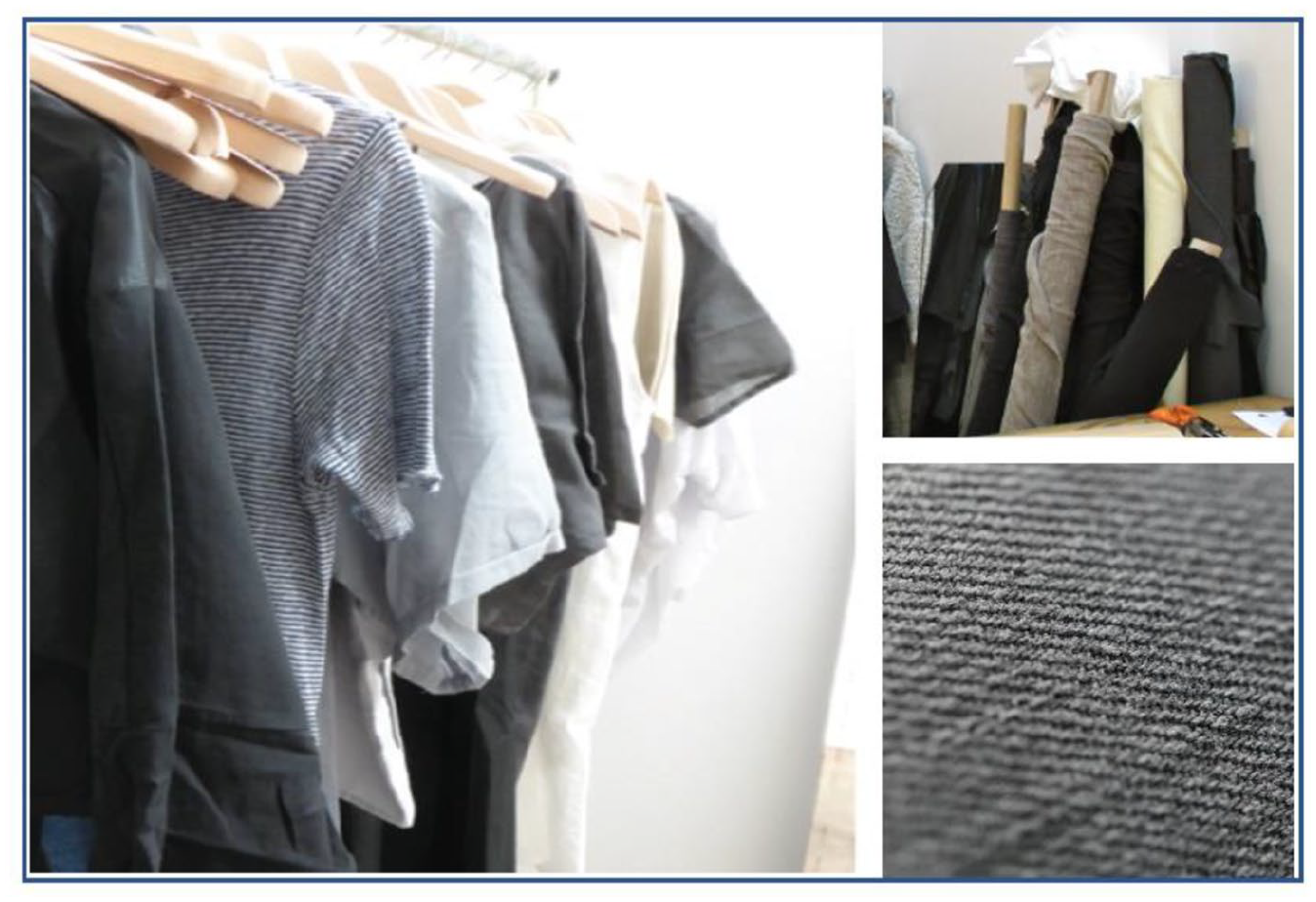
It all starts with fabric
Elle, like Ada, associates a fabric (e.g. silk) with a given accomplished form (‘a shirt like this, with a neck like that’), discursively representing how sensitive knowledge and matter are entangled within the design process. Fabric has such an evocative power that its arrangement is integrally embedded in the process. The lightness of jersey, a two-way stretch knit, offers a relaxed attitude. The material is in itself the condition for the idea, carrying an impersonal principle that guides the idea’s evolution. The cut-and-sewn technique allows for a rolled edge, producing rolls of material. From here, volumes are shaped, and forms are modelled on both mannequins and live bodies. Not all available components share equal capacity to resonate with the designers’ bodies. Fabrics matter because of their own qualities, forces and movements, and not because of how designers represent them.
The relationship with the fabric can only be described through sensory perceptions: sniffing, touching and looking are the appropriate verbs to convey this physical, embodied relationship. How many times did I hear them talk about the fabric, with Ada calling Elle or Elle calling Ada to say, ‘You need to come see this. Just look how this cotton is simply amazing to sew!’ Fabrics mediate the affective qualities of space, i.e. atmospheric qualities. I constantly witnessed the dynamic interplay unfolding between materials and embodied knowledge. The two designers are concerned with allowing the fabric some autonomy rather than giving it certain qualities formed or coloured in such and such a fashion. Elle and Ada do not move towards or away from a certain kind of fabric entirely out of instrumental concern – they are simply conscious of the fabric being something that ought to be treated in a certain way. What defines designing in the studio is not the skilled use of tools but the heedful regard for the often-surprising experience of being among the fabrics. For instance, the designers always get excited when fabrics arrive at the studio, shipped from Italy. They frequently take a fabric outside into the sunlight to properly appreciate its true colour, spending ages discussing and manipulating it. In those moments, common meanings circulate within the felt atmosphere. And sometimes, also, the fabric resists and refuses subjectification: 5
Elle is not quite satisfied with the colour of the fabric they received. She decides to dye it a darker colour. So, first, she designs the dresses. Indeed, it is easier to dye the made-up clothes than the whole roll of fabric (. . .). Once she has designed the dresses, she puts them in the washing machine where the dyeing is done. After a few hours, she opens the washing machine and gets the dresses out, which are now black – well, I see them as black, but Elle voices concern: she says the colour errs towards greenish. The fabric did not fully ‘appreciate’ the dye. Elle tells me she is disappointed by the results, but will try again, in a different way.
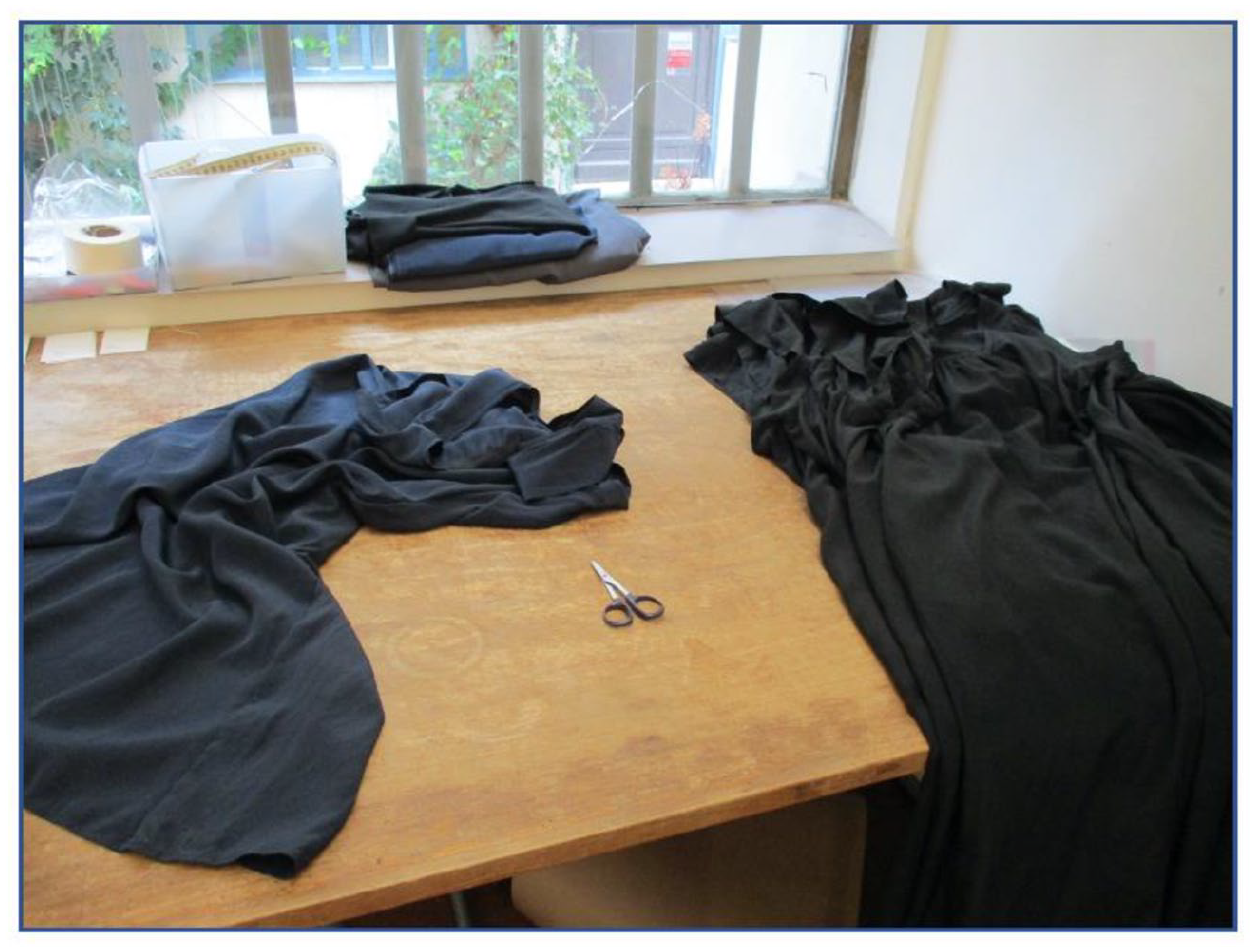
Fabrics somehow ‘behave’ in one way or another. Here, the experience features neither control nor full prediction. Frayed edges, asymmetries of cuts, the memory of the twisted fabrics. . . there is a multiplicity of possibilities that keep the designers connected to their affective bond with designing. Artefacts always contain more material possibilities than anticipated. Elements are either reproduced or challenged throughout those happenings. The properties of the fabric are thus to be understood as conditions of atmospheric effects. Any new twist and turn sets the design process in motion. Any bad surprises spark tangible disappointment or divergences in preference between the designers, thus blocking the process.
Ultimately, the fabrics definitely exist in relation to the designers, as a manifestation of who they are as makers at that moment. This ‘sensitivity or care towards the pressures of immediate localities’ (Jørgensen & Holt, 2019, p. 19) is key. The affective reaction needs to happen for designers to move on. However, affective reaction is far from predictable, and the previous vignette shows there is also a very personal part in these affective prompts. My perception of the colour was different to that of the designer, and this mid-dyed dress may have worked satisfactorily in another designer’s collection. Elle is also guided by the build-up, over the years, of her own style. Her affective potentialities, as a professional designer, are shaped by the feel of the house and the Elle Fonta brand, which relates to personal (creative) experience and previous collections but also to professional choices and external influences – to which I will return to later.
Bodies in performance and nothing considered as definitive
How, then, do Elle and Ada engineer the affective capacity of their space? Through experiments. As they ‘wander around’ in the studio, the two designers try things out. Their senses ‘sharpen on the surfaces of things taking form’ (Stewart, 2011, p. 448). As Elle and Ada move back and forth, several experimentations take place: the material reveals itself in volume while other elements materialize in the samples. The designers get an emotional kick out of these experimentations, lived as ‘moments of potentiality and promise’ (Michels & Steyaert, 2017, p. 98). Designing then means attempting to produce the image that renders what the designers have in mind, and in body, and the outcome of designing is seeing it formed.
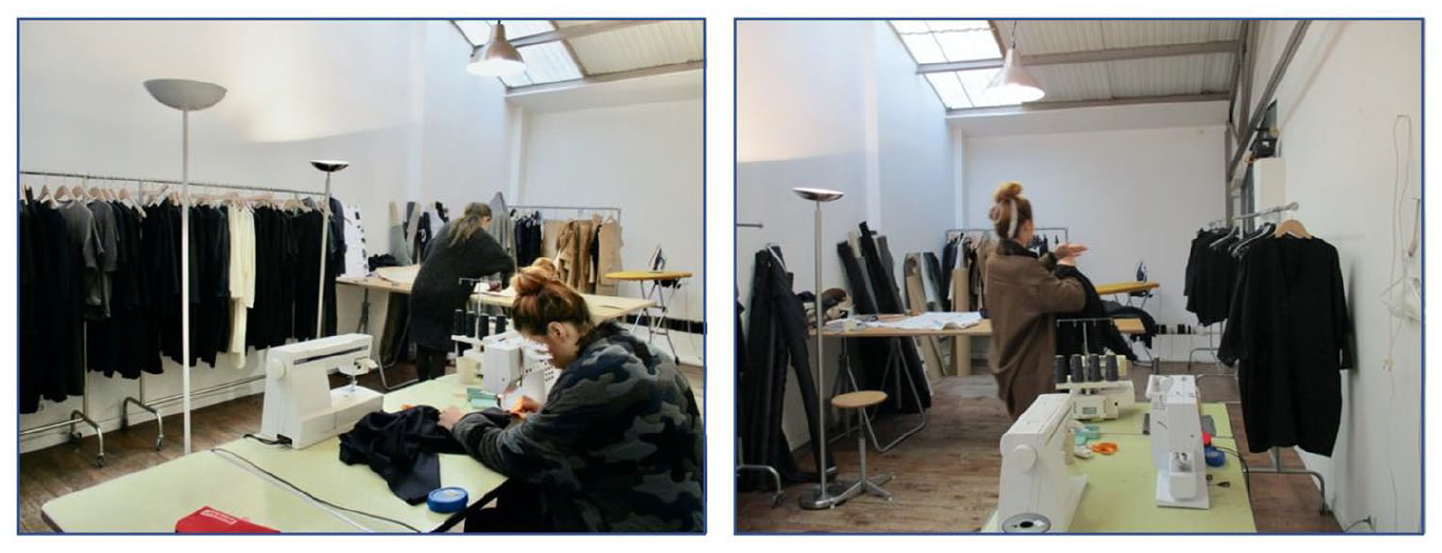
The happenings of materials afford an embodied experience of space and atmosphere as performative landscapes or ‘sceneries’ (Jørgensen & Holt, 2019, p. 20). Elle and Ada design because they can see, touch and feel, meaning they can capture a certain relationship of shapes, patterns and a given outline of space. Designing becomes a vector of the opportunities to move between the spaces of possibility opened up by the body and gestures.
A certain number of pieces from the winter collection are made following a patchwork style. Elle and Ada recycle pieces of fabrics they like (from previous collections, but also from current fabric fairs) and they try new things. Ada holds the pattern of the patchwork shirt in front of her, they arrange the pieces in different orders and modalities, they trial things, rediscuss, try again, go back to their first idea, touch the fabric, try the shirt on. As they work, they realize that certain fabrics are easier to sew together than others, and the shirt then takes another direction. It is obvious they enjoy doing it, as they keep trying and trying just to see the endless available possibilities.
This situation shows how the use of recycled pieces and sewing trials organizes sensory-spatial experiences. The affectivity engendered here is brought on by the unforeseen events of studio life, whether moments of colouring, ripping, sewing, or some other material experience. It is substantially through experimentation that Elle and Ada make sense of the task at hand. Rather than a dramatic burst of inspiration, designing instead unfolds as it follows a series of cues arising in the course of the formative activity, prompting the mixing of colours and textures. The emotional enjoyment and expression involved in these moments is manifest. The sense of something happening becomes tactile. Experimenting is repeated and elaborated for the sake of its attendant affects. Their eyes might find any object interesting: They have been working on the pink coat since early morning; the belt has now disappeared, and the coloured flounce is around the neck. I can see that they are disappointed – the coat has not quite materialized as they had imagined it. The atmosphere is tense. And then, at one point, they start looking at my own coat, hanging next to the front door. They examine it, use it to see how much separation between the buttons would suit the new coat. They virtually deconstruct the coat, grasp an idea here and there. . . and the atmosphere lightens.
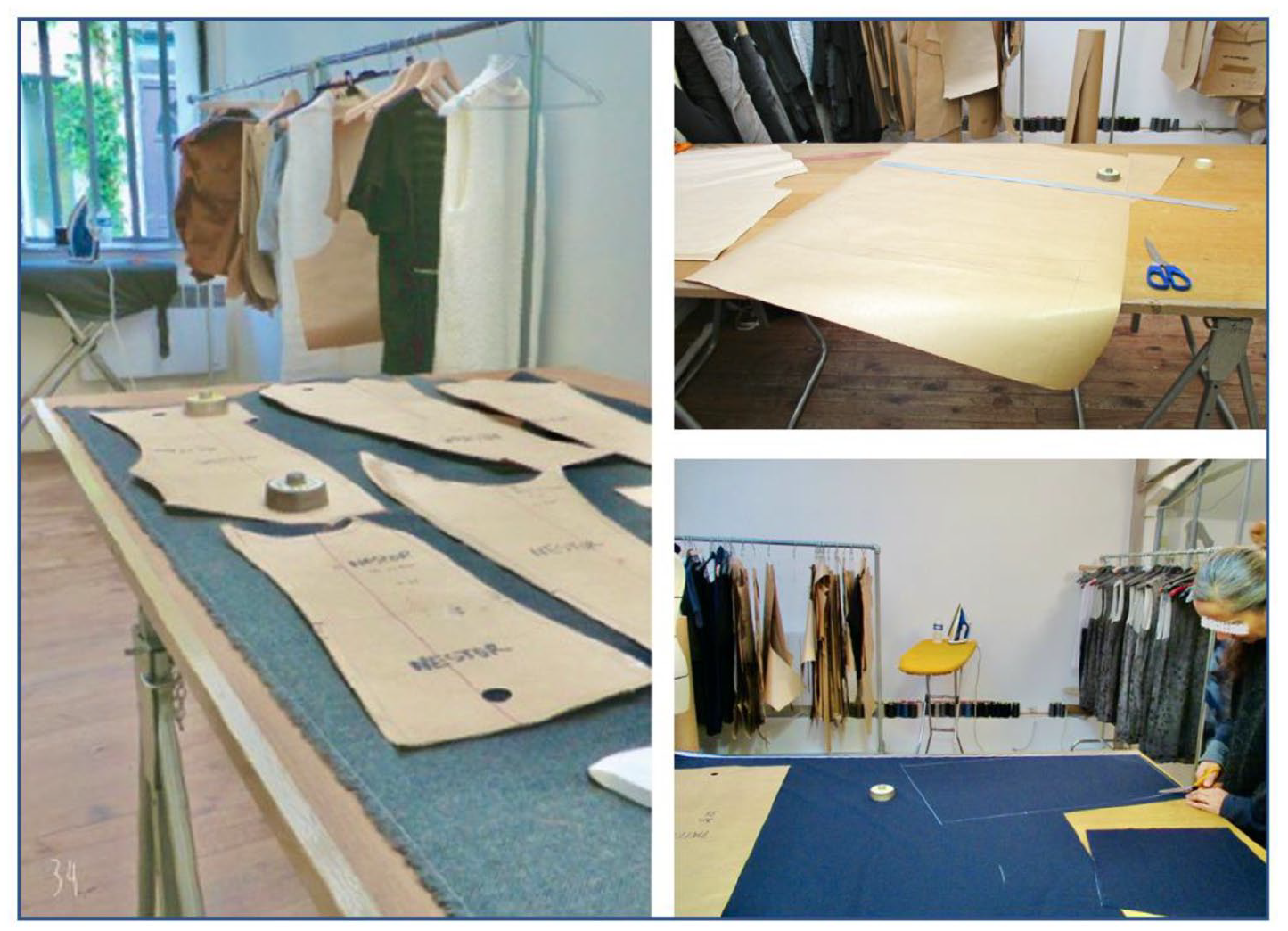
Any element might enter the stage and end up involved in the process, triggering excitement and affective renewal. The extract above reveals how unplanned-for and unexpected elements enter the studio and unleash new affective potentialities. In the studio, then, there are times of uncertainty and breakdowns that propel the design process. Fragments of lace give way to new white fragments, and the washing machine dyes them in unexpected ways. Elle and Ada’s restless experimentation is characterized by an accepted openness to doubt and, ultimately, the impossibility of completeness. So is their persistence with the direct experience of making. Designing is a continuous and unfinished process of de- and re-construction. Elle tells me several times that the only reason forcing her to finalize things is the deadline. Nothing is definitive, except her affective research through material experimentations.
The physical staging of the room itself also generates affects. This setup allows for (or even invites) the unexpected. Re-composing the studio differently creates a space for new resonances and new atmospheric performances. 6 In fact, Elle and Ada never know in advance how many pieces will ultimately make up the new collection. As designers, they progressively unravel the collection while coping with things that emerge ‘en route’. They follow their affective experiences, which can go in any direction. Sometimes they end up with 50 pieces, sometimes 70. The explicit work of the staging atmosphere creates discontinuities or contrasts in their experience of the studio. And this experience is, above all, spatial.
Spatialized affect(s): an enveloping milieu and its broader influences
Designing happens in a collaboration that is renewed daily within a set of surroundings. What matters is to keep going with pieces of fabrics, pliers, the washing machine, threads, shirts, rolls, kraft-paper, needles, half-sewn garments. . . a jumbled assembly-of-things that surround Elle and Ada, and with(in) which they interact all day long, in search of an affective reaction.
Studio space or envelopment
Their environment is to be understood as an affective constellation, or an enveloping milieu. The two designers enter a space (that of the studio) where affective reactions to embodied-material practices rule. Every morning they start all over again, with a bright and clean studio, and throughout the day all these various things pile up around the space. They have them all to hand, to try, examine, look at, work with, move from one place to another. . . At the end of the day, they clean everything up so they can get a fresh start the following morning. Creative action always requires adjustments to these circumstances. Even having the radio on or music playing can ‘get in the way’ of design. The form of the studio provides a stage, which is a condition for atmospheres to emanate (Böhme, 2016). Patterns in the composition of atmospheres are either reproduced or changed. As Jørgensen and Holt note, any arrangement of ‘light, colour, sound, material surfaces (. . .) create(s) a scenographic totality’ which allows atmospheres to emerge and enables a ‘mood-inducing embodied experience of the space’ (2019, p. 5). A garment will not be finalized until the end – meaning once the collection is packed and ready for the fairs.
In the following episode, the garment emerges at two different points in time, exemplifying the process of progressive forming within the space and time of the studio: One of the centrepieces of the collection is a large coat made in heavy wool. Elle and Ada spend an incredible amount of time on it, going back and forth, trying different colours, different shapes, before finally agreeing on a certain design. In the end, I help them sew the hem, and the wool is so heavy it takes me half a day. But then, out of nowhere, one morning about 15 days later, Elle looks at it once again, looks at the colour palette right next to it at that moment, and changes her mind on the hem, just from looking at the colour choices. I have to undo the hem, and sew a new one, a different one. To me, the change seems to come ‘out of nowhere’, but you can tell how important it is to Elle.
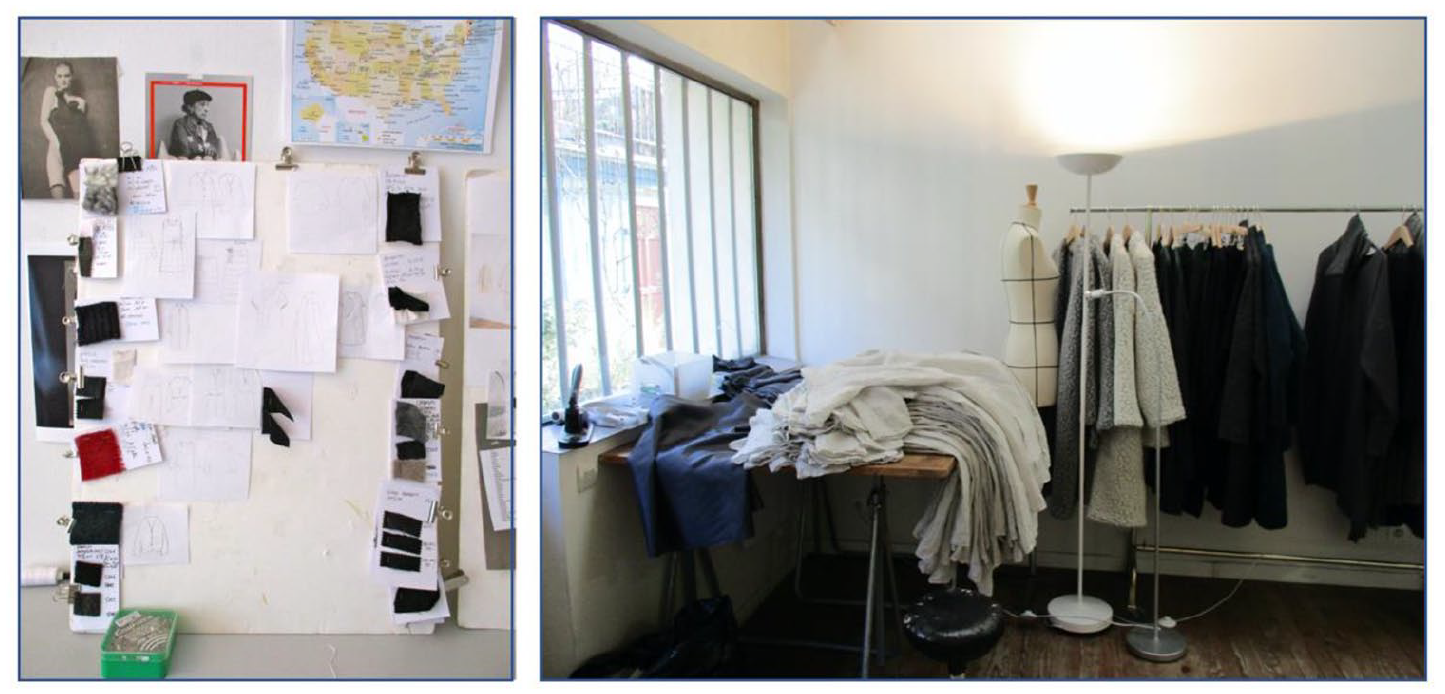
In the above extract, the material placement of creativity, understood as spatially configured, is observed: Elle looks at the colour palette that is right next to the coat at that precise moment in time. The form of the garment emerges within the realization of it, following what the designers feel like doing with it. The garment acquires form according to an affective preference at some point in time. The boundaries of the creative perimeter move and are unpredictable, creating conditions for affective encounters. Atmospheres emanate from the ensemble of elements that make up the creative object.
Compounding the process, bodies effectively engage in these activities of creation-in-motion. Atmospheres, after all, are defined as ‘what is experienced in bodily presence in relation to person and things or in space’ (Böhme, 1993, p. 119, my emphasis). The mutual interplay between material modulations and sensing bodies is obvious. There is a sensorial way of knowing that permeates practices and provides hints and clues. On this, I noted in my diary: Designing takes shape, between fittings, sewing machine noises, (. . .) and most of all repeated looks in the mirror to give expression to the garment. Elle and Ada try on the clothes, walk with them, talk about them, with them, looking at the mirror while twisting around on every side to get a full view of the worn garment, moving with it as much as possible. They are playing around until they feel it’s right (. . .) A smile on their faces means approval.
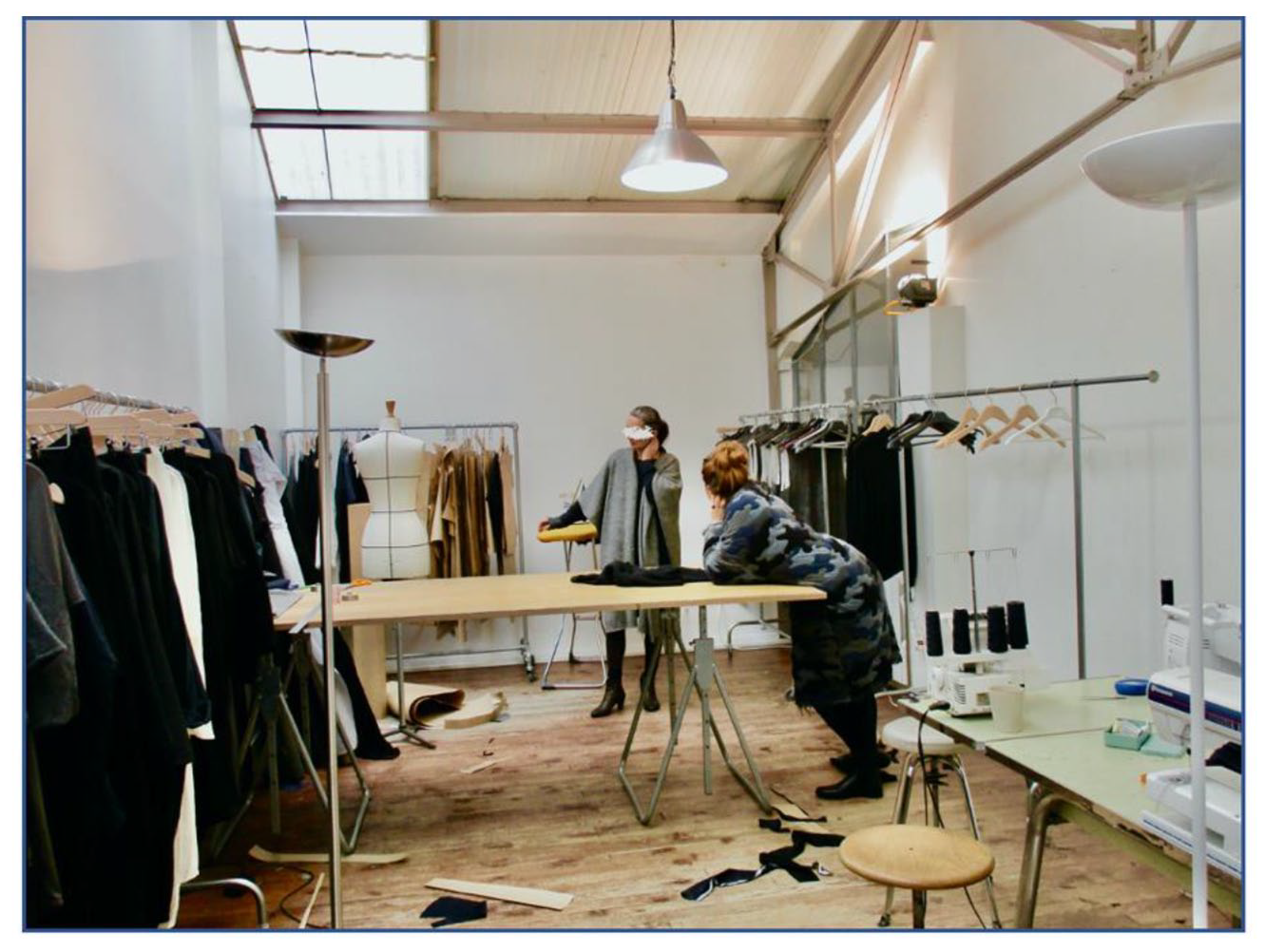
Here, bodies are on alert, readily engaged. The designing process involves moments of literally staging and performing with the garments in front of each other (or the mirror). The sensing and affective body of the designer remains a grounding presence. It is addressed here in a multifaceted role of enacting the garment by performing a walk, feeling the garment on the skin and moving with it as a dressed person, and looking at oneself and sensing the affective potentiality of the garment within its own performance. The transmittable affect in these spaces-of-making highlights momentary performances as an essential part of the design. Momentary performances enable Elle and Ada to ‘mock up’ a new movement in a matter of seconds and provide instant evidence to inform a collaborative idea. Their joint performance is a decisive feature of creative action and can intensify both the experience and the imagination. Things gain momentum, and the atmosphere fills and forms the room. The affective intensity of the performance is intensified by the agents’ mutual enjoyment, which amplifies the mimetic and contagious aspects of the affects involved. In these moments, Elle, Ada and their bodies relate to one another, all porous to affect. Through gestures and hands, they can unite the garment in its myriad different perspectives.
Consequently, atmospheres change as the agents’ bodies move through space and are exposed to changing sensory stimuli. Constant propositions of interactive creativity unfold to temporally reach an agreement, and this can only happen via coordination through manipulation. Note that there is no clear division of labour. Sometimes Elle will start a piece and Ada will pass by, suggest something. . . and end up finishing it.
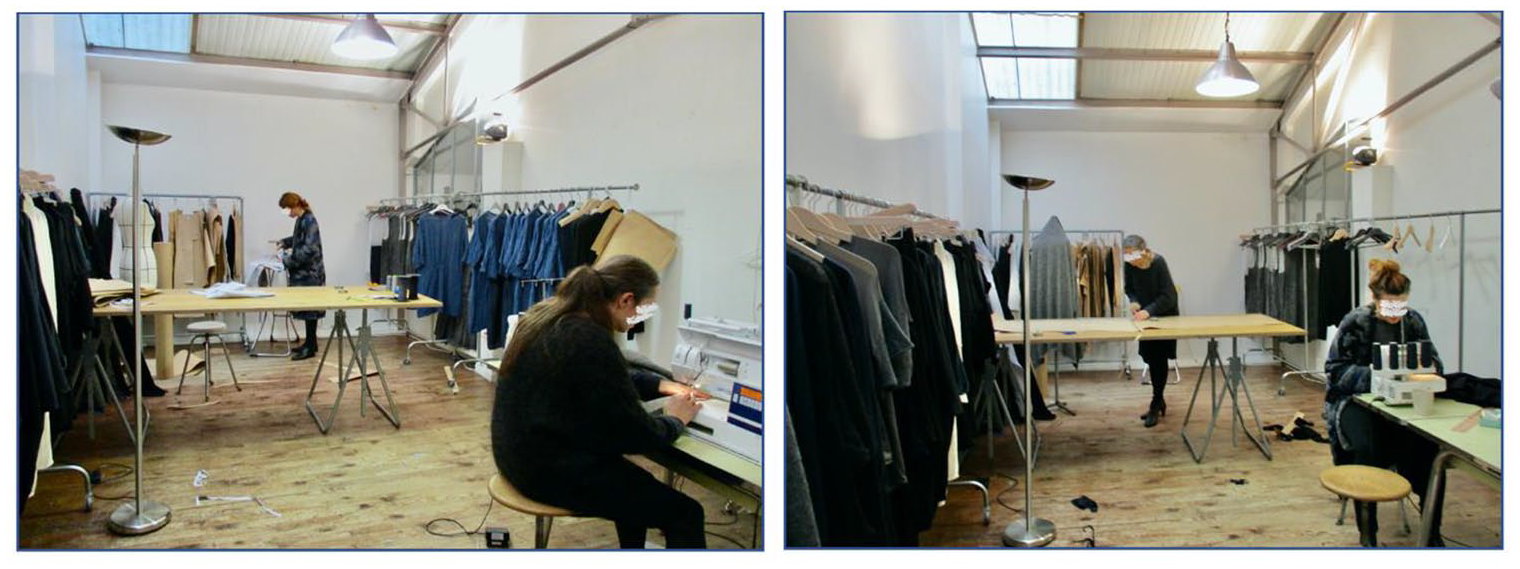
Over time, they have developed their own special ways of understanding each other. Designing unfolds as inherently affective and collective, for the force in this process comes from how receptivity is connected with spontaneity – from how the power to be affected is connected to the power to affect (Massumi, 2002). Interaction and feedback make space for the affective experience to unfold through sensory collaborative experiences. This attitude demands an atmospheric understanding of the other, be it intellectual (through words, where discursive elements can be addressed as components of affective atmospheres) or non-verbal (through adopted or manifested gestures). Atmospheres can be described as ‘envelopments’ as well as ‘ways of being together’ (Anderson, 2009). A palpable change in the shared atmosphere can also be brought about by a change in the personal atmosphere emanating from one designer, disagreement in the forms of an angry demeanour, for example, discernible from body language and behaviour, i.e. tone of voice, eagerness, hesitation, quickness or slowness. This mutual encoding continually unfolds along with various ups and downs, converging most of the time but diverging at others, in ‘spatial swirls of affects’, to use Thrift’s apt term (2006, p. 143).
Yet the ‘collective’ dimension entails affective forces that go far beyond the studio, and which intrude into the immersed tactility of the scenes described above.
Fashion space or the broader conditions of atmosphere
In addition to being an affect that emerges from the encounter between bodies, atmosphere is also an external force to these bodies, ‘at once a condition and itself conditioned’ (Anderson & Ash, 2015, p. 3). Creative work would not surface in all its dimensions without the presence of absent but felt forces. These ‘palpable and sensory yet imaginary and uncontained atmospheric attunements’ (Stewart, 2011, p. 445) contribute to the work just as much as the agents within the studio. Sensory experiences and feelings are transformed by conscious choices as well as the outside influences that mediate and organize perceptive fields, bodily gestures, and stylistic expression.
First, the configuration of affective prompts can be intentional. For instance, Elle always recruits her assistant designers from two design schools that she knows – either because she has been there or because she has worked with them. Thus, when she recruits a person (in this case, Ada), she recruits someone with an implicit artistic universe and sensitivity, a specific stylistic as well as material expression. She knows that the new recruit will be trained and accustomed to a certain way, with which she is familiar. The ‘creative match’ will be easier, as will the access to – or design of – the studio atmosphere. For instance, Ada comes from a school called ISAA (Institut Supérieur des Arts Appliqués), which implicitly means that she knows art history and the trends in contemporary art, that she has learnt to sew in a certain way, that she is well versed in the ‘flou’ (as opposed to tailoring) and in colour harmonies. This background forms a ‘cohesive glue of habit and embodied values’ (Jørgensen & Holt, 2019, p. 19) that will resonate with Elle’s own sensual capacities. The intentional orchestration of atmospheres is oriented towards her ideals of how the studio practice should feel and unfold. Imaginary and symbolic spaces are brought inward into sensory and affective reach.
Furthermore, outside forces also include those over which Elle has little or no control. Atmospheres in fashion carry normative forces that also proceed from very distant things (Esposito, 2011; Korica & Bazin, 2019). Some atmospheric compositions become possible while others remain impossible. For instance, the first step in clothing design is the choice of fabric. To source the fabric, Elle goes to fabric fairs to select the ones that catch her eye. She places orders and then receives the ordered fabrics in her studio to start the new collection a few weeks later. The choice of fabrics presented at these shows depends on the fabrics displayed in haute couture and during the season’s fashion shows. Atmospheres at these fairs are laden with current ideals, as well as norms, as they come into being (Huopalainen, 2016; Titton, 2018). If thick wools and tartan patterns have been seen on the catwalks, then they will easily be found at these fairs. This means that industry forces have an indirect yet manipulative influence on independent designers (Barkey & Godart, 2013; Bazin & Korica, 2021). These influences, too, take shape in specific affective capacities that participate in the unfolding of the studio atmosphere. In this sense, some specific compositions become possible while others do not. Fabric choices are part of the package of established ways of composing within the fashion sphere. Choosing from among the fabrics on show at the fairs is essential, because these are the very fabrics that will then be recognized by buyers – who are in tune with the trends in the industry. Here the shadow cast by fashion decision-makers is strongly felt. There is a need to clarify such ‘affective restrictions’. Atmosphere is both an effect that emanates from a gathering of agents and a cause that may itself have some degree of ‘weight’ of influence on the creative act. Conditionality or configuration reveals itself very basically through this sensory-affective order of attunement or restriction. Time is key here; it is through this breach that order is also instilled. Fashion calendars create a temporality that is optimized in mercantile terms. Designers can neither escape it nor ‘appropriate’ it in their own ways (Müller, 2020). The packed schedule of fashion fairs and shows and its social organization of time is a powerful and hegemonic tool of control (Cuganesan, 2022; de Vaujany, Leclercq-Vandelannoitte, Munro, Nama, & Holt, 2021).
And so, I could draft an open-ended list of the elements that condition without determining an atmosphere, which itself is a reminder of ‘the (im)material heterogeneity of the origins for this or that atmosphere’ (Anderson & Ash, 2015, p. 48). Taken together, the two examples given above converge to convey the idea of how ‘everything emanates atmosphere, and everything is maintained within an atmosphere’ (Philippopoulos-Mihalopoulos, 2013, p. 43). Creative studio atmospheres grow organically out of the locale and the designers working in the studio, as well as by being part of a fashion network and atmosphere that exceeds them, either consciously (choosing the training pathway for recruits) or unconsciously (choosing fabric samples from a selection that has already been made by fashion influencers).
Discussion
Complementing the creativity debate
The two stories emphasize the affective and spatial embeddedness that is so vital to creative work. Where previous relational work stresses the process of how various agents are involved in generating creative design (Duff & Sumartojo, 2017; Glăveanu, 2014; Hjorth et al., 2018; Islam et al., 2016), my findings reveal how inadequate it is to present the (non-human) actors and the ‘speciesist aspects of creative assemblages’ (Finkel, Jones, Sang, & Stoyanova Russell, 2017, p. 286) as unaffected agents. The few previous studies that deal with creativity and affect still tend to be human-centred, referring to an affect-based ontology of human practice (see Hoedemaekers, 2018 or van Iterson, Clegg, & Carlsen, 2017). Creativity is often chaotic, hesitant, incomplete, made up of affective practices and erratic decisions, and so it becomes meaningless as a concept if not considered in tandem with the many affective agents through which it operates (Moeran, 2011; Thompson, 2018). In this sense, a new materialist theory of creativity would understand materiality as atmospheric.
Providing a rich, dense, situated empirical study is a way to unlock such aspects and, in so doing, to escape the grammatical conventions of conceptual and representational thought (Beyes & Steyaert, 2012; Rickards & De Cock, 2012). By theorizing creativity as performed through different and indeterminate spatialities, this paper offers texture and depth to an attentive, embodied, engaged and immersive creativity (as well as method). In response to scholars calling for more critical views of creativity (Jeanes, 2006; Osborne, 2011; Reckwitz, 2014; Raunig, Ray, & Wuggenig, 2011), I can therefore bring to the fore what is normally hidden by the ‘rational flavour’ (George, 2007, p. 446) of most existing theoretical efforts which are typically grounded in psychosocial perspectives (Runco, 2007). These theoretical efforts reify the concept of creativity as a conscious human attribute (Sage et al., 2020; Thompson, 2018), and thus implicitly convey the same ‘dominant market-focused ideology of creativity’ (De Cock & Rehn, 2009). This means that theoretical efforts remain limited to mainstream notions of human resources or capital (Amabile, 2013; Amabile & Pillemer, 2012) and manageable organizational factors (Gotsi, Andriopoulos, Lewis, & Ingram, 2010), which can therefore only convey performed images of creativity.
In another manner, and in manifold ways, atmospheres are predicated on, and breed, exclusivity. An interior or envelopment is formed by forms of skill and attentiveness. Creativity, in this sense, has to be earned. The attentiveness to atmospheric conditions or envelopment (McCormack, 2018) emerges as key to an understanding of creativity attuned to its complexities. It unsettles assumptions about creativity as simply about ‘being (out) there’, engaging, exposing oneself to novel, surprising and pleasant sensations. While indeed affirming the openness of atmospheric formation, my findings remind the organizational scholarship on creativity of the importance of the spatio-temporal context in which creativity emerges rather than being a seemingly weightless creative act. Atmospheric thinking in this sense undermines the contemporary discourse according to which creativity can be summarized as casual/playful, or as simply predicated on open-space work platforms filled with hip colours and ping-pong tables (Cameron, 2019), all the more with regard to fashion, sometimes presented as the convenient flagship of the ‘creativity dispositif’ (Flyverbom & Reinecke, 2017; Reckwitz, 2014). Rather, my stories emphasize the multiple and indeterminate nature of creativity, attuned to its heterogeneous atmospheric and processual possibilities. General rules never capture the particularity of material artefacts that relate to local and embodied creativity, defined by its position in the given time and place of the everyday (Alcadipani & Islam, 2017; Leclair, 2017).
Engaging critically
The atmospherics of creativity then also reveal the darker and more critical aspects of creativity. It allows exploring the intimate proximity between embodied experience and sociomaterial norms and practices, without denying the major role played by contingent capacities. Past and broader contexts and actions constitute affective loads. Following Anderson and Ash in exploring the ‘key atmospheric ambivalence’ (2015, p. 78), I have here focused on what the atmosphere does (that is, how it affects) as well as how it forms (that is, how it is conditioned). Organization is a continuous spatial consolidation riven with social orders (see Benjamin, 1999, on the Parisian arcades). These manipulations often work in tacit or ambiguous ways: ‘seemingly vague and diffuse, atmospheres nevertheless have effects and are effects’ (Anderson & Ash, 2015, p. 36). The findings exemplify the social embeddedness of the atmospheric, tracing the way fashion atmospheres are sought and are consciously and unconsciously acted upon (Bazin & Korica, 2021; Mensitieri, 2020).
Just as space is ‘irreducibly political’ (Dale & Burrell, 2008), atmospheres and affects are exposed to interventions, and they can be channelled in a predetermined political direction (Beyes & De Cock, 2017; Bille et al., 2014). This paper draws attention to the manipulations of how creatives experience their world, showing how creative action is also a way of reproducing the established spheres of creativity in a given sector. Certain things, events and relations are valued more than others, and material spaces of organization can be shaped so that specific affects are encouraged and transmitted throughout (Aslan, 2019). Such atmospheric powers or the ‘politics of organizational atmosphere’ (De Molli et al., 2020) warrant more attention. Future research could investigate the staging of more or less explicit struggles and manipulations tapping into the affective disposition of creative workers. This politics of atmospheric creativity is all the more germane in the current era of ‘aesthetic capitalism’ where organized life is increasingly shaped by novel forms of aestheticization (Böhme, 2016; Reckwitz, 2016) and processes of affective ordering (Anderson, 2016; Beyes & Metelmann, 2018; Thrift, 2008). It is an invitation to connect the mediation of textures to questions of how they are produced and ‘what and who they make visible and invisible’ (Beyes, 2018, p. 4), who they include or exclude.
Along with all the possibilities of crafting atmospheres (Michels & Steyaert, 2017), I then want to point at the limits of such crafting. In my stories, not even the designer can foresee exactly what the garment will be like, because to predict it would be to produce it before it was produced. Any controlling attempts to be embodied in material reality are never completely substantiated (see Alcadipani & Islam, 2017, on the diverse affordances of visual images, or Jaumier & Daudigeos, 2021, on ad hoc arrangements in craft). In the studio, I witnessed the unfolding of an atmospheric experience that is to some degree determined but remains unstable and unpredictable (see Marsh & Śliwa, 2022). To borrow Müller’s escape terminology (2020), ‘escaping from’ (fashion scrutiny) means ‘escaping into’ (local, sited, atmospheric surroundings). Because of the inevitable gap between the specificities of everyday creative life and the generality of organizing principles (Alcadipani & Islam, 2017), atmospheric creativity, although socialized, cannot be fully subsumed under wider categories. Having dived into the small space of a designer’s studio, I can see how the creative apparatus is of a far less definitive and constraining order. An element of indeterminacy persists or resists, ensuring the variety and diversity of fashion’s final colours and forms.
The study of atmospheres, and thereby spaces, is thus my (conceptual) way out of the ‘grand dispositif of creativity’ narrative. It allows me to reach a more nuanced understanding of spatial prerogatives, beyond the ingrained ‘either/or’ thinking, where significations shift and dissolve, and intra-actions reorganize the sensible (Rancière, 2000). There lies the ever-present possibility of reshuffling given ways of ordering the creative.
Thinking atmospherically
The atmospheric approach offers novel ways for material encounters to surface, and for the affective engagements they generate. It allows reaching beyond the notion of an encounter between entities. Materiality within organizing is an atmospheric phenomenon. It is a singular affective quality that exceeds the set of elements of which it is composed (Anderson, 2009; Stewart, 2011). Atmospheric action can be conceived in terms of a processual materiality that ‘runs transversal’ (McCormack, 2008) to the spatial and the affective. In this paper, it means attending to the reciprocal and affective shaping of human and non-human agents at work during the creative process, thus including the engagement with material objects.
Böhme defined the task of ‘making the broad range of aesthetic reality transparent and articulable’ (1993, p. 125). Following this path, the concept of atmospheres allows thinking beyond relations and the metaphor of entanglement. Atmospheres are conditioned by relations but are neither reducible to them nor completely separate from them (Michels, 2015; Philippopoulos-Mihalopoulos, 2013). Böhme suggests thinking of atmospheres as ‘in-between’ the subject and object, but also prior to this very distinction. Creative materialities come to exist through a distributed atmospheric field of circulating materials. In the same vein, this paper concurs with Cooren who underlines the widespread mistake of ‘automatically associating matter to something that can be touched or seen, that is, something tangible or visible’ (2020, p. 1). This analysis concentrates on ephemeral spatial-affective experiences, expanding organizational perspectives that also resonate with O’Doherty’s (2008) observation of ‘the blur sensation’ within organizations, with Beyes and Steyaert’s (2012) interest in ‘spacing organization’, or with Jørgensen and Holt’s (2019) understanding of sensory orders as ‘atmospheric arrangements’.
Finally, this paper’s contribution is also empirical. Answering the call from Bille and colleagues for ‘a stronger emphasis on the material dimension of atmosphere’ (2014, p. 5) through ‘the development of a critical dialogue between theoretical explorations and empirical fieldwork’ (2014, p. 3), I dived into the everyday atmospherics of designing in a fashion designer’s studio. One of the most promising aspects of the concept of atmosphere is its ‘thereness’. It is a concept that strengthens and specifies felt experience, and as such it is hugely valuable for spatial studies, countering the arguments raised by critics about the vague and unverifiable character of spatial approaches. With this in mind, studying material matters requires being attentive to the very ‘substance’ of material relations (Bille et al., 2014). Atmospheres often work at a tacit level, ‘there but not there, imperceptible yet all-determining’ (Philippopoulos-Mihalopoulos, 2013, p. 2). Being open to ‘the immediate and mediated spatial experience’ (Sloterdijk, 2017) means grasping key atmospheric configurations and reconfigurations while in the field.
Conclusion
In this paper, I have tried to develop the contours of a new materialist theory of creativity, where materiality is understood as atmospheric. Creativity here takes shape in and through the happenings of materials and spatialized affects. The atmospheric aspects that emerge from under the fashion industry’s polished surface might represent an important part of the broader post-industrial and experience-based contexts that creative organizations share (Caves, 2002; Reckwitz, 2017). Impassioned attunements to materials, experiments and collaborations are not specific to any particular case. Affective ways of relating to environments and milieus will always vary from one creative realm to the next, yet they are predicated on atmospheric elements, the study of which should form a common thread in research on organizational creativity. The material, for instance, might be visual or auditory. While a fashion designer’s activities are channelled into the happenings of the fabric, a poet or musician’s activities will be channelled into the happenings of their sounds (or sound waves, with their own frequencies), a painter’s activities will be channelled into the happenings of their colours (also electromagnetic waves, with their own frequencies), and a choreographer’s activities will be channelled into the happenings of their dancers’ bodies and movements. In this sense, this paper identifies a new avenue for research, namely the comparative atmospheric analysis across the creative industries that would yield a more general theoretical conversation around the situated nature of atmospheric creativity, as well as for organization studies’ turn to the atmospheric more broadly.
Footnotes
Acknowledgements
I would like to thank Senior Editor Timon Beyes and the three anonymous referees for their support and guidance throughout the review process. Additionally, I would like to thank Stéphane Jaumier and Adèle Gruen for providing helpful comments on the many versions of this article.
Funding
The author received no financial support for the research, authorship, and/or publication of this article.
