



Abstract
The Earth is facing extraordinary ecological crises resulting from human impact on the planet. Meanwhile, a growing body of research studies the relationship of organizations with the natural environment but often overlooks anthropocentrism: the premise of human superiority over nature. Unfortunately, this human exceptionalist premise is the crux of the ecological crisis that cannot be overlooked any longer. To address this discrepancy in the literature, we claim that an ontological shift is necessary. Drawing from feminist new materialisms and Deleuzian relational ontologies, we develop becoming naturecultural, a material–discursive assembling process of more-than-human and more-than-capitalist entanglements. To illustrate the analytical value of becoming naturecultural, we engaged in empirical work at an organic cotton t-shirt supply chain, and conducted a multi-sited fieldwork with affective ethnographic methodologies. Working with the data collected, we narrated a human de-centered case study fostering critical but affirmative inquiries about sustainability from a non-anthropocentric relational ontology. At the end we discuss two implications for organizational sustainability research: thinking with and writing with becoming naturecultural. They facilitate moving beyond critiques of anthropocentrism and articulating affirmative possibilities for organization studies in and for the Anthropocene.
Keywords
“Nature is declining at an unprecedented rate, with nearly 1 million species at risk of extinction because of human activity. Earth system scientists have warned that the Amazon rainforest, the world’s coral reefs and the boreal forest biomes are all fast approaching the cusp of irreversible tipping points with far-reaching effects on the economy, society and life as we know it.” (WEF, 2020, p. 7) “The current geographic spread of the use of land, the large appropriation of multiple ecosystem services and the loss of biodiversity are unprecedented in human history. [. . .] Human use, at varying intensities, affects about 60–85% of forests and 70–90% of other natural ecosystems (e.g., savannahs, natural grasslands). Land use caused global biodiversity to decrease by around 11–14%.” (IPCC, 2022, p. 40)
As the quotes above illustrate, the Earth is facing extraordinary ecological crises resulting from large-scale human impact on the planet. Species extinction, land degradation, deforestation, and the like are fundamentally about the relationships of humans with nature (Ezzamel & Willmott, 2014). These are not new issues in management and organization studies (MOS) for they have been embedded in the “natural environment and sustainability” research domain since the late 1980s (Ergene, Banerjee, & Hoffman, 2021). In fact, today a growing scholarly interest in these topics is visible in many major management outlets (Bansal, Grewatsch, & Sharma, 2021; Howard-Grenville & Lahneman, 2021).
While growing interest in sustainability is desirable, this literature is mostly silent in challenging core anthropocentric premises lying at the root of ongoing ecological devastation. There are recent exceptions (Beacham, 2018; Gasparin et al., 2020; Kalonaityte, 2018; Sayers, Martin, & Bell, 2022), but more generally the literature seldom questions explicitly the premises of human superiority over nature nor inquires sufficiently about power within human–Earth relations. Forgotten perhaps is early research not blind to these issues (Banerjee, 2003; Purser, Park, & Montuori, 1995; Shrivastava, 1994). They argued then that the ecological concerns we now face were dangerous consequences of human exceptionalism: the view that humans are ontologically separate and superior to nature.
To address these concerns, we claim that an ontological shift is necessary to come to terms with humans’ role in perpetuating ecological catastrophes and to begin imagining viable possibilities for creating livable ecologies. In other words, sustainability must be problematized and de-centered away from human exceptionalism. To this effect, we engage with Deleuze and Guattari (1986) to challenge our discipline’s “major language” producing anthropocentric habits of thoughts. Instead, we propose to create a “minor literature” and advance becoming naturecultural, a material–discursive assembling process of more-than-human and more-than-capitalist entanglements.
Meta-theoretically our work is situated in Deleuze and Guattari’s (1987) ontology of becoming and its influence on the works of feminist new materialisms (Barad, 2007; Braidotti, 2013; Haraway, 2016). Conceptually we are guided by the notion of assemblage as developed by Deleuze and Guattari, including its accompanying notion of affect denoting not personal feelings but the ability to affect and to be affected in encounters with other bodies.
Advancing becoming naturecultural conceptually guided us to engage in empirical work at an organic cotton t-shirt supply chain, and trace human–Earth power relations as they are produced in unfolding events and assemblage becomings. We conducted a multi-sited fieldwork (Marcus, 1995; Prasad & Shadnam, 2023) with affective ethnographic methodologies (Fox & Alldred, 2015a, 2015b; Gherardi, 2019; Knudsen & Stage, 2015) and reformulations of actor–network theory (ANT) (Latour, 2004a, 2004b, 2005). Working with the data collected, we produce a human de-centered case study fostering critical but affirmative inquiries about sustainability from a non-anthropocentric relational ontology.
In the ending sections, we discuss two implications of our work for organizational sustainability research: thinking with and writing with becoming naturecultural. As a thinking tool, becoming naturecultural would be a constant reminder of the materialization of human superiority every time one refers to sustainability; thus, evading human exceptionalism when thinking about sustainability practices. Writing with becoming naturecultural would foster experimentation and intervention in MOS to avoid anthropocentrism in knowledge production practices. Our conclusion highlights the budding voices of a collectivity already longing for organization studies to become a field assembling more-than-human and more-than-capitalist possibilities.
De-Centering “Sustainability” as a Major Language
Deleuze and Guattari (1986) observed that concepts create a way of thinking which establishes thought to act in a certain way. They referred to the existing use of concepts and the habits of thought they create as “major language” (e.g., disciplinary canons). As we see it, the concept of sustainability qualifies as part of the major language in our field.
Sustainability as a concept in management theory and practice became part of the field’s lexicon when it was first articulated in the 1987 United Nations Brundtland Report. The origins of this notion forwarded a vision of economic development for improving social conditions in several areas of the world, as well as promoting environmental protection to reduce harmful effects of economic activity on Earth. Today, this concept has become promoted and celebrated in popular and academic discourse, increasingly so in corporate boardrooms and in financial reports.
In this paper, what we refer to as “the problem of sustainability” is how this concept has come to signify assumptions and junctions of anthropocentrism and the economic ontology of capitalism (Banerjee, 2003; Ergene, Calás, & Smircich, 2018; Purser et al., 1995; Shrivastava, 1994). These assumptions are now taken for granted in the mainstream lexicon, creating an illusion that socioecological crises can be addressed by market economic fixes such as stakeholder capitalism and green technology. These imaginings, however, re-center humans in control, often Western(ized) self-interested rational men supported by assumptions of neoclassical economics, and further perpetuate the sedimented power asymmetries resting on them. Nonetheless, such anthropocentric conceptualization has been challenged recently by MOS scholars arguing for a relational view of agency (i.e., capacity to act) moving beyond liberal humanist separation of nature and culture (Ergene et al., 2021; Gasparin et al., 2020; Kalonaityte, 2018). Particularly, Beacham (2018) highlighted the concept of “more-than-human” (Gibson-Graham, 2011; Whatmore, 2006), explicitly recognizing the vitality of a living world and the interdependency of all beings.
Altogether, these recent works are a first step in de-centering the concept of sustainability by re-conceptualizing its human-centered view of agency. However, following Deleuze and Guattari (1986), problematizing a major language also requires producing a “minor literature” which works almost as an irritant for a major language by creating concepts that are in constant flux and transformation. Thus, we argue that it is imperative to take another step and re-think, first and foremost, the concept of sustainability as a privileged articulation per se. While the recent MOS literature took the initial steps in problematizing the concept, it did not offer more-than-human alternatives to “sustainability” in its original conceptualization or in the language that carries it. As we discuss next, doing this will be a central contribution of this paper.
Towards a Minor Literature with Feminist New Materialisms
Following Deleuze and Guattari (1986), we engage in imagining a minor literature by re-thinking “sustainability” as ontologically mutable assembling processes unfolding in constant flux and transformation. This re-conceptualization would not become hegemonic or fixed even as a critique of a major language because as a material–discursive assembling process it merely arranges temporarily heterogenous material and immaterial elements that are immanent to the conditions of their appearance. That is, assemblages exist in constant processes of becoming (for an example see also Fox and Alldred (2017, pp. 35–53) discussed later). To move along this re-conceptualization, we draw from feminist new materialisms and Mazzei’s (2017) notion of a minor inquiry.
Feminist New Materialist Foundations
Feminist new materialisms comprise several still emerging approaches, which, despite their heterogeneity, eschew at a minimum the human exceptionalism of liberal humanist thought (Barad, 2007; Bargetz, 2019; Bennett, 2010; Braidotti, 2013; Coole & Frost, 2010; Haraway, 2016). These works follow from feminist epistemological concerns such as Harding’s (1991) and from conceptual locations such as Haraway’s (1988) situated knowledges. These concerns moved through postmodernist debates regarding possibilities for a gender politics after deconstruction, and eventually toward questions of ontology and the nature of the human as matter itself (e.g., Barad, 2007).
Recent examples from organization studies exhibit these feminist orientations. For instance Sayers et al. (2022) draw from Braidotti (2013) and suggest “figurations” as a method for producing new imaginaries of ethical subjectivities that are always in a continual state of becoming. They observe, “the term ‘we humans’ is by no means neutral, but rather denotes a normalized cis-male, individuated, Eurocentric subject that has, historically, overlooked the lives of women” (Sayers et al., p. 3). In addition, universalist ideals situate “Man” at the center of knowledge, and this has taken the form of mastery over others, human and nonhuman, deeming them to be passive and controllable (Braidotti, 2013; Ergene et al., 2018).
Often explicitly informed by Deleuzian thought, feminist new materialist works engage with the anthropocentric omission of matter’s agency and trouble the implicit separation between humans and nonhumans by conceiving all matter as outcomes of contingent and productive relations (i.e., continuous processes of materialization producing new assemblages and events). From this view, there are no a priori structures, systems, or mechanisms explaining phenomena; therefore, the central task of social scientists is unraveling these contingent webs of relations and to give an account of how they come to appear.
In the context of this paper, relations refer to fundamentally affective encounters between human matter and other diverse entities such as tools and machines (Bell & Vachhani, 2020) as well as Earthly matters such as rocks and plants (Bennett, 2010; Valtonen & Pullen, 2021). Latour simply puts it as “to have a body is to learn to be affected, meaning ‘effectuated’, moved, put into motion by other entities, humans or non-humans” (Latour, 2004b, p. 205). Affect is key for Deleuze and Guattari when addressing possibilities of assemblage formation: “we know nothing about a body until we know what it can do [. . .] how they can or cannot enter into composition with [. . .] the affects of another body” (Deleuze & Guattari, 1987, p. 257).
Advancing Becoming Naturecultural
Based on the Deleuzian arguments noted earlier, Mazzei maps what she calls a “minor inquiry”, which “enacts the concepts in ways that create new orientations for thinking” (Mazzei, 2017, p. 677). A minor inquiry begins with a problematization and involves three characteristics interrupting and transforming our ways of thinking: deterritorialization; political immediacy; and collective assemblage of enunciation. The recent organizational sustainability research previously noted shows some elements of these characteristics when recasting agency beyond the human.
Deterritorializing Sustainability
Deterritorialization implies transforming a concept by detaching its ordinary language use to disrupt its existing dogmatic orientation. While the same word may be used after deterritorialization, the concept is stripped away, escaping its original meaning and habitual use that categorized thought in a certain way. The dominant conceptualization of sustainability in MOS reinscribes human-centrism and the economic ontology of capitalism. The concept, as established in the major language, lacks any obvious signification of power. The human as Eurocentric self-interested Man is assumed to be in control (Braidotti, 2013; Ergene et al., 2018; Sayers et al., 2022).
To address these dangerous habits of thought, we engage with the concept of “natureculture” (Haraway, 2003). Conceived as more-than-human relations, natureculture allows us to think beyond nature and culture as separate domains. In one account, Haraway describes her engagement with biology as a natural scientist while at the same time understanding biology through histories and narratives produced by culture (e.g., colonial and sexualized knowledges, systems of labor, accumulation, etc.). With this neologism, she implied that there is no separation, one is always part of the other, “there is no nature or culture, only natureculture” (Subramaniam, 2014, p. x). The notion natureculture facilitates deterritorializing the concept of sustainability as naturecultural. It provides possibilities for thinking sustainability in more than biological and social/economic phenomenon and instead thinking it as becoming a material–discursive assembling process which exceeds the major language. That is, sustainability as assembling process exceeds existing territorialized notions of sustainability as a human-centered phenomenon.
Political Immediacy
The second characteristic entails questioning agency, which is a question of power—the central analytic concept of critical thought. In new materialist accounts, power is conceptualized as productive forces and potential capacities to affect as core to all relations unfolding in everyday practices. Here power is transient and fluctuating, and has continuity as long as it is reproduced and maintained. Fox and Alldred (2018) refer to this as “assemblage micropolitics” and call for unpacking them and identifying specific relations that produce power imbalances. These same authors offer an excellent example of micropolitics of assemblages unfolding in new materialist environmental sociology research (Fox & Alldred, 2017, pp. 35–53). They show how the semblance of overarching structures or systems (e.g., capitalism, patriarchy, anthropocentrism, etc.) are outcomes of continued replication of assembled relations (Fox & Alldred, 2017). Hence, everyday practices produce apparent continuities of hierarchic relations, sustaining power asymmetries; but when observed as assembling relations, their fluidity, precariousness, and other contradictory elements can be articulated.
In advancing becoming naturecultural, we also draw specifically from three feminist new materialist concepts to capture further what may be escaping from the notion of micropolitics when based on everyday practices. Each of these concepts provide specific political and ethical stances to the current ecological crises. First, Barad’s notion of “ethico-onto-epistemology” brings up an ethical posture that anyone producing knowledge must assume. The epistemological and the ontological are entangled in these practices and “with the world itself and its inhabitants – human and non-human beings that intra-actively co-constitute the world” (Barad, 2007, p. 90).
Second, the concept of “agentic capacities” re-conceptualizes agency as distributed across animate and inanimate entities (Coole, 2013). This re-conceptualization does not privilege either humans or nonhumans; instead, agency emerges within and through relations formed, during the creation of network of associations; that is, assemblages. From this view, the task of researchers is “to trace these densely productive and reversible relationships” (Coole, 2013, p. 455). Coole’s formulation carries the posture of “old” feminist materialism by foregrounding asymmetric power relations that are however re-produced within and through the dense network of relationships. While this political position is paramount in the formulation of agentic capacities, its ethical stance draws from ecological politics suggesting investigating “the unique ways humans’ imprudent interventions in basic life-support systems pose a threat to all species and to the very fabric of the earth” (Coole, 2013, p. 461).
Lastly, with “flow of surplus” within production, appropriation, and distribution practices, Gibson-Graham (2006) destabilizes the discursive formations of “the Economy” as a singular capitalist system and forwards a new economic ontology as “diverse economies.” In conversation with Marxist feminism, they reformulate class as a process from a relational ontological view. Flow of surplus facilitates observing diverse capitalist and non-capitalist practices as well as the agency of assemblages formed through relations among humans and nonhumans. It fosters ecological sensibilities recognizing the vitality of the living world and the interdependency of all beings as more-than-human (Gibson-Graham, 2011; Gibson-Graham & Roelvink, 2009).
Collective Assemblage of Enunciation
What are the implications of conceiving agency as a complex network of human and nonhuman relations? Political immediacy, as discussed, helps in understanding sustainability as an assemblage of enunciation. In this view, one can no longer assume the agency of individual elements reinscribing and fixing hegemonic concepts within the inquiry. Rather, this last characteristic suggests possibilities for new practices, languages, and thought in constant flux and reinvention within shifting relations. This means that individual elements in an assemblage do not account for sustainability. Rather, sustainability materializes as a “collectivity” (Deleuze & Guattari, 1987), from where more-than-human voices emerge. This constitutes a new political ontology where sustainability is no longer about only biological and physical environments (e.g., trees, rocks, animals, water, etc.) or only humans and their systems of economic production (e.g., capitalism, consumerism, conservation, etc.). Rather sustainability becomes through relationalities among human and nonhuman bodies in their affects.
In short, we advance the notion becoming naturecultural as an ethico-onto-epistemological process for troubling sustainability in the major language. “Naturecultural” performs the first characteristic of deterritorialization, while the “becoming” signifies our ontological commitment to Deleuze and Guattari (1987). The “becoming” reminds us about the constant unfolding of concepts that resists reterritorialization (i.e., a re-conception fixing the meaning and habits of thought). In Deleuze and Guattari’s words, “The problem is not the distinction between major and minor language; it is one of a becoming. It is a question not of reterritorializing oneself on a dialect or a patois but of deterritorializing the major language.” (Deleuze & Guattari, 1987, p. 104; also cited in Mazzei, 2017, p. 679).
Altogether, we deterritorialize sustainability from its current conditions of existence in MOS, forwarding it as already a multiplicity, material–discursive assembling processes of more-than-human and more-than-capitalist entanglements: becoming naturecultural. In this vein, becoming naturecultural guides tracing the webs of relations leading to materialization of power asymmetries (Coole, 2013) and observing more-than-human and more-than-capitalist practices on the ground (Gibson-Graham, 2011). It forwards a materialist political and an affirmative ethical stance (Barad, 2007; Latour, 2004a) combining critique of the circuits of power with an ecological sensibility to perform a livable world for all. 1 It materializes what “sustainability” in the major language is incapable of attending to while contributing to formulating a minor literature.
Assembling a More-Than-Human Fieldwork
Research Setting and Design
To empirically explore human–Earth power relations in everyday organizational practices, we conducted fieldwork at an organic cotton t-shirt supply chain in Turkey. A multi-sited research design (Marcus, 1995; Prasad & Shadnam, 2023) allowed following the movement of cotton seeds from the farms until becoming a “sustainable t-shirt.” We entered this supply chain through the cutting-and-sewing facility MaviKoy (a pseudonym) located in Turkey’s Aegean region. This is a respected contract manufacturer and supplies only European and United States apparel brands selling sustainable and organic garments. Since the 1980s, there is an established textiles industry in this region, which is famous for its agricultural products, cotton being one of its staple harvests, and promotes industrial clustering of facilities working with each other. As a result, garment supply chains are geographically much shorter here relative to other parts of the world. This clustering benefitted our project.
Affective Methodologies
Our interest in studying human–Earth relations in concrete industrial practices moved us toward methodologies that de-center humans and facilitate capturing more-than-human relationalities. Specifically, we were drawn to “affective methodologies” that aim to generate embodied data and follow affective traces of processes with empirical material (Knudsen & Stage, 2015). 2 As developed by Gherardi under the notion of “affective ethnography”, in this approach “all elements—texts, actors, materialities, language, agencies—are already entangled in complex ways, and that they should be read in their intra-actions, through one another, as data in motion/data that move” (Gherardi, 2019, p. 741). Grounded in Deleuze and Guattari’s ontology, Fox and Alldred (2015a, 2015b) described this entanglement with the materialist notion “research-assemblage,” comprising researcher, data, methods, and contexts.
In designing the study, we specifically drew from Latour’s (2005) reassembling of ANT. The theoretical basis of Latour’s “assemblages” is consistent with the feminist new materialist perspectives we rely on (see also Fox & Alldred (2017), chapter 2 on this point). New materialists espouse a flat ontology; that is, one that does not privilege some entity or agency over others, and one in which new assemblages and unstable hybrids are constantly emerging and dissipating across ontologically horizontal planes of action. ANT forwards a radically non-anthropocentric ontology, which enables accounting for affective relations among humans and nonhumans (Sage, Vitry, & Dainty, 2020). Coole notes, “the key point here is that actants have efficacy: they make a difference, produce effects and affects, alter the course of events by their action [. . .]” (Coole, 2013, p. 459). Also, Gibson-Graham takes the notion of assemblages from Latour via Bennett (2010) as these allow for “experimenting with new practices of living and being together” (Gibson-Graham, 2011, p. 5).
Mobilized by these affective approaches, we pursued embodied knowing where body refers not only to human but also nonhuman bodies. During this process the first author was learning to be affected (Latour, 2004b, pp. 205, 226) and moved with the data in the intra-action of fieldwork (Barad, 2007). This means that she experimented with unfolding bodily and sensuous experiences from one moment to the next, and relied on sound, smell, touch, and visuals of machines, workers, cotton, and managers, as much as the textual accounts of people. These are by no means reducible to independent and individual experiences, rather the researcher attended to the collective affects these produced wherever she traveled. Such an embodied process allowed her becoming-with-data and co-producing the fieldwork and the case study presented in the following pages. Altogether, the case study presented in the next section narrates the ongoing assembling process of cotton plants, workers, managers, textile materials and machines, photographs, and various discourses of sustainability, as well as the researchers themselves. ANT helped us flesh out how these elements affectively “become assembled and re-assembled” (Latour, 2005).
Data Collection
In the summer of 2016, the first author traveled to Turkey to visit specific places where the t-shirt was produced, starting with the farm in Bergama, moving to the spinning facility and dyehouse in Denizli, the knitting plant in Manisa, and ending at the cutting-and-sewing facility in Izmir. MaviKoy facilitated her access to all these organizations. Altogether, she conducted 142 hours of observations over two-months in the Turkish facilities and 40 formal and informal interviews with people across different places and positions (i.e., workers, managers, farmers, nonprofit representatives, auditors, and other contract manufacturers). In addition, she observed direct interactions between MaviKoy’s managers and a United States client both in Turkey and in the United States, through three-day long meetings in each place. She also collected private company documents from each of the production facilities in Turkey, including workflow diagrams, reports, spreadsheets, and other relevant material, to understand both the organizational processes as well as the technical manufacturing operations. Finally, during her observations, she took more than 600 photographs to capture affective encounters with cotton, machines, and humans. These photographs are also a major part of the data collected and help the first author represent the sensory experience of being there.
Prior to her field data collection in this supply chain, the first author developed expertise in the broader context of textiles and the fashion industry and conducted longitudinal research in the United States for over seven years at a fashion company, documenting its organizational transformation around sustainability. Meanwhile, she attended several industry conferences where suppliers and Western clients meet, and she collected data amounting to 86 hours of participant observations also gathering documents such as industry reports, presentations, regional supply chain distributions, and other pertinent information. Some of these conferences had a direct focus on sustainability and at times MaviKoy was present.
Writing the Case Study
To further connect the reader with her affective encounters, the first author employed a playful narrative approach in her fieldnotes, conveying the ordinary but intense lived moments of the research assemblage. This fieldwork anticipated her desire for writing a human de-centered case study. Yet, it was a difficult endeavor to accomplish as it disrupts all the institutionalized norms of social science writing placing the human author, her observations, experiences, and arguments at the center. How could she move past such fundamental predicament in the practice of writing? In finding a way to work with this trouble, she was particularly mindful of how she represented “voice in the agentic assemblage” (Mazzei & Jackson, 2017). This posthuman reformulation transforms common understanding of voice as emanating from a speaking subject that is attached to an individual into that “which is produced in the intra-action of things – bodies, words, histories – that as an assemblage, act with a force” (Mazzei & Jackson, 2017, p. 1092). Thus, she considered voice as part of an assemblage that is produced within and through affective forces among human and nonhuman bodies, such as her body, one among other bodies affecting and being affected in the becoming of the research assemblage (e.g., cotton seeds, machines, discourses of capitalism, workers, fieldnotes, discourses of sustainability, researchers, etc.). As such, voice exceeds language and becomes “a movement of forces in an assemblage” (Mazzei & Jackson, 2017, p. 1093). Furthermore, she relied on various photographs of cotton plants, machines, yarns, dyes, and other nonhuman bodies taken during field observations and included them in the case study. These photographs helped her better convey the “affective atmosphere” (Stewart, 2007) surrounding her fieldwork and represent the collective affects produced by the research assemblage. Therefore, the case study recounted in the next section is not a narrative of the first author’s field experiences, but of the research assemblage, that is, the voice of becoming naturecultural.
Tracing Organic Cotton in its Industrial Journey
Meeting “Organic Cotton” at the Farm
“I’m so happy! I finally met the organic cotton plants. I’m now on my way back to the city. The farmer, Tahsin, gave me a branch of the cotton plant, and it has a cotton ball inside. It’s not cracked though; the plant is green and closed. He told me that the puffy cotton ball is still forming inside. Either way, I’m taking it with me. It will be my companion for the rest of our journey.” (Fieldnotes, June 29, 2016)
The production journey of the organic cotton seeds starts in the Aegean region of Turkey. MaviKoy sources from ninety small-scale organic cotton growers in the region, and Tahsin is one of those farmers. During harvest time, twenty-five agricultural workers help him in hand-picking cotton. I learned that these workers come from an area two hours north of Tahsin’s fields and stay at the farm throughout the cotton harvest season. It takes about fifteen to twenty days to harvest his 6-acre field, and each worker picks 150–160 kilograms per season. Tahsin provides food and lodging for these workers, as well as health insurance. They earn about $25 per day, on average, calculating it based on the amount of cotton they pick. Usually, women do the picking whereas men carry the harvest on their back. Tahsin told me he has been working with the same twenty-five workers for the past ten years.
Organic or not, cotton plants need water, sun, dry climate, as well as human care. I learned from Tahsin that a new season starts at the end of the previous harvest period, and to prepare the land for the next crop, he plows the land, hoes it, and lets the soil rest. After planting the new crop seeds, he irrigates the land and hoes it again and again periodically. This rhythm is followed until the plants show their white puffy fruit. Before irrigation, the land must be aerated “to make the plants want water”; otherwise, they will not grow, just like children who do not eat their veggies. Tahsin irrigates the field once every fifteen days, and I learned that traditional irrigation methods are not appropriate for organic crops. Too much uncontrolled water may wash away the soil’s nutrition and can impoverish the land. As one auditor told me, the land wellbeing is crucial in organic farming, although organic certification is symbolically given to the land’s products.
There are also rules farmers must follow for growing organic cotton. According to these principles, growers cannot treat soil with synthetic fertilizers and pesticides; they can only refer to non-toxic folk remedies in cases where they want to do something for weeds or bugs that are harmful to plant’s growth. In one of my conversations, I learned that a farmer made a cider vinegar from organic apples and used it to kill weeds around cotton plants. When we were on the field, Tahsin also talked about weeds; he pulls the weeds by hand because chemicals are not allowed.
Apart from the weeds and other labor-intensive caring needs, I learned that crop yield constitutes one of the most critical issues in organic farming. Compared to conventional cotton, organic farming yields about 30% fewer cotton crops. Tahsin told me that farmers must be nationally supported to grow organic goods. The incentives provided by the government are not enough to convince farmers to grow organically, especially when the burden of the certification process lies on the farmers’ shoulders. 3 Who knew organic cotton would be so demanding, and require fertile land as well as wealthy caregivers?
Although surprised by all these, I was excited to have met organic cotton plants and learned about this process at the farm. I am an all-time fan now, and organic cotton became my companion throughout the fieldwork. I next followed its journey at the spinning mill located in Denizli, a Turkish city about four hours away from Tahsin’s farm. Cotton does not travel this distance at once though; it first goes to Izmir in bales and sits in MaviKoy’s cotton depot. Once MaviKoy receives production orders from a United States or European company, the cotton is transferred to the spinning mill. In the following, I trace its movement from one manufacturing site to the next until it returns to MaviKoy. Spoiler alert: when cotton arrives back, it will not be recognizable. Cotton looks and feels different after this processing; it becomes something else.
Thinning Cotton at the Spinning Facility
I am with cotton. Cotton is about to go through its first transformation, a mechanical one, but even then, as it goes through the process, not only its name but also its form changes. We will call its new body “yarn,” and it loses its puffiness. In fact, I learned that the thinner the cotton gets, the better qualified it becomes for fashion. Just like human bodies in fashion modelling. . .
The shopfloor is a long rectangular space where machines are the most visible actors with their gigantic bodies. They are also the loudest; I could not stand to be near some of them, and sometimes I had to move away quickly. There were humans on this floor, of course; mostly blue-collared men, but they seemed tiny compared to the machines. The space is organized by the flow of different tasks, from right to left, and cotton is the main actor whose movement connects these different machines with humans.
Various bales of cotton sit next to the far-right wall and acclimatize to the shopfloor. Interestingly, I learned that cotton must be acclimated to the temperature and humidity level of the production floor; otherwise, it may create issues for both machines and humans. If the cotton becomes too humid, it sticks to the machines and forms bumps of fiber between metal parts, preventing the machines from running properly. Blue-collared humans then must clean the machine parts one by one. If the cotton is too dry, it flies around and lands on other cotton fibers flowing through the machines, thus creating inconsistent thickness in the yarn. In either case, blue-collared workers together with their white-collared supervisors end up doing overtime. Thus, to prevent cotton creating problems for both humans and machines in this facility, the air is artificially cooled according to cotton’s needs; bales of cotton are left to find their comfort for a day or two before they are spun.
As cotton moves along the shop floor, it becomes acclimated, combed, thinned, and ready to be spun. All throughout this process, the trick is to align the bunches parallel to each other (see Figure 1 with cotton fibers showing off their stature to the researcher). Each time cotton moves in between the cylinders of the machines, it becomes thinner, denser, and stronger (see Figure 2 for assembling of machine-cotton during thinning). At the end of a two-day trip between machines, the product is no longer cotton; it has achieved the status of yarn.
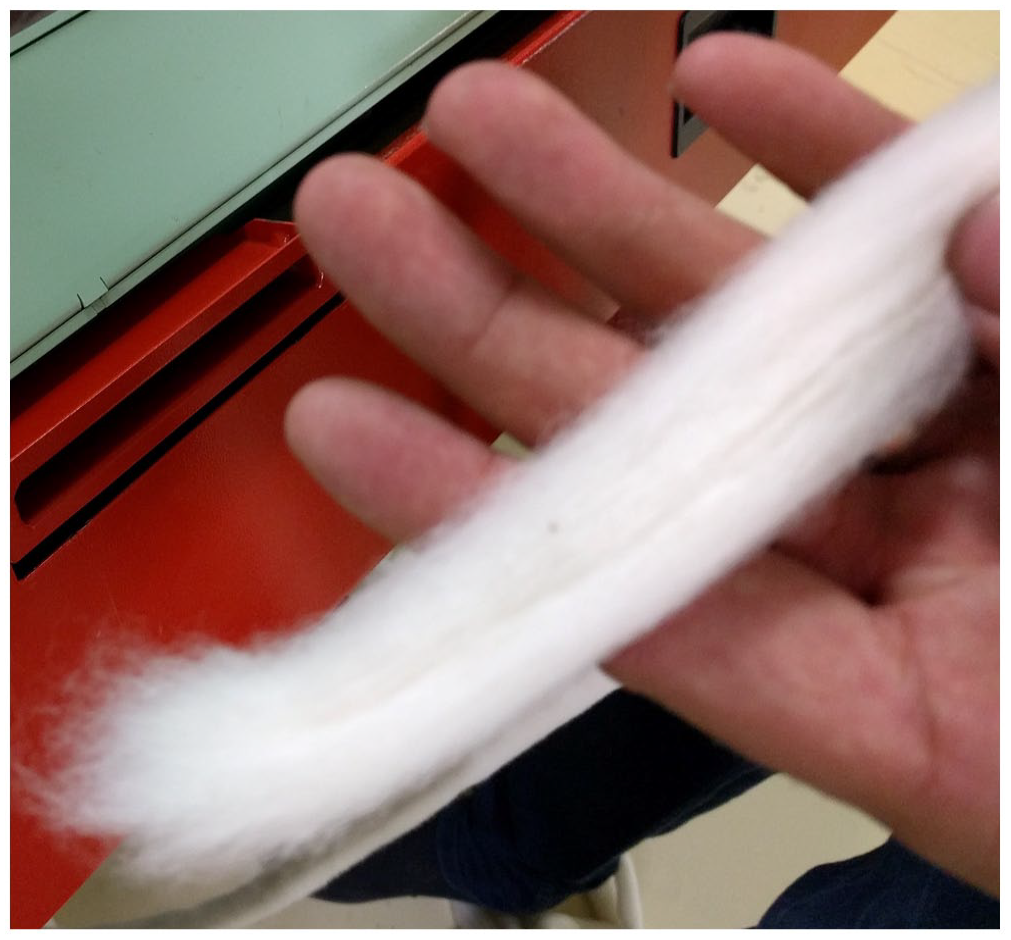
Cotton fibers showing off their stature.
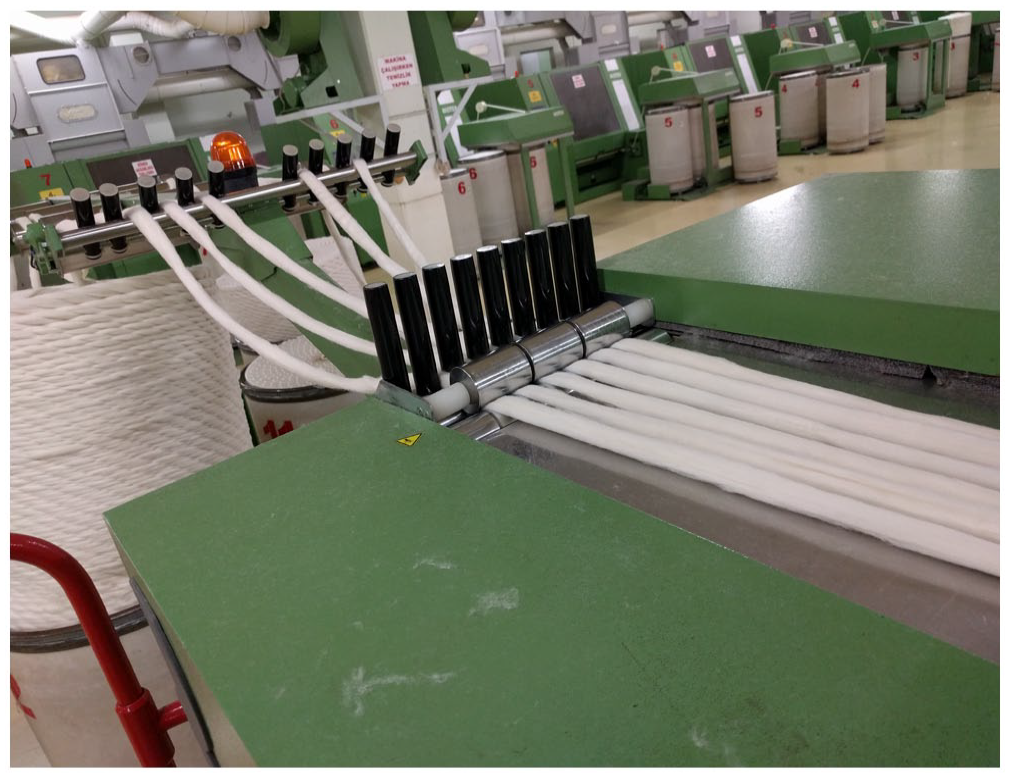
Cotton fibers becoming homogenous and parallel.
Laboring with Cotton at the Knitting Mill
Following the travels of the bunch of cotton seeds, I ended up in another facility, located in Manisa, three hours away by car from the spinning mill. Here is where yarn is knitted and turned into fabric. Before my visit to this mill, I was told that industrial knitting was not rocket science. Supposedly, machines carry out most of the work, and are standard across the industry (see Figure 3 for a dusty affective atmosphere created by cotton-machines-blue-collared-men-bobbins-concrete walls). What I was not told is that machines and cotton do not like each other; and blue-collared humans are in the middle of a long-standing fight, trying to keep both the machines and cotton fibers content with conditions in the facility. While at times humans get angry with either machines or cotton fibers, they show their utmost care for the well-being of cotton and machines at all times. Thus, the myth that prescribes “knitting is carried out by machines” does not represent the life at the shopfloor; the myth is ignorant of ongoing human labor sustaining the conditions for machines to make the stiches, the loops, and the links.
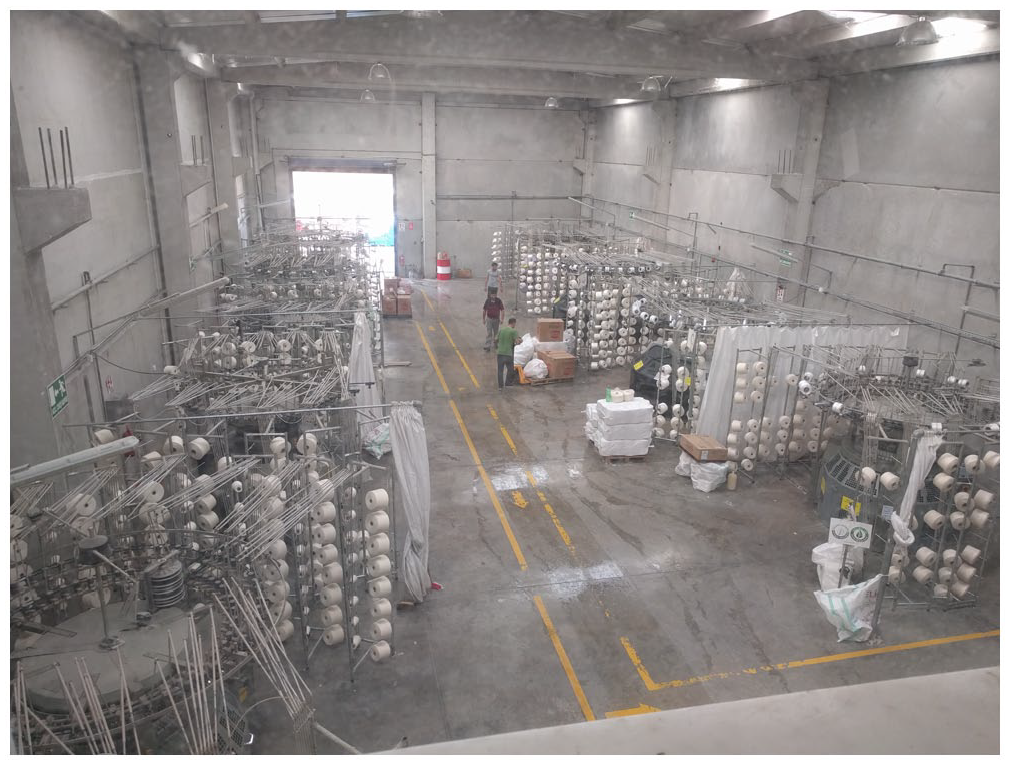
Dusty atmosphere with cotton yarns, knitting machines, humans, and concrete walls in Manisa, Turkey.
The invisible labor of blue-collared humans is significant; they feed the machines with yarn, tie the yarn threads to machines’ arms, oil machine parts, clean the needles periodically, and check up on them every three or four minutes. One of their most important tasks is to keep the cotton fibers away from the needles and to sustain the conditions for needles to work properly. Otherwise, the machines can become defenseless and spill their machine oil onto the knitted fabric. It can happen; in fact it happened while I was observing! The event was such a catastrophe because the machine operator realized the stain only after two tons of fabric was knitted with a few oily needles. The machine operator quit his job and promised himself he would stay away from cotton fibers for the rest of his life.
Blue-collared humans’ work does not end there; cotton fibers are naughty and difficult to control, and pieces fly around constantly. These flying cotton fibers are dangerous not only for the machines, but also for the humans! I learned that in the long term, breathing cotton fibers can cause chronic bronchitis and byssinosis, a permanent lung disease that leads to respiratory distress and failure. To avoid flying pieces of cotton, the humans wash the shopfloor with water every morning; they are like worker bees, moving swiftly following cotton to keep the floor undusted and maintaining clean airflow.
Becoming Fashionable at the Dyehouse
My world continued revolving around the journey of bunches of cotton seeds as they were moving toward becoming fashionable. Knitted fabrics arrive raw at the dyehouse–meaning full of little flea-like bugs and dried cotton plant parts. But they leave the facility cleaned, colored and abled, transforming into a wearable fabric. As such, the dyehouse is where raw knitted fabrics are treated, tamed, and readied for cutting and sewing for human bodies. I observed that making raw fabrics fashionable for human bodies took various chemicals, water, machines, and many human hands. Altogether, dyeing constituted a major transformation process, making possible the production of garments in desired textures, touch, and colors.
The work at the dyehouse involves two distinct phases following one another. The first phase takes place in air-conditioned spaces for white-collared humans, namely management and laboratory personnel. The next phase occurs where the large machines and blue-collared workforce spend their days and nights making the “magic happen,” always on wet floors with loud machine noise, and in air filled with cotton dust. Although separating the processes as such does no justice to the ongoing work occurring in both spaces, below I briefly describe each part of the workflow consecutively.
In the first phase, sales staff work to convince their potential clients that the dyehouse can deliver the colors requested. Once a request is received from a client, the “sampling process” begins at the laboratory. The laboratory is where the formula of a particular dye is prepared by humans in whitecoats with technical high school degrees in chemistry. Also, there are various machines in the laboratory that are as hard working as the human personnel, for example, the “spectrophotometer” and the “gravimetric laboratory dispenser,” as well as domestic machines, such as the dishwasher, doing the repetitive work of cleaning tubes and pipettes. While the laboratory dispenser takes the center stage with all its glamorous glass windows and containers showing off the dyes, the spectrophotometer is the star worker with its intelligence to read a dye’s formula off a fabric and translate it into English (see Figures 4 and 5 for assembling of dyes, sample fabric, and laboratory personnel’s hands). However, I learned that although the spectrophotometer is popular in the industry for providing the most accurate color formulas, it is never exact. Rather, the humans at the laboratory always end up tweaking the formula by eye, through trial and error.
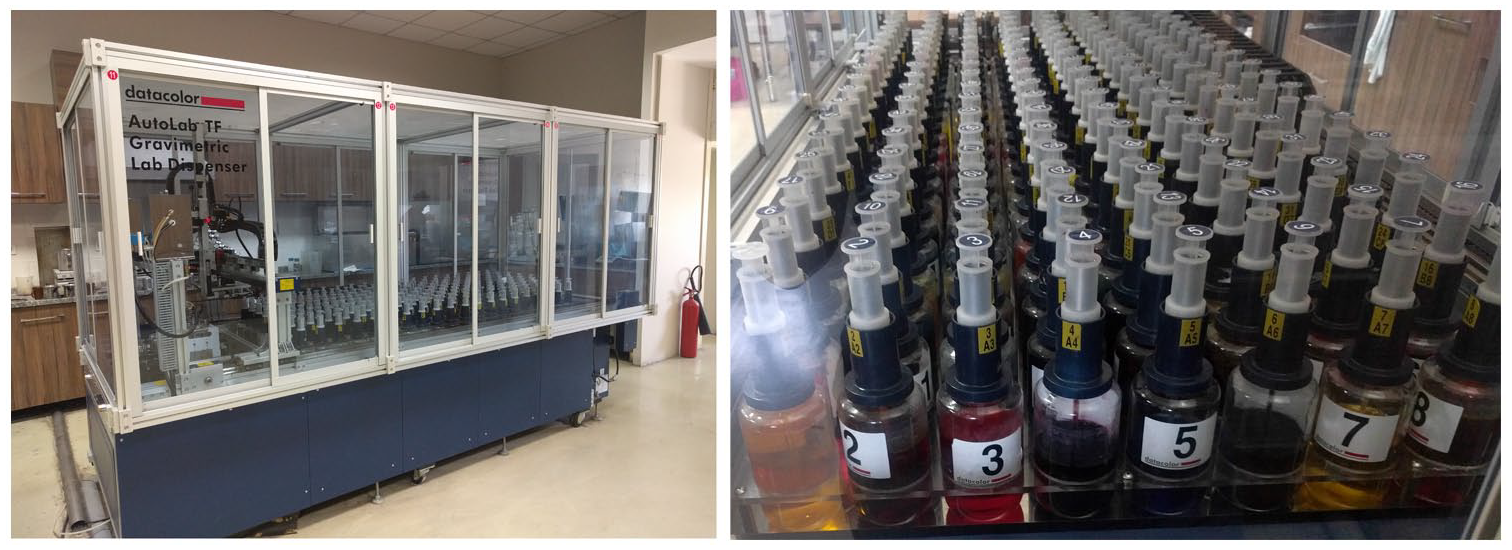
Gravimetric laboratory dispenser.
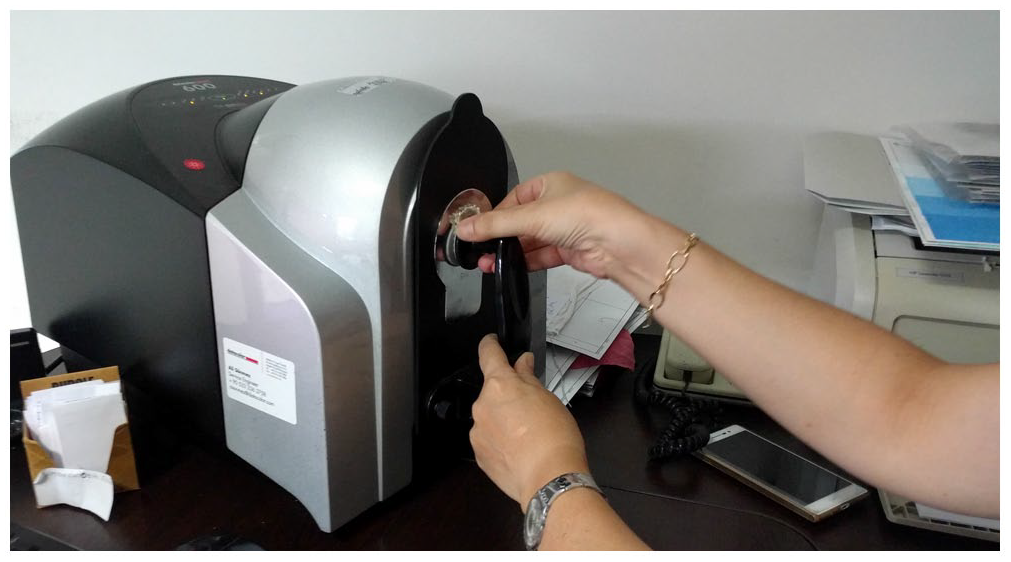
Spectrophotometer.
After three days of several trials and errors, laboratory personnel reach a level of confidence for the color. They compile the best four or five coloring trials and prepare a document with samples of dyed fabric stapled on a A4 size cardboard (see Figure 6 for a momentary assemblage of dyes, human eyes, machines, sample fabrics, and human handwriting on a paper). Each sample has a specific number attached to it for labeling purposes. This document is called the “labdip,” meaning it was dipped into dye at the laboratory. Although this is an English word, it is accepted as part of the common industry language in local Turkish facilities.

Labdips.
But then there is the next phase. . . Welcome to the shopfloor! It is hot and loud. If you are wearing sandals, your feet will get wet and dusty. There are many different machines run by blue-collared humans to treat incoming fabrics; these undertake the work of dyeing, mangling, drying and finishing, and make the raw fabrics fashionable. While some machines blare, especially drying machines, others produce too much heat; and some—the dyeing boilers—feel so hot as if they are about to explode. They are designed with a large body and little lids (see Figure 7 for the wet and steamy affective atmosphere during the assembling of fabrics, dyes, machines, and humans).
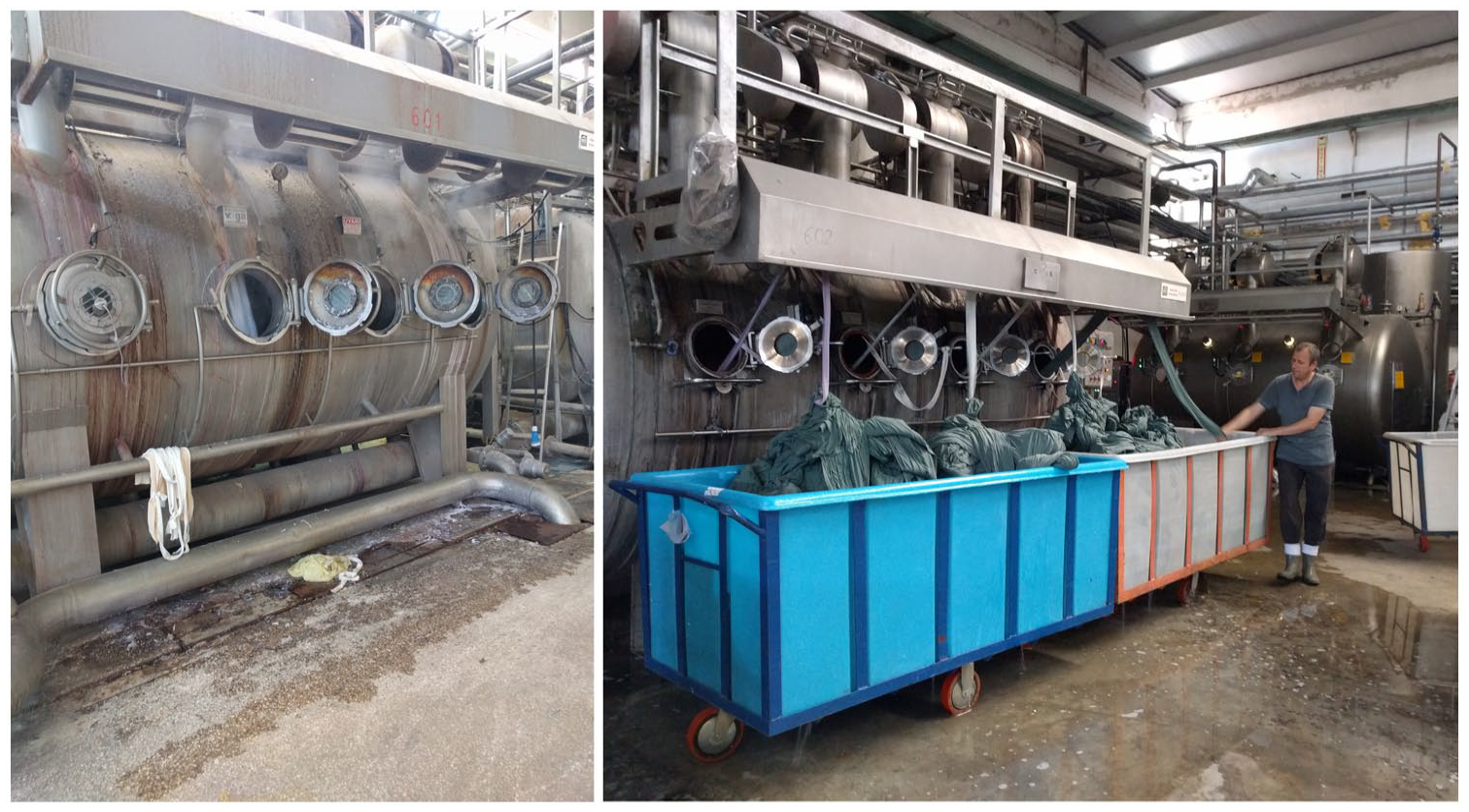
Assembling of dyes, fabrics, boilers, and humans.
The core of the dyeing process takes place in boilers. Fabrics are kept in them at 60°C for about 12 hours on average, though, depending on the color, this period changes. During my conversations, I learned that the success of a chemical transformation depends on the chemical solution, which mainly includes water, caustic soda, and salt in specific proportions. For someone outside of this industry, dyes could be thought of as the “heroes” of this process. But people in this facility informed me that the reproduction of the right conditions for the dyes to do their job are sustained by water and so forth, in addition to the hard labor of blue-collared humans taking care of the fabrics.
Fabrics may end up going through the dyeing process twice or more, and for each process the amount of water use doubles. As described a few paragraphs earlier, recipes for a particular formula are prepared by humans in white-coats at the laboratory. One expects—including clients and the general manager of the dyehouse—that if blue-collared humans were cautious and put every ingredient precisely according to recipes, magic would happen, and fabrics would accept dyes without any problem. Yet, this is hardly the case. In fact, blue-collared humans told me this is never the case, because these recipes are created with a small sample of fabric and small proportions of chemicals, and things are usually controlled in the laboratory. When the recipe is translated to treat the massive amounts of cotton fabrics at the shopfloor, the distribution of dyes, other chemicals, and water inside the boilers cannot guarantee the effectiveness of what was predicted at the laboratory. As a result, dyed fabrics may not come out as perfectly as one might have imagined. Some issues can be improved by re-washing, but for other issues fabrics must be dyed again, doubling the amount of water use for that particular fabric.
It is also worth noting the higher status of organic fabrics in the dyehouse. Although in appearance organic fabrics do not look any different than their conventional counterparts, everyone holds organic in high esteem. For instance, they have designated dyeing boilers and receive special treatments with different chemicals that are listed on an organic certification document. Further, after they come out of boilers, workers handle them very carefully, carrying the wet organic fabric only in their designated pushcarts. Otherwise, organic fabric can become contaminated with residue chemicals, which might have been smeared with wet conventional fabrics.
In the end, whether organic or not, unimaginably complicated processes at the dyehouse transform raw fabrics into materials that touch human bodies. But how is it that human bodies need chemicals and dyes and cannot become intimate with untreated cotton fabrics? Perhaps, that is a thread of another story, but it is quite something to see how raw fabric must go through such labored and special processes to become worthy of humans. It takes the movement of many Olympic size pools worth of water, variously colored dyes, capacious chemicals, skilled hands of blue-collared men and trained eyes of white-coated women to make cotton fabrics fashionable. After this point, no one can recognize my companion, the white puffy cotton, anymore.
Becoming Sustainable at the Cut-and-Sew Facility
Following the traces that the cotton seeds left behind, I finally arrived back at MaviKoy in Izmir, where I started my journey. This is the place where fashionable fabrics are cut and sewn for their final shape, and where they become garments, ready to be worn by humans in the United States and Europe. I was told that MaviKoy is a unique company and the cotton seeds I followed are the luckiest. In conversations with me, industry actors in Turkey praised MaviKoy for its expertise in organic textiles and for treating its workers fairly. All through my observations, I was reminded by its employees that they are honored to be in Turkey’s first certified organic textile producer. In fact, this was the only facility I heard the use of the term “sustainability.”
Calling a product “organic” requires a particular certification that is granted by authorized third-party auditors. The Global Organic Textile Standard (GOTS) is the most demanded certification by European brands that outsource manufacturing to Turkey. While some standards are only for environmental issues, GOTS considers both social and environmental concerns. Production facilities, such as those I visited, can acquire organic certification by requesting third-party audits, which are conducted by authorized bodies. These bodies grant facilities with the certification standards, the criteria for which include concerns for environmental management, wastewater treatment, legal worker pay and benefits, and maintaining safe working conditions for workers.
MaviKoy undergoes audits for GOTS twice a year. For the company, being certified is crucial for maintaining its relationship with European and United States clients; it is only through certification that it can claim they produce “sustainable” garments. As one company member told me, it is impossible to call a garment “organic,” let alone “sustainable,” by looking at it or touching it. One can tell a garment’s status only from its label by recognizing a particular logo that signifies production in a certified facility (see Figure 8).

Global Organic Textile Standard logo.
At the end, the cut-and sew-facility is where cotton seeds finally become sustainable garments. This is where fashionable fabrics are patterned, cut, grouped, sewn, folded, tagged, and packaged into designated bags and boxes. While all these practices are common across all cut-and-sew facilities, MaviKoy’s claim to sustainability lies in the certification it receives from auditing bodies guaranteeing to Western clients the safe and fair working conditions and the use of organic materials in these facilities. That is why I was told, the cotton seeds I followed were the luckiest!
From Sustainability to Becoming Naturecultural
The case study explored the concept of “sustainability” as we narrated the journey of a bunch of organic cotton seeds in their becoming of a “sustainable” t-shirt. We read the case with the ethico-onto-epistemological sensibilities suggested by Barad (2007), moving from the conventional understanding of “sustainability” that lacks any acknowledgement of human–Earth relations, to becoming naturecultural that accounts for humans’ domination of nature as well as embodied and affective relations of humans with nonhumans.
Once, cotton seeds were just “nature” planted in soil and cared for by farmers and migrant workers for their copious cotton balls. Yet, as the case study illustrates, through affective encounters of human labor and machine work, these white puffy fruits became cultivated by the human-centric and capitalist norms and values of industrial textile production—combed, thinned, spun, bleached, and dyed. After such series of ontological transformations, we can no longer talk about “nature” (e.g., cotton) without “culture” (e.g., thinning, dyeing, etc.); we can only refer to naturecultures (Haraway, 2003; Subramaniam, 2014). As such, the narrativity of the case shows the conceptual need to account for both exploitative and non-exploitative human-Earth relations; thus to deterritorialize sustainability from a human-centric and capitalist activity dominating nature to material–discursive assemblages of more-than-human and more-than-capitalist affective relations (Barad, 2007; Coole, 2013).
However, in new materialist arguments “de-centering the human” does not mean erasing it. Much to the contrary, human bodies and their affects are very much present in research assemblages but are not the privileged subjects/objects. They exist only in their relationships with other bodies (humans and others) and vice versa. So, while one human body recounts the fieldwork story, all throughout the journey her existence is dependent on her being with all other protagonist humans and non-humans populating her path and making her do things while also becoming other with her as they move along in assemblages unfolding. If anything, the story is not one of a privileged gaze but of a human entering a field and the surprises with which she becomes inscribed as the story unfolds. Thus, the “I” was not self-centered or self-sufficient but accompanied in awe with what she was learning; becoming other with all other. The phrase “I learned” all along reiterates this point.
As cotton moved through the industrial facilities and became assembled and re-assembled with affects, machines, labor, chemicals, water, dyes, and certifications, as well as researchers, the assemblage becoming naturecultural materializes. Here, becoming naturecultural is produced within and through capitalist and non-capitalist, anthropocentric and non-anthropocentric practices and encounters (Gibson-Graham, 2011; Gibson-Graham & Roelvink, 2009). It is only after making visible these encounters that we come to recognize the sedimented human–Earth power relations maintaining some humans’ interests (Coole, 2013). As our case illustrates, becoming naturecultural is cotton seeds’ journey in the twenty-first century. It is only as a result of these affective more-than-human and more-than capitalist entanglements that we have “sustainable” t-shirts today.
Implications for Organizational Sustainability Research
We advanced becoming naturecultural, a material–discursive assembling process, as a novel conceptual and empirical approach by drawing from feminist new materialisms. Stitching ethnographic examples of cotton’s movement and transformation through several industrial facilities, our case study narrative became an experiment into de-centering sustainability as an anthropocentric and capitalist concept in our major literature. Capturing affective human–Earth power relations, becoming naturecultural offers a move toward a minor literature that accounts for embodied affective assemblages of more-than-human and more-than-capitalist relations. These encounters might trigger thought and body to imagine, and eventually, perform livable naturecultural futures.
As we went through this inquiring process, two implications for organizational sustainability research more broadly were also unfolding: how to think with and write with becoming naturecultural. First, by locating our inquiries in relational ontologies and engaging with new materialist approaches, we learned to be affected with research assemblages and explored the materialization of human–Earth power relations in everyday human and nonhuman encounters. In so doing, the study highlighted the enactment of human exceptionalism as it occurs unreflectively in conventional organizational sustainability research, and offered possibilities for evading these enactments. Second, the ontological transformations we articulate challenge human-centered knowledge production in organization studies. It made evident that writing from a humanist perspective was no longer tenable while demonstrating a way to decenter (not eliminate) the voice of research from the speaking human subject. We further discuss these implications below (see Table 1 for a summary).
Thinking and Writing with Becoming Naturecultural*.
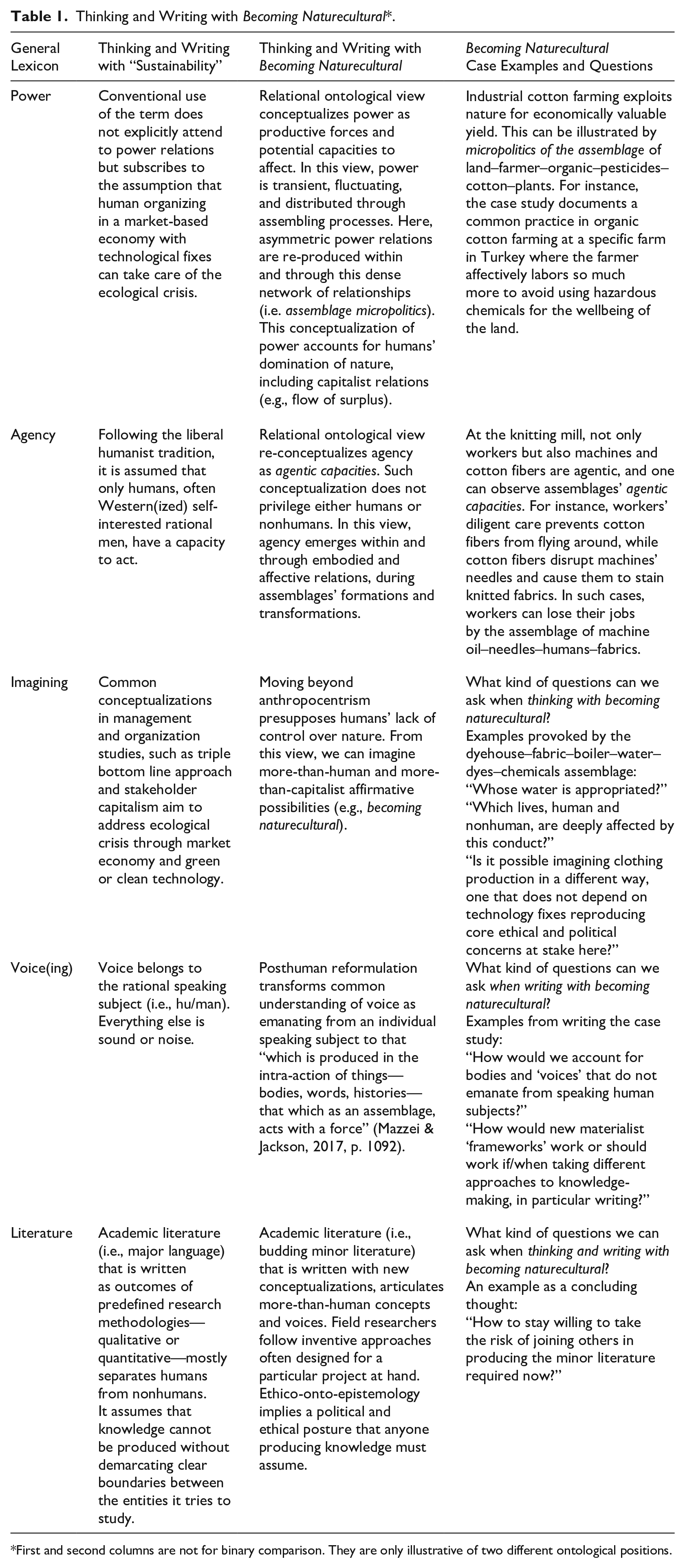
First and second columns are not for binary comparison. They are only illustrative of two different ontological positions.
Thinking with Becoming Naturecultural: Re-visiting Anthropocentrism
In forwarding becoming naturecultural, we respond to calls for new conceptualizations challenging capitalist assumptions and bringing focus to planetary human–Earth relations (Ergene et al., 2021; Sayers et al., 2022). In doing so, we contribute to ongoing conversations in our literature about power, agency, and imaginings to foster livable possibilities for all.
Consistent with organizational research pointing to Deleuzian thought in theorizing posthuman conditions (Simpson, Harding, Fleming, Sergi, & Hussenot, 2021), becoming naturecultural is grounded in an ontology of becoming, where power signifies embodied and affective capacities that human and nonhuman bodies produce as they form relations. As such, becoming naturecultural expands the views arguing for a relational understanding of power and agency moving beyond the liberal humanist separation of culture from nature (Braidotti, 2013; Kalonaityte, 2018). However, for becoming naturecultural, there is no end point or solution but rather a continuous engagement with what is there to come (Haraway, 2016).
Becoming naturecultural is a feminist thinking tool. It is rooted in the tradition of feminist knowledge production, committed to challenging inequalities, marginalization, and exclusion, and creating imaginaries for livable futures for all (Bell, Meriläinen, Taylor, & Tienari, 2020; Sayers et al., 2022). It is provoked by two feminist new materialist concepts, “agentic capacities” and “flow of surplus value,” which share the ethos of “old” materialism but do so from a Deleuzian relational ontology (Coole, 2013; Gibson-Graham, 2011).
Here, power is ethico-onto-epistemologically transformed from a human-centered and capitalist view into affective more-than-human and more-than-capitalist assemblages. For example, in organic cotton farming, the farmer affectively cares and labors on his field to avoid using pesticides and herbicides. The surplus value of the farmer is appropriated by the land, illustrating the possibility of noncapitalist practices, especially when organic cotton yields 30% less than its conventional counterpart. Yet, the farmer’s noncapitalist practices become entangled with the trading firm’s capitalist relations, when the trading firm secures supply that yields higher returns for its business even after it compensates the farmer for his loss. In this entanglement, the assemblage micropolitics become evident (Deleuze & Guattari, 1987; Fox & Alldred, 2018). The everyday more-than-human and more-than capitalist farming practices become entangled with the institutionalized market capitalism. As much as capitalist relations dominate most of cotton trading, the inevitability of market capitalism can be contested, for it is in moments like this that assemblages can be unpacked as something always escapes from the dominant.
As a thinking tool, becoming naturecultural is also a constant reminder of the materialization of human superiority every time we refer to sustainability, and therefore fosters evading human exceptionalism when thinking about sustainability practices. As such, questions of agency come to the fore. For instance, from the case study we learn that cotton fibers disrupt machines’ needles and cause them to stain knitted fabrics, creating waste of tons of fabrics, dyes, water, energy, and human labor. In addition, workers can lose their jobs when large amounts of fabrics are irreversibly stained by the assemblage of machine–oil–needles–humans–fabrics. Thinking with becoming naturecultural enables inquiring material consequences of such agentic assemblage and articulating the constituencies that are disproportionately affected by the assemblage’s act. For example, it facilitates questioning “whose water is appropriated?” and “which lives, human and nonhuman, are deeply affected by this conduct?” While this is a particular example, all fabric dying involves such consequences wherever the facilities are located, and it is usually the already disadvantaged who bears the consequences of these practices.
Is it possible to imagine clothing production in a different way, one that does not depend on technologies reproducing the core ethical and political concerns at stake here? Gasparin et al. (2020) suggested “slow design” as an imaginary solution to disrupt the anthropocentric modes of reasoning and imagine forms of organizing with nonhumans (see also Gasparin & Neyland, 2022). From this view, clothing production would respect the ecological cycles of nonhumans involved and rely on communal artisanal production. This is the ethico-onto-epistemology posture fostered by this feminist thinking tool, which will also contribute to defining a dwelling place as called for by Latour: “that on which a terrestrial depends for its survival, while asking what other terrestrials also depend on it?” (Latour, 2018, p. 95).
Writing with Becoming Naturecultural: More-Than-Human Writing in Organization Studies
Once we take a new materialist turn and pay attention to human and nonhuman relations, how would we then write in organization studies? How would we account for bodies and “voices” that do not emanate from speaking human subjects? Research on relational agency has been unfolding in social theory for some time, but despite ANT’s best moments trying to show how actants and agencies of all kinds “do things,” it is very hard “for the sociologists of the social who have to filter out everything which does not look in advance like a uniformed ‘social actor’” (Latour, 2005, p. 55). To gain as much inventiveness as the actants it tries to follow, ANT has often borrowed from narrative theory. But other critiques also argue that the notion of “voice” as such presupposes a “rational speaking subject,” a conception that has already privileged the white male subject throughout history and excluded people of color, women, and nonhumans from participation in political processes (Revill, 2021).
These critiques apply equally well to typical scholarly writing in MOS, usually performing human-centered knowledge production where authors “voice” their arguments or “give voice” to (often privileged) others, more like ventriloquists hiding behind opaque curtains of theories, methods, and distancing languages. How would new materialist “frameworks” work or should work if/when taking different approaches to knowledge-making, writing in particular?
Pullen and Rhodes (2015) have anticipated some answers to this question. However, as we write these pages, we have also been moved by the accounts of other organizational scholars who demonstrated what a feminist new materialist writing can look like. Valtonen and Pullen (2021) captivated us in their bare “writing with rocks,” creating embodied and affective relations with rocks and us. Huopalainen entangled us with the practice of feminist dog-writing and made us reflect upon “who and what is the writer?” and “whose writings, agencies and bodies we include or exclude in the field of organisation studies?” (Huopalainen, 2020, p. 7). Joining them here, we have written with cotton and explored possibilities our entanglements might produce in our field.
Specifically, we followed Mazzei and Jackson who suggest that from a posthuman position, voice no longer belongs to a speaking subject but instead emerges as “a material—discursive practice that is inseparable from all elements (human and non-human) in an assemblage” (Mazzei & Jackson, 2017, p. 1090). Thus, our writing here attempted to follow this approach to voice as a material experiment and intervention in our field’s knowledge production practices and avoid its anthropocentrism. The voice claimed in the case study was not attributable to the first author but to the assemblage (i.e., the research collectivity), and our focus and intention was showing the assemblage’s capacity to act when the world is facing extraordinary ecological crises.
Yet, while we followed all those suggested approaches in narrating the case study from a human de-centered position, including the voice of the agentic assemblage of enunciation, we are nonetheless cautious about the dangers of anthropomorphic imposition in our own interpretations. For instance, when we anthropomorphize cotton as being child-like (e.g., “cotton fibers are naughty”) and machines as being workers-like (e.g., “the spectrophotometer is the star worker with its intelligence to read a dye’s formula”) we are prompt to disclaim this attribution as an outcome of the first author’s affective reading of her encounters with humans, cotton, machines, and her own fieldwork practices. We said in fact that as she reflected all this as the voice from the assemblage, she was moved moment by moment by the unfolding of humans’ becomings with cotton and machines. But is not the disclaimer itself and her reflections another moment of human-centering? And, of course, this narration is unconventional and may even come out as naïve. Thus, what to do?
The more we think about this the more we realize that trying to break the mold of conventional practices from the strictures of our own disciplines may end up being the major trap we fall into. Were we too naïve by thinking our writing could contribute to the becoming of the more-than-human without falling prey to academic games? A writing mattering for repopulating the Terrestrial attractor? (Latour, 2018, p. 91). From where we stand, the jury is still out.
We observe that recently organizational writings affected by these orientations have continued to expand and so have our conceptual resources. For instance, Harding, Gilmore, and Ford (2022) adapt feminist posthuman research methods to study the materialities and materialization of working bodies. Sayers et al. (2022) engage with feminist speculative fiction as a resource for reimagining posthuman ethical thinking. Meanwhile, Jørgensen, Strand, Hayden, Sparre, and Larsen (2021) argue that the field of organizational learning needs a new language when speaking about sustainable organization. Following Latour (2017), they develop the Gaia theater cycle where scripts and storytelling imagine and visualize a future which is not yet finished but open for interpretation.
Thus, we see articulating this project as another material–discursive assembling process, engaging in experimental writing and taking a risk as part of our ethical and political commitments to contemporary matters of concern (Latour, 2004a). And so we did; by following the steps of our critical theory teachers we took “the risk of ridicule by experimenting with language that shocks established habits and deliberately provokes imaginative and emotional reactions” (Braidotti, 2013, p. 87), hoping to carve out more space for experimentation and joining others in producing a more-than-human organization studies as an intervention.
Longing for a More-Than-Human Organization Studies
“[. . .] the task of critical theorists should be [. . .] to provide adequate representations of our situated historical locations [. . .] that is connected to the ideal of producing socially relevant knowledge [. . .]” (Braidotti, 2013, p. 4)
This paper started as a modest project for rethinking “sustainability” by taking an ethico-onto-epistemological posture capturing the uneven power relations between humans and Earth-others. Inspired by feminist new materialisms, we argued that relational ontologies facilitate moving organizational sustainability research beyond anthropocentrism and re-configure it as a more-than-human space. That is, we hoped to make an intervention in the “major language” of our field.
Moving with the emerging feminist new materialist research in MOS makes us realize that the contours of a minor literature in MOS is well on its way. However, is it so or is it just a fad? As we discussed, to problematize, disturb, irritate a major language, a minor literature must be-coming with affirmative possibilities and concepts that are in constant flux and transformation; in other words, it will never be settled. Is that happening? Is a literature for organizing in the Anthropocene sufficient? Relational enough? Unsettling enough? What else is there? What else could be coming?
We produced this paper intending to address such inquiries. Its main contribution, a new conceptual and empirical approach—becoming naturecultural—is another thread following and multiplying the threads that our predecessors initiated in this regard but avoiding settling there. Most fundamentally, as a feminist project, thinking and writing with becoming naturecultural materializes ethical and political relations re-situating MOS in this current posthuman condition. Our hope for it is to ontologically transform how we become with Earth-others: transforming our conception of them as resources to be exploited by moving toward living with them as embodied companions to think and write with. Hopefully becoming naturecultural would help with cultivating response-able ethics and politics in our field (Barad, 2012; Valtonen & Pullen, 2021), but as a concept, it will become other, immanent to its conditions of emergence.
As such, this paper is part of a much larger project, imagining different modes of MOS in and for the Anthropocene; a collective body of research that is more-than-human and more-than-capitalist, and that acknowledges its political and ethical commitment performing a livable world for all. Together with Bargetz (2019), we are longing for this world to materialize while offering a minor move toward it.
Footnotes
Acknowledgements
We thank the Senior Editor Ignasi Martí and the anonymous reviewers whose guidance and positive suggestions through the revision process made this publication possible.
Funding
The authors received no financial support for the research, authorship, and/or publication of this article.
Conflict of interest
The authors have no conflicts of interest to declare.
