




Abstract
Consensus is often seen as a necessary condition for collaboration in multi-stakeholder initiatives and in multilateral settings. Yet, how the requirement of consensus shapes deliberations and negotiations of global governance issues – and at what costs – remains underexamined. This article raises the questions: How are contested frames revised for consensus in multilateral contexts, and what are the implications for the issues framed? We trace contestations over the framing of sustainable diets across diverse actors in the United Nations (UN). Based on a frame analysis of official policy documents, substantiated by insights from interviews with UN staff and experts on UN policy, we develop a processual model of frame revision in multilateral governance that explains how different forms of frame consensus – integrative, antagonistic and evasive – are reached. We advance framing research by theorizing how frames are revised for consensus through compartmentalization and subversion of contentious issues, thereby masking incommensurable differences. We also contribute to research on deliberative tensions through a processual take on consensus in multilateral settings. These contributions have wider implications for understanding global governance, highlighting why UN consensus politics are often associated with incremental rather than radical changes.
Keywords
Introduction
Addressing grand challenges that transcend national borders – such as climate change (Wijen & Ansari, 2007), migration (Klein & Amis, 2020) and ecosystem protection (Zimmerman et al., 2022) – requires coordinated action across diverse actors (Ferraro et al., 2015). This has spurred the rise of transnational and global governance initiatives that bring together governments, industries and social movements (Ansari et al., 2013; Reinecke & Ansari, 2016). These initiatives are often steered through multi-stakeholder initiatives (Gray & Purdy, 2018) and multilateral organizations such as the United Nations, the International Monetary Fund and the World Bank (Eberlein, 2019). In these settings, consensus is often celebrated as a marker of legitimacy and collective will, yet it rarely leads to satisfactory outcomes.
In this paper, we are interested in the interactive process of reaching consensus and the implications of these efforts in addressing grand challenges. More specifically, we studied the United Nations (UN) as one of the largest governance contexts for addressing transnational issues collectively. With 193 member states and a complex system of organizations and bodies, actors negotiate and struggle over governance issues and potential solutions. To reach a collective understanding despite actors’ individual differences, many UN bodies use consensus-building (De Pryck, 2021; Urfalino, 2014).
Consensus goes beyond simple agreement as it operates on the premise of non-opposition, creating an apparent unanimity (Urfalino, 2014). It functions both as the outcome of deliberations and negotiations (the ‘what’) and as the process (the ‘how’) of collective decision-making. Recent multi-stakeholder studies have cautioned that a focus on consensus can universalize certain viewpoints while marginalizing others (Banerjee, 2018; Ehrnström-Fuentes, 2016; Maher et al., 2024). However, how consensus-building shapes multilateral deliberations and negotiations of global governance issues remains underexamined in organizational research.
Framing theory helps address this gap by offering a lens to understand how actors construct and contest the meaning of these issues and potential solutions (Ansari et al., 2013). Struggles over meaning unfold through framing processes (Cornelissen & Werner, 2014), often marked by framing contests (S. Kaplan, 2008), in which actors mobilize and counter-mobilize ideas to assert interpretive authority (Benford & Snow, 2000, p. 613). Within the UN, a complex system of interlinked organizations, framing processes unfold among actors with differing interests and across various spaces. Thus, revising frames for consensus is riddled with poorly understood tensions that shape the framing process, raising questions about what belongs within a consensual frame and what costs such consensus entails.
To explore these tensions, we analysed the political contestation among UN agencies and member states over the framing of ‘sustainable diets’. This policy domain is significant for interconnected issues such as climate change, food systems, food security, and public health and nutrition (Burlingame & Dernini, 2018). It is also politically sensitive, often at odds with dominant economic interests. Drawing on an interactional framing analysis of UN policy documents and member states’ submissions, complemented by interviews with UN staff and policy experts from academia and civil society, we identified a frame revision process across multilateral arenas. The process, reactive to contestation, compartmentalized and subverted the negotiated frame during consensus-building processes. As a result, differences were masked through forms of frame consensus – integrative, antagonistic and evasive – which sustained high levels of ambiguity and sidelined more contentious frame components. Based on our findings, we develop a processual model of frame revision in multilateral governance that explains how these forms of frame consensus are achieved.
Our study makes two key contributions. First, we advance framing research in multi-stakeholder contexts (Dewulf & Bouwen, 2012; Grimm & Reinecke, 2024; Zimmermann et al., 2022) by theorizing how, in renegotiating for consensus, frames are revised through compartmentalization and subversion of contentious issues, thereby masking irreconcilable differences. Second, we advance research on deliberative tensions (Arenas et al., 2020; Banerjee, 2018; Giamporcaro et al., 2023) in multilateral settings through a processual take on consensus, which demonstrates how different forms of consensus emerge and how these reproduce deliberative tensions. We conclude that the emphasis on consensus in multilateral contexts risks leading to fragile and incremental outputs that lack specificity and, at least partly, explains why UN politics rarely translate into transformative action in addressing grand challenges.
Global Governance and Deliberative Tensions
Multi-stakeholder initiatives and multilateral organizations operate simultaneously as actors that shape global governance and as arenas where its issues are deliberated and negotiated. Organizations such as agencies in the UN system often act as ‘orchestrators’ or intermediaries in convening and coordinating governance efforts toward common interests (Eberlein, 2019). Prior research has highlighted the value of orchestrating high-level multilateral events such as the UN Earth Summits (Ferns & Amaeshi, 2019) and climate change conferences (COPs) (Schüssler et al., 2014) as spaces for deliberation and negotiation on global issues. Through organizing these events, the UN creates fora that ‘facilitate the interaction of disparate actors, normally not associated with one another in physical space’ (Ferns & Amaeshi, 2019, p. 1556). These interactions may (Ansari et al., 2013), under the right conditions (Schüssler et al., 2014), catalyse field-level change. It is therefore important to understand the processes underlying multilateral outputs.
In multilateral arenas, deliberations and negotiations are characterized by competing interests and attempts to coordinate these in addressing global issues (Ferns & Amaeshi, 2019; Wijen & Ansari, 2007). This coordination among multiple stakeholders is inherently challenging (Gray & Purdy, 2018), with scholars describing it as ‘epistemic contestation’ (Arenas et al., 2020) and as a pluriversality that exists in opposition to the construction of universal positions (Ehrnström-Fuentes, 2016). In UN arenas, such tensions might play out in disputes over the introduction or (re-)negotiations of outputs. For example, Banerjee (2012) observed at the Durban UN climate change conference how countries objected to specific wording, such as ‘legally binding’ (opposed by India) vs ‘legal outcome’ (opposed by the EU) and ‘equity’ (opposed by the US, who preferred ‘legal parity’). The increased plurality of interests in multilateral arenas can impede transformational change (Schüssler et al., 2014) and the promoted inclusiveness opens up for businesses influencing such governance spaces (R. Kaplan, 2024).
Collective decision-making in multilateral settings typically works based on the consensus principle: Rather than requiring full unanimity by vote, it is based on an apparent unanimity following the rule of non-opposition, notwithstanding individual differences among members. The rule of non-opposition ensures states’ sovereignty as it technically grants them the right to veto, shaping a form of multilateral consensus designed to be more democratic (Urfalino, 2014). Unlike expert or scientific consensus, which often aims for a singular view, multilateral consensus embraces a plurality of perspectives (De Pryck, 2021).
Consensus in multilateral organizations can be built through shared hybrid logics (Ansari et al., 2013), the influence of scientific consensus (Wijen & Ansari, 2007), or through the deliberate use of ‘constructive ambiguity’ (Fischhendler, 2008) that leaves sufficient room for interpretation (Feront & Bertels, 2021). However, critics have emphasized that a ‘preoccupation with consensus’ (Banerjee, 2018, p. 810) should be seen as a double-edged sword. While it might foster inclusiveness in outputs, differences in participants’ influence and equality likely remain during consensus-seeking processes (Urfalino, 2014). Moreover, consensus often comes at the cost of specificity and compromising (De Pryck, 2021) and does not always acknowledge incommensurable differences (Ehrnström-Fuentes, 2016).
These tensions are reflected in wider research on multi-stakeholder governance, often seen as tensions over the deliberative capacities of inclusiveness, authenticity and consequentiality (Dryzek, 2009; Giamporcaro et al., 2023). These are central to initiatives’ legitimacy and efficacy but are difficult to realize simultaneously (Arenas et al., 2020). However, in addition to the tensions between deliberative capacities, we argue that in multilateral contexts, these capacities themselves are internally conflicted, making outputs fragile. Tensions over representation between the autonomy of UN organizations and their members challenge inclusiveness in negotiation arenas – who are the UN organizations and involved actors representing? Tensions over processes, where actors coordinate for consensus while having competing interests, question the authenticity of processes – how are the deliberations and negotiations influenced? Finally, tensions over outputs, between constructive ambiguity to facilitate coordination and specificity to address, raise questions about outputs and eventually outcomes – what is the consequentiality of the consensus reached?
Since these deliberative tensions might jeopardize multilateral consensus, they underscore the need to better understand the value(lessness) of consensus-building in multilateral arenas. In practice, how issues are framed in multilateral contexts can decisively influence which topics gain priority, which coalitions form and what outputs emerge (Ansari et al., 2013). This points to the importance of framing, which we will discuss further below.
Framing in Multilateral Contexts
Frames are defined as schemata of interpretation (Goffman, 1974, p. 21). They are interpretation guides that ‘help to render events or occurrences meaningful and thereby function to organize experience and guide action’ (Benford & Snow, 2000, p. 164). Framing then refers to the processes of constructing meaningful frames (Cornelissen & Werner, 2014) or ‘signifying work’ (Snow & Benford, 1988, p. 198). As such, framing elucidates the dynamics through which the meaning of issues is constructed and contested using language and symbols. Framing processes often aim to make specific problems or solutions salient (Entman, 1993), thereby facilitating mutual understanding across actors. Attaining and maintaining shared frames among actors with divergent interests is central to multilateral contexts, characterized by both coordination and competition (Wijen & Ansari, 2007).
In movements and political struggles over diverging perspectives, scholars have focused on aligning actors’ interests through purposeful or strategic framing. They have shown how ‘collective action frames’ (Benford & Snow, 2000, p. 614) are employed to mobilize support and to counter existing framings of reality (Cornelissen & Werner, 2014). Several frame alignment processes expose these strategies (Snow et al., 1986): (a) frame bridging by linking similar or congruent frames; (b) frame amplification by emphasizing, highlighting or clarifying parts of a frame; (c) frame extension by broadening the frame to encompass new interests; and (d) frame transformation by changing the frame to address a different, new, or counter-factual understanding. These strategies can help to unite actors around a common understanding of a problem, its causes and potential solutions.
Organizational scholars have studied frame alignment to understand convergence (Ansari et al., 2013; Furnari, 2018) and political contestation over governance issues such as climate change and resource extraction (Murray & Nyberg, 2021; Nyberg et al., 2020). This literature has shown the role of different actors and the ‘content’ of their preferred (counter-)frames in explaining how frames evolve dynamically (Klein & Amis, 2020; Nyberg et al., 2020), define problems and diagnose causes, and propose solutions to the situation at hand (Furnari, 2018; Reinecke & Ansari, 2016). These framing contests can unfold within (S. Kaplan, 2008) or between organizations (MacKay & Munro, 2012), when actors strive to make their frames resonate (Giorgi, 2017) or mobilize support for shared understandings (Guérard et al., 2013).
In multilateral arenas such as UN climate conferences, actors’ contestation revolves around the sensemaking of global governance issues and their proposed solutions (Vanhala & Hestbaek, 2016). This can be expected due to the multiplicity of perspectives present: Intermediaries such as UN secretariats shape meaning construction (Eberlein, 2019); member states’ roles and issue positions differ and evolve over time (Vanhala & Hestbaek, 2016); and deliberations unfold across multiple spaces (Giamporcaro et al., 2023), each linked to different UN bodies and events. Thus, a better understanding of frame alignment in multilateral settings is important (Ansari et al., 2013; Gray, 2011).
These concerns have partly been addressed by studying micro-level interactions, among others in multi-stakeholder contexts (Gray et al., 2015; Reinecke & Ansari, 2021). Building on Goffman (1974), this research highlights how frames transform situationally and through bottom-up processes, emphasizing cumulative and interactional co-constructions – so-called frame laminations (Arenas et al., 2025; Lee et al., 2018). In framing interactions, interpretations and meanings are layered through keying (transforming activities into something else), re-keying (transforming the transformed), frame breaks (violating a frame, a new one emerges), misframing (formation of different interpretations), or frame ambiguity in the form of vague frames or uncertainty between frames (Feront & Bertels, 2021; Gray et al., 2015; Reinecke & Ansari, 2021). These dynamic and interactional processes underscore the complexity of meaning-making in deliberative settings, where frames are not fixed but continuously negotiated, layered and reconfigured through interaction across actors.
Once actors’ frames are aligned, retaining such shared frames across actors and arenas is challenging. For example, Grimm and Reinecke (2024) emphasized how collaborating is ‘on the edge of failure’ in their study of the German Partnership for Sustainable Textiles. They showed how negotiators align frames through cumulative laminations of framing within arenas and frame stretching across arenas – strengthening shared understandings over time. Others have shown how contestations over a particular frame’s content can be addressed through reframing tactics, such as ‘frame decoupling’ (separating existing frames that were connected) (Meyer et al., 2016), ‘frame accommodation’ (accommodating to the challenging element), ‘frame disconnection’ (removing challenging elements) and ‘frame incorporation’ (including a downgraded version of the opposing frame) (Dewulf & Bouwen, 2012). These interactional perspectives have shown that alignment on shared frames is facilitated by actively dealing with differences.
To date, interactional multi-stakeholder framing studies have emphasized the role of shared frames in maintaining collaboration (Klitsie et al., 2018; Zimmermann et al., 2022) and how shared frames can be maintained (Dewulf & Bouwen, 2012; Grimm & Reinecke, 2024). However, actors might support an overarching consensus frame without a fully shared or unified understanding of perspectives or values in the sense of unanimity. We argue that in framing interactions in multilateral contexts, where shared frames are to be maintained for consensus among member states and also across different UN organizations and their respective secretariats, framing contests remain latent despite a preference for consensus. This leads to three problematizations of the framing literature. First, as emphasized by previous studies, multilateral settings are characterized by a multiplicity of diverse actors with competing demands – including secretariats, member states and non-state actors – and arenas that shape the representation in framing (Ansari et al., 2013; Schüssler et al., 2014). There are unequal power relations and external forces that shape negotiations, potentially pushing certain things off the table in reaching a consensus.
Second, research shows that frame shifts in multilateral contexts can generate broad consensual understandings of issues (Ansari et al., 2013). Yet in such arenas, consensus is not only an outcome but also a mode of collective decision-making (De Pryck, 2021; Urfalino, 2014). This dual role of consensus shapes framing interactions and processes. On the one hand, framing is driven by contestation, as actors seek to avoid overt opposition. On the other hand, consensus often glosses over differences and ambiguities, which later resurface. Thus, negotiations rarely resolve framing contests; rather, they temporarily suspend them until deliberations inevitably resume.
Third, frame ambiguity, in the form of vagueness or uncertainty (Goffman, 1974), can be constructive for reaching consensus since it leaves room for interpretation (Feront & Bertels, 2021). Ambiguity can therefore be employed strategically (Jarzabkowski et al., 2010) or instrumentally (Feront & Bertels, 2021). However, it can also trigger situational misframing (Reinecke & Ansari, 2021) and hinder field-level change (Feront & Bertels, 2021) – thus being in tension with output consequentiality.
Existing research has significantly advanced understanding of how shared frames are constructed, aligned and maintained in multilateral and multi-stakeholder contexts. While consensus is treated as central to decision-making in these contexts, we know comparatively less about how frames are revised to accommodate tensions over representation, process and outputs in deliberations. The literature tends to treat consensus either as an outcome of successful frame alignment or as an assumed condition enabling coordination, rather than examining it as an ongoing framing process that both organizes and constrains deliberation. Moreover, the implications of consensus-seeking for global governance issues remain analytically overlooked. Therefore, the broad research question guiding our study is: How are contested frames revised for consensus in multilateral settings, and what are the implications for the issue framed?
Methods
Research context
To study framing processes in multilateral settings, we focused on global food governance. Food is fundamental to human existence; most lives are organized around it and it is recognized as a human right (Moser et al., 2021). However, organizing food sustainably involves multiple issues: People and regions are suffering from nutritional and food insecurity (Clapp et al., 2022); intensive agriculture degrades the environment including soils (Sage, 2025); land-use change, fertilizer use and the livestock sector drive biodiversity loss and climate change (IPCC, 2019; Rosenzweig et al., 2020); and, global food value chains are increasingly concentrated and dominated by a few corporations (Clapp, 2021), often featuring poor working conditions (Böhm et al., 2020). The pursuit of sustainable food is political and clashes over its meaning reflect struggles among actors with competing interests (Delbridge et al., 2024).
We examined how contested frames are revised for reaching consensus in multilateral contexts by analysing the evolution of the sustainable diets frame across UN arenas. We focused on sustainable diets given (a) their relevance across policy domains – agriculture, environment, health, food security – and (b) the contested nature at international and national levels. Efforts to link food choices to ecological impacts are often politically sensitive, since they challenge industrial interests and business models, potentially putting them at odds with dominant economic objectives.
Definitions of healthy and/or sustainable diets differ across countries, as reflected in food-based dietary guidelines that influence meals in public institutions (e.g. school canteens) and individual dietary recommendations (e.g. ‘5 a day’). While the EU integrated sustainable diets into key policy strategies like the Farm-to-Fork Strategy (European Commission, 2021), other countries, like the US, omitted the link between diets and environmental sustainability in their food-based dietary guidelines due to industry pressure (Jacobs, 2020). Contestations over sustainable diets were evident in the UN with possible implications for national policies (e.g. food-based dietary guidelines) and food-related sustainability standards, important for trade. Therefore, it offers a valuable context to study how frames are contested and negotiated in multilateral arenas.
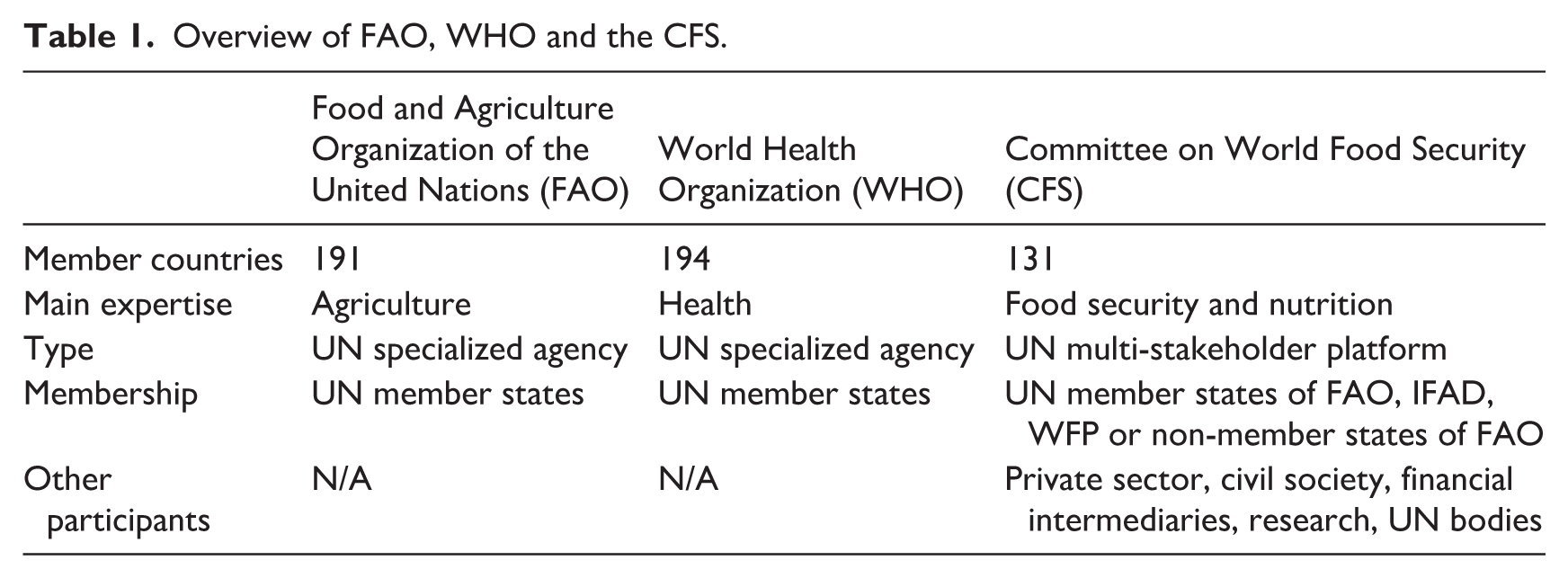
The UN is an important context for global food deliberations and negotiations, producing outputs that shape global agendas and national policies. It includes various arenas like the General Assembly, the Economic and Social Council, conferences like the climate COPs and specialized agencies, along with their secretariats and member states. Food sustainability is shaped in the UN through agendas, initiatives and conferences, and reports (for details, see Figure 1). Redefining sustainable diets featured particularly in the UN’s Food and Agriculture Organization (FAO), the World Health Organization (WHO) and the UN’s Committee on World Food Security (CFS). FAO and WHO are specialized agencies, while the CFS is a multi-stakeholder platform wherein UN member states and other third-party actors discuss food security and nutrition. Our focus on these three organizations – FAO, WHO and CFS – stemmed from their relevance as arenas for policy deliberations and negotiations, specifically over sustainable diets, and shaping global food governance through key texts (see Table 1).
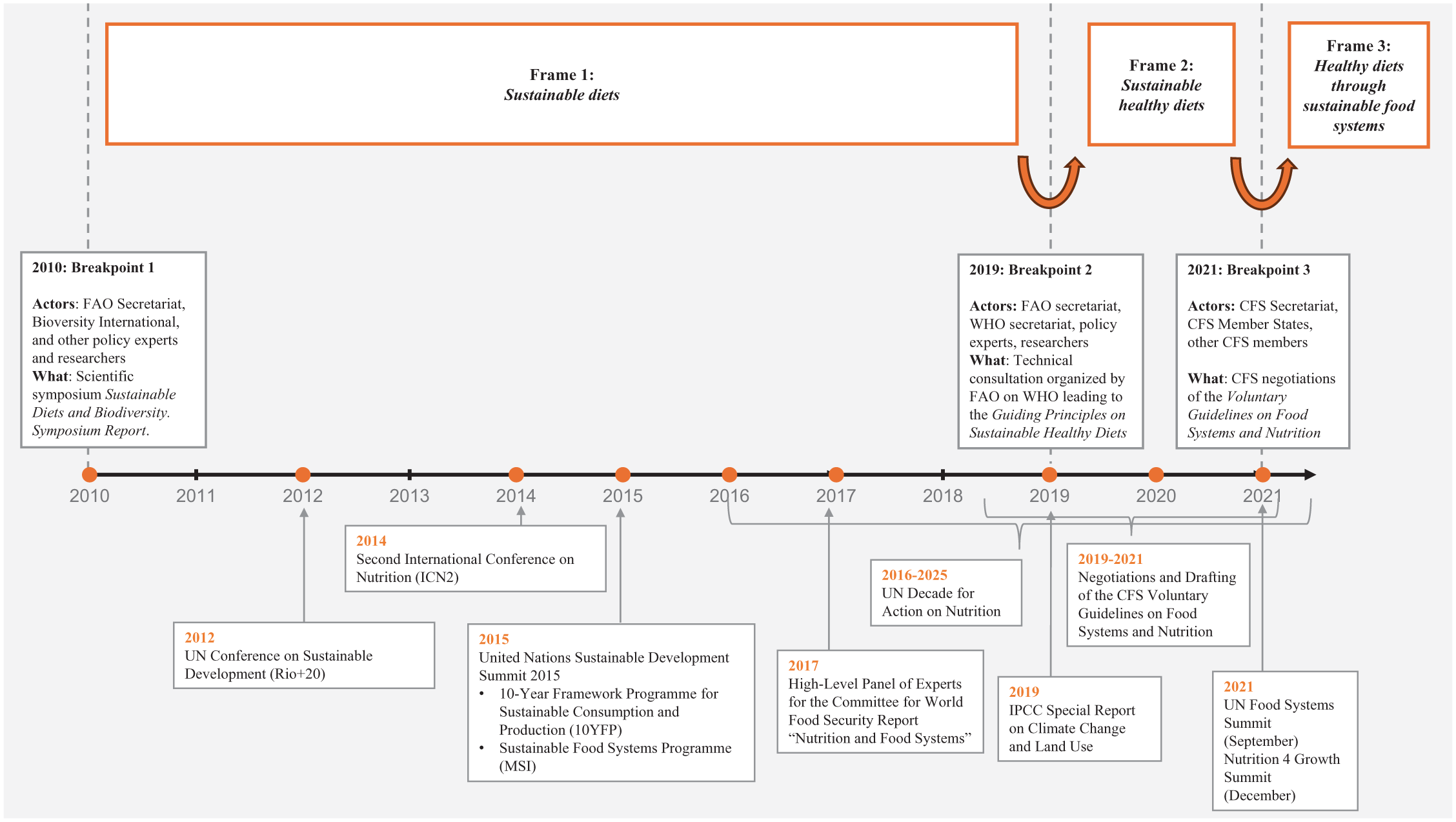
Timeline of the frame revision.
Overview of FAO, WHO and the CFS.
Within and across these organizations, actors aim to speak with one voice. Secretariats, for example, can propose and develop ideas with the help of scientific experts. However, member states retain authority through decision-making processes which are grounded in consensus. This consensus is not defined by unanimity through voting, but by ‘the rule of non-opposition’ (Urfalino, 2014). Deliberations conclude not when differences disappear but when no explicit or implicit opposition remains.
Data collection
We collected empirical data covering an 11-year period. Taking a longitudinal approach enabled us to study political contestations over the sustainable diets frame and the role of multiple actors (UN agencies and member states) in the framing process. Central to the collected data were: (a) three key texts defining and framing sustainable diets; (b) additional documentation linked to these three key texts; and (c) expert interviews. The three key texts include: (1) a report from the FAO symposium on Sustainable Diets and Biodiversity (FAO, 2011) that provided the first international definition of sustainable diets; (2) a report from a technical expert consultation organized by FAO and WHO titled Sustainable Healthy Diets: Guiding Principles (FAO & WHO, 2019); and (3) the final negotiated version of the CFS Voluntary Guidelines on Food Systems and Nutrition (CFS, 2021) (see Table 2). These ‘texts that leave traces’ (Phillips et al., 2004, p. 640) are important, as each conveys both changes to the frame and a temporary frame consensus on it.
Overview of Archival Documents.

In 2012, FAO published the symposium’s proceedings, Sustainable Diets and Biodiversity: Directions and Solutions for Policy, Research and Action (https://www.fao.org/3/i3004e/i3004e.pdf). Here, we focused on the shorter report from 2011.
This includes several background papers.
Inputs from member countries and other stakeholders include track-changes versions of the drafts, and/or separate documents with comments. Some member countries provided two documents per input round.
The format varied, thus more pages than the previous drafts.
The background material for the CFS Voluntary Guidelines on Food Systems and Nutrition was more comprehensive than for the other key texts. CFS member states provided input on the drafts of the Voluntary Guidelines during negotiations. We retrieved additional documents (n = 176) illustrating the drafting process, including written comments from CFS member states and other CFS stakeholders on policy drafts (n = 150). We also retrieved the drafts themselves (n = 5), background material summarizing countries’ positions (n = 2), and messages from the chair (n = 16) (see Table 2). This documentation detailing members’ inputs on various draft stages of the CFS Voluntary Guidelines (see Appendix in Supplemental Material for examples) enabled us to gain a more granular understanding of member countries’ different views and their efforts to alter the frame.
To substantiate our understanding of the framing process, we conducted expert interviews (n = 17) with people working on the sustainable diets issue within the UN context (see Table 3). The key sampling criterion for the interviews was having worked for one of the three UN organizations (i.e. FAO, WHO or CFS), either as a staff member or a consultant, on sustainable diets. The interviewees shared direct and indirect retrospective accounts of the contestations and how these were addressed. We also interviewed experts from academia and civil society with knowledge of the issue, who, due to their involvement in the 2021 UN Food Systems Summit (UNFSS), offered valuable insights into the framing debates.
Expert Interviews.

The interviewees were asked about the issue of sustainable diets, policy developments and the contestation between various actors. This included broader questions about sustainable diets and more detailed questions about drafting documents and interactions. We contacted informants by reaching out via email. All interviews were semi-structured and were conducted in 2021 and 2022 via Zoom, Skype and, in one case, via telephone. Conducting these interviews across the three UN organizations provided valuable insights into the different arenas where framing interactions occurred and highlighted the framing antagonisms.
Data analysis
In the initial step of the analysis, we constructed a historical account of how the sustainable diets frame emerged and was diffused on the international agenda. Drawing on secondary materials and interviews, we constructed a timeline of the development of the sustainable diets frame (see Figure 1). We employed a temporal bracketing strategy by identifying key documents that defined and reframed the concept as anchor points or ‘breakpoints’ (Langley, 1999, p. 696) linked to different versions of the frame and phases of the frame’s evolution. We identified changes in the frame with three different versions: sustainable diets, sustainable healthy diets and healthy diets through sustainable food systems.
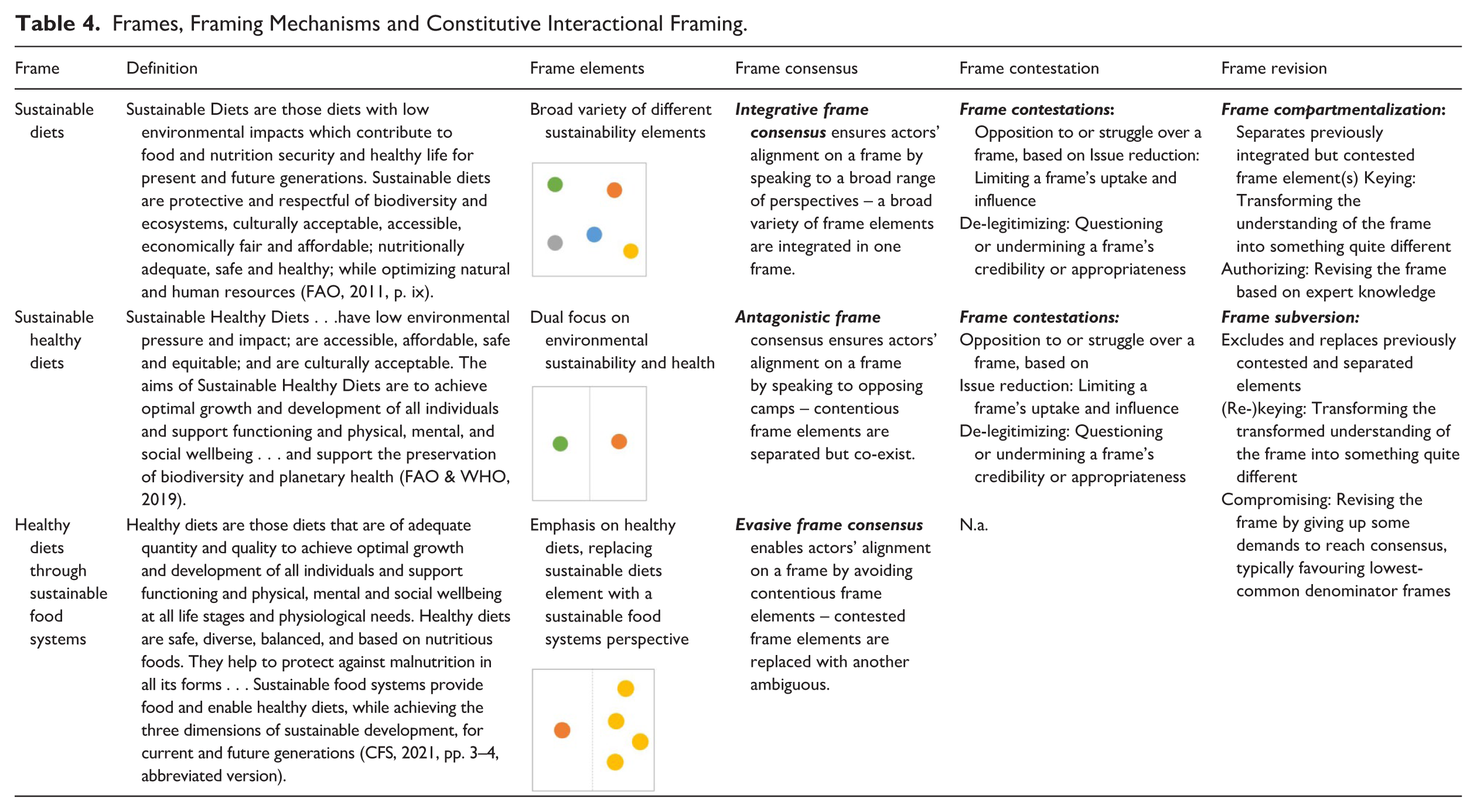
In the second step, we engaged in a more detailed analysis of the content of the three versions of the frame. We first clustered the empirical material (interviews and key documents) along the identified phases and conducted a frame analysis. The aim was to understand better what constituted the different versions of the frame or, in other words, ‘to sort out underlying logics’ and how these shifted over time (Creed et al., 2002). For this, we engaged in open and broad frame analysis of the frame in each phase. This showed how (un)sustainable diets were constructed as problematic, as well as the considered solutions and underpinning frame ambiguities. Table 4 provides an overview of the three versions of the frames and their elements.
Frames, Framing Mechanisms and Constitutive Interactional Framing.
In the third step, we turned our empirical gaze from the frame(s) to the framing dynamics and politics at play (Cornelissen & Werner, 2014). We situated the ‘frames in context’, and attended to the ‘surfacing politics’ and ‘contradictions’ in the framing process (Creed et al., 2002). Since speaking with one voice is central to UN agencies, our analysis focused on conflicts and deviations threatening consensus on the frame. Whereas the sustainable diets frame and later the sustainable healthy diets frame were accepted by a range of UN member states, they encountered strong headwinds from others. These deviating views were particularly evident in the drafting and negotiations of the CFS Voluntary Guidelines (see Appendix for country positions). Our analysis focused on these contestations and the roles of different actors (antagonists, protagonists and intermediaries such as FAO, WHO and CFS) involved in the process. The analysis foregrounded ‘what’ gets framed by ‘whom’ and ‘where’ in multilateral contexts. For each frame revision, we identified: support or opposition by member countries; arguments brought forward by member countries, specifically by those contesting the frame; and how intermediaries addressed oppositions (see Appendix for detailed classification).
In a final step, we zoomed in on the micro-level interactions underpinning the contestations and frame revisions. Given our focus on consensus among multiple actors (member states, intermediaries) in multiple arenas, it was at this point that we engaged more with the interactional framing literature to understand the co-construction of frames and ‘how parties negotiate meaning in interactions’ (Dewulf et al., 2009, p. 156). Our abductive analysis foregrounded how a shared frame was contested and revised for consensus in multilateral contexts (see Table 4 for definitions of different types of consensuses). The analysis identified constitutive interactional framing dynamics in the form of contestations (based on issue reduction and de-legitimizing), frame compartmentalization (based on keying and authorizing) and frame subversion (based on keying and compromising). Lastly, we axially analysed the mechanisms in developing a process model of framing in reaching a new consensus: (i) contestation, (ii) mediation and (iii) revision (compartmentalization and subversion). The framing dynamics and mechanisms are defined in Table 4 and supported by further quotes in the Appendix in the Supplemental Material.
Varieties of Frame Consensus in Multilateral Contexts
In the findings, we detail how different forms of consensus were reached through revising a shared frame. For this, we outline the political struggles and dynamics behind antagonisms and how these were addressed through frame revisions in reaching consensus. For this purpose, we zoom in to the interactions among different actors, member states and secretariats as intermediaries, and in different arenas. The findings are structured around the different forms of frame consensus and the processes of revising them: (i) the integrative frame consensus, (ii) the process (contestation, mediation and revision) to reach antagonistic frame consensus, and (iii) the process (contestation, mediation and revision) to reach evasive frame consensus.
Integrative frame consensus
Building on propositions to move beyond health indicators and integrate sustainability into (national) food-based dietary guidelines, the sustainable diets frame was invigorated in 2010. That year, FAO and Bioversity International
1
convened a scientific symposium, ‘United Against Hunger: Biodiversity and Sustainable Diets’ (FAO, 2011). A central result from the symposium was the introduction of the sustainable diets frame based on a definition developed by FAO’s Secretariat and different experts during a working group session (see Table 4). To begin with, the sustainable diets frame was adopted based on an integrative frame consensus, which ensured actors’ alignment on the frame by speaking to a broad range of perspectives as it incorporated a variety of different perspectives for synthesis. As stated in the report, ‘to produce a consensus position on a definition of “sustainable diets”’ (FAO, 2011, p. 9) was one of the symposium’s objectives. The finalized definition illustrates a constructively ambiguous and inclusive framing of sustainable diets, considering different sustainability elements. Besides economic and cultural dimensions, it emphasized environmental problems around diets, specifically biodiversity loss, and its links with food security – yet without much specificity on what that might mean for policy. One informant elaborated:
And so, we knew that 2010 conference, it was going to be politically delicate. And so, we created the definition that was all encompassing, that was evidence-based and if you like, we put a line in the sand and said, this is what really, we should be expecting to do. And whether nation states do, whether companies do, whether the farming does, whether the food industry does . . . well, that’s a separate issue, but least saying we the science and academic community, and enough people in very serious UN recognized bodies agreed that is what sustainable diets needs to be. Yeah, well, then, let the politics run. (FAO 3, emphasis added)
This highlights how different concerns were linked and how an integrative frame consensus was formed on this premise.
From integrative to antagonistic frame consensus
However, the initial integrative frame consensus was temporary. Antagonistic member states contested the adopted sustainable diets frame and intermediaries eventually responded by revising the frame through compartmentalization to re-establish consensus. In this section, we outline the frame contestation, mediation and revision through compartmentalization to explain how the sustainable healthy diets frame was formed (see Table 4) and how these revisions led to an antagonistic frame consensus.
Frame contestation I
Opposing member states contested the adopted sustainable diets frame by limiting its influence (issue reduction) and questioning its credibility (de-legitimization) in representing health and environmental issues.
Issue reduction
As part of their opposition, antagonistic member states tried to reduce the frame’s scope by limiting its uptake and influence. When the sustainable diets frame was introduced in 2010, it was defined broadly and vaguely, integrating different sustainability perspectives, which helped garner support from various member states. Despite leaving room for interpretation, multiple member states contested the frame. Interviewees recognized this contestation, linking it to powerful industry interests in the opposing home countries. One interviewee noted how FAO encountered ‘a strong against reaction from the countries, . . . because . . . they started to associate “sustainable diets” with the issue of meat’ (FAO 1).
The resistance from member states pressured FAO: ‘FAO came under a lot of pressure from the Americans, and the Latin Americans and the Northern Americans to not pursue sustainable diets’ (FAO 3). These pressures were further evidenced by continuous pushback from certain member countries not to include the frame in different settings. For instance, at FAO’s Commission on Genetic Resources for Food and Agriculture, member states ‘rejected’ the frame:
They rejected completely any mentioning of sustainable diets based on the interventions of GRULAC, the Group of Latin American and Caribbean Countries, Argentina in the lead with Brazil. Because you know, the backroom talk, the off-the-record reason, was that ‘sustainable diets’ sounds like ‘no meat and dairy’ and that is why they rejected it. (FAO 2, emphasis added)
In these ways, antagonistic member states limited the frame’s uptake in multilateral outputs, such as documents and reports, thereby reducing the issue’s influence.
De-legitimization
Furthermore, antagonistic members undermined the sustainable diets frame’s legitimacy, emphasizing the absence of a common view on what a sustainable and healthy diet is. To enhance the frame’s appropriateness, they demanded clarification over ambiguities and what sustainability really implied. One interviewee recalled: ‘It was said by more than one country that they were unclear about the definition of healthy diets – that there is no universal definition of what healthy diets are – and less so what defines sustainable diets’ (FAO 4, emphasis added). This shows concerns over the appropriateness of the current framing due to the absence of a real consensus. Additionally, representational tensions about which intermediary – which secretariat – was the appropriate actor responsible for addressing these issues complicated matters. One informant explained that ‘. . . food is a common currency on so many agendas . . . and so the work that they [UN agencies] do sometimes means that it’s necessary that committees have to have representatives from both organizations on them’ (WHO 2). This points to the challenges of aligning both member states and different UN intermediaries. Overall, antagonistic member states questioned the frame’s legitimacy in light of its ambiguity and origin.
Frame mediation I
Prompted by the frame contestation, FAO and WHO mediated the contestations. The secretariats organized a joint international technical consultation in 2019 in which the contestation was addressed. This three-day consultation aimed at developing Guiding Principles: Sustainable Healthy Diets (hereafter Guiding Principles) as an output with a revised frame. The Guiding Principles were deliberated by members of both secretariats and over thirty invited researchers and policy experts, rather than the member states. In the foreword to the Guiding Principles, it outlined member states’ call for ‘guidance’ on the meaning of sustainable diets and healthy diets:
[Due to] diverging views on the concepts of sustainable diets and healthy diets, countries have requested guidance from the Food and Agriculture Organization of the United Nations (FAO) and the World Health Organization (WHO) on what constitutes sustainable healthy diets. (FAO & WHO, 2019)
Interview participants explained that UN member states had asked FAO and WHO for clarification since ‘[t]here was sort of an implicit request for FAO and WHO to work together on bringing vision as to what sustainable, healthy diets are . . . they wanted to have one voice on what are sustainable healthy diets’ (FAO 4). Another respondent confirmed WHO’s involvement and significant role in this process, explaining that since the original framing,
FAO and WHO have been trying to come up with a definition and a body of work around this space. And I think the latest was that 2019 report . . . that was FAO and WHO’s attempt to try to come together around a definition. (CFS 3)
The two agencies as intermediaries facilitated the deliberations with experts.
Frame revision I – Compartmentalization
As a result of FAO’s and WHO’s mediation, the sustainable diets frame was revised to sustainable healthy diets. While the frame proposed by FAO and WHO was developed to clarify the earlier sustainable diets frame (FAO, 2011), it also diverged from it (see Table 4). We found that while the initial frame integrated different issues under the umbrella of sustainability, the new frame, while still being broad, had a dual focus on environmental sustainability and health. It also linked to ongoing debates on food systems and emphasized that solutions for sustainable healthy diets should be context-specific and addressed at the national level, thereby leaving countries enough room for interpretation. This revision worked through compartmentalization, which involved revising it based on expert knowledge (authorization) and transforming the meaning of the frame (keying).
Authorization
Following the frame mediation, intermediaries enhanced the credibility of their revisions by incorporating insights from researchers and other experts. One interview participant reflected:
. . . . we invited experts from around the world to prepare papers on different aspects of what we think sustainable, healthy diets should be and these were the background papers for our documents [Guiding Principles on Sustainable Healthy Diets] that we [FAO and WHO] published in 2019. (FAO 4)
Another respondent explained that while the secretariats could provide evidence for the Guiding Principles, the ultimate power to determine the frame rested with member states.
That’s why the only thing we can do is to provide evidence that is free from conflict of interest and do a good job there and develop guidelines based on the evidence and share that and hope that countries will take it up and translate it into national policies or help countries in translating international policy. Yeah, but we have to be very, very, very careful. (WHO 3, emphasis added)
This points to a tension about representation, demonstrating that UN secretariats can act as intermediaries who intervene in framing processes, but that their role is limited to providing ‘evidence’ and ‘guidelines’. Ultimately, member states are the ones adopting this guidance.
Keying
As a result of the consultation, intermediaries revised the frame to sustainable healthy diets to reach a new frame consensus. During the consultation, experts and UN representatives discussed how to refine the frame, emphasizing health and nutrition to complement the environmental sustainability element. This transformation can be understood as keying – changing the understanding of sustainable diets from its original meaning into something quite different, here a dual focus on health and the natural environment.
One informant reflected that the health perspective had always been part of the sustainable diets frame:
. . . there are some very knowledgeable permanent representatives in FAO, one of whom was the Swiss Perm Rep and he would make statements at conferences like ‘By definition, a sustainable diet is a healthy diet. But, by definition, a healthy diet is not necessarily sustainable at all.’ (FAO 2)
However, other member states were concerned about associating (environmental) sustainability and health with ‘sustainable diets’. One informant described this opposition ‘[t]hey don’t want to link the two concepts. They don’t want to talk about sustainable, healthy diets in one definition’ (FAO 4). This points to output-related tensions over the ambiguity of the sustainable diets frame and its different elements.
Following the consultation, the environmental sustainability perspective was isolated from healthy diets, separating previously interconnected elements. One informant summarized:
So this concept that was developed by FAO-WHO draws on the recognition that poor diets are major contributors to malnutrition in all its forms and it as well draws on the recognition of the impact that how food is produced and consumed has on the environment. (CFS 1)
This summarizes the frame’s dual focus on sustainability and health perspectives.
Antagonistic frame consensus
The frame revision facilitated a new antagonistic frame consensus, which ensured actors’ alignment on a frame by speaking to opposing camps by isolating contentious frame elements so that these can co-exist, but without resolving the conflict. Intermediaries addressed member states’ contestations through compartmentalization, which separated health and environmental sustainability but kept them under the same frame. The divisional directors of FAO and WHO introduced the revised frame in a shared foreword to the Guiding Principles, leaving room for countries’ interpretations:
At the Consultation, the experts agreed on the term ‘Sustainable Healthy Diets’, which encompasses the two dimensions – sustainability and healthiness of diets. Countries should decide on the trade-offs according to their situations and goals. (FAO & WHO, 2019, p. 6)
In this way, conflict was bracketed as contentious frame elements were isolated, but tensions were not resolved. While frame ambiguity aided the consensus, some member states continued to challenge the sustainable (healthy) diets frame, which led to further contestations in another arena, the Committee on World Food Security (CFS).
From antagonistic to evasive frame consensus
The antagonistic frame consensus on sustainable healthy diets was also temporary. When actors tried to solidify the updated sustainable healthy diets frame within the UN’s Committee on World Food Security (CFS), contestation resurfaced among member states. With the help of intermediaries’ mediation, the frame was further revised through frame subversion. In this section, we outline the contestations and explain how the frame was revised to healthy diets through sustainable food systems (see Table 4), arriving at an evasive frame consensus.
Frame contestation II
CFS members 2 drafted, and member states line-by-line negotiated, a policy document called the CFS Voluntary Guidelines on Food Systems and Nutrition 3 (hereafter Voluntary Guidelines). The CFS had acknowledged the value of the revised sustainable healthy diets frame from FAO and WHO for drafting the Voluntary Guidelines and had even ‘put a placeholder and wait for the outcome of that consultation [by FAO and WHO]’ (CFS 1). However, when the CFS secretariat suggested the integration of the revised sustainable healthy diets frame into one of its outputs, antagonistic member states’ contestations re-emerged by limiting the frame’s inclusion (issue reduction) and questioning its credibility (de-legitimizing).
Issue reduction
During the drafting of the Voluntary Guidelines, debates about the sustainable healthy diets frame arose among CFS members. Supporters such as Switzerland, the EU and intermediaries such as FAO and WHO called for the frame’s integration into the Voluntary Guidelines. However, once the frame was integrated by the CFS, frame contestations resurfaced, specifically over output tensions and the frame’s ambiguity – its ‘incredible vagueness’ (CFS 1), as one informant put it. Opposing member states challenged both the original ‘sustainable diets’ and the revised ‘sustainable healthy diets’ frame, evidenced by deleting respective paragraphs in the Voluntary Guidelines (e.g. Argentina WI, 2020), sometimes complemented by a determined ‘delete’ remark (e.g. Brazil WI, 2020).
UN staff observed these attempts to limit the frame’s scope and reflected on the confining atmosphere this created:
Sustainable, Healthy Diets Guiding Principles made by WHO and FAO, and now, we can’t talk anymore about sustainable [healthy] diets. . . . It’s political! . . . Member states putting pressure on us! . . . Our bosses are the member states, so we have to listen to them. . . We are very careful. . . . Some member states don’t hesitate to call our DG [Director-General] and complain about the department, saying that we [the department/unit] are doing crap work. (IO 1)
In this sense, member states’ resistance through issue reduction had significant implications for the work of the UN intermediaries in maintaining frame consensus.
De-legitimization
Furthermore, antagonistic member states sought to undermine the legitimacy of the frame triggered by process and representational tensions. They asserted that both versions of the frames were merely based on an expert consultation, lacking a formal multilateral negotiation and, therefore, did ‘not have international acceptance’ (USA WS, 2020). For example, in feedback on the Voluntary Guidelines, the US expressed concerns about the lack of appropriateness of how the frame was constructed:
[T]he United States has concerns regarding the use of the [Voluntary Guidelines] to promote definitions or terminologies that have not been formally negotiated, or to promote definitions that contradict formally negotiated definitions. . . . We also note the promotion of the term ‘sustainable diets’, a term that does not have international acceptance. (USA WI, 2020)
Other countries such as Argentina, Chile and Russia echoed these process-related concerns about the frames’ non-negotiated nature. For instance, Chile argued that ‘“Sustainable and healthy diets” is a non-agreed biased concept, which we do not feel comfortable with. This concept was taken from the “Sustainable and Healthy Diets – guiding principles” expert document, that has not been discussed, negotiated nor properly presented to the member states’ (Chile, Comments on One Draft, 2020).
Informants noted that various member states questioned the authority of the sustainable healthy diets frame, challenging framing processes based on what constitutes officially sanctioned wording and which texts, from which arenas, are superior. One informant recalled that
So of course, those who were against were also constantly saying: ‘Oh, it’s a new wording, we cannot use the new wording.’ And I was saying ‘But if the CFS doesn’t elaborate wordings about nutrition, who can do it?’ I mean we have the authority to do it, but those against were saying ‘No! New wording should come only from the General Assembly’. (CFS 2)
This ongoing de-legitimization and the continuation of prior frame contestation emphasizes that not all UN texts are considered equally appropriate by members to reflect multilateral consensus.
Frame mediation II
The CFS secretariat and negotiation chair then mediated member states’ opposition by facilitating the drafting and negotiations of the Voluntary Guidelines and thereby a new frame consensus.
In the beginning, this included providing background material and revising collective drafts based on member states’ written inputs that were then ‘consulted and negotiated among our members’ (CFS 1). These practices were detailed by the chair in a note to CFS members:
It is my pleasure to present you with a revised version of the CFS Voluntary Guidelines. . . , which will serve as the basis for upcoming negotiation sessions. . . We received 66 contributions [later more] with very accurate and detailed suggestions and comments. We did our best to incorporate them while trying to keep the document at a manageable length. (CFS chair, OEWG Food Systems and Nutrition, 16 March 2020)
This shows how the CFS and chair summarized the drafting process. They further explained how they made a proposition to overcome opposition for consensus:
We could come up with an idea of a definition of a healthy diet and then insist on the fact that a healthy diet is provided by sustainable food production. To me, that was already a big progress, and [we] got the agreement of those, who were against sustainable diets wording, [we] got the agreement of the US, which was quite appreciated . . . (CFS 2)
This emphasizes the role of intermediaries to mediate through new propositions to attain consensus among members on the frame.
Frame revision II – Subversion
As part of the revision, the link between sustainability and diets was replaced with a focus on sustainable food systems, while maintaining the health perspective. This marked a shift from the earlier frame, where health and environmental sustainability were separated, to substituting the difficult element (sustainability of diets) with a different perspective (sustainable food systems). This involved transforming the frame (keying) and compromising regarding the content.
Keying
During the Voluntary Guidelines negotiations, CFS members, together with intermediaries (CFS secretariat and chair), revised the frame through re-keying to re-establish consensus. The previously established health perspective (health key) was maintained, but the link between sustainability and diets was substituted with a focus on sustainable food systems. Opposing member countries argued that dietary sustainability should be redefined to emphasize that diets should be healthy but provided by sustainable food systems. Countries such as Argentina, Brazil, Chile and Russia supported this position ‘. . . that the focus of sustainability should be in the production of foods, in the agricultural processes, and not in the diet itself. Diets must be healthy and nutritious, not sustainable’ (Chile Bis WI, 2020, emphasis added). Opposing member states proposed to replace the sustainable healthy diets frame either with healthy diets or healthy diets through sustainable food systems:
Healthy diets should be provided by sustainable food systems. Therefore, we request the deletion of the term ‘sustainable healthy diets’ along ALL the document and replace it with ‘sustainable food systems for healthy diets’ or just ‘healthy diets’, whenever appropriate. (Chile WI, 2020, emphasis added)
This demonstrates how antagonistic member countries built on prior compartmentalization to further alter the frame and engage with sustainability only indirectly through food systems but no longer directly through diets and specific foods.
Compromising
To re-establish consensus, intermediaries facilitated a compromising process among member states. Throughout the drafting of the Voluntary Guidelines, two main camps emerged: those advocating for some version of sustainable healthy diets and those opposed. Despite contestations, some member states, like Switzerland, continued to push for the sustainable healthy diets frame as exemplified in their written inputs on a draft of the Voluntary Guidelines:
As already mentioned, we, as others, are fully convinced that the terminology of sustainable and healthy diets is important in meaning and scope, and that from the perspective of future generations we believe it would be entirely unforgivable not to make this an important feature in the way we manage food systems. (Switzerland WI, 2020)
Ultimately, a compromise was reached after several rounds of member states’ inputs and iterations on the drafts of the Voluntary Guidelines. The frame was revised to ‘healthy diets through sustainable food systems’, which led to a frame consensus that was supported by member states who previously had contested the frame and also by those that advocated for sustainable healthy diets before, as the EU’s position reflects:
We are supportive of the concept of ‘sustainable healthy diets’. We need to preserve the recognition that the food system and the individual diet have a direct impact on health and sustainability and that the two-way link between production and consumption is referenced clearly. (EU WI, 2020)
While this compromise specified healthy diets as an end, it made direct recommendations about unsustainable foods or diets less likely. Instead, it emphasized the need for more sustainable food systems. Informants viewed both the frame revision and its outcome as compromising. One informant explained the negotiated compromise:
The chair of the open-ended working group was saying all the time that ‘look, a good process is where at the end of the day, all stakeholders are equally unhappy’. (CFS 1)
This explains how compromises were made on both sides to attain consensus. Informants further suggested that they ‘couldn’t endorse the original definition presented by WHO and FAO, but [they] agreed on something very close to that’ (CFS 1). However, others were less hopeful, seeing the revisions as a dilution and arguing that diets could be sustainable themselves. One informant argued: ‘Particularly the United States was saying that a healthy and sustainable diet does not make sense: “Healthy diets come from sustainable food systems.” Yeah, but diets can be sustainable too! It just doesn’t make sense’ (CFS 3). These reflections highlight how frame revisions can encompass significant compromises between actors based on sidelining certain perspectives, which was also supported in an interview:
Once it got into the negotiations with the member states, all bets were off. I mean, everything got rewritten. It got more diluted. It got less evidence-based. I don’t know if you looked at the recordings. Oh, my God. I mean, . . . And then all the interests of different states come in particularly the United States. They are total bullies, right? (CFS 3)
This underscores how some intermediaries perceived the frame revisions as diluting the prior frame to achieve frame consensus.
Evasive frame consensus
The renewed frame revision facilitated an evasive frame consensus, which enabled actors’ alignment by avoiding contentious frame elements by replacing them with other ambiguous elements. After two years of negotiations, 150 written inputs from CFS member countries and stakeholders and five drafts, the CFS secretariat reached consensus on the final text. However, as a result, the sustainable healthy diets frame was revised to healthy diets through sustainable food systems. Despite further specification, the frame remained ambiguous since it replaced the dietary element with the food systems element, which only indirectly addressed the sustainability of particular foods and diets. It also shifted the focus away from direct links between certain foods (or diets) and sustainability.
Informants corroborated that the CFS negotiations were characterized by ‘a very tough debate’ in which member states held incompatible positions, prompting the revision of the frame to reach consensus. One informant explained ‘that the revision allowed reaching frame consensus: And then we have another element saying healthy diet and sustainable food systems. . . . And this, to me, is the compromise we wanted to come up with’ (CFS 2). This emphasizes the different elements and their role in compromising for consensus. Another informant described the underlying politics, explaining that when the frame was taken up for negotiation in the CFS, it was ‘in the hands of the member states to discuss and decide. . . . And then they turn it around and muddle it around . . . and I’m not sure what’s left’ (WHO 3). In summary, the evasive frame consensus was formed as a consequence of avoiding conflict by replacing contentious elements.
Discussion
The findings above show how different UN actors contested and revised the sustainable diets frame to maintain frame consensus. Latent representational, process and output tensions in multilateral contexts led to frame contestations and shaped the frame revisions. The initial revision involved compartmentalizing the frame, while the second revision subverted it. We observed how contentious frame elements were avoided through intermediaries’ strategies to ensure opposing actors would endorse it to re-establish frame consensus. We have captured these insights from our case in a process model (see Figure 2). The model explains the underpinning dynamics of how different types of frame consensus are formed by masking irreconcilable differences.
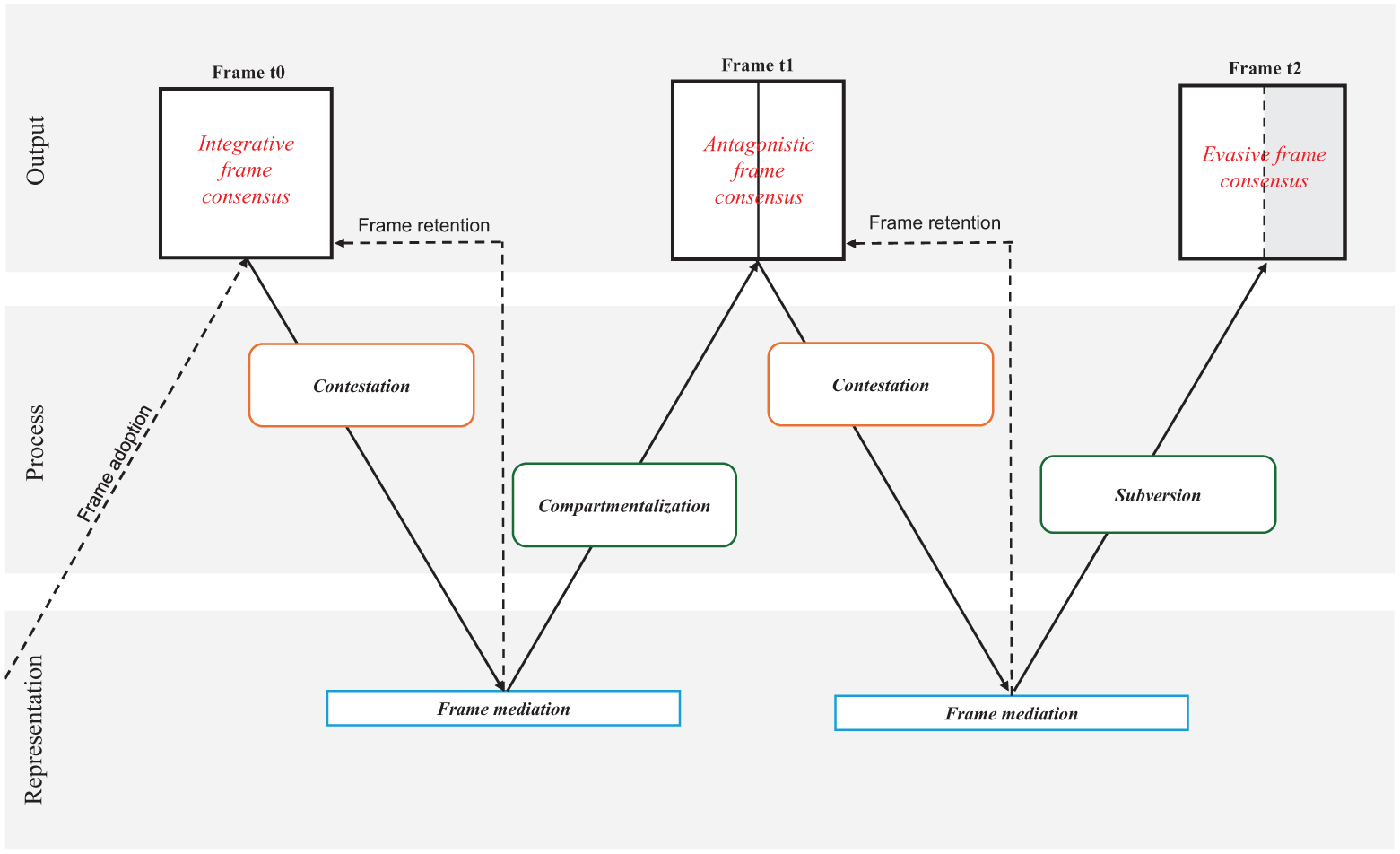
Multilateral frame revision process.
A key premise of framing in multilateral contexts is that tensions related to representation, processes and outputs remain latent. Representation tensions concern questions over who is involved in framing interactions (e.g. secretariats, ‘experts’, and member states) and whether these actors represent their own interests or those of the organization. Process tensions arise as interactions are based on the premise of finding consensus, while actors’ values and interests might remain different. Finally, output tensions relate to consensual frames, on the one hand, being purposefully ambiguous to be constructive to garner support from a wider audience, but also specific enough to be meaningful to actors. In this sense, output tensions over consequentiality (Giamporcaro et al., 2023), or the degree of frame ambiguity (Feront & Bertels, 2021), can trigger frame contestations.
The latency of these tensions increases the likelihood that actors’ contestations over a frame resurface in multilateral contexts. Frame contestation, which is concerned with how actors oppose or struggle over a frame (S. Kaplan, 2008), can trigger frame revisions. In our case, antagonistic actors contested the frame as they were concerned about adverse implications (specifically, the frame was perceived as ambiguous for meat and dairy production) and the legitimacy of expert-based rather than multilaterally negotiated origins of the frame. Contestations from antagonistic member states constitute deviances from and opposition to consensus in multilateral settings, which serve as a premise for further framing activities.
Multilateral intermediaries like UN secretariats engage in frame mediation to re-establish consensus in the face of contestations, shaping frame revisions in different interaction arenas. While not supported in our study, through negotiations, protagonistic actors together with the intermediaries can also retain the frame (frame retention in Figure 2). We identified that the revision led to different forms of frame consensus – integrative, antagonistic and evasive frame consensus – and were based on two distinct framing dynamics ensuing from the mediations: compartmentalization and subversion.
The initial adopted frame is based on an integrative frame consensus. It ensures actors’ alignment by speaking to a broad variety of perspectives through the integration of various frame elements. Moreover, it is characterized by a constructive frame ambiguity in the sense of vagueness to facilitate actors’ alignment on a frame. However, this ambiguity also opens up space for contestations (Feront & Bertels, 2021) and thus revisions to address these oppositions. Frame compartmentalization shows how previously integrated frame elements become separated (Meyer et al., 2016) or isolated but maintained under the same frame. In our study, this occurred when the previously unified sustainable diets frame was compartmentalized into sustainable healthy diets, isolating the contentious sustainability element or layer of meaning from the health element.
Compartmentalization enables an antagonistic frame consensus. This second frame consensus ensures actors’ alignment on a frame by speaking to different concerns in parallel – contentious frame elements are separated but coexist. While this coexistence increases chances for alignment for consensus, it also leads to uncertainties – ambiguity, rendering frame contestations, and thus opposition to consensus, more likely. In our study, this concerned the (environmental) sustainability and health elements of the frame. When the revised frame became subject to debate in another interaction arena, frame contestations among member states were reignited. To address the renewed contestations, actors revised the frame through frame subversion, where the contentious frame element was replaced with another vague element.
Frame subversion enabled an evasive frame consensus. This third frame consensus enables actors’ alignment on a frame by replacing, and thus avoiding, contentious frame elements. However, to maintain sufficient room for interpretation, frame ambiguity is sustained. In our study, the connection between (environmental) sustainability and diets was replaced during negotiations by shifting from an ends-oriented or teleological focus (diets) towards a means-oriented focus (food systems). Actors constructed ‘healthy diets through sustainable food systems’ as a compromise, but food systems only indirectly addressed the sustainability of particular foods and diets.
Overall, our processual model explains how different forms of frame consensus are reached through revisions based on compartmentalization and subversion. It shows how a frame is contested due to latent tensions and how it is iteratively revised by masking incommensurable differences while sustaining ambiguities. The observed frame revisions followed the contestations but also built upon each other. For example, the frame subversion to ‘healthy diets through sustainable food systems’ builds on the compartmentalization from ‘sustainable diets’ to ‘sustainable healthy diets’. While compartmentalization and subversion enabled a multilateral frame consensus, according to informants, the revisions also narrowed the frame’s ambition as it limited the ability to assess the sustainability of specific foods and diets. In this sense, the observed frame laminations (Goffman, 1974) go hand in hand with de-laminations, excluding certain perspectives in response to member states’ contestation. While compartmentalization disintegrates components already embedded in a frame, subversion enhances this disintegration by replacing a contested frame element with a new one.
We suggest that our model of multilateral frame revision processes could be applied to other multilateral contexts, which rely on diplomacy and lack authority – specifically where decision-making operates through seeking consensus through non-opposition. Scholars interested in other UN organizations, such as the World Trade Organization or negotiation events, such as the climate change and biodiversity COPs or the IPCC’s Summary for Policymakers, might find the dynamics between frame contestation and revisions, the role of intermediaries and different interaction arenas, insightful. For example, recent UN Climate Change Conferences (COPs) (Rowlatt & Gerken, 2021) and IPCC (Westervelt, 2022) negotiations indicate that member states revise policy ideas to align with domestic regulatory interests and powerful industries.
Contributions
Our study provides a processual frame revision model that explains how different forms of frame consensus are formed as contested frames are revised in multilateral arenas. We theorize how iterative frame revisions, based on compartmentalization and subversion, avoid dealing with incommensurable differences and, in turn, shape the form of frame consensus attained. This demonstrates how actors strategically and interactionally revise frames for consensus in highly political multilateral arenas and with what consequences – a phenomenon that has received little attention in framing research to date (Ansari et al., 2013).
Our study makes two key contributions. First, we advance organizational framing research (Cornelissen & Werner, 2014), specifically interactional framing perspectives (Gray et al., 2015; Reinecke & Ansari, 2021) in multi-stakeholder settings (Grimm & Reinecke, 2024; Zimmermann et al., 2022) by explaining how frame revisions for consensus in multilateral contexts are based on masking irreconcilable differences. Prior research has shown how frames are stretched (Grimm & Reinecke, 2024), amplified or expanded to gain further resonance and align actors (Gray et al., 2015; Lee et al., 2018), and differences in issue framing are dealt with in interactions through incorporation or accommodation (Dewulf & Bouwen, 2012). Our study extends this repertoire of how actors address differences by showing how shared frames are revised for consensus in multilateral contexts through compartmentalization and subversion (see Figure 2). These have implications for the salience of certain understandings: Compartmentalization and subversion not only include additional perspectives but also exclude contentious perspectives when frames are interactionally revised through keying. In efforts to reach an agreement, frame compartmentalization separates previously integrated frame perspectives into different sections, while subversion, building on compartmentalization, leads to the replacement of contentious perspectives.
In multilateral settings, actors often begin by proposing a shared frame, which then becomes the starting point for further interactions to reach consensus. This shifts the framing process from (a) actors adapting or shifting their own frames to align with others to (b) actors collectively negotiating and modifying an overarching frame itself to accommodate diverse interests and reach consensus. This has subtle but significant implications for understanding framing in multilateral settings: We observe that in multilateral arenas, framing contestations are not settled with one frame ‘winning’ over another or an outright frame rejection, but that contestations are likely to resurface due to latent tensions, which are then countered through iterative frame revisions that aim to neutralize dissent. Consensus-seeking, premised on non-opposition, suspends but does not resolve incommensurable differences.
Second, our study advances research on deliberative tensions in global governance (Arenas et al., 2020; Banerjee, 2018), specifically in transnational contexts (Giamporcaro et al., 2023), through a processual take on consensus that demonstrates how different forms of frame consensus emerge and how these consensus forms deal with differences. Previous research has criticized the preoccupation of multi-stakeholder deliberations with consensus due to power asymmetries (Banerjee, 2018), incommensurable views and values that cannot be reconciled under ‘win-win’ solutions (Ehrnström-Fuentes, 2016), and the tendency to either neutralize or radicalize contestation (Maher et al., 2024). We contribute to these discussions by conceptualizing three distinct forms of frame consensus – integrative, antagonistic and evasive – and showing how these navigate divergent interests, with varying implications.
In our study, varieties of frame consensus were formed through (a) broadly integrating different perspectives (integrative frame consensus), (b) isolating yet maintaining conflicting perspectives in parallel (antagonistic frame consensus) and (c) avoiding contentious perspectives (evasive frame consensus). We show how these forms of frame consensus reproduce latent tensions since underlying differences are managed but not genuinely deliberated.
This is particularly evident in tensions over inclusive representation and consequential outcomes (Giamporcaro et al., 2023). Multilateral outputs are often rendered ambiguous to secure broad support (representation), but risk lacking the specificity needed to address environmental and social issues through concrete policies (output). Previous research has discussed how ambiguity can be both constructive (Reinecke & Donaghey, 2025; Vanhala & Hestbaek, 2016) and also destructive for agreements (Fischhendler, 2008). In a similar vein, framing scholars have emphasized the need to balance between high and low levels of frame ambiguity to avoid both too much and too little specificity (Feront & Bertels, 2021). Our findings illustrate this paradoxical nature of ambiguity in framing in multilateral contexts: rather than resolving deliberate tensions related to ambiguity, iterative frame revisions often sustain high levels of ambiguity, reproducing related tensions.
Limitations and research opportunities
As with most studies, there are several limitations to this study, as well as paths for future research. To study framing dynamics in a complex multilateral landscape (Gray, 2011), characterized by a ‘myriad of overlapping interaction arenas’ (Grimm & Reinecke, 2024, p. 49), we focused on collective actors (UN agencies, member states) rather than individual actors (negotiators, chairs) and conducted a study based on documents and expert interviews. Building on our frame revision model, future studies could further investigate the important but less visible roles and constellations of the negotiators and individuals working in different multilateral bodies. Understanding the outcomes of these settings would benefit from researching how they represent member states, and also their interactions with third-party, non-state actors, like lobbyists and corporations often present at or around negotiations.
Further, our study focuses on how a frame around a contentious food governance debate in the UN evolves and how the emphasis on consensus sustains high levels of frame ambiguity. Future research could study and compare consensus-driven frame revisions in other governance contexts – focusing on other issues and other multilateral organizations. While research on multi-stakeholder agreements has shown how ambiguity might be resolved upon implementation (Reinecke & Donaghey, 2025), future research could study other governance issues and other multilateral contexts, in which ambiguity is reduced or resolved in the interest of specificity during negotiations. This might be more likely when scientific consensus is given in contexts such as climate change (Wijen & Ansari, 2007) or when multilateral outputs include legally binding review and enforcement mechanisms. However, as annual climate change negotiations illustrate, new ambiguities often emerge when amendments are re-negotiated – if not about the issue at stake, then about how to address it.
Conclusion
Our study highlights the contested and evolving nature of frames in multilateral contexts – within and among different UN organizations and their member states. Frame contestations arise due to latent and interconnected deliberative tensions in multilateral contexts – over inclusive representation, authentic processes and consequential outputs. Importantly, these frame contestations can occur in opposition to proposals perceived as either too ambitious or not ambitious enough.
Frame revisions often lead to the integration of new keys and allowing actors with diverse interests to align on a new frame consensus. This explains why efforts to address complex social and ecological issues through (re)-negotiating multilateral outputs often remain incremental rather than transformative (Schüssler et al., 2014). This is due to a focus on minimal consensus based on the tendency to evade difficult elements and with the consequence of a lack of specificity in favour of ambiguity to ensure sufficient support. However, these frame consensuses tend to be minimal, grounded in ambiguity and follow a lowest common denominator logic, which avoids incommensurable differences. Although consensus-based organizing has democratic potential, in the sense of greater equality in the weight of the outputs compared to voting (Urfalino, 2014), it also has universalizing tendencies that tend to marginalize ideas, interests and people. This is because differences are merely managed but not reconciled on a deeper level, limiting more radical forms of consensus based on deliberating genuinely by listening and without attempting to convert others (Graeber, 2013).
Such radical forms of consensus could further greater scrutiny of persistent power dynamics among negotiators, recognizing pluriversal viewpoints and perspectives through genuine and mutual learning. While efforts to organize for consensus in multilateral governance arenas may seek greater inclusivity by accounting for oppositions, they also risk producing fragile outputs and only incremental change (Schüssler et al., 2014). This contributes to explaining why negotiated multilateral agreements around contentious social and ecological issues often fall short in delivering the aspired transformative impacts.
Supplemental Material
sj-docx-1-oss-10.1177_01708406261418181 – Supplemental material for ‘. . . All Stakeholders Are Equally Unhappy’: The politics of frame consensus
Supplemental material, sj-docx-1-oss-10.1177_01708406261418181 for ‘. . . All Stakeholders Are Equally Unhappy’: The politics of frame consensus by Friederike Döbbe and Daniel Nyberg in Organization Studies
Footnotes
Acknowledgements
We would like to sincerely thank our editor, Frank Wijen, for his constructive and thoughtful editorial guidance. We also thank our colleagues for helpful comments on earlier versions of this manuscript; we are especially grateful to Sarah Glozer for her valuable comments on an earlier version. Feedback at research seminars at the Stockholm School of Economics (Department of Management & Organization and Misum), the Stockholm Centre for Organization Research (SCORE) and the EGOS standing working group on ‘system change, not climate change’ were instrumental in developing the paper.

Funding
The authors received no financial support for the research, authorship, and/or publication of this article.
Declaration of conflicting interests
The authors declared no potential conflicts of interest with respect to the research, authorship, and/or publication of this article.
Supplemental material
Supplemental material for this article is available online.