




Abstract
Jacques Vincey’s 2017 production (Théâtre Olympia, Centre Dramatique National de Tours) did not seek to purge The Merchant of Venice (‘Business in Venice’) of its many disturbing aspects, as many interpreters over time have sought to do. The play has been subject to many interpretations, often contradictory: In this case, Portia was a wealthy heiress; Shylock, a suffering and dignified man, tragically caught in a carnivalesque comedy; Bassanio, a fortune hunter; the Christians, barbarous hypocrites; and Belmont, a place of materiality and artificiality. The production elicited perceptions of anti-Semitism among members of Le Conseil représentatif des institutions juives de France Touraine-Poitou-Charentes.
‘ATTENTION, DANGER! La pièce que vous allez voir contient de très nombreux propos et comportements antisémites, donc racistes. La pièce que vous allez voir reprend une partie du texte du Marchand de Venise, lui-même antisémite, donc raciste’ [ATTENTION, DANGER! The play you are about to see contains a number of sentiments and behaviours that are anti-Semitic and therefore racist. The play you are about to see reworks The Merchant of Venice, itself an anti-Semitic, and therefore racist, text]. 1 Thus read the flyer distributed by François Guguenheim, regional delegate to Le Conseil représentatif des institutions juives de France (CRIF) Touraine-Poitou-Charentes, outside the Théâtre Olympia in Tours on 28 September 2017, during the run, from 19 September to 6 October, of Jacques Vincey’s production of Shakespeare’s play, re-baptized as ‘Business in Venice’ in a French translation by Vanasay Khamphommala.
If CRIF’s concluding exhortation that ‘everyone should fight against racism and anti-Semitism’ because, finally, ‘anti-Semitism is not a concern of the Jews alone but of everyone’ is an incontrovertible truth, equally incontrovertible, as James Shapiro reminds us, is that the terms ‘anti- or philosemitic’ were ‘inventions of nineteenth-century racial theory’ and thus ‘are fundamentally ill-suited for gauging what transpired three hundred years earlier, especially since the objectives of early modern English “philosemites” and “antisemites” were not all that far apart’.
2
Moreover, as Marjorie Garber remarks: Shakespeare’s Jew was, in a way, a literary rather than a ‘historical’ Jew, borrowed from Marlowe, from the Continental tradition, and the sensation surrounding the execution of Dr. López [so that] we do both playwright and play disservice if we see Shylock as a two-dimensional figure who represents an archaic and unpardonable prejudice.
3
It is within this framework that we ought to consider the director’s remarks on the production, which reflect an actor’s perspective as well, since he himself interpreted the part of Shylock. In response to a burning interview question – which itself assumed, however shortsidedly, that anti-Semitism pervaded the text (‘Comment traiter l’antisémitisme à l’œuvre dans ce texte’) – Vincey stated that the cast had an obligation to approach the issue head on and not elude or stifle its present-day manifestations, insofar as we are all implicated to a greater or lesser degree. Shakespeare’s genius, he added, has Shylock confront a Christian community consumed by hypocrisy and denial. 5 He saw the play as being just as ‘anti-Christian as anti-Semitic’: Scandalous or excessive behaviour was not limited to one side or the other. 6 With respect to the translation and adaptation for the current production, Vincey opted to remove the play from its historical context in order to underscore more broadly the ways in which identity and difference could result in humiliating and radical actions and defensive and violent reactions. This imaginary Venice boasted a globalized economy in which discrimination seemed to have been transcended, a thing of the past, but which in actuality continued to generate humiliation and resentment. 7
The production was framed by a prologue that was provocatively rendered, in Brechtian fashion, by an ‘actor’ (Pierre-François Doireau) decked out in shades of orange (a colour associated with emotional responses) and standing against the backdrop of a 2017 supermarket: It was still unclear that the store belonged to Shylock, and that the ‘actor’ also functioned as the latter’s servant. This monologue, one could posit with hindsight, was in some sense an interpolated prelude to Launcelot Gobbo’s dialogue with his conscience (2.2). Opening with a request for €2 from a spectator, it was meant to set the stage for the production: ‘Business in Venice’ as an adaptation of The Merchant; Shakespeare as a moneymaking industry; the proverb ‘Time is money’ enacted as the requisite €2 risked becoming three; his three roles in performance, for which he was not paid more than the director for his single role; love as a pecuniary investment: ‘To give money is to give love’; insinuations, vis-à-vis the €2, against both Jews and Catholics (‘cathos’): if the former were cheapskates, the latter were lacking in charity and neighbourly love.
8
Finally, in the performance that this reviewer attended, a spectator seated in the first row proffered the requisite sum of euros, and the show could begin. The prologue, with its pungent language and tone, thus addressed, however fleetingly, one of the play’s prickly issues that a non-nuanced interpretation could easily misconstrue, articulated as follows: [W]hat should we make of the Christians in this problematic play? Is The Merchant of Venice perhaps an ironic glimpse at Christian hypocrisy, rather than an endorsement of Christian behavior?…From first to last this play is quintessentially about interpretation, about the act of decipherment.
9

The Merchant of Venice, dir. Jacques Vincey, Théâtre Olympia (Centre Dramatique National de Tours, France). Photograph courtesy of Christophe Raynaud de Lage. Pierre-François Doireau (Launcelot), Théophile Dubus (Solanio), Jean-René Lemoine (Antonio) and Alyssia Derly (Jessica).
The business encounter between Shylock (Jacques Vincey), Bassanio and Antonio (1.3) took place in the supermarket where Shylock, attired in a classic black suit and white shirt without any external signs of his Jewishness, sat on a high stool to the side, stage left. Bassanio, outrageously dressed in a body suit and a long fur coat, exuded swishing movements of an extravagant playboy. Antonio, having doffed the Superman masque, wore a classic grey suit: Portia’s pivotal question in the trial scene – ‘Which is the merchant here, and which the Jew?’ (4.1.169) – would not be irrelevant to the case, insofar as the two resembled each other not only in métier but also in outward appearance. Shylock was cold, controlled and calculating as he pondered and paused over the loan solicited by Antonio and Bassanio, torturing them with a laborious rendition of the ‘Jacob and Laban’ speech often omitted in productions. Vincey’s Shylock resisted the stereotype of the Jew, all the while that he played with and against it, getting down on his knees as he recalled being labelled ‘misbeliever, cut-throat, dog’, as well as being spat upon (1.3.107–8). Antonio responded on cue to the provocation: He exploded and attacked Shylock in his prone position, thereby giving credence to his voiced threat ‘to spit on’ and ‘spurn’ the Jew anew (1.3.126) (Figure 2). If, in Khamphommala’s translation, Shylock’s well-paused proffering of the loan without taking a ‘doit / Of usance’ (1.3.135–6) played on the word ‘cash’ – meaning ‘sincere or frank’ in French slang (‘Je suis cash’) and ‘Je te prête la somme cash’ (16), moneylender tells merchant – it also resonated with the notion of money that is readily available in today’s global economy. Clearly, Shylock had won the round, for he had provoked the Christian into reacting true to character, while he himself seemed to be operating ‘in a merry sport’ (1.3.141) with regard to potential forfeit.

The Merchant of Venice, dir. Jacques Vincey, Théâtre Olympia (Centre Dramatique National de Tours, France). Photograph courtesy of Christophe Raynaud de Lage. Pierre-François Doireau (Launcelot), Jacques Vincey (Shylock), Jean-René Lemoine (Antonio) and Alyssia Derly (Jessica).
Belmont was an inhospitable place: Supermarket transformed into ‘salle réfrigérée’ [refrigeration chamber] with cold, whitish walls that evoked a morgue in the eyes of one critic. 12 Portia’s (Océane Mozas) dirge to Nerissa (Jeanne Bonenfant) about her suitors reached the audience from offstage; the women then appeared behind a scrim while enlarged likenesses of them were simultaneously projected onto it. Portia was arrayed in a white (wedding?) dress with a train, whose cut-out design concealed more than it revealed. The caskets were an absent presence, thus resolving for this director the perennial problem of how to represent them on stage; all we saw were their inscriptions projected onto the scrim. When Morocco and Aragon hazarded their chances of winning Portia, it was as though the lady were mistress of a ‘reality show’: dazzled by strobe lights, she addressed them with microphone in hand while their images were projected on the scrim behind (Figure 3). Mistress and maid functioned as automatons during the casket scenes; their cold, if not diabolical, facial expressions conveyed inhuman disinterest and derision.
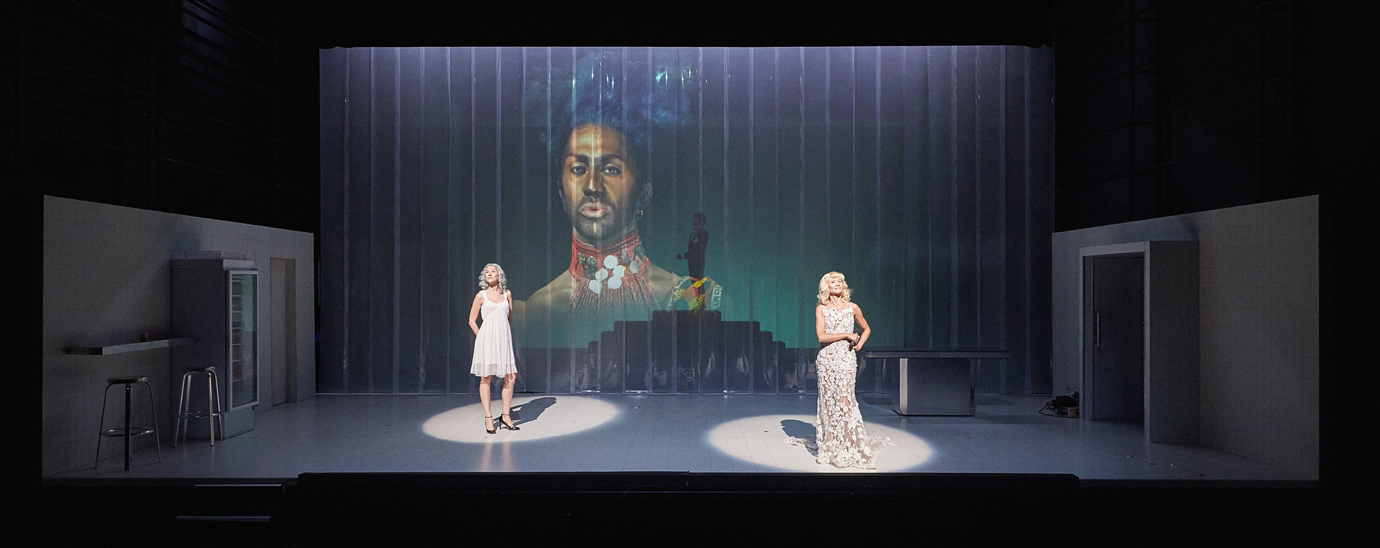
The Merchant of Venice, dir. Jacques Vincey, Théâtre Olympia (Centre Dramatique National de Tours, France). Photograph courtesy of Christophe Raynaud de Lage. Jeanne Bonenfant (Nérissa) and Océane Mozas (Portia).
When fortune hunter Bassanio contended for her hand, Portia was barely more human amidst screams and exaggerated sighs; since real passion did not seem part of her emotional repertoire, she could easily ‘allay [her] ecstasy’ and ‘rein [her] joy’ (3.2.111–12) as she awaited this suitor’s choice of casket. A huge representation of Portia’s counterfeit was projected onto the scrim from the winning lead casket, rendering Bassanio rather small and insignificant when he went to kiss his lady’s hand, extended as though she were distanced royalty. And Nerissa, sporting platform shoes, towered over a height-challenged Gratiano: the looming, physical presence of the ladies left little doubt as to who was in charge. Moreover, Bassanio’s heartfelt reaction to news of Antonio’s ill-luck (the first time he did not act as an outrageous playboy but showed some genuine feeling) did not bode well for the marital relationship. This Portia’s proffering of the treble of the double of 6000 ducats (3.2.298–9) suggested that money could buy her man’s attentions and so resolve problems of human emotion, about which she seemed to know precious little.
No real evidence presented itself to indicate that this Shylock’s house was ‘hell’ (2.3.2). He did not come across as a mean father, just matter-of-fact and cold, though he gave his daughter a kiss. Jessica was not exactly sangfroid about leaving her house as she pronounced the parting words, ‘I have a father, you a daughter lost’ (2.5.55). Shylock returned to an empty ‘supermarket’ that had been looted by Gratiano and Lorenzo in the guise of skeletons. They had hauled everything away (a clever way of clearing the stage, from a theatrical point of view) and then inscribed ‘JUIF’ [Jew] on the back wall with pink streamers. If Shylock mechanically removed the graffiti, it had left an indelible mark by forcing the audience to confront head-on, to the greatest extent possible, evidence of anti-Semitism in today’s world and to disparage it in a flash of ironic complicity with director and cast at their most subtle, without any attribution to Shakespeare, the play, or the production. 13
There was a dichotomy between the way we saw Shylock react to his losses, and the way the purveyor of the prologue, then in another role as ‘Solarino’, dressed only in underwear from the waist down, grotesquely distorted Shylock’s response to Jessica’s elopement with obscene gestures (2.8.12–22). A bit dishevelled (shirt open, jacket slung over shoulder), Shylock was controlled but in pain as he spoke of his daughter’s flight just before delivering the ‘Hath not a Jew eyes’ speech (3.1.45–61) in a low-key voice, which made the contrast between himself and the Christians, so vile in their comportment, all the more poignant. Rather than talking to Tubal, he addressed the audience directly, asking everyone for news of Jessica in Genoa. If, logically, he could not but feel the privation of money and diamonds, he seemed no less pained by the loss of his daughter. That Shakespeare might have intuited that ‘Orthodox Jews customarily mourn, as if dead, children who have abandoned the faith’ 14 in having Shylock wish his daughter ‘dead at [his] foot’, and ‘the jewels in her ear’ and ‘the ducats in her coffin’ (3.1.75–6), surely went over the heads of most spectators. The production cut Tubal’s response (3.1.87–8) and the rest of the dialogue in the scene, which meant that an emotional connection to Leah’s turquoise ring (3.1.107–8) could not work to render Shylock’s plight more tragic. That the phrase ‘I’ll have my bond’ (3.3.4, 12–13), pronounced as Shylock met Antonio in jail, was rendered as ‘Un contrat est un contrat’ emphasized the Jew’s contractual rights in legal terms, perhaps compensating for the omission at that moment of the merchant’s important assertion that the reputation of Venice with foreign merchants would be compromised if Shylock could prove injustice (‘The Duke cannot deny the course of law…’ (3.3.26–36)). 15
The trial scene took place after the interval, whose advent Lorenzo (Quentin Bardou) had announced in Brechtian fashion. Theatrical illusion was broken again when the Doge, played by the omnipresent enactor of the prologue in his third role, called the court theatre to order – ‘Je demande le silence dans la salle! (Je fais aussi le Doge)’ – while house lights remained up to solicit the audience’s engagement in the proceedings. Shylock, attired in his customary black suit, was controlled and contained as he stated his intentions; Bassanio escalated hysterically in defence of Antonio (dressed as usual in a grey suit), implying a certain romantic intimacy between merchant and friend; and Gratiano bellowed barbs from the back of the foyer/courtroom. The production downplayed the seemingly rhetorical but profoundly pregnant question, ‘Which is the merchant here? and which the Jew’ (4.1.169), thereby opting at that point not to ‘startle the audience into an awareness of the similarities between the two men’. 16 Portia delivered the ‘quality of mercy’ speech as a conversation intended to persuade and convince, but Shylock remained immobile and imperturbable. He responded with more revulsion and anger in Khamphommala’s translation than in Shakespeare, spitting out ‘Je crache sur votre pitié’ [62; I spit upon your mercy] versus ‘My deeds upon my head!’ (4.1.201). This reviewer experienced a moment of dèjá vu, overextended perhaps but real nonetheless: Antonio lay prone on a table positioned where a meat freezer had been in earlier scenes in the supermarket as Shylock prepared, in slow and premeditated fashion, to cut a pound of flesh (Figure 4). Bassanio’s impassioned voice rang loud and clear as he avowed that he would lose life, wife and all the world to deliver Antonio from Shylock’s knife, again problematizing the state of his union with Portia. Once Shylock became caught in the error of his logic following Portia’s well-timed ‘Tarry a little. /…This bond doth give thee here no jot of blood’ (4.1.300–01), the action accelerated to his withdrawal without much ado – ‘I pray you give me leave to go from hence’ (4.1.391) – and he was seen and heard from no more, unlike in many productions where he remained an absent presence on stage. Vincey’s Shylock maintained his dignity until the last.
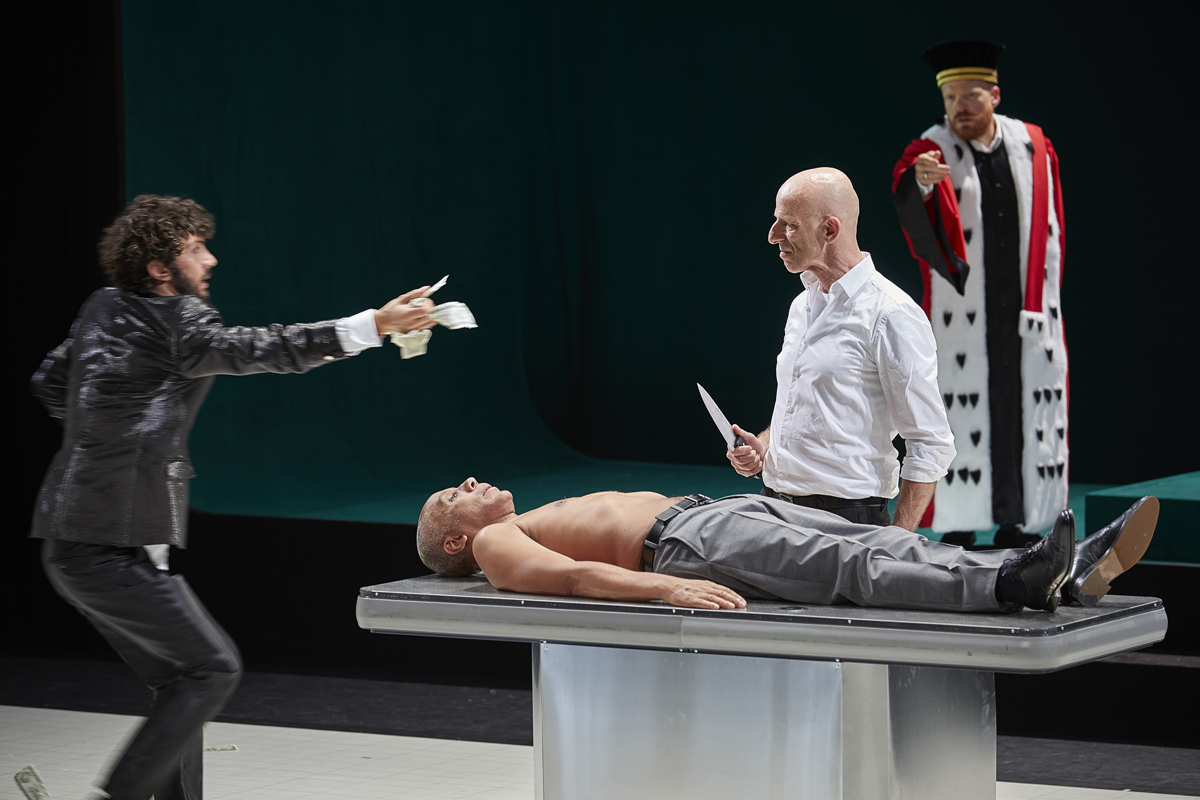
The Merchant of Venice, dir. Jacques Vincey, Théâtre Olympia (Centre Dramatique National de Tours, France). Photograph courtesy of Christophe Raynaud de Lage. Thomas Gonzalez (Bassanio), Jean-René Lemoine (Antonio), Jacques Vincey (Shylock) and Pierre-François Doireau (Doge of Venice).
The return to Belmont entailed a slow, psychedelic shift to create an ambience of stars, smoke and an abstract moon (a kind of flashing crystal ball), which hardly seemed to evoke ‘soft stillness and the night’ that became ‘the touches of sweet harmony’ (5.1.55–6). A quite assertive Jessica and a rather wooden Lorenzo threw themselves on a sprawling pink beanbag cushion positioned stage centre to intone a litany of classical literary lovers vis-à-vis their own love affair. But they substituted Romeo and the faithful Juliet (incongruously) for Troilus and the faithless Cressida; Marguerite and Faust for Thisbe (was it because latter-day lovers might be more apt to ‘sell their souls’ for the pleasure, for example, of drugs, alcohol, power, wealth?); and Queen Bérénice of Palestine, for whom duty destroyed love in Racine’s tragedy, for Dido, whom Aeneas loved and deserted. Their shifted, if not misplaced, ruminations were punctuated by the prancing and trumpeting of Launcelot, decked out in a metallic silver cape and ‘gaudy gold’ (3.2.101) leggings with silver shorts over them – casket colours connoting riches and commerce: (in)human desire for wealth, show and ornament, on the one hand, and the unmeritorious ‘deservings’ (2.9.56) of a ‘blinking idiot’ (2.9.53), on the other.
When Portia and Nerissa reappeared, so did Antonio’s sham Superman costume. Was this element of camouflage from Venice’s carnival celebration meant to conceal, at the same time that it revealed – or unmasked – character, social status and inauthenticity in a Belmont where love was already a commodity – an investment – as had been insinuated in the production’s prologue? 17 The wives of Belmont were cold if not mean as they chased their husbands round the plush pink prop over the loss of the rings they had told them not to lose, and the men screamed and tackled each other. Most telling was Bassanio’s reaction to Antonio’s becoming his surety anew in (re)producing Portia’s ring: he smooched the merchant straight on the lips. The women towered over their men (literally in the case of Nerissa and Gratiano) as they reined them in and pulled them away. Antonio, once more a vapid Superman speculator, remained isolated on stage, holding a letter stating that three of his argosies had ‘richly come to harbour’ (5.1.276): business not only had resumed in Venice but also had thrived (over genuine love) in Belmont.
Vincey’s production did not seek to ‘purge’ The Merchant of Venice of its ‘most dangerous and disturbing energies’, as many interpreters over time have sought to do. 18 The play has been subject to many interpretations, often contradictory: in this case, and according to this reviewer, Portia was a wealthy heiress; Shylock, a suffering and dignified man, tragically caught in a carnivalesque comedy; Bassanio, a fortune hunter; the Christians, barbarous hypocrites; and Belmont, a place of materiality and artificiality. The question of what Shakespeare may have intended, as Garber states, is ‘relevant but not recoverable, and finally not determinative’; the play is, in the end, ‘the sum of all its meanings, all its intentions, conscious and unconscious, including some that the author could never have intended’ 19 and directors and actors could not have predicted.
Footnotes
Acknowledgements
I am grateful to Claire Tarou (Théâtre Olympia, Centre Dramatique National de Tours) for providing me with production materials without which this performance reading could not have been so realized. A word of thanks also goes to Catherine Hatinguais for her assistance with the translations.
Declaration of conflicting interests
The author(s) declared no potential conflicts of interest with respect to the research, authorship, and/or publication of this article.
Funding
The author(s) received no financial support for the research, authorship, and/or publication of this article.