




Abstract
To contribute to the colourful palette of Europe’s noteworthy contemporary Shakespeares, this article analyses the unique approach to Shakespeare of the Hungarian director László Bagossy through case studies of two productions, The Tempest (2012) and Hamlet (2014). Bagossy’s Shakespearean productions peeled method acting off from Shakespeare for good and effectively demonstrated how a change in performance traditions (distancing, operatic, realist) can initiate a novel handling and reading of the familiar classics.
Before the curtain
To contribute to the colourful palette of Europe’s noteworthy contemporary Shakespeares, this article discusses László Bagossy’s The Tempest (2012) and Hamlet (2014), uncovering the Hungarian director’s unique approach to Shakespeare through case studies of the two productions. Bagossy’s uncontested merit is that his productions address an unusually wide range of audiences, from the older, regular theatre-goers (and critics), who are familiar with both the Shakespearean text and its acting traditions, to young adult and even teenage future spectators, who are either still developing their interpretive strategies for the theatre or totally new to a theatre-going experience. The two productions differ substantially from one another; however, my closer analysis of the reasons why Prospero repairs a chair and why Claudius appears on a grandstand full of shouting football fans in a stadium will reveal the same remarkable directorial method.
Unlike Róbert Alföldi or Robert Wilson, Bagossy does not have a trademark visual style, yet his work deserves notice among Europe’s talented Shakespeareans: his method is characterized by a profound openness and curiosity towards his actors and results in playfully self-reflective productions, which are textually faithful to Shakespeare while providing an audio-visually highly intensive, multilayered experience. What does account for his trademark is his empathy towards a heterogeneous audience, which is, as this study will show, not defined by wealth, or class, reading or snobbery, but by its varied interpretive strategies.
The contemporary Budapest theatre scene
Since the first post-socialist decade, the 1990s, the Budapest theatre scene can best be described with a notion theoretician Árpád Kékesi Kun invented in 2006, ‘new theatricality’. According to Kékesi Kun, it means the ‘dizzying wealth of sight and sound which requires both a sharpened perception from the viewer and the association mechanism initiated so far; and, what’s more, a self-conscious reflection’. 1 It is uncertain to what degree Bagossy’s pre-2006 works contributed to the formulation of Kékesi Kun’s concept in 2006, nonetheless, the director’s mature present-day productions, the two Shakespeares among them, certainly bear the characteristics of the tendency – geared towards the sophisticated palates – Kékesi Kun had earlier noticed and recognized.
The term ‘new theatricality’ demands some delineation: theatre and theatricality have been defined in several ways especially in the past decades by a wide range of theoreticians from Elizabeth Burns and Erika Fischer-Lichte to Victor Turner; but for now let us resort to Burns’s idea which brings us closer to the stance Kékesi Kun occupies in theory and Bagossy in practice. Theatricality may be understood as a mode of expression or behaviour, or even as a certain degree of demonstrativeness; but Burns places the spectator in her focus and suggests that theatre and theatricality are determined by the viewpoint, and thus what she recommends is to consider theatricality a ‘mode of perception’. 2 This concept will lead us to deem Bagossy’s productions as being emphatically about our modes of perception, our realities, appearances, associations and illusions.
Here, it seems practical to clarify that the ‘dizzying wealth of sight and sound’ has nothing to do with mere spectacle. Nothing can be further from what Kékesi Kun meant than such decorative approaches, as for instance, The Comedy of Errors at Budapest’s elegant Vígszínház/Comedy Theatre represents. This theatre caters for the wealthier upper half of the middle-aged middle class and regularly includes Shakespeare as ‘a must-see’ in the repertoire with directors of international renown such as Enikő Eszenyi or László Marton. However, these visually engaging large-stage, large-scale productions are more often than not blamed for offering mere Shakespeare-turned-into-circus shows, which, as critic Katalin Gabnai noted, ‘can be consumed by the spectator without any effort’. 3 Of course, the highbrow tradition of accusing directors of Shakespeare, in the name of the ‘real Shakespeare’, of providing too much for the eye and too little for the ear goes back to the nineteenth-century Shakespearean stagings of William Charles Macready, Charles Kean and Henry Irving. What I suggest here is that it is high time we discontinued this kind of discourse which has often proved unprofitable, and discarded both its arguments and methods, including the counting of the Shakespearean lines that the director’s team omitted. Much rather, in line with Burns’s idea, let us regard the productions from the spectator’s point of view.
The ‘dizzying wealth of sight and sound’ in Kékesi Kun’s description ‘requires both a sharpened perception from the viewer’ and an ‘association mechanism initiated so far’. The ‘sharpened perception’ seems to play a key role in fitting Kékesi Kun’s term to Bagossy’s Shakespeares, simply because the phrase implies the viewers’ active, and indeed very intensive, participation in the reception process. There appears to be a common agreement among Hungarian critics, theatre managers and directors that the only relevant difference between productions lies not in the degree of spectacularity on the stage, but in the quantity of effort the viewer must invest into digesting a performance. This view was articulated recently in the June 2017 issue of Színház [Theatre], the journal of the Hungarian Theatre Society, when it launched a debate about what commercial/tabloid/popular theatre was. 4 Interestingly enough, the respondents, theatre managers, directors, critics alike, argued that such labels as ‘commercial’, ‘spectacular’ or ‘popular’ are quite pointless, and instead they recommended that we consider what the viewer may perceive in a performance: that is to say the density of references the spectator is able to, willing to, or forced, to consume. 5
Let us therefore, following the fundamental principles of performance analysis/criticism 6 Fischer-Lichte penned, keep our focus on Bagossy’s spectators, and, as Gabnai initiated, consider their ways of cultural and theatrical consumption.
Shakespeare, now our contemporary
Directors of international renown in Bagossy’s generation, now in their late 40s and early 50s such as Sándor Zsótér, Róbert Alföldi, 7 have a reputation for shocking their audiences intentionally, but Bagossy, a regular guest director at Stuttgart’s Theater Tri-Bühne, appears to use shock only incidentally. Yes, his fragile, pretty, Snow White-like Ophelia does pee on the stage in what appears to be a liberated state of her derangement, and this freezes everyone’s blood onstage and off. She cries contemporary, colloquial swearwords and, foreshadowing her ‘weedy trophies’, scatters on the king, queen and court tiny multicoloured candies as if these were the dead, faded petals of rue, rosemary, pansy and violet. The characters seated on the grandstand look very much like us, moreover, they look at us, therefore Ophelia’s contemporary obscenities that deliberately sting the king and amuse the audience would not make a strong and sufficiently tragic signifier of her mental disturbance, hence her peeing onstage. The scene in which the otherwise intelligent and dignified teenager loses her mind opens with gloats over poor Ophelia’s target, the king, and proceeds to raise both empathy and disgust, indeed shock, but Bagossy makes sure that the audience’s shock is acted out by all the characters. Their loathing blended with pity is represented and thus released by the queen, who, with compassion and concern on her face, displays motherly desire to hide Ophelia’s state, picks up the girl’s knickers and gently escorts her out.
Thus, in this respect, Bagossy’s productions are singular: they drive the spectator to the very edge of their comfort zone, while thoughtfully releasing the tension too: they seek neither to spare efforts and consideration for the spectators nor to shock them out of their skins. Rather, The Tempest and Hamlet effectively serve as inexhaustible food for thought and inspiration. Bagossy’s productions are able to convey a coherent image of Shakespeare as a playwright of sharp wit, with a boisterous but also refined sense of humour and, as we saw in Ophelia’s case, one who is both funnily and painfully grotesque. A Shakespeare who is very much ‘actable’, contrary to what Lamb and the English Romantics held and, as Kott believed, a profoundly contemporary dramatist; yet the coherent and highly theatrical image of Shakespeare these productions convey is by no means an aim, more of a side product.
What I consider Bagossy’s greatest merit is his unique capacity to address an age-wise and also politically and life experience-wise heterogeneous audience. He caters for the restless and reluctantly engaged Generation Z while managing not to lose the more mature audiences. 8 By (avoiding conventional solutions and) turning the performance experience into explorations of uncharted lands – tasting the text, every bite of it – Bagossy is able to surprise us independently of our prior theatre-going experiences. Perhaps the key lies in his refusal to give answers: instead, he asks questions and pours inspirations and associations onto his audiences that engage them for days or weeks. It is left to the spectators to find the answers and they do, since Bagossy’s characters are so very strongly bound to their private familial nexus that empathy, compassion and identification on the part of the audience becomes inescapable.
Notably, Bagossy’s Prospero is not a dictatorial character at the summit of the island’s hierarchy who for some reason peacefully resigns, albeit, as we know from Jana Bzochová-Wild, 9 in a similarly post-communist Central European context, such as Slovakia, this was a realistic option. Bagossy’s Prospero is powerful in the way a father and a professional is: he seems omniscient and omnipotent for a while, then loses or relinquishes his power to appear, to us and to the play’s adolescents, as a fallible, loveable, often energetic but quite disillusioned parent in his fifties (gate-closing panic?).
Reviews of Bagossy’s The Tempest in 2012 and Hamlet in 2014 reveal that the productions equally pleased spectators of both the (then very sharply divided) political left and right: the reviewers praised the productions in unison for remaining apolitical but, when it comes to individual moral values, spotlessly uncompromised.
By the time of writing this paper in the summer of 2017, however, we are witnessing a significant change in the spectators’ point of view due to the increasing rottenness/corruption in the state of Hungary: interestingly enough, it is not the productions that have induced the radicalization of the effect, but the political context in which they are performed. In 2012 and 2014, the challenge was to address conservative-Christian and leftish-liberal theatre-goers by pointing at the danger of losing eternal ethical values under the Fidesz-regime. By then, pro-government (conservative-Christian) and opposition (leftish-liberal) views surfaced in the smallest details of everyday life either gradually filling one’s life with (family) conflicts or gradually extinguishing one’s desire to speak one’s mind openly.
Bagossy did much not to degrade Shakespeare’s play to a mere flat political pamphlet: his characters are multifaceted and round, even his Polonius and Claudius are very human and understandable. Even if László Bagossy and his set designer brother, Levente, chose a grandstand which referred to the football fan Prime Minister Orbán’s useless and harmful spending on football and stadiums, the Bagossys managed to avoid straightforward politics in Hamlet. The stadium where the queen and king, both wearing sunglasses, make their first appearance as a couple (1.2.) represents the nation as football fans, the entire cast, dressed in vivid Danish colours. Claudius’s subjects cheer but also occasionally interrupt the king and behave, in general, as a loud-mouthed brutish mob would, among whom Hamlet the university student – very much like us – certainly feels hopelessly lonesome. The grandstand whose rows are occupied by characters who remain onstage throughout causes an uncanny feeling: the spectators there watch the spectators here, thereby blurring the division between those on the stage and those in the auditorium.
So instead of (besides?) raising his voice specifically against Orbán and his megalomania, 10 Bagossy focuses on the choices of the individual and generational issues. The fact that both conservative and liberal journals liked the production in 2014 proved that what Hungarians craved then was the sense of a shared experience of contemporary Hungarian reality which they recognized on the stage.
By 2017, however, Orban’s mafia-style governance appears as increasingly blatant, his recent attack against the Central European University suddenly opened the eyes of a large group of professionals, perhaps his last intellectual bona fide voters, so there can be no question about the inherent rottenness of his regime and yes, the danger it represents: thus, Bagossy’s Hamlet which in 2014 merely foreshadowed how an illiberal state could work, now anatomizes such a state, the one we currently live in. With this change of context, it is more than obvious that this production of Hamlet sadly but perfectly belongs with those Hamlets which used to be the mouth-piece of silenced intelligentsias during the decades of socialist dictatorship, as Veronika Schandl has mapped out in her Shakespeare Behind the Iron Curtain. 11 In fact, the same sense of oppression by a morally deeply corrupted state induced a number of other Hamlets recently, all over Hungary.
The Shakespearean texts and the truths of the stage
As if to answer Fischer-Lichte’s worries about priorities, Bagossy, a dramatist and a man of letters, 12 stated in an interview, ‘I do not consider the text untouchable and I prioritize the truths of the stage (valid only in the constellation of a particular performance) before the truths of literature’. 13 He already wrote an article in 1999 14 pondering about the ontology of a characteristically Hungarian phenomenon: critics prioritizing text over performance. In 2004, he noted with a touch of irony that the situation had hardly changed since literary critics, many of whom are also translators, still ‘want to protect literature from the theatre’. Precisely because he subordinated the text to ‘the truths of the stage’ he chose Ádám Nádasdy’s transparent translation to create his ‘dizzying wealth of sight and sound’ in The Tempest and Hamlet.
Translation is an issue for us in Hungary (and so it is most probably in the small nation-states of Central Europe), so choosing a translation or commissioning a new one says a lot about a production. As Kinga Földváry recently remarked: It is an issue in Hungarian Shakespeare studies, and it is an equally relevant and lively area of debate concerning Shakespearean performance, so much so that translations and retranslations may even come up and be commented on in intelligent social – non-academic – conversation: the awareness that translation is a necessary medium of cultural exchange is a part of our national identity in many ways. Besides the canonical set of classical Shakespeare translations, done by the greatest nineteenth- and early twentieth-century poets, there is an ever-expanding collection of modern translations, mostly commissioned by theatres who find it increasingly problematic to attract their audiences (and direct their actors) with more and more archaic sounding poetic texts.
15
Bagossy’s choice was appreciated for its spectator-friendliness: even those who said they missed the proverbial phrases and locutions from Arany’s text valued the simple clarity of Nádasdy’s translations. Another recent Hamlet, directed by János Szikora used Nádasdy’s translation as well, but the grateful comments from Bagossy’s spectators of all ages and even critics for finally making Shakespeare comprehensible 16 also point at a quality that lies outside the translations, in Bagossy’s directorial work. The only points where Bagossy dropped the translator’s lines were Shakespeare’s word-plays and puns (as in the Stephano and Trinculo scenes): with Nádasdy’s blessing, these playful 400-year old gags were replaced by contemporary and occasionally bawdy ones that emerged from sessions of improvisation.
The dizzying wealth of sight and sound
Bagossy admits to lacking a trademark visual style; his two Shakespeare productions are substantially different, especially in the style of acting, the use of music and theatre space. Asked in an interview if he arrives at the first playreading session with a detailed concept of the planned production, Bagossy answered that ‘if a concept equals a final score which only needs to be “rehearsed” or practised, then indeed I have none’. This, however, should not be mistaken for hesitation or indecisiveness, since he lacks neither a concept nor a meticulous textual analysis prior to the first rehearsal. Rather, this statement casts light on the humility, openness and curiosity with which Bagossy approaches the actors, their ideas and experiences. This attitude may be likened to his empathy with all of his characters.
Judgements are practically not depicted on Bagossy’s stage: more ‘negative’ characters like Polonius in Hamlet or Antonio in The Tempest consequently and convincingly come across as understandable though perhaps incorrigible. A portrayal directed by Bagossy will not beautify the filth of the character, rats like Polonius or Antonio will always remain rats, but while they speak we see their little truths, we come to understand them and, what is more, to pity them.
A political snake and a busybody, Polonius (played by Imre Csuja) is also an honestly worried single parent, with whom members of the audience may identify: during his drawn-out advice in Act 1 Scene 3, he allows himself to be playfully parodied and lovingly pampered by his teasing son Laertes. Polonius’s usually monotonous, pompous or pathetic monologue thus allows a form of dynamic interaction with Laertes and Ophelia, a multivocal family gathering in which each has their own tune sung simultaneously. The reason why we recognize ourselves (as teenagers or parents of teenage children) in the scenes with the Polonius family is precisely because they look and behave like a strongly bonded family (the actors who play Laertes and Ophelia are university students, while the actor who plays Polonius is in his late fifties). Under Bagossy’s direction, the Shakespearean text is accompanied by an abundance of familial gestures that depict physical closeness and gentle attention: touches, kisses, hugs, pats on the shoulder or the hair. The loving family gathered around Polonius as he distils his advice wins the audience round and they sympathize and understand Polonius who would do anything to keep his teenage daughter away from Hamlet, so much so that he forgets to care about Ophelia’s feelings in his deep fatherly zeal.
In Bagossy’s interpretation, we come to understand the motives and perhaps this is exactly the reason why we do not believe in the moral improvement of a character. A talented yet repressed younger brother, a Cain-like figure struggling against the power of a reprobate and useless firstborn, Antonio (Csaba Debreczeny) in The Tempest is not likely to mend his ways. In Hamlet (3.3), Claudius’s (István Znamenák) ‘stubborn knees’ hardly ‘bow’: he simply wanted a gorgeous woman – who wouldn’t? – and now, under the exposure of this stadium world, there is no way back, he must go on plotting secretly among tantalizing fears, desperately trying to save his skin…All this is threateningly real, the spectator may conclude.
Playful explorations: Stage crew, baroque opera and other surprises
Whether Bagossy consciously works along Aristotelian lines about the necessity of surprise –‘an effect is best produced when the events come on us by surprise’ 17 – is an open question: certainly, Shakespeare’s well-known plots, when staged by Bagossy, roll ahead at a swift pace and feature a number of unexpected nuances in performance. These sequences of surprises contribute to what the audience sense, sharpening their perception of Shakespeare as a stupendous unknown treasure trove that deserves exploration over and over again.
It is through surprises that Bagossy invites the audience to explore Shakespeare’s fantasy world, just as Ariel charms the travellers on Prospero’s island. On the barren, Brookean or Elizabethan stage of The Tempest where stage hands, prompter and stage manager are equally visible, we have the illusion that we are being shown the making of a performance and being initiated to the many practical and often comical secrets of the theatre. The revolving stage is revealed, the prompter is given a one-line role (checking in her text she confirms what has been said in a discussion), 18 at Prospero’s order the stage manager visibly and audibly calls Miranda and Ferdinand on the stage. The storm is created by a ventilator frontstage, and the set for the masque is visibly painted in oil on canvassed panels to imitate a miniature nineteenth-century paper theatre which in turn imitates a design by Inigo Jones. The light fades and the spectators, including Miranda and Ferdinand, swiftly switch to another performing mode, as they are drawn to the brightly lit tiny opera stage where a charming live opera performance suddenly begins out of nowhere. Purcell duets may seem neither a practical nor a popular idea considering the high number of teenagers in the audience, but when the opera singers make the wooden wings of the oil-painted angels clap, the momentary pathos of the arias is suddenly undercut by irony and laughter. Before Prospero halts the performance-within-the-performance, Ferdinand and Miranda join in effectively expanding the duet into a quartet, so the spectators may wonder if they are opera singers too?
While creating the illusion that all the details of the creative process are being revealed during the performance, Bagossy ensures that the audience will be both deceived and surprised: the people in black T-shirts with the theatre logo appear to be stagehands, but they participate in the performance actively: some roll Ariel’s high mobile seat, occasionally visibly functioning as spirits, some provide the inarticulate sounds and noises of the enchanted island, some duck Caliban into a bucket of water at Prospero’s bidding, some speak the sailors’ parts in the storm (Figure 1) and some sing duets by Purcell. Who are they, then, if not what they appear to be?

József Gyabronka (Alonso) and a stage hand in The Tempest. Photograph courtesy of Eszter Gordon, Örkény Theatre, Budapest.
Bagossy’s masking games include several sequences of surprises that run throughout his Tempest production. One such surprise is Ariel (70-year-old Judit Pogány) who appears each and every time in a different shape from larger-than-life to handkerchief size, just like an amusing shapeshifter, only to take her final leave of Prospero and the stage as a desolate pensioner. ‘My bag…!’ she grunts at the prompter and dodders out; in a sudden tragic pang the audience’s laughter dies away and the non-Shakespearean line does not seem out-of-place anymore. 19 Prospero’s magic wand provides another sequence of those little surprises: the three-legged chair from which so many of the characters, even the prompter, fall off, is eventually repaired by the arched stick which Prospero often held. Thus, the old useless piece of junk becomes once again a fragile and precious ancient throne (Figure 2).

László Gálffi (Prospero), with the chair leg in The Tempest. Photograph courtesy of Eszter Gordon, Örkény Theatre, Budapest.
The audience’s attention is held strongly throughout the performance: the spectator is effectively led through a playful sequence of illusions and revelations towards the final scene when Prospero mends the three-legged chair. When he sits on it, balance, both physical and political, is restored and is again visibly delicate, and at stake.
‘Performances are characterized by their eventness’, Fischer-Lichte reminds us in her essay ‘Culture as Performance’: ‘[a] performance is to be understood as an event also in the sense that no participant will have complete control of it’. 20 Prospero does not have complete control over the chair, once his throne, no matter how well he fitted its fourth leg. Under Bagossy’s guidance, the spectator is strongly reminded of the performance’s unique ‘eventness’ and its unrewindable nature: it is an increasingly important point when in our surrounding reality replayable videos and vlogs are ubiquitous and consumed in massive quantities by the teenagers. The point is effectively and emblematically conveyed during the last monologue when the charmless magician or rather, László Gálffi himself balances on the newly repaired seat and, though not aware of Bagossy’s essential reflection on the theatre as an unrepeatable, ephemeral art form, even the youngsters literally hold their breaths – just prior to bursting out in screaming ovation.
Modes of acting and grotesque tragedy
Hamlet seems to be an antithesis of the gradual revelations and the audiovisual illusions seen in The Tempest, as it is played in the unchanging setting of the concrete grandstand. Scene changes are merely verbal, aided only by lighting: spotlights point at the participating characters while non-speaking characters remain in shadow. Here Elizabethan stagecraft comes into play: their uncanny presence brings forth the threat of eavesdropping, overhearing, reporting, which echoes our recent Socialist past as well as our Orbanist present. The swift changes, almost parallel scenes, identifying the characters apart from the extras in the colourful bunch of football fans that populate the forty plastic seats pose a continuous intellectual challenge for the spectator.
The frontality of the stadium, in fact a bitter mirror to hired crowds and easily directable masses, provides ample space for Bagossy to experiment with Brechtian distancing, and his use of this technique is always carefully intentional. On some occasions he required the actors in Hamlet to speak towards the audience without gestures and resort to a minimum of facial expressions, though not throughout the performance but exclusively when contrasted to other characters’ swift and highly (hyper?) realistic expressions. For instance, the performance opens with the king’s speech (1.2) and the football fans’ frontal communication. Soon Polonius dutifully gives Laertes advice facing the audience, but his son, not taking Dad’s frontal logorrhoea for a moment seriously, is grooming him, undermining – not Polonius’s intention, but – the seriousness and credibility of his ‘to thine own self be true’. The closet scene also contrasts acting modes, moreover, the Queen’s alienated/frontal/stationary acting is supportive of the production’s textual interpretation: Gertrude here is not Claudius’s pander, rather, she is his victim. She had desperately desired a stable, strong person to help her out when her husband died, but soon she wakes to the painful recognition that she is trapped in Claudius’s bed. Gertrude’s motionlessness conveys her forced situation and self-imposed distance from the unpleasant questions of her hyperactive and unpredictable son, and by the time the scene ends, the Queen’s frozen face is soaking in tears (Figure 3).
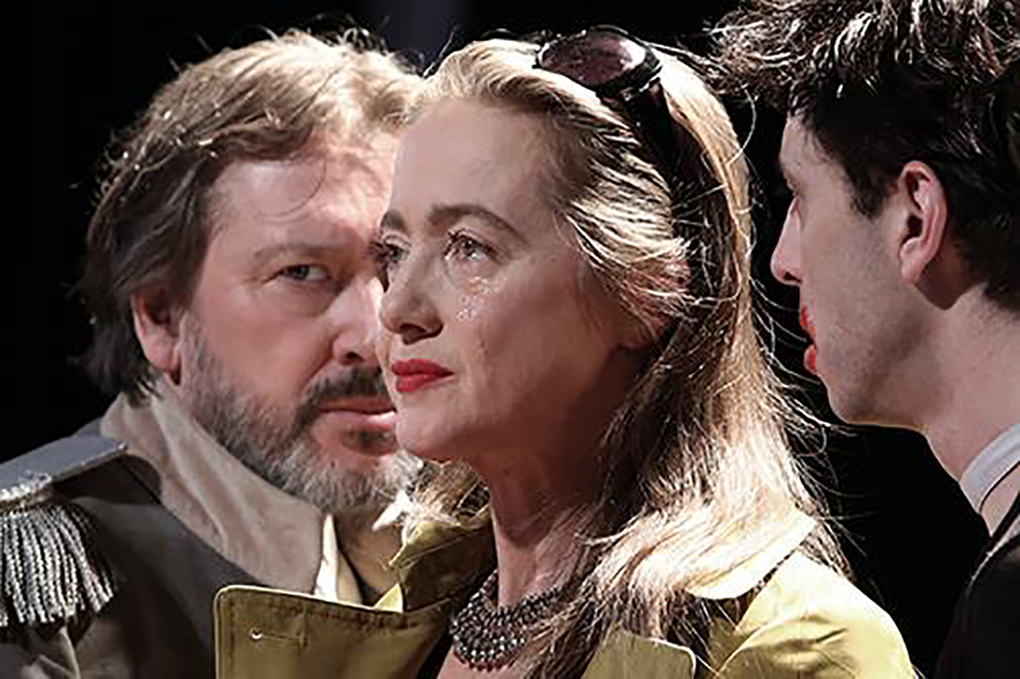
Gertrude with the Ghost of Old Hamlet and Hamlet in the closet scene. László Gálffi (Old Hamlet), Anikó Für (Gertrude), and Csaba Polgár (Hamlet). Photograph courtesy of Eszter Gordon, Örkény Theatre, Budapest.
A closer and more consistent look at these acting modes reveals that these are much more significant than one first perceives: the way Bagossy directs his actors is far from being haphazard, decorative or eclectic: besides his uses of diegetic sound/music, stage business and lighting, acting modes – indeed three different ones – add to the production’s complexity. It is the Player King and Player Queen in whose performance of ‘Priam’s death’ the somewhat outdated operatic, declamatory mode is most manifest, as if on the highly formal opera stage. There is one person who would perform all three acting modes: László Gálffi’s Player King is a fine piece of stylized declamation, his pale old Hamlet is dignified and distanced, his ruddy complexion as a drinking and shovelling Gravedigger, who smoothly hums his obscene little tunes, is (hyper)realistic and extremely funny. A participant in all the scenes important for Hamlet, the presence and the acting of Gálffi, once a Hamlet, too, is determinative for any young man playing the title role.
Devices often characterized, after Lehmann, as postdramatic are also present, but, again, never for their own sake: the communication between the performers and the spectators occasionally surfaces in full direct light. This happens when the neglected son of a desirous, re-marrying mum, a crazily and joyfully critical rapper kid from next door, Hamlet fiddles with a revolver and fires a few shots accidentally. Hamlet calms down spectators in the first rows, ‘Don’t worry, ma’am, I won’t shoot’, but then halts them with direct questions, ‘Who says I am a coward? Who says I am a coward?!’ Then a part of the monologue is repeated in two different acting modes: first in direct light Hamlet addresses the audience in a casual, broken and fragmented, non-theatrical intonation as if a private person, and then he repeats the same lines for himself in proper theatrical darkness and spotlight, in the conventionally expected declamatory mode. The reflection on the art of the theatre is yet again embedded in and contrasted with realist, sweaty, panting Method acting; and the contrast obviously serves multiple purposes: for simple amusement’s sake, for the sake of emphasis, as the lines of the monologue can be savoured twice, and also for the audience, who feel in their bones that in these moments time stops, or is at least out of joint. But then Bagossy leaves little time for the audience to ponder: the accidental shots, the direct questions, the repetition of lines, the onstage music which Hamlet himself conducts and produces (he plays the trumpet), provide a sense of physically felt ‘eventness’, of real risk and danger, just as in The Tempest, to induce a response that is at once intellectual and visceral. Spectators seem to forget about their prior knowledge of the play’s ending…
Besides the frozen silence and occasional tears at the end, frequent remarks, as ‘I have never laughed so much at a tragedy’ or ‘I didn’t know Hamlet was such an amusing play’ indicate that the impression of the performance is by no means static, rather grotesque and perhaps even, as Natália Pikli wrote, the ‘spirit of the carnivalesque pervades the tragedy’. 21 References to popular culture are organic parts of the performance: for instance, the mouse trap scene features a few beats from the music of The Lion King, Hamlet raps, and when Ophelia ‘redelivers’ her ‘remembrances’ to Hamlet, nearly all the others in the grandstand throw something that was or could have been an object of her memory, including a red lipstick (it refers to ‘God has given you one face, and you make yourselves another’), a huge artificial sunflower, and a white tutu. Laughter pours around when these drop, especially when Hamlet puts them on. The red lipstick looks hilariously clownish at first but soon serves his pretence and becomes the permanent grotesque reminder and emblem of his being a wise and tragic Fool.
Shakespeare as family entertainment
While most reviewers emphasized either the political aspect or the popular/carnivalesque traits of Hamlet, none of them, except the author and dramaturg András Forgách, viewed the production from the perspective of the potential audience Bagossy targeted: Forgách alone devoted longer passages 22 to the topic of contemporary family relations and mentioned that he took his teenage offspring to the theatre. 23 It is time we realized that the director’s addressing several generations and entire families must hold the key to understanding Bagossy’s work and the multivocality this results in is highly valuable in terms of raising a new generation of theatre-goers. What perhaps is seen as a jumble of entropic associations in the photos is in reality a masterly woven network or rather networks that cater for generations Z, Y and, as the antithesis to the play’s Olivier-dominated stage history proves, even earlier ones.
Just as in The Tempest, in Hamlet too, parent–adolescent relationships are anatomized, without passing judgement on either side. Prospero, while telling his daughter the story of their close escape, routinely does Miranda’s hair into a pony tail, wipes her nose and repeatedly, and with good reason, asks whether or not she is listening. Identifying with either the father or the daughter is inescapable. Audiences laugh out loud already at Prospero’s first monologue due to these little familiarities: realistic acting adds a peculiar taste to what can be, in some productions, a long parental declamation.
Bagossy’s display of surprising theatrical devices culminates in the ending of Hamlet in which he effectively dismisses the traditions of the Shakespeare cult to provide for Gen Z while for the others he envisions what seems to be the most tragic fate ever of any small country like Hungary, the extinction of a nation. He agreed with his actors that duels cannot be staged in the age of digital action movies without becoming ridiculous, therefore the distancing features of narrative theatre (motionless frontal speech) are used again in the fight scene and the director resorts to Horatio’s relation of the events.
The aftermath of Hamlet’s death, usually left unstaged, is expanded here – as if in an opera: Purcell’s requiem is sung by the entire company (!), a tragically toned manifestation of the production’s polyphony. Slowly white skeletons replace the living on the red seats of the grandstand and as they lie besides the dead the sight reminds us of the heap of corpses in Senecan revenge tragedies (Figure 4). Horatio’s audience consists of the spectators and of the casually dressed Norwegians who enter the stadium, curious and perplexed by the massacre as they listen to an interpreter who translates Danish/Hungarian to their language. Although the Norwegian interpretation is genuine, the Norwegians are apparently too astounded to conceive such a real yet unbelievable story (so contrary to Aristotle’s advice) as Hamlet’s. Then the Norwegians slowly come to terms with the situation of a nation’s death: they start to take photos of the dead and selfies with the corpses. Only Norwegian is heard when the curtain drops. The effect of the final scene, the death of all those we once understood, is indescribably powerful.
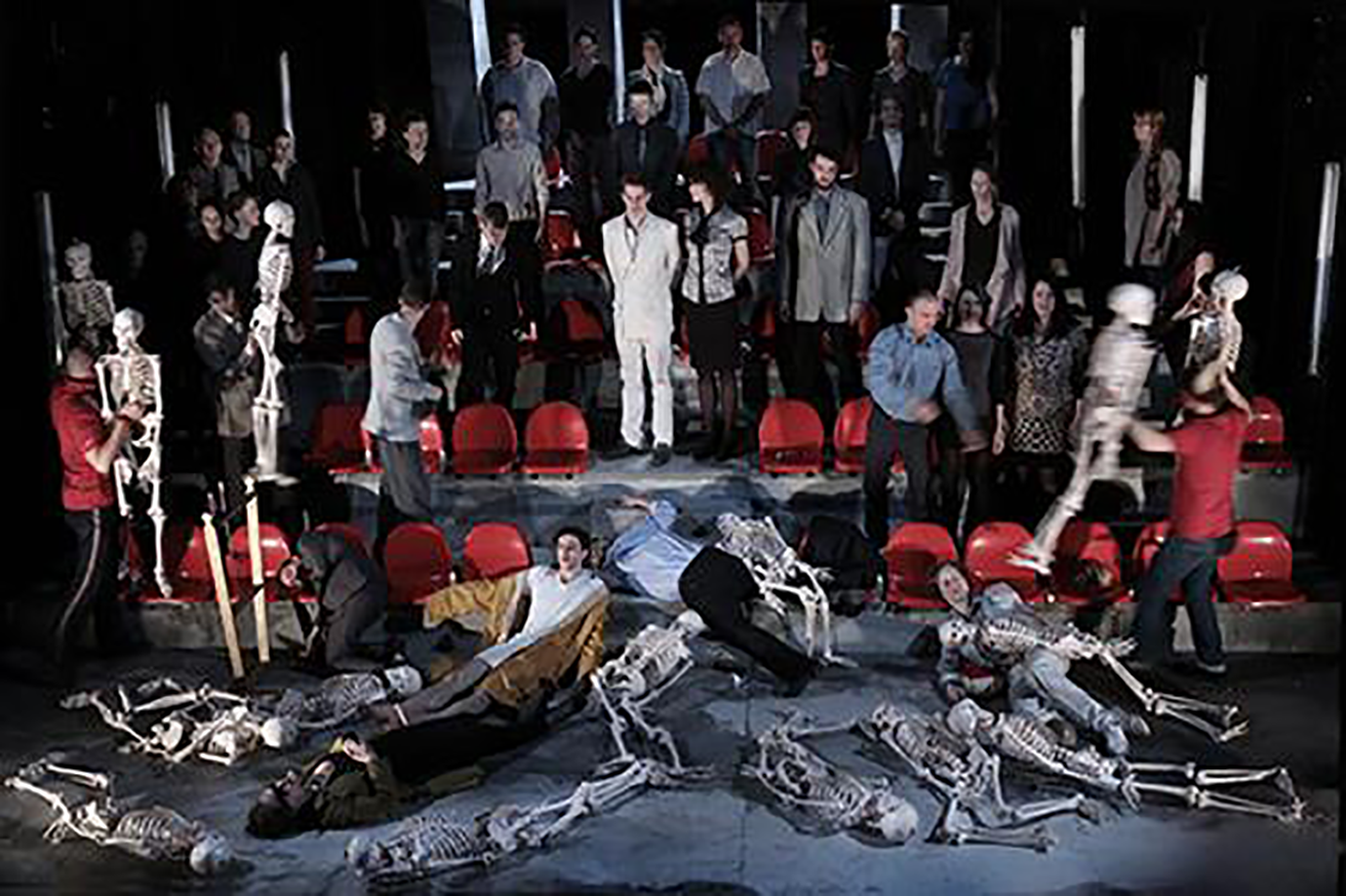
The death of a nation: the final scene of Hamlet with Fortinbras in white, the interpreter, the corpses and the Norwegians. Béla Dóra (Fortinbras), Júlia Neudold (the interpreter), and Máté Novkov (Horatio). Photograph courtesy of Eszter Gordon, Örkény Theatre, Budapest.
Conclusion: Beyond representation
Whether teenager, grandparent or Shakespeare gourmet, Bagossy’s spectators walk uncharted paths in their exploration of the Shakespearean texts and have to digest tons of references (from Millais’ Ophelia to Iggy Pop’s music, from rap to baroque opera) to compose their own selection of signs, their own Shakespeares. His fascinatingly organic blend of postdramatic tools, stylized operatic, alienating/distancing and realist acting practically set up new expectations of Shakespeare-acting and open up new horizons in Shakespearean close-reading and playtext-handling.
Well-known Shakespearean plots ought to operate in a context where, just as in postdramatic theatre, ‘the progression of a story no longer forms the centre’. 24 One glance at the contemporary context of Shakespeare-acting in Britain illustrates how valuable Bagossy’s inspirational eclecticism and handling of the text are in Europe. A decade ago The Guardian’s critic Andrew Haydon complained that mainstream realist theatre tradition ‘remains so absolutely married to the idea of literal-minded mimesis that there is virtually no hint that anything, but the text can invent meaning on the stage beyond dumb representation’. 25 Two years ago, he advised Britons to recognize that ‘it simply isn’t possible to stage the play “as written”. This school of “postdramatic theatre” essentially demands that the director [of European plays] cuts, edits and shapes the text in a way that we British are only just becoming accustomed to’ and that it is ‘vital’ for them to learn. 26 Bagossy’s productions effectively peeled method acting off Shakespeare for good and effectively demonstrate how a change in performance traditions can initiate a novel handling and reading of the same old text.
Footnotes
Conflict of interest
The author(s) declared no potential conflicts of interest with respect to the research, authorship, and/or publication of this article.
Funding
The author(s) received no financial support for the research, authorship, and/or publication of this article.