



Abstract
In Act 2 Scene 2 of Richard II, Bushy advises the Queen against ‘looking awry’ upon the King’s departure, comparing her gaze first to a perspective glass and then to a perspective picture that appears distorted unless viewed at an angle. I rely on this metaphor of anamorphosis to examine two recent productions of Richard II in Athens, both of which ‘distort’ the text and situate it in a bleak context. Viewed from the angle of the current political discontent, the 2014 and 2016 adaptations, directed by Elli Papakonstantinou and Efi Birba respectively, assume distinct meaning for the Athenian audience.
Theatre and the polis
Since 2010, Athenian theatres have abounded with performances of Shakespeare’s plays. Audiences have had the opportunity to watch a variety of performances of the most favourite plays, like Hamlet, King Lear, Macbeth, Twelfth Night and Romeo and Juliet as well as of those that have been rarely performed in Greece, such as Cymbeline and Richard II. The plethora of productions was not only due to the 400th anniversary of Shakespeare’s death but also was related tο the renewed significance of the theatre in Greece, especially in Athens, a city that has been severely hit by the protracted socio-economic crisis as well as by the refugee crisis. As the middle class and the younger generation, who have traditionally been the most avid theatregoers, have felt the strain of the crisis, it was generally expected that the theatre would suffer as much as other structures and services in Greece, including welfare and education. Surprisingly, the opposite seems to have happened, with around 1000 performances staged every season in Athens alone. 1 How is it that people are still going to the theatre in Athens? It could be that many turn to art in times of crisis, seeing the theatre as a way of avoiding the numbness caused by the prevailing sense of disempowerment. Performances staged against all odds, on traditional stages but also in bars, clubs, warehouses, apartments, basements, often performed by poorly paid or even unpaid actors, invite audiences to participate in a collective resistance against depression.
Therefore, while subsidies for the arts have been radically cut due to enforced austerity and fiscal discipline, it seems that the theatre has risen to the occasion and, liberated to a certain extent from state dependence, enabled Athenians to rethink and possibly redefine themselves. 2 According to Patrick Duggan and Lisa Peschel, performance ‘as a form of political resistance and protest’ enables ‘societies in crisis to continue to define themselves’; it also allows individuals and groups ‘to prepare themselves for a post-crisis future by keeping alive their own notions of who they are and who they hope to be’. 3 In this essay, I intend to situate two recent Athenian performances of Richard II in the sociopolitical context of their making and reflect on the directors’ use of the play to engage with the present, not just in terms of the script performed, but also by considering the factors which shaped their production and reception.
Richard II has been very rarely performed in Greece: before the 2014 production of the ODC ensemble, directed by Elli Papakonstantinou, and the 2016 performance by Rēs Ratio Network, directed by Efi Birba, it was only staged once at the National Theatre, in November 1947 during the Civil War. 4 The 2014 and 2016 performances of Richard II were adaptations of Shakespeare’s play, in which spectacle dominates over the text, and symbols such as mud, fire and blood marked the transition between two different worldviews and orders. Watching the fall of Richard II in Athens, the issues of authority depending on the consent of the governed, on the effective use of material resources, a balanced budget, or even the seizure of private property, assumed a heightened significance.
In the socio-economic setting of contemporary Athens, a spectator’s decision to go out, buy a ticket and watch a play is a social and political act – an act of the citizens of the polis as well as an act befitting its citizens. 5 Despite the slight economic growth of 2017 (1.8 percent), Greeks have lost about one third of their income since 2009 and it will take many of them a long time to overcome the traumas of the crisis and the attendant feelings of fear, insecurity and injustice. Unemployment remains very high (20.9 percent), especially among the young, resulting in the highest rate in the European Union (EU) 6 and forcing many to emigrate to Northern Europe. 7 Beyond statistics, the impact of the crisis can be witnessed in the everyday life of Athens, in images of abandonment and violence; in the collapse or deterioration of structures and services, such as hospitals, schools, transportation, social security; as well as in the decline of the living conditions for families from low and lower middle socio-economic strata. The strain on the country’s infrastructure and services is exacerbated by the refugee crisis, as more than one million refugees and immigrants arrived or passed through Greece in 2015 alone, while 54,700 refugees are currently staying in the country. 8
In this setting, the flourishing of the theatre depends on the perseverance and personal commitment of both theatre practitioners and theatregoers. Theatre fosters a sense of community in a city where, as Mina Karavanta argues, ‘the overlapping of the two new conditions of precariousness, the stateless and the precariat’, pose the greatest challenges Greek democracy has had to face. 9 Although foreign visitors to Athens, surprised at the crowds in cafes, bars and art events, sometimes voice doubts about the impact of the crisis, Athenians try to retain the right to a bios politikos rather than toiling through a bare life while ‘living through the interregnum’. 10 Watching Richard II in a packed theatrical space, among mostly young people, one could not help but think of the role of the theatre, more specifically of Shakespeare, in the current life of the polis. As many scholars have argued, Shakespeare is an author of political theatre, whose history plays and certain of his tragedies explore the politics of statecraft, nationhood, political leadership and the quest for power. 11 According to Andrew Hartley, few plays combine these concerns better than Shakespeare’s second tetralogy, which includes Richard II, with their ‘preoccupation about the getting and maintaining of power’, 12 responding to the Elizabethan anxieties about kingship and succession. Richard II’s topicality also found resonance in the events surrounding the Essex rebellion of 1601 13 as well as the struggle between Elizabeth I and Mary Stuart, two queens, who, according to Alison Findlay, ‘both had to cope with the political challenge of identifying themselves as princes rather than women’. 14 Although such political resonances may be lost on a contemporary audience, especially a Greek audience with little knowledge of British history, the two productions of Richard II explicitly, in the case of Papakonstantinou, or implicitly, in the case of Birba, attempted to draw connections with present social, political and economic practices.
In 2.2 of Richard II, Bushy advises the Queen to avoid ‘looking awry’ upon the King’s departure, comparing her gaze first to a perspective glass and then to a perspective picture that appears confused and distorted unless it is viewed at an angle (‘eyed awry’):
Shakespeare’s metaphor is ambiguous, as it is precisely by ‘looking awry’, with a gaze filled with grief and fear that the Queen may clearly see the impending tragedy. The same metaphor of anamorphosis is relevant in the two recent Athenian productions of Richard II, which both ‘distort’ Shakespeare’s text, situating it in a bleak and confusing context. Viewed at an angle informed by the present disillusionment and discontent and by anxiety and pessimism about the future, these recent adaptations of Richard II assume distinct meaning for the Athenian audience.
Richard II The King is dead, by ODC ensemble, Vyrsodepseio, Athens 2014
The subtitle of Papakonstantinou’s Richard II The King is dead, which premiered in February 2014 at Vyrsodepseio/Tannery arts centre, is derived from the phrase, ‘Tis thought the King is dead’ (2.4.7). In the play, the lines that follow – the Captain’s words about dark omens, the ‘fearful change’ and disorder in the kingdom – are resonant in the Greek context:
In June 2012, a coalition Government formed after a second round of parliamentary elections. In the following months, Prime Minister Antonis Samaras, a conservative, led a narrow parliamentary majority in passing a contentious reform bill to secure bailout aid. This resulted in violent demonstrations outside parliament to protest the reforms. Over the next two years Samaras’s plan to end Greece’s four-year €230 billion bailout and to resume borrowing abroad without a safety net of credit from the EU and the International Monetary Fund gradually collapsed, while the impact of the austerity measures and the rising discontent led to the victory of the left-wing party Syriza in the elections for the European Parliament – in that same spring of 2014 while Richard II was being staged. 15
Papakonstantinou, founder and artistic director of Vyrsodepseio and of the ODC Ensemble, a politically oriented group active in experimental performance art,
16
chose to adapt and direct Richard II exactly because of its topicality for Greece, where the state of exception had become the norm. Papakonstantinou pointed out that she had been looking for a play that would give voice to the feelings of ‘deep shame and anger’ she attributed to the current politics and system of governance in Greece: I was looking for a play that puts forth such questions. This text expresses these feelings in an extremely poetic language – a remedy for the soul. It expresses fear in a language that elevates.
17
The text is highly relevant .…It is topical exactly because it records a time – the period of the Middle Ages – when kings ruled by divine right…There was no way to challenge the king…I think that unfortunately we live in a similar time. Citizens have lost their rights, there is a great distance from those who rule, a great challenge to the political system, a deep unease. We have turned into subjects.
18
Moreover, the director involves the audience in the performance by having the four actors who play all the parts (save Richard) explain the plot, comment on the events happening onstage and ask questions directed to the spectators. In fact, as the spectators enter the bare theatrical space (save for a circle on the floor), they have to cross the stage to find their seats, while Richard – played by Aglaia Pappa, known for her work with director Theodoros Terzopoulos and especially for her performance as Mary Stuart in Alarme 19 – is ringing the bells for the opening of the show. After the spectators are seated, Pappa as a white-dressed Richard delivers a part of his famous final soliloquy, in which the weeping and enclosed king ‘finds himself in the position the play has defined as feminine’ on the one hand, 20 and on the other dominates as player-king, connecting his own fall with the shattering of the world order:
By commencing the play with a final-act speech, and then returning to its start with German actor Adrian Frieling, who in accented Greek explains the setting and the action before the quarrel of Bolingbroke and Mowbray, the director underlines the element of theatricality and uses the actors to tell a story rather than solely enact their parts.
As Frieling soon transforms into the Queen, the audience realises that roles are constantly changing, with men often playing women’s parts and vice versa, in an allusion to Shakespeare’s own era. Although Pappa is not the only woman to have played Richard II (a notable precedent being Fiona Shaw in the National Theatre London 1995 production), the former’s visual transformation throughout the play illustrates the king’s journey from the arrogance of absolute power and masculinity to utter despair and humiliation. Pappa changes out of her initial white clothes and puts on a crown, which is an actual cage covered with feathers that conceals her face, and then later appears naked smeared with blood in the shape of a cross, images that combine violence with surprise and even humour (Figure 1).
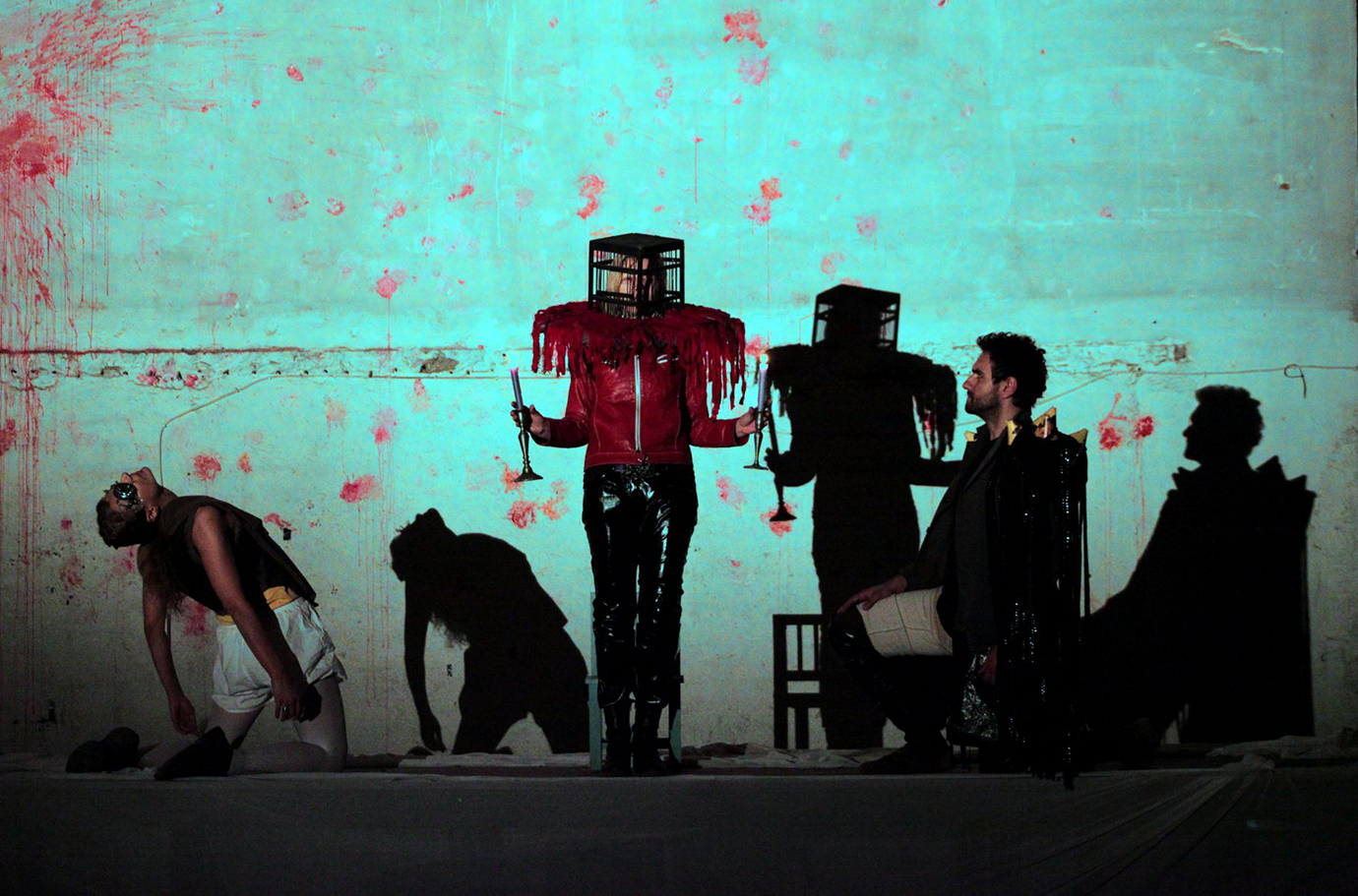
Richard II (Aglaia Pappa) surrounded by the rest of the cast in the 2014 ODC Ensemble’s Richard II The King is Dead, directed by Elli Papakonstantinou. Courtesy of ODC Ensemble.
Pappa’s dramatic Richard is juxtaposed to the manipulative Bolingbroke, played by Meletis Ilias, whose manoeuvring affects both characters and spectators, creating a confusion as to who is right or wrong in the story. During the last half hour of the performance, the actors ask the audience to move to another space (‘we are moving house’) to follow the action of the play. The unsettling of the theatrical space, together with the impressive projected imagery – evoking a range of paintings from the Baroque to Francis Bacon – and the burlesque elements, force the audience to stay alert and try to figure out what is going on. Fires and torches light up onstage (the circle is set on fire), creating a ritualistic and dark atmosphere that conjures the Middle Ages. Yet the striking visual effects are counterbalanced by the actors’ satirical comments and interaction with the audience, who are even urged to lynch the king.
Papakonstantinou seeks active spectatorship: ‘I want to negotiate the way I am doing theatre and why I do theatre in this particular era. We need to rethink lots of things anew’. 21 She calls her adaptation of Richard II a popular show, not one addressed to an elite audience. Combining the political and theatrical power evident in the text, the performance depends on the concept of reciprocity, or what Jan Cohen-Cruz calls ‘an aesthetics of call and response’, characterising his notion of engaged performance. 22 More recently, Papakonstantinou has further emphasised the connections between the theatre, the city and the citizen, polis and politics: ‘All art is political (politikos/political here means from, with and about the people)’. The ‘theatre of the polis’ is not meant to please but to provoke and challenge the citizen: ‘Raw aesthetics for neo-medieval times without a God: black holes in narrative are beautiful: raw is beautiful: chaotic structures are harmonious: open questions give no answers’. 23
If Papakonstantinou’s Richard II reflects the political situation of Greece, it does so as a distorting mirror. Through the fragmentation and the visual installations of the set, spectators take a distance from the events onstage, while being invited to think of the crisis in a different way from the one endlessly played out in the media. In the director’s own words, ‘The world the theatre opens up should be Other, strange, and poetic, and Richard II opens up such a magical world. A different world, rather than today’s Greece’. 24
Richard II, by Rēs Ratio Network, Roes Theatre, Athens, 2016–17
The only thing that changed in the two-and-a-half years separating the two productions was the growing awareness that what had been announced as an economic crisis had now become a permanent condition for Greece no matter who is in power, right-wing or left. In fact, these terms seem almost meaningless to many Greeks who have grown cynical and disillusioned with party politics and would-be saviours. That was perhaps the reason why the opening of the performance at Roes Theatre, another industrial space in Athens, was eerily evocative. The play begins with the image of the king emerging out of the fog; dressed in his shining golden armour, Richard II moves slowly forward. He climbs on a hill, holding a small sphere in his extended hand, with a ceremonial movement that conveys the sacred dignity of his kingship. His golden collar is the symbol of his power, exposing kingship as a contraption that both safeguards and confines Richard’s human body. He is the source of light illuminating the dark space of the stage and dazzling spectators. Suddenly, he starts pounding his stomach and the sphere rolls downhill while the light fades in darkness.
Birba, who is also a visual artist, clearly focused on the visual and kinetic image of the king. This is obvious from the first resplendent image of Richard, who is played by Aris Servetalis, a tall and gaunt figure, stiff and ceremonial in his medieval haircut and iron armour. His kingdom is a visual and sound installation, 25 whose dark emptiness is accentuated by symbolic objects, such the red oriental carpet, which like the armour and crown represent Richard’s hollow power; after Bolingbroke’s uprising, the carpet is lifted to expose a ground of clay. The opening scene presents King Richard both as the divine ruler (recalling Ernst Kantorowicz’s interpretation of the play as the tragedy of royal Christology) 26 and as the player-king aware of his posture and speech. It also draws a dramatic opposition with his representation in Act 3, when he loses all his powers and mourns for the loss of his identity. The removal of his royal attire and his crawling on the clay after his return from Ireland highlight Richard’s attraction to martyrdom, the change from the sacred to the human body. Abandoning the throne for the soil materialises in the vulnerability and mortality of the actor’s shrouded body, the appearance of which connects his physical body to his subjects and to all humans:
The dramatic changes in lighting and the recurrent sound of sirens underline the renouncement of politics and the questioning of the king’s two bodies, which is the theme of the famous ‘hollow crown’ speech (3.2.160–77). Although the beautiful poetry of the text is mostly absent from this performance, the visual imagery recalls the play’s many interwoven images and symbols, such as the earth, soil and clay, the garden, the mirror, the sun, and birth and death. Richard’s ritualistic cyclical walk also enacts his fall and his obsession with his crown. He introduces himself through the phrase ‘I am’ (‘Ego eimai’), and his arrogance quickly develops into self-questioning and self-dissolution.
Richard’s similarity to Bolingbroke is stressed by the iron chains that they share-chains handled by the sycophants surrounding them. The set, sound and lighting create a dark and enigmatic world, in which Servetalis delivers parts of Richard’s famous speeches, either alone or surrounded by the other four actors 27 who switch roles and speak much less than the king. Their presence in the performance centres on movement rather than words or characterisation: Achilleas Haritos, who becomes the throne for Richard to sit on, probably represents the king’s favourites (Bagot, Bushy, Green) or even his supporters such as Salisbury and Carlisle, whereas Ermis Malkotsis is Bolingbroke, the ascending ruler who steps over Richard’s body and then drags his headless naked torso around the stage. Despite the visual impact of the performance, the absence of Shakespeare’s text divided critics: for example, Louisa Arkoumanea wondered for how long the audience might enjoy the rolling in the mud without knowing what happens in the plot, who each character is or why Mowbrey and Bolingbroke fight in the first place, 28 while Savas Patsalidis found the performance insipid and narcissistic, pointing out that it did not allow the audience to appreciate the play’s significance. 29 Conversely, other reviewers praised the adaptation as an immersive theatrical experience, with powerful imagery and an exceptional mise-en-scène, 30 and audiences flocked to Richard’s sold-out performances. 31
In an interview, Birba called Richard II a cinematic play, ‘a montage rather than a sequence of events’, and described Richard as ‘an impulsive king…in effect a bad king’, arguing that his persona is only revealed through his errors. 32 Whereas Birba emphasised the aesthetic dimension of the play, Servetalis commented on its contingency, the corruption caused by political power and the loss of identity. 33 Although they have both avoided drawing direct connections to the present, many reviewers and spectators saw the performance as a commentary on the prevailing political decay and disillusionment. The post-theatrical practices of Rēs Ratio Network’s Richard II paradoxically invited the disaffected Greek audience to make their own political associations. In a 2017 survey of Greek theatre Philip Hager and Marissia Fragkou observe that it has not been immune from the wider debt crisis or the austerity and the economic and sociopolitical restructuring it brought; they also underline that its being in constant change ‘does not exclusively stem from outside national borders [international postmodern and post-dramatic aesthetic strategies] but may also arise from the cultural margin – a milieu that is always already in aesthetic, ideological and institutional crisis’. 34
The two productions of Richard II in Athens reimagined and recrafted Shakespeare’s play through images addressing the visual references of contemporary Greeks, which, when accompanied with fire and blood (in the ODC Ensemble production), darkness, smoke and the piercing sound of sirens (in the Rēs Ratio Network production), reminded the audience of the violent demonstrations and chaos of Athenian streets, especially during the first years of the economic crisis. Xenia Georgopoulou has lately argued that during the economic crisis ‘very few Shakespearean productions have been related to contemporary political and social issues’, as directors seem interested in innovative aesthetics rather than politics. 35 Still, the post-dramatic practices in the Athenian Richard II are not merely aesthetic innovations but may be key to alerting spectators to statecraft as stagecraft. Following Papakonstantinou’s definition of political theatre, the Other world that Richard II opens up provokes rather than pleases the audience: offering a strange old tale, it asks the contemporary civic audience to step outside itself and think with the different voices in the play in order to translate its meaning.
The performances of Richard II in Athens – fragmented and even elliptical adaptations of Shakespeare’s play – deliberately distort the spectators’ perspective, asking them to see the play from a specific vantage point in order to reconstitute it as a whole. From that position of a theatrical space in the contemporary city, Richard’s dramatisation of the economic and political crisis he faces draws attention to the drama made out of the ‘Greek crisis’, whose constant reiteration both at home and abroad has rendered it cliché. It is both the choice of the play and the emphasis on the figure of Richard that show the theatre practitioners’ engagement with the deeper issues raised by the economic crisis, such as the legitimacy of authority, political self-representation, greed and complacency, and subordination and dominance. Going back to Bushy’s metaphors in Act 2, the play may be seen as ‘substance with twenty shadows’: split into twenty reflections by each spectator’s subjective view, it emerges as a blurred image. Yet the second metaphor of anamorphosis suggests the opposite: looking straight-on produces a blur; the play becomes clear only if looked at an angle, with an engaged view, distorted by the anxiety and need of the present moment.
Footnotes
Declaration of conflicting interests
The author(s) declared no potential conflicts of interest with respect to the research, authorship, and/or publication of this article.
Funding
The author(s) received financial support for the research, authorship, and/or publication of this article from the Special Account for Research Grants of the National and Kapodistrian University of Athens.