



Abstract
Taking into account the versions by Plutarch, Shakespeare, and Mankiewicz, this article focuses on Cleopatra's force of attraction and capacity to travel by water, thus crossing geopolitical, cultural, and emotional frontiers. It presents her barge as a metonymical ‘territory’ in a transitional space and examines its power of seduction and symbolism at political, spectacular, and mythical levels. It takes up the issue of Antony's de-Romanisation, inviting a parallel between the queen's barge and the ship of fools. It extends the analysis to variants of the royal barge as part of a territorialising/deterritorialising dynamic: the Egyptian flagship and her funeral-boat-like tomb.
How could Cleopatra's magnificent royal barge, metonymic of Egyptian splendour, be represented on the Jacobean stage and still excite uncommon feelings of wonder in the audience? It could not. So Shakespeare had Enobarbus report, ‘in what are almost entirely Plutarch's words’, 1 the queen of Egypt's majestic arrival on the river Cydnus in act 2 scene 2, verbally recreating (with the use of rhetorical and poetic devices such as hypotyposis, oxymoron, synaesthesiae, and pathetic fallacy) what could not be visually conveyed, and thus inviting us to ‘ascend / The brightest heaven of invention’ (King Henry V, Prologue, 1–2). 2 As for the ‘feast’ (Antony and Cleopatra, 2.2.234) 3 awaiting Mark Antony aboard the royal barge, Enobarbus gives no detail at all; but Plutarch himself had written, in ‘The Life of Marcus Antonius’: ‘Antonius … went to supper to her: where he found such passing sumptuous fare, that no tongue can expresse it’. 4 In later times, however, from the early twentieth century onwards, screen adaptations would omit Enobarbus’ description and show Cleopatra's barge directly; they would also overcompensate for Plutarch's scanty description and show how ‘sumptuous’ indeed the revelling was on board. 5 This is what Joseph L. Mankiewicz did in his 1963 film production of Cleopatra (part 2). 6 Not only did he show the dazzling beauty of the queen's royal barge and the extravagance of the feast aboard, but he also emphasised the barge's major importance as, to take up Gilles Deleuze's and Felix Guattari's terminology, a ‘territorialising’ or ‘deterritorialising’ instrument, capable of erasing or creating ‘the mark[s] that make the territory’ 7 (be they material, political, emotional, or imaginary), and of shifting the borders between objective geography and the subjective appropriation of a specific place. 8
This article seeks to bring together Plutarch's narration (translated by Thomas North from Jacques Amyot in 1579), Shakespeare's play (performed in 1606), and Mankiewicz's screen adaptation (released in 1963), and explore this chain of transmission and refashioning specifically to examine Cleopatra's force of attraction, her propensity to travel by water and cross boundaries, with a particular focus on three key moments that include the presence, real or imaginary, of a ship (a royal barge, a flagship, or a funeral vessel): the encounter of Antony and Cleopatra on the river Cydnus, the battle of Actium, and Cleopatra's death in her monument. It will first present her barge as a mobile, metonymical ‘territory’ (i.e., having both a subjective quality and an existential value) which creates a form of transitional space, and examine its power of ‘territorialisation’ on the political, spectacular, symbolic, and mythical levels. Then, paying attention both to the semantic field of ‘folly’, as deployed in Shakespeare's play, and to Mankiewicz's displacement of the drunken feast on Pompey's galley to Cleopatra's barge (two episodes briefly related by Plutarch), it will take up the issue of Antony's ‘de-Romanisation’, or Roman ‘deterritorialisation’, and suggest a parallel between the queen's royal barge and the ship of fools, as depicted in Sebastian Brant's 1494 Das Narrenschiff, which Alexander Barclay translated into English in 1509. Finally, it will extend the analysis to variants of Cleopatra's royal barge that, again, are part of a ‘territorialising’ / ’deterritorialising’ dynamic: the ‘Antoniad, the Egyptian admiral, / With all their sixty’ (3.10.2–3), which precipitates Mark Antony's desertion during the battle of Actium, and, ultimately, her tomb, which she imagines as a funeral ship carrying her towards Antony in the afterlife.
A mobile, metonymical territory with a ‘deterritorialising’ power
In the book he devoted to the four types of boats in Ancient Egypt (‘papyriform boats’, ‘cargo boats’, ‘sea-going vessels’, and ‘river vessels’), Dilwyn Jones stresses the crucial place of water from the start: No civilisation, ancient or modern, has depended more on water transport for its existence and growth than Egypt. From the earliest period down to modern times, the Nile was the main artery along which commerce and military expeditions moved. Travel by land was always a time-consuming and arduous undertaking in comparison. The movement of men and materials for the building projects and the military expeditions that played such an important role in each successive pharaoh's reign could not have been undertaken without the constant use of water transport. It is not surprising, therefore, that boats were so dominant a feature in the lives of the Ancient Egyptians and so profoundly affected their mental processes and religious thinking.
9
If we bear this in mind, and also remember the importance of primeval waters in ancient Egyptian mythology, 10 it comes as no surprise that Cleopatra should travel on her royal barge to Tarsus, later insist on fighting by sea – implicitly in Shakespeare's play, but explicitly in Plutarch's narrative 11 – and be, throughout the play, ‘closely associated with water’, as David Bevington notes. 12
As she arrives in her splendid barge on the river Cydnus, she appears like Venus to Enobarbus, ‘o’erpicturing’ (2.2.210) pictorial representations, and she may recall more specifically Venus Anadyomene, ‘rising from the sea’. Commenting on the observation that the queen's barge ‘like a burnished throne, / Burned on the water’ (2.2.201–2), Amalendu Bose pictures ‘the reflection of a golden surface, or of a fire, on any big tropical river at noon-time on a summer day’,
13
and adds: Also, if you are familiar with tropical rivers, you will know how unstable the reflection is, losing itself from moment to moment, one reflection yielding to another, as a barge moves on. Such unstability [sic] is true of any watery surface but is especially noticeable on the sunny, glittering surface of a tropical river.
14
Because it highlights the changing quality of the reflection and the unsteady quality of the vision, this observation, although offered from a realistic point of view, is in keeping with Enobarbus’ poetic description of the barge, in which oxymorons and synaesthesiae create unexpected and unstable correspondences. On the barge with Cleopatra are her gentlewomen, who evoke ‘Nereides’ (2.2.216) and ‘mermaids’ (2.2.217, 219), hybrid creatures belonging to the water. Later Cleopatra will metaphorically associate Antony's pleasures with water: ‘His delights / Were dolphin-like: they showed his back above / The elements they lived in’ (5.2.87–9). The instability of the initial reflection on the river is increased by the blurring of lines between the human and the mythological, and between the literal and the metaphorical. As if contaminated by unstable reflections and absorbed by the Egyptian sphere, Antony will later be unable to ‘hold this visible shape’ (4.14.14).
The river Cydnus was geopolitically part of the Roman state, which corresponded, to take up Deleuze's and Guattari's terms, to a closed, ‘striated space’, ‘dimensional or metric’, ‘of measures and properties’, 15 criss-crossed by a network of civilised infrastructures and under control. Yet, as a river, the Cydnus was also an open, ‘smooth space’, ‘directional’, on which the Egyptian queen could come and go at will, as if ignoring political frontiers, and symbolically remain on her Egyptian micro-territory, the barge, and in its element, water – even though, when she is on the river, Cleopatra is no longer in Egypt, but in Cicilia, at Tarsus. By means of the barge, as Deleuze and Guattari note, ‘the dwelling is subordinated to the journey; inside space conforms to outside space’. 16
The vital link between Egypt and water (the Nile is one of the longest rivers in the world) is emphasised in Mankiewicz's 1963 film adaptation via Cleopatra and her barge. As Rufio (Martin Landau), sent by Antony (Richard Burton) to ‘summon’ Cleopatra, arrives at the queen's palace, Cleopatra (Elizabeth Taylor) is bathing in her private bathroom. Rufio is allowed to speak to her while standing behind a folding screen. Their short conversation is filmed with a series of shots and countershots alternately showing Rufio standing behind the folding screen and Cleopatra naked in her bath. Cleopatra does not make much of Antony's ‘order’ and tells Rufio: ‘In any case I am the queen of Egypt and I choose to remain on the Egyptian soil’ (00:08:41). As she insists, ‘I will meet with lord Antony … only on Egyptian soil’ (8:58), she grasps her bath toy, a golden plastic barge, and, as Rufio is dismissed, she plays with her miniature floating barge and sends it gliding across the water in her bath (00:09:21; Figure 1). The bath toy provides an astute transition to her arrival at Tarsus, which is Mankiewicz's next sequence (00:10:08; Figure 2).
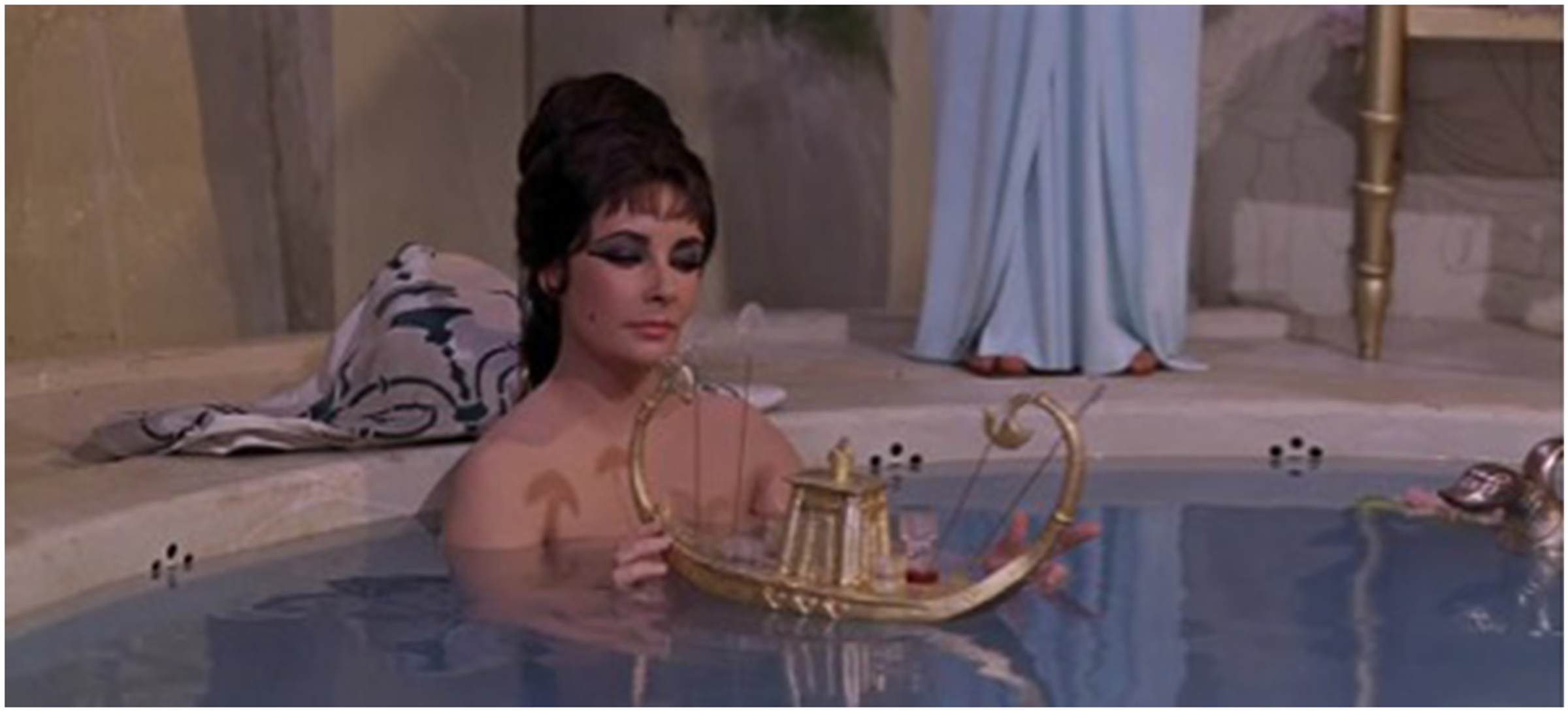
Cleopatra (Elizabeth Taylor) playing with her bath toy while telling Rufio that she will meet Antony only on Egyptian soil (Joseph L. Mankiewicz, Cleopatra, disc 2, 1963–00:09:21).
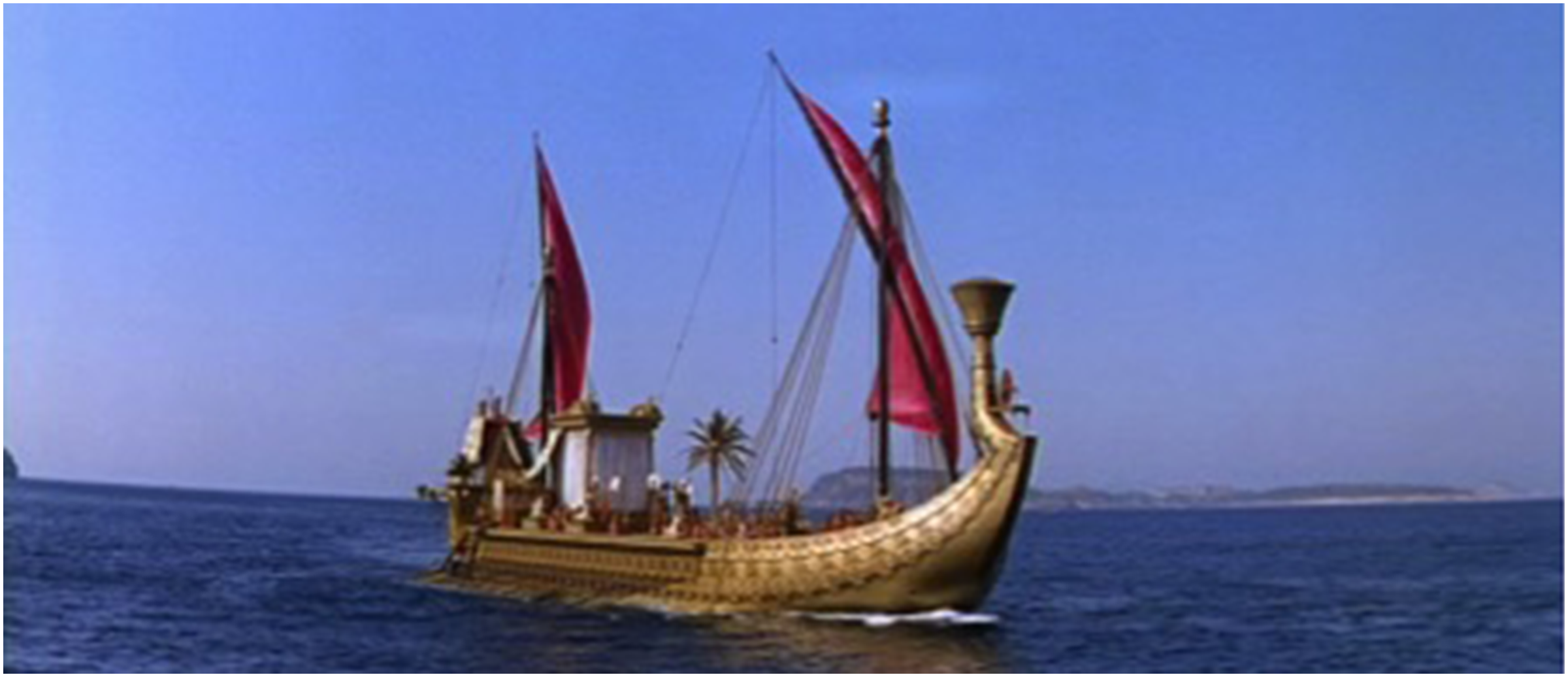
Cleopatra's barge arriving at Tarsus (Joseph L. Mankiewicz, Cleopatra, disc 2, 1963–00:10:08).
The film director adds the bath episode (to be found neither in Plutarch nor in Shakespeare), not only for its transitional function, but also because it works as a filmic displacement of the cosmic sensuality that pervades Enobarbus’ poetic description of Cleopatra's barge on the river Cydnus. It might also be taken as conveying her fear of being ‘deterritorialised’: paradoxically, she will meet Antony out of Egypt, yet still on her own ‘territory’.
The royal barge, as a metonymy for Egypt and a symbolic representation of the queen herself, enables Cleopatra to display a power that is effective on both the public (political, spectacular, and metaphysical) and private (individual) levels. With the comparison to ‘a burnished throne’ (2.2.201), Enobarbus clearly refers to her status of queen: the royal barge, like the official throne of Egypt, or like the giant sphinx upon which Cleopatra sumptuously enters Rome in the first part of Mankiewicz's film adaptation, is a symbol of political power. The colour of the sails would also point to royal power not only in ancient Rome but also in early modern England, as J. R. Mulryne has observed: ‘The sails of Cleopatra's barge were purple, the blood-red colour of Elizabethan usage, signifying royalty, rather than the more acidulous colour of modern use’. 17
There cannot be efficient political display without spectacular effects which create wonder. As Mulryne has shown in his article on ‘Cleopatra's barge and Antony's body: Italian sources and English theatre’, Enobarbus’ verbal recreation of the royal barge was probably reminiscent of lavish, early modern water pageants, whether in England or in Italy, and it is significant that the term ‘barge’ should be used: ‘When such events [pageants] took to the water, as they often did, the semi-technical word for the floating scenic element in which grandees played mythological persons was “barge” (Italian barca)’.
18
Mulryne also refers to those water pageants as ‘occasions when aristocracy sought to dazzle elite and popular audiences by taking on the appearances of gods’.
19
This is precisely what Cleopatra is trying to do, taking on the appearance of Venus and intending to dazzle both the representatives of the Roman state and Antony himself. So it seems that Shakespeare took his inspiration not only from Plutarch's narrative, but also from the water pageants of his day, whether in England (David M. Bergeron notes that the last Elizabethan progress pageant that took place at Harefield, in 1602, celebrated ‘the cosmic power of the queen’)
20
or in Italy (with ‘the Venetian bucentoro, the state barge from which the doge confirmed each Ascension Day the wedding of his city with the sea’).
21
According to John H. Astington, Shakespeare might also have known an early sixteenth-century tapestry (belonging to the Tudor family and used as a movable decoration) entitled The Triumph of Venus, on which Venus stands, rather than lies, like her Egyptian follower, on a chair of state copied from a relief in Ravenna, the Throne of Neptune, of the first century B.C. Her figure rises from a cloth hanging across the throne, as from the sea (its colours, blue-green with golden accents, match those of the sea below). The centre of the composition thus alludes to the mythic birth of Venus from the sea.
22
Whichever source of inspiration we turn to, Cleopatra is spectacularly divinised as Venus, endowed with political and mythical power.
If we turn back to Plutarch's ‘Life of Marcus Antonius’, another divinity is mentioned, not to be found in Enobarbus’ description: ‘and there went a rumor in the peoples mouthes, that the goddesse Venus was come to play with the god Bacchus, for the generall good of all ASIA’. 23 In Shakespeare's play, Cleopatra's barge's capacity to attract the people's gaze and create ‘a gap in nature’ (2.2.228) is clearly reported in Enobarbus’ speech. Antony is symbolically ‘[e]nthroned i'th’ market-place’ (225), yet ominously ‘dethroned’ by the queen on her barge. Mankiewicz goes a step further in suggesting Cleopatra's ‘deterritorialising’ power on board her royal barge: he shows how Antony turns into a mock Bacchus, makes a fool out of himself, and gets caught in a relentless process of ‘de-Romanisation’ and Egyptian ‘reterritorialisation’.
De-romanised Antony on the ship of fools
Shakespeare's play opens with Philo's description of what Antony has become since his affair with Cleopatra began on the river Cydnus, where, as Enobarbus will later reveal, ‘she pursed up his heart’ (2.2.196–7): the Mars-like general has turned into a foolish lover. Thus Philo concludes: His captain's heart, Which in the scuffles of great fights hath burst The buckles on his breast, reneges all temper And is become the bellows and the fan To cool a gipsy's lust. (1.1.6–10)
This royal barge, as a miniature Egyptian ‘territory’, is governed by Cleopatra, who is not immune to foolish behaviour herself (especially in loving Mark Antony), as she acknowledges, at least rhetorically, when she comments that ‘age from folly could not give [her] freedom’ (1.3.58), and refers to ‘[her] unpitied folly’ (1.3.100). It thus seems that Antony has been contaminated by Cleopatra's ‘folly’. Philo's perception of his ‘dotage’ (1.1.1) – a word that, John Wilders notes, ‘has connotations of folly’ 24 – and of his ‘transform[ation] / Into a strumpet's fool’ (1.1.12–13) is soon confirmed by Antony's momentary awareness that ‘[t]hese strong Egyptian fetters [he] must break, / Or lose [himself] in dotage’ (1.2.122–3). His ‘folly’ climaxes during the battle of Actium, when he flies after Cleopatra's flagship, ‘like a doting mallard’ (3.10.20), according to Scarus, like a wild duck now ‘domesticated’ and love-sick, and out of his wits. 25
Antony, no doubt, illustrates certain fools depicted by Sebastian Brant in his satirical typology of human folly, a ‘volume of instruction’ with ‘a connotation of carnival gaiety’, 26 as the English title The Ship of Fools suggests (Barclay's 1509 translation of the original Das Narrenschiff published in 1494). In Shakespeare's play, Antony is blamed by Caesar for ‘his voluptuousness’ (1.4.26) and ‘lascivious wassails’ (1.4.57), and later presented by Pompey as ‘ne’er-lust-wearied’ (2.1.39). Among Brant's 112 poems (each of which is illustrated with a woodcut by Albrecht Dürer), 27 the most appropriate ones would be ‘Of disordred loue and veneryous’, which explicitly refers to Antony as a ‘blynde louer’ whose ‘lewde desyre’ 28 leads to his fall, and ‘Of bodely pleasour or corporall voluptuosyte’, which warns against ‘carnall lust’, ‘the bayte / Of folysshe lust pleasour’, 29 and shows on Dürer's engraving a bird which ‘tangleth in hir snare’, 30 of which the ‘doting mallard’ may be a variant. In this regard, in Edwin H. Zeydel's 1944 abridged translation, the introductory moral to ‘Of Sensual pleasure’ reads as programmatic of Antony's tragic destiny: ‘The stupid oft by lust are felled / And by their wings are firmly held: / For many, this their end hath spelled’. 31
Brant's poem ‘Of glotons and dronkardes’, mainly a warning against excessive drinking, would also be appropriate, even more so if we have in mind Mankiewicz's film adaptation, in which Antony's intoxication comes close to the dramatic caricature anticipated by Shakespeare's Cleopatra: ‘Antony / Shall be brought drunken forth’ (5.2.217–18). The Antony of Mankiewicz's Cleopatra (Richard Burton) illustrates Brant's lines, according to which ‘namely dronkennes and wretchyd glotony / By their excesse and superfluyte / Engendreh the rote of cursed Lechery’.
32
Enobarbus does not say much about what happens on Cleopatra's barge. Departing both from Plutarch and Shakespeare, Mankiewicz takes his spectators with Antony to ‘the feast’ (2.2.234) inside the barge. If there is an evocation of a ship of fools in Shakespeare's Antony and Cleopatra, it occurs when the triumvirs are invited to Pompey's galley, where wine is flowing freely. There, Lepidus is absolutely drunk; Pompey keeps filling up the cups and agrees with Enobarbus and Antony to ‘dance now the Egyptian Bacchanals / And celebrate [their] drink’ (2.7.104–5); a boy sings a song in honour of ‘Plumpy Bacchus with pink eyne’ (2.7.114). As Caesar, who still has a somewhat clear head, concludes: Strong Enobarb Is weaker than the wine, and mine own tongue Splits what it speaks. The wild disguise hath almost Anticked us all. (2.7.122–5)
In his film, Mankiewicz displaces the revels from one ship to the other: Pompey's galley is absent from his adaptation, and the bacchanals take place on Cleopatra's royal barge. There Antony (Richard Burton) keeps drinking, and at one point the camera begins to reflect his blurred vision (00:21:32). The bacchanals take the form of ‘an obscene satiric pageant’, 33 as Simon J. Ryle puts it, with a mock Bacchus and a lookalike Cleopatra carousing on what resembles a carnival wagon. Antony, tipsy and frustrated by Cleopatra (Elizabeth Taylor), is carried along by enticing carnival bacchantes, but, pushing them away, he steps onto the wagon, takes the mock god of wine's crown, dethrones him, takes his place, thus becoming ‘a burlesque Antony in the carnivalesque representation of Bacchus’, 34 and passionately kisses the mock Cleopatra – until he realises that she is a mere decoy. The wild disguise (here the wine, but also the lookalike) has ‘anticked’ him indeed, driving him to make a grotesque fool of himself.
Antony's mock elevation as a Roman god, Bacchus rather than Mars, is the starting point of his de-Romanisation. Plutarch had highlighted this shift already in ‘The Life of Marcus Antonius’: ‘It was sayd that Antonius came of the race of Hercules, as you haue heard before, and in the manner of his life he followed Bacchus: therefore he was called the new Bacchus.’ 35 Plutarch's tone (or rather that of North influenced by Amyot's translation) here suggests an oversimplified vision of the god – which Mankiewicz seems to echo with his carnivalesque decoy. Yet, interestingly, Plutarch's view of the gods is different, following that of the Stoics, in his essay ‘Of Isis and Osiris’ (translated into English by Philemon Holland in 1603): ‘the generative and nutritive Spirit, is Bacchus; but that which striketh and divideth, is Hercules’, 36 who in this essay by Plutarch, as Richard Hillman has noted, ‘blends into the figure of Typhon, the death-principle that perpetually opposes the creative union of Isis and Osiris’. 37 What might have looked like a mere debasement (from Hercules to Bacchus) announces a telling shift from a Roman mythological archetype to an Egyptian one, from Bacchus to Osiris, which highlights Antony's mythological de-Romanisation. 38 As for his military de-Romanisation, it climaxes with his attitude at the battle of Actium – as incidentally emphasised by the Second Soldier: ‘‘Tis the god Hercules whom Antony loved / Now leaves him’ (4.3.21–2) – which asserts the ‘deterritorialising’ power not only of Cleopatra's royal barge but also of her ineffectual warship.
Antony's impulsive turning away from the Roman ethos during the battle of Actium, his ‘most unnoble swerving’ (3.11.50), as he puts it, is expressed in terms of loss in Plutarch's version and violation in Shakespeare's play. In Plutarch's narrative, Antony's desertion from the sea battle to follow ‘Cleopatraes shippe vnder saile’ betrays that he had not onely lost the corage and hart of an Emperor, but also of a valliant man, & that he was not his owne man: (prouing that true which an old man spake in myrth, that the soule of a louer liued in another body, and not in his owne) he was so carried away with the vaine loue of this woman, as if he had bene glued vnto her, & that she could not haue remoued without mouing him also.
39
In Shakespeare's play, Cleopatra's power of displacement over herself and others, in the sense of both dislocation and deposition, is bitterly acknowledged by Antony himself: Egypt, thou knewst too well My heart was to thy rudder tied by th’ strings And thou shouldst tow me after. O’er my spirit Thy full supremacy thou knewst, and that Thy beck might from the bidding of the gods Command me. (3.11.56–61)
From Scarus’ point of view, ‘Experience, manhood, honour, ne’er before / Did violate so itself’ (3.10.23–4). With no honour, the highest of aristocratic virtues for Roman patricians, the major component of their romanitas, Antony is definitely de-Romanised, as if he had melted, not ‘in Tiber’ (1.1.34) but ‘into the Nile’ (2.5.78). He who boasted that kingdoms were just ‘clay’ (1.1.36) now cannot help considering himself as a persona non grata, an exile apparently unable to ‘reterritorialise’ himself anywhere: ‘The land bids me tread no more upon't’ (3.11.1); ‘I am so lated in the world that I /Have lost my way for ever’ (3.11.3–4) – whereas Plutarch locates this episode in ‘Taenarus’, 40 Shakespeare does not specify the location, and, according to Bevington, ‘we cannot be sure until well into this present scene that we are in Egypt’. 41 Apparently, because Antony will later ask Caesar to let him ‘live in Egypt’ (3.12.12), which formerly his own heart considered as ‘[his] space’ (1.1.35); apparently, because if he geographically pictures himself as a doomed wanderer, he has found his true emotional ‘territory’: Cleopatra – her kiss by itself ‘repays’ (3.11.71) him.
Cleopatra's mausoleum as a funeral boat
The love story of Antony and Cleopatra is punctuated by significant episodes that take place on board a ship: their encounter on the river Cydnus, their flight at Actium – and even, arguably, their death in Alexandria. For although Cleopatra's funeral monument is not, strictly speaking, a vessel, it functions as a means of leaving behind the ‘dull world’ (4.15.63), of going beyond ‘desolation’ (5.1.2) or what Roland Barthes calls ‘disreality’, 42 beyond the world of the living, in which, now that Antony is dead, ‘there is nothing left remarkable / Beneath the visiting moon’ (4.15.69–70). Cleopatra is ready to embark for the other world and cross over metaphysical borders, and, in this respect, her ‘bed’ (5.2.355) in her mausoleum is not unlike a funeral boat, especially since, as Mulryne notes, ‘the strategies she adopts for her death scene are those of royal funeral’. 43 The Egyptian queen imagines that she is ‘again for Cydnus / To meet Mark Antony’ (5.2.227–8). And when she orders Iras, ‘Yare, yare!’ (5.2.282), she uses a term of seamanship 44 that significantly echoes Enobarbus’ description of her arrival on the river Cydnus: ‘The silken tackle / Swell with the touches of those flower-soft hands / That yarely frame the office’ (2.2.219–21). 45
The final boat metaphor is revived by Mankiewicz's screen adaptation. The way the dying Antony is hoisted up to the mausoleum makes the monument itself reminiscent of a ship. Even more interestingly, the stretcher made from rushes or bamboo on which Antony is hauled up by Apollodorus (Cesare Danova) (01:50:57; Figure 3) seems to evoke humble ‘papyrus skiffs’, the ancestors of ‘papyriform boats’ that were, as Jones explains, ‘a wooden copy of the double-ended papyrus boat made of papyrus-reed bundles’ and used ‘as a means of transporting the deceased and the grave goods across the river to the necropolis’. 46 The countershot mirroring Cleopatra's point of view from the inside reveals the sea with boats in the distance, so that when Antony's stretcher is level with the monument's upper opening, we have the illusion that it comes from the sea (01:51:12; Figure 4).
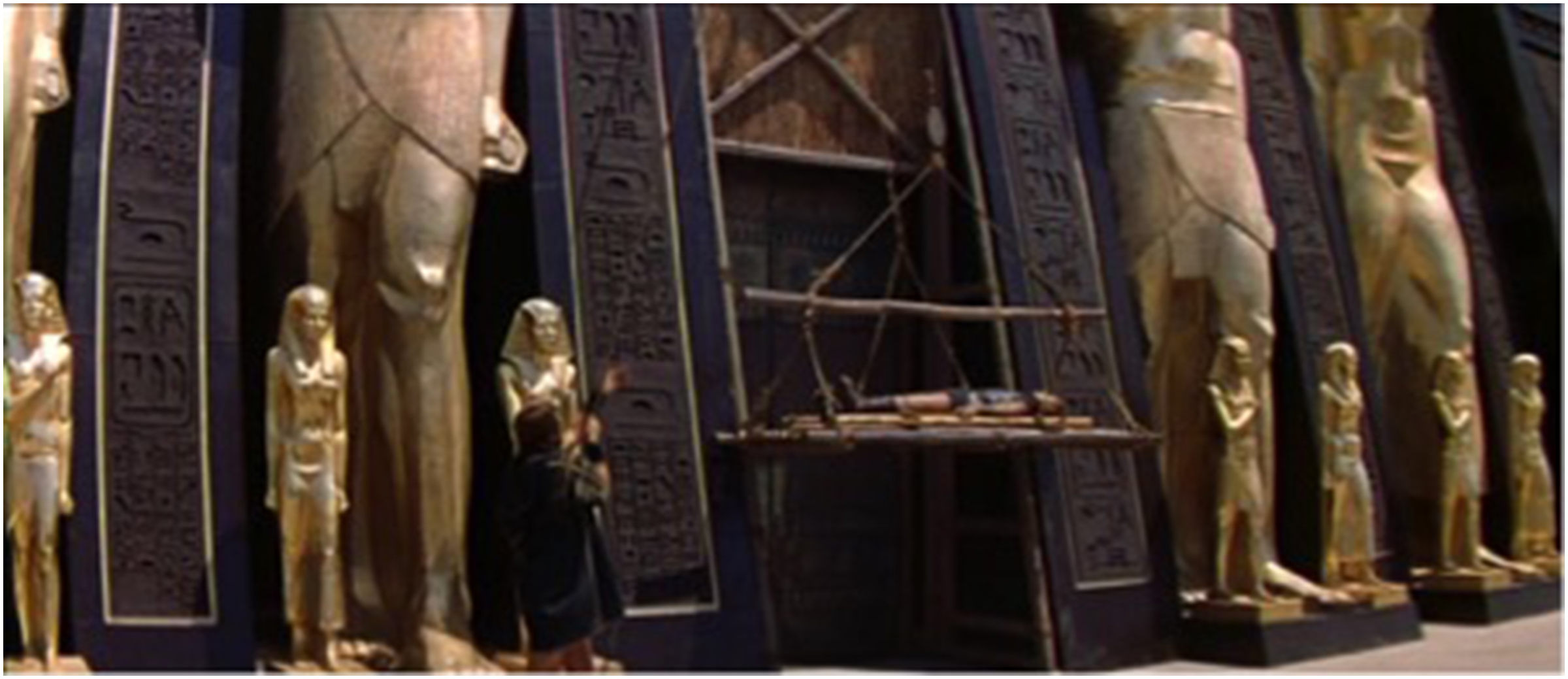
Antony (Richard Burton) being hoisted up the front of Cleopatra's mausoleum by Apollodorus (Cesare Danova) (Joseph L. Mankiewicz, Cleopatra, disc 2, 1963–01:50:57).
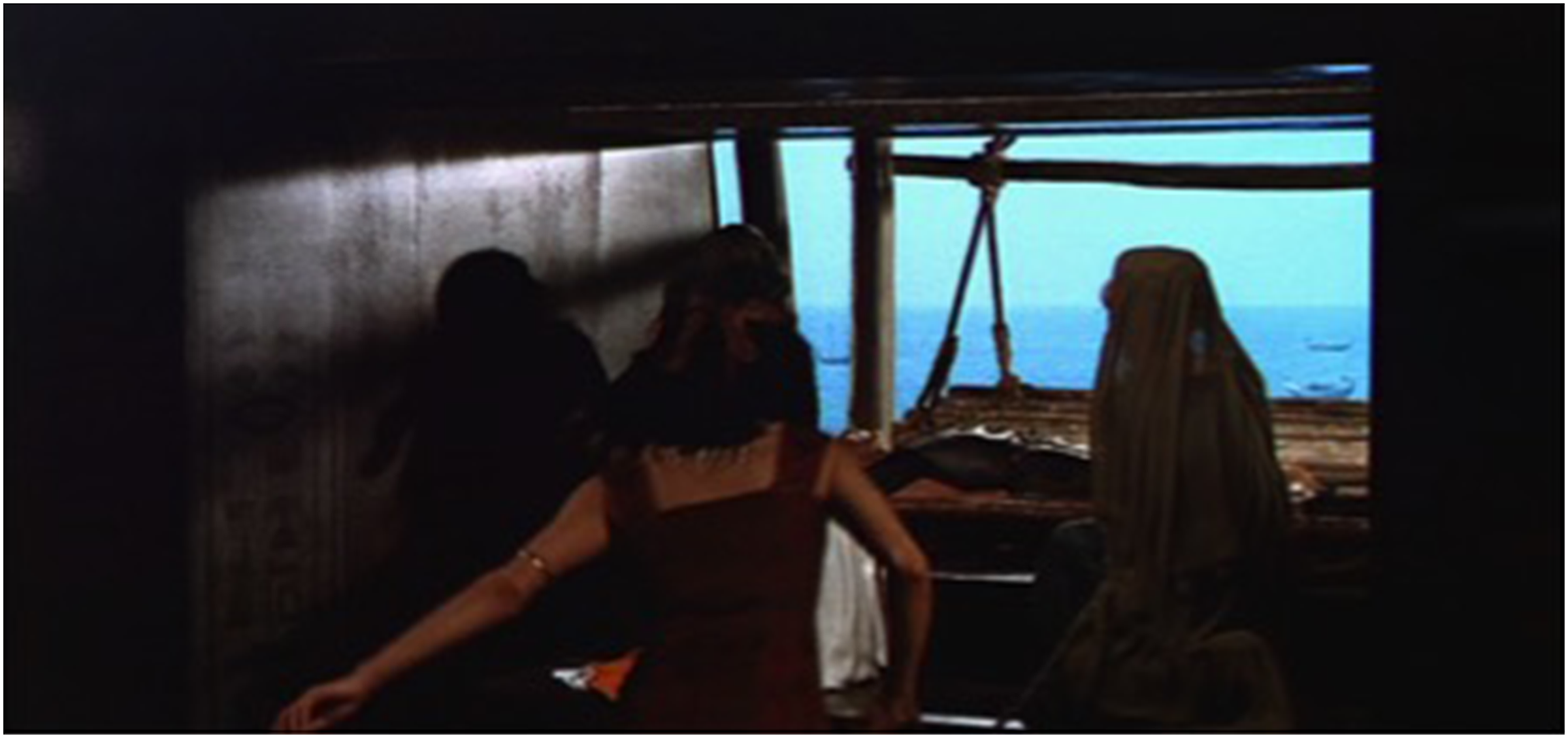
Cleopatra and her women removing Antony from his stretcher (Joseph L. Mankiewicz, Cleopatra, disc 2, 1963–01:51:12).
As Cleopatra succours the dying Antony, she can once more be associated with Isis. In ‘The Life of Marcus Antonius’, Plutarch reports that Cleopatra ‘did not onely weare at that time [the day when Antony established her as Queen of Egypt, Cyprus, Lydia etc.] (but at all other times els when she came abroad) the apparell of the goddesse Isis, and so gaue audience vnto all her subiects, as a new Isis’.
47
This is reported by Caesar in Shakespeare's play: ‘She / In th’habiliments of the goddess Isis /That day appeared, and oft before gave audience, / As ‘tis reported, so’ (3.6.16–19).
48
In ‘Of Isis and Osiris’, Plutarch relates the moment when Isis went in search of Osiris’ scattered body parts, after her brother and husband were murdered and dismembered by Typhon: she searched for them in a bote or punt made of papyr reed, all over the moores and marishes: whereof it comes that the Crocodiles never hurt those who saile or row in vessels made of that plant, whether it be that they are affraid of it, or reverence it for this goddesse sake I know not.
49
Isis uses a boat of papyrus to gather Osiris’ scattered body parts, re-member him, and give him a decent funeral and tomb. Mankiewicz's stretcher made of rushes is as instrumental as the boat of papyrus: Cleopatra (Isis) ‘reconstructs’ 50 Antony (Osiris), endowing him with a metaphysical dimension. And when her women have dressed her in her ‘best attires’ (5.2.227), her golden dress with wing-like sleeves is clearly evocative of representations of Isis. Finally, still in Mankiewicz's Cleopatra, if Antony's stretcher can recall a humble ‘papyrus skiff’, Cleopatra's magnificent sarcophagus can metaphorically be regarded as a ‘papyriform boat’, especially in the final sequence, when the camera zooms out (02:05:38; Figure 5): the composition of the shot, with the tomb in the middle and the framing structure, may be reminiscent of a ‘papyriform boat’, as shown on Bjorn Landstrom's sketch (Figure 6).
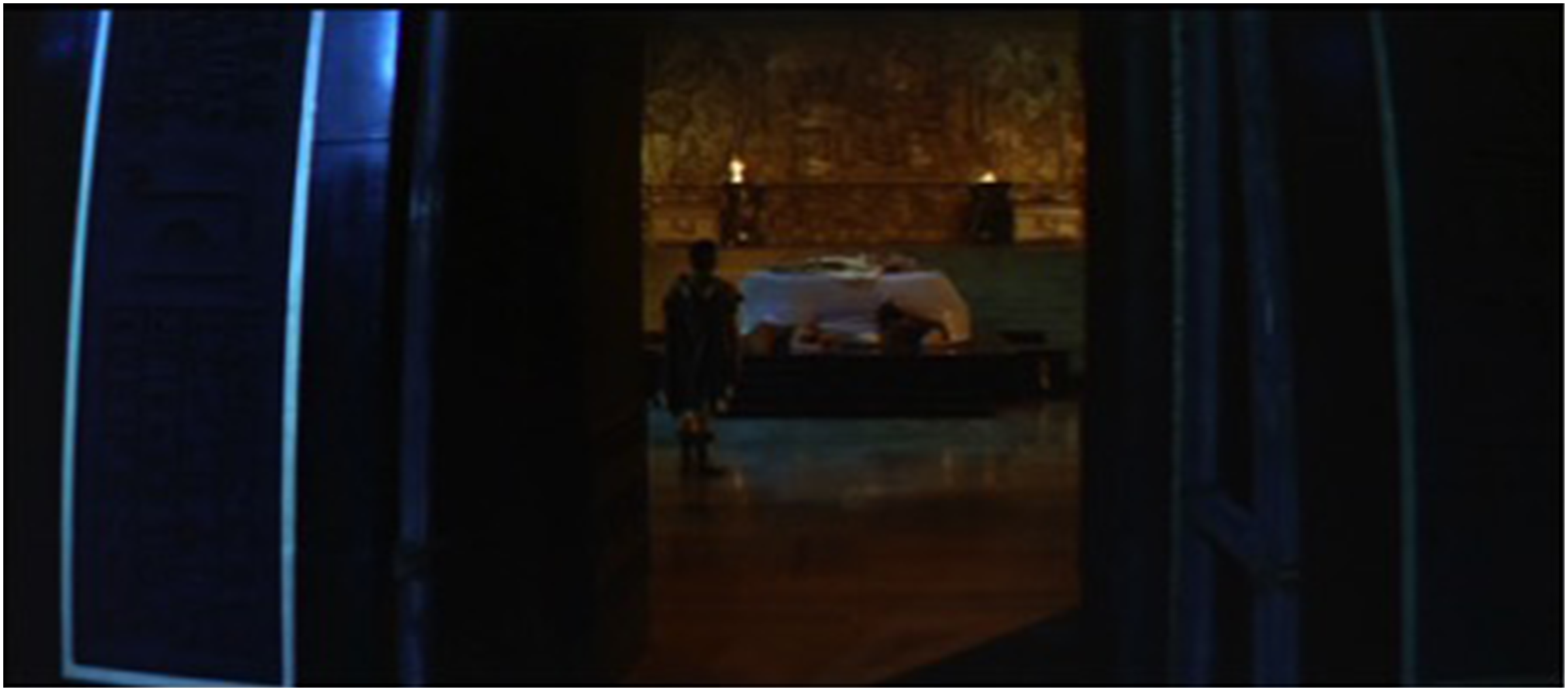
Cleopatra dead on her sarcophagus in her monument (Joseph L. Mankiewicz, Cleopatra, disc 2, 1963–02:05:38).
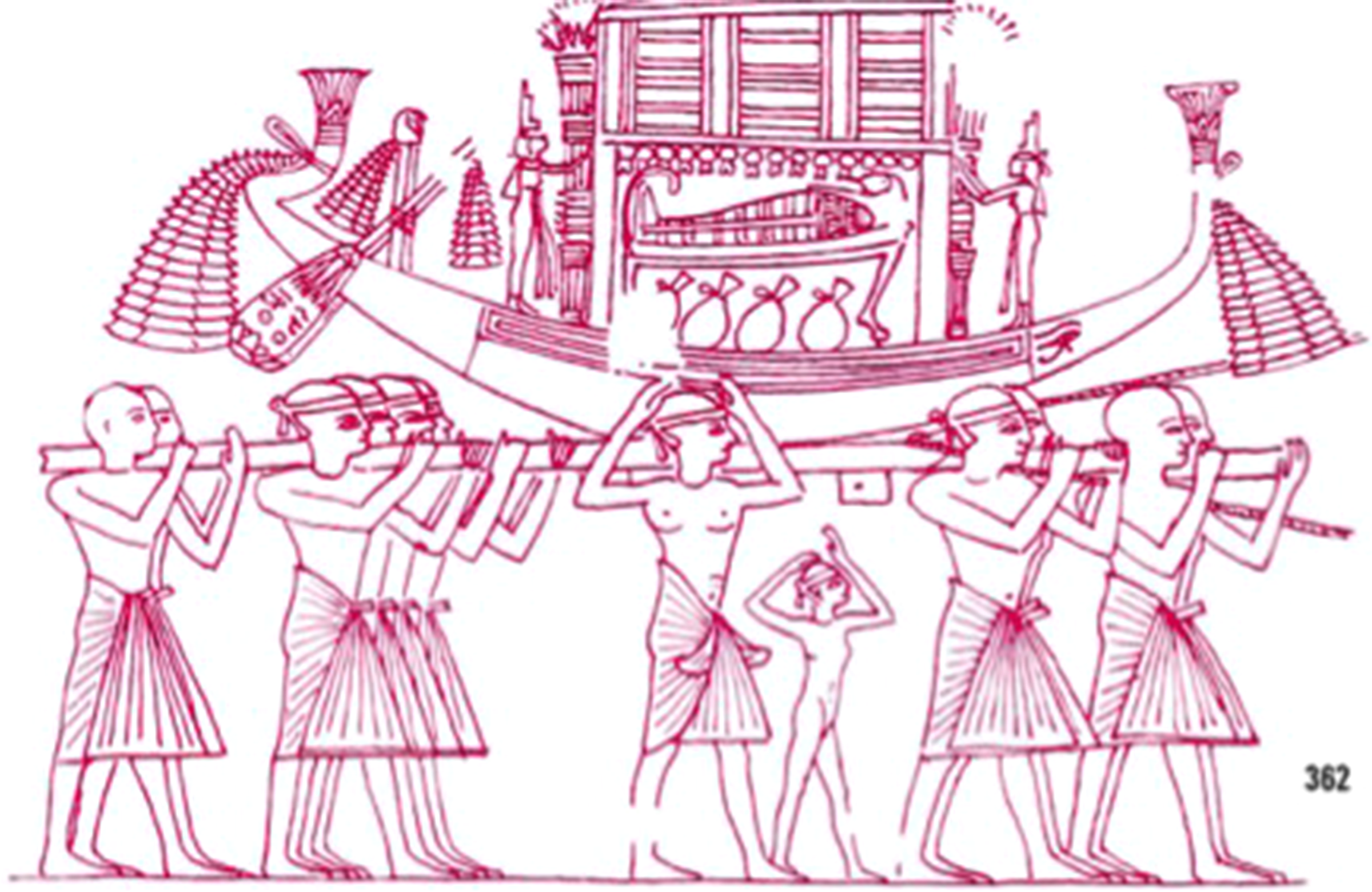
The sketch of a papyriform craft after plate 25 from Norman de G. Davis, Seven Private Tombs at Turnah (London: Egypt Exploration Society, 1948), taken from Bjorn Landstrom's Ships of Pharaohs (Garden City, New York: Doubleday & Company, 1970), p. 117.
The ‘territories’ that Cleopatra's imaginary papyriform boat is now heading for have nothing to do with Egypt and those formerly granted by Antony, ‘lower Syria, Cyprus, Lydia’ (3.6.10). They encompass nothing less than a limitless, transcendental space: they are cosmic, in keeping with her ‘[i]mmortal longings’ (5.2.280). In Plutarch, there is no metaphorical or metaphysical voyage: Cleopatra's reported speech on Antony's tomb is reduced to ‘doleful plaints’ 51 that betray her fear of being parted from her lover and buried alone in Italy. The focus is on death and burial, that is, earth, an element that Shakespeare's Cleopatra has relinquished on the verge of her voyage, being now ‘fire and air’ (5.2.288) only, showing, like Antony's dolphins, her ‘back above / The elements [she] lived in’ (88–9). In the Shakespearean play, as in Mankiewicz's film, the ultimate voyage breaks through tragic destiny to reach eternal romance and cosmic harmony. 52 Cleopatra's royal funeral vessel, like her barge on the Cydnus, will find its way through the elements, and simultaneously incorporate them and dissolve into them, so that she may be reunited with Antony, whom she pictures to the last in terms of cosmic cartography, immortalising his living face ‘as the heavens, and therein stuck / A sun and moon which kept their course and lighted / The little O, the earth’ (5.2.78–80), and ultimately finding her lover's ‘new heaven’ (1.1.17).
Footnotes
Declaration of conflicting interests
The author(s) declared no potential conflicts of interest with respect to the research, authorship, and/or publication of this article.
Funding
The author(s) received no financial support for the research, authorship, and/or publication of this article.
