



Abstract
The Padua First Folio owned by the Biblioteca Universitaria does not include the original binding, but photos show the shelfmark as having belonged to the Santa Giustina Library. Other English books with the same binding and similar shelfmarks have been found, all coming from Santa Giustina. Some of them contain a mark of ownership by the two John Hobsons, consuls of the English nation in Venice in the seventeenth century, who bequeathed their books to the library of the natio Anglica at Padua University. We know very little about this library, founded in 1649. An Appendix proposes a reconstruction.
The First Folio and the Biblioteca Universitaria
The Shakespeare celebrations in 2016 provided the opportunity to reappraise the copy of the First Folio preserved in the Biblioteca Universitaria in Padua, and specifically to try and shed some light on its provenance. 1 On this topic, no new information had surfaced since 1895, when the Scottish journalist John Robertson first announced the existence in Padua of an exemplar of the famous editio princeps of Shakespeare's works. He described the volume's discovery by the librarian, Marco Girardi, in a crate full of books that had long laid abandoned; the loss of the frontispiece was arguably the reason why the volume was not catalogued and had not found a place on the shelves. 2 Robertson's reconstruction, possibly prompted by the desire to give prominence to his ‘discovery’, was not based on facts. The book had surely been known since its arrival at the library, which must have happened in or before 1840, when the Biblioteca Universitaria received the last portion of the books coming from the religious congregations that had been suppressed between 1806 and 1810. The book was marked with the official stamp associated with the Austrian domination, entered in the registry and placed in the Sala Nuova, a venue where the books coming from the suppressed convents were stored, located near the Sala dei Giganti in the former residence of the Carraresi family, where the Biblioteca Universitaria was then housed. As happened with other volumes, the Folio was collocated in the available space, without any regard for the coherence of the collection to which it belonged. The ancient inventory of the Sala Nuova also displays on the margin the shelfmarks referring to the collocation in Magazzino B (‘Storage B’); this shelfmark is datable 1912, when the Library was moved to its current location. The Folio was moved to a restricted access collocation and, due to its rarity, became the starting point of a new collection called ‘Rari Nuova Serie’. 3
The volume lacks the frontispiece and the address ‘To the Reader’, now substituted by facsimile pages. The original binding was also been lost and substituted with the current one in 1960, as testified by the binder's records. Charles Shattuck, consulting the volumes in 1962, was justly incensed and commented: ‘Who would dream of replacing (and destroying) the original boards of a 1623 Folio? … Their very filth is part of their history’. 4 However, in 1923 Bruno Brunelli had reported that the book was bound in basil, the soft sheepskin; presumably, the modern binding in full leather, with raised bands on the spine and a decorative double-fillet frame blind-tooled on both covers, attempted to reproduce the original. 5 Pictures of the endpapers, taken by Gwynne Blakemore Evans before restoration and published in his 1960 edition of Shakespearean promptbooks, have provided this study with a starting point and supplied valuable information. 6 The original binding must have been of the cheapest kind, as indicated by the irregular edges of the turn-ins of the leather cover and by the pastedowns, made of recycled printed material. The latter can be identified as fragments of two different editions, not yet paginated, of a work of biblical genealogy by John Speed. The fragment pasted on the back of the volume belonged to an edition not accounted for in records, but close to one attributed to Felix Kingston and dated around 1638. 7 The pastedowns, inserted under the turn-ins and under the leather nerves inside the wooden boards, appear contemporary to the original binding. On the front pastedown, we find several annotations: the number ‘385’, the translated title ‘Tutte le opere di Sakespear Commedie e tragedie, manca il frontespizio’, on a paper fragment, and the shelfmark ‘F. in capsa ad laevam’ (Figures 1 and 2). This last annotation is the key that has allowed us to trace the Padua First Folio back to the library of the Benedictine monastery of Santa Giustina, as the same type of shelfmark can be found in the eighteenth-century catalogue of that library, now held by the Biblioteca Universitaria, which does not mention the Folio. 8
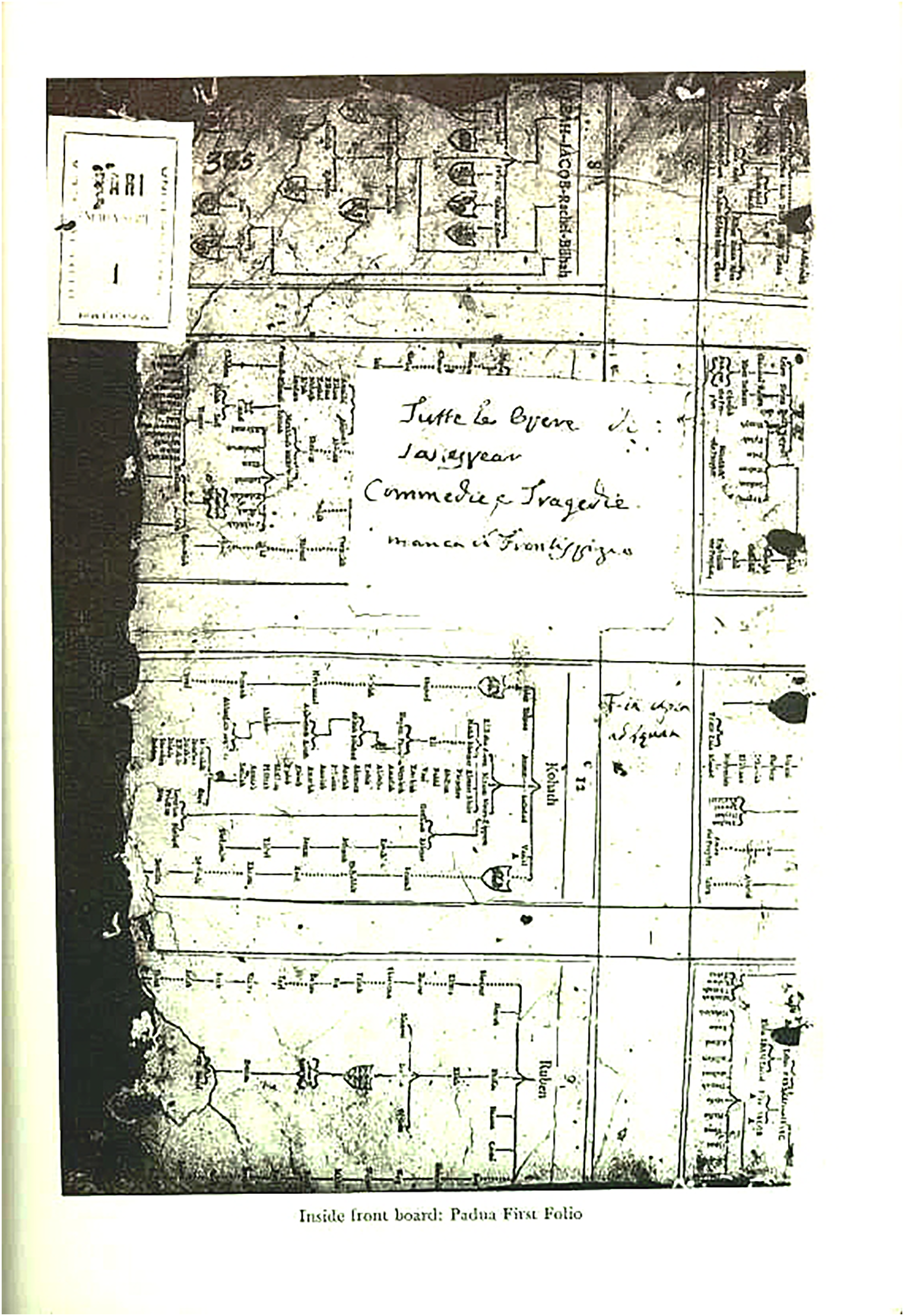
William Shakespeare, Mr. VVilliam Shakespeares comedies, histories, & tragedies […] (London: Isaac Iaggard and Ed[ward] Blount, 1623). BUP, Rari N.S.1: the front pastedown now lost; reproduced in Gwynne Blakemore Evans (ed.), Shakespearean Prompt-Books of the Seventeenth Century, vol. 1 (Charlottesville: Bibliographical Society of the University of Virginia, 1960).

William Shakespeare, Mr. VVilliam Shakespeares comedies, histories, & tragedies […] (London: Isaac Iaggard and Ed[ward] Blount, 1623). BUP, Rari N.S.1: the back pastedown now lost; reproduced in Gwynne Blakemore Evans (ed.), Shakespearean Prompt-Books of the Seventeenth Century, vol. 1 (Charlottesville: Bibliographical Society of the University of Virginia, 1960).
The companions of the Padua First Folio
Research in Magazzino B has uncovered several other books in English with the same kind of binding, showing severely deteriorated leather and considerable water damage, with the titles translated in the same hand and similar annotations and shelfmarks. Several volumes have been identified, clearly part of a previously unknown English collection. This is confirmed by the discovery of a related list of books, ‘Libri in lingua inglese’, inside another catalogue from Santa Giustina, held at the Biblioteca Civica in Padua; the catalogue remained in use until the monastery suppression in 1810. 9 The list can be dated 1801 (or slightly later) and must be the work of the librarian of Santa Giustina, Innocenzo Maria Liruti, and of his collaborators, who undertook to clear out a room full of books, to ‘separate the useful and good from the useless or despicable’, as Liruti writes in a report produced shortly before the Benedictine library was closed. 10 This list records the books collocated in the upper closet labelled ‘N’ (‘nell’armario N. sopra’) and, in the Appendix (see online Supplemental material), the books ‘under the letter F in the trunk on the left’ (‘sotto la lettera F in capsa ad laevam’): the first reads ‘Shakespear. Commedie e tragedie (manca il frontespizio), in folio’. The document lists 126 volumes, a number accounting for multiple copies and editions of the same works; some of these entries refer to volumes containing more than one work, or to copies containing only a section of a work. After checking the older shelfmarks for the phrase ‘N. sopra’ or ‘F in capsa ad laevam’, 97 volumes have been identified, containing 119 works, of which one is present in two witnesses; these are mostly seventeenth-century editions printed in London, but there are also six sixteenth-century editions and 12 eighteenth-century editions (all dated before 1755). The distinctive feature of the collection is the presence of the original English bindings in full leather, mostly preserved. Besides the older type, described above, with a simple blind-tooled double-fillet frame, several books dated to the mid-seventeenth century display additional decoration in the form of a vertical double-fillet creating two asymmetrical square frames; bindings typical of the Restoration and of the early eighteenth century are also present, with squares of tanned leather creating a multi-tonal effect and covers framed by a simple decoration. Limp parchment bindings are also recorded on late-sixteenth-century editions, as are later booklets bound in marbled paper. In a few cases, the original sewing stitches have been preserved, tied near the spine edge, as the simplest form of temporary binding for booklets or small volumes. 11
Some of the books, not present in the list, must have escaped cataloguing: these include English editions containing works in Latin and Latin works published abroad, probably bound in the English way after being imported unbound (non ligati) in England. 12 When they entered Santa Giustina, the Latin books and the more valuable English ones would have been immediately put on the shelves, while other English books, including the Folio, were probably set aside waiting for a collocation, later provided by Liruti. Some of the most significant English editions, which could have entered Santa Giustina along with these collections and are mentioned by Liruti in his 1806 report, were probably dispersed soon after the suppression of the monastery, due to their material value. 13 The books belonging to the same collection are confirmed by the previous shelfmarks. Thanks to these collocations and ownership notes, and with the discovery of previously unknown archival documents, it is now possible to reconstruct the complex pilgrimage of these volumes, which must have belonged to the library of the natio Anglica, the corporation of English students at the University of Padua; before that, several of them belonged to the consuls of the English merchants in Venice. They came to the Biblioteca Universitaria through the library in Santa Giustina, via the library of the Discalced Carmelite friars of St Jerome, in Padua.
History, trade, and navigation
These books are mostly practical manuals related to the activities of merchants and sailors: they concern the art of navigation, astronomy, cosmography, mathematics, trigonometry, computation, and trade. There are volumes on the art of war, geography, the English monarchy and navy, and travel accounts, but also classical works, poems, plays, and religious works. Some display annotations that can be dated to the difficult period from the reign of Charles I to the Civil Wars and the Restoration. On the frontispiece of the 1641 edition of Speeches and passages of this great and happy Parliament, the word ‘happy’ is amended to ‘unhappy’. The volume Reliquiae sacrae Carolinae, in the 1658 edition, has been annotated by a partisan hand, calling Charles I ‘a loyal martir’ and Cromwell ‘a damned traytor’. In the 1660 edition, describing the rigging used by all English ships and frigates, the word ‘State's’, referring to ‘Ships’, is systematically substituted with ‘King's’; this must have happened after the Restoration. 14 Some editions in this collection are extremely rare even in British libraries, and several have not yet been entered into any catalogue. 15 A collection of official documents published between 1672 and 1674 refers to the different stages of the third Anglo-Dutch War, including the declaration of war by Charles II. The 1670 Index Vectigalium and The Acts for tonnage and poundage (1671) contain handbooks with the tariffs of custom duties owed to the Crown. Among the manuals for merchants, the Socius mercatoris by the mathematician John Mayne shows an annotation by the author, who gifted the book to his friend Nicholas Gunton, employed around 1670 as ‘mathematical practitioner in London; general gauger in the Excise Office’. A small volume also by Mayne, The practical gauger, containing a practical method for measuring beer and wine barrels and custom tables, is present in its 1683 edition, never documented before. 16
The volumes on navigation, along with the mathematical works, constitute the largest part of the collection, documenting the flurry of activity in this field, with the many new studies and discoveries marking the onset of the scientific revolution in Britain. Several volumes discuss the calculation of longitude, a key problem for astronomers and sailors: among them are The longitude found by Henry Bond and The longitude not found by Peter Blackborow, who criticised Bond's method. Among the rare editions there are Richard Norwood's The sea-man's practice (1676) and Nathaniel Colson's The mariners new kalendar (1682), beside the 1677 edition of Andrew Wakely's The mariners-compass rectified. Worth mentioning is also The navigator by Charles Saltonstall, dedicated to Thomas Howard, Earl of Arundel, alongside two editions of Practical navigation and An epitome of the art of navigation by the famous cartographer John Seller, with the engraved title pages depicting Instruments of Navigation. 17 Among the manuals of mathematics there are Records arithmetick and The ground of arts by Robert Recorde, Arithmetick by Thomas Masterson edited by Humphrey Waynman, and the works by Seth Partridge and William Leybourn on the art of calculating numbers with Napier's Bones. Among astronomy volumes, there is a gathering of extremely rare material, including Edmund Halley and William Whiston's prediction of the total solar eclipse of 22 April 1715. 18 Several other volumes testify to the many theological disputes of seventeenth-century Britain. The few volumes of poems and plays are quite significant: besides the First Folio, there is a copy of John Harington's Orlando Furioso in English heroical verse (1591), the only Elizabethan literary work in the collection. Other works of literature are Psyche, a tragedy by Thomas Shadwell adapted from Molière, and Nathaniel Ingelo's allegorical romance Bentivolio and Urania. 19 Ownership notes, older shelfmarks, prices, and other types of annotations allow us to validate the hypotheses on the volumes’ provenance, establishing interesting relationships between single volumes.
The consuls’ library
Several of the books can be connected to the English consuls in Venice, diplomatic agents who represented the English merchants’ interests and were generally appointed directly by the King or one of his ambassadors. Their houses functioned as a refuge and a residence, providing material support to merchants, and in general to Englishmen travelling abroad. Moreover, their libraries came to be viewed as intellectual and psychological refuges for English expatriates, as happened elsewhere throughout the Continent. 20 These books show the names of several consuls: John Hobson and John Hobson Jr, uncle and nephew originally from Bristol who were among the most influential merchants in seventeenth-century Venice, and Giles Jones, a powerful merchant and shipowner in the Republic's service. The books related to the consuls are worth examining: John Hobson could be responsible for the arrival of the Folio in Venice, as part of his personal library. The exemplar of Harington's translation of Ariosto presents an antique binding in full leather identical to the original binding of the Folio. Inside the front cover, the title is translated by the same hand displayed in the Folio, on a small paper pastedown, along with the number 384 (preceding the Folio's own 385) and the ownership note ‘John Hobson. Anno 1629’. 21 Another volume with Hobson's ownership note and the same binding contains the fourth part of Samuel Purchas's Pilgrimes (1625), another extremely rare edition. On the back turn-in, the name of the previous owner can be read as ‘Thomas Gatward. His booke. Anno Domini 1636 in Lon[don]’, testifying to the fact that the volume was still in England at that time, and providing a terminus post quem for its acquisition by Hobson. 22 The years 1629 and 1636 are to be respectively taken as terminus ante quem for the binding of the two volumes.
Giles Jones, who succeeded Hobson as consul in 1660, owned The surgeon's mate by John Woodal in the 1639 edition dedicated to Charles I, a fundamental text in the history of the English Navy Medical Service. 23 Among the books belonging to John Hobson Jr can be found Thomas Blundeville's Exercises (1597); the book was addressed to young English gentlemen who wished to expand their knowledge of cosmography, astronomy, geography, and navigation. The volume is marked ‘John Hobson Junior n. 25’, while a printed ex-libris reveals the previous owner as ‘Iohn Laugharne. 1599’ 24 (Figure 3). Polybius’ Histories in Grimeston's 1634 translation displays a mark reading ‘John Hobson Junior 56’, along with the signature of a ship's captain, ‘Captayne Thomas Clarke’. The text is heavily annotated and amended; on the free endpaper at the back of the volume, partially torn, one may read the name of the Irish town ‘Kinsale’, which in 1601 witnessed a decisive battle in the Nine Years’ War. 25 Another volume, Fortification or Architecture Military by Richard Norwood, published in 1639, is marked ‘John Hobson Junior n. 11’. 26 In January 1659 Hobson Jr asked the Venetian Collegio dei Savi for a license to host several English nationals in his house, claiming that it was his duty to take care of countrymen coming to Venice and recommended to him, since he had established business relations with England and with other places during his 14 years in Italy, and trade was booming. His books must have represented an organised collection, as testified by the shelfmarks written after the ownership notes, which can also help us gauge the library's significant losses: the shelfmarks on the three surviving volumes witness a collection including at least 56 volumes. The presence of different names in the volumes indicates that Hobson's library must have been open to merchants and other guests; presumably, books owned by other English nationals were also held there. The influential Hobson family kept the consulate for three generations during the second half of the seventeenth century. With the death of Hobson Jr in 1685, his son Thomas obtained the post. He was in Padua in 1689 and signed his name there as ‘Consull for His Mayestie King James the second’, in the register of Viatores in Italia kept by the Bedell of the English nation 27 (Figure 4). In the same year, however, Thomas Hobson was removed by the new King William III of Orange, due to his Jacobite leanings. Several books in the collection must have belonged to him, specifically a 1688 edition describing the King's right to bestow indulgence in spiritual matters, bound with sermons preached in the cathedral at Bristol in memory of Charles I and with a pamphlet defending King James II. The volume was held in Santa Giustina, together with the First Folio, under the letter F ‘in capsa ad laevam’. 28

John Hobson Jr’s ownership note in Thomas Blundeville, His Exercises […] (London: John Windet, 1597). BUP, 111 b 138.
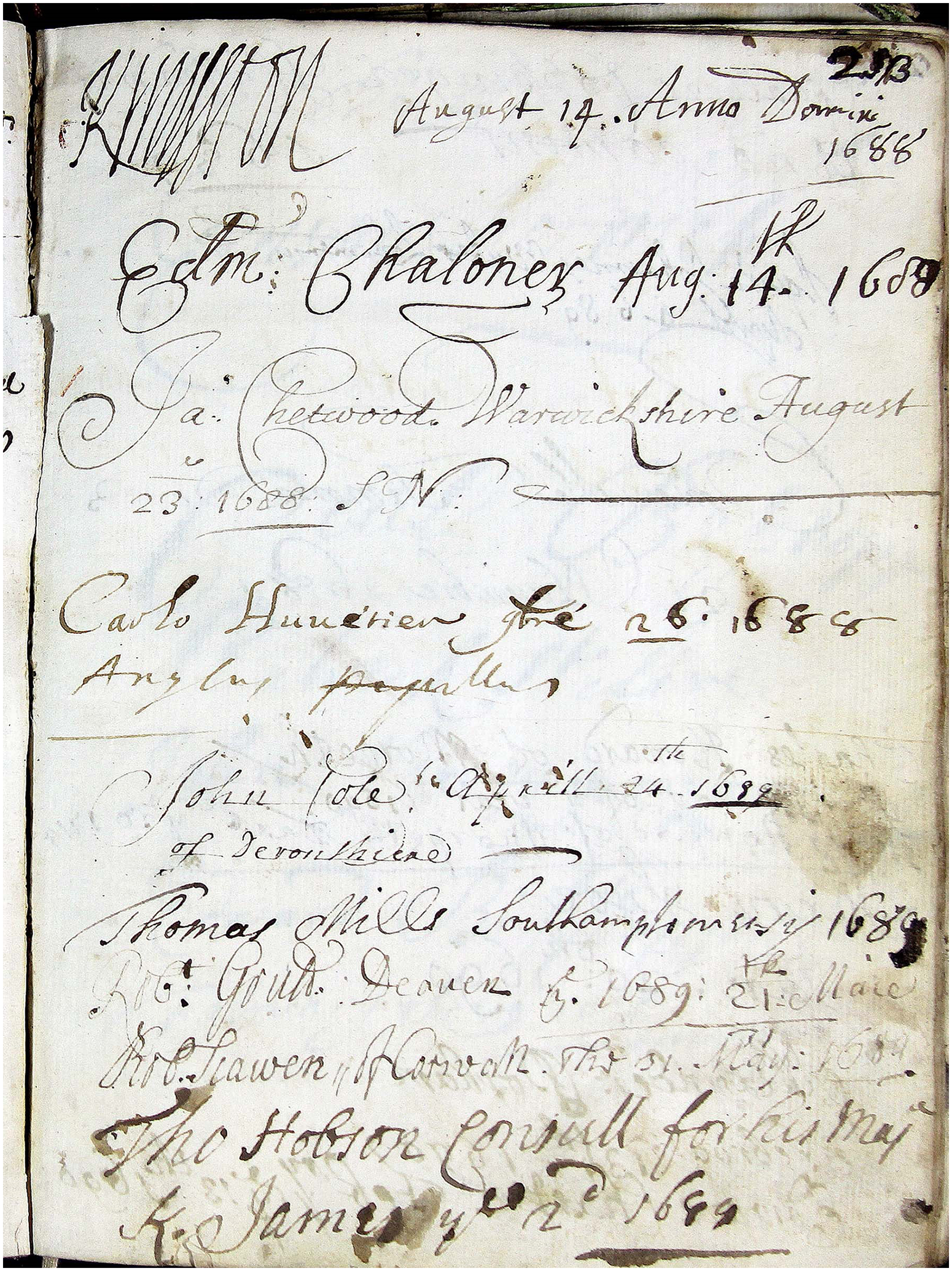
Consul Thomas Hobson’s signature (1689) in the register of Viatores in Italia. BSP, MS. 634, fol. 253.
The discovery of John Hobson's original will in the Venice State Archive allows us to shed some light on the transfer from Venice to Padua of the books belonging to the consuls and other English merchants. In the will, written in Venice in 1655, Hobson calls himself consul for the English nation and leaves all his goods to his wife Giulia and his nephew John Hobson Jr, who lived in the same house. He also makes separate bequests, among which is the following: ‘I leave to the library of the English nation in Padua, to be preserved for the communal use of said nation, all my printed books in English and specifically the History of the World written by Sir Walter Raleigh, Grimston's History, and the History of the Turks, with many others in the number of…’ 29 (Figure 5). These were the books Hobson held most dear: ‘Historia del Grimston’ could refer to the above-mentioned Polybius translation, which bears an annotation by Hobson Jr; Raleigh's History of the World, first published in 1614 and often reprinted, is not among the books in the list from Santa Giustina; the list contains instead ‘Turchi. Loro origine (manca il frontispizio), in 8.’, which may be Richard Knolles's Generall Historie of the Turkes, first published in 1603 and often reprinted, or Paolo Giovio's Commentario delle cose de’ Turchi translated into English (1546); this volume is probably lost. 30 After the death of Hobson Sr, John Hobson Jr, who probably retained his uncle's books, wrote a first will in Venice in 1662, naming his lifelong friend ‘Erasmo Dryden q. Iohannis gentiluomo inglese’ as his executor and heir. In accordance with his uncle's will, he repeated the same instructions regarding the books: ‘I leave all my printed books to the English nation at Padua, to be kept in their library in that city, for the common use of my nation’ 31 (Figure 6). The Hobsons’ wishes may have been fulfilled by Thomas Hobson, the last consul in the family, who in 1689 visited the Padua Studium. The list of English books including the remnants of the consuls’ library, laid out as a separate document in the inventory from Santa Giustina, may represent what was left of the library of the English nation in Padua.

John Hobson Sr’s bequest to the library of the English nation in Padua. ASV, ‘Notarile, Testamenti’, b. 327, n. 66 (22 October 1655).

John Hobson Jr’s bequest to the library of the English nation in Padua. ASV, ‘Notarile, Testamenti’, bb. 64–5, n. 252 (16 September 1662, unpublished).
The library of the natio Anglica
We have very little information about the library of the natio Anglica. It was created in 1649 on the model of the German one; during the Civil Wars, the Studium accommodated more and more English students exiled from their land, a number that decreased dramatically in the following years. 32 At least initially, the library was well organised and books marked with the ownership note ‘Bibliothecae Anglo-Patavinae’ and the initials ‘NA’ (for ‘natio Anglica’) tooled on the front edge. This is testified to by the very few extant books acquired after the dispersion of the English library. Two volumes can be found at the Biblioteca Universitaria, where they arrived during the Venetian domination; one belonged to the pathologist Giovanni Battista Morgagni. Two other volumes are held respectively in the Biblioteca Civica and Biblioteca Capitolare, and were donated to the natio by Alexius Vodka, a member of the Royal College of Physicians in London, who signed the Viatores register on 15 June 1650, and on 31 October 1652 became a Doctor of Philosophy and Medicine at the Veneto College of Arts. 33 In later years, librarians must have been less attentive in registering ownership and donations, since the volumes in our collection lack any annotation directly referring to the natio. If some of the books in our collection of English volumes can be connected with the merchant community in Venice, others must have come to the English library by other means, either donated by departing students and teachers of the University, or by travellers, whose signatures can sometimes be found in the Viatores register. Robert Barret's Theorike and practike of moderne warres displays an ownership note by ‘Henricus Sventonus Scotus’, a councillor for the natio Scota legista, who left two coats of arms in the Palazzo del Bo, referring to the two posts he held in 1638 and 1643. His signature can be found in the English register, dated 20 December 1637, and is connected to his payment of the subscription fee to the natio. 34 A volume on the art of painting by William Sanderson dated 1658 belonged to Richard Symonds, the antiquarian who sided with the Royalists during the Civil Wars. Symonds was in Padua in 1651, when he ended his Grand Tour: he signed the English register on 13 June and left on 10 September. He died in 1660 and his books were dispersed. 35 Robert Hues's Tractatus de globis coelesti et terrestri shows an ownership note by ‘Moses Hodges e Collegio Reginae Oxoniensi 1682’. In 1682 Hodges, lord of Sulgrave Manor, obtained a bachelor of arts from Queen's College; he then became a doctor of divinity and pursued an ecclesiastical career. 36 The close relationship between Padua and Oxford, sorores institutions, is further documented in the Viatores register by an annotation dated 3 March 1700 and commemorating a donation to the Bedell of the English nation on behalf of the University of Oxford. 37
The Hobson wills prove that there was a strong link between the two English communities, the merchants in Venice and the students in Padua. Another document testifies to the direct influence of the consul on the natio library. In a document of the Law University, dated 29 March 1728, the English and Scottish nations petitioned to give the post of librarian to Filippo Cullin, councillor of the natio Scota, who was to replace Domenico Mingoni, ‘an Italian and a resident of this city’, who had the double role of Bedell and librarian. Mingoni had no intention to leave his post, claiming it had been bestowed on him by the late consul, but the nations, noting the deteriorating conditions of the library during his tenure, considered that the current consul would also approve of giving the post back to another British national. 38 The late consul was Hugh Broughton; Neil Brown, his successor, should have approved the substitution of Mingoni with Cullin. 39 On 26 April, however, the Reformers of the Studium, noting that the decision to elect Filippo Cullin as librarian had been taken with only two students of the nation and that Domenico Mingoni, doctor in utroque iuris, had satisfactorily held the post for 20 years, decided to confirm him in his post for the time being. 40 Richard Rawlinson, collector and benefactor of the Bodleian, met him in February 1722: ‘Meeting Dr Domenico Mingoni, Bedell of the Britannic Nation, I entered my name in his book of Matriculations’. 41 Filippo Cullin, the designated librarian, was in the Studium at least since 7 May 1726, when his signature, followed by the qualification ‘Hybernus’, appears in the register. 42 The same register testifies to a progressive reduction in the number of English students and travellers: slightly above a hundred in the 1730s, they were about 20 in the 1740s and only 15 in the 1750s. This diminution paralleled the decadence of the University institutions, wholly subverted in 1738 by the decision to transfer the roles of vice-rector and mayor from students to professors, highlighting a progressive loss in the prestige of student magistrates that had been ongoing for a long time. 43 The register was not updated after 9 August 1765; even the Bedell would soon lose his function. In 1790, in a letter addressed to Count Girolamo Beltramini, vice-rector and mayor of the Law University, Chancellor Marcantonio Galvani, asked to provide information about the post of English Bedell, claimed that ‘although the post does not seem necessary at this time, it however serves the decorum of the University in private and public functions’. 44 The English library must have been largely dispersed, first, thanks to the neglect of Mingoni, the librarian from whom English nationals tried to obtain ‘the exact and perfect note for every book, such as had been given to him from the beginning’, 45 then again during the transfer of the books to the Carmelite friars and to Santa Giustina, with the resulting selections and reductions, and finally as a consequence of Napoleon's suppression of monasteries. Other books that came to the Biblioteca Universitaria during the Venetian domination could also be part of the dispersed library of the natio Anglica, such as Johannes Scharpio, Symphonia prophetarum et apostolorum (Genevae, 1639), which displays a numerical shelfmark and several annotations in English hands. 46
The Discalced Carmelites
Along with the shelfmarks from Santa Giustina, the books also bear traces of previous cataloguing. They mostly show shelfmarks from the Padua Library of the Discalced Carmelite Friars of St Jerome, or traces of the typical tag on which the shelfmark was written, attached to the bottom of the spine and running inside the cover. Alternatively, several numerical shelfmarks can be found, written by the same hand. This cataloguing style, found in less than 30 volumes published between 1591 and 1683, must have included at least 1092 books, as testified by the highest number recorded; the Folio was assigned the number 385. 47 These numbers indicate the extent to which the original collection was dispersed. The numerical shelfmark could be a partial collocation, perhaps assigned to the volumes at the natio Anglica library. Three of the books that used to belong to the Hobsons show the numerical shelfmarks 327, 384, and 1091; 48 two others display traces of the tag from the Discalced Carmelites library. 49 The volumes, with different shelfmarks, all found their way into Santa Giustina, to be then given to the Biblioteca Universitaria. Those bearing the shelfmark of the Discalced Carmelites, probably destined for sale or exchange, have no ownership note and do not appear in the catalogue of the same library, which was started in 1742. 50 There, only a few English books are recorded, probably the ones the library decided to keep, such as John Florio's Queen Anna's new world of words, now lost, and The passenger by Italiano Benvenuto; the latter entered the Biblioteca Universitaria following the suppression of the convents and displays several features shared with the volumes in our English collection. 51 The English books, held for some time by the Carmelites, were probably partly sold, partly ceded to Santa Giustina, as the order prescribed in the case of books considered useless, or of duplicates. 52
The circumstances that brought the books of the natio Anglica to the library of the Discalced Carmelites remain mysterious. The Carmelites were a religious order based on prayer and meditation: the topics of these volumes must have sounded alien to them. It is difficult to believe that they represented the result of a deliberate purchase. The thriving libraries of the German natio survived the eighteenth century before being incorporated into the Biblioteca Universitaria; the library of the Polish natio was deposited at the Biblioteca Universitaria in 1766 by Pietro Busenello, who intended to save what was left of the library, which had undergone ‘enough diminution and shipwreck’ at the hands of untrustworthy Bedells since the presence of Polish students at the University had diminished so much. 53 A similar situation might have developed in the case of the library of the English natio, whose difficulties at the beginning of the 1730s have been mentioned above. Their books, already reduced in number, may have been at least partly destined for the library of the Carmelites; the order had been recently established and distinguished itself from the crowd of other religious orders during the seventeenth century. Having separated from the mother house in 1593, it came to Venice in 1633 and after 20 years began the majestic church of Santa Maria di Nazareth. 54 It received the support of patricians and devout women, but also of the recently ennobled and rich merchants who, like the Carmelites, were trying to find a place in Venetian society. 55 John Hobson Jr belonged to this emerging class; in 1664, after the death of his uncle, he took as his second wife Benedetta, daughter of Andrea Soranzo. She was probably related to the Miracoli branch of Benetto Soranzo, Procurator of St Mark, who subsidised the works for the main chapel and the altar of the church of the Discalced Carmelites in Venice. Benetto's brother Mattio had entered the order as Father Bernardo; his wife Maria Flangini instituted a perpetual mission in favour of the Carmelites in 1654. 56 The order was established in Padua in 1669, when it acquired the suppressed convent of the hermits of St Jerome of Fiesole in the Arzere area of the town, now Via Beato Pellegrino. In 1696 the library was undergoing maintenance works. The church, rebuilt in 1700–01 according to Giuseppe Pozzo's design and demolished in the nineteenth century following the suppression of the order, was one of the most significant late Baroque buildings in the Veneto. 57 Abbot Volpi called the library good and well-furnished in 1756 when, among his Varie Avvertenze Utili, e necessarie agli Amatori de’ buoni Libri, under the entry for ‘Northern wind’ claimed it was extremely damaging to libraries, citing the library of the Padua Carmelites as a lamentable example, since, in spite of the thick walls, the wind penetrated and damaged a great quantity of books. 58 The state of conservation of most of the English volumes, with leather bindings and leaves heavily darkened and frail, is compatible with their prolonged stay in damp quarters. 59 Considering the influence exercised on the management of the library of the natio Anglica on the part of the English consuls, as has emerged from the 1728 documents, the transfer of the books in the library of the Carmelites must have happened with the consul's approval. The support enjoyed by the Discalced Carmelites in Venice and the close relation between the Venetian and Paduan religious houses could have contributed to determining the destination of the volumes.
Accounts in the First Folio
Since the Folio frontispiece, endpapers, and binder's leaves, which could have contained ownership information, have been lost, we only have circumstantial evidence. The original binding must have been similar to the binding of the oldest books in the English collection; moreover, the shelfmark 385 directly follows the 384 on Hobson's Orlando Furioso, which presents the same kind of damage (a damaged binding and missing frontispiece and endpapers). The back endpaper in the Folio showed numerical annotations that Evans identified with ‘what may possibly be either a library number or acquisition date (?1695), perhaps both’ 60 (Figure 2). It is instead an account, similar to the one appearing on the verso of the last page in Henry Philippes, The geometrical sea-man, bound with Saltonstall's The navigator and with Blackborow's The longitude not found; it is also similar to the annotations in Francis Bacon's Sylva sylvarum 61 (Figure 7). The annotation probably represents a division executed with Napier's notation, the Scottish mathematician who introduced logarithms in 1614 to simplify the complex calculations necessary for astronomy and navigation; he also invented a calculating machine, called Napier's bones, which anticipates modern slide rules. Some of the volumes in the English collection illustrate Napier's method. 62 This confirms that the Padua First Folio was in the hands of merchants, taking accounting notes on books not necessarily related to mathematics. This is also supported by the recently discovered accounts written on the leather cover of Thomas Fuller's The holy state. The profane state (1642). 63 The Folio may have been part of the library brought to Venice by John Hobson Sr, perhaps in the early 1640s; it must have remained in England until that point. Several annotations document the Hobsons’ habit of acquiring second-hand books. The Folio could have been ceded by the same company that operated the cuts and revisions to three of the plays, after the closure of theatres decided by Cromwell. In this context, a play such as The Merchant of Venice, appearing in this volume, has a special fascination: the vicissitudes of Antonio and Bassanio were probably part of the daily experience of the English merchants involved in the commercial and military enterprises of the Republic.
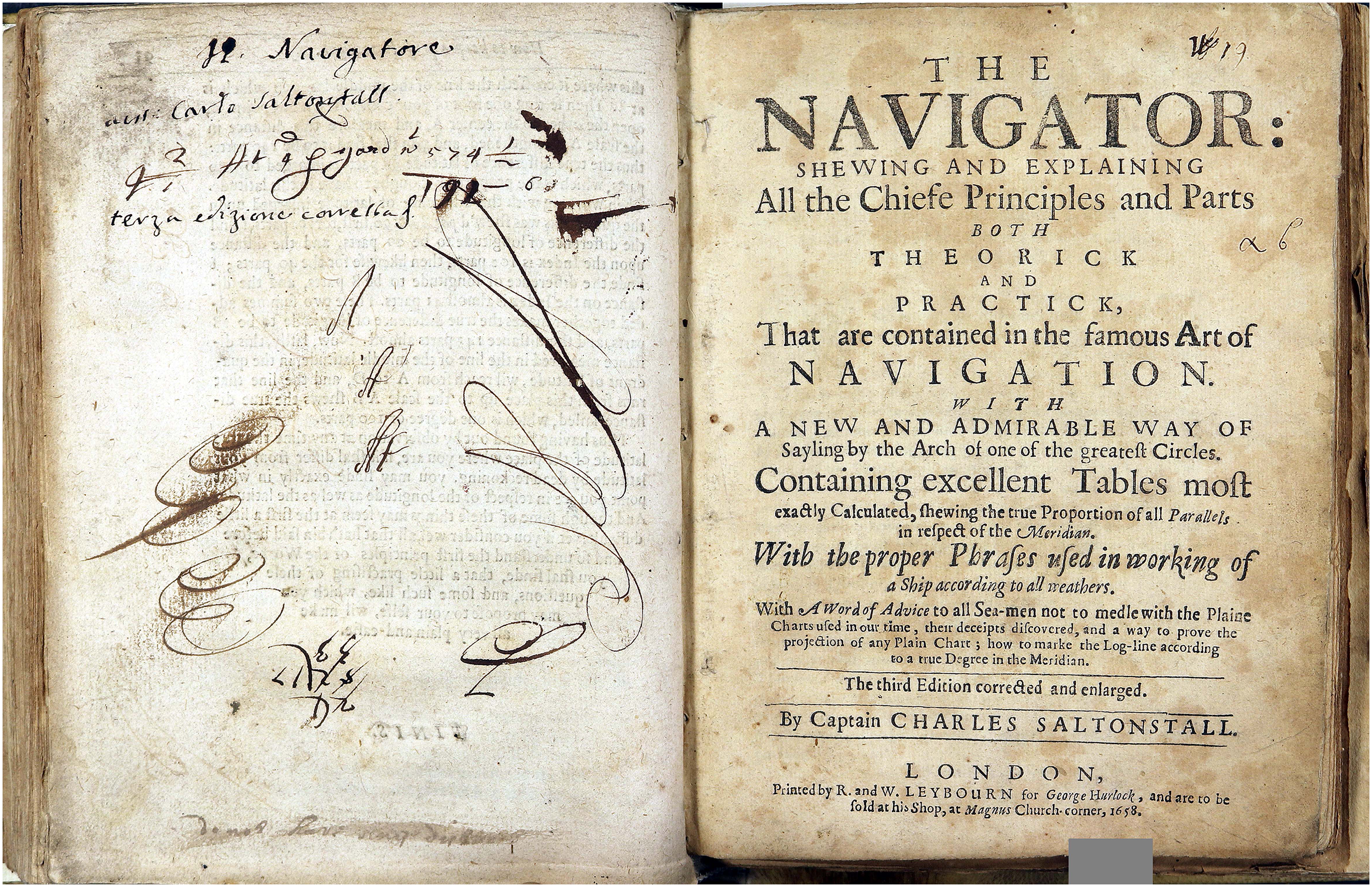
A numerical annotation on the verso of the last page in Henry Philippes, The geometrical sea-man (London: Robert and William Leybourn, for George Hurlock,1652), bound with Charles Saltonstall, The navigator (London: R. and W. Leybourn for George Hurlock, 1658). BUP, 111 b 137.
New information could surface in the future. This research so far has allowed us to discover the travel companions of the Padua First Folio preserved in the Biblioteca Universitaria: a collection of previously unknown English books providing clues to a common provenance. The Folio could have arrived in Venice along with the library of the Bristol merchant John Hobson Sr, consul of the English nation in Venice, who left his books to the library of the natio Anglica in Padua; his will was later accomplished by his nephew John Hobson Jr, also a consul. Our Folio is even more significant, as it not only represents one of the extant copies of the first edition of the works of William Shakespeare, but is also an important document for the reconstruction of a shared institutional and cultural history.
Supplemental Material
sj-doc-1-cae-10.1177_01847678231208157 - Supplemental material for The First Folio and the merchants of Venice: A collection of books from the natio Anglica in Padua *
Supplemental material, sj-doc-1-cae-10.1177_01847678231208157 for The First Folio and the merchants of Venice: A collection of books from the natio Anglica in Padua * by Lavinia Prosdocimi in Cahiers Élisabéthains: A Journal of English Renaissance Studies
Supplemental Material
sj-doc-2-cae-10.1177_01847678231208157 - Supplemental material for The First Folio and the merchants of Venice: A collection of books from the natio Anglica in Padua *
Supplemental material, sj-doc-2-cae-10.1177_01847678231208157 for The First Folio and the merchants of Venice: A collection of books from the natio Anglica in Padua * by Lavinia Prosdocimi in Cahiers Élisabéthains: A Journal of English Renaissance Studies
Supplemental Material
sj-doc-3-cae-10.1177_01847678231208157 - Supplemental material for The First Folio and the merchants of Venice: A collection of books from the natio Anglica in Padua *
Supplemental material, sj-doc-3-cae-10.1177_01847678231208157 for The First Folio and the merchants of Venice: A collection of books from the natio Anglica in Padua * by Lavinia Prosdocimi in Cahiers Élisabéthains: A Journal of English Renaissance Studies
Supplemental Material
sj-doc-4-cae-10.1177_01847678231208157 - Supplemental material for The First Folio and the merchants of Venice: A collection of books from the natio Anglica in Padua *
Supplemental material, sj-doc-4-cae-10.1177_01847678231208157 for The First Folio and the merchants of Venice: A collection of books from the natio Anglica in Padua * by Lavinia Prosdocimi in Cahiers Élisabéthains: A Journal of English Renaissance Studies
Supplemental Material
sj-doc-5-cae-10.1177_01847678231208157 - Supplemental material for The First Folio and the merchants of Venice: A collection of books from the natio Anglica in Padua *
Supplemental material, sj-doc-5-cae-10.1177_01847678231208157 for The First Folio and the merchants of Venice: A collection of books from the natio Anglica in Padua * by Lavinia Prosdocimi in Cahiers Élisabéthains: A Journal of English Renaissance Studies
Footnotes
Declaration of conflicting interests
The author(s) declared no potential conflicts of interest with respect to the research, authorship, and/or publication of this article.
Funding
The author(s) received no financial support for the research, authorship, and/or publication of this article.

Supplemental material
Supplemental material for this article is available online.
Notes
Author biography
Supplementary Material
Please find the following supplemental material available below.
For Open Access articles published under a Creative Commons License, all supplemental material carries the same license as the article it is associated with.
For non-Open Access articles published, all supplemental material carries a non-exclusive license, and permission requests for re-use of supplemental material or any part of supplemental material shall be sent directly to the copyright owner as specified in the copyright notice associated with the article.
