



Abstract

Although ‘duty versus desire’ was the Stratford Festival's official theme last year in 2023, as articulated by Artistic Director Antoni Cimolino in that season's programme notes, the topical dichotomy seemed strikingly prominent in this season's Shakespearean productions as well (note 1). Director Esther Jun's Cymbeline featured Allison Edwards-Crewe as the heroine Innogen, the steadfast secret spouse to Posthumus Leonatus (Jordin Hall), torn between filial and marital duty and beset by attempts on her chastity. Jessica B. Hill's Viola and Laura Condlln's Malvolio in director Seana McKenna's ribald Twelfth Night both weighed attraction to their respective masters against dutiful servitude; while Vanessa Sears's Juliet and Jonathan Mason's Romeo defied their families in declaring their devotion to one another in Romeo and Juliet, directed by Sam White. Finally, director Donna Feore's musical Something Rotten! showcased Nick Bottom's (Mark Uhre) marital deception for the sake of his craft, juxtaposed against brother Nigel Bottom's (Henry Firmston) forsaking of workplace duties in favour of love. Olivia Sinclair-Brisbane's Portia also relinquished familial and Puritanical ties by binding herself to Nigel and poetry, respectively. While characters who raced headlong into desire often encountered obstacles and punishments, those who prioritised familial responsibilities and duties of service were generously rewarded. Duty versus desire is, as Cimolino remarks in the 2023 programme notes, a relevant concept in a post-pandemic world, one in which responsibility to the community may conflict with individual inclinations (note 1).
In Jun's Cymbeline, the heroine Innogen relinquished filial for marital duty, absconding to Wales to meet up with her banished husband Posthumus. She remained faithful to her marriage vows when Iachimo (Tyrone Savage) tested her virtue. Despite her dereliction of daughterly duty, Edwards-Crewe's Innogen encountered redemption, forgiveness, and reward at the play's end, largely on account of her marital steadfastness.
The most notable adjustment Jun made to Cymbeline's text was her creation of a commanding Queen Cymbeline (Lucy Peacock) out of the historically male role, and the corresponding shift to a supporting Duke (Rick Roberts) instead of Duchess (Figure 1). The Royal Shakespeare Company previously boasted a female Cymbeline, Gillian Bevan, in director Melly Still's 2016 production as well, which may have inspired this shift. By replacing the archetypal scheming ‘evil queen’ with a male figure in Roberts's Duke, Jun revitalised the plotline and refuted gender stereotypes.

Lucy Peacock as Cymbeline (left) and Allison Edwards-Crewe as Innogen with (from left): Julie Lumsden as Helen, Tara Sky as Queen's Guard, and Caleigh Crow as Lady in Waiting, in Cymbeline. Stratford Festival 2024. Photograph by David Hou.
Also innovative was the inclusion of an opening mimed enactment of the text's genealogical exposition. Replacing the First and Second Gentlemen's conversation with a visual representation of their exchange, including Posthumus’ heavily pregnant Ghost Mother (Julie Lumsden) and voiced-over with the First Gentleman's remarks, proved highly effective in communicating to the audience the basic plotline of a rarely performed play. This is the Stratford Festival's fifth staging of Cymbeline, the most recent being directed by Antoni Cimolino over a decade ago in 2012.
Furthermore, the emphasis on humour was surprising and seemed to echo recent productions’ similar emphases in unanticipated places, such as in Cimolino's 2022 Richard III and Kimberley Rampersad's 2023 King Lear. Humour punctuated the performance of this late romance, aided by Christopher Allen's bombastic Cloten; Savage's wily Iachimo; and the grotesque diegetic details, such as the beheading of Allen's ‘clotpoll’ (4.2.185) Cloten, regarding which Edwards-Crewe's Innogen, mistakenly imagining the body to be Posthumus’ (Hall), retorted guilelessly, ‘O Posthumus, alas, / Where is thy head?’ (322–3) (note 2).
Finally, this particular performance was remarkable due to a power outage suffered in the fourth act. Just as Noah Beemer's Arviragus declared his brotherly love for Fidele (Edwards-Crewe), saying, ‘I know not why / I love this youth’ (4.2.20–1), an explosive ‘pop’ emanated from the lighting above and darkness ensued. Generator power provided emergency lighting as the actors, unfazed, accessed their improv training: Jonathan Goad's Belarius interjected, ‘You must really love her!’, then asked the troupe, ‘Wanna hunt?’, while Edwards-Crewe commented that it would be an opportune time to host a ‘Q&A’ (question and answer period). After perhaps five minutes, the power returned, and the actors resumed the scene from their entrance. This shared unexpected occurrence and the actors’ skilled response created an unique sense of community and camaraderie between actors and audience.
A tree, some of its limbs truncated to mirror the ‘lopped’ (5.6.439) branches of Cymbeline's family tree, dominated set and lighting designer Echo Zhou's smoky stage. Its branches interlaced themselves over the upstage wall, and its trunk lit up with white or green light throughout the performance, though the meaning attributed to each colour was not immediately evident. Mushrooms, moss, two tree stumps and a rock completed the depiction of pre-Roman Britain, while characters swept the stage in costume designer Michelle Bohn's earthy yet elegant designs – regal garments touched with braid, fringe, and metallic elements, and reminiscent of Ngila Dickson and Richard Taylor's designs in The Lord of the Rings filmic trilogy. Modern adjustments, such as Posthumus’ trendy hairstyle – an undercut with bleached braids – infused the aesthetic.
Edwards-Crewe capitalised on the comic potential of Innogen's lines, lamenting to Cloten, ‘You put me to forget a lady's manners / By being so verbal’ (2.3.100–1); garnering dark laughs with her rejoinder to Irene Poole's Pisanio's admission that he was ordered to kill her, ‘Do't, and to bed, then’ (3.4.99); and her wry contemplation, ‘I see a man's life is a tedious one’ (3.6.1), upon cross-dressing as Fidele. However, her unbounded conviviality toward Iachimo seemed unwarranted.
Allen's Cloten also accessed the comedic elements of his character, as when simpering, ‘I had rather not be so noble as I am’ (2.1.17); unintentionally jesting bawdily about ‘fingering’ (2.3.12) and singing off-key; admitting in accidental double-entendre, ‘I yet not understand the case myself’ (71); and reiterating ad nauseum, ‘His meanest garment?’ (145). His physicality enhanced his buffoonery, as when fluttering his eyelashes to entice Pisanio to ‘serve’ him (3.5.119), verging on hysterics, or swatting away insects upon arriving in Milford Haven (4.1). Allen's range was superb, from his roaring entrance to the unexpected sympathy he elicited upon Cloten's death.
The youthful villains eclipsed the protagonists in this production, with Savage's Iachimo equally engaging. His confident, easy delivery and exceptional comic timing endeared him to the audience to such a degree that his emergence from the trunk in Innogen's bedchamber was initially met with laughter. However, the ludic potential of his outstretched fingers slowly emerging from his refuge gradually soured into the unsettling violation it was. Especially effective were his sinister barefoot passage around Innogen's chamber while alluding to the classical rapist Tarquin, as well as his standing on her bed, staring down at her sleeping body, this positioning both a metaphorical and literal assumption of dominance over her. Performed gingerly, his lifting of her garment's strap to note the ‘mole, cinque-spotted’ (2.2.38) was haunting as well.
Also impressive were the rough-hewn forest-dwellers: in particular, Guiderius’ (Michael Wamara) sword-flourishing, choreographed by fight director Anita Nittoly, which elicited gasps; Belarius’ (Abbey) natural delivery, as in his sardonic rejoinder, ‘My boys, / There was our error’ (5.6.259–60) in learning about Fidele's potion; and the brothers’ (Wamara and Beemer) excellent vocal harmonies in the funeral dirge.
To improve, the head of property, John Lowe, might consider a weightier substance for Cloten's decapitated head, as it swung rather lightly in Wamara's hands. Dripping blood would add realism as well. Additionally, Roberts's Duke's delivery was somewhat stilted and could benefit from enjambment. Finally, Peacock's otherwise imposing Cymbeline was cut off by the imprisoned Roman soldiers’ groaning in a timing error.
Jun's rustic fairytale rendition of Cymbeline in which marital constancy is rewarded sparkled with wit and magic, ushering a gilded Jupiter himself (Marcus Nance) onstage in the finale to bestow blessings upon a poignant family reunion.
As her directorial debut, Seana McKenna's Twelfth Night proffered a fresh take on this popular comedy. Set in 1967, ‘the summer of love’, this production featured mid-century plastic furnishings, backpacking marijuana-smoking ‘hippies’ (Hilary Adams, Nick Dolan) traversing set and costume designer Christina Poddubiuk's stage, Afro hairstyles, fringe and floral prints, and a flashmob ‘mashed potato’ jig at the end. McKenna's rendition seemed female-forward, with Hill's brilliant Viola, Vanessa Sears's excitable Countess Olivia, and Sarah Dodd's astute Maria – not to mention the transformation of traditionally male characters Malvolio (Condlln) and Feste (Deborah Hay) into women. Incorporating a female Malvolio character played by a woman provided new layers of homoeroticism and social disruption to a play already rife with sexual and gender ambiguity (Figure 2). Malvolio trespassed boundaries hierarchical and heteronormative in her infatuation with her employer, the Countess Olivia. In succumbing to this desire and thereby neglecting her primary duty to serve her mistress, Malvolio underwent exile and ridicule ‘in darkness’ (4.2.84) in a rather solemn scene at the mischievous hands of the revellers, including Scott Wentworth's dishevelled Sir Toby Belch, Deborah Hay's mercurial Feste, and Dodd's practical Maria. Conversely, Hill's Viola encountered reward at the play's end, pulling André Sills's Orsino offstage by his necktie (after loosening her own as ‘Cesario’), for her self-denial in relinquishing her feelings for her employer in favour of her duty to him.
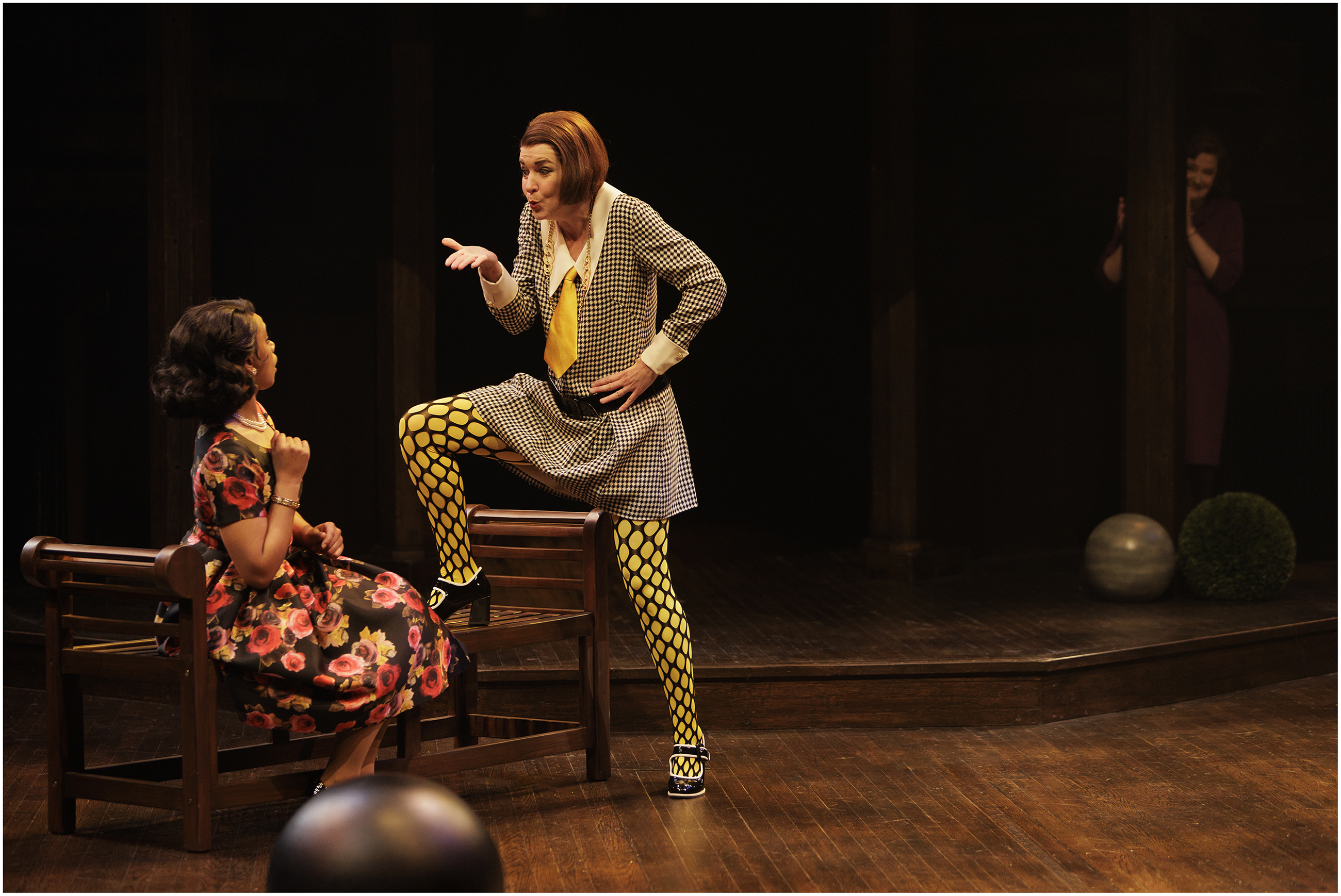
Vanessa Sears (Olivia, left) and Laura Condlln (Malvolio, standing) in Twelfth Night. Stratford Festival 2024. Photograph by David Hou.
Witty and at times vulnerable and apprehensive, Hill's Viola made good use of physicality and clowning. When Orsino commented upon the effeminate aspects of Cesario's body, where ‘all is semblative a woman's part’ (1.4.33), Hill thrust out her pelvis in mock-masculine manner; when he placed a reassuring hand on Cesario's chest, Hill sent a pleading look to the audience; Hill's Cesario interjected, ‘I’m very sensitive’ when fending off defiance in Olivia's household, and also created an echo effect in crying ‘Olivia-a-a-a-a!’ (1.5.243) in the ‘willow cabin’ speech; and finally, Cesario entered into a game of Pat-a-cake when Fabian (Michael Spencer-Davis) attempted to initiate a boxing match between Hill and Ryan Wilkie's Sir Andrew. Wilkie and Hill were especially amusing in this scene, swinging at each other with eyes closed. Additionally, Hill's cross-dressing in a three-piece suit as Cesario was quite effective. Her admission, ‘I am … the MAN’ (2.2.23), proved risible.
However, it was Condlln's Malvolio who shone brightest in this production. Tall and commanding, with a pinched expression and robed in sober black and starched white, Condlln's bespectacled Malvolio evoked a ‘schoolmarm’ or dour librarian personality. Unequivocally part contortionist, Condlln rearranged her features into diverting expressions of impatience and disgust. In the gulling scene, it was as though Malvolio's face had forgotten how to smile, the muscles and ligaments twitchy in reviving. The device of her daydreamy entrance in this scene while signing airborne autographs as ‘Countess Malvolio’, yet pragmatically wearing sunglasses over her glasses, was truly hilarious. Her spinning at the command ‘revolve’ (2.5.125) fell rather flat; however, her unintentional squatting at ‘thus makes she her great P's’ (78–9) and humping of a topiary ball at ‘some have greatness thrust upon ’em’ (127), as well as her garish black stockings dotted with yellow as being ‘cross-gartered’ (3.4.47), garnered much laughter. Her timing was superb, particularly at ‘And one thing more’ (2.2.7–8) before peevishly throwing Olivia's ring to Cesario, and also in her pause between ‘an obedient … hope’ (5.1.329), the latter generating an unexpected empathy.
McKenna's casting was superb: Hay's female Feste delighted the audience as a ‘wise woman’ figure, beautifully serenading while playing guitar; her alteration of the line, ‘Good madonna’ (1.5.50) to ‘Good MAD donna’ was quite clever. Sills's Orsino was masterful and commanding; David Collins's Sea Captain embodied his ‘salty dog’ character; and Dodd's elegantly dressed Maria, first seen mixing a seltzer for Wentworth's hungover Toby (to which he surreptitiously added booze from a flask) prior to his barefoot entrance, seemed the household's voice of reason. Nevertheless, her placing of Sir Andrew's (Wilkie) hand to her breast during the ‘buttery-bar’ (1.3.59) jest revealed her mischievous potential. Sears's Olivia accessed the comic potential of her character admirably, creating a ‘face-palm’ gesture when lamenting her query, ‘What is your parentage?’ (1.5.259); ecstatically rushing onstage robed in a wedding gown, veil, and bouquet while dragging along John Kirkpatrick's Priest immediately after encountering Austin Eckert's Sebastian; and generating laughter by her emphasis in exclaiming, ‘Most wonderful!’ (5.1.218) upon viewing Sebastian and Cesario side-by-side.
A few minor recommended adjustments: the clock's ticking, created by sound designer Verne Good, captured the play's obsession with the passing of time, but occasionally seemed rather intrusive; with a female Malvolio, Sir Andrew's line about ‘beating [Malvolio] like a dog’ (2.3.126) fell flat; the wheelbarrow and shrub used as hiding places in the gulling scene were too diminutive to be convincing; and Hay's accent as Sir Topaz was unusual, though her use of lower register was good. Finally, Toby's line, ‘Fabian can scarce hold him yonder’ (3.4.250–1) regarding Cesario would have increased mirth had the mentioned characters been grappling onstage, and the finale would have benefitted from having Wentworth's Toby and Dodd's Maria onstage when Fabian reports that Toby ‘hath married her’ (5.1.253).
Duty vanquished desire in McKenna's refreshingly feminine Twelfth Night, marking a directorial debut that intimates innovative productions to come.
Conversely, in Sam White's Romeo and Juliet, desire outpaced duty – to disastrous effect. The young lovers defied their families for the sake of their own union; however, unlike Cymbeline, this play punished the protagonists for this transgression.
Upon first glance, White's Romeo and Juliet appeared quite ‘safe,’ its period dress and lack of sexualised emphasis in certain places, such as Gregory (Howard Dai) and Sampson's (Tarique Lewis) bawdy yet darkly insinuating exchange in the play's opening, sanitising the play as a version ostensibly engineered for a secondary school audience. However, the electrifying first fight scene, in which Emilio Vieira's Tybalt elicited gasps in unsheathing and slicing the air with his sword, dispelled notions of bowdlerisation. Punctuated by composer and sound designer Debashis Sinha's drumming, the quick-paced stage combat injected life into what may have been yet another traditional presentation of this classic, the Montagues clad in blues, greens, and greys and the Capulets in reds and browns. Innovation and attention to detail were evident in these combat scenes, as when Andrew Iles's Mercutio knocked the cap off Tybalt's head prior to their final fight; Jonathan Mason's Romeo grappled hand-to-hand with Tybalt, eventually strangling him; Graham Abbey's Capulet dangled Vanessa Sears's Juliet over the balcony menacingly during their Act 3 argument; and when Romeo viciously stabbed Austin Eckert's Paris in the neck, precariously tussling on the Capulet tomb's balcony. Fight and intimacy director Anita Nittoly deserves accolades for these brilliant interchanges. Furthermore, Romeo and Juliet's miming of postnuptial intercourse on the balcony prior to their early-morning parting occasioned astonishment in the audience's young people, one declaring, ‘Oh snap!’ (Figure 3).

Jonathan Mason as Romeo and Vanessa Sears as Juliet in Romeo and Juliet. Stratford Festival 2024. Photograph by David Hou.
Sears absolutely dazzled as a lyrical Juliet. Her operatic Italian solo at the Capulet ball was positively breathtaking and denoted the actress’ vocal training and Broadway experience. Refreshingly and brilliantly, Sears's Juliet delivered her lines as though they were occurring to her. One might simply say her performance was perfection. Her unexpected disappearance by sinking into the floor whilst affected by Friar Lawrence's (Wentworth) sleeping potion extorted wonderment as well.
Abbey was an energetic Capulet, clashing broadswords with Michael Spencer-Davis's Montague in the opening scene. Abbey's effortless delivery, pace, and broad emotional range solidified his standing as one of the Festival's most accomplished veterans. He created great empathy with the line, ‘The earth that swallowed all my hopes but she’ (1.2), and demonstrated fatherly tenderness when consoling grieving Juliet, holding her while she apparently wept for Tybalt (though also secretly for Romeo) (note 3). These softer emotions conflicted with his spiteful admonishment of Tybalt at the ball, ‘I’ll make you quiet’ (1.5.85), which he then laughed off while spectators gawked, as well as his near-psychotic threatening of his character's daughter with death upon her refusal of Paris, thus demonstrating the complexity and changeability of his character. Set and costume designer Sue LePage captured the majesty of his performance by attributing to him a splendid lion's mask in the ball scene.
Clad in salmon and gold hues, Jessica B. Hill's Lady Capulet seemed both poised and wry, on the one hand seeming to enjoy the Nurse's (Glynis Ranney) incessant babbling, and on the other comically emphasising, ‘in brief’ (1.3.75). She accessed humour also when juxtaposing her planned assassination of Romeo with the ‘joyful tidings’ (3.5.104) of the arranged nuptials between Juliet and Paris. Ranney's Nurse was similarly entertaining, screeching encouragement to Juliet at the ball and teasing her by withholding news of Romeo's proposal. Her clowning in the latter scene, feigning physical ailments and guiding Juliet's hands to massage her head, was quite amusing. Nevertheless, in drowning out Lady Capulet with laments upon discovering Juliet's body, and in being the one to deliver a poignant dirge, Ranney intimated the intensity of her character's bond with the ill-fated teenager.
The pensive Friar seemed a role made exclusively for Wentworth. His witty interjections, such as ‘That's a certain text’ (4.1.21) in reply to Juliet's maxim, ‘What must be shall be’ (21), added humour, as did gestures such as clearing his throat in censuring Romeo and Juliet's excessive displays of affection.
The production suffered from several inconsistencies, such as the substantial age gap between Spencer-Davis's Montague and Antonette Rudder's Lady Montague, and the seemingly advanced age of Ranney's white-headed Nurse, one who was supposed to have nursed Sears's Juliet only 11 years prior. Similarly, Kirkpatrick's Balthasar seemed an unlikely companion to Mason's Romeo due to their age difference. Furthermore, the balcony scene would have benefitted from added gravitas, as it evoked more a cutesy teen TV drama than a momentous and archetypal love story. Mason's Romeo, though impressive in his physical prowess, scaling the balcony to kiss his love and slashing his sword skilfully, seemed to lack passion, with unaltered facial expression after news of Juliet's death and sounding tired rather than provoked in his line, ‘tempt not a desp’rate man’ (5.3.59). Finally, Steven Hao's delivery as Benvolio was regrettably rather choppy, though it did improve as the play progressed.
White's fast-paced Romeo and Juliet, her second play directed at the Festival, punished unbridled desire with expertly choreographed and performed violence.
Finally, Donna Feore's wildly popular musical Something Rotten! proffered multiple variations of the theme of duty versus desire. The production delineated the struggles of Renaissance playwrights Nick (Uhre) and Nigel (Firmston) Bottom to maintain their patronage from the formidable Lady Clapham (Khadijah Roberts-Abdullah), and therefore their standing in London's playgoing world. They needed to outperform ‘the man who put the “I am” in iambic pentameter,’ William Shakespeare (Jeff Lillico), and his new hit Richard II. Uhre's Nick dipped into his family's savings to finance a visit to mystic Thomas Nostradamus (Dan Chameroy) – nephew of the famous seer – for creative inspiration, thereby neglecting familial duty for that of the workplace. There, Nick encountered a novelty named ‘the musical,’ which he then endeavoured to premiere on the early modern stage. When Lillico's Shakespeare stole the notes for the first iteration, a tap-dancing number on the Black Death, Nick returned to Nostradamus and gleaned the name and plot of Shakespeare's masterpiece (slightly mistranslated): Omelette, The Musical.
Meanwhile, brother Nigel Bottom deserted his post as company poet to romance Portia (Sinclair-Brisbane), daughter to a theatre-despising Puritan. These young lovers bonded beautifully through a sweet duet, ‘I Love the Way,’ highlighting their mutual love of poetry. Their connection reached its pinnacle with Nigel reciting a sonnet to Portia in mock ‘sex scene’ style, with her escalating responses to each line. Their neglect of workplace and filial duty, respectively, for love resulted in their lasting union in the New World.
Audience exuberance for Something Rotten! was palpable: patrons packed the stalls to capacity, danced in their seats, and, remarkably, bestowed a standing ovation upon the troupe halfway through Act 1 (of 2). As a certain familiarity with the musical genre, as well as with specific musicals, is required for understanding of the barrage of references and in-jokes that encompassed everything from Annie to Spamalot (the latter of which the Festival showcased last year, in 2023), the audience's ostensible appreciation denoted its impressive literacy in this area.
Robed in studded black leather, chains, and sunglasses, Lillico's Shakespeare, both admired and reviled in Nick's song, ‘God, I Hate Shakespeare,’ embodied the quintessential Renaissance ‘rock star’, especially in the numbers ‘Will Power’ and ‘Hard to Be the Bard’. His writhing male dancers ‘The Bard Boys’ (Gabriel Antonacci, Devon Michael Brown, Anthony MacPherson, and Jason Sermonia) and Shakespearean ‘fangirls’ reinforced his celebrity status. Using raised candles as the equivalent of lighters lifted in reverence during a song was a clever touch. Bardolators might object to this depiction of Shakespeare as a sticky-fingered ‘hack with a knack for stealing anything he can’ – including the script for Omelette – although the historical figure did ‘borrow’ most of his plots from earlier works.
Uhre demonstrated excellent vibrato in his vocal numbers, and brilliant comic timing. His query, ‘Are you okay?’, to a spontaneously tap-dancing Thomas Nostradamus (Chameroy) was particularly amusing (Figure 4). In turn, Chameroy as a gruff, dishevelled Thomas Nostradamus kept the audience in stitches with his one-liners, such as his description of musicals as ‘something relaxing and less taxing on the brain’, and his outrage at the future price of concession-booth beverages, ‘That much! For a glass of WINE?’. Starr Domingue's forward-thinking Bea, wife to Nick's Uhre, was masterful in her role as well, garnering laughter with her prediction that ‘by the year 1600, women will be completely equal to men’.
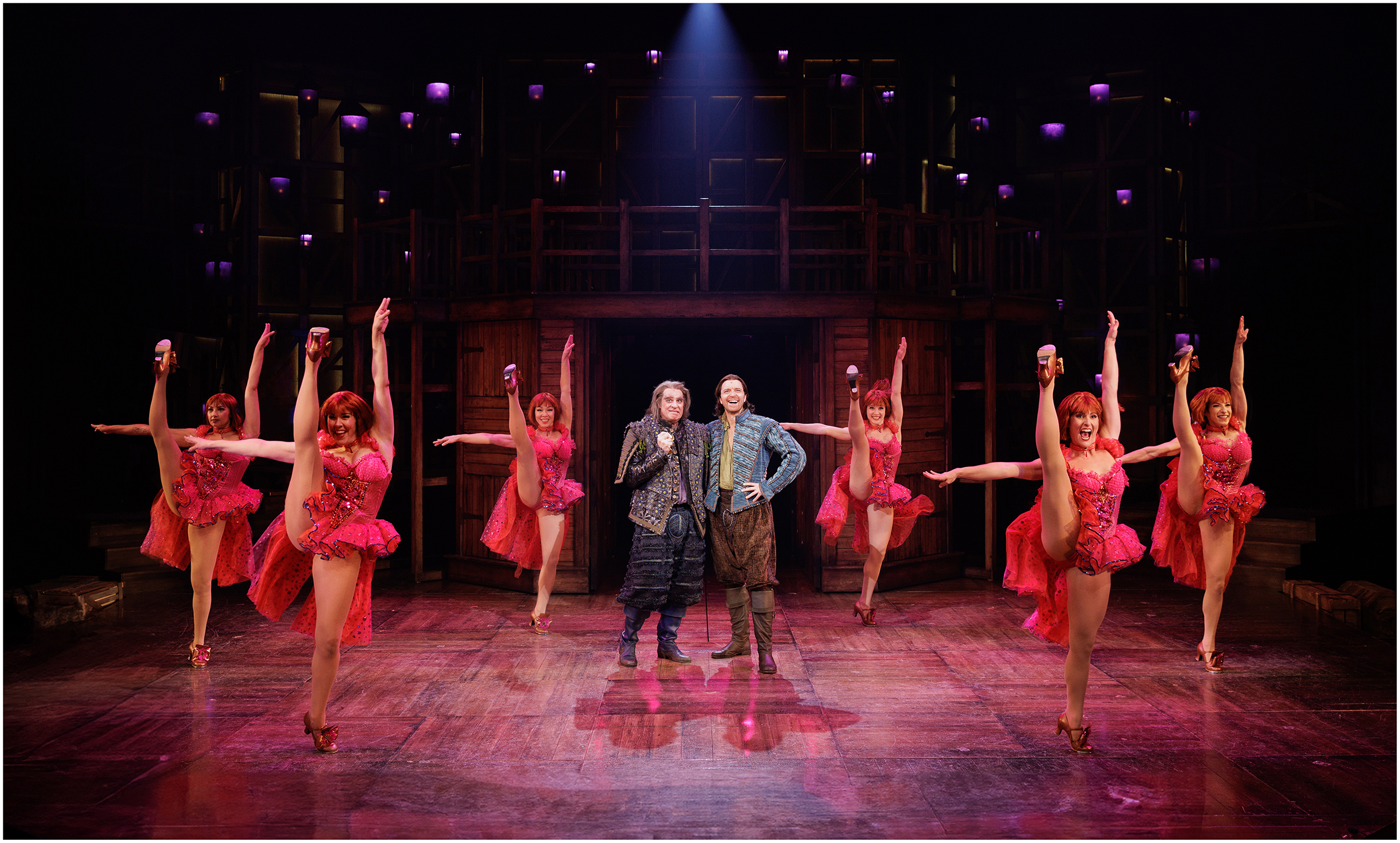
Dan Chameroy as Thomas Nostradamus (centre-left) and Mark Uhre as Nick Bottom (centre-right) with members of the company in Something Rotten!. Stratford Festival 2024. Photograph by David Hou.
The cast worked together seamlessly in executing engaging number after number. Brothers Nick and Nigel complemented each other vocally, notably in the final scenes. The song, ‘To Thine Own Self Be True,’ was especially beautiful in its harmonies, and the dance numbers were slick, diverting, and at times explosive. Most memorable was the number in which dancers dressed as eggs wore top hats and yellow tights, exited the stage, and entered after an impressive quick-change wearing omelette costumes with green ‘garnishes’ on their heads. Furthermore, when some of the props broke during a dance number, backstage company members noticed immediately and removed them stealthily. In this particular performance, director (and choreographer) Feore accompanied the troupe during the second and final standing ovation, to raucous applause.
One might question the blithe incorporation of Nazis into the Omelette script as ‘fellows of infinite jest’; also, in places Sinclair-Brisbane's Portia seemed to struggle to reach certain notes. Nevertheless, Something Rotten! emerged as one of this season's most popular shows, privileging familial duty over devotion to the workplace – a valuable lesson for overworked families.
In a post-pandemic age that favours individualism over community, the conquest of duty over desire in many of this season's Festival productions provided gentle social commentary while encouraging audience members to question what truly matters most.