



Abstract
Using the 2004 General Social Survey (N = 453), the identity stress process is investigated in terms of crises in intimate relationships and at the workplace. I discuss dispositional optimism as a psychological resource that is relatively independent of the situation and the self, making it ideal for structurally disadvantaged actors and for navigating crises that diminish self-based personal resources such as self-esteem. Consistent with this logic, dispositional optimism was associated with increases in self-esteem and self-rated health net of emotional stability; its effect on these outcomes intensified around the time of relationship crises and was stronger for women than for men. Moreover, optimism was more vital to self-rated health than self-esteem during either type of crisis, suggesting it may be a uniquely durable psychological resource in the stress process.
Love and work are the cornerstones of our humanness.
Given the sizable rates of divorce and separation (Amato 2010) and involuntary job loss in contemporary America (Kalleberg 2009), crises in intimate relationships and at work are likely to befall many individuals over the life course. From a self and identity perspective, crises may be defined as situations in which meanings and beliefs attached to the self are highly disconfirmed due to impending or anticipated changes in social status (e.g., Burke and Stets 2009; Stets and Cast 2007). In weathering crises, individuals draw upon their personal resources, which include social as well as psychological resources (Pearlin 1999; Taylor and Stanton 2007). Psychological resources are facets of personality that shape and reflect coping with life circumstances (Stets and Cast 2007). They include self-esteem and personal mastery, both of which anchor one’s sense of effectiveness during difficult times and underlie effective coping techniques (Caplan and Schooler 2007). However, as Pearlin et al. (1981) noted long ago, stress may lead to diminishment of self and thus to diminishment of certain psychological resources.
In this study, I introduce and examine dispositional optimism as a durable psychological resource in the navigation of relationship and work crises. In doing so, I contrast the durability of optimism with the volatility of self-esteem. Although previous investigations of optimism have spotlighted its link to social network formation and attainment and delinquency outcomes (e.g., Andersson 2012; Hitlin and Elder 2007; Kao and Thompson 2003), dispositional optimism has yet to be investigated within the context of the identity stress process.
In examining the identity stress process, this article draws a valuable nexus between psychological and sociological social psychology. Indeed, sociological social psychology has traditionally understood personality differences as resulting from ongoing social causation processes; in contrast, psychological social psychology often is interested in how stable individual differences produce different outcomes depending on situational contexts. As will become apparent in this article, self-esteem is in keeping with a sociological approach to personality, in that it fluctuates considerably due to interactional and situational processes. In contrast, as personality and social psychologists have demonstrated, levels of dispositional optimism do not change across most life situations; rather, dispositional optimism is usually durable and is activated more or less depending on different situational contexts.
Dispositional optimism is defined as a stable expectation that good things will happen across a variety of complex life situations (Carver, Scheier, and Segerstrom 2010; Solberg Nes and Segerstrom 2006). Expecting good things to happen is linked to directing attention to positive features of difficult situations and to coping with difficult situations effectively, even despite anxiety and physiological distress (Aspinwall and Tedeschi 2010; Carver et al. 2010; Scheier, Carver, and Bridges 1994). While self-based psychological resources such as self-esteem and personal mastery are volatile in the face of social stress and thus cannot steadily support effective coping (Cast and Burke 2002; Stets and Cast 2007; Yang 2006), dispositional optimism is anchored in general expectancies rather than self-beliefs.
In comprehensive models of the stress process, dispositional optimism has been found to enhance coping and health above and beyond self-esteem, emotional stability, and other psychological resources (Carver et al. 2010; Solberg Nes and Segerstrom 2006). Despite ample theoretical and empirical knowledge pointing to optimism’s role in effective coping, some research has found that the efficacy of optimism differs according to demographic group, stressor, and/or indicator of psychological or physical well-being (e.g., Benyamini and Roziner 2008; Rasmussen, Scheier, and Greenhouse 2009). Therefore, it is important to specifically examine the importance of dispositional optimism to relationship and work crisis outcomes.
This article conducts two basic empirical investigations about dispositional optimism as it relates to relationship and work crises. First, it assesses to what extent optimism may contribute to the maintenance of psychological resources that are less stable (i.e., self-based resources such as self-esteem), both generally and among those who have recently suffered a crisis. Second, in a comprehensive model of stress process outcomes, it assesses to what extent optimism may deliver stronger and more reliable contributions to perceived health status than self-esteem. Across both of these empirical aims, the contributions of dispositional optimism are differentiated by crisis domain (relationship vs. work) as well as gender.
A framework for assessing dispositional optimism’s importance to relationship and work crisis outcomes is established in three parts. First, identity control theory is used to theorize the experience and outcomes of relationship and work crises, as well as the role of psychological resources. Next, psychological resources are explored in detail, with a key emphasis on the conceptual distinction between self-esteem and dispositional optimism. In particular, optimism is likely to be activated, not depleted, by identity stress situations. Finally, to round out the conceptual framework, the role of various demographic factors in the stress process is considered.
The Stress Process: Regulating Identities in Love and at Work
An identity control perspective defines individuals as continually regulating their behavior in order to affirm or verify identity standards (Burke 1991; Burke and Stets 2009; Stets and Carter 2012). Identity standards are defined as meanings that are assigned to the self in the performance of a given role. For instance, when acting as a spouse, one may see oneself as traditionally masculine or feminine; or as responsible for providing emotional support, humor, or income; or as undertaking tasks such as shopping or doing yard work (Burke and Stets 2009). At work, one may see oneself as possessing a certain level of skill and performance ability and as trying to uphold various habits and qualities that are characteristic of one’s occupation (Burke and Stets 2009; Stets 2003, 2005; Stets and Harrod 2004). In acclimating to their environments, individuals become skilled at verifying identity meanings, as the “process of achieving and maintaining congruence may become relatively efficient and automatic” (Burke 1991:839).
Crises are expected to be distressing to the extent that they interrupt the verification of salient and/or highly organized identity standards (Burke 1991; Burke and Stets 2009). In the case of crises in intimate relationships and at work, distress is likely to be very high because intimate and work-related roles tend to be fairly if not highly salient within an actor’s prominence hierarchy (Burke and Stets 2009; Stryker 1980). Meanwhile, relationship and work identities tend to be highly organized because they incorporate fine, specific skills that are distinctive to getting along with and carefully supporting cherished individuals or negotiating substantively complex and specialized work environments (Burke and Stets 2009; Fuhse 2009; Kohn 2006).
To the extent that identity confirmation is disrupted, distress and a lowered sense of self-esteem and mastery ensue (e.g., Cast and Burke 2002; Stets and Cast 2007). Furthermore, perceived health status is bound to suffer for a number of reasons. Negative emotion and distress, especially strong emotions like anger, depression, and anxiety, incite inflammatory responses that accelerate the disease process (Stewart et al. 2009; Suls and Bunde 2005). In addition, distress lessens available cognitive resources, leading to engagement in poor health behaviors such as overeating or substance abuse (Baumeister, Vohs, and Tice 2007). Meanwhile, distress renders meaningful social interaction more difficult, which leads to the weakening of existing social support systems that indirectly bolster mental and physical health (Umberson, Crosnoe, and Reczek 2010). Given these important pathways, I conceptualize perceived health status as a comprehensive, ultimate outcome of the identity stress process. Meanwhile, following previous identity research, I conceptualize self-esteem as an intermediate outcome of the stress process. That is, it reflects the extent to which one is affirming identity meanings associated with being a partner or worker (Burke and Stets 2009; Cast and Burke 2002; Stets and Harrod 2004). Figure 1 provides a conceptual depiction of the identity stress process examined in this article.

Conceptual Diagram of the Identity Stress Process
Hypothesis 1 (main effect of crises): Relationship- and work-related crises will be negatively related to self-esteem and self-rated health.
Psychological Resources: Self-Esteem and Optimism
According to Stets and Cast (2007:518), identity resources are “processes that are definable in terms of sustaining a system of interaction, including verifying the self.” Following this definition, self-esteem and dispositional optimism are both psychological resources that act as identity resources insofar as they support the verification of relationship- and work-related identities. Although self-esteem and dispositional optimism both may buffer stress (Taylor and Stanton 2007) and both are linked to positive emotion (Judge 2009; Segerstrom and Sephton 2010), they hold qualitatively different ramifications for identity stress outcomes. In particular, whereas self-esteem may deplete in response to identity stress and other self-relevant feedback, dispositional optimism refers to stable positive expectations that are not anchored in feelings about the self or its social situation (Carver et al. 2010; Geers, Wellman, and Lassiter 2009).
Current theory and research largely advocate treating dispositional factors such as dispositional optimism and emotional stability as stable psychological resources that infuse role performance and thus in turn configure trajectories of self-esteem (e.g., Erol and Orth 2011; Schetter and Dolbier 2011; Scollon and Diener 2006). Similarly, personality has been conceptualized as a personal identity that infuses the enactment of role identities such as spouse/partner or worker, thus indirectly impacting levels of self-esteem (Brooks, Swann, and Mehta 2010; Stets 2006). In support of dispositional optimism’s unique contribution to navigating the stress process, previous research has shown that dispositional optimism enhances life outcomes above and beyond self-esteem (Geers et al. 2009; Scheier et al. 1994) and other psychological resources such as emotional stability (i.e., low trait levels of negative emotion; Carver et al. 2010; Solberg Nes and Segerstrom 2006). However, if assessed in isolation, the estimated effect of dispositional optimism on life outcomes may be spurious, in that optimism is conflated with more dynamic psychological resources (e.g., self-esteem) and/or a lack of proneness to negative affectivity (i.e., emotional stability; Rasmussen et al. 2009; Scheier et al. 1994). To help avert this methodological fault, the current study controls for self-esteem as well as emotional stability.
Although many definitions exist (Swann, Chang-Schneider, and McClarty 2007), self-esteem is typically defined as a “positive evaluation of the self” (Cast and Burke 2002:1042) that is contingent on others’ evaluations and situational outcomes (Cooley [1902] 1964; Crocker et al. 2003). Viewing the self favorably is an identity resource because positive self-views make it more likely that ensuing interactions go favorably (i.e., support meanings associated with the self; Stets and Cast 2007). Although self-esteem may remain stable across time, such stability is likely to depend on an interpersonal “opportunity structure” (Swann 1983:36) within which self- and identity meanings can reliably be verified. That is, self-esteem has been shown to fluctuate considerably due to psychosocial processes such as belongingness and social acceptance (Leary 2007; Leary, Cottrell, and Phillips 2001; Stinson et al. 2008). Therefore, self-esteem has been modeled fruitfully as a dynamic outcome of identity performance and is taken to fluctuate according to the performance of emotionally and instrumentally oriented identities (Stets and Harrod 2004; Turner and Stets 2006).
In contrast, dispositional optimism denotes an expectation that good things will happen. That is, it denotes stable and positive general outcome expectancies that are largely independent of self- and relationship-based processes (Carver et al. 2010; Solberg Nes and Segerstrom 2006). Previous research mostly suggests that self-esteem fluctuates in response to relationship and work crises whereas optimism does not.
Psychological Resources and Intimate Relationships
Intimate relationships are taken to be mutual verification contexts wherein partners are able to reflect each other’s desired feedback and in which trust, commitment, or love may therefore emerge (Burke and Stets 1999). Nonverification of spousal identities is, on average, associated with negative emotion and loss of self-esteem (Burke and Harrod 2005; Cast and Burke 2002). In addition to decrements in self-esteem, relationship conflict has been linked to declines in physical health (Kiecolt-Glaser and Newton 2001).
In the context of intimate relationships, dispositional optimists are more pleasant to be around and perceive a greater degree of support and agreement from those around them than do those with less optimistic outlooks (net of objective levels of support; Assad, Donnellan, and Conger 2007; Srivastava et al. 2006). Assad and colleagues (2007) posit that optimism is linked to cooperative problem solving within intimate relationships. Meanwhile, they investigate the possibility that being in an unsatisfying or harmful intimate relationship could lower one’s sense of optimism. They find no support for this view, suggesting that optimism continues to operate independently even in intimate relationships and that it, in contrast to more dynamic personal resources such as self-esteem, is not volatile in the face of relationship setbacks (for a similar finding, see Neyer and Asendorpf 2001).
Psychological Resources and Work Performance
Work identity performance holds ramifications for self-esteem and health. Verification of self-meanings associated with being a worker, such as meanings of effectiveness and carefulness, is linked to differences in self-esteem (Stets and Harrod 2004) and chronic negative emotion (Stets 2003, 2005; Stets and Tsushima 2001). Job strain and unemployment are related to negative psychological and physical health outcomes (Kessler, Turner, and House 1988; McKee-Ryan et al. 2005; Pearlin et al. 1981).
Evidence for the relevance of dispositional optimism to the navigation of work crises is compelling but less direct. Mueller and Plug (2006) examined linkages among scores on the five-factor measure of personality, measured at the time of high school graduation, and earnings about 30 years later. They found that neuroticism predicted lower career earnings. Using an experience sampling approach, Judge, Woolf, and Hurst (2009) found that extraverts glean greater amounts of positive emotion and lesser amounts of negative emotion from routine work-related activity.
Given how neuroticism and extraversion factor into occupational success, and how dispositional optimism is associated negatively with the former and positively with the latter (Carver and Connor-Smith 2010), these studies lead one to expect that dispositional optimism would be related to career success through enhanced performance and emotion work capabilities across time. Indeed, Kaniel, Massey, and Robinson (2010) have recently found using longitudinal data that dispositional optimists, relative to pessimists, spend less time searching for jobs, receive offers more quickly, and are more likely to be promoted once hired. Segerstrom (2007) similarly found a prospective association between dispositional optimism and financial success.
Stets and Harrod (2004) suggest that the worker identity is centered on mastery through persistent effort, a cultural heritage that can perhaps be traced back to the Protestant work ethic. If this is the case, then dispositional optimism should aid ongoing identity verification at work by motivating persistence during difficult occupational tasks and by fostering positive emotion during times that one is not effective.
Dispositional Optimism and Engaged Coping
Within crisis situations, expecting good things to happen seems to go hand-in-hand with an engaged approach to life. In particular, previous research has linked optimism to heightened attention and vigilance during threatening or important situations (Abele and Gendolla 2007; Carver and Connor-Smith 2010; Geers et al. 2009). Although situational importance is shaped by self-related information like personal goals and salient role identities, optimism underlies engaged coping regardless of self-relevant feedback, such as whether situations are disconfirming identity standards. Put differently, optimism motivates persistence within situations that matter to the self without being depleted by feelings or attitudes toward the self (Carver et al. 2010).
Engagement during threatening life situations among optimists is likely facilitated by multiple pathways, including buffered reactivity to social stressors (Segerstrom 2001; Terrell, Ruiz, and Garofalo 2010; Vollmann et al. 2011), heightened attentional bias for positive stimuli (Segerstrom 2001), perceived social support (Srivastava et al. 2006; Vollmann et al. 2011), and by health-protective behaviors, robust immune functioning, and lowered pain and physical symptoms (Carver et al. 2010; Rasmussen et al. 2009). Several studies have meanwhile found a positive association between optimism and self-esteem, suggesting that optimism may support self and identity processes across a variety of life circumstances. Put another way, optimism should help uphold identity performance, and thus self-esteem, while also exerting a unique effect on engagement and coping (Geers et al. 2009; Scheier et al. 1994).
Hypothesis 2 (main effect of optimism): Dispositional optimism will be positively associated with self-esteem and self-rated health net of emotional stability.
In sum, previous research suggests that dispositional optimism may serve as a psychological resource in the identity stress process via two key pathways. First, its importance to identity verification and health processes should intensify due to engaged coping styles that are activated by identity stressors and that involve attending productively to negative information and emphasizing positive information. Second, relative to self-esteem, optimism should be durable: that is, it should make stronger and more consistent contributions to health processes because it is activated by, not dependent on, self-related processes.
Hypothesis 3 (intensification of optimism): The incidence of relationship and work-related crises will increase the positive association between dispositional optimism and levels of self-esteem and self-rated health.
Hypothesis 4 (durability of optimism): Dispositional optimism will be positively associated with self-rated health around the time of relationship and work crises, whereas self-esteem will not be associated with self-rated health.
Demographic Variables and Stress Process Outcomes
Gendered Stress Responses: Intimate Relationships versus Work-related Stressors
Studies that conceptualize gender as status posit that lower-status individuals (e.g., women relative to men) are less likely to experience identity verification during interaction (Cast, Stets, and Burke 1999; Stets and Harrod 2004). Following this research, it seems that in effecting verification, personal resources should be more important for those who are lower in status (Stets and Cast 2007; Yang 2006). This argument vindicates empirical research finding that optimistic self-beliefs are particularly beneficial for health among lower-status individuals (Schöllgen et al. 2011). Although women should benefit more from dispositional optimism than men, men and women report equivalent levels of dispositional optimism (Scheier et al. 1994; Vollmann et al. 2011).
Hypothesis 5 (gendered benefits): Women will glean larger increases in self-esteem and self-rated health from optimism than will men.
Thoits (1995) summarizes research indicating that women are more susceptible than men to negative outcomes in the wake of network events (including relationship troubles) whereas men are more susceptible than women to work-related stressors. While the genders are similar in terms of their psychological responses to the quality and quantity of social relationships (Umberson et al. 1996), women seem more vulnerable to crises that take place within their personal social networks, which may be due to their socialization into a moral sense of caring for others (e.g., Dohrenwend 1977; Gilligan 1982; but see Jaffee and Hyde 2000). Therefore, optimism may be doubly important to women as a psychological resource in the domain of personal relationships.
Hypothesis 6 (gendered crises): Women will exhibit larger decreases in self-esteem and self-rated health from relationship crises than will men, whereas men will exhibit larger decreases in these same outcomes from work-related crises than will women.
Hypothesis 7 (gendered benefits and crises): The effects of dispositional optimism on self-esteem and self-rated health will be strongest when women experience crises in relationships and when men experience crises in work.
Other Sociodemographic Variables and the Stress Process
In addition to gender, age, education, and race are theorized to shape identity enactment, such that younger, less educated, and minority individuals are less structurally enabled in the verification of their spousal/partner and worker identities (Stets and Harrod 2004). Generally, sociodemographic situation is linked to the development of material, social, and psychological resources and to the incidence of relationship and work crises (Schnittker and McLeod 2005). Therefore, it is important to control for these sociodemographic distinctions in models of the identity stress process. Further, it is important to control for the presence of young children, as child-raising has been shown to diminish parental well-being and to conflict with relationship and/or work roles (Budig and Hodges 2010; Umberson, Pudrovska, and Reczek 2010). 1
Method
To assess the role of dispositional optimism as a psychological resource in the identity stress process, I utilize the 2004 administration of the General Social Survey (GSS; Davis, Smith, and Marsden 2008). The GSS is a broad assessment of the social attitudes and behaviors of the noninstitutionalized, English-speaking U.S. population age 18 and over, based on a random sample of households. Conducted by the National Opinion Research Center (NORC) at the University of Chicago, it has been undertaken at least every other year since 1972. In 2004, all respondents were asked questions pertaining to sociodemographic characteristics, and distinct but overlapping subsamples responded to questions pertaining to self-rated health, psychological resources, and personal crises experienced within the past calendar year. Respondents who were given all pertinent questions constituted the analytic sample (N = 490), while there was a larger sample available for evaluating the effects of dispositional optimism on self-esteem and self-rated health by gender (N = 765). Because relevant variables had few missing cases, listwise deletion procedures were utilized. All descriptive statistics and estimated models are weighted by the GSS variable WTSSNR (NORC, personal communication).
Outcomes
Self-rated health (comprehensive outcome)
To assess perceived health status, I utilize a four-category measure of self-rated health (“Would you say your own health, in general, is excellent, good, fair, or poor?”). While this is a subjective measure, it correlates highly with more objective measures of health status and morbidity (Grol-Prokopczyk, Freese, and Hauser 2011).
Self-esteem (intermediate outcome)
Some respondents completed a partial version of Rosenberg’s (1965) self-esteem scale. Statements were “On the whole, I am satisfied with myself,” “I feel that I’m a person of worth, at least equal to others,” “All in all, I am inclined to feel I’m a failure,” “I wish I could have more respect for myself,” and “At times I think I’m no good at all” (1 = strongly agree, 2 = agree, 3 = disagree, 4 = strongly disagree). Items were reverse-scored as necessary and summed to arrive at a self-esteem index (α = .71; similar to Marcussen’s [2005] partial self-esteem scale).
Crises and Optimism
Love and work crises
Although the incidence of a crisis does not necessarily lead to identity disconfirmation, identity crises in intimate relationships and at work were measured based on their likely association with partner/spousal or worker identity disconfirmation (Burke and Stets 2009). 2 To score the presence of a relationship-oriented crisis during the previous year, I noted whether the respondent had “serious trouble with your husband/wife/partner,” “separate(d) from your husband/wife/partner,” or “obtain(ed) a divorce or separation” during the previous 12 months (0 = no crisis, 1 = presence of crisis). To score the presence of a work-oriented crisis, I noted whether the respondent had been “fired or permanently laid off,” “demoted or switched to a less favorable position,” “passed over for a promotion,” or had “serious trouble” with their boss within the previous year (0 = no crisis, 1 = presence of crisis).
Dispositional optimism
Some respondents completed a partial version of the Life Orientation Test–Revised, which is routinely used to measure dispositional optimism (Carver et al. 2010). Items included “I’m always optimistic about my future,” “I hardly ever expect things to go my way,” “Overall, I expect more good things to happen to me than bad,” and “I rarely count on good things happening to me” (1 = strongly agree, 2 = agree, 3 = disagree, 4 = strongly disagree; α = .62; Kivimäki et al. 2005).
Control Variables
Emotional stability
Emotional stability is the reverse of neuroticism in that it refers to low trait levels of broadly related forms of negative affectivity such as moodiness and anxiety (Beckmann, Wood, and Minbashian 2010). As part of the module in which self-esteem was assessed, respondents were asked to characterize themselves as “A person who often feels sad and blue” (1 = a very good description, 2 = a good description, 3 = a fair description, 4 = not a very good description, 5 = not a good description at all). 3
Sociodemographic variables
Age (in years) at interview ranged from 18 to 89. Education (in years) ranged from 0 to 20 or more. Sex was measured as male (0) or female (1). 4 Race was measured in a three-category format (white, black, other). For marital status, I noted whether the respondent was currently married at the time of the interview. Income was measured on a 23-point self-reported scale of ordered brackets. These brackets ranged in designation from “Under $1,000” to “$110,000 or over” and ranged in width from $1,000 to $15,000. For analyses, I recoded this variable into a continuous measure by substituting bracket midpoints and then applied a log transformation. The presence of children was measured as the respondent’s self-reported number of children (transformed by square root).
Results
Descriptive statistics for self-rated health, psychological resources, personal crises, and sociodemographic variables are presented in Table 1. Outcome measures (self-esteem and self-rated health) had considerably high means but substantial variance. Auxiliary analyses supported the treatment of self-esteem and dispositional optimism as distinct psychological resources. 5 Crises were relatively rare, with relationship crises reported by 12.0 percent of the weighted analytic sample and work crises by 11.2 percent of the sample (ns = 52 and 49, respectively). Men and women were equally likely to report either type of crisis (ts < .90).
Survey-weighted Descriptive Statistics for Indices and Demographic Variables
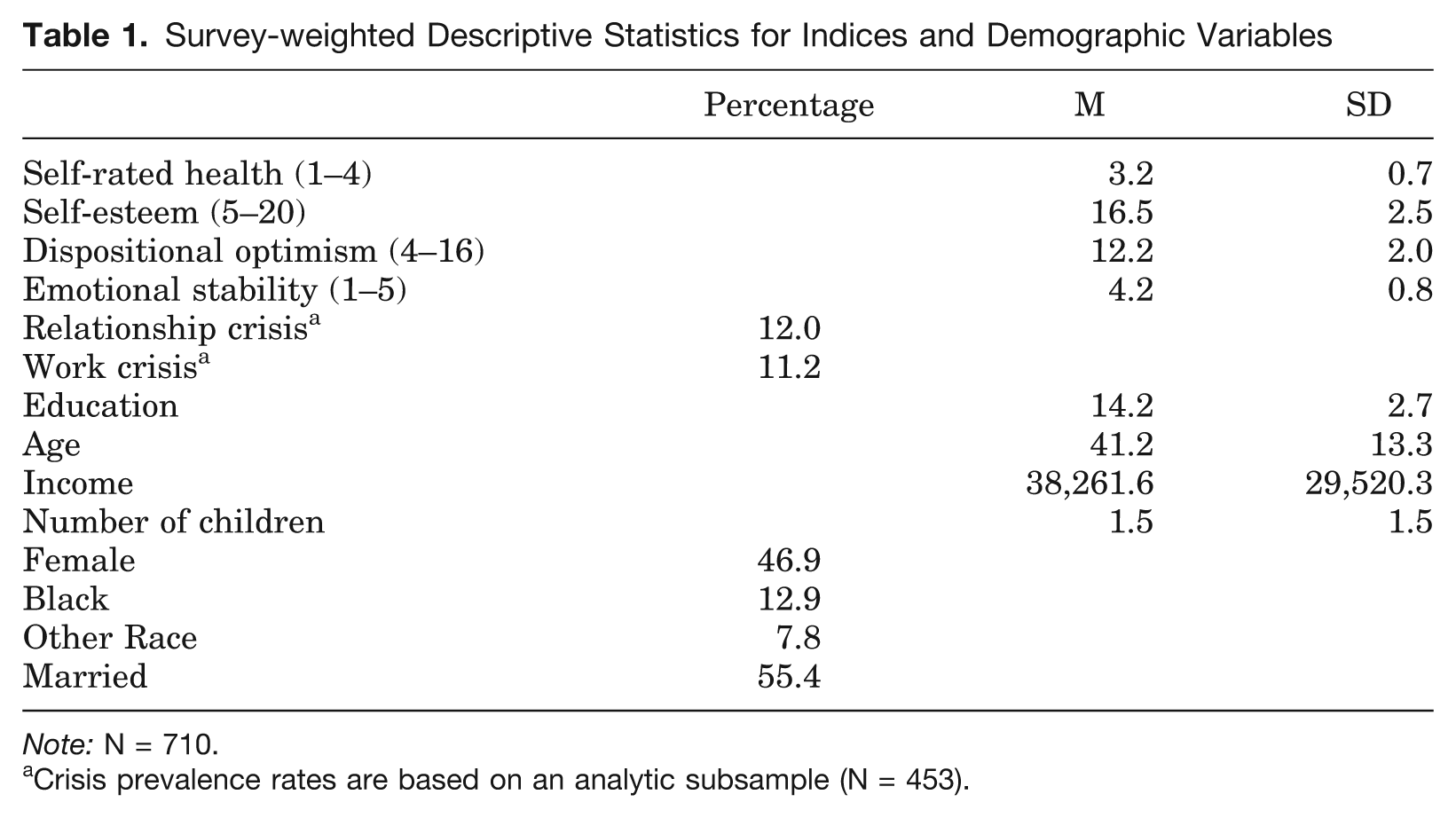
Note: N = 710.
Crisis prevalence rates are based on an analytic subsample (N = 453).
In these results, I use one-tailed tests of statistical significance because all hypotheses are proposed directionally and because statistical power to examine crisis outcomes is limited due to the rarity of crises as well as the coarseness of crisis and outcome measures. As this is the first study to conceptualize dispositional optimism as a uniquely durable psychological resource, doing so moreover aids in the identification of trends that can be supported or refuted by future research.
Hypothesis 1 predicted that relationship- and work-related crises would be negatively related to self-esteem and self-rated health. Relationship crises were negatively associated with self-esteem (unstandardized b = −.90, p = .02) and self-rated health (b = −.77, p = .02) net of sociodemographic variables. Similarly, work crises were linked to lower levels of self-esteem (b = −.95, p = .02), but not to lower levels of self-rated health (b = −.31, p = .18). In sum, then, Hypothesis 1 was mostly supported. Hypothesis 6 qualified the main effect of crises on well-being outcomes, stating that women would exhibit larger decreases in self-esteem and self-rated health from relationship crises than would men, whereas men would exhibit larger decreases in these same outcomes from work-related crises than would women (Models 1—2; Tables 2—3). Gender interactions supported only the especially adverse effect of relationship crises on self-esteem for women (b = −1.51, p = .04); all other interactions did not reach significance (ps > .24).
Survey-weighted Ordinary Least Squares (OLS) Regressions of Self-esteem on Sociodemographic and Crisis Variables
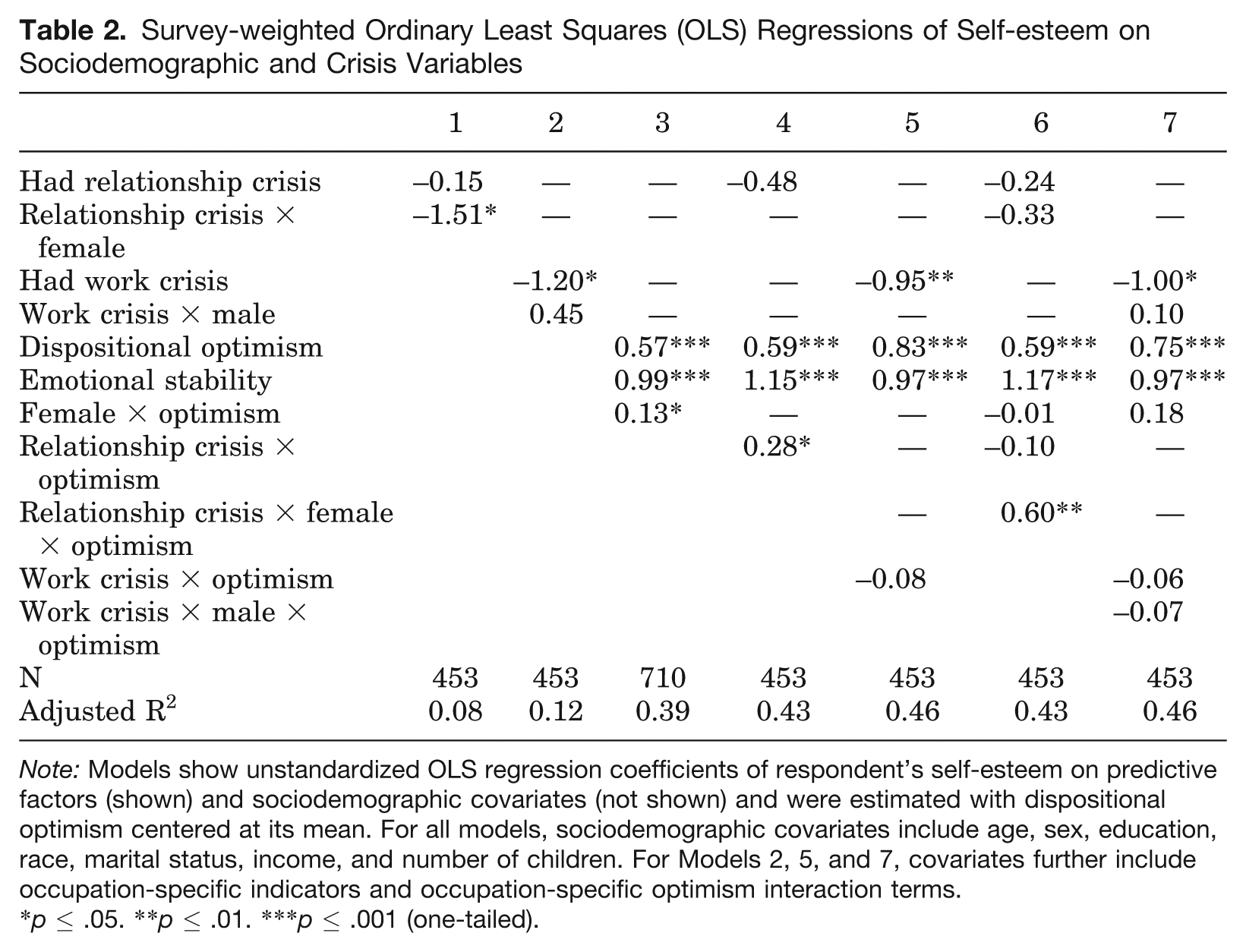
Note: Models show unstandardized OLS regression coefficients of respondent’s self-esteem on predictive factors (shown) and sociodemographic covariates (not shown) and were estimated with dispositional optimism centered at its mean. For all models, sociodemographic covariates include age, sex, education, race, marital status, income, and number of children. For Models 2, 5, and 7, covariates further include occupation-specific indicators and occupation-specific optimism interaction terms.
p ≤ .05. **p ≤ .01. ***p ≤ .001 (one-tailed).
Survey-weighted Ordinal Logistic Regressions of Self-rated Health on Sociodemographic and Crisis Variables
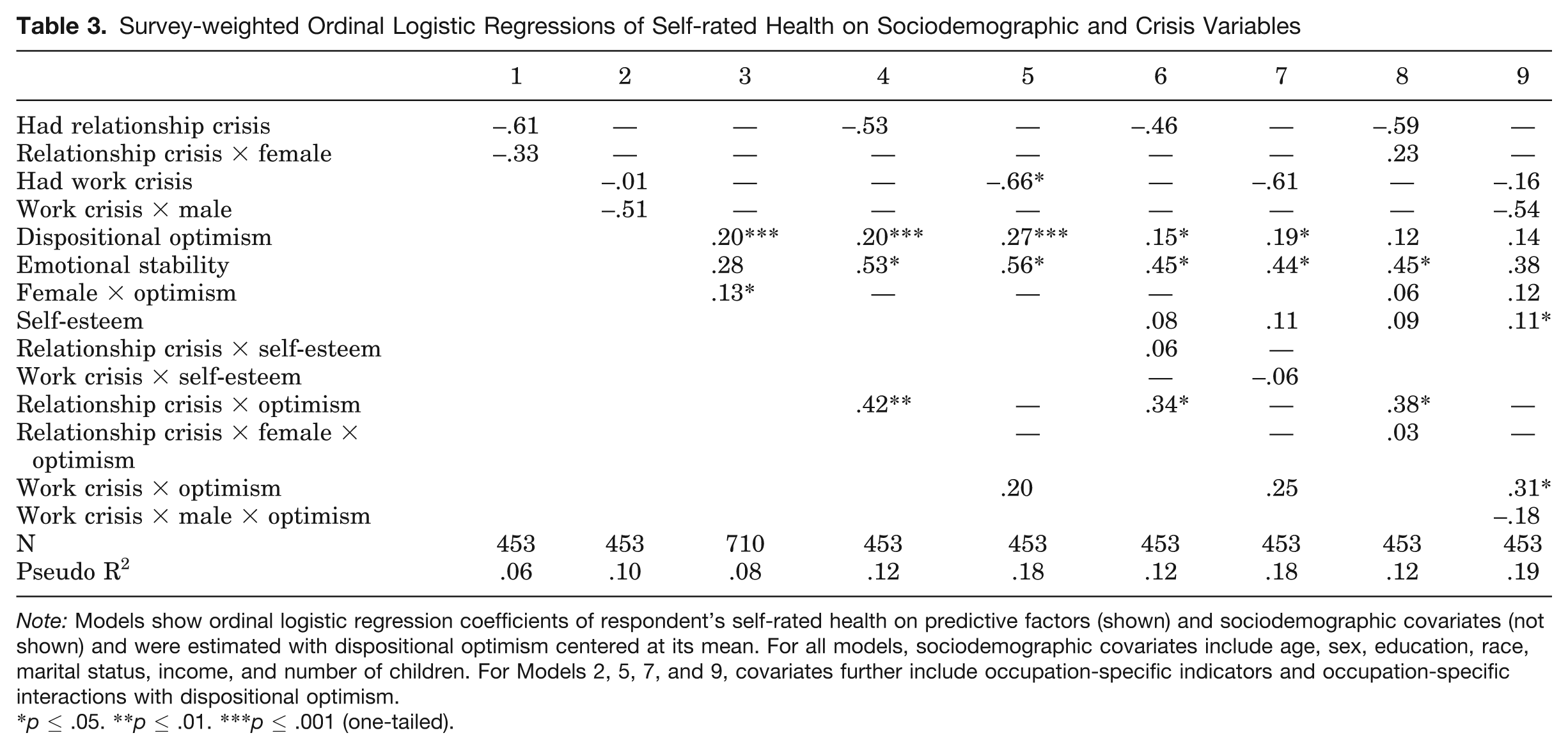
Note: Models show ordinal logistic regression coefficients of respondent’s self-rated health on predictive factors (shown) and sociodemographic covariates (not shown) and were estimated with dispositional optimism centered at its mean. For all models, sociodemographic covariates include age, sex, education, race, marital status, income, and number of children. For Models 2, 5, 7, and 9, covariates further include occupation-specific indicators and occupation-specific interactions with dispositional optimism.
p ≤ .05. **p ≤ .01. ***p ≤ .001 (one-tailed).
According to Hypothesis 2, dispositional optimism should be positively associated with self-esteem and self-rated health net of emotional stability. Consistent with this hypothesis, optimism predicted self-esteem (b = .64, p < .001) as well as self-rated health (b = .27, p < .001) net of emotional stability and sociodemographic variables. Hypothesis 5 qualified this main effect by predicting that women would glean larger increases in self-esteem and self-rated health from optimism than would men. Indeed, gender interactions demonstrated significance for both self-esteem (b = .13, p = .05) and health (b = .13, p = .05), supporting this hypothesis (Model 3; Tables 2—3).
Hypothesis 3 predicted that crises would intensify or increase the positive association between dispositional optimism and levels of self-esteem and self-rated health. Optimism interacted with the presence of a relationship crisis, such that the association between optimism and self-esteem became stronger (b = .28, p = .03), as did the association between optimism and self-rated health (b = .42, p < .01), contemporaneously with relationship crises (Model 4; Tables 2—3). However, no interactions were observed for work crises (ps > .10; Model 5, Tables 2—3). Thus, Hypothesis 3 received only partial support.
Hypothesis 4 held that optimism would be positively associated with self-rated health around the time of relationship and work crises whereas self-esteem would not be associated with health. As shown in Model 6 (Table 3), optimism contributed more positively to health contemporaneously with relationship crises (b = .34, p = .05) whereas self-esteem did not (b = .06, p = .34); furthermore, optimism demonstrated a main effect on health (b = .15, p = .04) whereas self-esteem did not (b = .08, p = .13). As shown in Model 7, optimism did not contribute significantly more to health when work-related crises had occurred recently (b = .25, p = .10), and neither did self-esteem (b = −.06, p = .38). However, in this model, optimism showed a significant main effect on health (b = .19, p = .03) whereas self-esteem did not (b = .11, p = .06). Overall, Hypothesis 4 received support.
Finally, Hypothesis 7 posited that the effects of optimism on self-esteem and self-rated health would be strongest when women experienced relationship crises and when men experienced work crises. Model 6 in Table 2 shows a significant three-way interaction for relationship crises (b = .60, p < .01), such that the association between optimism and self-esteem is especially pronounced among women contemporaneously with relationship crises. However, the three-way interaction for health was not significant (b = .03, p = .46; Model 8, Table 3). No three-way interactions emerged for optimism among men who had recently suffered work crises (ps > .26; Model 7, Table 2 and Model 9, Table 3). Thus, Hypothesis 7 only received weak support.
Discussion
Dispositional optimism, in the form of positive outcome expectancies, is relatively independent of the situation and of the self. As such, it is activated, rather than depleted, by identity stress situations. Findings provided strong support for the general role of dispositional optimism in maintaining self-esteem and perceived health amid crises in love and at work. However, analyses revealed the differing importance of optimism depending on crisis type, gender, and the interaction between these two social contexts. For instance, results suggested that dispositional optimism may be more important to the psychological and physical well-being of women than that of men. Among women, dispositional optimism may motivate cooperative and persistent action despite structural disadvantages.
Crises were generally found to attenuate self-esteem and perceived health, which is consistent with the claim that crises are social situations characterized by high levels of identity-relevant stress. This is not to dismiss the possibility that crises may ultimately be beneficial rather than detrimental under some life circumstances (e.g., Amato and Hohmann-Marriott 2007; Wheaton and Reid 2008). However, seemingly unproblematic role exits may still entail increases in distress (e.g., Kalmijn and Monden 2006), and role negotiation and accumulation are core factors in personal adjustment (Owens, Robinson, and Smith-Lovin 2010), making psychological resources such as dispositional optimism vital to identity maintenance and accumulation even under benign circumstances.
Work crises did not seem to negatively impact perceived health status. This could be due to competing beneficial processes of role exit and negotiation or to the fact that stress at work is offset by identity accumulation in other domains. Previous research has generally found that unemployment in particular is detrimental to health outcomes. Within the current sample, unemployment was only one of the several work-related crises examined, which could help explain why a negative health effect was not observed.
Due to the fact that crises lessen dynamic psychological resources that are based in the self-concept, it was expected that the importance of durable resources such as dispositional optimism to self-esteem and perceived health would intensify during such crises. This hypothesis was supported for relationship-oriented crises but not for work-oriented crises, generally echoing Pearlin and Schooler’s (1978) original finding that personal resources are of limited utility for occupational stressors and are more efficacious for coping with relationship-based stressors.
Gender-specific theorizations of the identity stress process received mixed support and thus provide stimulating grounds for future research. In particular, models did not suggest that men are especially harmed by work-related crises in terms of self-esteem or perceived health status or that men especially benefit from optimism contemporaneously with work-related crises. In contrast, as hypothesized, women demonstrated larger decreases in self-esteem in response to relationship crises, and optimism was especially important to women for self-esteem maintenance around the time of such crises, though these same effects did not hold for perceived health status. These mixed findings highlight contentious areas of dialogue within the stress process literature. For relationship crises in particular, research has found that while network events are particularly distressing for women (Thoits 1995), men exhibit more emotional distress and heightened morbidity risk in response to marital adversity (Kiecolt-Glaser and Newton 2001). Contemporary divisions of labor situate both men and women in high-status occupations, rendering it more likely that men and women have salient worker identities and thus are similarly disturbed by work-related crises.
Of key theoretical interest, models of perceived health allowed for the simultaneous assessment of multiple psychological resources, including emotional stability and self-esteem. As hypothesized, optimism made or tended to make stronger contributions to perceived health during either type of crisis than did self-esteem. Although empirical support was stronger for relationship than work-related crises, this finding is consistent with the key theoretical claim that dispositional optimism is a personal resource that is largely independent of the situation and the self, making it ideal for navigating the identity stress process. At the same time, emotional stability sometimes made contributions to self-esteem or perceived health comparable to those afforded by optimism, which illustrates the importance of integrating complementary aspects of personality into models of identity adjustment. In fact, emotional stability is taken to capture the avoidance domain of personality whereas optimism taps the approach domain; the approach-avoidance theory of motivation and personality posits that both domains have early temperamental origins in the life course and that both are needed to predict behavior and well-being adequately (Carver and Connor-Smith 2010; Elliot, Gable, and Mapes 2006; Hitlin, Andersson, and Elder forthcoming).
One alternative explanation for the observed durability of optimism relative to self-esteem is that optimism leads to reporting biases in self-rated health. Consistent with this counter explanation, a recent meta-analysis found that optimism exerts a larger effect on subjective health than on physical health, though both effects are highly significant (Rasmussen et al. 2009). Future research that includes a variety of health indicators will help refine theory on how and when dispositional optimism influences health more robustly than self-esteem and emotional stability. Moreover, future research should enlist a panel design in order to establish that life crises and chronic identity disconfirmation do not diminish dispositional optimism (Segerstrom 2007).
A second alternative explanation centers on the fact that substantive pathways linking self-esteem to health may differ from those linking dispositional optimism to health; in particular, although both psychological resources likely contribute to health through positive affect and positive health behaviors (Cohen and Pressman 2006), these psychological resources may shape health processes differently in a way that is not captured by self-rated health. Meanwhile, the inclusion of full personality scales will help determine whether the durability effects found in this study (using partial scales) are due in part to methodological limitations.
In addition, identity verification during relationship and work crises will need to be assessed more directly. In the present research, the presence of a crisis was assumed to instigate identity disconfirmation. However, direct assessment of this pathway should be carried out by measuring identity meanings associated with worker and spouse identities and then examining chronic discrepancies between these meanings and situational meanings. Direct assessment is important because there may be considerable variability in the extent to which individuals experience relationship and work crises as identity disconfirming.
In sum, results suggest that expecting good things to happen in fact supports the verification and health outcomes of role-based identities. The importance of dispositional optimism to personal adjustment appears to be stronger for women and to intensify during crises involving the spousal or partner identity. Furthermore, optimism seems to be an especially durable psychological resource in the wake of personal crises relative to self-esteem. Through intensification and durability pathways, dispositional optimism may help safeguard—to quote Freud—“the cornerstones of our humanness.”
Footnotes
Acknowledgements
Thanks to Deborah Carr, Karen Hegtvedt, and the anonymous reviewers for their insightful feedback.
Funding
The author(s) disclosed receipt of the following financial support for the research, authorship, and/or publication of this article: A Presidential Graduate Fellowship at The University of Iowa facilitated the preparation of this article.
1
For models pertaining to work crises in particular, covariates further include occupation-specific indicators and occupation-specific optimism interaction terms to help rule out the possibility that findings are due to occupational forces or socialization rather than a general, cross-occupational effect of dispositional optimism. These indicators were constructed using the ISCO-88 occupational coding system. I entered an occupational main effect into the model if at least five respondents reported a given occupation. As such, the work-related models of self-esteem contain about 50 occupation-specific indicators and related interaction terms. For the ordinal logistic regressions of self-rated health, however, a reduced set of indicators and interaction terms (for 20 of the most frequently occurring occupations) had to be specified in order to achieve model convergence.
2
Other available items on relationship crises either were not directly pertinent to spousal/partner identity issues (e.g., “having serious trouble with a friend”) or, in one case, conflated relationship categories (“breaking up with a steady boyfriend or girlfriend or fiancé(e)”), making relevance to previous identity control research on divorce and marital satisfaction uncertain. Other available items on work-related problems either did not clearly indicate a loss of worker status (e.g., “a cut in pay or reduced hours,” which could indicate a lifestyle or personal choice), referred to ownership rather than to work (“own business losing money or failing”), were not directly pertinent to the self (e.g., “a husband/wife/partner being fired” or “[being] cut in pay”), or referred to possibly mild worker problems (e.g., “looking for work for as long as one month”).
3
Because very few respondents elected categories 1 through 3, I enter emotional stability into models as an indicator (referring to those with a self-reported lack of trait sadness [5]; 36.2 percent of weighted analytic sample).
4
Mean levels of dispositional optimism did not differ by sex, t(708) = 0.17.
5
In the current sample (n = 710), self-esteem and dispositional optimism shared 36 percent common variance. To confirm that that they should be treated as distinct psychological resources in the 2004 General Social Survey (GSS) data, I ran nested confirmatory factor analyses in Mplus 6.12 using the Weighted Least Squares Mean and Variance Adjusted (WLSMV) estimator ( ). In the unrestricted measurement model, two covarying exogenous latent variables, optimism and self-esteem, were reflected by their corresponding scale items. This model provided a good fit to the 2004 GSS data, χ2(17) = 55.71, p < .001 (root mean square error of approximation = .057, Comparative Fit Index = .981, standardized root mean square residual = .030, weighted root mean square residual = .983). Constraining the covariance of optimism and self-esteem to one resulted in a substantial loss of fit, Δχ2(1) = 12.47, p < .001 (via DIFFTEST), suggesting that the constrained one-factor model should be rejected in favor of the two-factor model.
Bio
References
Supplementary Material
Please find the following supplemental material available below.
For Open Access articles published under a Creative Commons License, all supplemental material carries the same license as the article it is associated with.
For non-Open Access articles published, all supplemental material carries a non-exclusive license, and permission requests for re-use of supplemental material or any part of supplemental material shall be sent directly to the copyright owner as specified in the copyright notice associated with the article.
