




Abstract
Network structures have strong effects on the frequency and terms of negotiated exchanges, shaping who exchanges with whom and who fares better or worse. In this study we ask how exchange patterns of commitment and inequality are affected when negotiated exchanges are combined with reciprocal exchanges in more complex relationships of embeddedness. Drawing on the organizational literature on embeddedness and economic performance and the social exchange literature on forms of exchange and integrative bonds, we predict that embedding negotiated exchanges in a relationship of reciprocal exchange will increase the strength of behavioral commitments and reduce the effects of structural power differences on inequality. We base these predictions on two theoretical mechanisms that link forms of exchange to bonds of attachment: the relational climate of trust and solidarity created by reciprocal exchange, and the more cooperative task structure of negotiated exchange. A laboratory experiment provides substantial support for our logic and predictions.
Three decades of research show strong effects of network structures on actors’ choices of exchange partners and the terms of their exchanges (Cook and Emerson 1978; Markovsky, Willer, and Patton 1988; Skvoretz and Lovaglia 1995). To a considerable extent, the opportunity structure of exchange networks governs exchange processes, affecting who exchanges with whom and which actors have greater power than others. The vast majority of this work, both theoretical and experimental, has studied negotiated exchanges in which actors jointly bargain over the terms of binding agreements. When exchanges are reciprocal in form, with benefits exchanged through reciprocal acts of individual giving, the effects of network structure are weaker and power use is lower (Molm, Peterson, and Takahashi 1999).
In this article we ask how behavioral patterns of commitment and inequality are affected when both forms of exchange, negotiated and reciprocal, are combined in more complex relationships, in which one form is “embedded” in an ongoing relation composed primarily of the other form. We propose that the combination of these two forms of exchange alters the relationship between network structure and exchange behaviors, by increasing commitments between exchange partners and reducing the impact of structural power differences on the inequality of negotiated exchanges.
In developing our theoretical argument, we draw on two distinct literatures: the organizational literature on embeddedness and economic performance, and the social exchange literature on forms of exchange and integrative bonds. From the organizational literature, we adopt the insight that embedding economic exchanges in ongoing social relationships promotes stronger commitments and greater cooperation, as actors’ interests shift from the short-term gains of exploiting structural advantage to the longer-term benefits of nurturing and maintaining a relationship of loyalty and trust. From the exchange literature, we draw on two well-developed theories that offer specific causal mechanisms to explain how and why such commitments develop. We base our predictions on a new integration of these theories.
We test our predictions with the method commonly used in the exchange tradition, laboratory experimentation. A controlled experiment allows us to examine the causal role played by one feature of embedded relationships—the combination of negotiated and reciprocal exchange—in producing relations of greater commitment and cooperation. Organizational researchers typically compare embedded relationships with “arm’s-length” ties, that is, purely economic exchanges between actors whose relation is impersonal (Larson 1992; Uzzi 1996, 1997), and they commonly attribute behavioral differences between the two to their personal versus impersonal character. But in organizational settings, embedded and arm’s-length relations differ on numerous dimensions, and determining which features produce particular behaviors is difficult. We argue that the underlying forms of exchange that distinguish embedded from arm’s-length ties can account for key behavioral differences between them, independent of the content of actors’ personal associations. In arm’s-length ties, exchanges are negotiated and typically bound by contract; in embedded relationships, negotiated exchanges are situated in a larger context of reciprocal exchange. We create exchange relations in the laboratory that are distinguished solely by that feature, and we test their effects on commitment and inequality.
Our predictions are based on two theories—Lawler’s (2001) affect theory and Molm’s reciprocity theory (2010)—that propose alternative theoretical mechanisms for how forms of exchange affect the emergence of attachments to partners and relationships. Molm’s reciprocity theory argues that the greater risk and uncertainty of reciprocal exchange produce stronger trust and affective bonds than negotiated exchange (Molm 2010; Molm, Takahashi, and Peterson 2000), whereas Lawler’s affect theory asserts that the more cooperative structure of negotiated exchange, with its greater “jointness of task,” produces stronger affective attachments than reciprocal exchange (Lawler 2001; Lawler, Thye, and Yoon 2008). We propose that when negotiated exchanges are embedded in a relationship of reciprocal exchange, these two forces act in concert to promote the kinds of behaviors that organizational researchers have documented. Reciprocal exchange creates a relational climate of trust and partnership, and in that climate, the more cooperative structure of negotiated exchange encourages stronger commitments between partners and increased efforts for mutual gain.
Before developing our theoretical argument, we introduce key concepts and findings from the social exchange tradition, which frames our analysis and provides the background on which our study builds. We then turn to the organizational literature on embeddedness, which suggests important implications for research on exchange networks and power.
Theoretical Background
Forms of Exchange
All forms of exchange are based on either direct or indirect reciprocity. In direct exchange, two actors exchange benefits with each other: A gives to B, and B to A. In indirect (or generalized) exchange, A gives to B but receives benefits from a different actor in the social circle (Molm, Collett, and Schaefer 2007). Our focus in this study is on direct exchange, which takes two primary forms—negotiated and reciprocal (Blau 1964; Emerson 1981; Molm 1994).
In negotiated exchange, actors jointly bargain over the terms of exchange to reach mutually beneficial (and typically binding) agreements. Because the task of negotiation requires communication and joint decision making, actors know the terms of exchange—what each is getting for what each is giving—before making an agreement. Both sides of the exchange are agreed upon at the same time, creating an easily identified, discrete transaction. Neither actor can obtain benefit without making an agreement that benefits both (however unequally); thus, reciprocity is a taken-for-granted feature of these exchanges. Most economic exchanges other than fixed-price trades are negotiated, as well as some social exchanges (e.g., family members who negotiate the division of household labor).
In reciprocal exchange, actors initiate exchange by performing a beneficial act for another (such as giving assistance or advice), without knowing whether, when, or to what extent the other will reciprocate. Exchange relations develop when these acts prompt voluntary, reciprocal acts of benefit. Because the same act can complete one exchange and initiate another, discrete transactions are difficult to identify. Instead, reciprocal exchange relations take the form of a series of sequentially contingent, individual acts, with the equality or inequality of exchange established only over time. Reciprocal exchanges are most common among family and friends, but they are also an important component of business relations and international trade (Keohane 1986; Macaulay 1963; Uzzi 1996).
Although classical theorists were primarily concerned with reciprocal exchange (Blau 1964; Homans 1961), most contemporary researchers, influenced by Cook and Emerson’s (1978) groundbreaking work, have studied negotiated exchange. This is particularly true of the extensive work on the relation between the structure of exchange networks and the frequency and inequality of exchange. This literature, to which we turn next, provides our point of departure for considering effects of relationships that combine negotiated and reciprocal forms of exchange.
Exchange Networks, Inequality, and Commitment
Two-party relations of direct exchange are typically connected to other exchange relations in larger network structures (Emerson 1972). These exchange networks provide actors with access to different partners and define their structural opportunities for obtaining valued outcomes. Sociological exchange theories assume that actors try to maximize their benefits within the constraints of these structures. Extensive research shows that differences in the size and shape of exchange networks have strong and predictable effects on the exchange behaviors of actors, in ways that influence both whom actors exchange with (their commitments to particular actors) and the equality or inequality of their exchanges (Cook and Emerson 1978; Markovsky et al. 1988; Thye, Lovaglia, and Markovsky 1997).
The relations between network structure, power, and inequality, in particular, have been the subject of extensive theoretical development and experimental testing. Virtually all of this work has been conducted on negotiated exchange. Its objective has been to predict how actors’ structural positions affect their relative power over others and thus their ability to negotiate agreements with better terms. Actors who are power-advantaged in a relation, because they have better (more valuable) alternative partners and/or more available (more dependent) alternative partners, are able to negotiate more favorable agreements than their disadvantaged partners (Bonacich and Friedkin 1998; Cook et al. 1983; Markovsky et al. 1988). The greater an actor’s power advantage over the other, the greater the inequality of exchange.
To illustrate, consider the two simple, negatively connected networks shown in Figure 1, which we compare in this study. 1 Both networks create some power inequality or imbalance between actors in the A and B positions by varying their relative opportunity to make exchanges of high or low value (indicated by the solid or dashed lines connecting actors). In both, A has a power advantage over B because A has a more valuable alternative to exchange with B (the other A in Figure 1a, and the other B in Figure 1b) than B has to exchange with A (the other B in both networks). A’s power advantage is greater in the three-actor, “high-power” network than in the four-actor, “low-power” network because A’s alternative partner is more available (and thus more dependent) in the former. Consequently, A’s power over B is greater in the three-actor network, and exchanges between A and B will be more unequal, in A’s favor. In Markovsky and colleagues’ (1993) terms, Figure 1a is a weak power network and Figure 1b is a strong power network.
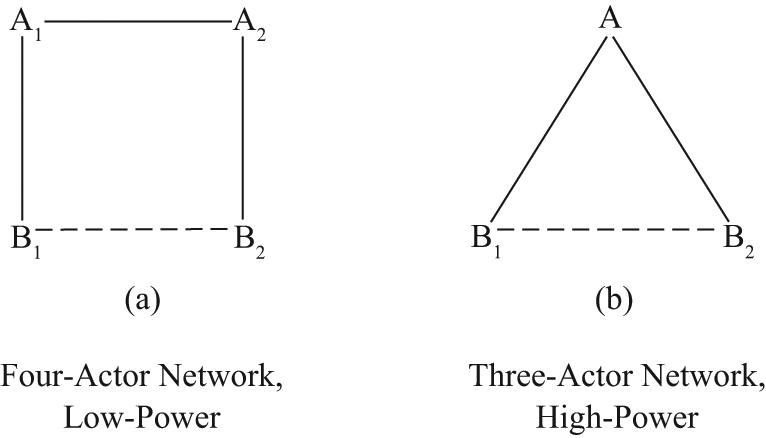
The Two Networks Studied in the Experiment
The size and shape of networks also affect actors’ tendencies to form behavioral commitments to one another, by repeatedly exchanging with the same partner (Lawler, Thye, and Yoon 2006; Skvoretz and Lovaglia 1995). Consider the two networks in Figure 1, which provide different structural opportunities for commitments to form. In Figure 1b, both Bs would prefer to exchange with A, their high-value partner, rather than with each other (a low-value relation); A, however, is structurally indifferent between the two Bs. Consequently, a committed relationship between A and either B is unlikely in this network, although the Bs may still form commitments, of varying degrees, to A. But the network in Figure 1a provides the opportunity for two committed relationships—between A1 and B1 and between A2 and B2—to form. Consequently, behavioral commitments between A and B should be stronger in the four-actor network than in the three-actor network. 2 To the extent that commitments form between pairs of actors, they reduce uncertainty and increase the stability of exchanges. But these benefits, although clearly advantageous to power-disadvantaged actors, come at a cost to power-advantaged actors: By forgoing the opportunity to exchange with alternative partners, these actors do not “use” their structural advantage, and consequently exchanges between committed actors become more equal (Cook and Emerson 1978; Lawler and Yoon 1996; Yamagishi, Cook, and Watabe 1998).
These findings, and the theories that predict them, are based on exchanges in which actors negotiate the terms of binding agreements. When actors engage in reciprocal exchange, the effects of network structure on inequality are weaker and power use is somewhat lower, particularly in structures like Figure 1b that produce greater inequality in negotiated exchanges (Molm et al. 1999). Behavioral commitment, in contrast, is not affected by the form of exchange; actors are just as likely to develop commitments to particular partners in either form.
All of this work has been conducted in laboratory settings in which exchange partners engage in a single form of exchange, either negotiated or reciprocal. 3 In natural settings, relationships often combine the two forms, with actors engaging in both reciprocal and negotiated exchange, at different times, with the same partners. Such combinations are a key feature of socially embedded relationships. The organizational literature on embeddedness, to which we turn next, suggests that actors in embedded relationships do not act purely on the basis of self-interest and do not always exploit structural opportunities offered by their networks.
Exchange and Embeddedness
As Granovetter (1985) defined the concept, social embeddedness refers to the embedding of economic exchanges in ongoing structures of social relations. Organizational researchers commonly distinguish between purely economic or arm’s-length ties and embedded relationships in which economic transactions are embedded in the broader context of a social relationship between exchange partners (Baker 1990; Larson 1992; Powell 1990; Uzzi 1996, 1999). Arm’s-length ties are typically characterized by one-shot deals, focused solely on monetary outcomes, between individuals with little connectedness or familiarity, whereas embedded relationships involve recurring interactions between individuals linked through relations and networks, in which interests expand beyond monetary exchanges and business partners become friends (Granovetter 1985; McGinn and Keros 2002; Uzzi 1996).
The form of exchange is a central feature of this distinction and the focus of our analysis. In arm’s-length ties, exchanges are negotiated and typically bound by contract; in embedded relationships, negotiated exchanges are situated in a larger context of reciprocal exchange (Larson 1992; Uzzi 1999). Not only are social interactions in embedded relationships reciprocal in form, but so are many of the business dealings. To a considerable extent, embedded relationships use exchange protocols that are more commonly associated with social, nonbusiness attachments—in particular, the voluntary acts of reciprocal giving that are common among family and friends (Uzzi 1999).
Organizational research links embeddedness, as compared with arm’s-length transactions, to a number of economic and social benefits. 4 Although some benefits are specific to a particular industry or type of firm, two general behavioral consequences apply more broadly. First, embeddedness encourages the development of relational commitments between particular partners, such as placing repeat orders with a favored supplier (Granovetter 1985). These recurring exchanges require a willingness to commit to a long-term relationship and to invest in the costs of its maintenance (Larson 1992). Trust develops hand in hand with commitment, and as both trust and commitment increase, uncertainty and transaction costs are reduced (Podolny 1994; Uzzi 1996). Second, embeddedness promotes cooperation, in the form of resource pooling, coordinated adaptation, information sharing, joint problem solving, and integrative agreements (Granovetter 1985; Larson 1992; Uzzi 1996, 1997). Motivations shift from maximizing immediate gain, by exploiting more dependent partners, to cultivating cooperative ties that offer greater potential rewards in the long term. In these cooperative relationships, both parties show a willingness to contribute more to the relationship than is contractually required (Uzzi 1997), and differences in negotiated payoffs are often reduced (McGinn and Keros 2002).
These consequences of embeddedness have important implications for the exchange literature we have just discussed. As Uzzi (1996) points out, the effects of embeddedness are in many respects contrary to predictions based on resource dependence. Both exchange theories and resource dependence theories are based on assumptions that actors will try to maximize gains from each transaction, that less dependent actors will do better than more dependent actors, and that inequalities in the benefits obtained will increase to the extent allowed, or facilitated, by the opportunity structure of the network. The organizational research on embeddedness suggests modifications in these effects: increased commitments to exchange partners beyond those shaped by network structures, and reduced use of structural power advantages. In short, embeddedness should modify the behavioral effects of network structures observed in exchange experiments, in directions that promote greater commitment and equality.
Our aim is to examine the causal role that a single feature of embeddedness—the embedding of negotiated exchanges in an ongoing relationship of reciprocal exchange—plays in producing these effects. In field studies, numerous dimensions distinguish between embedded and arm’s-length relations, making it very difficult to determine which features of embedded relationships are responsible for their effects. Organizational researchers commonly attribute the outcomes of embeddedness to the close, personal relationships between actors—the friendships and features shaped by those friendships (such as network connectedness and multiplex exchanges). Our emphasis, instead, is on the forms of exchange that distinguish between embedded and arm’s-length ties. We propose that the “mix” of reciprocal and negotiated exchanges in embedded relationships, compared with purely negotiated exchanges in arm’s-length ties, can produce greater commitment and cooperation, independent of other features typically associated with them in natural settings. In the following section, we draw on recent work in the social exchange tradition, particularly work on forms of exchange and social attachments, to develop the causal mechanisms that underlie these effects and inform our predictions.
A Social Exchange Analysis of the Behavioral Consequences of Embeddedness
Uzzi (1996) has described embeddedness as a logic of exchange in which exchange partners shift from the pursuit of immediate gains for self to the longer-term benefits, for both parties, of developing a relationship of trust, cooperation, and commitment. This is a topic that exchange researchers began studying systematically in the 1990s. We draw on this recent work, particularly the theories and research of Lawler and associates (Lawler 2001; Lawler and Yoon 1996; Lawler et al. 2008; Thye, Lawler, and Yoon 2011) and Molm and associates (Molm 2010; Molm et al. 2000, 2007; Molm, Whitham, and Melamed 2012) to develop our theoretical arguments.
We base our key predictions—that embedding negotiated exchanges in a reciprocal exchange relationship will increase behavioral commitments and decrease the effects of network structure on inequality, compared with relations of pure negotiated exchange—on two theoretical mechanisms. The first mechanism is the demonstrated capacity of reciprocal exchange to build strong bonds of trust and solidarity. For many organizational scholars, trust is central to both the conception of an embedded relationship and its behavioral consequences (Larson 1992; Uzzi 1996). Trust promotes the voluntary, reciprocal exchanges of benefits between actors in embedded relationships (Uzzi 1996), but trust also develops from reciprocal exchange (Molm et al. 2000). Molm’s reciprocity theory links the development of trust to the greater risk and uncertainty of reciprocal forms of exchange (Molm 2010), which allow actors to demonstrate their trustworthiness to one another. Through reciprocal acts of unilateral giving, in which benefits are offered without negotiation of terms or assurance of reciprocity, actors signal their trustworthiness and convey their commitment to the partner and the relationship. The negotiation of bilateral agreements lacks these features. Compared with negotiated exchange, reciprocal exchange promotes stronger trust (Molm, Schaefer, and Collett 2009), reduces the salience of actors’ conflicting interests (Molm, Collett, and Schaefer 2006), and increases actors’ perception of the relationship as a cooperative one between partners, rather than a competitive one between adversaries (Molm et al. 2007).
This work suggests that embedding negotiated exchanges in a relationship context of reciprocal exchange should create the kind of relational climate—one of trust and perceived cooperation—that is conducive to more committed and egalitarian exchanges. A recent study supports that argument. Molm and colleagues (2012) argued that a relationship primarily composed of reciprocal exchange should tend to inoculate actors from the more competitive, conflictual aspects of exchange, by building positive relationship characteristics of trust and solidarity. Such a foundation reduces or prevents the heightened sense of conflict that actors would otherwise experience when some of their exchanges must be negotiated. Using this logic, Molm and colleagues predicted and found that embedding negotiated exchanges in an ongoing relationship of reciprocal exchange produced stronger trust, affective regard, and feelings of solidarity than did an equivalent relationship of pure, negotiated exchange. Furthermore, the amount of reciprocal exchange in the relationship mattered less than its presence; introducing even some reciprocal exchange into a negotiated exchange relationship significantly boosted trust and solidarity, compared with negotiated exchange alone.
Our second mechanism, which comes from the work of Lawler and associates, is the cooperative structure of negotiated exchange. Negotiated exchange is, in game theoretic parlance, a cooperative game, in which agreements are made jointly by actors who can communicate with one another (Heckathorn 1985). The process of jointly negotiating a mutually acceptable agreement focuses attention on the dyad as a unit. Even if actors initially explore possible agreements with alternative exchange partners in the network, the formation of this dyadic unit directs attention to the partner and the relationship in a more focused way than in reciprocal exchange, where unilateral flows of benefit are more diffuse and discrete transactions are more difficult to identify. This feature of negotiated exchange is actually a double-edged sword, and its potential consequences have been the basis for different theories of solidarity in exchange relations. On the one hand, Lawler’s affect theory proposes that the cooperative structure of negotiated exchange—the greater “jointness of task”—should produce stronger relational solidarity and feelings of partnership than reciprocal exchange (Lawler 2001; Lawler et al. 2008). Lawler argues that perceptions of shared responsibility are weaker for reciprocal than negotiated exchange, making it less likely that positive emotions from successful exchanges will be attributed to the relationship. On the other hand, Molm’s reciprocity theory asserts that the very features that make negotiated exchange more structurally cooperative than reciprocal exchange can accentuate the inherent conflict of interests in a mixed-motive exchange relation, by making costs more transparent, outcomes easier to compare, and inequalities more obvious—thus decreasing feelings of solidarity and partnership (Molm 2010; Molm et al. 2007).
Experimental comparisons of pure forms of negotiated and reciprocal exchange provide stronger support for the predictions of reciprocity theory than affect theory, particularly in unequal power relations (Molm et al. 2007; Lawler et al. 2008). Although negotiated exchange is more structurally cooperative, reciprocal exchange is perceived as more cooperative. As Thye and associates (2011) have recently shown, however, even negotiated exchange can generate the perception of a shared group affiliation—which they describe as a type of social embeddedness—when certain structural conditions, particularly networks with dense connections and equal power relations, initiate processes that promote relational cohesion. We propose that a reciprocal exchange context can also heighten the positive effects of the cooperative structure of negotiated exchange, albeit through different mechanisms.
We contend that when negotiated exchanges are embedded in an ongoing relationship of reciprocal exchange, the combination of the stronger trust and perceived cooperation produced by reciprocal exchange, and the greater jointness of task of negotiated exchange, will interact to produce a more cooperative relationship than either form of exchange alone. The reciprocal exchange context will inoculate actors from the heightened sense of conflict that the negotiated exchanges would otherwise produce. Rather than seeing each other as adversaries engaged in a competitive process, actors are more likely to view themselves as working together to achieve mutually beneficial outcomes. In this relational climate of perceived cooperation, the cooperative structure of negotiated exchange—the value of “doing things together” (Kuwabara 2011)—will promote behavioral acts of cooperation. Behavioral commitments should increase, and network variations in structural power should have weaker effects on the terms of agreements.
As this analysis indicates, our primary interest is in the effect of embedding negotiated exchanges within an ongoing relationship of reciprocal exchange. We compare these embedded relationships with relationships of “pure” negotiated exchange—the form of exchange in arm’s-length interactions. But embedded relations can emerge in various ways (DiMaggio and Louch 1998), and the relative mix of reciprocal and negotiated exchange in these relations can differ. As Uzzi (1996:679) notes, “just as economic transactions are embedded in social relations, new social relationships are partly reverse-embedded in economic transactions.” Consequently, we also study the effects of embedding reciprocal exchanges within an ongoing relationship of negotiated exchange, compared with a relationship of “pure” reciprocal exchange. Given our analysis, we do not expect the reciprocal exchanges in an embedded relationship to be any more committed or equal than in a relation of pure reciprocal exchange. Embeddedness, per se, does not produce greater trust or solidarity than reciprocal exchange alone; in fact, for disadvantaged actors, embedding reciprocal exchange in a negotiated exchange relationship decreases feelings of solidarity, compared with pure reciprocal exchange (Molm et al. 2012). In addition, reciprocal exchange lacks the cooperative structure of negotiated exchange.
For these reasons, we expect embeddedness to primarily influence the commitment and inequality of negotiated exchanges in embedded relationships. The following hypotheses reflect this logic:
Hypothesis 1: Embeddedness (a) strengthens behavioral commitment in negotiated exchanges (for negotiated exchanges embedded in a reciprocal exchange relationship, compared with a relationship of pure negotiated exchange), but (b) has no effect on behavioral commitment in reciprocal exchanges (for reciprocal exchanges embedded in a negotiated exchange relationship, compared with a relationship of pure reciprocal exchange).
Hypothesis 2: Embeddedness (a) weakens the effect of network structure on negotiated exchange inequality (for negotiated exchanges embedded in a reciprocal exchange relationship, compared with a relationship of pure negotiated exchange), but (b) does not alter the effect of network structure on reciprocal exchange inequality (for reciprocal exchanges embedded in a negotiated exchange relationship, compared with a relationship of pure reciprocal exchange).
Examining the embeddedness of both forms of exchange also allows us to compare embedded relationships that mix negotiated and reciprocal exchange in different proportions: a relationship that is primarily reciprocal (negotiated exchange embedded in a reciprocal exchange relationship) versus one that is primarily negotiated (reciprocal exchange embedded in a negotiated exchange relationship). That comparison provides a finer-grained analysis of the effects of embeddedness and the contributions of the two forms of exchange to those effects.
Method
Design and Participants
We test our predictions in a laboratory experiment in which undergraduate student participants earn money through exchanges with other students. The control and randomization of the laboratory allow us to disentangle effects of our manipulated variables from other, potentially confounding variables that make causal inference difficult in natural settings. In particular, the laboratory setting allows us to study the effects of variations in the form of exchange while holding constant other characteristics that have traditionally been associated with the distinction between embedded and arm’s-length relations. The actors whom we study in all conditions of our experiment have no prior relationship with one another, are connected through small networks that link them to potential exchange partners, engage in recurring exchanges with those partners, and obtain only monetary benefits from their exchanges. Some of these experimental constants are associated, in natural settings, with arm’s-length relations (i.e., exchanges for monetary benefits between actors with no prior relationship) and others with embedded relations (i.e., recurring exchanges between actors connected to one another in networks). Our aim is not to simulate either type of relation (embedded or arm’s-length) as it occurs in any natural setting but rather to test, under controlled conditions, how a particular feature of these relationships—their underlying forms of exchange—affects key behaviors studied by both exchange theorists and organizational researchers.
Table 1 shows the design of our 2 × 2 × 2 factorial experiment, which crosses the form of exchange (negotiated or reciprocal) with network structure (the two networks shown in Figure 1) and the presence or absence of embeddedness (embeddedness within an ongoing relationship based on the other form of exchange). In the baseline conditions of no embeddedness, participants engage in only one form of exchange throughout the exchange period; in the embedded conditions, the designated form of exchange is embedded within a relationship that is based primarily on the other form. Twelve networks, each consisting of same-sex subjects, were run in each of the eight experimental conditions, for a total of 336 subjects. 5
Design of the Experiment

Experimental Procedures
Subjects were randomly assigned to positions in one of the two networks shown in Figure 1. To provide the opportunity for behavioral commitments to develop, subjects remained in the same network positions throughout the experiment and interacted repeatedly with the same two partners. To prevent personal characteristics from influencing exchange outcomes, we ensured that all interaction occurred through computers; subjects were seated in isolated rooms and never met each other.
Following detailed instructions and practice trials (the timing and content of which depended on the experimental condition), subjects engaged in repeated exchanges with their partners to earn points equal to money. On each exchange opportunity, subjects could make an agreement with (negotiated exchange) or give points to (reciprocal exchange) only one of their two partners; thus, relations were negatively connected. Subjects were then informed about the source and amount of any points gained, and their total points (and monetary value) were cumulated and shown on their computer screens. At the conclusion of the exchange period, subjects responded to a questionnaire on their computer screens asking them to evaluate their partners and relationships. Subjects were then asked to write any additional thoughts they had about their experiences. Finally, they were paid the amounts they had earned and were debriefed.
Subjects were not informed in any of the conditions about the amounts of money their partners received from exchanges with them or others, the outcomes of their partners’ exchanges with others, or their partners’ cumulative earnings. 6 Subjects’ information about the network was restricted to knowledge of their own access to their two exchange partners and their potential benefits from these partners. They knew that their partners had other potential partners, but they did not know the number or value of their partners’ alternatives.
Manipulations
Network structure
We manipulated the structural determinants of behavioral commitment and inequality by comparing the two networks shown in Figure 1. Both networks link each actor to two alternative partners, and both networks create a relation of imbalanced (unequal) power between actors in the A and B positions, favoring A, by varying their relative opportunity to make exchanges of high or low value. An exchange between two actors in a high-value relation could produce a total of 12 points for both actors; an exchange in a low-value relation (i.e., an exchange between two Bs) could produce a total of 4 points for both actors. The focal relations of our study, between actors in the A and B positions, were always high value.
The two networks vary both the structural power imbalance between A and B and the structural likelihood that A and B will form behavioral commitments with each other. A’s power advantage over B is greater in the three-actor, “high-power” network in Figure 1b than in the four-actor, “low-power” network in Figure 1a. In contrast, the structural likelihood that A and B will form behavioral commitments to each other is greater in the four-actor network than in the three-actor network.
Form of exchange
All conditions of the experiment involved variations in reciprocal and negotiated forms of exchange. Our manipulations of the two forms were designed to make them as comparable as possible on all dimensions other than their defining differences.
In negotiated exchange, subjects negotiated the division of a fixed amount of benefit (12 points in the high-value relations and 4 points in the low-value relations) on each of a series of exchange opportunities. Each opportunity consisted of up to five rounds of negotiation. On each round, all actors in the network simultaneously made offers to both of their alternative partners. After the first round, actors could accept another’s offer, repeat their last offer, or make a counteroffer. Negotiations continued until all potential agreements were made or the five rounds were up. In the three-actor network, only one potential agreement (between any two of the three actors) could be made; in the four-actor network, two agreements (between two pairs of the four actors) were possible. As soon as an agreement was reached, both actors received the amounts agreed upon; thus, agreements were binding. Subjects knew the range of points they could request from agreements and that, in general, the more they received, the less the other person received. They did not know that a fixed amount of profit was divided, however, nor did they know the exact value the other person received from an agreement. Subjects made offers by requesting the number of points they wanted to receive from an agreement, and the computer then converted each request into an offer of the remaining points for the other subject.
In reciprocal exchange, each actor gave a fixed number of points to one of his or her partners on each exchange opportunity. Giving points to a partner added to the partner’s total points without subtracting from the actor’s own points. As in the negotiated exchanges, subjects knew only the number of points they could receive from others, not the number of points they could give to others. On each exchange opportunity, all subjects simultaneously and independently chose a partner to give points to, without knowing whether or when the other would reciprocate. Subjects were then informed that each of their partners either added to the subject’s earnings or did not act toward the subject, and their cumulative points were updated.
To hold constant the potential joint benefit of negotiated and reciprocal forms of exchange, the number of points that each actor could give to a reciprocal exchange partner on an opportunity was fixed (2 points in the low-value relations, and 6 points in the high-value relations) and equal to one-half the total points (4 and 12) that two actors could divide on each negotiated exchange agreement. Thus, the total points at stake in a relation were the same in the negotiated and reciprocal exchanges.
Each reciprocal exchange opportunity involved only a single act of giving, whereas each negotiated opportunity involved up to five rounds of negotiations, with each round consisting of multiple actions. To adjust for this difference in time and effort, subjects participated in more reciprocal exchanges for less money. In the four-actor network, subjects participated in five times as many reciprocal as negotiated exchanges, at one-fifth the monetary value (one cent per point in reciprocal exchange, and five cents per point in negotiated exchange). In the three-actor network, the opportunity for only one negotiated agreement between two of the three actors (compared with two agreements between two pairs of the actors in the four-actor network) required somewhat different adjustments. First, because the structural opportunity to engage in negotiated exchange in the three-actor network was only two-thirds that in the four-actor network, and each opportunity took less time to complete, subjects were given 67 percent more exchange opportunities in the three-actor network than in the four-actor network. Second, because subjects required fewer rounds, on average, to complete a single agreement in the three-actor network than the two agreements that were possible in the four-actor network, subjects participated in three (rather than five) times as many reciprocal as negotiated exchanges. The monetary value of points was adjusted to compensate for these differences: Subjects received one cent per point for reciprocal exchange and four cents per point for negotiated exchange. 7 These procedures approximately equated the time, effort, and earnings opportunities across all experimental conditions.
To simplify comparisons between the two forms of exchange in our manipulation of embeddedness, we created a new exchange unit—the exchange occasion—to refer to either a single negotiated exchange opportunity or five reciprocal opportunities in a row in the four-actor networks and three in a row in the three-actor networks. In the embedded conditions, it is exchange occasions of the two forms (not opportunities) that are randomly interspersed with each other.
Embeddedness
The embeddedness manipulation compared “unembedded” exchange relations consisting of a single form of exchange—negotiated or reciprocal—with relations in which either negotiated or reciprocal exchange was “embedded” in an ongoing relationship of the other, primary form of exchange (see Table 1). In the latter, exchanges of the embedded form were randomly interspersed with exchanges of the primary form, which provided the dominant context for the relationship (Granovetter 1985). The embedded form of exchange constituted one-third, and the primary form two-thirds, of the relation. We used the same random order of the two forms for all relations in the embedded conditions.
All conditions began with detailed instructions and practice trials. In the baseline (no embeddedness) conditions, these instructions taught subjects how to engage in a single form of exchange, negotiated or reciprocal. Subjects then engaged in that form of exchange for 60 (the four-actor network) or 100 (the three-actor network) exchange occasions.
In the embedded conditions, instructions identical to those in the baseline conditions first taught subjects how to engage in the primary (dominant) form of exchange. An initial period of interaction (10 exchange occasions in the four-actor network, 16 occasions in the three-actor network) consisted of only that form of exchange, to establish an ongoing relationship of the primary form. Subjects then received additional instructions, informing them that for the remainder of the experiment they would continue to interact with the same two persons and that many of their interactions would be like those in the first part of the experiment, but that sometimes they would have opportunities for a different kind of interaction, signaled by an announcement on their computer screens. The instructions then described the second (embedded) form of exchange, in the same detail and with the same practice trials as the initial instructions for the primary form. Following those instructions, the main embeddedness period of exchange occurred. In the four-actor network, the embeddedness period consisted of 40 occasions of the primary form of exchange, with 20 occasions of the embedded form randomly interspersed, for a total of 60 exchange occasions. In the three-actor network, the embeddedness period consisted of 64 occasions of the primary form, with 32 occasions of the embedded form randomly interspersed, for a total of 96 exchange occasions.
Measures of Relational Climate
The predicted effects of embeddedness are based in part on the establishment of a relational climate of trust and cooperation by the reciprocal exchanges in the relationship. Findings from previous research support this relation (Molm et al. 2012); to confirm that it holds for this data set, we asked subjects to respond to a series of seven-point bipolar semantic differential scales, shown on their computer screens, at the conclusion of the experiment. We derived measures of trust and perceived cooperation from subjects’ evaluations of the focal partner and their relationship (A’s evaluations of B and the A–B relationship, and B’s evaluations of A and the A–B relationship). Scores were computed for each A and each B and then averaged across actors in each position within the network; finally, a relational score was computed as the mean of the individual scores, comparable to our relational measures of exchange behaviors.
We measured trust in the partner with a two-item scale: One item asked subjects how much they trusted the partner (very little/very much), and one item asked them to evaluate the partner as untrustworthy/trustworthy. We measured perceived cooperation with a three-item scale, based on subjects’ descriptions of their relationship with the exchange partner as competitive/cooperative, adversaries/partners, and conflictual/harmonious. Scale values range from 1 to 7 (4 is the neutral point), with higher values indicating stronger feelings of trust and stronger perception of a cooperative (versus competitive and conflictual) relationship. Cronbach’s alphas are .90 for the trust scale and .88 for the cooperation scale. 8
Measures of Exchange Behaviors
Our dependent variables are measures of behavioral commitment and inequality in the A–B relations. In the baseline conditions, commitment and inequality were computed for the sole form of exchange in the relation, either negotiated or reciprocal. In the embedded conditions, we computed separate measures of commitment and inequality for the two forms of exchange in the relation (negotiated and reciprocal) and overall commitment and inequality for all exchanges in the relationship (both forms combined). The separate measures for reciprocal and negotiated exchange commitment/inequality are used for tests of our hypotheses, which predict different effects of embeddedness for the two forms of exchange. Overall commitment/inequality is the weighted average of the separate measures, with the primary form of exchange weighted twice as much as the embedded form. This weighting simply reflects the relative proportions of the primary and embedded forms of exchange; in the embedded relationships, there were twice as many occasions for the primary form of exchange as for the embedded form.
Below, we describe the computation of these variables for the two forms of exchange. To take account of the dependencies in our data (between actors within networks and between behaviors across exchange opportunities), all measures are computed for the network as a whole and for the entire exchange period.
Behavioral commitment
We measured behavioral commitment in the A–B relation by computing how often A and B chose to exchange with each other rather than their alternative partners. Scores were computed for each A and each B and then averaged across actors in each position of a network to obtain a measure of A’s commitment to B and B’s commitment to A for the network as a whole. For reciprocal exchange, each actor’s commitment to the other is equal to the proportion of opportunities on which A gave to B, or B to A. For negotiated exchange, each actor’s commitment to the other is equal to the proportion of that actor’s agreements that were made with the other (A with B, or B with A). The mean of these two individual scores (A’s commitment to B, and B’s commitment to A) provided our measure of behavioral commitment in the A–B relation. That measure has a maximum value of 1 when A and B exchange only with each other and a minimum value of 0 when A and B never exchange with each other.
Because the two A–B relations in the three-actor network share a common actor (the single A), our measure of A’s behavioral commitment to B in those networks, which averaged A’s commitment to each of the two Bs, is .50 by definition. Thus, in the three-actor networks, the only variation in A–B commitment is produced by variation in B’s commitment to A.
Inequality
We measured inequality in the A–B relation by the value of benefits that A received from B, divided by the total value that both A and B received from exchanges with each other: (VAB)/(VAB + VBA). In reciprocal exchanges, benefit value depends on the frequency with which A and B give points of fixed value to each other; in negotiated exchanges, benefit value depends on the points that each actor obtains from A–B agreements. Values of VAB and VBA were first computed for each A and each B and then averaged across actors in each position in the network. In the four-actor networks, each A could receive benefit from only one B; in the three-actor networks, the single A could receive benefit from both Bs, which were averaged. This measure, like behavioral commitment, has a potential range of 0 (maximum inequality in B’s favor) to 1 (maximum inequality in A’s favor), with .50 indicating equal exchange.
Table 2 displays mean values of behavioral commitment and inequality by experimental condition. For each variable, means are displayed for negotiated exchanges only, for reciprocal exchanges only, and for the relationship overall (all exchanges of both forms).
Means and Standard Deviations of Exchange Behaviors, by Experimental Condition (N = 12 in each condition)

Note: Standard deviations are in parentheses.
Results
Preliminary Analyses
Before turning to tests of our predictions, we first report results of two sets of preliminary analyses, designed to confirm that (1) patterns found in previous comparisons of “pure” reciprocal and negotiated exchange hold for our study as well, and (2) a relational climate of trust and cooperation is established in the embedded conditions, as our theoretical logic assumes and previous research has found.
For the first objective—confirming patterns found in previous comparisons of pure reciprocal and negotiated exchange—we examine the four baseline conditions with no embeddedness. Two-way analyses of variance on each of the exchange behaviors, by form of exchange and network structure, find the same differences and similarities between these pure forms of exchange that previous studies have reported. First, network structure has the expected strong effect on behavioral commitment (F1,44 = 16.57, p < .001), which is greater in the four-actor network than in the three-actor network, but the two forms of exchange do not differ on mean commitment (see Molm et al. 2000 for similar findings). Second, network structure and form of exchange interact in their effects on inequality (F1,44 = 12.22, p < .001). Network structure has a strong effect on negotiated exchange inequality, which is greater in the three-actor network than in the four-actor network (t22 = 4.65, p < .001), but no effect on reciprocal exchange inequality (t22 = 1.19). This pattern also supports previous findings (Molm et al. 1999).
Our second set of preliminary analyses examines support for one of the key mechanisms on which our predictions are based: establishment of a relational climate of trust and perceived cooperation by a reciprocal exchange context. Comparison of our baseline conditions shows, as previous studies have found, that reciprocal exchange produces stronger perceptions of both relational trust and cooperation than negotiated exchange (mean trust = 4.85 for reciprocal and 4.03 for negotiated; t46 = 3.15, p < .01; mean cooperation = 4.94 for reciprocal and 3.86 for negotiated; t46 = 4.42, p < .001). Two-way analyses of variance confirm our assumptions of the effects of reciprocal exchange in embedded relationships: Embedding negotiated exchange in a reciprocal exchange context boosts trust from a mean of 4.02 in the baseline negotiated conditions to 4.98 in the embedded conditions (F1,44 = 22.05, p < .001) and boosts perceived cooperation from a mean of 3.86 in the baseline conditions to 4.88 in the embedded conditions (F1,44 = 29.28, p < .001). These changes mean that the relational climate shifts from slightly negative or neutral in the pure negotiated conditions to clearly positive in the embedded conditions and that actors no longer perceive their partners as competitive adversaries. Additional analyses show that even when reciprocal exchange constitutes only one-third of the relationship (i.e., when reciprocal exchanges are embedded in a negotiated exchange relationship), the means for trust and perceived cooperation are nearly as great (4.76 and 4.68, respectively) as when reciprocal exchange is the primary form (4.98 and 4.88). All of these results are consistent with patterns found in previous work (Molm et al. 2012).
With these preliminary issues addressed, we turn now to our key analyses of the behavioral consequences of embeddedness and the tests of our predictions.
Effects of Embeddedness on Exchange Behaviors
Behavioral commitment
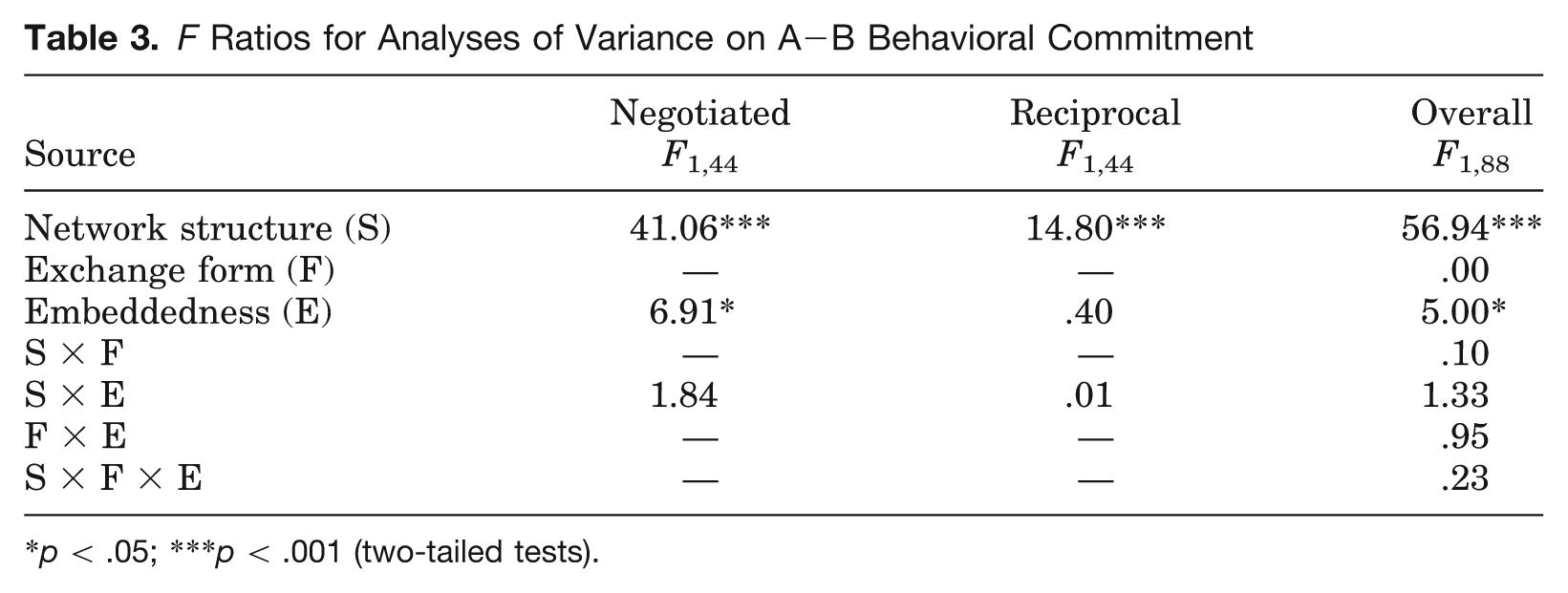
Perhaps the most fundamental prediction for embeddedness is that it should increase actors’ commitment to each other, as indicated by their tendency to exchange repeatedly with the same partner. Table 3 reports the results of analyses of variance on commitment for each form of exchange separately (negotiated and reciprocal) and for all exchanges in the relationship (regardless of form).
F Ratios for Analyses of Variance on A−B Behavioral Commitment
p < .05; ***p < .001 (two-tailed tests).
Results for all three analyses show the strong effects of network structure found in previous studies, with greater commitment in the four-actor network than in the three-actor network. Our primary interest, though, is whether embeddedness affects commitment, over and above the effects of network structure. Hypothesis 1 predicts that embeddedness will increase negotiated exchange commitment but have no effect on reciprocal exchange commitment. The analyses summarized in columns 1 and 2 of Table 3, which test the predicted effects for each form of exchange separately, support the hypothesis. As Hypothesis 1a predicts, embedding negotiated exchanges in a reciprocal exchange relationship increases commitment in the negotiated exchanges of the embedded relationship, compared with a relation of pure negotiated exchange. Although this effect appears stronger in the four-actor network (see Table 2), it occurs to some extent in both networks, and the structure × embeddedness interaction is not significant. Hypothesis 1b is also supported; embeddedness does not significantly affect reciprocal exchange commitment. Both negotiated and reciprocal exchange commitments increase with embeddedness, but the increase in reciprocal exchange commitment is smaller and nonsignificant (see Table 2). These results suggest that the significant effect of embeddedness on overall commitment (column 3 of Table 3) is primarily the result of its effect on the negotiated exchanges in the relationship.
Additional analyses (not shown in Table 3) show that both conditions of embeddedness (embedding negotiated exchange in a reciprocal exchange relationship and embedding reciprocal exchange in a negotiated exchange relationship) significantly increase commitment in the negotiated exchanges of the embedded relationship, compared with a relationship of pure negotiated exchange (F1,44 = 4.97, p < .05 for reciprocal embedded in negotiated). As the means in Table 2 show, the two embedded conditions produce virtually identical values of negotiated exchange commitment in both network structures. Mixing some proportion of reciprocal exchange with negotiated exchange, whether the proportion is two-thirds or one-third of the relationship, increases commitment in the negotiated exchanges of the relationship. Indeed, mean negotiated exchange commitment in these embedded relationships (M = .74) is significantly greater than mean commitment for either pure negotiated (M = .67) or pure reciprocal (M = .64) exchange.
Inequality
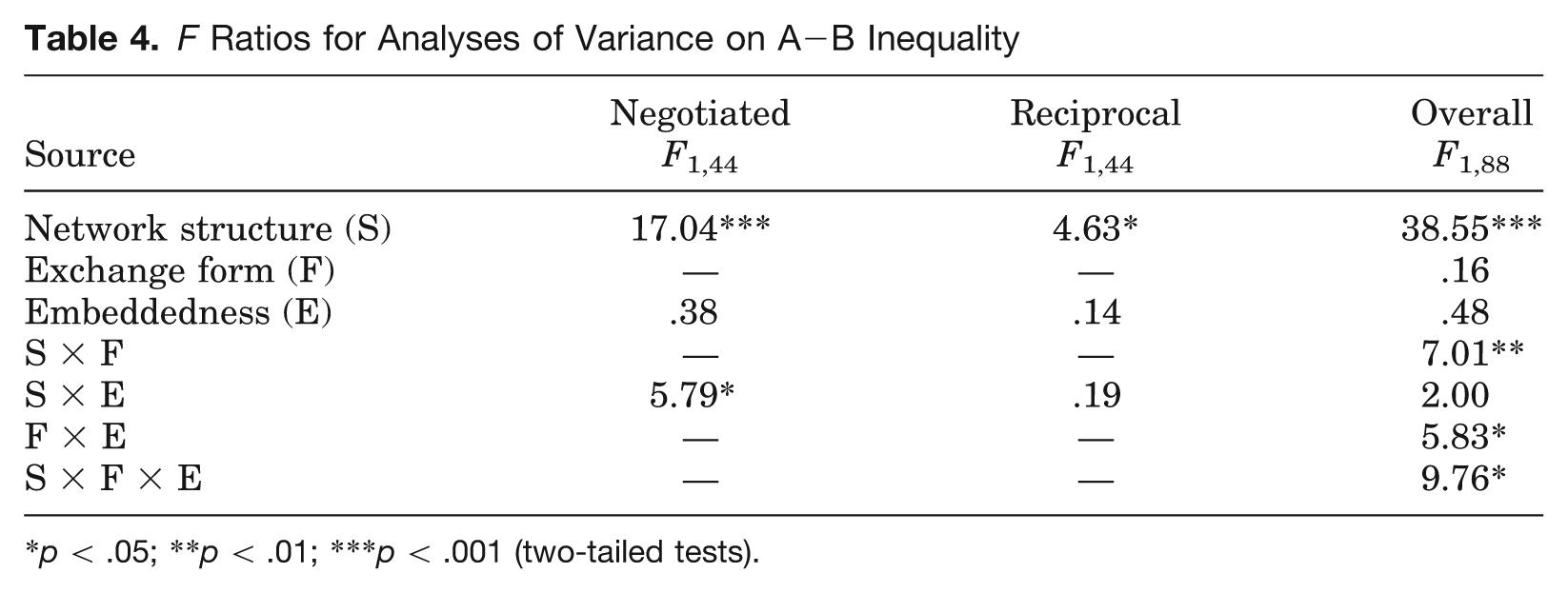
We next examine whether embeddedness decreases effects of structural power, by making exchanges between embedded partners more equal in the high-power network. Table 4 reports the results of analyses of variance on inequality for each form of exchange separately (negotiated and reciprocal) and for all exchanges in the relationship (overall inequality).
F Ratios for Analyses of Variance on A−B Inequality
p < .05; **p < .01; ***p < .001 (two-tailed tests).
All three analyses show the expected effects of network structure on inequality, which is greater in the three-actor network than in the four-actor network. Hypothesis 2a predicts that embeddedness will modify the effect of structure on negotiated exchange inequality, decreasing it relative to the baseline condition of pure negotiated exchange. The significant structure × embeddedness interaction for negotiated exchange inequality (column 1 of Table 4) supports that prediction. Hypothesis 2b, which predicts no interaction between structure and embeddedness for reciprocal exchange inequality, is also supported; the effect of structure on inequality is much weaker for reciprocal exchange than for negotiated exchange, and embeddedness does not alter that effect (column 2 of Table 4).
These results show that embedding negotiated transactions within a reciprocal exchange relationship makes negotiated exchange more like reciprocal exchange, by weakening the effect of network structure on inequality. As we saw earlier, in the baseline condition of pure negotiated exchange, inequality is significantly greater in the three-actor network than in the four-actor network. But when negotiated transactions are embedded in a reciprocal exchange relationship, the effect of structure on those transactions becomes nonsignificant, as inequality decreases in the three-actor network and increases in the four-actor network. 9 We see a tendency toward this same effect in the embedded reciprocal exchange conditions; including even some reciprocal exchange in the relationship (here, 33 percent) tends to reduce effects of structure on the inequality of the negotiated transactions in the relationship compared with baseline negotiated exchanges (F1,44 = 2.76, p = .10). More generally, the greater the proportion of reciprocal exchanges in the relationship, the weaker the effect of network structure on the inequality of negotiated agreements.
Although embeddedness weakens the effect of structure on inequality in negotiated exchanges, mean inequality remains higher in negotiated than in reciprocal exchanges, even in embedded relationships (see Table 2). Consequently, the overall inequality of exchange in embedded relationships, averaged across both forms of exchange, reflects the relative proportions of reciprocal and negotiated exchanges in the relationship; the higher the proportion of reciprocal exchange, the lower the overall inequality. This factor explains the significant interaction between the form of exchange and embeddedness on overall inequality (column 3 of Table 4): Embedding negotiated exchange in a predominantly reciprocal exchange relationship decreases overall inequality (compared with pure negotiated exchange), whereas embedding reciprocal exchange in a predominantly negotiated exchange relationship increases overall inequality (compared with pure reciprocal exchange). Other findings for overall inequality support both previous research and the separate analyses for negotiated and reciprocal exchange. The significant structure × form interaction indicates that network structure has a stronger effect on negotiated than on reciprocal exchange, and the three-way interaction (structure × form × embeddedness) shows that embeddedness modifies this effect, making it nonsignificant in the embedded conditions.
Discussion and Conclusions
For the past 30 years, exchange theorists have studied the extent to which the structure of networks shapes the frequency and terms of exchanges, especially negotiated exchanges. Both actors’ commitments to particular partners and the equality or inequality of their exchanges are influenced to a considerable extent by key features of exchange networks—in particular, the availability and value of alternative partners—that affect actors’ dependencies on one another.
In this study we asked how embedding negotiated exchanges in the context of an ongoing relationship of reciprocal exchange affects these behaviors and their relation to network structure. Drawing on the organizational literature on embeddedness and economic performance and the social exchange literature on forms of exchange and integrative bonds, we predicted that embedding negotiated exchanges in a reciprocal exchange context would increase behavioral commitments, over and above the effects of network structure, and decrease the effects of structural power on inequality, compared with a relationship of pure negotiated exchange. We based these predictions on two causal mechanisms that exchange theorists have linked to the development of attachments in social exchange relations: (1) the capacity of reciprocal exchange to produce strong bonds of trust and solidarity, and (2) the cooperative structure of negotiated exchange created by its strong “jointness of task.” We argued that when a reciprocal exchange context creates a relational climate of trust and perceived cooperation, the cooperative structure of negotiated exchange encourages stronger commitments and greater equality—the behavioral consequences that embeddedness researchers have observed.
Our findings support four main conclusions. First, embedding negotiated exchanges in a reciprocal exchange context alters key features of those negotiated exchanges in directions consistent with organizational studies of firms. Behavioral commitments between partners are increased, actors respond less to their structural dependencies, and they negotiate more equal agreements in highly power-imbalanced relationships, compared with relations of pure negotiated exchange. Second, these effects occur only for the negotiated exchanges in embedded relationships; reciprocal exchange behaviors are not affected by embeddedness. Third, these patterns hold, with only minor variations, for embedded relationships that vary in the relative proportions of the two forms of exchange. Fourth, although network structure remains the dominant influence on these behaviors, embeddedness has significant, independent effects on each of them, over and above the effects of network structure, or in interaction with structure.
These findings have important implications for both the embeddedness literature and the exchange literature. First, our work suggests that the forms of exchange that distinguish embedded relationships from arm’s-length ties play an important role in producing some of the general behavioral consequences of embeddedness that organizational researchers have observed. These consequences are not simply the result of dense network ties or close personal relationships, as typically assumed. The participants in our experiments were linked through network ties and they engaged in repeated exchanges, but they were strangers with no prior personal relationship who exchanged with each other for monetary gain. Furthermore, these features were constant across both the embedded and nonembedded relationships in our study. Under these highly controlled conditions, our research provides compelling evidence that at least some of the key behavioral consequences associated with embeddedness can be produced simply by mixing negotiated exchanges with reciprocal exchanges in a relationship. Close personal relationships may be a common feature of embedded relationships in natural settings, but they are not a necessary feature.
Second, both the increased behavioral commitments between exchange partners and the more equal exchanges in highly imbalanced network structures demonstrate the power of embedded relationships to shift actors’ motivations from a focus on short-term economic gains to the potential long-term benefits that may be achieved through trust and reciprocity (Powell 1990; Uzzi 1996). Behavioral commitments are typically contrary to powerful actors’ short-term interests, because they eliminate the ability of these actors to “play off” alternative partners against each other in order to improve their own outcomes from agreements (Cook and Emerson 1978). But as issues of loyalty and trust become more important, maintaining the relationship becomes as important as achieving the best payoff (Larson 1992). As one subject in the powerful A position wrote, “It was hard to separate the need to make money from being committed to Person W” (a subject in the B position). 10 The lower inequality in the high-power, three-actor networks—networks in which actors’ power positions typically determine their relative benefits to a remarkable degree—is particularly notable. Power use in the four-actor networks depends much more on individual bargaining skill (Markovsky et al. 1993).
Third, our findings have important implications for potentially reconciling two exchange theories that have proposed different relations between forms of exchange and relational attachments. 11 Lawler and associates have argued that the greater “jointness of task” in negotiated exchanges enhances solidarity and commitment, relative to reciprocal exchange (Lawler 2001; Lawler et al. 2008), whereas Molm and associates have contended that the same jointness instead heightens actors’ awareness of their conflicting interests and reduces solidarity (Molm et al. 2006, 2007). Here, we proposed that when the two forms of exchange are combined in an embedded relationship, the positive effects of each form of exchange—the greater structural cooperativeness of negotiated exchange, and the positive relational climate of trust and perceived partnership created by reciprocal exchange—will work together to produce stronger behavioral commitments than either of these forces alone. Our results support that prediction for both negotiated exchange commitment and overall commitment.
Studying embeddedness in the laboratory had a significant advantage for our objectives: It allowed us to disentangle effects of the form of exchange from other features that typically distinguish between embedded and arm’s-length relationships in natural settings and to address causal issues that are not easily answered in observational studies. But the abstract setting that we created also limited the behavioral effects we were able to observe. Consequently, some of the consequences of embeddedness that organizational researchers have noted were outside of our reach. For example, our actors did not have the opportunity to make multiplex exchanges, to engage in integrative agreements, to provide others with access to new resources, or to transfer useful information—all behaviors that have been observed in organizational studies (Uzzi 1996, 1997). But despite these limitations, our laboratory setting produced effects that capture the same general kinds of behaviors described in detailed ethnographies of particular settings—the commitment, cooperation, loyalty, and trust engendered by embeddedness. Our subjects’ written accounts of their experiences at the conclusion of the experiment illustrate the extent to which this occurred. Here are three examples: “There was a bond of mutual benefit and loyalty” (comment from a B). “During the choice interaction I became friends with X . . . and I was able to have a better negotiation interaction with them” (a B’s comment about an A). 12 “A sense of loyalty was quickly established . . . the participant who gave me points would get points from me. When the negotiation started, there seemed to be more of a team effort with one participant over the other, and we exchanged points almost exclusively over time. The opportunity to interact both ways contributed to this feeling” (comment from an A).
Although our emphasis in this study, as in much of the organizational literature, has been on the positive aspects of the greater cooperation and commitment engendered by embeddedness, it is important to recognize that these effects can also have a negative side. Too much commitment can lead to insularity and the loss of new opportunities or new information (Mizruchi and Stearns 2001; Portes and Sensenbrenner 1993; Uzzi 1996); relationships that are too close can lead to intense emotions that override rational considerations. For firms that are motivated, above all, by profit, the positive effects of embeddedness may have a threshold, and some combination of embedded and arm’s-length ties may be optimal (Uzzi 1996).
Finally, our work shows one of the ways in which social psychological theories and research can advance our understanding of processes studied by researchers in other fields of sociology. By bringing together the common interests of social exchange theorists and organizational researchers, this study contributes to the growing literatures in both of these fields on the importance of forms of exchange, affective bonds, and trust in relationships, over and above the effects of network structure. As we show, even behaviors that are strongly governed by network structures, like behavioral commitment and inequality, are influenced by the mix of negotiated and reciprocal forms of exchange in the relationship, and the effects of that mix depend on both the subjective feelings created and the structure of exchange itself.
Footnotes
Acknowledgements
The authors gratefully acknowledge the support of the National Science Foundation, the helpful comments of the SPQ editors and anonymous reviewers, and the research assistance of Jurgita Abromaviciute, Kelly Bergstrand, Scott Savage, and Alyssa Mangelsdorf. The contributions of the second and third authors are equal.
Funding
The author(s) disclosed receipt of the following financial support for the research, authorship, and/or publication of this article: This research was supported by a grant from the National Science Foundation (#SES-0814317) to the first author.
1
Our analysis, as well as most contemporary exchange theories and research, focuses on negatively connected networks (Emerson 1972) of substitutable resources ( ). These are networks in which actors choose among partners who are alternative sources of the same resource, such as raw materials or advice.
2
Note, though, that because of the interdependencies between relations in this network, a commitment between actors in one relation necessarily affects partners of those actors. Thus, if A1 and B1 become committed to each other, then A2 and B2 may become committed to each other by default (Cook and Emerson 1978). This “structural commitment” is related to the distinction that Lawler et al. (2006) make between “structurally enabled” and “structurally induced” relations. In structurally enabled relations, actors prefer to exchange with one another on the basis of incentives embedded in the structure; in structurally induced relations, actors would prefer to exchange with other partners but have no choice except to exchange with one another. In contrast to the structurally induced relations that Lawler and associates study, however, both the A1–B1 and A2–B2 relations in are high-value relations that offer benefits equal to or greater than those available in alternative relations.
3
See Cheshire, Gerbasi, and Cook (2010) and Molm, Whitham, and Melamed (2012) for recent exceptions.
4
Although the organizational literature emphasizes the positive consequences of embeddedness, negative consequences are also possible, including greater insularity, intense emotional reactions, reduced opportunities for new information, and reduced incentives for entrepreneurship (Granovetter 1985; Mizruchi and Stearns 2001; Portes and Sensenbrenner 1993; ). Many of these effects result, paradoxically, from extremes of the positive consequences; too much commitment can lead to insularity and a failure to take advantage of opportunities that ultimately hurt a firm’s survival (Uzzi 1996). We return to this issue in the discussion.
5
The baseline conditions consisted of six male and six female networks; the embedded conditions consisted of five male and seven female networks. Gender did not affect any of the study’s findings.
6
These procedures are commonly used in the power-dependence tradition of exchange to reduce potential effects of motives based on equity or competition, which are contrary to exchange theory assumptions of self-interest (e.g., Cook et al. 1983; ). They are also consistent with exchange conditions in many natural settings, where precise information about the value a partner places on the benefits from exchange is often lacking.
7
The four cents per negotiated exchange point compensated for both the difference in the number of exchange opportunities (compared with reciprocal exchange) and the difference in the structural opportunity to earn money on each opportunity. In the three-actor networks, actors could earn a total of 12 points (from one dyadic agreement) on each negotiated exchange opportunity, compared with a total of 18 points (from three individual acts of giving) on each reciprocal exchange opportunity.
8
The reliability scores we report are averages of Cronbach’s alphas for the individual measures of trust and perceived cooperation for A and B. For trust, the individual alphas are .91 for A and .88 for B; for cooperation, they are .87 for A and .90 for B.
9
The increase in inequality in the four-actor network is something of an artifact, produced by the unusually low mean inequality (.50, indicating equal exchange) in the baseline negotiated exchange condition. This low value is primarily the result of two cases in which power use was substantially reversed; that is, agreements strongly favored the power-disadvantaged actor in the relation, far more strongly than they favored the power-advantaged actor in the other cases. In low-power networks, bargaining skill can count for more than structural advantage or disadvantage (), as it clearly did in these two cases. With the two cases omitted, inequality in the baseline negotiated condition is not significantly lower than inequality in the embedded negotiated condition of the four-actor network.
10
Participants in the experiment were designated by letters but not by A or B because of the association of those letters with course grades. In this quote, “W” refers to a subject in the B position.
11
In this respect our study joins a growing body of work seeking to reconcile the different predictions of these two theories. Kuwabara (2011) has shown that more cooperative forms of bilateral exchange (integrative bargaining and two-way trust games) produce less conflict than distributive bargaining; Collett and Avelis (2011) have argued that a combination of reciprocal exchange and perceived task interdependence produces the best outcomes in a qualitative study of families; and Willer, Flynn, and Zak (2012) have proposed a “mediated moderation” model to reconcile the different findings of Molm et al. (2007) and on generalized exchange. Our integration of the theories, unlike these others, is restricted to predicting the effects of embeddedness on cooperation and inequality.
12
In the experiment, the two forms of interaction were referred to as “choice opportunities” (reciprocal exchange opportunities) and “negotiation opportunities” (negotiated exchange opportunities). See also note 10.