



Abstract
Farrell’s (2001) theory of collaborative circles provides a useful frame for analyzing the interpersonal dynamics that enable creative collaboration in small groups, but it leaves contextual factors of collaboration undertheorized. Using ethnographic data on freestyle BMXers in Greenville, North Carolina, this article demonstrates how resource mobilization theory’s conception of resources can specify the enabling and constraining aspects of a circle’s environment in a theoretically satisfying way. Specifically, I find that the enabling interpersonal dynamics found by Farrell rely on distinct arrangements of material, moral, and what I term locational resources. During the formation stage, a welcoming skatepark and moral support from the local community afforded the group the space and time it needed to unite, articulate a common vision, and produce dramatic innovations in their sport. During the separation stage, increased resources from the commercialization of freestyle BMX influenced both the separation of the circle and the production of the scene that followed.
Circles often play a part in the development of artists and writers, but these are not the only professionals who form them (Farrell 2001:2)
The quickest way to describe freestyle BMX (bicycle MotoCross) is by saying that it is “like skateboarding, but on bicycles” (Nelson 2010:1154). Along with many other activities such as surfing, skateboarding, and snowboarding, BMX has been labeled a “lifestyle sport” because its ethos of anti-competitiveness, anti-regulations, high risk, personal freedom, and artistic expression differs from traditional mainstream sports. Many practitioners of lifestyle sports consider their pursuit art and not merely sport, emphasizing creative invention and personal expression characterized by stylistic nuances that they argue cannot be measured or ranked (Wheaton 2004).
While not new, these activities have experienced a massive and unprecedented growth in popularity over the past two decades, leading to their commercialization and partial professionalization (Thorpe and Wheaton 2011). Within the world of freestyle BMX, a small group of BMXers who relocated to a peripheral town in North Carolina from different parts of the world were at the center of these changes and to a large degree pioneered them. By and large, it was the outstanding skill and charisma of these riders that corporations sold to the public in their successful attempts to commercialize the sport through nationally televised competitions. This small community of riders formed what has come to be known as a collaborative circle—a group of friends who engage in close collaboration over time to produce noteworthy innovations in their field.
Among previous studies of creative collaboration, Farrell’s theory of collaborative circles is one of the most promising. 1 Much research devoted to small-group creativity has been conducted in laboratory or therapeutic settings, leaving questions unanswered concerning the applicability of their findings to real-world situations (Farrell 1976, 2001). In Collaborative Circles: Friendship Dynamics and Creative Work, Farrell (2001) inductively develops a theory of creativity in small groups through historical case studies. By examining detailed accounts of the formation, growth, and eventual dissolution of a diverse set of successful collaborative circles (the Impressionists, the founders of psychoanalysis, Nashville’s Fugitive poets, Joseph Conrad’s Rye Circle, and the women’s rights movement circle of the “Ultras” that included Susan B. Anthony and Elizabeth Cady Stanton), he is able to extract and articulate the regularities that seemingly enable successful creative collaboration. Farrell notes that the figure of the lone genius is not always accurate. Instead, he recognizes that extraordinary creativity is often the result of successful collaboration among peers who develop an intense friendship and work together on similar projects for an extended period of time. He argues that this work is spurred by a specific set of enabling social dynamics that work to support, encourage, and spur creativity among members of the circle. These groups typically evolve through a series of relatively well-defined stages, each with its own characteristic dynamics (Farrell 2001).
Although the theory has been regarded as an important advancement in the sociology of creativity (Collins 2004; DeNora 2003; Fine 2003), it retains significant shortcomings. First, it is based on historical data that, while rich in certain respects, hold the obvious limitation of preventing the researcher from live observation or an opportunity to interview members of the group (DeNora 2003; Farrell 2001). Perhaps because of this, it focuses too narrowly on the interpersonal dynamics among group members while paying less attention to the context within which they operate (McLaughlin 2008). Furthermore, as Farrell (2001:289) himself concedes, it is largely descriptive and does not attend to the “underlying causal dynamics that push the whole process forward” (see also Farrell 2008).
This article builds on Farrell’s research through an ethnographic investigation of a group of freestyle BMX cycling riders in Greenville, North Carolina. The members of this circle remain among the most successful riders in the history of freestyle BMX and, through their ambition and technical advancement, ushered this subcultural activity into its era of commercialization and partial professionalization. Currently, collaborative circles theory (CCT) does not adequately account for the contextual factors that enable or constrain collective endeavour of the kind that collaborative circles are pursuing. On the other hand, research on social movements has developed analytical tools to investigate the ecological context of collective action, with particular emphasis on the resources that individuals need to mobilize toward their goals (Edwards and McCarthy 2004; McAdam, McCarthy, and Zald 1996; McCarthy and Zald 1977). Thus, in order to address some of the shortcomings of Farrell’s theory, I borrow the nuanced conception of resources developed by scholars of resource mobilization theory (RMT) (Edwards and McCarthy 2004; McCarthy and Zald 1977) and integrate it into CCT through a theoretical extension (Snow, Morrill, and Anderson 2003).
Collaborative Circles: Social Dynamics and Stages of Development
Farrell (2001:13) defines a collaborative circle as “a primary group consisting of peers who share similar occupational goals and who, through long periods of dialogue and collaboration, negotiate a common vision that guides their work.” The individuals in the circle are roughly of equal status; they differ from mentor-protégé relationships, which entail more rigid hierarchical dynamics. Members are often close in age (early or late twenties) and enter the circle with similar amounts of capital (Bourdieu 1993; Farrell 2001), resulting in an egalitarian group. As the group evolves, they develop a common vision (e.g., artistic, scientific, or political), develop their own idiosyncratic communication styles and rituals, and individually find distinct social roles within the group.
In terms of reciprocal social influence, circle members “set the pace for working, and they escalate the level of risky play on the edges of acceptability” (Farrell 2001:16), thereby expanding the boundaries they and others originally thought was possible. As Farrell (2001:17) elaborates, circle members feel “more free to explore untried or even objectionable ideas, less distracted by guilt, self-doubt, resentment, or jealousy.” Farrell employs two concepts to explain this kind of pivotal influence that circle members have on each other: “instrumental intimacy” and the “norm of escalating reciprocity.” Instrumental intimacy is a type of exchange between dyads of the group denoted by trust, mutual support, and free transfer of ideas, resulting from deep knowledge of one another acquired through long and persistent interaction. The norm of escalating reciprocity is the dynamic that pushes members to both match and exceed each other’s work, ultimately increasing the quality of the work done by the group as a whole.
Collaborative circles typically develop through seven stages: formation, rebellion, quest, creative work stage, collective action, separation, and reunion. Formation occurs when individuals belonging to the same discipline meet through a social network of acquaintances. The joiners often feel marginalized in their field or blocked from advancement. A gatekeeper plays the crucial role of either attracting or explicitly recruiting other members into the circle. Because of this filtering, members tend to already have much in common when they start working together, which facilitates successful cooperation early on (Farrell 2001). After evolving through the various stages, separation occurs when the group disintegrates, as tensions that emerged among members in the previous stages reach their apex.
For Farrell, each stage is distinguished primarily by group culture (including articulation of vision and development of group style), and by the characteristic relationships that become dominant in that stage (including the evolution of roles and interpersonal dynamics). While his descriptions of these dynamics are insightful, Farrell does not account equally well for the contextual factors that make these developments possible.
Felmlee and Sprecher (2000:369–70) have argued that research in social psychology generally, and of close relationships in particular, has the tendency to ignore “the social and/or environmental context of relationship behavior” (see also Ancona and Bresman 2007; Wittenbaumand and Moreland 2008). To be fair, CCT identifies a number of properties of what Farrell calls the “magnet place,” 2 but as a concept this is more descriptive than analytical, and difficult to coherently fold into his theory. Throughout the work, for example, Farrell broadly refers to various resources without specifying how they can be analytically differentiated. Moreover, for Farrell, the “magnet place” does not evolve with the group and thus plays only a limited role in the progression of stages. A plausible reason why he did not fully develop his concept of magnet places lies in not having been there to directly observe them. Consequently, any potentially relevant information that was not recorded by participants was inaccessible; in essence, the influences that his diarists and letter writers took for granted were “invisible” to him. This limitation suggests that the study of contemporary circles by participant observers has much to offer in this regard.
By adapting geographers’ language of “grounding truth” (Gieryn 2002), this research takes an important step beyond Farrell’s application of insights derived from laboratory research to historical case studies. In doing so he missed the influences of the material and cultural elements of locational space on human behavior. By contrast, the findings here are “grounded” through field research to a “truth spot”: a distinct geographical location that adds credibility to claims. Similarly, Fine (2010, 2012) argues for a “sociology of the local” in which theory is both derived and anchored to physical and cultural spaces. Thus, Greenville is my truth spot (Gieryn 2002): a place whose idiosyncratic details are both essential for the functioning of my specific group, but should at the same time transcend location in the form of general insights that could be true anywhere.
Since its publication in 2001, Farrell’s book has deservedly received considerable attention. Students of scientific or other scholarly collaborations have taken a particularly keen interest (Collins 2004; Levine and Moreland 2004; McLaughlin 2008; Parker and Hackett 2012). The most direct engagement comes from McLaughlin (2008) who, taking the critical theorists of the Frankfurt school as a case study, demonstrates the importance of external context to the group’s development. Here, “context” is understood in two overlapping ways: first, in terms of access to resources (e.g., income and academic appointments) and second, in terms of the larger intellectual fields in which the school worked (in this case Marxism and psychoanalysis). He calls for a “more structural analysis” of collaborative circles that can “theorize systematically the ways in which resources shape the formation of budding network of creative thinkers, cultural workers, or scholars” (McLaughlin 2008:24–5).
Parker and Hackett’s (2012) case study of a contemporary collective of research scientists differs from Farrell’s collaborative circles in significant ways. Members vary notably in age and status and are geographically distributed across various research institutions. Furthermore, the group has remained active for far longer than is typical of a collaborative circle. Although members do not live and work together in one place, they do meet regularly in “neutral” retreat locations to collaborate and set research agendas. It is these meetings that are the focus of the study; hence, like I do, they also give attention to the importance of space for collaborative circles. However, Parker and Hackett do not engage directly with the full theory of collaborative circles, but instead borrow insights from Farrell to illustrate the role of emotion in scientific work. In particular, they observe many of the same dynamics that lead to successful collaboration: “instrumental intimacy,” “collaborative movements,” 3 and the importance of gatekeeping in terms of “good island personalities.” But unlike Farrell, they connect these observations to both the wider scientific community and to contextual factors of the retreat location (hence, “hot spots and hot moments”) more systematically than CCT.
Resource Mobilization
Resource mobilization theory (RMT) is a structural perspective of social movements that takes grievances as given and thus seeks to explain the emergence, persistence, and decline of social movements by examining how social actors create or gain access to key resources to pursue a common agenda. Unlike other approaches that locate the impetus of a social movement primarily in the minds of activists (as “deviance” or “strain” in earlier functionalist literature; see McAdam and Snow 1997), RMT focuses on how a social movement relates to its environment (Jenkins 1983; McCarthy and Zald 1977).
A recent formulation of this approach includes five general types of resources: human, material, moral, social-organizational, and cultural (Edwards and McCarthy 2004). Of these, only the first three play a major role in the proceeding analysis.
Human resources include labor, experience, skills, and expertise; they are highly dependent on different activists (and therefore not transferable), and depending on the kind of movement and stage of development, some activists are more valuable than others. Material resources refer to money, equipment, supplies, and other tangible artifacts. Money is a key resource that can be converted into more or less of any other type of resource, with the partial exception of moral resources—partial in the sense that in order to be most effective, moral resources should appear spontaneous and not bought (Lin 2001). Moral resources include solidarity support, sympathetic support, and celebrity (Cress and Snow 1996; Lahusen 1996; Meyer and Gamson 1995; Snow 1979).
The resources that a collectivity needs to accomplish its goals cannot be fully understood without reference to the specific context in which the group operates. While every group (including collaborative circles) requires resources for its existence, the variety and quantity vary across groups and stages of development (Cress and Snow 1996).
This article argues that the nuanced concept of resources from RMT can augment our understanding of collaborative circles by shedding light on factors that would otherwise go analytically undifferentiated. As opposed to a magnet place in which contextual changes can only be handled in an ad hoc manner, the concept of resources allows us to reconceive the magnet place in terms of a constellation of resources, providing analytic purchase on variations in the context of action. This article also advances the theory by showing how specific resources (human, material, moral, and what I term locational) influence group development at formation and separation. Specifically, I argue that the “incubation period” characteristic of collaborative circle formation depends crucially on a distinct arrangement of resources that affords the group privacy and tolerance from the local community. I further argue that the availability of resources is influential both in precipitating the separation of the group and in shaping what remains of the circle’s project after dissolution.
Data and Methods
The majority of the data was gathered in Greenville, North Carolina, between September 2004 and July 2007 through participant observation and 26 semi-structured interviews with BMX riders living in or visiting town during that period. Observations and interviews took place in a variety of settings: the subjects’ homes, at my home, at private ramp facilities, at the public skatepark, in a number of restaurants, and in trucks while driving to skateparks in other towns or states.
I spent about three years in the field and observed about two riding sessions per week, averaging three hours per session, over nine months each year, recording my observations in fieldnotes. This amounted to over 200 sessions (or 600 hours) in the field, excluding observations that took place in other contexts.
Gaining access
I had been riding a skateboard for more than 20 years, and this helped me in the field in several ways. When in the field, I rode my skateboard alongside the BMXers, learned a little bit about how to ride from them, and taught them some skateboarding as well. My proficiency on a skateboard proved to be valuable subcultural capital, allowing me to not only show competency in a related lifestyle sport, but also appear relatable in demeanor and speech as well. This served to make my interest in their activity transparent—not “put-on” for their benefit—and allowed me to be in the field without looking out of place (Hammersely and Atkinson 2003; Junker 1960). In addition to riding, I shot photographs and occasionally assisted in filming stunts.
The 26 semi-structured interviews were audio-recorded, selectively transcribed, coded, and analyzed in Microsoft Word, applying a coding scheme that arose inductively as the research progressed. One focus group was conducted with four participants, while two interviews utilized photo elicitation (Harper 2002). One final interview was conducted with professional BMXer Ryan Nyquist in Santa Cruz, California, in the summer of 2009.
The sample comprised nearly the totality of Greenville pros, plus a number of visiting riders and other members of the community. Interviewees were selected by theoretical sampling (Glaser and Strauss 1967), meaning that interviewees were included to cover each category in the typology of actors that I developed over the course of my fieldwork, and with the help of two key informants (Whyte 1943).
Subjects viewed me as a “buddy researcher” (Snow, Benford, and Anderson 1986), which is a type of “researcher-participant” (Gans 1982) particularly helpful in generating trust (Whyte 1943) and entailing a complementary combination of the responsibilities of researcher and friend.
Acceptance and trust from the BMX community enabled me to effectively employ a variety of techniques to gather information in the field and in interviews. In addition to the more structured interviews that asked respondents to reflect on and explain their experiences, I also often asked questions in situ as informal interviewing (Lofland et al. 2005), obtaining “perspectives in action” (Gould et al. 1974) to complement and triangulate (Denzin 1989) with the “perspectives of action” gathered in interviews.
When engaging respondents, I asked direct questions and also interviewed “by comment” (Snow, Zurcher, and Sjoberg 1982). Simply put, interviewing by comment means trying to obtain information from a respondent “by making a statement rather than by asking a question” (Snow et al. 1982:287). It is a type of probe that aims at exploiting reactivity in order to elicit rich responses to complement information gained in other ways. It is a particularly useful strategy when conducting interviews in the field, and according to Snow et al. (1982:287–88), it also maximizes the chances to learn unexpected findings. Eight different types of comments have been identified (puzzlement, humorous comments, the replay, descriptive comments, motivational comments, outrageous comments, altercasting comments, and evaluative comments) (Snow et al. 1982; Snow and Anderson 1993). I made use of all of them except for the last three, but I also employed another type, which I label quotation; I believe this category should be added to the literature and further developed. This technique entails reading selected excerpts from other interviews (while keeping the speaker anonymous). This practice can be used to achieve three outcomes: first, to trigger longer accounts and reactions to what it is described in the excerpt; second, to triangulate the validity of their contents; and third, to learn about sensitive matters by giving a pretext to approach the topic and ultimately providing a way of inducing extensive and sincere answers. I used this technique to elicit reactions from one rider about the circumstances leading to the separation of the circle by reading him another rider’s account of that separation and was pleased with the result. In retrospect (and at the time), I feel other methods would have been less successful in eliciting such an honest and detailed response to such a sensitive topic.
A Brief History of Freestyle BMX and Introduction to the Case Study
Freestyle BMX is an activity (and subculture) that originated in the 1980s, branching out from BMX racing (Nelson 2010). BMX racing became a popular phenomenon in the United States during the 1960s, partially due to the mass production of the Schwinn “Sting Ray” bike. Notably, aspects of this bicycle resembled a motorcycle, with “ape-hanger” handle bars, a banana seat, and smaller tires and frame than a road bike.
In the mid-1980s a new style of riding emerged from BMX riders who began performing tricks on their bicycles to kill time between races (Nelson 2007). Eventually, freestyle BMX supplanted racing in popularity among riders. Among its many advantages, it could be practiced individually (without the need for other people to race against) and virtually anywhere (instead of on a maintained track)—from flat ground to city lots, and eventually to constructed ramps (Nelson 2008). Freestyle BMX evolved in close relation to skateboarding, and while exact numbers are hard to gauge, it is safe to say that its popularity and visibility, along with other lifestyle sports, has been growing (though not steadily) over the past few decades (Thorpe and Wheaton 2011).
Since its origins, freestyle BMX has gone through two major peaks of mass popularity: first during the late 1980s and second beginning in 1995 with the launch by ESPN of a large series of televised competitions named Extreme Games (X Games), which, along with BMX, also featured a number of other then-marginalized activities like skateboarding and in-line skating (Nelson 2010; Rinehart 1998). Throughout this second peak of popularity, a group of transplant BMX riders known as the “Greenville riders” consistently dominated these competitions and ushered the sport to new technical heights. Dave Mirra, a founding member of the group, became the most recognizable name in BMX, and as of this writing has won more X Games medals than any other competitor in any event (Edwards and Corte 2010). Ryan Nyquist, another well-known member of the group, is also recognized as one of the best competition riders in the world. As an indication of their dominance, Mirra and Nyquist were probably the two highest paid athletes in their sport each year for a stretch of ten years (Nelson 2007) and were among the first to hire agents to represent their commercial interests. From the late 1990s until around 2002, as many as a dozen riders (many of them living in Greenville) had annual incomes in the six-figure range, with top earners (Dave Mirra and Ryan Nyquist) bringing in as much as $1,000,000 in peak earning years (field notes 10/03/05; Nelson email 10/24/12).
Pro Town USA and its Collaborative Circle
The first group of professional BMXers who relocated to Greenville in the second half of the 1990s can be considered a collaborative circle. This BMX circle consisted of “graduates” of circles from various distant towns and cities who migrated to a place where they found a dense network of people who shared their identities and interests. Dave Mirra moved to Greenville in 1995 and was quickly followed by a small number of other notable professional riders including Mike Laird, Ryan Nyquist, Mike Mancuso, Allan Cooke, Scott Wirch, Rob Darden, Colin Winkleman, and Jeremy Fanberg. Together, they formed a tightly knit circle of friends whose performance dominated the major BMX competitions and whose innovations technically advanced their sport.
The work and lifestyle of these Greenville riders differed from what they had been doing in their respective local scenes—defined as instances of a wider subculture (Bennett and Peterson 2004; Irwin 1973; O’Connor 2002)—in several ways. Their riding sessions were more frequent and more intense, the town was more accommodating to their activity and lifestyle, and their work was initially pursued almost exclusively with a stable group of new friends who happened to be some of the best riders in the world (and who, like them, had relocated with the goal of pushing the limits of their activity). These riders were motivated by similar professional goals, possessed similar amounts of capital, and were familiar with each other from having met at various competitions over the years. Collectively, their accomplishments attracted national attention, and in March 2001, Ride BMX Magazine, a niche publication dedicated to BMX riding, dubbed Greenville “Pro Town USA” (Nowak 2001).
Inspired by the success of the Greenville pros, a large number of professional and amateur BMXers began relocating to Greenville in the early 2000s. Many riders who did not move permanently still visited for extended periods of time (often more than once and sometimes regularly), as it became an important destination in the field of BMX. The original circle remained close until 2002 when its equilibrium was destabilized by multiple factors, including the increase of riders moving into town and a split among its main dyad—Dave Mirra and Ryan Nyquist. These factors led to the dissolution of the circle and initiated the formation of other groups within the local scene (Edwards and Corte 2010). Many (but not all) of the advantages of Greenville survived the split, and the city retains its reputation among riders and fans to this day. 4
As is typical of the collaborative circles studied by Farrell, the Greenville riders’ social dynamics not only pushed and inspired them technically, but also sustained them emotionally and materially as an extended family. Moreover, Greenville riders benefited from a mix of resources that included material, moral, and human resources and others particular to Greenville that I label locational. Together, this combination of community and resources enabled the Greenville riders to enjoy the most productive, creative, and consequential period of their respective careers.
Greenville Pro Circle: Formation and Composition
When I said to my friends I was moving to Greenville, they made fun of me asking if I was going to train and wanted to become as rich as Dave Mirra. (Tooker interview, 03/20/07)
Farrell (2001) provides some general comments about the “structural” and “cultural” conditions that are conducive to the formation of collaborative circles. First, he claims that circles tend to arise in the periphery of a magnet place, where mentors with established visions are unavailable to ambitious would-be innovators. Second, he argues that “Collaborative circles that develop innovative visions flourish in turbulent cultural environments, where two or more versions of a discipline . . . vie for centrality in a single place” (Farrell 2001:268). While the situation for BMX riders was not completely analogous, related dynamics existed.
Within the wider BMX subculture, participating in the major competitions, as Greenville riders aspired to and regularly did, was widely considered “selling out”—at odds with the dominant subcultural ethos of not getting involved with corporate sponsors. More specifically, participation in these events was seen as contributing to making BMX a “sport,” thereby popularizing a diluted, even corrupted version of the original activity (Humphreys 2003). Nelson (2007:105) writes:
Indeed, it is the professional BMX freestyler or “Pro” who finds himself at the intersection of the “authentic” (keepin’ it real) and the “commodified” (gettin’ paid), and who must negotiate between these imperatives so that he is both compensated and compensatable (that is, he must not appear to have “sold out,” as this would mean that his endorsement of products would be undesirable).
Riders who moved to Greenville rebelled both against the wider societal public perception of BMX as nothing more than an adolescent hobby, and against the prevailing ethos of the subculture that often did not see the work and successes of Greenville riders in a positive light. As one rider said, “The word sell-out gets thrown out a lot . . . kids in other scenes talk trash about our style” (Laird interview 04/19/05).
Avenues of Formation: Informal Networks
The first riders moved to Greenville because they knew someone else who already had relocated to the scene. Mirra played a key role as a gatekeeper, attracting the first pros on the strength of his charismatic personality and his early recognition as one of the most prominent BMXers in the world. Subsequently, as Nyquist progressed, he also functioned as a catalyst for drawing in other riders. Nyquist, for example, was responsible for pulling in Allan Cooke and Scott Wirch, two other fellow BMXers from Northern California. After the circle began to achieve significant notoriety, new transplants were more likely to be drawn to Greenville by their reputation than through direct social ties.
Group Composition: Similar Demographic Characteristics
The first riders were very similar in age (late teens to early twenties), gender (all male), social class (mostly middle class), and status (none were married at the time, and only one was involved in a stable romantic relationship). Consistent with Farrell’s theory, they were all facing a turning point in their lives, leaving home for the first time and turning professional. It is worth emphasizing that while Mirra was already a successful rider at the time of the move, this did not initially set him apart from the other riders. Mirra, in fact, was still largely dependent on the support of other riders, both emotionally and materially. For example, he rented one room of his apartment to Ryan Nyquist and routinely shared gas costs with other riders when traveling (Edwards and Corte 2009).
Similar Psychological Characteristics: Homogeneity
It is widely acknowledged that some degree of homogeneity among group members is a crucial factor for successful collaboration. There are three principal ways of securing homogeneity identified in the literature: (1) via group formation (Farrell 2001; Feld 1982; Fontana 1985; Levine and Moreland 1990), (2) through socialization and interaction among group members (Farrell 2001), and (3) through the construction and maintenance of group boundaries (Farrell 2001; see also, Parker and Hackett 2012). The Greenville riders benefited from all of these processes.
All riders held the same level of commitment and occupational motivation toward their activity, as evidenced by their having relocated in order to pursue freestyle BMX riding at a professional level. Farrell (2001:273) writes: “Because the magnet place has a reputation and sends out similar signals to a wide network, those who go there are likely to have much in common.” As Nyquist put it, “The place appealed to whoever seemed to be attracted to move there” (Nyquist interview 08/22/09)—meaning that the decision to relocate functioned as a sort of voluntary selection process. And because most of the riders were connected through their social networks before they relocated, less time was needed to instill and nurture reciprocal trust. In addition, being in a new place provided riders with the chance to create new habits and escape old ones. It also freed them from the prevailing norms and obligations within the respective cultures of their original scenes and from other individuals, riders and non-riders alike, who had exerted an influence and demanded valuable time. Significantly, a small number of riders who moved to Greenville ended up leaving because their expectations did not match reality or because they discovered that they did not fit in with (or were not accepted by) the emerging collaborative circle.
Socialization and interaction among group members leads to the development of what Fine (1979) calls idioculture, or the distinct culture that each group creates. In this case, the idioculture of Greenville’s riders was the result of interactions among the newly relocated riders who valued competition. Their idioculture, unlike that of most riders in other BMX scenes at the time, placed a greater emphasis on technical progression, professionalism, and participation in the major competitions, regardless of faults within those systems (including, e.g., the arbitrary judging systems). Consequently, the group’s social climate positively influenced the performance of the riders, who did not shy away from making BMX the center of their lives (in a lifestyle sense) and their livelihood. This often meant having to make compromises in order to benefit from the relationship with the corporate sponsorship world.
One memorable incident in the field illustrates the tension that Greenville riders felt with regard to matters of authenticity, how sensitive they became toward criticisms, and how strongly and almost reflexively they responded:
After having ridden “Jaycee” (the local park), and as I am leaving and getting ready to drive off, I talk with some riders who are also in the parking lot: One is newly relocated, and the other one of the original pros. Surprisingly, I notice that the latter is sporting a very clean look which seems to clash with the clothes I have seen him wear before. I ask him about his “new” look and he says: “You know, now I am on corporate sponsor.” And I instinctively reply: “Oh yeah, I understand you had to compromise” to which he quickly responds back appearing surprised, but mostly irritated at what appears to be a slip off from both sides: “No, I never compromise!” (Field notes 05/10/08)
Not surprisingly, Mirra, already an established professional and the first one to relocate to Greenville, pioneered this idioculture of professionalism and excellence and served as the role model for the articulation of the group’s vision.
Patterns of Formation: Causes
In addition to the “pull” factors that drew riders to Greenville, riders also experienced “push” factors that led to dissatisfaction with their hometown scene. Riders relocated to overcome various structural problems, including a lack of human resources in the form of other comparatively talented and committed riders, and lack of material resources in the form of infrastructures such as facilities for practice. As one rider put it, “At home I could be the only bike rider for three hours” (S. Nyquist interview 05/13/07).
At the end of the 1990s and early 2000s, the great majority of localities across the United States lacked facilities intended specifically for BMXers. In many places, skateparks restricted BMXers to only fixed days or hours of the week. Moreover, such arrangements charged an entry fee and imposed a code of behavior on its users. Neither of these conditions was the case with facilities in Greenville, where initially the local ramp park, “Jaycee,” had no gate and no staff, and subsequently a staff that maintained a list of pros who could enter at no charge and where behavior was self-policed by the riders. 5
Thus, the collaborative circle’s innovative vision of BMX riding emerged from this scene in a manner largely consistent with the “structural” and “cultural” conditions articulated by Farrell—in a peripheral location and against both mainstream societal dismissals of BMX as a mere hobby and the dominant anti-corporate subcultural ethos. Note, however, that there is already evidence of other factors—seemingly equally influential—that have no apparent place in Farrell’s theory. Among these were the skatepark Jaycee, and the attendant norms that guided access to it, and the broader corporate structure that gave these riders an outlet for their ambitions. In the sections that follow, I will show how these and other resources played a crucial role in enabling not just the formation of the circle, but also the interpersonal dynamics that characterized the group as well.
Influence and Escalating Reciprocity
You do it as art: You can compare it [riding] to an artist with a coloring book and how you color the blank page. The picture is up to you. (Harrington interview 05/07/05)
Influence
Until early 2000 there were very few private facilities available and few riders as well. The group was small and comprised mostly of transplant professionals. “This is a scene of pros,” as one rider commented (Lilly interview 05/07/05). As the riders explained, the fact that there were few places to ride other than Jaycee meant that this park played an important role in their development. Riders could simply go there at any time of the day, any day of the week, and expect to find other talented riders without having to explicitly arrange meetings beforehand. It was tacitly understood that everyone would show up there at some point. Mike Laird explained:
Back then Jaycee park was the Mecca. This was before we got all the backyard ramps and Dave’s warehouse and all that other stuff, so everybody had to ride there and there was just an intense riding scene. . . . Our sessions were unlike any other session of any scene I have seen before, where the hardest tricks were done once a week, or maybe two weeks. Here you got so many pros just feeding off each other, every day is a “hard trick” session . . . it will make your riding improve to another level, and when guys comes here to visit and see how hard we ride every day for a week, they are like: “this is the place I need to be if I want to be anything in a Pro-class.” (Laird interview 04/19/05)
Ryan Nyquist further elaborated:
The sessions we had at Jaycee park, when it was just a small group of guys, looking back they were really intense . . . they were great sessions. We were all pushing each other riding-wise . . . it was not even really pushing, it was just fun to ride at that level and on a daily basis go “OK, I am goin’ to flip the spine.”
6
Normally you might flip it once a week, but just the fact there were so many really great riders in one spot and everybody was having a good time . . . it was just kind of like a really great formula . . . like on a daily basis ride to do great riding, to ride awesome. And it happened a lot. And I feel that like when you are in such circumstances, you can’t help but just be a better rider. It would be really hard to just not get better in a situation like that; like making a constant effort not to ride that day, not touch the bike . . . whether you like or not, it’s probably going to happen. (Nyquist interview 08/22/09)
At Jaycee, riders found others to ride with and to push them to new technical heights. Every day was a “hard trick” session, and as Nyquist explained, a rider in that environment would have to deliberately try to not ride and not improve. What the riders describe here is what Csikszentmihalyi, in another context, described as flow. Csikszentmihalyi (1996) defines flow as a mental state characterized by a total concentration that comes when we are engaged in tasks that are challenging enough not to bore us but not so difficult as to overwhelm us. At its peak, Greenville was practically devoid of less talented riders, riders at different levels, large numbers of transient riders, and even spectators. Greenville participants had the luxury of riding almost exclusively with a small stable population of similarly talented riders in a sort of backstage (Goffman 1959), which was especially conducive to achieving flow. 7 Top-level riders generated individual and collective technical progress, as well feelings of general well-being among the riders—an outcome of flow.
Escalating Reciprocity
Farrell (2001) argues that bursts of work in collaborative circles are often motivated by the norm of escalating reciprocity. Writing about the relationship between Freud and Fliess, he writes: “Freud felt he owed something to Fliess, who seemed to pour out work endlessly. Freud was motivated to keep apace and to have something to present at their congresses in exchange for all he had received” (Farrell 2001:185, emphasis added).
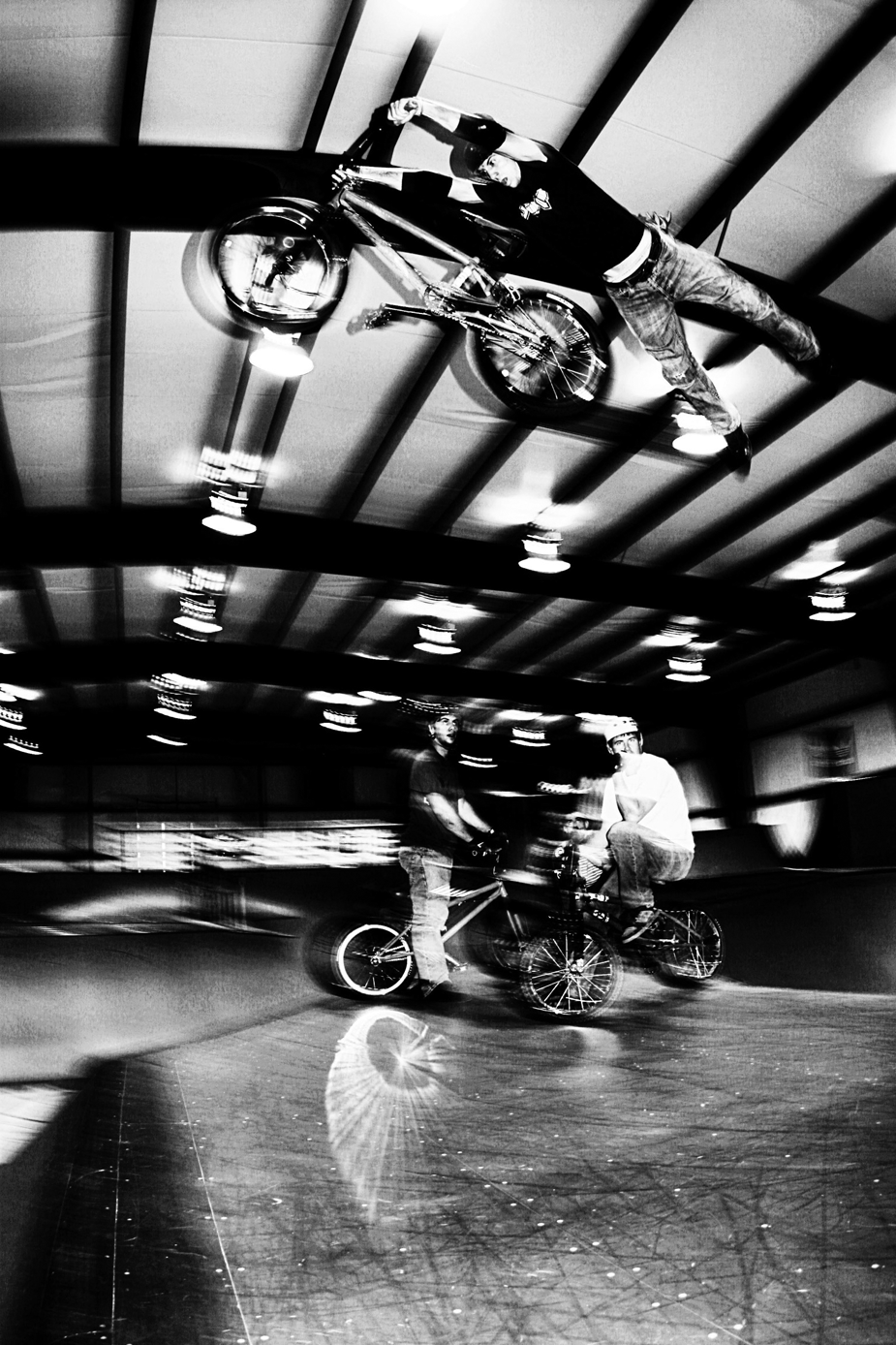
Marcus Tooker doing an exceptionally extended “Superman” at the Unit while Teo and Quinn Watch. Photo: Ugo Corte.
Similar to Becker’s (1963) classic study of jazz musicians, Greenville riders “sessioned” or performed for each other rather than having to put on a show for “squares”—people who had unrefined tastes and could not understand the subtleties of riding. Smythe, quoted in Borden (2001:123), describes a riding session by skateboarders in the following way:
[Sessioning] . . . is that unpredictable aspect of the skateboard experience that occurs whenever the varied personages that comprise the contemporary vanguard assemble together. The action is always faster, always more furious, and limits are always pushed harder than ever before.
During one of my very first days in the field doing participant observation at Jaycee park I noticed that riders did not cheer each other as often as I had observed before in other parks. Puzzled after seeing what seemed to be difficult tricks performed to no acclaim, I inquired about the matter to another rider. He explained that while the tricks I was witnessing were “objectively” difficult and dangerous, they were not “subjectively” so for riders at this level. He further elaborated that BMXers in Greenville ride together so frequently that each has deep knowledge of the other riders’ skills and repertoires. This leads riders to praise one another only when one does something that it is difficult for him, and not merely “objectively” difficult, or difficult for someone else (Field notes 02/02/05). Furthermore, this dynamic led to two main outcomes: First, it allowed riders to push their own limits in order to receive validation from other members of the group. At the same time, it also provided them the freedom to try only the tricks they wanted to work on without feeling pressure from outsiders, since their status within the group had already been established.
Related to the importance of group dynamics, Fine (2003) argues that contemporary sociologists tend to neglect the tribal nature of society. Against Goffman (1959), who theorized social actors on a stage performing for an anonymous audience, Fine contends that “we conform, we strive to organize our impressions, because those with whom we belong—structurally, behaviorally, and psychologically—have demonstrated in a dance of threats and tricks that the importance of a good impression has consequences” (Fine 2003:655). Thus, not only do we become who people in our group expect us to be, we also help shape the image and content of the group to which we belong.
In a local scene with a larger and more transient population, one could more easily refrain from pushing one’s limits, relying instead on doing what comes more naturally and what has already been learned. While this dynamic would likely lead to a refinement of previously learned practices, we can imagine that it would be less conducive to learning new tricks than the prevailing dynamic at Jaycee.
BMXers in Greenville practiced in ways that prompted them to try tricks they would not normally have tried. In addition to the unique sessioning that happened at Jaycee and the constant “hard trick” sessions described previously, riders also played a game known as “BMX”—a variant of the commonly known game of HORSE in basketball, which entailed the performance of a number of maneuvers by all riders who participated. In turn, each rider would perform a trick that would then have to be repeated by all of the other players. Riders would take turns choosing the trick, and each time a rider fell he would “get” a letter. When the player acquired all of the letters of the word BMX, he would be eliminated. Game norms dictated picking progressively harder tricks and not beginning with tricks that only a few could perform. Visiting riders from other scenes, dumbfounded by this practice (before it spread in popularity), thought that Greenville riders were “all about training” and often criticized them for having lost sight of the “fun” of riding (Laird interview 04/19/05). On the contrary, in hindsight we might argue that the Greenville riders were simply among the first to fully appreciate the “fun” to be had in consistently challenging oneself and one’s friends to technical advancement.
Counterfactually, we may speculate that what took place in Greenville could have happened anywhere, that there was nothing particularly special about this single location. Insights from resource mobilization, however, teach us that the specific availability and configuration of particular resources are vitally influential. Without the ability to access and mobilize the right resources, projects simply do not take off or endure if they do manage to get off the ground (McCarthy and Zald 1977; see also Fine 1989). Thus, as Farrell saw clearly, the unique dynamic that developed among the riders pushed each of them to become better individual riders simultaneously advancing a novel vision for the practice of BMX. Note, that the riders credit Jaycee in all of their accounts. Access to material resources like the Jaycee park (and, no less important, lack of access to alternative places to ride) played an instrumental role in enabling those dynamics to emerge and flourish. In a different scenario, we might imagine a comparative study of two similar groups operating in distinctively different contexts. Instead, for the purpose of this article, and with the benefit of hindsight, I now focus on what we already know: Greenville is a place that promoted new directions in the performance and measures of the sport.
Properties of the Magnet Place
What makes Greenville unique is that riders built the scene inside out. (Lilly interview 05/07/05) Greenville is the vortex ’cuz it’s too much fun. Once you move here, you can’t leave. There’s nowhere that has the ramps this place has. (Tooker interview 05/20/07)
Greenville is a city of about 78,000 inhabitants located in eastern North Carolina. The city is home to East Carolina University (ECU), which has an enrollment of about 27,000 students and was the fastest growing campus in the University of North Carolina system for six consecutive years (2001–2007) (US Journal of Academics 2007). More than once, ECU has ranked among the top ten party schools in the United States (“Playboy’s 2011 Top 10 Party Schools List” 2011). University students refer to it as “G Vegas,” emphasizing two things: its geographical isolation and its many forms of entertainment. What the desert is to Las Vegas, tobacco and cornfields are to Greenville.
Before the arrival of professional BMXers, beginning with Mirra in 1995, Greenville, like many other cities in the country, already had a small but vibrant local scene of BMXers and skateboarders. They were the ones who collaborated to build Jaycee and other smaller ramps that made Greenville a realistic destination for Mirra and the other riders of the Greenville circle in the first place (Edwards and Corte 2009). These were far from the only resources that the transplant pros found waiting for them.
Locational Resources
Locational resources refer to properties inherent to the location that can be enjoyed as a resource for virtually any group in the area without having to be actively mobilized. Typically, locational resources include such things as climate, local economy, demography, and cultural history of the place. For Greenville in the late 1990s and early 2000s, these included mild weather suitable for outdoor riding year-round, availability of land to buy or rent at affordable prices, a general low cost of living, and a university with related recreational activities and a young population.
Temperate weather was an influential factor in Mirra’s decision to move to Greenville (as Mirra’s brother explained, “Dave was sick of the long winters in Upstate New York,” T. Mirra interview 06/05/05). Other locational resources manifested themselves in conjunction with material and moral resources.
Material Resources
Material resources refer to equipment, facilities, money, or other tangible materials. The most important material resource for the riders was of course the public skatepark jointly built by BMXers and skateboarders. Although the history of the park and its established norms regarding access are not literally “material,” these elements made Jaycee a more useful resource than skateparks in other cities. This facility was initially free for all. After being refurbished, free entrance was officially allotted only for listed professionals, but this privilege was informally extended to virtually anyone living in town. The park employed a young and complacent staff who had a laissez-faire attitude toward the rules. This stood in sharp contrast to ramp parks in most other cities, which barred access to BMXers completely or allowed access only during certain days and hours of the week. Moreover, these parks had rules of conduct that were often quite restrictive. Jaycee formally allowed both BMXers and skateboarders, but with the reconstruction of the ramps by proactive BMXers who increasingly tailored them with higher structures more suited for riding than for skateboarding, it became a de facto BMX park—one of the few in the United States at the time.
Moral Resources
According to Edwards and McCarthy’s (2004) typology, moral resources include legitimacy, solidarity support, sympathetic support, and celebrity. In this case, the moral resources I refer to consist of the support and recognition riders received from other inhabitants of Greenville. This recognition came with privileges granted by authorities, employers, and the wider population, from college students to tertiary workers such as bar owners.
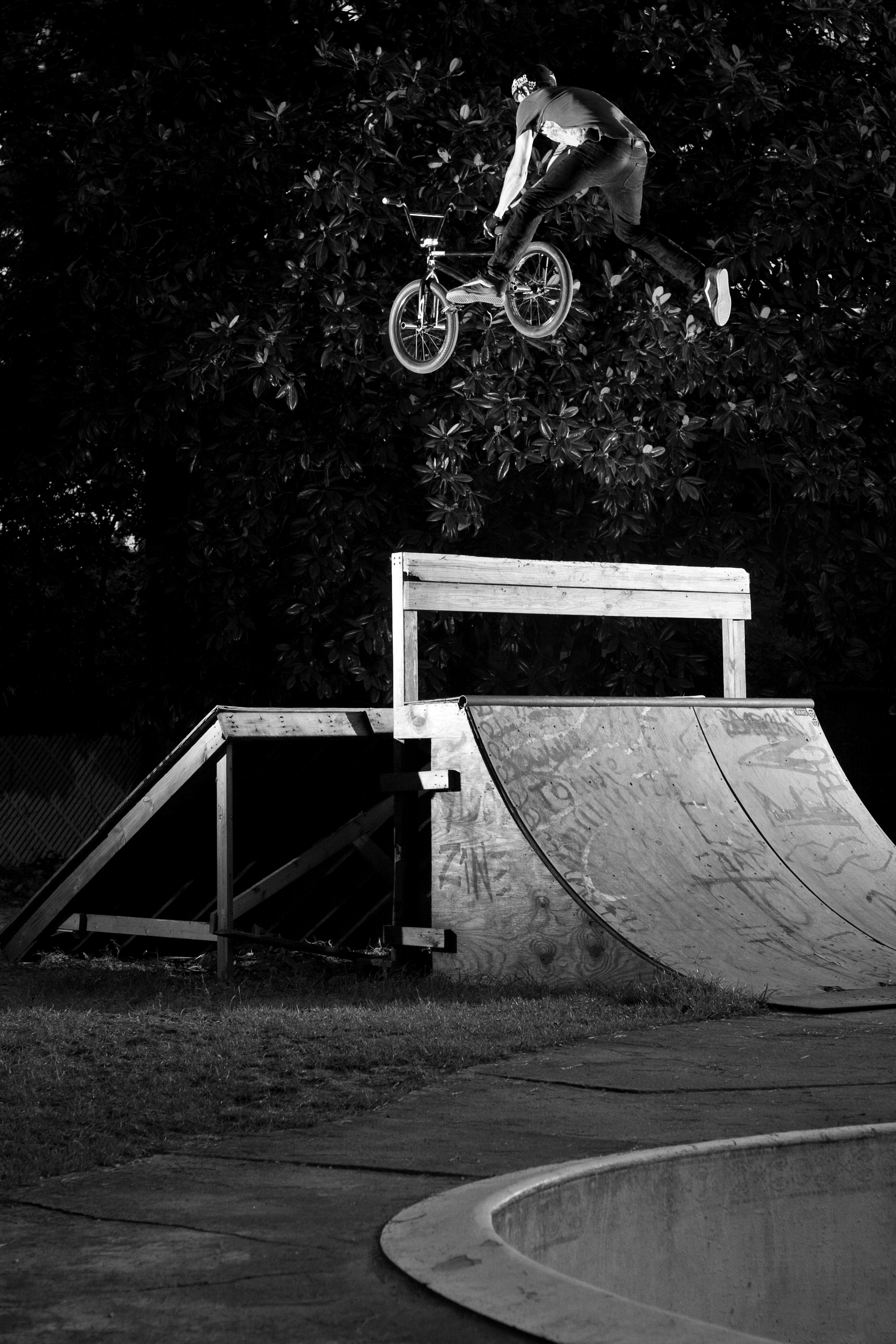
Josh Harrington in his yard in Greenville, NC. “Cannonball over his subrail.” Photo: Jordan Vilonna.
As activities like BMX are customarily practiced in public space and not confined to private settings, the position of participants with respect to the law can be problematic. Furthermore, the stunts performed by these athletes can indeed cause damage to public and private property. “Grinding” ledges or handrails or riding on walls and among pedestrians and cars are all examples of common activities that put riders in a position to break laws daily. Fearing property damage and the risk of being sued in the event of an accident, most cities in the United States outlaw such activities, relegating them to specific, confined places (e.g., skateparks). Constructing these confined places, of course, requires the appropriation of public space and all of the challenges that this entails (Edwards and Corte 2009).
The city of Greenville instead tolerated BMXers for two main reasons: first, for the notoriety of the riders who were increasingly perceived to be professionals instead of “troubled kids,” and were seen as advertising an appealing image for the city and the university (Field notes 04/05/06), and second, because the most economically successful riders purchased properties in town—some of them quite large and luxurious. Not only were riders initially seldom bothered by the police while riding, but the most recognizable were also treated sympathetically by authorities when, for example, they were pulled over for driving over the speed limit (Nyquist interview 08/22/09). Unlike in other cities where the performances of extreme sport athletes like BMXers were, and are still to a large extent, often neglected, Greenville’s local newspapers began to cover the exploits of “its riders” regularly (Lilly interview 05/07/05).
As Farrell (2001) points out, members of collaborative circles develop routines that revolve around specific practices and places. The daily routine established by riders in Greenville consisted of riding the few places available (initially only the local park Jaycee) and hanging out at a local sports bar every day for a few years. The bar benefited from the increased publicity brought by the BMX riders, who were reserved a table by the main window (possibly as a kind of advertisement to attract customers) and often provided free food and beer.
The town offered many other benefits as well. The riders who could not support themselves solely through riding were able to find part-time jobs with understanding local businesses who gave them the flexibility to periodically leave town for contests and demonstrations. Moreover, the local university also provided them with “a fresh supply of girls” as one rider straightforwardly put it (anonymous interview 05/10/05). For the young, single, mostly heterosexual male riders, the opportunity to meet women played a non-negligible role in making their life more enjoyable. A few riders noted that if they had lived in a larger city like Los Angeles, they could not have enjoyed the celebrity that they did in Greenville or been able to afford their carefree lifestyle (S. Nyquist interview 05/13/07; Fanberg interview 05/23/07). One dramatic show of local moral support occurred in 2005 when Mirra and Nyquist were given the keys to the city by Greenville Mayor Don Parrott (Letchworth 2005).
In summary, the magnet place offered riders the possibility of developing a simple, focused, and intensive lifestyle that allowed frequent, high-level riding while also providing for their financial, social, and other needs. As Nyquist put it,
We were living almost like rock stars in Greenville. It was really amazing, just great, ’cuz Greenville is such a small town. We would go to Boli’s [the local bar] . . . nightly, and Dave knew the manager and he would be hooking us up with pizza and beers for everybody. We walked into a place and we had this kind of instant respect and we were like “wow, this is kind of crazy!” . . . it was a weird reality. We had friends who knew what we did, who might have seen us on TV . . . we were treated like kings. It was really weird. We always ate out, rode until it was dark, go home, shower up, go out, go to Boli’s, hang out, meet girls, do whatever . . . no real responsibilities; it was really like surreal life. Looking back it was like super basic . . . now I have a kid, a wife, I have a mortgage, it seems like it’s much more complicated . . . all we had to do [back then] was worry about riding bikes. (Nyquist interview 08/22/09)
The town’s particular mix of resources enabled the Greenville riders to flourish and become an innovative force in their sport. Could this have happened elsewhere—perhaps in a different town with good weather and a low cost of living? Certainly not every resource described previously is completely unique to Greenville. But note that even with regard to material resources (the species of resources that is least location dependent), other factors such as the peculiar history of Jaycee’s construction and renovation and the norms that developed to manage access to the park played a crucial role (and are not so easily replicated). Properly understood, I argue that these are properties of Greenville that augmented the value of the better-known types of resources found there.
Interaction between Different Types of Resources at Formation and Separation
I see it as one of the last sports where there’s people making a lot of money, but not enough where they can’t be friends with their competitors. I really try to embrace it because I know it’s not gonna last forever. (Cooke interview 04/10/05) As people got more competitive, they started to lose friends. (Bland interview 05/17/05)
Formation
This is the stage for which we can take best advantage of existing RMT literature. The defining claim of RMT is that resources (rather than grievances) are the key variable in explaining mobilization (Jenkins 1983; McCarthy and Zald 1977). Much of the work done from this approach focuses on the resources that facilitate movement emergence, and its claim that a number of (then) counterintuitive corollaries could be empirically tested. Because resources are unevenly distributed among people and over time, RMT predicts that movements are more likely to emerge from the middle class (Edwards and McCarthy 2004; Kim and Bearman 1997; McCarthy and Wolfson 1996), in more affluent societies (Wiest, Smith, and Eterović 2002), and during better economic times (McLaughlin and Khawaja 2000; Soule et al. 1999). When mobilizations do emerge from the lower classes, RMT predicts that higher class “sponsors” will materially support the movement.
There is already some evidence to support these hypotheses in the literature on collaborative circles, including in Farrell’s own writing. McLaughlin (2008), for example, notes that Felix Weil’s windfall inheritance was a major factor in establishing the Frankfurt School, and the haven from Nazi Germany the members found at Columbia University in the 1930s was essential to their continued existence. Likewise, Farrell’s (2001) case study on the Impressionist circle shows that they too would have been unable to develop without continuous material support from family members and their extended network. Farrell also writes that the wide range of styles accepted in Charles Gleyre’s studio provided an important resource for Renoir’s and Bazille’s early development. Lastly, it is safe to further infer that the Impressionists’ style, which emerged from painting outdoor scenes, would not have developed in the same way had they been unable to enjoy the locational resource of Paris’s relatively temperate weather.
What Paris was for the Impressionists and Frankfurt (later Columbia) was for the critical theorists, Greenville was for the BMX circle. Greenville provided a fertile ground for an initially small group of talented individuals to come together at a time when their pursuit was not well known, widely accepted, or self-sustaining. During the formation stage (as well as the other early stages of development like rebellion and quest), the circle needed a geographical setting where the economic, climatic, and demographic characteristics allowed them to indulge in a lifestyle built almost exclusively around perfecting their skills. Similar to the collaborative circles studied by Farrell, the BMX riders needed a sort of incubation period where working in private and being tolerated by the local community (and local law enforcement) were the most valuable resources. In line with the RMT hypotheses, access to resources was an essential ingredient in circle formation (and, as noted earlier, the members of the circle did come from mostly middle-class backgrounds). One further observation can be made with respect to the resources that enabled circle formation. For the BMX riders, it was not only the resources that they had access to but also the resources that they lacked that were influential. As I have shown, Jaycee became a Mecca for riders in part because there were no other adequate facilities to ride.
Separation
Interpretation of the separation stage is an analytical challenge because, unlike in the formation stage, my findings do not seem to align neatly with previous results. According to Farrell’s theory, separation results in the dissolution of the group. Separation for the BMX riders, however, resulted in multiple overlapping circles, the ultimate outcome of which was the creation of a scene that persists to this day. This separation was precipitated by a conflict between Mirra and Nyquist, the two main figures of the group. Although some of the interpersonal dynamics that Farrell highlights help us explain the separation of the BMX circle, significant differences in outcome need to be accounted for.
The RMT literature is again useful in making sense of what happened. Earlier, movement emergence and circle formation were seen as roughly analogous stages, with findings and insights from research on the former providing intuitive suggestions for analysis of the latter. It is widely acknowledged, however, that RMT (and social movement literature more generally) pays significantly less attention to movement decline than it does to the early phases of mobilization (Edwards and Marullo 1995; Gillham and Edwards 2011; Staggenborg 2010). From the perspective of social movements, it is not at all clear that “decline” is the appropriate analogous phase. Although the original collaborative circle separated, the “movement” of freestyle BMX certainly did not die with it. In large part due to the circle itself, the resources available to BMX riders grew enormously over the lifespan of the group by every measure (including prize money, visibility, prestige, corporate sponsorship opportunities, etc.). RMT predicts that in such cases where resources become more widely available, we should expect to find a proliferation of social movement organizations taking advantage of these resources. These organizations may have similar stated goals but may compete among themselves for resources. RMT also points out that resource increase can allow a member to carry on alone, resulting in dissolution of the coalition (Jones et al. 2001). If we interpret BMX rider circles as roughly akin to social movement organizations in this analogy, then in fact this is precisely what occurred.
The separation of the group was caused by a number of factors, many of them similar to the ones identified by Farrell in explaining the break-up of other circles. The commercialization and partial professionalization of BMX not only offered larger material rewards for the riders but also posed new demands, similar to the ones faced by the Impressionists after their initial success (Farrell 2001). Moreover, the individuation of Mirra and Nyquist, as well as the differential recognition by both the public and the growing number of riders they inspired, parallels the dynamic between Stanton and Anthony that led to the separation of the American Suffragettes circle of “Ultras” (Farrell 2001). Finally, other riders attributed Mirra’s behavior to demands posed by new non-BMXer friends and the constitution of his own family, which was a common refrain in Farrell’s accounts of separation as well.
From Play to Sport
As explained in detail by Edwards and Corte (2010), the mass popularity and commercialization of BMX by large corporations dramatically influenced the local scene, as well as BMX at large. While contests were originally events organized by riders for riders with little to no material resources at stake, they became spectacles directed by people who knew nothing about sport and were unaware of (or did not care about) its ethos. 8 As many riders pointed out, contests in the early days were viewed as opportunities to party and catch up with friends from other riding scenes. The larger competitions brought about by commercialization became a sort of “circus act” in which riders fulfilled the role of both athlete and entertainer (Mancuso interview 05/12/06).
Commercialization involved a distortion of BMX, but also a chance for the most famous and successful riders to earn unprecedented sums of money, and motivation for others to chase the same. In Greenville, riders became increasingly busier, richer, and, to an extent, more serious in their approach to competitions and to training. Riders had less time to dedicate to others, were less interdependent, and some undertook individualized cross-training programs to gain an advantage. Furthermore, commercialization also brought an influx of ambitious young riders to Greenville who bought into a distorted version of the competitive ethos that the circle had originally pioneered. Their arrival was disrupting and threatening to the established riders because, among other things, these newcomers did not know or respect the established sponsorships tariffs, could then be paid less, and arguably were more keen on taking risks (S. Nyquist interview 05/13/07).
Coakley (2009), writing about the conditions under which sports become commercialized, argues that new sports need to become digestible to a number of consumers who are not connoisseurs. Both entrepreneurs and corporations work at maximizing drama, competition, and risk to make events more entertaining to a wider pool of viewers, most of whom do not practice the activities. The X Games, which were the main channel for the commercialization of lifestyle sports, did exactly this (Rinehart 1998). For BMX, the “drama” was created around and channelled through Mirra and Nyquist, the two top athletes and best friends. Early on, the two maintained a solid friendship through this made-for-TV dramatization, but this would not last.
As with many mass-commercialized competitions, the X Games were (and still are) organized around a “winner-take-all system.” This meant that the top five or six riders made a disproportionate amount of money while the rest earned significantly less. This top-heavy distribution of prize money had the effect of imposing incentives to competition on a sport that had historically resisted overt competitiveness. Moreover, there was no system for open qualification for these events, meaning that competitors were hand-picked by sponsors—a practice that generated criticism from riders who questioned its fairness and representativeness. In the early 2000s, many of those large events were dominated by Greenville riders, where often Mirra placed first and Nyquist second. Because of this success and the rewards it brought, members of the wider BMX subculture began mimicking the more competitive ethos of the Greenville riders. The attendant changes to the subculture that came with commercialization, including the shift in emphasis toward competitive riding, the influx of new riders, and the partial professionalization of daily routines, introduced new tensions and new sources of disequilibrium into the scene (Edwards and Corte 2009).
Materially, the rewards of commercialization allowed the most successful riders to build smaller private riding facilities in their backyards. Initially, this did not threaten the group because it was understood that all riders had access to them. However, in 2002 Mirra built a 16,000- square-foot warehouse in a commercial area a few miles outside of the city limits, and he along with a select group of friends withdrew from the scene. The barrier was not only geographical, but social as well, as only certain riders were welcome there. The facility was designed specifically to practice new maneuvers in private, with the intention to unveil them at major competitions. Among the many excluded was Nyquist, who was Mirra’s best friend, but also principal competitor (and thus the most important person to hide innovations from). One rider commented,
Some people call Dave up every once in a while to ask him if they can bring their friends and Ryan who is a friend of Dave cannot even go there anytime he wants. This is because being the number one competitor of him [Mirra] whether on street or ramp, it is understandable that he does not want to train with him. (Anonymous interview 06/04/05)
Years later, I read this excerpt to Nyquist, adopting a type of interviewing “by comment” (Snow et al. 1982) that I label quotation. He responded,
I guess it was really hard for me to understand why Dave was kind of shutting people out. . . . For so long everything was open and free and I think a lot of people in BMX kind of saw what he was doing was weird. It makes sense on paper when you read it. You have the number one and number two guy, and you have those two guys who are really great friends. When the competition comes they both want to be the best . . . so like in the world of sport and competition it completely makes sense. In the world of BMX it did not make sense at all. It was like: “What the fuck? What is this all about?” I had a backyard ramp, everybody is welcome, it is just about riding together . . . but Dave kind of took it to the next level saying this is like you could say, a business where you had to protect your asset, you had to protect your investment, and his investment was himself and him riding in that warehouse. He built the warehouse to progress his riding, trying to be the best that ever was forever . . . do I agree with the fact, with what he was doing? Yes and no. Like I said, it completely makes sense when you think of it . . . you take all emotions out of it, all whatever has been done in BMX, and you look at it . . . it makes sense. You have to do whatever it takes to get that edge. But the fact that we were all really tight, and like we’ve always ridden together, done so many things together, shared together, and all of a sudden . . . it threw me out for a loop. . . . It was shaking and hurting. (Nyquist interview 08/22/09)
In 2006, frustrated by not being able to ride Mirra’s warehouse and unchallenged by the public park, Nyquist bought land and built a warehouse, creating one of the best BMX parks in the world. Called “The Unit,” Nyquist’s park was open to anybody “in the know,” with the notable exception of Mirra (members of Mirra’s circle were welcome).
The split between Mirra and Nyquist led to the division of the group into two circles centered around Mirra and Nyquist, respectively. From then on, Greenville’s reputation continued to grow and more BMX pros moved into town, resulting in multiple circles within the scene. In line with Farrell’s theory, interpersonal dynamics played a major role in the separation of the original circle. However, the role of resources, and here especially the dramatic increase in (real and potential) material resources available to the riders as a result of commercialization, was again decisive in enabling those individuating dynamics to emerge and override long-established friendships. Moreover, the theory cannot account for the proliferation of circles that replaced the original except in an ad hoc way—a difficulty that insights from RMT also helps us resolve.
Conclusion
The purpose of this work has been to advance Farrell’s theory of collaborative circles through an ethnographic case study of professional BMX riders. While Farrell’s formulation provides an enlightening account of the social dynamics that enable creative collaboration, I have argued that its treatment of the contextual factors of that collaboration leaves important questions unanswered. Through these findings, I have demonstrated that the concept of resources, borrowed and adapted from the RMT literature, is one fruitful way of gaining analytic purchase on this ecological context. 9 Thus, the “magnet place,” which Farrell utilized as an undertheorized generator of ad hoc causes, can be disentangled by reference to the mix of resources—human, material, moral, and locational—available to circle members. In making this argument, I have attempted to move collaborative circles theory toward the “structural analysis” called for by McLaughlin (2008:24).
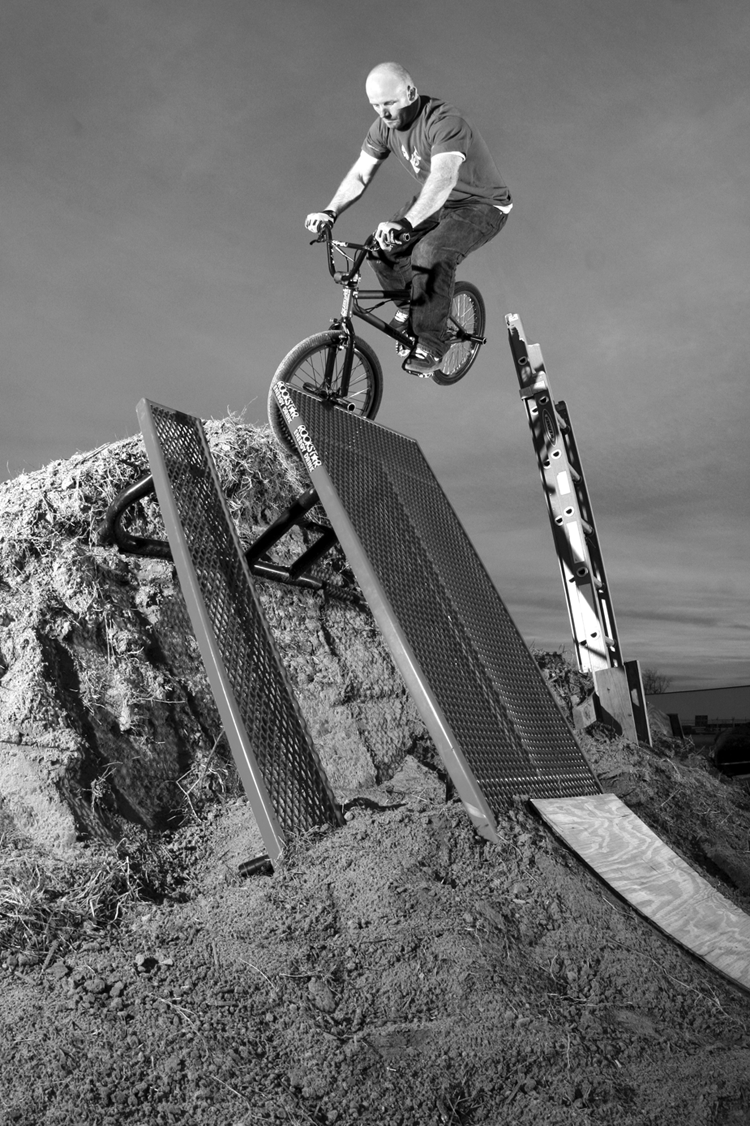
Before moving to Greenville Ryan Nyquist was a “dirt jumper”; now he is known as one of the best all-around riders in the world. Here Ryan is doing an “impossible tooth-pick” in an unusual spot. Photo: Jordan Vilonna.
This work also illustrates the ways that resources can enable and constrain the development of a collaborative circle during the critical stages of formation and separation. During the formation stage, Farrell highlights the importance of a “gatekeeper” who draws the members together and begins the work of establishing friendship relations. Equally important at this stage, however, is the need for privacy and tolerance while the work and vision of the group is being developed. For the Greenville riders, these stages were largely dependent on the availability of material and moral resources. During separation, I find that commercialization was the crucial external process that precipitated the split between Mirra and Nyquist. Moreover, I find that the dramatic increase in resources (both at stake and at disposal) allowed the strain in their relationship to express itself in a way that made continuation of the circle impossible. Like Parker and Hackett (2012), I also find significant deviation from the typical pattern at the separation stage, and I locate the cause of this deviation in “environmental, organizational, and economic contingencies” (Parker and Hackett 2012:42). Specifically, I find that separation of the circle led to the development of a still-thriving scene constituted by multiple circles—an outcome explained by the increase in available resources from commercialization and the persistence of appealing locational resources available in Greenville.
The study of collaborative circles has an obvious affinity with the study of social movements, scientific intellectual movements (Frickel and Gross 2005), scenes (Bennett and Peterson 2004; Creasap 2012; Irwin 1973; O’Connor 2002), and subcultures (Williams 2011). I have tried to take advantage of this affinity by incorporating insights from social movement theory to extend the theory of collaborative circles, but it seems likely that there is much more to learn by bringing together these sometimes disparate lines of research (Corte 2012). Leach and Haunss (2009) note, for example, how little we know about how scenes originate, grow, flounder, and change. Examining scenes at the level of small groups like collaborative circles, as I have done here, may be a good starting point for answering these questions. More generally, we may yet discover that these small groups are the link connecting all of these various phenomena (see also Fine 2012).
Finally, although it has not been the focus of my study, a few points have been made that may contribute to the RMT literature. First, I theorize what I have termed locational resources, defined as enabling resources that are available passively to all actors in a particular location. The presence of locational resources can positively augment the accessibility or usefulness of other species of resources (in the way, e.g., that temperate weather augments the accessibility and usefulness of an outdoor skatepark). Second, I have noted that more is not always better when it comes to resources, as many RMT studies implicitly assume. Whether this is a general feature of movements or whether this is particularly salient in the early phases of mobilization remain questions for future study.
Ultimately, it would be useful to learn how to identify circles in formation and foster their development. One first step is identifying the crucial resources that circles need at each developmental stage. One wants to know how these groups form, how they flourish, if they necessarily need to separate, and how they might reproduce themselves so that as their original core dissolves, the project does not dissolve with them. In addition to the strategies suggested by Parker and Hackett (2012:39) for staving off separation, I believe that a fuller understanding of the role of resources will help answer these questions.
Footnotes
Acknowledgements
I am very grateful for the sharp comments I received from my friends Jukka Gronow, Tom R. Burns, and Bob Edwards. The quality of the feedback from four anonymous reviewers, plus one of the editors, Cathryn Johnson, also strengthened and enhanced my paper. I am also indebted to Sang-hyoun Pahk who provided judicious editing and attentive comments, as well to Wade Nelson who dispensed valuable information on BMX history. Lastly, I want to thank participants of the Social Psychology section “Group Context and Social Influence” at the International Sociological Association (ISA) Congress, July 11–17, 2010, in Gothenburg, Sweden, and in particular Cecilia Ridgeway, as well as John N. Parker.
1
Alternatives include theories by Mullins (1973), Collins (1998, 2004), and  .
.
2
3
As Parker suggested to me via email, “collaborative movements” (Farrell 2001), “flow experiences” (Csikszentmihalyi 1996), and “mutual entrainment” () are essentially different terms for the same social-psychological dynamic (personal communication 08/01/12).
4
Pro Town: Greenville, a 2010 documentary about the BMX scene in the city, is evidence of this point (). The opening onscreen text reads “34 Pro BMX riders, 21 Gold Medals, 1 Small Town.” This undersells the significance of these riders in the field of BMX, as it counts only major competitions and neglects all noncompetitive accomplishments (e.g., appearances in popular media or other forms of recognition).
5
Riders who were not on the list could enter for free by signing in with the name of any rider on the list who was not present that day. This is an example of the camaraderie within the group and of the relaxed social atmosphere maintained at this particular park.
6
“Flip the spine” means jumping from one ramp over another one while rotating upside down. It is a dangerous maneuver requiring not only skill, but also commitment and confidence.
7
I do not want to give the impression that the scene was completely insulated; riders traveled extensively and gathered influences from the other riders that they met at competitions, demos, or during filming trips. Moreover, riders from other scenes also visited Greenville and were both shaped by and helped to shape the scene there. But the intimate dynamic of the Greenville scene persisted.
8
This does not mean that a subcultural underground scene did not persist; it did and some Greenville riders continued competing there as well.
9
McLaughlin (2008) found that both the resources available to the circle and the fields in which the circle worked were essential considerations for understanding the development of the Frankfurt school. While I do not provide a systematic treatment of how the field of freestyle BMX evolved here, I find in this case that circle members experienced variations in the wider field of BMX primarily through variations in the resources available to them. Although the field of BMX is not explicitly integrated into my argument, I believe that its effects are adequately accounted for. See for a fuller discussion of the commercialization of BMX.